Tahoe benefits from Reid’s success in securing earmarks

By Erin Kelly, Gannett News Service

WASHINGTON — As he fights for a fifth term, U.S. Senate Majority Leader Harry Reid, D-Nev., is touting his clout as a key reason that voters should keep him in Washington.

But just what has Reid’s seniority — and his powerful position as majority leader — brought Nevada?

Harry Reid

Harry Reid

The answer, if you look just at the federal earmarks he’s gotten in the past two years to fund Nevada projects, is nearly $662 million, to pay for everything from Lake Tahoe restoration to firefighting equipment for Reno.

______________________

Where the earmark money has gone

______________________

Reid ranked No. 6 in the Senate in fiscal year 2010 for the number of earmarks he got for his state, according to Taxpayers for Common Sense, an anti-earmark group.

Read the whole story


Tesla — a silent roadster making noise in the car world

By Susan Wood

INCLINE VILLAGE – The wind in my hair, a tight grip on the steering wheel and the cozy comfort of being framed into my seat – the feeling was electrifying.

My first adventure behind the wheel of the new Tesla Roadster Sport electric car on a recent summer night seemed so natural.

Susan Wood takes a Tesla for a spin. Photos/Kathryn Reed

Susan Wood takes a Tesla for a spin. Photos/Kathryn Reed

For one thing, I’ve had muscle cars before. At 16, I owned a 1968 California Special Mustang. They only made them one year. Then, I moved over to a Chevy Camaro of the same year. This car bared a 327 V8 engine with dual exhaust. Responsiveness is something I’m accustomed to.

There’s a lot that’s different about this latest car made by Tesla of Palo Alto, the quasi darling of green technology, which went public this summer. Shares are expected to trade at about $14.

A low-maintenance engine plugs into a charging station, turning 240 volts over a 3.5 hour-period into 245 miles of driving luxury. This vehicle is anything but business as usual. (For gearheads, the electric, rear-wheel drive car is powered with a liquid-cooled battery pack consisting of 6,831 lithium ion cells.)

Its sexiness lies with its look and its feel. It has a body of a roadster (mine, a color called “very orange”) that appears to belong on a racetrack. Its light carbon fiber frame floats between zero and 60mph in three seconds. My racing bicycle made of the car frame’s same material would be hard-pressed to produce such a smooth and fast ride.

With the top off while pulling out of the Hyatt Regency parking lot onto Lakeshore Boulevard, I tried to see what this expensive toy could do. I was not disappointed.

First, I didn’t know the car was turned on because it’s so quiet. I pushed a button and suddenly I’m in drive. Other buttons include park and reverse. (If you’re backing up, a handy visual screen provides the view from the back end.) Needless to say, I kept reaching for a stick shift.

As with most vehicles in this price range, there is something for the cold of Tahoe: warmers on executive leather seats are included on the sport model. For the musically inclined, it also comes equipped with a special slot for iPods.

Then I noticed no power steering – something to be thankful for when I pressed on the accelerator. “Wow,” I thought as the car took off like a dart. I soon found the brake, as I headed for the loop from Lakeshore to Highway 28 and back.

“Tesla wanted to prove electric vehicles are not dinky golf carts. They can be sexy and practical for everyday use,” said Miki Sofer, Tesla’s client advisor and my passenger for the joyride.

Joy it was.

The stares from people are worth capturing.

It was unfortunate Incline Village was busy on this Friday night. Otherwise, I would have tested that zero to 60 claim.

The 7-year-old company brought the vehicle to Tahoe for a demonstration weekend designed to get people who can afford it (not the media) to see what the vehicle is all about. They say the rear-wheel drive works in snowy Canada.

The name comes from Nikola Tesla, a mechanical engineer who discovered the alternative car.

Indeed, I would consider this car to be the alternative – in price tag as well. The roadster starts at $101,500 after a $7,500 federal tax credit, so it’s hardly affordable for every motorist.

When asked, Tesla executives said the car is so pricey because it is hand built. They also cited the cutting-edge technology. When further developed, the price should come down.

The ideal market, according to the company, consists of people looking for high performance vehicles like those driving Ferraris, Mustangs and Priuses.

“We see owners who love the car for its performance and design and also owners who are proud to drive the cleanest car on the road right now,” spokeswoman Khobi Brooklyn said of the 1,000 bought in 25 countries.

The thought is, electric vehicles’ time has come.

The California Energy Commission is funding 4,047 more chargers in the state to add to the existing 1,271. The one I drove stopped in Davis to get charged along its drive from the Bay Area to Lake Tahoe. UC Davis is considered the hub of research on the plug-in hybrid electric vehicle in the state.

Reducing greenhouse gases is all the rage now, especially prompted by the major oil spill in the Gulf of Mexico. Tesla officials provided no comment on that subject. But the energy commission suggests “EV” technology benefits the state “economically and environmentally” by putting employees to work and clearing the air. And although electric vehicles run on a grid fueled by nuclear and coal, energy analysts believe “de-carbonizing” the power line they run on would be easier to change than attempting to reduce carbon emissions from gas guzzlers.

The commission has figured the nearly 26 million registered vehicles operating in California produce about 40 percent of the state’s greenhouse gas emissions. In 2007, Californians consumed an estimated 20 billion gallons of gas and diesel fuel on the state’s roadways.

ngg_shortcode_0_placeholder (Click on photos to enlarge.)


Classic wooden boats bring history to Lake Tahoe

By Kathryn Reed

Shimmering mahogany and sparkling chrome bob on the tranquil waters at Tahoe Keys Marina. At the far end of the pier, 69 wooden classics are docked, many with the owner inside.

This is Day 2 of the South Tahoe Wooden Boat Classic, which features woodies form 1929-73.

“Most have been restored back to their original condition,” said Sandy Chase, who was working the event Friday.

"Saga" is one of 69 woodies at Tahoe Keys Marina with a story to tell. Photos/Kathryn Reed

"Saga" is one of 69 woodies at Tahoe Keys Marina with a story to tell. Photos/Kathryn Reed

Her husband, Lee, spent 11 years restoring their boat, including the Lycoming V-12 engine. There are only two of these engines on the West Coast, and only four in the United States.

Chase said she lost her garage so her husband could have a boathouse.

It’s a mix of locals, second homeowners and those who love Tahoe who have brought their vessels to South Lake Tahoe for the public to view.

Rich Christopher of Morgan Hill brought “Clinker Toy” to Tahoe on July 29 for the show. She is a 1959 22-foot Chris Craft Sea Skiff with a 353 Chevy engine.

“I have had her for seven years. Last year was the first year she was in the water,” Christopher said while sitting in his boat.

He can’t even count the hours it took to fully restore the boat, including engine.

This is the first show he has come to that includes judging. Twenty-three awards will be given out, with the ceremony on Sunday at Sugar Pine Point on the West Shore. That event is from 11am-2pm.

Members of the local Boys & Girls Club cruised around as judges, too. Horns were going off, interior inspected and finish analyzed to determine the number of points each particular boat should be awarded.

A lot of money is tied up in these boats. Chase said a couple Rivas are scheduled to be auctioned at Pebble Beach in August with asking prices of $260,000 and $320,000.

“These boats become a member of the family,” Chase said. “The value depends on the rarity of the boat and if the restoration brings it back to the original or not.”

Mahogany is the dominant wood. It used to come from Africa, but that is hard to get now. Much of today’s wood hails form Honduras.

As part of the Antique & Classic Boat Society, the local chapter is supposed to have an educational component – the boat show fits that criteria.

Tickets are $20, though Raley’s has them for $15. Proceeds benefit Thunderbird Lodge Preservation Society, Boys & Girls Club of Lake Tahoe, the three Kiwanis Clubs on the South Shore, and the South Lake Tahoe Fire Department. The event is from 9am-5pm today at Tahoe Keys Marina on Venice Drive off Tahoe Keys Boulevard in South Lake Tahoe.

Now in its third year, the boat show is growing – 10 more boats this year, and a couple thousand people expected to weave among the docks these two days.

The Tahoe Maritime Museum has a booth. Membership is available, with certain categories coming with a ride on a woodie.

New this year is three racing boats. All on trailers – not in the water – because it is too rough for them.

ngg_shortcode_1_placeholder (Click on photos to enlarge.)


Cycling, running assessments help keep athletes healthy

By Kathryn Reed

Flexibility – good. Hamstring strength – not so good. Seat – broken and didn’t know it. Pedal efficiency – could be greatly enhanced by losing the toe cages and getting clip-in pedals.

Riding a bike has gone high-tech. Beyond what the two-wheelers are made of, the specialties for road-mountain-tri, and all that lycra, some riders have cycling power meters on the handlebars. The handlebar area in bike lingo is known as the cockpit.

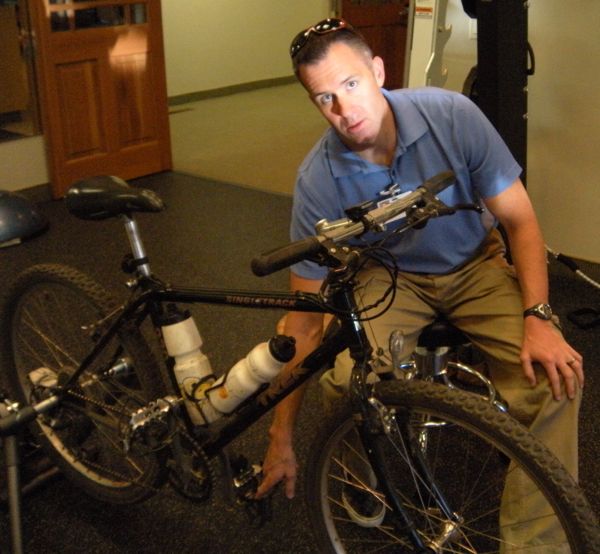
Beyond degress in kinesiology and physical therapy, Jason Collin has training in bike fitting just for people in health care. Photos/Kathryn Reed

Beyond degress in kinesiology and physical therapy, Jason Collin has training in bike fitting just for people in health care. Photos/Kathryn Reed

And now cyclists in the greater Lake Tahoe area can be professionally fitted to whatever kind of bike they pedal. Jason Collin has been fitting people to their bikes for several years, but it was just last month that the physical therapist working out of Tahoe Fracture & Orthopedic Medical Clinic in South Lake Tahoe started offering the service in Tahoe.

Biomechanical expertise and knowledge about anatomy are the things Collin brings to an adjustment session that a bike shop usually doesn’t have. He also takes about two hours to do the whole assessment – time the bike shop doesn’t give. Barton Health charges $199 – a much higher fee than a bike shop.

My mountain bike was bought sometime in the early ’90s when I lived in Las Vegas. I road it around the parking lot, liked it and bought it. The shop may have adjusted the seat. That was it.

My road bike is a few years old. My girlfriend who likes to ride bought it for me so I wouldn’t be so whiney on my mountain bike while she cruised ahead of me. I never liked the person who assembled it in South Lake Tahoe. Maybe his less than friendly demeanor is why he is out of business.

I had heard a bit about Barton’s Pro Bike Fit and Runner’s Program, but wanted to know more. I was skeptical about how paying nearly $200 for the bike fit or the $150 for the running program could be worth it. Then I let my cynical reporter’s brain be taken over by my health conscious massage therapist brain and thought, hmmm, just give it a try.

I know proper equipment is key to preventing injury and enhanced performance. (Stronger hamstrings and not so tight hips would help, too, Collin pointed out.) I don’t have a laser to look at my biomechanics. I can’t take measurements while I’m on a bike. I don’t have mini-jacks to balance my pedal on while the measurements are taken. I don’t know a shaky seat can mean it’s broken and therefore a real hazard. And even if I could get a friend to do all of what I went through on Thursday, neither of us would know what it meant.

Collin knows. And the next closest person to tell you about your bicycle mechanics is at UC Davis.

Barton decided to tap into Collin’s expertise as a way to expand its sports medicine offerings as well as expand its destination health care. The same goes for Alan and Caroline Barichievich, two physical therapists, who offer the runners’ assessment at Stateline Medical Center.

The next closest runners’ program is in Carmel.

“It’s for anyone who runs, hikes, or walks. We do a full muscle-skeletal evaluation, including video analysis,” Alan Barichievich said. “A lot of changes can be made by getting in the right shoe.”

Both programs are available to anyone – wherever they live. Insurance is accepted. Sometimes a cycling injury covers the bike assessment. Barichievich said most people he’s seen have a prescription. Knee issues can warrant the type of evaluation the Barichievichs provide.

These programs are geared toward everyone – the novice athlete, the weekend warrior, the competitor. Collin and the Barichievichs know their sports firsthand – not just the medical aspects to the assessments. They know what it’s like to do a tri, ride a century or run an ultra-marathon.

No bike shop is going to have a customer lay on a table to test strength and flexibility. Nor are they going to explain how my ACL is threatened via cycling and skiing when my hamstrings and hips are, um, lacking in muscle.

And they certainly aren’t going to send an email at 11pm with your assessment, pictures of exercises/stretches and a mild lecture that says, “Please get that seat swapped out soon so I don’t have to see you for rehab after a crash! Bike shoes and clipless pedals will make a world of difference for you, too. Don’t worry, the learning curve is quick!”

For more information on the bike program, call (530) 543.5896 or click here. For runner info, call (775) 589.8953.

ngg_shortcode_2_placeholder (Click on photos to enlarge.)


EDC grounds its buses; BlueGo sputters to stay viable

By Kathryn Reed

El Dorado County pulled its two buses out of the BlueGo fleet Wednesday, creating an unstable situation for on-call riders of the public transit system.

“Because everything happened late (Tuesday) I’m not sure about the on-call services or what is being offered to those folks,” county Supervisor Norma Santiago told Lake Tahoe News late Wednesday. Until July 22 she was the vice president of the South Tahoe Area Transportation Authority. She is still on its board. “There are some discussions going on that I’m not privy to.”

(STATA is a nonprofit Nevada-based umbrella agency that runs the transit system on the South Shore.)

No one is riding El Dorado County-owned BlueGo buses. Photo/Kathryn Reed

No one is riding El Dorado County-owned BlueGo buses. Photo/Kathryn Reed

On Wednesday afternoon one of the two buses was in the county’s transportation yard in Meyers. Just after 5pm a BlueGo bus was in service in the Meyers area headed toward South Lake Tahoe on Highway 50.

The directive to park the vehicles came about because of liability issues involving the county not being named on the certificate of insurance, Santiago said.

Two closed session items involving BlueGo were on the Board of Supervisors’ July 27 agenda, though no reportable action was taken. These pertained to lawsuits.

Eleven days ago the set route in Meyers was eliminated along with other changes in an attempt to put a Band-Aid on the ailing system.

Lake Tahoe News called BlueGo dispatch Wednesday asking about booking a ride for this morning for on-call service in Meyers. The dispatcher said it was possible, but there was limited availability.

Financial concerns

“Right now the county has no agreement with STATA,” Santiago said.

On June 29, she made a motion as chairwoman of the Board of Supervisors to not fund an estimated $181,343 for July 1, 2010, through June 30, 2012, to provide for the operation and funding of BlueGo on-call services. The board agreed.

Stacy Dingman, a STATA board member and spokeswoman for the group, told Lake Tahoe News this week she knew nothing of El Dorado County’s June vote even though the STATA board last met July 22.

Things are so bad at the Stateline agency that the B word – bankruptcy – has been broached.

“There have definitely been rumors about bankruptcy. The fiscal year began July 1. That is when new grants come in. Monies are coming in,” Dingman said.

Mike McLaughin, attorney for STATA, said, “The board is considering all of their available options and it would be imprudent not to consider bankruptcy as an option. Settling the debt with MV is an option and other options are available.”

State and federal dollars, which is what STATA relies on to keep the buses rolling, have strings attached. A basic requirement is to have annual audits and a semblance of financial stability.

STATA has neither. The audit for fiscal year ending June 30, 2009, is not done. And its financial solvency resembles scarlet red more than midnight black.

In an email from STATA accountant Rhonda Saigh to Dingman, which Dingman shared with LTN, it says, “The 08-09 audited financial statements have not yet been accepted by the board. That action is expected to be taken at the board meeting on Aug. 9. No public distribution or posting is appropriate prior to board acceptance. The audited financial statements are not required, but desired, to be posted on the website. To refresh your memory, the completion of the 08-09 audit was vastly delayed primarily because of the very, very late grant billings to NDOT. “

The Nevada Department of Transportation is so worried about STATA’s ability to operate that it sent STATA Chairwoman Nancy McDermid and Treasurer Dan Garrison an email July 12 saying it was threatening to cut off funding.

The letter from Derek Kirkland, transportation planner, says, “The biggest concern is that STATA is lacking cash flow and is relying solely on grant funding, which is not allowed. NDOT’s grant funding is a reimbursable program and requires a 50 percent local match,” Kirkland wrote. Later the letter says, “As I know you are very aware, STATA is in a very serious situation and risks shutting down service indefinitely.”

Federal law mandates annual, timely audits be done in order to receive funding.

One of the issues for El Dorado County is the 2009 audit is not approved, when in fact it’s the 2010 audit that should be under way. Audits are due to California by Dec. 31 each year.

“STATA has a contractual obligation to the county to provide us with an audited financial statement,” county Auditor-Controller Joe Harn said. “(It’s) unfortunate the audit was not completed sooner. It might have provided insight to the board of directors of STATA and to the county of El Dorado about what was happening financially to STATA.”

Because STATA is a Nevada corporation it does not have to meet some of the stricter rules California has on the books. John Andoh, the transit administrator who left STATA earlier this year, did not have to file papers with the Fair Political Practices Commission in relation to MV Transportation – his former employer – who he recommended to the board be the transit operator. If it were a California entity, the contract STATA signed that was valued at more money than it had, would have been null and void.

Looking for answers

Santiago says there is plenty of blame to go around for why STATA is in the quandary it’s in. She admits the board should have asked more questions of Andoh and not relied on this one staff person to be so powerful.

“Hindsight is 20-20. We should have reigned in John a lot sooner,” Santiago said. She said he misrepresented to MV what the board wanted and what STATA was capable of paying.

Andoh at one time tried to get El Dorado dollars passed to a dormant, essentially non-existent JPA called the Basin Transportation System that was established in the 1970s.

McLaughlin does not believe there has been any misappropriation of funds.

“I don’t think anyone has cast any doubt that all the funds in the operation were used for capital acquisition and operations. But the system was set up to run with a certain budget and all those budgeted funds did not come to fruition,” McLaughlin said.

Another lawsuit on the books

On July 27, the fourth lawsuit from MV Transportation, the transit operator for the South Shore system until June 20, was filed. This one in Douglas County names all of the member agencies of the South Tahoe Area Transportation Authority.

The entities named in the latest suit are: South Lake Tahoe, El Dorado County, Douglas County, Harveys, Harrah’s, MontBleu, Horizon, Lakeside, Heavenly, Ridge Tahoe, Tahoe Transportation District, and Tahoe Regional Planning Agency. TRPA is a non-voting member of STATA.

“The lawsuit filed (Tuesday) is pretty extensive. Everyone is scrambling,” Santiago said.

The problem is STATA owes MV more than $2 million, though the sparring entities disagree on exact amount.

Bringing in TTD

To appease NDOT, and probably other funding agencies, STATA at its special July 22 meeting that was a joint board meeting with Tahoe Transportation District, agreed to have this agency handle the day-to-day operation. Transit Resource Center has a limited contract to run the actual vehicles.

NDOT officials were at last week’s meeting. It had been the state agency’s recommendation in the July 12 letter that TTD be brought in.

TTD will do this through Sept. 30. This agency, which has two staff members, is tasked with handling grant proposals and administering the request for proposal to find a long-term bus operator for STATA.

It’s possible a longer contract could be issued or that TTD would take over the bus system and STATA would be dissolved. One thing that needs to be overcome is the TTD board is made up of public agencies, while STATA is a public-private enterprise.

Santiago envisions it being a rough road going forward for everyone involved.

“I think everybody is committed to making sure the BlueGo system continues to operate. It may operate on a smaller scale,” McLaughlin said. He said talks have centered on having a transit system where the operations fit the confirmed dollars coming in. “The system might get a bit smaller. I don’t think anyone anticipates the system going away.”


Defensive response to grand jury report by South Tahoe

sltBy Kathryn Reed

South Lake Tahoe City Council members had almost nothing to say before the city’s response to the scathing grand jury report was voted on. The written response by City Manager Dave Jinkens agrees with little that the independent panel chastised the city about and instead gives a flimsy defense to many accusations.

Before Councilman Bill Crawford had to leave the July 27special council meeting, he said he considered the report and response to be the same – “vague.”

The vote was 3-1 to accept the response as written by Jinkens and prepared with City Attorney Pat Enright. City Councilman Jerry Birdwell was the dissenting vote, though he said nothing at the meeting.

Afterward he told Lake Tahoe News, “No. 1, I think the grand jury report was correct. I saw no need to answer and argue about the report. I accept the report and as I have previously stated, I take it as constructive criticism and that we need to do better.”

He said he is trying to do what he can to make the council run as smoothly as possible. Birdwell points to his stance on the issues involving Johnny Poland, the city cop who successfully fought his termination case, and former City Attorney Jacqueline Mittelstadt, who resigned after the city tried to fire her, as proof he was right.

Birdwell is good with how he is conducting himself on the council, but agrees with the grand jury there that there is plenty of room for improvement.

Jinkens read part of his staff report into the record on Tuesday, saying, “I am proud of the work of city government as a whole and city employees to deliver efficient, effective and a high quality of service to the people of South Lake Tahoe each and every day of the year. Employees are our greatest resource and we must work with them and the community in a positive and constructive manner to address the pressing needs of our community.”

Click on response to read the city’s unedited and therefore not quite final version to what it will submit regarding the 2010 El Dorado County Grand Jury report.

The response defends the reimbursement for outside legal counsel to Councilman Bruce Grego, even though the grand jury questions it.

In the 20-page response LTN learned “the city manager is ‘technically’ the director of finance” and the city manager is the personnel officer.

It addresses the nepotism issue by giving only estimates of how many married couples work in the city (seven) and how many family members (eight) work for the city. This doesn’t include council and commission members.

Even with 30 of the 195 full-time employees related, this would represent more than 15 percent of the workforce having a perceived conflict. And that’s just the number the city admits to. It doesn’t include those who are engaged or living together.

The city’s response says, “The statement of the grand jury gives insufficient information to determine if alleged concerns by complaining parties are on a city-wide basis or in one or more city departments. In order to properly evaluate this statement, more information is needed and requested about the situation.”

But the city won’t reveal to Lake Tahoe News who all is related by blood and marriage between full-time and part-time employees, council members and commissioners, and only gives estimates in its response. How can the city know if there is problem, if it doesn’t know who is related and therefore who is reporting to whom?

Instead of addressing the issue internally, it has put the onus back on the grand jury – a body that is seated for one year.

This theory seems to contradict a segment of the city’s response under “overview and comments” that says, “The City Council, city manager, city attorney and all department heads have a duty to ensure that the workplace is productive and devoid of illegal harassment and discrimination of any kind.”

While that statement is a fact, many city workers who have spoken to Lake Tahoe News say it is not a policy that is practiced.

The response in another section further says, “The city will review within the next six months its existing nepotism policies in the personnel rule and MOU from a legal perspective and with representatives of recognized employee associations to determine if changes are needed and the city manager will report his findings to the City Council.”

Considering there will be a new city manager in 10 days and the council will be changing by at least 40 percent in five months, it’s hard to know if there will be follow through on the above statement.

At one point the grand jury calls the council “bush league”. To this the response begins, “The city is unfamiliar with the term ‘bush league’.”

The 1982 dictionary at the offices of Lake Tahoe News defines “bush-league’” as, “of or pertaining to a bush league; mediocre; second-rate.”


South Tahoe jail’s success a testament to staff’s work

By Kathryn Reed

Finding fault – that’s usually what a grand jury does.

It’s getting more difficult to do that at the South Lake Tahoe jail.

Every year the two jails in El Dorado County are scrutinized by the grand jury – it’s the law. Commendations are extremely unusual. The South Lake Tahoe jail received its third commendation this year.
Randy Peshon

Randy Peshon

Sheriff Fred Kollar says the praise in this summer’s report “says a lot about (jail commander and Lt.) Randy (Peshon) and his staff.”

Just based on the people who spend the night, trouble has walked through the door. It’s how the staff deals with the inmates that contribute to the 158-bed facility functioning so well.

“This group I’m working with in the jail is the best ever. They are very excited and very positive,” Peshon said. He has been jail commander for eight years.

The report says, “The 2009-2010 El Dorado County Grand Jury commends the South lake Tahoe Jail administration and staff for their dedication in providing a safe and secure custodial environment. The number and variety of available programs, especially the Culinary Arts program, have a proven record of success.”

Other entities receiving commendations from the grand jury this year include:

• The registrar of voters for plans to save the county money and actions to secure accuracy of all ballots cast.

• The Probation Department and Office of Education for advocacy and rehabilitation programs for at-risk youth.

• The CAO and staff for consolidation of administrative service functions in county government.

• Growlersburg Conservation Camp leadership for various items.

Besides the culinary program, which serves 700 meals a day, the grand jury noted the church services, drug and alcohol counseling, English as a second language, GED program, Health Education and Recovery Through Self-Responsibility, Mental Health Court, and Women’s Health.

The report found four items the jail needs to address – most of which Kollar and Peshon said have been taken care or are in the process of being fixed. With the building originally built in 1971 and an addition coming 20 years later, the flat roof the grand jury pointed out as contributing to leaks is not going to change any time soon.

Originally, the facility was the sheriff’s department substation.

In the 2010-11 county budget are the dollars to upgrade the security and surveillance cameras, as well as improve and expand the number of recording cameras.

The department is working on getting the cracks in the cinderblock fixed. Kollar said it was built with 4-inch blocks when it was supposed to be 8-inch.

What the inmates get

Budget issues are always looming over Peshon’s head. One category he has little control over is medical expenses. About $1 million a year is spent on inmate health care – just in the Tahoe jail.

“Inmates generally have more health care issues than the general population,” Peshon said. “People who go through the system have more issues. They age faster.”

It’s not unusual for a 50-year-old inmate to have the health problems a 70-year-old on the outside would have.

Peshon said with a significant number of inmates older than 34, he has noticed a rise in health issues.

People coming in often experience withdrawals from their drug of choice in a matter of hours. A nurse is on duty 24 hours a day to handle whatever comes up.

A general practitioner comes in once a week, as does a psychologist. Psychiatric care is via videoconference.

A trek to Placerville is required for dental care.

Serious medical conditions mean a trip to the hospital.

Exercise is encouraged, with an area downstairs for those who can’t walk upstairs, and a larger area on the second floor for the more able bodied.

Taking part in one of the programs in also encouraged.

The commercial kitchen at the South Lake Tahoe jail. Photos/Kathryn Reed

The commercial kitchen at the South Lake Tahoe jail. Photos/Kathryn Reed

“You are dealing with people who may not want your help, but need your help,” Peshon said of the inmates.

Most of the programs are segregated by gender, but a few are co-ed. The thinking is that with so many inmates having relationship issues that getting them to interact with the other gender before getting out will make their release easier.

Inmates are not allowed to call staff by first names. It’s rank and last name.

“There is always something going on 24 hours a day,” Peshon said. “If it suddenly goes quiet, you are going to have problems.”

Various murals are painted on the walls inside – all done by inmates. The one in the kitchen has the culinary program’s theme written out – “Jail house catering, it’s so good it’s a crime.”

A system within the system exists if inmates misbehave. Steve Sherman is responsible for making sure the punishment fits the crime. If an inmate is caught writing on the wall, his likely sentence is painting.

Once formally sentenced, inmates can stay in county jail for a year. Some have stayed longer while awaiting trial. Ulysses Roberson, who was convicted earlier this year in the murder of his 4-year-old son, spent six years in this jail before his trial began.

Working inside the jail

“Literally, it’s like running a little town,” Peshon said of the jail.

When he got into law enforcement he never envisioned he would learn so much about food and nutrition, as well has laundry.

Under his direction the culinary program is receiving awards, allowing inmates to have a skill when they get out and provides qualified employees for local businesses.

Keeping the peace is a full-time job for Joe Ruelas. As a gang expert, he figures out who plays nice together and when housing changes need to be made.

“It’s a balancing act,” Ruelas said. He is part of the regional intelligence meetings that include California and Nevada law enforcement, parole and probation officers.

It’s the Norteños and Sureños that dominate the turf on the South Shore, with the Sureños the larger group. The latest gang of concern is the Juggalos out of the Modesto, Ruelas said.

No one in the jail wears a gun. This is for everyone’s safety. But tear gas, grenade launchers and gear are just outside the housing units in case officers need to quell a major disturbance.

Often it is the jail employees who come up with ways to make their work area function better. Pads were added to the booking area to prevent injuries because this had been an area where fights would often break out.

Computerization has made it so booking went from a four-hour event to 45 minutes.

A box phone is in the holding cell because years ago an inmate hanged himself with the cord from the old phone. Another suicide preventive feature is sprinkler heads designed so an inmate can’t tie off on it.

“We exceed the training for suicide prevention,” Peshon said.

Even when there was a fire a year ago in the jail, the staff still managed to lay eyes on every inmate each hour – a state requirement.

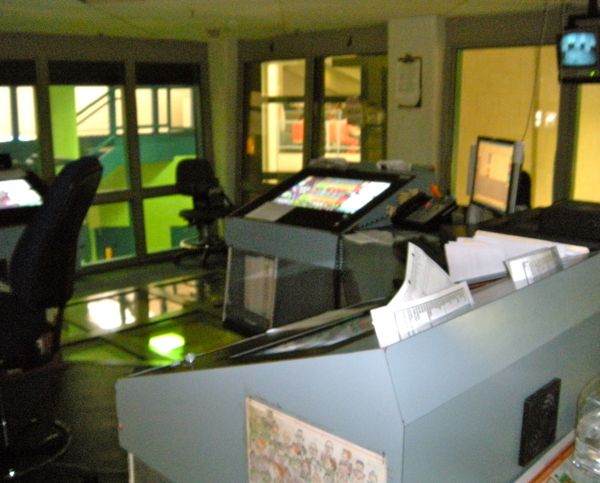
The second-floor control room.

The second-floor control room.

On the second floor  Sherman doesn’t stand still. A slew of monitors are in front of him. Out the vast windows in this circular work area are the various pods of inmates. The floor has glass so he can see some of what is going on below him.

The jail is at minimum staffing with 24 sworn officers and six sergeants, along with Peshon who is a lieutenant.

Clerks, nurses, sheriff’s technicians and detention aides make up the whole workforce.

“What keeps it running smoothly is everyone watches out for everyone else,” Peshon said. “We keep our humor up. We run it as a family.”




Kollar juggles complexities as sheriff in divided county

By Kathryn Reed

Fred Kollar was a short timer from the first day he took the helm of the El Dorado County Sheriff’s Department. And he’s OK with that.

But he’s not about to take on the roll of a lame duck leader just because he was appointed the position earlier this year when Jeff Neves left before his term was up or because he will retire after a new sheriff is elected in November.

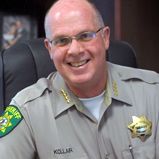
Fred Kollar

Fred Kollar

For some time there has been talk about morale being lousy inside the department. Kollar disagrees. He doesn’t get that sense walking down the hallways in Placerville, where he spends the bulk of his time. Nor does he overhear negativity when he is changing in the locker room.

“I don’t want my successor to clean up my problems,” Kollar said during a recent lunch. Meaning he is doing what he can to ensure there is cohesiveness in the department.

He points to the number of people applying for the sergeant’s test as evidence people are happy.

“People wouldn’t strive to move higher up if morale were bad,” Kollar said.

A vacant detective-sergeant’s position had more than a dozen internal applicants.

Still, it’s curious that the two candidates for sheriff represent an insider (Craig Therkildsen) and an outsider (John D’Agostini). Perhaps that is more reflective of the electorate than what is going inside the department when it comes to status quo v. change.

One issue that is wearing on the department is a recent discrimination suit filed by an employee.

Tahoe-Placerville relations

An issue that has been going as long as Kollar can remember is the disconnect between Lake Tahoe and Placerville. It’s even obvious in the sheriff’s race. The six candidates in the June primary barely showed their faces in Lake Tahoe. The two finalists have set no public events in the basin, nor does anyone seem to realize there is a sheriff’s race in November.

The department has most newbies start in Tahoe, then go to Placerville. The idea is then they have a feel for the whole county as well as an appreciation for what goes on in the basin. Kollar said any affection an officer had for Tahoe seems to wane after a couple years.

Part of the issue is that a fraction of the 175,000 county residents live in the basin. Estimates are about 30,000 are on this side of the summit.

Kollar isn’t in Tahoe nearly as much as he would like. One of the things that is different with him compared to his predecessors is they all had an undersheriff. When he moved from the No. 2 to No. 1 post, his former job was not filled.

But he also points to this Tahoe-Placerville divide not being unique to the sheriff’s department. Most departments with a Tahoe office tend to feel isolated by the granite barrier known as Echo Summit.

That summit is of concern to Kollar and officers working in Tahoe because it’s expected to be closed next spring or come with substantial delays when Caltrans replaces the rock barrier.

County employees commute between the two areas. Sheriff’s deputies regularly transport inmates over the summit.

“It’s going to add an hour each way,” Kollar said of routing his staff through Amador and Alpine counties.

Plus, cell phone and radio reception can be sketchy on the back roads.

Tahoe specific issues

For a small county, and the portion of Lake Tahoe being a blip on the map in some ways, this area has had it’s share of high profile events.

Right now Joseph Nissensohn is sitting in the South Lake Tahoe jail awaiting his murder trial for a crime that occurred in 1989. The trial in this death penalty case is supposed to start in January, but with the death of a key witness, it could change things.

Kollar has testified at hearings involving that case. The trial will be in South Lake Tahoe.

From the 2007 Angora Fire, it’s media relations that the sheriff said needed the most improvement.

“We didn’t have a good handle on it until the fourth day into it,” Kollar said.

On the first night – June 24 — the department was planning how residents of the 254 houses that burned to the ground and their neighbors would be allowed in. Kollar kept the road closed so people could assess the damage without being hounded by onlookers.

Deputies on looting patrol took down the addresses of the houses that were destroyed. This provided displaced residents with quick, accurate information.

“It would have been a great day on patrol if they were not my neighbors,” sheriff’s Lt. Randy Peshon said. His house survived. The stories of his heroic acts to get people out of the inferno are cherished by those he helped. Some say he is lucky to be alive.

Kollar was also the lead spokesperson last summer during the first press conference after Jaycee Lee Dugard was rescued after 18 years of captivity.

“We worked that case long after people thought we had stopped,” Peshon said.

Shortly after Dugard was rescued, Kollar was sent to the Antioch compound where she and her two daughter lived with the kidnapping suspects, one of whom fathered her children.

These cases just scratch the surface of what Kollar has been involved in during his law enforcement career.

Publisher’s note: Read Lake Tahoe News on July 27 for look inside the South Lake Tahoe jail.


Jail culinary program creates yummy food, future cooks

By Kathryn Reed

When El Dorado County Sheriff Fred Kollar worked in Lake Tahoe the jail was serving TV dinners. Last week he made a special effort to commend the inmate, yes the inmate, who made the cream puffs.

Kollar has a thing for cream puffs and he told inmate Jimmy Beechler these were as good as the ones his mom made.

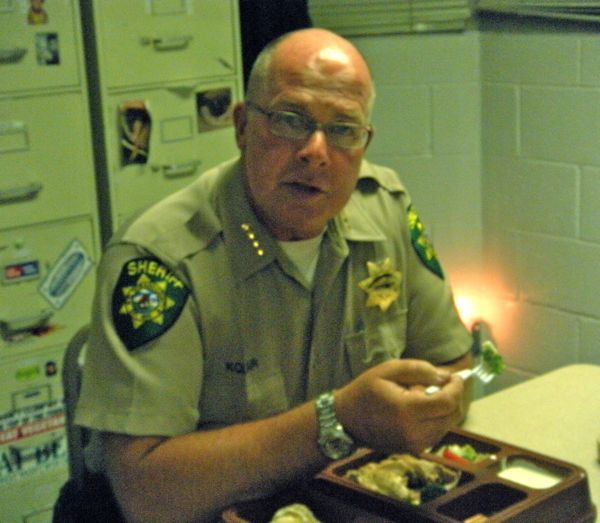
Sheriff Fred Kollar raves about the cream puffs made by inmates at the Tahoe jail. Photos/Kathryn Reed

Sheriff Fred Kollar raves about the cream puffs made by inmates at the Tahoe jail. Photos/Kathryn Reed

As the high bidder of the “lunch with the sheriff at the jail” during Soroptimist International of Tahoe Sierra’s Elegant Evening earlier this year, I finally redeemed my voucher on Monday. Joining us was jail commander Lt. Randy Peshon.

It’s under Peshon’s leadership that the culinary program in the jail has taken off in the last three years. In cooperation with Lake Tahoe Community College, three adjunct faculty members (Hugo Lizaola, Bob Grijalva and Trish McGrath) work in the jail kitchen under the supervision of head jail chef Jeanette Shippee.

The inmates who qualify for worker status, are not behind bars for a violent crime and show an interest in the program may apply to be in the culinary arts program that has the same curriculum as LTCC. It means working 12-hour days.

“They come out of here with a GED, culinary arts certificate and resume. Jeanette and I work our contacts to get them a job. The recidivism is almost non-existent,” Peshon explained. “They are out and not coming back. That is where the huge savings to the county comes from.”

It takes eight months for an inmate to complete the program. Their final is serving a complete meal to a public panel.

Peshon was needled by Shippee to take the serve safe class. This class is a necessity for anyone working in a commercial kitchen. Now the inmates are challenged to beat his score.

He’s even learning a thing or two about cooking, which is paying off for his wife.

With state mandated nutritional guidelines as well as the presentation of the food, the inmates are eating well-balanced meals. They can also get meals if they have special diets or for religious reasons.

Bad food equals bad behavior, Peshon said. No slop, like what is sometimes depicted in the movies, is served here.

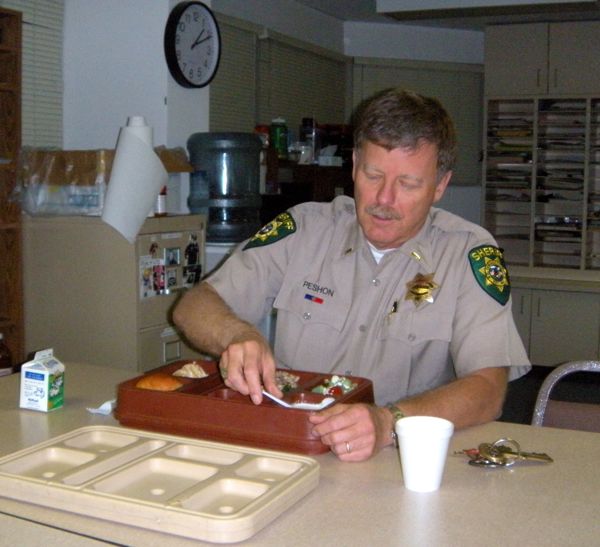
Lt. Randy Peshon has learned cooking skills as part of his work in the jail.

Lt. Randy Peshon has learned cooking skills as part of his work in the jail.

“In the early ’80s every meal was a TV dinner. It took 20 to 30 minute to heat up,” Kollar said. “It would be expensive today and it wouldn’t meet nutritional requirements.”

Baking is what Shippee likes to focus on. She teaches at LTCC on occasion, so it’s not just inmates who benefit from her culinary skills.

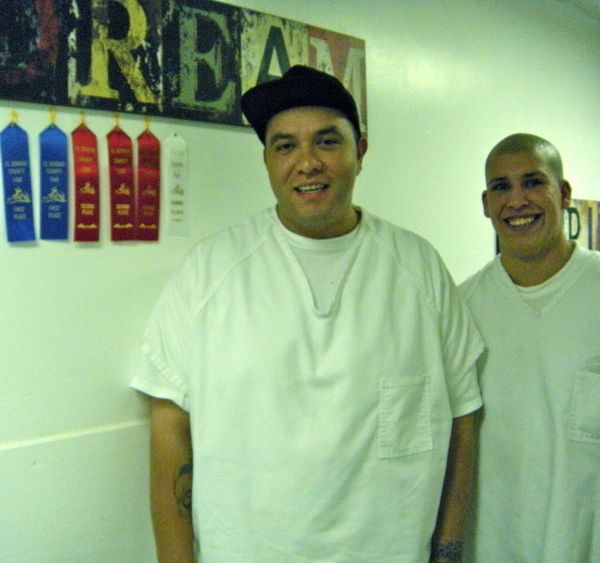
For several years she has had her charges enter the El Dorado County Fair. And each year several ribbons are awarded to the inmates. Oftentimes this is the first time any of them has won anything.

Carlos Gonzalez, still dressed in his inmate white cooking uniform, is a little shy about talking about his blue first place ribbon for his dinner rolls. Having had one of the light, fluffy rolls with my lunch that day, I’d say they are a definite runner-up to my mom’s dinner rolls.

Gonzalez said he and Shippee came up with the recipe.

Inmates Carlos Gonzalez and Eric Malone show-off their ribbons from the county fair.

Inmates Carlos Gonzalez and Eric Malone show-off their ribbons from the county fair.

Eric Malone has ribbons from the past two county fairs. For this summer’s fair he entered a chocolate raspberry bar (second place) and a chocolate raspberry cream cake (first place).

“It was kind of nerve wracking trying to prepare everything. You think you have more time than you really do,” Malone said.

In the past he won for an almond kiss cookie and a triple layer brownie.

It was Malone who had a strong influence in what was served to the sheriff. He admitted to being a little nervous cooking for the sheriff.

“You worry if it’s going to turn out,” Malone said.

For the July 19 lunch, Malone said, “Me and Jeanette threw it together.” The idea was coming up with one dish that could be served three ways to accommodate the three of us. I skipped the chicken, Peshon wanted just the chicken and Kollar could eat everything.

Malone came up with the name of the pasta dish at the last minute while back in the kitchen after everything was cleaned up.

Our lunches were served in the same plastic trays the inmates get, along with a carton of milk. Individual slots in the tray hold the food, so no worries about items touching one another.

A green salad with a side of ranch dressing occupies two slots, the yummy dinner roll, a decadent cream puff, and pasta primavera as the entrée fill the other areas.

Per meal costs are $1.10-$1.15, according to Peshon. This does not include labor. When you serve more than 100 people three meals a day, shopping in bulk pays off.

Inmates have a minimum of 15 minutes to eat a meal. Luckily, no one was watching the clock while I was there.

Considering my voucher said I could bring a guest and I didn’t, I’m thinking I may call the sheriff up again for another lunch or maybe wait until the new guy gets in office. I wouldn’t say the food is a reason to commit a crime, but I would suggest bidding on this item or the lunch with the jail commander at the next Elegant Evening.

Sheriff in the Jail Meal

1 purple onion, julienne

2 zucchini, quartered

2 yellow squash, quartered

1½ red bell peppers, julienne

8-10 mushrooms

2 tomatoes

1 C basil, chiffonade

1 full bowl broccoli

Cook all of the vegetables, toss with cooked pasta. Serves five.

Publisher’s note: Lake Tahoe News will feature an interview with Sheriff Fred Kollar on June 26.


Abundance of color, creativity dominate garden tour yards

By Kathryn Reed

MEYERS — If there were any doubt about summer’s arrival in Lake Tahoe, one need only go on next weekend’s annual garden tour on the South Shore. Lush green lawns and plants are accentuated by splashes of color representing all shades of the rainbow.

Creative water features prove these aren’t just something flatlanders can have. Meandering paths create an artistic flow to the outdoor oasis. Vegetable gardens are robust – enough so that if they pooled their resources the neighbors could establish their own farmers’ market.

Russell Crawford has a knack for creating unique features for his yard. Photos/Kathryn Reed

Russell Crawford has a knack for creating unique features for his yard. Photos/Kathryn Reed

The Lake Tahoe Historical Society’s seventh annual garden tour is June 31. This is the society’s major fundraiser, with most of the money being used at the museum in the middle of South Lake Tahoe by the senior center.

While many garden tours have professionals come in and work the yards, the eight on this tour are created and maintained by the homeowners.

“Our theme is anyone could do it,” said Lynne Bajuk, this year’s organizer.

Though it’s true these eight houses have at least one gardener in the family, the truth is many left this reporter exhausted just looking at them. Some of the land is on more than an acre. At least one house had a riding lawn mower. Not all are retirees, so odds are a ton of time after work is spent in the garden.

Each has a uniqueness, with the overriding theme being a tremendous amount of pride and love for their property.

Two weeks before the public tour, organizers and homeowners take a look at the gardens, see what the flow will be like for the public, and answer questions the owners may have about the event.

Many of the owners pointed to the long winter delaying growth. Everything seems to be about three to four weeks late this summer. Some complained of voles – but looking around, their complaints seemed minimal compared to non-garden tour yards.

A sampling of the gardens

Without giving away all the details about the gardens, Lake Tahoe News will give you a sneak preview of seven of the eight yards.

Beverly Pevarnick is quick to point out it’s her husband, Dennis, who gets most of the credit for their expansive yard that backs to Lake Tahoe Golf Course. There is little delineation between their backyard and the greens.

No golf balls have hit the house, but plenty end up in the yard.

Islands of flowers, shrubbery and boulders break up the nearly acre lot that is full of grass, making a ride on the lawnmower something of an adventure.

It’s the back yard of Jerry and Marcia Gaudet that is full of raised planter beds. He starts most things with seeds.

A greenhouse is where the tomatoes start. Silicon oil on the windows allows them to expand in the heat so the ventilation is automatic.

Various lettuces, strawberries, beans, onions, beats, carrots, snap peas, potatoes and other veggies fill the planter boxes.

“I make my own compost,” Jerry Gaudet said of the soil mixture.

An abundance of bears have come by their Bakersfield Street house. In the last couple years, cottontail rabbits have been visiting the garden.

Some might say it’s cheating that Diane and Chip Morrill’s garden is on the tour because she works for Aspen Hollow nursery.

Dirt from the old Office Depot site was transformed into a mound in their front yard that features a tremendous amount of plants, a wooden stairway that seems to lead to nowhere when in fact a water feature is at that top that looks like a mini stream. This water eventually forms a waterfall dropping into a small basin.

Their robust asparagus plants caught the eye of several of the gardeners on the preview tour.

The back is full of flowers from seeds Diane Morrill threw out, along with beds of veggies.

The accents in the garden at Russell and Judy Crawford’s are mesmerizing. Judy Crawford’s stenciling on part of fence above a dresser that has plants in the drawers is eye-catching.

The backyard expands in the lot they bought after moving into the house decades ago.

“Every time she watches HGTV I go ‘oh, no’,” Crawford said of his wife.

Walt and Debi Shild’s 1.25 acres feels like much more than that. It goes on and on – in a good way. On the far side is the chicken coop, where they can get 15-20 eggs a day in the summer. On the opposite side is pea gravel with a fire pit and wildflowers.

In between are two distinct sections – one is the veggie garden, the other lawn and other vegetation.

A short walk from there is the garden of Rick and Laray Taylor.

On this nearly acre lot, the Taylors have 360 feet of riverfront property. Laray Taylor said only once has the Upper Truckee River caused her concern – during the 1997 flood when it came close to being at the edge of their lawn.

Wild aspens in the landscape would make this an ideal fall garden tour spot.

Next door is the home of Sue and Bob Novasel. Pool or river? That’s the tough question they have to ask themselves.

With the steep grade from the house to the river, it must make mowing a challenge. It flattens out at the bottom where two chairs sit; looking over what is now a mildly flowing river.

Tour details:

July 31 from 10am-4pm. All gardens are in El Dorado County. Five of the eight gardens are on land once owned by the Celio family. Tickets are $20 and may be purchased at the museum at 3058 Lake Tahoe Blvd., South Lake Tahoe, and at Aspen Hollow, Tahoe Outdoor Living, Nel’s and SunBasin. Tickets are limited and last year it sold-out. For more information, call (530) 541.5458.

ngg_shortcode_3_placeholder (Click on photos to enlarge.)