Tahoe water transit takes hit with latest boat cutting engine

By Stephen Ward

For those who anticipated “getting on Tahoe” and sailing the shores by means of the much touted Blue Warrior water shuttle this summer, start sending out SOS signals. The water shuttle service conducted by Get On Tahoe has come to an abrupt and erratic end, with the boat being sold Friday for just enough to cover the promissory note on the vessel after being in business for a little more than two months.

The enterprise boasted a 36-foot, 20-passenger boat dubbed the M/V Blue Warrior and was owned and operated by the Tahoe Divers Conservancy, a nonprofit partner to the Alpen Group that helps fight invasive species in Lake Tahoe. The shuttle offered pick-up and drop-off services from areas such as Carnelian Bay, Sand Harbor and Thunderbird Lodge, with tickets ranging from $35 for a round-trip adventure to $110 for a complete Lakeshore Water Tour.

The Blue Warrior water transit ceased proving service on Aug. 13. Photo/Provided

The Blue Warrior water transit ceased proving service on Aug. 13. Photo/Provided

Conservancy spokeswoman Mechele Duhamel cited two explanations for why the shuttle was unable to wade through the turbulent waters of challenges it encountered.

“The key reason we had to sell the boat is because we couldn’t land a dock or marina to station the boat,” Duhamel said. “We had to use a dinghy to bring the passengers to the boat.”

The dinghy crippled the venture. Besides serving as a constant indicator of the lack of support from the docks and marinas, it set limitations to who could board the Blue Warrior. The company’s website deterred young children and those with limited mobility from boarding the shuttle, saying the “process of getting in and out of any dinghy can be a sporty one.”

In addition to having trouble with the marinas, Duhamel also expressed her disdain with the money allocated to the Tahoe Regional Planning Agency, a purported $5 million, and the bi-state regulatory agency’s reluctance to provide funding for the shuttle.

According to TRPA spokesman Dennis Oliver, this is not the case.

“We don’t have a pile of money to hand to people,” Oliver said. “We are studying the feasibility of public water transport. If our studies show that waterborne transit would be a feasible venture, we would probably talk about starting a public water charter service … but we don’t have money to fund private water shuttle companies.”

TRPA put together a water transit study in June 2007.

The notion of moving people by boat beyond scenic tours has been tried unsuccessfully a number of times on Lake Tahoe. Ridership is inconsistent, destinations are changing and parking remains a problem.

Austin Sass, director of sales and marketing for Aramark at Lake Tahoe, believes a lot needs to be considered before rushing into this type of service. Sass runs the Tahoe Queen and M.S. Dixie II paddle-wheelers.

“One thing that needs to be looked at is parking,” Sass said. “If people are going from Heavenly Resort to Crystal Bay or Kings Beach, there needs to be a parking garage or ground shuttle that would be willing to take them to the dock. That’s a different issue in and of itself.”

Andy Chapman with the North Lake Tahoe Resort Association could not be reached for comment about how the demise of this shuttle service may impact tourists.

With ambivalence escalating and efforts dwindling, the future of waterborne transit being offered at Lake Tahoe is becoming increasingly murky.

In an Aug. 18 post on LTN by B Gorman, executive director of the Lake Tahoe South Shore Chamber of Commerce, she says, “I believe everyone is in agreement that we must find funds to improve bike trails, develop waterborne transit etc. etc.”

But no one has proved waterborne transit is logical or needed in Tahoe.

A March 22 Lake Tahoe News story says, “Another (Tahoe Transportation District) project involves South Lake Tahoe and Tahoe City — water transit. The goal is connecting the North and South shores via transit. By the end of the year the federal transit analysis should be finished. Out of that will come a recommendation if water transit is viable or not.”


Economy woven into annual Tahoe environmental summit

By Kathryn Reed

INCLINE VILLAGE — No documents to sign. No grand announcement of buckets of money coming to Lake Tahoe. No new threat to the lake.

Tuesday’s annual environmental summit was more of an update on what is going on than anything else. The economy was a last-minute add as a topic, which was embraced by some of the speakers.

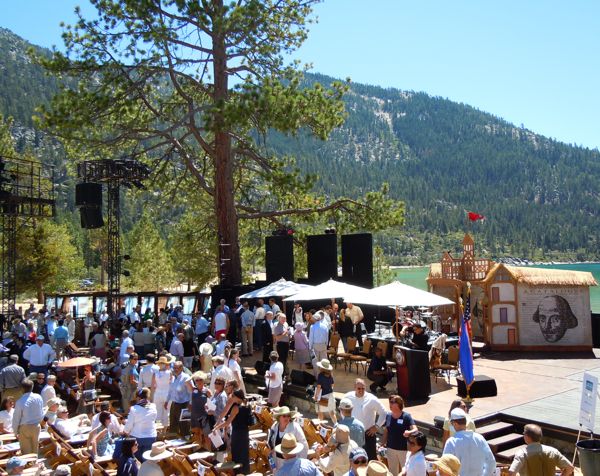
Hundreds gather for the 14th annual environmental summit Aug. 17 at Sand Harbor. Photos/Kathryn Reed

Hundreds gather for the 14th annual environmental summit Aug. 17 at Sand Harbor. Photos/Kathryn Reed

David Hayes, Department of Interior deputy secretary, talked about the importance recreation has on the U.S. economy. It accounts for 6.5 million jobs, generates $49 billion annually in tax revenue, and $289 billion in retail sales.

“It’s an important industry. It’s a way to bring economic development to rural areas,” Hayes said.

Recreation was evident on this bluebird day, as beach-goers frolicked along the shore and in the water at Sand Harbor. The historic Thunderbird woody sat offshore during the summit.

Sen. John Ensign, R-Nev., sported a bandage on his right arm – a mountain bike misadventure along the Tahoe Rim Trail during his multi-day visit to the area with his family.

What would also help the Lake Tahoe economy and the environment is for Congress to reauthorize the Lake Tahoe Restoration Act. With it being an election year, action on the plan that would bring $415 million to the region in an eight-year period may not occur until after Nov. 2, if at all.

It was the inaugural summit in 1997 with then President Bill Clinton that spurred the federal funding for Lake Tahoe. The original act passed in 2000 brought $424 million to Tahoe in 10 years.

All told, $1.5 billion has been spent on environment improvement projects in Lake Tahoe since the first summit.

Senate Majority Leader Harry Reid, D-Nev., spoke to the nearly 300 people on Aug. 17 about how the Travel Promotion Act passed by Congress earlier this year will help Tahoe. He said it will create 6,000 jobs for Nevada and a half million nationwide. The idea is people outside the country will be told about the virtues of Lake Tahoe and be enticed to re-create here.

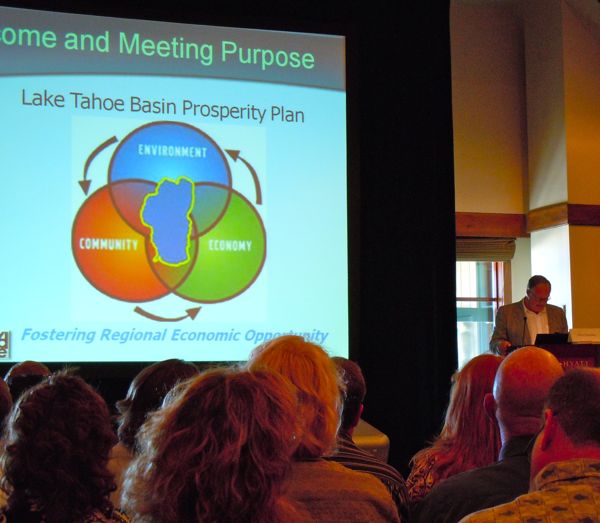
As always, lake clarity was a substantive part of the summit.  Invasive species and forest fuel reduction were also touched on. El Dorado County Supervisor Norma Santiago and consultant Trish Kelly rehashed the previous day’s meeting about the Prosperity Plan.

Sen. Dianne Feinstein, D-Calif, spoke about a meeting she hosted for 50 locals on Monday who provided her with a slew of reports – mostly about lake clarity, some about the thousands of acres treated for fuels management.

At the summit she said, “Twenty-five percent of these beautiful forests around us are dead and dying, therefore it’s primed for a catastrophic fire.”

She illustrated how the Asian clams invading Lake Tahoe could extend 3.5 miles if laid end-to-end.

In these trying economic times, Feinstein and others pointed to the need to tap into the private sector even more. She praised Steve Teshara with Sustainable Community Advocates and Andrew Strain at Heavenly Mountain Resort for their efforts. She also acknowledged Art Chapman who runs JMA Ventures.

The constant theme for the day was Tahoe is an international treasure that needs protecting.

ngg_shortcode_0_placeholder (Click on photos to enlarge.)


Prosperity plan’s focus: health care, environment, tourism

By Kathryn Reed

INCLINE VILLAGE –Tourism, health-wellness, and the environment. These three areas are supposed to be the economic saviors of Lake Tahoe.

In a room full of about 70 of Tahoe’s movers and shakers on Monday the two-hour talk was all about the Lake Tahoe Basin Prosperity Plan. A bit of irony is the meeting was at the Lone Eagle Grille in Incline. Incline Village is sometimes called Income Village based on the wealth of the homeowners.

John Breternitz, Washoe County commissioner, opens the economic forum on Aug. 16. Photo/Kathryn Reed

John Breternitz, Washoe County commissioner, opens the economic forum on Aug. 16. Photo/Kathryn Reed

El Dorado County Supervisor Norma Santiago, who has been instrumental with a handful of others to initiate this plan, promised this isn’t just another document to collect dust, but is one with legs.

But the problems of today are what they were 20 years ago, only exacerbated because of the recession, and the declining relevance of gaming in the basin and throughout Nevada.

This group believes the prosperity plan will change what the Lake Tahoe Basin will look like 20 years from now. If all things go according to this plan, employment won’t be in double digits, lake clarity will continue to improve, the area will be transformed into environmental innovation centers, a sports commission will attract major events, medical centers of excellence will sprout, high speed Internet access everywhere will allow for telemedicine and e-commerce.

But much of what is being said is what the people who live “poverty with a view” know – it has always been about the environment. Many in that room are the ones who pooh-poohed that for years. Their personal wallets were thick, or government-agency bank accounts flush with cash. Not so anymore. Poverty with a view is hitting closer to home.

People for years have said Tahoe needs a second economy to sustain itself during the ebbs and flows of tourism. But no one did anything. Look at Boulder, Colo., a mountain town that thrives not on tourism, but biotechnology firms. And, yet, it is an outdoor mecca much like Tahoe.

Tahoe could already have a world-class orthopedic center instead of being in the infancy of creating one. Dr. Richard Steadman left South Tahoe’s Barton Memorial Hospital for Vail in 1990 because there he had the support to create what he wanted.

Steadman’s website says, ”Dr. Steadman has developed numerous techniques for knee surgery and rehabilitation that have been adopted worldwide for the treatment of various knee disorders.”

What if those had been created in Tahoe? Would the area be more prosperous? Would people come here for destination health care? That’s a goal of this prosperity plan – to have people come here for health care needs. Barton can’t survive on the medical needs of locals. When it’s a bad ski season or mountain injuries are down, hospital revenues are blood red.

It was repeatedly pointed out at the Aug. 16 meeting that government is not going to be the savior. It will take the private sector to make this plan a reality. But it will also take buy-in from locals – the ones, perhaps, who have not been listened to in the past and have become jaded.

According to the executive summary the plan is, “To rebrand the region as a green, geotourism, health and wellness visitor destination, providing a unique, authentic Lake Tahoe experience including sports, recreation, culinary, historical, art, cultural experiences, environmental education and volunteer opportunities.”

As South Tahoe City Councilman Hal Cole put, it seemed like a political shindig more than a nuts and bolts meeting.

When Lake Tahoe News asked B Gorman, one of the leaders of the prosperity plan and executive director of the Lake Tahoe South Shore Chamber of Commerce, if transit would be part of this, she said, “No.”

LTN responded that a reliable bus going around the lake would be good for those who need it and those who want it – locals and tourists; in addition to reducing vehicle miles traveled, which is always touted as an environmental benefit.

Lake Tahoe Community College and Sierra Nevada College were touted as places of higher learning that will help foster the goals. But in a climate where education spending is continually being cut, it’s hard to know if these institutions or universities in either state could be relied upon as incubators of Tahoe prosperity.

Today, according to stats provided by prosperity officials, Tahoe creates $4.7 billion in revenues a year. Tourism is the dominant contributor.

Rick Tremblay with the federal Economic Development Administration said for the short-term Tahoe needs to reinvent its tourism model, while for the long-term is needs to “aggressively invest in technology.”

His examples of small towns that have done big things were interesting, but oddly irrelevant to Lake Tahoe. The region doesn’t have the land for much of what he talked about. Nor is manufacturing likely to happen based on all the regulations.

During the panel discussion where six people were invited to give input to the plan, Jared Blumenfeld, Region IX administrator for the U.S. Environmental Protection Agency, said, “It’s not a new idea to be green. You need to get it right and be bold. You need to have goals.”

Goals, if there are any, were not discussed Monday.

Blumenfeld further pointed out, “I think your brand is ahead of where you are.” Meaning, people expect Tahoe to be green and healthy. He said people are disappointed to find out how that really isn’t the case, and how dilapidated so much of the infrastructure is. Blumenfeld also pointed out how it’s hard to eat healthfully in Tahoe.

John Breternitz, Washoe County commissioner, said questions asked by forum attendees and the answers would be put on the website, but the FAQ page says it’s under construction.


El Dorado DA’s caseload not typical of rural counties

By Chelsea Phua, Sacramento Bee

Moments before stepping inside an El Dorado Hills coffee shop, Vern Pierson pecked away at his BlackBerry. He was sending an e-mail message to his secretary about the caseload handled by a prosecutor.

It was only 8:30am, and Pierson, El Dorado County’s district attorney, already had his plate full. He confessed he is a workaholic.

Vern Pierson

Vern Pierson

“My wife will tell you this,” Pierson quipped.

As the district attorney of a rural county of about 178,000 people, Pierson runs a small shop, with 22 prosecutors.

But his office has 11 pending homicide cases, nearly four times as many as neighboring Placer County, which has nearly double the number of prosecutors and population of El Dorado County.

Read the whole story


LTCC’s green choices reap enviro, economic dividends

By Kathryn Reed

Looking for Lake Tahoe Community College’s fall schedule?

ltcc logoIt’s going to be a little harder to find a hard copy of the two-year institution’s schedule as it follows the lead of other colleges by not mailing them out as well as reducing the content. Officials envision the print version going away completely in the future.

This fall and for the foreseeable future it is available via the college’s website or by clicking schedule. Hard copies will be at the South Lake Tahoe college starting Aug. 16 — the only place they will be in hard copy. Open registration begins Sept. 3, with classes starting Sept. 20.

“Where we see the possibility of losing students is people taking the occasional class who are quite used to getting the schedule in their mailbox as their reminder of class availability,” Christina Proctor, LTCC spokeswoman, said.

Besides this being one of the college’s green initiatives, it also is a cost-saving tool. Printing fewer schedules, along with not including a detailed description of the course will save $10,000 a year.

“We have to make sure our limited dollars are going where they need to, which is students. This is one easy way to save money and not really affect services to students,” Proctor said.

The college is hoping people will recycle the schedules by having multiple people use a single copy. With it all being online and the college having computers for the public to use, everyone still has access to a schedule.

This is not the only way the college is going green. When Craig Brinkman came onboard as a contract employee through a federal grant, he noticed most printers on campus were ink jets.

The IT department has wiped out the active inventory of printers by 40 percent. This means a whole lot of people adjusting to not having a personal printer. Laser jets are what they are sharing.

The change also comes with a reduction of ink by 50 percent. Monetary savings comes with fewer cords plugged into a wall as well as less ink needed to be bought, and what is purchased will cost less.

All of this is environmentally beneficial, too.

Everyone is also going to a terminal server. It should reduce the demand on the information technology employees.

“There have been some bumps along the way. It’s a change in the way we do business, a change in thinking,” Proctor said.

Brinkman is also responsible for implementing Datatel, a software system that is supposed to make the college run more efficiently. Brinkman wrote an article for TechEDge about this and IT issues at LTCC.

Another way the college would like to be green is by creating a geothermal facility. It has gone after a number of grants, but continues to be bypassed. The plan is to tap into the geothermal power of Lake Tahoe.

“I have also implemented an online campaign on the college Facebook page and this fall students will find the logo around campus with explanations about other green projects the college is implementing,” Proctor said.


South Shore bus agency maps route to bankruptcy court

By Kathryn Reed

Another major entity on the South Shore is headed for bankruptcy. Joining the failed convention center in debtors’ court is South Tahoe Area Transit Authority.

The board, at least those members who showed up for the Aug. 13 meeting, unanimously agreed to file for Chapter 11 bankruptcy in Nevada.

With bills topping seven figures that can’t be paid, the agency that runs BlueGo buses on the South Shore and in the Carson Valley is ready to reorganize. Like all Chapter 11 filings, the creditors will have a say in the outcome.

Banlruptcy is not supposed to affect BlueGo bus service. Photo/Kathryn Reed

Bankruptcy is not supposed to affect BlueGo bus service. Photo/Kathryn Reed

MV Transportation out of Fairfield is owed the largest sum. However, that dollar figure is in dispute. MV says the total is close to $3 million, while STATA says it’s closer to $2 million. Either way, STATA doesn’t have the money to make good on that debt.

Tahoe Regional Planning Agency is owed at least $50,000, though an exact figure could not be secured. Legal fees are also mounting.

Things have only gotten worse since MV, the former bus operator, got a judge in Minden to freeze STATA’s assets.  Not having access to that pot of $677,000 is making it difficult to run the day-to-day operation.

Still, even with the official bankruptcy filing that will occur in the next month, the buses will roll, according to STATA officials. Riders should see no change in service for the time being.

A group of students and parents representing Grace Christian Academy in Minden helped fill the room Friday, worried their route will be cut as the agency keeps tweaking the schedule.

The board voted to keep it going because about a dozen families at the lake use the bus that goes over Kingsbury Grade. It serves the greater public, not just these students. Plus, one reason Big George Ventures wrote a hefty check for what had been called the Kingsbury Express was so fewer passenger vehicles would go by the owner’s neighborhood.

It’s still not known what El Dorado County is going to do with their residents in the basin who want/need public transit. The county pulled out of the public-private transit agency last month.

Derek Kirkland, transportation planner with Nevada Department of Transportation, spoke about route changes before the bankruptcy issue was voted on.

NDOT in a letter dated July 12 had threatened to pull its funding because of its lack of confidence in STATA.

STATA, at NDOT’s urging, then contracted with Tahoe Transportation District to handle the bulk of the operation, except for the actual buses. That will continue to be the agreement as STATA enters bankruptcy.

Mike McLaughlin is STATA’s attorney, but the board will hire a specialist to handle this situation.

Even though it is creditors who have a large say in what STATA’s reorganization looks like, it is not likely the players will want to lose control and still contribute financially.

South Lake Tahoe, Douglas County, Harveys, Harrah’s, MontBleu, Horizon, Lakeside, Heavenly, Ridge Tahoe and Tahoe Transportation District are voting board members. TRPA is a non-voting member.

Besides bankruptcy court, STATA is dealing with three lawsuits from MV. One was misfiled in El Dorado County, that’s why it’s down to three.

The audit for fiscal year 2008-09, which is well overdue, was on the agenda. The board tabled it because TRPA has concerns about some of the wording in the document.


Moore about to call it quits at South Tahoe Parks and Rec

By Kathryn Reed

Gary Moore is ready to redefine recreation.

South Lake Tahoe’s director of Parks and Recreation is retiring Oct. 1. His wife, Angela, is retiring the day before as manager of the infusion center at Barton Memorial Hospital. Travel is a big part of their plans – and recreating.

Tahoe will always be home even if they spend a bit more time in Angela’s native New Zealand. But no longer will either have to ask for time off or worry about work while away.

Gary Moore is sprinting toward retirement. Photo/Kathryn Reed

Gary Moore is sprinting toward retirement. Photo/Kathryn Reed

Though only 56-years-old, Moore is practically an institution in the department. He started full time with the city rec department June 2, 1975. Prior to that he spent three summers lifeguarding at El Dorado, Regan, Ski and Connolly beaches.

Although the city was incorporated in 1965, parks and rec wasn’t part of the plan at the beginning. Keith Gottschlak was the initial director in 1971 when the department got its first facility. El Dorado County leased Campground by the Lake to the city that year.

Moore started the same month the recreation complex opened its doors. Before that the department rented space from the U.S. Forest Service when its offices were on Tata Lane.

“We were the first wave of professionals brought into the department,” Moore said of he and the four young guys who were hired. With his bachelor’s in recreation administration from San Diego State University and a master’s in the same subject from CSU Sacramento, he thought Tahoe would be a stepping-stone to another job. It was – and several times. Only he never left the department.

When Moore started his career, parks and recreation had been around a while, but the ‘70s is when it began to boom, and cities saw the need to acquire open space and initiate more innovative programs.

For the past four years he has been at the helm of the department. Prior to his ascension, he was superintendent of the recreation side. For about a decade the department didn’t have a director, it had superintendents – one over recreation, one over parks.

City Manager Tony O’Rourke said his initial reaction is to hire a director. He’s heard he has big shoes to fill with Moore’s departure. A changing of the guard had nothing to do with Moore’s decision to leave. It was just time.

“We like the direction right now that Lake Tahoe and South Lake Tahoe is going. Finally, the bell went off that we have this big blue thing out there,” Moore said. “We are now saying we are a recreation paradise, guys.”

He likes that his department is part of the greater effort of defining how Lake Tahoe will prosper in the future.

A life of recreation

Moore has done it all in his 35 years with the department. He’s scrubbed toilets at the campground, he ran the Senior Center, oversaw the ice rink, has been at Bijou Golf Course.

His fingerprints are on just about everything that involves recreation in South Lake Tahoe.

“Times change. You try to look at the crystal ball and find trends. We don’t say, ‘We don’t do that’,” Moore said. “I have more ideas than I know what to do with.”

He admits his eyebrows have been raised at times by some of the suggestions that have been brought to his department. Disc golf was the community’s idea.

“They walk in and say can we do disc golf at the park,” Moore recalls. “We said, ‘What’s that?’”

Trash can lids were the early baskets.

It was more recent that a group of women approached him about having a roller derby rink at Bijou Community Park. The department went with it.

When the City Council wanted a dog park, it was parks and rec that went to work.

The department has branched out into interpretive services with Explore Tahoe near Stateline.

Moore credits his father, good mentors, an incredible staff and the will of councils for the department’s success.

His background was traditional sports – football, basketball and baseball. It was his dad who told him, “Get off the tree trunk and get out on the limbs” when it comes to thinking about possibilities.

With the groundbreaking of Lakeview Commons earlier this month, Moore is excited about the direction the city as well as the department is going. After all, El Dorado Beach is part of his jurisdiction.

Leaving an impression

From a department of about a half dozen employees when Moore started, he now oversees 225 workers in full season who work in nine divisions.

The length of time people stay in parks and rec is a testament to the cohesive working atmosphere, one of openness and respect that Moore has fostered.

“He is real accessible to the employees. Everyone has appreciated that,” said John Collins, who runs the senior center. “When I came back to the senior center it was tough because everyone was sad to see him go.”

Moore and Collins have worked together for 30 years, with Moore starting out as his boss. Collins likes that Moore has knowledge about all areas of the department, that he isn’t afraid to get his hands dirty.

Greg Ross, who runs Bijou Golf Course, has also worked with Moore for about 30 years.

For those who know Moore, they know not to stand close. His hands are never stationary.

“You need your defensible space around him,” is how Ross describes it.

Steve Weiss, who retired as superintendent of parks in 2006, has told a story to others about he and Moore driving to Sacramento. Moore was the passenger. By the time they got back to Tahoe, Weiss’ shoulder was bruised from Moore’s gesturing.

“He is hard to capture in a sentence or two. His personality is what you remember,” Ross said.


Results-driven city manager takes helm of South Tahoe

By Kathryn Reed

STATELINE — Results. That is how Tony O’Rourke wants his tenure as city manager of South Lake Tahoe to be judged.

Part of Day 3 on the job was spent speaking to Soroptimist International of South Lake Tahoe during the group’s weekly lunch at Harveys. Looking out and down from the 12th floor setting it was inevitable someone would pepper him with a question about the stagnated convention center project.

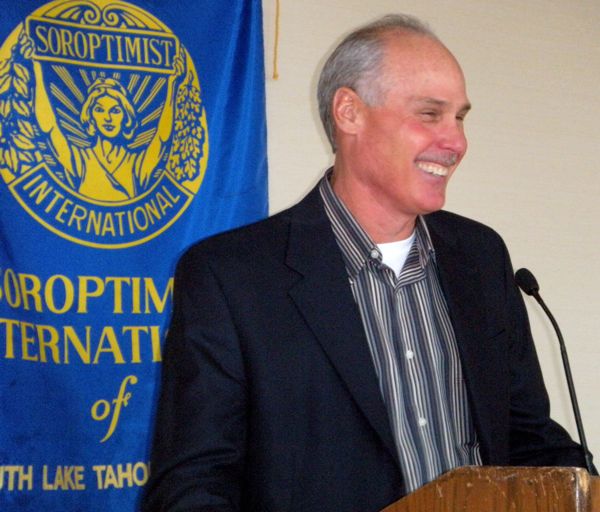
South Lake Tahoe City Manager addresses the Aug. 11 noon Soroptimist meeting.

South Lake Tahoe City Manager addresses the Aug. 11 noon Soroptimist meeting. Photo/Kathryn Reed

He didn’t have much of an answer, other than to say the concept is great, and two hotels and a convention center would be an asset to the community.

What the public tends to forget is the city – neither elected official, nor paid staff – can get the project moving. It’s stalled in bankruptcy court.

But if it does come to fruition on O’Rourke’s watch, maybe future Soroptimist meetings could be conducted where the service club is headquartered – South Lake Tahoe.

Soroptimist Deb Howard asked O’Rourke to give specifics about the challenges and opportunities he sees.

Immediately he said the airport – where his office is.

“I’m not familiar with any other destination with an airport in the middle of it,” O’Rourke, 55, said. “It would be a great opportunity to get commercial service.”

He said this is one of the first things he wants to talk to the City Council about – pursuing the return of commercial flights into Lake Tahoe Airport. He mentioned Mammoth as an example of a ski town doing booming air business.

In Beaver Creek, where he was executive director of Beaver Creek Resort Company, he said 70 percent of visitors flew in. International travelers tended to stay 10 to 14 days and spend more money compared to weekend warriors. He added that tapping into the Mexican and British markets would be huge for the South Shore – “they love alpine skiing” – he said.

O’Rourke is well aware of what is going on in the city, or not, as the case may be. He did his homework before interviewing. On Monday he met with all the department heads as a group. One-on-ones are going on the rest of this week.

“I like the idea there are challenges. I’m not a caretaker,” O’Rourke said.

He wants to engage the community in the direction the city should go, then create a strategic plan with a handful of achievable goals.

The avid outdoorsman said having 60 percent of the council changing after the Nov. 2 election is not a concern because boards and councils change all the time. He said if goals are outlined, this reduces personal agendas council members may want to promote.

“You need to create a shared vision. What do you want to become?” O’Rourke said. “There is no substitute for results. Are you really achieving anything?”

His contract is for three years, but the disgruntled public is apt to want results well before the council considers an extension.

But O’Rourke also pointed out it’s easy to criticize and that if the public wants change, it should be in the game and not on the sidelines or playing Monday morning quarterback.

“No one person can make a difference, it has to be collective,” O’Rourke said.


4-car accident sends 3 to hospital, closes Hwy. 50

Updated Aug. 14, 2010, 9:20am: The person flown to Renown Medical Center has been discharged from the hospital.

By Kathryn Reed

Highway 50 in South Lake Tahoe was closed for a couple hours Wednesday afternoon after a suspected drunken driver caused a four-car accident that sent three people to the hospital.

Eric Acri, 50, of South Lake Tahoe was booked into Lake Tahoe Jail on suspicion of felony drunken driving after the 1:39pm accident near Lake Tahoe Pizza Company.

CalStar takes an accident victim from South Lake Tahoe to Reno on Aug. 11.

CalStar takes an accident victim from South Lake Tahoe to Reno on Aug. 11.

This was the second of what would become three DUI crashes in the city limits in 31 hours.

Debris was scattered across the highway between D and F streets, as metal was crunched, airbags deployed and the jaws of life used to extricate the most seriously injured person. CalStar crews landed in the middle of the highway to have a faster transport time to Renown Medical Center in Reno.

Names of the three injured people were not released, but witnesses said they believe they are South Lake Tahoe residents.

Acri was driving toward Lake Tahoe Airport when his vehicle sideswiped a Toyota, taking off the side mirror, according to South Lake Tahoe police Officer Jake Herminghaus. He then rear-ends a vehicle, which causes that truck to swerve and spin into oncoming traffic, T-boning a GMC Sierra, Herminghaus said.

It was the driver of the small truck that hit the GMC who was airlifted to Reno. First crews had to cut off the driver side door to reach him.

Bonita Christensen, who is staying at the Silver Shadows Motel, said she helped two women get out of the GMC.

“They said they saw the car come over the line and tried to dodge it,” Christensen said. “It was so loud and horrific. Dust was flying.”

The impact was so great the left rear tire was several feet from where the GMC stopped.

Traffic was diverted on Bonanza Avenue for a couple hours while investigators did their work and then the cleanup began.

After that accident, South Tahoe officers responded to a DUI crash at Alma Street and Sierra Boulevard at 5:11pm. Nicholas Dellavin, 27, of South Lake Tahoe was arrested on driving under the influence charges. There were no injuries in the two-car accident.

On Aug. 10 officers arrested Nicola Foster, 34, of South Lake Tahoe on DUI charges after she allegedly did serious damage to three parked cars and a mailbox on Ruby Way between Wildwood Avenue and Ski Run Boulevard.

A citizen cut-off the vehicle and then officers arrived.

“The crashes, they are once in a while. We get two or three DUI arrests every day, but not crashes,” Sgt. Jeff Reagan said.

ngg_shortcode_1_placeholder (Click on photo to enlarge.)


Tahoe’s spastic weather not uncommon, officials say

By Kathryn Reed

Even though the National Weather Service says nothing much out of the ordinary is happening with the weather in the greater Lake Tahoe area, it is providing plenty fodder for locals and tourists.

Today might require a jacket with highs in the basin barely touching 70. Sunday produced hail that looked like golf balls. Less than a month ago South Tahoe was recording a record high and back in May posted a record low. Reno just came off tying a record for number of days of 90-degree temps or higher.

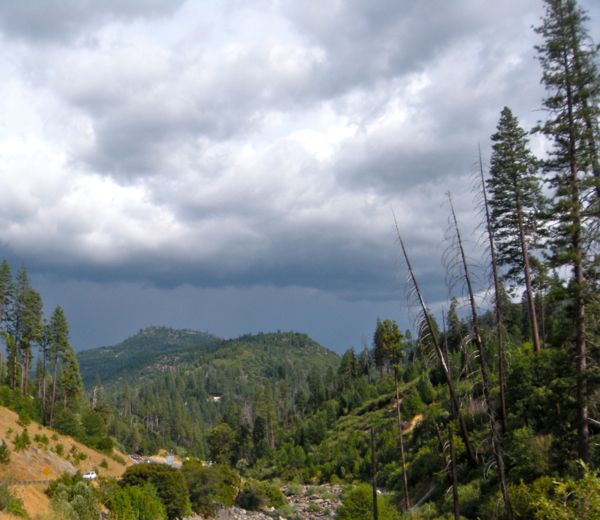
It was a soggy drive over Echo Summit into South Tahoe on Aug. 8. Photos/Kathryn Reed

It was a soggy drive over Echo Summit into South Tahoe on Aug. 8. Photos/Kathryn Reed

“It’s not different (this summer),” according to Jessica Kielhorn, meteorologist technician with the National Weather Service in Reno.

Today should be the coldest day of the week in the basin and stretching to the Carson Valley and up to Reno. It will be cooler and drier, with no thunderstorms in sight.

Lake Tahoe isn’t the only place with cooler than normal temps. The Bay Area has been chilly compared to most summers. In the Central Valley cool weather is affecting the tomato harvest.

While Tahoe has been mild when it comes to mercury readings, on Aug. 8 Reno tied a record at 35 days of temperatures at 90 degrees or higher. It had the exact same 35-day run in 2008 (July 5-Aug. 8), and did the 35 days in 2005, too.

“We’re looking to warm back up over the weekend,” Kielhorn said of the Tahoe-Reno area. “We have a ridge of high pressure moving in after this trough.”

Dark clouds sit over the basin on Aug. 8.

Dark clouds sit over the basin on Aug. 8.

South Lake Tahoe and Tahoe City should hit the mid-70s by the end of the week. Both ends of the lake should be in the mid-80s Sunday and Monday. Reno will be close to triple digits at that time.

While afternoon thunderstorms are not uncommon in the basin in July and August, the hail has surprised some locals. For those from the Midwest, summer hailstorms are no big deal.

Hail is tiny pieces of ice that bounce through freezing thunderclouds.

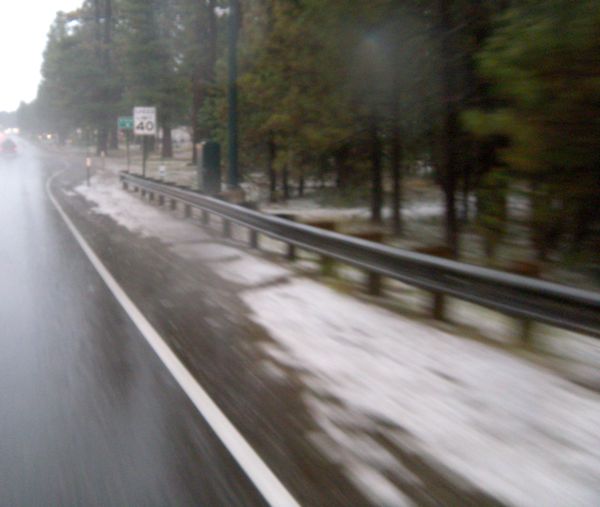
Hail piles up near the Y in South Tahoe on Aug. 8.

Hail piles up near the Y in South Tahoe on Aug. 8.

And bounce they did near the Y on Aug. 8. A weather spotter for the NWS reported the ice formation as 1-inch in diameter in some cases. Driving by Lake Tahoe Airport it looked like snow on the ground.

Puddles from the storm still sat on some city streets two days later.

With the relatively fast moving storms, and definitely isolated showers, it is not affecting the lake level much. On Aug. 10 it was 1.3 feet above its natural rim.

The declining water level has caused some boat launches to close for the season. Coon Street Boat Launch in Kings Beach closed earlier this month and Tahoe Vista Recreation Area launch closed Aug. 9.

Even though a nip is in the air and some people are using that four-letter word – fall – to describe what it feels like outside, the forecast is for normal temps for at least the next week or so.

This is welcome news considering it seems like winter just ended.

It was back on July 17 that South Lake Tahoe hit a record high of 90 degrees, beating the old record by 1 degree. It was May 23 that the low of 19 degrees set a record, beating the old one by 6 degrees.