Lakeside Inn — an ideal spot to turn a year older

By Kathryn Reed

STATELINE — No wonder Lakeside Inn is a favorite with locals. Good food, excellent prices, fun dealers, great guest service. And no wonder tourists and locals like to stay there. Reasonable room rates, spacious hot tub, outdoor pool that isn’t visible from the highway, walking distance to lots of things.

Having never stayed at the hotel-casino, I didn’t know what to expect. I was pleasantly surprised.

Fries, beer and the Giants -- two out of three were good that night. Photos/Kathryn Reed

Fries, beer and the Giants -- two out of three were good that night. Photos/Kathryn Reed

For starters, as a non-smoker it was so nice to walk into what’s called the Edgewood Lodge and not smell smoke on either of the two floors. I didn’t even know the lodging buildings existed because I’d only been to the main casino and Latin Soul.

Wow – was my initial reaction walking into the room – because of the balloons with a note wishing me happy birthday. Anytime the folks operating the inn know a special occasion is the reason for the overnight stay, something special like this is done for the guest.

It was that added little touch that started last weekend off right.

We had one of the suites – providing ample room for birthday gifts, to set up a makeshift office and to feel like we had a home away from home for a weekend.

What got me interested in staying at the Lakeside is getting an email saying they had a deal for me with September being my birthday month. Oh my. They know how to treat a girl right. (OK, everyone who gets older gets special treatment.) Lodging discounts, a free meal, free drink, buy-in deal on poker, match play at other tables, a T-shirt and free coffee are part of the deal.

Walking around

It was time to explore the other side of town. Being typical locals, we tend to hang out in our neck of the woods near the Y.

We decided to go check out Heavenly Village since it had been a while and we’d heard good things about the Stateline Brewery.

Sitting in the seasonal outdoor area, we had a beer. (Be sure to go during happy hour.) A group of guys probably in their 30s were in town to do a little bonding while their wives and children were at home.

People drifted in and out of the shops. It was good not to see too many vacancies. Others were attempting to sink the colored ball in one of the putt-putt golf holes.

I keep trying to be a believer in villages. And still, not a single one in California has won me over. Explore Tahoe and the Heavenly gondola are definite reasons to visit this village.

Walking back, we were going east with traffic along Highway 50. Not a great idea. No sidewalk past MontBleu made me think I was in South Lake Tahoe.

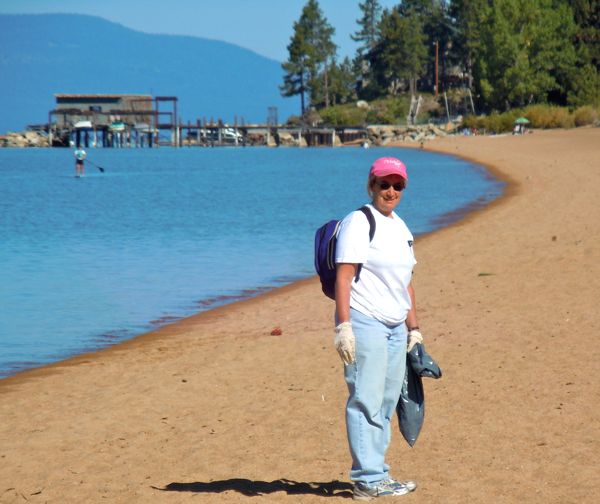
The next morning we walked to Rabe Meadow to Nevada Beach. All along the way we picked up trash as part of Coastal Cleanup Day. It’s nice having this acreage so close for people who want to get outdoors.

Food, glorious, food

Friday night’s dinner came with a sunset view of Lake Tahoe atop Kingsbury Grade at the Chart House. Yes, a vegetarian at a steakhouse. But have you seen this view? The $15.99 all you can eat salad bar is a treat in itself. I skipped the caviar, but I don’t know of another salad bar in the region that has the offerings this one has.

Sue was delighted with her $28.99 filet mignon.

Skip the fried asparagus. “Jumbo spears, topped with fresh tomatoes and blue cheese butter” sounds better than what was delivered.

Richard was a superb waiter and could show a thing or two about what guest service is all about to his brethren in other South Shore eateries.

As a little twist, the top of my menu said, “Welcome to the Lake Tahoe Chart House – Happy Birthday Kae!” The other birthday people around us thought this was a pretty cool way to start the night. And we could all take the menus home as a souvenir.

Definitely save room for the Hot Chocolate Lava Cake ($9.99). The only place I’ve been that does this type of dessert better is The Beach House in Kauai.

The next night we stayed in at the Lakeside, choosing to try Latin Soul again. We had been there shortly after it opened. The biggest complaint then was smelling smoke from the nearby sportsbook. Whatever they did to the ventilation system worked.

We should have shared an entrée – the portions are that big. Sue indulged in a chicken enchilada, while I had a burrito. Vincente said they could put portabella mushrooms in it instead of meat. Yummy!

Two entrees and two beers came to about $25.

The morning we left we chose to eat at Lakeside’s other restaurant – Timber House. We had spent a little time in the bar the night before – watching the Giants lose. It was hopping then and it was hopping mid-morning.

The wait staff said locals are the ones who are usually at the tables eating.

Sue chose breakfast – an omelet she would order again; and I went with a veggie sandwich that I would gladly have again. Two meals and two bloody Mary’s cost us another $25.

Chilling at Lakeside

After doing our volunteer work on my birthday, it was time to relax. The pool at Lakeside is inviting. It’s heated through September. With the outside temperature in the 80s, I was happy to bake in the lounge chair and catch up on some reading.

The night before we had met a couple women on a girls’ weekend away from home in Reno. They had left husbands and children behind to enjoy Tahoe and the Genoa Candy Dance.

An oversized tub with jets was a perfect place to land one night. The bath salts are a great touch.

With televisions in the main room and the bedroom, it means not having to watch the same thing if you don’t want to. A mini kitchen allows for refrigerating items and heating things up in the microwave.

With the property turning 25 years old in May, it looks a bit dated. But the rooms and property are clean, the guest service impeccable, the food delicious.

It’s a bit of that old Tahoe funky that some of us love and hope stays around to keep the South Shore from being something it will never be and yet so many want it to be – upscale and soulless.

Lakeside does want to make improvements. I just hope in doing so it doesn’t lose its character and the reasons why locals fill the tables, bars, restaurants, and hotel rooms.

Talking to employees they said Sept. 24 was one of the best days of the summer tourism season. The confluence of Street Vibrations (there were a lot of bikes in the parking lot), Lake Tahoe Marathon, events in Carson Valley and fall being the best season in the basin apparently made for a profitable weekend.

It was profitable for me on my birthday. Sit at Diana’s table next time you want to play blackjack. I like turning $20 into $200. It’s probably a good thing I only gamble every few years because I know this kind of luck doesn’t hold. After all, when I lived in Vegas I cashed a paycheck once and lost the whole thing. But that’s another story.

The story I’m sticking with for now is the Lakeside is a great escape – all six miles from home. I know I’ll be back to the restaurants before I get next year’s birthday coupons.

For more information:

Website

Telephone: 800.624.7980

Address: 168 Highway 50, Stateline

ngg_shortcode_0_placeholder (Click on photos to enlarge.)



California reaches deal on long-overdue budget

By Kevin Yamamura, Sacramento Bee

Three months into the state’s longest budget impasse, Gov. Arnold Schwarzenegger and legislative leaders reached a handshake deal Friday to close the state’s $19 billion deficit, leaders announced after a five-hour meeting.

To bridge the gap, they are relying on about $7.5 billion in spending cuts, as well as delaying a corporate tax deduction and using rosy projections for how much the state will receive in tax revenues and federal dollars, according to sources close to budget talks.

Arnold Schwarzenegger

Arnold Schwarzenegger

Standing outside Schwarzenegger’s office beside the three other legislative leaders, Senate President Pro Tem Darrell Steinberg, D-Sacramento, said legislators will return to Sacramento next week to finalize their “comprehensive agreement.” The Legislature plans to vet the plan in a joint budget committee Wednesday and hold floor votes Thursday.

Read the whole story


Nancy Garrido pleads not guilty to indictment charges

By Sam Stanton, Sacramento Bee

Using secret testimony from kidnap victim Jaycee Lee Dugard, prosecutors today unveiled a new 18-count indictment charging Phillip and Nancy Garrido with abducting Dugard in 1991, when she was 11.

Nancy Garrido was arraigned and pleaded not guilty to the new charges, which were handed up by an El Dorado County grand jury on Sept. 21. But Phillip Garrido, who has had criminal proceedings against him suspended while the court assesses his mental competency to stand trial, did not enter a plea because of questions over whether he could be arraigned.

Judge Douglas Phimister called attorneys to return to court Nov. 4 to address the issue of whether Garrido would enter a plea or have the judge enter one for him.

Read the whole story

Phillip and Nancy Garrido

Phillip and Nancy Garrido


Tahoe poverty forum to tackle stemming the downward slide

By Kathryn Reed

Poverty with a view has never been more accurate than now.

Though the powers that be would like to remove the phrase from the vernacular of South Shore locals, the truth is the phrase cannot be disputed. Tahoe has gorgeous views and the people living among the pines at 6,200 feet are poorer today than anytime in recent memory.

When organizers and others gather Oct. 8 in South Lake Tahoe for an all-day summit dubbed Poverty to Prosperity, they will be tasked with coping with the reality of a city whose unemployment rate is at nearly 18 percent, whose permanent residency is stagnant with 70 percent of housing belonging to second homeowners, and a school district with nearly 70 percent of its elementary students qualifying for free or reduced lunches.

Scott Lukas, LTCC professor, is the keynote speaker at the Oct. 8 poverty forum.

Scott Lukas, LTCC professor, is the keynote speaker Oct. 8 at the S. Tahoe poverty forum.

Homelessness in Tahoe isn’t unusual. It’s just a bit invisible. Lake Tahoe Unified School District reports of its 3,993 students 250 are homeless. Some live in motels. Some in cars. Some couch surf. Those 250 don’t live in a traditional home and therefore are considered homeless.

Wendy David, one of the forum’s organizers, sees the increasing destituteness of those living in South Lake Tahoe through a variety of volunteer efforts mostly involving children, as well as being president of the LTUSD school board. That is why she wants to bring people together to begin a dialog of what can be done to reverse the poverty trend.

Alissa Nourse, Carl Ribaudo, Arturo Rangel, Cindy Hannah and Michael Ward (who will be the facilitator) have been instrumental in making next Friday’s event a reality.

South Lake Tahoe is not unique in its financial struggles.

In data just released by the U.S. Census Bureau from 2009 stats, not the ones taken earlier this year, it shows the income gap between the richest and poorest in the United States grew last year by the widest amount on record. Children were a large segment of that number.

The figures show most people taking a hit during the recession last year, but the poor being the worst off.

Some stats from the report:

• U.S. residents below half the poverty line — $10,977 for a family of four — rose from 5.7 percent in 2008 to 6.3 percent in 2009. This is the highest level since 1975 when this statistic was first recorded. The 2009 poverty level was $21,954 for a family of four.

• The 2009 poverty rate in the U.S. was at 14.3 percent – the highest since 1994. (It was at 13.2 percent in 2008.) That’s 43.6 million people or nearly 1 in 7. This is the highest since poverty figures began being kept in 1959.

• In the four county region of El Dorado, Placer, Yolo and Sacramento counties the poverty rate in 2009 was 13.4 percent in 2009, 12.1 percent in 2008 and 11.1 percent on 2007.

• Child poverty is at 20.7 percent, up from 19 percent in 2008.

• People with employer-provided health plans declined from 176.3 million to 169.7 million in 2009.

• 2009 was the largest single-year increase in U.S. residents without health insurance since the government began tracking the figures in 1987.

At the forum in South Tahoe, which is open to the public, the day will begin with El Dorado County Superior Court Judge Suzanne Kingsbury providing opening comments at 9am. In her work she has seen plenty of changes and is in constant contact with those considered impoverished.

Scott Lukas, a cultural anthropologist at Lake Tahoe Community College, will provide the keynote address. He will delve into the differences of generational and situational poverty – both of which exist locally.

After lunch a panel discussion with representatives from the business community, education, health care and others will take on the poverty topic. The public will be able to weigh-in before the day wraps up at 4pm.

“Why it’s important to have a community forum is it’s not one sector that will change things. It will take all sectors of the community,” David said.

The simple goals are for this to begin a dialog, for forum attendees to take it upon themselves to derive achievable goals, and for collaboration among concerned parties to be realized.

David anticipates tourism will be a component of the discussion because it is the chief employment sector.

If people are not coming to the area, it means businesses have fewer hours to give to workers, which means they have less money to spend, which in turn puts them on or past the brink of being able to pay their bills. This means downstream the businesses the tourism workers go to are being frequented less or not at all, and potentially service oriented businesses are not getting paid. It also means social agencies being tapped when resources to give are dwindling because fewer have the means to give.

“We need leaders to say it is a concern that so many are on the edge, that we are losing families, that we want kids to have jobs,” David said.

Poverty to Prosperity Forum details:

• Oct. 8

• 9am-4pm

• Embassy Suites Lake Tahoe, 4130 Lake Tahoe Blvd., South Lake Tahoe

• RSVP to Lori Blackburn at (530) 295.2403

• Sponsors – Child Abuse Prevention Council, El Dorado Community Foundation, Lake Tahoe Gaming Alliance, First 5 El Dorado, Tahoe Youth & Family Services, El Dorado County Office of Education


South Tahoe pot cultivation ordinance ready for council

By Kathryn Reed

On the same day the South Lake Tahoe City Council is expected to vote on a medical marijuana cultivation ordinance, residents will elect three new council members and all of California will decide if pot should be legalized via Proposition 19.

Before Nov. 2, the City Council will have a public hearing on Oct. 19 regarding the local ordinance.

Also at the Oct. 19 meeting the agenda is likely to contain an extension on the moratorium to limit the number of pot clubs to the three existing ones. The original one-year moratorium was passed in November 2009. It will require a super majority or four-fifths vote to keep it going. Two years is the maximum for a moratorium like this.

Officials on Sept. 29 work on South Tahoe's draft pot cultivation ordinance. Photo/Kathryn Reed

Officials on Sept. 29 work on South Tahoe's draft pot cultivation ordinance. Photo/Kathryn Reed

It’s not entirely clear what would happen to the collectives if the moratorium were not extended because all three have city business licenses, which was not the case a year ago. It could also mean more collectives would seek to be part of the community.

The 12-person committee recently convened to come up with a cultivation ordinance specifically for the collectives – since growing in other manner would be illegal – met Sept. 29 to finalize the plan that will be presented to the council in October.

The members include two city councilmen, a rep from each collective, a property manager, city manager, assistant city manager, city attorney, building inspector, police chief, and fire marshal.

Not much was changed in the draft pot ordinance even though the meeting went on for nearly two hours.

One of the most talked about issues was Lukins Brothers Water Company’s inability to put out a house fire.

Ray Zachau, fire marshal, said the issue to fight a fire if one of the 900 residences off Highway 89 is in flames is a concern that goes beyond the cause. The lack of water pressure in this area was exacerbated and brought to public’s conscience during the 2007 Angora Fire. Former City Manager Dave Jinkens spent years trying to rectify the issue to no avail.

Current City Manager Tony O’Rourke on Wednesday said it would be discriminatory to not allow grow operations in houses supplied by Lukins Brothers water.

“The No. 1 cause of residential fires everywhere is kitchen fires. Are we going to prevent kitchens in Lukins?” O’Rourke said.

He said the capability to put out a fire is not a reason to ban a grow-house when there are plenty of day-to-day causes that ignite fires.

On the flip-side, O’Rourke used the example of Monday’s fire on Wildwood Avenue as a reason to make sure the cultivation ordinance works. That house had a grow operation. (Renter Kevin Christensen was at the meeting to dispute his two plants under a 600-watt bulb were the cause of the fire that is likely to render the house a total loss. He said an outside uncovered electrical outlet was the cause, which contradicts the fire marshal.)

Part of the application for a grow permit will require the homeowner’s consent – and that person’s validated signature. Background checks will be done on want-to-be growers.

“If I can see something from the street that indicates it’s a grow operation, then it’s a violation,” O’Rourke said.

The goal is to write a document that will stand up in court if it were challenged. O’Rourke believes this has been done by using existing standards like electrical, building, and health and safety regulations and not writing something from scratch.

Minor tweaks will be made to the draft ordinance from this latest meeting. Some of which include adding attics are not permissible grow areas and reworking the violation language. The revisions are expected to be completed by Oct. 4 and then available at city offices at Lake Tahoe Airport.

Councilman Bruce Grego unsuccessfully sought stricter penalties for people who violate the ordinance.

“I want to bury them,” he said.

City Attorney Patrick Enright explained to the councilman, who is also an attorney, city ordinances per state law are misdemeanors and the maximum fine is $1,000. Grego had thrown out the number $10,000.

Councilman Bill Crawford weighed-in that being able to revoke a business license for people operating in the industrial area should solve the problem.

Several people at the table noted that if city officials find substantial violations at a residence to make the structure a public safety hazard, the electric company could pull the meter.


Unable to figure out nuts and bolts of SLT’s 10-11 budget

By Kathryn Reed

In two days, a new fiscal year begins in South Lake Tahoe. The multi-million dollar budget approved in August on the eve of then-City Manager Dave Jinkens’ departure is rife with questions.

cityLake Tahoe News has been trying to put the pieces together, but the city has been hampering those efforts.

The budget for 2010-11 was approved 5-0 by the City Council on Aug. 3 even though now City Manager Tony O’Rourke wanted to be at the helm when it came before the council. Jinkens at the time told Lake Tahoe News it was important to pass the budget then. Why it was important was not articulated. And without the full budget available, Lake Tahoe News can’t answer the question.

What city staff, aka Finance Director Christine Vuletich, presented to the council is on the website.

What’s missing in these documents is the detail.

The city each year sends the budget to some firm to be bound. This takes months to be done. Lake Tahoe News has asked for the documents in PDF form and not bound form.

To this request, last week Vuletich replied, “We have not forgotten you, but must check with the City Attorney to make sure the work papers you are requesting are public information, that can be provided to you.”

All LTN wanted was the documents that were sent to the printer or backup material that allowed the Finance Department to put the budget together.

On Sept. 27, after LTN asked again, Vuletich confirmed what LTN already new – the documents are for public consumption.

However, the 500-plus pages will not be available until sometime today. LTN will need time to scour them before reporting on the detail. This is assuming they are actually available.

In the documents available to the public and media via the website, LTN was able to come up with 21 questions. They were sent Vuletich, O’Rourke and the five councilmembers on Sept. 27 with a deadline of noon Sept. 28.

Vuletich per an email said, “Regarding the twenty one detailed budget questions you asked (Monday), these will take considerable staff time to research in order to provide answers for you. It is not possible to complete this work by noon (Tuesday). We will do our best to complete this work as soon as possible, and will let you know when it is done.”

The response by this reporter was, “… when it comes to answering the questions, I don’t believe you when you say it will take considerable staff time to answer them. You could not have put the budget together without knowing the answers.

“I’m writing the first budget story (Sept. 28) based on the answers or non-answers to these questions. Subsequent stories will follow once I get through the documents you will be providing.”

No word from Vuletich since then.

O’Rourke weighed-in with a phone call Sept. 27 saying he’d like to talk. Calls to him that evening and on Sept. 28 were not returned.

Lake Tahoe News will print the answers when the city answers all of them. A question LTN has been able to answer is the increase in the redevelopment budget by $1.5 million. It’s the lead paint grant.

In other cities grant income and then expenditures are classified separately and not part of the overall budget. Not in South Lake Tahoe.

Although the below reference to the STR Trust Fund still remains a mystery, LTN has learned several departments in the city have trust funds. These are specified funds the public may donate to for a specific cause that are not part of the general fund.

When Lake Tahoe News receives the detailed budget documents it will be looking at those funds more closely and specifically to see if the $20,000-plus for Linear Park that was given to the city from Core 24 Charities is in a fund like this or anywhere else. (This reporter was a founding member and past vice president of the now defunct nonprofit.)

Here are the questions Lake Tahoe News asked the city. The councilmembers were part of the email. Mayor Kathay Lovell and Mayor Pro Tem Hal Cole make up the finance committee. Neither emailed nor called LTN with a comment.

Unanswered budget questions:

1. Why did the City Council budget go up 15 percent? How much of that $192,541 is for salary and how much for health benefits? And what is the rest for?

2. The City Attorney’s Office in 2009-10 had budgeted revenues of $100,000. Why no revenue this fiscal year? How does this department generate revenue?

3. Why did the vehicle abatement budget increase 144 percent? What specifically is this line item?

4. Is it true there is one less fire captain position in the 2010-11 budget? And is it true the fire chief didn’t know about this reduction until the morning the council voted on the budget in August?

5. Fire prevention costs went up 17 percent? What is the public getting for those $42,721?

6. Fire training and safety budget was decreased by 20 percent. What was cut? Is this prudent?

7. Engineering under Public Works had an increase of 25 percent or more than $181,000. What is this money for? Are these the same people responsible for bids like the Lakeview Commons fiasco?

8. Can the city be doing its share of EIP projects with this kind of cut? Please explain what isn’t getting done with the quarter million dollar cut.

9. Is the 38 percent increase in the TID bottom line related to the TOT increase that went into affect this year?

10. How/why did the Redevelopment and Housing budget increase 58 percent or $1.5 million? Where does that money come from and where will it be spent?

11. The Parking Enterprise category, is that just the Heavenly Village garage? With the numbers indicated, it looks like the projection is for it to lose even more money than this past fiscal year? How was that scenario arrived at?

12. Why are the airport environmental operations increasing 52 percent? And what are “airport environmental operations”?

13. What is AB939? And why did this fund increase 150 percent?

14. What is the $840,000 in the 2009-10 STR Trust Fund? What is that fund?

15. My calculations come to a deficit of $4,972,735, yet the city talks about $3 million taken from reserves to compensate for the 2010-11 deficit. Please explain how you wiped away the other nearly $2 million from the ledger? From the budget documents on the website, revenues for 2010-11 are $66,061,944. Expenses are budgeted at $71,034,670. This creates the earlier mentioned deficit. These numbers, though, don’t tie back to the PowerPoint on the city’s website. It seems like the Capital Improvement Plan Budget is not in the budget documents that are on the website. Please explain the discrepancy.

16. Did the budget get approved without the specifics of the CIP being documented or discussed? The website said the CIP revenue budgeted is $34,524,280, while expenses will be $30,805.295. Is this the surplus, so to speak? Does that mean the CIP has been “robbed” unknowingly by the council, or perhaps knowingly, I’ll let them weigh-in individually.

17. The lack of detail provided in the documents on the website don’t allow for thorough analysis of how the cost savings from one budget year to the next have been made. Details would be nice.

18. Is it possible to get the actual balance sheet? This would show all assets, including fund balances, equipment and reserves. It should also show all debt obligations. This should be in one easy to read document. May I please have it?

19. In regards to using the $500,000 from the Workers’ Comp Reserves during the 2009-10 midyear budget revise, was this legal? Is it prudent?

20. There is also the use of the RDA Loan Transaction for $300,000. The document states, “Principal repayment is a balance sheet transaction, not typically budgeted, but increases fund annually.” This sounds like a slush fund to me. Please explain. And what about the interest on this account? Where is it? And how is it spent?

21. Regarding the TOT delinquencies: How do you account for these potential receivables? Is there a “bad debt” account? Interest is added to delinquent TOT, but where is the interest accrued? Is it included anywhere in revenues?


Camp Richardson trails on target for complete make-over

By Kathryn Reed

Pedaling around Camp Richardson could be a drastically different experience in the not so distant future.

Technically it’s called the Pope Baldwin National Recreation Trail, though most people who’ve been on this stretch of asphalt on the South Shore know it as the Camp Rich Trail.

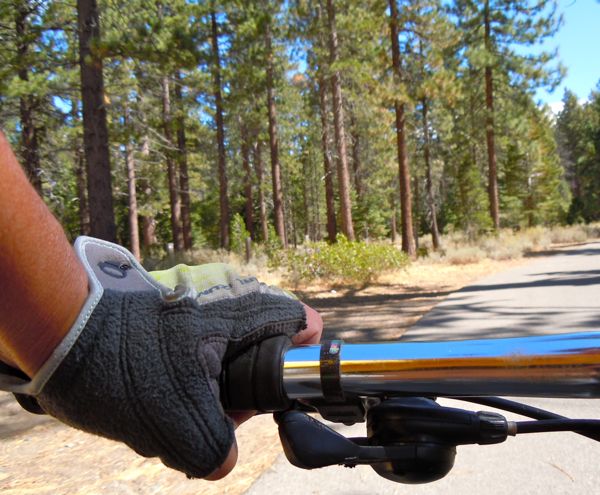
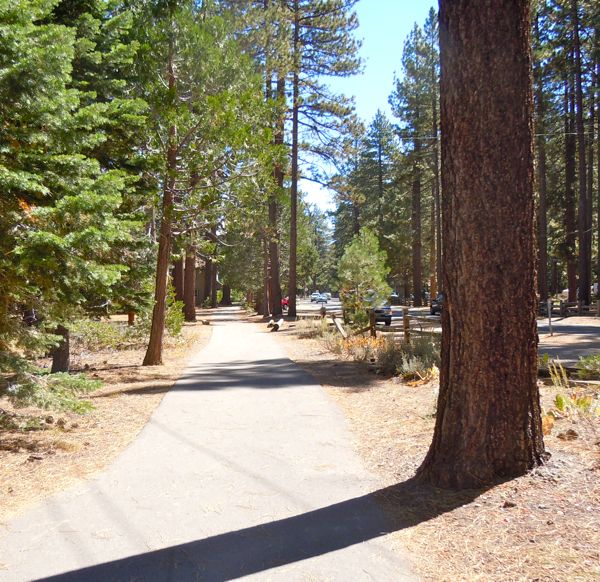
Cycling at Camp Rich may change in the coming years. Photos/Kathryn Reed

Cycling at Camp Rich may change in the coming years. Photos/Kathryn Reed

With nearly 110,000 trips – that would be one-way – on it each year, it is the most highly used path in the Lake Tahoe Basin, according to trail surveys by the Tahoe Regional Planning Agency.

The U.S. Forest Service, the landowners, want to improve the 30-year-old route so it meets current standards, connects to other trails in the area and is moved away from Highway 89.

The American Association of State Highway Transportation Officials (AASHTO) defines how trails should be configured. To meet those standards the Camp Rich route needs to be moved back five feet from the highway or a vehicle barrier installed.

Creating a two-foot shoulder of dirt or aggregate material (not paved) is another criteria. The paved trail would be 10-feet wide.

Garrett Villanueva, assistant forest engineer, said his agency is looking at the American River Trail in the Sacramento area to see if that model would work in Tahoe. The separation of user types – cyclists, walkers, equestrians – functions well on that stretch of terrain.

“We have a lot more walkers on peak days than they see on the American River path which is why it might not work,” Villanueva said. “We are going to have to figure out what works from a regulatory and user standpoint as we go through the analysis process.”

The trail doesn't meet current standards because it is so close to Highway 89.

The trail doesn't meet current standards because it is so close to Highway 89.

Environmental documents for the project are expected to be out for public comment before Thanksgiving. It’s possible the final documents could be completed in March and a record of decision by June. Ground breaking could be in 2012.

Because a definitive plan has not been created the cost is unknown. Villanueva said the Forest Service plans to go after Southern Nevada Public Lands Management Act dollars.

“Right now there are a lot of routes on the map. Some will fall off because of wildlife or archaeological constraints or we won’t be able to get the coverage necessary,” Villanueva said.

He envisions some of the current dirt trails going and others becoming official routes.

Improvements are expected on both sides of the highway and along the unofficial trail paralleling Fallen Leaf Lake Road. The idea with the latter is to provide safe access for campers to get to the bike trail.

Linking the end of the bike route at Spring Creek, connecting with Cathedral Road, making the dam at Fallen Leaf Lake crossable without getting off the bike, connecting with Fallen Leaf Lake Road, and possibly going to where the highway is four lanes are all on the drawing board.

Some popular cross country trails may become official routes, too.

Improving winter parking is another goal of this plan. Currently people park at the gate for Baldwin Beach to trek in, which can be dangerous and does not accommodate the number of users who want to re-create there.

While Villanueva works on the bike routes, his colleagues are working on the South Shore Recreation Plan that includes upgrades to Camp Richardson.

“To a large degree it is in the same configuration it has been for 50 years,” Villanueva said of Camp Rich. “The uses have changed. We are coordinating plans.”

As plans go forward, the public will have opportunities to comment. When documents are released, they will be on the USFS website.


Lane wants until 2013 to finish S. Tahoe convention center

By Kathryn Reed

Foreclosure. It is the word circulating around the bankrupt convention center project in South Lake Tahoe.

Randy Lane, principal with Lake Tahoe Development Community, wants the creditors to hold off a few more years.

“We are just asking for more time to figure things out and sell the property, which has not been well received by the city and one of the creditors,” Lane told Lake Tahoe News. “I don’t know that that is going forward. ”

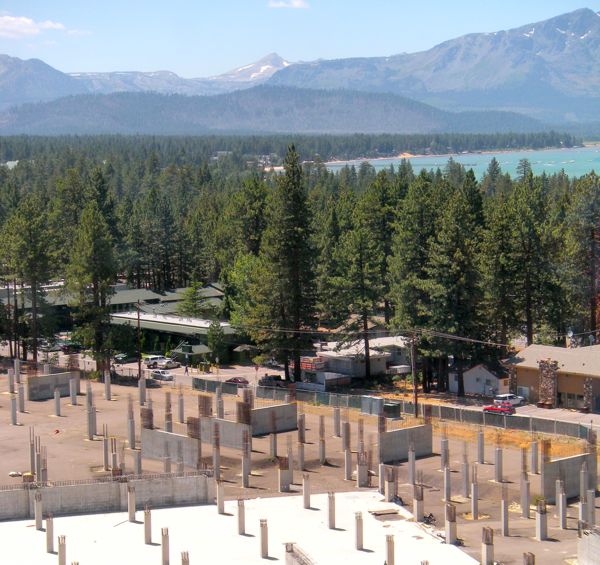
A construction zone is the view Harveys' guests have had for years. Photo/Kathryn Reed

A construction zone is the view Harveys' guests have had for years. Photo/Kathryn Reed

He knows the banks are tired of waiting.

A hearing is scheduled for Oct. 5 in U.S. Bankruptcy Court in Sacramento to discuss Lane’s latest proposal. Besides wanting to wait 2½ more years, the filing lists how the various parties would be treated.

Lane wants to be given until May 2013 to begin filling in the hole.

The project near the state line and across from Heavenly Village would have been the largest construction project in the city’s history at more than $400 million. It was supposed to have two hotels, a convention center, retail and open space. Environmental impacts were highly lauded.

Projected revenue was heady. At the get-go developers were touting 180,000 visitors a year would pump $78 million into the South Shore economy.

When ground was broken in 2007 the first hotel was projected to open two years later. Instead, in October 2009 Lake Tahoe Development Company filed for bankruptcy.

The City Council at the time signed a contract without a performance bond in place. City officials let concrete be poured and rebar installed without a final map in place.

The significance of the latter is that it means 29 parcels have to be dealt with instead of one. If the property is foreclosed on, instead of getting back dirt, most investors are still tied together because of the foundation that was allowed to be put in without the Zephyr Cove-based firm having its finances all lined up to fund to project.

Patrick Enright, South Lake Tahoe city attorney, said the city is not backing Lane’s latest proposal.

“We are saying it is way too long and a bad idea. We are not going to have a hole there until 2013,” Enright said.

Lane does have until Dec. 21 to come up with a viable plan creditors will agree to. The bankruptcy judge keeps giving him extensions to have exclusive rights.

After that date a creditor or group of them could present a plan to the court or they could foreclose. El Dorado County could also foreclose to recoup the $2.45 million in property taxes Lane has not paid.

C.L. Raffety, county tax collector, did not return a call to discuss the county’s position.

Through the Teeter Law the county has been paying South Lake Tahoe its share of property taxes, which are higher with concrete and rebar compared to when businesses were operating on the 11-plus acres. The county, when all is said and done, will collect interest and penalties on the unpaid taxes.

If no plan comes out of bankruptcy court, the county has the first chance, over all the other creditors, to file for foreclosure. It would have to foreclose on all 29 parcels. People could come forward and pay the property taxes and then they would own the parcels. If no one comes forward, the county would own the property.

With Owens Financial owed nearly $29 million, it’s doubtful the firm would walk away from this project without getting a few pennies on the dollar. Much of the property City National owns has not been touched by construction workers, so it, too, is likely to want to recoup the land to compensate for the $7 million debt it’s owed.


Tahoe-ites rid lake beaches, riverways of tons of trash

By Kathryn Reed

STATELINE — “I’m going out of state and getting trashed” is not what my Mom wanted to hear I was doing on my birthday. It was met with silence on the other end of the phone.

The truth is I’ve spent the last two nights in Nevada – out of state — even if the Lakeside Inn is only six miles from my California home. And I got trashed yesterday, on my birthday, in the sense that I participated in the annual coastal cleanup day.

Cigarette butts littered Rabe Meadow and Nevada Beach. Photo/Kathryn Reed

Cigarette butts littered Rabe Meadow and Nevada Beach. Photo/Kathryn Reed

Mom still wasn’t amused with my initial description. But she did applaud my community service.

With staying at Stateline, I arranged through Ellen Nunes of Clean Tahoe to have Nevada Beach be a satellite affiliate this year. It was great to be able to walk there from Lakeside.

With 12 of the 15 official sites reporting, Blackwood Meadow reported the most amount of trash – 1,465 pounds — collected during the three-hour campaign to rid California locations near water of trash. Lou Graves parked a truck in front of Clean Tahoe’s office in South Lake Tahoe the afternoon of Sept. 25. It was full, and included a couch.

He said this was just one of five couches retrieved from the meadow in the center of South Lake Tahoe. Graves said the truck had 19 bags of trash.

My Jeep was filled with one bag of trash and what looked like the spring of a rear Jeep seat we found near Burke Creek.

In the roughly 2.5 hours Sue and I spent walking through Rabe Meadow and along Nevada Beach we collected 228 cigarette butts, 175 food wrappers, 22 caps/lids, five pieces of glass, 12 straws, rubber from a bike tire, 91 pieces of food and other trash.

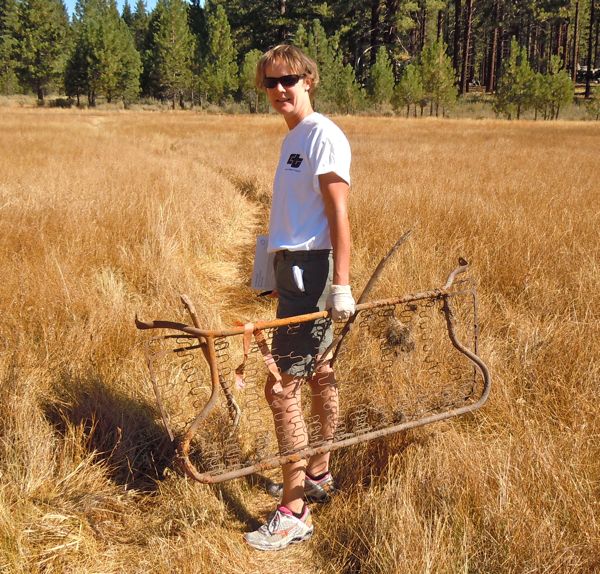
Kathryn Reed hauls outwhat looks like spring for a car seat that she found in Burke Creek. Photo/Susan Wood

Kathryn Reed hauls out what looks like a spring for a car seat that she found in Burke Creek. Photo/Susan Wood

While Sue was using profanity toward smokers, I had choice words for the people who left behind peanut-pistachio-sun flower shells.

Yes, putting out a cigarette in the sand is great. But what the heck are you thinking when leaving it there?

I love pistachios – but why leave the shells on the beach? How long do you think it’s going to take to biodegrade? And no bird wants the empty shell. Stop being lazy. Your litter is worse than the paper left behind because it blends in more with the sand.

According to Clean Tahoe’s Nunes, with 80 percent of the sites reporting, 193 people participated through her organization, 2,557 pounds of trash were collected, 266.5 pounds of recyclables were bagged, and 26 miles were covered.

These are just results on the South Shore. Coastal Cleanup is a statewide effort.

Sue Wood finds Nevada Beach isn't as pristine as it looks at first glance. Photo/Kathryn Reed

Sue Wood finds Nevada Beach isn't as pristine as it looks. Photo/Kathryn Reed

“The youngest volunteer was 18 months old, although many little ones were in backpacks. The youngest in dad’s backpack was 2 months. Our oldest volunteer was 84. Four of our volunteers drove all the way from San Francisco to participate,” Nunes told Lake Tahoe News. “I’m simply amazed at how our group pulled it together without the usual grant funding to advertise the event. Getting the word out was a grass-roots effort with each member of our organizing committee reaching out to their co-worker and friend networks. Facebook played a big role in getting the word out as well.”


Mediation fails between MV, STATA in Tahoe transit mess

By Kathryn Reed

Mediation this week failed to resolve the lawsuit MV Transportation filed against the South Shore’s transit agency and the members in the organization.

MV Transportation filed a lawsuit against South Tahoe Area Transit Authority after the agency severed the contract with the Fairfield-based company. MV had signed a three-year contract in summer 2009 to run the day-to-day operation of the bus service on the South Shore that includes BlueGo, Heavenly ski shuttles, Nifty 50 Trolley, routes to Carson City, and service into Carson Valley.

Transit on the South Shore is in a precarious predicament. Photo/Kathryn Reed

Transit on the South Shore is in a precarious predicament. Photo/Kathryn Reed

Financial issues began surfacing early in the relationship. Sources close to the situation told Lake Tahoe News MV was racking bills immediately because drivers employed by former bus contractor Area Transit Management did not pass the basic state and federal tests. This meant MV had to bring in workers from outside the area at an added premium.

Issues at the bus garage in South Lake Tahoe and maintenance of the vehicles were also problems MV had to contend with.

During this time John Andoh was the transit administrator. The board, made up of representatives from South Lake Tahoe, Douglas County, Heavenly Mountain Resort, Ridge Tahoe, Harveys, Harrah’s, MontBleu, Lakeside Inn, Horizon, and Tahoe Transportation District gave him free reign without much oversight. (El Dorado County at the time was a member, but has since pulled out; TRPA has a non-voting member on the board. They are named in the lawsuit.)

No financial wrongdoing has been alleged in regards to Andoh. He was hired to operate the buses by the Tahoe Regional Planning Agency. He wasn’t hired to keep track of expenses. He was told to make sure the buses ran. And he did.

The board didn’t know about MV’s expenses until the bills started piling up because they weren’t getting paid. MV board members have said off the record they didn’t know bills weren’t being paid. They didn’t believe it was their job to know what was going on a day-to-day basis.

MV wants its money and that’s what the lawsuit is all about. The firm claims it is owed about $2 million and wants another $1 million in lost profits.

Other than confirming there was a mediation session for the better part of a day in Reno this week, MV officials did not want to comment further.

With STATA having filed for bankruptcy on Sept. 13, MV doesn’t have much to gain from the agency. The agency owns two buses, while the members own the remainder.

Mike McLaughlin, attorney for STATA, said the attorney representing his client in bankruptcy court is going to seek to remove this particular lawsuit to bankruptcy court. This means the bankruptcy judge would rule on the lawsuit as part of the bankruptcy resolution.

It is possible MV will ask the bankruptcy judge to remand the case back to state court.

Each of the members pays a different amount into the STATA kitty, so to speak. Each, though, has an equal vote on the board. If the bankruptcy judge decides the members are liable for paying the millions of dollars, it is not known if it would be in equal payments or some method based on their annual contribution.

The 2008-09 audit as of Sept. 24 was still not posted on the BlueGo website so it’s hard to know if the document had been prepared by the federal deadline of months ago, if any information contained in it could have prevented some of the chaos that is going on now.

For now, the buses keep rolling. But the routes keep changing.

Board members have their fingers crossed that one day BlueGo’s vision statement will be more than just words and will be a reality, “The vision statement of BlueGo is to provide a transit service that allows anyone to go anywhere easily on a service that is clean, accessible, reliable, efficient and safe which hereby improves the environment and the quality of life in our resort community. “