
Dems see opportunity in a strongly GOP Tahoe district

By Chris Megerian, Los Angeles Times
 
Regina Bateson was at home trying to get her young children to fall asleep before they realized Donald Trump would be their next president. Jessica Morse was volunteering in an empty office in Colorado surrounded by the wreckage of Hillary Clinton’s failed campaign. Roza Calderon felt like she was living through a nightmare as she watched the results roll in with a friend.

None of these three women, all Democrats, had run for office before. Now they’re all vying to unseat Rep. Tom McClintock, a conservative Republican who hasn’t faced serious opposition from their party since winning his seat almost a decade ago.

The campaign could prove to be a test of just how far Democrats can reach outside their political comfort zone during next year’s midterm elections. Republicans have a 15-point voter registration advantage here. Trump won by more than 14 points.

Read the whole story


Fun in the snow focus of LTVA winter ad campaign

By Kathryn Reed

STATELINE – Snow – and all the things one can do in it will be the thrust of the 2017-18 Lake Tahoe Visitors Authority ad blitz.

They will tie into the “there must be something in the water” mantra that started in summer 2016.

The board of directors this month were shown some of the visuals that will be used in the nearly $400,000 campaign that launches the first week of December. Some are a bit whimsical with snowmen, others show actual skiing and casino scenes.

Duncan/Channon of San Francisco, the firm tasked with developing the ads and figuring out where to place them, had photographers shooting last winter. With the epic snowfall, it provided ample opportunity to highlight snow, snow and more snow.

Some ad banners are designed to run when it’s dumping here, with click-throughs going to webcams showing all that powder. Some are specific to various social media sites like Facebook. Others target those who will be flying here.

Skiing, snow play and night clubs are the primary activities that will be highlighted. Olympic references will be thrown in to capture that 2018 is a Winter Olympic year and the fact the South Shore is home to multiple Olympians.

Bob and Scarlett Hart prove even locals like to sled at Lake Tahoe. Photo/LTN file

Videos will have a huge presence. While in many ways they are just snippets of what the South Shore has to offer, they are designed to pique a traveler’s interest.

Video is shot every two years, with this being the year to film. That video will be used next winter. The plan is to film snowboarding since skiers are in the current videos. Snowmobiling, nightlife and a polar plunge are other ideas. Drones were used for much of the current footage and will likely be used this time, too.

Many videos are 15 seconds. That’s why visuals more than words are used to tell the story of the South Shore.

New this year is specific advertising to attract people here during spring break. That campaign has not been fully developed.

While Northern California is still where most people come from, LTVA continues to tap into the Los Angeles and San Diego markets.


Lessons for Nev. from prior attempt to deregulate energy market

By Riley Snyder, Nevada Independent

When Nevada voters head to the polls in 2018, they’ll be given the opportunity to fundamentally reshape the state’s energy market and end NV Energy’s monopoly control of electric service.

But what voters may not know is that Nevada came close to doing the same thing almost 20 years ago.

The state flirted with, but never consummated, a transition away from a standard regulated monopoly structure to a competitive, retail electric market in the late 1990’s and early 2000’s. Despite thousands of man-hours and countless hearings in front of the Legislature and Public Utilities Commission, state leaders ultimately backed away from the effort after watching California’s energy market implode and lead to mass rolling blackouts across the state.

Read the whole story


Ways to keep Tahoe-Truckee backcountry wild

By Jill Sanford, Moonshine Ink

As the snow settles from our most recent storm, the Tahoe/Truckee backcountry community is buzzing with anticipation for those remote, untouched lines and the fresh tracks they dream of all summer long.
 
Each winter more people opt to earn their fresh turns by hiking the local mountains rather than riding lifts, and increased use in the backcountry year-round has led to more opinions weighing in on the management of these areas.

Enter the Winter Wildlands Alliance, a national organization that advocates on behalf of non-motorized winter recreation on public lands. According to the WWA, the number of backcountry skiers is projected to increase by anywhere from 55 to 106 percent by 2060.

Read the whole story


Math scores fail to impress ZCES, WHS principals

WHS Principal Crespin Esquivel updates the school board Nov. 14. Photo/Susan Wood

By Susan Wood

STATELINE – There’s a memorable scene in the movie “Big” where lead actor Tom Hanks leaves a dinner party table to explain algebra to a boy having trouble with it.

Hanks tells the youngster to forget the X’s and Y’s.

“Let’s imagine Larry Bird is going to score 10 points in the first quarter. How many is he going to score in the whole game?” Hanks asks.

 “That’s easy — 40 points,” the boy answers in a “aha” moment.

 “OK, and that’s algebra,” Hanks says.

With the advent of Common Core, this is where teachers are heading with their math lessons – trying to find new ways to reach children. It’s one thing to know the answer. Now, students need to explain how they got there.

The topic came up at last week’s Douglas County School District meeting in which two principals – Nancy Cauley of Zephyr Cove Elementary School and Crespin Esquivel at Whittell High School – provided their school performance goals.

Both principals painted a pleasant picture on the Nevada side of the South Shore.

Cauley shared her enthusiasm over milestones ranging from the hiring of a reading tutor to the funding of a native plant walk created with 15 species of trees. Esquivel expressed glee over the restoration of the ballfield and with the popularity of the culinary arts classes. 

Both praised their programs in which teachers drop in the classrooms of other instructors to share ideas and gain insight of what works and what doesn’t. Cauley calls hers “peer classroom visits.” Esquivel labels his as the “pineapple board,” named for its hospitality inference.

“It’s helpful for us to get into each other’s classrooms and learn from each other,” Esquivel told the board.

Whatever one calls it, the program has been deemed a success to school head honchos seeking any way to improve scores and livability at school.

What the principals admitted they can’t live with are math scores.

At Zephyr Cove Elementary, math SBAC (Smarter Balanced Assessment Consortium) assessments reveal that 38.2 percent of students in third- to sixth-grade are proficient in the subject. This means most are not proficient.

The older students fared better but didn’t meet their target goals. In 2017, a little less than 77 percent of students met the advanced placement goals outlining college-level curricula. In a five-year summary, Esquivel took solace in the fact his school’s scores are higher than the state’s at 52.5 percent. Plus, there’s an upward trend at Whittell. In 2013, those scores showed 52.5 percent of WHS students got it.

Still, board President Tom Moore warned Esquivel he would “have to get a grip” on declining scores.

Esquivel nodded and insisted “we’re working on it.”

And that’s the challenge of Common Core.

“It’s a different mindset. Now, there’s a formula,” Cauley told Lake Tahoe News, standing with Esquivel after the session. LTN asked them if math is harder these days.

“We have to start them in kindergarten. There’s a multi-step process in which they have to give the rationale to their answer. It’s not enough to have the answer. And that’s Common Core,” Cauley said. “We’re asking students to do more with what they know.”

The U.S. educational standards starting in 2009 define what K-12 students should know in English, language arts and math at the end of each grade. 

Here’s an elementary school example comparing a pre-Common Core question with a post.

Pre: “Each shirt costs $4. How much do three shirts cost?”

The answer “12” can be submitted without knowing multiplication tables.

Post: “Each shirt has six buttons. How many buttons are needed to make seven shirts.”

The answer of 42 relies on a quick recollection of the multiplication tables.

 Think of it this way. Remember those math word problems from days gone by that start with “two trains were traveling in opposite directions…”?

Back then, teachers and tests were seeking one answer. Now, students must explain the process used without derailing the answer.  

This is the subjective problem some students have and parents notice.

“Everyone describes things differently and in a different way. Much depends on how it’s taught,” said Kim Felton, a parent whose son Aubrey attended all Nevada South Shore schools. Aubrey, who graduated from Whittell High a few years ago, learned enough about math to get him into college, but it wasn’t his favorite, his mother said.

Felton laid out the difference in the two teaching styles by declaring traditional math covers one subject at a time. First grade might highlight addition and gradually work up from there in each grade. Common Core demonstrates an integrated method that blends the subjects and jumps ahead before some students grasp it.

Word problems may muddy the process because there’s room for error in interpretation.

“Math is the language of numbers. What Common Core does is make it a language of words,” Felton told Lake Tahoe News.



Invasive clams tracked by their DNA

By Ben Coxworth, New Atlas

The sooner that you know an invasive species is present in your local environment, the better the chances that you can control it before it becomes unmanageable. It was with this in mind that researchers from the University of Illinois recently detected the presence of a species of invasive freshwater clam, by looking for its cast-off DNA in lake water.

Working in collaboration with colleagues from Rice University, the University of Notre Dame and UNR, the scientists performed an eDNA assay – eDNA stands for “environmental DNA,” and refers to DNA that is passed into the environment in the form of excretions and other biomaterials.

Read the whole story


Placing blame for NorCal’s deadly fires

By Sonali Kohli, Los Angeles Times

More than two dozen investigators have spent weeks scouring wine country trying to solve the mystery at the heart of the most destructive wildfires in California history: What caused the infernos that killed 43 people and destroyed more than 8,000 buildings?

The answers will have wide-ranging ramifications for the region, which faces staggering losses and a challenging rebuilding effort. Losses from insured properties alone are expected to far exceed $1 billion, and the total bill for the fires will be still higher. Just fighting the fires cost $189 million, according to CalFire

CalFire is likely to take months to determine the official cause. But in wine country, there is already one prime suspect: utility giant Pacific Gas & Electric.

Read the whole story


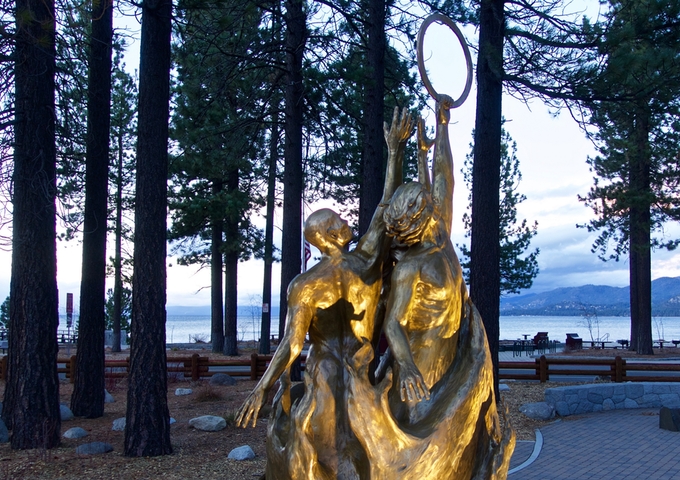
Opinion: SLT taxpayers fund sexist sculpture

South Lake Tahoe’s champions statue treats women as inferior to men. Photo/Kathryn Reed

By Kathryn Reed

Champions Plaza in South Lake Tahoe was developed to recognize athletes in the area who have reached statewide, national or international recognition in their sport. It was never intended to be just about Olympians or three in particular.

Nonetheless, the idea was born out of the trio who became known as the Golden Girls – Jamie Anderson, Maddie Bowman and Hannah Teter. All have won gold medals in their disciplines at a Winter Olympics, all live in Meyers, and all ride for Sierra-at-Tahoe.

Next year the inaugural inductees will have their names engraved into the Walk of Champions. They include: Anderson, Bowman, Teter, Elena Hight, Glen Plake, Jonna Mendes, Kyle Smaine, Shaun Palmer, Travis Cabral and Travis Ramos. Perhaps not surprisingly they are all either a skier or a snowboarder.

Let’s hope other sports are soon brought into the fold.

I know who I’d nominate: the 2010 3.5 senior women’s tennis team from Zephyr Cove. They won the national championship that year.

The Zephyr Cove team included Becky LeBuhn, Yrma Haro, Diane Baker Roberts, Patty Yamano, Charna Knerr, Becky Darrow, Susan Glasson, Linda Vollenhals, Karen Neri, Carel James, Carla Paterson, JoJo Conroy, Eddi Quiggle, Julie Zeid, Carol Faccinetti, Mary Rey, and Sandy Paul.

It was up to Neri, captain of the team, to choose who went to nationals in Indian Wells. She picked herself along with Roberts, Vollenhalls, Haro, Zeid, Kerr and Rey.

But it takes an entire team to qualify for playoffs, then districts, then sectionals and ultimately nationals. That’s why all of the women (and one would be posthumously) deserve to be inducted into the Champions Plaza.

In 2015 the City Council approved the criteria and nomination process for future Champions Plaza inductees.

The city is to be commended for carving out a part of Lakeview Commons to honor athletes. We are an athletic bunch, competing in an array of sports.

A sculpture was commissioned and last month the Spirit of Competition was installed. It’s even more magnificent at night illuminated by a handful of lights.

It is Gareth Curtiss who created this nearly 11-foot bronze work of art.

When the City Council saw the first version the three beings were clearly male. Anderson, who is a native of the South Shore and won gold in slopestyle in 2014, voiced her disappointment to those who would listen – as did others. The council told the artist to try again. Curtiss listened. One of the three is a woman, the other two are clearly male.

I first noticed the art piece earlier this month, driving by with my mom and two of my sisters. I explained to them how it came to be. We swung into the parking lot, got out and looked at it. And we all had a similar reaction – what the hell?

One of the male figure’s hands is on the ring, while the other two are reaching for it. I felt like I had been hit in the gut, the wind knocked out of me. This sculpture is an assault on all women – athlete or not. It is hard to believe two female councilmembers and a woman city manager could sign-off on what is clearly a piece of work that puts women in second place (second class?) again.

“I honor the artist’s interpretation of the spirit of competition with those in competition reaching for excellence as represented by the ring,” Councilwoman Wendy David told Lake Tahoe News, adding that she “approves” of the sculpture as is.

JoAnn Conner was the councilwoman at the time.

I say shame on anyone who had something to do with approving this $75,000 sexist piece of art.

All hands should have been on the ring or none at all.

Maybe I won’t nominate that tennis team; maybe Douglas County will figure out a way to honor athletes without a gender bias.

Kathryn Reed is publisher of Lake Tahoe News.


Proposed federal budget, tax cuts could stunt affordable housing

By Michelle D. Layser, The Conversation

Low-income Americans are already struggling to keep a roof over their heads due to a growing affordable housing shortage.

But budgets drafted by the Trump administration and Congress, along with provisions in the tax cut package, are bound to make matters worse.

As a researcher who studies the intersection of tax law and housing policy, I am concerned about how these proposed changes would reduce the volume of new housing for low-income people and cut aid that people facing economic hardship use to cover their rent.

The federal government stopped building public housing two decades ago after years of declining construction. Although it has demolished many of these homes, the government continues to own and rent out about 1.1 million of these units.

Read the whole story


Calif. pot rules open way for potentially larger fields

By Associated Press

California released long-awaited rules Thursday that will govern the state’s emerging legal marijuana industry, while potentially opening the way for larger-scale cultivation that some fear could strangle small-farm growers.

The thicket of emergency regulations will allow the state to begin issuing temporary licenses for growers, distributors and sellers on Jan. 1, when recreational sales become legal.

They provide a regulatory roadmap for business operations, from licensing fees to establishing guidelines for testing, growing and distribution of marijuana in what is projected to be a $7 billion economy, the nation’s largest.

Read the whole story