Lights on South Tahoe High football field to be permanent

By Kathryn Reed

Sam Borges won’t be at the dedication of Viking Bowl next year when the South Tahoe High School football team takes the field on its lighted artificial turf field. But his three sons – Don, Dave and Dwight — likely will be, along with his widow, Rosie.

Sam and Rosie Borges talked for a decade about putting lights on the gridiron. Unfortunately, Sam Borges died earlier this year before the dream was realized.

Speaking to the Lake Tahoe Unified School District board of trustees on Tuesday, Don Borges became choked up talking about his parents’ dream. As athletic director of the school, he will be instrumental in pulling off this endeavor.
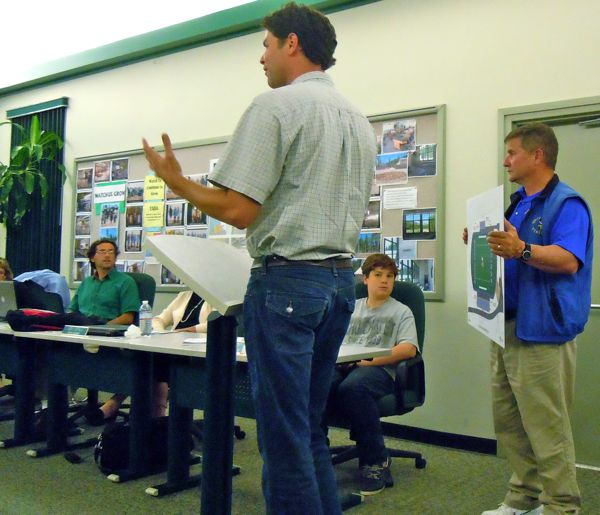
Don Borges, right, holds a rendering of the football while architect Brett Long talks about it. Photo/Kathryn Reed

Don Borges, right, holds a rendering of the football field while architect Brett Long talks about it. Photo/Kathryn Reed

On Oct. 12, the board voted 5-0 to go forward with the nearly $1 million project that could be completed by the 2011 season.

Temporary lights have been brought in twice this season. The inaugural event drew out about 1,000 people, and last week’s romp over Sparks saw about 800 in the stands.

Principal Ivone Larson read an almost poetic account of how those two games have brought the school and community together, and then delved into what a renovated, permanently lighted facility would mean to the school and town.

Besides being a moneymaker at $6 a ticket, the vision is the field could be rented to outside interests.

Chuck Leonard, president of the local Pop Warner association, said he has had calls from semi-pro leagues wanting to have games in South Lake Tahoe. Today, no field can accommodate them.

What the board approved Tuesday will allow Leonard to say “yes” in the future when people call.

Leonard spouted figures of 22 weekends a year being available to athletic teams wanting to use this as a football or soccer field that could infuse $150 million to $175 million into the economy.

The turf and lighting are expected to cost about $1.057 million. The district has a donor lined up to contribute $120,000, and will work on a match of $120,000 from the community. Until the agreement is signed, the donor’s name is not being released. This brings the cost to the district for phase one to $817,000.

The plan is to do phase one and two simultaneously. Phase two includes a concession stand that is likely to be LEED certified with ADA compliant restrooms. Spectators now use bathrooms at Mount Tallac High or the new building on STHS’ campus. But the American with Disabilities Act compliant facilities were going to need to be built sooner rather than later, which is why the district wants to expedite that aspect of the plans.

The anonymous donor has pledged $180,000 toward phase two.

Total for the district for the two phases would be $988,050. The money would come from developer fees. Those dollars can only be spent on construction projects. Less than $1.5 million is in that account now.

The third phase, which does not have a timeline, would get rid of the current bleachers. It would provide 1,000 seats on the home side, and 500 for visitors at a cost of $407,000.

Brett Long of Brett T. Long Landscape Architecture had a rendering of what the field could look like – including the Viking logo in midfield.

The footprint would encompass about 95,000 square feet. The oval would not be a regulation size track, but could be used for training – not meets.

School officials envision the artificial turf providing more opportunities for physical education classes because the field could be plowed in early spring. Plus, spring sports would now have a place to practice instead of going to the Carson Valley.

When it comes to raising money from the community, the plan is to sell blue and gold bricks (school colors) for $100 and $200, respectively, that will have the donor’s name on it. They will be incorporated into the design of the revamped stadium.

When the track and field at South Tahoe Middle School was constructed a few years ago about $700,000 in cash was raised and roughly $400,000 in in-kind services provided. District officials realize that kind of giving isn’t likely to happen in these economic times, but they are confident the town will come through with $120,000 to seal the deal.

To donate, call Angie Keil at (530) 541.2850, ext. 225.



El Dorado supes’ budget shakeup impacts Tahoe office

By Kathryn Reed

An effort for El Dorado County Board of Supervisors to be on equal financial footing isn’t working out that way, according to some supervisors. The Tahoe office was hit the hardest.

countyWhen the preliminary 2010-11 budget was passed in June each supervisorial district was allocated about $225,000. In September, that was reduced to $193,500.

It was Supervisor Jack Sweeney’s idea last month for each of the five districts to have a pot of money instead of it being one pot for the whole board. From those individual pots the salaries of the supervisor (about $75,000) and of the assistant (it varies), health benefits, retirement, phone, car, mileage, and other expenses are paid.

Norma Santiago, who represents the South Shore, is being hit the hardest. She is no longer being reimbursed for mileage or cell phone expenses. Her assistant, Judi McCallum, will work 36 hours a week.

Santiago drives to Placerville nearly every day from her home in South Lake Tahoe, thus incurring more gas bills than some of her colleagues. Tahoe also has a separate office, while the other four only work out of the county seat.

“I am not going to change my work schedule. I am very dedicated to this job,” Santiago said, even though she will have less cash in her pocket.

Supervisor Ray Nutting has the largest swath of land to represent, so he, too, regularly fills his gas tank.

Supervisor John Knight and Santiago’s assistants are at the top of the pay scale because of the length of time they’ve been with the county – a hit to their bottom line.

Another discrepancy in costs is which health plan a supervisor is on and how many dependents he/she has as well as what plan their assistant is on. For those in Placerville, Kaiser is an option. The Tahoe plan is more expensive.

With the change in allocations, Santiago and Nutting are hit the hardest, Knight is close to breaking even, and Supervisor Ron Briggs has offered his surplus to help Santiago and Nutting. Sweeney’s excess of more than $30,000 is in his account for now.

Sweeney and Briggs could not be reached for comment.

“I made the motion to cut our salaries,” Nutting said.

That proposal will likely be before the board later this fall. It takes a change to the county charter to make that happen. Nutting would have preferred that to occur before the current financial structuring took place to keep things even.

Even if three votes could be obtained for a salary cut, in the case of Sweeney, he would still have a surplus. One reason he has fewer expenses is he’s on Medicare and has no dependent children.

While Santiago supports the pay cut over the current scenario, she doesn’t think the votes are there for it to pass.

Knight won’t be the third vote.

“I think it’s grandstanding,” Knight said of Nutting’s proposal. “I don’t think he thought it out. I think it’s political.”

Knight said he has never taken a dime of reimbursement pay from the county for things like medical insurance, phone or mileage.

Nutting said it costs him about $600 month in expenses to be a supervisor. No longer is he being reimbursed for his cell phone, though he says 99 percent of what he uses it for is county business.

“There is a lot of stuff going on that I don’t care for,” Nutting said in regards to the supervisors’ budgets. He agrees things need to be cut, but he doesn’t like the way it is happening.

With the added expenses, Santiago said it would be more like a 30 percent pay cut for her. She agrees the board needs to make cuts just like it is imposing on employees, but she believes it could be more fair.

“In the past there was one budget for the board. My proposal would be to look at the resources that are needed for each district, which would be a far more equitable way of doing this,” Santiago said.

The Board of Supervisors is having its annual Tahoe meeting this morning at 9 at Lake Tahoe Airport.


Experts to dissect Mother Nature’s snowy dangers

By Susan Wood

When author Jennifer Woodlief wrote acknowledgements in her book “A Wall of White” about the 1982 Alpine Meadows-area avalanche that killed seven, she thanked snow expert Jim Plehn for explaining the difference “between a snowflake and a pure stellar crystal.”

This kind of knowledge goes a long way in the Sierra Nevada Mountain Range, where a freak storm can mean the difference between living or dying, and a wet, heavy layer on top of ball-bearing soft flakes can turn a good time in the wilderness into a scary day.

Just ask the avalanche forecasters and controllers about the Lake Tahoe region. It is challenging terrain because the masses tend to show up on skis, boards and snowshoes for this world-renowned resort area – turned winter wonderland to ride the slippery surface.

The deadly 1982 Alpine Meadows avalanche will be discussed at this month's climate symposium.

The deadly 1982 Alpine Meadows avalanche will be discussed at this month's snow science symposium.

And because more people who play in it test the backcountry each year, the masses of snow experts trained to protect and rescue them are booking reservations for the 2010 International Snow Science Symposium.  More than 900 attendees are expected to turn out for the Oct. 17-22 workshop at Resort at Squaw Creek.

Woodlief will speak next Monday at 8:30pm in the resort’s Grand Sierra Ballroom about her book’s account of Alpine’s monumental snowstorm and subsequent massive slab avalanche that roared over and buried buildings and people. The worst avalanche in Tahoe history occurred a few miles from the conference.

The public is invited to the talk, without registering for the conference. The conference costs $325 for five days. Attendees may also sign up for individual days.

A slew of subjects will be covered ranging from snow stability and thermal photography to snowpack properties and the state of the explosives industry. The lecture halls will give way each day to field observations and a social agenda. Product demonstrations will also be on hand.

One example: There’s an avalanche airbag of sorts that can deploy like a parachute from a pack for a snow rider to float to the surface of a moving avalanche. Another featured device, which looks like a snorkel, allows a buried skier or hiker to breathe under snow.

“We think for the regular recreationalist, there is value,” said Lel Tone, the event chairwoman and Squaw Valley ski patroller.

While novices make not understand the subject matter, workers in the field may be joined by the growing number who venture into the conditions that command expert technology and information.

Mike Laney, event registration chairman and avalanche program director for the National Ski Patrol System, believes increased development in mountain towns with increased interest among people to tread into avalanche-prone areas makes these conferences necessary and crucial to risk managers, patrollers, search-and-rescue volunteers, land-use managers and scientists. Laney is a retired science teacher.

The mantra of the symposium, Laney explained, is “merging theory with practice.”

“I’ve had a few close calls in the wilderness, none of which would have been helped with modern technology, but almost all would have been avoided if I knew what I know now,” Laney told Lake Tahoe News.


Expansive views of Lake Tahoe from Snow Valley Peak

By Kathryn Reed

SPOONER SUMMIT — One of the hazards of wanting to get some incredible views of Lake Tahoe is that it takes a bit of climbing. But those 2,000-feet of uphill to get to Snow Valley Peak are worth it.

Fortunately, it’s not one of those grueling routes that make you think housecleaning would have been a better activity. But it isn’t something parents with little kids are going to want to try.

The six miles (one way) are part of Tahoe Rim Trail.

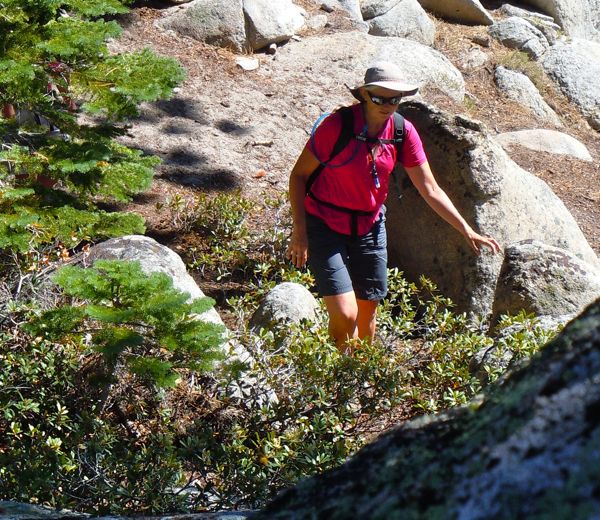
Brenda Knox on her way to Snow Valley Peak. Photos/Kathryn Reed

Brenda Knox on her way to Snow Valley Peak. Photos/Kathryn Reed

“The trail beyond here is incredible,” Brenda Knox says of the area past our turn around point at Snow Valley Peak. She has done the entire 165-mile TRT.

Mount Rose would be the next exit point of the Tahoe Rim Trail. Sand Harbor isn’t far away, but it’s not visible from the part of the trail we’re on. Part of this route is used for the Tahoe Rim Trail’s endurance run.

Even though the four of us did an out and back on this September Saturday, it’s possible to do a circle by going down to North Canyon Road. This is the dirt road mountain bikers use to access the Flume Trail. It means having to circle around Spooner Lake at the end.

Now the fall colors should be in abundance.

We start our morning at 7,146 feet at Spooner Summit. Snow Valley Peak is 9,214 feet.

Several signs along the mostly soft dirt trail say “vista point” so hikers can go slightly off the trail for views of Lake Tahoe and the Carson Valley. Seeing both at once is always such a contrast in what this area has to offer — the liquid blue alpine lake v. the barren high dessert.

Camping in this area must be done in designated sites. Signs point the way. These are the rules of Nevada’s Lake Tahoe State Park.

Up we go, passing beneath towering pines that are spaced so the terrain can be enjoyed without feeling closed in. Shrubs are close to the ground, including Manzanita.

The sign says 1.5 miles more as we are about to begin the trek across the ridge. The four of us agree it feels like a whole lot more than 1.5 miles.

A few wildflowers are out, but not many.

Lake Tahoe unfolds below us. This is one of those hikes where the size is so obvious. Often it doesn’t look 22-miles long or 12-miles wide.

Directly across from us the mouth of Emerald Bay opens up, with the peaks of Desolation Wilderness looming over her.

From this vantage point it’s obvious how Fallen Leaf Lake is at a higher elevation than Tahoe.

The wind is whipping. It’s only Labor Day weekend and fall is definitely in the air. We take shelter behind a small rock outcropping to have lunch before making our way down. Marlette Lake is a short distance from us.

But it’s the views of Lake Tahoe that make this 12-mile roundtrip hike worth doing over and over again.

Getting there:

From South Lake Tahoe take Highway 50 to the top of Spooner Summit. Just past the turn off for Highway 28 is a small parking area on the left for the Tahoe Rim Trail. (You may feel like you’re headed to the Carson Valley because it’s just over the crest.) Park, walk. Trail goes to the right for the peak, to the left for Spooner Lake.

It’s also possible to access the trail by parking at Spooner Lake, but it costs money to do that.

ngg_shortcode_0_placeholder (Click on photos to enlarge.)


Ed Foundation providing ‘extras’ to S. Tahoe students

By Kathryn Reed

Excited energy fills the rooms. Youngsters are eager to get outside and start pedaling.

These 22 Bijou Community School students are willingly extending their school day. They are part of the weekly Bike Club.

Other classrooms are also abuzz after school each week as teachers and parents volunteer their time to lead one of the 10 clubs. Ballet and cross country skiing will be added in December.

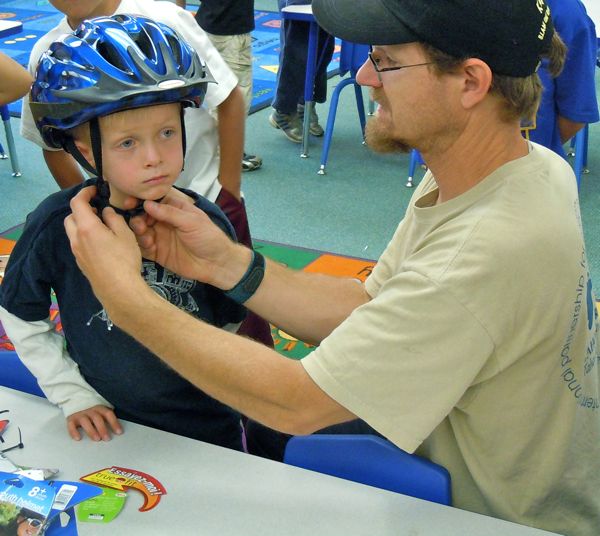
Jackson Trew, 5, has his helmet fitted by Pete Fink. Photos/Kathryn Reed

Jackson Trew, 5, has his helmet fitted by Pete Fink. Photos/Kathryn Reed

“One teacher is doing a computer class. There were so many who wanted in she’s doing it every Tuesday instead of every other,” explained Principal Karen Tinlin.

These clubs – which range from sports to rocketry to cooking – are in their second year. Participation keeps growing – with half of the student body in at least one club. The offers change, too, to keep things fresh and relevant.

Supplemental dollars have long been the source of keeping schools filled with the extras, that generations ago were considered the basics.

One of the key funding sources for students in Lake Tahoe Unified School District is the Lake Tahoe Educational Foundation. This nonprofit volunteer-run foundation is all about providing cash with few strings attached.

The Ed Foundation is paying for these after-school programs.

“We want to generate something that won’t otherwise be able to be done because of the current economics in the school district and No Child Left Behind’s focus on test scores,” said Chris Campion, president of the Ed Foundation.

But a check is not just written. Each school must apply for the money, explaining in detail where it will go and how it will benefit students.

For the past few years the Ed Foundation has been working with the school sites on enrichment programs like the after school clubs at Bijou. Before that the Foundation was responsible for spending thousands of dollars to keep class-size reduction in lower grades.

“Well, LTEdF is wonderful. Do I need to say more? Also, this year, Dr. Greg Bergner, a LTEdF member, is doing our Rocketry Club,” said Kathy Haven, an active Bijou parent. “He approached us after seeing my presentation for the foundation. So, now LTEdF is giving us financial backing and a volunteer to boot.”

Although the clubs are designed to be fun, education is still part of the mix. Before anyone goes riding around the South Tahoe neighborhood where Bijou is located, parent volunteer and bike guru Pete Fink makes sure helmets are fitted correctly, brakes are in working order and students know the rules of the road.

This is Hannah Lucas’ second year in the bike club. The 8-year-old has learned the importance of checking tires for flats before heading out.

The Foundation gets the bulk of its money through the annual Food Fest. The Oct. 15 event is casual, centered on eating and drinking with friends. Membership is another form of income. Donations are always accepted.

Other things the Foundation has funded are the Mad Science program out of Sacramento doing presentations at all the elementary schools, money for music/choir groups, and mini-writing sessions for eighth-graders.

“We are taking a more broad-based approach to providing enrichment for all of the kids to increase their curiosity, to increase their ability to dream what they want to do with their lives,” Campion said.

Food Fest details:

Website

Date: Oct. 15

Hours: 6:30-10pm

Location: Harveys Convention Center, Stateline

Cost: $35 in advance, $40 at the door

ngg_shortcode_1_placeholder (Click on photos to enlarge.)


Heavenly’s new leader bullish on ski resort’s future

By Kathryn Reed

Pete Sonntag comes across as a man who would rather be answering questions on a chairlift in between runs than sitting in his spacious office.

As the new leader of Heavenly Mountain Resort, he’s eager to get on the mountain – he skis and snowboards. After all, the former Vail ski and snowboard school director has only skied his mountain 1½ days.

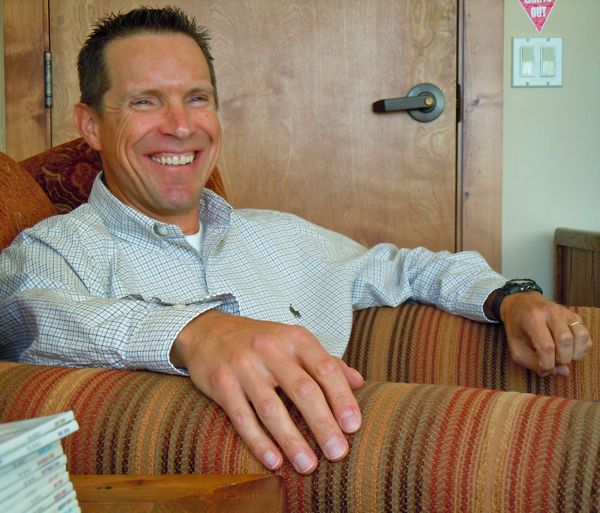
Heavenly GM Pete Sonntag is eager to make some turns. Photo/Kathryn Reed

Heavenly GM Pete Sonntag is eager to make some turns. Photo/Kathryn Reed

When he spent the summer of 1997 in Reno many of his days were on the trails in the basin, climbing most of the higher peaks.

Having started his job in August, he’s been familiarizing himself with the area via his running shoes and bicycles. He’s passionate about cycling – road and mountain.

It’s not just the outdoor terrain Sonntag is getting used to. He headed west knowing Lake Tahoe can be a difficult work environment.

“I did come in knowing there were challenges,” Sonntag said in a wide-ranging sit down interview with Lake Tahoe News.

He believes the resort has a strong team in place so he’s relying on those players to steer him through landmines before he gets a feel for the lay of the political and regulatory landscape.

“I want to have a positive impact on our company and community,” Sonntag said. “I would say we’re in a period of transition in our company. We are actually looking to make the company stronger. That’s reflected in restructuring at the highest level.”

Sonntag reports to Blaise Carrig, former chief operating officer at Heavenly, who is co-president of the Mountain Division. Sonntag’s titles are general manager and vice president. He is running the day-to-day operation at the bi-state resort.

Sonntag says a similarity between them is being competitive. A couple things setting the two men apart are Sonntag will live at the lake, while Carrig lived in the valley. Sonntag has children – ages 6, 8 and 10. Plan to see the Sonntag gang at the South Lake Tahoe Ice Arena a lot – the kids are big into hockey.

Sonntag expects being in the community as a dad will allow him to hear plenty of “unfiltered feedback.”

He’s optimistic Heavenly will have another profitable winter. Although on-mountain figures were good for Vail Resorts last season, the company’s overall numbers were down because of the real estate sector.

Still, Sonntag believes the ski industry is rebounding.

“I feel like it’s the strength of the brand at each (Vail-owned) mountain, which is built on great guest service,” Sonntag said. “People still value time with their family. A ski vacation is incredible. It’s a valuable way to spend time with your family.”

Looking forward, Sonntag won’t point to what the next improvement to the resort will be beyond the Feb. 1 opening of Tamarack Lodge near the top of the gondola.

“Every year we need to look at what needs to be done immediately, then three to five years, and what might be done in 20 years,” Sonntag said. “It’s an ongoing conversation. There are a lot of ideas.”

He said it would be a matter of prioritizing the ideas, and analyzing the impacts to the company and guests.

“We’re bullish about the future,” Sonntag said.


Tamarack — Heavenly’s first lodge in 30 years

By Kathryn Reed

Skiers might not like to admit it, but sometimes a resort is more than the mountain. Heavenly knows this and is doing what it can to add to the overall experience for its guests.

The Tamarack Lodge near the top of the gondola won’t just be a winter escape. The multi-million dollar year-round lodge will open in February. For non-skiers and in the offseason it will provide a place to relax – perhaps after hiking in the area.

Crews work on the Tamarack Lodge at Heavenly. Photos/Kathryn Reed

Crews work on the Tamarack Lodge at Heavenly. Photos/Kathryn Reed

With the weather being agreeable this fall, SMC Contractors (the same firm doing the work at South Tahoe High School) is ahead of schedule. But that doesn’t mean Mother Nature won’t lash out and slow the process down.

Heavenly is striving for gold LEED certification from the U.S. Green Building Council.

“It will look totally different (than the other lodges). It has a retro feel with a lot of exposed lumber,” Russ Pecoraro, spokesman for Heavenly Mountain Resort, said. “People will want to hang out there.”

Exposed lumber right now is a fitting description. Framing began in September after the August groundbreaking, with the roof following shortly there after. Plenty of floor-to-ceiling windows and outdoor seating will allow for expansive views of runs off Tamarack chair.

Entrances are on either side of the building.

Five themed food stations will be available, though the themes haven’t been revealed. Expect burgers to be one because that remains the No. 1 seller.

A bar, TVs – all part of the lodge. The goal is to make it comfortable, not have a cafeteria feel.

The Umbrella Bar that has been in a tent-like structure for a few years will remain through the winter. Then the plan is to take it to Snow Beach.

The terrain park with its 100 percent recycled features is going to be put back on Cascade run. This could provide quite a show for people at the lodge. Sam’s Dream and 49er are the runs to the left if one were sitting at the lodge.

With 500 indoor seats and 250 outdoor, officials expect this to be the place to congregate. Added to this is the ski school works out of here and the tubing hill is walking distance from the lodge.

The magic carpet had to be moved to the skiers’ left side of the Big Easy Chair. The yurts will stay.

After the lodge is open and a traffic pattern develops, resort officials will figure out if changing the flow of skiers will be necessary. How that might be achieved would need to be worked out.

The primary reason for the lodge is Heavenly, which straddles California and Nevada, lacks on-mountain facilities. The master plan calls for two more lodges – Powder Bowl and Sand Dunes. No construction date has been set for either one.

East Peak, which was erected in 1970, is the last lodge Heavenly built.

Since Vail Resorts bought Heavenly in 2000, nearly $60 million has been pumped into the South Shore resort. With the recent change in chief executive officers, dollar figures are harder to come by from folks in Colorado, so there is no public price tag for Tamarack Lodge.

By the time the resort opens Nov. 19 the area will look much less like a construction zone. Adventure Peak Grill will serve food until Tamarack has its kitchen open.

Follow the progression of Tamarack Lodge on Heavenly’s website. Do a search on Tamarack.

ngg_shortcode_2_placeholder (Click on photos to enlarge.)

Publisher’s note: On Oct. 8, read what Pete Sonntag, Heavenly’s general manager, has to say.


TTD to keep BlueGo buses rolling on the South Shore

By Joann Eisenbrandt

The wheels on BlueGo buses have been going round and round for years, but they have not been able to get riders to their destinations efficiently, reliably and affordably. The City Council is hoping its unanimous approval of an interim funding and service agreement between the city and the Tahoe Transportation District on Oct. 5 to manage the coordinated transit system most recently run by South Tahoe Area Transit Authority will be a positive new step.

bluegoTTD was created under Article IX of the Tahoe Regional Planning Agency Compact. Its board includes representatives from the public and private sectors. TTD is responsible for implementing transportation plans and projects, and can own and operate transportation systems and/or facilities. Under the contract approved Tuesday, it will be the governing body of BlueGo, responsible for its day-to-day management.

A South Shore Transit History

Bus service the on South Shore has a long, but not always successful history. In 1985, local Ken Daley formed ATM (Area Transit Management) and began running STAGE (South Tahoe Area Ground Express), the predecessor to BlueGo. Daley sold ATM in 2006. Operational and financial problems followed under the new ownership. In late 2008, ATM abruptly stopped service, leaving the buses and bus barns in disrepair.

STATA, a nonprofit Nevada umbrella agency, was formed to create a coordinated public/private transit management entity. Funding for STATA came from grants, state and federal governments and money from the member partners, which included the South Lake Tahoe, El Dorado County, Douglas County, TRPA (non-voting), TTD, Ridge Resorts, Harrah’s, Harvey’s, Lakeside Inn, MontBleu, Horizon and Heavenly Mountain Resort.

STATA contracted with MV Transportation to run the transit service, which included BlueGo, Nifty 50 Trolley, Heavenly ski shuttles, and routes to Carson City and the Carson Valley. MV faced financial challenges from the outset. Cleaning up the problems left by ATM was expensive. STATA worked on a cash-in cash-out basis. From the start, more cash was going out than coming in. Service reductions and bus route manipulation didn’t solve the problem. In May 2010, MV threatened to walk away if it didn’t get the more than $2 million it contended STATA owed it. In late May, STATA terminated MV’s contract.

STATA then contracted with TRC Consultants, a firm it had used earlier to assess the system and make recommendations on cost savings. MV Transportation filed lawsuits against TRC, STATA and its individual members. STATA’s assets were frozen; the lawsuits remain unresolved and mediation has so far been unsuccessful.

STATA subsequently made route and service changes, eliminating Meyers Route 40 and Zephyr Cove Route 22 and enhancing Highway 50 service from 60-minute to 30-minute intervals to fill in the gaps.

In late June, El Dorado County pulled its $181,000 in funds allocated to STATA for fiscal year 2010-11. County concerns focused on liability because they were not on the certificate of insurance, and on STATA’s failure to release the 2009 state audit.

In July, STATA brought in TTD to handle the day-to-day transit operations through Sept. 30, 2010. TRC retained its earlier contract to actually run the buses. Rumors about STATA filing for bankruptcy had been swirling for some time, but had been consistently denied. State and federal agencies had become nervous about their precarious financial situation, with the Nevada Department of Transportation threatening to pull their funding because of the instability. On Aug. 13, 2010, the STATA board voted to file for Chapter 11 bankruptcy protection in Nevada.

At its Sept. 10 meeting, the STATA board approved more route changes, including the elimination of Routes 52, 54 and 55. These changes became effective Oct. 3.

Handoff to TTD

The transit hot potato is now in TTD’s hands. The money the city will use to fund the agreement come from the state under the Transportation Development Act (TDA), one of the main sources of public transit funding in California. No general fund monies will be used.

TTD also signed a lease agreement for use of the South Tahoe transit facilities, including the bus garage on Shop Street and the South Y Transit Station on Emerald Bay Road at $3,000/month, and a license agreement for the Y transit facility, Stateline Transit Center and all bus stop locations in the city.

“Each entity that is a part of STATA is giving TTD their assurance that the funding they provide now to STATA will continue as TTD takes over management of the transit service,” said Assistant City Manager Rick Angelocci.

City Attorney Patrick Enright explained to the council that this is a “short-term resolution” to the problem, which will allow time for STATA’s future and pending lawsuits to be resolved. The TTD board is expected to approve the agreement next week.

Not everyone thinks this is the best solution. Councilman Bill Crawford told Lake Tahoe News, “TRPA is a total failure when it comes to public transportation in the basin. They are supposed to be the planning deity. If we want a regional transportation system in the basin, it should be federally funded, since TRPA was created under a federal charter. It should be TRPA’s responsibility.”

Crawford added, “STATA had too many players. The city had a reliable bus system that worked years ago. It should run its own system, one with fares that the working class citizens of the community can afford.”

When asked by LTN why the city doesn’t consider running an independent bus system again, Angelocci cited inconsistent funding.

According to Angelocci, STATA designed its routes and services based on the total amount of funding it expected — close to $5 million — when in fact the actual funding received was about $3.6 million.

Tahoe transit’s future

As of Sept. 30, most members of STATA had withdrawn their funding from that entity and provided letters approving the takeover of the transit system by TTD. Lakeside Inn, Ridge Resorts, Heavenly and TTD remain part of STATA.

At present, STATA still exists, but should board members choose to file Chapter 7 bankruptcy, the entity will then dissolve and their assets and funds will be distributed according to bankruptcy law.

TTD does not want this management role long-term. An RFP will go out in December. The precise configuration of that RFP, Angelocci explains, will determine “who takes over and does what. TTD could retain part of the responsibility, or none, but this RPF will dictate the future of our transit system.”


Judge: Lakeview Commons’ future in SLT council’s hands

By Jeremy Evans

South Lake Tahoe discovered last month that it was operating under an invalid contract with construction company Reeve Knight, the contractor selected to complete the Lakeview Commons project.

On Monday, El Dorado County Superior Court Judge Steve Bailey ruled the city needs to start the bid process all over again, a decision that will derail any improvements to the El Dorado Beach area until at least next spring.

“We expected the judge to send it back to the city,” said City Attorney Patrick Enright. “Now we need to decide what we will do next.”

The city will meet on Tuesday in a closed session to evaluate its next move, although the city is likely facing two options. It can either appeal the judge’s decision within 30 days or it will turn the bid process back over to the City Council, which would restart the process of accepting bids for the project.

The future of Lakeview Commons is uncertain. Photo/Kathryn Reed

The future of Lakeview Commons is uncertain. Photo/Kathryn Reed

If the closed session results in a decision that the project’s fate be handled by the City Council, it will discuss the matter at its next meeting on Oct. 19.

“We might wait until the full 30 days are up before we do anything or we could turn it over to the City Council to decide,” Enright said. “We will go over our litigation options tomorrow in the closed session.”

Bailey could have ruled that the city had to award the bid to Clark & Sullivan, the Sparks-based firm that brought the case to court. While Reeve Knight was awarded the bid on Aug. 3 on a 4-1 vote by the City Council, Clark & Sullivan challenged the awarding of the $4.5 million bid after excavating had begun. Bailey issued an injunction on Aug. 30 that halted construction, and then ruled in mid-September that the contract was void and invalid.

Since construction will remain at a standstill until spring at the earliest, Bailey signed an executive order to ensure proper winterizing of the property, per requirements by the Tahoe Regional Planning Agency and the Lahontan Water Board.

Calls from Lake Tahoe News to both Clark & Sullivan and Reeve Knight went unreturned as of Monday evening.


Mountain bike advocates work on cohesiveness

By Dana Turvey

STATELINE – Trail builders, trail users and landowner gathered for three days to talk all things mountain bike related.

“IMBA is a good, knowledgeable organization specific to mountain bike trail building,” attendee Dave Clock said. “People don’t understand the hoops you have to jump through to build trails. The Forest Service as an entity has come to IMBA asking for help … they aren’t being hard-nosed, saying we have to do things this way or that. The Forest Service is saying ‘help us to know what you want.’ It’s been extremely productive.”

Clock is an example of the 90-plus who signed up for Oct. 1-3 conference. A former bike shop owner, he’s now lead bike mechanic for Tahoe Sports Ltd. in South Lake Tahoe.

The Flume Trail above Sand Harbor is a popular mountain bike trail.

The Flume Trail above Sand Harbor is a popular mountain bike trail.

Many familiar faces rounded out the meeting room, from shop workers to trail volunteers and a blend of cycling enthusiasts of all skill levels.

“This is a unique opportunity for riders to have their voices heard on the type of trails they want in the Tahoe region,” Tom Ward, IMBA’s California policy advisor, said of the event. “The Forest Service is ready to unveil their plans for managing Lake Tahoe over the next 10 to 15 years, so this is a key moment for mountain bikers to prepare our best speaking points for the public commentary period. Decision-makers in the Forest Service will be on hand at this event, and it’s IMBA’s goal to prepare both sides to work together in the months ahead.”

The International Mountain Bike Association and U.S. Forest Service hosted this first Tahoe regional mountain bike conference. While the Boulder-based bike advocates attend worldwide conferences every two years, the Tahoe meetings stood as a prototype of what IMBA hopes to provide to other regions across the nation.

The three-day conference at MontBleu used a series of seminars to share information directly between the mountain bike community of Lake Tahoe to the U.S. Forest Service.

Topics included Mountain Biking at Summer Resorts, Building the Tahoe Bike Community and Trail Science, Design and Management.

One of the more popular conferences was a roundtable discussion titled Trails for Tahoe. Nine topics were listed on dryboards around the room; after splitting into small groups attendees spent a few minutes discussing each issue before listing pertinent solutions or feedback for each.

Topics and some of the shared input included:

• What should IMBA do to help the Lake Tahoe mountain bike community? Create an online community message board; develop a local IMBA club to specifically focus on Tahoe mountain biking (currently there is not a Tahoe branch);

• What specific input should mountain bikers provide on USFS planning efforts? Volunteer hours can help with grant funding; explain the type of trails and experience we want, both front-country and back-country;

• What types of trail/riding experiences are desired? Develop more beginner and advanced trails (it was agreed there are ample for intermediates); add signage with trail descriptions; connectivity of trail system; use natural terrain features on advanced terrain;

• What role can local bike shops play? Share information about successful and new trail work; influence where people ride; promote trail work days for volunteers.

A seminar on the final day called Community Bike Parks focused on the viability and popularity of mountain bike parks within a Parks and Recreation structure.

Ty Polastri of the Lake Tahoe Bike Coalition reported, “This idea of a bike park within the community is something I presented to the [South Lake Tahoe] City Council for Bijou Park. This seminar brought it down to two ideas: first, we need to organize a group of people to present the idea formally and second, it needs to be accompanied by a feasibility study generated by people like us. These can run from $5,000 to $10,000 and there are companies who create professional feasibility reports, like (seminar leaders) Hillride Progression Development Group.

“With this whole Trails Conference, where we’re headed is toward the hope of the local bike shops and the local volunteer groups and the local riders coming together in a cohesive way to work with the city, with the Forest Service and with the other entities to have a bigger voice than just mine, so the agencies will respond.”

Echoing the sentiment was Max Jones from Spooner Lake Outdoor Co., at the base of Tahoe’s famous Flume Trail.

He said, “We all have to work together … local bike shops could promote the variety of trails as they get built. Then we get people back over and over. Why does a downhill ski resort have 150 runs? Well, because tomorrow when that guest comes back, they want to ski on that one now. Here, the Forest Service is asking for our help. If the mountain bike community, if the trail building fringe doesn’t step up to this opportunity, then we are lost. I’ll say it that strongly.”

Polastri concluded, “The Forest Service has reached out to us, which is huge. They are responding to all the illegal trails that are being built, which use USFS resources to repair or remove them and also, they need to build a volunteer base. They have had trail workdays and had no volunteers show up.

“Overall, this conference has brought together the various groups – the bike shops are here, the Rim Trail is here, the Bike Coalition, TRPA, trail builders and passionate riders are all here. It’s the first time all these entities have gotten together and I feel energetically that they can come together to make the steps we need for our bike community.”

For those interested, the next USFS trail workday is Oct. 9 from 9am to 1pm. Volunteers should meet at the first gate of the Corral Loop at Oneidas Road in South Lake Tahoe. Call (530) 543.2694 for more information.