Political candidates matter as much as the voters

What would an election season be like if the political party of the candidate were never stated? If a picture of the candidate were never seen? If the voice of the candidate never heard? If the gender, religious affiliation, sexual orientation – were never known?

voteWhat if there were no mudslinging? What if only the truth could be said? What if sound bites taken out of context could not be used?

It’s doubtful our biases will ever be overcome. We all have built-in prejudices no matter how open-minded and evolved we claim to be.

Yes, it’s a utopian idea to think there could be an election where votes are cast only for a candidate’s ideas, beliefs and record. But we all have the power, if we choose to exercise it, to eliminate all the clutter that boils down to propaganda and bias.

Many of you have already voted. Others will go to the polls throughout today to cast their vote.

This voting thing is something that makes the United States of America so unique. It’s a freedom, a right that is bestowed upon us without threat from others no matter whom we vote for.

It’s also a tremendous responsibility.

Unfortunately, in this ever polarized society we live in, we seem to have stopped listening, we’ve stopped communicating without trying to talk over the other, we call each other names instead of arguing the issue. We have become the lowest common denominator of all of our parts instead of the best of all of the parts.

How do we reverse course?

Start by casting your ballot today for the best person for each position. Look beyond the party affiliation. Look at the individual. Look at what they stand for.

Lake Tahoe is struggling, the two states surrounding her are hurting, the nation is wounded. It’s time to heal.

When we wake up tomorrow (assuming the votes are counted) there will be three new South Lake Tahoe City Council members, a new sheriff in El Dorado County, new governors in California and Nevada, and a lot of other familiar or new faces in office. It’s doubtful any one person’s ballot will have all the winners.

It’s our individual choice how we react to the results. Does the name-calling begin again? Does the mud get hurled? Does the divisiveness remain and the uncooperativeness stay intact?

We hope not.

It’s time to cooperate. It’s time to do what’s correct for the greater good and not just the person in the mirror. It’s time to play nice in the sandbox of life. If we expect change from our elected officials, then we need to change as well. One person can make a difference, one vote can make a difference, but it will take all of us to bring about change for the greater good.


Giants win World Series dominating Texas Rangers

By Kathryn Reed

It wasn’t another earthquake Monday night. It was San Francisco fans jumping up and down, celebrating the Giants becoming World Series champions.

The Giants won 3-1 against the Rangers in Texas, clinching it all in five games.

It started as the same pitching matchup as Game 1 when Tim Lincecum dominated Cliff Lee. The duel was closer, but Lincecum, a two-time Cy Young winner, dominated with 10 strikeouts.

Tim Lincecum pitches in Game 1. Photos/Kathryn Reed

Tim Lincecum pitches in Game 1. Photos/Kathryn Reed

Brian Wilson and his shoe polish black beard closed it out.

The last time the Giants won a World Series was when they called New York home – 1954. They moved to San Francisco in 1958. At that time there was no Major League team west of the Mississippi. And Giants manager Bruce Bochy was 6 month old.

With so many Giants up for free agency, it could be a different team when spring training opens in spring in Scottsdale. But tonight none of that matters.

Buster Posey -- the incredible rookie -- in Game 1.

Buster Posey -- the incredible rookie -- in Game 1.

Tonight the San Francisco Giants are the World Champions.

And for those who have not seen this video, it captures the season.

There will be a parade in San Francisco on Wednesday beginning at 11am.


Scathing audit of South Shore transit system released

By Kathryn Reed

If the 2008-09 audit of South Tahoe Area Transit Authority’s books had been completed before this fall, would it have meant avoiding bankruptcy?

Dan Garrison, treasurer of the board of the bankrupt agency since January 2010, doesn’t think so. He says several factors contributed to the financial ruin of STATA.

Joe Harn, auditor-controller for El Dorado County, believes “this would have been really useful information to have in 2009.”

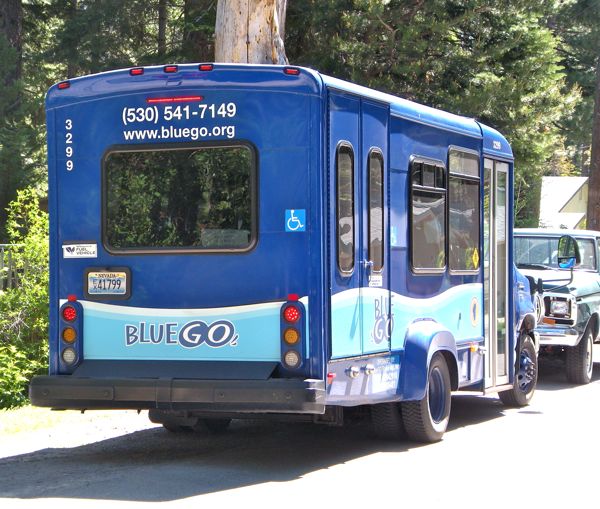
A BlueGo bus parked illegally in front of a private residence in South Lake Tahoe. Photo/Kathryn Reed

A BlueGo bus parked illegally in front of a private residence in South Lake Tahoe. Photo/Kathryn Reed

“This is the worst (audit) I’ve ever seen for an organization this size. The weaknesses in internal control are the worst I’ve ever seen,” Harn said. He’s been in the business since 1979.

Even the auditors aren’t happy with the cooperation it got from the STATA board. “We were unable to get written representations from management of STATA as required by auditing standards generally accepted in the United States of Americas (sic) and the standards applicable and to financial audits contained in Governmental Auditing Standards, issued by the Comptroller General of the United States.”

The audit was due last spring. C.G. Uhlenberg LLP out of Redwood City dated the report Oct. 1, 2010. The firm said it could not express an opinion on the financials because of the lack of information provided by STATA.

The firm goes on to say, “The audit we were engaged to perform was for the purpose of forming an opinion on the basic financial statements of STATA taken as a whole.”

Garrison, on behalf of the STATA board, accepted the report. It had been on a number of STATA agendas throughout the summer, but the Tahoe Regional Planning Agency wanted to give input and sought revises.

TRPA is involved because it’s the agency that hired John Andoh in May 2008 as transit administrator for BlueGo, the name of the Shore Shore buses. STATA oversees BlueGo and the seasonal trolleys.

At first Andoh reported to Nick Haven, TRPA transportation team leader. Haven was not available for comment. Andoh reported to the STATA board starting in July 2009. That board and Andoh subsequently parted ways.

“TRPA is reviewing the STATA audit and remains concerned about the difficulties facing the transit system,” TRPA spokeswoman Julie Regan said.

This audit is for the fiscal year when TRPA was in charge of Andoh. He was hired to run the buses. No one, apparently, was running the books.

“The fact is, Mr. Andoh was over his head and simply not qualified to properly control and maintain the responsibilities expected of him nor, in the end, was he able to perform to the level of experience he claimed he had during the hiring process,” Garrison said. “During the first quarter of 2010, STATA brought in an outside transit consulting firm to assist us in determining our actual operational and financial status. It had become somewhat obvious that the financial condition of STATA was not what we had been led to believe under Andoh’s watch. At the same time, with the ’09 audit running way behind, we secured a second accounting person to assist the STATA accountant in playing catch-up.”

The audit points out how grant reporting was abysmal.

As noted in the audit, STATA did not have an account just for its operations until June 2009.

The audit says, “… we identified certain deficiencies in internal control over financial reporting that we consider to be material weaknesses.” It goes on to say, “The results of our test disclosed instances of noncompliance or other matters that are required to be reported ….”

The audit includes information about Fairfield based MV Transportation, the firm now suing STATA, that had been operating BlueGo. It talks about repaying MV $825,000 at 8 percent interest through May 2014.

That isn’t going to happen now that STATA is in bankruptcy and MV has multiple lawsuits on the books. Knowing STATA has few assets except for the $677,000 in a bank account that MV got a judge to freeze and a few outstanding grants that are likely to trickle in, MV is contemplating suing the individual board members of STATA.

Those members represent public and private entities – South Lake Tahoe, El Dorado County, Douglas County, Harveys, Harrah’s, Horizon, MontBleu, Lakeside Inn, Heavenly, Ridge Resorts, Tahoe Transportation District and TRPA.

Garrison said everyone has resigned from the STATA board. But they could still be sued.

The Tahoe Transportation District has been running the coordinated transit system for several weeks and is expected to officially take it over starting Nov. 1. STATA will likely dissolve through bankruptcy court.

“If there is to be a transit system going forward, it will be under the professional oversight of TTD,” Garrison said.

El Dorado County has reached a settlement agreement with MV that is expected to be accepted by the bankruptcy court judge Dec. 1.

“The amount of the settlement is $160,000 for all litigation,” Mike Applegarth, with the county’s Chief Administrative Office, said.

At the last TTD meeting county transportation officials intimated they would be back on board if TTD were in charge. Applegarth told Lake Tahoe News that isn’t true.

“The county is not contemplating a partnership or a participation agreement with TTD or any other party,” Applegarth said. “If TTD does provide transit service in the basin on a prospective basis, in order to utilize the county’s two Tahoe transit vehicles and transit funds, there would need to be further action by the Board of Supervisors and the TTD board of directors, and that could not take place until pending motions in the bankruptcy court on TTD’s contract with STATA regarding transit service are heard.”

The county has a seat on the TTD board per Article IX of the TRPA Compact.

Carl Hasty, executive director of TTD, told Lake Tahoe News before the audit was released that he does not need to read it – his group is going forward with the intent to provide coordinated transit to the South Shore despite the poor prior fiscal management and dire financial conditions the system is in.


S. Tahoe park touted for dogs, but people like it too

By Kathryn Reed

It’s hard to know if the dog park in South Lake Tahoe is for the four-legged members of the family to socialize or if it’s really for the adults to get out and meet new people.

A lot of both often take place every day at the 2-year-old dog park.

Abbey and AJ play at the Bijou Dog Park in South Tahoe. Photos/Kathryn Reed

Abbey and AJ play at the Bijou Dog Park in South Tahoe. Photos/Kathryn Reed

Some stay close to mom or dad, others play a game of chase, some want to be petted by unfamiliar hands, others tromp off on their own to check out the new scenery.

Although the area is divided into little and big dog sections, it’s up to the owners to decide which area to go into.

In the case of Phiona, she prefers the big dog area despite being a small brown Boston terrier.

“She thinks she is a big dog,” her dad Ted Rann said. “She lives with big dogs.”

The unique spelling of the 3-year-old’s name is because her parents are Phillies fans. Hopefully, Phiona won’t be teased at the dog park.

For John Andrews and Jessica Pederson they like the socialization aspect of the dog park for their terrier mix, Abbey, who is less than a year old.

“It teaches her manners,” Andrews said.

Devin Morales knows the effort that went into building the dog park because he was employed by the Parks and Recreation Department at the time. Now he brings 10-month-old Jax, a coonhound, to the park at least once a week.

Morales hasn’t witnessed one bad incident at the park.

What he likes is the dogs can run off leash without running off. The entire area is fenced. Coming in from the parking lot is a small holding area of sorts so no dogs on either side of the park can get out.

Benches are on both sides of the park. People who lost a furry friend donated most. People are sitting, chatting about their dogs – who prefers the cold, who likes to catch some rays, and so on.

Fire hydrants add a comical, though well used attraction. Water is available, though the faucets are shutdown this time of year. People have left bottled water for the animals.

Many of the dogs dashing around on the woodchips (the small dog area has some grass) are a mix of breeds. A Whippet is by himself in the small dog area. Running up and down the fence line, the bigger dogs next door try to keep up with this slick creature.

Alex Steel, who brings his black golden retriever to the park three or four times a week said he may be the only one there at first, but within 10 minutes the park is howling. It’s as though people drive by on Al Tahoe Boulevard see someone else at the park and decide to venture in.

Everyone on this particular Friday using the dog park is friendly – as are the dogs. People are quick to clean up after their dog. A lesson people walking along Al Tahoe Boulevard should learn.

The canine facility at Bijou Community Park opened Aug. 18, 2008. The nearly 1-acre site cost $35,000 to build. It’s one thing the three outgoing members of the City Council started and finished.

Details:

Open year-round, dawn to dusk

Closed Mondays from 8-11am for cleaning

No cost

No treats inside the park

Dogs must be 6 months old

(530) 542.6056

Website

Directions:

From Stateline, go about 3 miles into California

Turn left on Al Tahoe Boulevard at Denny’s

Bijou Park is on the left, about a mile up

Circle around the parking area to reach the dog park.

ngg_shortcode_0_placeholder (Click on photos to enlarge.)


Pedaling back in time through the hills of Vermont

By Susan Wood

BRIDGEWATER CORNERS, Vt. – I made the summit of the scenic crescendo on the road bike and instantly saw why we took the optional route on the Bike Vermont October tour.

After leaving 40 years ago, the pilgrimage to my hometown of Woodstock, technically the nearby small bedroom community of Pomfret, involved more than Vermont’s celebrated history. It involved my own.
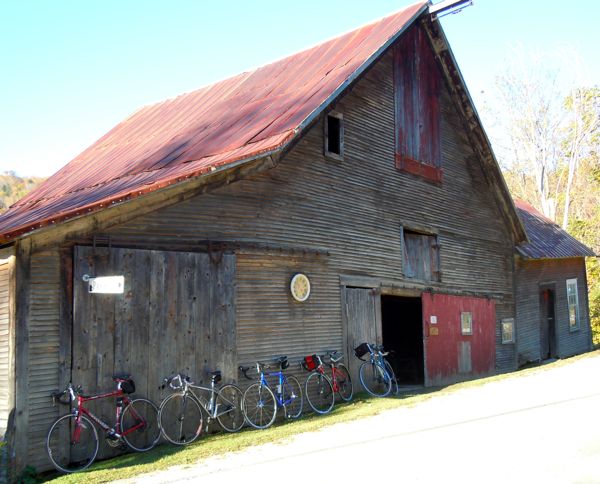
Ready to ride through the Green Mountain State. Photos/Kathryn Reed

Ready to ride through the Green Mountain State. Photos/Kathryn Reed

We passed the road leading to my childhood home a few miles back, then crested the top of the hill on the first day of the two-day 60-mile bike ride, bringing me face-to-face with Pomfret’s old town hall in the foreground of a drop-dead killer view of red, orange and yellow maple trees in central Vermont’s famous rolling green hills. Across the road, the one-room schoolhouse where I learned to read and write in first and second grades still stands and now functions as town offices. I peeked in the windows and recognized the open front room as my small classroom that resembled something out of “Little House on the Prairie.”

And to think this highlight fell on only the first day of the weekend bike tour out of the Bridgewater Corners-based October Country Inn. The tour is aptly named after the bed and breakfast we stayed in for two nights. Owners Chuck and Edie Janisse, who have run the place off Route 4 for nine years, came on board as the third inn operators after she went on a Bike Vermont tour.

The weekend was nothing less than superb on every front. The inn’s food was delicious, the conversation stimulating, the service genuinely stellar. The setting makes me want to return on vacation to hang out in the immaculately groomed grounds or inside the cute, antique-furnished room.

With a roaring fire, cozy furniture and homey environment, the living room is established as a common space for the 18 people on the tour. We are from all walks of life and regions. It’s so relaxed I take off my shoes as if I’m at home. That’s a sign I belong there.

More than a bike ride

With 34 years under their belt, Bike Vermont owners Larry and Dawn Niles, with their staff and tour leaders, have these trips down to an absolute science. Signups were easy, and the tour unfolded exactly how I expected. In 20 years of serious cycling, I’ve never had such detail on a route map.

Tour leaders Meg Davis and Jim Ortuno provided full explanations of what to expect for the day, including a session called “map wrap.” The duo made it refreshingly obvious how much they enjoy their jobs, each other and sharing experiences with fellow cyclists.

Ortuno, who lives in Shoreham, Vt., where one tour is based, thoroughly embraced the meal Edie and her staff were serving from the kitchen’s apron-donned cook Chuck. The October Country Inn meals follow an international theme, with Friday night’s menu of sole, carrots, salad, pilaf and cheesecake representing a French theme.

“This is why I bike. My wife is a good cook (too). I’d weigh 500 pounds if I didn’t,” Ortuno said, while taking a second helping of the perfectly seasoned carrots.

The next morning’s breakfast will long be remembered for its mini maple scones, which many in our group fought over or bid on because they were so appetizing. But even upon request, the recipe remains closely guarded by Edie.

It soon became apparent that I would actually gain a few pounds on a cycling vacation.

Our charismatic leaders quipped there are “no hills, just gear changes,” on the two routes. Ortuno also assured the group to forget about the recent rains because there are “no bad bike days, just bad clothing choices.”

I was OK with that because after a quick fitting of my Bike Vermont-rented Giant bicycle, Saturday’s first day of touring Woodstock, Pomfret and Quechee was brisk, but sunny. The blue sky after the evening rainfall offered quite a scenic backdrop to the bright foliage, old-time architecture, historic covered bridges and cows grazing on the green rolling hills. A few sightings of wooly bear caterpillars crossing the road are an indication winter is coming to the Northeast.

On the road

The start of the ride took us east, over the iron bridge at the Ottauquechee River, which runs through the quaint, historic town of Woodstock. Three covered bridges, including the Middle Bridge in town and the Taft near Quechee, cross the water about 10 miles apart from each other. A word of caution from our bike tour leaders – go slow or walk your bike on the covered bridges.

The 16-mile Pomfret loop provides some of the best “leaf peeping” one can get in New England. The loop empties into Quechee, known for its so-named gorge with views that dramatically drop hundreds of feet into the river. Rafting and fishing enthusiasts can be seen on any given day in three seasons on the river.

Quechee’s lunch stop included hot soup at a busy café and a visit to the gallery of Vermont glassworks artist Simon Pearce.

This is the epitome of how I like a bike tour – beautiful without belaboring the exertion at the expense of the sheer enjoyment of being free from work or without a care in the world. (Plus, I knew Kae would go on another bike tour if it were like this.)

The first day’s 42-mile jaunt had us ending in Woodstock, where the Billings Farm and Museum was celebrating harvest days. The working farm is operated by a nonprofit founded by Laurance Rockefeller, who married Mary Billings, in cooperation with the national historical park where Route 12 and River Road meet. Cows still graze there.

Added treats

In town, Kae and I hit the Mountain Creamery for homemade ice cream and a walk around my historic, pedestrian-friendly hometown. The sidewalks are packed with tourists. Imagine a place where there are no traffic lights or fast food eateries, but an independent bookstore that has thrived for 75 years.

Karen Greenberg and Steve Pittendrigh of Phoenix end their tour at the Woodstock Inn & Resort with a drink at the bar and massages at the landmark hotel’s new full service spa.

At Saturday night’s Italian-themed dinner in our home-base inn, Greenberg gave a sign she was melting into the dining room chair to reflect her state of mind. The rest of the group got shoulder massages at the table from the two tour leaders. Beyond being a guide and a nurse, Davis is known for her rubdowns.

My red wine and an eggplant Parmesan good enough to write home about added to my restful evening, which included a rousing game of Scrabble in front of the fire. Unbeknownst to Kae and I, cyclist Ann Chilton of New Hampshire – who was on her sixth Bike Vermont tour – has a penchant for the game. She won with a 50-point Scrabble bonus for using all seven tiles.

For those who may partake in a night out for a cold glass of Vermont beer, the Long Trail Brewery – named after the trail that runs through the spine of the state – is located directly across the inn from Route 4.

Day 2 began with silver dollar pancakes and pure Vermont maple syrup, then a ride, as Ortuno put it, “with rested bikes” that took us on an interesting journey through the childhood home of Calvin Coolidge. It was here his father swore him in as the 30th U.S. president. The Plymouth Notch Historic District is nothing short of gorgeous and a reminder of one of Vermont’s primary food groups – cheese.

The Plymouth Cheese Factory is the second oldest continuously operating cheese factory in the United States. I sampled some and liked it a lot. I’m in good company. According to the St. Petersburg Times, chef Julia Child considered Plymouth cheese “her favorite.”

Plymouth is bursting with history. An old Gulf gas pump in front of the general store declared fuel costing 11 cents a gallon.

Relying on my own body fuel, I hopped back on my bike and finished the 18-mile journey along scenic Route 100, where it seemed we stopped every few feet to snap a photo. I didn’t mind. I was taking it all in.

We passed the northeast station of Killington Ski Area, Vermont’s largest resort recognized for often being the first area in the United States to open in October. But no snow was in the forecast. It was just a cruise back to the October Country Inn, where lemonade and dessert bars await.

If you go:

Bike Vermont offers a multitude of tours, many more ambitious than our 60-mile, three-day October Country Inn weekender. The company tours Maine, Maryland, Scotland, Ireland, Italy and the outer regions of Vermont, such as Lake Champlain.

The October Country Inn weekend tour costs $545 per person in the fall, a highly recommended time to see the foliage. The Scotland tour runs $2,995.

Road or mountain bike rentals with 21 gears may range from $40 to $100 depending on the length of the tour.

Bike Vermont may be reached by calling 800.257.2226 or via email at bikevt@bikevt.com or online.

ngg_shortcode_1_placeholder (Click on photos to enlarge.)



Significance of tossing trash into water resonates with kids

By Kathryn Reed

MEYERS — A bunch of kids sit around a pond with plastic bottles floating on it. It’s their fault. Each one thought it would be OK to toss their empty into the water.

“We created this problem, didn’t we?” Cindy Wise asks the kindergartners.

Students draw on a drop water to show what water means to them. Photos/Kathryn Reed

Students draw on a water drop to show what water means to them. Photos/Kathryn Reed

This pond, as it were, is actually a dark blue sheet representing a body of water. The youngsters are in Aimee Rice’s class at the Environmental Magnet School. Wise is with the Tahoe Resource Conservation District; part of a Wonders of Water program being taught for the second year in South Shore schools in grades K-6.

With the curriculum grade appropriate and tying into state requirements, youth this month in Lake Tahoe Unified School District and at Zephyr Cove Elementary are learning about watershed health, water conservation, fish life cycles, food webs, water cycles, water quality and the importance of stewardship of water resources.

“Year after year, concepts and topics become a bit more complex and build upon one another. Ideally, students will have been exposed to several years of different activities, making them much more informed about local and global water and conservation issues,” explained Pete Brumis with TahoeRCD.

The kindergartners in Rice’s class on Tuesday could not have articulated exactly what they were learning, but they quickly figured out their one bottle of litter and their friend’s and their other friend’s adds up to a whole lot more than just one bottle.

“The Earth can be killed,” Bella Munson said of what happens if this sort of thing were to really happen.

Bella Munson

Bella Munson

Though that is not likely to be the immediate outcome, Wise said, “Ecosystems can be killed.”

Before tossing the bottles in the “water” a bunch of (paper) animals that might be found in a pond were put into the water. With imaginations going, they were swimming in a pristine body of water.

Once the bottles were tossed in, they were overrun, killed. Only bottles could be seen.

One by one the students took out their bottle and tossed it into a blue bag – the icon for South Tahoe Refuse’s recycling program. As they plucked the bottles, to the tune of “Mary had a little lamb,” they sing “Garbage should not go in the water, should not go in the water.”

The animals are back. No more muck to contend with.

“This brings their local environment into the classroom. This is where it all begins,” Rice said.


El Dorado County budget cuts touch nearly every sector

By Kathryn Reed

The man who oversees the department that accounts for the largest expense on El Dorado County’s ledger will face his five bosses Monday.

Sheriff Fred Kollar isn’t planning to go into the Board of Supervisors room with guns drawn, but he also isn’t about roll over and play dead even though he’ll be retiring when the next sheriff takes office in January.

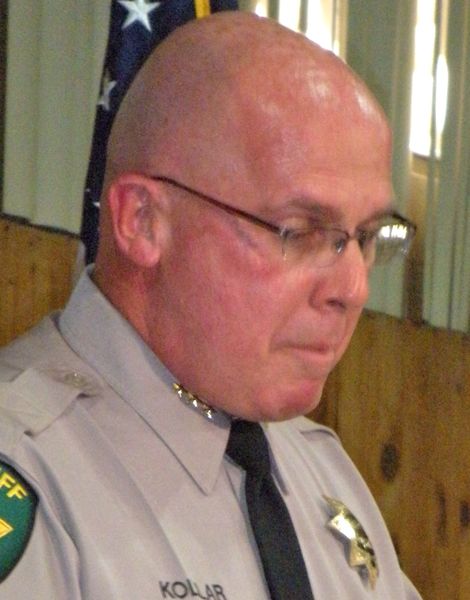
Fred Kollar

Fred Kollar

To close the $11 million deficit for fiscal year 2011-12 that begins July 1, the county wants to make half the cuts by the end of the year and the next $5.5 million in the first two months of 2011.

The Chief Administrative Office is proposing a 2.7 percent across the board cut for law and justice that would total $1.6 million. The sheriff’s department would lose $1.13 million, probation $264,725, district attorney $152,056, and public defender $74,388.

“The 2.7 percent is somewhat deceptive,” Kollar told Lake Tahoe News. “Through early retirement we are going to eliminate 15 positions, which exceeds $1.5 million, so really it is almost 6 percent.”

One thing Kollar knows he will lobby for at the Nov. 1 meeting is to have his old job, that of undersheriff, be put back on the books. When Kollar took over for Jeff Neves, who left office last December before his term was up, undersheriff was wiped off the books instead of just being unfunded.

He is crunching the numbers to see what more could be cut.

“Part of meeting the $1.2 million might be what our organizational structure looks like,” Kollar said. “I want to spend time with the new sheriff. These don’t have to go into affect until Jan. 1. I don’t want to do anything significant to the department and have the new sheriff undo it.”

Human Services Department

For Daniel Nielson, director of the Human Services Department, he is slated to talk to the board Nov. 3.

For now, the $400,000 proposed to be slashed from the Community Service Aging Programs would mean eliminating five of the seven sites where meals are served to seniors. The South Lake Tahoe and Placerville centers are being funded – for now – in this first round of cuts, Nielson told Lake Tahoe News.

But the cuts mean 25 percent of the seniors getting a hot meal from one of the facilities on the chopping block would not get that meal. Instead, a frozen meal would be delivered, and perhaps once a week instead of five times. This is because health code mandates a hot meal be delivered at a certain temp, and increasing the driving distance won’t allow for that to happen.

Nielson is cognizant is will be a different type of delivered meal. The fresh food, like a salad, will be gone. He also knows the personal connection of the homebound senior and the meal deliverer is huge. But this program is a drain on the bottom line.

The suggested donation for a meal is $3 – eating it at a facility or having it delivered. In 2009-10, the average donation at the South Lake Tahoe Senior Center was $1.81 and $2.66 in Placerville. The average collected for home delivery in South Tahoe was 83 cents in that same fiscal year and $1.59 in El Dorado Hills.

El Dorado County served 59,402 meals at its facilities in 2009-10, while 81,761 meals were delivered.

In South Lake Tahoe, there were 10,179 congregate meals served to 1,003 people and 19,547 meals delivered to 645 people.

Tahoe budget meeting

The county conducted an information meeting in South Lake Tahoe on Oct. 25 about the proposed budget cuts. Seven members of the public (the city attorney, a council candidate, two county employees, two concerned citizens), three media reps and three county staffers were there.

County officials weren’t too disappointed by the turnout considering the Placerville meeting had 30 people.

Concerns that night centered on worries the basin will take a harder hit. (Staff said supes wants to play fair.) Employees questioned their plight compared to managers. (Everyone will be hit, though negotiations are going on now with the county’s 15 labor units so nothing is solidified.) Questions about the $540,000 promotions budget not being touched were raised. (The pledge is being honored to reinvest at least half what is brought in with the hotel tax back into tourism.) Snow removal concerns were voiced. (It won’t be impacted.)

“What is it that we don’t get when we cut people?” Rhonda McFarlane asked.

Terry Daly, assistant chief administrative officer, said, “We are trying and looking at ways to minimize service cuts. We are working with others to eliminate redundancy. But you are right. If the board decides to cut the UC Extension and your child is in 4-H, that is the service cut.”

The Board of Supervisors anticipates taking action on the proposed budget cuts Nov. 15.


Vail Resorts buys second Tahoe resort — Northstar

Updated: Oct. 25, 2010, 4:50pm.

By Kathryn Reed

Vail Resorts has expanded its footprint on the greater Lake Tahoe area with the announcement Oct. 25 of its acquisition of Northstar-at-Tahoe.

The Colorado-based company acquired the stock of the companies that operate Northstar-at-Tahoe from Booth Creek Resort Properties LLC and other sellers for $63 million. The Truckee ski area is on land owned by CNL Lifestyle Properties Inc. Vail now has a long-term lease, the details of which have not be disclosed, with CNL.

Sierra-at-Tahoe is not affected by the transaction. It is still owned by Booth Creek.

Northstar-at-Tahoe is now owned by Vail Resorts. Photo/Kathryn Reed

Northstar-at-Tahoe is now owned by Vail Resorts. Photo/Kathryn Reed

“We truly see this as a positive thing,” Sierra spokeswoman Kirstin Cattell told Lake Tahoe News. No changes are being made to Sierra’s management team.

George Gillett, chief executive officer, Chris Ryman, president and chief operating officer, and Betsy Cole, executive vice president and chief financial officer of Booth Creek, will no longer have management positions at Northstar. Julie Maurer, vice president of marketing and sales at Booth Creek, is now vice president of marketing with Vail Resorts, overseeing the marketing and sales of Heavenly and Northstar.

John Wagnon will remain as vice president of marketing at Heavenly.

A general manager, who still needs to be hired, will oversee Northstar much like Pete Sonntag was brought in this summer to run Heavenly.

Kelly Ladyga, spokeswoman for Vail Resorts, told Lake Tahoe News, “We have been watching Northstar. It has been one of the fastest growing resorts in North America for the past few years. It has substantial and diverse terrain, and a new and modern base village.”

Northstar, under the ownership of Booth Creek, had a renaissance in the last several years with terrain being added, along with lifts. The mid-mountain lodge was rebuilt after arsonists caused significant damage several years ago.

East West Partners, a company that is now in bankruptcy, developed the LEED-certified village.

A Ritz-Carlton opened mid-mountain last December with mixed results during the recession.

“There are no immediate plans for capital improvements (at the resort),” Ladyga said.

She would not comment if other acquisitions are in the works or being talked about. This is normal for the publicly traded company. However, it’s possible news could be forthcoming after the Dec. 3 annual stockholders meeting in Colorado.

Vail earlier this month bought Accommodation Station to be able to offer Heavenly skiers a lodging package.

Vail is used to having its properties being associated with high-end lodging. Beaver Creek has a Ritz and its other Colorado resorts have lodging that caters to a crowd with money.

Heavenly is Vail Resorts’ only ski area to not be associated with a lodging component. Vail bought Heavenly Mountain Resort in 2000 from American Ski Company. It has pumped millions of dollars into the California-Nevada resort, with the latest infusion of cash going to a mid-mountain lodge that will open in February.

Vail was going to be the hotel owner at the now bankrupt convention center, but both sides ended that partnership before Randy Lane filed for bankruptcy a year ago. Rumors are still rampant Vail Resorts would like to run a hotel operation across from the Heavenly gondola in South Lake Tahoe.

Season passholders at Northstar, Heavenly and Sierra have a chance to ski all three areas this year. People who bought the Double Whammy pass will still be able to ski Northstar.

Ladyga said people with the $799 unlimited Double Whammy may exchange it for the $629 Epic pass, get a refund, and ski at all the Colorado resorts Vail owns in addition to retaining the right to ski at Sierra.

People who buy Heavenly’s $349 season pass will be able to ski there, Northstar and Sierra this winter, Ladyga said.

The EpicMix, which Vail is introducing this season, will be available at Northstar in 2011-12.


Scientist reveals intricacies of cloud seeding in Sierra

By Stephen Ward

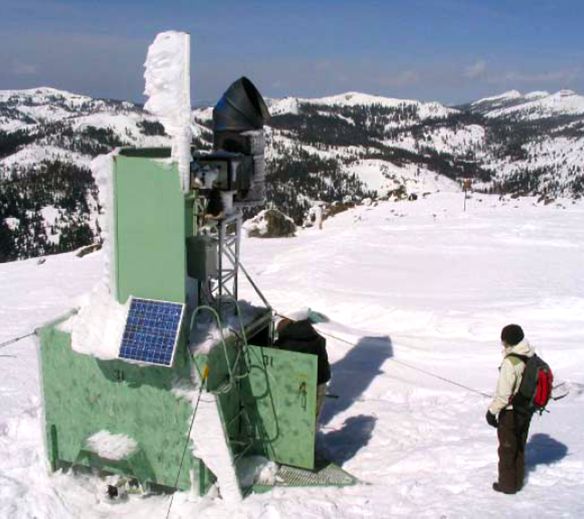
INCLINE VILLAGE – Using a propane flame to shoot silver iodide into the sky with a unit that resembles a prison watchtower with a trash barrel aimed at the sky attached to the top is how the Desert Research Institute is helping Mother Nature produce more moisture.

Ground tactic cloud seeding is the only type of seeding being done by DRI this year.

Arlen Huggins

Arlen Huggins

Arlen Huggins addressed his area of study with a swiftness that marginalized the nearly 23 years of research he has devoted to the project. And with each slide projected on the screen underpinning the complex procedure he was presenting, Huggins offered observers a detailed look at cloud seeding – a method local scientists use to augment rain and snowfall in Lake Tahoe.

The lecture last week at the Tahoe Center for Environmental Sciences on the campus of Sierra Nevada College before roughly 50 began with an array of definitions for words meant to bridge the gap between the scientist and the public’s disparate lexicons. Words like cloud drops, or small water spheres, and the ice nuclei silver iodide were among the highlighted expressions.

From there, Huggins briefed the crowd on the history of cloud seeding, with its genesis being in the late 1940s with studies conducted by scientists Vincent Schaefer and Bernard Vonnegut, the older brother of the popular American novelist.

“Cloud seeding helps enhance rainfall during the growing season, as well as reduce the damaging effects of hail,” he said. “It also has the capability to increase runoff in the spring for power generation, and has potential for increasing water supply.”

Although no studies have been conducted, Huggins said there are no health effects to cloud seeding.

“It would be a concern if the mass were a lot,” he said. “But we’re nowhere close to EPA levels.”

Cloud seeding in the Sierra brings more moisture to the area. Photo/Provided

Cloud seeding in the Sierra brings more moisture to the area. Photo/Provided

Not everyone was convinced cloud seeding is an effective process. Steven McQuinn of Incline Village believes DRI might have ulterior motives.

“I didn’t get a sense of any conclusive evidence,” he said. “The nature of their statistical studies … doesn’t achieve proof of cause and effect. There could be other motivations, such as a water manager under pressure. Moreover, I feel there’s more evidence for climate change. Compared to (climate change), cloud seeding evidence is negligible.”

The effectiveness of cloud seeding has been measured by instrumented aircrafts with probes on the wings that count the ice crystals and plume in a cloud. In addition, DRI uses radars and its own process of snow sampling, where they push snowfall through a cheese grater-like apparatus, collect it and examine it in a lab.

The silver iodide particles rise into the clouds at minus 5 degrees Celsius, causing cloud moisture to freeze and create ice crystals. This process takes about 20 to 30 minutes. Once the ice crystals grow big enough, they fall as snow.

The entire process is done through a generator that took nearly a decade to get. Each generator costs about $30,000 to build, between $40,000 to $50,000 to run for a year.

Loren Rupp, a 10-year Incline Village resident and graduate student at Sierra Nevada College, received answers to the questions he brought with him to the meeting.

“I came here with two questions: effectiveness and how it’s measured,” he said. “I see how they gather their results through blind and parallel studies.”

Airplanes have also been used in the past for cloud seeding by flying over clouds and dispersing silver iodide through nozzles attached to the wings of planes. This was done by the DRI west of Lake Tahoe for most of the past decade before losing state funding because of the sagging economy.

DRI conducts the majority of its cloud seeding research with the help of Truckee Meadows and Southern Nevada Water authorities.


Woodstock Inn — A landmark for the season and the ages

By Susan Wood

WOODSTOCK, Vt. – The red carpet Vermont throws out in fall lies beyond the ground beneath its world-renowned maple trees.

In the heart of central Vermont, Woodstock boasts a AAA four-diamond rated hotel as rich with history and iconic to the quaint, colonial-style village as the Rockefeller name and the origin of its agricultural and railroad traditions.

Service and style are all a part of the Woodstock Inn & Resort, which operates under the Laurance Rockefeller-spawned Woodstock Foundation. The inn’s early beginnings date back as far as 1793. The Inn as it’s known today was built a century later with $120,000 of the citizenry’s money to keep up with the demand for the Vermont lifestyle.

Woodstock Inn

Woodstock Inn

The Woodstock Inn has transformed to reflect the growing needs of local residents and tourists. In the early 1900s, each guest received a heavy fur coat in winter.

Recreation touches every season here – from alpine skiing at the nation’s first rope tow on Clinton Gilbert’s pasture in 1934 and cross country skiing in the hills behind the Inn’s Racquet & Fitness Club to the early years of tennis and golf inspired by Boston resident D.B. Harrington. In 1895, the doctor brought his clubs on one stay to play in a cow pasture behind the Inn. An 18-hole, Robert Trent Jones-designed golf course sits there now to entice summer and fall visitors.

But it’s the fall that prompts visitors to flock in droves to witness the splendor of the vivid red, pink, orange and yellow foliage. They’re welcomed by pure New England hospitality, and this year was no exception. Staffers greet guests with an open door and friendly hello. (Don’t be surprised if at least one doorman remembers what your plans are and asks you later how they were.)

A month ago, the 142-room grand hotel covering one square block celebrated the addition of a 10,000-square-foot, full service spa costing $10 million. It is next to the inn’s scenic back courtyard that is lined with maple trees. But no need for guests to walk outside; it’s also accessed via the Inn.

From the minute one arrives at the front entrance of the Inn, it’s easy to see the visual Rockefeller was going for after buying the property in 1967 and rebuilding a grander version farther off the Village Green. (Prior to 1967, an older inn sat next to the Green, as shown in artwork hung in one of the hotel’s hallways that this reporter’s uncle painted years ago.)

The Woodstock Inn spans more than 9 acres, embracing its history and incorporating it into modern times where tourists insist on amenities and the perfect blend of relaxation and things to do. It perfectly complements the town of Woodstock.

The front desk even prints an activity list if it’s a rainy day.

The hotel is an ideal launching pad to a hike through Faulkner Park and up Mount Tom, which “towers” over the village. Although only a few hundred feet up through a series of switchbacks, it’s steep in one section. But the nearly 360-degree view is well worth the jaunt.

At lower elevations, an easier stroll can be had around the village, which touts long-lasting retail establishments such as an independent bookstore that has stood since 1935.

For those who appreciate the historic, the interior of the hotel’s library – one of several seating areas in the Inn – was built with barn wood.

Some rooms are equipped with wood stoves for a cozy atmosphere. A large stone fireplace sits square at the main entrance and looks inviting enough to tell stories around, but in the peace and quiet of the late hours of the evening the blaze represents mesmerizing comfort. Lamp stands resembling maple tree bark flank the fireplace, showing the importance of the region’s sugarhouses.

For the modern-day guest, furnishings made of solid wood allow a guest to set up an office or lounge around in style to watch the high-definition flat-screen television or read in the comfy king-size bed adorned with a high wooden headboard. A half-dresser half-hutch includes a contemporary coffee maker with a plentiful stash of Vermont’s own Green Mountain Coffee.

Instead of increasing the nightly room fee upfront, guests are greeted in their room with the news a $4 housekeeping fee will be added to the bill. No chance of opting out, unlike what we encountered at the Sheraton in Boston.

A marble floor uses Vermont’s signature stone in the guest bathrooms. Wall tiles look so clean it appears the military came in to scrub the premises. Nice touches include a small oil candle on the counter. A vanity mirror assists in getting the guest ready for an evening out at one of the Inn’s varied dining choices.

The Red Rooster is the fine dining option – with its entryway marked by a bar that even locals use to satisfy their appetites. The restaurant’s food, in particular the prime rib, is excellent, but reservations come with a recommendation to request your waiter. A server may be disengaged or slow as the tables fill up during the Inn’s demanding peak season. (Another suggestion: If wanting to dine with a group in the alternative, less expensive Richardson’s Tavern, stake out your sofa, booth or bar stools early. It may fill up faster and even if five in your gathering were born in Woodstock and two are guests, you may never get a place to sit. And waiters will not find the time or inclination to serve you in the outside seating area.)

Woodstock Inn dining options may change down the road. Marketing director and hospitality veteran Courtney Lowe wants to bring more special events to the hotel, including wine dinners and culinary demonstrations.

“This is only the tip of the iceberg. We’d like to not just offer them during the off season, but we’d also like to maximize on the peak seasons when the people are here,” Lowe said earlier this month while lounging in one of the comfy chairs near the front desk with Chef Jason Lawless steps away hosting a cheese sampling.

Lowe has worked for the Inn since March and has grand plans to expand on its offerings for foodies and increase partnerships with local businesses. One example would be teaming up with a local winery for late-night dessert wine tastings.

The Inn gets the word out on its offerings through mostly electronic means such as email blasts to its feeder markets of New York City and Boston. Packages are provided, and Lowe expects to extend them. One has a romantic theme. Another includes the full breakfast buffet in the dining room’s cheery, open-air environment.

Lowe said after a few years in a downturn for tourism, business has started to pick up.

“It’s been a good year. We started to see the group business come back, and the wedding business went up while everything else was down,” Lowe said.

Of all the features of the Inn, none accomplishes its full service goal and comes as heralded as its spa and salon that opened in September. More than 300 people showed up for its grand opening.

Spa Director Michelle Adams told Lake Tahoe News the reception of it has exceeded “all expectations” – with a clientele ranging from 75 percent tourists to a quarter of the users being local residents.

According to Lowe, the spa answers the quest of entertaining guests who don’t ski.

“Every day is good for a spa day,” Adams said during a tour of the facilities, which are open from 10am to 7pm.

The treatment menu is extensive – from the standard Swedish massage to a “hot chocolate firming body wrap.” Treatments in one of the 10 rooms can run more than $300 for a couple. For $25 guests may use the spa’s tranquil and holistic-style facilities that include a Eucalyptus-scented steam room. A dip in the hot tub is an experience with a wood fire blazing in the pit steps away from the tub and an attentive staffer checking in with guests. A Japanese lilac growing nearby marks the passages of the seasons, a critical part of life for Vermonters.

Those attending weddings and other special occasions are apt to enjoy the VIP room for relaxation upstairs, along with a full salon for hair styling, pedicures and manicures. Polishes come under names like “Get Off My Cloud.” Adams anticipates offering the spa’s own line of bath products in the near future.

Even the soundproof, calming acoustics suggest a harmonious balance between complete relaxation and isolation. Design aficionados will also appreciate accent touches from the likes of glassworks artist Simon Pearce and furniture maker Charles Shackleton, both local to central Vermont.

If you go:

The Woodstock Inn & Resort is located on South Street, taking up one square block of real estate in Woodstock where Routes 4 and 12 intersect at the town’s Village Green.

Call for reservations at 800.448.7900 or visit online. A Woodstock single with a king-size bed can run $317 a night for double occupancy in the fall.

ngg_shortcode_2_placeholder (Click on photos to enlarge.)