Angora trail not just for mountain bikers
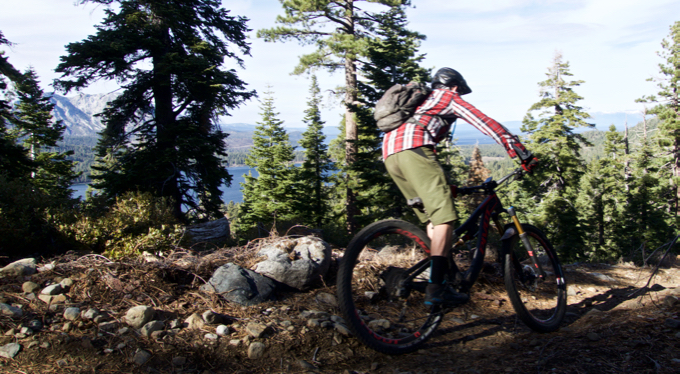
It didn’t take long for mountain bikers to discover the new Angora trail. Photo/Kathryn Reed

By Kathryn Reed

Hiking Angora Ridge just got better thanks to a bunch of mountain bikers and the U.S. Forest Service.

No longer do people have to contend with vehicles or be on pavement to reach Angora Lakes.

The nonprofit Tahoe Area Mountain Biking Association partnered with the federal land owner to build a trail that basically parallels the road. One of the best parts is the road is not visible much of the time.

I was there after the Angora gate was closed for the season, so I’m not sure what the sound of vehicles will be like in summer.

And while this was built as a single-track mountain bike route, plenty of hikers (some with dogs) were out earlier this month checking out the trail that was completed this year. People seemed giddy about the new trail.

It goes from where Tahoe Mountain Road intersects with Angora Lakes Road and comes out near the fire lookout. That’s as far as we went that day.

It doesn’t take long before Fallen Leaf Lake comes into view. Be sure to turn around to see Lake Tahoe as well.

Fallen Leaf Lake with Lake Tahoe in the background. Photo/Kathryn Reed

Mount Tallac becomes quite a presence as well.

This is what makes this trail so much more scenic than being on the road – the views are stunning most of the way. You don’t have to wait to hit the ridge to get them, which is the case with the road.

Seeing the houses on Tahoe Mountain is something I’ve never noticed from the road.

Being on foot gave me a chance to survey the route to see if I’d want to come back on my bike. Seeing people pushing their bikes oddly made me want to try it. I didn’t want to be the only one possibly not pedaling. It didn’t look technical, just steep (for a bike, not on foot) in places. Families were out – on bikes and walking.

The cyclists can be coming down pretty fast, but all were courteous as we scampered to get out of their way.

It took about 2,000 hours of volunteer labor and thousands of dollars in private donations to make the nearly 5 miles of trail in this area a reality. There is also a connector from the Angora burn area.

More trails are on the drawing board, including extending the Angora trail north to connect with Fallen Leaf Lake.

It’s possible within five years there will be a single track trail to Emerald Bay.

The ultimate goal is to have a mountain bike trail that goes around the lake. Yes, there is the 165-mile Tahoe Rim Trail, but that is for hikers and much of it is off-limits to bikes.
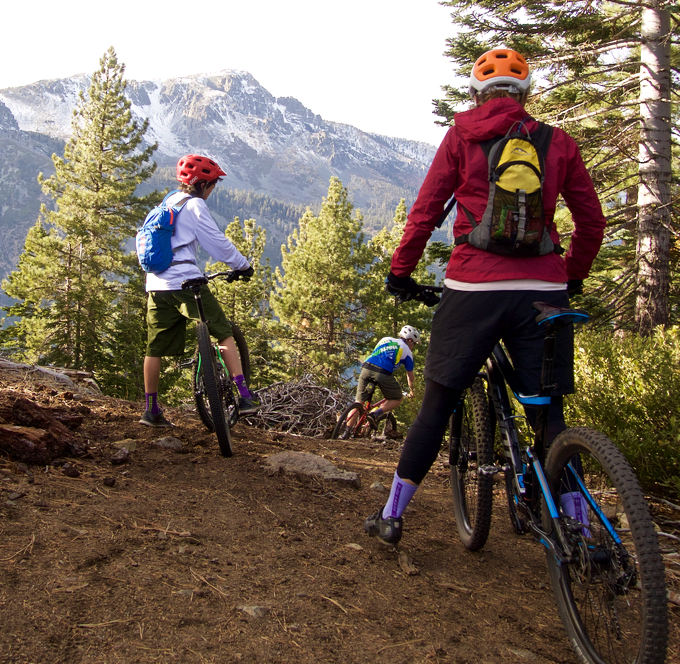
The Angora trail is attracting families. Photo/Kathryn Reed

—–

Getting there:

From South Lake Tahoe, at the Y go on Lake Tahoe Boulevard toward South Tahoe High School or the burn area. Turn right on Tahoe Mountain Road. Go right at the T intersection. Go left at the next T. The road curves a bit. Go slow. Additional parking has been created near Angora Lakes Road. The trail starts to the right of the Angora gate/road. There is no trailhead sign.


South Tahoe sets record high on Thanksgiving

By Kathryn Reed

If you thought Thanksgiving at Lake Tahoe was hot, you were right. And it had nothing to do with what was going on in the kitchen.

South Lake Tahoe’s high of 65 degrees broke the record of 63 that had been standing since 1995.

People were in shorts, and those at Zephyr Cove Tennis Club were in skirts and short-sleeves.

According to the National Weather Service, the warm temps for Nov. 23 were not out of the ordinary. It all had to do with a ridge of high pressure above the area.

Winter is back in the forecast, though. Expect snow Sunday into Monday, with rain in the valleys. The Sierra summits could see 6 inches of snow.

Snow is expected to start at 9,000 feet Sunday morning, dropping to about 7,000 feet by that night, with white stuff expected at 4,500 later in the evening. Those elevations could change if the storm comes in a bit warmer.

Wind will the precursor to the moisture, with a high wind watch in effect from Saturday evening through Sunday morning. Ridge tops could see 100 mph gusts.


Wildfires can wipe out Calif. greenhouse gas gains

By David R. Baker, San Francisco Chronicle

Most years, the amount of greenhouse gases spewed by California’s cars, factories and power plants drops slightly — a hard-won result of the state’s fight against global warming.

And in any given year, one big wildfire can wipe out that progress.

Over the course of just a few weeks, a major fire can pump more carbon dioxide into the atmosphere than California’s many climate change programs can save in 12 months. Scientists debate whether California’s vast forests are emitting more carbon dioxide through fires than they absorb through plant growth.

As global warming raises temperatures, making fires like the ones that tore through the Wine Country last month more likely, it could turn into a vicious cycle.

Read the whole story


Transformer replacement to lessen Liberty outages

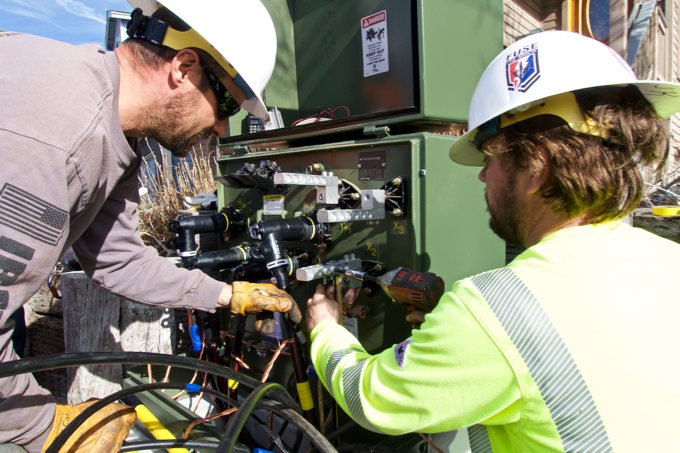
Tyson Hurd and Josh Kleinschmidt hook up a transformer in the Tahoe Keys on Nov. 21. Photo/Kathryn Reed

By Kathryn Reed

Power outages are never fun. And when the problem isn’t obvious, it’s worse for everyone – including the crews tasked with solving the issue.

Last weekend a swath of the Tahoe Keys was without power. A transformer had gone out in this South Lake Tahoe neighborhood. It needed it replacing.

The problem is when the Keys was built in the late 1960s all of the transformers were submersible. In other words, they are underground and likely sitting in water because of the high water table. Even when some were replaced in the 1980s, back underground they went.

Aesthetically, putting electrical transformers underground made sense. Practically, though, the logic was missing.

“The submersibles are mapped, but they’re hard to find,” Nick Rains, a patrolman with Liberty Utilities, told Lake Tahoe News. “A backhoe is brought in and it’s a bit of a guessing game.”

In winter it is even more problematic with snow and the ground being frozen.

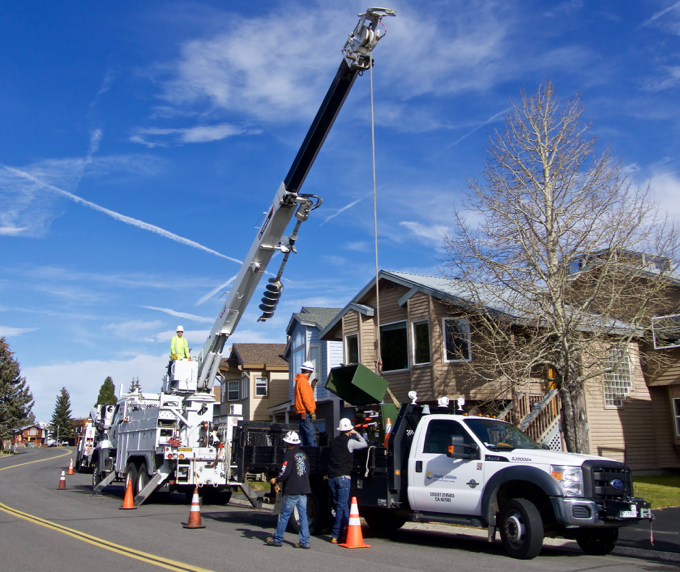
Crews maneuver the green transformer box into place. Photo/Kathryn Reed

Rains was out with a crew this week on Venice Drive replacing the transformer that died three days earlier. To do so required getting permission from the homeowner to place a green box in their front yard. Most people don’t want it there, so it can take some negotiating.

Liberty has a program to replace all the submersible transformers. But when one goes out, like last Saturday, then it rises to the top of the list. The new ones have a life expectancy of about 30 years.

When Liberty bought the territory from NV Energy in 2011 there were more than 130 of these submersible transformers, with most being in the Keys. Since then about 80 percent have been replaced.

“Liberty has made the change-out program a priority; investing about $100,000 per year with a goal to change out an average of 10 per year,” Jeff Matthews, manager of engineering and planning for Liberty Utilities, told Lake Tahoe News. “Liberty wasn’t able to change out as many submersible transformers this year because of the high water table due to the extreme snow earlier this year.”

Doing any repair work can be a nightmare on the submersibles. The above ground ones make it so outages don’t last as long because the work can be done faster. The technology also allows for outages to not be as widespread by rerouting customers.

Another concern of the submersibles is what they are doing to the environment.

“A potential toxin of concern for electric transformers contaminating groundwater is polychlorinated biphenyls (PCBs), which were formerly used in transformer oil. (South Tahoe Public Utility District) tests all of our wells regularly for PCBs and has never found PCBs in our drinking water,” Shelly Thomsen with STPUD told LTN. “By moving electrical equipment above ground, Liberty Utilities is moving in the right direction to greatly minimize any issues relating to groundwater in the future.”

Utility companies are mandated to test the water in these vaults when pumping is required to access the components.  

“Not all older transformers had PCBs in the internal fluids. I am not concerned about the individual older transformers units that may have had PCBs because the hydrostatic pressure from being submersed in water helps keep the contents inside and individual units usually have very little internal fluids. Also, PCBs have a high affinity for adhering to soil particles, which makes the PCBs less likely to leach into groundwater,” Doug Smith, assistant executive officer with Lahontan Regional Water Quality Control Board, told Lake Tahoe News.

According to Matthews, Liberty has not had any issues with its transformers in regards to contaminants.


Damaged roads from last winter still an issue in EDC

By Vicki Gonzalez, KCRA-TV

The aftermath of relentless winter storms can still be seen throughout El Dorado County, after a series of destructive systems crippled dozens of locations at the start of 2017.

“It was a year none of us have really ever seen up here,” John Kahling, with the El Dorado County Department of Transportation, said. “We’ve got a lot of hilly terrain that causes water to move faster and get into more concentrated flows. And when you have that in areas that haven’t seen rain — serious rain — for several years, erosion and other damage is bound to happen.”

The county has been working nonstop to repair the damage. Many major routes are back up and running after being shut down for months.

Read the whole story


Tahoe’s roads — from dirt to modern construction

Dave Borges talks about transportation in the American River Canyon. Photo/Denise Haerr

By Kathryn Reed

CAMP RICHARDSON – Roads in and around the Lake Tahoe Basin seem to be in a perpetual evolution.

Local historian Dave Borges took a group on a ride through transportation lore at a presentation this month at Camp Richardson Resort. The Lake Tahoe Historical Society talk went from the 1800s to today.

“We’ve progressed from deer tracks,” Borges said. Wagon trains followed those paths, then pavement covered the dirt.

Mostly Borges focused on the trek between South Lake Tahoe and Placerville. What now takes about an hour to drive used to take days to travel.

“El Dorado County couldn’t afford to build roads so they had franchises,” Borges said.

The Osgood Tollhouse was built in 1859. (It is now located at the Lake Tahoe Museum in South Lake Tahoe.)

According to Borges, the first year of the toll road $1.6 million was collected.

People would have to pay a toll at various locations through the American River Canyon. Traffic was steady in this era because of the Gold Rush on the West Slope and the Silver Rush in Virginia City.

Trading locations dotted the route; places where people could refresh their horses and stock up on supplies.

Borges said it was in 1877 that the county purchased the toll roads because by that time there was so little traffic. The transcontinental railroad in 1869 drastically changed how people traveled and did business.

By 1895 Caltrans took over. The problem was the roads weren’t constructed well. Workers slapped on some oil over the dirt, then some asphalt.

The Mormon Emigrant Trail came into being in 1848, Johnson Pass in 1852, Luther Pass in 1854, and Hawley Grade to Echo Summit in 1858.

Remnants of an old state bridge can be seen near Pioneer Trail and Golden Bear. Other sections along what is now Highway 50 also have historical markers.

At mile post 55.19 just past Strawberry is a rock masonry culvert from days gone by. It’s possible to still see three of the four posts from the 1901 Riverton Bridge.

At first roads were built higher on the hillsides. As they started to be constructed closer to the American River bridges had to be built as well.

Old Meyers Grade was the primary route of the basin to Echo Summit until 1946.


How advertising shaped Thanksgiving

By Samantha N.N. Cross, Iowa State University

I have always been intrigued by Thanksgiving – the traditions, the meal, the idea of a holiday that is simply about being thankful.

For my family, Thanksgiving is all about the food. Some foods, like turkey and mashed potatoes, may be familiar. But there are a few twists. Since I grew up in the Caribbean, I’m allowed a Caribbean dish or two. The reliability of the menu – with a little flexibility sprinkled in – seems to unite us as a family while acknowledging our different cultural backgrounds.

Chances are you and your family have similar traditions. Filipino-American families might include pancit. Russian-American families might serve a side dish of borscht. That’s what makes Thanksgiving unique. It’s a holiday embraced by people regardless of their religion or ethnicity.

Yet despite this adaptability, there’s a core part of the meal that almost everyone embraces. How did this come to be? Although few appreciate it, advertisers have shaped the meal as much as family tradition.

A uniquely broad appeal

When Sarah Josepha Hale, the editor of Godey’s Lady’s Book, first advocated for Thanksgiving as a national holiday in 1846, she argued that it would unify the country. In our research, my colleagues and I have been able to show that Hale’s vision for the holiday has been largely fulfilled: Inclusivity of people and traditions has been Thanksgiving’s hallmark quality.

A reason for its broad appeal is that it lacks any association with an institutionalized religion. As one interviewee told us, “There is no other purpose than to sit down with your family and be thankful.” And after interviewing a range of people – from those born in the U.S. to immigrants from countries like South Africa, Australia and China – it became obvious that the principles and rituals they embraced during the holiday were universal no matter the culture: family, food and gratitude.

But as a relatively new holiday – one not tied to a religious or patriotic tradition – a shared understanding of the celebration and the meal is crucial to ensure its long-term survival.

While there might be subtle variations, the Thanksgiving meal is the lodestone of the holiday, the magnet that brings people together. Today, familiar items constitute the meal: turkey, cranberry sauce, stuffing, gravy, alcohol, salad, apple pie and pumpkin pie. Many of our interviewees tended to serve some version of this list.

But why these items and not others? What makes turkey, cranberry sauce and pumpkin pie so special? My colleagues and I studied 99 years of Thanksgiving ads in Good Housekeeping magazine to find out.

Marketing a ritual

Starting with Thanksgiving’s early champion, Sarah Josepha Hale, the history of Thanksgiving is rooted in marketing. Marketers not only helped create many of the rituals and cultural myths associated with the Thanksgiving meal, but they also legitimized and maintained them.

Initially, the Thanksgiving turkey competed with other meats, like duck, chicken and goose, for centerpiece at the Thanksgiving table.

But by the 1920s, turkey had become the only meat advertised. Early ads would focus on how to prepare and present the perfect bird, promoting branded tools like roasters, ranges, pop-up thermometers and oven-cooking bags.

Iconic Swift’s Premium turkey ads focused on the sacredness of the meal by featuring families at prayer, giving thanks before the meal begins. The importance of the turkey to the Thanksgiving celebration dominates, helping to perpetuate the Thanksgiving turkey tradition.

Meanwhile, early ads for the Eatmor Cranberry Company positioned their whole cranberries as a perfect complement to any and all Thanksgiving meat dishes. This brand dominated until the 1930s when another brand, Ocean Spray, entered with its canned gelatin cranberry sauce.

Ads for both brands implied that cranberry sauce has been around since the first Thanksgiving dinner, which was highly unlikely. However, the brand positioning war successfully promoted cranberry sauce as the natural condiment for the Thanksgiving turkey. Ocean Spray would triumph and, to this day, promotes whole cranberries and canned gelatin.

Considered by many to be the quintessential Thanksgiving dessert, pumpkin pie also wasn’t present at the first Thanksgiving meal. (The Pilgrims lacked the butter, wheat flour and sugar to make the pastry.) Nonetheless, beginning as early as 1925, a range of brands – for example, Borden’s, Snowdrift, Mrs. Smith’s and Libby’s – have competed fiercely to connect pumpkin pie to the season, the holiday and the meal. It’s a rivalry that continues to this day.

The role of the consumer

Not every product category or brand succeeded in becoming a core part of the Thanksgiving meal.

A Welch’s ad from the 1960s implies that the first Thanksgiving meal included juice made from grapes. In 1928, Diamond marketed their walnuts as an accessory to dress up Thanksgiving dishes. Despite vociferous ad campaigns, few associate Welch’s grape juice or Diamond walnuts with Thanksgiving today.

But those early 20th-century ads for turkey clearly resonated: Today, nearly 88 percent of U.S. households have turkey on Thanksgiving, and approximately 20 percent of the turkeys consumed in any given year are consumed at Thanksgiving. This is a testament to the enduring influence of marketing on the holiday. For brands like Butterball (formerly Swift’s Premium), Thanksgiving is big business.

Whether you’re a turkey fan or not, prefer apple pie to pumpkin pie, enjoy canned gelatin over whole cranberry sauce, by celebrating Thanksgiving, you play a role as well. Marketers may have shaped many of the rituals of the holiday. But all Americans – from all backgrounds – certainly do their part to maintain them.

The ConversationAfter all, brands need customers to survive.
Samantha N. N. Cross is an associate professor of marketing at Iowa State University. This article was originally published on The Conversation. Read the original article.


NASA: 2017 likely to be 2nd warmest year on record

By Jonathan Erdman, Weather Channel

Global temperatures are on pace to make 2017 the second warmest year in 137 years of record keeping, according analyses by NASA and the Japanese Meteorological Agency.

October 2017 was the second warmest October in records dating to 1880, according to data released by NASA’s Goddard Institute for Space Studies.

Only 2015 had a warmer October in NASA’s analysis than 2017.

The first 10 months of 2017 as a whole rank second warmest only to 2016, according to NASA and JMA.

Read the whole story


Wine Country fires show mutual aid inadequacies

By Joaquin Palomino and Kimberly Veklerov, San Francisco Chronicle

In the early hours of the most destructive firestorm in California history, officials in Napa and Sonoma counties knew their local first responders would be overwhelmed and turned to a statewide mutual-aid system designed to swiftly bring in support crews from other regions to protect homes and save lives.

They got help, but they didn’t get what they asked for — not nearly.

Commanders in the two counties requested 305 fire engines through the state’s mutual-aid program as the Tubbs Fire swept west from Calistoga to Santa Rosa and the Atlas Fire raced through the hills north of the city of Napa. But only 130 engines would be sent to those blazes over the first 12 hours, according to data obtained by The Chronicle under the state’s Public Records Act.

Officials in Mendocino County, where nine people were killed by another big fire, requested 15 engines from outside the county. None was sent the first day.

Read the whole story


SLT mayor highlights staff accomplishments

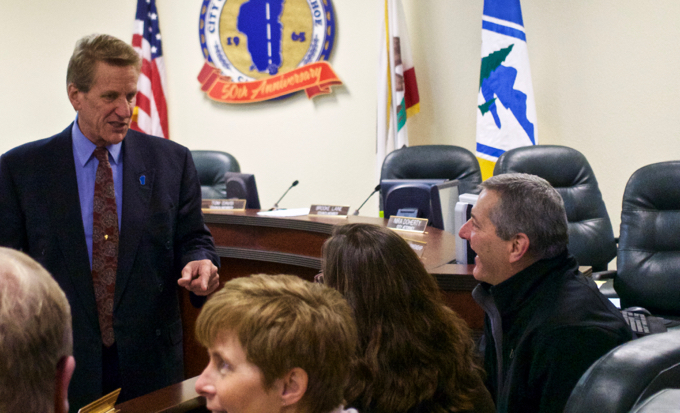
Mayor Austin Sass on Nov. 21 talks to department heads during a break. Photo/Kathryn Reed

By Kathryn Reed

It was a bit of a grade-school level civics lesson for those who sat through the South Lake Tahoe mayor’s address on Tuesday.

It was not about laying a path for the future. It wasn’t about what the council has done in his one year holding the gavel. It wasn’t about how the electeds’ policy decisions have come to fruition – good or bad; or lessons learned; or any vision.

Then again, Austin Sass on Nov. 21 said his address was not going to be like others. “It’s not really a state of the city.” And his talk lived up to that introduction.

Normally, the mayor takes the opportunity of his or her last full council meeting to tout what has happened in the last year, with a bit of a nod to what lies ahead. Sass altered that tradition.

Another noticeable difference was the room was not packed as it has been in years past for the annual mayor’s address.

Instead, Sass launched into how the most important part of the city is the nearly 200 employees. But in an odd twist he did not speak of the accomplishments of the city manager or city attorney. Those are the only two employees the City Council has any say over. The council hires and fires, disciplines, and give raises to those two employees.

And those two had to have had accomplishments in order for Sass to bestow praise on the department heads.

Two other workers not mentioned were the city clerk and treasurer, and the latter was in the audience. Maybe it’s because they are both elected officials and Sass doesn’t see them as integral to the operation of the city.

Sass’ address was more like that of a boss praising his employees, but these individuals are not his employees.

There is not a single employee the council has any control over other than the city manager and city attorney. In fact, the protocol in City Code is that council members are not allowed to give direction directly to staff outside the city manager or city attorney.

During his talk, Sass walked around to where each department head was sitting. He patted most on the shoulder as he stood over them. He introduced them and then he listed their accomplishments.

Some accomplishments of the city department include:

·      Growing the city’s social media presence;

·      Champions Plaza;

·      Responding to more than 3,200 fire incidents in 2017;

·      Increased training for firefighters;

·      24,097 airport operations; the highest it’s been since 1992;

·      395 arrests by police officers this year;

·      8,029 miles of roads plowed;

·      1,153 potholes filled;

·      Community ball fields built;

·      Debt refinancing saves $1 million annually;

·      1,372 building permits issued;

·      7,000 special events in the city;

·      6,400 rounds of golf at Bijou.

At the end of the speech, the audience was left with how much work the various departments do but no sense of what the council does. Sass seemed to paint a picture for how effective and efficient a city manager led government works, what great leaders there are among staff, while reducing the role of the electeds to essentially being figure heads.

At the Dec. 12 council meeting the five electeds will choose among themselves who will be the next mayor and mayor pro tem.