Banzai Tour — a test of free riding, downhill skills

By Dana Turvey

The Rahlves Banzai Tour follows a simple equation: speed plus terrain divided by fun equals just what the host still craves post-World Cup.

And Daron Rahlves is the guy to do it. He took a perfectly good career as a 12-time winning World Cup downhiller and three-time Olympian and amped it with a run on the newly formed U.S. Skier Cross Team and a fourth visit to the Olympic Games. Throw in some X Games hardware and there’s quite a resume.

The three-stop Banzai Tour has morphed from its roots as the Silver Belt Banzai Race, which Rahlves re-booted in 2009 at his host resort of Sugar Bowl. A blend of ski and boarder cross strategy, big mountain free riding and downhill racing, the Banzai pumps racers four at a time out of a skicross start “maneuvering through strategically-placed gates on a big mountain course while navigating alongside fellow racers, with the limited rules to finish fast enough to advance to the next round.”
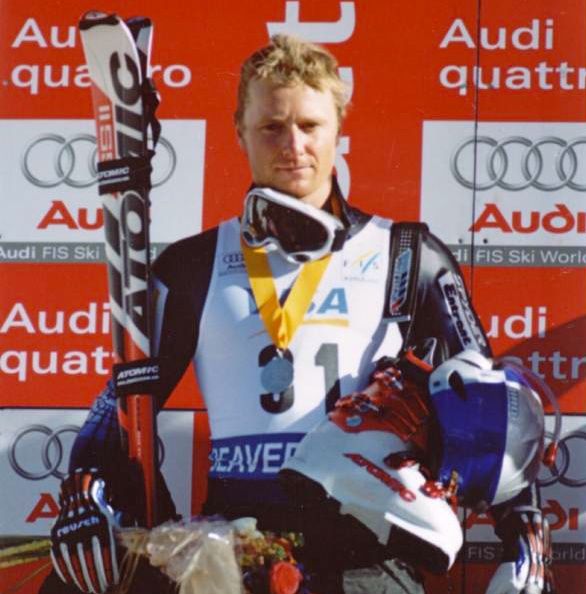
Daron Rahlves

Daron Rahlves brings the Banzai Tour to Kirkwood Feb. 5-6. Photo/Dana Turvey

“The Silver Belt event has been so much fun that I wanted to see it kind of expand and to also do something for Tahoe,” Rahlves told Lake Tahoe News from his home in Truckee. “This kind of series isn’t done anywhere else and I figured that it could be a draw to bring attention to Lake Tahoe in a way that’s really unique.

“So, I got together with (long-time sponsor) Red Bull and we tried to decide what other resorts would fit in. In addition to Sugar Bowl, we came up with Kirkwood and Alpine Meadows because of their terrain. With both places, it’s so wide-open and they get lots of snow, plus they have plenty of natural terrain features and impressive steeps.”

This winter’s Banzai Tour schedule had the first event at Alpine Meadows on Jan. 22-23, with the results sheet reading like a partial who’s who of winter: Errol Kerr, Shelly Robertson, Nate Holland and Chris Hernandez were part of the world class roster.

Kirkwood is coming up this weekend and the finals at Sugar Bowl will be March 12 and 13. The format is fairly simple: day one is qualifiers and after inspection and practice runs, each entrant has a solo timed run that is used for the four-person brackets the following day. The finals day will bracket the top 32 skiing men, top 32 snowboarding men and top 16 in each category for the women. Then the banzai part truly starts.

At a fairly tame entry fee of $100 per resort, that gives racers two days of lift tickets in addition to the event. There is a total purse of $50,000, which allows for $10,000 in prize money at each of the resorts, plus an extra $10,000 distributed to the overall tour winners. Math whizzes will realize that leaves a spare $10,000 that goes to the winner of the Banzai Super Final.

Don’t look for Rahlves’ name on a check this weekend, but maybe at the very end of the series.

“I won’t be racing through the series,” Rahlves explains. “I’m more just the ambassador for the event and I’ll be there with my wife and our twins. So I’ll be there each day and I’m setting the course, forerunning and doing a lot of work behind the scenes. But I’m mostly sitting on the sidelines, licking my chops waiting for the Super Final, where I get to race against the winning skier from Alpine, Kirkwood and Sugar Bowl. Then it’s a final day, one run, winner-take-all $10,000 that should be a definite crowd pleaser.”

Speaking of crowds, spectators get more than just great racing. At each stop there’s a sponsor village with tents and a few giveaways. Rahlves has brought together an impressive list of sponsors, many onboard since his early World Cup days. Look for booths from Spyder, Bud Light, Red Bull, Contour HD, Giro, Sierra Avalanche Center, Atomic, Suunto, Snowbomb, 101.5FM, TahoeTV, Powder Magazine, Wend Snow Wax, Zinka SPF and Crux Events.

Rahlves says, “At Kirkwood, after the qualifiers, we plan to meet at the outdoor patio, the Village Plaza (at the base of chairs 5 and 6) and just have some fun. If it gets colder, then we may migrate to Bub’s Pub across the street. But at each event, we have a charity that some of the proceeds go to – again, for Kirkwood, it’s the Level Field Fund, which offers grants to athletes who may not have the funds to travel to competition. It was started by Ross Powers, and with other athletes like Michael Phelps and Seth Wescott, we’re trying to bring it some attention.”
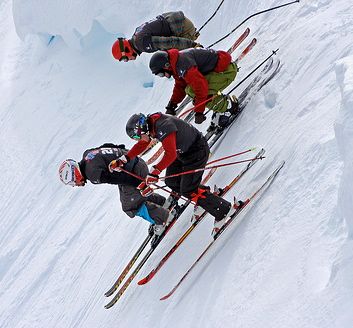
Banzai Tour competitors at Alpine Meadows in January. Photo/Alpine Meadows

Banzai Tour competitors at Alpine Meadows in January. Photo/Alpine Meadows

The Kirkwood course on Feb. 5-6, accessed from top of Chair 10, will run down Eagle Bowl and Rahlves guesstimates that it will be a bit more than one minute long.

“You get there from the top of the Wall, but the course won’t start until the Eagle Bowl ridge to skier’s right. Then it’s pretty wide-open, which is great because there’s lots of room to spread out and a chance to use the fall line. There will be eight or so gates and we’ll set it so you can use the terrain to naturally soak up speed or just let it go and catch some air. Plus, you don’t have to worry about anyone coming in from your right,” Rahlves said with a laugh.

Based on the popularity of the Alpine Meadows stop, Kirkwood’s entries could sell out. Register beforehand online and mark your calendar for a day of fun, speed and terrain, Daron Rahlves-style.


Kindertown faces state closure; owner going to court

By Kathryn Reed

Kindertown parents found out Monday night at an emergency meeting the state intends to shutdown the South Lake Tahoe day care center Friday.

This is the second time in 16 months the state Department of Social Services has issued such a notice.

Mike McLaughlin, who successfully defended owner Maria Barrows-Crist in El Dorado County Superior Court last year, intends to file a stay on Thursday. If granted, it would mean the center with 90 youngsters and 18 employees would at least temporarily remain open.

Maria Barrows-Crist on Jan. 31 tells parents Kindertown's future is in jeopardy. Photo/Kathryn Reed

Maria Barrows-Crist on Jan. 31 tells parents Kindertown's future is in jeopardy. Photo/Kathryn Reed

Barrows-Crist, holding back tears at Kindertown, told the more than 40 adults and about a dozen children she is going to fight the current allegations just like she did the prior ones.

The most serious of the allegations in the 25-page document is a young boy with Downs syndrome wandering away from the facility to Highway 50, which parallels the facility a block away.

The report details how the boy was found by a family driving down the highway, how police were called, and the subsequent interview of Barrows-Crist and one of her employees.

In addition to a child being able to leave the premise unattended, the state says Barrows-Crist did not file the proper Unusual Incident Report.

“I thought he was hiding. We looked everywhere. I got in my car and searched the neighborhood,” Barrows-Crist said in an exclusive interview with Lake Tahoe News before the Jan. 31 meeting with parents. “I reported it. They said they didn’t get the Unusual Incident Report.”

Police officers are also obligated to report such incidents to the state, so it’s not like Barrows-Crist could hide what happened.

The paperwork ordering the license for the preschool and the license for the infant center be revoked was signed by Administrative Law Judge Ann Elizabeth Sarli on Jan. 3.

Barrows-Crist, unable to hire an attorney, represented herself at the late-November hearing that led to that decision. It was Jan. 26 that Frank S. Furtek, deputy director of the legal division for the Department of Social Services, signed the paperwork for the closure to be effective Feb. 5.

The state Department of Education will be at the center at 6:45 Tuesday morning telling parents where else they can enroll their children. Part of Barrows-Crist’s funding is from the state through subsidies parents receive.

“We’ve got your back” and “we’ll be here” were said by parents gathered on Monday. Many have been through this before.

John Cocores was at the Sept. 23, 2009, meeting Barrows-Crist conducted to let parents know about the first threat of closure. He was there Jan. 31, 2011, too.

Cocores took his 4-year-old son, Ryan, out of Kindertown for a bit during the uncertainty of whether is would remain open. The second day at the new place, which Cocores would not name, Ryan suffered a head injury.

“He is progressing wonderfully,” Cocores says of his son at Kindertown. He only has good things to say about the care his child receives.

Cocores goes on to say, “At some point you have to wonder when it’s harassment. Do they inspect all the schools as much as this do (Kindertown)?”

Kori Tomlin, senior staff attorney with the Department of Social Services, deferred comments to the public affairs section of DSS. A representative could not immediately be reached for comment.

Throughout the report Barrows-Crist’s credibility is called into question.

The report says, “Respondent’s attitude towards [sic] these two citations for lack of care and supervision demonstrated her lack of understanding of the seriousness of her violations. She maintained that the Department was unreasonable for citing her and was persecuting her because of her success in opposing earlier disciplinary action. She maintained that no child had been hurt in the almost 30 years she has been operating her facilities. Her position was that she had been set up for license revocation. She completely disregarded the fact that the Department is obligated to respond and investigate when a child is found running into and along side Highway 50, choosing instead to view the investigation and citation as persecution.”

In speaking with Lake Tahoe News, Barrows-Crist does believe she is being singled out. She also acknowledged the gravity of the charge, but says her site is not the first the child has run from, just the first to be closed because of it.

Barrows-Crist said the child’s father continues to bring the youngster to Kindertown.

Barrows-Crist said the worst that will happen if the state prevails in shuttering the facility that opened in July 1973 is she files for bankruptcy, the children must find other care facilities, and the employees new jobs.

For now, though, she is counting on a judge issuing the stay this week. Then she needs to raise $20,000 to keep McLaughlin on as her attorney. She’s already in arrears on paying Feldman, Shaw, McLaughlin LLP.

She has spent more than $100,000 in attorneys’ fees in the last 16 months. The Kindertown bus is for sale. If Barrows-Crist can get through this chapter of turmoil, she plans to sell the center. She has a meeting with a real estate agent Tuesday.


Subtle sign changes designed to help drivers in S. Tahoe

By Kathryn Reed

What people may begin to notice as they drive around South Lake Tahoe is something is missing.

But what?

Clutter. Clutter in the form of signs.

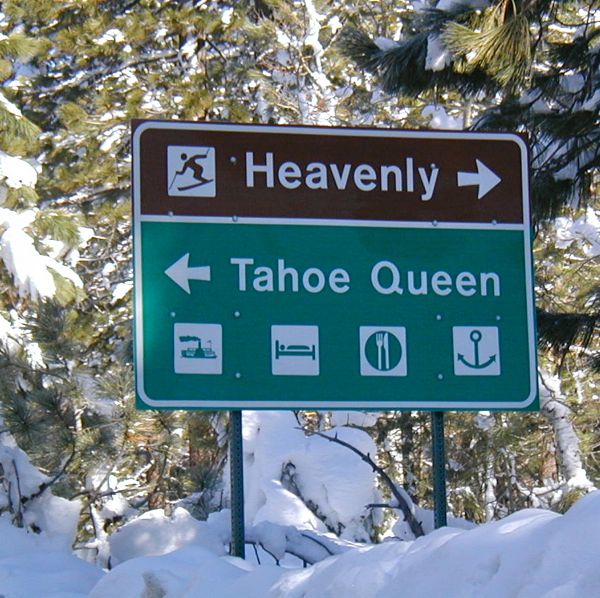
Signs are changing in South Tahoe to help motorists find things easier. Photo/Provided

Signs are changing in South Tahoe to help motorists find things easier. Photo/Provided

“Wayfinding is intended to be an intuitive way to find your way around the community. It is not intended to be glaring or offensive,” explained B Gorman, executive director of the Lake Tahoe South Shore Chamber of Commerce.

This collage of signs shows what led to the desire to make changes. Gorman said it’s the absence of visual clutter people will notice most.

Her group helped spearhead the challenge to bring uniformity to signs throughout the South Shore, with the El Dorado side the first to implement the program. The chamber took Carl Ribaudo, a marketing specialist on the South Shore, up on is idea this was something the community needed.

South Lake Tahoe put $66,000 toward the project and El Dorado County $42,500.

It is just now that signs are popping up in town even though the project started being discussed in spring 2007. A major cog in the wheel of progression is a state highway runs through the middle of town. Caltrans and NDOT have particular rules about signage on state highways.

NDOT, according to Gorman, would not proceed until its California counterpart took action. When NDOT may consider wayfinding again is not known.

“We tried to explain to Caltrans we are different,” Nancy Kerry said. Kerry worked on the program while employed by the chamber and then when she was hired by South Lake Tahoe.

That difference is that in addition to regular signage on a state highway, the small towns that dot these roads also need to let people know where things like the library, marina and beaches are.

“It was exciting when Caltrans said we can make this work,” Kerry said. “They are separating the town destinations from the highway destination needs.”

What won’t be seen on the highway signs are lots of color and fun symbols like what San Francisco has with an icon of Italy pointing to North Beach and a crab for Fisherman’s Wharf.

The city may be able to get more creative with signs that are not on the highway, and to possibly incorporate an alpine motif.

But the ski resort and marina symbols people are accustomed to will remain, but incorporated into that uniform look.

“It’s important to bring some consistency in sign style because when you are traveling down the road, if there are a lot of different signs, whatever the message is gets lost because you have to read so many things,” Kerry said. “If there is consistency in size, color, font and style, then you only notice what has changed, which is content. You can get to where you are going faster and easier.”

The new signs are cleaner, more uniform. The 22 signs Caltrans approved are slated to be in place before the Amgen Tour de California bike race in mid-May that starts in South Lake Tahoe.

“It makes the community look more appealing for the visitor and residents,” Gorman said of wayfinding.


Panoramic views of Tahoe without a ton of exertion

By Kathryn Reed

Easy, fun, scenic. Scampering up Twin Peaks on snowshoes encompasses all of these elements.

It’s one of those jaunts that is great on a day when you want a little exercise outdoors, but don’t have a ton of time. Of course the snow conditions always play a role in how long an excursion will take.

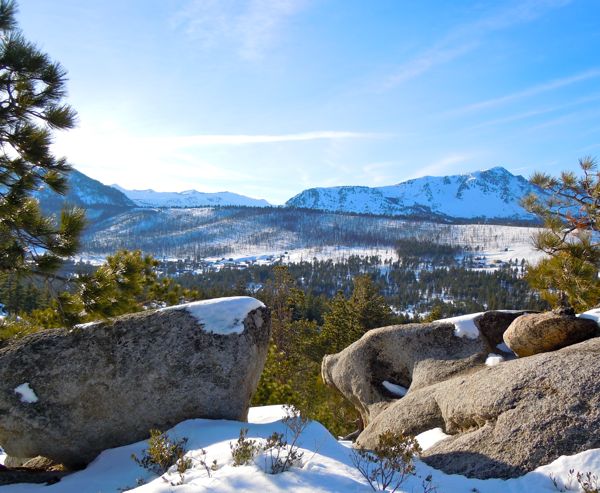
Hiking Twin Peaks in South Lake Tahoe is worth the views. Photos/Kathryn Reed

Hiking Twin Peaks in South Lake Tahoe is worth the views. Photos/Kathryn Reed

But it’s also one of those sojourns when on a warm day it’s worth lingering a bit. The views are some of the best for so little effort. The top is an ideal lunch spot and place to sit with a book or just meditate a while, remembering why Lake Tahoe is so special.

Starting off from the Echo View Estates neighborhood off Sawmill Road in South Lake Tahoe, we follow the well-established trail.

Beneath us the snow is firm. It’s nice to have the claws on the shoes so we don’t slip. Although the route is not extremely steep, it is definitely uphill without any plateaus to change the pitch.

Crossing the terrain filled with conifers and boulders, we come to what is a fun 4-wheel drive road in the summer. Being a road, it’s wide enough to walk side-by-side.

Fully exposed, we welcome the sun on this chilly late afternoon January day. Turning around, the views of the Sierra unfold. The ridges look uninviting in some ways. Maybe it’s just me imagining how much more work they are to climb than this little hill that’s practically in my back yard.

In the summer we hit both peaks – it is called Twin Peaks, after all. On the other side is the tower with the warning light for aircraft. From there, is a view to Lake Tahoe Airport, Lake Tahoe Golf Course and Meyers. But it takes a bit of bushwhacking through the Manzanita in summer. That prospect sounds horrible on snowshoes; plus, not enough daylight exists to tempt it this day even if we wanted to.

Instead, we saunter up by the massive granite boulders to take in views of Lake Tahoe to our right. Angora Ridge with her barren trees from the 2007 fire by the same name is stark against the brilliant white snow. Mount Tallac hovers beyond.

It’s been awhile since I’ve been up here. I had forgotten the majestic views it offers. It won’t be long between this visit and my next one.

Getting there:

From the Y in South Lake Tahoe, continue on Lake Tahoe Boulevard. Turn left on Sawmill Road. Park immediately in the lot to the left.

Yes, I start off a neighborhood street, but I’m not going to be responsible for cluttering up a residential neighborhood. And this way, you get even more exercise.

ngg_shortcode_0_placeholder (Click on photos to enlarge.)


Water content in Sierra above average despite dry January

By Kathryn Reed

PHILLIPS STATION — Despite January producing more sunny days than snowy ones, the water content at the top of Echo Summit is greater now than it was a month ago, but percentage-wise the average has dropped.

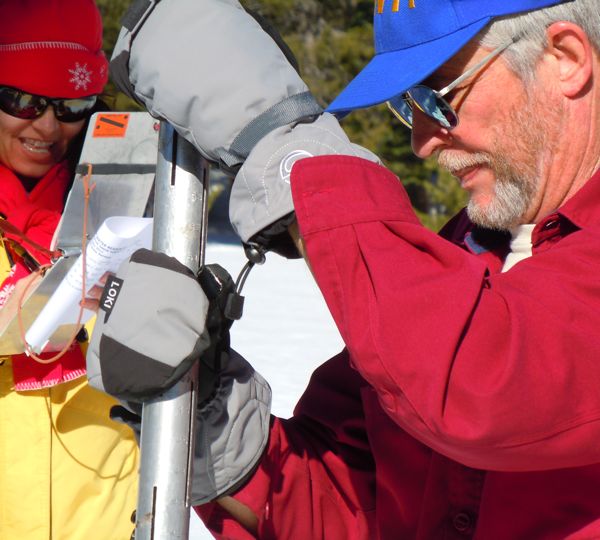
Department of Water Resource officials were at the junction of Highway 50 and the entrance to Sierra-at-Tahoe on Friday for the monthly snow survey. Results at this location show the snow depth is 56 inches, with 24 inches of water content. The water content is 125 percent above average.

Frank Gehrke measures the water content at Phillips Station Jan. 28 as Tina Cannon Leahy records the figures. Photo/Kathryn Reed

Frank Gehrke measures the water content at Phillips Station Jan. 28 as Tina Cannon Leahy records the figures. Photo/Kathryn Reed

In December, the figures were 55.9 inches for snow depth, 19 inches of water content, for a reading of 158 percent above normal.

“January was pretty much a non-event,” Frank Gehrke, chief of the California Cooperative Snow Survey Program, said of the precipitation. He said this is typical of La Nina years. What wasn’t normal was all the wet stuff in December.

The concern is if this weather pattern continues, it could mean depleted reservoirs downstream. The snowpack in the mountains provides for about one-third of the water for all California households, industry and farms.

In South Lake Tahoe, the average precipitation for January is 1.96 inches. As of Jan. 28, the National Weather Service in Reno had recorded 0.08 inches for January. That number is likely to increase with a storm blowing in Saturday that could linger until Monday morning. It is expected to bring 2 to 4 inches of snow at lake level and 4 to 8 inches at higher elevations.

What concerns Gehrke is if most of the remainder of the water year is below average for snowfall, it could mean a faster snowmelt. Already the above average temperatures are creating streams and puddling water that is not normal for January.

“As we move into spring, there is a lot more sun angle and increased snowmelt,” Gehrke explained on this bluebird day that had the mercury in the Sierra hitting 50-plus degrees. “(This is bad) because then we won’t have the water in the spring.”

Most of the major reservoirs in California have two purposes – storing water for use and flood control.

According to the Department of Water Resources, Lake Oroville, the State Water Project’s principal reservoir, is 102 percent of average and at 67 percent of capacity; Lake Shasta, the federal Central Valley Project’s largest reservoir, is at 112 percent of average and 76 percent of capacity.

“Virtually all the major reservoirs are releasing water. The releases are mandatory by federal law. It’s based on the flood control diagram,” Gehrke said.

Even with water being let out, users of the State Water Project are expected to receive 60 percent of what they’ve requested. In 2010 users were given 50 percent of allocations. The last 100 percent allocation year was 2006. That was the same year it continued snowing well into May even thought it, too, was a La Nina year.

“California weather is characterized by extremes,” Gehrke said.

Location

Elevation

Snow Depth

Water Content

% of Long Term Average

Alpha

7,600 feet

60.6  inches

28  inches

133

Phillips Station

6,800 feet

56  inches

24  inches

125

Lyons Creek

6,700 feet

63.8  inches

28.4  inches

145

Tamarack Flat

6,500 feet

60  inches

24.4  inches

126

Source: Department of Water Resources


Citizen survey: South Tahoe functioning at subpar level

By Kathryn Reed

Although some would argue a survey did not need to be taken, South Lake Tahoe officials believe having current data in writing gives them the authority to make changes people want, instead of guessing what they want.

slt logoCity Manager Tony O’Rourke took his own analysis in September about the city. The new council did the same in late December-early January. The public was sent a survey in December, with results released this month.

Everyone is on the same page – the natural environment is great, everything else needs improving. Less than half of the survey takers rated the direction of the city as good or excellent.

“Clearly, it’s not a surprise,” O’Rourke said of the entire survey. “Now we are developing a course of action to address those weaknesses and build upon the strengths. We’ll develop tactics and performance measures. Ultimately we need to build the public’s trust.”

From all this data and analysis of it, the council on Tuesday came up with five goals to work on.

Facts about the citizen survey:

• 1,200 utility customers were mail the survey – so not just South Lake Tahoe residents, but people affected by decisions the council makes;

• 390 surveys were returned, for a response rate of 35 percent;

• The National Citizen Survey compares South Lake Tahoe responses to about 500 jurisdictions elsewhere in the United States to provide a benchmark.

In the executive summary of the citizen survey it points out, “Of the 31 characteristics for which comparisons were available, three were above the national benchmark comparison, two were similar to the national benchmark comparison and 26 were below.”

South Lake Tahoe is dead last with its residents when compared against others in employment opportunity category. Ninety-four percent said “poor” on the survey.

Compared to the 2008 citizen survey, people today believe things in South Lake Tahoe have gotten worse when it comes to ease of traveling via bus, car, bike and foot.

One thing that has improved slightly between the years is people think traffic signal timing is better. Otherwise they are more disenfranchised with streets – the repair, cleaning, lighting, snow removal, and sidewalk maintenance.

Forty-eight percent believe housing costs are reasonable, 20 percent believe there is ample affordable quality housing, and 30 percent believe the variety of housing is adequate.

In two years, people’s sense of community has dropped four percentage points to 46 percent.

Consultant Mike Levinson was brought in to decipher the volume of paperwork in front of the five councilmembers Tuesday, which went beyond the survey, to bring perspective to the material, and help them set goals.

“You have enormous potential with your amenities, in particular your airport,” Levinson said. “Fourteen percent of your tourists you are attracting are from Southern California and they are driving eight to 12 hours.”

He believes commercial air service will double that percentage.

Levinson said with three-fifths of all tourists coming from California, “You should do more to promote within that market. You are not taking advantage of that.”

He also pointed out with 78 percent of the city’s budget devoted to salaries and benefits, the council is going to have to address it if the city is going to be solvent.

“If you take all the data, you can build a case for change. There is a lot of room for improvement,” Levinson told the council.


LTUSD deficit may swell to $2.6 mil.; depends on state

By Kathryn Reed

It’s a bit of hoping for the best, planning for worst when it comes to forecasting what the Lake Tahoe Unified School District budgets will look like for the next two years.

ltusdEducators have their fingers crossed the proposed June ballot initiative by Gov. Jerry Brown passes. But the reality is it may never see the light of day. That will be determined by the Legislature in March.

The best-case scenario as presented to the board Jan. 25 is the continued running deficit of $1.2 million. The worst-case option is another $1.4 million will be added to that systemic problem to bring the district’s ledgers showing $2.6 million in red.

CFO Deb Yates and Human Resources Director Jim Watson delivered the sobering news Tuesday to a packed house at the district office. Watson went over possible elimination of positions for the next two years. His job is one that could be cut in 2011-12.

This would mean Superintendent Jim Tarwater would spend all of his time at the district office. He currently divides his day as principal of the Environmental Magnet School. Someone would have to take over those duties.

Watson said during a recent webinar a leading economist said what makes this different from previous budgets is “this really is a sky is falling budget to go with the sky is falling rhetoric.”

California is grappling with a $25 billion deficit. For the past several years lawmakers have put a Band-Aid on the issue and deferred some of the more painful decisions. Brown has said he wants to stop that practice and begin making the hard decisions.

He wants voters to continue on with tax hikes that were put into effect two years ago. The Republican Legislature is resisting the Democrat’s idea.

Even if the proposal makes it on the June ballot, that does not give this or most districts much time to figure out what they are doing because most fiscal years begin July 1. This is why LTUSD is essentially working on parallel budgets based on funding possibilities.

The LTUSD board took no action this week. (Sue Novasel was absent.) But action will have to be taken soon even if it means revising things when the state figures out its mess.

Teachers have another week to let the district know if they will be taking the golden handshake retirement option. If enough people pursue early retirement, pink slips will likely not have to be issued for the coming school year.

A slew of ideas were outlined at the meeting as possible ways to maintain solvency. When it comes to positions, reduction in the number of school days or the furlough day, those would have to be negotiated with the unions.

The state allowed districts to go from maintaining a 3 percent reserve to 1 percent for this school year. The proposed budget from Brown says districts will be allowed to maintain a 0.33 percent reserve.

“I’m hearing if this is not the time for reserves, I’m not sure when is. No one I’ve crossed paths with has seen it worse,” Yates told the board.


Lively discussion leads to 5 strategies for S. Tahoe council

By Kathryn Reed

“Credibility is the currency of leadership.”

This was one of the nuggets of information Mike Levinson gave South Lake Tahoe city councilmembers during their three-hour strategic planning session on Jan. 25. Levinson, former city manager of Coral Springs, Fla., and now a consultant, was brought in for $1,500 to facilitate the meeting and offer insight.

After hours of lively discussion, the council came up with five broad priorities to focus on. In no particular order, they are:

Consultant Mike Levinson leads the discussin Jan. 25 about the direction of South Lake Tahoe. Photo/Kathryn Reed

Consultant Mike Levinson leads the discussion Jan. 25 about the direction of South Lake Tahoe. Photo/Kathryn Reed

• Economic development

• Infrastructure/built environment, including public works and technology

• Public trust, including communication and accountability

• Financial stability

• Partnerships, with private entities, as well as on the local, regional, state and national levels.

From here City Manager Tony O’Rourke will devise bullet points – or action plans that flush out what those five statements mean based on dialog given Tuesday.

“We’ll put some meat on this bone,” is how O’Rourke put it.

Each councilmember will soon take ownership of one of the bullet points. The idea is to not micromanage the progress of staff, but to be the liaison from staff to the council, and when appropriate to be a voice in the public about the bullet point.

The reason to do this is to give each council person ownership as well as having to be accountable to the electorate they are doing something other casting votes every other Tuesday.

Part of the early discussion was on the results of the citizen survey. Compared against the SWOT (strengths, weaknesses, opportunities, and threats) analysis the council did of the city, the results parallel one another, according to Levinson. (Lake Tahoe News will be writing about just the survey in the near future.)

“If you take all the data, there is a bold case for change,” Levinson said. “There is a lot of room for improvement.”

In the free form discussion that led to the ultimate decision to focus on the five issues above, Mayor Hal Cole brought up the idea of the city being more intricately involved in what happens at the foreclosed would-be convention center site. This would be a 180-degree turn from where the city wanted to have no real part of the project — especially financially.

“We might say this would be our (cultural center),” Cole said. He added how the former contract was laid out, the city might have been able to have 10-days of events at the site.

Councilman Bruce Grego wants to engage Heavenly Mountain Resort or its parent company Vail Resorts about being annexed into the city. (The California Lodge is in El Dorado County.) He is also an advocate of taxing lift tickets even though an amusement tax cannot be implemented for 22 years based on previous contracts.

Banter back and forth culminated with the opinion Heavenly would come to the table, but the city would have to have something to offer – like X number of events a year.

A survey of tourists that was discussed Jan. 25 pointed to how special events get people to the South Shore.

The dialog was not always linear, with topics bouncing all over the place.

Councilwoman Claire Fortier wants to ensure technology, like WiFi, is easy for locals and tourists to tap into.

The sign ordinance was brought up, quickly followed by code enforcement.

“We need a balance between pro business and pro aesthetics,” O’Rourke said of signs.

He proposed working with businesses as Caltrans begins making improvements to Highway 50 this summer and for several years after that. He threw out the idea of making the business community conform based on where Caltrans does its improvements so it all is done in small, manageable segments.

Councilwoman Angela Swanson brought up the desire to get the Prosperity Plan off the ground and finding a way to do so.

Much discussion focused on land use issues, including the cog Tahoe Regional Planning Agency can be in the wheel of progress.

Cole brought up how an issue with the Mikasa building is that TRPA mandates any building more than 50 years old be studied for its historical significance. It was pointed out the better part of the South Shore would fall into this category. The irony being much of the city is deemed a redevelopment area, meaning it has considerable blight.

Playing nice with others was a big component. It was pointed out how the city barely got Lakeview Commons approved because of the acrimonious relationship with El Dorado County.

Cole pointed to how he sat on the TRPA Governing Board with current Nevada Gov. Brian Sandoval, adding that relationship should be pursued. Councilman Tom Davis pointed to how the city used to have a lobbyist in Washington who helped secure money for the city.

Grego wants to develop a pool of candidates of people “with our sympathies” to help get placed on boards like Lahontan so perhaps the city would receive favorable treatment.

Levinson said he was surprised this is the first workshop the City Council has had in years, as well as that it doesn’t have a public information officer to carry its message to the public.

The redesign of the city’s website was brought up, with the idea it could be a portal of information about city issues as well as point visitors to appropriate locations.

Davis kept bringing up media relations without elaboration.

Fortier wants to create a recreation hub.

Cole would like the city to work with sections of town to have something like what Ski Run Boulevard developed with its business improvement district.

The council is expected to drill down on the five priorities at the first meeting in February.


Mormons leave behind rich history in El Dorado County

By Kathryn Reed

CAMP RICHARDSON — Trudging along in less than ideal conditions – mud so high the wagon wheels barely turn, cold so bitter it is impossible to ever get warm, hunger like the Donner Party knew. And yet, the worst may have been being driven from their home, unwanted, persecuted all because they were Mormon.

Life in the 1840s came alive at the rustic Camp Richardson Lodge last week as Frank Tortorich took on the persona of a young man caught up in the strife. Tortorich, who lives in Amador County, is an educator, researcher, guide, author and member of the Oregon California Trails Association.

William, the character Tortorich portrayed, knew Joseph Smith and later Brigham Young. Starting in the Midwest, marching with the Army to California, then heading back to the Salt Lake area, Tortorich led the nearly 40 people in attendance on what felt like a physical journey through time, as well as through history that has been left out of school curriculums.

Historian Frank Tortorich enlightens people about the Mormon migration that involved El Dorado County. Photo/Kathryn Reed

Historian Frank Tortorich enlightens people about the Mormon migration that involved El Dorado County. Photo/Kathryn Reed

Smith’s murder in June 1844 and Young’s ascension to lead the Mormon people is part of the story.

It was after Smith was killed that the 25,000-person migration from Nauvoo, Ill., began for the people of the Church of Jesus Christ of Latter-day Saints.

A couple hundred, including Sam Brannan, went by boat around Cape Horn to California. It was in San Francisco where William would meet up with Brannan again.

A deal was struck between President James Polk and Mormon leaders that in exchange for protection along the route west 500 men would join the Army.

Young’s prophecy that no Mormon would die in battle fighting the Mexicans proved true — though plenty died on the journey. They were part of the Mormon Battalion. It was a grueling march from Santa Fe to San Diego. By the time they arrived in California the war was over.

They were introduced to Catholics, who welcomed them instead of being afraid of people with a different religious belief.

It was now the late 1840s and Young had made his way to the Salt Lake Valley.

With the discovery of gold, some of the Mormons headed to what is now El Dorado County to find some nuggets to take to Salt Lake.

Tortorich talks about James Marshall and John Sutter’s gold rush that started it all.

“James Sly, one of our brothers, loved the place. He built a corral about 6 miles up,” William says.

(Sly Park exit off Highway 50 may now have new meaning to people.)

The migration east to Utah included 17 wagons, two brass canyons, 150 horses and 150 oxen. The group knew about the Donner Party tragedy and had no desire to go over what was known as the Truckee River route.

Though they lost scouts to Indians along what is know Highway 50 in the American River Canyon, they believed this to be a less treacherous route.

“We went over this summit and it was beautiful; into a valley we called Lake Valley,” William told the audience. Then over another summit in the Sierra the men, women and children went. “Brother Biglar wrote in his diary we shall name this Hope Valley.”

(John Biglar became the third governor of California and at one time called Lake Tahoe Lake Biglar, but that never took.)

Finally, the group made its way along the Carson River, knowing its name because John Fremont had called it such after his friend Kit Carson.

All the wagon trains the Mormons saw headed west were advised of this new route over the Sierra instead of possibly having the same fate of the Donner Party.

William didn’t live long upon his arrival in Salt Lake. His widow remarried a man with the last name Kimball. They moved into the Wasatch mountains, calling their outpost Kimball Junction. Today it is known as Park City.

This night was part of the Lake Tahoe Historical Society’s Winter Program.


Tahoe Keys Marina parking spaces to be increased

By Kathryn Reed

Parking may no longer be a hassle for people using the Tahoe Keys Marina, Fresh Ketch restaurant and Cove East nature trail.

This is because the California Tahoe Conservancy board at its meeting this month agreed to enter a lease agreement with the marina owners to build 91 shared use spaces.

The Conservancy owns 1.3 acres of land between the current parking lot and the trail. It’s that dirt area at the end of Venice Drive in South Lake Tahoe that could be paved over as early as this year.

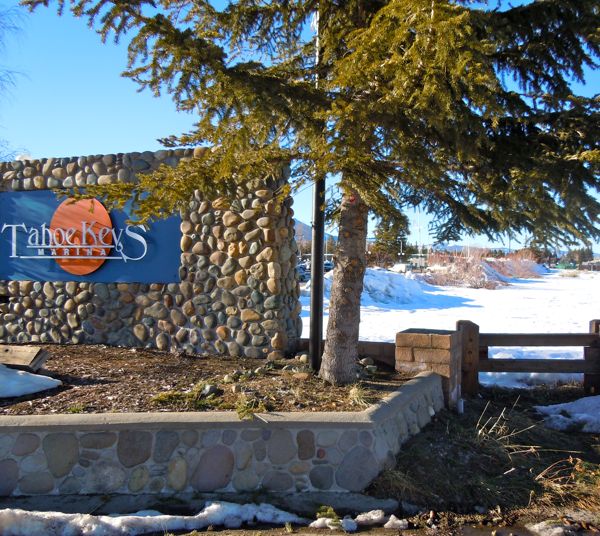
The acreage behind the Keys sign is slated to become a parking lot. Photo/Kathryn Reed

The acreage behind the Tahoe Keys Marina sign is slated to become a parking lot. Photo/Kathryn Reed

“The existing footpath should not be affected,” Bruce Eisner of the Conservancy told the board Jan. 20.

The parking lot would be linked to the popular path that leads to Lake Tahoe.

Negotiations have been going on for a couple years to seal this deal. Although the marina owner still has to sign-off on everything, the Conservancy is confident a contract will be in place shortly.

In addition to adding parking to an area that is congested throughout much of the summer, a lane leading to the boat ramp will be dedicated to people needing inspections related to invasive aquatic species. Also part of the project are restrooms, day use amenities and landscaping.

Although there are no plans today to make any of the spaces at the marina paid, if that were to happen, language in the lease calls for the Conservancy to receive 20 percent of the proceeds.

The 30-year lease will not cost the CTC a dime. The marina will pay for the planning, permitting, construction, and operation and maintenance of the facilities.

The board also on Thursday approved the lease agreement where the marina will pay the Conservancy $5,000 a year for the use of the 1 acre parcel on Venice Drive that is about halfway between Tahoe Keys Boulevard and Cove East.

With the agreement comes an option for the marina to buy this plot of land for $261,000. But the Conservancy does not want to sell it until after Jan. 1, 2015. This is because the state agency foresees using it as a staging area if work is done to the Upper Truckee River at this location.

If the river, which is being reconfigured upstream in stages, goes through a similar rebirth at the mouth of Lake Tahoe, then the footpath would be altered.

“The current path is merely a temporary path,” Eisner said of the big picture that involves restoration to the river.

The other component that is likely to affect Cove East and what is called the Upper Truckee Marsh is the environmental impact statement and environmental impact report on 525 acres that are scheduled to be released this spring. Four alternatives are proposed in those documents about what should be done with the property that is owned by the state.

The land is some of the most sensitive in the Lake Tahoe Basin, containing rare and threatened species.