Plow drivers deal with un-fun part of Tahoe snowstorms

By Kathryn Reed

Bouncing. Snowplows can do this even though the machines literally weigh a ton and then some. Even with chains on all six tires, if they are carrying enough snow, especially uphill, it’s far from a smooth ride. And these monsters also slide.

Operating heavy equipment isn’t easy under the best of conditions. Best of conditions for a plow driver would be adequate visibility, no obstacles and a road surface that doesn’t resemble a Zamboni having just cleared a sheet of ice.

It’s Feb. 17 and the snow is dumping in South Lake Tahoe. Visibility is less than ideal. Vehicles are coming and going, and this contraption is supposed to zig and zag to accommodate them. Mailboxes are on the edge of driveways looking like targets.

Visibility is lacking for snowplow drivers during a storm. Photos/Kathryn Reed

Visibility is lacking for snowplow drivers during a storm. Photos/Kathryn Reed

With 130 miles of streets to clear in the city limits, the 16 plow drivers work 12-hour shifts (6 to 6) at times when it’s dumping like it has been for the past few days. The city is divvied up into routes, with a team working a particular route.

It’s a little before 6pm in the employee room at the snowplow yard. Dennis Hillyard is telling Bobby Maxwell what the day shift was like, what he accomplished, how the machine is operating. Something isn’t quite right with big blue so Maxwell takes an older machine that rattles onto the streets of South Lake Tahoe.

Before he leaves the yard Maxwell tests the hydraulics. It’s a bit like a pilot going through a checklist.

The instrument panel is not as complex as that of an airplane, but there is certainly more to do at all times while the machine is in motion. No autopilot on this rig.

Five controls on the left, six on the right and the foot pedals require dexterity, concentration and quick thinking. Plus, there are levers to the right dealing with front wheel drive and being able to lock the rear axels. Windshield wipers clear – though not well – the moisture from the glass on top and below. The radio to home base is to the left.

There’s the plow in front, the belly blade and the gate to contend with on the machine.

That’s what these guys, and it is a male dominated profession, contend with just in their small sphere that is not designed to carry a passenger.

Outside their sphere of influence are driveways, intersections, drainage areas, street signs, mailboxes and vehicles.

And then there’s the public. Some don’t know how to drive in the snow. Some don’t care their vehicle is on the edge of the driveway looking close to losing a front bumper. Some people come out to stare. Others throw their arms up in disbelief about the berm that just got left.

“There’s never anything positive from the public when you’re plowing,” Maxwell says.

He’s had people chase him in their vehicles. He doesn’t stop; thinking nothing good could come of the confrontation.

But that doesn’t mean he is callous about leaving a berm. He said he and co-workers do their best, but when it’s coming down as fast has it has been with this storm, the accumulation means the snow has to go some place.

“You can only carry so much snow,” Maxwell explains. “The gate really only reduces the berm. It does not eliminate it.”

Headed up Bode Drive off Pioneer Trail the machine is resisting, it’s bouncing a bit. That driveway is going to be bermed. The gate, the device that is used to avoid berms, has to be released. And simple physics prove plows can only carry so much snow before it spills over.

Houses on the right corner of an intersection are apt to receive the biggest berms. Such are the hazards of the plows having to clear an intersection, with some of that snow from the street getting dumped right away.

People who plow their snow into the street – which violates a city ordinance – are apt to get a larger berm because it’s just more snow that has to be moved out of the street.

It’s not one pass that Maxwell makes on what is called the Heavenly route. He said he and Hillyard are about quality, not the distance.

Other operations

South Tahoe plow drivers are responsible for all the city streets, while Caltrans contends with all state highways, just as NDOT does the highways in Nevada.

In El Dorado County, the main arterial roadways and school bus routes are the priorities when it comes to clearing the 158 miles on the South Shore. The county also has 35 miles of pavement in the Tahoma area to contend with.

“We have been hit by the budget to some degree, but it is not affecting snow removal operations,” said Tom Celio, El Dorado County deputy director of maintenance and operations.

The county also runs two 12-hour shifts and breaks the work into zones.

Douglas County is only responsible for a handful of streets at the lake, which is done by two private contractors. The rest of the South Shore is either covered by homeowners associations (like in Glenbrook) or general improvement districts (like the streets off Kingsbury Grade). Douglas County School District plows Warrior Way for the schools along there.

Once the streets all get plowed, then the blowers come out in all the jurisdictions. The guys driving the blowers are the same ones who had been in the plows.

ngg_shortcode_0_placeholder  (Click on photos to enlarge.)


Investment banker accused of fraud; Holly’s Place survives

By Jessie Marchesseau

“I don’t know what to say. It just really, really, really hurt a lot,” Holly Eimer, owner of Holly’s Place, said of her experience with former financial planner Lori Zoval.

Zoval is the South Lake Tahoe resident indicted last July on charges of wire fraud. The charges stem from an investment fraud scheme allegedly enacted by Zoval while working as an investment banker in Folsom. However, Eimer said she was also swindled out of hundreds of thousands of dollars by Zoval.

Sitting in the common area known as the Rainbow Room at Holly’s Place, Eimer describes how Zoval became a trusted friend and colleague who nearly cost her this business. Holly’s Place is a dog-friendly vacation retreat in South Lake Tahoe. The pet-friendly sanctuary sits on more than an acre in the center of town and consists of four studio units, one cabin and the Rainbow Room which was formerly a barn. The community kitchen, flickering wood stove, casual sofas and ping pong table within make the Rainbow Room a cozy place for guests to hang out, and, of course, dogs are always welcome.

Holly Eimer of South Tahoe is trying to be recover after being swindeled out of hundreds of thousands of dollars. Photo/Jessie Marchesseau

Holly Eimer of South Tahoe is trying to be recover after being swindeled out of hundreds of thousands of dollars. Photo/Jessie Marchesseau

“I don’t care about making money,” Eimer said. “I just want people to love this place as much as I do.”

This sunny outlook may be what has kept Eimer and Holly’s Place going after losing three cabins to foreclosure, dealing with a tax nightmare and watching her nonprofit, Tahoe Helping Hands, go belly-up. She estimates that hiring Zoval cost her nearly half a million dollars.

Eimer met Zoval through the South Tahoe Chamber of Commerce in 2006. She says she was impressed right from the start and soon hired Zoval as her financial planner. By the end of the year, Eimer had hired Zoval on fulltime to run Tahoe Helping Hands, an organization she set up to make the retreat wheelchair accessible.

“I remember feeling like she might really be interested in my idea,” Eimer said, “because my idea has been, for the last 10 years, making this place wheelchair accessible for people like myself.”

Eimer was diagnosed with multiple sclerosis in 1989, and though she is not in a wheelchair now, she knows she might be someday. For Eimer, the disease has affected her cognitive abilities more so than her physical abilities, something she suspects may have made her an easy target.

“I wanted to help people,” she said. “I wanted to help people because I know what it’s like to have MS.”

Eimer said Zoval convinced her to refinance three of her properties and opened numerous credit card accounts under the name Tahoe Helping Hands. She said Zoval then used the credit cards extensively on trips, hotels and a lavish lifestyle, leaving Eimer with thousands of dollars in unpaid credit card bills.

Zoval was in charge of the overall financials of Tahoe Helping Hands for nearly two years. Then in October 2008, Zoval went on a business trip to San Diego and never returned.

Eimer said she considered Zoval a friend, and had even allowed Zoval to live on the property with her son and boyfriend while she was employed there. However, after Zoval left, Eimer discovered bills, loans, mortgages and taxes had not been paid, and she was facing foreclosure.

Having founded Holly’s Place more than 20 years ago, tears well in Eimer’s eyes as she talks about losing three of her cabins. Her dream of a retreat for people with disabilities is all but gone now. And after what has happened, at 61, Eimer is ready to start slowing down.

“It’s time to downsize and time to rest,” she said, “and I just hope I can financially make it.”

Eimer was more than willing to provide financial documents to the FBI last summer for use in the case against Zoval. Eimer said she does not want Zoval to do this to anyone else.

Zoval pleaded not guilty at the initial hearing six months ago, but the case is still in the pre-trial stage. She is out on bond, and her lawyer, Mark Reichel, said she is “working hard to support her family through a tough time.”

At a hearing before the judge on Feb. 11, the U.S. Attorney’s Office in Sacramento reported a proposed plea agreement had been offered to Zoval. Details of the agreement have not been made public. Reichel requested a continuance until April 8 to further review the case and continue negotiations on the proposed plea agreement.

If Zoval pleads not guilty at the April 8 hearing, the case will be set for trial at that time. Reichel said he does not know how Zoval will plead.


Friends turn emails into food blog for the masses

By Kathryn Reed

Puttanesca probably wasn’t on a vocabulary or spelling test when Klaire Pirtle was principal of Kingsbury Middle or Minden Elementary schools.

That’s because the Italian dish is better known as “whore’s style spaghetti.”

The retired Douglas County School District educator helped her daughter, Amber Asbjornsen, whip up a bowl of puttanesca worthy of being posted on the Beauties and the Feast blog.

Puttanesca from Beauties and the Feast. Photo/Amber Asbjornsen

Puttanesca from Beauties and the Feast. Photo/Amber Asbjornsen

The blog’s subheading is: Six beauties. One feast. One blog where we gather to dish our reviews.

Asbjornsen is one of the beauties who started the blog a couple months ago with five friends from college. The 1998 Douglas High School graduate took a home ec class there, but is not attributing her culinary expertise to that experience.

Five of the friends live in Washington state (they all went to Western Washington University) and one is single and traveling.

The blog emerged from casual emails sent among the friends.

“If we tried something good, we would email it out. Then someone would say can I have this, someone would say something quirky, others would say what they did differently (with the recipe),” Asbjornsen explained.

She admits with a full time job, husband and two kids to not having much time for extra things like a book club, but thought something virtual would allow her the flexibility and fun she was looking for.

From there, Beauties and the Feast was born.

Each month one of the six posts a recipe. The others all try it and post comments on the blog. In between there might be “extra” recipes like a special cocktail for the Super Bowl.

February is Asbjornsen’s month to post a recipe.

“I knew I wanted to try puttanesca. I looked at a million recipes. Then I made up my own recipe from those and I posted a little history lesson about what it means,” Asbjornsen said.

On the blog she also gives her mom a ton of credit for the dish.

“My mom is my biggest supporter. They didn’t laugh at me when I was taking pictures of my food,” Asbjornsen said. “When we get together we do a lot of cooking.”

She considers cooking a creative outlet, and now the blog is an extension of that.

“I’ve never considered myself a chef, but I love cooking and I love cooking for my family,” Asbjornsen said. “Both of my parents stressed sitting down with our family an eating. We still do that now.”

The women don’t know where this will take them.

Megan Crosby is the single friend who is exploring the world.

Missy Cudworth is a mom of an 11-month-old and writer for the Delilah show.

Jolie Lucero is a stay at home mom of two.

Emily Adamson is married and does social networking for her job, so is the blogging expert. “She is the real foodie of the group,” Asbjornsen said.

Rachel Strachan is married, living on several acres as sustainably as they can.

Making money off the site would be the dessert, so to speak, to the whole project. For now, though, it’s all about sharing their love of food with the rest of the world.


Heavenly Village entities look at new era of cooperation

By Kathryn Reed

Movement is afoot to alter language in the multi-year agreement regulating who pays what and does what at Heavenly Village. South Lake Tahoe officials brought the idea to the board Tuesday with the hopes of possibly being able to offer in-kind services, help with special events and restructuring parking fees as incentives to pay less each month.

“I think everyone at this table wants it to be successful. We’ll put together a group to talk about parking and the existing agreement,” PADMA board Chairman Greg Campbell told City Manager Tony O’Rourke at the Feb. 15 meeting. He said the board would have something to bring to the table at or before the April meeting.

Park Avenue Development Maintenance Association is the organization formulated in 2002 to maintain the Heavenly Village. The two Marriott properties pay 55 percent collectively, Heavenly Mountain Resort 20 percent, South Lake Tahoe 20 percent, Trans Sierra Investments 2.5 percent, and Cecil’s 2.5 percent for the upkeep.

The fee structure at the Heavenly Village garage is likely to be altered. Photo/LTN file

The fee structure at Heavenly Village garage is likely to be altered. Photo/LTN file

Attorney Lew Feldman, who represents PADMA, pointed out there is a separate parking agreement between the city and PADMA that calls for the board to be consulted regarding parking fee changes at the village garage even though it is owned by the city. That hasn’t been happening.

“The parking structure should be an enhancement for the village and it’s not,” O’Rourke told fellow PADMA board members.

He broached the idea of instituting the “Free after 3” program like Vail has, but added, “To do so we need to off-set the costs.”

If the Free after 3 idea were implemented, the city would take an additional $100,000 a year loss on the parking garage that already loses $100,000 and has a debt of $7.2 million that is gradually being paid off. That is why the city, as O’Rourke told the board, “wants relief with our agreement.”

Officials from Vail will be in Tahoe in the next couple weeks to offer advice about what the city can do with its financially failing concrete structure.

The idea is to get more locals to use the garage and therefore frequent the businesses in the village.

But Feldman also pointed out the trend is more people are staying in vacation rentals, so a reasonable parking rate – or free at times – would be incentive for those tourists to venture to the Stateline area village.

He also noted with the garage being the most underutilized during the midweek that in the past the idea of having a parking pass for Heavenly season passholders was brought up but went nowhere.

Pete Sonntag, general manager of the ski resort, is a PADMA board member. He didn’t comment on Feldman’s midweek parking incentive idea.

To offer different types of parking options for people, O’Rourke told the PADMA board it’s possible about 30 spaces could be created at the transit center, with the first two or three hours free.

When it came time to discuss how much retailers pay the city per validation coupon, Feldman said the idea for the movie theater to pay so little compared to others was to get locals to the village.

O’Rourke contends with the length of time movies are in the theater – months not weeks – that would point toward the theater having an eye toward tourists, not locals and therefore wants the board’s help with making the validations equitable. The city manager also asked for assistance with getting all retailers to offer validation that will provide consistency for retailers.

Gary Casteel from Trans Sierra Investments, the group that owns the bulk of the retail buildings, said it’s easier for someone selling high-end art to offer validation than someone selling an ice cream cone.

In the era of trying to all play nicer together, Feldman pointed out there was resistance from officials with the city who are no longer on the payroll for things like banners and other visual displays to spruce up the area.

“Let’s look at this relationship from a different perspective and bury the adversarial tones,” O’Rourke said.

O’Rourke told the PADMA board how the current council wants to build partnerships – which includes with the folks at Heavenly Village. It’s part of the council’s economic development plan.

The more Heavenly Village is successful, the more sales and hotel taxes the city collects – not to mention parking fees.

Feldman said most of the businesses are seeing double-digit gains over the prior year. Campbell noted the Marriott properties are doing well this season, too.

“Luxury items are off a little bit like the rest of the country,” Casteel said.

Kerry David with David & Johnson certified public accountants went over the November and December financials. The numbers prove early snow isn’t always a good thing.

Snowmelt was budgeted to cost $1,746 in November, when in fact the bill came to $16,975. For December, the deficit was $4,584. The good news is a dry January made up $19,000 in savings with no snow on the ground to melt.


Mt. Rose blooms with steeps, impressive day lodge

By Kathryn Reed

RENO — It’s one of those days when the slopes are as enticing as relaxing in the lodge.

At 8,260, Mt. Rose Ski Tahoe has bragging rights for having the highest base elevation of any Tahoe area ski resort. The summit is 9,700 feet.

Being located on the Mt. Rose Highway between Lake Tahoe and Reno, it falls into a pattern that gets hit hard with good snow. And the elevation of the resort means if the groomers do their job right, the snow is good even when Mother Nature hasn’t dumped freshies in a while. A week ago when some area resorts had spring-like conditions, Rose was ripe for carving turns on the hard pack.

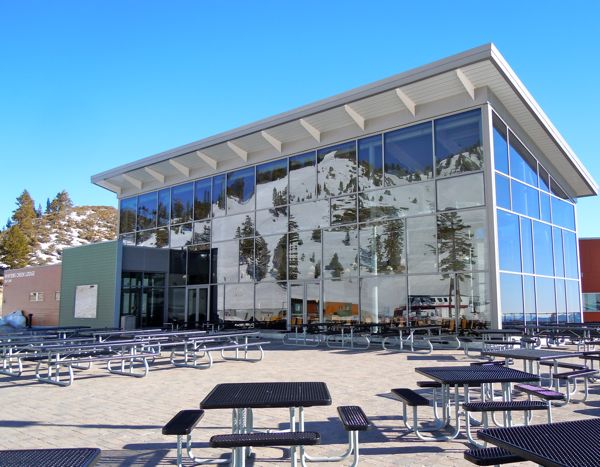
The slopes of Mt. Rose are reflected in windows of Winters Creek Lodge. Photos/Kathryn Reed

The slopes of Mt. Rose are reflected in windows of Winters Creek Lodge. Photos/Kathryn Reed

But it, like other exposed resorts, is susceptible to the wind wreaking havoc. It was blowing so hard Mt. Rose didn’t open Valentine’s Day.

Even with today likely to be a powder day, I wouldn’t go in the chutes. And I certainly wasn’t going down what looked like a glacial ice field last Thursday. I’m just not good enough.

All the chutes at Mt. Rose are 45- to 50-degree pitches. That’s something that sets the resort apart from most of Tahoe – the number of steep runs as well as the sustained pitch.

Resort officials say they benefit from a bit of a cult following. The chutes are one of the reasons. About 50 percent of the clientele is local – which is mostly Reno residents. The rest are primarily from the Bay Area, with the South Bay dominating that group.

Mike Pierce, marketing exec at the resort, isn’t exaggerating when he says Mt. Rose’s blues are equivalent to Northstar-at-Tahoe’s blacks. Going down Ramsey’s – a blue – I feel like this is a black at many Tahoe resorts.

With the amount of terrain, it’s easy to pick a side to ski, after all, this used to be two distinct ski reports – Mt. Rose and Slide Mountain.

Slide Mountain, the closest to Reno, opened in 1953. Both were in operation in 1964. Slide went bankrupt in 1987, when Mt. Rose bought it out. The Slide side is on U.S. Forest Service land, while the Rose side is privately owned.

The lack of lodging at the resort makes it a definite day-use area and not a destination resort. But the Rose side is slated to be developed – one day, with something. The market will dictate if it’s houses or hotels or condos or something else that gets built. Nothing it being talked about at this time.

The privately owned resort is doing better than a year ago, Pierce said. The early snow made for a base that all the Tahoe resorts have been living off of since Mother Nature has been chincy with the white stuff in 2011.

Another draw this season was the opening of Miller Time, the ninth gated chute.

Still looking brand new is the Winters Creek Lodge on the Slide side that opened last season.

Remnants of the old Reno Ski Bowl are no longer visible now that the Winters Creek Lodge has opened on the knoll that was home to the old structure. Employees used to be park here, too.

With nearly 360-degree views from the floor-to-ceiling windows, this high point of the base area is definitely being put to better use. So ideal is the setting, the lodge has a separate website from the resort’s because of its high demand for special events.

Washoe Lake shimmers on one side, while the snow covered slopes are in the opposite the direction. The contrast, especially this time of year, is stunning, as the Carson-Reno area seems a brown desolate desert in comparison to the winter scene on the mountain.

Jazz is playing as we walk up to the lodge in the morning. A few people are getting breakfast. Not many cars are in the lot. The Blazing Zephyr six-pack opens at 8:30am, 30 minutes before the rest of the mountain.

Lodge or slopes? A lot of both is the best answer.

Getting there:

From South Lake Tahoe, take Highway 50 east. Turn left on Highway 28 at the top of Spooner Summit. In Incline Village, turn right on Highway 431 – Mount Rose Highway.

The Mt. Rose base is the first entrance on the right. The Slide Mountain entrance is about a half mile farther on the right.

More information is online.

ngg_shortcode_1_placeholder (Click on photos to enlarge.)


South Tahoe on path to change how it does business

By Kathryn Reed

A blueprint for how South Lake Tahoe will conduct business is taking shape, with adoption of the formal strategic plan expected at the March 1 council meeting.

The City Council spent about 90 minutes last week creating substance for the five priorities the group agreed to at the prior meeting.

SLT_logoBesides what the council envisions for the area, City Manager Tony O’Rourke is doing is own assessments that are designed to complement the policy the City Council is formulating.

Also at the March 1 meeting will be O’Rourke’s reorganization plan for the city.

“We need to right size the government to match resources,” O’Rourke said.

What positions will be eliminated and the cost savings are not being made public. Part of the secrecy is the need to discuss matters with unions. Lake Tahoe News has been told the cuts will be at various levels, not just rank and file employees.

O’Rourke told the council during the workshop portion of the Feb. 8 meeting under the Fiscal Sustainability section that change is coming. The plan calls for looking at “shifting city’s employee compensation system from a longevity-based step plan to a pay-for-performance system that rewards results.”

He said, “We are just paying people to show up and I don’t think that’s our goal. We have good employees. We need to recognize them.”

Nancy Kerry, who works in the Housing and Redevelopment Department, has been assisting O’Rourke with the intricacies of the strategic plan.

Another thing O’Rourke is looking at is how the city delivers services. He is considering privatizing some of the city’s resources such as the ice arena.

“We don’t have to be the direct provider of services,” O’Rourke told the council.

The council agreed the goal should be for the Parks and Recreation Department to cover 75 percent of it costs instead of the current 50 percent. Stan Sherer, who has been at the helm of the department for six weeks, is assessing how best and who best to operate entities under his authority.

“We need to be more entrepreneurial in how we invest in Bijou (Golf Course). Maybe we need more special events,” Councilwoman Angela Swanson said.

At the start of the meeting the council agreed to the city’s mission statement being, “We are dedicated to providing essential, outstanding and cost-effective services that enhance the vitality and quality of life our residents, businesses and guests.”

Within the five categories of the plan are strategies to achieve the goal and performance measures.

Under Economic Development, the goal is to adopt the Tahoe Valley Community Plan by the end of the year, increase hotel tax collections by two percentage points next fiscal year, increase business licenses from 3,000 to 3,150, and increase hotel occupancy rate from 23 percent to 32 percent.

O’Rourke said he had been meeting with stakeholders “to discuss what is the community brand.”

He added, “There are not enough events celebrating the natural environment.”

Councilwoman Claire Fortier said it’s important for the city to support events even if they are not city-initiated events.

Under fiscal matters, Councilman Bruce Grego believes the city needs look at going back to voters to increase the business license fee even though it failed at the ballot in November.

Councilman Tom Davis strongly disagreed. He said there is no appetite for such a fee no matter how much the public is educated. He said his Tahoe Keys vacation rental business would have gone from paying $3,800 a year to $10,000 had the measure passed.

“If we are going to go to the public, it should be for more than $150,000,” O’Rourke said. That’s all the fee change would have generated.

When it came to the Built Environment, O’Rourke praised Mayor Hal Cole’s sign near the airport welcoming people, saying more things like that are needed in town.

The idea it to improve things like landscaping, plant flowers, and make Linear Park near Tahoe Meadows be visually appealing.

One of the strategies is to create a rating system in conjunction with the lodging and visitors bureaus for hotel properties that would encourage owners to enhance their establishments so they are at the top of the list.

A performance measure for this category is to add two business improvement districts in 2011-12 to what Ski Run Boulevard has established.

Providing a 24-hour online and voicemail service was proposed as a way to better get input from the pubic, with the idea people will get a response within 24 hours.

Playing nicer with everyone keeps being reiterated. The idea of the council having annual meetings with various boards was broached. Ironically, Douglas County Commissioner Lee Bonner spoke at the start of the regular council meeting saying his board wants to set up a meeting soon with the council to discuss matters of importance regarding the South Shore that cross the state line.

Next up is for the council is to adopt the plan. Then staff will start implementing it. The council will be provided quarterly reports, with an annual progress report created for the public, although the quarterly documents would be public documents.

Although the strategic plan is a bit of a living document, it is designed to be a vision for the next four years.

From the strategic plan, the business plan will be developed. That should be before the council in April. That in turn will drive what the budget looks like. For the first time in at least a decade, if ever, the city plans to create a five-year budget.


Environmentalists sue USFS to not log Angora burn area

Reno Gazette Journal

Environmentalists are suing the U.S. Forest Service to try to block logging at Lake Tahoe that the agency says is needed to help guard against another wildfire like the one that destroyed 254 homes three years ago.

In addition to removing downed logs that hamper firefighting efforts, the Forest Service says the Angora project will help speed regeneration of the forest and restore wildlife habitat across about half of the 3,000 acres that burned on the southwest edge of South Lake Tahoe in June 2007.

But the Earth Island Institute and Center for Biological Diversity say the logging would do more harm than good.

They say the project would do little to reduce fire threats but would disrupt the natural regeneration of the forest and eliminate about 70 percent of the last suitable habitat for the rare black-backed woodpecker across the entire 230 square miles of the national forest surrounding Lake Tahoe.

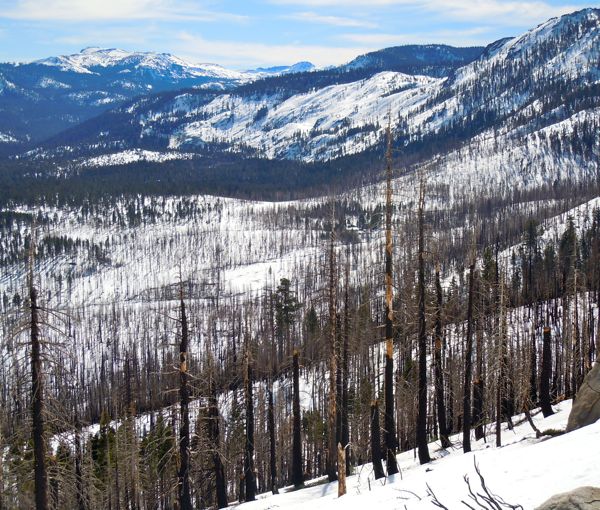
The burn area from Angora Ridge on Feb. 13. Photo/Kathryn Reed

The burn area from Angora Ridge on Feb. 13. Photo/Kathryn Reed

The Forest Service’s own research shows the woodpecker is highly dependent on burned forest where beetles and other insects are plentiful, especially where the fire burned intensely, as was the case across about a third of the Angora site, the lawsuit said.

The agency designated the bird the “management indicator species” for post-fire habitat throughout the Sierra Nevada in 2007. Last September, the Center for Biological Diversity and the institute’s John Muir Project petitioned the California Fish and Game Commission to declare it threatened or endangered under the state’s Endangered Species Act.

“If the black-backed woodpecker is going to survive here in California, we can’t keep logging its habitat. And this is exactly the kind of habitat it needs,” said Justin Augustine, a staff attorney for the Center for Biological Diversity who helped prepare the lawsuit filed on Friday in U.S. District Court in Sacramento.

Read the whole story


Expedition: Kirkwood cranks it up a gear for riders

By Jessie Marchesseau

KIRKWOOD — It is the day after a powder day, another blue bird day at Kirkwood. The sun is shining and not a cloud in the sky. No lift lines in sight and plenty of fresh tracks still to be had.

Untracked snow can often be found here for days after a storm. This general lack of crowds is part of Kirkwood’s appeal. The terrain is the other part: the cornices, the chutes, rock drops and steeps. Kirkwood has the look and feel of a backcountry ski adventure, most of it accessible by chairlift. This is what Expedition: Kirkwood director Jon Copeland calls the “wow factor.”

It was also the inspiration for the only resort-based all-mountain skill development program in the Tahoe area, aptly named Expedition: Kirkwood.

“We step out of the front door and we’re 50 feet away from phenomenal terrain,” Copeland said. “As far as the backcountry side, you step out of the classroom and you’re immediately in avalanche terrain.”

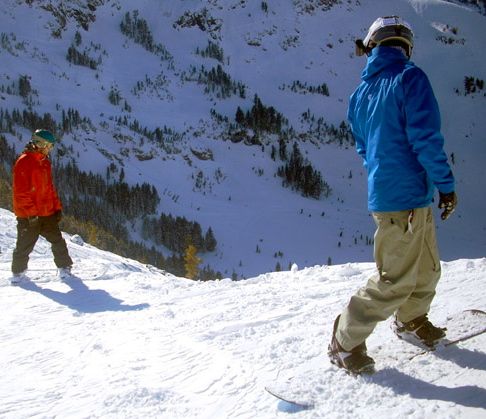
Difficult terrain like the drop into Vista at Kirkwood attracts Expedition and non-Expedition riders. Photos/Jessie Marchesseau

Difficult terrain like the drop into Vista at Kirkwood attracts Expedition and non-Expedition riders. Photos/Jessie Marchesseau

Kirkwood has an open boundaries policy that allows riders access to backcountry terrain directly from the resort. Expedition: Kirkwood guide Adam Marshall explained that this policy is directly related to their programs.

“You gotta remember, with open boundaries comes responsibility,” he said. “Our job is to make sure people are going out educated and prepared.”

Now in its 10th season, Expedition: Kirkwood started as a way to provide backcountry awareness and avalanche courses to advanced skiers and snowboarders. Copeland estimates they had about 165 participants the first season, a number that has grown to between 1,200 and 1,500 in recent years.

And people come back again and again. Marshall said he has had guests return for Expedition: Kirkwood tours two, three, four times. It is in these return clients who he and the other guides often witness the greatest progression.

“We see them becoming more and more like the riders we are,” he said. “We see them having fun and exploring the mountain like we do.”

Expedition: Kirkwood’s offerings have also expanded over the years. The program now includes snowcat tours, private guides, women’s camps and clinics, multi-day backcountry courses, and American Institute for Avalanche Research and Education (AIARE) avalanche certification courses, among others.

“The thing we try to focus on in every one of our programs, whether it’s just a two-hour private guide in-bounds or a full-day/multi-day avalanche course is there’s a huge education component to everything,” Copeland said. “Whether it’s based on your skiing or equipment or leave-no-trace ethics and that kind of stuff, really what we try to promote is the safety education aspect in all of our programs.”

To accommodate the expanding program and growing number of participants, Kirkwood recently opened Expedition: Kirkwood Outfitters. The spacious facility located next to Bub’s Pub has a modern mountain look to it with a combination of corrugated metal and natural woods throughout. Directly across from the entrance is a conference room complete with flat-screen TVs which will be used for avalanche and backcountry awareness courses. A retail store is off to the right offering high-end ski and snowboard gear and backcountry/all-terrain equipment, and a demo center exclusively for all-terrain, and avalanche equipment is on the left. Both are fully stocked with everything from avalanche beacons and shovels to seriously fat powder skis.

Copeland said he expects Expedition: Kirkwood Outfitters will enable the resort to provide better services to guests and allow more flexibility in its programs. They can now schedule classes at the spur of the moment and accommodate more custom courses, something Copeland estimates already makes up around 25 percent of Expedition: Kirkwood’s business.

Riders will also have a place to congregate, relax and connect with fellow ski and snowboard adventurists. Since it opened in January, Copeland said he has already seen a greater comradery forming among participants. After all, they all have something in common to start with: a love for the sport and for the mountains.

Marshall describes Expedition: Kirkwood guests as people who want to “ride anywhere, anytime in any conditions.” They already had the ability to form friendships on the hill, now they have a place to gather and get to know one another off the slopes, too.

Expedition: Kirkwood Outfitters demo center offers a variety of backcountry gear.

Expedition: Kirkwood Outfitters demo center offers a variety of backcountry gear.

Since the program is geared toward intermediate and advanced skiers and snowboarders, most Expedition: Kirkwood participants are Kirkwood regulars. They generally come from Tahoe, Reno and the Bay Area, and are often passholders wanting to take their skills to the next level.

“The way we explain it to a lot of people is: it’s your higher level of education. If ski school is high school and college, this is your doctorate degree or your Ph.D.,” Copeland said.

But the education opportunities and recognition of Expedition: Kirkwood do not stop with locals. The word is spreading.

“It’s definitely getting to where Expedition: Kirkwood is noticed all over, even at other mountains,” Marshall said. “If I go to Mammoth or even Colorado, people know when I say I work for Expedition: Kirkwood. It’s become more than just a brand, and it’s actually a new way for people to advance from intermediates to advanced and advanced to expert.”

So with a guide as a professor, and Kirkwood’s awe-inspiring terrain for a classroom, Expedition: Kirkwood could be well on its way to becoming one of the most sought after schools for a Ph.D. in ski. After all, who would argue with fresh powder turns for homework?


LTCC takes hard look at creating goals to improve

By Kathryn Reed

Lake Tahoe Community College knows what it needs to work on, but how to get there is another matter.

“We want to develop a shared understanding of opportunities and challenges,” Tom Greene, vice president of Academic Affairs and Student Services, explained as the five tables of eight people chatted among themselves. “This is critical because everyone looks at data and interprets it differently. When everyone is on the same page you move forward together.”

By the time the stakeholders of the two-year college finished the five-hour session, to some degree a shared vision emerged. From the reams of information gathered Friday, specific goals will be developed, with the board of trustees ultimately signing off on everything after the other necessary leadership groups have given their input.

Greene led most of the 9am-2pm planning session, with the help of Aaron McVean, director of Institutional Research and Planning.

LTCC instructor Jon Kingsbury goes over his group's ideas. Photo/Kathryn Reed

LTCC instructor Jon Kingsbury goes over his group's ideas. Photo/Kathryn Reed

The master plan is something the college does every six years. The strategic planning session is usually an annual event in the fall, but was delayed this year to accommodate a slew of changes at the college. Plus, the institution is in the middle of the self-study process of the six-year accreditation cycle.

Most tables had students, administrators, faculty, classified and a trustee at them so all sectors of the campus were heard. They spent the better part of Feb. 11 brainstorming how to put substance to the four strategic goals that will be part of the college’s Education Master Plan for 2011-17. Those goals are Student Access; Student Learning, Success and Achievement; Community Engagement; and College Sustainability.

When it comes to student access, data reveals the college population does not mirror the community or Lake Tahoe Unified School District. The college has more Caucasians.

“By and large we are white people over 40,” Virginia Boyar, director of Career and Technical Education, said of the group. “We cannot just assume what they want and need. We need to get them at the table and listen. We can’t listen if they are not here.”

It’s the Latino population she was speaking of.

Recruitment and outreach were repeatedly stressed when it comes to getting the Latino community interested in attending LTCC. Recognizing cultural and financial barriers exist was also talked about.

Creating a student ambassador was an idea – to have LTCC students talk to high school and middle school students about what college life is about, the benefits of an associate of arts degree or getting a certificate.

Looking at the curriculum, what is taught online and providing appropriate tutoring were other avenues to look at in regards to student access.

When it comes to the students’ learning, success and achievement it was noted these might be measured in different ways. For some it’s finishing the class, for others it’s graduating, still others it’s transferring to a four-year college.

“Can you separate learning from success and achievements?”

McVean asked the group to think about this as they delved into that strategy.

One table stressed the need for academic advisors for students, something the college does not have. Other support services such as counseling and financial aid were mentioned.

Preparedness was a recurring word – in terms of being ready for college level courses and ready to move on from LTCC.

Another group said students’ goals need to be defined before anyone can tell if they have been achieved.

Michael Ward, project manager for the Lake Tahoe Basin Prosperity Plan, spoke to the group before they dissected the community engagement strategy.

His overriding message was to “invite career pathways that are consistent with why people live here.” This means looking at what the curriculum has to offer related to the outdoors and recreation.

“We are growing tourists, not a middle class,” Ward said of Lake Tahoe as a whole.

He wants LTCC and the other institutions of higher education at the lake to focus on educating people who will stay in the basin. This in turn will help with the escalating unemployment rate. Ward said 50 percent of El Dorado County’s unemployed are on the South Shore. In the city limits the official rate is 17.2 percent, though with the underemployed it’s closer to 19 percent.

From there the groups came away saying the college is only selectively engaged with the community. Creating partnerships was a theme most of the groups championed – whether it is with other education outlets, the private or public sectors.

Hosting community-wide events, like today’s rail jam, is an opportunity for non-students to get a feel for the campus. Doing more of that was encouraged.

Knowing what the community wants was also pointed out. Being proactive instead of reactive was the message.

The last strategy talked about was how to keep the college sustainable, with money, facilities, human resources and technology being the components.

Greene stressed it’s time to look at moving from a state funded to a state supported institution.

A possible bond to raise money was floated, as were increasing summer programs and using the college when traditional classes are not scheduled.

Working with partners could also be a moneymaker. So could bringing in outside entities to host their meetings at the college.

Tying in with the community and recreation aspects, one table thought an intensive kids sports program is a good idea.

On the flip side, elder hostel was brought up.

“We will establish goal teams to establish clear, strategic goals. Don’t expect to see too many goals,” Greene told the group as he wrapped up the session.


City wants to adjust Heavenly Village contract, fix garage

By Kathryn Reed

Two of the current South Lake Tahoe City Council members are responsible for the city entering a 30-year agreement to pay 20 percent of the total cost, or about $140,000 a year, for the upkeep of Heavenly Village.

The current city manager, city attorney and redevelopment director all say the contract needs revisiting before it expires. Those three were not on staff when the deal was consummated in August 2002.

The city owns the common areas or walkways in the village that is anchored by two Marriott properties and the Heavenly gondola. This is not a usual way of handling these sorts of things, according to city staff.

An effort is under way to entice people to visit Heavenly Village. Photos/Kathryn Reed

An effort is under way to entice people to visit Heavenly Village. Photos/Kathryn Reed

More than once current staff has said previous councils upon recommendation of former employees have given away more to developers and private entities than is logical based on what the return is for the city.

Mayor Hal Cole and Councilman Tom Davis were on the council at the time this particular document was signed by then Mayor Brooke Laine. The other councilmembers were Bill Crawford and Judy Brown, the latter who got appointed to the Planning Commission effective today.

The two Marriott properties pay 55 percent collectively, Heavenly Mountain Resort 20 percent, Trans Sierra Investments 2.5 percent, and Cecil’s 2.5 percent into the kitty. Trans Sierra, run by Gary Casteel, owns the bulk of the retail buildings; Cecil’s owners were a large stakeholder in the original deal and own what is now called Stateline Brewery. (Casteel did not return phone calls.)

Here is the current PADMA budget, short for Park Avenue Development Maintenance Association. It details the breakdown of expenses for things like snow removal, security and landscaping.

The board is made up of a rep from all of the entities that pay into it, with the city having two people on the board.

Last spring the City Council decided not to send anyone to the PADMA meetings. Councilman Bruce Grego and Redevelopment Agency Director Gene Palazzo had been the designees.

“They were in the process of negotiating to get out of PADMA. They have been talking about that for a year,” Palazzo said in explaining why no one went to meetings for months.

City Attorney Patrick Enright attended the last meeting in December, with City Manager Tony O’Rourke wanting to go but needing to be at the new councilmember orientation. They’ve been to other meetings, but could not vote.

In January, the current council appointed Enright and O’Rourke to the PADMA board, which means they are now voting members. The next meeting is Feb. 15. (The board meets every other month.)

From the December meeting a “window of opportunity” was opened to re-examine the agreement, city officials say. But that’s not what other board members are saying.

“Our argument is private companies are benefitting,” Enright said in why the city wants to renegotiate the deal.

Lew Feldman is the attorney for PADMA and was also the attorney representing the developers. So he was negotiating with the city for the deal that is now being revisited.

He told Lake Tahoe News if a conflict arises, he would not participate in negotiations.

But Feldman also said the city’s current position is a political one, not a legal one. “It’s a contract,” he said, implying there is no wiggle room.

“At this time we are satisfied with how the contract is,” said Greg Campbell of Marriott Grand Residence. He is chairman of the PADMA board.

Building consensus

Two things the parties who spoke with Lake Tahoe News agree on is more needs to be done to bring people to Heavenly Village and the parking garage is a deterrent to making that a reality.

The City Council at its March 15 work session is scheduled to discuss PADMA and the city owned parking garage.

The PADMA board next week is expected to delve into parking and special events.

PADMA was not designed to be a marketing entity. It’s more of a property owners association.

“We are looking at forming a subcommittee this season to look at more opportunities,” Campbell said in regards to getting locals and tourists to the Stateline area complex.

He pointed to the success of Hot August Nights last year and said the village will play a larger role in hosting that car event this year.

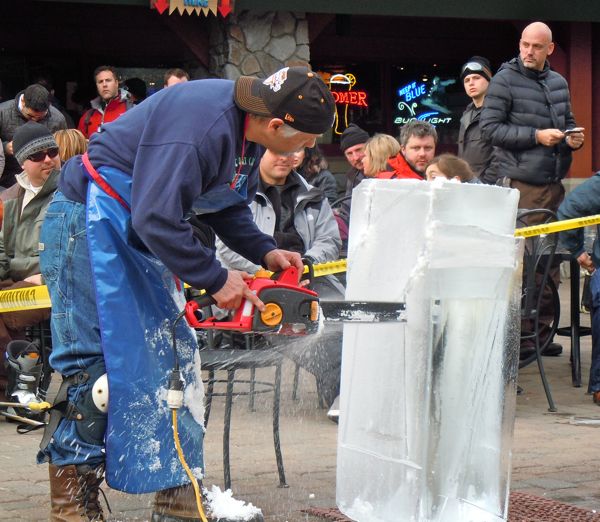
More special events like the ice carvers on Feb. 5 are being talked about.

More special events like the ice carvers on Feb. 5 are being talked about.

Campbell and Feldman pointed to the family-friendly inaugural New Year’s Eve festivities at the village as something to build on with the Lake Tahoe Visitors Authority, which spearheaded the event.

“In the past, funding has always been a challenge,” Campbell said of developing special events.

City Manager O’Rourke wants daily activities and major special events at Heavenly Village.

The other problem the village has is no one tells the media, therefore the public, about what is going on there. Lake Tahoe News reporters stumbled across two ice sculptors on Feb. 5. The guy taking a chain saw to a slab of ice captured the attention of dozens of spectators at Fire + Ice, which was doing a brisk business, while the rest of the village that afternoon was quiet.

Parking issues

One thing holding back locals from going to Heavenly Village is having to pay $3.75/hour at the garage.

So few people use the structure that the city loses $100,000 a year on the garage.

“It doesn’t help us to get 9 cents an hour from the movie theater,” O’Rourke said. “If it were an independent theater, wouldn’t they provide their own parking or couldn’t they have worked out a deal with Raley’s?”

The good deal for the public is four hours of validated parking with the purchase of a movie ticket.

The bad deal for the city is the theater pays the city 9 cents for each of those tickets. Many other private businesses in the village pay the city $1.56 per validated ticket. Retailers buy validation coupon books from the city.

O’Rourke wants to make those books more equitable to all involved. He can’t understand how anyone in the city ever thought it a good idea for a business to pay 9 cents.

The city violates its sign ordinance to direct people to the parking garage.

The city violates its sign ordinance to direct people to the parking garage.

He also doesn’t believe the city needs to keep paying for consultants to figure out how to run a parking garage. O’Rourke said talking to other cities that operate successful parking garages should do the trick. One thing he is looking into is how Vail offers free parking after 3pm.

O’Rourke told the council, “Based on current hourly revenue streams, it would cost the city approximately $100,000 to initiate a ‘Free after 3’ program at the parking garage. Staff is examining opportunities to off-set that loss with garage management changes, sponsorship advertising better garage signage, and possible PADMA cost sharing.”

Campbell agrees filling up the parking garage will help the businesses be more successful.

Feldman’s stance is the city has not adequately made the public aware of the garage. The city agrees.

However, last weekend the city violated its own sign ordinance by having a sandwich board sign pointing to the garage. This is the second time the city has been caught violating the ordinance. The other time it had a banner on the movie theater building.

“People driving down Highway 50 don’t know where to park for the gondola,” Feldman said. “I felt strongly and I still do that the village has not been (embraced) by locals as it ought to be and the major obstacle is parking.”

O’Rourke agrees, as he says, “Parking is a major disincentive for the public to go there.”

But the city’s top leader also acknowledged there has to be reason to go to the village.

Activities are one solution.

A better mix of retail, O’Rourke and Feldman said, will also get locals to come and visitors to stay. Both point to a need for a more unique mix of food and beverage options.

O’Rourke has worked with Bon Appetite officials in prior jobs and spoke to magazine officials when he was in New York last month about possibly having them do an event in South Lake Tahoe.

Although a better mix of retail is called for, some entities have survived since shops opened less than a decade ago – the movie theater, Heavenly Sports, Powder House, Kalani’s, Wolf Gang Puck, Fire + Ice, Patagonia, North Face, Cecil’s (with name changes and alterations), Boarding House, Cold Stone Creamery and Century 21.

“Heavenly Village is probably among the most functional mixed use developments in the basin in the economic situation we find ourselves in,” Feldman said. “Retail has taken a beating everywhere. Like the rest of the world, we are turning a corner.”