Blister rust threatens to destroy Tahoe’s sugar pines

By Kathryn Reed

Orange tinged pine needles signal a tree that is likely to be a skeleton of itself in a couple years. If standing, it will be a dead gray stick of sorts.

White pine blister rust is killing three species of pines found in the Sierra – sugar pine, Western white pine and white bark. With less than 5 percent of sugar and Western white pines having a natural resistance to the fungus, these trees could one day be extinct.

sugar pine

Sugar pines are often more than a foot long.

The Sugar Pine Foundation is attempting to do what it can to prevent them from being wiped out in the Lake Tahoe Basin.

John Pickett founded the nonprofit in 2004. His wife, Maria Mircheva, is executive director. Tressa Gibbard is development coordinator. The trio relies on a wealth of volunteers to further the cause of saving the sugar pine.

Gibbard recently spoke to Soroptimist International Tahoe Sierra about the foundation’s efforts.

“Blister rust goes from pines to rag weeds to pines. It would not spread if there were no rag weeds,” Gibbard explained.

In the short video the group saw it says 45 percent of the trees on Barker Pass are infested with pine blister rust, while the percentage is 40 on Dick’s Pass.

Pickett, in the film, talks about the billions of dollars spent on attempts to improve the clarity of Lake Tahoe, but wonders why no money is being spent by the states and feds on what is going on in the higher elevations.

He said fewer trees absorbing groundwater means more will flow downhill – and faster. It will contain fine sediment that clouds the lake. Other impacts to the ecosystem would also naturally occur if a species of trees were killed off.

What the foundation is doing to save the sugar pine species is climbing trees each September to harvest cones from the trees that have a natural resistance to the rust. Then the U.S. Forest Service, Pickett’s former employer, grows them into seedlings that can be planted throughout the region.

This spring a group of South Tahoe High School students is slated to plant seedlings in the Angora burn area.

The first plantings by the foundation were in 2008. Gibbard said more than 30,000 seedlings have been planted since then, with the anticipation of 10,000 more going in the ground this year.

Besides volunteering to plant seedlings, people can also become members of the foundation. Details about that and other aspects are on the Sugar Pine Foundation’s website.

Sugar Pine Foundation events:

• March 24: Maria Mircheva and John Pickett will give a talk at Explore Tahoe in Heavenly Village in South Lake Tahoe, 6pm

• April 16: South Lake Tahoe Earth Day at Bijou Park, 10am-4pm

• April 23: Tahoe-Truckee Earth Day at Squaw Valley, 11am-5pm

• April 30: Community Planting in the Angora Burn off Mule Deer Drive, 10am-noon (weather permitting).


Closed Highway 89 allows for spectacular snowshoe

By Kathryn Reed

Cascade Lake looks like it needs a Zamboni machine to clear off the snow to make it a perfect skating rink. Emerald Bay is eerily black, as though perhaps some creature of the lake lurks below.

Tahoe Tessie?

It’s one of those rare winter opportunities when Highway 89 is closed to vehicles and open to foot traffic.

Sun peaks through on a frozen Cascade Lake. Photos/Kathryn Reed

Sun peaks through on a frozen Cascade Lake. Photos/Kathryn Reed

Parking at the gate near the entrance to Eagle Point Campground, we strap on snowshoes to make the trek to appropriately named Inspiration Point.

Fortunately, someone beat us there last weekend so we didn’t have to break trail. Only one path heads up the road – wide enough for snowshoes, but a definite single file approach.

Meandering up the hairpin turns, going slower than the 10mph limit, we come to one of the most scenic areas in the Lake Tahoe Basin. The private Cascade Lake is to our left, Emerald Bay on our right and behind us Lake Tahoe.

Cascade looks frozen – like a hockey game or figure skating competition should be under way.

As the M.S. Dixie II churns into Emerald Bay, the normal blue waters look foreboding. Ice lingers on the edge near Vikingsholm castle, signaling just how cold the water is. Fannette Island is dusted in snow from the recent storm, making the teahouse almost look like a gingerbread house sprinkled with powder sugar.

The snow is light, but the air is cool. Traipsing up we are warmed by the sun. But as soon as we pause at the lookout area, we are chilled in the shade. We don’t linger long – having many times before read the informative interpretive signs explaining what we are looking at and how glaciers formed these bodies of water.

We turn around.

Heading back it’s as though we are surrounded by water now that Lake Tahoe is in front of us. I smile.

Meeting people along the way from Seattle and Southern California it makes me pause to appreciate I get to see this oasis every day.

Highway 89 opens and closes throughout the winter, so it’s hit or miss when this snowshoe route is an option.

ngg_shortcode_0_placeholder (Click on photos to enlarge.)


TRPA extension designed to spur redevelopment in basin

By Kathryn Reed

STATELINE — South Lake Tahoe developers and property owners have two years to come up with a viable plan to transform the Raley’s and Mikasa centers at the Y and still retain special incentives from TRPA.

Both properties are part of the Community Enhancement Program the Tahoe Regional Planning Agency initiated in 2008.

“The focus of the CEP is to encourage revitalization projects in downtown and recreation areas that demonstrate substantial environmental, as well as social and economic benefits. The program provides incentives for mixed-use development projects on existing disturbed or underutilized sites,” TRPA’s website says.

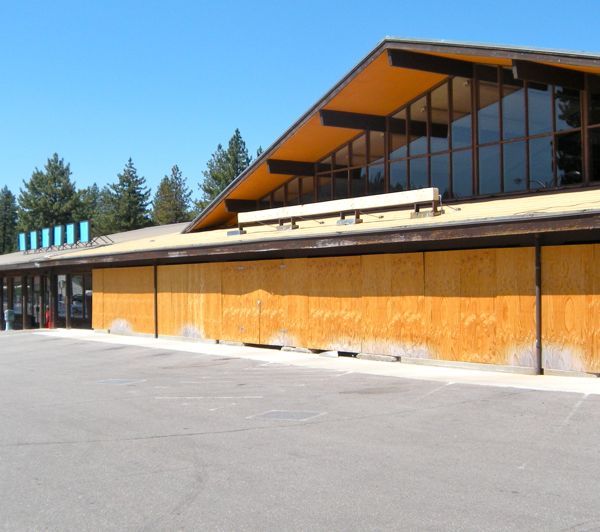
The old Mikasa and Miller's Outpost buildings are slated to be a Community Enhancement Project. Photo/LTN file

The old Mikasa and Miller's Outpost buildings are part of the Community Enhancement Program. Photo/LTN file

Big components of the CEP are allocations for commercial floor area, tourist accommodation units and multi-residential bonus units. TRPA has in effect made these items commodities that are sold and traded among jurisdictions. There are also a limited number of them arbitrarily set by the TRPA. The CEP has added to that overall pot without the project developers needing to secure them in some other way.

While the Governing Board of the bi-state regulatory agency at its February meeting cited economics and the realization project proponents are not able to get financing as reasons to extend the CEP permit for two years, the truth is no movement has even occurred at the two South Tahoe locations.

This compares to Homewood, which is in the middle of the environmental document process. Boulder Bay – the project to renovate the Tahoe Biltmore in Crystal Bay – will be before the Governing Board on March 23.

“Limbo” is the word Hilary Hodges, interim director of the Development Service Department for South Lake Tahoe, used this week in describing to Lake Tahoe News where the Tahoe Valley Community Plan is. That document is relevant to the CEP discussion because without it developers must work in the confines of current zoning regulations.

Building heights and multi-use projects would likely be stumbling blocks working with today’s rules. Those issues are being addressed in the city’s General Plan and TRPA’s Regional Plan.

The odd thing is the TRPA stipulation for a project to be included in the CEP was it had to be part of an approved community plan. Neither of the South Tahoe projects is in a community plan because one is not approved for the Y. A plan area statement governs that area, but that is not in the league of a community plan.

“The two CEPs at the Y are in the program with the condition that they can’t break ground until an approved community plan is adopted for Tahoe Valley,” explained TRPA spokesman Jeff Cowen. “Homewood is doing its master plan as part of its CEP application.”

Hodges said, “The city would like to move Tahoe Valley forward.” The problem is TRPA’s Regional Plan update that was originally supposed to be approved in 2007 has had one delay after another. The importance of the Regional Plan’s completion is so the city’s document would conform to it. If it doesn’t, then it’s possible lawsuits would ensue or permits would never be issued.

Hodges would not venture a guess to when the Tahoe Valley Plan would come before the council. Last year the original community team came together in hopes there would be movement, but TRPA expressed concerns with going forward, so the group was disbanded again.

At the TRPA meeting last week, Wyatt Ogilvy spoke on behalf of the BB LLC project on 18 acres in downtown Kings Beach. The mixed-use project is one of nine CEP projects.

“Ultimately by providing a two-year extension you provide the incentive to move forward and adequate time,” Ogilvy told the board. He said his group is going forward with hiring an environmental consultant to prepare the necessary documents.

Dave Ferrari, general manager of Ferrari’s Family Resort in Kings Beach, has plans to overhaul their business, which would also come with significant environmental improvements.

“Our head is above water, but not by much,” Ferrari said. He said it’s hard to move forward with short time lines to get things done when financing is not in place and permitting and environmental review can take years.

Ultimately the board agreed to the two-year extension of the CEP permits, with a review of where the projects are in one year.


TRPA facing $1.3 mil. deficit; 8 people laid off, 12 reclassified

By Kathryn Reed

In an effort to close a $1.3 million deficit, the Tahoe Regional Planning Agency on Friday laid out a reorganization plan that eliminates eight positions and reclassifies 12 others.

“Our position is exacerbated by what I call the perfect budget storm,” TRPA Executive Director Joanne Marchetta told Lake Tahoe News.

That storm includes mounting legal bills and cuts in revenue sources.

trpaThe bi-state regulatory agency estimates spending about $1 million in outside legal counsel in the next couple years, Marchetta said.

Personnel cuts account for about $721,000 of the anticipated shortfall for fiscal year 2011-12 that begins July 1. The remaining $600,000 will partly come from reducing the impact on the current budget with those employees no longer on the payroll. As the agency works on the next budget, other spending cuts will be addressed.

TRPA’s general fund is about $7.7 million. The bulk of revenue comes from the two states, with California paying two-thirds and Nevada one-third. However, Nevada has not allocated its full share. About 13 percent of the general fund revenue comes from fees.

With building stagnant in the Lake Tahoe Basin, that income is much less than previous years. A downturn in construction is reflected in not needing as many the planners.

The court’s decision to invalidate the shorezone plan has rendered that segment of TRPA almost nonexistent.

Five of the positions being eliminated are effective March 4, with the three others being transitioned out. Gone are three planners, a quality monitoring coordinator, records technician, special projects director, shorezone coordinator and 1.5 positions from the Regional Plan update team.

TRPA is down to 68 employees – 22 less than were on board three years ago.

When it comes to the dozen positions being reclassified, some will be immediate and others will occur over time to ensure the organization functions properly and the needs of the public are adequately addressed.

“What we did was conceptually flattened the management structure and simplified it,” Marchetta said. “I approach this from two points of view and not purely from a cost-cutting side of things. We made sure whatever changes we finally settled on were done with an eye on implementing our strategic plan and strengthening those pillars in the strategic plan.”

Despite the news on March 4, TRPA has not put a freeze on vacant positions. The open finance director and public information officer jobs will be filled.

“This was one of those very difficult situations where TRPA had to act and we had to make choices and all of the choice were hard choices,” Marchetta said. “We made them with the assurance we would be strengthening the organization for the long term so we could operate and meet our mission.”


STHS grad: Peace Corps struggling to be relevant

Publisher’s note: The Peace Corps turns 50 this month. Two 2005 South Tahoe High School grads are in the Peace Corps having different experiences. Jessica Wackenhut today weighs in with her thoughts from Paraguay. On March 11, Michelle Aguilar will share her opinions from Panama.

By Jessica Wackenhut

ENCARNACION, Paraguay — When one thinks of Peace Corps, the first thing that tends to come to mind is living in a mud hut in the middle of Africa, experiencing incredible hardships in a new culture, but overcoming such obstacles by bonding with community members and bringing in amazing infrastructure such as a new school, library, or modern bathrooms.

Jessica Wackenhut

Jessica Wackenhut

This, however, is far from my experience as an Environmental Education Volunteer in Peace Corps Paraguay (2009-2011), where during the last 17 months I have truly questioned whether we should be celebrating or, instead, re-evaluating Peace Corps as an institution.

Peace Corps, founded in 1961 by President John F. Kennedy, was created to encourage development and cultural exchange for recent college graduates who had little to no experience abroad. During the first two decades of Peace Corps, volunteers were able to help their communities develop through sharing the technical knowledge they acquired from their bachelor’s degrees — a level of education way beyond that of their community counterparts. Additionally, volunteers had to integrate with their communities because if they did not, they would have no one to talk to.

It was incredibly challenging to visit other volunteers because of little infrastructure, and conveniences such as cell phones and Internet were still decades away. In fact, much communication with family from the States was limited to snail mail that took more than months to arrive.

Now let’s fast forward 50 years to Peace Corps 2011: Today’s Peace Corps has changed significantly since its creation because of globalization, higher rates of education for host country nationals, and the rapid spread of technology. As a Peace Corps volunteer in Paraguay, my life is a bit easier than those volunteers who served in the first years of Peace Corps’ existence. If I am tired of traditional Paraguayan food, I can find Coca Cola, Sprite, Doritos, M&Ms, Pringles, among many other American foods, in my local supermarkets. If I am feeling homesick, all I have to do is insert the Internet device that I pay for monthly with my Peace Corps salary into the laptop I brought with me and call my parents on Skype. And if I’m not close to my computer, I can use my Peace Corps issued cell phone to call my volunteer friends and talk for free, thanks to the Peace Corps phone plan.

Now don’t get me wrong, I’m not complaining. It’s truly impressive how far technology has come. And while the rate of globalization can be a bit overwhelming at times, it’s nice to get a small reminder of home.

The problem lies in the fact that Peace Corps continues to recruit the same recent college graduates they were searching for 50 years ago, even though more host country nationals are obtaining higher education degrees from universities in big cities or abroad. In this sense, globalization has so profoundly affected Peace Corps that many volunteers no longer have a higher knowledge base than their community counterparts. Therefore, it is not hard to find agriculture volunteers whose prior experience is limited to a summer of landscape architecture or a construction job, a health volunteer who was qualified based on her undergraduate biology degree, or an environmental education volunteer who was accepted based on her minor in environmental studies.

Fortunately, upon entering their country of service, each volunteer must undergo roughly three months of mandatory training. Many volunteers, however, finish training feeling like they touched the surface of so many different themes but never truly learned about anything that will actually be of assistance in their sites. For example, one of the largest environmental problems in Paraguay is trash. However, during training, my group had only a 45-minute session dedicated to trash where we learned several different activities about how to teach trash decomposition and stories about why burning trash is bad.

We never learned that throughout all of Paraguay there is only one sanitary landfill, nor did we learn how to set up a trash management system in our own sites. The general consensus post-training is the only thing we get out of it is language training, which, I must admit, Peace Corps does an exceptional job with.

This, in essence, is the question I have been struggling with for the past year and a half while I’ve been in Paraguay: what makes it OK, then, for a recent college graduate turned Peace Corps volunteer to come into a foreign culture and try to tell their community how they should change their way of life because she thinks it will be better that way? Who am I as an environmental studies major from the U.S. to come into Paraguay and say how to plant crops and trees when I have never studied this climate and most farmers in the country will know the soil, weather, pests, and plants far better than I ever will since they have been working on the land for their entire lives.

There are college graduates who have come to Peace Corps and completed impressive projects with their counterparts. Many times all communities need is a little cheerleading and organization to make their projects come to fruition. But my project area, which is to increase environmental awareness in Paraguay, doesn’t include making modern bathrooms or libraries. And because my projects are harder to conceptualize, it’s harder to receive grants from Peace Corps Partnerships. Additionally, I’ve found very little resources at the Peace Corps Office in the capital. My bosses seem more concerned with placing new volunteers in their sites and expanding the number of volunteers in Paraguay than helping current volunteers acquire the resources and knowledge needed to have successful projects.

When I ask the workers in the office of possible projects ideas and what has been done in the past, I am almost always pointed to the same five classroom activities instead of actual community projects. Many times my community members ask me examples of what Peace Corps has done to develop their country. I have yet to respond to them because Peace Corps Paraguay has no collection of examples of their work in Paraguay over the last 45 years they’ve been here. This is especially discouraging when I hear about some of the projects more professional Japanese (JICA) and Korean (KOICA) volunteers are doing within Paraguay as they work with large institutions such as the Ministry of Agriculture and Ministry of Education — two powerful institutions that rarely work with Peace Corps Volunteers who they view as inexperienced and immature.

I want to be clear, I do thank Peace Corps for giving me an opportunity I would have never had otherwise. I have learned a great deal about myself, others, the world, and how to do projects without the support of the institution who I am supposed to be working under. I came to Peace Corps in the hopes that I would be doing some small-scale projects that would be positive development models that in turn help my community grow more sustainably. After I got here, I quickly realized Peace Corps is not a development organization as it advertises, but is more of a cultural exchange program. The projects I have done or am working on have had little to no support by Peace Corps, some of my projects were even discouraged.

In my experience, I have had many hardships thus far in my service and although some of them were a result of mere cultural differences, a majority of the stresses arose from Peace Corps as an institution and the lack of resources or even support given to myself and many volunteers. This experience will be one of a lifetime, one I will never forget. The people I have met, the relationships created, the projects I worked on with various counterparts throughout my site will never be replaced.

As Peace Corps celebrates its 50th anniversary, I hope this organization refocuses to become more meaningful if it wants to be a development organization, or be clear if its intentions truly are to be a cultural exchange program via the social responsibility department of the U.S. government. During the celebrations, Returned Peace Corps Volunteers will lobby Congress to increase the number of volunteers, is this making this organization more quality?

Peace Corps embarks on its 50th anniversary and what does it have to celebrate?


Tahoe skiers put the fun into freeskiing competition

By Jessie Marchesseau

KIRKWOOD — Last weekend’s Subaru North American Freeskiing Championships was quintessential Kirkwood. Postponed two days due to a gnarly storm, Day 1 boasted blue skies, 4 feet of fresh powder and the steep, rocky, forbidden terrain of the Cirque.

Freeskiers traveled from as far away as New Zealand, Chile, Sweden and France to be part of this year’s competition. And Kirkwood did not disappoint.

But one does not need to venture into the closed terrain of the Cirque to find extreme here. Kirkwood is teeming with rocks, cliffs, cornices and some of the deepest snow in the Sierra.

The Cirque at Kirkwood is closed except during competitions. Photos/Jessie Marchesseau

The Cirque at Kirkwood is closed except during competitions. Photos/Jessie Marchesseau

“Kirkwood terrain pushes you,” Dan Durkin, a local freeskier, said. “I mean everywhere you look there’s jumps to jump, there’s chutes to go through, there’s just natural rock airs that are going to progress you and make you look for the next bigger line.”

And in the end, skiing Kirkwood terrain on almost a daily basis paid off for local competitor Josh Daiek, 27, who took home this year’s title. Daiek, who won the Freeskiing World Tour in 2008, dominated the entire weekend, earning the highest score in the qualifying round, winning Day 1 of the finals and solidifying his place on top with a smooth run on Day 2.

Daiek attributed his win to “good snow and skiing at Kirkwood all the time. It’s one of the coolest training grounds.” He added, “It’s what I do every day; I go out, jump off rocks and try and land on my feet.”

Having primarily stepped away from competition for the last two seasons due to injury, Daiek spends most of his days skiing at Kirkwood or in the nearby backcountry with friends like Durkin and fellow freeskier and two-time winner of Kirkwood’s North American Freeskiing Championships, Craig Garbiel.

Garbiel was prequalified for the weekend’s competition as a result of being in the top 10 overall on the tour last year. He stuck solid runs during both days of the finals earning him a 12th place finish.

Though they both call Kirkwood their home mountain, neither Daiek nor Garbiel grew up in Tahoe. Garbiel, 35, hails from Vermont where he dabbled in ski racing as a kid, but spent most of the rest of his time on a snowboard. He moved to Tahoe 15 years ago because someone told him that it snowed every night and was sunny every day. He has been here ever since.

Daiek, on the other hand, never had any formal ski training.

“I grew up skiing trash heaps in Michigan,” he said. “Basically, when I came here, I couldn’t really buy a turn. I didn’t know how to turn very well or ski very well and just started following Craig (Garbiel) around and skiing with him a bunch, and my skiing definitely got a lot better.”

That was nine years ago, around the same time Garbiel began entering freeskiing competitions. He recalled how a group of friends paid for his first one at Kirkwood:

“The night before they were like ‘OK, who’s got money?’ and they all just pulled out cash and paid for me to do it. I’ve been doing it ever since,” he said.

Garbiel was ranked the seventh best freeskier in the world three years ago, a standing that earned him the opportunity to spend two seasons skiing around the world as part of the Freeride World Tour. However, a knee injury during the second season took him out of the competition.

Daiek and Garbiel are healthy again and hungry to regain their places on the podium. They ski together often, sometimes at Kirkwood, sometimes hiking in the backcountry, sometimes using snowmobiles. Daiek admits his style and line choices somewhat mimic that of Garbiel because he basically learned to ski by watching and skiing with him. There are, however, still some notable differences.

“Josh is younger and crazier so he goes full out all the time: big backflips, lots of 360s, just kind of full bore going for it,” said Durkin who skis with the duo regularly. “Craig is a little bit older and more reserved .… He’s just real calculated and just nails his lines. Everything he looks at, he just seems to stomp like a cat, just landing on his feet all the time, and real fluid.”

The money to ski

These are the skills that earned both skiers sponsorships from big-name companies like Blizzard and Moment skis and Smith Optics. Moment, who sponsors Garbiel, even created a signature ski that bears his nickname, Garbones.

Sixpoint Snowwear, owned by South Shore local Teri Jones, also sponsors Garbiel and Daiek. Jones said she has known both skiers for years and was honored when they agreed to ride for her company. A Kirkwood rider herself, Jones admits she cannot keep up with them on the hill, and calls them “friends that are some of the best skiers in the whole world.” She is currently working on the design for a limited edition line of Garbones beanies.

Sponsors are a big part of being able to compete in events like the one at Kirkwood. Entry fees generally run $200 to $300, not including travel, lodging and lift tickets. While the winner of a competition can take home thousands of dollars, skiers can often spend more than they make entering contests.

Money and sponsors add to the pressure to do well in competitions, and both men admit to feeling a little added pressure on their home turf.

Even though they ski Kirkwood all the time, neither skier said they felt like it gave them an advantage. Unlike some of the other mountains on the tour, the terrain Kirkwood offers for the competition is closed except during the competition.

“The local skiers here have no advantage over the other skiers because it’s closed terrain,” Daiek said. “We ski it once a year like everyone else.”

So they choose their lines by looking at the slope from the bottom just like the rest of the field, and hope for the best.

“I got a little off my line and I didn’t quite hit what I wanted to hit,” Garbiel said of his final run. “But I skied fast and that’s what I wanted to do. I skied fall-line top-to-bottom through the Hour Glass.”

However, in a competition that’s judged heavily on factors such as steepness, exposure and airtime of the skier’s chosen line, getting a little off can have big effects. Both Daiek and Garbiel plan their lines ahead of time and stressed the importance of trying to stick to it, but also having a backup plan.

“I have a visual idea of exactly what I want to do. What I want to hit, where I want to land, where I want to take off,” Garbiel said. “It’s ideally 100 percent planned. But it doesn’t always work out that way; sometimes you improvise.”

Back at the comp

Whether they were carefully calculated, or improvised, nearly all the descents at this year’s competition seemed larger-than-life. Big-name pros including JT Holmes, Sebastian Hannemann and Henrik Windstedt from the Freeride World Tour joined the field of competitors making this one of the most stacked competitions of the winter.

And judging by the technicality of the lines and the amplitude of the crowd, no one was holding back. Some skiers, like Garbiel and Daiek, were sticking their lines. Others, like Holmes, were blowing up. However, with this degree of all-out skiing comes inherent danger. Competitors and spectators alike commented on the higher than usual number of skiers coming off the hill with injuries. Two competitors were taken to nearby hospitals by helicopter on Sunday, and at least that many came down in toboggans.

Ryan Hawks, 25, was the second skier to be taken out by helicopter. Just after 3pm on Sunday, as the sun was starting to move behind the peak and the light on the Cirque was getting a little flat, he dropped in for his turn at the rocky terrain. Mid-run, Hawks threw a backflip off a 40-foot cliff, but showed little movement after landing.

Ski patrol immediately tended to the injured Hawks, and the waiting Care Flight helicopter rushed him to Renown Medical Center in Reno. He was treated for internal injuries, but passed away early Tuesday morning.

Still on a high from his recent win, Daiek’s voice went somber when asked about Hawks. Daiek had befriended the young skier earlier this season at a competition in Revelstoke, Canada.

“He was a super positive guy,” he said, “always had a smile on his face.”

Daiek said he lives by the philosophy that life is short, so you better live it up while you’re here. In the past, he found himself getting stressed out preparing for competitions, but has tried to let that mentality go.

“That’s never why I fell in love with skiing,” he said. “Skiing’s just an awesome sport and an awesome feeling of freedom. That’s why I do it .… It’s not about the comp, or it’s not about being the raddest skier or anything like that. Skiing’s about having fun.”

Daiek and Garbiel plan on competing in the Freeskiing World Tour Championships at Snowbird, Utah, March 8-13.

ngg_shortcode_1_placeholder (Click on photos to enlarge.)



Invasive species destroying tiny critters in Lake Tahoe

By Stephen Ward

INCLINE VILLAGE – Bugs. They are missing from Lake Tahoe.

While most people might think it’s a good thing not to swim or kayak with these seemingly invisible critters, the fact is their disappearance is contributing to the changing ecosystem of this massive body of water.

Their demise is being blamed on invasive species.

Dozens of people learn about life below the surface of Lake Tahoe. Photos/Stephen Ward

Dozens of people learn about life below the surface of Lake Tahoe. Photos/Stephen Ward

After watching videos showing various species of bugs inhabiting the bottom of Lake Tahoe, coupled with information detailing their assistance in keeping the lake clean, the audience sat in silence as the presenter showed a graph demonstrating how light transmittance and plant life are plummeting in unison.

This was the overarching tone Tuesday at the Tahoe Environmental Research Center, where Annie Caires gave an hourlong presentation about the impact on endemic species found in Lake Tahoe.

Caires is a researcher from UNR’s Aquatic Ecosystems Analysis Laboratory and has studied benthic invertebrate since 2004. She has been studying Lake Tahoe since 2008 and believes the bugs, or the lack thereof, has a dramatic affect on the lake.

“When we look at Lake Tahoe, we don’t think about what’s in the depths of the lake,” Caires said. “The point is these bugs perform important ecological processes.”

The evidence Caires cited for a fleeting critter population was clear – 25,400 bugs were collected from 389 samples in a two-year study in 1963. When a similar experiment was conducted with 394 samples less than 50 years later, only 7,400 bugs were unearthed.

One species discussed was the blind amphipod, a white, many-legged creature found hundreds of feet below sea level on the sea floor. Caires noted the amphipod’s reputation for being aggressive just before showing a video of them fighting viciously over territory.

When an audience member asked about the size of the amphipod, Caires scattered a jar of 3,500 grains of rice across a table to show the relative size of the bugs.

Rice represents the size of bugs in Lake Tahoe.

Rice represents the size of bugs in Lake Tahoe.

“Yeah, I know, I’m dedicated,” Caires added after the example.

But now, after being the most populous creature in the 1963 study, no trace of the amphipods remains today.

Caires said species such as the blind amphipod are gone because of invasive species and eutrophication, or the addition of natural and artificial substances through sewage and other substances.

Caires also said the decrease in water clarity has reduced the ability for plant beds to grow. She linked the introduction of mysid shrimp and other invasive species with the fisheries of the 1930s. The introduction of invasive species was meant to enhance the productivity of the fisheries. The mysid shrimp, that were not supposed to compete with the blind amphipods, ended up overpowering their frumpy counterparts.

Another invasive species attributed to harming the lake is crayfish; opportunistic feeders that hinder plant growth. They are another invasive species introduced to Tahoe 80 years ago when the fisheries started.

Caires added that preliminary research has suggested that the crayfish are eating the amphipods in the lake.

To Caires, the lack of bugs at the bottom of Lake Tahoe is not just the process of evolution.

“These things can be great indicators of lake health,” she said.

As for what can be done, Caires said public support for agencies such as the Tahoe Regional Planning Agency and California Tahoe Conservancy is crucial to reverse eutrophication because both agencies are helping fight invasive species.

“We’re seeing huge declines in native species, but I think we can reverse the trends if we continue to focus on cleaning up,” Caires said.

The public support Caires described seemed to be gaining momentum shortly after the presentation. Steve Hale, a retired forest worker who worked in the South Lake Tahoe area for 20 years, called the information sobering.

“This is why it’s so important people come to lectures so they can learn from scientists,” Hale said. “To hear silence from the audience and see their reaction was remarkable.”


South Lake Tahoe rolls out plan to eliminate deficit

By Kathryn Reed

To wipe-out an ongoing $3.4 million annual deficit, South Lake Tahoe staff members are proposing getting rid of positions, freezing wages, raising the hotel tax, and revamping employee pension and health care options.

Some of the proposals brought forth during the City Council’s workshop Tuesday afternoon need to be vetted and approved by the bargaining units. But it was noted, if they don’t agree to them, more layoffs are probably the only other solution.

The council on March 15 is slated to vote on the reorganization plan and five-year budget proposals presented to them March 1 by City Manager Tony O’Rourke and Finance Director Christine Vuletich.

South Lake Tahoe Finance Director on March 1 goes over the five-year budget plan. Photo/Kathryn Reed

South Lake Tahoe Finance Director Christine Vuletich on March 1 goes over the five-year budget plan. Photo/Kathryn Reed

Eliminating positions, reclassifying jobs, early retirements and shifting things around would cut the annual deficit in half. That proposal was released last week.

Besides those proposals, the city is also looking at revamping what it contributes to employees’ pensions and health care plans.

“In most organizations salaries and benefits are about 65 percent (of the general fund). In ours it is 78 percent,” O’Rourke told Lake Tahoe News. “In the private sector it is closer to 45 percent.”

In the current budget the city is paying $3.1 million to CalPERS, the Public Employee Retirement System, for the nearly 200 employees. Pension costs are projected to increase by 5 percent per year for the next five years.

That 5 percent equates to about $900,000 during the next five years. Today, 11 percent of the general fund goes to employee pensions.

Councilman Tom Davis asked about the city’s unfunded liability. Vuletich said today it is about $26 million, whereas a few years ago it was at $42 million. The city is paying about $400,000 on that each year.

It wasn’t until last year that any employee in the city contributed a dime to his or her own retirement. Police officers now pay 6 percent of the 9 percent employee contribution.

If employees start paying their share – or the full 9 percent, this would save the city about $800,000 a year.

Lake Tahoe News, before the presentation to the council, asked O’Rourke about the possibility of having a flat fee the city would contribute instead of a percentage plan. Lake Tahoe Unified School District does this with its employees in regards to health care.

“There are some strong arguments to go to a defined contribution so you know each year your exposure,” O’Rourke said. “So then the risk is shifted to the employee.”

At this time, that is not being proposed.

When it comes to health care costs, the city doles out about $18,500 per employee and $14,900 per retiree — each year.

“On average, employees are contributing 4 percent, and retirees 12 percent, respectively, to the city’s annual health care cost,” the staff report says.

O’Rourke wants to revamp the system to “generate at least $550,000 annually in savings.”

After repeated questioning by Davis and Councilwoman Angela Swanson if the wage freeze is really that, Vuletich acknowledged the step increases built into the agreements with the bargaining units for employees who qualify would in fact get a raise. However, all cost of living increases are gone.

The pay freeze will save about $350,000 a year.

This year’s budget has $13.4 million allocated for salaries, which includes $1.4 million in retirement payouts.

The other way employees will be receiving more cash in their pocket is by eliminating furlough days. This equates to a 13.4 percent pay increase because workers have not legally had to be at work during that time. For those who were, it means actually getting paid for the work they are doing; for those who took the day off, it means being paid to work a full week.

Property tax is the city’s largest source of income at 23 percent of the general fund revenue. With revenues from the Stateline or Project Area No. 1 taking a 15.7 percent hit, it means $1.2 million less for the city. This is because the county reassessed the values on the property in that area.

Projections are for property taxes to decline next year, with increases for the following four years – the most being a 1.6 percent uptick in fiscal year 2016. The county Assessor’s Office is forecasting a 4 percent assessment decline for this fiscal year.

Hotel taxes are the second largest moneymaker for the city at 15 percent of general fund revenue. Today a rate of 10 percent is charged to people staying in most areas of town, while a 12 percent tax is added to a room in the redevelopment areas. Staff is proposing 12 percent throughout the city. This would have to go before voters, but is not likely to happen until 2014.

O’Rourke would like the $900,000 a year cash infusion from raising the TOT to be used on upgrading the roads.

Another way to bring in money is to ask the voters about creating a 5 percent amusement tax. This would be levied on recreation equipment rentals like bikes and skis, as well as ticket sales for the Tahoe Queen.

An agreement made by a prior council prohibits a tax on lift tickets at Heavenly Mountain Resort.

The forecast is a half million dollars a year could be generated from an amusement tax.

The other new source of revenue is via metered parking, especially near beaches. O’Rourke said most waterfront communities charge to park close to that body of water. The anticipation is this could bring in $450,000 a year.

The summary statement of the staff report says, “The strategy reflected in the Five Year Financial Plan allows the city to ensure long-term financial success and sustainability, Moreover, the strategy will allow the city to continue to provide essential, outstanding cost-effective service and capital improvement to our residents and businesses.”


Water content well above average in Sierra Nevada

By Brenda Knox and Kathryn Reed

PHILLIPS STATION — With the amount of snow that has fallen and the sudden meltdown of it, people living in Lake Tahoe know there is plenty of water in that white stuff.

Officials from the California Department of Water Resources made it official Tuesday.

The measurements taken March 1 at the entrance to Sierra-at-Tahoe show 89 inches of snow, 31.7 inches of water content, which is 128 percent of normal. Statewide, water content is 124 percent of normal.

Frank Gehrke takes water samples March 1 near Sierra-at-Tahoe. Photo/Brenda Knox

Frank Gehrke takes water samples March 1 near Sierra-at-Tahoe. Photo/Brenda Knox

A month ago the content at Phillips Station was 125 percent of normal and in December it was 158 percent.

Even though the state is still technically in a drought – that designation is something the governor controls — the readings are much better than last year when the water content was 107 percent of normal, and in 2009 was 80 percent of normal.

Frank Gehrke, chief of the California Cooperative Snow Survey Program, said the state would be in “pretty good shape hydrologically speaking at the end of the season.”

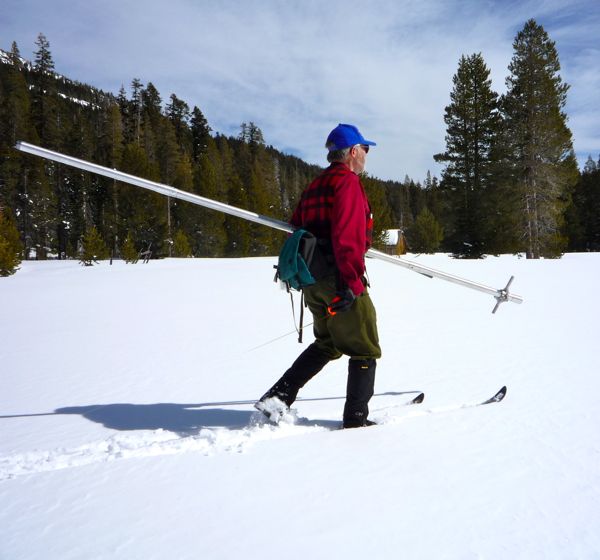
So much snow was in the field that it was getting stuck in the core of the metal tube he uses for the seven samples. A month ago there was so little snow hiking boots could be worn instead of snowshoes or skis.

For a La Nina year, the amount of moisture coming down has been unexpected. A month ago Gehrke was concerned if the dry January continued, it could be trouble for water users downstream of the Sierra runoff. He acknowledged it has been quite an unusual winter.

“March 1 is a key date, flood control reservoirs can increase storage as of March 1,” Gehrke said. “It’s important to fill reservoirs.”

Typically, snow continues to accumulate at a decent rate through April 1, and then the meltdown begins. The peak runoff is usually in May.

The mountain snowpack numbers are important because approximately one-third of the water for California’s households, industry and farms come from this source.

Location

Elevation

Snow Depth

Water Content

% of Long Term Average

Alpha

7,600 feet

91.7  inches

36.8  inches

131

Phillips Station

6,800 feet

89  inches

31.7  inches

128

Lyons Creek

6,700 feet

101.1  inches

39  inches

153

Tamarack Flat

6,500 feet

Missing

Missing

Missing

Source: Department of Water Resources


Soroptimist singles out 4 Whittell students for honors

Publisher’s note: On Feb. 23 Soroptimist International of South Lake Tahoe honored four students from Whittell High School as Young Women of Distinction. Bernadette Esquivel spoke about each woman. Here is what she had to say.

By Bernadette Esquivel

soroptimistSTATELINE — I have had the pleasure of knowing Karin Sharon and her family for well over 12 years. Karin currently has a weighted gpa of 4.347 and she has taken all of the honors and AP classes we have to offer at Whittell High School, as well as some college classes.

She has maintained straight A’s her whole high school career and has been on the honor roll all four years. She currently has 25 credits and will graduate with 27½ credits, when you only need 23 credits to graduate. She scored 1,820 on her SAT and a 26 on her ACT. She is a member of the National Honor Society and is the current president, she is also a member of the Key Club and she is the secretary. She was the class president her freshman year and a class representative her sophomore year.

Karin Sharon and Taylor Shepack

Karin Sharon and Taylor Shepack

Karin began her community service career at age 13. Karin made her Bat Mitzvah when she was 13 years old and hurricane Katrina had just taken place a few months prior. After watching and hearing about all of the devastation caused by Katrina, she decided to donate all of the gift money she had received to the victims of the hurricane. After that day she tried to devote her spare time to serve her community and give back as much as she could.

Some of Karin’s other community service has included working the Soroptimist food booth at the Celebrity Golf Tournament for four years, she helps the Rotary Club every year with the annual St. Patrick’s Day fundraiser, Kiwanis Crab Feed, and she helped organized Teens for Jeans, an organization that donates jeans to thousands of homeless people in America.

In 2007, Lake Tahoe experienced a devastating fire that destroyed more than 250 homes, the Angora Fire. Karin was there to help for five consecutive days around the clock making beds, serving food, and many other acts that helped the evacuees. Her list of community service goes on and on.

Karin is also very athletic. She has been on the volleyball team for the past four years helping them attain a state title her junior year. She has been on the basketball team for four years and made the Nevada All State Academic Team Sports Award for three years and probably the same for this year.

Last year she won first place in the Rotary Speech contest at the club level and came in 4th place at the district level.

In Karin’s spare time she tutors students who plan to make their Bar and Bat Mitzvah’s and she substitute teaches for the Temple Bat Yam’s Hebrew School.

Karin plans a career in communications and plans to study at either UC Berkeley, New York University, or Harvard.

Taylor Shepack is a wonderful George Whittell High School student. While attending our school she has maintained a weighted gpa of 3.848 while taking a number of honor and AP classes. She already has the required number of credits to graduate from high school, which is 23, but she will graduate with 26 credits.

Taylor is a member of the National Honor Society and has been on the honor roll all four years. Taylor has also been on the student council, being the class representative her freshman year, vice president her sophomore year, class president her junior year and she is currently the senior class representative.

Taylor’s community service has included Key Club for four years, the Festival of Lights, and Adopt a Grandparent. Her most memorable one would be Adopt a Grandparent. It is run through Barton Memorial Hospital. Taylor enjoys going to the hospital and visiting with the elderly, listening and talking to them. She stated that a lot of these folks don’t have frequent visitors and it makes her day when she is able to bring a smile to someone’s face and to let them know people do care.

Taylor’s athletic abilities include soccer, dance, and cross country running. She has also been involved in our band for four years, Black and White Choir for three years, Christian club for four years, she is on the SMILE committee (Students Making It A little Easier) and the SIC committee which is a Students Issues Committee.

In Taylor’s spare time she dances. She does hip hop, jazz, ballet, couples and modern dance. She takes dance classes all week at Marcia Sarosik’s Dance Studio. She also enjoys hanging out with family and friends. During the summer she enjoys hiking, biking, swimming and hanging out at the beach.

Taylor plans on attend the University of Nevada Las Vegas and majoring in performing arts and business.

I have known Lea Manzano for many years. While attending George Whittell High School Lea has maintained a 3.7 gpa, she has been on the volleyball team for the past three years, as well as the basketball team for four years. Lea is currently a member of the National Honor Society and has been on the honor roll for the past three years.

Lea has been very instrumental with our school yearbook for the past three years. When I try to find her at lunch she can usually be found in the computer lab working on the yearbook or uploading pictures she took at a school event. Mr. Crammer, the yearbook advisor says, “Lea Manzano has been a key participant and editor for the yearbook the last three years. Her participation has led to the production of a memorable piece for the school. I couldn’t have done it without her.”

Lea began participating in community service when she was 13 years old. She started at Kahle Community Center working with the RAD camps. Lea has been involved in the South Lake Tahoe Women’s Center, volunteering many hours of community service. She is one of their shelter program volunteers working with abused women and their children. She has learned that being a woman is very valuable and women are powerful and they should take pride in being a woman.

Lea plans on attending UNLV, UNR or LTCC. Lea has chosen a career path of journalistic or portrait photography. Lea will be very successful and we are proud to have her as one of our students.

I have had the pleasure of knowing Samantha Brumbach for 13 years, since she was in kindergarten. Sammy currently has a weighted gpa of 4.33 and has taken numerous honor and AP classes while attending George Whittell High School. She will graduate with 26 credit, where as a typical senior has 23 credits. Sammy has been on the honor roll all four years with straight A’s.

Samantha Brumbach and Athalia Torres-Manzano

Samantha Brumbach and Lea Manzano

She is a member of the National Honor Society, she is the executive vice president of the student body, she has sung for the Black and White Choir for the past three years, waking up extra early to get to school by 6:3am for zero period. She is a member of our school’s Christian club for four years, and she has been a member of the Key Club for four years. The list goes on and on of her accomplishments.

Sammy’s community service list is an extensive list as well. Some of her highlights have been going on a mission trip to Mexico her freshman year handing out food to people and painting a church, being a member of Key Club where she was vice president last year and this year she is the president. She is constantly thinking up new ideas for the group on community service projects. Her newest project is the Polar Bear Plunge on March 19 and all proceeds will go toward Special Olympics.

Sammy is not only a great student and a great asset to our school, but she is a wonderful athlete. She has been on the varsity soccer team for four years and when the team was disbanded her junior year that didn’t stop her from playing soccer. She joined the boys’ team and earned a starting position.

Ms. [Kathy] Bluethman, our athletic director said, “Sammy is an outstanding soccer player. She is so committed to her sports that when our girls’ soccer team was withdrawn from our school due to lack of amount of players, she was playing on the boys’ team and was just as competitive as all the boys. She is always smiling and has a very positive attitude towards her academics, instructors, friends and teammates.”

During her sophomore year Sammy played soccer for two weeks in Spain and France for a club team. She has also been a member of our girls’ track team for the past three years and I am sure she will make the team this year too.

During her free time she skis, babysits for a number of our local families and she has helped at a soccer camp for children.

Sammy plans on studying at the Western Washington University and majoring in elementary education or in the health science field. Sammy looks at her life as a patchwork quilt. She states in her autobiography, “My fabric consist of loving parents, a home in the mountains, the care of three older sisters and a secure childhood. I grew up in a family where church and Sunday school were musts, and naming rocks, climbing trees and scraping knees were not only accepted, but expected. I grew up without any sort of technology such as Game Boys or even television, which forced my sisters and I to turn to each other and our imaginations for entertainment. I believe this lifestyle led me to be different from my peers and helped me form the pattern for my quilt.”

Bernadette Esquivel is the registrar and scholarship coordinator at Whittell High School.