DIY store in South Tahoe granted permit to sell lumber

By Kathryn Reed

Lumber will be able to be bought on a Sunday sometime this summer on the South Shore.

This is because on Thursday afternoon the South Lake Tahoe Planning Commission agreed to DIY’s special use permit that would allow the store to sell lumber.

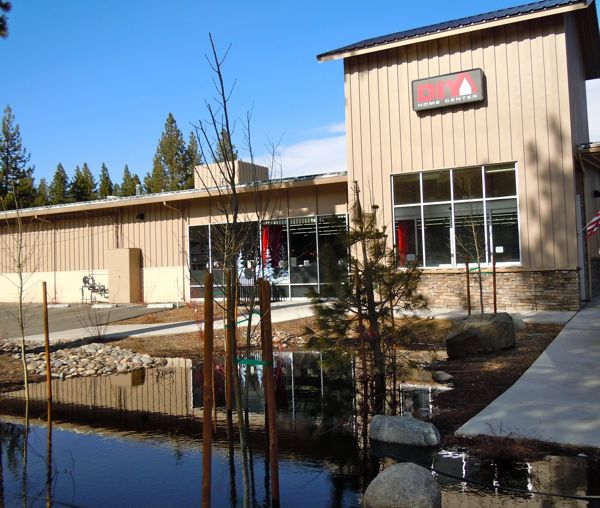
DIY will sell lumber this summer add 12 parking spaces. The driveway apron will be changed to concrete down the road. Photo/LTN

DIY will sell lumber this summer and add 12 parking spaces. The driveway apron will be changed to concrete down the road. Photo/LTN

The controversial store – at least when it was going through the permit process more than a year ago – expects to start construction on the building that will house the lumber as soon as dirt can be moved May 1. The permits are in hand.

Jordan Haun, manager of the Tahoe Do It Yourself, said execution of the permits didn’t happen because there was no need to have a lumber building when the use permit didn’t allow the sale of that product.

When DIY President Jess Ruf signed a 10-year lease on the old South Shore Motors building in December 2008 he believed he would be opening the following summer.

Then the controversy started in 2009 when the Southern California-based chain started to go through the permitting process. Appeals by representatives of Scotty’s, Nel’s and Meeks led to the City Council approving DIY to operate a general merchandise store, which meant it could not sell lumber. In doing so, the city essentially gave Meeks a monopoly on the sale of lumber on the South Shore. However, Meeks’ South Tahoe and Meyers locations close at 4:30pm on weekdays and is not open Sundays – whereas, DIY has longer hours and open both weekend days.

Lew Feldman, attorney for DIY, told planning commissioners April 14, that granting the special use permit will address the leakage of retail sales off the hill by having a one-stop shop that is open on Sundays.

At the time of the multiple public hearings nearly two years ago, Judy Brown spoke out at a meeting saying how DIY should not be allowed to move in — that proximity of similar businesses should be taken into consideration.

Now she is on the Planning Commission. While she acknowledged what she had said in the past, she voted for the special use permit.

“At this point I feel like my hands are tied. It is existing and it’s an allowable use,” Brown said.

Robert Cosmi told Lake Tahoe News after meeting he does not know if he will appeal the decision. Scotty’s Hardware, which he owns, is walking distance from DIY. He has contended all along that DIY would cut into sales of existing hardware stores.

Ace Hardware, which was on the same street of Scotty’s and DIY, went out of business this year, though they said not because of DIY.

South Tahoe codes allow applicants to reapply for special use permits one year after being denied – which is just what DIY did.

In other action at the Planning Commission meeting:

• The group approved the General Plan Update, which now goes before the City Council on May 3 for approval. It will be one of the topics of the council’s workshop after its regular meeting on April 19.


Lahontan board on road to allow chemicals in Lake Tahoe

By Kathryn Reed

Milfoil is a problem weed that will be allowed to continue to flourish in 2011. But 2012 could be a different story.

On Wednesday night the Lahontan Regional Water Quality Control Board heard a presentation on the Pesticide Basin Plan Amendment that would allow chemicals to be used on a limited basis in Lake Tahoe to eradicate aquatic invasive species.

The rules currently on the books are being violated because the water board knows vector control is spraying for mosquito abatement in the Lake Tahoe Basin. In the southern part of the state, which Lahontan has jurisdiction over, water purveyors are applying chemicals.

Milfoil has been a problem in Lake Tahoe since the 1980s. Photo/TRCD

Milfoil has been a problem in Lake Tahoe since the 1980s. Photo/TRCD

Bringing people into compliance is not the driving force behind creating the amendment, but a bonus.

The reason staff believes the amendment is needed is for public health and safety, as well as ecological preservation. Environmental scientists Dan Sussman and Mary Fiore-Wagner made the presentation to the board at the April 13 meeting at Lake Tahoe Community College. (The two-day meeting resumes this morning at 8:30 at LTCC in South Lake Tahoe.)

“The long-term benefits to the environment outweigh the impacts of allowing some degradation to occur,” Fiore-Wagner said.

Ten people spoke during the public hearing – mostly in favor of using pesticides and herbicides. However, most were also from the Tahoe Keys area of South Lake Tahoe, which has had an issue with milfoil clogging the canals for decades.

The Keys contingent said the problem with mechanically getting rid of milfoil is that it keeps growing back – much like mowing a lawn. Plus, the invasive aquatic species grows in warm areas like the Keys (and Emerald Bay).

Jeff Pylman, Nevada County agricultural commissioner, said he liked staff’s proposed tiered approach to the process.

“A lot of pesticides have been so robust they rise to the level you need pesticides to eradicate them,” Pylman said.

The idea is not to universally allow the application of pesticides or herbicides in Lahontan’s jurisdiction, but instead put the applicant through a rigorous process to convince staff and the board that this alternative is the only way to get ride of the harmful species and that the long-term benefits outweigh living with the status quo.

The Tahoe Area Sierra Club and League to Save Lake Tahoe each wrote letters this week to Lahontan saying what a horrible idea the amendment is.

“The long-term impacts are unknown and the public benefit is unknown. This is an experiment with no limits,” the Sierra Club wrote.

Neither group had a representative at the meeting.

Also in opposition, but who attended the meeting and spoke, was Madonna Dunbar, executive director of the Tahoe Water Suppliers Association.

Her group represents the entities around the lake that use Lake Tahoe as a drinking water source.

She pointed out that of the 160,000 water purveyors in the United States, 60 have received exemptions from the EPA saying they don’t have to filter the water. Six of those are part of her group. Dunbar fears allowing chemicals into the lake will jeopardize that status.

Board Chairman Jack Clarke is sensitive to her concerns, but overall believes the amendment “is a step in the right direction.”

Executive Director Harold Singer added, “We wouldn’t want to do something and the EPA pulls the exemption.”

Staff has time to investigate that issue. Another public hearing will be at the May 11 meeting in Victorville. People have until May 13 to comment on the amendment. More information about the amendment can be found online.

The Lahontan board is expected to vote on the amendment at the October meeting. It it’s approved, it would go to the state board in March 2012, to the Office of Administrative Law the next month, and be before the EPA in June.


DCSD approves budget that started with $6 mil. hole

By Kathryn Reed

STATELINE — The final cuts to close what had been a $6 million budget gap were made Tuesday night by the Douglas County School District board of trustees.

It was a somber mood for much of the five-hour meeting at Kahle Community Center. This venue provided ample room for the more than two dozen people in attendance. Usually the meetings at the lake are at the county library – a much smaller setting.

The significant change the seven-member board made from what Superintendent Lisa Noonan recommended for the $48 million general fund was to slash about $40,000 from the athletic budget. Although at first it was going to be a direct hit to the $261,914 allocation for stipends, in the end the board said the funds could come from anywhere but transportation. Chief Financial Officer Holly Luna advised against touching bus dollars based on the intricacies of how that department works.

“If I have the discretion, I can make it work,” Douglas High School Principal Marty Swisher told Lake Tahoe News after the meeting. The school site administrators are tasked with trimming the sports department.

DCSD Superintendent Lisa Noonan makes a point April 12 about the budget. Photos/Kathryn Reed

DCSD Superintendent Lisa Noonan makes a point April 12 about the budget. Photos/Kathryn Reed

The savings will be used to restore the student intervention funds that had been cut at the March 30 meeting.

The federally funded one-time EduJobs dollars altered the budget in the last two weeks – in the positive. Noonan’s ideas for spending the $526,693 addition to the general fund were approved by the board. It means keeping one trimester each of music, art and physical education at the elementary level. It also restores $156,627 for elementary computer aides.

The tentative budget per Nevada law had to be approved this month, with the final 2011-12 budget coming before the board in May.

With the state not expected to have a budget until June at the earliest, and with some people predicting two special sessions, it could be well into summer before the Silver State has a budget. Until the state passes its budget, in some ways it is a guessing game for all districts as to what level of funding will come from Carson City.

“I’m worried about the students, but also if we add to unemployment – what it does to the overall community,” Noonan told Lake Tahoe News during a break.

Nevada K-12 districts must notify certificated employees by May 1 if they will not have a job for next year. Classified must be told by mid-May. The exact number of employees losing their job hasn’t been tallied based on retirements, resignations and leaves of absence. But it could be more than four dozen jobs off the payroll, including three security guards. Two of those are from Douglas High. Most of the losses will be teachers as changes to class-size reduction are made.

Noonan is frustrated with the level of funding Gov. Brian Sandoval has proposed. It will be less than $5,000 per pupil. Nevada spends less than half the national average on each student.

For the upcoming school year, the district was faced with a drop of $4.3 million from the state in per pupil funding, a hit of $441,000 based on declining enrollment, and an increase of $1.4 million for salaries-benefits-operational expenditures.

DCSC board members Cindy Trigg, left, and Teri Jamin listen during the budget session.

Douglas board members Cindy Trigg, left, and Teri Jamin listen to the budget debate.

Besides the current cuts, DCSD has trimmed $5.3 million from its ledger in the last four years.

Noonan believes in spreading the financial pain by volunteering to cut her salary by $2,500 – the equivalent of five workdays. But Noonan said she’ll still be working, it’s just a salary cut – not furlough days, so to speak. The CFO and two assistant superintendents are also taking a $2,500 cut, with the expectation they will be compensated with days off.

Some of the eight people who spoke during the April 12 public hearing wondered why the district office was not cut more. It was then pointed out for the nearly 900 employees there are 24 administrators.

Though it won’t be a cost savings per se, one of the assistant superintendents is slated to take on the duties of principal of ASPIRE, the alternative education site that had been housed in a valley elementary school, but will move to a leased site next school year.

Noonan reasons that moving it off-site allows the program to grow, which ideally will provide a revenue stream for the district.

Three public meetings were conducted earlier this month to gain ideas from the community about where cuts should be made. Staff members dominated these meetings, with only a few parents in attendance.

Nancy Hamlett, secretary with special services, told the board Tuesday that as hours are cut for classified staff it could mean also mean not qualifying for benefits. Their contract is different than the teachers who can work part time and receive full benefits.

From the community meetings several ideas were brought forward the board could not take immediate action on. Many involve opening negotiations with the unions, which appears likely to happen.

During the board member comments portion of the meeting it was noted what items they would like to delve into at future meetings in regards to future budgets. Topics include:

• Sick time policy

• Creating endowments

• Kindergarten transportation

• Field trips

• Pay-to-play for sports.

The board is slated to vote on the final budget May 18 at Douglas High School.


Fishing season in Lake Tahoe lures locals and tourists

By Susan Wood

With a whale of a fish already caught in Emerald Bay this spring, the 2011 fishing season may turn out to be a memorable one for Lake Tahoe enthusiasts and guides.

The little tykes and younger set have received a boost from the state and the El Dorado County community because Sawmill Pond will be stocked with plenty of fish. The formal season for the popular family fishing hole where Lake Tahoe Boulevard and Sawmill Road intersect starts April 30, though people were out there April 10.

Last year, California was unable to contribute to stocking the pond, sending the community scrambling to secure private funds for the venture.

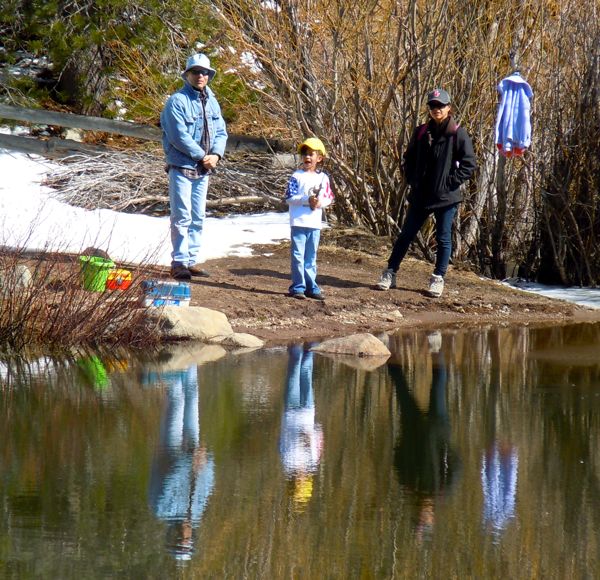
Fishing is free and only for those 14 and younger at Sawmill Pond on the South Shore. Photo/Kathryn Reed

Fishing is free and only for those 14 and younger at Sawmill Pond on the South Shore. Photo/Kathryn Reed

This spring, the California Department of Fish & Game intends to supply the pond with 250 pounds of Lahontan cutthroat trout – the native fish that is mandated, but was unavailable to the state in great numbers from hatcheries last year.

Private groups already came through this winter with their donations – including two Tahoe rotary clubs contributing $8,500 for the effort. About $15,000 is needed to get the pond up to par for the annual Sawmill Pond Kid’s Fishing Derby put on by the Optimist Club on June 11, El Dorado County Fish and Game Commissioner Victor Babbitt indicated. The derby is open to children ages 14 and younger.

Babbitt, who runs Tahoe Fly Fishing Outfitters in South Lake Tahoe, predicts 2011 to be a good year for fishing in the rivers and lakes.

During drought years, it’s tougher for fish to survive with less flow in the waterways. They won’t have that problem with the high flows and phenomenal runoff expected this year. Whitewater blankets the American River.

However, it may be harder early on for those who fish to negotiate their spots.

“We’ll still have high flows right up to the opener,” Babbitt said.

Even ice fishing may last longer with the big winter in the Sierra Nevada.

Among other places, Babbitt sends fishing enthusiasts to Indian Creek Reservoir and Cave Rock if they’re venturing onto Lake Tahoe. The limit on the lake is five, with no more than two Mackinaw trout, according to California Fish & Game regulations.

On the Carson River, the East Fork is always closed to fishing above Carson Falls. Below them, it is allowed all year.

All the tributaries leading into the lake remain closed until July 1. For the season opener, one may fish 1,000 feet below the Lake Tahoe outlet dam on the Truckee River. The minimum size requirement is 14 inches. Only artificial lures with barbless hooks may be used.

Winter is fair game on the lake

fish

Gene St. Denis holds an 11-pound, 4-ounce German brown trout caught in Lake Tahoe. Photo/Provided

Chuck Lane got a jump on the fishing season by braving 29-degree, blustery weather a few weeks ago to catch a mega German brown trout in Emerald Bay with his Lake Tahoe guide Gene St. Denis of Blue Ribbon Fishing.

“We were the only boat out there. Emerald Bay was howling,” said St. Denis, who logs at least 200 days on the water. The trout they hauled in St. Denis considered “rare.”

The fish weighing 11 pounds, 4 ounces and measuring 32 inches took a lot of fishing line from the Morgan Hill man, but he expected a longer fight.

“He didn’t fight that much in the cold. If I had caught him in the summertime, I don’t how long it would have taken,” Lane said. He agreed with his wife, Barbara, who called it a “bucket list” venture.

“I’ve always had a big desire to catch a German brown. I’ve become enamored with it. It’s a beautiful fish, and it tastes really good,” Lane said while at Harrah’s Reno for a bowling tournament. The fish meat is considered rich.

Lane took the fish to the casino kitchen to cook it. He got one serving and treated the cooking staff to the rest.

As a decade-long ritual, Lane comes up to Tahoe from the Bay Area to fish and ski. With his luck, some may wonder if he should hit the tables.


Lake Tahoe real estate in stabilization mode

By Susan Wood

Lake Tahoe real estate agents and sellers hope to spring into a new season of renewal in this hard-hit industry. But most admit in this economy, it will take a lot of special treatment and unique touches to get buyers through the door and on the deed.

“Consumer confidence is a little down affecting house sales in general. But the median price has stayed steady for 16 months now, and the inventory is a little low, but the buyer could be coming to the mindset that maybe now’s the time to buy,” said longtime real estate agent Deb Howard, who runs her own company in South Lake Tahoe. “The stabilization is huge.”

The median price of a single family home on the South Shore in March was $310,000, the South Tahoe Association of Realtors reported in its multiple listing service. The median was $7,500 more at this time last year. Over the year, the prices have hovered between this price and $328,000, making many wonder if this housing market recession has reached its bottom at least in Tahoe.

Howard believes it has. Her company has logged recent sales – with a $2 million home in escrow — that have prompted her to raise her eyebrows at the prospect of seeing the end of a true market correction from Tahoe’s heyday between 1999 and 2002 when buyers were in bidding wars over homes. Some bought without even stepping inside.

Gone may be those days. However, Howard has seen the international buyers poking around recently and activity is picking up. She’s placed more effort and energy into Internet marketing and learned catch phrases to use such as “getaway,” “exclusive” and “lifestyle” that tap into the desire for prospects to have a world-renowned mountain lake experience.

First-time homebuyers and even those with bad credit buying with cash have come around since “financing may not be possible” for the latter, Howard indicated.

Timing is everything. South Lake Tahoe announced last week it received approval for $800,000 in first-time homebuyer assistance awarded in California Housing and Community Development Department grant funds. The South Lake Tahoe Redevelopment Agency covers a portion of the administration costs, enabling a greater percentage of the funds to go toward the homebuyers.

Overall, the hope is spring will launch a new year of an upward swing. Month after month, national and statewide reports declaring drops in home prices and sales as well as billions tied up in banks with tight lending practices have prompted some to ponder the future of buying a home as the all-American dream. These reports don’t necessarily represent the case for Tahoe, contends Howard, who serves on a resort community committee she once chaired for the National Association of Realtors. There are trends at work – and sellers at work doing the extras.

For one thing, Lake Tahoe has two peak real estate markets. They run from 4th of July to mid-October and New Year’s to Easter. Baby boomers may either want to retire here with their recreational enthusiast war paint or transfer wealth at an astonishing rate to their children. Some of these so called “kids” got into the world of technology and are driving a new age of commerce, so they may not need daddy’s money.

But nothing worth having comes easy. That’s why, if sellers want to move their homes, they need to be creative like Mike and Sue Zanetell. To show their four-bedroom home at 927 Candlewood in South Tahoe that he built from the ground up, she makes cookies and lets a pot of minestrone soup simmer in the kitchen.

“See, you come here and get fed,” Howard said, while Zanetell pulled out some pastries.

One unique selling feature has become a picture board of the home. One stood next to the traditional fliers and compact discs of more photographs.

“It’s critical to let the buyer know what it looks like in all four seasons,” Howard said. Zanetell’s back yard that’s good enough to be on the local garden tour was on display. For that, they’ve added Forget Me Not wildflower seeds into a baggie as an added touch for those who view the home.

Signs are put up telling viewers they can “leave their shoes on.”

Sue Zanetell shows the cabinetry in her home. Photo/Susan Wood

Sue Zanetell shows the cabinetry in her home. Photo/Susan Wood

Zanetell’s persona envelops the Craftsman home, which comes with impeccable detail that only a builder may insist on. They’re selling the home to move to Mendocino County to care for aging parents and plan to keep their cabin at Fallen Leaf Lake.

Listed at $529,000, Howard admits the price is higher than the average. But she’s confident the high end buyer is back in the saddle. Those with money know to be the first to set the trends, and they’re waited for the bottom.

Not your average seller or house

Entrepreneur and builder Chuck Bluth apparently got that same message. He’s listed his 9,530-square-foot lakefront home in Incline Village with Chase International for $15.998 million.

To Bluth, the European home speaks for itself – with a bathroom that won an international award for the use of marble and a wood finish with five layers. More than 15,000 hours and 18,000 hours were placed in the masonry work and painting, respectively. If the privacy isn’t enough to think of living in a resort, try owning a personal waterfall.

“Tahoe couldn’t produce a house like this under $20 million,” Bluth told Lake Tahoe News. “But someone coming from the Bay Area is used to this quality.”

What’s Bluth’s reason for selling? He calls the Logan Shoals area house in Glenbrook the place he hangs his hat. To sell the Incline Village home, the former owner of the Cal Neva Resort and developer may assist as a lender to the ideal party.

“Basically, I sort of held off on marketing to some degree because the market had been so bad. There was no doubt the real estate market was hit hard, but what hit the wealthy especially hard was the stock market (plunge). But the market is back, and I believe this year’s market coming into spring and summer is going to be a good market,” he said.

Homes circling the Lake Tahoe Basin saw a 14 percent jump in the average price, according to Chase’s last quarterly report comparing 2011’s figures with the prior year. The median sales price increased 1 percent from $417,500 to $422,500.

“The Lake Tahoe market is showing definite signs of stabilization,” Chase Vice President Sue Lowe said, echoing Howard’s statements.

Even the U.S. real estate market has economists noticing recently.

The National Association of Realtors reported a 2.1 percent increase in pending home sales about a week ago.

“Pending home sales have trended up very nicely since bottoming out last June, even with periodic monthly declines,” NAR Chief Economist Lawrence Yun said.



Napa Valley isn’t just about wine — it’s good for camping

By Kathryn Reed

CALISTOGA – Camping at Bothe-Napa Valley State Park almost had us forgetting about all the nearby vineyards.

This 2,000-acre park is quiet despite its proximity to Highway 29, the main artery through the Wine Country. Tucked into the hills, the vegetation – and tents – reminds us why we are here. It’s our annual girls camping weekend.

We barely got a campsite last June. Such are the hazards of being in snow country; you can forget June is the heart of summer for most of California and that recreation sites fill up. In fact, campsites can be booked up to seven months in advance.

(We learned from last year and already have reservations for this year.)

Pam Valentine relaxes during the annual girls camping trip. Photos/Kathryn Reed

Pam Valentine relaxes during the annual girls camping trip. Photos/Kathryn Reed

But I’m not much of a camper – that’s why I picked this particular park. I would prefer wine tasting and spa treatments as a girls’ get-away. A little wine tasting with our camping made it my kind of roughing it.

Still, the park is magnificent with redwoods sprouting near Ritchey Creek. Douglas fir, tanoak and madrone make up most of the flora.

Although 10 miles of trail exist in the park, we didn’t just stretch our legs there. We drove through the town of Calistoga, along the windy section of Highway 20 to Robert Louis Stevenson State Park.

The author used his diary from his days of honeymooning at the site to create “Silverado Squatters.”

Parking is on both sides of the highway. The trail leads to the top of Mount St. Helena. Much of it is wide because it becomes a fire road. (Bikes are allowed on this section.)

It is one of those hikes to do early in the day because of the heat of the sun is baking. Shade is scarce.

Once at the top we realize it’s really two peaks. We stop at the south peak – elevation 4,003 feet and 4.1 miles from the truck. The north peak – elevation 4,343 feet – is another 1.7 miles up the road.

From our perch we look down into the verdant Napa Valley. On clear days Mt. Diablo and Mt. Tamalpais are visible.

Back at the park we spend part of a day walking along the 1.2-mile History Trail that starts in the picnic area and ends at the historic Bale Grist Mill.

Along the dry, hot trail (bring water) is the site of the first church built in Napa County in 1853. Tombstones fill a cemetery. Oh, the stories that must be associated with them.

At the mill we are treated to a tour of what is still an actual working grist mill. It was built in 1846. Grain is ground into flour just like it was 150 years ago.

The end product is for sale. But the packages say “not for human consumption” because the site doesn’t meet 21st century health codes. Nonetheless, there are women buying up the various mixtures – saying this is their annual trip to do so.

We leave with pastry flour and a recipe for Bale Mill Pancakes. Bisquick could take some pointers from this mill.

The history of the area is worth a side trip next time you are in the Napa Valley – and certainly worth a camping trip away from the Sierra. This state park is on Highway 89 between St. Helena and Calistoga on west side.

More information about California State Parks is on the agency’s website. The camping page is here.

ngg_shortcode_0_placeholder (Click on photos to enlarge.)


Nevada bikeway route gets environmental green light

By Susan Wood

Rabe Meadow between Stateline and Round Hill may be a future site for the first phase of a proposed bike link.

Rabe Meadow between Stateline and Round Hill may be a future site for the first phase of a proposed bike link. Photo/Susan Wood

INCLINE VILLAGE — A critical step in the Nevada Stateline-to-Stateline bikeway project was accepted Friday by the Tahoe Transportation District, an arm of the Tahoe Regional Planning Agency tasked with such issues.

The public comment period ended for the environmental assessment. Now, the U.S. Forest Service and TRPA need to approve it.

Groundbreaking of the first phase of the $9 million project is scheduled for May 15. Officials have about half that amount with funding sources being lined up, TTD Executive Director Carl Hasty told Lake Tahoe News.

The first of three phases covers two miles from Stateline to Elks Point Drive. The 30-mile trail advances on paper to Crystal Bay. Each phase is estimated to cost about $2.5 million.

Project managers and officials are reviewing different options. One choice crosses Rabe Meadow and merges with the Watah Trail that starts at Kahle Drive in Stateline and meanders through Round Hill. The other parallels Highway 50.

Project Manager Alfred Knotts told the transportation board the “superior” alternative staff is leaning toward is the latter because of fewer environmental concerns.

The proposal calls for bike racks, signs, picnic tables and restrooms.

“I’ve very excited with the progress. It’s an important link,” said TRPA Senior Transportation Planner Karen Fink, a longtime cycling advocate.

Cycling venues are believed to contribute $23 million in tourism revenue and reduce carbon dioxide emissions by 1,400 metric tons.

In other items, the transportation district:

-Approved the request for proposal to be used to secure a long-term operator for BlueGo Transit Services, which has been mired in legal wrangling and complaints. The district, which will oversee the service, wants a reliable operator on a long-term contract.


Fire weather station going up this summer

By Susan Wood

Come summer, Smokey Bear could be more accurate on forecasts than weather reporters. And he’s probably kept his job longer — since 1944.

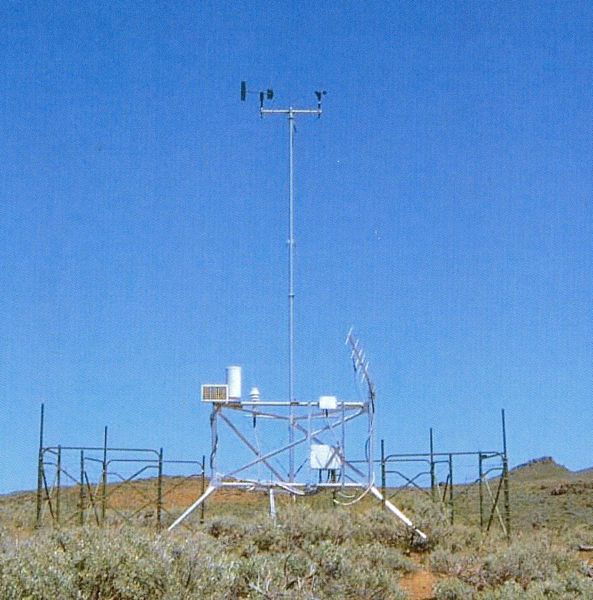
The new fire weather prediction station LTBMU will install this summer resembles this photo provided.

The fire weather prediction station LTBMU will install this summer resembles this photo.

The Lake Tahoe Basin Management Unit plans to erect in Meyers a fire weather station that looks like a cross between a tripod and a spaceship. Still, this $15,000 device reads levels of relative humidity, precipitation depth, fuel moisture, solar radiation, along with wind speed and direction. It sends those readings to a computer program that provides fire danger for the U.S. Forest. From there, Smokey Bear signs will indicate fire hazards that include the five levels: “low, moderate, high, very high and extreme.”

The most commonly seen sign exists in front of the South Lake Tahoe visitor’s center off Highway 50 next to Campground by the Lake. One may also call the LTBMU fire danger recorded line at (530) 644.6048.

In contrast, “red flag” fire warnings originate with the National Oceanic and Atmospheric Administration.

A similar weather station now stands at the Meyers fire station, but it’s so old it no longer meets National Fire Danger Rating System guidelines, and it can’t be repaired. Moreover, structure development has hindered the satellite readings from the 29-year-old unit referred to by the Forest Service as RAWS (Remote Access Weather Station).

Fire resources will be managed by the readings – including those crews out in the woods cutting. On dry days, machinery even intended to reduce fire fuel can start one.

“That’s where we locally see our fire dangers. It’s extremely important,” said John Washington, LTBMU fuels division chief.

The Forest Service aimed to find adequate space, ground cover, air flow and sunlight. At a mere $500 in costs, the new RAWS will be installed at the end of Mohawk Street near Lake Baron. It will take up 400 square feet and will be fenced in. When the snow completely melts in the area, about 200 feet of vegetation must be cleared from the site. Crews will need to take down 25 trees under the proposal, which already passed its required comment period.

“It definitely does help because it helps us compile all our available resources,” Lake Valley Fire Chief Jeff Michael said.

Much like the Lake Tahoe Basin sits at the cusp of heavy moisture between the El Nino and La Nina weather phenomena, the National Wildland Significant Fire Potential Outlook from April through July this year reports “equal chances” of a bad fire season in this region of the Sierra Nevada. Fire officials will sometimes say when it’s wet more fuel for the fire grows. When it’s dry, the terrain sparks easily.

Predicting is one thing. Prevention is quite another.

“(The RAWS) will help – but we still knew we were in a high fire danger and had a red flag warning during the Angora Fire. Sometimes we can have all the technology in the world, but it still takes preventing and doing what we can and telling others to do what they can. Fire’s going to happen,” said Leona Allen, a former city dispatcher who was on the job when her father’s home burned in the devastating fire in 2007 that consumed 254 homes. The lot is now home to a commemorative garden, and Allen works for Lake Valley Fire.


New South Shore recreation measure slides into first base

By Susan Wood

It may have the makings of a great novel — perceived sexism, money and the law.

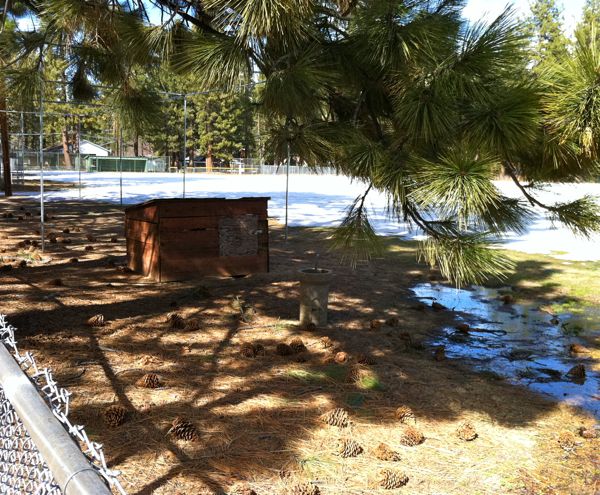
Ballfields like the one on Rufus Allen Boulevard could be headed toward improvements if a new measure goes before voters in November. Photo/Susan Wood

Ballfields like the one on Rufus Allen Boulevard could be headed toward improvements if a new measure goes before voters in November. Photo/Susan Wood

A proposed measure to go before El Dorado County voters in November to fund recreation improvements for ball fields and bike trails as an altered version of Measure S passed its first hurdle with the city. And already, recreation alliances and competing forces have formed to vie for the coveted $470,000 collected since the first recreation-oriented initiative passed.

Essentially, the South Lake Tahoe Recreation Facilities Joint Powers Authority and recreation advocates would like to change the controversial Measure S that’s been in effect for more than a decade. In 2009, advocates of ball field improvements tried to channel that money away from bicycle trails, but Measure B failed with only 62 percent of the vote. The ballot initiative needed a two-thirds vote.

Former City Councilman John Upton, the one staff person managing the finances of the JPA, got the approval from the city Tuesday to proceed to the next base but not before entering into an almost two-hour discussion on the preliminary ballot language.

The new language highlighting “Little League” fields came into question when a softball mom challenged the baseball-myopic group pushing the new measure to include the predominantly girls leagues.

And she had listeners in high places – namely City Councilwoman Angela Swanson, who had to remind the male dominated group speaking to the matter that girls have taken a second seat in sports for too many years pre- and post Title IX of the Civil Rights Act of 1964.  The federal law dictates the support of facilities for women’s sports on an equal playing field with the men.

“By law, you have to bring the girls facilities up to the men,” Marilyn Breisacher said. The softball mom watched her daughter grow up wondering why “her brother got to play on better fields.” She doesn’t want that to happen anymore.

On several occasions, she cited AB2404. enacted in 2005 and mandated for local governments five years later, making California the first state in the nation to enforce the civil rights of girls in community athletics as an institution in local jurisdictions and special districts.

Breisacher also took issue with the language singling out the field on Rufus Allen Boulevard at the former Al Tahoe Middle School where the Little League teams play as the one place getting the money for improvements such as batting cages, irrigation systems and a snack bar. She wants to see the improvements expanded to the South Tahoe Middle School field.  Right now, Tahoe Valley Elementary is where the softball teams play.

When all was said and done, Upton pledged to broaden the language to read “baseball/softball” fields and deleted the specific reference to improvements at one particular ball field. Councilman Tom Davis repeatedly asked if the changes would meet the state bill requirements. To that, Breisacher nodded.

The $6.5 million Measure S has turned out to be a hot-button issue in some circles because it was written in vague language to cover “ball fields.” Even the specifics haven’t always followed the letter of the law. The multipurpose field built next to Lake Tahoe Community College opened with much fanfare, but three were supposed to be constructed, and both baseball and soccer teams compete for playing time there. Softball leagues get bumped.

The intent of the new measure is to take the $470,000 currently on the books and split it between ball field improvements and bicycle trail maintenance to routes built before Measure S passed. This current law now only allows the money to be spent on trails constructed after the measure passed. That’s not many trails. Only eight of the anticipated 25 miles have been laid. The shortage created a cash-cow fund building at $5,000 per year, per mile that the JPA collects from taxpayers on about 50,000 parcels to the tune of $18 per year. The Measure lasts until 2030.

“I hate to see that money languish like this,” Mayor Hal Cole said Tuesday.

Cycling advocates would like other trails to get much-needed maintenance in this pothole infested region.

Longtime cycling advocate Tom Wendell supports changing the law under this new proposed measure “in theory” because the effort appears more inclusive and covers more trails because many were built long before 2000. He couldn’t say this about Measure S or even Measure B. He also takes issue with the money collected being called “excess” funds when they were clearly designed to go toward the maintenance of the area’s dilapidated, broken trail system.

“We are in dire need. Those trails are bad,” Wendell said Wednesday.

“We have fallen short in terms of meeting our obligations. We have to address in the end that the bike trails are getting a great deal of that money. There’s no way on God’s green Earth we are going to take that money for upkeep of the trails and give it (all) to the ball field people,” said El Dorado County Supervisor Norma Santiago, who also serves on the JPA board consisting of the city, county and Tahoe Paradise Resort Improvement District run out of the park in Meyers.

Santiago has a history with Measure S. She ordered the complete audit of the funds in 2006, when it became clear the infrastructure it was designed to protect was in disrepair and a lot of money was being collected.

The county is expected to hear the proposal for the new measure in the next few weeks.

Then by May 5, the JPA will meet and determine whether it wants to cough up $35,000 to support an election effort. The ballot measure’s language must be finalized by the end of June to make the November ballot.


South Tahoe’s mid-year finances show improvement

By Susan Wood

In the quest for the green or even the black, South Lake Tahoe’s government finances appear on paper to be much rosier than the figures tallied last year at this time – at least for now. The redevelopment picture could change that.

The South Lake Tahoe City Council received two critical financial reports Tuesday. Photo/Susan Wood

The South Lake Tahoe City Council received two critical financial reports Tuesday. Photo/Susan Wood

The City Council heard and filed a mid-year budget report by Finance Director Christine Vuletich Tuesday stating that the local government’s general fund is down by $276,689 in unfunded expenses this year. This term means items not budgeted. Last year at this time, the city was forced to make up for $1.5 million in the general fund.

“Compared to last year, it’s really minimal,” Vuletich said to the council, sharing her excitement about the improvement.

Overall, she summarized the report as “good news.” Revenues show an $800,000 increase over this time last year – except for one area that’s taken a major hit in diminishing property tax dollars during the recession.

“Most funds are up except the RDA,” she said, referring to the Redevelopment Agency’s $900,000 drop in revenue in one year.

“Flat is the new up,” she said.

The city contends it has made inroads on containing costs, and Vuletich’s optimistic about slight revenue gains showing a growth pattern, she later told Lake Tahoe News. The mid-year changes in total funds showed a net gain of $462,496. And city officials plan to follow a five-year strategic plan to prosperity.

City Manager Tony O’Rourke, who is most recently from the private sector, has shown no patience for government waste and business as usual.

When O’Rourke came on board, he took issue with 78 percent of the general fund being consumed by salaries and benefits. His aim is less than 65 percent. Just last month, 11 positions were eliminated.

The city had to pay out two top-level, former managers. Agreeing not to sue or disparage the city, Assistant Manager Rick Angelocci got $54,891 in severance, while Redevelopment and Housing Director Gene Palazzo received $44,748. These consent agenda items passed unanimously without discussion.

“I’m not happy about this,” Councilman Tom Davis told Lake Tahoe News during a break.

But O’Rourke insisted the terminations were necessary over the long haul – calling the maneuvers a 23-to-1 savings when considering Angelocci’s $144,360 annual salary.

The challenges continue. The city is scheduled to start labor negotiations in closed session at its meeting in two weeks.

O’Rourke appeared to breathe a sigh of relief with the city’s financials – that is, this year’s mid-year report and last year’s audit presented side by side before the council that afternoon.

Looking back at tough times

The city’s auditor, Cory Biggs of Maze and Associates based in Pleasant Hill, provided South Lake Tahoe with a reasonable bill of health on its finances evaluated over its 2009-10 fiscal year. And with no “discrepancies,” Biggs said he would rate South Lake Tahoe’s 190 separate funds it manages in the top tier of the 40 cities it combs over.

“If we found some, we would have been talking before this meeting,” he said.

Still, the city has worked to dig itself out of a hole.

In 2009-10, the audit presented a $2.1 million negative difference between the general fund’s revenues and expenses. Times have been tough. Another slide showed the history of the general fund starting with a $1.4 million overage in revenue in 2003. Growth continues until 2008, which reported a budget deficit of $1.2 million. And things went downhill from there.

Going from 2007 to 2008, the city even had to move $1.2 million in reserves to pay for general fund expenses.

The redevelopment story was bleak last year. State takeaways amounted to $2.1 million – and this year could be worse. Gov. Jerry Brown has suggested eliminating redevelopment agencies to ease the pain of its own budget woes.

“It’s an issue,” City Attorney Patrick Enright warned the council. The state’s threat also made the agenda as the city tries to absorb the ramifications of no state-supported funding for urban renewal. California’s possibility of being able to seize local assets and nullify loans represents a worrisome moving target for this city.

The local government’s Redevelopment Agency has struggled to pay back half the money owed to the general fund from the $7.2 million it borrowed a decade ago to complete the Heavenly Village project. It pays $500,000 each year, amounting to collected interest of $638,353. Over time, the interest almost doubles the amount owed.

Redevelopment is considered a tool for business and housing investment in town. But South Lake Tahoe’s liabilities outweigh its assets, representing “a huge amount of debt,” Vuletich announced.

In other money matters, the council:

-Approved rehiring Maze and Associates for future audit services.

-Authorized the pursuit of grant funding amounting to a total of $464,133 for 1.6 miles in bicycle paths.

-Allocated $40,000 in air quality funds for bus shelters.