The great American single-family home problem

By Conor Dougherty, New York Times

BERKELEY — The house at 1310 Haskell Street does not look worthy of a bitter neighborhood war. The roof is rotting, the paint is chipping, and while the lot is long and spacious, the backyard has little beyond overgrown weeds and a garage sprouting moss.

The owner was known for hoarding junk and feeding cats, and when she died three years ago the neighbors assumed that whoever bought the house would be doing a lot of work. But when the buyer turned out to be a developer, and when that developer floated a proposal to raze the building and replace it with a trio of small homes, the neighborhood erupted in protest.

Most of the complaints were what you might hear about any development. People thought the homes would be too tall and fretted that more residents would mean fewer parking spots.

Whatever the specifics, what is happening in Berkeley may be coming soon to a neighborhood near you. Around the country, many fast-growing metropolitan areas are facing a brutal shortage of affordable places to live, leading to gentrification, homelessness, even disease. As cities struggle to keep up with demand, they have remade their skylines with condominium and apartment towers — but single-family neighborhoods, where low-density living is treated as sacrosanct, have rarely been part of the equation.

Read the whole story


Satellite ski communities are the new dream

By John Clary Davies, Powder

The ski town as we know it is dead. The cause? A toxic combination of all-time national wealth inequalities, wage stagnation, the proliferation of short-term rentals, and too many damn tourists. Unless you got in early, have a family inheritance, or somehow snagged one of the few affordable rentals in town, living in a traditional ski town is a less viable option than it has ever been.

Places like Jackson, Telluride, and Mammoth—classic cute-as-a-button ski communities—are no longer realistic places to move to, but weekend stops where one might find a cool Airbnb while flexing another stop on their Mountain Collective pass.

What, you thought you could actually live there? C’mon. The median listed home prices for great places to live and ski: Bozeman, $410,000; Whitefish, $519,000; Mammoth Lakes, $539,000; Truckee, $704,250; Telluride, $1.2 million; Jackson Hole, $1.4 million. Trailers in Aspen are going for half a mill.

Read the whole story


Heavenly plans to widen trails, reduce hazards

Heavenly Mountain Resort wants to remove obstacles and put some snowmaking underground. Photo/LTN file

By Kathryn Reed

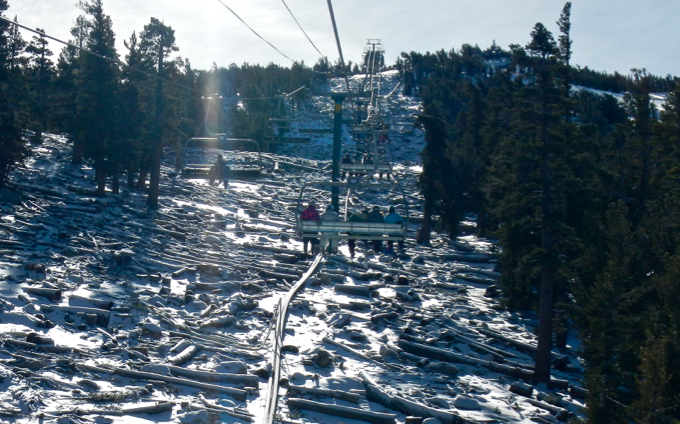
Heavenly Mountain Resort wants to cut down trees, move boulders and relocate snowmaking equipment all in the name of creating a better experience for skiers and snowboarders.

For this next phase of the master plan, the Lake Tahoe Basin Management Unit is taking comments on the draft environmental assessment until Dec. 22.

The work is slated for next year. A price tag for the construction has not been disclosed.

Heavenly has a number of locations where it’s rather dangerous because so many people are in a narrow area. That’s why the resort wants to do this work, the goal being to give skiers more room to spread out.

The plan is to remove congestion on 49er, Orion, Big Dipper, Cascade, Sam’s Dream, Ridge Way, Ridge Run, Olympic Downhill, $100 Saddle, Powderbowl, Comet and Bonanza. These 12 trails encompass 25.3 acres.
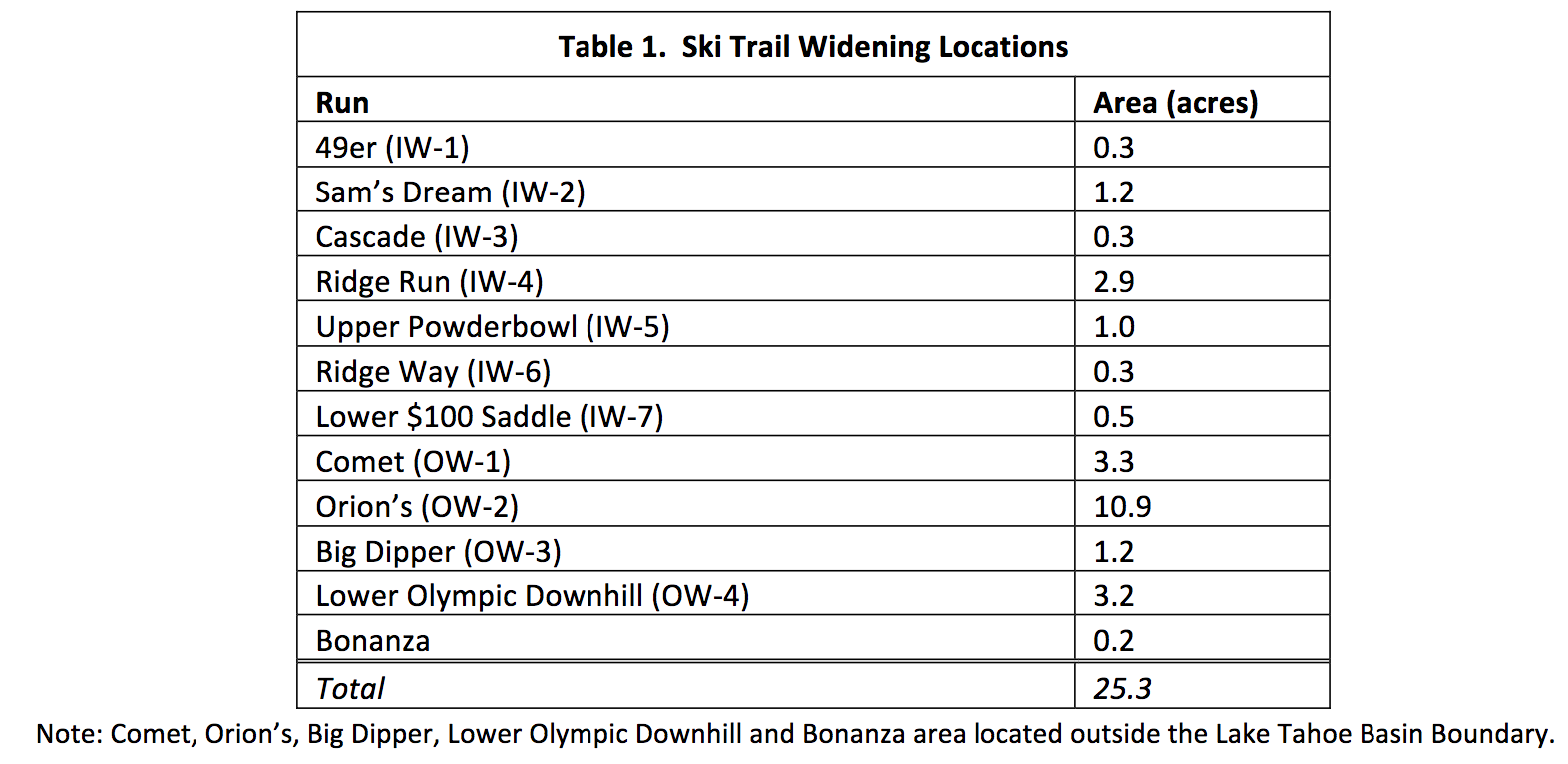
                                                                                                                                                   Source: USFS

According to the draft EA, “Lower Orion’s and Lower Olympic Downhill would require grading to match the widened area to the grade of the existing ski trail. Widening proposed for Ridge Run would expand the skiable boundary, but would be located within the existing special use permit boundary.”

When this project was out for scoping in the spring nine comments were submitted to the Forest Service.

“Some of the issues received, such as limiting ticket sales to manage congestion and user experience, and issues around charging fees for uphill skiing access, were deemed to be outside the scope of the proposed action,” according to the Forest Service.

The USFS is advocating for tree removal and the other work desired by Heavenly.

“There are identified locations on sections of key ski trails that, as a result of bordering forested areas, are not sufficiently wide enough to accommodate existing use levels and the desired flow of skiers and snowboarders during peak daily and seasonal periods,” the EA states.

Most of the resort operates on USFS land under a 40-year special use agreement that expires in 2042.

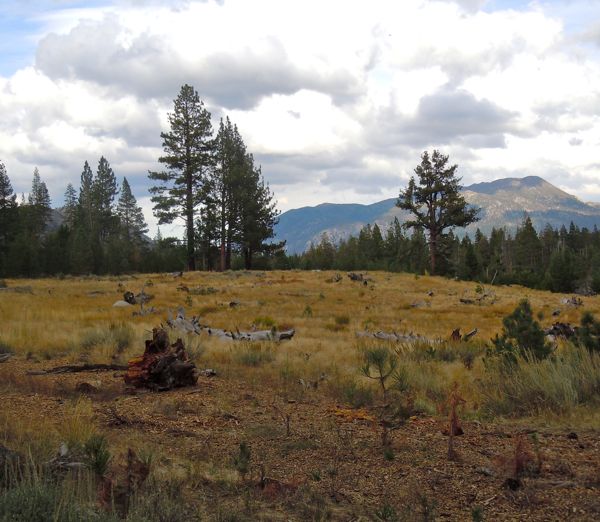
“Tree removal would be conducted over snow and skidded behind a snowcat over compacted snow. The trees would then be chipped and reused as mulch and soil amendment. Exposed boulders posing a safety hazard would be removed during the summer with excavators and placed in existing depressions along the edges of the widened trails,” the environmental document says.
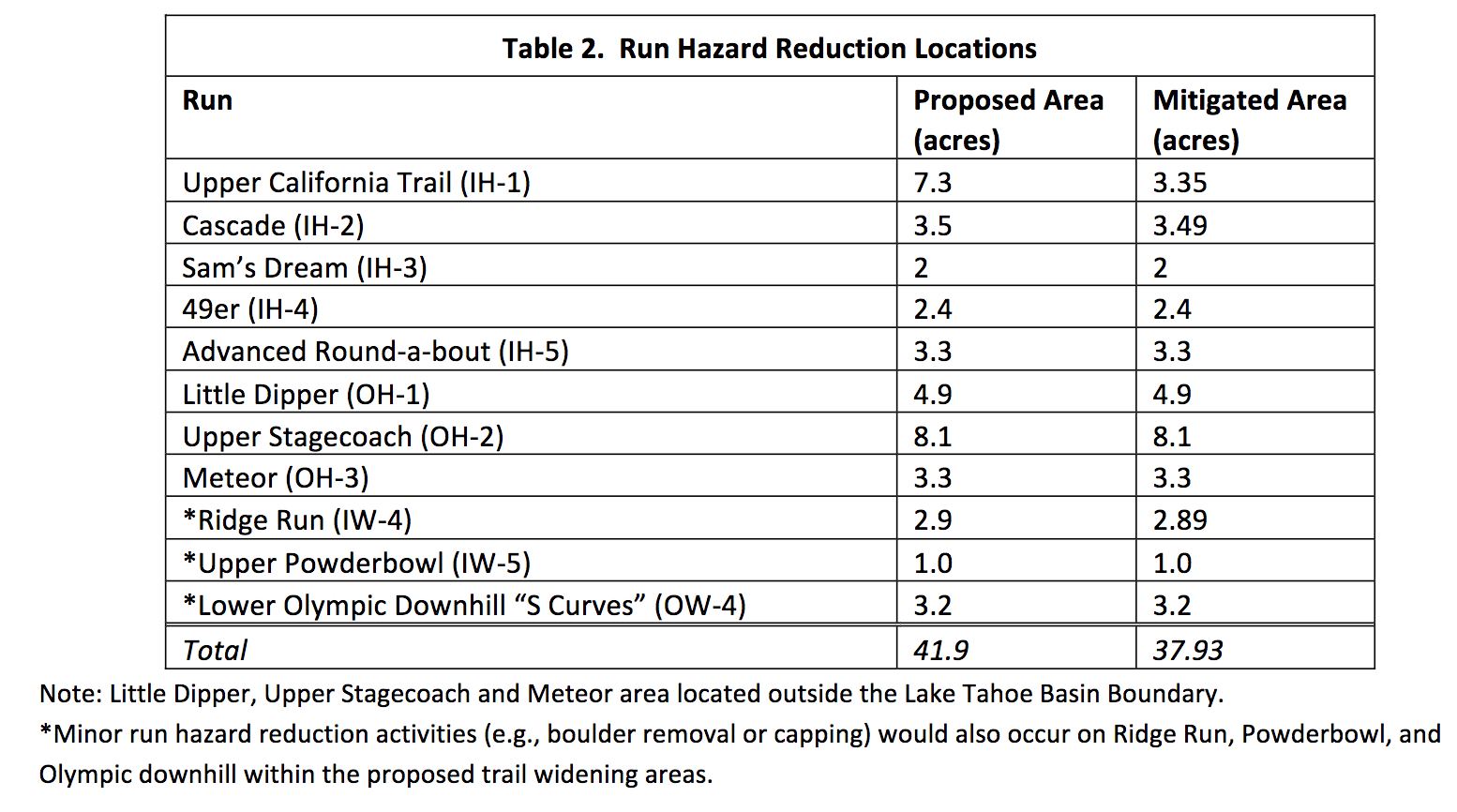
                                                                                                                                                                    Source: USFS

Getting rid of obstacles would occur on: Little Dipper, Meteor, Cascade, Sam’s Dream, California Trail, Stagecoach, Advanced Roundabout, Ridge Run, Powderbowl and Olympic Downhill.

A result of getting rid of the boulders and downed trees would mean the depth of snow needed to ski that run would be dramatically reduced. This then reduces the amount of snowmaking needed and could open terrain sooner.

The resort is projecting to save 10.9 million gallons of water and 365,000 kilowatts of electricity by lessening the need for snowmaking on these select trails.

About 5,800 feet of snowmaking equipment would be moved to accommodate the widening and obstacle removal projects. Plus, much of it will be put underground.

The draft EA is available online.


International visitors to U.S. down 4 percent

By Beth J. Harpaz, AP

The number of international visitors arriving in the United States declined nearly 4 percent in the first six months of this year compared with the same period in 2016, according to data released Wednesday from the U.S. Department of Commerce National Travel and Tourism Office in Washington.

Many sectors of the travel industry have been warning that President Trump’s anti-foreigner rhetoric and immigration policies would lead to a drop in tourism here.

Fewer visitors came from nearly every region of the world, with declines in arrivals from Western Europe, Eastern Europe, Asia, the Middle East, Africa, South America, Central America and the Caribbean.

Read the whole story


Sale of historic Cal Neva on shaky ground

By Dale Kasler, Sacramento Bee

Tech billionaire and real estate fanatic Larry Ellison might back away from a deal to buy Frank Sinatra’s old Lake Tahoe casino.

Ellison’s $35.8 million purchase of the faded Cal Neva Resort & Casino has been tied up in court for more than a month, and the Oracle Corp. founder isn’t willing to wait much longer, federal bankruptcy officials warned in a court filing last week.

If Ellison drops out, the Cal Neva would be left in limbo. The 91-year-old resort has been a fixture on Tahoe’s north shore but has out of business since 2013 and is decades removed from its glory days.

Read the whole story


Tahoe’s murky near shore getting more attention

By Kathryn Reed

While a uniform strategy is working to bring more clarity to Lake Tahoe as a whole, that is not the case for the water closest to the shore.

That is the conundrum scientists and regulating agencies are finding themselves in. There is no magic solution to clean up, so to speak, the murky, algae-ridden water by beaches. This is in direct contrast to the various initiatives to reduce sediment from the lake that is blamed for the lack of clarity.

The near shore, as those tasked with managing call it, is defined as “the low water elevation to a depth of 30 feet, or to a minimum width of 350 feet.”

Bob Larsen with the Lahontan Regional Water Quality Control Board this month updated the board about what staff and others are doing to improve the quality near the shore.

As has been stated many times, the data is lacking – especially compared to lake clarity. Then there is the quandary of data and anecdotal testimony from longtime locals not being in sync. Data show things aren’t that much different, but those who have lived in the basin for a while or visited the area seem to be a chorus stating things are much different, and not in a good way.

Making things difficult is that conditions vary depending on where on the lake studies are conducted. That requires the need for multiple solutions, which to date have been somewhat elusive. This in part is because studies should involve fish, algae, aquatic invasive species and more.

Money is often a barrier. And then there are competing interests. Plus, it wasn’t until a few years ago that a coalition was put together to tackle near-shore issues.

Algae – some floating, some attached to rocks – is one of the bigger concerns, at least for the public.

At Crater Lake algae has been increasing in the last few years. That body of water in Oregon has similarities to Tahoe.

Larsen said at Crater Lake officials believe crayfish may be responsible for the algae growth. That could be a factor in Tahoe, where the crustaceans were introduced decades ago.

Another concern is there has been an increase of algae in wilderness lakes in Lahontan’s jurisdiction, which goes from the Oregon border to Southern California through the Sierra. There’s the potential to do a peer watershed study. Lake Tahoe, which is a highly disturbed lake when it comes to plant and animal species being introduced, could be compared to a higher elevation lake that has not been artificially changed. Though, there are some lakes that have been stocked with fish.

Lahontan is looking for partners to investigate the ecological change at Lake Tahoe to determine the impacts on native species. Ecological studies would determine biological changes, while climate change has physical drivers.

With the cyanobacteria, or blue-green algae, bloom this summer in the Tahoe Keys, human health concerns at the near shore are now a very real concern. This was the first such outbreak in the basin.

This winter/spring the near shore action plan from 2014 will be updated. Next summer an aquatic plants survey will be conducted, along with a microorganisms and toxin survey pertaining to human health, and further algae research. The plant survey will include marinas – unlike previous surveys, “to understand what is going on with native and nonnative species.”


Sports leagues hedging bets on nationwide legal gambling

By Ben Nuckols, AP

WASHINGTON — In court, all four major U.S. sports leagues are fighting New Jersey’s challenge to the federal ban on sports gambling, which the Supreme Court will hear next month.

Outside of court, leaders of three of the four leagues have made public comments that suggest they wouldn’t mind losing the case. Only the NFL has been steadfast in its opposition to gambling, a stance that critics see as hypocritical, especially as the Raiders plan a move to a billion-dollar stadium just off the Las Vegas Strip.

As the Supreme Court prepares to hear a case that could lead to the federal ban on sports betting being struck down, the leagues are hedging their bets — preparing for a future of expanded gambling and hoping to have a say in how legalization takes effect.

Read the whole story


Birds nesting earlier to try to survive global warming

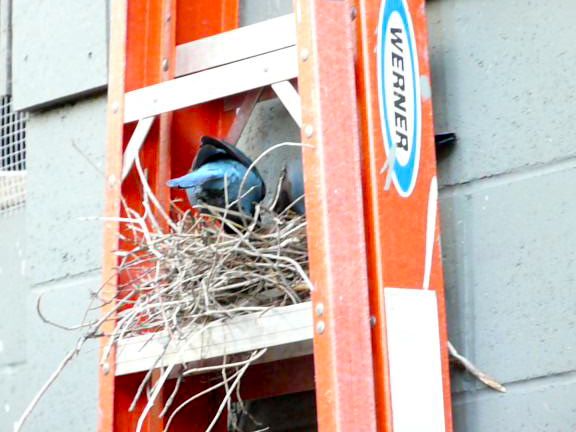
Steller Jays find all sorts of places to build a nest. Photo/LTWC

By Kurtis Alexander, San Francisco Chronicle

The early bird not only gets the worm, but may stand a better chance of riding out global warming.

A study finds that birds in California are breeding up to 12 days earlier than they did a century ago, an apparent effort to maintain their optimal nesting temperatures as the planet warms.

Like many plants and animals, birds have been known to relocate to cooler places to compensate for rising temperatures, moving north or to higher elevations. But the research published this month in the journal Proceedings of the National Academy of Sciences highlights the extent to which birds are going to adapt in other ways to a changing world.

Read the whole story


Substantive garbage rate increase on South Shore

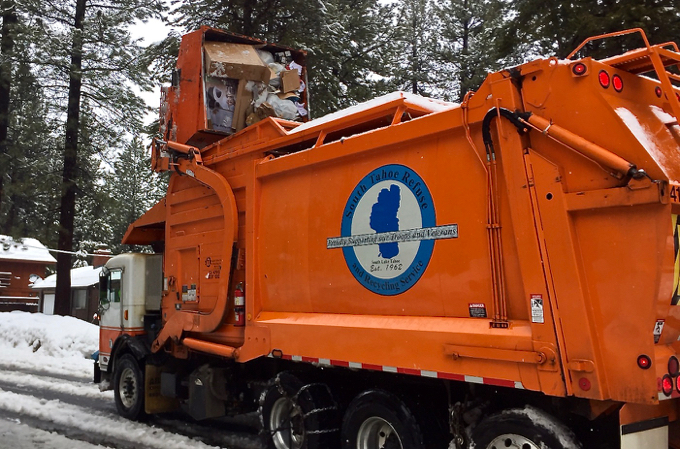
South Tahoe Refuse plans to raise rates beginning Jan. 1. Photo/LTN

By Kathryn Reed

One of the largest rate increases ever requested by South Tahoe Refuse is expected to go into effect Jan. 1.

While the respective jurisdictions still must approve the increase, the Waste Management Joint Powers Authority board this week signed off on it. South Lake Tahoe customers would see an 8.81 percent increase, El Dorado County 9.34 percent and Douglas County 6.81 percent. On a monthly residential bill this would equate to an increase of $2.34 to $28.89, $2.85 to $33.32 and $1.21 to $18.93, respectively.

STR had wanted a 10 percent increase, but the auditing firm tasked with analyzing the proposal came back with the lower rates.

According to the report from Crowe Horwath, without the rate increase STR has a projected revenue shortfall of $1,370,489 for 2018.

The larger increase in large part has to do with a credit from the construction of the resource recovery facility (RRF) going away.

“STR removed the RRF fund credit which had been paid to JPA jurisdiction ratepayers, to account for excess rate revenues collected during the construction of the RRF. On March 2, 2012, the JPA approved a RRF fund credit of $4,722,285, with a six-year payback period, applied in base years, beginning in 2012,” the report says.

Beginning in 2018 that credit is gone.

“This is the most significant factor in causing rates to increase for 2018, and effectively represents approximately 50 percent of the requested rate increase,” the report states.

Lake Tahoe News asked STR President Jeff Tillman if these sorts of rate increases will become the norm.

“I certainly hope not to see these,” Tillman told LTN. “That’s why we said it could be spread over two years.”

It will be up to the individual jurisdictions to OK the full increase for 2018, or for it to be split with two-thirds of the proposal taking affect next year and the remainder in 2019.

Other reasons for the rate increase are labor and disposal expenses. Employees are getting a 3.4 percent raise, health insurance has gone up 6.7 percent, and workers’ comp bills soared 19.4 percent.

The South Lake Tahoe-based refuse company per its contract is permitted every three years to come back with a base rate adjustment. This is what these increases are. However, the company may seek interim rate increases as well, which in large part are based on the Consumer Price Index. Those increases are usually 2 to 3 percent. Rates at the start of this year went up less than 2 percent in each jurisdiction, with no increase in 2016.


Washoe Meadows wins suit against State Parks

By Kathryn Reed

Lake Tahoe Golf Course’s footprint will not be expanding any time soon. This is because Washoe Meadows Community prevailed in court against California State Parks.

Nearly six years to the day after the initial lawsuit was filed in Alameda Superior Court, the First District Court of Appeal this month upheld the lower court’s April 2015 decision which in effect ruled the environmental documents are invalid.

This means State Parks, which has owned the 777 acres that comprises Washoe Meadows State Park and Lake Valley Recreation Area in Meyers since 1984, must start over with its desires to revamp the Upper Truckee River in that location, and put on hold its desire to move some of the golf holes across the river.

To make the state’s plans work would have meant reclassification of some of the land. Downgrading actual State Parks land would have been unprecedented.

El Dorado County officials had protested the state’s plans as well.

The appellate court said, “The public was not provided with an accurate, stable and finite project description on which to comment,” which is required by law. The draft environmental impact report “did not identify a proposed project but described five very different alternative projects.”

Washoe Meadows State Park will remain as it is per a court decision. Photos/LTN file

State law through the California Environmental Quality Act demands that a preferred alternative be identified and studied in order for the public to have an opportunity to comment on the proposal and to bring transparency to the process. That didn’t happen. While federal law is different and through the National Environmental Policy Act multiple options may be studied at once without a preferred alternative, the appellate court said, “California courts will not follow NEPA precedent that is contrary to CEQA.”

The court further said, “In this case the differences between the five alternative projects was vast, each creating a different footprint on public land.”

Lynne Paulson, who spearheaded the lawsuit with the backing of the Washoe Meadows Community, said, “This reaffirms all the comments we had about this project from Day 1. Now we have to wait and see what other projects State Parks propose.”

While Paulson and others would like to celebrate this victory, now isn’t the time. “We are not done with our work,” Paulson told Lake Tahoe News. “Washoe Meadows Community will stay engaged in order to ensure a transparent process along with a project that benefits the environment and the general public by minimizing the destruction of what was set aside due to its natural resource values.”

Although the court made its decision on Nov. 15, Sierra District Superintendent Marilyn Linkem said she was unaware until Lake Tahoe News called.

“We are evaluating the court opinion,” Linkem told LTN. She would not say anything else, so it’s unknown what State Parks’ next move will be.

The park has never had a master plan. It also doesn’t receive much attention from the state or even the local Sierra District headquarters, though trails have been improved in recent years. Officials had said a planning document for the park could not start until the lawsuit was settled.

The golf course continues to operate on a year-to-year lease.