TRPA: Amphibious tourist mobile not hurting lake clarity

By Anne Knowles

If you’re wondering if you saw a white boat with wheels drive off Highway 50 into Lake Tahoe sometime this summer, you did. And if you’re wondering if it’s legal, it is.

Tahoe Duck Tours, in its first full summer of operations, is offering daily, multiple hour-plus tours of the lake on its amphibious vehicles it calls ducks. The World War II-era boats feature six wheels, a watertight hull, a propeller and a canopy-covered deck that seats 24.

Several times a day, the ducks pick up passengers at Heavenly Village near Stateline and travel the five miles via 50 and Tahoe Keys Boulevard to the Tahoe Keys Marina where they enter the water. An hour and 20 minutes later, they emerge and make the five-mile trek back, but not before being cleaned of milfoil, an invasive weed found in the lake.
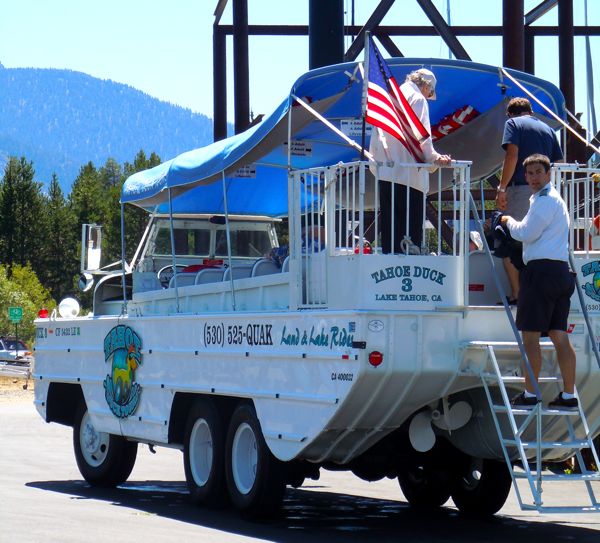
A duck boat driver/captain was cleaning underneath the vehicle/boat Aug. 18 at the Tahoe Keys Marina parking lot before hoping aboard. Photo/Kathryn Reed

A duck boat driver/captain was cleaning underneath the vehicle/boat Aug. 18 at the Tahoe Keys Marina parking lot before hopping aboard. Photo/Kathryn Reed

“We take a lot of plant material off,” said Shawn Kearney, owner of Tahoe Duck Tours in South Lake Tahoe. “The boat gets dirtier than we get the lake.”

Each vehicle is cleaned of road sediment once a day, in the morning before the first trip. And they take additional care on the boats’ exteriors.

“We use food-grade oil, the same used on meat slicers, for anything that comes in contact with the water,” Kearney said. “It is non-toxic.”

The ducks are permitted by the Tahoe Regional Planning Agency as well as regulated by the U.S. Coast Guard and the California Highway Patrol.

The TRPA permit is a two-year, commercial boating permit issued to Swimming Truck LLC – aka Tahoe Duck Boats – issued July 29, 2010. It limits the boats to five trips a day per boat, seven days a week, in July and August, and to no more than three trips a day per vehicle three days a week in April, May, June, September and October. Tahoe Duck Tours paid an $868.80 air quality mitigation fee and a $1,000 monitoring fee.

The boats can launch only from Tahoe Keys Marina and pick up customers at the Stateline Transit Center, adjacent to Heavenly Village, and cannot enter any other body of water without additional review and approval from the TRPA. An additional memorandum of understating prohibits the boats from going into other waters even when not operating as a business in order to prevent invasive weeds and species located elsewhere from entering Lake Tahoe.

The permit also requires the daily cleaning and maintenance and the removal of all aquatic vegetation prior to entering and exiting the lake, and says the boats are subject to random inspections.

“As part of the permitting process they completed an environmental check list and we did not identify any impacts,” said Ken Kasman, shorezone coordinator for the TRPA, who was involved in issuing Tahoe Duck Boats permit.

The daily cleaning, said Kasman, involves washing the entire vehicle including the undercarriage, vacuuming the entire system including the bilge pump and applying a degreaser.

“They have spent considerable time cleaning the vehicles and making sure there is no loose grease,” he said.

Kasman also said the boats launch from one of the busiest marinas at the lake, where trailers for other boats haul in fine sediment as well.

“It’s unfair to specifically call these guys out,” Kasman said. “They’re not creating any significant impact.”

The boat operator is an “excellent partner in fighting the spread of aquatic invasive species in Lake Tahoe,” according to Ted Thayer, TRPA’s aquatic invasive species program manager. In addition to cleaning the boat of milfoil, which is mandatory, and using vegetable oil on the boat, which is not, Tahoe Duck Boats makes TRPA educational material on invasive species available and educates passengers about the issue during the ride, said Thayer.

“They have been very good partners and stewards of the lake,” Thayer said in an email to Lake Tahoe News.

Lahontan Regional Water Quality Control Board has no jurisdiction over the boats.

“We don’t regulate boats, but we do regulate the marinas,” said Lauri Kemper, assistant executive officer at the California agency. “The marinas are obligated to report to us.”

Kemper said she has received no complaints, either officially or anecdotally from the public, about the boats.

The boats have been nearly full all summer and hired for a couple additional private parties, said Kearney, but business has slowed down in the last week. The boats currently run Monday through Friday at 11am, 1pm and 3pm, and Saturday and Sunday hourly from 11am to 4pm. After Labor Day, the schedule will be reduced to Wednesday through Sunday, three times a day, until the end of September.

Tickets are $30 for adults, $27 for seniors and active duty personnel, $19 for children older than 3, and $8 for children under 3 years old.




S. Tahoe retirees grapple with potential spike in health care

Publisher’s note: This is the second of a two-part series about South Lake Tahoe’s fiscal situation.

By Kathryn Reed

Fixed incomes and health care payments are beginning to clash for South Lake Tahoe retirees.

As retirees, most of their retirement checks are set. Not so when it comes to health care benefits. They get what employees get. And this may mean they could be paying more as of Oct. 1.

retireesWhile discussions sputter along between city negotiators and the seven collective bargaining units, the retirees are making noise. They want a seat at the table, but are being denied. They say in past years they’ve been able to have a voice, but say City Manager Tony O’Rourke is denying them that opportunity now.

“As to why the retirees are not at the table: 1. It is not in the seven collective bargaining MOUs. 2. It is exclusive bargaining right of the city and current employees to amend the health plan and cost structure. 3. If retirees were at the table, it is only fair city taxpayers were also there since they ultimately pay for all our health care costs,” O’Rourke told Lake Tahoe News.

Retirees have three representatives residing in Lake Tahoe – none allowed a seat at the table.

Lake Tahoe News obtained the following message from a 28-year city employee retired for 16 years who sent the following email to O’Rourke, “What is being proposed will put some of us on welfare. The cost of insurance has not gone up very much for the city and to try to increase our deductible by 300 percent for individual and 450 percent for family and a 400 percent increase in individual out of pocket and a 600 percent increase in family out of pocket. My retirement pension is $28,000 per year. We will have to go on welfare. Please don’t do this to the retirees. Those that are working can still plan for their future. I’m 70 years old and I cannot; my future was planned 16 years ago and now you’re trying to kill me.”

Retirees are subject to the same health care as employees – so if employees agree to changes, retirees have no choice.

The current deductible for retirees is $250 and the city is looking at increasing it to $750. Now they must pay $1,000 out of pocket, with the possibility of that increasing to $4,000.

“I wouldn’t have left if I knew they were going to take the medical away,” said Mike Pollack, who worked for the public works department from 1982-2009. “I have no idea what the recourse is but go back to work.”

Retirees have told Lake Tahoe News they are looking into their legal options. With one of them being a retired city attorney, they have connections.

One thing several retirees told Lake Tahoe News is they sacrificed pay increase with the promise of premium health benefits upon retirement.

“When we retired we expected no changes in our benefits. We had a realistic expectation that what we went out with, we would keep,” Candy Morganson, who worked as a secretary for the fire department, and building and safety from October 1979 to December 2004, said. “What happened is the day you walk out the door they hand you a piece of paper and they force you to sign it. Whatever current employees have, you get, too.”

Many who talked to Lake Tahoe News believed they were retiring with a defined health benefit that could not be changed. That’s not the case.

“It’s not my fault they don’t have the money,” Al Turner said. He blames previous councils and city managers for their financial choices as to why there isn’t money now to pay for retiree benefits.

Turner worked for the city in the roads department for nearly 30 years, having retired in April 2004.

He said his colleagues gave up about 12 percent worth of raises to have the city pick up the pension and health care costs.

“Don’t tell me I’m not paying for it,” Turner said.

To reel in costs, a previous City Council passed a policy that says anyone hired after Jan. 1, 2008, will not receive health benefits from the city upon retirement.

Currently, 134 retirees are on the city’s health care plan and 188 employees use it.

The following is an example of a vesting schedule as provided by the city:

Less than 10 years: employee pays 100 percent, city pays zero.

More than 10, less than 15: employee pays 75 percent, city 25 percent.

More than 15, less than 20: employee pays 50 percent, city 50 percent.

More than 20, less than 25: employee pays 25 percent, city pays 75 percent.

More than 25: employee pays zero percent, city pays 100 percent.

The city is self-insured. The last time the city went out for a request for proposal for health insurance was in 2010.

For 2011-12, the city has budgeted $1,989,712 for retiree health benefits. Health costs are estimated to increase between 4 to 5 percent annually over the next five years, according to the city.

“Assuming a middle point, 4.5 percent increase, then the total amount estimated for the next five years would be $10,885,137,” city spokeswoman Nancy Kerry said.

She broke down the figures as follows:

• Fiscal year 2011-12 $1,989,712

• FY 2012-13 $2,079,249

• FY 2013-14 $2,172,815

• FY 2014-15 $2,270,592

• FY 2015-16 $2,372,769.

Retirees have their own budgets, costs and stories to share.

The following is from Morganson:

“Last August, my husband suffered a life-threatening medical emergency requiring emergency bilateral brain surgery. He spent a combined total of seven weeks in three different hospitals in Reno and San Francisco – nine days in ICU at Renown Medical Center, a month at Tahoe Pacific Hospital (respiratory rehab) as he required a tracheotomy immediately post-op as he could no longer breath without assistance, and then two weeks in the acute rehab section for TBI at St. Francis Hospital in San Francisco. As you can imagine, the costs for this care were staggering. This doesn’t count the cost of the ALS ambulance transport from Reno to San Francisco and from San Francisco back home in Incline Village.

“While Medicare picked up a substantial portion of the costs after their deductible, the city insurance also picked up the balance after applying deductibles. Luckily I had the few thousand dollars to handle that. If the same occurred with the newly proposed cuts in coverage/increased co-pay and ‘stop loss’ amounts, the result would be financially devastating. As retirees, we exist on a fixed income with very little ‘wiggle room’ in our budget.

“While nobody can plan for a catastrophic event such we experienced, it only takes once to financially devastate a family. That is yet another reason we retirees want our medical coverage — to remain as it was when we retired and as we were led to believed it would, at least until the day each of us retired and were forced to sign the form I described to you. I think I would be safe to say that retirees would have no problem if current employees want to impose these increased costs on themselves, but we want the city to honor it obligation to us retirees & leave our medical benefits alone.”

When Tom Fay started with the city he made $1.85 an hour. By the time he left in 1996 he was making $19/hour as street superintendent of public works. His pension is less than $28,000 a year, he said.

“We gave up several years of raises to get the medical package,” Fay said. “The majority of retirees were there when the salaries were low. Medical benefits were the asset they were looking forward to.”


South Tahoe may layoff 2 dozen to close $5.2 mil. deficit

Publisher’s note: This is the first of two stories about South Lake Tahoe’s fiscal situation.

By Kathryn Reed

South Lake Tahoe has 43 days to figure out how to close a $5.2 million budget deficit. That’s the start of the next fiscal – Oct. 1. The reality is the deadline is 25 days from now because the City Council is expected to approve the 2011-12 budget Sept. 13.

What seems to be a constantly increasing ledger of red has to do with the potential loss of $1.3 million a year depending on the outcome with the state regarding redevelopment agencies, property taxes and the associated income from this source like vehicle license fees continuing to drop below expectations, and the bulk of the bargaining units not making concessions to their pension and health care benefits as hoped and budgeted for in the five-year financial plan approved earlier this year.

sltAs a tourist destination, South Lake Tahoe’s economy is expected to recover more slowly than other regions. While economists argue whether the nation is about to enter another recession, many locals don’t believe the Lake Tahoe Basin ever emerged from the one that began three years ago.

The South Shore is in a worse state than the nation as a whole. Unemployment is near 17 percent, the value of single-family residences has declined by 35 percent since 2006, about 40 percent of the houses on the market are in foreclosure, and hotel occupancy is at 23 percent.

Considering property and hotel taxes are two of the three largest revenue sources for South Lake Tahoe, the above paragraph points to two of the reasons why the general fund is not healthy.

With sixty-seven cents of every dollar in the general fund going toward employee salaries and benefits, this is another large component of what is hurting the city’s financial health.

Looking at city figures, some of which are provided in the Aug. 23 staff report, the combined property tax, transient occupancy tax and sales tax from 2008-09 compared to the next fiscal year has dropped by 3 percent. Those are the three main revenue sources for South Lake Tahoe.

And even though the city’s workforce has decreased by 42 positions or 17 percent since fiscal year 2009, the employees are still the biggest drain on the general fund. But that is the case for most organizations and is not unique to South Lake Tahoe.

On the Aug. 23 City Council agenda is the five-year financial plan’s quarterly update. While the staff report by Finance Director Christine Vuletich says, “The City’s General Fund revenues are estimated to grow slowly, at approximately 1.5 percent annually over the next five years,” it doesn’t mention the nearly two dozen employees who are likely to add to the 16.7 percent unemployment rate when they are terminated next month if city employees don’t make concessions.

Of the city’s seven bargaining units, only the fire association has come to the table, with the intent of agreeing to the concessions asked for by the city. This also ensures their jobs are intact.

It has been this administration and council’s philosophy that frontline staff should have their jobs preserved while middle management positions are flattened.

That scenario is one that is being playing out across the country – though mostly in the private sector.

The general services group is the only bargaining unit that must negotiate this year because its contract is up at the end of September. But they only started negotiating in the last couple weeks after having become part of the Teamsters.

Aug. 23 is only the second time this year that in closed the council will have discussed labor negotiations. That is not because the council has not wanted to move forward, but because the employees have been dragging their feet.

This council has made it known it will not dip into reserves to make ends meet – which is what employees are used to.

What is being asked of employees is for them to pay their share of their pension costs as well as part of their health care expenses.

Even if employees were to agree to the proposals by the city that would save $1.5 million through pension and health care changes, layoffs would be necessary because of the ever-increasing budget deficit.

It has been known for months if the employee groups don’t help defray costs – $1 million a year in savings if they pay their PERS and $500,000 with health care changes – jobs will be lost.

Of the nearly two-dozen positions that may be axed, three are definitely going away, according to O’Rourke. Those are the division chiefs in the fire department. The three are in an associatin by themselves and are technically at impasse with the city.

Sources have told Lake Tahoe News the nine captains will be asked to do more, and that eliminating the three division chiefs will be part of the budget plan the council will vote on next month no matter what.

Other jobs going away are the captain’s position in the police department when Martin Hewlett retires early next year. The department will run with five sergeants instead of seven.

The police chief for the next year is also the fire chief.

Who else will be in the unemployment line remains to be seen. It’s still possible through collective bargaining jobs will be saved.

At several council meetings the topic of privatization of entities besides the ice rink has been broached. If that goes forward, positions could be eliminated that way.

Another issue on the table, according to employee groups, is the elimination of incentive pay.

“Educational degrees and state certification programs were the largest factors for the incentive programs so that the PD would be made up of seasoned and well trained cops and full of rookies. I would suspect that public works had similar things to strive for such as master mechanics or other technical degrees an employee could secure and then be paid for their experience gained,” a former police officer said in an email obtained by Lake Tahoe News.

It is not known how much this would save the city if this were to be enacted.


Tennis players being aced out of court availability

By Kathryn Reed

Tennis doesn’t get talked about much as a reason for tourists to visit the South Shore, while Tahoe City and Truckee are a draw for people looking for good courts.

Maybe it has something to do with the quality of and accessibility to courts in and around the Lake Tahoe Basin that makes the difference.

But it’s also locals on the South Shore, particularly on the California side, who are put off by what is going on with the myriad courts.

Lack of accessibility to South Tahoe High School's tennis courts is an issue for the public paying for them. Photo/Kathryn Reed

Lack of accessibility to South Tahoe High School's tennis courts is an issue for the public paying for them. Photo/Kathryn Reed

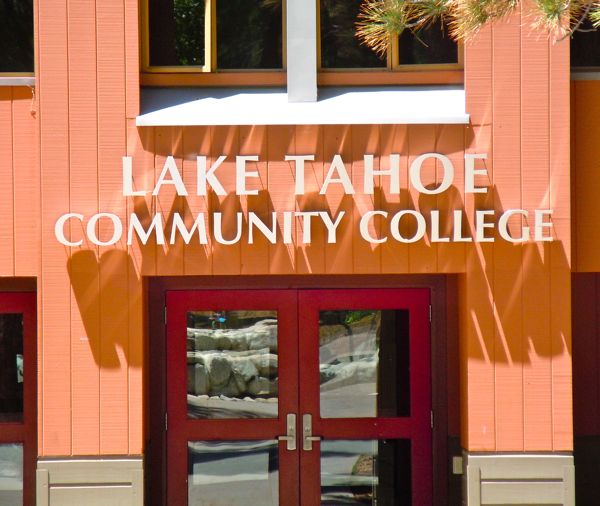
Lake Tahoe Community College has offered tennis classes for years, and will again this fall. It used to be taught at Tahoe Paradise Park, then South Tahoe Middle School and now at South Tahoe High School.

The college’s master plan includes courts, but last week they were stripped from the five-year facilities schedule because college President Kindred Murillo said there’s no way they’ll be built in that time span.

LTCC’s classes keep changing locations because the courts keep deteriorating to the point they are dangerous to play on.

The three courts at Tahoe Paradise Park near Meyers were locked because of the horrible condition they were in. Two have been resurfaced, but are sitting without paint and lines – therefore, unusable. The groundskeeper says expect them to be playable in September. Only two are being fixed; the other is left as an eyesore.

The four courts at South Tahoe Middle School are open to anyone, but a “use at your own risk” sign should be placed there because of the numerous cracks.

South Tahoe High School’s six courts were resurfaced as part of the Measure G bond that was passed by voters in 2008. The problem is accessibility.

The district wants to keep its $400,000 investment pristine, but that means a lock is on the courts when no one is there monitoring them. Skateboarder and cyclists are the users not wanted on the courts.

Justin Clark has the key. But it requires calling him ahead of time to open the courts or go during scheduled public time. For instance, Lake Tahoe News went to the courts on Wednesday at 1:30pm and found them locked, no one playing. The STHS court schedule does not favor the public when the high school tennis teams are not using them.

And the schedule is not posted on the courts – you’d have to read this story or have another connection to know the hours.

Clark is also LTCC’s tennis instructor. Plus, he runs a for-profit tennis academy at the courts.

“We are not getting money from him. He has to put money back into the facilities, like $3,000 worth of backboards that he paid for,” Lake Tahoe Unified School District Superintendent Jim Tarwater said of Clark.

Those backboards should be up by the end of the month, according to Clark.

People have been dismayed they have to pay to use the courts when in the past they have been free. People have been complaining to Lake Tahoe News that they don’t want to have to reserve a court, nor do they want to pay Clark.

To appease the general public, some of who are the taxpayers paying for the courts, the district is looking at putting in a card key for next summer. Rates have not been established, nor how it would work for the person just wanting to play once or twice.

This source of revenue for the district could then be used for future upkeep to the courts, and not go into an individual’s pocket – something people have concerns with.

Clark would like to turn the courts at STHS into what Douglas County has at Zephyr Cove Park. It costs to play at those six public courts, plus there is a ladder and other tennis events.

The Tahoe Tennis Classic was at Zephyr Cove earlier this month.

Other tournaments in the basin include the 30th annual Incline Open that was last weekend and the Northstar Tennis Open the weekend of Sept. 10-12.

Incline Village Tennis Center has 11 courts.

Northstar-at-Tahoe has for years been singled out in Tennis magazine as a place to travel to play tennis. It has 10 courts and tons of camps for all ages.

Granlibakken resort in Tahoe City has been home to the Nike tennis program for years.

Tahoe City Public Utility District Parks and Recreation runs public courts –eight of them.

The only covered court in the basin is at Ridge Tahoe on Upper Kingsbury Grade. To use it, you must be a guest or owner of a time-share.


Lack of money not stopping desire, regulations to improve Lake Tahoe’s famous clarity

By Kathryn Reed

HOMEWOOD – Money and cooperation were the overriding themes of the 15th annual Lake Tahoe Environmental Summit on Tuesday at Homewood Mountain Resort.

For the first time since then-President Bill Clinton started these summits, the governors of California and Nevada attended the event. But it was Sen. Dean Heller, R-Nev., who was the only speaker to have his speech interrupted by applause.

His desire to turn a greater amount of the regulatory control in the Lake Tahoe Basin over to the five counties and one city was met with strong approval by the few hundred people in attendance.

Govs. Brian Sandoval and Jerry Brown pledge to work together on Lake Tahoe issues. Photos/Kathryn Reed

Govs. Brian Sandoval and Jerry Brown pledge to work together on Lake Tahoe issues. Photos/Kathryn Reed

Heller and others spoke of the need for TRPA’s Regional Plan to meet its latest deadline of December 2012 for approval by the Governing Board.

A meeting on Monday between Govs. Jerry Brown and Brian Sandoval sparked a mutual desire to travel to each others respective capitals to further the dialog about Nevada Senate Bill 271 and getting the Tahoe Regional Planning Agency to function better.

(Sandoval and Heller are former TRPA board members.)

“We need a road map and certainty about what is going to happen at this lake,” Sen. Dianne Feinstein, D-Calif., said in reference to the need for the Regional Plan update’s completion.

Eye on sediment

While much was made of the need to reduce fine sediment from reaching the lake, the irony is all those people listening to the politicians on stage were sitting in fine sediment, stirring it up as they walked on the lower ski slope – which is on the other side of Highway 89 directly across from the very waters they are trying to protect.

At the summit, Brown and Sandoval, with Jared Blumenfeld, administrator for the EPA’s Pacific Southwest Region, signed the Total Maximum Daily Load document, which has a goal to substantially improve lake clarity.

The federally mandated and unfunded program says that in 65 years the white dinner plate-looking Secchi disc will be visible to a depth of 100 feet. Right now it can be seen at 64.4 feet.

In this year that saw the lake rise 3 feet from runoff, it declined in clarity by the same amount.

On the California side it’s Lahontan Regional Water Quality Control Board that oversees the TMDL, while it’s the Nevada Division of Environmental Protection on the other side of the lake.

“Ten years ago people thought Lake Tahoe’s loss of blue was because of algae. It’s about 25 percent of the problem,” Blumenfeld said. “The rest of the problem is sediment. Science has given us a road map. I like to call it a diet for Lake Tahoe.”

While Sandoval singled out the Sierra Colina project in Stateline being an example of a private entity working on eliminating 74 tons of sediment from reaching the lake each year via the project in and around Burke Creek, he skirted around the greater problem with that project in that it is held up in litigation.

Brown said, “The lake stands as a microcosm of the larger issues we face.”

He said it’s time builders and environmentalists get together to find a way to sustain the region economically and environmentally.

Where’s the money?

The problem is no one had definitive answers how to pay for that diet of reducing fine sediment reaching Lake Tahoe. Everyone talked about a greater need for cooperation, for there to be less reliance on the federal government, and a greater need for private entities to step forward.

One source of money will be the Tahoe Fund. A Monday night fundraising dinner brought in $200,000. While it’s a start, it’s a drop in the bucket – especially when one considers it costs nearly $2 million to build one mile of bike trail in the basin. And these trails are viewed as a means to reduce sediment by getting cars off the road.

Another $34 million from Southern Nevada Public Lands Management Act money has been allocated for Lake Tahoe. But that source is also drying up.

While $1.5 billion has been spent in the last 10 years on projects designed to improve lake clarity, where the money will come from in the future is an unknown.

The Lake Tahoe Restoration Act has not be reauthorized, though Sen. Harry Reid, D-Nev., is confident is will pass. He was confident last year, too, and Congress didn’t give the green light.

“We need to adapt to a new fiscal reality,” Feinstein said.

While that is true, no one is openly speaking about adapting to a possible new reality if Lake Tahoe’s clarity doesn’t improve and what that means for the eco-system as well as economy via tourists not wanting to see another brown lake.

ngg_shortcode_0_placeholder (Click on photos to enlarge.)


LTCC launches community ed with classes for athletes

By Kathryn Reed

Don’t be surprised if competitors in next month’s Iron Girl triathlon have better times than they did at the inaugural event in 2010.

This could happen because of three classes designed with the Sept. 18 South Lake Tahoe event in mind. The swim clinic, tri interval speed clinic, and tri circuit workshop are the first three classes offered through the resurrected Community Education program at Lake Tahoe Community College. They are geared toward improving performance.

ltccThey are three of the first four classes the college board of education has approved. It’s likely at most of their meetings going forward they will be asked to OK community ed classes. Ed code requires the board sign off on them.

Megan Waskiewicz, who works 20 hours a week coordinating the program, said having these types of classes to start the program fit with what survey takers said they want. Nearly 80 percent of the 100 respondents said health-fitness-wellness type classes are what they want.

A recent Lake Tahoe News “Question of the Week” also asked people what kinds of classes they would like.

The college also queried the 500 participants in this month’s Spanish Institute what they would take in the future. With many of them from out of town, this taps into the destination visitor.

Waskiewicz envisions weekend classes that could involve part or the whole family. It might involve cooking, hiking or both.

Culinary programs were high the list of desires in the community survey.

Next summer she wants swimming programs to be part of community ed. As a former employee in the local ski industry, she is ready to tap that area – perhaps a women’s ski class or something geared toward kids.

Community partnerships

Cynthea Preston, dean of Instruction at LTCC, told the board last week that Barton Health and Lake Tahoe Visitors Authority approached the college about putting on the three classes related to triathlon training.

“I would have liked it last year,” board member Karen Borges said. “My friends and I were saying if we get a flat, we’re done.”

She did the tri last year and welcomes a lesson in changing a flat tire as part of the Sept. 17 class.

This particular tri is geared toward newbies, with nearly 90 percent of the 600 registrants competing in their first triathlon.

The college’s website will have detailed information about the various classes, while clicking on tri classes brings up the PDF for those particular ones.

Barton has an internal boot camp that LTCC will be part of when it comes to instruction.

That is one of the unique things about community ed compared to the regular college – classes don’t have to be offered to everyone.

Nuts and bolts

Plus, grades are not involved. However, curriculum is written for each class.

This week the website will have an instructor proposal form added so anyone who wants to teach a class may fill that out. Then a committee will decide whether to pursue it.

Cost for classes and instructor pay will depend on what is being offered, the number of students, materials required and other factors.

For instance, the Aug. 20 and Aug. 27 tri classes are each $18, while the Sep. 17 tri circuit workshop is $35.

This compares to the three-day SAT prep class that runs $200, plus $25 for the text. That is the fourth class the community ed program is offering. Right now South Tahoe High doesn’t offer such a class, so the college is hoping the Sept. 11-18-25 sessions are well received. It’s being taught by Frances Lord, an LTCC instructor who has taught the subject elsewhere.

And the requirements to teach have nothing to do with what it takes to be a full-time or adjunct instructor.

“We have a lot of flexibility. Why not try some things that are different?” Waskiewicz said.


Keb Mo accentuates weekend get-away 4 miles from home

By Susan Wood

STATELINE – A relaxing weekend getaway featuring a Keb Mo concert, urban walk, jaunt to a new state park and pool time at the Forest Suites Resort proved there’s more than one way to enjoy the home we call Lake Tahoe.

“More than One Way Home” is but one track off Mo’s 1996 Grammy-award winning album “Just Like You” that the blues singer, guitarist and writer belted out Saturday night at Harrah’s Lake Tahoe South Shore Room. The artist, who started his career in a calypso band and is now known for his eclectic arrangements of blues, Delta rhythms, country and soul first played Tahoe almost a decade ago for the Harveys Outdoor Concert Series blues show. It was his first time to the lake.

Since then, Mo (Kevin Moore) has grown personally and professionally – with his own record label Yobelle International, a move to Nashville, a family and a new album released this month titled “The Reflection.”

Keb Mo delights a nearly sold-out South Shore Room at Harrah's Lake Tahoe on Aug. 13. Photos/Kathryn Reed

Keb Mo delights a nearly sold-out South Shore Room at Harrah's Lake Tahoe on Aug. 13. Photos/Kathryn Reed

With the opening number, an Eagles’ hit “One of these Nights,” the showroom’s capacity crowd whooped, screamed, danced and swayed in delight. But many of the dedicated also quietly and intently listened to his easy swings from the sexy blues to the sentimental – including one track off his new album called “We Don’t Need It.” The acoustic number told the story of a man fraught with concern over losing his job amid the expressed desires of his family. From that, his little girl in the song informed him:

“We don’t need it, we can do without it; We’re gonna make it, no doubt about it;

We’re gonna stick together, make it better; We don’t need it, all we need is you…”

The words and Mo’s stage presence seemed to catch his audience off-guard. They had been calling out songs for most of the two-hour show. But after this song, a hush came over the room. And at the last guitar strum, one man in the fourth row shook his head and said: “Awesome.” Tears welled up for some in the audience, as the hit-you-between-the-eyes lyrics were appropriate for our contemporary hard times.

Few artists can pull off those hard-to-sit-still tunes, yet captivate an audience with lyrics that matter. And the crowd responded – including Tom Conely of South Lake Tahoe (Captain Tom of KTHO), who patiently waited to get his daughter Kristin’s guitar signed by Mo. He obliged.

Dressed in his signature jeans, Fedora-like hat and Converse tennis shoes, Mo had come to please – especially the women in the audience. A few found it difficult to sit down, with one who showed up in front to sway to every note.

“Watch it now, girl,” Mo said, noticing the follower. “A party’s going on tonight,” he added, as he checked in with his audience.

He and his band consisting of drummer Les Falconer, bassist Vail Johnson, keyboardists, guitarists Michael Hicks and Jeff Paris along with the enthusiastic keyboardist, guitarist Kevin So cranked out the blues with energy and style. To appease one special request, Mo threw up some slack of his electric guitar cord and opened “Dangerous Mood” off his “Just Like You” album in front of the woman.

Mo has collaborated with many musicians including Bonnie Raitt and Jackson Brown on “Just Like You” and now “The Reflection” with jazz saxophonist Dave Koz, who has shown he can play with a variety of artists as seen during his “Friends” jazz show over Thanksgiving weekend at the Hyatt Regency in Incline Village.

Mo has also worked with television executives with “I See Love,” a song he wrote for the opening of the CBS series “Mike and Molly.”

“I’ll play the whole thing,” he promised, flashing his pearly whites.

It became obvious this band has fun – finding the perfect rhythm for “The Door,” the title track off his 2000 album and the lively rhythm and blues tune “Gimme What You Got” off the same album and the angst filled “Perpetual Blues Machine” off the “Just Like You” CD and hopping “She Just Wants to Dance” from his 1994 album.

He rotated his albums like his handful of guitars, returning to the stage for three encore songs including the slide-guitar Delta blues track off “Just Like You” — “Standing at the Station.” He ended with the soul-searching number off his so-named 1994 album “City Boy,” who is looking for a home where the buffalo roam.

Home is where the heart, mind, soul or appetite is

The Keb Mo show was the highlight of a weekend away from our South Lake Tahoe house on the Y side of town. I don’t have buffalo roaming as Mo described in his quest for South Dakota, but the occasional wildlife is often joined by the interruptions of the day. The phone rings. The hot tub needs cleaning. The stove needs tending. You know the drill.

That’s why the Forest Suites Resort nestled in the pine trees at the corner of Montreal Road and Heavenly Village Way near the state line summoned the perfect, quiet blend of scenery, amenities and comfort with location, location, location.

The place may often get overlooked in the search for rooms at Stateline, given Harrah’s, Harveys, Embassy Suites and other notable properties along Highway 50. But what it lacks in recognition it makes up for in serenity and options of what to do from there.

For those who like to splurge, the Black Diamond suite – which starts at $299 a night — is situated alongside Bellamy Court where the city parking garage sits. Traffic is next to nil, allowing light sleepers to snooze all through the night and even get up late as we proved we could do. Even in the heart of the day, it’s quiet – including on the patio steps away at the swimming pool and hot tub with the Heavenly Gondola cars going by overhead. Another pool and hot tub are located on the opposite side of the 5.5-acre landscaped property. But we enjoyed the closeness of our set next to the suites.

The pool is small-to-moderate sized – but I had no intention of swimming laps. We spent hours reading. For a little action, the core of the Village Center is a three-minute walk. A longer jaunt for shopping or people watching may include a wide swing to the highway to the Heavenly Village, which has been recently bustling with summer pedestrian traffic. In front, the Stateline Brewery sets up a day-and-evening bar and mini restaurant outside. We opted to continue to Embassy Suites’ “Upper Deck” restaurant where the seating and service are better than the nachos and musical act.

Hunger pangs for Italian food can best be served with a short drive down Nevada’s Loop Road to the highway east of Lakeside Inn and Casino to Lanza’s. The menu is vast for meat eaters and better-than-usual for vegetarians on the South Shore. I had the baked penne. Kae ordered the Portobello mushroom ravioli, which I liked better. The restaurant offered a worthwhile wine special, a bottle of Chianti Classico from Straccali of Tuscany. This $20 selection went well with the weekend’s reading from that region of Italy.

And on foot from the Forest Suites, a gondola ticket opens up a whole different type of terrain for hiking beyond the Von Schmidt flats on the ridge around Heavenly’s Tamarack chairlift. Climbing up to East Peak is a favorite for those wanting to stray from the urban life.

But besides going to a concert at Harveys or Harrah’s on a one-way, 7-minute walk, the Forest Suites Resort’s claim to fame should be its proximity to another best kept secret – the first bi-state park in the United States. Van Sickle Bi-state Park opened less than a month ago, just across Montreal Road – literally steps away – from the resort. This day-use urban park’s bang-for-the-buck views will give it instant known value when it catches on. So says Brian Smalkoski of Minnesota. He was waiting for his wife to finish her spa treatment and stumbled across the sign driving by with his two youngsters, 2-year-old Alex and 4-year-old Chaz. They found much joy doing a little rock scrambling on the boulders Nevada State Parks had placed there.

“What better way to kill time than to bring them to a park?” Smalkoski asked.

Back at our forest, Forest Suites, down time was appreciated. Inside the room, the décor was spacious, stylish and comfortable, with a big chair and cozy sofa situated in front of a large flat screen television and gas fireplace. The same duo is on the other side in the master bedroom. I remember thinking this room would be grand during ski season – especially with a Jacuzzi tub to warm up in and a full dining room table and kitchen complete with microwave, stove, oven and refrigerator if going out seems out of the question.

Two notes of improvement – Internet service inside the suite is sketchy at best and the grassy greenbelts scream lawn chairs to lounge in.

Also on the grounds, amenities are rounded out with a small gym, massage unit and game room with Foosball and pool tables above the lobby. Off to the side of the lobby, a wedding chapel sits, which according to staff, sees a steady business for those who want to tie the knot. And for groups who want to unwind, Al’s Saloon opens up for private parties. Forest Suites offers a Champagne and roses package with all the wedding touches.

The privately-owned 119-room resort hosted a family reunion last weekend, along with a stage crew from Another Planet, the production company that puts on the Harveys outdoor concerts.

Standard rooms start at $129 during a summer special period.

If you go:

Forest Suites is located on Lake Parkway (Loop Road) behind Embassy Suites Resort. Reservations may be made by calling 800.822.5950 or (530) 541.6655. For more information, email info@forestsuites.com or go online.

ngg_shortcode_1_placeholder (Click on photos to enlarge.)


Wildflowers a bonus treat on hike to Dardanelles Lake

By Kathryn Reed

Pretty face, cow parsnips, California valerian, forget-me-nots, lupine, columbine, Indian paintbrush, larkspur, groundsel – these are just some of the flowers flourishing in a kaleidoscope of color along the trail to Dardanelles Lake.

It’s helpful to have someone on the trail telling you what you’re looking at instead of just saying – ooh, look at that pretty red or yellow or purple flower. They actually have names besides colors.

This splash of color was an added bonus to the hike Sue and I took my mom on two weeks ago. I don’t often think of this trail as a wildflower destination, but instead I like it for the magical alpine lake at the end of the 3.5 miles.

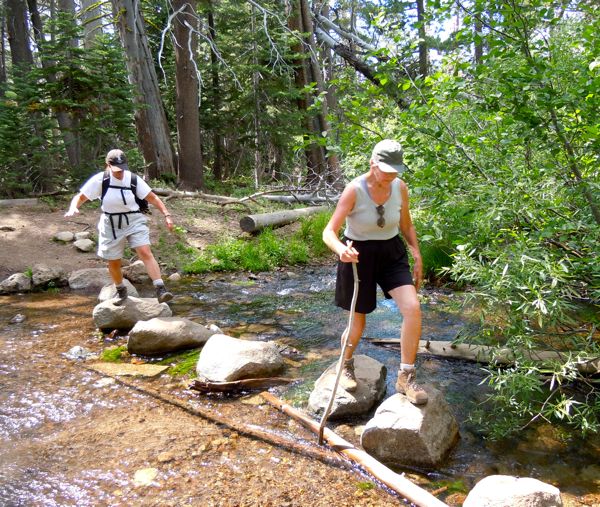
Sue Wood and Cleo Reed cross a stream on hike to Dardanelles Lake. Photos/Kathryn Reed

Sue Wood and Cleo Reed cross a stream on a hike to Dardanelles Lake. Photos/Kathryn Reed

With the abundance of moisture this season, not only are the flowers prolific, so are the mosquitoes. Even with bug juice, we had plenty of souvenirs to itch.

Another consequence of the snowfall and water is the bridge leading into Big Meadow has collapsed. While the water was still tumbling over it on the last Saturday of July, it was crossable without getting wet.

But that’s not the only water crossing. Fairly stable rocks have been strategically placed in other sections to make stream crossings do-able.

It was magical on this particular Saturday to see the array of wildflowers. Some are so tiny, some are like groundcover, while others go above my knees. I just want to pick them to have for a bouquet – but instead I take their pictures.

We pause to marvel at their beauty. But soon we are hitting ourselves to swat at the skeeters.

Big Meadow is so aptly named. The tall grasses make me channel Julie Andrews – but I don’t sing out loud. The hills really do seem alive, though.

We carry on. After all, the meadow is just the beginning.

Plenty of shade covers the trail – which is welcome. Mostly it’s dirt at a moderate climb. We start at 7,200 feet, with the maximum elevation being 7,760 feet.

The worst part of the hike is leaving the lake. It’s a good descent at the end to Dardanelles Lake, so climbing out is no fun. We certainly didn’t appreciate the downhill enough since we were whining going out.

Oh, but that lake. It shimmers in a way that it looks like it is dancing. Granite walls line one side. People are swimming to rocks; others wade closer to the shore.

I think cold water is for drinking, not dipping into. After all, snow dots the far shore as well as the peaks.

Flat granite provides an ideal spot for lunch. While there are several people doing the same, we still have our own spot in the Sierra.

Color on this trail is not limited to the wildflowers. In the fall, the aspens come alive in their array of yellows and oranges.

Getting there:

From South Lake Tahoe, go west on Highway 50.

Pass the bug station, then turn left onto Highway 89. Before reaching the summit of Luther Pass, Big Meadow trailhead parking is on the left. Park.

Follow the trail from the lot that crosses the highway. You passed the trailhead marker on Highway 89 on your right.

Follow the signs to Dardanelles Lake. Signage is good for the most part. But about a quarter mile from the sign that has you go right, you need to make a sharp left. The trail is obvious, but it also goes straight – so it’s not obvious turning left leads to Dardanelles.

Part of this is the Tahoe Rim Trail.

The route is 7 miles roundtrip. The U.S. Forest Service rates it as moderate. My 76-year-old mom says it’s a wee bit more than moderate.

ngg_shortcode_2_placeholder (Click on photos to enlarge.)


Lake Tahoe’s famed clarity getting substantially murkier

By Katherine E. Hill

Lake Tahoe’s world-renowned water clarity dropped 3.7 feet in 2010 from 68.1 feet to 64.4 feet, the second-lowest clarity level ever recorded.

The drop in clarity is the result of climate change and increased algae growth, according to the UC Davis Tahoe Environmental Research Center in the annual State of the Lake Report released Friday.

Lake Tahoe’s famed clarity can increase or decrease based on any number of factors such as fine articles, algae growth, sediment runoff, snowmelt and others. Researchers say the decrease between 2009 and 2010 in clarity is the result of climate change that may have allowed for the growth of a tiny, free-floating algae named Cyclotella. These tiny algae, which proliferate in warmer temperatures, have grown significantly in recent years.

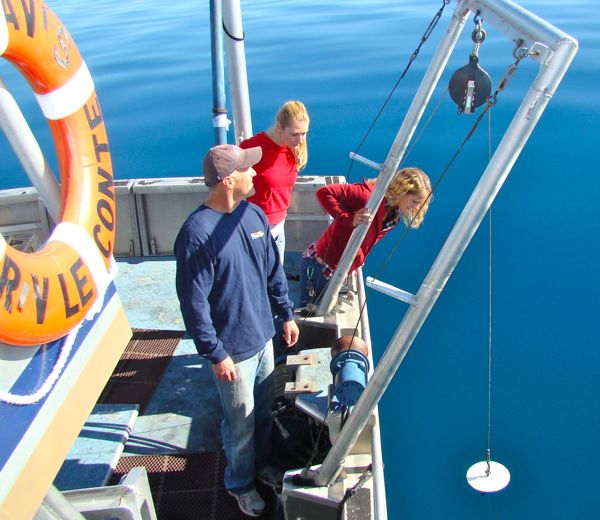
The Secchi disc is lowered into Lake Tahoe for one several readings. Photo/Katherine E. Hill

The Secchi disc is lowered into Lake Tahoe for one of several readings. Photos/TERC

“This year, in particular, these single-cell algae were concentrated very close to the surface, strongly scattering light and thereby impacting lake clarity,” said John Reuter, associate director of TERC in a release about the decline in clarity.

The State of the Lake report also calls for continued joint efforts by California and Nevada to manage the health of Lake Tahoe. The Nevada Legislature passed a bill in June to pull out of the Tahoe Regional Planning Agency Compact by 2015 unless the Regional Plan is amended.

“While land use activities, resource management activities and policy can be controlled to conform to geopolitical boundaries, the waters of Lake Tahoe are not constrained by these human boundaries,” the report states. “What happens in the waters of Lake Tahoe is a direct reflection of activities in both states. If a concrete example of why Lake Tahoe needs to be managed jointly by the two states is needed, then this is one.”

Optimism despite decline

The clarity report also reports a trend in increased clarity during the winter months, with decreased clarity occurring during the warmer, summer months. Researchers stated in the report that improvements in winter clarity measurements may be due to recent efforts to reduce urban stormwater flows, but that those gains are being lost in the summer, which sees higher than normal temperatures due to climate change.

“There is every reason to believe that if it were not for the decades of watershed management, development policy and water quality restoration projects, the lake’s transparency would be worse than it is today,” Geoffrey Schladow, TERC’s director, said in the release.

Despite the drop in clarity, researchers remain positive about the overall health of the lake. The lake clarity chart shows the measurement through the years.

“Taken alone, that decline in clarity is unusual, but it is within the range of normal fluctuations,” Schladow said.

For the first time, researchers also have gleaned a bigger picture of Lake Tahoe’s clarity using remote sensing to record data from around the lake. Most notable in the remote sensing findings is that clarity on the East Shore is lower than the West Shore for most of the year, according to the report. As well, clarity generally improves 1 mile off the shoreline than at points closer to the shore.

How clarity is defined

Lake clarity is measured by several scientific means, but it has been continuously measured since 1968 using a Secchi disc, a 10-inch white disc that is lowered into Lake Tahoe throughout the year to come up with a yearly average. The Secchi measurements are the longest continuous measure of Lake Tahoe’s water clarity.

The Secchi disc was developed in 1865 for use by ships to measure the depths of harbors, but has been used in modern times to measure the clarity of water.

The Secchi disc is the main means to measuring lake clarity. Photo/Provided

The Secchi disc is the main means to measuring lake clarity.

The Secchi disc measurements are taken by researchers every 10 days at solar noon at the same two locations – off the Tahoe City shelf and off Homewood toward the middle of the lake, according to Heather Segale, TERC’s Education and Outreach director.

The disc is lowered from the boat by a metered wheel and the researcher marks the point on the wheel at which the disc disappears from view, Segale explained, and then marks the point at which the disc reappears as it is raised. The distance between these two points is averaged for the day’s reading.

Since the researchers rely on their eyesight to mark the points at which the disc disappears and reappears, they are required to have their eyesight checked regularly, cannot wear sunglasses, and measurements are performed only during smooth waters, according to Segale. The annual clarity measurement is an average of about 20 to 25 measurements; about 10 are thrown out due to anomalies such as inclement weather, wind and other factors.

While the Secchi disc measurements represent the longest study of the lake’s clarity, researchers also rely on other measurements to gauge clarity. Researchers use several high-tech instruments mounted on a Seabird profiler: a transmissometer that measures how much light of a certain wavelength is received over a fix path; an optical backscatter sensor that measures how much light from a LED is scattered backward by particles; a photosynthetically active radiation sensor that measures solar radiation; and a turbiditimeter that measures the cloudiness of water.

In addition to the annual clarity report, the State of the Lake report also addresses efforts to control aquatic invasive species, such as the Asian clam that were first reported in Lake Tahoe in 2002. The report also addresses the impact of climate change on precipitation, changes in the lake’s water temperature and effect of lake warming on circulation.

To view the report, go online.


Tahoe Fund aims to be conduit to bring cash to basin

By Katherine E. Hill

The nonprofit Tahoe Fund will announce funding for its first basin project at a fundraising dinner on Lake Tahoe’s West Shore next week. The Tahoe Fund, formed about a year ago, plans to raise much-needed funds for projects in the Lake Tahoe Basin identified by TRPA’s environmental improvement program that would otherwise go unfunded.

The Tahoe Fund’s kick-off dinner at West Shore Café will feature guests of honor Sen. Dianne Feinstein, D-Calif., and her husband Rick Blum, one of the original contributors who sparked the formation of the fund, said board chairwoman Cindy Gustafson, who is general manager of the Tahoe City Public Utility District.

The idea behind the Tahoe Fund was to look at the basin as a whole and identify projects that need funding and then work to raise those funds, Gustafson said.

The Tahoe Fund is designed to bring money to the basin for environmental and recreation projects. Photo/LTN file

Tahoe Fund is designed to bring money to the basin for environmental and recreation projects. Photo/LTN file

“There’s the Tahoe Rim Trail Association fund raising for the Tahoe Rim Trail, and there’s SWEP (Sierra Water Education Partnerships) raising funds for education projects in schools, but there’s not one doing a broader spectrum for the TRPA’s EIP,” Gustafson said.

The EIP, or environmental improvement program, was formed following the 1997 Presidential Forum that brought a renewed commitment to preserving Lake Tahoe’s ecosystem. EIP projects target watersheds, forestation, air quality, transportation, recreation and much more through a $2.45 billion plan to protect Lake Tahoe, but much of the projects lack the funding to make them a reality. The Tahoe Fund’s goal is become that funding partner, Gustafson says.

“We thought a nonprofit focused on those sort of projects would resonate with donors, with locals, and with foundations that would fund a nonprofit, but not a government agency,” she said. “We could be the intermediary to donate to large projects.”

Projects targeted by the Tahoe Fund will come from three areas: conservation, recreation and environmental education/stewardship, which could translate to projects like bike trails, interpretive programs, lakeside parks and restoration work. The fund will not perform any of the work on the projects, rather it will raise funds to pay for the projects through private donations, grant writing and other fundraising methods.

“People want to fund something that they can see and touch and feel,” Gustafson said about the types of projects the Fund will target.

The board was already identified a laundry list of projects in its Project Portfolio that lack the necessary funding. The portfolio, which can be found online, includes basinwide projects such as restoration work in Glenbrook; boat parking and accessibility work at Sand Harbor; Lake Tahoe bike projects around the lake; an ADA-accessible path and fishing platform at Spooner Lake; interpretive signage; a Tahoe Atlas that will be a collection of scientific information; Upper Truckee River and Incline Creek restoration; Tahoe Rim Trial projects; and much more.

The first projects identified for initial funding will be announced at the Aug. 15 $300-per-plate dinner.

Gustafson credits the idea behind the Tahoe Fund to Patrick Wright, executive director of the California Tahoe Conservancy and a board member of the fund. His idea was to form a “sister nonprofit group” to a government agency, in this case the Tahoe Regional Planning Agency, to fund projects in the basin. The Tahoe Fund is modeled after similar nonprofits like The Yosemite Fund.

“When I first arrived in the basin about five years ago, it struck me that the Conservancy didn’t have a nonprofit partner,” Wright said, citing similar nonprofit partnerships with Yosemite and Golden Gate national parks. “I said let’s see if we can pull something together in the basin.

“The Tahoe Fund can focus on a broad range of conservation and recreation projects,” Wright said. “There’s been a tremendous interest and people are attracted to on-the-ground projects. We’re going to focus on projects that are ready to go, that are visible and that have support … projects that people can use and enjoy.”

Years of discussions about a way to see basinwide projects funded led to a meeting about a year ago that became the kick off for the Tahoe Fund with a significant contribution from Blum, and a challenge from Feinstein to “provide her with the private part to partner with the federal agency to fund these projects,” Gustafson said.

The first year has been focused on logistics, Gustafson said, with the naming of the board, which includes many high-profile Tahoe residents and second homeowners, business people and conservationists, along with significant fundraising and identifying projects for the fund’s initial funding cycling.

The 17-member board of directors includes many high-profile board members, but Gustafson stresses that its draws from a broad spectrum of the community.

“The board has both private individuals, private business people, as well as public officials, conservationist and environmentalists … we’re trying to balance the board,” she said. The board also includes second homeowners and people with public policy background.

Among the board members are Allen Biaggi, the immediate past chair of the TRPA Governing Board; Art Chapman, president of JMA Ventures, which owns Alpine and Homewood ski areas; Jim Boyd, who serves on the California Energy Commission; Blaise Carrig, co-president of Vail Resorts, which owns Heavenly and Northstar-at-Tahoe; entrepreneurs Dan Eaton and Roger Wittenberg; Jim Lawrence, administrator of the Nevada Division of State Lands; Andy Wirth, CEO of Squaw Valley; and environmentalists Cory Ritchie and Trish Ronald, among others.

The fund has been in a major fundraising drive since May, Gustafson said, and the board hopes to close its Founders’ Circle campaign by the end of the year. And, with donations from board members and a grant from the California Tahoe Conservancy, the Fund should have operating expenses for the next two to four years, which will then allow them to focus on funding projects in the basin. The Tahoe Fund currently has a few part-time staff members and hopes to eventually add full-time staff, but the goal is to keep overhead low, Gustafson said.

Lake Tahoe Summit

The Tahoe Fund also is the organizing sponsor the 15th Annual Tahoe Summit on Aug. 16 hosted by Feinstein at Homewood Mountain Resort from 9 to 11:30am. California Gov. Jerry Brown and Nevada Gov. Brian Sandoval are expected to attend this year’s summit; the first time governors from both states have attended since 1997. Along with Feinstein, speakers will likely include Sens. Harry Reid, D-Nev., and Dean Heller, R-Nev., as well as other federal, state and local officials.

The theme of this year’s Tahoe Summit is “Stewardship and Sustainability in Challenging Fiscal Times.” Family oriented activities including a youth art contest and interactive displays will take place at the summit. The summit is free to attend and is open to the public.