Sierra Colina housing project prevails in court over League

By Kathryn Reed

Just more than two years to the date of filing a lawsuit to stop the 18-acre Sierra Colina project in Stateline from progressing, the League to Save Lake Tahoe lost its battle.

The winners are Steve Kenninger and Gail Jaquish who own the property and want to develop it, as well as TRPA.

The League had sued the Tahoe Regional Planning Agency – citing transfer of land coverage as its main issue.

Sierra Colina in Stateline won in court on Aug. 30.

Sierra Colina, outlined in orange, in Stateline won in court on Aug. 30.

U.S. District Judge Robert Jones in Reno on Tuesday ruled in TRPA and Sierra Colina’s favor.

“Judge Robert C. Jones’ decision heralds a significant victory by allowing responsible development which invigorates the economy and creates jobs to advance in the Lake Tahoe Basin without frivolous lawsuits tying up environmentally beneficial projects,” Kenninger said in a statement.

Rochelle Nason, executive director of the League, did not respond to a request for comment.

“We were confident throughout the whole process that the Governing Board made the right decision with the approval of the Sierra Colina project,” Julie Regan, spokeswoman for TRPA, told Lake Tahoe News.

The board approved the project in summer 2009.

Regan elaborated that the bi-state regulatory agency is extremely pleased the judge cited the numerous environmental benefits of the project in his 25-page decision.

The decision released Aug. 30, came 29 days after both sides gave testimony. At that time the judge wondered why the lawsuit was filed. Jones in his ruling cites much of what the final environmental impact statement says in terms of quantities of pollutants that will no longer enter Lake Tahoe if the project is completed, how the project goes beyond the environmental requirements, how bike-pedestrian trails will be improved, and the reduction of disturbances in stream environmental zones.

“The court spent a great deal of time walking through the various environmental benefits of the project and that was a factor in the decision,” Regan said.

Kenninger and Jaquish did not wait for the judge’s decision to begin environmental improvements. Work on Burke Creek is under way.

With the Lake Tahoe Basin having a limited time frame when dirt can be moved – May 1-Oct. 15 – the soonest ground could be broken is next year because building permits still need to be secured and the economy needs to help indicate when would be the time to build.

When built, Sierra Colina will include 41 market rate dwellings and nine moderate-income deed restricted places. Forty-two units will be in 21 townhouse-style duplexes, with eight being single-family homes.

The goal is to be the first neighborhood in the basin to have all units meet state of the art green sustainability criteria.

Here is the court ruling.


Sheriff’s volunteers add manpower to streets of El Dorado County

By Kathryn Reed

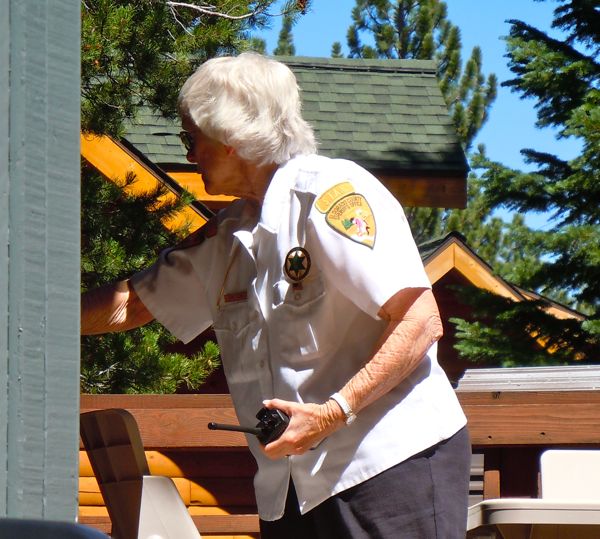
Walking around the house they look to see if the doors and windows are secure – that no one, not even a bear – has broken in.

It’s all part of the job – these checks on homes where people are on vacation or the house is for sale. (It’s free for the homeowner.)

Dick and Joan Young are two of the 20-member Sheriff’s Team of Active Retirees. They don’t carry guns. A radio is their biggest weapon, so to speak. Had there been something amiss at this house off North Upper Truckee they would have radioed it into dispatch so a deputy could take over.

“STARs are our eyes and ears. They are not our hands and feet,” is how El Dorado County sheriff’s Lt. Les Lovell puts it. “It’s a volunteer program to assist the sheriff’s office with providing services to the community.”

Joan Young checks to on a house to make sure it is secure. Photos/Kathryn Reed

Joan Young checks on a house to make sure it is secure. Photos/Kathryn Reed

Although the program started in 1994, the Youngs have been doing it for a handful of years, with Dick starting first.

Two people always are in the vehicle at the same time – acting as partners for each other like sworn officers do.

They put in about 16 hours a month. This particular Thursday the South Lake Tahoe couple is on a four-hour patrol shift. Another team had taken a morning shift.

No two days are alike – just like with sworn personnel. They might be asked to take a vehicle to Placerville or a local shop for repairs. Perhaps it’s another sort of delivery between the offices.

Lovell says the STAR volunteers allow deputies to be patrolling the streets – doing more critical law enforcement work.

While some might say STAR volunteers do the more mundane things in terms of all the duties involved in operating a sheriff’s department, there is excitement.

A few years ago when a man put a gun to his head in the middle of Riverside Avenue it was STAR volunteers who put their vehicle in the middle of traffic to stop people from getting closer.

Traffic patrol is a big thing for these volunteers. They helped out during the Angora Fire of 2007, too.

No one tells them where they have to go unless there is an emergency. The Youngs have been called up to the parking lot at Vikingsholm to clear the lot so a helicopter on a search and rescue mission could land there.

Most people, though, have probably seen these men and women at special events. They had a booth at the air show Aug. 27 at Lake Tahoe Airport in addition to being responsible for parking cars.

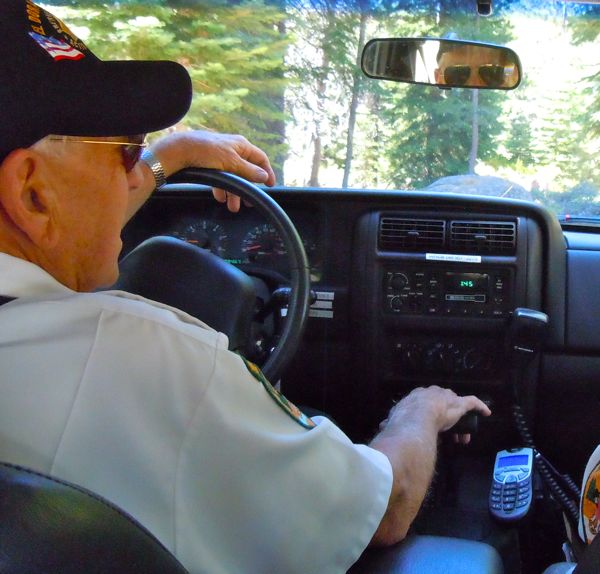
Dick Young drives through El Dorado County looking for possible trouble.

Dick Young drives through El Dorado County looking for possible trouble.

Before the air show this year the hours STAR volunteers in the basin have put in are:

• Administration-reception – 135

• Patrolling – 1,060.5

• Station meetings – 294.5

• Cape Program – 56

• Special Events – 254

Total hours – 1,800.

Special events they help with run the gamut from providing overnight security for the Fine Arts Festival to working on the Drug Store Project to being at veterans events to providing security on Election Day.

Dick Young said it’s never boring; just some days are slower than others.

His wife likes being able to drive around to parts of the county she wouldn’t otherwise see.

On this day they drive through the North Upper Truckee area to Tahoe Mountain Road, around Angora Highlands, down to Fallen Leaf Road and into two U.S. Forest Service operated beaches.

They notice traffic has slowed and the beaches are less crowded. So many schools are back in session.

But with Lake Tahoe Unified students returning to school this week it will mean being visible around bus routes. STAR volunteers take down the license plate numbers of drivers not obeying the flashing red lights or speed limits in school zones.

While no law enforcement background is needed to be a STAR, they take on the traits of seasoned officers.

“The one thing I’ve learned is you do a lot of looking,” Dick Young said. “You pick up on things that are not in order, like a window that is broken out.”

To be a STAR volunteer you must be at least 50 years old and not be a felon. Then you must go to a two-week STAR academy that is about four hours a day, five days week. For more information, call Sgt. Pete Van Arnum at (530) 573.3002.


Free energy audit provides tips for saving money

By Kathryn Reed

I need to use less energy. Well, I don’t, but our house should be using less.

That was the conclusion by Sten Seemann after he performed an energy audit last week.

“You do pretty good in the summer, but in the winter you almost use twice as much energy. We are going to see why,” he said.

Sten Seemann checks to see the type of bulbs in this fixture. Photos/Kathryn Reed

Sten Seemann checks to see the type of bulbs in this fixture. Photos/Kathryn Reed

Seemann through his company Sierra Energy and Water Conservation is a subcontractor for Liberty Energy. The utility, which took over Nevada Energy’s California customers this year, does the energy audits for free.

Armed with our past bills supplied by Liberty Energy he was able to see how our electricity usage changed from month to month over a few years.

February was higher this year than last. I’m thinking we had company and the outside temps dropped. I don’t really know.

Part of the summer-winter difference is lifestyle – more lights on for longer in the winter, the furnace hums, increase in TV watching, more people visiting, more cooking (oven especially).

But the big energy culprit, according to Seemann, is the hot tub being set at 102 degrees all the time – or hotter in winter. He suggested putting in a timer to reduce the temp overnight when no one is in it. I have a call into Hot Springs Spas who we got it from to see if this is possible and what the cost would be.

When it comes to hot tubs in the winter it takes more energy to heat them because the outside air is so dang cold in South Lake Tahoe.

Another biggie is to get more insulation. Looking in the attic – Seemann did this, I’ve never done it – was not good. We have about R-12 insulation. Code is R-38. Such are the hazards of a house built in 1965 and knowing we’ve added zero insulation in the eight years we’ve lived in it.

Seemann recommended getting quotes from Gale Insulation and Meeks for insulation. In an email he sent the night of the audit he said to do so before November.

That’s one of the nice things about the audit, Seemann follows it up with an email with the suggestions he said verbally and then some additional comments.

Even though the audit is painless and takes an hour or so, the problem is remembering all the information that is dispensed. That is why the follow-up email is nice to receive.

Window and door insulation inspections are part of energy audit by Sten Seemann.

Window and door insulation inspections are part of the energy audit by Sten Seemann.

Education is a big component of what Seemann does. Nothing he suggests has to be done. No “energy police” are going to come see if you took him up on his recommendations.

“Liberty Energy is obligated by the regulator, California Public Utility Commission, to offer energy efficiency programs so that customers can choose to exercise options to lower the commodity costs on their electric utility bills,” Bob Dodds, president of Liberty Energy, told Lake Tahoe News. “This does result in less money in the company’s pocket but that is offset by the lower amounts of electricity the company needs to purchase for distribution. In the long term, lower electricity use by customers reduces the need for continuing investment in facilities for the generation, transmission and distribution of electricity which ultimately lowers impacts on rates and the environment.”

Most of our light bulbs were CFLs, so we were ahead of the curve on that. I hesitated when Seemann wanted to put a CFL in the fixture over the kitchen table. We had done so a couple times with each one burning out rapidly. The older CFLs burned out faster if turned off and on a lot. I relented, but I kept the energy-hog old one just in case.

Seemann’s philosophy is that it’s better to throw out an old working bulb than to throw away money. In other words, don’t wait until the energy-inefficient bulbs die before replacing them.

Seemann also put in a low-flow showerhead. I had the most consternation about this change. I have a thing for hot showers with good pressure. I’ll write in the dark on my laptop battery without using electricity before I give up my daily hot, hot, hot shower.

So far, so good with the showerhead.

And on top of that, the bulbs and showerhead were free.

While Liberty Energy doesn’t supply our water, the energy audit touches on water and gas usage, too.

To schedule a free energy audit through Liberty Energy, call 800.782.2506. They are running a bit behind on appointments. It was in June at the North Lake Tahoe Chamber of Commerce Business Expo that I learned about the audits. It took two months to get a call — so be patient.


Heavenly Mountain proves it’s not just a one-season resort

By Kathryn Reed

I kept feeling like I was going backward even though I wasn’t. And I was a bit disoriented, not to mention I felt small.

Such are the hazards of hiking up Skyline Trail at Heavenly Mountain Resort in the summer. Going to the top of Sky Chair via foot instead of the lift means going in the opposite direction I normally ski the trail. I knew where I was (because I could see Lake Tahoe), but at the same time I felt like I didn’t know where I was. And the signs everywhere – they are so tall when there aren’t several feet of snow on the ground. I had to crane my neck to read them – making me feel super short.

Heavenly has opened more hiking trails that are easily accessed from the gondola in the village near Stateline.

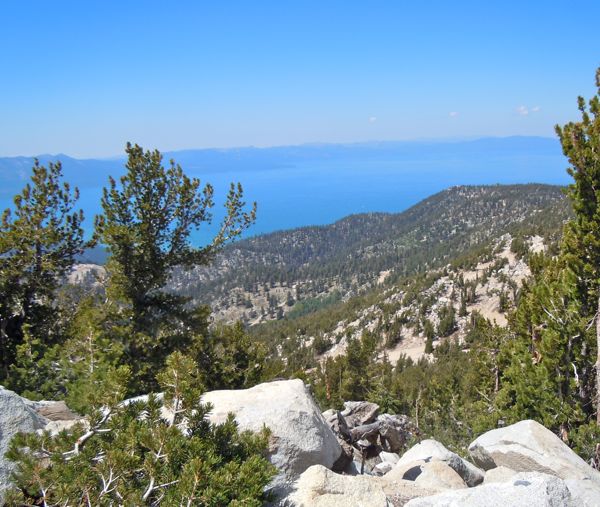
Hiking at Heavenly provides stunning views of the Lake Tahoe Basin. Photos/Kathryn Reed

Hiking at Heavenly provides stunning views of the Lake Tahoe Basin. Photos/Kathryn Reed

I never get tired of that ride.

If only the windows let in more air. It was a bit stifling last weekend. I understand all the precautions to prevent people from flicking a cigarette out so there isn’t a repeat of 2002 when more than 600 acres burned because of a smoker on the gondola, but it was uncomfortable.

When I’m skiing I don’t take the time to get out at the midway station. But on this leisurely Saturday it was great to see that 360-degree view of the Lake Tahoe Basin from 9,123 feet. Signs point to the various sites – Emerald Bay, Cave Rock, Mount Tallac.

It’s like a kids’ playground at the top – and not just little kids.

Christine and Daniel Rock barely had time to answer a couple questions before dashing off to take the conveyer belt to the top of the tubing hill. This is what the Bay Area resident wanted to do to celebrate her 53rd birthday.

Instead of snow, the hill looks more like artificial turf. A Heavenly employee said this is just the second hill like this in the world.

For Susy Corriea, she was enjoying sitting in the shade watching her 10-year-old son, Brayden, scamper up the climbing wall.

Plenty of people were parked in the Adirondack chairs in front of the Tamarack Lodge that opened last ski season. It allows the resort to have a year-round on-mountain dining facility.

Before we kickback in one of the chairs we take the Tamarack Lift ($8).

While we knew we wanted to follow the map we had gotten in village that said we could hike to the top of Sky Express, for those who didn’t think about it or are not familiar with ski areas, they would be apt to follow the “ski” sign for Sky Express. That takes people to the “lift line” – not the top.

In other words, better signage for hikers is needed.

This 1.92-mile roundtrip is listed as “most difficult” by Heavenly because of its steepness. I’d say anyone who is used to this elevation and who is in good shape can make it without difficulty.

Of course, the end of the trail is at 10,040 feet. Bring water. The trail is exposed.

The nice thing about it in summer is it’s not crowded with people stopping at the gorgeous views of Lake Tahoe and the surrounding area. I’ll admit, though, I stopped more on that hike to gaze and take photos than I do in an entire ski season.

It’s always so weird to see a ski resort without snow – to know in three months I could be skiing above those rocks and logs; to know that dirt trail will be a wall of white.

More information about the Heavenly Gondola is online. Various ticket prices exist. And the activities at the top are individually priced.

ngg_shortcode_0_placeholder (Click on photos to enlarge.)


Department responsible for S. Tahoe’s finances stays intact

By Kathryn Reed

While employees keep dropping off the payroll in South Lake Tahoe, and even more layoff notices are expected next month, the finance department has for the most part remained fully staffed.

In fact, while other departments are asked to do more with fewer employees, this department hires temporary workers. This is at a time when there are fewer paychecks and other money related items needing processing, and the fiscal projections from this department are regularly off the mark or not fully accounted for.

Admittedly, no one has a crystal ball to know what the future holds, but South Lake Tahoe’s finance experts in the last handful of years projected increases in revenue from hotel and property taxes – at a time when everyone said the country was in a recession. Those projections were wrong. Those are two of the three main revenue sources for the city.

And the director of the department, Christine Vuletich,was told by City Manager Tony O’Rourke to put the potential $1.8 million loss from redevelopment into the budget – something she had kept out until recently. It makes the city’s deficit headed into 2011-12, which starts Oct. 1, $5.2 million instead of $3.4 million.

Christine Vuletich

Christine Vuletich

Each year the city’s general fund is supplemented with redevelopment money, which is really the TOT collected in those areas. The hotel tax is higher in the redevelopment areas than the rest of the city. Tax increment is not enough to pay all of the millions of dollars in redevelopment debt the city has incurred, and therefore TOT is used for debt, too.

Here are the dollar amounts that have been transferred from the Redevelopment Agency (which is governed by the council members) to the general fund:

• Fiscal year 07 — $338,000

• Fiscal year 08 — $457,000

• Fiscal year 09 — $834,000

• Fiscal year 10 — $834,000

• Fiscal year 11– $1.3 million.

Another $500,000 each of those years has gone from RDA to the general fund to pay back the $7.2 million that was “borrowed” to pay for the Heavenly Village and parking garage projects.

Until the state makes a ruling in January about the future of redevelopment agency’s the city is not voting on what to do with its agency.

Other TOT issues

This also is the department that is accused of letting transient occupancy tax dollars go uncollected.

Councilman Tom Davis at the Aug. 23 meeting asked Vuletich what is going on with the annually unpaid $500,000 in TOT from private vacation rental owners. Instead of answering the question, Vuletich at first got defensive and argued the amount, not the fact the city is not being paid what it is owed.

The half-million dollar figure is what property management companies have told city officials is not being paid.

Even Lake Tahoe News last September was able to uncover nearly $1,000 in TOT not being paid by B Gorman, executive director of Lake Tahoe South Shore Chamber of Commerce.

Vuletich told the council that last week she met with vacation rental owners and the police chief.

“We have a joint effort under way to address that issue and that will be pretty effective,” she told the council. Specifics were not divulged.

After the meeting Lake Tahoe News asked her if she thought people were deliberately not paying the tax or if they did not know they had to. She wouldn’t venture a guess.

Finance department staffing

Vuletich’s salary was increased in March when airport and parking came under her leadership. This was at the same time staff was laid off.

She is the lone director remaining from the Dave Jinkens eight-year reign as city manager. O’Rourke defends Vuletich – saying she is competent and does a good job.

While O’Rourke when he was hired a year ago said the first budget produced with him at the helm would be easy to read and ready early, insiders say it won’t happen. Clearly, it is not early. The budget will be before the council for a vote 18 days before it takes effect. It will be released at least a few days before the Sept. 13 meeting, so readability can be judged then.

While Vuletich has more in her pocket, her employees keep being spared.

In the 2006-07, 2007-08, 2008-09 budgets the finance department had 14.5 full-time equivalent positions. The amended 2009-10 budget brought this number to 13.73. The current budget is back up to 14 FTE.

When it comes to defending her hires, Vuletich emailed Lake Tahoe News saying how other departments also use temps – like the police department for the boat patrol (though she failed to mention their salaries don’t come from the general fund), stormwater for an environmental analyst (often paid for by grants), and parks and rec summer employees (whose wages are less than the fees they collect).

The finance department uses a temporary accounting technician to process business licenses. Their fee is expected to be $7,000, according to Vuletich.

“The total temporary labor expense in the Revenue Division is expected to be approximately $30,930 at fiscal year-end and is a combination of the former temporary full-time Technician ($23,930) and the current seasonal temporary Technician costs ($7,000),” Vuletich wrote LTN. “Accounting Division: Temporary Budget Analyst hired work on budget preparation and analysis during the budget preparation period. The cost has been $5,725.50 so far through July 31st and have $23,000 budgeted for the 10-11 fiscal year, but expect to be paying for approximately 5 more weeks for a total of $10,725. All temporary labor expenses in the Finance Department have been eliminated for next fiscal year 2011-12.”


Fallen Leaf Lake and its people come to life in book

By Linda Fine Conaboy

With each book I read about Lake Tahoe and its early settlers, I am reminded that this lovely region isn’t made up of just a few parts: Lake Tahoe, Fallen Leaf Lake, Desolation Wilderness and all the bodies of water there, Glen Alpine Springs, Mt. Tallac, Homewood, Freel Peak, Emerald Bay and so many more intriguing places. It’s all intertwined and the early tales let us know that the sum of these parts made, and even now if you look at the whole scheme of things, still makes a perfect whole.

Janet Beales Kaidantzis, in her just-published book “Fallen Leaf: A Lake and its People 1850-1950,” presents this beautifully. And she was wise enough to enlist the memories of Bill and Barbara Craven, among others, who, after many years at Fallen Leaf Lake still reside there.

In his forward, Bill Craven says: “Fallen Leaf Lake’s happiest years occurred during the one-hundred-year period of this book. For most of that time, the Lake was unknown and sparsely populated. It took great effort to get here; those who made the trip were hardy types who appreciated nature and simple living.”

Amen.

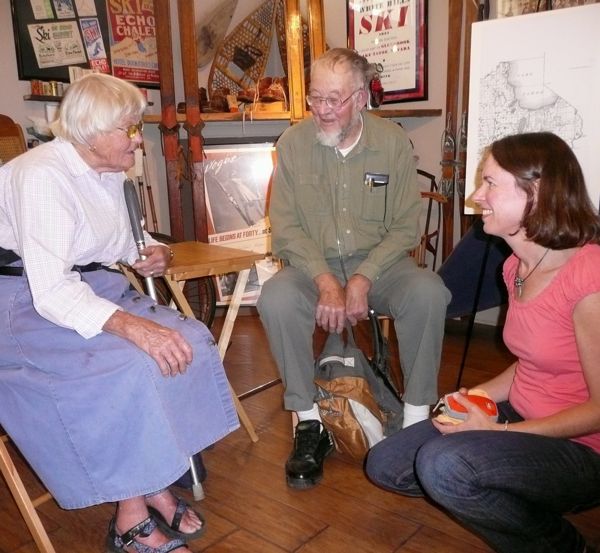
Barbara and Bill Craven with Janet Kaidantzis at the Lake Tahoe Historical Society book signing. Photo/Tom Beales

Barbara and Bill Craven with Janet Kaidantzis at the Lake Tahoe Historical Society book signing. Photo/Tom Beales

As I read this book, I wondered, how did they do that, those early settlers? And where did they get the pluck, the resolve to make a life there? And best yet, from Kaidantzis’ viewpoint, it seems they actually had a good time mucking out a life in some incredibly harsh conditions.

During a recent book signing at Lake Tahoe Museum, I had the good fortune to interview Kaidantzis and the Cravens. Kaidantzis’ family goes back five generations to her great-grandpa Arthur Steadman, who helped subdivide a tract of land on the east side of Fallen Leaf Lake in 1925.

“He built a cabin and that cabin has been cherished and passed down from year-to-year,” Kaidantzis said. “We go every summer and winter. In the old days we cross-country skied; I was brought up there as a baby.”

Kaidantzis said her grandparents met at Fallen Leaf, as did her parents, Tom and Marcia Steadman Beales. Additionally, her father’s parents honeymooned at the lake; in the mid-40s, Bill Craven met his future wife, Barbara Granger, at Fallen Leaf.

A book’s beginnings

“This book started as a family project,” Kaidantzis said. “It started when I wrote an essay for my mom’s birthday about our experiences at Fallen Leaf, starting in 1925, and the history of our cabin.”

That’s all it took. Kaidantzis was hooked; there was more to be said. When she finished the essay and realized all that remained to explore, her enthusiasm and motivation for the project spurred her to write more expansively.

“I wanted to share with a wider audience so I spoke to everyone I knew at Fallen Leaf — the old-timers.” She said the support she received from the Lake Tahoe Historical Society was invaluable as was the information she gleaned from Tahoe Heritage Foundation.

Bill Craven, who was a good knowledge source for the book and the grandson of Bertha and William W. Price, founders of Fallen Leaf Lodge, is an authority on all things Fallen Leaf. It doesn’t hurt that he isn’t stingy with his knowledge. Bill and Barbara managed the lodge from 1972 to 1985.book

The book begins with Fallen Leaf Lake’s earliest inhabitants — the Washoe people, who also maintained summer camps at Taylor Creek, Camp Richardson and Glen Alpine Springs. In fact, history shows the Washoe inhabited these areas as many as 10,000 years ago.

Their seasonally adjusted lives continued until just beyond living memory, Kaidantzis reports, which is a good way of saying some of the old-timers at the lake still recall “a small group of Washoe women, children and elderly men camped for the summer in the 1930s between Glen Alpine Creek and the shoreline.”

Fallen Leaf’s vibrant settlers

Bill Craven recalls in the book that his grandparents, William and Bertha Price, employed Washoe women and men at Fallen Leaf Lodge.

From the discovery of Fallen Leaf Lake by Col. John Calhoun Johnson and his Delaware Indian guide, Capt. Falleaf sometime between 1850 and 1858, to the discovery of Glen Alpine Springs by Nathan Gilmore the history is nicely detailed and obviously carefully researched.

Kaidantzis reports in depth on the often-heated rivalry between Lucky Baldwin and Gilmore, a feud lasting until Gilmore’s death. She details not only Gilmore’s vast influence on the area as well as those of the colorful, if not always honorable, Baldwin and his legacy of wild exploits.

She includes Lucky’s daughter, Anita, and her impact on Fallen Leaf, including the rise and fall of her estate on the lake’s west shore. Under the provisions of the property’s transfer to the U.S. Forest Service, Anita’s home and most of the outbuildings comprising the estate were demolished in 1953.

Craven, during my interview, said the Anita Baldwin house, which she named Nid Ji Eh Wa Ri (a Hopi Indian word meaning “House on the Lake”), would have made a memorable museum. If you’re up for an easy hike along Fallen Leaf’s west side, not far from the lake’s damn at Taylor Creek, you’ll come across the foundation of Anita’s home and one or two of the outbuildings. It’s worth the walk, and if you sit for awhile on the old foundation, you may find yourself imagining what life was like for a woman of privilege at Fallen Leaf Lake.

There are chapters on John Steinbeck’s sojourn at Fallen Leaf; a nice overview of Glen Alpine Springs; Angora Lakes Resort and the fire lookout at Angora Ridge; Camp Richardson and its founder Alonzo Richardson, as well as several of the other early inhabitants, all of whom made their mark on this area.

Read the book as you would a novel, but watch out, tomorrow you’ll find yourself hiking to Glen Alpine Springs (a tough trek), or at least making the trip on the once oiled, now paved, but always breathtaking road into the lake and its environs.

Oh, and don’t forget to visit the little chapel constructed by William Price and described by Kaidantzis in Chapter 10. He named it for the patron saint of wild birds and animals, Saint Francis of the Mountains. It’s a fitting place to contemplate Fallen Leaf Lake and the folks who left their marks here.

The book

“Fallen Leaf: A Lake and its People 1850-1950” sells for $18.50 plus tax and is available at Lake Tahoe Historical Society and Museum. It can also be purchased at the Fallen Leaf store, Angora Lakes Resort store, the Baldwin Museum store at Tallac Estates, the USFS Visitor’s Center at Taylor Creek and the LTBMU office in South Lake Tahoe, and online.


S. Tahoe air show to introduce budding pilots to the sky

By Kathryn Reed

Soaring through the air at eye level with the mountains. Lake Tahoe seems so much bigger from the sky, the boats so much smaller. All those trees. The Lake Tahoe Basin really is a forest and not a concrete jungle.

For youths ages 8 to 17 they get to experience this for free on Sunday as part of the annual Young Eagles program. The catch is they must attend Saturday’s air show at Lake Tahoe Airport to sign up.

“This is to expose the younger generation to all facets of aviation,” explained Michael Golden, who runs Mountain West Aviation at the South Shore airport.

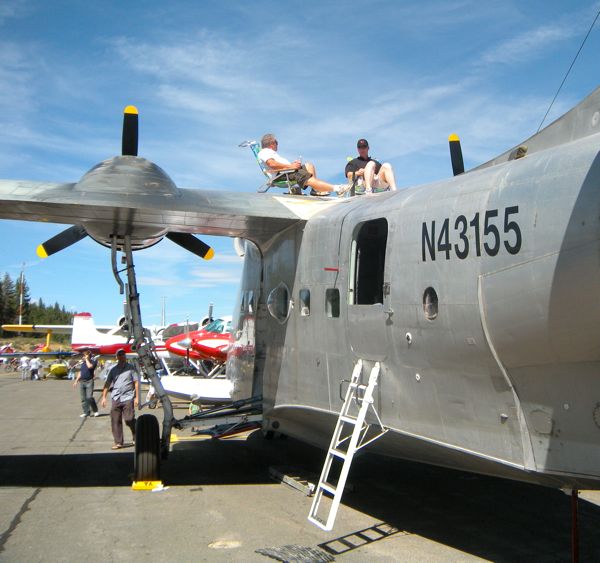
Expect all sorts of planes flying on Aug. 27 and even more on the tarmac at Lake Tahoe Aiport. Photo/LTN file

Expect all sorts of planes flying on Aug. 27 and even more on the tarmac at Lake Tahoe Aiport. Photo/LTN file

He is also one of the pilots who donates his time and plane to take kids in the air. Most flights are about 20 minutes – going from the airport, over the casino corridor, to Cave Rock, before turning around and following the shoreline back to the airport.

“Some have never been in a plane before, so it’s really an experience for them,” Golden said.

Many of the planes are single engine, with some pilots having a twin engine.

Sometimes a youngster even gets to take over the controls to get the feel for what it’s like to be a pilot and not just a passenger.

Young Eagles started in 1992 as a way to introduce young people to aviation. Each year it seems more critical because the number of people wanting to become pilots is dwindling. And this comes at a time when the demand is increasing.

In June, USA Today reported, “After nearly a four-year drought of job openings, the airline industry is on the brink of what’s predicted to be the biggest surge in pilot hiring in history. Aircraft maker Boeing has forecast a need for 466,650 more commercial pilots by 2029 — an average of 23,300 new pilots a year. Nearly 40 percent of the openings will be to meet the soaring travel market in the Asia-Pacific region, Boeing predicts, but more than 97,000 will be in North America.”

The Aircraft Owners and Pilots Association reported a high of 827,000 pilots in the United States in 1980, while in 2009 there were 594,285.

Besides the lack of desire to get in the cockpit, the number of flight schools in the U.S. and Canada went from about 2,400 to 1,700 after Sept. 11, 2001. Though, the FAA reports the number of student pilots was dropping before then, with 129,000 in the system in 1990 and 72,000 students in 2009.

Air show

This marks the 22nd year for the Lake in the Sky air show at the South Lake Tahoe airport. Each year it’s a little different depending on what planes are available and who is in the sky doing acrobatic maneuvers.

“You are going to see a lot of newer general aviation aircraft and lot of military transport aircraft,” Golden said of the Aug. 27 event. “An Air Force C5 Galaxy will be doing an aerial fly-by over the airport. This thing is gigantic.”

Part of the opening ceremonies is having the plane fly close to the ground more than once.

Golden said another change is more demonstrations this year.

It costs $5 per person or $15 per car to attend the air show.

More information about Young Eagles is online.

The schedule for Saturday’s air show is also online.


Measure S bonds to be resold to accommodate South Lake Tahoe ice rink privatization

By Kathryn Reed

Measure S bonds are going from tax-exempt status to taxable. At least that is what South Lake Tahoe wants done with them.

But the city is just one-third of the equation. The joint powers authority that oversees the voter approved recreation measure must vote on the change for it to go forward. It’s not known if the El Dorado County Board of Supervisors and Tahoe Paradise Park board as the other members of the JPA need to individually agree to the change.

“I don’t know enough of the details to be able to comment on it,” El Dorado Supervisor Norma Santiago told Lake Tahoe News on Tuesday night. She is also chairwoman of the JPA.

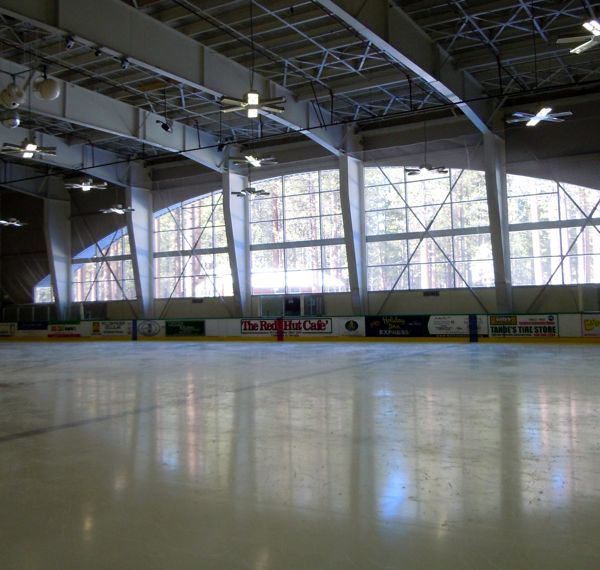
ice rink

Private operators are about to benefit from a taxpayer funded ice rink in South Lake Tahoe. Photo/LTN file

She said she plans to talk to Councilwoman Claire Fortier at today’s TRPA meeting – they are Governing Board members – to find out what is going on.

What is going on is the city needs to change the bonds to accommodate the IRS when it comes to having a private operator who wants to make a profit run the city-owned ice rink.

The status quo could prevail if the operators didn’t intend to make money – some to be reinvested in the property and some for themselves.

The issue is that ice rink was built with Measure S money.

The bond money is one big pot – same with the debt, according to JPA administrator John Upton. It’s not like the ice rink is paid for or has a precise number of dollars still owed. In total about $4.5 million is still outstanding, though a payment of about $140,000 on the principal is slated for Sept. 1.

IRS rules state private entities cannot make money off tax-exempt bonds. When Measure S was approved by voters who encompass the same boundaries of Lake Tahoe Unified School District it was envisioned the ice rink would always be run by South Lake Tahoe.

With the rink losing more than $100,000 a year, the City Council on July 12 voted to turn the operation over to Tahoe Sports Entertainment.  At that time it was not known the bond structure would be an issue.

At the Aug. 23 council meeting the five, with little discussion, agreed to go forward with changing the bonds.

City Attorney Patrick Enright told Lake Tahoe News after the meeting there is no downside in doing this, especially with interest rates so low.

Taxpayers will not see any changes to their $18 annual assessment on their property tax bill.

Upton, the lone paid staff member to the recreation JPA, said Tuesday night, if the debt payment schedule is higher than it is now, the city would incur those costs.

What happens is the current bondholders will be paid back. To do so prior to Sept. 1, 2012, there is a $37,500 penalty. This could be absorbed with the refinancing, according to Upton, or could be paid by the city.

Then new bonds are sold for the outstanding amount.

In the interim, an addendum to the agreement between the city and Tahoe Sports Entertainment that was sealed Aug. 23 calls for the latter to be able to take over the rink operations by the end of the week. The IRS grants a waiver that is good for 50 days.

Upton said all of the likely changes pose no threat to Measure R; the Nov. 8 ballot proposal that would redefine how the recreation funds can be spent.

In other action at the Aug. 23 council meeting:

• After much back and forth, on a 3-2 vote the ordinance governing medical marijuana dispensaries passed the first reading. Councilmembers Bruce Grego and Angela Swanson were the dissenters. It comes back for a final vote Sept. 13, with it taking effect one month after that.

On a side note, it was disclosed that no one has applied for a residential grow permit – which is necessary to have starting in December.

El Dorado County is investigating creating an ordinance that mirrors South Lake Tahoe’s.

• It was agreed a letter would be written in support of bringing the Tour de California cycling event back to the South Shore in 2012. Tour officials are expected to name host cities in October.

• Wood Rodgers Inc. is not going to receive $67,000 for work done because the council is fed up with bills presented after the fact and not being notified by staff of overcharges by contractors or professional service providers.


Mandatory boat inspections to expand to Truckee area

By Katherine E. Hill

TRUCKEE – Truckee-area waterways will implement a regional mandatory boat inspection program in summer 2012, with public meetings being conducted to gather input before the program is crafted by the Tahoe Resource Conservation District.

The next meeting will be Aug. 25 at the Truckee Donner Public Utility District office at 5:30pm. The final meeting will be on Sept. 29.

The first meeting on July 28 drew only about a dozen people, and the majority were local officials already invested in the boat inspection program. Tahoe RCD, which also manages the inspection program on Lake Tahoe and Echo and Fallen Leaf lakes for the Tahoe Regional Planning Agency, is developing the Truckee regional program. The Truckee program will include Donner Lake, and Prosser Creek, Boca and Stampede reservoirs. The Tahoe RCD is conducting voluntary inspections at these waterways, but mandatory inspections are needed to keep invasive species, like the destructive quagga and zebra mussels, out of local lakes and reservoirs, officials say.
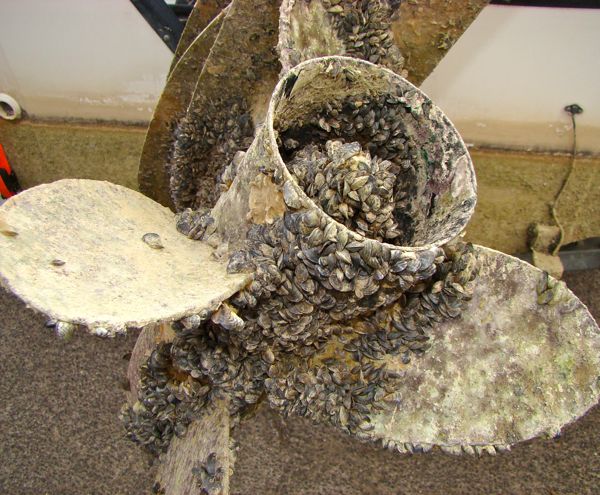
Quagga mussels like these on a boat prop leaving Lake Mead are what officials want to keep out of uncontaminated lakes. Photo/TRPA

Quagga mussels like these on a boat prop leaving Lake Mead are what officials want to keep out of uncontaminated lakes. Photo/TRPA

“The zebra and quagga mussels are the scariest of the invasive species,” said Kimberly Boyd, Tahoe RCD invasive species program manager, at the July 28 forum.

Zebra and quagga mussels would be the priority for the boat inspection program, but the program also would address other aquatic invasive species such as New Zealand mudsnails, Asian clams and Eurasian milfoil. While mussels have not been detected in local waterways, Eurasian milfoil is in Lake Tahoe, Martis Creek Reservoir and the Truckee River, and Asian clams have been found in Lake Tahoe and Donner Lake, said Dave Roberts, Tahoe RCD district manager.

Tahoe RCD officials said during the forum that the need to keep aquatic invasive species out of local waterways is broad reaching. AIS affect the food supply of native species and the health of local waterways, including Lake Tahoe’s famed clarity. For the Truckee region, AIS in local waterways also will affect the water supply for the Reno-Sparks area, which gets 80 percent of its drinking water from the Truckee River. While the river originates in Lake Tahoe, Donner, Boca, Prosser Creek, Stampede, Martis Creek and Independence Lake are all part of the river’s watershed. Any AIS in local waterways will mean infected drinking water supplies.

Locals will be the most affected by the mandatory program, as about 55 percent of boaters using the waters within the Truckee River watershed also live within it, according to a survey conducted by UNR, for the Tahoe RCD. Of those boaters, about 61 percent are anglers and 17 percent are water skiers and wake boarders.

No fees were discussed at the meeting. Fees will depend on how the program is crafted and any outside funding sources that could be used to offset the cost to boaters, Boyd said.
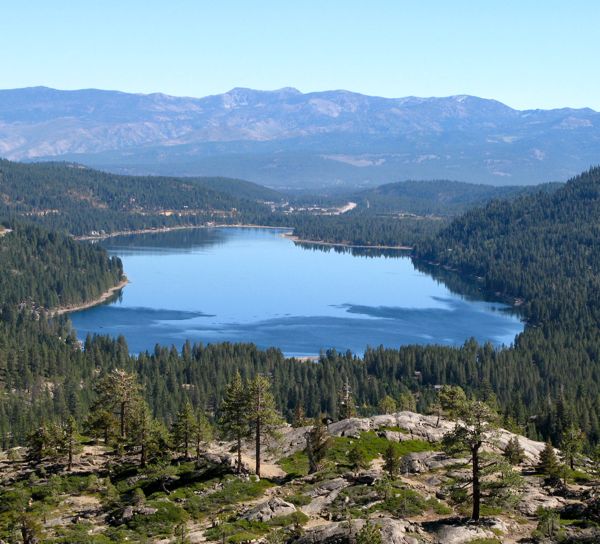
Mandatory boat inspections may be coming to Donner Lake in 2012. Photo/Katherine E. Hill

Mandatory boat inspections are coming to Donner Lake in 2012. Photo/Katherine E. Hill

Boaters can now found inspectors at the Donner Lake boat launch, as well as roving the east side of Boca and Stampede Reservoirs educating boaters about AIS and conducting voluntary inspections through Sept. 30. Free decontaminations also are offered.

The challenge, once a mandatory inspection program is in place, will be where to have them. Unlike Donner Lake, which has only one public boat launch, boaters using local reservoirs can launch from the shore. Officials will be looking at where to conduct the inspections next summer to catch all boaters, with the Hirshdale exit off Interstate 80 cited as one possible location.

“The Truckee area has enormous shoreline launching with uncontrolled launch sites,” Boyd said.

The public forum, which lasted about 1½ hours, focused on educating the audience about AIS, the voluntary inspection program and boating in the Truckee region. What it did not do is outline a mandatory boat inspection program. Instead, officials want the public to tell them what a boat program should include and then the Tahoe RCD will craft a program around those needs.

The Tahoe RCD wants public input on the use of a banding and/or sticker program like the one being used at Lake Tahoe, where boaters receive a sticker after passing an inspection before launching and the boats are banded to the trailer when it comes out of the lake. The seal is required to remain intact before the next launch, or an inspection must be performed again.

Other topics open for discussion include possible locations for inspection stations, fines for non-compliance, restricting access to local waterways, decontamination of infected boats, inspections of fishing equipment, education and outreach, and fees.

Once the forums are finished, Boyd said the Tahoe RCD would form a plan and then seek funding to operate the mandatory inspection program. The district also would have to get approval from myriad public agencies that control the different waterways, like the Nevada County Board of Supervisors, Town of Truckee, California State Parks, U.S. Forest Service and others. This process could take months, she said, noting that it would be next summer before a mandatory program could be implemented.

The Truckee River Fund has been funding the voluntary boat inspection program, as well as efforts to establish a mandatory program. The fund was established by the Truckee Meadows Water Authority, which oversees the drinking water for the Reno-Sparks area.

A look at AIS

Quagga and zebra mussels are at the center of Lake Tahoe’s inspection program.

These mussels, which are hitching rides on boats and trailers and in ballast tanks, bladders and live wells, are spreading across the West. Quagga and zebra mussels will spread rapidly once they are introduced to a lake and will gorge on the food supply, kill fish and pollute the clarity of the lake. They will clog cooling system water intakes, causing motors to overheat. As well, they have been found in pipes in municipal water systems.

The mussels can also be found on kayaks, water toys, wetsuits and any equipment exposed to infected waters.

Young quagga mussels will feel like sandpaper to the touch, while adults usually have dark concentric rings on the shell. The mussels can grow up to 1.6 inches, making the young mussels hard to spot. Full grown mussels are usually smaller than a quarter.

Eurasian milfoil, a fast-growing invasive plant, is believed to have been intentionally introduced in the

Milfoil is throughout the Tahoe Keys. Photo/TRPA

Milfoil is throughout the Tahoe Keys. Photo/TRPA

South Lake Tahoe area, where it has proliferated. The milfoil is commonly found in aquariums and researchers believe that someone dumped out a fish tank into Lake Tahoe, thereby setting off an environmental nightmare. Simply breaking off a plant fragment will cause it to spread and reproduce, and it is choking parts of Lake Tahoe, including the Tahoe Keys, where the milfoil has to be regularly removed to keep the waterway clear. The plants latch onto motor boats, causing it to spread across the lake, where it degrades water quality, decreases oxygen levels in the water, destroys native habitat and creates habitat for non-native species. Researchers are working on methods to eradicate the milfoil in Lake Tahoe.

Asian clams grow to only about 1½ inches, but rapidly reproduce and compete with native species for food. The clams also affect the clarity of Lake Tahoe. The clams likely arrived in Lake Tahoe on boat that came from infected waterways and from aquariums being dumped into Lake Tahoe. Researchers are working on methods to eradicate the clams in Lake Tahoe.

New Zealand mudsnails are about the size of a pencil lead when fully grown and are hard to spot. The mudsnails have been infesting rivers and streams across the Western United States, often found latching onto the gear and boots of fishermen; they can be hard to distinguish from boot laces. The mudsnails reduce the food supply for trout and have no natural predators in the United States.

Next meeting

Tahoe RCD will conduct the Aug. 25 public forum at the Truckee Donner Public Utility District office, 11570 Donner Pass Road, Truckee. For more information, go online or call (530) 587.4911.



Lambert dazzles Lake Tahoe audience with energetic show

By Susan Wood

STATELINE – With singer, guitarist Miranda Lambert in the house, many could argue the Harveys outdoor concert stage was built for her the way she twirled, strutted, danced, rocked and sang her heart out for a capacity Lake Tahoe crowd Friday night.

The Texas native’s energetic performance never wavered – except to slow down for “The House That Built Me,” her poignant No. 1 hit about a country star returning to her childhood home to get grounded after living in the fast-paced music world. The ballad off her current and third album “Revolution” spent four weeks at the top of the Billboard charts. At one point, she tested the audience by holding out the microphone. Many mouthed the words while video images in the background showed her childhood.

The lyrics: “I bet you didn’t know; underneath that live oak; My favorite dog is buried in the yard,” captures a touching song with meaning and soul that earned her a Grammy award for best female country vocal performance.

Miranda Lambert seldom stopped moving throughout her Aug. 19 show at Harveys in Stateline. Photos/Kathryn Reed

Miranda Lambert seldom stopped moving throughout her Aug. 19 show at Harveys in Stateline. Photos/Kathryn Reed

Music of heart and soul are as much about Lambert as her spiritual roots and dedication to her 4-month-old wedding vows, which she demonstrated with a duo with her country music star husband, Blake Shelton. The audience screamed as the couple performed “Who are You When I’m Not Looking.” The song provides a no-holds-barred view of a relationship that’s more realistic than a fairy tale – as in slamming doors or “eating a box of chocolates because you’re feeling bad.”

“How ‘bout that little surprise?” she asked the grateful audience after the two kissed and he exited. The famous Shelton-Lambert duo has collaborated before. This includes their work on Michael Buble’s touching hit song “Home,” which was also written for those seeking their roots.

Lambert appeared to feel right at home in Tahoe from the very beginning. In her last appearance, she opened for Kenny Chesney, and for Toby Keith before that.

“How’s Tahoe?” Lambert yelled out, before the featured act tipped her hat to her opening band Little Big Town. Before Lambert even arrived, the Grammy-nominated singing quartet provided a rousing performance with a country version of Lady Gaga, Nashville-inspired bluegrass and a tribute to being in a band with late-night waffle house trips for hash browns that are “Scattered, Smothered and Covered.”

Lambert related to those country roots – including an admission to being “one of those redneck chicks.” Country music star Gretchen Wilson’s ears must have been burning.

“This is for all the small town people in the house,” she said to introduce her “Revolution” tune “Famous in a Small Town.” A signed flashed Stateline’s population.

The audience was engaged most of the time through the concert. Most listened and even raised their glasses when she noted to the delight of living “now only two miles” from being able to buy beer in Oklahoma. In Texas where she was raised, beer was 30 miles away – inspiring the song “Dry Town” off her first album “Crazy Ex-Girlfriend.”

The show offered a unique blend of country music with a rock-style sound such as the on-stage rendition of “Dead Flowers,” her major hit “That’s the Way the World Goes ‘Round” and country music award-winning “White Liar,” all off her latest “Revolution” album. Her lively dancing and guitar playing resembled a country version of Melissa Etheridge. She even gave tribute to Joan Jett, with a stirring version of “I Love Rock and Roll.”

Her personable side and appreciation for her fans came out when she signed autographs in the middle of a set. For the encore, she gave a nod to her opening band — having been there not long ago – by bringing up Little Big Town to sing John Fogerty’s smash hit “Traveling Band.”

While Lambert’s Revolution Continues tour moved on to Southern California, the shows from producers Another Planet rock on next month with Sammy Hagar for the Stateline’s outdoor concert series final summer concert.

To make a weekend out of one of the concerts, check out this story.

ngg_shortcode_1_placeholder (Click on photos to enlarge.)