S. Tahoe council asks for help if workers want to keep jobs

By Kathryn Reed

After nearly three hours, the South Lake Tahoe City Council turned the budget discussion on the nearly 200 people who attended the special meeting Thursday night.

Councilman Bruce Grego led the charge, with his colleagues falling in behind, when he asked where those in attendance have been before last night. Then asking them to suggest solutions for closing the $5.2 million gap. Asking them to do more than say they are good workers or retirees, and that they should keep their jobs, salaries and benefits. The offer was put to the community at-large as well.
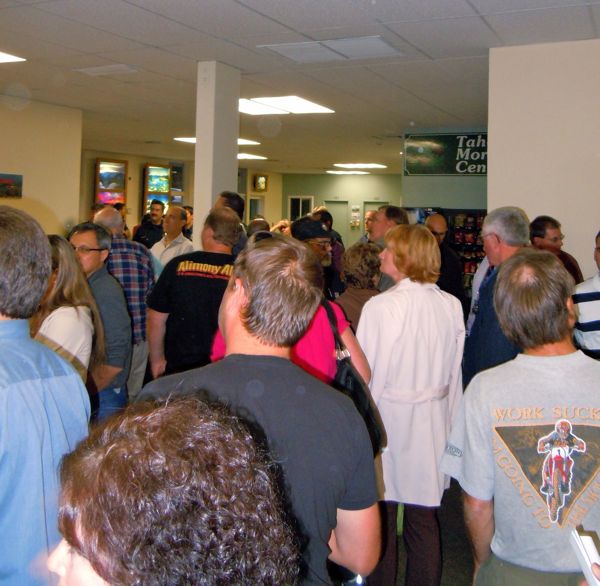
The overflow crows at the Sept. 15 council meeting is directed to the TV in the lobby. Photos/Kathryn Reed

The overflow crowd at the Sept. 15 council meeting is directed to the TV in the lobby. Photos/Kathryn Reed

With the 2011-12 budget taking effect Oct. 1, the council unanimously agreed to meet again Sept. 27 at 6pm, with a vote expected that night. Between now and then council members want ideas for how to solve the problem, not reasons why not to do something. However, it would be a serious violation for a represented employee to engage a councilperson in a discussion about salaries, benefits or work conditions.

This extension also allows the city to continue negotiating with its seven bargaining units and come up with solutions that would alter the budget proposal as presented. While the council met in closed session before the budget meeting started at 7:15pm, no reportable action on the labor negotiations was taken.

Revenue discussion

Grego, showing his frustration, said the council put a measure on the ballot two years ago to raise the business license fee, which would have mostly increased the rate on larger businesses, and the town voted it down.

With the hotel occupancy rate at 23 percent, City Manger Tony O’Rourke said now is not the time to raise the transient occupancy tax when rooms already are empty.

One person who spoke to Lake Tahoe News said she tried to offer O’Rourke ideas but was shunned. She’s going to take her thoughts to the council in private.

At the meeting, Robert Stiles with Tahoe Real Estate Services, suggested raising the vacation rental home fee from $144 a year to $250 to raise about $130,000.

Steve Crouch, who represents the General-Public Works association, said lower the reserves to less than 25 percent, don’t spend money on frivolous items like $9,000 to decorate a Christmas tree or $50,000 on GPS tracking devices for snowplow drivers.

Rob Swain, who runs the senior center, said, “There are lots of assets. Things could be explored. We could get creative and have lots better results.”

This longtime employee ran the ice rink before it was turned over to a private operation last month.

He did not present any ideas at the Sept. 15 meeting, but instead spoke in platitudes.

Councilman Tom Davis is most concerned about the projected revenue in the budget. He echoed Stiles’ comment that forecasting an increase in property taxes of about 1.5 percent could backfire. Property taxes are the city’s largest source of income.

What’s on the table

The elimination of 22 jobs is likely if concessions are not made by the employee groups regarding benefits. Who exactly they are is not definitive until either a labor contract is renegotiated or the deadline arrives for the council to pass a budget – which must be balanced per state law. Even then, employee bumping rights make for the fallout to be a bit prolonged.
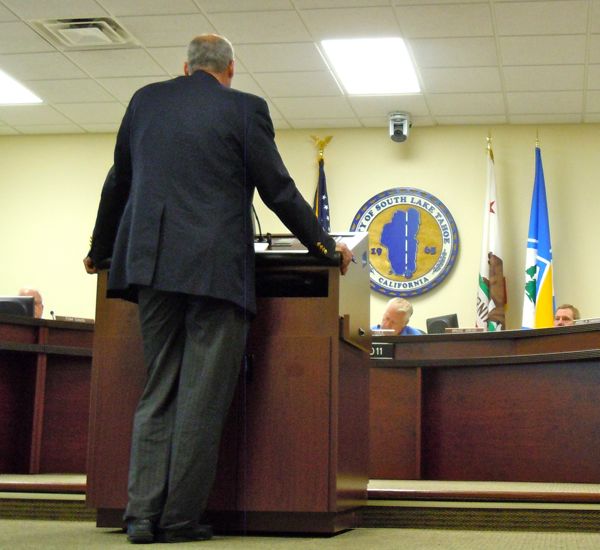
City Manager Tony O'Rourke outlines the budget.

City Manager Tony O'Rourke outlines the budget.

Cuts are expected in nearly every department. The three division chiefs in the fire department have been given notice. They are at-will employees.

At the meeting Thursday, O’Rourke said the city is “proposing alternative delivery contracts” for the rec center, senior center and pool. He said this would not affect the quality or quantity of services.

Sources have told Lake Tahoe News the rec center is likely to have a greater partnership with the local Boys & Girls Club because it is running similar programs, plus the two buildings are walking distance from each other.

El Dorado County is expected to take over a larger roll in how the senior center is operated. Most counties run these types of programs – not a city.

Changes to the pool are expected, but it will not be operated by a private entity.

O’Rourke admitted the golf course, airport, campground and other city run operations could be turned over to a private operator if the numbers make it more advantageous to do so and the council agrees to it.

Temporary snowplow operators are expected to go from seven to 15. O’Rourke said this will provide for an initial savings of $256,000 a year, with long-term benefits of a half million dollars a year.

Maintenance of roads beyond pothole repair will be contracted out.

Furloughs for just about everyone are going away – which equates to 18,000 hours of additional service.

Lease purchase agreements for police vehicles will become the new norm.

Who’s saying what

Many of the 29 people who spoke, along with a few shouts from the audience (many of whom were watching on the television monitor in the lobby because of space constraints), voiced frustration with what they perceive as cuts only at the bottom.

However, it was in March that three director jobs and the assistant city manager position were eliminated. O’Rourke on Thursday said the consolidation of jobs resulted in 10 percent raises for the finance director, police-fire chief, and community services director because of increased duties.

He failed to mention how the human resources director and public information officer also are making more.

Employees say this is unfair. When they are asked to do more with fewer people they are not given raises. While this is true, they have a contract per their bargaining unit and the upper management positions are at-will and not represented.

But two of their own got 10 percent raises as well — the capital improvement manager and payroll specialist.

Non-exempt types will also be paying their share of PERS, while the only employee group to agree to do so is the fire association.

O’Rourke emphatically stated he had not received a single bonus nor a nickel raise since he has been here. (Although he came on board in August 2010, the council has yet to review him as is normal each year.)

Crouch, the union rep, said it’s frustrating to negotiate with the numbers continually changing. City staff said property taxes and state take-aways legitimately altered the figures.

Judy Crawford, former parks and rec employee, lamented how sad it is there are more places to buy pot in town than there are places to buy shoes.

Thirteen-year-old Garrett Harley spoke of the great job the rec staff does.

Vivian Gonterman, who has lived in town since Pioneer Trail was a dirt road, equated the city contracting out services to how well the United States has prospered by having other countries make everything. Her husband is a retired city employee.

Joe McKenna, retired fire captain, said, “We’ve always dealt with financial crisis. I was on the bargaining team. We gave up a lot for our health care.” (Retirees get the same health care benefits employees get.)

Jerry Copeland, representing the Admin-Confidential employee group, said no one told him there would be a reward to come to the table first. (The fire association is getting a 2 percent raise because they made concessions.) He also said the perception is the employees are the ones who caused the financial problems.

A recurring sentiment expressed confidentially to Lake Tahoe News is that management, and therefore the council, don’t really care and are trying to balance the budget on the back of employees who did not create the fiscal mess. In addition, the dictatorial nature of how things are run is often echoed.

Lindsey Henry, 27, a third generation South Lake Tahoe resident, said of the employees, “You need to consider the big picture of what they are doing for this community.” Her dad used to work for the city.

Many people voiced concern for how well the streets would be plowed with temps and the potential liability it could create for the city.

“Temporary workers won’t save our city,” Vernon Lee told the council.

While the city struggles to live within its means, many who spoke said it’s also critical to not lose the sense of community that still lingers.



South Lake Tahoe employees weighing down city’s budget

By Kathryn Reed

While South Lake Tahoe employees cry poor, city documents show their wages keep going up. Furlough days that were implemented did not reduce salaries. They reduced take home pay because fewer hours were being worked. But retirement funds were not affected by furlough days.

sltIn actuality, city employees have been getting raises during the recession, while the private sector in large part has seen the opposite happen. In their defense, most of the contracts were agreed to before the recession. But it does show how little foresight there was on the part of staff and council members who agreed to the deals.

The one raise that stands out is just before Dave Jinkens left his post as city manager last year a side letter with the Administrative-Confidential group extended the contract through fiscal year 2011-12 with a 4 percent raise in exchange for a third furlough day.

According to MOUs and documents provided by the city, from 2007-10 Administrative-Confidential, General-Public Works, and the Police Employees groups received 18.5 percent salary increases. Police Officer and Supervisors group received a 26 percent raise in that time period. Fire received a 15 percent raise.

None of these figures is compounded, so it’s actually a higher amount.

The fire group chose not to accept its agreed upon 3 percent raise for 2010.

Here is a salary schedule of city employees by position.

Some workers will get a raise in the next fiscal year based on step-in-grade increases. These come on the anniversary of the hire date.

A full house is expected for the City Council meeting at 7 tonight at Lake Tahoe Airport because of the proposed changes in staffing and programs. Budgets are often considered the most significant decision a council makes – with the vote indicating how the group prioritizes staffing, programs and infrastructure.

While each council member has been apprised of what will be before them and have individually met with city staff, this is the first public discussion of the document and the first real opportunity for the public to weigh-in on the matter.

But this is the eleventh-hour because the budget takes effect in 16 days. Per state law, it must be balanced.

Because negotiations with employee groups are ongoing, adoption of the budget is not even expected tonight, according to City Manager Tony O’Rourke. It will likely require a special meeting to finalize it, but that date has not been set.

Nuts and bolts

To help close the $5.2 million budget gap, employees were asked to pay their share of their retirement and more for health care.

Only the fire association has made the concessions, though as a reward they are slated to get a raise of 2 percent for at least this coming fiscal year. However, because the group has not signed the deal yet, council members could voice their opinion on the matter tonight and potentially negate the deal.

Instead of one nice tidy document called a budget, what the South Lake Tahoe City Council will dissect tonight is a bunch of “proposed departmental summaries.” That’s the city’s lingo for it.

These proposals were put on the city’s website late Tuesday.  However, the details behind the proposals are in five binders in the finance department. Christine Vuletich, who is in charge of that department, will have them with her tonight. An actual budget for anyone to look at won’t be available until the end of the year. Some years it has been well after the first quarter has ended.

The proposed budget calls for $94,695,245 in expenses. Of that, $28,157,124 is for the capital improvement program and nearly $11 million is for the ongoing debt. The general fund accounts for $28,607,349 of the total expenditures for fiscal year 2011-12, which begins Oct. 1.

Salaries and benefits are paid from the general fund.

The city has seven associations it works with. Their agreements and amendments, aka side letters, are on the city’s website. Only the General and Public Works contract is up at the end of the month. All other contracts expire Sept. 30, 2012.

However, the General and Public Works did not have its first meeting with all employees until Sept. 12. This, despite, the council in March approving the five-year fiscal plan that called for the salary-benefit concessions or layoffs.

A strike by the Admin-Confidential and Public Works and General employee groups is not possible based on a memorandum of understanding that says, “It is agreed and understood that there will be no strike, work stoppage, slow-down, picketing, or refusal or failure to fully and faithfully perform job functions and responsibilities or other interference with the operations of the City by the Association or by its officers, agents, or members during the term of this agreement, including the recognition of picket lines or additional compliance with the request of other labor organizations to engage in such activity.”

MOUs representing fire and police do not have such language because they are prohibited by law to strike.

Balancing the budget

In a 27-page memo to the council, O’Rourke outlines the fiscal health of the city and the measures he wants to take to make sure the city keeps functioning.

In part, they include:

• Voluntary separation program offered to employees of General and Public Works Union.

• Elimination of 26 positions, reduction in hours for four employees, and five positions vacated.

• Reorganization of city services. (Read more about this on Lake Tahoe News after the meeting.)

• Furloughs will be eliminated except for the Administrative-Confidential group. It saves the city money to keep that group on furlough days until the contract expires in a year.

• All non-represented and management staff paying their full 8 percent PERS contribution.

• Using $500,000 of the estimated $1.8 million health plan reserves. (Employee and retiree health care plans are budged at $5.2 million for the next fiscal year – which is 18 percent of the general fund.)

• Adding $278,000 to the budget through parking meters on Ski Run Boulevard and beach areas in addition to the ones already installed near the Stateline area transit center.

• Borrow $675,000 from general fund operating reserve to pay the proposed Redevelopment Agency continuation payment of $1.8 million.

Example of a city expenditure

Lost in a budget of this magnitude can be the expenses not even thought of by the public. Like the $23 per page the city pays to have minutes taken by the city clerk be transcribed by an outside agency.

Considering a slow professional typist can type 50 words per minute and there are an average of 500 words per page it means the person is making $23 every 10 minutes.

“It is not a matter of wpm and how fast a person can type. The industry standard is per page, which for summary minutes is cheaper than charging for hourly. This is a specialized and technical service,” City Clerk Suzie Alessi told Lake Tahoe News.

The city pays $10,000 a year for the service. The savings comes from not paying benefits to a city employee, Alessi said.

Still, it begs the question with all these layoffs, can’t one of those employees type for less than $138 an hour?


Nason resigns as ED from League to Save Lake Tahoe

By Kathryn Reed

Rochelle Nason was adamant Wednesday morning when she spoke with Lake Tahoe News – saying she is not resigning as executive director of the League to Save Lake Tahoe. However, a press release arrived at 2:34pm saying otherwise.

Nason did not answer the phone when called this afternoon.

The press release says, “League to Save Lake Tahoe Executive Director Rochelle Nason has resigned today, effective October 2011, after nearly 20 years of working to protect and restore Lake Tahoe. League Program Director Carl Young will serve as interim executive director, with Nason serving as a senior advisor, until a new executive director has been selected.”

Rochelle Nason

Rochelle Nason

Nason has had the top position since 1993, having been the League’s attorney for one year before becoming executive director.

The League has been chastised more than usual in the past year for continually suing entities in the Lake Tahoe Basin. Many call the environmental group obstructionists who only file lawsuits, provide no real leadership and offer no solutions to the problems in the basin.

While the League is based in South Lake Tahoe, Nason spends the bulk of her time in Berkeley. She said in the press release that traveling between the Bay Area and Tahoe is not something she wants to continue.

The last lawsuit the League lost was the decision last month regarding the Sierra Colina project in Stateline.

Dissension in the ranks surfaced this summer when Nason said the League’s annual fundraiser on the West Shore at a house that involved an illegal extension of a pier was essentially no big deal. The League’s board president, Robert Damaschino, said otherwise. At the time, in a statement, Damaschino said, “The League to Save Lake Tahoe views the environmental violations that took place at the site of our fundraiser as a very serious matter. We support the efforts of TRPA and the landowner to correct them and assure they are not repeated.”

Most board members never issue statements, instead deferring to staff to speak for the League.

In the Sept. 14 release, Damaschino praised Nason’s leadership – “The entire Lake Tahoe Basin will continue to benefit for years to come from what she has accomplished over the past two decades.”


S. Tahoe council still unable to agree on sign regulation

By Kathryn Reed

South Lake Tahoe Councilman Tom Davis said, “I don’t want to be the taste police” when it comes to what kind of decorative lights people use on their businesses.

swiss

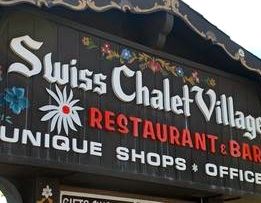
The Swiss Chalet sign could be grandfathered in.

The irony is the overall discussion was about signs – which is subjective and a matter of taste.

With more discussion Tuesday about the decades-old sign problem in the city, the council still is working through what rules it wants to dictate private businesses follow – all in the name of taste.

This type of regulation is something most cities have. The local problem is what is on the books is not enforced because this and previous councils have not agreed with it nor has there been the manpower to enforce the rules.

Too many changes were proposed Sept. 13 for a vote to be taken on the first reading of the ordinance. The soonest the next revision will come back to the council is Oct. 4.

The five councilmembers took votes on individual sections of the ordinance, but most of those were split – meaning the issue is as divisive as it ever has been.

How any ordinance that might get approved will be enforced was the subject of much discussion.

Owners of non-conforming signs will be sent a letter giving them 10 days to bring it up to code. If they don’t, then they’ll be fined each day they are out of compliance.

The five could not agree whether the Planning Commission should be the last stop for some appeals or if the council should be the body making that decision.

Nor could they all decide on when sandwich boards should be used. Though the majority sided with Development Services Director Hilary Hodges’ proposal to allow them only during holiday periods and city sanctioned community events.

What’s being called “locally unique signs” will be allowed to stay if the owners apply for that designation. Sno-Flake, Swiss Chalet and Stardust were the examples used.

No longer will private businesses be able to hire someone to hold a sign pointing to their business. But people having car washes and the like will be able to lure people to their fund-raising event in this manner.

Businesses wanting to string up energy efficient blue or white lights year-round can do so. No permit needed to do so for 90 days between Nov. 1 and March 1, though a design review is needed and a building permit may be required to keep them up longer. This is primarily to look at fire safety issues.

While progress was made on the sign issue, until a final vote is taken, each council member can change their mind. After all, that is what happened with the medical marijuana vote.

In other action:

• The council approved the ordinance affecting how medical marijuana dispensaries are regulated. Councilman Bruce Grego was the lone vote against the law. At the first reading Councilwoman Angela Swanson had voted no. Tuesday she voted yes.


No contest for Amodei; NV seat in the House still GOP

By Kyle Trygstad, Roll Call

Republican Mark Amodei ran away with a victory Tuesday night in the special election for Nevada’s 2nd district.

Amodei, a former state legislator and ex-state GOP chairman, took 57 percent of the vote to Democratic state Treasurer Kate Marshall’s 37 percent with 66 percent of precincts reporting.

Mark Amodei

Mark Amodei

Amodei keeps the seat in GOP hands following the Senate appointment of Republican Dean Heller in May. The rural district, which includes all of Nevada outside metro Las Vegas, has never elected a Democrat to the House since it was created in 1981.

That fact, along with President Barack Obama’s 33 percent approval rating and the Marshall campaign’s inability to find a message that moved voters in her direction, led to this race becoming even less competitive than the other Tuesday special election in New York’s heavily Democratic 9th district.

Nevada added a fourth district through reapportionment, so this district will change when Amodei seeks a full term in November 2012. It’s the most likely of the four districts to be a safe Republican seat, but nothing is certain with the state’s redistricting process now in the courts.

Read the whole story


Report rips how SLTFD functions, says keep station 2

By Kathryn Reed

South Lake Tahoe is not closing a fire station, even though the prospect of doing so has been discussed for several months. However, other changes besides personnel are in the works.

sltfd“The biggest risk is inadequate code education and enforcement. We need to be more diligent,” City Manager Tony O’Rourke said of his assessment of a study done on the city’s fire department.

ERASE Enterprises out of Texas has given the city a 27-page report based on its analysis of the operations of the South Lake Tahoe Fire Department. The report paints a picture of inefficiency, poor recordkeeping, shoddy supervision, a lack of emphasis on fire prevention, reserves being underutilized, and a need to review contracts for mutual aid, including the ambulance service.

The report has been disseminated to fire staff, with their comments on it expected to Chief Brian Uhler by the end of the week.

By Sept. 19, Uhler expects to have an action plan to deliver to O’Rourke.

“We know we are keeping station 2 up and running,” Uhler told Lake Tahoe News.

O’Rourke originally contracted with the firm to assess the operation of the station near South Tahoe Middle School. Part of the reason had to do with the number of calls the station responds to and part is the age of the building. The cost of the study was about $12,000, which came out of the fire department’s budget.

It was two years ago that then Fire Chief Lorenzo Gigliotti was looking at relocating station 2, as compared to the latest talk of doing away with the station. Right now the status quo will remain in regards to station facilities. However, the report says the city should, “Evaluate the ability to modify Fire Station #1 to accept Truck 2 or the construction of a new station at Al Tahoe Boulevard and Pioneer Trail with the sale of the property at Fire Stations #2 & #3.”

Expect to see current Chief Uhler at more fires. That is another recommendation of the report – a chief of this size department that had just seven structure fires in 2010 should have the top guy at them. This was not the case.

“In fact, per the Unit Logs maintained by the dispatch center the Fire Chief only responded to 3 of the 42 actual fire related incidents in the City. In each case he did not respond with the initial response of emergency personnel,” the report says. “His responses for the three incidents were 33 minutes, 50 minutes, and 1 hour and 26 minutes after the initial alarm. In a department of this size, the Fire Chief must be part of the initial response to all structure fires and specialized hazard incidents.”

Dealing with people

“We have addressed some of issues like structural changes,” O’Rourke said in regards hierarchy in the department.

For the time being Uhler has added fire chief to his police chief duties. That is expected to last about a year.

Though it won’t be a done deal until the council approves the budget this month (it could happen Thursday night), the working document does not have the three division chiefs on the payroll.

O’Rourke has previously said some of the nine captains will be given more responsibility.

However, some of these men are the ones who insiders said helped get themselves a 2 percent raise starting Oct. 1 by being the only employee group to reach a deal with the city, while at the same selling out their bosses – the division chiefs.

“It came down to a simple issue – close the station or reduce the administration,” Uhler said.

Uhler said the city’s priority should be keeping the stations open with actual firefighters and paramedics on staff to reach the emergency.

If the division chiefs are let go, this means the fire marshal position is vacant. Policy had it that Lake Valley and South Tahoe’s fire marshals filled in for each other. Lake Valley has a newbie at that position with the promotion of Gareth Harris to fire chief.

Uhler would not speak to how the fire marshal role will be handled in the future until a decision regarding the division chiefs has been made.

He did say, “We will promote some people into shift commander jobs.”

City looks like a firetrap

“Of serious concern was that the area visually observed as the most dangerous part of the community regarding unsafe fire conditions was exactly where most of the structure fires occurred per the data analysis! When you can drive around and via a ‘windshield inspection’ predict where the structure fires will be you have an obvious lack of code enforcement,” the report states.

It is the fire marshal and building inspector who are responsible for those types of code enforcement.

The report suggests creating an anti-arson program, and to look at state and federal funds to deal with blighted areas.

“During the initial data review, the site visit, and subsequent review of department records many other issues came to light which all impact the efficiency and effectiveness of the fire protection system for the city,” the report says.

This is why the scope of the analysis grew beyond looking at if the city could do without station 2.

In all, 25 recommendations were brought forward. Uhler said some will be implemented, others won’t. Until he gets feedback from the fire staff, he would not elaborate beyond what he had already said.

However, more complete reports are bound to be on the to-do list.

“To be able to rely on data to make critical management decisions the reports that the data is extracted from must be both valid and reliable. To achieve these two measures the reports must be completely filled out with valid data and the reporting methodology must be consistent and accurate, thereby being reliable. In our review we found reports that listed content damage but no property value, property loss with no property value listed, content loss without content value and so forth,” the consults says in the report. “Other reports had no physical address shown (even for a wildfire a geographical address needs to be entered to complete the report) and on others we found numerous fires occurring at the same location but with different identifiers used to describe the same location. The lack of complete and accurate reports is an issue that comes from both training and a lack of supervision.”

The report also wants the city’s money people to be more engaged.

Two recommendations are, “Re-evaluate all contracts for outside services with the City Finance Department reviewing actual costs for services versus fee structures in the contracts to ensure a positive cash flow outcome.

“[And] (e)valuate permit fees and stand by fees for the fire department to ensure that fee structure represents costs for the services.”


9/11: South Shore remembers those who died in 2001

By Jessie Marchesseau

Rounding the corner en route to the Duke Theatre at Lake Tahoe Community College on Sunday, I walked into a sea of tiny American flags, 2,977 of them to be exact. One for each victim of the attacks.

A loud bell was tolling — 2,977 times.

Each flag represents one of the 2,977 people who died at the World Trade Center. Photos/Jessie Marchesseau

Each flag represents one of the 2,977 people who died at the World Trade Center. Photos/Jessie Marchesseau

In commemoration of the 10th anniversary of 9/11, LTCC presented The 9/11 Project. The event, which consisted of a theatrical presentation, a panel discussion, and a special commemoration and reception, was not only to pay tribute to those who died that day, but also to celebrate local public safety personnel.

“I wanted to honor and remember the victims of 9/11 and morph it into something a little more hopeful,” Susan Boulanger, director of theater arts at LTCC, said.

Girl Scouts wearing sashes handed out programs at the door and asked for donations for the South Lake Tahoe Search and Rescue. The local Boy Scout troops had placed the nearly 3,000 miniature flags into the ground. Most of the Scouts did not look old enough to remember that day in 2001, some of them were probably not even born yet.

The Duke Theatre, which holds 190 people, was packed. Some attendees were forced to stand in the walkways. As the lights went down, 18 actors dressed in black took their places on stage in front of 18 chairs. Seeing them standing there, somber, on a stage of all black, a firefighter uniform and hats from various public service departments displayed in the rear corner of the stage, it was apparent there would be no singing and dancing in this play.

Boulanger chose to do a collection of monologues from two plays for the 9/11 presentation. Seventeen actors would be reading from “With their eyes – September 11th: The view from a high school at Ground Zero,” a series of real-life accounts of faculty, staff and students at Stuyvesant High School, located just four blocks from the World Trade Center. The 18th actor would perform excerpts from “The guys,” a play based on a true story about a New York City fire captain who lost eight of his men in the tragedy, and is then faced with the task of finding the words to remember each of them.

Before a syllable was even spoken on stage, I felt the lump forming in my throat and the tears beginning to well in my eyes. A woman in front of me pulled a tissue from her purse. Just the thought of that day brings about myriad emotions for many of us.

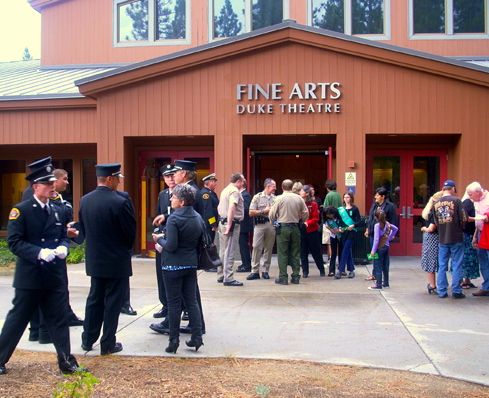
Law enforcment gather at LTCC for Sunday's event.

Law enforcment gather at LTCC for Sunday’s event.

The performance was dramatic. Not a giggle or a snicker in the house. Each oration was a reminder of the real people affected that day, not mythical heroes or ghosts, but ordinary people whose lives would never be the same.

“We tend to forget that they’re human beings,” Boulanger said. “We put heroes on a pedestal.”

She said she chose this particular set of monologues to remind us all of that.

After the theatrical presentation, a panel of seven law enforcement officers, firefighters and military veterans took their place on stage to share how the events of 9/11 affected each of them personally and their professions. The audience was also encouraged to pose their own questions to the group.

South Lake Tahoe Police Chief Brian Uhler said it was an honor to be asked to be part of the panel. “I’m glad that people are still paying attention, and we haven’t become numb to the events of 9/11,” he said.

A plaque at LTCC honors those who lost their lives Sept. 11, 2001.

A plaque at LTCC honors those who lost their lives Sept. 11, 2001.

Due to weather, the commemoration and reception that had been slated to follow at the Ledbetter Terrace was moved into the theater. Boulanger announced the planting of two crab-apple trees in the terrace along with a plaque reading “In Honor of the Heroes and Victims of 9/11 And the Heroes Who Protect Us Today September 11, 2011.” As she gave thanks to our public service personnel, the audience offered a standing ovation.

“I wasn’t there when it happened, and I couldn’t do anything then,” Joanie San Agustin, one of the actors, said after the performance. “This was a really great way to pay tribute to those who gave their lives and those who lost their lives.”


9/11: A generation loses its innocence in a N.Y. minute

Publisher’s note: This is one in a 12-part series running from Sept. 1-12 about how Lake Tahoe is tied to 9/11.

By Stephen Ward

When you’re young, you have a peculiar way of gauging things. Some children worry about a new school because of the size or shape of a fence, or from the look of their teacher. Others might sense alarm if their dinner is overcooked or negated altogether.

Although these signals are dubious, they grant closure. They help you reduce dimensions, to understand the world around you and momentarily fend off its opacity.

9:11 logoFor me, I always judged how the day would unfold by who woke me up in the morning.

My mother was the norm; she would sit beside me and rub my back, speaking softly until I woke up. This meant today would be the new yesterday — everything is as it should be.

Being woken up by my father was a different story. He favored yanking the sheets off quickly and shouting “Morning!” relying on the startle to wake me up. This occurred less often and indicated that I had an appointment or errand to run before school. The day would be slightly different, more unpredictable.

On the morning of Sept. 11, 2001, both parents were in my room. But, unlike the other days, neither one made an effort to disrupt my sleep. I awoke to find their backs facing me on the foot of my bed, my bedroom light still off. They were just sitting there, motionless, with their eyes glued to the burning building framed within the 12-inch TV screen.

I couldn’t ask what was happening before a second plane answered my question.

I wish I could say time stood still at that point, but the opposite happened. The TV was turned off and I was told to go downstairs for breakfast. My mom, with her nurturing disposition, consoled me throughout my bowl of cereal. She told me she’d take me to school and that everything would be all right. Don’t worry, she repeated. Everything is fine.

But I already knew that wasn’t the case. I woke up myself, with both of my well-being signifiers entranced in front of me.

Stephen Ward -- 2001

Stephen Ward — 2001

Ask any teenager what it’s been like since 9/11, and you’ll probably get a descriptive before/after binary. Before, schooldays seemed shorter. Lunch tasted better and the air was less stagnant. Teachers would watch their students from afar, reclined against the school wall and talking among themselves.

Sept. 11 was a lost day. No one wanted to do anything, so everyone sat together and watched the TV or listened to the radio. Every 50 minutes, a bell rang — a signal for everyone to get up and go somewhere else to do more of the same.

The most memorable class that day was physical science. My teacher had a close friend who worked in the World Trade Center. She stopped class repeatedly to answer her phone, exchanging calls with her friend’s wife. She cried uncontrollably in front of us when her friend called and said he was alive.

Stephen Ward has lived with the aftermath of 9/11 most of his life.

Stephen Ward has lived with the aftermath of 9/11 most of his life.

From Sept. 12 onward, teachers were falconine. They stayed on the field with students during every break from class, constantly surveying the grounds. They were sentient guard towers, armed with whistles and neurosis.

I was 13 years old living in Las Vegas when the terrorist attacks transpired. According to the major news channels, my region was a potential target. Some of the hijackers met in strip clubs and casinos in Las Vegas before carrying out the attacks. Security cameras showed the perpetrators sauntering through casino floors, detached from reality with the blue, grainy haze of the recording. Like the world they left behind, they were a shadow of themselves.

I wish I could say social profiling didn’t seep into the schoolyard, but it did. Among the many topics discussed back then were sleeper cells, especially in our area. Teachers kept close watch of the Muslim students. Children with darker skin were supervised by multiple hall guards. We stopped getting the occasional hug from our teachers when we left class.

The “us versus them” mentality the nation’s leader adopted divided what was once a unified generation. By reducing dimensions, by trying to better understand the world around us, and our place in it, my peers adopted a new breed of hostility.

It carried into high school. By my sophomore year, the war against terrorism was in full motion. Many students were bloated with chauvinism. The common resolution in history and government classes was to turn the Middle East into a parking lot. This was met with overwhelming approval.

Not every teacher promoted xenophobia. My sophomore English teacher showed us documentaries about war, social unrest and the conspiracy theories surrounding the attacks. His mantra was on expanding our perspective, not polarizing our paranoia.

During the last 10 years, I’ve had quite a bit of time to reflect on what happened and, consequentially, what it means. The world I live in now is a product of an unpredictable event, one that lasted for a few hours and shifted the social axis of everyone around me. To grow up during the post-9/11 era is to grow up with a broken perception of safety, trust and acceptance.

Still, I’m convinced my English teacher had it right. Resilience is tangible, so long as my generation seeks information and awareness rather than rhetoric and scare tactics.

Nowadays, I spend more energy gauging my reaction rather than the events themselves.

Stephen Ward is a student at UNR interning for Lake Tahoe News.


9/11: ‘Women at Ground Zero’ — gripping, inspiring

Publisher’s note: This is one in a 12-part series running from Sept. 1-12 about how Lake Tahoe is tied to 9/11.

By Kathryn Reed

Now I understand why “Women at Ground Zero: Stories of Courage and Compassion” cannot be read all at once. It is so emotionally charged that it requires the reader to pause long enough to digest the words on the page.

bookBut at the same it’s one of those books you don’t want to put down because it is so gripping.

Authors Susan Hagen and Mary Carouba embarked on a journey to New York City just after terrorists destroyed the Twin Towers Sept. 11, 2001. Their frustration with seeing no women rescue workers on television or in other news accounts led the Californians to search these women out.

The book is about 33 women; including three who died in the attacks. They are firefighters, police officers, emergency medical technicians and therapists. It’s not that their stories are more important than men’s. It’s that until Hagen and Carouba came around no one was talking about the women. The media and politicians focused on the men.

But this is not a book for women. It’s for everyone who cares about what happened that day. It also puts a more human touch on the tragedy that I had not connected with before.

9:11 logo

From Sept. 1-12, Lake Tahoe News is looking at 9/11.

For someone like myself who was out of the country at the time of attacks, the book offered insight into this event on 9/11 and the months afterward that I was not aware of.

I learned the EMTs not connected to the New York City Fire Department were not given the same benefits as those who are employees. I learned about the police department’s evidence department and the heartache of body parts coming in – like a hand with a wedding ring.

I winced as I read. Tears welled up. Anger – though I’m not entirely sure whom it was directed at – filled me. But overall I smiled when I finished the book and had a bit of time to reflect on what I had read.

The authors taking the initiative to research and write the book impressed me. But mostly I felt inspired by these women’s stories.

Hagen and Carouba were on the South Shore in September 2010 to give a talk – which was funny and poignant at the same time.

Although the book first came out in 2002, a 10th anniversary release of “Women at Ground Zero” is out. More information about the authors is on their website.


9/11: A world-changing event experienced outside the U.S.

Publisher’s note: This is one in a 12-part series running from Sept. 1-12 about how Lake Tahoe is tied to 9/11.

By Kathryn Reed

Machu Picchu. It’s what I think of when I hear 9/11.

Throughout the day on Sept. 11, 2001, I kept being drawn to the most sacred temple at these historic Inca ruins in Peru. Pages of my journal talk about the experience.

Later that night and still today, I am compelled to believe that stone brought me a source of spiritual energy that resonates calmness when I think of her and of 9/11.

From Sept. 1-12, Lake Tahoe News is looking at 9/11.

From Sept. 1-12, Lake Tahoe News is looking at 9/11.

I had taken a six-month sabbatical from my job as an editor of the San Francisco Chronicle, with four months of it spent in South America. I was finishing week one of the trek when the cowards leveled the Twin Towers.

Being out of the country during this momentous time has left me not sharing the intense feelings of those who were on U.S. soil that morning. In reflecting back on my memories – aided by my journal and emails to my parents – I can honestly (and selfishly) say I’m glad I was where I was, doing what I was doing.

Getting back to Cuzco that night was a bit harrowing because of the transportation strike, not speaking Spanish, and fires burning in the road. I thought I had a great story to write home about.

Somewhere along the way word came that a plane had hit the towers. We thought it a Cessna or something small, no surprise there would be deaths associated with it. But somehow I knew it was bigger than that by the time I got back to my hotel. I just didn’t know how big.

I asked a hotel employee to put CNN on in English. He looked at me with an expression that said, “Oh, god, she doesn’t know.”

Kathryn Reed at Machu Picchu Sept. 11, 2001.

Kathryn Reed at Machu Picchu Sept. 11, 2001.

It didn’t take long to see what I hadn’t known until that moment. The videotape of the planes hitting the World Trade Center kept playing. It was surreal. It was like a bad B movie that wouldn’t end.

The next day was spent watching CNN and emailing family and friends. People filled the Internet café. Wallpaper on one computer was of four panel photos of the WTC collapse.

My journal on Sept. 12, 2001, says, “I’m not thrilled to have in my possession a ticket on American to JFK in December. I really want to be at home to see-hug all my family [and] friends – but at the same time staying on track may be best – and for now that’s what I’ll do. Last night was restless because of this news – today I was a bit numb – I just wanted to be around English speaking people – ah – how we migrate to people like ourselves.”

A few days later I’m at Lake Titicaca where I meet a couple from Philadelphia traveling with their adult daughter. They have black armbands as a symbol to those who died in New York City, Washington, D.C., and Pennsylvania. We cut one in half and I wear mine with honor.

Eventually I tie it to my backpack – where it stayed for the entire trip.

I’m getting word from friends in Vegas about lines for gasoline. I read about people in the United States being fearful. I don’t comprehend these feelings.

I feel a sense of loss and loneliness – but not of fear.

On Sept. 17 I write to my parents, “It is so weird being out of the US … it is [as] though nothing really has changed. I do not have any constant reminders of all of the East Coast tragedies and the domino effect.”

It’s Sept. 18, I’m outside the U.S. Embassy in La Paz, Bolivia. I can’t stop staring at our flag at half-staff. I’m told not to hold onto the fence. I’m told I have to get permission to a take picture of the flag. Now I’m angry. It’s my flag.

On Sept. 18 I write a group email saying, “People down here do care. Though it was a bit weird the other day crossing form Peru into Bolivia and waiting in the line at the Bolivian immigration office and having a young shoeshine boy come up and ask me where I was from. The United States I responded. Oh, and then he makes a gesture with his hands of a plane going through a building. I had nothing more to say. A woman with a Netherlands passport in front of me said what a way to greet you. I smiled. She said the tragedy has affected the whole world.”

Mom writes back about the continual pit in her stomach.

To this day it’s something I don’t relate to.

It’s Jan. 2, 2002, and in my journal I write, “On Sunday [Dec. 30] we went to Ground Zero. They opened a viewing platform that day. It was hard to believe that the World Trade Center once stood there. It looked like a construction site. Had there not been other buildings boarded up [and] w/canvas hanging down it would not have been so dramatic. What got me the most were the views from the Empire State Building [and] Statue of Liberty ferry. And on the city map it just has a white space for the WTC – with no written designation. It is still hard for me to comprehend all that the Untied States [and] its people have [and] are going through and perhaps having been in S. America on Sept. 11, 2001, will make it impossible for me to ever grasp the magnitude of the loss [and] fear.”