User fee to take effect in Hope Valley on Jan. 1

By Kathryn Reed

Starting Jan. 1 it is going to cost money to recreate in parts of Hope Valley.

The land affected is owned by the California Department of Fish and Wildlife. In Alpine County the areas are known as Hope Valley Wildlife Area-North Unit, Hope Valley Wildlife Area-South Unit, and Red Lake Wildlife Area. Most of the nearly 3,000 acres are at Picketts Junction and then north on both sides of Highway 89 up Luther Pass.
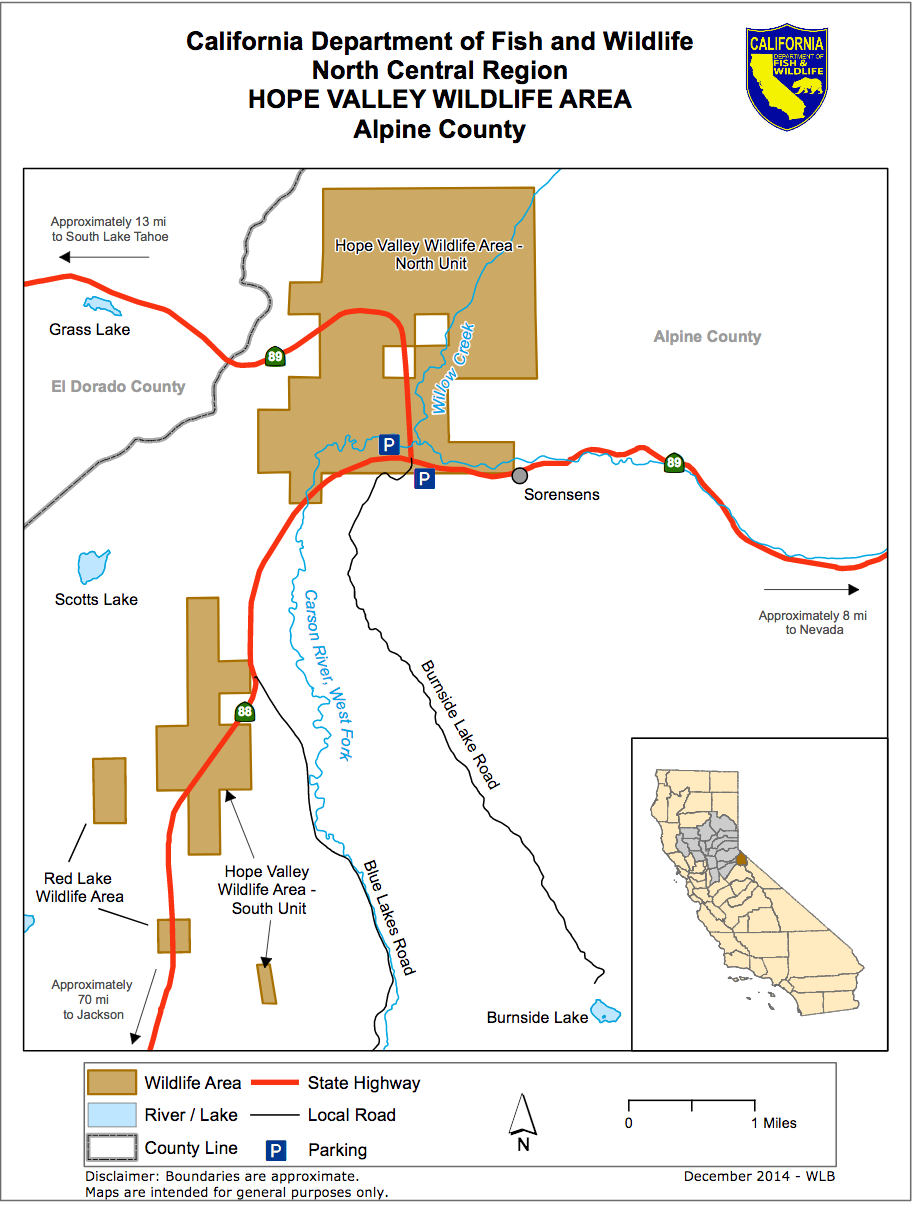
A user fee for the brown areas labeled Hope Valley Wildlife Area starts Jan. 1                         Source:  CDFW

The Land Pass Program dates back to 1988, but is only now taking full effect. At that time six properties had a fee, others were added this fall, with the remainder coming on board in 2018.

“Since 2006 the Legislature has been after the department to generate more income from user fees,” Julie Horenstein, ecological reserve coordinator with CDFW, told Lake Tahoe News. “In 2012 a statute was passed explicitly directing the (California Fish and Game) Commission to require a lands pass where it was practical and cost effective to do so.”

Statewide, 42 properties come under the land use fee program. The state agency does not have lands in El Dorado or Placer counties that will be subjected to the user fee.

In all, CDFW manages 247 wildlife areas and ecological reserves up and down that state, which encompasses about 1 million acres.

Hunters and anglers have had to pay to use these lands for years. Mostly the money came from licenses, duck stamps, and taxes on equipment they use for their sport. They have been vocal in wanting hikers, birders and wildflower enthusiasts to pay their share. Those with a hunting or fishing license do not have to pay the additional user fee.

Horenstein said a state blue ribbon committee in 2012 mandated the department to “develop more equitable funding sources.” This user fee is the source.

The money collected from the new user fee will go into the Native Species Conservation and Enhancement Account. It can only be used for managing the operating CDFW lands. If the agency can identify where the user was going to recreate, then 35 percent of the fee will be reinvested at that location.
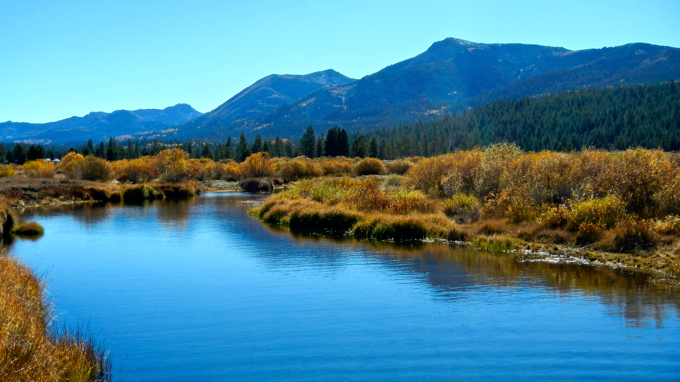
A large swath of Hope Valley will no longer be free to access starting Jan. 1. Photo/LTN file

Day and annual passes will be available. They will be like sno-park passes, in that they are available online or at select outlets, and that they are not available at the parking location.

The agency expects to generate a little more than $150,000 a year statewide. Expenses the first year could reach nearly $100,000, with metal signs being the most expensive item. Education material is another expense. So the net is about $50,000 a year to start with. The money could be leveraged to secure federal grants so more work is done on state lands.

Those caught without a pass will face a fine of between $50 and $250. Leniency is expected for the first six months or so for the public to become educated about the fee.

While this state department said it sent out notices to all counties and adjacent public land owners and likely interested agencies, Alpine County officials said they never received the information. That is in part why Horenstein will be speaking at today’s Alpine’s Board of Supervisors meeting.

Supervisor Don Jardine, who has been in office for 30 years, is very familiar with this land. He was on the board when it became public property.

“The county at the time didn’t want to see major development in Hope Valley,” Jardine told Lake Tahoe News.

The Trust for Public Land and Friends of Hope Valley partnered to protect 25,000 acres in the area that had been privately held. This started in the late 1980s and took more than 10 years to finalize. The CDFW and U.S. Forest Service bought the land.

Jardine said Alpine was not notified of the fee structure, that’s why he wants a CDFW official to speak to the board.

He is most worried about:

·      Access for low income people. – The state said lower income people mayaccess the land for less money.

·      Nonprofits that use the area. – The state says schools and organized youth groups are exempt from the fee.

·      People wanting to get to USFS land having to pay. – They will have to pay.

Jardine said he isn’t necessarily opposed to the fee, but he and his colleagues want a better understanding of what the state is about to do and they want to make sure the original agreement when the lands became public is adhered to.

—–

Notes:

·      Passes may be purchased online and where hunting/fishing licenses are sold.

·      Day passes are $4.32; 2017 annual pass is $24.33; 2018 annual pass is $25.10. Passes are good for a calendar year.
Skiing in Europe or America: which is best?

By Helen Coffey, Independent

USA vs Europe: which is best for a ski or snowboard holiday? The whole experience becomes very different depending on which side of the pond you’re on – off-piste etiquette, chair-lift queuing, après ski and even the kind of snow you’re turning on all vary wildly between continents. We look at the pros and cons for each to decide which might be right for you.

The prevalence of package deals mean a European ski holiday can work out cheaper than a North American equivalent. Of course, you can choose to spend thousands on a private chalet in Courchevel 1850 with a 24-hour butler, Champagne on tap and helicopter transfers, but there’s also the option of booking a seven-night package deal to Bansko in Bulgaria for $618, including flights, transfers, B&B accommodation, ski hire and lift pass.

In comparison, U.S. lift tickets can work out to be pretty expensive for a week’s ski trip: for example, a six-day pass for Breckenridge, Colo., is currently a whopping $727.

Read the whole story


Status of snowpack after a mild November

By Angela Schilling, KTVN-TV

Lake Tahoe is the fullest it’s been for this time of year since the mid 1980s, and according to the National Weather Service, the region would need to have more than one dry winter to go back into a drought.

It usually takes about three dry years for Lake Tahoe to deplete its storage.

As far as the current snow season, the snowpack is doing quite well above 8,000 feet. Looking at the snow water equivalent, the Truckee basin is 145 percent of normal and about the same in Carson and Walker. The Tahoe basin is at 64 percent, as it is lower in elevation.

Read the whole story


STR looking at altering green waste collection

Green waste totes could replace cans full of yard debris. Photo/LTN

By Kathryn Reed

Specific bins for green waste may be coming to South Tahoe Refuse customers.

The garbage company, which operates on the South Shore in El Dorado and Douglas counties, conducted a pilot program this fall to see how customers liked the service.

About 125 households near Sierra House Elementary School were give a green 90-gallon garbage tote to use from Sept. 8-Oct 27. Only yard waste was to be deposited in the bin.

Decreasing injuries and lessening the cost at Full Circle Compost are the main reasons STR is contemplating the green waste can.

“Green waste is where we have the heaviest lifting,” Jeanne Lear with South Tahoe Refuse said. Bags or cans of waste can weigh 30 pounds.

The company’s workers’ comp bills went up 19.4 percent in the last year. Lowering that bill by having employees stay healthy would presumably be a positive outcome with the totes.

STR reps gave an update on the pilot program to the South Lake Tahoe Waste Management Authority board in November.

STR retrofitted a truck in order to be able to mechanically lift the totes. Doing so on all of the trucks for all types of waste is not being talked about. But the company is contemplating green waste collection via a provided tote as becoming the norm. A final decision has not been made, though.

How many trucks to retrofit and the cost to customers need to be analyzed.

During the pilot there was a 95 percent participation rate, with households using it 57 percent of the time. Eighty-five percent liked the convenience. Overall, 72 percent preferred the tote. Almost half still had extra bags of yard waste to be picked up. About a third said storing the tote in winter would be problematic.

STR takes most of its green waste to Full Circle Compost in Minden. The company charges STR a fee for contamination, which is mostly the bags people put the waste in. Using the totes would eliminate much of the contamination as long as people adhered to putting in only green waste. In the pilot program the contamination level was less than 1 percent.

Getting more green waste out of normal trash collection would also help keep it from going to the landfill. All garbage companies in California are required to recycle 50 percent of the waste they collect – known as the diversion rate. The goal per the state is 75 percent in 2020. STR is currently at about 64 percent.


Calif. may not be biggest threat to Nev. marijuana market

By Colton Lochhead Las Vegas Review-Journal

California is set to join the legal weed party Jan. 1 when recreational sales become official in the Golden State.

The state was one of four, including Nevada, that voted in 2016 to legalize the recreational use of marijuana. With sales projected to top $5 billion once the market gets up and running, California’s cannabis corner is expected to be by far the nation’s largest.

Nevada’s fledgling market got off to such a hot start this summer by selling more than $85 million in recreational marijuana during the first three months of legal sales.

But having a big competitor nearby shouldn’t be a problem.

Read the whole story


Calif. lawmakers push back on White House with new wildfire request

By Emily Cadei, McClatchy

California’s House members are joining across party lines to call for $4.4 billion for wildfire recovery from Congress, a unified statement that boosts the state’s chances of securing much-needed funds to help rebuild after this fall’s devastating fires.

The request is also a rebuke of the White House, which sent a $44 billion disaster aid request to Congress last month that made little mention of the state’s fire victims. The Trump administration later clarified that its requests for money for Federal Emergency Management Agency (FEMA), the U.S. Department of Agriculture (USDA) and Small Business Administration would all apply to California’s fire recovery, as well as Hurricanes Harvey and Irma.

Even so, the sums the White House outlined on Nov. 17 were far less than what states affected by these disasters said they need to rebuild. California Democratic Reps. Mike Thompson and Jared Huffman called the $44 billion request “anemic” even if applied just to hurricane recovery, and not nearly enough if wildfire needs were also included in the mix.

Read the whole story


Carson River, grasslands, sage dominate easy hike

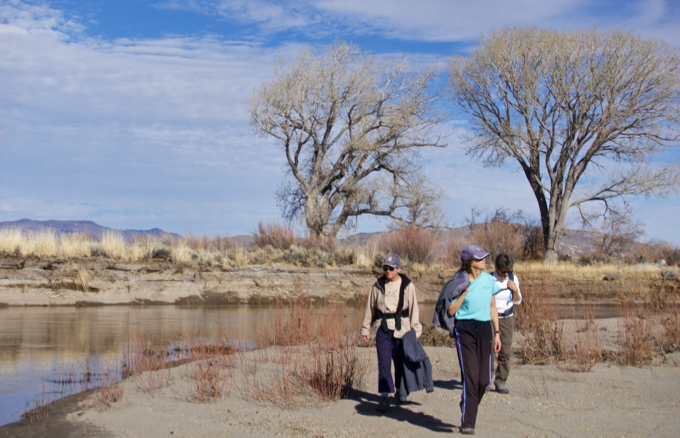
Rhoda, Liz and Rosemary along the Carson River on the Bentley Heritage Trail. Photo/Kathryn Reed

By Kathryn Reed

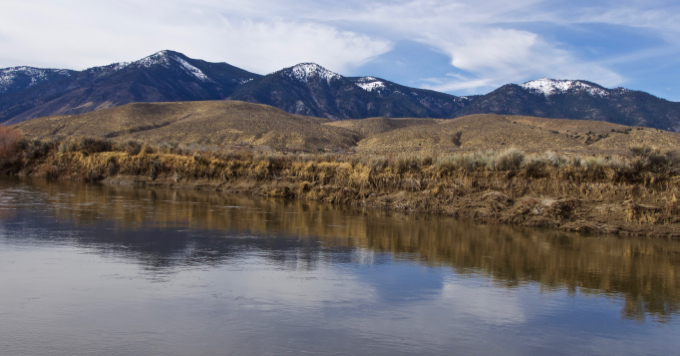
MINDEN – Meandering through grasses more than 6-feet high, mesmerized by sage bushes just as tall and with thick trunks, a brief oops where the trek went through slick mud, the Carson River wending its way through the valley as the snow covered Sierra peaks scratched the sky – all of this provided more reasons to be thankful on Thanksgiving weekend.

With the recent snow in Tahoe, hiking at any elevation above lake level may necessitate snowshoes, and yet it doesn’t quite feel like snowshoe season has truly arrived. To keep hiking this time of year requires dropping in elevation. That’s just what the four of us did the day after Thanksgiving.

The Carson River and Sierra mountains are focal points along the trail. Photo/Kathryn Reed

The Carson Valley Trails Association has been busy creating a trails throughout the Minden-Gardnerville-Genoa area.

This particular one – the Bentley Heritage Trail – is like being in the middle of nowhere, and yet so close to civilization.

We are so used to hiking in the Tahoe area that is was strange to have no elevation gain. A 1 percent grade is what you’ll encounter.

With no trees, it seemed like you could see forever – which was wonderful.

While the network of trails here is 4.8 miles, what is great is that hikers can easily make it shorter. This is because trail builders made several links from one side to the other. The other nice touch was the off-shoots to the Carson River.

Our goal was to make a circle. We kinda did that.

Private property via an easement has created this nearly 5-mile trail system. Photo/Kathryn Reed

While at first I was thinking the signage was wonderful, there were a couple incidents where we weren’t quite sure where to go. The main obstacle was when we got to what I would call the end of trail before it curves around to head back. The arrows pointed left and right. We thought we needed to go right to keep with our plan to go counter-clockwise. Well, it turns out this was one of the spurs to the river and not the actual trail. After a muddy adventure near the water, we turned around and figured out our mistake.

We also weren’t sure which direction to go at another junction. Instead of completing the circle, we wound up going across to the side we started on.

Neither of these hiccups was that big of a deal, but for first-timers a little more info besides an arrow would have been nice. Things like “river,” “trailhead,” “eastern trail” would have kept us where we wanted to be.

Still, we’d all recommend this trail – just not in the summer or anytime it is hot. It is completely exposed, with zero shade. The river might provide some cooling off, though.

It was easy to see how high the river had been this spring based on the erosion along the banks and the wash along the side.

A surprising find were some tiny clam shells along the shore, that to this non-scientist looked like the invasive clams found at Lake Tahoe.

Carson Valley Trails Association, with the Nature Conservancy, local Eagle Scouts, and the property owner built the hiking trail system.

The trails association had to replace some of the boardwalks this year that had been ruined by the spring flooding.

The biggest negative for me is that dogs are not allowed. This is because cattle could be in the area. Horses, bikes and motorized vehicles are also not permitted. But I’m thankful the private property owner agreed to the easement that allows the public onto these lands. The easement protects four miles of the Carson River, conserves wildlife habitat, safeguards more than 1,000 acres of floodplain, and encourages sustainable agricultural practices.

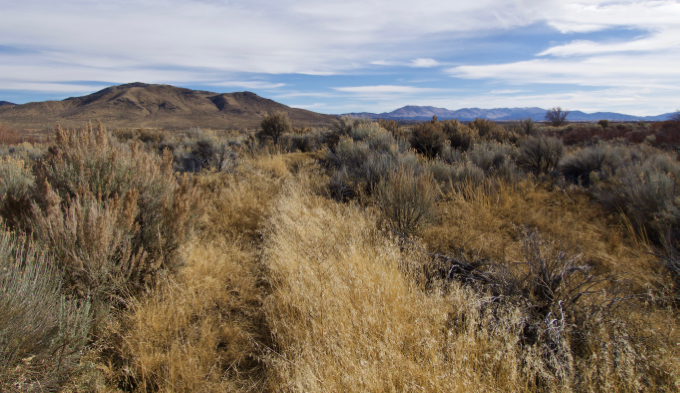
This hike is mostly a single-track trail through grassland. Photo/Kathryn Reed

—–

Getting there:

From South Lake Tahoe head east on Highway 50. Go right onto Kingsbury Grade. At the bottom, go left on Foothill Road. Turn right on Muller Lane. Turn left onto Highway 395. Turn right on Stephanie Lane, then left on Heybourne Road. The trailhead is to the left and is well marked.


Old ‘Welcome to Nevada’ signs a collector’s item

By Daria Sokolova View, Las Vegas Review Journal

When the Nevada Department of Transportation switched the design of the longtime “Welcome to Nevada” sign this year, a battle for the pieces of history ensued.

Department spokesman Tony Illia said he was shocked by the amount of interest in the old highway fixtures.

“You cannot believe how many people wanted those signs,” he said. “They were fighting over them. We had thousands of people calling and emailing me, and I was just flabbergasted. These are huge signs; you can’t just hang them up in your house.”

About 14,500 Nevadans entered the free raffle via phone, website and social media, and NDOT randomly selected four winners from each region of the state.

Read the whole story


U.N. investigating extreme poverty in the U.S.

By Ed Pilkington, Guardian

The United Nations monitor on extreme poverty and human rights has embarked on a coast-to-coast tour of the U.S. to hold the world’s richest nation – and its president – to account for the hardships endured by America’s most vulnerable citizens.

The tour, which kicked off on Friday morning, will make stops in four states as well as Washington, D.C., and the U.S. territory of Puerto Rico. It will focus on several of the social and economic barriers that render the American dream merely a pipe dream to millions – from homelessness in California to racial discrimination in the Deep South, cumulative neglect in Puerto Rico and the decline of industrial jobs in West Virginia.

With 41 million Americans officially in poverty according to the U.S. Census Bureau (other estimates put that figure much higher), one aim of the U.N. mission will be to demonstrate that no country, however wealthy, is immune from human suffering induced by growing inequality. Nor is any nation, however powerful, beyond the reach of human rights law – a message that the U.S. government and Donald Trump might find hard to stomach given their tendency to regard internal affairs as sacrosanct.

Read the whole story


3D image revolutionizes mammograms at Barton

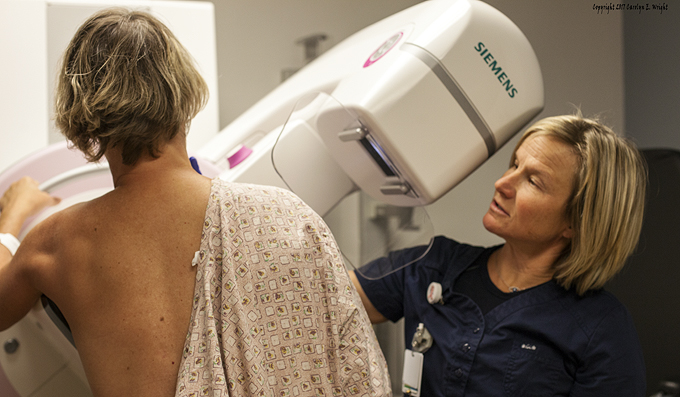
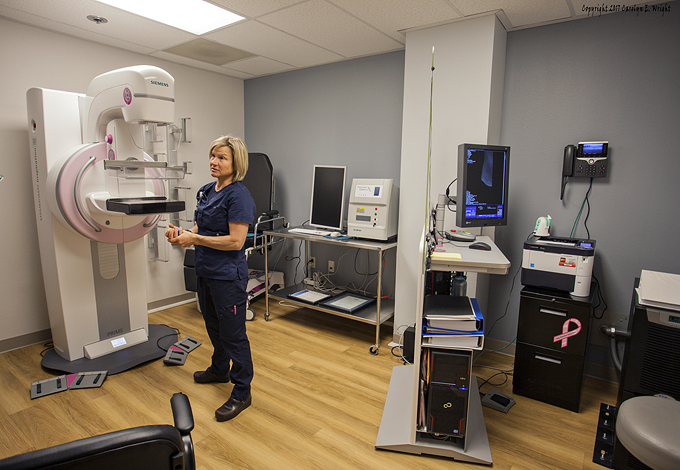
Sara Rourvinen of Barton Health, right, positions the new 3D mammogram machine. Photo Copyright 2017 Carolyn E. Wright

By Kathryn Reed

I call it getting my boobs squeezed. It’s an annual ritual most women of a certain age subject themselves to – the mammogram.

While I won’t say the new machine Barton Memorial Hospital has is something I would want to experience any more often, it is better than the old piece of equipment. It doesn’t squeeze the breast as hard, but it does take longer to get the full image because it is going through a 50-degree arc.

There is also a bar to hold onto, which makes things more comfortable.

The exam room is larger, a little warmer, a little more secluded. It’s part of Barton creating a women’s suite.

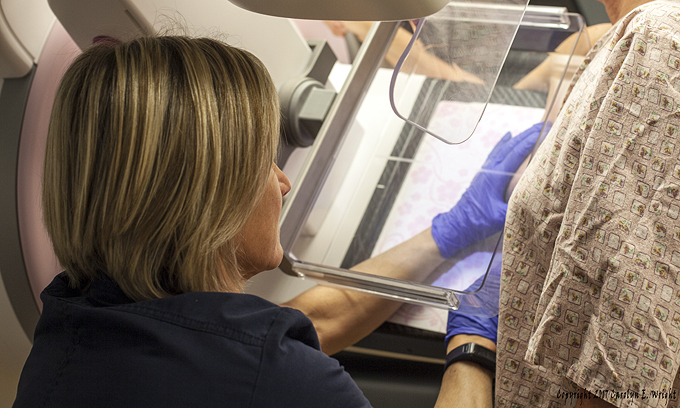
Sara Rourvinen of Barton works to position a breast for the best pictures. Photo Copyright 2017 Carolyn E. Wright

The whole experience is better. While that’s great, the best part is the efficiency of the new machine. Cancer detection is increased by 30 to 40 percent. The earlier the diagnosis, the better the outcome is likely to be.

The new technology is called tomosynthesis, which is essentially taking a 3D image of the breast.

As technician Sara Rourvinen explained it, 2D images are like taking a picture of a book cover, while the 3D version allows all of the pages to be seen. Those pages, so to speak, are layers of breast tissue.

“Cancer doesn’t have places to hide anymore,” Rourvinen said.

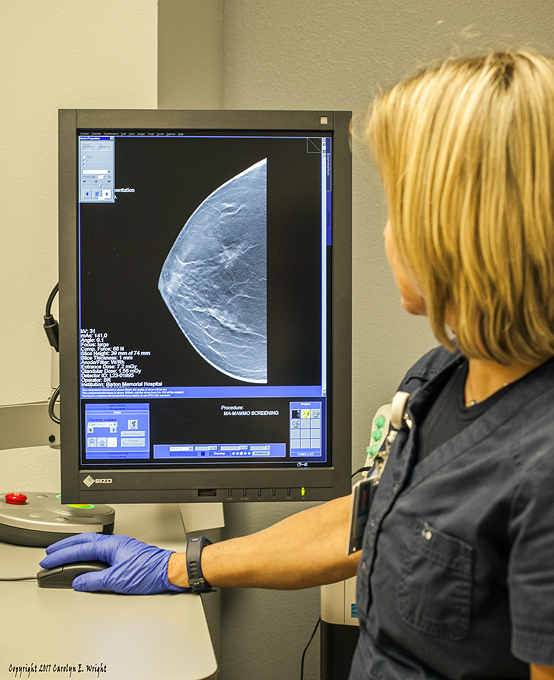
In many ways it’s an awkward procedure – what with having someone placing your breast on the flat surface of the machine, then a vice like contraption pressing down to keep it in place, having the tech tell you to standstill, but still breath. Rourvinen then walks behind the lead glass to be protected from the radiation. Next to her she has a monitor to see the images come up. She prides herself in getting it right the first time. Then the pictures are sent electronically to radiology.

Sara Rourvinen reviews the 3D image of a mammogram. Photo Copyright 2017 Carolyn E. Wright

This machine is going to be most beneficial to women with dense breast tissue.

“High density breasts are a cancer risk. Because there is more breast tissue, there are more places for cancer to arise,” physician Leonard Holmgren told Lake Tahoe News.

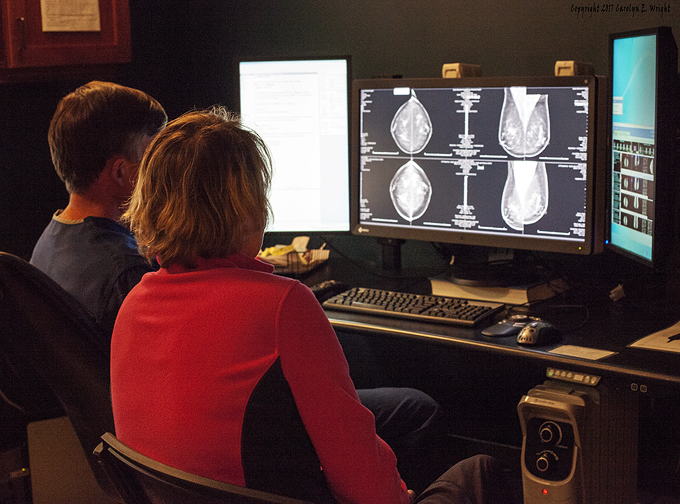
Holmgren, one of the radiologists at Barton tasked with reading mammograms, looked at my images in his office on a 5-megapixel monitor. He compared them to last year’s. No change – still cancer free.

2D images are still taken. It is static. Sorting through the 3D images the layers of tissue are distinguishable. It’s easy for the doctor to scroll back and forth for another, closer look.

This new machine, which has been in use since June, requires doctors to spend about 40 percent longer reading the results. The added time is looking at all those layers of images. My exam resulted in 68 images on one setting, 75 on the other.

Dr. Leonard Holmgren goes over the mammogram results with patient Kathryn Reed. Photo Copyright 2017 Carolyn E. Wright

Two different images of each breast are taken. The number of images the 3D machine takes is dependent on how thick the breast tissue is.

This machine is better for everyone, not just those with dense tissue. It also gives a better reading for women with implants.

The stack of images also means fewer women will have to be called back for a second diagnostic mammogram. What might have been a suspicious spot with the 2D exam can now be seen in full, so to speak. Dense breasts in particular produce spots that need more analysis. This 3D machine is in essence providing that deeper analysis without subjecting the woman to another dose of radiation.

Barton mimics the national average of 10 percent of women being called back for a second screening. The machine is expected to decrease that rate to 8 percent.

This technology was approved by the FDA a handful of years ago, but only in the last couple has it been perfected. Plus, there are multiple manufacturers now. That is what led Barton to want to pursue purchasing the device. The Siemens machine cost $402,000, with the Barton Auxiliary contributing $220,000 toward it.

At first insurance companies would not pay for mammograms using the 3D device, but now they do. This was a concern of Barton’s because many of the healthcare system’s patients are on Medicare or Medi-Cal.

An added benefit is Barton can use the instrument to perform stereotactic biopsies. Before patients were sent to Carson City or Placerville.

The docs and technicians had to go through specialized training on the machine, with the 3D now being what all mammogram patients will use.

Technician Sara Rourvinen in the new space for mammograms at Barton Hospital. Photo Copyright 2017 Carolyn E. Wright

Notes:

When to get a mammogram: Ob-gyns at Barton Women’s Health go by the recommendations specified in the American Congress of Obstetricians and Gynecologists. The ACOG recommends starting clinical breast exams at age 25. Average-risk women should start getting annual mammograms at age 40. Barton Health urges people to speak with their doctor about frequency, as well as other possible testing if they have a family history of breast cancer.