Public-private deal stops tons of silt from clouding Tahoe

By Anne Knowles

Installation of a stormwater treatment system at the Sierra Colina Village development site this week marks the completion of the first private-public partnership project many say is the kind of work that is key to Lake Tahoe’s future.

The system will filter, treat and store runoff from the development and from Echo Drive. It is part of a larger, Burke Creek watershed facility being built by Douglas County to treat stormwater runoff from Lake Village Drive.

According to Douglas County, the entire project will reduce sediment loads into the lake by 74 tons annually.
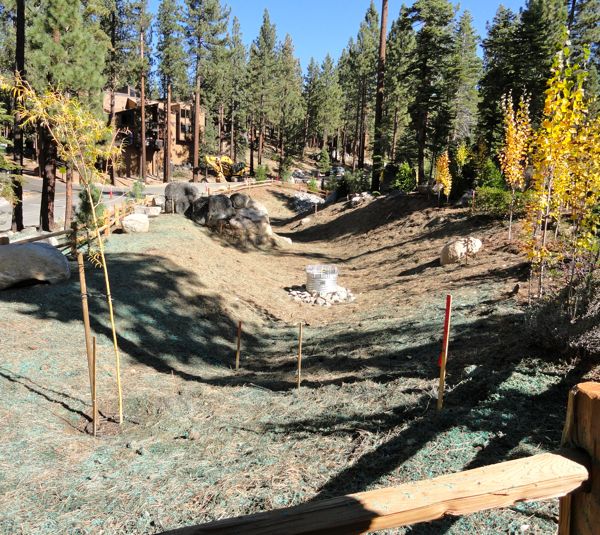
Environmental improvements are being made to Sierra Colina before construction begins. Photo/Steve Kenninger

Environmental improvements are being made to the Sierra Colina site before construction begins. Photo/Steve Kenninger

The Sierra Colina portion of the water quality improvement project (WQIP) is being paid for by the developers of the 18-acre site, Steve Kenninger and Gail Jaquish, who plan to build 41 market-rate and nine moderate-income, deed-restricted dwellings that will be Leadership in Energy and Environmental Design certified.

The private developers funded the initial $25,000 study conducted by Northwest Hydraulic Consultants of South Lake Tahoe and used by Douglas County to plan the system, and spent $250,000 for the construction of the Sierra Colina portion and will likely spend another $250,000 to maintain it. (Per agreement, the county will maintain the entire system and invoice Sierra Colina for its portion.)

The county, through an $878,600 grant from the Nevada Department of State Lands and an $876,600 grant from the U.S. Forest Service, is spending $1.76 million to design and build the rest of the WQIP. The WQIP was designed by Nichols Consulting Engineers in Stateline and built by Peek Construction, which has an office in Stateline.

“The entire project would not be as efficient or as effective if the Sierra Colina group had not decided to partner on it,” said Mahmood Azad, principal engineer/fisheries biologist for the Nevada Tahoe Conservation District and the former Douglas County engineer who is managing the project for the county. “If we’d both done separate projects, we would have spent more money and it would not be as efficient.”

With the cost of restoring Lake Tahoe clarity to 80 feet by 2025 estimated at $1.5 billion, while public funds continue to dry up, everyone from Nevada Gov. Brian Sandoval to Tahoe Regional Planning Agency Director Joanne Marchetta has been saying that the only way to achieve the clarity goal is through private-public partnerships like the WQIP project.

One obstacle, though, may be convincing private parties that the cost of such endeavors is in their best interest. The Sierra Colina project price tag, for example, was $525,000 — or more than three times the $160,000 coverage mitigation fee the developers could have paid instead.

“The TRPA code gives us two options,” Kenninger told Lake Tahoe News. “We could pay the coverage mitigation fee or create a new public water quality project if you can show you completely mitigate the runoff from the private project’s coverage.”

Kenninger said they studied the issue and found that the land, even undeveloped, was creating problems.

“The status quo was hurting water quality,” said Kenninger, and the development as planned would create an additional load.

Kenninger said he wanted to completely mitigate the load caused by the new project rather than pay the mitigation fee.

“Public-private partnerships haven’t happened before because of the cost,” Kenninger said. “We wanted to show everybody we can work together. This project is a model because future federal and state EIP funds are going away. In return, they’ll allow redevelopment to happen. And the revenue from that pays for the private contribution to treat public stormwater.”

Kenninger and Jaquish went forward with environmental improvements even though the development is tied up in court.

Azad said the county is now looking for potential other projects to work on with private parties, but that nothing has been indentified yet.

“The lesson I’ve learned from all this is it takes longer and requires more manpower upfront,” Azad said. “But it ends up being more efficient and cheaper in the end.”




Upper Truckee River scenic designation hits snag

By Kathryn Reed

It’s more about the fishing experience than anything else. That was the message delivered by proponents Tuesday to the El Dorado County Board of Supervisors during a lengthy discussion about whether the Upper Truckee River – the Meiss Meadow area in particular – should have the designation of National Wild and Scenic River.

Meeting in South Lake Tahoe for their once a year venture from Placerville, the five electeds tend to have a Tahoe-centric agenda on these days. Oct. 11 was no different.

However, at the end of the day only Supervisors Norma Santiago and Ray Nutting thought going on a tour of the new facilities at South Tahoe High School was worth their time.

A Lahontan cutthroat troat near Meiss Meadow. Photo/Dick White

A Lahontan cutthroat trout near Meiss Meadow. Photo/Dick White

But the five did work through the normal lunch hour to come to the conclusion more information is needed before a vote on the river designation will be taken. However, no date was given when it might resurface. It was already continued from September. The Oct. 11 continuance was done on a 4-1 vote, with Supervisor Jack Sweeney ready to vote no on the whole notion of the designation.

Meiss Meadow is where the Upper Truckee River begins. At 21.4 miles, it is the largest tributary to Lake Tahoe.

One thing that makes the area above the falls unique is this is where Lahontan cutthroat trout prosper.

While Jenny Hatch with CalTrout and David Lass with Trout Unlimited told the supervisors the Upper Truckee River is the only stream-based population of this fish, the U.S. Fish and Wild Service’s website says otherwise.

It’s 7.3 miles of the river that would be part of the larger 32 miles that would potentially receive the federal scenic designation. Included in the area are Round, Dardanelles, Showers, and Meiss Lakes, and other creeks in the watershed.

The U.S. Forest Service, which owns the land in El Dorado and Alpine counties that is being discussed, in 1999 determined the area met the criteria to be part of the National Wild and Scenic Rivers System. However, it takes an act of Congress for the designation to become a reality.

It would also take an environmental assessment or environmental impact statement to be done before it’s a done deal.

The Forest Service has done its part. Now it’s up to another entity to carry the torch, so to speak, to get Congress to act. The two trout groups want to be the torchbearers, but need the backing of a public agency like the Board of Supervisors to have the clout. Thus the reason for the hearing.

“We manage the area as though that designation has come through,” Nancy Gibson, Lake Tahoe Basin Management Unit forest supervisor, told the board.

After the discussion, Santiago told Lake Tahoe News, “The protections are temporary at best (for the area). Someone could say, ‘Let’s dam up the river.’”

While that is not likely to happen, with the LTBMU this winter set to release its updated Forest Plan for a 90-day review, it’s possible what is adopted could change how the Meiss Meadow area and Upper Truckee River are managed.

Four residents spoke at the meeting, with three against the designation.

Santiago, in the same post-discussion conversation with LTN, said she has more constituents than just those three who spoke.

Sue Novasel, who has a house on the river, is appalled the first she heard of the issue was at the meeting. She has experienced two fish kills on the river that no longer allow ample fishing from her back yard.

“I think less regulation is better,” Novasel told the supervisors.

Shirley Taylor, whose family once ranched a large part of the acreage being talked about, is dead-set against the proposal. She went to the September Alpine County Board of Supervisors meeting to speak her piece. The body agreed to send their El Dorado County colleagues and CalTrout a letter not supporting the scenic designation.

The trout enthusiasts believe the designation would mean being able to attract more people to the area just for the thrill of reeling in the rare Lahontan cutthroat trout. The opportunity exists today as well. The scenic designation would ensure the area is kept as is for future generations.


10,000-acre thinning project may start in 2012 on S. Shore

By Kathryn Reed

With parts of the forest near developed areas being in prime condition for a wildland fire much like in June 2007 when the Angora Fire consumed more than 3,000 acres, the U.S. Forest Service is ready to do something about that land.

Once the long-awaited South Shore Fuel Reduction and Healthy Forest Restoration Project gets under way – which could be next summer — 10,112 acres will be treated.

The 10,000-plus South Shore fuels project could begin in 2012. Photo/LTN file

The 10,000-plus South Shore fuels project could begin in 2012. Photo/LTN file

Duncan Leao, U.S. Forest Service forester, calls the wildland urban interface (this is where the forest abuts development) on the South Shore one of the areas in the basin that most needs treatment.

“It’s important work to do. We don’t want another Angora Fire. The conditions we are looking at in many places on the South Shore are conditions we saw in Angora before the fire,” Leao told Lake Tahoe News.

It will take about four years to thin the trees, with another four years for follow-up treatments. In all, it is roughly estimated to cost $40 million. The U.S. Forest Service, mostly through the Southern Nevada Public Lands Management Act, has secured three-quarters of that figure.

Before a single branch is limbed or tree felled, comments on the project will be taken until Oct. 28 from anyone who submitted a comment when the environmental impact statement was first released. If anyone files an objection to the final EIS, it triggers a 30-day resolution period.

Ultimately it is up to the forest supervisor to sign off on the document, allowing the project to go forward.

Then comes the process to obtain the necessary permits. The one from the Lahontan Regional Water Quality Control Board is the biggie.

However, Lauri Kemper, No. 2 at the regional water board, said the draft of the permit has been on hold since February 2010. But it takes more than a signature to make it valid.

California Environmental Quality Act regs are what Lahontan is going by. Lahontan officials must certify the EIS addresses CEQA concerns.

The project will involve working in stream environmental zones – that’s a main sticking point for the water board. It doesn’t mean no permit; it means a thorough review and not just taking the Forest Service at its word that the EIS is complete and addresses those concerns.

“We’re all for fuels reduction,” Kemper said.

What could hold up the project is the Lahontan board may not grant a permit until its May meeting. The Forest Service cannot go out to bid until all the permits are in place. This could delay work in what is already a limited season for thinning because dirt in the basin, per TRPA rules, can only be disturbed between May 1-Oct. 15.

A combination of mechanical and hand treatments are likely to be used.

Whether hand thinning could begin without the Lahontan permit depends on what type of permit Lahontan decides to issue. There are three possible ways it can permit the project.

Trees 16-inches and less in diameter are likely to be felled by hand, while those up to 30 inches would be taken out by machines. Most likely the process will be similar to what is being done in the Angora area in terms of the machines used. The forest pattern will be different because Angora is mostly about removing dead trees.

“A lot of hand work goes pretty quick. Then (people) would see piles. Those may last a couple years,” Leao explained. “With the mechanical you do not see as many piles because most of it is removed.”

Trails used by recreationists will either be off-limits at times or rerouted to ensure no one is hurt as the work is being done.

“It will be a combo of biomass and merchantable material — stuff that could go to a mill will depend if there is a mill nearby. The market is very difficult to predict,” Leao said. “If no sawmill is open, then contractors would have to determine what to do with that. It’s very helpful to have both biomass and saw log markets.”

The USFS decides which trees to thin first based on size – taking out the smallest at the get-go. Then the health of the tree and species are determining factors.

Jeffery and sugar pine, incense cedar and larger trees are ones Leao said the Forest Service wants to keep.

Diseased trees, including ones with mistletoe, will be on the chopping block.

“Ideally, you want a forest with multiple sizes and age classes. You can’t do that with thinning alone,” Leao said. “As we get the WUI stuff done, the forest still has an even age to it. Fire and planting trees, and other methods could be used to get it into a healthier condition. That is more long term.”

To view the South Shore final EIS, go online.


South Shore’s Measure S bond action taking place illegally

By Kathryn Reed

South Lake Tahoe has begun the process to refinance Measure S bonds without the proper authority to do so.

The city is one of three entities that is part of the South Lake Tahoe Recreation Facilities Joint Powers Authority. The others are El Dorado County and Tahoe Paradise Resort Improvement District. It would take a vote of the JPA board for the bonds to be legally changed. That has not happened. Nor is there a JPA meeting planned in the next month.

City Attorney Patrick Enright told Lake Tahoe News that John Upton told him to start the process. Upton is the lone staff member of the JPA.

John Upton and Norma Santiago have not publicly discussed refinancing Measure S bonds. Photo/LTN file

John Upton and Norma Santiago have not publicly discussed refinancing Measure S bonds. Photo/LTN file

(The JPA’s sole job is to oversee the spending of the money collected from the 2000 voter approved recreation measure.)

“I assumed John had the power to do this,” Enright said.

Upton, who did not return multiple calls, could only get that authority by speaking with the three JPA board members individually. To do that would have been an egregious violation of the Brown Act, completely circumventing the public process through an open meeting. Without a vote by the JPA board, it makes the city’s actions illegal.

Upton, who has held multiple elected positions representing the South Shore, knows what the Brown Act is and could not say he was unaware of the process.

South Tahoe wants to refinance the tax-exempt bonds and change them to taxable bonds in order to accommodate IRS rules regarding having a private operator who wants to make a profit run the city-owned ice rink.

(Measure S paid for the ice rink in South Tahoe, but as of August is has been run by a private company.)

“The contract with those guys is contingent upon this. I’m not sure what is going to happen with the ice rink,” South Lake Tahoe Mayor Hal Cole and the city’s rep on the JPA board said. “We have to adhere to the conveyance of the bond that was sold. If that means we renegotiate the contract for the ice rink, so be it.”

Debbie Henderson, Tahoe Paradise’s JPA board member, is out of the state on vacation and not reachable for comment. However, as finance manager for South Tahoe Public Utility District, she would be well versed in how the bonds work as well as public meetings.

In August, El Dorado County Supervisor Norma Santiago, who chairs the JPA board, told Lake Tahoe News she did not know enough about the bond issue to comment.

In October, she is refusing to return multiple calls to discuss the matter.

But she is aware of the issue because she has spoken to county Auditor-Controller Joe Harn about it. He referenced that conversation in a letter dated Sept. 27.

In the letter to Santiago that was copied to Cole, Henderson, Enright and Lou Green (El Dorado County counsel), it says, “I believe that it is in the best interest of residents and property owners in CFD [community facilities district] 2000-1 to pursue a tax exempt refinancing of the bonds at this time.”

Harn told Lake Tahoe News it is better for the property owners, who are mostly in the boundaries of Lake Tahoe Unified School District, for the bonds to stay tax-exempt. He said refinancing the existing bonds could create a larger pot of money for recreation needs or help pay down the debt.

“They are going to have to demonstrate to me why this is in the best interests of (residents) and I know of no benefit at this time,” Harn said of South Lake Tahoe’s desire to switch the bonds to taxable.

The city is going forward on the wrong assumption that Upton has the power to make that decision.

Enright is working with Mark Northcross, who was involved with the original bond sales.

“We have a couple proposals back. We are taking a look at those,” Enright said.

It’s possible all the hours Northcross has put into this bond action could end up being donated time because state law says he doesn’t get paid unless the work to be done was authorized by the board that has the ultimate authority. In this case, that would be the JPA board. And the board has taken no action regarding refinancing the bonds or changing them from tax-exempt to taxable.


‘Do nothing’ becomes mantra during Sausalito hotel stay

By Susan Wood

SAUSALITO – In a place where boats dominate the landscape, the fantasy of permanently drifting through life here like the ebb and flow of the tide became our weekend reality at the Inn Above Tide.

From the moment we drove in, inn staffer David greeted us with a sincere welcoming to the gated parking area. There I knew we were in store for something special. He later brought up the luggage only to ask if we’d like Champagne flutes. The attention to detail is unmatched.

Sometimes it's best just to watch the world go by from a hotel balcony. Photos/Kathryn Reed

Sometimes it's best just to watch the world go by from a hotel balcony. Photos/Kathryn Reed

In all my days of travel exploration, I have never experienced such a hotel where I’ve wanted to stay inside the whole time wrapped in a cushy robe and soft slippers with the quiet lapping sounds of the tide touching the building just below. The shore is so close one could almost treat the deck like a diving board.

It’s no wonder at least three guest service workers at this 15-year-old independent boutique hotel warned us of others who show up but never leave the room. (If you do find yourself out during the day, like we did to bike across the Golden Gate Bridge, here’s a lunch tip: Get it to go at the Venice Gourmet Deli to enjoy on the balcony. We opted for pasta salad, marinated mushrooms and a veggie sandwich – one of five on the menu).

The next day, we didn’t go out until 2:30pm, except to drop one floor for a feast of quiche, fruit, muffins, bagels, coffee and fresh-squeezed orange juice in the common area for breakfast. A woman from Los Angeles who comes every year calls the inn “paradise.” The next morning, I brought a breakfast tray to our room to dine on the balcony.

Although the inn starts the day with a list of possible activities, why bother leaving the room? The view from the private deck or even from the bed is beyond mesmerizing. That’s why the inn provides binoculars as an added perk. The balcony above the bay by the ferry dock in this Marin town became my favorite space. The Bay Bridge is within view, along with Angel Island, Belvedere and across the bay to San Francisco. All 29 rooms come with this view and a private deck equipped with teak patio furniture. It’s an ideal setting for breakfast and lunch or even dinner as the lights of San Francisco come on. If there’s a nip in the air, a flick of a switch ignites a gas fireplace and an oversized tub can warm up the inner self.

We slept with the slider open all night. Seagulls, foghorns and boat motors are further reminders of the marine environment by day and night.

In the evening, the inn serves an ample supply of wine and cheese.

A friendly chat with Chuck from Boston reinforced the idea that this is a place for special occasions. He and his wife were celebrating their 50th wedding anniversary.

And for special occasions, it’s highly recommended a guest bring a furnished wallet. Ten rooms start at $320 a night and go up to $1,100 a night for the penthouse suite.

An unusual complimentary amenity is bicycles to use for exploring.

For a fee, a guest may order in-room dining through Room Service of Marin (in keeping with the never-leave theme) and a private in-room massage and other spa services (for enhancing the relaxed mood). We opted to head down the street to the Casa Madrona’s new remodeled spa, which the Inn recommends for a full service facility.

If you go:

The Inn Above Tide is located at 30 Portal in Sausalito off Bridgeway Avenue near the ferry docks. The hotel may be reached by calling (415) 332.9535 or 800.893.8433, or go online.

ngg_shortcode_0_placeholder (Click on photos to enlarge.)


South Tahoe remembers a fallen soldier — Garrett Fant

By Linda Fine Conaboy

U.S. Army Spc. Garrett Anthony Fant died Sept. 26 from injuries when he stepped on an improvised explosive device while on duty in the Helmand Province, Afghanistan. He was born May 11, 1990, and was 21. In March 2009 he enlisted in the Army, assigned to the 4th Squadron, 4th Cavalry Regiment, 1st Heavy Brigade Combat Team, 1st Infantry Division out of Fort Riley, Kansas. He was on his first deployment. On Oct. 7 he was buried.

How many times throughout history have words like these been written or spoken of those in the military and how many families like Fant’s have had to receive his body, make burial arrangements and finally, lay him to rest?

Garrett Fant

Garrett Fant

Most of the 85 plus people gathered in the Sierra Community Church on Friday had a close relationship with Fant. There were grandparents, there was his mom Julia Farrell and his dad John Fant. His brother James Keough and sister Shanna Askins were there as well as his uncle and several friends. All speaking eloquently of the young man so recently dead, who they say, would not be deterred from the siren call of the Army.

Outside, a cadre of men, most belonging to various motorcycle groups, stood in a two-row formation as if to guard this young man. All of them standing tall and holding large American flags as his casket was wheeled into the church and again as it was wheeled out and placed carefully into a waiting hearse. The respect they felt for him and his service was palpable as they stood there in the cold morning sun, silently honoring him.

There were police, firefighters and many in uniform representing various branches of the military. All came to say goodbye to U.S Army Spc. Fant.

Judging by the stories told — some humorous, many heartbreaking — Fant was a rough and tumble boy who had no other career goal than to enlist. He had no doubt what his life’s calling was – Army all the way. He told his best friend that after about 40 years in the Army he wanted to become a teacher.

Now in death it will be lessons of bravery he will teach.

His sister and brother said he went into the service a young boy and when he came back to celebrate his 21st birthday he had become a man. Now, they said, he’s a hero. His sister said of Fant that he had the ability to make people laugh; what she called belly aching laughter. Askins once asked him if he was scared, and he replied simply, “Sis, I’ve got a job to do.”

Garrett Fant was laid to rest Oct. 7 at Happy Homestead Cemetery in South Lake Tahoe. Photos/Linda Fine Conaboy

Garrett Fant was laid to rest Oct. 7 at Happy Homestead Cemetery in South Lake Tahoe. Photos/Linda Fine Conaboy

Many shared that Fant was a humble man, non-judgmental and proud of what he was doing. According to his brother, he stood tall, literally (he was well over 6 feet) and always looked up to his older brother. In truth, Keough said, “I always looked up to him.”

His best friend said he and Fant played army everyday when they were kids growing up together in South Lake Tahoe. “We were a couple of hellions,” he said.

Brig. Gen. Randy Dragon presented many medals and commendations to Fant’s parents. Among them were a purple heart, the good conduct medal, the Afghanistan campaign medal with one campaign star, the Global War on Terrorism service medal, NATO medal and several others. As the brigadier general draped special dog tags around each parent’s neck, his eloquent thanks were deep sobs and grieving hugs.

Dragon said Fant was the best marksman in his unit of more than 1,000.

“He lived with duty as his watchword,” he said.

He too alluded to Fant’s sense of humor as he told of his recent Facebook post: “You can’t spell infantry without Fant.”

It’s hard to believe that this young man was so recently a dynamic force in the armed forces, doing what he needed to do in Afghanistan. Now he’s come home to South Lake Tahoe, as his siblings said, a hero.

A burial service followed at Happy Homestead Cemetery.

Donations may be sent to the Fisher House Foundation.


DA: Fallen Leaf Lake voter fraud a case of poor judgment

By Jessie Marchesseau

In January 2010, there were 158 registered voters in the Fallen Leaf Lake Community Services District. By August 2010, that number had grown to 461.

This flood of voter registrations was spurred by political turmoil in the area. However, such a significant increase in voters over such a short period of time does not go unnoticed. A voter fraud investigation was opened by the El Dorado County District Attorney’s Office and the California Secretary of State’s Office.

It's a new day for voters at Fallen Leaf Lake. Photo/LTN file

It's a new day for voters at Fallen Leaf Lake. Photo/LTN file

Much of the political divide within the Fallen Leaf Lake CSD revolved around the replacement of longtime Fallen Leaf Lake store and marina operators John and Ruth Rich. Even though the board of directors voted unanimously to replace the Riches on two occasions, the community was sorely divided. In July 2010, residents petitioned for a recall election to replace two of the board members. The recall election was approved, and voter registrations started pouring in.

When the small district whose voter registration numbers generally hover somewhere around 100 to 150 voters quickly jumped to more than 400, red flags went up at the El Dorado County Elections Department. The elections office alerted the Secretary of State’s Office, which in turn alerted the El Dorado County District Attorney’s Office.

An investigation was launched that lasted just more than a year and identified felony voter fraud. The determination was that many of the voters who voted in the August 2010 election were not legally eligible to vote in the Fallen Leaf Lake Community Services District. Some were ineligible because Fallen Leaf Lake is not their legal domicile, and some were registered to vote in more than one district.

On Sept. 19, 2011, District Attorney Vern Pierson issued a letter to every voter registered at the time of the August 2010 recall election outlining the department’s decision in the matter.

The letter states, “This investigation revealed that improprieties had in fact occurred, and were criminally subject to prosecution as felony-grade offenses. Largely because the acts appear to have been precipitated by poor judgment, some misinformation which was circulating in the community, and a failure by some to accurately and fully appreciate the requirements of the pertinent law, this office has determined to decline prosecution at this time.”

While the fraud findings do not negate the results of the election in question, the letter goes on to say that any similar future violations will be prosecuted.

Pierson said he declined to prosecute because he saw no malicious behavior on the part of the voters, and attributed the fraud to negligence and misunderstanding of the law.

This type of issue comes up from time to time in areas with a lot of vacation homes, he told Lake Tahoe News. What it essentially boils down to is where a person’s domicile, or primary residence, is. Voters are entitled to vote and hold office where they intend their domicile to be, and only in that place.

The El Dorado County Assessor’s Office lists 289 land parcels in the Fallen Leaf Lake area, some of which are vacant land, commercial property and U.S. Forest Service cabins. The official list of voters from Aug. 10, 2010, lists some addresses as having five, six and seven voters registered at a single address.

With only about a dozen people living at Fallen Leaf Lake full time, this prompts the question that if only people who consider Fallen Leaf their primary residence can vote and hold office, would the entire district be run by that handful of people?

This quandary has left homeowners with the task of trying to figure out how to effectively and legally run their community. One idea being considered is allowing a set number of votes per parcel.

As for the election coming up in November, Fallen Leaf Lake CSD does not have anything slated for the ballot, but the registered voters will be receiving ballots for Measure R, Lake Tahoe Unified School District and Lake Tahoe Community College. The next scheduled election will be June 2012, leaving residents some time to find a solution.

In the meantime, however, the El Dorado County Elections Department has also issued a letter to Fallen Leaf Lake voters reminding them of registration regulations and the district attorney’s decision on the matter, as well as providing instructions on how to remove themselves from the voter list.

As of Aug. 8, the number of registered voters in the Fallen Leaf Lake CSD was down to 267.


Peace Corps allows STHS graduate to help others

Publisher’s note: Michelle Aguilar is one of three 2005 South Tahoe High School graduates who joined the Peace Corps upon college graduation. As it gets close to their return date, each will share with Lake Tahoe News readers their thoughts about the last two years.

By Michelle Aguilar

BUENA ESPERANZ, Panama – You know that “talk” most grandparents get to give their grandchild? The talk where they get to say how rough they had it compared to the seemingly effortless and uncomplicated lifestyles of their grandchildren. It usually starts when the child is whining or complaining about how tough their life is. That’s when the grandparent gets the opportunity to chime in with some words of wisdom, typically starting with “well when I was young …” fill in the blank. I think you know what speech I am talking about.

Now, how many people in my generation, “Gen Y”, will be able to give this insightful and intuitive talk to their heirs? Or maybe it will be that they will just fill in the blank a bit differently. Instead of talking about how far they had to walk in the snow, barefoot, both ways, they may fill in the blank with something like “when I was young, Twitter only gave us 140 characters, and the iPad only offered 60,000 apps, and we had to watch our movies with only three dimensions.”

Michelle Aguilar will return to South Lake Tahoe later this year after completing her commitment in the Peace Corps. Photos/Provided

Michelle Aguilar will return to South Lake Tahoe later this year after completing her commitment in the Peace Corps. Photos/Provided

Well, my grandchildren will be hearing a different story.

I lived in rural Panama, working as a Peace Corps volunteer in a remote Ngobe indigenous village named Buena Esperanza, accessible only by boat. I have seen and experienced true poverty firsthand for 27 months.

I lived in the heart of the village and my daily life was much like theirs. I practiced a minimalistic lifestyle. I lived without running water and electricity. I survived without a car, or any personal form of transportation other than the dugout canoe that took me only as far as I could row it.

I have gone without Internet for months at a time and I lived in a place where only the sun controlled my sleep pattern.

However, I did not join Peace Corps just so that I would have a good story to tell my grandchildren. I joined because I truly believe the proverb: “Much is to be expected from those to whom much has been given.” So, really, Peace Corps was just another way for me to advocate that in my personal life.

My main project in Buena Esperanza was a clean water project. Together with my community members we engineered appropriate technology to bring clean, potable water to the community. We solicited and received funds from Rotary International, a local governmental organization and other private donors. Community members were trained in construction methods adapted to the community’s resource availability and maintenance techniques, emphasizing low-cost designs and the use of local resources.

Together we installed 38 water catchment systems and one clean water well which directly benefits more than 500 individuals. This provided them with clean, potable water for the first time in their lives.

I aided in the creation of a comprehensive and culturally appropriate educational program and training manual on the maintenance and use of the water system to ensure its sustainability.

I also worked closely with the women’s artisan group in my community, acting as a motivator and small business consultant. Together we worked on various fundraising, budgeting and forecasting techniques, which resulted in their ability to finance their own artisan house for the production and sale of their products.

My days were also filled with more informal secondary projects including English classes, literacy projects, Girl Scout meetings and painting maps. Since most of my community members had never been farther than 30 miles from their homes and have little access to information, I found myself facilitating many informal discussions, usually sparked by photos from National Geographic magazines, about political, historical, cultural, geographical and scientific issues regarding “the outside world.”

So, now that I am at the end of my Peace Corps adventure, what do I think? I say what most returned Peace Corps volunteers would say: that I have learned and received so much more than I have taught or given.

I realize now that serving as a Peace Corps volunteer is unlike any volunteer or life experience I have had prior, and may every have again. The Peace Corps experience is about human connection, about giving a community hope, teaching them new skills and above all, helping them to help themselves. It is not about bringing in aid, dropping it off and waiting until they need it again. It is about working one-on-one or little by little to reach a goal. It is about taking time. The Peace Corps experience is about truly immersing yourself in another culture to figure out together what is right for them. Peace Corps is about working yourself out of a job (i.e. development work).

As my time here in Panama comes to an end, I am able to reflect on and appreciate all I have been given during my Peace Corps service. Most of all, I am thankful that I have been given the opportunity to see and experience the way the majority of the world’s population lives. I leave Panama with a new appreciation and outlook on life.

As hard as it is to leave and say goodbye, I feel like I am ready. I am ready to move on to the next chapter in my life, and I am definitely ready to get back to Tahoe’s mountain air. Once I leave Panama, I plan on traveling through Central America. But I will be back in Tahoe for the holiday season, with my plans after that are still undecided.

Thank you for your support during my few years abroad. I am looking forward to seeing some familiar faces when I get home.

For the full account of my time in Peace Corps Panama refer to my blog.

ngg_shortcode_1_placeholder (Click on photos to enlarge.)


South Lake Tahoe passes sign ordinance on 3-2 vote

By Kathryn Reed

Unable to compromise, Tom Davis and Bruce Grego voted against the latest version of South Lake Tahoe’s sign ordinance.

Still, it passed with a 3-2 vote. This was the first reading, with the second likely to be at the Oct. 18 meeting. Then it becomes the law 30 days later.

Tom Davis wants a broad sign ordinance -- a change from seven years ago. Photo/LTN

Tom Davis wants a broad sign ordinance -- a change from seven years ago. Photo/LTN

One of Davis’ issues is wanting any color of decorative lights, not just white or blue as had been proposed. To this, his colleagues agreed.

What the majority would not agree to were allowing sandwich board signs to be used anytime and for the council to hear appeals instead of planning commissioners. Those were sticking points for Davis and Grego.

Davis hasn’t always had this free spirit about signs.

In April 2004 when he was on the City Council he said, “I’m trying to strike a balance, but we don’t want it to look like little Tijuana.”

On Oct. 4 he said, “I believe in free enterprise all the way. I want to give businesses as many advantages as possible.”

While much of the discussion this year during the laborious sign discussions has been about how difficult the economy is now and that businesses should be allowed to do what they can to attract customers, this same argument has been made for years.

In April 2004 when the economy was humming on the South Shore, Hal Cole made that same desperate argument. At a meeting seven plus years ago he said, “I want to visually upgrade our corridor. But on the other hand, I know how tough proprietors have it to make a living in this town.”

With the Tahoe Regional Planning Agency having sign regulations on the books since 1998, the city and five counties in the basin must abide by it or create stricter rules. South Tahoe has been going back and forth, with each council coming up with its own version and enforcement never existing.

While staff says enforcement is coming – that’s always been said.

This is not the first time Grego has been on his soapbox about the council needing to have the last word. Councilwomen Claire Fortier and Angela Swanson along with Cole said the planning commissioners are more than capable of ruling on whether a business is complying with the sign ordinance.

Grego tried to do a bit of horse-trading with his colleagues to get what he wanted, but the three stuck by their convictions. Grego said he really wanted a 5-0 vote. The majority said they were good with the motion as presented that eventually passed.

In other action:

• Grego asked for an item to be put on a future agenda to discuss taxing Heavenly Mountain Resort. Cole said he’d agree to a broader discussion about the cost analysis of having Heavenly and other businesses pay for their share of fire costs and wear-and-tear to roads. Eventually, it was decided to have the Fiscal Sustainability Committee, which has yet to be tasked with any homework, to look into the issue. This group next meets in three weeks.


Clubs provide safe place for South Shore’s LGBT students

By Shannon Early

In August, a private college in Elmhurst, Ill., announced it would include a question on applications about whether a prospective student identifies with the LGBT community. If applicants answer yes, they might be awarded an Enrichment Scholarship which could cover up to 40 percent of Elmhurst College’s tuition. The question is designed to promote acceptance on Elmhurst’s campus, as well as to diversify the student body and to enrich students’ lives.

allyThough Elmhurst is seemingly the first to directly inquire about a student’s sexual orientation, it is not the first to award scholarships based on the LGBT community, nor is it the first campus to welcome diversity.

Last year, Friends of ALLY, a LGBT club at Lake Tahoe Community College in South Lake Tahoe, awarded $750 worth of scholarships to students based on essays they submitted related to lesbian, gay, bisexual or transgender issues. The scholarships were open to any student who wanted to share his or her coming out story or an experience with a friend or family member who identifies as gay or lesbian.

Chris Sidell, president of Friends of ALLY, said the scholarships this year will be of equal value so a non-LGBT student would receive the same amount as a LGBT student. He said the scholarships help students make a connection with the club who may not normally seek out the club for support.

Lisa Shafer, adviser for Friends of ALLY, said the club, as well as scholarships, should be open to all students, not just those who identify with the LGBT community. In addition to providing scholarships, Friends of ALLY will begin to offer peer support once a month and strengthen its bond with the ALLY club at South Tahoe High School.

Shafer said the club is welcome to people who “want to be a part of social justice and equality for all.”

Friends of ALLY was founded last year, while STHS’s ALLY club is in its seventh year

STHS recently hosted a guest speaker who spoke about HIV in front of 100 students. Nearly every class at STHS bears a “Safe Zone” poster on classroom doorways and every Thursday is “ALLY Day”, where staff wears ALLY T-shirts to remind students they are in an environment free of harassment.

STHS instructor and adviser Bridey Heidel said the club was not always welcome. A bulletin board covered in ALLY flyers and messages outside of her classroom was torn down and vandalized the first few years. But this year the billboard remains unscathed from hateful words or actions.

“We don’t really work to change anyone’s opinions because I don’t really think you can. I just work to protect the children and I hope that they feel comfortable as they graduate going out into the community,” Heidel told Lake Tahoe News.

Both clubs have been successful in recruiting members and fundraising for special events and trips. More than 100 people signed up for Friends of ALLY within three days. And the club hosted a widely successful dance last winter. ALLY participates in Winterfest – the gay ski week – and has gone to the Queer Youth Advocacy in Sacramento to instruct students how to lobby for their cause.

Overall the clubs have received positive feedback for their work from the community and schools.

Shafer said she has met amazing people since becoming adviser of Friends of ALLY and from the looks of the first meeting members want to support an important cause but also have a good time. Shafer believes the students deserve all the credit for the group.

“It’s their lives. It’s their stories,” she said.

The next event hosted by Friends of ALLY will be a Back to School BBQ on campus on Oct. 11 from 11:30am-1pm.

Tahoe Pride may not be affiliated with an institution, but with its nearly 600 friends on Facebook it attempts to connect the LGBT community in Tahoe.

Dawn Harkins, one of three creative members of Tahoe Pride, said the group supports ALLY and Friends of ALLY and hopes to interact with them more in the future. The group hosts mixers and events throughout the year.

Tahoe Pride’s mission statement is: “Tahoe Pride is a safe, welcoming place for LGBTQ people and their friends, a place to build a strong community while forming lasting friendships. We build community by organizing a variety of social, cultural, and outdoor activities where we promote equality and respect toward each other. We are committed to diversity and are open to all: men and women; straight and gay; couples and singles. Tahoe Pride and its friends care strongly about equal rights. We strive to promote tolerance, education, and communication about issues that affect our community through being active and visible in the community in which we live. As we grow we are taking steps to form a board and move forward in our vision of providing programs and services that benefit the LGBTQ community and their friends.”

Their next monthly mixer is Oct. 11 from 6-9pm at Murphy’s Irish Pub. The mixer coincides with National Coming Out Day.

While the LGBT community mostly considers Elmhurst College’s inclusion of a question about sexual orientation a positive step, Shafer and Heidel agreed all underrepresented groups deserve opportunities to earn scholarships. As evidenced by the work of groups in town, the LGBT community is working toward an atmosphere accepting of all lifestyles.

For more information:

LTCC Friends of ALLY Club Facebook page

STHS ALLY Club Facebook page

Tahoe Pride Facebook page