Lahontan: Lake clarity at any cost, no matter what

By Kathryn Reed

More than one billion dollars — $1,000,000,000 – is what has been spent on the environmental improvement program in the Lake Tahoe Basin. The goal is to increase lake clarity.

Clarity is not declining as rapidly as it once was, but it’s still declining each year. That makes the programs winners, according to Lahontan Regional Water Quality Control board members and staff.

And Executive Director Harold Singer readily admitted at the Dec. 6 Lahontan board meeting that nothing his agency has made entities do can definitively be said to have improved that clarity.

El Dorado County Supervisor Norma Santiago, center, addresses the Lahontan board Dec. 6 while her board stands next to her. Photo/Kathryn Reed

He said he’s often asked by money suppliers – the federal government in particular – what they are getting for their money. He points to projects.

“We’ve never been able to quantify those actions as they relate to water quality,” Singer said.

The EIP program started after then-President Bill Clinton’s visit to Lake Tahoe in 1997 – hardly the Dark Ages when it comes to scientific know-how.

It is just now that Lahontan believes it has developed the tools to quantify how projects impact lake clarity.

On Tuesday, the Lahontan board on a 5-0 vote (Keith Dyas was absent and three board positions remain vacant) agreed to approve the stormwater-urban runoff permit system for South Lake Tahoe, El Dorado County and Placer County.

The board didn’t see any point in extending the process — despite the passionate pleas of the three jurisdictions. While in some ways the process has been lengthy and years in the making, the comment period closed Nov. 30 — less than a week before the board voted.

It’s through the permitting process that Lahontan will monitor projects on the California side of the basin.

But it was also said by board member Amy Horne to the three jurisdictions, “If in 2016 we don’t see the level of improvement we expect, it’s not your problem.” (That is the year the five-year permit expires, though the program continues, and permits will need to keep being acquired.) In other words, if that occurs, fine sediment won’t be the culprit after all.

Sediment reduction is what the city and two counties are tasked with. Regulators in the basin all say the majority of fine sediment clouding Lake Tahoe is from urban runoff.

But there is more than just particles reaching the lake.

Horne said weather is an uncontrollable factor in all of this. The more snow, the more runoff, thus the cloudier the lake gets. Droughts provide for the best clarity readings.

Midway through the 4½-hour meeting at Embassy Suites, Brendan Ferry, senior planner with El Dorado County, explained how his jurisdiction believes its measuring tools are superior to Lahontan’s.

While the permit allows the jurisdictions to use other tools, Lahontan must approve those tools. But no one could give the multiple speakers for the county an answer as to how it will be determined if their tools are legit, and if a decision will be made so the first deadline of March 15 to provide Lahontan with mandated information can be met.

The county is so incensed with what is going on that the Board of Supervisors recessed their regular meeting for all to attend the Lahontan meeting. As Supervisor Norma Santiago read the prepared statement, her colleagues flanked her in a show of support not usually seen.

“What has been created in the TMDL Management System are tools that lack scientific backing, that are not integrated, are duplicative and/or inefficient and will require tremendous administrative staff time to analyze and implement,” Santiago said.

She went to say, “If you go through with the draft permit today, the predictable result for the county, because of these unnecessary administrative costs, will be layoffs in the transportation department, roads will not be fixed in compliance with the requirements and we may be forced to do very little toward our common goals.”

Money is a big issue for the jurisdictions. It could cost up to $2 million a year to do what Lahontan is asking. Federal money is evaporating. No one knows how the requirements will be implemented without cash to do so.

Lahontan staff has told Lake Tahoe News the Total Maximum Daily Load and now the stormwater permit are not unfunded mandates. But when someone or an agency is told they must do something and no money is provided to do the mandate – that makes it an unfunded mandate.

Ken Grehm, director of Placer County Public Works Department, said he’s been disappointed how Lahontan staff repeatedly say money can’t be an issue. He added that if any useful discussions are going to happen in the future, there must be the realization money is important.

“Water quality is just one of the services we provide,” Grehm said. This sentiment is shared by all jurisdictions.

Lahontan board member Don Jardine, who is also on the Alpine County Board of Supervisors, understands shrinking budgets. He didn’t use the phrase “unfunded mandate” but at the end of his remarks he ultimately said, “things have been put on us that we have to do.”

It’s the federal Environmental Protection Agency that is responsible for the TMDL program throughout the country.

Jacques Landy, who works for the EPA out of an office in the TRPA building, told the board his agency is satisfied with the permit as written and voiced support of its approval.

Sarah Hussong-Johnson, South Lake Tahoe director of engineering, echoed her colleagues in questioning Lahontan’s tools and the money needed to satisfy the permit.

(Hefty fines that could not be articulated well at the meeting will be levied against the jurisdictions if they don’t satisfy the permit requirements.)

Hussong-Johnson also said the city is frustrated with the “lack of a concerted effort with the near shore.”

This is where the growing muck and marked lack of clarity is visible standing on the beach. This isn’t the clarity that is measured. If it were, the numbers would be worse. Instead, a disc that looks like a white dinner plate is lowered into the water from the middle of the lake. That’s how the experts determine lake clarity.

————–

The Lahontan board resumes its meeting this morning at 8:30 at Embassy Suites. The main topic is pesticide use.



Financial cracks emerge in South Tahoe ice rink deal

By Kathryn Reed

Even though the South Lake City Council in August voted to change the recreation bonds from non-taxable to taxable to allow the private ice rink operators to legally make a profit, the board with the ultimate power to ensure that happens didn’t have its first meeting about the issue until Monday.

And now it’s a race to get the legal, financial and political agreements in order so the bonds are sold before March 1. Changes can only take place March 1 and Sept. 1 – the debt payment dates.

Discussion was delayed by Measure R proponents (aka the JPA board) because they did not want voters last month to confuse rewriting the original Measure S to allow a different disbursement of funds with changing the actual bonds. The two are completely separate issues.

The recreation JPA board (Hal Cole-Norma Santiago-Debbie Henderson) listen to county Auditor Joe Harn. Photo/LTN

But not trusting the voters to understand the difference has created this accelerated pace to not only refinance the bonds, but to make them taxable.

Even though Dec. 5 was the first time the JPA board officially heard the proposal, the financial advisor who was officially hired that same day is already on the Dec. 13 agendas for the South Lake Tahoe City Council and El Dorado County Board of Supervisors.

While there is no proving meetings occurred between John Upton, the lone paid employee of the South Lake Tahoe Recreation Facilities Joint Powers Authority, and the three board members, Hal Cole (South Lake Tahoe rep), Norma Santiago (El Dorado County), and Debbie Henderson (Tahoe Paradise Resort Improvement District) seemed well versed about the issue. Had Upton spoken to each member individually, it would be considered a serial meeting and thus a violation of California’s opening meeting law. The public’s business is supposed to be conducted in public.

With Cole showing up 35 minutes late – saying he didn’t know about the meeting until someone called him when he was a no-show at 1pm Dec. 5 and that he hadn’t seen the agenda – he was the most adamant the financial advisor be paid a fixed price over the discounted hourly rate that was proposed at the meeting.

Mark Northcross with Northcross-Hill-Ach in Marin County was the financial advisor in 2001 when bonds for the South Shore recreation measure were first sold. He’s the guy being used this time, too.

Northcross told Lake Tahoe News he was first contacted by Upton this summer. Northcross said he is the one who brought up the issue of the IRS having a problem with a private entity making a profit off tax-exempt bonds and that they would need to be changed.

The board on Monday agreed to hire Northcross on a $37,500 contingency fee. This means he only gets paid if the bond sale goes through. Stradling, Yocca was hired as bond counsel at $50,000 under the same contingency agreement.

However, County Auditor Joe Harn told the board the county shies away from these types of agreements, and instead opts for time and materials contracts.

“The fewer people who have a financial interest in the bond closing, the better,” Harn said. Harn is also the JPA’s treasurer.

Cole said he prefers knowing what the cost will be upfront; believing the financial advisor will operate within set parameters (that will be decided at the Jan. 20 JPA meeting) and therefore the JPA has no risk involved.

However, Northcross at the meeting said his excitement for being back in South Tahoe made him want to reduce his hourly fee. Normally it’s $300/hour. He said he’d charge $275/hour, with a cap of $15,000. The cap, he later told Lake Tahoe News, could then be negotiated if more work were needed.

Despite this offer of a reduced price, the JPA board didn’t even discuss it, nor did the members do any math to figure out how many hours might be needed to do the job and what the better deal would be. The JPA was more concerned with knowing the price than getting the best price.

South Lake Tahoe’s city attorney, Patrick Enright, and finance director, Christine Vuletich, were in the audience. They didn’t offer any advice.

Northcross and Harn had a brief conversation while waiting for Cole to arrive – knowing they were within earshot of this reporter. Northcross said to Harn that while refinancing may save 3 to 4 percent, or $15,000 annually, many in his field say not to go forward until the benefit is 5 percent. He didn’t share that with the JPA board.

The current interest rate on the bonds is a bit more than 5 percent.

All of this work could save property owners about 75 cents a year on their $18 bill for Measure S/R.

But City Manager Tony O’Rourke followed Harn at the podium, saying it’s not just about the JPA taxpayers to consider.

“We want to enable private investment at the ice rink – that benefits the taxpayer,” O’Rourke said. With the city losing $100,000 on the rink in some years, it wanted to unload it, even though taxpayers paid for it through Measure S property fees.

The JPA board also agreed to allocate up to $15,000 to have a current bond rating secured – a necessary requirement to go forward. The last rating was AA-minus. That money comes out of the JPA’s administrative budget – though it’s still taxpayer money.

Another big question mark is what entity will sell the bonds. Northcross said going with BBVA Compass bank might be the best option instead of the traditional bond market.

Northcross pointed out that depending on what deal is struck, it’s possible the city will have to come up with $400,000 to pay down the debt in order to make it all work. There are certain legal requirements with reissuing the bonds and the taxpayers not incurring a financial burden.

O’Rourke said if it came down to that, “We’ll have discussions with the operator (of the rink).”

If there is a buy down cost, that wouldn’t be known until February – which would leave only a matter of days for the city to come to a deal with the ice rink operators.

And if the city is left footing the bill, that would be those same taxpayers incurring the costs that O’Rourke said are saving money with the ice rink not being controlled by the city.

“We wouldn’t be here if the ice rink contract weren’t a problem,” Cole said early in the meeting.

——————–

Dates to know:

• Dec. 13: South Lake Tahoe City Council and El Dorado County Board of Supervisors at their respective meetings hear presentation from Mark Northcross

• Jan. 17: South Lake Tahoe and El Dorado County discuss and vote on legal documents and official financing

• Jan. 19: Tahoe Paradise board votes on legal documents and official financing

• Jan. 20: JPA board votes on legal documents and official financing

• Feb. 28: Bond sale expected to close.


House engulfed in flames — all to train firefighters

By Kathryn Reed

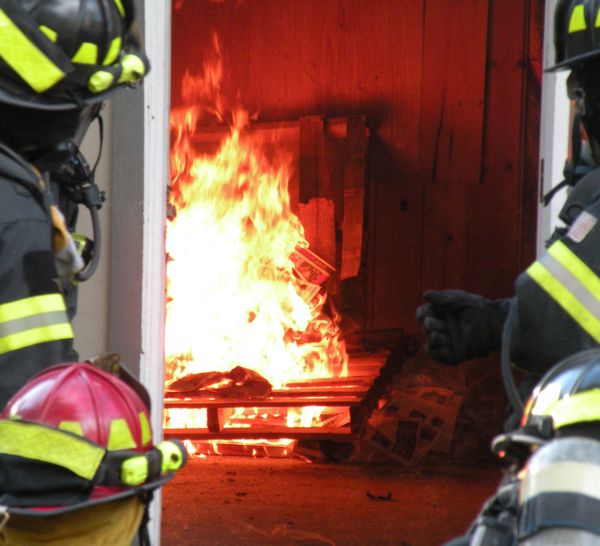
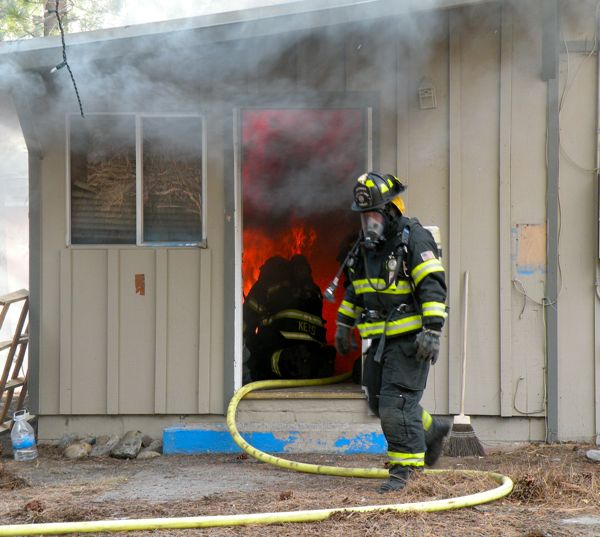
Smoke fills the air. It’s hard to see. Flames all around. It doesn’t matter. No time to think; just time to instinctively react. Someone up the narrow stairs is injured. It’s going to take careful maneuvering to get them out of the engulfed house on a gurney.

Situations like this happen all the time throughout the world. In South Lake Tahoe it happened twice last week and is expected to again later this week.

It’s all about training.

A house on Third Street near the corner of South Avenue is being used by South Lake Tahoe and Lake Valley firefighters as live fire training. Barton Health recently acquired the tiny structure with the intention of demolishing it. (It’s a short walk to Barton Hospital from the property.) The South Lake Tahoe Fire Department negotiated a deal to use it for training, with the end result being less debris for Barton to be responsible for hauling away and area firefighters more ready for a real structure fire.

South Tahoe firefighters use a house on Third Street for training. Photos/Sallie Ross-Filgo

“There are some dangers associated with this sort of training, but it’s important to do it in a controlled way so they can gain some experience, feel some heat, so to speak, and overcome whatever challenges are associated with it so when they encounter the real deal they will be able to think more clearly and operate at maximum capacity,” Fire Chief Brian Uhler told Lake Tahoe News.

Firefighters are required to always be training, but the high-risk, low frequency emergency situations like fires, and water and rope rescues are more difficult for a small department to train for. This is because with only three shifts it’s not possible to take one off duty for training and have the others cover. That scenario works in metropolitan locations.

And until recently the command structure within the city’s department did not put an emphasis and priority on real-world training.

When Uhler took over in August he met one-on-one with firefighters as well as in group settings.

Firefighters discuss how best to approach the live fire.

“One question I asked was, ‘When was the last time you deployed from the station and went to and actually put a fire out during a training session?’ I got some blank looks and answers like ‘never’. I asked how long they’d been here and some said five years,” Uhler said.

Thus began a new era within the South Lake Tahoe Fire Department.

But part of the sparse real fire training had to do with logistics as much as higher ups. Plus, lack of a training facility and no overtime are other hindrances to getting ample time in.

While Lake Valley has an extremely old burn tower at its station on Highway 89 in Meyers, it’s not the same as a house. Carson City has a training site that uses propone, so the flames can be turned on and off. But that does not give firefighters the same feel as being in a room to watch and feel how fire behaves, builds and refuels.

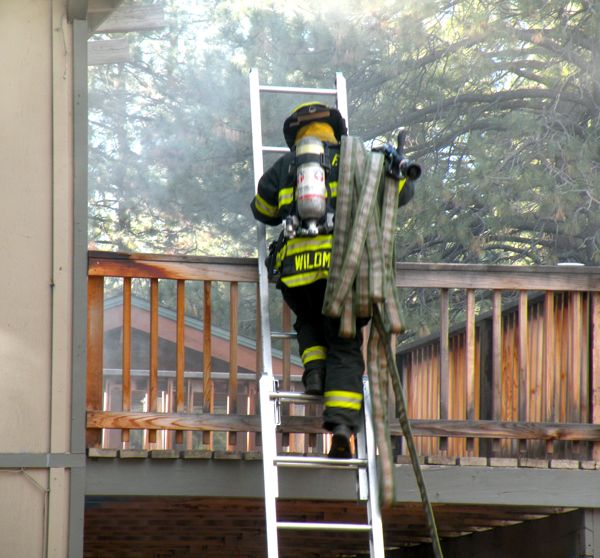
A firefighter drags a hose to the second floor balcony.

Jim Drennan, who was is one of three South Tahoe fire captains to be promoted to shift commander, is now in charge of training for the city’s troops.

“The formula in my perfect world is to have the resources and funding to have a true training facility nearby and take one engine company out at a time and send them to the training tower,” Drennan said.

While he recognizes that perfect world is not going to exist anytime soon, he plans to actively seek more structures to burn for training purposes. Plus, it’s cheaper for owners to have firefighters burn it to the ground compared to having a demolition team haul away the debris.

Of course there are a ton of hoops to jump through to do something like this – permits from the Tahoe Regional Planning Agency, Air Resources Board and others. The Barton house had to be certified not to contain asbestos before it was ignited.

In the past, South Tahoe has coordinated with Tahoe Douglas firefighters to train to extinguish a high-rise fire. Wildland training has been done in conjunction with Tahoe Douglas, Lake Valley, U.S. Forest Service, CalFire and CalStar.

With the house on Third Street, firefighters are cutting holes and doing ventilation work before the fire is set. Then, as flames roar, the men and women sling hoses over their shoulders, dragging them to the second floor – all to get used to what that’s like fully suited up, oxygen masks on and heat intensifying.

“There have been some learning opportunities, some corrections were made in how things were done,” Uhler said.

To that end he says the training has been a success.

Next up is for the third shift to get its turn at training – that will be Dec. 7 or Dec. 8.


8th-grader eager to use her voice to prove she’s got talent

By Kathryn Reed

At 13, Stephanie Hernandez doesn’t have the life experiences to write lyrics about the angst of a woman scorned, but she does have the voice and conviction to deliver the words for the world to hear.

The South Tahoe Middle School eighth-grader will be traveling to Anaheim next weekend to audition for “America’s Got Talent” – the popular NBC television show now in its sixth season that features potential stars competing in song, dance, comedy, juggling, magic and other talents. The end prize is $1 million.

Stephanie Hernandez

Hernandez recorded Christina Perri’s “Jar of Hearts” for her demo tape and plans to sing Carrie Underwood’s “Before He Cheats” at the tryout Dec. 11.

Considering Perri got her break performing the single on “So You Think You Can Dance” and Underwood won “American Idol”, Hernandez may be smart in picking music from established female television winners.

Excitement – at least on Friday – filled her more than nerves or butterflies. She admits that may all change in a week. While Hernandez considers the stage her friend, this audition will be the biggest stage she has performed on.

“I love the feeling of getting to connect with the audience. I embrace the energy and feed off of that,” Hernandez told Lake Tahoe News.

She credits her dad’s side of the family for her singing ability. She’s been singing since age 3.

Country is her favorite genre, but she also likes jazz and punk.

She will be on stage today in Stateline as part of Miss Marcia’s Lake Tahoe Shining Stars. Hernandez enjoys dance and acting, but it’s singing that she is passionate about.

Hernandez can’t imagine singing not being a focal part of her professional life in the future. And she wants Lake Tahoe to remain her home base.

She can be heard walking down the halls at school humming. In the shower, it’s full on vocals.

To keep her throat relaxed her former voice coach, Susy Grubb, told her about sucking on black licorice and taking a teaspoon of honey.

“It clears the throat so the higher notes seem more clear,” Hernandez said of the honey. “I do this when my throat is not the greatest and before I perform.”

Hernandez can’t say enough good things about her family, friends and everyone at STMS who have helped her reach this point. It was school receptionist Jo Walker who after hearing Hernandez kept prodding her to send in the tape. Teacher Carol Murdock was integral in creating the video. And Principal Beth Delacour is making sure her grades aren’t suffering with all of these distractions. She is an AVID student and has people in her corner who want her to focus on going to college, too.

But this week the spotlight is on her voice – and what she is going to wear. That she still hadn’t figured out as of Dec. 2. And shoes? And her hair? She admits there are lots of things to finalize this coming week that go well beyond singing.

If she’s picked, then it’s more tryouts in Las Vegas before going to Los Angeles.

——–

Hernandez will likely be giving a recap of her experience and a demo of sorts at the Dec. 13 Lake Tahoe Unified School District 6pm board meeting.


No ordinary musical for STHS’ state-of-the-art theater

By Kathryn Reed

Clicking of tap shoes fill the room. Girls in skirts from the 1930s. High school boys in suspenders and vests.

It must be “42nd Street” – on Viking Way.

Alec Niven plays the lead dancer Billy Lowler, while Jack Percival has the lead non-dancing role as Julian Marsh. Tall and thin, the two young men look like they could be from that era eight decades ago.

South Tahoe High students practice a number from "42nd Street". Photos/Kathryn Reed

“This is a lot different (than other shows). There are a lot more dance numbers,” Niven says, taking a break from rehearsal on Thursday.

Percival says the number of set changes also makes it a more complicated show.

In less than a week, one of South Tahoe High School’s largest productions will be performed. Theater director Liz Niven didn’t want to go small when it came to breaking in the new theater. The bigger the better – something memorable – she told Lake Tahoe News as the Theater Arts and Design Academy was being worked on last summer.

Feet rapidly move, arms wave, bodies are gyrating – all in unison – all under the watchful eye of Marcia Sarosik.

They are in the Sound Stage room where a wall of mirrors allows them to see themselves. A flat screen television has a direct feed to what is going on in the theater.

Using an iPod to deliver the music (it will be live music during the performances), Sarosik watches her charges clack their shoes – the girls all with a slight heel to contend with.

Alec Niven plays Billy Lowler.

Sarosik has been an integral part of each high school musical, and the dance instructor for some of these students since they were little kids.

She knows the play well, having seen it four times – at Harrah’s, on Broadway, and twice in up state New York. The latter was with South Tahoe High School graduate Bubba Romagnolo on stage.

Romagnolo returned home in October to spend a few days helping to choreograph the show and inspire the students.

On Thursday, the set was still being painted and looked far from finished.

Today is hat day. Each must be unique to complement the stylish dames who will parade across the stage.

More than 100 people are involved with the production – from actors to set designers to the orchestra. Key adults include Bob Grant as musical director, Casson Scowcroft as orchestra conductor, and Drake Niven as technical director.

“The theater being new is adding extra challenges,” Sarosik admits. “The sound and lighting are more challenging.”

Everything is new. But it’s also smaller, with less seating. This is one reason why instead of having the usual four productions in one weekend, there will be six shows covering two weekends.

————-

"42nd Street" involves a sea of fast moving tap shoes.

Performances of “42nd Street” at South Tahoe High School:

• Dec. 9 7pm

• Dec. 10 7pm

• Dec. 11 2pm

• Dec. 16* 7pm

• Dec. 17 7pm

• Dec. 18 2pm

Advanced tickets are available by calling Lori Nelson at (530) 541.4111, ext. 235. Cost: $15 general admission, $10 adults 60-plus, $5 students, Super ASB free after all ticket holders are seated.

* Performing Arts Booster Association is celebrating the opening of the theater with a fund raiser called “Stars Night Out” on Dec. 16 that will feature dinner at 5:30pm served by the high school’s culinary arts students. Dessert will be served during intermission. Cast members will make appearances. Cost is $40 and includes the show. Contact Kathy Percival at (775) 527.3556 or Madonna Doyle at (530) 545.9734 for “Stars Night Out” tickets. Dinner seating is limited.


Fire safety comes before fun at Festival of Trees and Lights

By Kathryn Reed

STATELINE – Feathers. Cross them off the list of decorations to go on the Christmas tree. No matter how “in” they are this year, they combust rapidly.

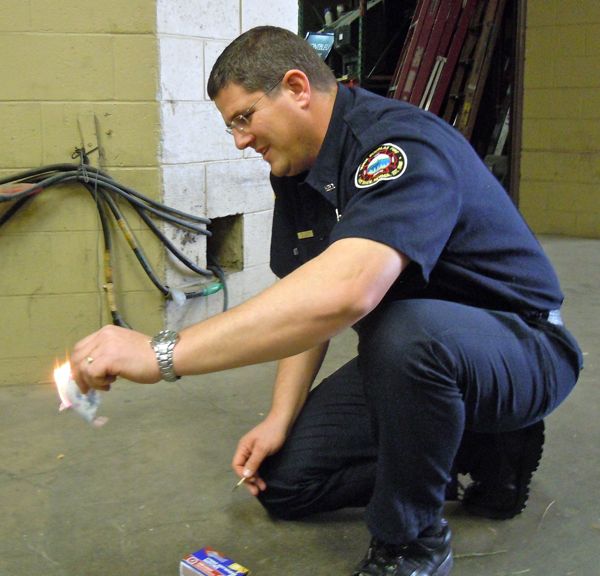
This was evident Wednesday as Eric Guevin set fire to decorations from trees assembled at MontBleu for the Festival of Trees and Lights that starts today.

A marshmallow becomes toasty on a school tree and needs treating to remain. Photos/Kathryn Reed

Guevin is the acting fire marshal for Tahoe Douglas Fire Protection District. It’s his job to make sure this event with its 14 designer trees and assorted holiday decorations don’t go up in flames if they were to catch fire.

Snipping pieces of fabric he assembles a handful to take to the back loading dock to set on fire.

A feather becomes unrecognizable charred debris in seconds.

“Maybe you should tell them no feathers,” Guevin says to Denise Earls with Barton Foundation and Anna Vopalensky with MontBleu.

Earls says they’ll try treating it one more time with a fire retardant spray. If it burns again, that tree won’t be lighted.

Last year two trees didn’t pass muster and therefore could not have the lights on.

“Someone flocked their own tree last year. It was scary when he tested it,” Earls said.

Barton Foundation, sponsors of the event, order the trees so they come treated. They can even get flocked trees that are flame resistant. It’s the stuff people use themselves that can spark to make it be like a Fourth of July celebration.

Guevin says many of the things he inspects for in a commercial setting apply to homes. Artificial trees need to be fire resistant. Fresh trees need to have water – and the needles should be hard to pull from the branches.

A non-grounded extension cord is a no-no and not allowed to be used at the festival. Guevin advises following the same policy at home.

One tree is being backlighted with a floodlight. Guevin shakes his head. Vopalensky finds a casino employee to replace it with something they have that won’t set the place on fire.

Eric Guevin with Tahoe Douglas fire watches material go up in flames.

“This could be a good ignition source,” Guevin says of the light. It’s almost like a heat lamp.

At home, lights on trees should not have damaged strands, no more than three strands per extension cord, and all lights should be off and/or unplugged when going to bed or leaving the house.

To pass the fire marshal’s test the item cannot burn for more than 12 seconds, will extinguish itself, and if it drips, the matter goes out and does not continue to burn.

“Some designers come to us ahead of time to be preapproved,” Guevin said. “We’ve done training for designers so they know what products are acceptable to use.”

Barton Foundation has two people patrolling the premise at all times who are called fire watchers – just in case.

———–

Public viewing of the trees is $5 for adults, $3 for children and seniors. Both Raley’s in South Lake Tahoe have discounted tickets for $3 for all ages. Those prices are good Dec. 2-4 from 10am-2pm. Special events associated with the Festival of Trees and Lights are throughout the three days, with information online. 


Bookstore pops up in South Lake Tahoe as a bit of a test

By Kathryn Reed

From environmental planner to book publisher to book distributor to bookstore owner. That has been the career path of South Lake Tahoe’s Michael Scialfa.

How long he will have the title of bookstore owner remains to be seen. For now, Lake Tahoe Books and Art is what’s called a pop-up bookstore. It opened Thanksgiving weekend down the stairs from Sports Ltd. in the Village Center. The lease expires at the end of December, with an option to keep going through February.

South Lake Tahoe has a bookstore again -- for now. Photo/LTN

The last store devoted to selling new books in South Tahoe – Neighbors Bookstore – went out of business in January 2008. That was before the economy totally tanked and ebooks became mainstream.

Three main things led Scialfa to open the store: believing it would be a worthy community endeavor, a desire to make money, and a way to get feedback on book buying trends that would be useful in his wholesale business.

It was two weeks from the day he pulled the trigger to launch Lake Tahoe Books and Art to the day the open sign was put in the window.

Prior to that mid-November decision, a survey had been sent to a slew of people with about 100 people responding. It gauged reading interests, booking buying patterns and shopping interests as related to books.

“One result of the survey strongly indicated there may be local support for a bookstore,” Scialfa said. “The real shock and disappointment was they would not patronize a store two to three miles from their home.”

Considering it is five miles from the Y to Stateline and four miles from Zephyr Cove to Stateline, time will quickly reveal if people will drive for a new book.

Prior to ever sending the survey were numerous conversations between Scialfa, his friends, colleagues and others about whether the South Shore could sustain a bookstore.

Despite the doubt that persists if the right demographic exists to keep a bookstore open, Scialfa is willing to take the gamble for the short term.

What the survey revealed is there are voracious readers in the area. A couple people said their households buy more than 100 books a year. Most buy the real tangible item, as opposed to the digital variety. And several buy both.

Ninety percent of the respondents are year-round Tahoe residents, with the median age being 52, and women outnumbering men 2 to 1.

Background in books

Scialfa has been along for the ride though the ever-changing book business since the mid-1990s. He started as an environmental consultant with a focus on recreation and interpretive planning. Projects included early signage on the Tahoe Rim Trail, work on the Shasta-Trinity Forest, and interpretive planning near Mount Rose.

He was putting together brochures and other promotional material. These were the days before desktop publishing.

What was missing was a book about day hikes in Lake Tahoe. Scialfa and Lyn Barnett partnered to create “Trail Guide to the Lake Tahoe Basin and Vicinity”. More than 3,000 copies sold the first year.

People told them they should do more guides – on fishing, biking and other topics. But Scialfa knew they existed already and told storeowners how to get them. But they ignored his advice.

That’s what led Scialfa to go from micro-publisher to distributor. He knew he could figure out a way to get those books into stores. And so, Crystal Range Associates – Outdoor Books and Maps was born. To this day it is his main job.

In the late 1990s he was dealing with a handful of publishing lines. Today he works with more than 300 publishers who represent about 10,000 titles. Most of his accounts are in Northern California, though he goes east to the Rockies.

“We bring to people content knowledge about books and what is appropriate for a geographical location and customer base,” Scialfa said.

One change through the years is growing niche markets and where people are buying books.

People traveling like to read about the area (fiction or non-fiction) or they want something by a local author. They are picking up books in visitor centers and gift shops.

Scialfa isn’t worried Kindles and other ereaders will wipe out the printed book. His fear is much deeper.

“I think the Internet and Twitter and Facebook are a greater risk than Kindle because people don’t know how to read,” Scialfa. He fears people are all becoming e.e. cummings – without the prose, without the ability to wordsmith.

Lake Tahoe Books and Art

Selections include fiction, non-fiction, contemporary bestsellers, literary classics, outdoor and nature guides, travel guides, maps, history, food and cooking, gardening and landscaping, humor, gift books, young adult, children’s titles, posters and note cards, plus selected titles in Spanish, and a miscellaneous assortment of other genres.

To ensure the store has the title you want before the end of the month, call (530.542.3245) or email (LakeTahoeBooksandArt@yahoo.com) before Dec. 3.

The store will be increasing its hours after Dec. 10. For now they are Sunday-Monday 11am-6pm, closed Tuesday-Wednesday, Thursday noon-6pm, and Friday-Saturday 11am-7pm.

Special events are planned. All of those details will be posted on the store’s Facebook page.


South Lake Tahoe confident; keeps pot ordinance intact

By Kathryn Reed

“Bring it on!”

That was essentially what the five members of South Lake Tahoe’s City Council said Tuesday night at the conclusion of a one-hour special meeting about the medical marijuana ordinance.

“Let them react to us for a change,” Councilman Tom Davis said after Councilman Bruce Grego led the charge to stick with the status quo.

The reference is to the feds who keep waffling on what their stance is in regards to medical marijuana as well as to the recent Pack vs. Long Beach court decision.

The Nov. 29 meeting was a continuation of the Nov. 15 meeting when attendees spilled into the lobby area where they had to watch the proceedings via a television monitor. The latest meeting, though people nearly filled the room, was much more subdued with only five people speaking.

All the council members agreed much give and take has gone on for the last two years to come up with what all sides affected locally believe is a viable, comprehensive and fair ordinance for regulating the three dispensaries and dealing with growing medical marijuana in residences.

City Attorney Patrick Enright presented five scenarios to the council. They ranged from doing nothing to banning dispensaries completely.

After the meeting, Enright told Lake Tahoe News, “I think they made the right decision.”

While an attorney better versed in the topic was consulted and recommended tweaking the ordinance, Enright believes in what is on the books, as does the council.

It was also pointed out that something new about the topic seems to emerge monthly – whether it’s a court decision, litigation, policy change or something else. Neither the council nor city staff wants to keep hashing out the issue.

As Grego said, the city needs to move on and start addressing other issues besides medical marijuana.

Plus, there is no truly safe decision the council could have made.

“I think we could get sued no matter what we do,” Councilwoman Angela Swanson said. “We can’t act based on the fear of litigation.”

While the ordinance remains in effect without change, all cities in the California with medical marijuana dispensaries are waiting until the state Supreme Court decides if it will hear the Long Beach case. That decision is expected by Jan. 10. If the jurists hear the case, a decision could take more than a year. If they don’t hear it, then the Long Beach case is the law of the land and South Lake Tahoe would have to revisit the issue. Or the top court could depublish the Long Beach decision, making it enforceable only within the limits of the Southern California city.

South Lake Tahoe has asked for the federal government to issue a ruling on the city’s ordinance but as of Nov. 29 had received no response. And while the feds have sent letters to dispensaries in some California cities to cease and desist, the three dispensaries in South Tahoe have received no such letters to date.


3 docs blaze community health care trail in S. Tahoe

By Kathryn Reed

No white coats, no stethoscopes around their necks. One could easily mistake this threesome for just an ordinary group of friends.

But they aren’t.

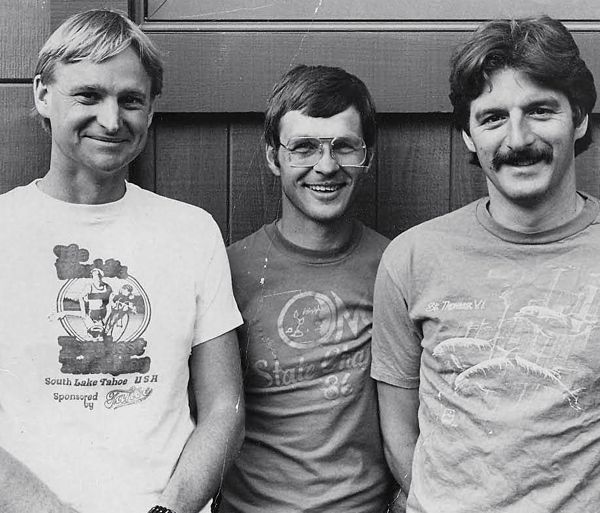
Paul Rork, Greg Bergner and Brooks Martin are the reason the Barton Community Clinic exists. In 1989, they were the doctors who made up Tahoe Family Physicians. That year they opened what was called the El Dorado Community Clinic. For six years the doors stayed open under their care despite the red ink getting brighter and more voluminous.

Paul Rork, Greg Bergner, Brooks Martin -- circa 1980s

Today the clinic is still thriving. More people are using it than ever before (about 1,900 a month) and it has outgrown its current location. Proceeds from the annual Festival of Trees and Lights (Dec. 2-4 at MontBleu) will go toward renovation of the clinic, which will begin next year.

Permits are in hand. Moving into the new facility is slated for between Thanksgiving and Christmas 2012; then renovation of the older section begins.

“It will be more efficient,” Martin said.

The clinic is the original Tahoe Fracture office. What was the X-ray room is in the middle of the clinic, which makes it a bit dysfunctional when it comes to the flow.

Recognizing hard work

Paul Rork, Greg Bergner, Brooks Martin -- circa 2011

But it was their vision, their generosity and their commitment to their profession that has earned them the Spirit of Philanthropy Award that will be presented at the annual Barton Gala on Dec. 3. (The event is sold-out.) The award recognizes a person or people who have demonstrated extraordinary dedication to the health of the South Lake Tahoe community in general and to Barton Health in particular.

Rork, Bergner and Martin sat down with Lake Tahoe News this month to talk about life 22 years ago and what is in store for 2012. All have been practicing medicine on the South Shore since at least 1981.

While they remain steadfast friends and doctors within the Barton Health Care system, only Martin is an integral part of the clinic. He manages it.

Barton Hospital took over the clinic from them in 1995 and a year later moved it to what is the old part of the hospital – where the emergency room used to be. In 2002, it was officially designated a rural health clinic.

The clinic has had a few homes, including in the building where Sprouts restaurant is. Those were the days of brown walls and orange carpet.

The docs were the only primary care physicians at the time taking Medi-Cal patients. That’s what led them to start the clinic. It was better to break that segment off from their main practice. Midlevels were brought in to provide much of the care – which is the same today.

Today, like when things started, the clinic is overseen by doctors, with one going to the facility each day.

But it was a Catch-22. Two midlevels (which are nurse practitioners or physicians assistants) were seeing 25 patients a day, five days week. That pace could not be maintained, nor could the financial loss be sustained.

That’s when Barton took over.

Time brings change

The three pioneers have seen many changes over the years.

“You could work in the casinos in the ’80s at a low level job and have insurance. Then the casinos laid people off and rehired them at part time,” Rork said. “There are a lot more unbenefitted patients.”

In the 1980s and 1990s the county public health clinic was more vibrant, too. Now the services it provides are few and far between.

“The community clinic has become more and more important,” Bergner said.

None of the doctors foresees the day when the clinic won’t be needed.

“As long as the American health care system has a work related health system, not everyone will be offered it,” Martin said. “And private is not affordable, so the clinic is clearly needed.”

He says clinic patients involve more psychosocial issues because usually there is more than just the medical issue to deal with. Loss of job, financial problems, possible language barriers – this all contributes to what Martin says becomes some of the most difficult patients to care for because of the complexities of the whole patient.

Evolution of care

Changes since they started the clinic include specialists going to the clinic, telemedicine and psychiatric care.

“There is so much more chronic care involved in primary care,” Bergner said.

They pointed to how just a couple decades ago a cancer or HIV diagnosis would be a death sentence – that’s not the case now.

But all the changes are not welcome.

“Only one country in the world allows television prescription ads,” Rork said.

Martin said with the number of studies funded by drug companies there is “corporate pressure to increase the use of medications.”

More than doctors

All three have been chief of staff. Rork and Bergner are on the board of directors, while Martin has been chairman of the physician advisory committee at Barton Hospital for more than 17 years.

They have participated in and coached local sports teams. They helped the local library when it needed funds, and have regularly donated to fundraisers for community organizations.

Their families grew up together.

The night before the interview they had dinner together.

While one day they will retire, they envision a more tapering off approach instead of all or nothing.

One thing won’t change no matter how many hours they devote to medicine – that’s their friendship.

“We’ve been best friends forever. That will never change,” Rork said.


Lawsuit filed to stop Washoe Meadows State Park from becoming golf course

By Kathryn Reed

A month after the California State Park and Recreation Commission voted unanimously to move Lake Tahoe Golf Course into Washoe Meadows State Park, a group has filed a lawsuit to prohibit that from happening.

“I would like people to know this has consequences for the entire state,” Lynne Paulson, who is part of Washoe Meadows Community, told Lake Tahoe News. “The Parks and Recreation Commission has done something that is unprecedented. They downgraded a property where they want to move the golf course. Usually they upgrade classifications to give more protection to land.”

Some cycling and hiking trails would become a golf course if the project continues. Photo/LTN file

Besides reclassifying state land, the Washoe Meadows Community – the group that filed the lawsuit Nov. 23 in Alameda County Superior Court – believes the California Environmental Quality Act has been violated.

Lake Tahoe News was notified of the lawsuit Sunday and therefore unable to immediately speak with State Parks officials.

The state acquired the 777 acres in Meyers in 1984 for $5 million following a lawsuit between developers and the Tahoe Regional Planning Agency.

Part of that decision says, “The unique subject property is scientifically valuable, environmentally sensitive, vital to the maintenance of riparian habitat and to the maintenance of water quality in Lake Tahoe, and is, therefore, highly suitable for public acquisition in order to preserve and maintain these natural resource values ….”

Reclassification came about because water quality experts believe the Upper Truckee River must be reconfigured to near its original meander to best prevent sediment from reaching Lake Tahoe, as well as to restore meadows along the banks, and to create a more robust ecosystem.

In order to change the segment owned by State Parks the golf course on Lake Valley Recreation Area land must be touched. What the state commission approved in October was moving nine holes to what is now state park land and reclassifying it to a recreation area because a golf course cannot be built on park land.

Opponents, including those behind the lawsuit, don’t advocate for the golf course to go away. Instead, they support Alternative 3 – which would take the 18-hole course down to nine holes or convert it to an 18-hole executive course.

“We hope a better solution is brought up,” Paulson said. “We are in favor of Alternative 3. It’s the best balance of the extremes.”

Paulson and her group would welcome new ideas that have not been brought up or consideration of ones not part of the environmental documents.

This is not the first time the state has tried to reclassify land it owns. In 2010 part of Tolowa Dunes State Park near Crescent City was slated to become a state recreation area to accommodate waterfowl hunting. After several public workshops, the commission voted to keep all of the property a state park.

Washoe Park proponents believe if this South Shore park is downgraded, that it’s possible it will happen up and down the state.

The December hearings before the Tahoe Regional Planning Agency on the river restoration/state park/golf course project have been moved to 2012, though specific dates have not been set.

More information about the Upper Truckee River restoration project is online.