Lahontan Water Board needs new leader; Singer retiring

By Kathryn Reed

After 40 years of employment with the state water board, Harold Singer is retiring.

He has been executive officer of the Lahontan Regional Water Quality Control Board since the late 1980s and was working for the state board before taking the job in South Lake Tahoe.

What he does next is unknown because Singer chose not to return multiple calls. Nor is it known when his last day will be.

Harold Singer

When Lake Tahoe News started inquiring about Singer’s departure, most people didn’t know he was leaving, though some knew he had been talking about retiring.

Neither the Lahontan office in South Lake Tahoe office nor the state office in Sacramento have a bio or resume for Singer on file. Neither of those offices nor the Victorville office for Lahontan would release contact information for Lahontan board members.

Even the state board’s public affairs folks didn’t know he was leaving until Lake Tahoe News called.

Board President Jack Clarke was asked by Sacramento officials to call Lake Tahoe News. He didn’t. Lake Tahoe News sent board member Amy Horne an email, but she didn’t answer it.

Singer’s job has been posted several places. Here is the job description for the position that pays between $112,068 and $121,176 a year. The deadline to apply was Dec. 16.

It will be up to the regional board to hire his replacement. The state doesn’t get involved. This could happen behind closed doors, at a special meeting, or a subcommittee could be put together to vet the applicants.

Lahontan has been a lightning rod of late. Pre-Angora Fire in 2007, it was the Tahoe Regional Planning Agency which received the bulk of public badmouthing. That changed as it came to light the rules the water board has that some say thwart progress in the Lake Tahoe Basin.

Lahontan is often said as though it is a four-letter word. Every agency and jurisdiction in the basin has had difficulty with the regional water board – from permits to thin trees, to the recent sediment load regulation, to working in stream zones, to redundancy, to being unwilling to compromise.

With Singer not returning calls, his second in command, Lauri Kemper, out until the end of the month, and the board being incommunicado, Lahontan chose to have no voice in this story.

While Lahontan’s jurisdiction covers a much greater area than Tahoe, stretching to Southern California, the news from there is not all great, either. Think Erin Brokovitch and Hinkley – the issue brought to the world through the film starring Julia Roberts. Lahontan and PG&E are still dealing with contaminated drinking water.

Many thought Singer would soften after his family lost their home in the Angora Fire. As executive officer, not much changed, according to people who spoke to Lake Tahoe News off the record.

But as a neighbor, Singer is seen as one of the good guys.

El Dorado County Supervisor Norma Santiago, whose jurisdiction encompasses the 254 houses that burned to the ground that June, has witnessed Singer be a friend to his neighbors, and as she put it – that neighbor everyone wants to have.

Singer has also given a lot to youth sports. He has been an umpire in softball leagues and referred youth soccer.

Santiago said, “He is a very dedicated individual to the mission of Lahontan. He has always been very open with me, straightforward and taken the time to teach me so I could gain an understanding of the information as it relates to Lahontan.”

Joanne Marchetta, TRPA executive director, said, “Harold has made significant contributions to the lake and his community of South Lake Tahoe. We wish him well in the next phase of his life.”

Claire Fortier, South Lake Tahoe mayor, said, “He has kept Lahontan focused for 20 years. He has run an effective organization for as long as he has been there.”

The next Lahontan board meeting is Jan. 11-12 in Apple Valley. The agenda is not posted so it’s not known if the board will discuss the executive officer position.


LTCC professor leads charge to bring etexts to students

By Kathryn Reed

Free college textbooks?

Maybe.

Lake Tahoe Community College Professor Larry Green is part of a pilot program that allows students to use a statistics textbook for free. On Tuesday, he was in Sacramento with lawmakers to lend his support representing California faculty to make etexts available to more students.

Larry Green

The average annual cost for textbooks is $1,260. Often times, new (instead of used) texts have to be bought because publishers change content. This then means at the end of the semester or quarter college bookstores won’t buy them back. New texts come out usually every three years, and each time a new edition is published on average it’s 12 percent higher than the previous addition, according to the 20 Million Minds Foundation.

The Center for College Affordability and Productivity last month said books and supplies represent the largest cost increase for postsecondary students receiving aid and grants.

“There’s a clarion call from students and middle class families to make higher education more accessible and affordable. Textbook prices are going up four times the rate of inflation, and many students say they drop out of college because they can’t afford to spend more than $1,000 a year on books,” state Sen. Darrell Steinberg, D-Sacramento, said in a statement. “If we can use technology to maintain the high quality of materials while cutting the cost, we need to do it. Open source digital textbooks can bring real relief of nearly $1,000 a year to each college student.”

Green was by the state Senate president’s side Dec. 13 advocating passage of the bill Steinberg introduced that would allocate money for open education resources (OER) for the UC, CSU and community college systems.

“If all goes as planned, our students at LTCC could save thousands of dollars each year by using these OER textbooks. Since the materials will have a Creative Commons License, all students in the world, not just in California, will benefit,” Green told Lake Tahoe News.

According to the Government Accountability Office, textbooks for community college students can account for 75 percent of their education costs, while books reflect 26 percent of the cost of attending a CSU.

The idea of the legislation is to have 50 key lower-division textbooks now being used by undergraduates be available digitally – via computer or mobile device. Printed versions would still be available, too. And hard copies would also be in college libraries for students to access. The etexts would be free.

If the legislation passes, then a request for proposals would be sent out. Publishers, faculty or others could respond with an idea for how they will create “high quality digital open source textbooks and related courseware”.

Green said, “With over a billion dollars spent on textbooks each year by our students, the $25 million proposal makes sound economic sense. For many years, I have taken the lead on this effort.”

Green knows something about numbers. He is a math professor.


Homewood to enter 21st century with mega-upgrades

By Kathryn Reed

TAHOE CITY – What’s another 10 hours when five years had already been spent on the revitalization plan of Homewood Mountain Resort? For Art Chapman, sitting in a room all day Wednesday listening to people praise and rip apart his plan was worth it.

Chapman is president of JMA Ventures, the San Francisco-based development company that bought Homewood in summer 2006.

The Tahoe Regional Planning Agency Governing Board on Dec. 14 did not cast a dissenting vote on the multiple motions needed to adopt the final environmental impact statement, Regional Plan amendments and phase 1 of the Homewood Mountain Ski Area Master Plan.

Homewood will be getting a mid-mountain lodge with a public swimming pool.

Despite the approval after the marathon meeting at Granlibakken resort, a lawsuit was filed Dec. 8 to stop the project based on California Environmental Quality Act violations. The California Clean Energy Committee filed the suit against Placer County and JMA.

“The committee’s supporters on the West Shore will be directly and adversely impacted by the implementation of the project and by the failure of the Homewood Mountain Resort Ski Area Master Plan EIR/EIS to adequately evaluate the impacts of the project and to propose mitigation as required pursuant to CEQA,” according to the Homewood CEQA writ.

People who would be on the defendants’ side at the meeting told Lake Tahoe News they believe the final EIS addresses the concerns brought forward in the lawsuit and are not concerned.

Chapman after the meeting spoke one-on-one with Lake Tahoe News.

“If this thing were to work, it had to be embraced by the locals. And that’s why we will be successful when we build it,” Chapman said of the Homewood project.

Of the 22 people who spoke against it, most were in favor of doing something, but on a much-reduced scale.

Fifty people spoke for the project, while two others fell in the neutral category.

Of the people who spoke, more full-time residents want the project, while part-time/second homeowners don’t want things to change. It was obvious the economic situation in the Lake Tahoe Basin – loss of jobs, little or no public-private investment, and declining school enrollment – has taken its toll on locals. They are the ones welcoming JMA – its money, jobs and goal of revitalizing the West Shore.

Much was said of how this project will be good for the economy and good for the environment. It will create 500 construction jobs and 180 year-round positions.

Chapman expects to add nearly $7 million to the tax rolls, and between $16 million and $20 million to the West and North shore economies on an annual basis.

“I hope it rejuvenates the local economy,” Chapman said.

He and his wife have lived in Placer County for the last eight years. When the residences are built at Homewood he intends to move there.

As a skier, Chapman told Lake Tahoe News one day he hopes to be able to ski between Homewood, Alpine Meadows and Squaw Valley. As it is, with JMA entering a partnership with KSL Capital Partners to create Squaw Valley Holdings so the two entities jointly operate Alpine and Squaw, putting Homewood into the mix could be easy.

“It’s not that far from the top of Homewood to the backside of Alpine,” Chapman said. He likes the idea of making Tahoe be like European ski resorts with linking terrain.

The environment

Environmental gains beyond what is required are part of the plan. At the meeting Chapman agreed to monitor for 10 years how well the impervious materials are working.

By the time it’s built Chapman expects to have secured an LEED gold certificate for construction.

Improvements have begun, with 88,000 fewer pounds of sediment reaching the lake. By build out that number will rise to 154,000 pounds a year.

TRPA standards are that filtration systems must sustain a 20-year event, or 1 inch of rain in an hour.

Homewood’s plans call for twice that standard.

Generators will be able to be used on the snowmaking equipment if there were ever a wildfire, so firefighters have an added mechanism to put out the flames.

Coverage – a concept unique to the basin that stipulates how much land can literally be covered – will be reduced by 235,000 square feet. The TRPA regulation has to do with erosion.

Project concerns

Issues brought up at the TRPA meeting included how much traffic the development will create. The lawsuit also takes issue with the numbers Placer County approved which are the numbers JMA cites.

JMA says winter vehicle miles traveled will decrease based on providing free dial-a-ride service to local residents and the idea guests will be staying longer than a weekend visit. The bus will run from the Y in Tahoe City to Emerald Bay. Ten will run in the winter, three in summer. Beaver Creek is the model being used.

“Upon completion, traffic will be less than five years ago,” Chapman told the board. He also said state statistics show traffic along that stretch of Highway 89 has decreased by 30 percent in the last 10 years.

Board member Mara Bresnick liked the League to Save Lake Tahoe’s idea to have rigorous monitoring of traffic. That was agreed to. The number of vehicles coming to Homewood will be tracked. Tracking use alternative transportation and surveys of guests about how they got to the resort are also part of the conditions.

Concerns are traffic on busy weekends will be even worse going through Tahoe City at the Y. While plans are in the works to reroute Highway 89 so it no longer goes over Fanny Bridge, construction of a bypass is years away and at this rate is likely to occur after Homewood breaks ground. (The TRPA Advisory Planning Commission is scheduled to discuss Fanny Bridge on Jan. 11, 9:30am at the Stateline office. JMA is required to pay for part of the bridge bypass.)

Added on Wednesday was the agreement to monitor traffic for 20 years.

Board members Clem Shute and Bresnick insisted if vehicle numbers are higher than what’s expected, there must be some sort of mitigation requirements and that phase 2 doesn’t get approved without addressing vehicle issues.

Everyone agrees summer vehicle trips will increase because the resort as it is today is used for one season.

A water taxi will be operated by Homewood in summer. Free bikes will be available. Completion of the West Shore bike trail is being paid for by JMA. Access to hiking will be allowed — whereas now people would be trespassing. The pool at mid-mountain will be open to the public. And the mid-mountain lodge will be open year-round.

The goal is Homewood will be a year-round destination.

But not everyone is thrilled with that. One of the 74 speakers talked about how it’s ridiculous to build a five-star resort at a three-star mountain.

Chapman, on Wednesday and at the multitude of meetings he’s spoken at, said if the project he wants to develop wasn’t approved, he would have to shutdown the ski resort which will be 50 years old in 2012.

The tiny West Shore town with its population of 744 residents could grow if and when the project is developed. A late revise by JMA was to eliminate the fractional ownership units and make them whole ownership.

The development

Chapman expects to break ground on the $500 million project in summer 2014. Final designs and permits need to be secured between now and then.

The plan calls for 56 residential condominiums, 47 multi-family condominiums, 48 ski-in/ski-out chalets, 13 workforce-housing apartments and a 75-room hotel.

Chapman made no bones about the real estate portion being the financial driver for everything else. He said with Homewood having about 100,000 skier visits a year, the average skier spending $6.48 on food and beverage, and no profit in ski school, it will take the real estate to drive on-mountain improvements. Even with an estimated increase of 18,400 skiers a year upon build out, Chapman said it wouldn’t substantially move the bottom line.

“Before we can borrow money for real estate, we need to prove the ski area is viable. This little ski operation can’t afford to spend $12 million on lifts or $10 million on a mid-mountain lodge or $13 million on (a base) lodge,” Chapman said. “Real estate is the golden goose.”

The EIS/EIR and amendments that were voted on can be found on the TRPA’s website.


LTUSD, LTCC brace for their share of $1 bil. in midyear cuts

By Kathryn Reed

Money for teachers, textbooks and lights for the classrooms remain – for the most part – but there may be no students sitting at the desks. That’s because school bus funding has been cut throughout California.

Gov. Jerry Brown on Tuesday pulled the trigger to slice millions of dollars from K-14 education.

When the state budget was passed last summer a number of assumptions came with it – like how much revenue would flow to Sacramento. Those predictions are so far off — $4 billion short – they forced the governor to implement midyear cuts.

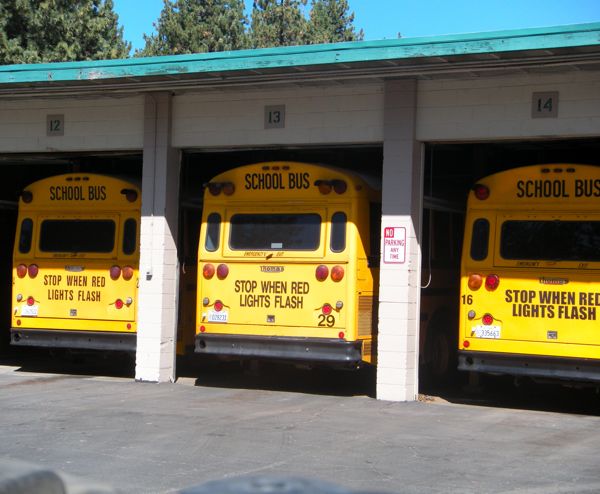
State budget cuts could force LTUSD buses to sit idle in the garage. Photo/LTN file

For Lake Tahoe Unified School District it means losing $382,000 in transportation dollars.

“Our fear is what do the cuts look like next year,” Superintendent Jim Tarwater told Lake Tahoe News after the Dec. 13 school board meeting adjourned at 10:30pm. “We have to bus people.”

The state isn’t saying if these are one-time cuts or ongoing for 2012-13.

And that bus money is  just what is used to get students to and from school. Athletic and special education busing expenses are separate categories.

Students can’t drive their friends to school until they’ve had a driver’s license for at least a year. The price of a gallon of gasoline is also filling up bus seats instead of the student parking lot. LTUSD buses 1,800 students, while about another 2,000 get to school some other way.

CFO Deb Yates was slated to give her first interim budget report to the board Tuesday night before it was known Brown would be dropping the hammer on education.

Throughout the state K-12 is about to lose $79.6 million in general funding, plus another $248 million in transportation. Community colleges will lose $102 million.

“It could have been worse,” Yates said.

Education officials knew when the state budget was passed that midyear cuts could occur. K-12 could have been hit with a $1.5 billion loss.

In addition to the bus dollars being whacked, the governor is taking about $14 per pupil, or roughly $56,000 from LTUSD.

To bridge the gap, reserves will be used. This was anticipated when the board approved its budget. But it will bring the reserves below the desired 3 percent minimum.

If the cuts are ongoing, this will drastically affect future budgets. As it stands, LTUSD is forecasting a shortfall of more than $416,000 for 2012-13.

But there is enough in reserves to survive the next two years with the known cuts.

Earlier Tuesday night the Lake Tahoe Community College board met.

LTCC President Kindred Murillo anticipates the college will face a $50,000 loss for this academic year. More than four times that amount was set aside for anticipated midyear cuts.

The big change will be the increase statewide of semester units going from $36 to $46 (which would be adjusted for LTCC’s quarter system). This fall semester fees went from $26 to $36.

All told, the governor came up with $1 billion in cuts. But that barely touches the projected 2012-13 deficit of $13 billion.

Other entities taking a hit include:

• $100 million each to the UC and CSU systems. (They each were cut by $650 million in the state’s current budget.)

• $100 million to In-Home Supportive Services.

• $15.9 million to county libraries.

• $100 million to services for people with developmental disabilities.

• $102 million to public safety services, including prisons.

• $8.6 million to Medi-Cal.

Most of the reductions announced Tuesday will be implemented Jan. 1, with more cuts likely to be declared by Brown after the first of the year.

One way to generate revenue is raising $6.8 billion through increasing the sales tax and raising rates on wealthier Californians. The governor wants voters to approve those taxes next November.

———–

In other action:

• Molly Blann is president of the LTCC board and Karen Borges the clerk.

• At LTUSD, Wendy David will serve as president of the board another year, with Sue Novasel the clerk.


Kings Beach beautification: roads, sidewalks, lights

By Katherine E. Hill

KINGS BEACH – Kings Beach will be undergoing a face-lift over the next three years, with sidewalks, lighting, landscaping and a reconfigured three-lane highway through the small hamlet. With these improvements, known as the Kings Beach Commercial Core Improvement Project, come long-term maintenance and repair costs from snow removal in the winter to replacing pavers and making repairs through the years.

A proposed benefit assessment district is being considered to pay for these long-term costs that would encompass property owners along Highway 28 from Highway 267 to east of Chipmunk Street and about one block back from Highway 28 into the area known as The Grid. Property owners learned about the proposed assessment district last week during a series of presentations by Placer County officials and consultants hired for the project.

Kings Beach will be transformed in the coming years. Photo/Katherine E. Hill

NBS consultants recommend property owners form the benefit assessment district to fund the ongoing maintenance of the $35 million capital improvement project. The consultants presented three alternatives for the district that ranged from $378,878 per year to maintain a snowmelt system to $266,246 annually to remove all snow by hand.

Greg Davidson, director of NBS, recommended against a snowmelt system in the sidewalks, noting that it would add an additional $3 million in initial costs to install the system, with annual maintenance costs at more than $378,000. Instead, NBS is recommending property owners consider a district that would cost about $186,761 annually to maintain, with a wide portion of the sidewalks cleared during snowstorms by hand with some snow storage along the walkways.

“It seems to be the most popular,” Davidson told members of the North Tahoe Business Association during a lunch presentation Dec. 6. Consultants had presented the proposal to property owners during a morning meeting that day and noted that those in attendance preferred the alternative with the most snow cleared by hand and to eliminate the snowmelt system. A third presentation was that night.

This proposal would mean an average annual assessment of about $600 per property owner, which could change as plans for the district are finalized.

“Landscape maintenance may be something to be considered to add to the district,” added Stephanie Parson, NBS senior consultant. Property owners at the morning meeting expressed interest in landscape maintenance being included in the assessment district, which was not part of the initial plan. NTBA members at the lunch meeting were also in favor of adding landscape maintenance to the plan, which will add about $12,000 to the annual costs, Davidson said.

The assessments for each parcel are based on a variety of factors, including street and sidewalk frontage, lot size, building size, and land use (residential, commercial, vacant land, recreational use, and more). Property values are not used for assessments within the district.

Assessments would be done annually to reevaluate each parcel, with a public hearing conducted yearly by the Placer County Board of Supervisors. Property owners also could dissolve the district in the future should they vote to do so.

Consultants are expected to have the final property assessments for each parcel completed by February, with property owners within the proposed district voting in February or March. The district would then have to approve by the Board of Supervisors, with assessments added to 2012-13 property tax bills.

Kings Beach project on track

While property owners consider the assessment district to pay for long-term maintenance of improvements, Placer County Associate Engineer Dan LaPlante says the project is on schedule to be finished by fall 2014.

During the summer, traffic-calming measures such as speed bumps and traffic circles were installed within The Grid. These traffic-calming measures will continue to be installed next summer, along with off-highway improvements such as sidewalks, drainage and five parking lots. As well, utilities will be moved and put underground along Highway 28 in summer 2012.

The bulk of the work, which will realign Highway 28 through Kings Beach from four lanes to two lanes with a center turn lane, will be done in the summers of 2013 and 2014, said LaPlante, who also is serving as project manager.

LaPlante said the county is still working to fully fund the project, but is optimistic that funding will be ready before the major project work begins in 2013. The $35 million project is being funded through federal and state agencies, transit occupancy tax, impact fees and other sources. There is currently a $10 million funding shortfall, he said.

“If we can salvage the middle two lanes, we can save $5 million,” he told NTBA members, bringing the shortfall down to $5 million.

For more information on the Kings Beach Commercial Core Improvement Project, go online.

——-

Note: Katherine E. Hill is a member of the North Tahoe Business Association, but does not own property within the proposed assessment district, and therefore, will have no vote in its formation.

ngg_shortcode_0_placeholder (Click on artist’s rendering for full image.)


Pier installation signals start of Tahoe Beach Club

By Kathryn Reed

STATELINE – Not wanting their permit to become invalid, Tahoe Beach Club developers decided to create even more phases for the multimillion dollar project at the end of Kahle Drive in Stateline.

Putting in about 60 feet of what will be a 159.6-foot pier this fall and adding the remainder next year satisfies the Tahoe Regional Planning Agency’s stipulations that movement on a project must begin within three years of the permit being issued. Had the developers – Tom Castaneda and Bob Mecay – not put in the floating pier this fall, it would have meant starting at the very beginning with the permitting process.

That would have been a costly endeavor – time-wise and financially.

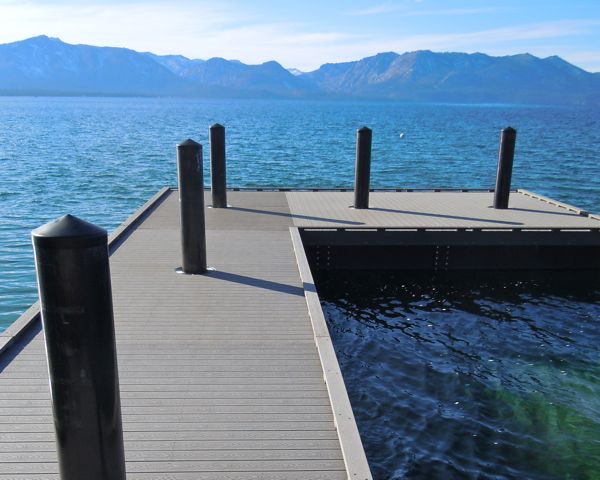
The floating section of the Tahoe Beach Club pier was installed this fall. Photos/Kathryn Reed

After all, five agencies were involved in the pier – TRPA, Douglas County, Nevada Division of Environmental Protection, Nevada Division of State Lands, and the Coast Guard.

Three engineering firms had to witness the pylons being put in to make sure the soil wasn’t disturbed in a manner that would stir up the sand and be bad for Lake Tahoe. Some who witnessed the installation said a person walking in the water would have kicked up more sand.

The pier, when complete, will have a price tag of about $400,000 – with a substantial portion of that figure involving the permitting process.

Castaneda and Mecay wanted the entire pier to be floating, but said TRPA rules no longer allow that to happen because with the dock abutting the shore it could present erosion concerns.

The Tahoe Beach Club pier brings the number of floating docks on Lake Tahoe to 19. The 275-foot one at the Hyatt in Incline comes all the way to the shore.

“New engineering designs will allow us to lower and raise the entire 100-foot second section,” Castaneda said. “We will do that two to three times a year so that it is at the same level of the floating pier. Then there will be an adjustable ramp between them.”

Walking on the Trex platform it’s hard to know it’s floating because of the stability. Steel sits on top of the floats.

With waves several feet high a couple weeks ago, the dock’s stability passed Mother Nature’s test.

The end of the floating section is 36-feet-long – twice what the walkway is. This is so larger boats could dock to pick up residents for excursions.

The main project

While the economy has stalled Castaneda and Mecay’s plans to remove the mobile home park and replace it with 143 high-end housing units, they see a ray of light in the financial world.

“The financial investment atmosphere is a lot better than a year and two years ago,” Castaneda told Lake Tahoe News. “We would like to lock up some construction financing. I would safely say next year and then begin the project.”

This would be the first multifamily residential property built on the shores of Lake Tahoe in nearly 30 years.

Tom Castaneda and Bob Mecay are eager to build Tahoe Beach Club.

Castaneda and Mecay bought the 19-acre parcel in 2002 for about $12.6 million. At that time 155 mobile homes occupied most of the land that sits between Rabe Meadow and the University of Nevada 4-H Camp. Now at Tahoe Shores Mobile Home Park there are 18 vacant lots, about 30 people leasing spots from the property owners, and another 110 mobile homes the two men own and lease out. It has been a mobile home park since the 1960s.

While 39 units were supposed to be real phase 1, that will now be phase 3. One hundred and fifty people are on a waiting list to buy into the development. They want one of the units that range from 1,250- to 4,000-square-feet.

The luxury villas will have 19 to 30 units in a building, while the estate homes have four to eight units. The lower level will be one story, while second floor units will have a loft.

The later will be designed to have the feel of a brownstone.

The architecture, though, is old-style Tahoe, with influences of the Tahoe Tavern running throughout.

In all, there will be 14 buildings along one mile.

A private 40,000-square-foot beach club on the water is part of the plans. It will include a restaurant, full spa, workout area and facilities for banquets-parties-weddings. The club will offer memberships to the public.

Club members will have access to the 270-foot stretch of private beach.

Before the market crashed it was estimated the project would cost $260 million, with units selling for between $1.5 million and $4 million. Those numbers could change depending on when construction and sales begin.

Environmental benefits

Environmental improvements are part of the development’s goals as well. The project ties into the Rabe Meadow restoration work being done by Sierra Colina, Douglas County and the U.S. Forest Service.

Today about 11,384 pounds of sediment reach Lake Tahoe from the acreage owned by Tahoe Beach Club. When the project is built out that will be reduced to 632 pounds of sediment a year.

Two acres of stream environment will be restored. Currently it’s paved.

Greenhouse gas emissions will be cut by 63 percent. Much of that will be accomplished by getting rid of the woodstoves that are now in use.

The goal is to treat the water onsite through an intricate filtration process.

Native vegetation will be used in the landscaping.

Power lines will be put underground. Part of the deal is the developers will also bury the line on the 4-H site.

The whole project is going after silver LEED certification.

ngg_shortcode_1_placeholder (Click on renderings for full picture.)


Control of invasive species in Lake Tahoe remains a struggle

By Geoff Schladow, Heather Segale, Allison Gamble and Andrea Wilkins

Research efforts to control invasive aquatic species from around the world continue to threaten the Lake Tahoe Basin. Work to identify the most effective mechanisms for controlling the populations of Asian clams continues. Current projects are focused on controlling the spread of the Asian clam population in Emerald Bay. Researchers are working collaboratively to experiment with different methods of eradication.

Research is also being done in the southern part of the lake on Curlyleaf pondweed. Curlyleaf pondweed is an invasive aquatic weed that is increasing in density in Lake Tahoe. It reproduces via vegetative shoots called turions, which are extremely resilient and hard to kill. Researchers are working on identifying possible means for controlling the spread and reproduction of this invasive species using bottom barriers of several materials (jute, rubber, and polyethylene). Three sets of these barriers are currently out in Lake Tahoe.

Scientists continue to discover new things about Lake Tahoe. Photo/LTN

Post-doctoral researcher Allison Gamble is also studying the effects of Mysis shrimp on Tahoe’s food web. Mysis were deliberately introduced into Lake Tahoe in the 1960s. Mysis are a big predator on smaller zooplankton, and also an important food source for fish. They undertake a diel (within 24-hours) vertical migration every night, where they migrate from the bottom of the lake to close to the surface, one of the longest vertical migrations in nature. If we scaled the Mysis to the size of a human, it would be equivalent to moving 50 miles (or 1,700 laps of a pool) vertically up and back down in a single night.

Gamble is comparing the historical densities of Mysis shrimp to current densities in Lake Tahoe, Emerald Bay, Fallen Leaf Lake, and Donner Lake, and addressing how ecosystem characteristics influence food web dynamics. Her research will provide new insights into the evolving Tahoe food web.

PARASOL

The lake was buzzing with scientists from around the world at Tahoe for a weeklong research project called “PARASOL” (PARticulates And SOlutes in Lakes). Scientists and students from TERC, the EPA National Health and Environmental Effects Research Laboratory in Duluth, and the University of Kyoto completed a circumnavigation of the lake, taking measurements of all the physical properties and the suspended particles and organisms that comprise the lake’s ecosystems. These measurements will allow us to know how the near shore water quality changes around the lake.

In addition, the team devoted extra effort to studying conditions in Marla Bay and Emerald Bay. The work was exhausting, often starting before 6am, and usually ending well after dark. TERC supporters allowed research vessels to be moored at their private docks around the lake, saving valuable time and gas.

Hundreds of samples went from lake to the lab all week.

The data from this project is still being analyzed at Tahoe, Davis, DRI, Duluth and Kyoto.

Microbial plankton survey

Three weeks following PARASOL, a new group of collaborators filled TERC’s laboratories to conduct a preliminary survey of the microbial plankton of Lake Tahoe. This time the visitors were from Laval University in Quebec, and UC Santa Cruz. Most of what lives in Lake Tahoe is invisible, and it has only been in the last few years that tools such as flow cytometry and DNA sequencing have allowed us to see this hidden world and learn about how it is impacting the features of the lake that we do see. The results of this experiment are being used as the basis of new proposals to the National Science Foundation.

Input of sediment

TERC post-doctoral researcher Alexander Forrest and graduate student Paul Stumpner deployed a current-measuring instrument in Lake Ohau in New Zealand in November 2011. This collaborative project with Richard Levy of GNS Science will provide information on the input of sediment to this glacial lake. What we have learned at Lake Tahoe is being applied in many parts of the world. Conversely, what we learn in New Zealand will help us to better understand Lake Tahoe.

Geoff Schladow, Heather Segale, Allison Gamble and Andrea Wilkins are with the UC Davis Tahoe Environmental Research Center.


Meyers creates sense of place without fancy ad agency

By Kathryn Reed

MEYERS – Embracing and celebrating what they have. That’s what Meyers is doing.

“Our little niche out here is we are a recreation Mecca,” Rene Brejc said.

“We are celebrating Meyers tonight,” Kim Wyatt said.

“Our 10-year plan is to be one of the top 10 outdoor places in Outside magazine,” Josh Welch said.

Santa is escorted by sheriff's Deputy Damian Frisby Dec. 9 to all the waiting children in Meyers. Photos/Kathryn Reed

These three people live and work in Meyers. For them, and many others who call this hamlet at the base of Echo Summit home, Meyers is already on the map. They don’t struggle with who they are, what they want to be, or why they live and work where they do.

For others, though, Meyers is merely where the bug station is, the first or last gas stop in or out of the basin, or just another place to slow down before going 55 on Highway 50 again.

That is about to change.

Friday night was the first event put on by what is loosely being called the Meyers Business Group. Brejc of Got it Real Estate & Development Corp., Wyatt of Bona Fide Books, and Welch of Safe Haven Chiropractic are the backbone of a grass roots movement to unite the business community, while at the same time sharing with others just what it is Meyers has to offer.

On Dec. 9 they attracted about 300 people to the parking lot of Divided Sky for the inaugural tree lighting. (About 75 more were warm inside.) It may have been the first time locals caused a traffic jam in Meyers.

Three-year-old Kylee Caudillo had one of the best seats of the night – atop her grandpa Jon Kolb’s shoulders. He has been on the South Shore for 42 years, most of that time in Meyers, and can’t remember a time when there was a tree lighting.

Savannah Caudillo, 9, of Meyers was giddy in anticipation of seeing the “special surprise” – aka Santa’s sleigh.

The crowd went wild as the hum of a helicopter could be heard coming from the north. Ah … that would be CalStar with Santa onboard. After all, when Santa was asked where his reindeer were, he told all the boys and girls that the animals were home resting for the big event later this month.

As the helicopter circled the area a few times looking for a spot not filled with a vehicle, the pilot decided to land in the lot neighboring where everyone had gathered. Kids and adults ran through the field to greet the helicopter. His special elves, aka law enforcement, made sure the little ones didn’t rush the chopper.

Under escort by an El Dorado County sheriff’s deputy, Santa was led to the decorated Lake Valley fire truck to talk to every child who wanted to whisper in his ear.

Clutching free cups of hot cocoa to ward of the bitter cold 28-degree Tahoe night, (or is that Meyers night?), adults could be overheard saying what a wonderful event, why didn’t it happen sooner, and they hoped more events are planned.

More are is the works.

When the snow begins to fly and enough is on the ground, a snowman, woman, family, village – (depends how much white stuff there is) – will be created in a communal effort.

The Meyers Business Group intends to focus on art, culture, recreation, and health and wellness.

Events are one thing, but creating a more cohesive sense of community is another goal. Sprucing up some of the dilapidated buildings is on the to-do list.

Brejc wants to continue the “wow factor” of being at the top of Echo Summit all the way through Meyers.

While Brejc, Wyatt and Welch know plenty of reasons to stop in Meyers – each of their businesses, the restaurants, the yoga-Pilates studio that just opened, among other reasons – they want more people to see Meyers as a place to go to, not drive through.

For the Dec. 9 event all but one business that was asked to donate money did so. Collaboration and cooperation seem to come naturally to folks in Meyers.

As a gateway to Desolation Wilderness, an area with road and mountain biking, rock climbing, bouldering, backcountry skiing, cross country skiing, fly fishing and other sports – Meyers is the outdoors – not a gateway to it.

A logo and tagline are in the works for the group. The idea is there will be more ways to unify Meyers.

Brejc is the person to contact for anyone wanting to know more about the Meyers Business Group – (530) 577.7111. The group also has a Facebook page – search Meyers Community.

ngg_shortcode_2_placeholder (Click on photos to enlarge.)


Tourism officials rebranding South Shore into Tahoe South

By Kathryn Reed

STATELINE – Tahoe South. It’s a place. It’s an attitude. It’s a feeling. It’s a people. It is the South Shore.

“We know who we are. Now everyone else will too.” That was the tagline in a promotional video shown at Thursday’s Lake Tahoe Visitors Authority board meeting.

The fast-moving segment touched on all things South Shore. Real people doing all the things people moved here to do. The same things tourists envy locals for being able to enjoy 365 days a year.

A new name for the South Shore -- Tahoe South.

Gone are the mixed messages through various advertising and public relations campaigns through the multiple venues the word was delivered. In its place is a coordinated effort to deliver the same message, multiple ways, through an array of mediums. Bringing this promotional consistency means people will get used to seeing Tahoe South and hearing Tahoe South through online, television, radio, and social media outlets.

One cohesive brand is the outcome. While multiple components are involved to reflect the diversity of the region, it’s not dominated by gaming and it’s not some concept like “blue” that no one ever embraced.

When people say “Las Vegas” a variety of images emerge. That same idea, not the same images per se, are what marketing gurus are going after with “Tahoe South”. As time goes by when people say Tahoe South the idea is it will evoke an image, feelings – ideally, a desire to plan a trip.

Expect to see it on T-shirts, tote bags, bandanas, stickers and other merchandise.

As people explore what Tahoe South is all about more in depth via the website – that Tahoe South logo will be there, the imagery will be familiar, but the content deeper, more rich.

Keeping with people’s desire to be interactive online, the new website will allow people to blog about their experiences in Tahoe.

What started about 2.5 years ago will be complete on Monday when the tourism agency’s website goes live.

To see the difference, go to the LTVA website between now and Sunday, and then go back after Monday.

“The complete reinvention of this brand will be done,” Andy Berkenfield said of the website being finalized. With a glass of Champagne in his hand, he toasted the board for its tenacity to go forward, and his staff and others involved for what is being called a leading edge site.

Berkenfield is general manager of Duncan/Channon, LTVA’s ad firm. While Noble Studios built the website, the two companies worked in concert to make it a reality.

Distinct winter and summer ad campaigns are part of the mix, too. This is the first winter LTVA has done a campaign beyond its participation in Ski Lake Tahoe material. Usually it relies on the ski resorts to bring people to town.

“Come to the Wild Side” is the message geared toward ages 25-54 and families. The idea is Tahoe South is more hip, more fun, more energetic than the North Shore. A billboard in San Francisco and one on Interstate 80 eight miles west of the Highway 50 split will target drivers.

Buses along main routes in The City – including Market Street and the Financial District – will also be covered in advertising to lure people to Tahoe South.

“We want to bring the vibrant energy of the destination to life,” Jennifer Corrigan, account director with Duncan/Channon said.

While the ads will be up soon, they are not finalized so they can’t be shown on Lake Tahoe News yet. It’s abstract artistry of elements that when examined closely are crystal clear. They look more like murals than a traditional billboard.

At the Dec. 8 meeting it was also decided what direction to go with the $1 million 2012 summer ad campaign. This is the same amount that was spent this year.

The goal is to increase awareness of Tahoe South and support key summer events.

Gone will be the television spots except on Comcast during Giants and A’s games and what is contractually required with NBC for the celebrity golf tournament.

“Online is the most cost-efficient (advertising) out there,” Laura Davis, associate communications planning director with Duncan/Channon said. “People are spending more time online.”


Mixed reaction to Lahontan OKing chemicals in Tahoe

By Kathryn Reed

Public health is one of two reasons the Lahontan Regional Water Quality board on Wednesday voted to allow chemicals to be used to rid Lake Tahoe of invasive species – plant or animal. Public safety is the reason people who supply drinking water to thousands of people in the basin spoke against the decision.

Allowing pesticide use at Tahoe is practically revolutionary for the water board. The decision is a 180-degree turnaround from years of not allowing anything potentially harmful from being added to the pristine water.

Staff told the board that the long-term benefits of applying chemicals would outweigh any short-term degradation to the lake.

Tahoe Keys homeowners association is excited to be able to use herbicides to get rid of milfoil. Photo/TRPA

County vector control units have been using chemicals for years with Lahontan’s knowledge, but also in violation of its rules.

Vector control is also a health and safety issue.

Karen Bender with the El Dorado County Environmental Management Agency told Lake Tahoe News vector control rarely sprays in the Lake Tahoe Basin; it’s mostly larvae sites that are treated. She has volumes of records Lahontan could have checked at anytime. The board’s decision likely means Lahontan staff will be getting reports of all future chemical applications assuming pesticide use passes state and federal boards.

While water purveyors lost the battle to keep dangerous chemicals from the drinking supply of thousands, they did get the board to agree to notify all of them when an application will take place so all could comment on the proposed project.

There are 18 water purveyors around the lake, with 21 intakes between them. There are other water purveyors in the Lake Tahoe Basin, like South Tahoe Public Utility District, that use groundwater.

An issue for water purveyors is if the chemical is detected in the drinking water supply it must be mitigated. That can create problems downstream, so to speak. None of those concerns, though, were brought up at Wednesday’s meeting.

Nor was it discussed how one chemical might react with another.

In passing it was acknowledged the chemical to treat the problem could create problems for other aspects of the ecosystem. For instance if milfoil is eliminated, it could impact any species that uses it for habitat.

Besides public health, the other reason chemicals could be put into Lake Tahoe is for ecological preservation.

Three Tahoe Keys representatives spoke at the three-hour meeting at Embassy Suites on Dec. 7 – citing the need for chemicals to eradicate milfoil that is clogging the canals. The South Shore homeowners’ group years ago asked Lahontan for exemptions and was denied each time.

It may still be years before any herbicides are applied. This is because more boards need to approve the Pesticide Basin Plan Amendment. The final overseer to vote will be the federal EPA – maybe in July 2012.

An environmental impact report will need to be done by the Tahoe Keys Property Owners Association before Lahontan votes on that specific project.

All potential projects will undergo a rigorous vetting process, according to Lahontan staff.

“If the project qualifies, then the applicant takes their case to the board,” Mary Fiore-Wagner, Lahontan environmental scientist, told the board. “There will be robust monitoring, and tracking and recovery of species.”

All projects must also meet California Environmental Quality Act requirements.

One issue the board had some problems with was that chemicals under rare circumstances might be used without board approval. They understood emergency criteria – as in if the governor of California issues a mandate to do something. But what took some understanding was the “time sensitive” project that the executive director could approve on behalf of the board.

Staff explained “time-sensitive” could be the introduction of an invasive species to Lake Tahoe that would not reach the level of a state emergency. There are 36 species that have been identified as being a threat to Lake Tahoe, with 20 of them already in the water.

Another issue that changed from earlier versions of the amendment is chemical detection will be allowed to last for more than a week. This is based on how some chemicals are released.

Dan Sussman, Lahontan environmental scientist, said monitoring still must begin one week after the initial application of the chemical.

Any treatment could mean temporary prohibition of swimming, boating and fishing or other recreational activities.

Lauri Kemper, second in charge at Lahontan, after the meeting told Lake Tahoe News, that via CEQA, project applicants are supposed to document past, current and future projects that could impact theirs. Kemper said even if that does not take place, her agency would be aware of what is going on in Tahoe to know if application of one chemical could interfere/conflict with another.

While the decision by Lahontan affects the whole lake – because water moves – the agency only has oversight of California’s portion of the lake.

It is the Nevada Division of Environmental Protection that oversees what goes into Lake Tahoe in the Silver State. They follow requirements outlined by the National Pollutant Discharge Elimination System.

Bob Loding, water-wastewater specialist with Tri-state Water Operations in Zephyr Cove, told Lake Tahoe News that water purveyors are told by NDEP of anything going on with water – including being consulted before the rubber mats were put down to study the Asian clams.

He does not know of any time when chemicals have been allowed to be used in Lake Tahoe originating in Nevada.

Al Tinney, chief of water pollution control for NDEP, was not available for comment.