STPUD part of pool that owes $915 million to CalPERS

By Kathryn Reed

South Tahoe Public Utility District says it has no unfunded liability other than the $3 million for sick days employees could claim. But it is part of pool that pays into the state retirement system that is behind more than $900 million in payments.

While the district is current on its payments to PERS, it has not taken steps to cutback what is must pay – something entities throughout El Dorado County have already done.

Because STPUD has fewer than 100 active members in the California Public Employees Retirement System it must participate in a risk pool. The more than 150 cities and special districts in this risk group share the responsibility of the unfunded retirement account.

There are two ways to calculate the unfunded amount. One is to use the market value of the fund and the other is the actuarial number. The latter is what STPUD uses in its financial statement. In doing so, it skews the numbers dramatically to paint a much less bleak picture.

The district’s most recent annual financial report for fiscal year ended June 30, 2011, says the collective unfunded liability for PERS as of June 30, 2009, was $466,178,582. Another way of looking at it is the pot is missing 21.8 percent of what it should have. This compares to the prior year when the unfunded liability was $293,817,678 – or missing 16.1 percent.

However, using the market rate assessment the unfunded liability for the pool is $915,908,782 for the same time period, or 42.8 percent deficient.

This means these groups have promised their workers a certain amount of money when they retire, but the money is not there. If everyone comes collecting, it could affect STPUD retirees because their money is part of the pool.

CalPERS essentially has two sets of books. The market value is the true value of the account. But when the stock market crashed and the losses of 2008-09 depleted the fund value, this private entity (CalPERS is not a government agency) said that loss would be amortized over 30 years. That in essence is the lower, actuarial rate STPUD and other government bodies use because it is smaller.

When it comes to retirement benefits there are three basic choices: 1. nothing, 2. defined contribution upfront, like what most 401(k)s are in the private sector, so employees know what amount the employer is giving toward their retirement, or 3. defined benefit, which is what most public employees have, so then they know the dollar amount they will get when they retire.

The problem for the public agency paying the defined benefit if that at least through PERS there is no control by the member agencies in how the money is invested. When there are losses, the public agencies must make up the difference. When raises are given, that affects what people get in retirement, but is seldom part of the public discourse in terms of what taxpayers are liable for.

Someone may be hired as a public servant. But it’s the taxpayers who are doing the lifetime of serving by paying for that employee until they die.

STPUD has been part of PERS since 2003.

“STPUD does not have an ‘unfunded liability’ as defined by CalPERS. The CalPERS Pool itself is required to account for the unfunded liability,” Paul Hughes, South Tahoe PUD’s chief financial officer, told Lake Tahoe News. “This liability is 100 percent CalPERS’ and not the district’s.”

But the pool is funded by those 150-plus entities, which includes STPUD.

Other entities in the risk pool with STPUD include Diamond Springs/El Dorado Fire Protection District, Lake Valley Fire Protection District, South Placer Municipal Utility District, Squaw Valley Public Service District, Tahoe City Public Utility District, Tahoe-Truckee Sanitation Agency, Town of Mammoth Lakes, Town of Truckee, Truckee Donner Public Utility District, Truckee Fire Protection District, Truckee Sanitary District, and Truckee-Tahoe Airport District.

For the last fiscal year STPUD’s CalPERS contribution was $1,316,604; for fiscal year ending June 30, 2010, it was $1,313,791; and for year ending June 30, 2009, it was $1,204,423.

For the current year, the district pays 16.59 percent of an employee’s salary into PERS, while the employee’s share is 6.59 percent. Those figures change July 1 to having the district pay 16.804 percent and employees 6.804 percent.

Full member contribution is 8 percent. So, the district is paying a portion of the employees’ share in addition to the employer’s share.

It’s items like these that the STPUD management and board have not even tried to negotiate with staff. The next round of negotiations is expected to start this spring because the current contract expires June 30.

Getting employees to pay their share of PERS is what the city of South Lake Tahoe finally accomplished with its bargaining units. The final agreement was ratified by the City Council Jan. 3, with the last group upping its contribution for this fiscal year and going to pay the full amount starting next fiscal year.

“I like to think No. 1 we have been as conservative as we can. If there are things that can be done to make the plan better relative to the long-term financial stability of the district, that will be looked at,” STPUD board President Eric Schafer said.

He said changes to PERS have not occurred because the current contract was signed in 2007 when fiscal matters were more robust. That was for four years, then extended a year to expire this June.

This fiscal year, which ends June 30, 2012, the district has a $49,733,789 budget. Salaries account for $9,434,757 or 18.97 percent; PERS $1,416,237 or 2.85 percent; and health care $2,749,200 or 5.53 percent.

STPUD’s main sources of income are people paying for water and/or sewer operations, property taxes (which were down 6.6 percent last fiscal year and are expected to drop another 1.8 percent this fiscal year), investments, and connection fees.

Service charges accounted for 69 percent of revenue in fiscal year 2010-11 – that is the money people are paying each quarter.

South Tahoe PUD employees have the best PERS retirement plan available. At age 55 they may retire with 2.7 percent of the highest year’s salary for every year of service.

Schafer says it’s not the absolute best because employees have to pay into it.

The least expensive available is 2 percent at 60.

“The Board of Directors is currently considering a tiered system that would affect new hires. Bear in mind, while that is certainly a possibility, it is a long-range solution that only bears fruit many years from now,” Dennis Cocking, STPUD spokesman, said.

A tiered approach is something South Lake Tahoe went to several years ago. El Dorado County went to a tiered structure years ago, too. Some employees are at 2 percent at age 55, while new employees are at 2 percent at age 60. Eldorado Irrigation District, the county’s largest water provider, is also tiered.

As it stands now, someone hired today at South Tahoe Public Utility district would have retirement benefits that are 35 percent higher than someone hired today by South Lake Tahoe.


Water content in Sierra dismal, record low set for January

By Kathryn Reed

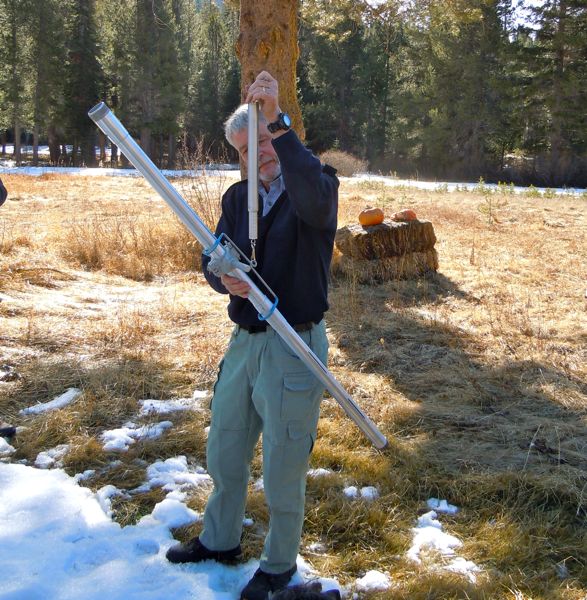
PHILLIPS STATION – Scanning the field at the base of Sierra-at-Tahoe, Frank Gehrke wonders if he needs to bring his equipment out of the vehicle.

It turns out he does need the tools. But he didn’t need them to tell the story. The dry, not even muddy field spoke volumes. The Sierra has no snow.

Frank Gehrke barely found any snow to measure Jan. 3 near Echo Summit. Photo/Kathryn Reed

No snow has many ramifications for a state that depends on its mountains to fill its reservoirs, irrigate its fields, provide winter recreation that translates into tax dollars and keeps people out of the unemployment line, and lowers the threat of fire.

The one measurement Gehrke took Jan. 3 showed a snow depth of 4 inches. But it’s the water content that matters. It came in at 0.14 inches – a record low.

Gehrke has been taking snow samples near the top of Echo Summit for the California Department of Water Resources since 1987. That was the year the previous low water content record was set at 0.9 inches.

1987 was also the start of a five-year drought.

While no one wants to use the “D” word this early in the season, the lack of precipitation throughout California and Nevada last month had it going down as one of the driest Decembers on record. What Northern California has been experiencing is typical in a La Nina year.

Liquid Precipitation

Location         Dec. 2011    Dec. 2010  

S. Lake Tahoe  trace            6.43 inches

Tahoe City       trace          11.40 inches

    Reno                 zero             1.39 inches

Carson City      zero             3.39 inches

Bridgeport       zero             4.52 inches

Mammoth        zero           13.17 inches

Driest Decembers on record

Location           Precip Total/Years

S. Lake Tahoe               trace (2011)

Reno     zero (2011,1883,1882,

1877, 1876,1874)

Carson City      zero (2011,2000,1989)

Mammoth        zero (2011)

2011 Oct.-Dec. Precipitation Totals and Rank

Location           Precip Total/Rank

Tahoe City         3.72 inches (8th driest)

Reno                   0.30 inches (5th driest)

Carson City        0.45 inches (3rd driest)

Source: National Weather Service

The irony is arid Southern California has received more moisture. Some areas are having an above average rainy season.

The smell of dry grass lingers in the air where the snowpack is being measured. No snowcapped peaks are evident. Mountain bikes on cars go by on Highway 50, while a few die-hard skiers turn in to take some runs at Sierra.

“We just don’t know what the future weather will be,” Gehrke said. “Last year was unexpected. It was supposed to be relatively dry.”

Instead, the winter of 2010-11 set records for snowfall in the Sierra. That’s a good thing because it filled California’s reservoirs to the point that they are higher than they were this time last year.

But Gehrke is realistic. He doesn’t believe the water content can catch up if things remain dry through February.

The National Weather Service in Reno does not see any storms on the horizon for at least the next 10 days. That means going into the next holiday weekend – Martin Luther King Jr. – it will be more manmade snow for skiers to schuss on. While resorts keep making snow, bike rental places are getting back into the business, too, in Tahoe.

After all, it’s been darn right hot out – at least for January. South Lake Tahoe hit record highs on Jan. 2 and Jan. 3. On Monday it was 59 degrees in South Tahoe, breaking the 1997 record of 50 degrees. On Tuesday the mercury crept to 58 degrees, one degree higher than the record from 1996.

The entire region is warm. Reno also hit records for the past two days. On Tuesday the high was 66, breaking the 1927 record of 57 degrees. While on Monday the high in Reno was 69, smashing the 58-degree record set in 1939.

While the moisture is nowhere in sight, the cold is returning. Expect highs to be in the 40s in the Lake Tahoe Basin by the end of the weekend with overnight lows in the teens for the weekend.

Phillips Station:

Dec. 30, 2009

  • Snow Depth: 38.5 inches
  • Water Content: 9 inches
  • Percent of Long Term Average: 75 percent

Dec. 27, 2010

  • Snow Depth: 55. 9 inches
  • Water Content: 19 inches
  • Percent of Long Term Average: 158

Jan. 3, 2012

  • Snow Depth: 4 inches
  • Water Content: 0.14 inches
  • Percent of Long Term Average: 1

Source: Department of Water Resources


South Lake Tahoe’s newest resident born New Year’s Day

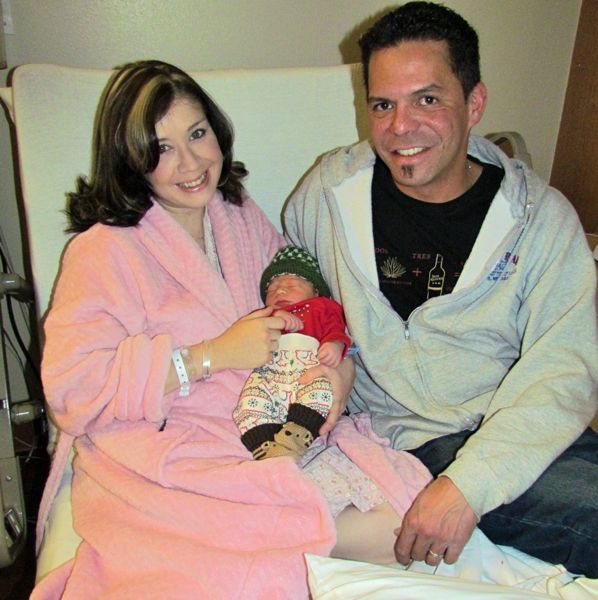
Apparently Laird Lopaka McDaniel doesn’t like to wait and likes to do things his own way.

The newest South Lake Tahoe resident was born New Year’s Day at 8:02pm – two weeks sooner than doctors had expected.

The little one weighs in at 6.9 ounces and is 18.5-inches long.

Andie and Sean McDaniel with newborn son Laird. Photo/Rebecca Wass

Andie McDaniel went into labor about noon New Year’s Eve, but didn’t go to Barton Memorial Hospital until 4am the next day. When a few complications arose, the doctors opted for a Cesarean section. Mom and son are dong fine.

Laird is named after his dad’s brother, who died when Sean McDaniel was a boy.

With their passion for the sun, the ocean and the snow, Laird’s parents look forward to teaching him to surf and ski.

“I knew that as soon as I had a boy he would be named Laird,” Sean McDaniel said. “He will be athletic and a well-rounded individual.”

Barton Health gathered more than $1,300 in gifts from local businesses for Andie, Sean and baby Laird to begin their new journey together.

“It was such a surprise and very nice of all of the businesses to help celebrate the birth of our child,” Andie McDaniel said.

There were more than 400 Barton babies in 2011, with 45 born in December.

 — Rebecca Wass, Barton Health


Vail Resorts renewing its focus on guest safety on the slopes

By Kathryn Reed

No sport is without risk of injury or death. While common sense can play a roll in staying out of the hospital or morgue, sometimes it’s the other “players” who are the problem.

Skiing and snowboarding are two sports where participants don’t often have control over whether they will be hurt. Out of control riders are par for the slopes. Hardpack terrain is unforgiving. Safety bars on chairlifts don’t have to be used.

According to a study by the Centers for Disease Control and Prevention, of the 213,000 people who were treated in emergency rooms between 2004-05 for outdoor recreational injuries, snowboarding (25.5 percent), sledding (10.8 percent), and hiking (6.3 percent) accounted for the highest percentage of injuries. Fractures (27.4 percent) were the most common injuries.

Those taking lessons at Heavenly must wear a helmet. Photo/LTN

Injuries are so prevalent that most ski resorts have an onsite clinic to treat injured riders before assessing if they should be taken to a hospital by ambulance or helicopter.

While it would be impossible to prevent all injuries, Vail Resorts is raising the safety bar in terms of trying to make its six resorts safer than they have ever been. The Play It Safe, Play All Season campaign rolled out last month, after having been in the works since last spring.

Pete Sonntag, general manager of Heavenly Mountain Resort, said weekly surveys of guests keep indicating the resort could improve in the safety department. He said slope density, people skiing faster than they should, and where trails merge near lifts are three of the biggest problems people cite at the South Shore resort.

Sonntag would not say how many people are dedicated to the safety program, but said the numbers have increased substantially. He, along with other upper management, is taking turns joining the Yellow Jacket team. These employees work in slow zones and elsewhere on the mountain to ensure people are riding responsibly.

 Skier-Snowboarder Responsibility Code                 • Safety on the slopes is everyone’s responsibility. Ski safely-not only for yourself, but for others as well. • Always stay in control and be able to stop or avoid objects. • People ahead of you have the right of way. It is your responsibility to avoid them. • Do not stop where you obstruct the trail or are not visible from above. • Whenever starting downhill or merging into a trail, yield to others. • Always use devices to help prevent runaway equipment. • Observe all posted signs and warnings. • Keep off closed trails and out of closed areas. • Prior to using any lift, you must know how to load, ride, and unload safely.

Some people receive warnings, with their pass or day ticket marked, while others are done skiing for the day or even the season.

Through December, one person had their pass yanked for the season, with about 60 being revoked for the day.

Those who have their passes confiscated are able to go to a safety training at any of the Vail properties and get their pass back if they pass a quiz.

Mike Allen, director of snow surfaces, said the people being talked to run the gamut. It’s not a particular demographic that is more prone to violating the Skiers’ Responsibility Code.

“While everyone is ultimately responsible for their own behavior on the slopes, we can absolutely do our part in encouraging and enforcing responsible behavior and are committed to doing that,” Blaise Carrig, co-president of Vail Resorts’ mountain division, said in a statement.

Vail officials would not point to anything in particular for the amped up safety campaign. The announcement coming in the same week Heavenly was sued by a skier who was allegedly hurt last season by a snowboarding employee was coincidental, according to spokesman Russ Pecoraro.

He also said Vail Resorts does not release stats about injuries at any of its resorts because it is a publicly traded company.

According to the National Ski Areas Association, in the last 10 years nearly 41 people on average died each year from skiing or snowboarding.

This season to date, the lone death at a Tahoe area resort came after a 7-year-old boy fell from a chairlift at Sugar Bowl.

According to the California Ski and Snowboarding Safety Association, coming into this season, “Twelve chairlift deaths have occurred since 1973, the latest at Heavenly Valley Ski Resort [in 2007] where 19-year-old Ryan Moore died when he leaned forward on the Dipper Express chair because of a leg cramp and fell nearly 20 feet into rocks below. California law does not require ski resorts to use restraining bars on chairlifts and no resort mandates it.”

However, Heavenly does mandate the bar be used for all ski school participants.

Teaching kids is one way Vail Resorts is getting its message out. Kids must wear helmets during lessons, and the safety bar comes down almost immediately and is not raised until just before disembarking.

Bars are on every lift at Heavenly, but they don’t have to be used by anyone except those riding with an employee.

While the technology exists to have bars operate automatically, Heavenly doesn’t foresee putting in those devices any time soon.

National Safety Week, which is embraced by most resorts, is Jan. 14-22. This is a time when ski areas put an emphasis on alerting skiers-boarders about etiquette on the mountain and other rules that make it safer for everyone.


Spooner Lake’s beauty captivates on First Day Hike

By Kathryn Reed

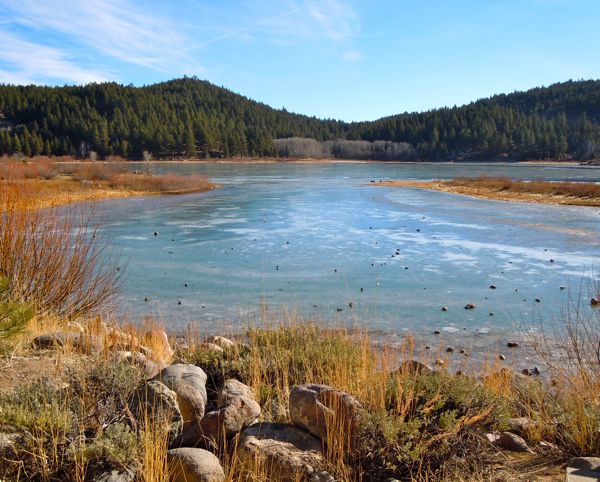
LAKE TAHOE NEVADA STATE PARK – Tromping along the dirt under sunny skies, the only indication this is not a fall day in the Sierra is the fact the lake is nearly completely frozen.

What was supposed to be a snowshoe at Spooner Lake turned into a trail walk with a few patches of ice on the north side. The dozen people – a mix of locals and out-of-towners – who showed up at 10am New Year’s Day didn’t seem to mind.

Rocky and Shilpa Shah are on the walk with their son and daughter, and two friends. Lack of snow is keeping them from spending all their time on the slopes. While they’ve been to Tahoe several times to ski, this is their first time to venture to this part of the basin.

Spooner Lake, except for the ice, has the look and feel of fall Jan. 1. Photos/Kathryn Reed

One of the things Rocky Shah likes is learning about the terrain and history from the park supervisors who are leading the hike. For those who don’t have a guide, plenty of interpretive signs dot the landscape as well as benches to take a rest to take it all in.

“Native Americans did a lot for us. They discovered medicinal uses in plants and food uses,” Bill Champion, supervisor of Spooner-Cave Rock units of the state park, told the group along the 2.1-mile trek.

Stopped at one of the grinding rocks not far from the lake, Champion explains how the Washoe Indians would use the willows that grow along the shore to make baskets and for pain medication, much like people today take aspirin.

Shilpa Shah holds a large pine cone in her hand – though smaller than a sugar pine.

Jay Howard, supervisor of Lake Tahoe Nevada State Park, uses a catchy phrase to distinguish between the cones – “gentle Jeffery, prickly ponderosa”.

This is the first year Nevada has taken part in First Day Hikes and it’s the first year all 50 states have participated. It started 20 years ago in Massachusetts as way to get the year off on a healthy note. More information about First Day Hikes may be found online.

Spooner Lake – off Highway 28 near the junction of Highway 50 – got its name from Michel Spooner, a French-Canadian who with partner Simon Dubois acquired 640 acres for a ranch in the 1860s. During the Comstock the land included a hotel, blacksmith shop and way station.

Facts about U.S. state parks:

Source: America’s State Parks

Total Park Visits: More than 740 million per year
Number of state park units: 7,810
Total economic impact on communities: More than $20 billion
Percent of visitors with children: 64%
Miles of trails:

44,219

Number of campsites: 220,329
Number of cabins and lodges: 7,954

While the state of Nevada acquired the land in the 1960s, Spooner did not become part of the state park until 1981. About 12,500 acres are in the backcountry, while about 1,500 acres are what most people visit at Spooner, Cave Rock or Sand Harbor. All three of these locations are part of Lake Tahoe Nevada State Park.

Spooner Lake, which is mostly fed by natural springs and snowmelt, is nearly 20 feet at its deepest. With a Nevada fishing license, people try to hook rainbow trout and other fish the lake is stocked with.

Today, it’s mountain bikers who dominate the trails. About 75 percent of trail users are on two-wheels, while hikers and equestrians are the other main users. In the winter, Spooner has cross country trails.

Spooner has a year-round concessionaire that ferries cyclists using the Flume Trail from the end back to the parking lot and cuts the ski trails. Three seasonal concessionaires operate at Sand Harbor – Shakespeare Festival, food, and boat rentals. The latter started this past summer and brought in $30,000 to Nevada State Parks. In all, the four concessionaires added $80,000 to the state coffers for 2011.

Champion said public-private partnerships are the way to go, especially as money becomes scarcer out of Carson City.

Still, more people are visiting the state park at Lake Tahoe – especially as the economy tanked.

“People can’t afford to travel,” Howard said. “Our visitors are up.”

Getting to Spooner Lake:

From South Lake Tahoe, take Highway 50 east. At the summit, turn left onto Highway 28. The entrance to the state park is quickly on the right. Parking is $7 or $8 depending on the season.

ngg_shortcode_0_placeholder  (Click on photos to enlarge.)


Random Acts of Kindness — tell us what yours are

Lake Tahoe News wants to start off 2012 on a happy, positive, joyful (insert favorite word) note. Mostly, we want it to be a kind note.

With that said, January will be Random Acts of Kindness Month on Lake Tahoe News.

We are asking all readers to let us know about a Random Act of Kindness that they did, were a recipient of, or that they witnessed. It could be as simple as opening a door for someone.

Start today by putting a comment at the end of this story. Then, each day a Random Acts of Kindness story will be on Lake Tahoe News announcing who won, why that person won and what was won.

We realize people may be reluctant to promote themselves. We hope you will get beyond that because your kindness deserves recognition and ideally will help foster more kindness from everyone who reads about it.

We also realize you may not want to get credit for receiving or witnessing a Random Act of Kindness. Still, the awareness of it and acknowledgement should be made public so people can see the world is full of goodness. The other thing you can do is ask the people involved if you could post their name and write about the Act. If you want them to be in the running for the prize, first post what the Random Act of Kindness was and say that you want that person to be a contender for the prize. Then you will need to send their email address to info@LakeTahoeNews.net with RAOK in the subject line and details in the body of the email or tell them about Random Acts of Kindness to have them write a comment on Lake Tahoe News so they put themselves in the running.

Randomly, one of the people who writes in will be rewarded each day in January.

While Random Acts of Kindness should not necessitate more than a “thank you” from the person on the receiving end, with the help of dozens of local businesses we are going to reward you for your Random Acts of Kindness.

Our goal is the kindness expressed throughout January will continue forever. But this will only be successful if you tell us about the Random Acts of Kindness. If you are shy about receiving a gift, consider donating your gift – if appropriate – to further extend the Random Act of Kindness.

A few rules and things to know:

• Anyone, living anywhere may participate. This includes people who write for Lake Tahoe News or do other work, advertisers, previous contest winners, and people in another country (though you may need to come to Tahoe to get your gift).

• Winners’ full names will be published.

• Prizes have already been assigned to specific dates so there cannot even be the perception of an individual or response receiving preferential treatment.

• All negative, irrelevant comments will be marked as spam. Go by the rule – If you can’t something nice, don’t say anything at all.

Thank you in advance for being part of Lake Tahoe News’ inaugural Random Acts of Kindness Month.


Lahontan-issued stormwater permit being appealed to state

By Kathryn Reed

A joint appeal to the state Water Resources Control Board is being crafted by South Lake Tahoe, and El Dorado and Placer counties regarding the stormwater permit the Lahontan Regional Board approved earlier this month.

El Dorado County initiated the process. Legal counsels for the three jurisdictions with the assistance of outside attorneys in Sacramento are finalizing the paperwork. All three are sharing in the nearly $20,000 it will cost to file the petition.

The deadline to file is Jan. 5.

Lahontan Executive Director Harold Singer, third from left, told the board Dec. 6 the stormwater permit should be approved. Photo/LTN

Because the petition is not expected to be finalized until the deadline, the exact language and specific arguments are not yet public.

“We hope to get some modifications to the permit which will at least modify the tools used and get the costs down somewhat,” El Dorado County Chief Counsel Lou Green told Lake Tahoe News.

The three jurisdictions don’t believe the regional board on Dec. 6 understood their concerns or listened well. They also don’t understand why the disagreements couldn’t be talked through before the board approved the permit.

Lahontan Regional Water Quality Control Board gets to tell the three government entities on the California side of Lake Tahoe what to do when it comes to water issues. Nevada does not have an equivalent layer of government.

“We have always approached water quality on a regional level and we aren’t anymore,” South Lake Tahoe Mayor Claire Fortier said. “We need a concerted and collaborative effort to reach the goals. If the problem is roads, then let’s put money into roads.”

No one is arguing stormwater should not be treated or that lake clarity is not important. What they disagree with is the language and requirements in the permit. This also then puts another layer of responsibility on two-thirds of the lake, instead of taking a basinwide approach to the sediment issue. Monitoring and costs associated with it are huge stumbling blocks for the local entities.

“For some reason the money doesn’t matter (to Lahontan). Boy, if I ever thought of a time when money mattered, it’s now with how bad the economic times are,” Ken Grehm, Placer County public works director, told Lake Tahoe News.

“I would like to focus on cleaning up water, not so much on monitoring. Let local agencies provide services and let scientists do what they do. The real concern is I don’t know if this will work,” Grehm said of Lahontan’s rules.

He would prefer a slower, more calculated approach instead of jumping in with both feet to unchartered processes like Lahontan has mandated.

All jurisdictions call the permit an unfunded mandate. They are told to do something and no money is provided. Lahontan uses a state definition for “unfunded mandate” that differs from conventional wisdom.

Equality is an issue as well. The state water board is working on the overdue stormwater permit for Caltrans that will likely have a special section for highways in the basin. That permit, according to Lahontan, is likely to resemble what the city and counties are being asked to do.

The U.S. Forest Service, which owns about 75 percent of the land in the Lake Tahoe Basin, falls under the federal Clean Water Act instead of a municipal stormwater permit.

Lauri Kemper, second in charge at Lahontan, said she didn’t realize an appeal was in the works, but was not surprised. She said the process is the people in the petition unit do not work with the regional board on permitting issues, but are more independent. The petition unit has the authority to dismiss the petition or have a public hearing before the state board.

“If it goes to a public hearing, we would prepare a rebuttal then,” Kemper explained.

The South Lake Tahoe City Council will discuss the issue in closed session at the Jan. 3 meeting. (The full City Council agenda is online.)

The Placer County Board of Supervisors will have the petition on closed session Jan. 10. Placer County Counsel Anthony La Bouff said staff has authority from the board to go forward with the petition.

“There are a lot of moving parts in Lake Tahoe all the time. This is just one of them,” La Bouff said of the stormwater permit issue.


LTCC grooves to the beat of 3-day outdoor music festival

By Kathryn Reed

One day SnowGlobe might legitimately be used in the same sentence of Woodstock or Day on the Green. More than 9,000 people – mostly younger than 30 – swayed, danced, bounced and moved to the sounds of bands like their parents’ and grandparents’ generations did decades ago.

Only this music isn’t rock ’n’ roll. It’s techno. It’s hip-hop. It’s crunk. It’s a whole lot of drum machine and bass. Sometimes a band isn’t even on stage – it’s a disc jockey putting the sounds together in a mix that becomes original music. They are artists in their own right, not like the disc jockey putting someone else’s song on the radio.

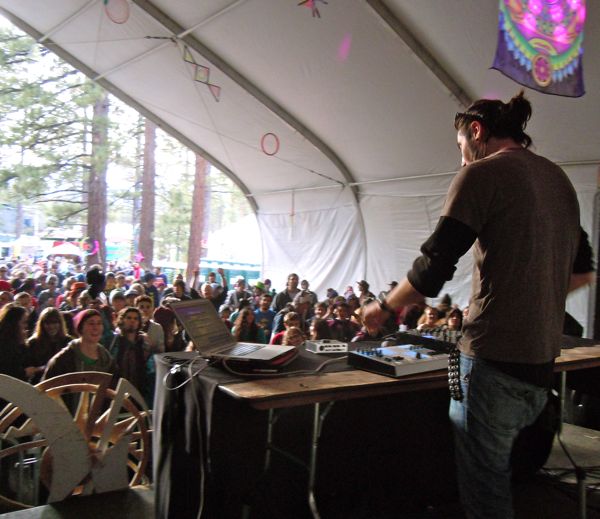
Stephan Jacobs keeps a throng of SnowGlobers moving to the music. Photos/Kathryn Reed

It’s got a beat that makes everyone listening want to dance. It’s a party. It’s people having fun.

South Tahoe evolves

Kindred Murillo has a smile on her face as she surveys the crowd. She is used to this age group. After all, she is president of Lake Tahoe Community College; which is doubling as a concert venue for two more nights.

“It’s better than I expected,” she said looking at a line of people waiting to get in.

On the job less than six months, she is doing something no one in the history of the 30-plus-year-old college has done – turning the campus into a music venue. If everyone determines SnowGlobe was successful, Murillo envisions the college being more of a partner in the future.

She’s well aware of the publicity the event has already brought to the campus and hopes to be able to capitalize on it in the future.

The college is getting about $10,000 from the concert promoters for use of the site. The city will get about the same from the business license fee and reimbursement of hard costs like overtime for employees.

It’s a potential shot in the arm to local businesses, too – money in pockets of hotels, vacation rental owners, and other businesses that are smart enough to tap into the needs of this crowd. Like food when the festival is over. Souvenirs to take home. Warm clothes for these flatlanders.

Tickets: Dec. 30 $65, available at Horizon in Stateline noon–6pm; Dec. 31 $75, available at Horizon in Stateline noon–6pm Age: Anyone Times: Dec. 30 2:15-11pm; Dec. 31 4:15pm-1am Info: SnowGlobe online

It was South Lake Tahoe City Manager Tony O’Rourke who shook his head a year ago when he heard the city did nothing on New Year’s Eve except pay police officers overtime to help patrol the Stateline casino corridor. His idea was give those twenty-somethings something to do and get them to open their wallets.

They are here and they are spending money. Three-day tickets cost about $150, with Saturday-only being $75.

Vendor Village is a tented area where jewelry, hats, glasses, clothes, leather goods and organic food are being old. On the outskirts of the shopping area is SpiritHoods. They sell those animal hats with long ears, so to speak, that can be scarves of sorts. At the concert they sell for $100 — $35 less than online or at their Los Angeles headquarters.

A slew of women and men have this style of hat on. They seem to be everywhere.

SnowGlobe is giving people who might usually stand around in the cold at Stateline on New Year’s Eve something to do other than question why they are standing around in the cold. It will give people who can stay out past 9pm on New Year’s Eve a place to be on the South Shore – which includes a fireworks show.

It’s about putting South Lake Tahoe on the map as a place to be this time of year that doesn’t involve being in a casino.

It may even be good business for the three marijuana dispensaries in South Tahoe.

With the smell of pot wafting between the three stages on opening night of the three-day event and no line for Sierra Nevada brew, it was obvious the drug of choice for this crowd is weed.

The cops are ignoring them. After all, it’s just an infraction in California – like getting a speeding ticket.

But South Lake Tahoe police officers make their presence known at the get-go. And SnowGlobe officials alerted their followers that undercover cops would be on the grounds, too.

“Their security handles everything,” Sgt. Shannon Laney told Lake Tahoe News as he watched people funnel in. “They bring the problems to us.”

It’s all about the music

Dillon Francis – on the Sierra stage – is who Robert Bunnett, 19, was most excited to see Thursday.

He and 14 friends made it a road trip from Los Angeles for three days of music. They are staying – all of them – in a one-room cabin. Usually it’s the LA-San Bernardino music fests they follow. The lineup and the opportunity to be in Tahoe for New Year’s led them north.

Even though Sherose Renck, 17, and Serena Gafford, 16, didn’t have to drive far, the best friends from Gardnerville are staying in a hotel overnight on the South Shore – going to SnowGlobe all three days.

They are moving to the beat of Stephan Jacobs who is making techno music on the Igloo stage. This is the biggest music event either one has been to.

It’s the atmosphere that captivates Renck. “I love the energy,” she says.

With goggles on her forehead, Lorene Carlston of Santa Cruz waits to get in. She’s most excited to see Pretty Lights, one of the headliners on the SnowGlobe stage Dec. 29.

Frustrated with the people who work at the Horizon casino in Stateline for not knowing where the shuttle to LTCC was, this led her and a friend to a hitch a ride.

At 28 and her friend 31, she says, “We find it to be a young crowd.”

Despite their hiccup, most people were getting to LTCC via the 30 buses bringing them to and from LTCC for free.

Eran Afmer, 34, of Seattle is a bit disappointed with no fresh snow, especially considering she left powder in the Cascades. Still, she’s excited to be in Tahoe – a first for her – with friends from various states. They rented a huge house for the long weekend.

South Lake Tahoe local Anthony Davis put in six hours volunteering at the event Thursday.

“I did it so I can get a feel for the event and know what it’s all about before I judge it,” Davis said. “I’m liking it. I like the vibe.”

ngg_shortcode_1_placeholder (Click on photos to enlarge.)


Grass Roots to expand product line at new location

By Kathryn Reed

Three-foot wide aisles with shelves packed from floor to ceiling are not the ideal shopping conditions – for consumer or storeowner.

That’s why Jon McElroy is moving out of the location Grass Roots has been in since 1973 and moving across the driveway to the old Blockbuster building. With 1,200-square-feet of retail space today, when the new store opens in the spring it will have 4,000-square-feet devoted to natural foods.

“You will be able to see the products,” McElroy said of the new site. “Now you can’t stand back far enough to see what’s on the bottom shelf. And if gets crowded, it is annoying.”

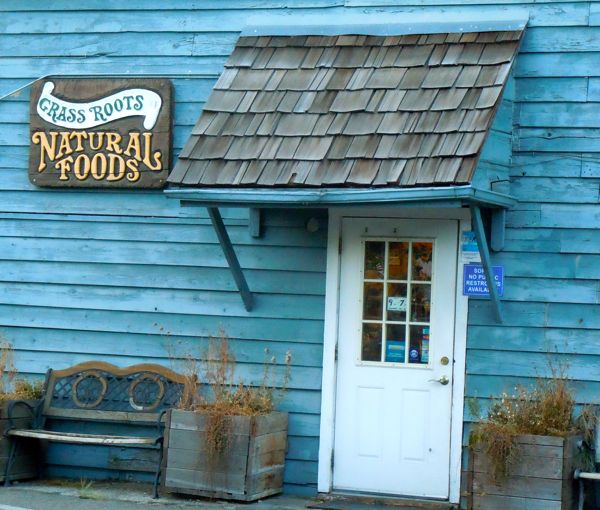
Grass Roots will be moving almost next door in spring 2012. Photo/LTN

Through the years McElroy and wife Sandra have thought about moving into a bigger place than their Dunlap Drive location in South Lake Tahoe, but the right place never came along.

Then earlier this year everything clicked. They bought the building that is next door, which also fronts Highway 50 at the Y. The Grass Roots sign is in place even though the moving date isn’t likely to be until March.

“One reason we wanted to expand is there are a lot of new products, fun things (on the market). We go to trade shows and say we wish we could carry this and that, but where would we carry it?” McElroy said.

The McElroys look forward to being able to carry more products, expanding the produce section and creating a better shopping experience. He envisions it being a mini Whole Foods Market.

With the tight quarters of the current store, it’s not possible to introduce a new product without taking one away.

Although the size of the store is much larger, with doubling the aisle space to 6 feet, much of the room will be used in cosmetic ways instead of devoted to sales. But at the same time, a more pleasant environment with more choices may keep the cash register ringing louder and more often.

Like most businesses, Grass Roots saw its bottom line take a hit in 2009 and 2010. McElroy said things have been on the upswing this year.

“People’s shopping habits have changed. We have a sales flyer that comes out every month. They will look for specials and walk around with the flyer in hand,” McElroy told Lake Tahoe News.

While people are price conscious, they are also turning their attention to better nutrition. This is one area where Grass Roots is attracting new customers – those who care about what’s in a product and where their food comes from.

Lots of things need to be done to the building to convert it from a video store to a grocery store. Gone are the blue carpet and yellow walls. Wood will be on the walls and the floor will be stained concrete.

Today’s store has four little freezer doors. The new place will have 10.

Grass Roots is forming a partnership with Freshies for that South Tahoe restaurant to provide soup at the new location. It will be self-serve, with people able to get lunch on the go.

McElroy is talking to some people about turning the current Grass Roots spot into a café. The owner, who lives out of state, is likely to convert the upstairs back into apartments. Now it’s used as office space and storage.

The bakery, which McElroy knows well, will remain in the current location because the process to create a commercial kitchen is too involved. It means the fresh breads will be sold at the new property.

McElroy first went to work at Grass Roots as a baker in 1978 when Karen and Jeff Miner owned the natural foods store. The Miners had opened it five years earlier. McElroy bought them out in 1985 – the same year he got married. The McElroys have been operating it ever since then.


State panel to reconsider Washoe Meadows decision

By Kathryn Reed

Second thoughts are what the California State Park and Recreation commissioners are having regarding the October decision to approve the final EIR for the Upper Truckee River restoration project, and to swap land between Washoe Meadows State Park and Lake Valley Recreation Area to allow Lake Tahoe Golf Course to be reconfigured.

Commissioners at their Jan. 27 meeting in the Bay Area are having another public hearing on the state park in Meyers.

The agenda item says: Reconsideration of, and upon reconsideration, action on approval and findings for the Environmental Impact Report, General Plan Amendment & Classification Adjustment related to the Upper Truckee River Restoration & Golf Course Reconfiguration Project.

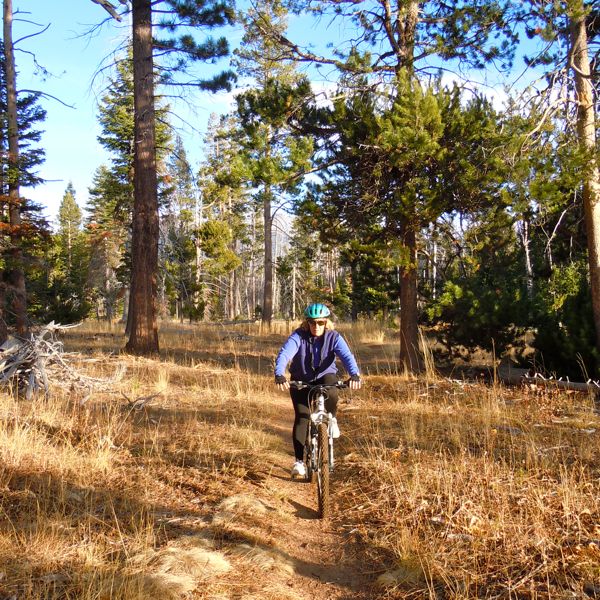
Without snow, Washoe Meadows is still good for mountain biking -- though if the decision is not overturned, this section will become a golf course. Photo/Kathryn Reed

No one from State Parks or the commission was available for comment Tuesday night. So it’s not known who asked for the issue to be heard again or how often this happens by the state commission.

At the Lake Tahoe meeting two months ago the decision was unanimous to accept staff’s recommendations.

The decision by the commissioners came as Ruth Coleman, director of the Department of Parks and Recreation, sat to their left. She is now in jeopardy of losing the job she was appointed to in 2002 by then-Gov. Gray Davis.

The State Parks Peace Officer Management Association sent a letter Dec. 14 to Gov. Jerry Brown that said 93 percent of the 56 percent of the members polled want a new director.

Whether her tenuous situation played a roll in rehearing the Washoe project is not known.

Before the public items are addressed next month the commission will go into closed session to discuss the lawsuit filed by the Washoe Meadows Community. This group filed a lawsuit Nov. 23 in Alameda County Superior Court on various grounds in an attempt to halt the project as approved.

Both sides have agreed to push back some of the deadlines regarding filing of papers in the case.

Washoe Meadows Community supports Alternative 3 – which would take the 18-hole course down to nine holes or convert it to an 18-hole executive course.

The reason the golf course would be altered is to accommodate restoration of the river – an ongoing project by all parties who own property where the river runs through it. It’s all about reducing sediment that reaches Lake Tahoe and restoring the ecosystem.

The Tahoe Regional Planning Agency Governing Board still needs to vote on the Washoe Meadows section, but that has been pulled indefinitely at the request of State Parks.

Lynne Paulson, a member of the Washoe Meadows Community, said her group would be present at the January public hearing.

She had not been given a heads up about the issue being on the January agenda; learning about it when notification of the meeting was sent via mass email Dec. 27.

“I hope this leads to a better alternative,” Paulson told Lake Tahoe News of the Jan. 27 meeting.

Regarding the lawsuit, Paulson does not expect a settlement conference to be scheduled before the commission meets.

—————

Meeting info:

• Jan. 27 at 9am in the Community Room of the Brentwood Community Center, 35 Oak St., Brentwood.

• To comment on agenda items, write to State Park and Recreation Commission, Box 942896, Sacramento, CA 94296-0001, or email LNastro@parks.ca.gov, or call (916) 653.0524.

• The meeting agenda is online.