Discovering history en route to a scenic mountain bike ride

By Kathryn Reed

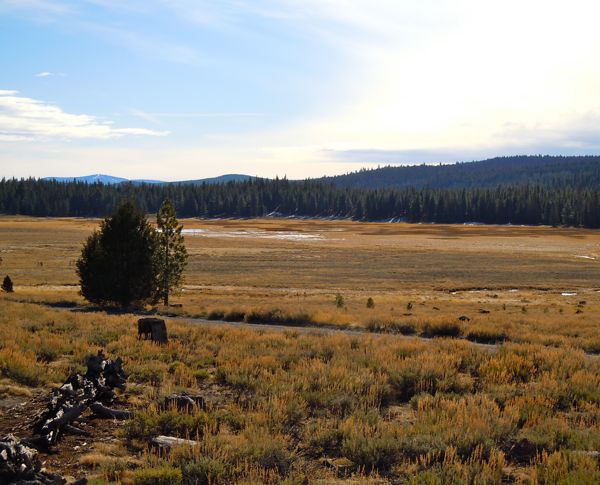
TRUCKEE – Scanning the vast open space, with tall grasses dancing in the gentle breeze and pines looming overhead, the solitude is extraordinary. That’s what makes it so hard to imagine this used to be a bustling outpost in the mid-1800s.

Called the Henness Pass, it linked the Gold and Silver states – still does, but not with nearly the same amount of traffic.

A marker at Kyburz Flat says, “Henness Pass Road was used in the 1850s for travel to the mining camps along the North and Middle Yuba rivers. After the Comstock silver strike in 1859, Henness Pass Road was improved to attract travel between San Francisco and Virginia City via Sacramento, Auburn, Nevada (City), and Camptonville.”

Wide-open spaces north of Truckee off Highway 89 used to bustle with silver and gold miners. Photos/Kathryn Reed

More’s Station was a 320-acre ranch.

Three points of interest are marked in this area that is one mile off Highway 89 between Truckee and Sierraville.

In a quest to find someplace new to mountain bike while the ground is snowless in January, we ventured just outside the Lake Tahoe Basin. I can’t count the times we’ve driven by this dirt county road. This time we turned right and drove a mile in.

Wow. What history tucked back into this near pristine acreage that is mostly on Tahoe National Forest land.

A sign talks of a once thriving hotel being two-feet from that marker. It would still make for an ideal place for a lodging establishment. But, selfishly, it is so wonderful to look at such a large swath of undeveloped land.

A little boardwalk makes a loop, with markers pointing out where a hotel, well, barn, corral and root cellar once stood. Rocks that are likely from that time period are still there.

Getting on our bikes, we ride less than a mile to what was the Wheeler Sheep Camp. A brick oven still stands – though volunteers, in cooperation with the U.S. Forest Service, rebuilt it. It works today and can be rented.

It’s easy to imagine sheep roaming in the adjacent meadow, munching away on the native grasses.

No one is here.

It’s quiet, except for the wind in the trees.

We ride up a bit farther, but the road dead ends. We turn around, but instead of making a left to go back to the Jeep, we go right to explore more.

Done with our cultural and historical portion of our outing, we get some exercise.

The trail is really more like a logging road. Evidence is everywhere that thinning projects have been going on recently in this section of the forest. The grade is gradual. A few spots have snow and ice, some places are hardpack, while others are dry and dusty.

It’s chilly and the light doesn’t last as long this time of year. We don’t venture that far in. Next time, on a summer day, we’ll explore even more.

Getting there:

From the South Shore, get to Truckee going up either side of the lake you like. Then get onto Highway 89 north going out of Truckee.

Between Truckee and Sierraville, which is 25 miles from Truckee, is Sierra County Road 450. Turn right.

One mile in is Kyburz Flat, where we parked. Seven miles is Sardine Valley and 14 miles in is Stampede Reservoir.

A four-wheel drive is not necessary to get to where we parked.

Signs point to where the historical sites are located.

ngg_shortcode_0_placeholder (Click on photos to enlarge.)


Public input changes USFS Fallen Leaf Lake plans

By Kathryn Reed

CAMP RICHARDSON – People are cycling and walking on what’s commonly referred to as the Camp Rich bike trail. A red-tail hawk soars overhead. Fallen Leaf Lake is glassy, almost inviting to water ski on. An embankment at Taylor Creek along a user-created trail exposes tree roots. The bridge at the dam is accessible only to the able bodied and to those who get off their bikes.

The U.S. Forest Service has big plans for these 13,000 acres on the South Shore that encompass more than 40 miles of trails.

This section of Taylor Creek may no longer be an equestrian crossing. Photos/Kathryn Reed

Based on comments received regarding the Fallen Leaf Lake Trail Access and Travel Management Proposal, changes are already in the works. Comments for this scoping segment of the project ended Jan. 13.

The 285-foot long dam/bridge at Fallen Leaf Lake-Taylor Creek needs to be replaced to accommodate modern day uses and meet current access standards.

“This was never intended for public access,” Garrett Villanueva, forest engineer with the Forest Service, said while standing on the bridge.

A significant portion of the nearly 50 comments received mentioned the federal agency’s idea to expand the bridge to accommodate equestrian use. And people didn’t favor the original idea.

Now the USFS is considering a 6-foot-wide bridge, which would meet its minimum requirements and likely better satisfy those who have said a bridge twice that wide would have changed the character of the area.

It’s about 3-feet-wide now. It was built in 1934 with Anita Baldwin’s money.

The concrete spillway would remain. No changes are slated for the dam. Just the bridge will be altered. A cut out is likely to be incorporated into the design so people could stop to look at the scenery without impeding the flow of people.

Equestrians currently cross Taylor Creek about one-third of a mile from the bridge. While this location is also a popular swimming area, especially for people from the Fallen Leaf Lake campground, it’s not where USFS officials want horses.

Looking at the tree roots exposed near the creek, Forest Service engineer Mike Gabor, says, “It’s not natural. It’s an indication of how much sediment is going in the creek.”

Bare soil is in abundance here.

“We are not trying to stop people from swimming, but how they get to and from there is the challenging part,” Gabor told Lake Tahoe News.

The plan is to move the equestrian crossing closer to the bridge.

Protecting resources and providing recreation are the two main reasons to create what is essentially a master plan for the area. While talk about doing much of what is proposed first started in the 1980s, a comprehensive plan never got off the ground.

With an average of 1,600 people using the paved bike trail at Camp Richardson during peak season, this area is among the most popular and heaviest used areas in the Lake Tahoe Basin. It is also part of the National Trail System.

The paved area would be brought up to AASHTO (American Association of State Highway and Transportation Officials) standards – so 10-feet wide, shoulders 2-feet wide, and a grade of no more than 5 percent.

Many of the trails on both sides of Highway 89 were user created – not ones developed or maintained by the Forest Service. These types of trails have been created since the beginning of time, and even more recently by people with the last names of Gilmore, Price and Baldwin.

The problem is trampling on so much land compromises vegetation and habitat. It’s also a safety concern because land managers may not travel those routes and therefore not find someone who is injured.

Some people, though, are concerned the trail closest to the creek by the bridge will be removed. With the embankment eroding, Forest Service trail gurus say it has to go or at least be moved back.

Another  concern is a heavily used trail traverses two private parcels at the far end of Fallen Leaf Lake. Those are Forest Service managed trails that have existed for 100 years. But without permission by the owners, which has not been granted yet, those routes could be off limits.

More information about the proposed project, including maps, is online.

A public workshop will be conducted in the next few months. The public will be able to comment again when the draft environmental assessment comes out, which is likely to be late spring/early summer.

The Camp Richardson project ties into the Fallen Leaf Lake plans. The environmental assessment is done, with comments regarding Jameson Road still being worked on. A written finding on that project could be released in a matter of weeks.

ngg_shortcode_1_placeholder (Click on photos to enlarge.)


Report: Officials stay one step ahead of aquatic invasives

By Kathryn Reed

STATELINE – Sixty-three percent of the vessels inspected in 2011 had to be decontaminated before being allowed to enter Lake Tahoe.

Of the 30,400 boats that were launched, 7,600 had to be checked for aquatic invasive species, with 4,800 of those needing to be decontaminated. While most of the boats originated in California or Nevada, Utah, Oregon and Arizona were the states with the next highest number of boaters.

Small mouth bass are a threat to mackinaw in Lake Tahoe.

Overall, that was 9,000 more than in 2010. Ted Thayer, aquatic invasive species program coordinator for the Tahoe Regional Planning Agency, said how data is collected changed between 2010 and 2011, so while marinas reported business was up, it may not have been as significant as the AIS program numbers indicate.

Thayer on Jan. 11 updated the Advisory Planning Commission about how the AIS program worked last year. The TRPA Governing Board will hear the presentation at its Jan. 25 meeting in Stateline.

“This was a very successful year for the program,” Thayer said.

The program since its inception in 2007 keeps evolving. Prevention, monitoring and controlling are the mantras. Weeds, Asian clams and warm water fish are the predominate invasives that partners in the program are trying to eradicate, control or prevent from reaching Lake Tahoe. Fallen Leaf and Echo lakes also come under the purview of this program.

But what makes Fallen Leaf Lake different than Tahoe is no aquatic invasive species have been found in that body of water off Highway 89. Motor boats are inspected at the marina, with a roving inspector checking non-motorized watercraft that are mostly launched from the U.S. Forest Service-owned campground at the other end.

The Fallen Leaf Lake report shows of the 428 inspections, 24 vessels came from lakes known to have quagga or zebra mussels, or New Zealand mud snails.

Other regional bodies of water like Donner Lake and Lahontan Reservoir are outside TRPA’s control. However, as funding these programs becomes more difficult with the disappearance of federal dollars, a broader regional approach to aquatic invasive species is likely to occur.

Thayer said this could mean one day the decontamination station on the North Shore being outside the basin and closer to Truckee, and possibly having a station in Carson City instead of at the top of Spooner Summit. Those are just ideas now. Eventually permanent stations are the goal.

TRPA is not alone in the AIS program. A number of agencies and groups are involved, including, but not limited to, Tahoe RCD, UC Davis, California Department of Fish & Game, and Nevada Department of Wildlife.

In 2011, 6.51 acres of Emerald Bay were treated for invasive weeds. This compares to the 1.1 acres treated in 2010. Commercial divers helped with the removal of the plants.

Milfoil is one of the biggest problems throughout Lake Tahoe, especially in the lagoons of Tahoe Keys on the South Shore.

“This project was designed to test multiple methods,” Thayer said. “Tahoe Keys is a very different environment. There is a lot denser growth of weeds, with a lot of boat docks.”

A dye that is invisible to the human eye was used in this area. Thayer praised Lahontan Regional Water Quality Control Board’s decision late last year to allow herbicide use in Lake Tahoe on occasion. He said this may be needed for the Keys.

Using a barrier to suffocate Asian clams was most effective in summer, but worked in the winter as well – it just takes longer when the water is colder. Marla Bay is where the winter tests were done.

Knowing this works means the material could be used in areas with a ton of boat activity – like Ski Run Marina area – that during the summer make it dangerous for divers to work.

A pilot program to rid the mouth of Emerald Bay was less successful because of the topography and water exchange.

A warm water fish eradication program encompassed about 14 acres, mostly in the Tahoe Keys. An electrical charge was sent into the water that stunned the fish. They were then scooped out of the water – all 12,000, which weighed 2,157 pounds.

The small mouth bass, according to Thayer, is what concerns officials the most. They can threaten the mackinaw. Even though the mackinaw is not native — it was introduced as a sport fish — it is not considered an invasive species.

A change going forward is creating a lakewide permit for AIS treatments. Thayer said that should be in place this year.

In the past, engines were flushed for one minute to decontaminate them. That will decrease to 10 seconds this year. Thayer said this is to conform with industry standards. For boaters it will speed up the process and decrease potential propeller damage from the decontamination process.

Monitoring the water at 60 locations throughout Tahoe, Fallen Leaf and Echo is how scientists determine if invasives have reached those bodies of water. The most threatening are quagga and zebra mussels. They have not reached any of these waters.

To keep the program going, an increase in watercraft inspection fees is being proposed. The Governing Board will make that decision. The document linked here is what was presented to the APC and is likely to change before it reaches the Governing Board in 12 days.


Tahoe ski resort heavyweights to advance Olympic chances

By Susan Wood

Experience counts. The Reno-based coalition tasked with bringing Olympic gold to the California-Nevada region in winter 2022 threw some big guns behind the effort Wednesday by appointing to the board Lake Tahoe ski giants Blaise Carrig of Vail and Andy Wirth of Squaw Valley.

The two men have shared the Olympic experience when they worked in Utah. They would like to share it again in 10 years.

If organizers get their way, the Olympics will return to Lake Tahoe 62 years after they were in Squaw. Photo/LTN file

Carrig, co-president of Vail’s mountain division, brings to the Tahoe table his experience at The Canyons resort in Park City during the 2002 Winter Games at Salt Lake City and a steadfast investment as the head of Heavenly Mountain Resort before moving up Vail’s corporate ladder.

Wirth would like to see the Games return to Tahoe and pledged to work closely with his old pal and resort competitor Carrig to accomplish that goal.

The board may even enlist some high-level help from the East Coast – as in presidential candidate Mitt Romney, who salvaged the Winter Games to Utah a decade ago and turned it into a profitable endeavor. Romney visited the coalition in 2008.

It could also be a boon that Nevada Lt. Gov. Brian Krolicki is co-chair of Romney’s presidential campaign in Nevada.

“(Romney) did a phenomenal and remarkable job. He took a group from utter disaster to an extreme success,” Wirth said.

The Squaw chief noted that even if the Reno-Tahoe group loses to a city like Denver, it would be a lesson learned.

“It’s difficult to handicap (one city versus another). I’m just encouraged by the initiative of the resorts,” he said.

Reno and Denver want to be the U.S. city chosen for 2022. Reno has Tahoe, with resorts from Squaw Valley to Heavenly providing world-class views from one side of the lake to another. Denver has Vail, with seven back bowls stretching seven miles across at its namesake and a not-for-the-faint-of-heart World Cup downhill run (Birds of Prey) at the customer-oriented Beaver Creek resort that would make Tahoe’s Olympic downhill legend Daron Rahlves look twice.

On the North Shore, Squaw has a reputation. Let’s face it. If one doesn’t get enough of a poignant chill seeing that Olympic flame burning on Highway 89, then maneuvering with the elite down runs off KT-22 may provide bone-chilling humility.

On the south side, Heavenly has the entertainment to support the bed base and snow caches some don’t want to share. The bi-state resort even brings its own entertainment to the slopes, with Gunbarrel 25 each spring. Just once, one may want to imagine skiing wild man Glen Plake and freestyle Olympian Jonny Moseley bumping knees side-by-side.

Both resorts have a history with the Winter Games.

The guts and vision of Alex Cushing brought the games to Tahoe in a surprise move away from Innsbruck, Austria, 42 years ago. A decade ago this month, the Olympic torch graced Lake Tahoe on its way to Utah with one of the torchbearers, Martin Hollay, skiing it down Heavenly’s Olympic run. (This reporter ran a leg of it down Sierra Boulevard.) The South Shore community showed up in great numbers for both.

In an area divisive on many fronts, the North and South shores were unified in being a part of something big.

Organizers hope for this dream again.

But either way, the revenue-sharing agreement between the U.S. Olympic Committee and International Olympic Committee will need to be worked out before any U.S. city is considered. The two entities are in meetings this week to hash out their differences.

Carrig insists the Olympic-seeking group remains in the early phases of planning – with no cost analysis or set venues in mind.

The Denver committee recently released a cost estimate to host the Games — $1.5 billion. They used the 2010 Games at Vancouver as a benchmark, the Denver Post reported.

Everything remains on the table as a possibility in Tahoe. Carrig did mention Heavenly could see a new run – perhaps one carved on the front ridge of South Lake Tahoe leading to the Olympic run. It’s all just a possibility. It all could be for the men’s downhill.

“We’re going to evaluate it. A new venue could start over that way,” Carrig told Lake Tahoe News, while peering out his Colorado window at snow falling last weekend.

“A larger issue is all the beds being filled by the spectators, media and athletes,” he said.

Carrig admits Tahoe and Colorado are attractive for the Winter Games, with their history, ski terrain, scenery and environmental cultures.

He believes the stigma has disappeared regarding Denver turning down the Games in 1976 after winning the bid. Nonetheless, Carrig said his loyalty lies with working with Reno-Tahoe Winter Games Coalition Chairman Krolicki.

Squaw Valley CEO Wirth has a massive background at Vancouver with Intrawest. His home resort’s host-city status in 1960 and his company’s purchase of neighboring Alpine Meadows bring elements of nostalgia and terrain to the Olympic bidding table.

The goal is for Tahoe-Reno to edge out Chile and China on the international front after bumping Denver out of the picture.

What Denver’s coalition of public officials and business leaders doesn’t have is a representative from Vail Resorts, the largest U.S. ski company.

“I’m not sure how (our efforts) all stack against others, but their not having something has no bearing on what we do. The truth is, we have the properties in both regions. We did look at who they have on their committee and noted what representation they did have but didn’t focus on what they didn’t have,” Reno-Tahoe coalition CEO Jon Killoran told Lake Tahoe News on Jan. 11. Instead, Killoran focused on the board’s level of depth. The efforts began in 2001 with Reno sports commissioner Jim Vanden Heuvel, who died three years ago.

Since then, California Lt. Gov. Gavin Newsom – the former San Francisco mayor — threw his support behind the venture, along with a Bay Area sporting event group which tried to bring the 2012 Summer Games to the area. State Sen. Ted Gaines, R-Roseville, is one of the California Winter Games Committee members. Gaines started skiing at a young age at Tahoe resorts and has a second home on the North Shore. And Newsom has business interests at Squaw.

To Killoran, a vision like forming an Olympic bid requires cooperation from a collective group of people.

“You don’t always do that every day,” Killoran emphasized.

Wirth seconded the sentiment.

Other members of the Reno Tahoe Winter Games Coalition board include:

• Dan Allen – ITS Logistics

• Krys Bart – Reno Tahoe International Airport

• Larry Bernard – attorney

• Bruce Breslow – Nevada Department of Motor Vehicles

• Nicholas Butler – Umpqua Bank

• Brad Chamberlain – attorney

• Nancy Cushing – Squaw Valley

• Carolyn Wallace Dee – Squaw Valley

• Susan Fisher – Fisher Consulting

• Jeff Hamilton – Olympian

• Toni Harsh – Valley Building Company

• Glenn Hibl – CFO Group

• Chris Kassity – Kassity Management Group

• John Krmpotic – KLS Design

• Limin Liu – Olympian

• Tamara McKinney – Olympian

• Gregory Peek – ERGS Inc.

• Michael Pennington – Community Services Agency & Development Corp.

• Daron Rahlves – Truckee Olympian

• Rossi Ralenkotter – Las Vegas Convention & Visitors Authority

• Tony Sanchez – NV Energy

• Jim Simon – Porter-Simon Attorneys at Law

• Steve Trounday – Navegante Group

• Steve Woodbury – Nevada Commission on Tourism

• Larry Young – Ward Young Architects

• David Youngberg – Youngberg Group.


SnowGlobe angst, praise keep reverberating in South Tahoe

By Kathryn Reed

Balancing the needs of the environment, the economy and the residents was the overriding message delivered by seven people who spoke at the Lake Tahoe Community College board meeting Tuesday night about SnowGlobe.

The three-day music festival during New Year’s Eve weekend continues to be cursed by those who endured the loud music inside their homes and blessed by businesses that otherwise would have had little income without the influx of tourists.

These young professionals are a different crowd than the people who gather at Stateline New Year’s Eve. SnowGlobers have money to spend. The casino crowd is a lot of college students with little money.

SnowGlobe is making noise more than a week after the musicians left town. Photo/LTN

Jacob Hurd, president of LTCC’s Associated Student Council, rattled off a list of foreign passports he saw representing the diverse group at SnowGlobe.

“We brought a new group of tourists up here,” Hurd told the board.

The ASC plans to present the board or staff with recommendations for how to get students more involved and to make the event better if it were to return.

While the college could reap about $13,000 in cash – that goes to the general fund and not to Sacramento – this was a city event. The college made money by leasing the gym as the green room for performers and the student center/kitchen for meals to be prepared for concert workers.

The field’s ownership wasn’t uncovered until all the paperwork was being put together between the promoters and South Lake Tahoe. The California Tahoe Conservancy still has title to the multiuse ball field. The deed was never filed for the city to take possession of the property. That should be rectified soon.

The CTC did turn over operations of the field to the South Lake Tahoe Recreation Facilities Joint Powers Authority because it was money from Measure S that paid for the ball field. The JPA then turned over operations and maintenance of the field to South Lake Tahoe.

The city has controlled use of that field since it opened a few years ago. That is why the city is the one who had the permit with the promoters.

While the promoters would like to come back, no one has come to the city or college asking to do so. As of today, there is no August concert on the calendar – nor any other concert planned in the city for 2012 by anyone, according to city spokeswoman Nancy Kerry.

College President Kindred Murillo told the board if SnowGlobe or something like it were to come back to the field, she would like LTCC to be more of a partner. But she also said because the college doesn’t own the property, the city could do whatever it wants.

“When you are a partner in the process, you have more control,” Murillo said. “I feel we need more of a say in things.”

The three key things Murillo wants to be part of are transportation, noise and trash.

The latter two issues are what most of the people who spoke Jan. 10 complained about. Six people who live in the area mostly gave the board an earful about the noise they experienced, the vibrating walls and inability to escape the thumping bass.

Catherine Whelan let the board know people are talking with an attorney with the intent of filing a class action lawsuit against the city and college to cover damages from items that were broken when they fell off shelves or walls because of reverberation from the music produced at SnowGlobe.

“The entire inside of my house was vibrating,” Whelan said.

Murillo after the meeting told Lake Tahoe News this was the first she had heard of a lawsuit.

Kerry said, “SnowGlobe producers took out an insurance policy protecting the city, county, the college, CTC, and JPA. If there is any damage or problem, they would have to take it up with SnowGlobe.”

The college board members were a bit restrained in their comments about SnowGlobe at the end of the meeting. Fritz Wenck said the the closest he got was driving by. Others, though, praised the college staff for a job well done.

Murillo said if the city is going to do this again, she hopes they come asking for assistance soon so appropriate planning can begin.

Kerry said the council is not likely to have anything about SnowGlobe on a future agenda. When someone proposes an event, that’s when the ball gets rolling.

But the city is not waiting for the next event to even reach the idea stage before it makes changes. Staff met Tuesday to discuss amending its special use permit for events like SnowGlobe. Revisions would have to be approved by the City Council, which is likely to occur in March or April.

Noise and time elements, with specified penalties/fines will be part of that revised permit.

“The other thing is there will be an agreement between the city and producer, not just a permit,” Kerry told Lake Tahoe News. It will be a binding contract.

The South Tahoe Chamber of Commerce took a survey with the results showing SnowGlobe being a moneymaker as the overwhelming sentiment of business owners.

Lake Tahoe South Shore Chamber of Commerce this week put up a survey on its site that anyone may take.

“The positive impacts to businesses are indisputable,” Kerry said.

However, Tom Wendell told the LTCC board, “The short-term benefits do not outweigh the long-term detriments.”


Conditioning is first step to preventing knee injuries

By Kathryn Reed

Most people don’t give tips for how not to visit their business. But that’s exactly what doctors Terry Orr and Jonathan Finnoff did.

In a 90-minute presentation last week, the two did a tag-team lecture about Ski and Snowboard Injury Awareness before more than 30 people at Lake Tahoe Community College. Working in the field of orthopedics through Barton Health and both being affiliated with the U.S. Ski Team, these two know how to help people stay out of the operating room as well as what to do if someone needs that level of care.

For every 1,000 skiers on the slopes, one person will hurt her knee. Half of those injuries will be to the MCL or medial collateral ligament, while a third are to the ACL or anterior cruciate ligament.

Jonathan Finnoff with Tahoe Center for Orthopedics talks about knee injuries. Photo/LTN

Of the quarter million ACL injuries each year, most are non-contact.

“Most of the time it’s someone running or landing in a jump,” Finnoff said. “One out of 10 collegiate female athletes will tear their ACL.”

Women are more apt to have an ACL injury than a man. Part of it has to do with women having smaller ACLs, but Finnoff also said research also shows there are “tons of hormone receptors in the ACL.”

Pre-puberty boys and girls tend to jump from a box and land with their knees going in. This is hard on the joint. Post-puberty, guys tend to land with their knees in alignment with the rest of their body. Not so for gals; they are still turning their knees in.

This is another contributing factor to why women have more ACL injuries. However, if they go through proper training, they can learn how to land a jump in a way that will be less impactful to their knees.

Prevention comes via core stability, endurance and strength training. A dynamic warm up is suggested, but static stretches should be avoided before athletic activity.

While everyone laughed when the doctors pointed out the irony of someone saying they got hurt on the last run of the day, the truth is fatigue plays a role.

This is why preseason conditioning is so important. Knees take a beating on the slopes. If the muscles surrounding them aren’t strong, they will be more susceptible to being hurt.

Ligaments, they said, are like ropes. If they exceed their tension limit, they snap. People can hear and feel when a ligament tears.

“One of the busiest times for us with knee injures is April with the variable conditions,” Orr said. “Be aware of what you are skiing on and use caution when we have conditions like we have now.”

It’s days where ice, slush and ideal conditions are all on one run that can pose risks. Skis can jerk or slide, causing knees to twist.

A quick anatomy lesson was given – bone, cartilage, ligaments, muscles and tendons. Pictures of what an intact knee looks like compared to one with torn ligaments were shown.

But it’s not just knees theses docs worry about.

“You need to armor-up,” Orr said. “I’m surprised by how many people don’t wear a helmet. It doesn’t make sense.”

——

The Jan. 5 lecture is one in a series Barton Health is putting on. Details about the free upcoming lectures are online.


Seniors, mental health clients to share building in S. Tahoe

By Kathryn Reed

Seniors and some mental health patients are likely going to share the same building this spring in South Lake Tahoe. This co-mingling of usually different populations has some people concerned.

Erik Olsen, one of the seniors who spoke against the proposal on Thursday, told Lake Tahoe News seniors should have their own place to socialize and that’s it is not up to him to find a solution, it’s government’s problem.

Community Development Director Stan Sherer explains to seniors Jan. 5 how the city and county need to save money, pointing to how a year ago the city’s rec staff had seven employees and now it has one. Photo/Kathryn Reed

The problem governments have – specifically the city of South Lake Tahoe and El Dorado County – is the lack of money to keep operating as they have been. That is why they are consolidating resources. In this case the main resource is a building.

The county owns the senior center building, while the city runs the programs for the seniors. With the county no longer able to pay to lease some of the buildings it has been within the city limits that it uses to serve Lake Tahoe Basin residents, it is moving some operations to the county-owned senior building to lessen its financial burden.

Closing the county office at 1900 Lake Tahoe Blvd. and other changes is a savings of about $190,000 a year for the county.

The county operating out of the senior center means the city has help with utility and maintenance costs. It also will allow an “official” to be on site at all hours when the building is open.

The Board of Supervisors is scheduled to discuss and vote on the changes at the Jan. 24 meeting. The City Council is likely to take up the issue Feb. 7.

Olsen, who is a former national president of AARP, questions how the center can change what it is used for when some of the funding to upgrade the facility was from the Older Americans Act and other grants.

George Regan thinks mental health should look at using the library’s reading room.

City and county officials have been meeting with seniors for months. The latest gathering was Jan. 5 with Community Development Director Stan Sherer explaining the city’s point-of-view and answering questions. The week before it was Supervisor Norma Santiago addressing the lunch crowd.

“This is purely a fiscal crisis we are trying to address in our community,” Sherer said Thursday. “Change is difficult. We didn’t do this on a whim.”

The main change is the county will take over the room being used for senior exercise classes for one-on-one sessions with mental health clients. The room has a separate entrance so the newcomers don’t have to access the main senior center.

Sherer reiterated services for seniors are not being cut. Figuring out a solution to keep the exercise classes going is still being worked out.

The proposal is mental health workers will be in that room Monday-Thursday, 1-4pm.

Ann Snyder, a senior, has been acting as a liaison to get information to seniors. She addressed her peers first.

“The clientele is characterized as functional,” Snyder said of the mental health patients who will have sessions at the senior center. “The clients will mostly be bused to the center so it will not impact parking.”

Sherer also said employees will be parking at the recreation center and more disabled parking will be marked at the senior center to help with congestion.

Also sharing the site will be the county Veterans Administration. These people will use the Annex Meeting Room, which is to the left of the dining area. This should mean expanded services for veterans on the South Shore.

Changes could happen in February, but March is a more likely scenario.


Nuances of forest come alive in guided Tahoe trail hike

By Kathryn Reed

STATELINE – Someplace National Winter Trails Day lived up to its purpose – a free, guided snowshoe or cross country trek, with introductions to the sports for those who are unfamiliar with them.

In Tahoe, the North Shore event was canceled because of lack of snow and the South Shore event turned into a hike.

No snow didn’t matter Saturday for those who bundled up to experience Van Sickle Bi-state Park – the only park in the country that crosses into two states.

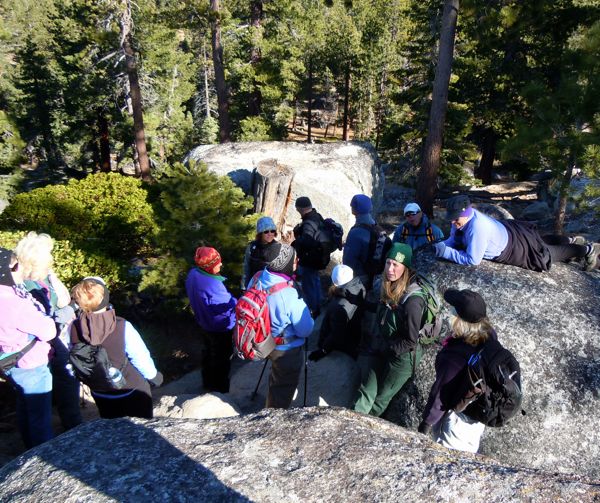
Lindsay Gusses with the USFS, in green, leads an interpretive hike Jan. 3 through Van Sickle Bi-state Park. Photos/Kathryn Reed

The 120 people who preregistered and the nearly two dozen who signed up at the event that launched from the parking lot at Harrah’s Lake Tahoe were divided into seven groups before they headed uphill.

Holding up a three-pronged pine needle, Lindsay Gusses bends one needle down to make a Y as a way to get her group to remember the Jeffery pine is a yellow pine.

It was these little tidbits of information delivered in a fun way that kept the chilly two-mile trek entertaining.

The beauty, well, that needs no explanation. But sometimes it’s nice to know what you are looking at or how something came to be.

Gusses works for the U.S. Forest Service. Her job on Jan. 7 during this Tahoe Rim Trail Association sponsored event is to tell her charges about various aspects of the forest.

“A good reminder as we are walking through the forest is to use all of your senses,” Gusses says.

People are walking up to a Jeffery pine, putting their noses in the crooks. Butterscotch and vanilla fill their nostrils.

On a warmer day, with several of these trees near one another the aroma can permeate the air.

“Gentle Jeffery” is often the nickname for these conifers because their cones are gentle to the touch.

Some conifers – which are any cone-bearing tree – are prickly, even painful if grabbed tightly.

A short history lesson about the Comstock era explains why so many fir trees dot the landscape. They are drought resistant and shade tolerant, allowing them to propagate after the forest was clearcut to build the silver mines in Nevada.

White pines are more often found closer to Lake Tahoe, while red fir are farther up ski slopes.

“One way to tell the difference is the spacing of the needles,” Gusses says. White fir needles curve a bit, while red look more like a hockey stick.

Part way up the trail a cluster of South Tahoe High School students is ready to educate each group that comes by about using avalanche beacons and how to find someone who may be trapped. Leave No Trace is a component of the hike, with Plan and Prepare being one of the seven principles.

These students are part of the Generation Green Club, a collaboration between the school and  U.S. Forest Service.

Tyler Myers, a junior at STHS, uses his beacon to find a transmitter that has been stuffed in a football and hidden behind a tree. The beeping gets louder as he gets closer. How far he is from the “victim” shows up on the device – though 20 meters is the farthest it reads.

“It doesn’t give a depth, that’s why we bring a probe,” Myers explains.

Moving on, the group goes through part of the forest that was charred in summer 2002 during the Gondola Fire.

Gusses talks about the importance of fire when it comes to having a healthy forest. But she also imparts how it’s incumbent upon everyone to prevent wildfires. After all, it was a smoker who tossed a cigarette butt out the Heavenly gondola that started that fire. Heavenly has since made it impossible for that to happen again.

“It doesn’t take much to completely change the ecosystem,” Gusses says.

——–

The Tahoe Rim Trail Association has free Trail Talks scheduled through May. For more information, go online.

ngg_shortcode_2_placeholder (Click on photos to enlarge.)


Douglas County’s master plan takes control from TRPA

By Anne Knowles

MINDEN – The Douglas County Commission approved an update to the county’s 15-year-old master plan, paving the way for the county to take over permitting in its portion of the Lake Tahoe Basin from the Tahoe Regional Planning Agency.

“The TRPA wants to get out of the permitting process,” Douglas County Commissioner Nancy McDermid, who also serves on the Governing Board of the TRPA, said during the Jan. 5 commissioners’ meeting. “And as chair of the (TRPA’s) local government committee, I’m telling you it’s going to happen.”

The revision calls for the county to work with the agency on the update of its long-awaited Regional Plan and ordinance codes and “explore the feasibility” of taking over permitting responsibility through a memorandum of understanding.

With Douglas County taking more control of permitting in the Lake Tahoe Basin, it may have more of a say of what Edgewood Companies does with its land in Stateline. Photo/LTN file

Some of the work to update the county’s local plans cannot be completed until the TRPA delivers its Regional Plan update, promised by year-end. That’s because any plans for the Lake Tahoe Basin must comply with the TRPA’s yet-to-be-completed plan, said Candace Stowell, planning manager for the county, during a presentation to the commission.

“Well, yes and no,” McDermid said. “The city of South Lake Tahoe has adopted a plan and say they will comply” with the TRPA update after the fact, once the plan becomes available.

“We can’t make changes until the TRPA comes out with a plan,” Stowell replied.

Brandy McMahon, senior planner for the county, added that she has been working closely with the TRPA Planning Director John Hester and Regional Planning Coordinator Arlo Stockham, but said local plans can only be updated after the TRPA plan is finished.

“The message we get from the TRPA is different than what they tell the staff,” McDermid said.

South Lake Tahoe adopted its updated General Plan in May 2011, with the caveat that it would change the plan where necessary in order to comply with the TRPA Regional Plan update. A month later, the League to Save Tahoe filed suit in U.S. District Court, claiming the city plan was out of compliance with the TRPA Regional Plan. In December, South Lake Tahoe City Attorney Patrick Enright said he expected Judge Garland Burrell to rule on the case in early January. There has been no ruling to date.

Douglas County’s master plan update also calls for the county to assist in the completion of the Stateline-to-Stateline Bikeway and to work with South Lake Tahoe, Caltrans and others in the planning and implementation of the Highway 50 Stateline Corridor/South Shore Community Revitalization Project.

The Highway 50 revitalization project will get more attention at the Jan. 10 meeting of Douglas County Planning Commission, when the commission gets status reports on the master plan changes and TRPA Regional Plan, according to Jo Etta Brown, chair of the commission.

Brown and fellow planning Commissioner Kevin Servatius were reappointed to the commission by the board of commissioners during its meeting. Public comment was unanimously in favor of reappointing the pair. Some spoke about the lack of representation of the lake on the board, but agreed that it was more important to keep people already up to speed on the complex issues facing the county. Bob Cook, project coordinator for the Chimney Rock chapter of the Nevada Fire Safe Council, had also applied.

“Bob lives at Stateline and we live in the valley, but there’s no requirement to have someone from the lake and there never has been,” Brown told Lake Tahoe News. “We know Lake Tahoe needs our help. And 90 percent of the problems at the lake are problems here in the valley, too.”

The commissioners also added an action item saying the county would work with other stakeholders in the completion of the South Shore Vision Plan, a $70 million project to overhaul traffic routes, both pedestrian and vehicular, around the casinos. The item, proposed by Zephyr Cove attorney Lew Feldman, was approved but not before being changed to read that the county would incorporate the plan rather than adopt it.

Other master plan update items affecting the lake include changes designed to increase affordable housing throughout the county and development of green building codes.


Lawsuit prevents Homewood from starting development

By Kathryn Reed

Homewood Mountain Resort’s desire to reinvent the West Shore ski resort is an “ill-conceived, inadequately studied, and environmentally-disruptive development project … threatening one of our nation’s iconic landscapes.”

At least that is what documents filed Jan. 5 in U.S. District Court in Sacramento say.

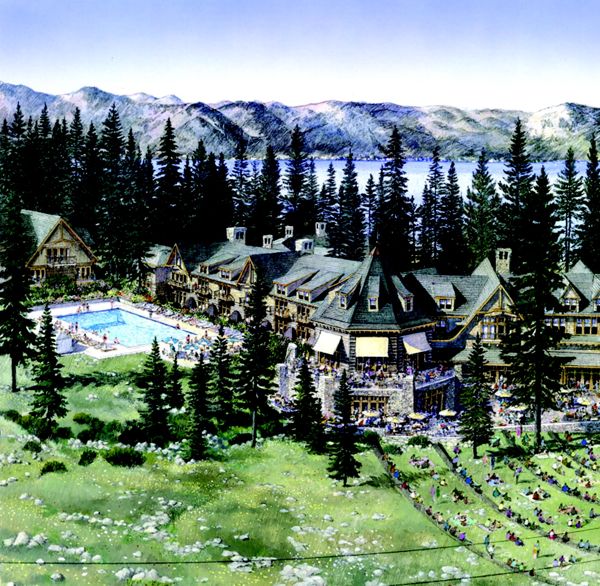
An artist's rendering of what Homewood's owners would like it to become.

Earthjustice on behalf of Friends of the West Shore and Tahoe Sierra Club is suing to stop the project that was approved Dec. 14 by the Tahoe Regional Planning Agency Governing Board.

Defendants in the suit are TRPA, Placer County, Placer County Board of Supervisors, Homewood Village Resorts and JMA Ventures. The latter is the San Francisco-based company that owns the ski area.

While approval of the project has been unanimous in every vote taken by everybody that had a say in the development and master plan for the ski resort, it has always been controversial.

Today the area is a throwback to years gone by. The resort, when one drives by on Highway 89, looks like something a Warren Miller movie would show to reflect skiing of yesteryear. What Art Chapman, JMA’s CEO, envisions is a five-star resort.

There is no doubt the look, feel and type of visitor would dramatically change. That’s what Chapman wants to happen. It’s not what the Friends of the West Shore want.

“We welcome a revitalized Homewood Ski Area, but the current project is simply too large,” Mason Overstreet, conservation director of Friends of the West Shore, said in a statement. “A smaller resort in scale with the surrounding community would still bring in hundreds of jobs for residents and millions of dollars in revenue. We must be careful not to destroy the beauty that attracts visitors to Lake Tahoe in the first place.”

The plaintiffs want the environmental documents to be declared invalid.

The lawsuit says, “… the Environmental Impact Report and Environmental Impact Study (EIR-EIS) prepared jointly by TRPA and the county failed to properly study and mitigate the project’s effects on traffic, air quality, water quality, noise, scenic resources, groundwater, and soil conservation, in violation of the California Environmental Quality Act (CEQA) and the Compact. Thus, the Homewood amendments and project stand to make matters worse.”

Joanne Marchetta, TRPA executive director, said in a statement, “It’s unfortunate that this lawsuit could divide the community at a time when we need to work together more than ever. TRPA continues to believe that lawsuits are not the best path to sustainability in the Tahoe basin.”

A major issue for challengers is TRPA’s allowing amendments to its codes – essentially disregarding the current Regional Plan, which in effect is the bible by which TRPA is supposed to live by – and by de facto, everyone in the basin’s law book.

The 1987 Regional Plan was supposed to be updated in 2007. The current date for expected approval is December this year, with draft environmental documents associated with it released in March.

Some of the changes expected in the Regional Plan Update – like to the height and density rules – are being incorporated into projects through amendments. Such amendments were part of the Boulder Bay project that passed TRPA muster last April and does not face a legal challenge.

The Governing Board and TRPA staff believe the project would be a boon for the environment. That was the overriding reason for approving the development.