Future of planning in Tahoe basin coming into focus

By Kathryn Reed

Artists’ renderings of what Tahoe could look like are on easels. Talk is about not having a cookie cutter approach to planning. What might be allowed in one area won’t necessarily be permitted in another. Incentives to rid sensitive land of development and instead concentrate redevelopment in central locations are goals.

For those who were around during the placed-based planning sessions of 2005 and 2006, the message of Wednesday’s meeting sounded like something that should have happened six months, maybe a year after those meetings came to a close.

Those gatherings six and seven years ago were to give input into the Tahoe Regional Planning Agency’s update of the Regional Plan. That was supposed to be finalized in 2007. Now the target date is December 2012, with the draft of the environmental documents slated for release March 28.

TRPA Executive Director Joanne Marchetta on Feb. 8 oulines proposed changes to the Regional Plan. Photo/Kathryn Reed

While some point to the Angora Fire of June 2007 and then the attention being turned to all-things fire, as well as the shorezone plan as reasons the Regional Plan update got derailed, the overriding reasons are people couldn’t even decide what should be studied in the environmental impact statement or the process to get there. Despite scoping sessions being under way in fall 2007 regarding the EIS, the process got hijacked by special interest groups.

Fast forward to Feb. 8, 2012, to a room at Lake Tahoe Community College filled with more than 70 people. TRPA Executive Director Joanne Marchetta is talking about how what is coming down the pike is part philosophical, part practical change.

Keeping the lake in the forefront

Lake clarity remains the driving force for what will be allowed to occur. But with the basin nearly built out, the emphasis isn’t on stopping growth – that has been achieved – but on smart redevelopment.

“We got so good at stopping things in the 1980s that we locked the status quo in place,” Marchetta said.

She talks about the need to balance the environment, economy and community interests. The triple bottom line is what her predecessor called it.

Doing nothing will keep Lake Tahoe’s clarity on the downhill path, she said.

But spending a billion dollars in the last 10 years hasn’t helped it either.

“The emphasis in the Regional Plan, unlike the last one, is fixing the built environment,” Marchetta said.

The mantra from all regulatory agencies is the built environment needs to be improved. Fifteen percent of the Lake Tahoe Basin is privately owned. Of that, Marchetta said, 1 percent is the main contributor to Tahoe’s decrease in clarity.

Walk near the shoreline and so much is brown instead of “blue”.

Seventy-two percent of the fine sediment reaching the lake is from the built environment, including roads. Marchetta gave the example of people needing to sweep their garages. That is fine sediment picked up from area roads that eventually reaches the lake.

Local control

While none of the information above is new, what could be new if the Governing Board approves the Regional Plan update and no one files a lawsuit to stop it, is creating an arena where doing small or large scale projects are not time- or cost-prohibitive because of the permitting process.

What the committee putting together the Regional Plan wants to do is allow the five counties and one city in the basin to develop local plans, have the TRPA approve them, and then most individual projects would never need a TRPA permit. Bigger items, like Homewood, would still undergo TRPA scrutiny.

Julie Regan with the TRPA told Lake Tahoe News after the meeting that these community plans would differ from the current community plans and/or plan area statements because the bi-state regulatory agency would approve them based on what winds up in the Regional Plan update. Then individual projects only need permitting by the local entity – not TRPA.

The six jurisdictions will have about a year to file a letter of intent with TRPA to create the plans. If that isn’t done, then the TRPA will be the permit issuer. Time lines are not finalized as to when the plans would need to be completed.

To avoid the one-size fits all approach like the current Regional Plan, the committee is looking at allowing height and density variances from one area of the basin to another. For instance, a 96-foot high building might be allowed on the South Shore, but not in Tahoe City.

Local entities have been clamoring for more say in what their communities look like.

But some local politicians want more say in what goes on. (Only one elected official was at the Feb. 8 meeting – an LTCC board member.)

At the Feb. 7 South Lake Tahoe City Council meeting, Bruce Grego said there would be no way he would vote for the Regional Plan if the issue of drive-through windows is not addressed.

Supposedly that topic is being put on a “to-do list”, but won’t be an item in the update. As it stands now, no new drive-throughs are allowed. The longtime theory is idling cars are problem.

Arlo Stockham, TRPA regional planning coordinator, told the council on Tuesday, “In the area plan you will be developing, you can have drive-up windows. The EIS is not analyzing regionwide impacts of that change. It would require delaying the process or supplemental review.”

“This year people in the basin get justice or it’s the end of TRPA,” Grego said.

That statement is in reference to Nevada Senate Bill 271 that would have the Silver State pull out of the bi-state Compact if changes are not made.

What’s next

On Feb. 15 the TRPA goes to the Tahoe City Yacht Club at 6pm for a similar meeting to the one at LTCC. A week later, there will be a meeting in Incline Village about the Regional Plan update. Time and location are still being worked out.

March 28 the draft of the environmental documents for the Regional Plan will be released at the Governing Board meeting. People will have 60 days to comment.

In December, the Regional Plan is expected to be voted on by the Governing Board. Any litigation that might be filed must be done so within 60 days.




South Tahoe grappling with $44.9 million health care bill

By Kathryn Reed

It would cost South Lake Tahoe close to an additional $2 million a year for the next 20 years to fully fund its retiree health care plan. That’s because as of Sept. 30, 2011, that account had an unfunded liability of $44.9 million.

The city currently pays its share plus $400,000 a year. It’s still not enough because for years the full amount was not paid. The more that is paid each year means the projected 6.5 percent return on investment will help defray the deficit.

“We have a moral and legal obligation to make sure the retiree health plan is solvent. This is a time bomb that will go off,” City Manager Tony O’Rourke said.

But the city doesn’t know what it is going to do to fix the problem.

On Feb. 7 the City Council heard the dire news from John Bartel, president of Bartel Associates out of San Mateo.

He called the retiree health benefits “generous”. An expensive component, Bartel said, is also the average age of city retirees. For those in public safety, the average age at retirement is 53.9 years, while for everyone else it is 56.3 years.

“That exacerbates the problem,” Bartel told the council.

With Medicare not being available until one turns 65, it means the city – via the taxpayers – are footing the entire bill. For city employees hired before Jan. 1, 2008, many receive all of their medical care for the rest of their lives, plus for their spouse and dependents.

Fifty-eight percent of the retirees pay nothing for health benefits.

Councilman Hal Cole asked why the premiums don’t significantly drop when retirees start on Medicare.

Bartel said the city’s insurance broker needs to answer that question. But he also said the city needs to make sure retirees are signing up for Medicare so the city’s plan then becomes the secondary policy.

“If you continue this policy, you will pay more in retiree health care than you do in employee payroll for these employees,” Bartel said of the overall retiree health plan.

The staff report written by O’Rourke says, “The city’s retiree health plan liability has grown due to higher than expected claims ($4.3 million), more retirees than expected ($2.4 million), insufficient invest principal and earnings ($3.7 million) projected higher health care costs trends ($8.4 million) and updated CalPERS demographic assumptions ($2.4 million).”

The city pays $1,700 month for active employees and $1,100 for retirees.

The health plan was changed four years ago to be less generous. But it didn’t solve the burden of paying for those in the system before that date. And with stats from the consultant saying the last 90 days of a person’s life are the most expensive in terms of health care, the bills are going to keep accruing.

A higher deductible was put into place for this fiscal year that has an immediate savings of $4.7 million and an ongoing operational savings of $500,000 per year.

While it’s the 134 retirees who are at issue, they receive the same health benefits as the current 139 employees. So, any changes to employee health benefits affects retirees.

This problem did not pop up overnight. It has, though, essentially been ignored by previous councils and administrations. This council on Tuesday agreed something needs to be done. (Councilwoman Angela Swanson was absent.)

“We need to increase the cost-efficiency of the plan,” O’Rourke said.

That will take the six employee groups to come to the table.

Jerry Copeland, who represents the admin-confidential group, said one problem is the isolated location of South Lake Tahoe limiting health care options. But he also said, “It does need to be discussed as an entire budget issue. It needs to be transparent and open.”

In recent years, the whole unfunded liability of retiree health care has not been discussed in the open.

Retirees have not been asked to the table. Nor is the city contractually obligated to invite them. But it is possible some of them might opt for a cash payment instead of being on the health plan.

Mayor Claire Fortier asked what paying down the debt would equate to in layoffs. O’Rourke said the loss of 17 to 20 people. But he also said with departments so thin and employees being tasked with doing the jobs of multiple people, he doesn’t see how cutting jobs is a possibility. Plus, it would mean the reduction in services to the public.

Tuesday’s meeting was a workshop, with no action plan. More definitive ideas are expected to be brought to the council at the March 6 meeting, with the five likely to be asked to take action. However, they will be limited in what they can do based on contractual agreements. But they can direct staff to negotiate for certain things.

Employees can accrue 500 hours of sick time and be paid out when they leave. That could be negotiated.

Councilman Tom Davis would like to work on increasing revenues via special events that would put heads in beds and therefore up the city’s hotel and sales tax collections.

“Revenue is not a real solution. We need to look at the expense side,” O’Rourke said. “The burden doesn’t rest with the retirees; it’s with the current employees.”


South Tahoe to ask voters to raise business license tax

By Dan Tirabasso

In a 4-0 decision Tuesday, the South Lake Tahoe City Council decided to give residents another opportunity to vote on a tax revision aimed at increasing revenue for the city. (Councilwoman Angela Swanson was absent.)

The June 5 ballot measure would increase the tax on the city’s largest companies by increasing the maximum business license tax from $3,448 to $20,000, while at the same time lowering the overall business license tax rate by 5 percent. It would mean a business would need gross revenues of $20 million to hit the $20,000 fee.

“… the business license tax will be decreased for approximately 99 percent of the businesses in the city, and increased for 1 percent of businesses,” the staff report says.

Finance Director Christine Vuletich on Feb. 7 told the council the tax increase could generate between $200,000 and $270,000 a year. The money would go into the city’s general fund, to be used as the city sees fit.

With the tax increase, it would mean just more than $1 million for the city coffers.

At the meeting, Vuletich said the $20,000 would be paid by three to five businesses, but not everyone agrees with that assessment.

According JoAnn Conner, president of the South Tahoe Chamber of Commerce, under this proposal five to 10 of the largest businesses will feel the pinch of this nearly 600 percent increase.

“We do communicate with these businesses, and we do know some of them are incurring increased costs because of new mandates from the feds and the state. So they’re experiencing higher costs and lower profit margins, in some cases,” Conner, who was at the meeting, told Lake Tahoe News. “So, we are concerned that if you implement new taxes and licensing fees at this point, some of those businesses will end up either downsizing more or cutting employee hours.”

But the majority of the council believes the tax increase makes things more equitable. Councilman Tom Davis is not in favor of raising taxes, but does agree the voters should decide.

Vuletich said overall about 47 of the approximately 3,000 businesses in South Lake Tahoe will see their business license fee go up if the measure passes.

Voters narrowly shot down a similar proposal, Measure E, on Nov. 2, 2010. It would have increased the maximum business license tax to $10,000, while reducing the overall business licensing tax rate by 10 percent.

Opponents of Measure E stated it was too tough on large businesses with low profit margins. They also said that by not eliminating the up to 3 percent annual increase that is tied to the Consumer Price Index, which is designed to keep pace with inflation, the 10 percent tax reduction would eventually be right back where it started, if not beyond.

The CPI adjustment would be eliminated under the new proposal.

This raises the concern that the already financially hobbled city may eventually have to endure a further reduction in revenue as inflation increases.

“It’s a concern, but not at this moment. We could always put it back on the ballot at a future time or just adjust the rates,” City Attorney Patrick Enright said.

If the measure passes with a simple majority, fees would go up July 1 – the annual date businesses must renew their licenses.

Current Rate                Proposed Rate

Schedule A: $1.10            $1.05

Schedule B: $1.65            $1.57

Schedule C: $2.20           $2.09

Schedule D: $2.75           $2.61

Schedule E: $3.30           $3.14

This is per $1,000 of gross receipts.


School food program — a necessity for many in LTUSD

By Kathryn Reed

Using a spork, Odette Sosa eagerly scoops out the fruit of the kiwi that has been cut in half. She got it off a friend’s tray. She had already eaten her orange – what she said at the time was the best part of the meal. But she wanted more fruit.

This Bijou Community School first-grader said she’s used to eating lots of fruit at home.

Natalie Bedlre, her friend sitting next to her, says one of her favorite school lunches is the chicken with gravy over brown rice. Good thing – because that was on the menu Monday.

The cafeteria staff at Bijou serve about 400 lunches a day. Photos/Kathryn Reed

But pizza is still an all-time favorite at all grade levels. Only these slices are healthier than what their parents were likely served when they were in school. Crusts are at least half whole wheat, cheese is reduced in fat and sugar content of sauces is noted.

While the elementary kids probably don’t know it or even care, the tray of food before them is designed to ensure they have a well-balanced meal.

Because Lake Tahoe Unified School District is part of the National School Lunch Program it must follow all of the federal guidelines. This includes having five components with each lunch – meat or meat alternative, fruit, vegetable, grain, and milk.

The offer vs. serve aspect allows a youngster to choose three of the five choices and still meet the federal guidelines. This recognizes not everyone is going to eat everything – whether because of taste or dietary restrictions.

Plus, food waste is something to consider. No reason to pile something on that won’t be consumed.

On Monday, most of the trays are empty. But Patty Lefteroff, who runs the Bijou kitchen, knows to cut the whole grain bean and cheese burritos in half for the younger students. If any of them were still hungry, they just had to ask for more.

With about 60 percent of LTUSD students qualifying for a free or reduced lunch, it means the feds are paying for the bulk of the food program. It also means having to follow their rules and most of their recipes.

Even though the feds released regulations Jan. 25 about what districts must serve, California’s rules are stricter and therefore LTUSD is already doing what much of the country will have to do to meet the federal rules.

Deep fat fryers left LTUSD school kitchens in 2001, trans fats were eliminated in 2008, sodas have not been allowed at the high school for years and never were at the elementary level, whole grain regs are the norm now and flavored milk is already nonfat.

Shelley Giannotta, director of LTUSD food services, said the one item she will struggle with is sodium content. Salt is in everything. The just released federal rules say by 2014-15 current sodium levels must be cut by 5 percent to 10 percent; going up to a 25 to 50 percent reduction from today’s baseline in 2022-23.

But LTUSD does not have to offer a food program. California law leaves that choice up to the districts.

“If we did away with it, we would have a lot of kids going hungry,” Giannotta said while in the Bijou cafeteria Feb. 6. “We are here for the kids.”

Giannotta knows if they didn’t eat at school, some may not eat anything – and if they are given food at home, it may not be a hot, balanced meal.

Most of the kids in the room are eating the school lunch. Very few lunch boxes are visible.

But it’s impossible to know who has paid or who is getting a subsidy. This is because kids give their student number to one of the lunchroom workers and it’s calculated via the cash register.

About 1,800 lunches are served a day and 700 breakfasts throughout the district.

The magnet school has a different menu than the other three elementary students because fewer students eat the hot lunch. This means they are given one choice of entrée instead of two like the other students.

The middle and high school students have another menu. But that is likely to change next year when the student union opens at South Tahoe High School.

With that addition comes the opportunity to offer more items in a food court setting. South Tahoe High School’s food area will be set up to have eight points of service, though it may start with fewer offerings. One area may be soup and salad, another for burgers (not just beef), another for rotating world themes – it’s all still being worked out.

New dishes will be incorporated to balance out the favorites.

Entrée salads are offered to elementary kids in the fall and spring, to the older kids year-round.

When meat is on the menu food preparers are always able to accommodate the vegetarians in the crowd.

Lefteroff said a handful of kids at Bijou don’t eat meat. Grilled cheese, a cold cheese sandwich or PB&J are back ups.

To avoid the expense of tahini and possible peanut allergies, the hummus is made with sunflower seed butter.

Giannotta wants to provide locally grown food, but being in the mountains makes it difficult. Mt. Moriah Farms in Davis supplies pesticide-wax free apples. She works with Bonanza Produce as well. Money is an issue, but there isn’t an idea she isn’t willing to pursue.

Being part of the federal program means getting the commodity discounts that are offered.

Lunches at the six Lake Tahoe Unified schools are probably the cheapest place in town to eat – especially considering the nutrients involved. Elementary lunches are $2.25, while it costs $2.75 to eat at the middle or high school.

While some districts subsidize their food programs, the opposite happens in LTUSD. In the 12 years Giannotta has been at the helm, she keeps making changes. Besides food content and nutritional upgrades, she returns more than $50,000 a year to the general fund that can then be used for textbooks, class size reduction or whatever the school board deems necessary.

ngg_shortcode_0_placeholder (Click on photos to enlarge.)


Star Wars lands at Sierra with park for little snowboarders

By Kathryn Reed

TWIN BRIDGES – Sierra-at-Tahoe has put the force of Burton and Lucas Films behind its kids’ learn to snowboard program.

Four-year-old Elliana zips away from Jar Jar Binks headed toward Chewbacca. It doesn’t take her long before she is riding without any assistance.

“Dropping in,” she says as she whizzes down the subtle decline.

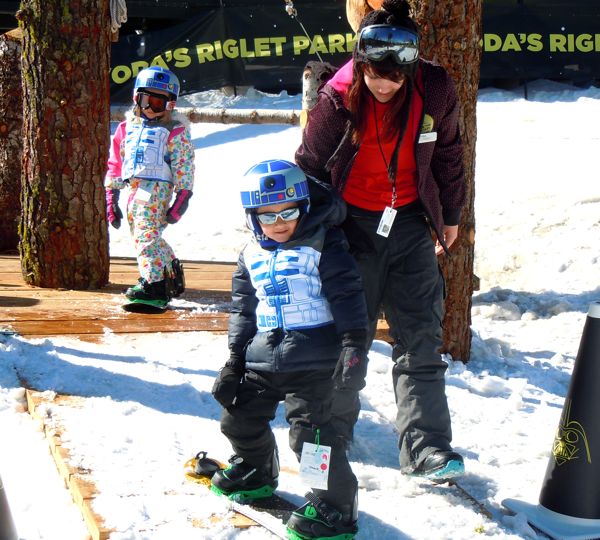
Yoda's Riglet Park at Sierra is designed to teach 3- to 6-year-olds how to snowboard. Photos/Kathryn Reed

There isn’t anything about the sport and Yoda’s Riglet Park that she doesn’t like. She even likes jumping. But the 180s come with a little assistance. Instructor Alexis Fleming lifts Elliana up by the strap on the back of her bib to twist her around. Still, it gives her the feel for what it’s like to get a little air and go from regular to goofy foot.

“Here, there are so many more options,” Fleming said in comparison to the magic carpet. “It helps kids because they stay more engaged.”

She said youngsters learn more in such a fun atmosphere and that they seem not to notice they are in a lesson instead of a theme park. But with a storm trooper standing guard and Yoda welcoming the youngsters, it does feel more like a play area than a ski center.

However, when Fleming tells one of her charges the reason she is on her knees is because she needs more weight on her toes, it becomes obvious this all-day class is focused on teaching youngsters to snowboard.

Yoda’s Riglet Park is the combination of Burton wanting to tap into a market that is often ignored (3- to 6-year-olds), using the snowboard company’s technology, and Lucas Films’ wanting to engage the next generation of Star Wars fans. The film company, whose headquarters are in Marin County, also wanted a local ski area to work with. Burton and Sierra have had a partnership for years.

With “Jedi Knights” coming to theaters Feb. 10, it’s timely of Sierra to launch its other-worldly training facility. Folks from Burton and people affiliated with the Star Wars films will be at the resort Feb. 17 for the grand opening of the park. By then the audio features should be installed.

But some people wanted to learn this weekend instead of waiting for the crowds of Presidents Day weekend.

Kristi Verma is standing outside the fenced-in area watching her 4-year-old son, Ahren, slide across the white stuff. While the kid from Sacramento didn’t say much during the lesson because he was focused on the job at hand, his mom said all he could talk about on the way up Saturday was learning to snowboard.

With the X Games just last month, this is also fueling the enthusiasm to learn to board. Who knows, maybe one of these snowboarders will be the next to score a 10 in superpipe.

Pato Bicens is working with 5-year-old Jayden of South Lake Tahoe in the “superpipe” area. He’s able to pull her via the riglet at the top of the board from the bottom of the pipe to the top. The riglet is the device at the top of the board instructors use to pull little ones that helps them with balance as well as making it more realistic instead of pushing them along. The pipe, while it does have visible contours, is miniature like everything for this size and age group.

But what could not be scaled down are the Star Wars figurines. Sculptor Bob King of Washington had to carve the wooden items to the same specs as they are seen in the movies.

Much of the park was built from downed trees at the resort, with a portable mill being brought in to cut the wood.

Before getting on the snow the newbies enter the Padawan Center. In Star Wars lore a Padawan is the first step to being a Jedi Warrior.

One wall has Yoda overseeing the training of a young Luke Skywalker.

Each young Padawan is given a fighter vest. Older warriors wear an R2-D2 vest. All have a light saber – though no one was dueling on the snow Saturday.

In the center they stand on a skateboard-like device that shows instructors which foot they put forward first (left = regular, right = goofy), and to test their balance on a stable surface.

Then it’s off to Yoda’s Riglet Park.

The idea is if the little ones get the hang of it, by the afternoon they could be on the mountain in Burton’s Progression Park off Easy Rider. Classes usually don’t have more than four kids per instructor, so there is lots of quality time.

Most classes are all day, though half-day afternoon sessions are available. Three-day and 10-day learning packages are also available.

Susan Wood contributed to this story.

ngg_shortcode_1_placeholder (Click on photos to enlarge.)


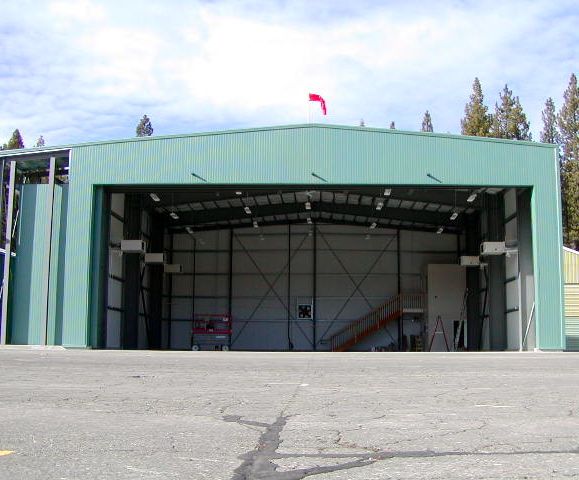
Executive hangar at LT Airport ready for big aircraft

By Kathryn Reed

Lake Tahoe Airport’s new hangar in relation to the old one is like comparing a penthouse to an ordinary hotel room.

That’s how Michael Golden of Mountain West Aviation described the executive hangar that is on the north end of the property. While he wouldn’t disclose the exact cost of the building, it was several hundred thousand dollars.

Having such a facility in South Lake Tahoe means airplane owners who have bigger planes and want them stored out of the elements will be able to do so in Tahoe. In the past, passengers were dropped off and the flight crew would go to Reno to store the plane until called upon to pick up the people.

The executive hangar at Lake Tahoe Airport allows larger planes to be covered. Photo/Provided

“There are customers during celebrity golf who want their plane in a hangar, but this is more for the itinerant traveler who doesn’t want their plane out in the elements. Ice and snow do not mix well with plane travel,” Golden told Lake Tahoe News.

Summer sun and planes is not a good combo either. That’s why it’s expected the hangar is likely to be used year-round.

Size of planes would dictate how many the space could hold. It could fit one big executive jet, or a mix of turbo props – it all depends.

“We would prefer someone to rent it out year-round, but we also know there is a market for people who want their plane in a hangar while visiting,” Golden said. “And if it’s successful, we’ll build another one.”

The airport has other hangars that are owned by the city. If looking to the right of the runway from the deck of the terminal, those are the smaller, city hangars. Golden’s executive hangar is to the left, past his office.

When Golden took over the fixed base operations in December 2007, part of the lease agreement was to eventually build the hangar. What was there before was so poorly designed that the door opened in the back so a plane could never access it. Instead, it was rented out for storage. An adjacent building had been used for weapons training for South Lake Tahoe police officers.

Both those buildings are gone. The footprint is not identical, but the coverage is the same. Most of the scrap from the old building was recycled.

The new facility has high-intensity, low-voltage throughout. Each wall panel has solid foam as insulation between the metal and outside. The five heaters hanging from the ceiling act as thermal deicing units. Any water coming off the plane goes into a floor drain where there is a water-oil separator.

The whole point is the planes will be more than protected from Mother Nature. The warmth will keep all the parts in working order.

While Mountain West has a deicer, it’s expensive to use. But it is a tool Golden envisions will be useful if commercial service resumes.


South Tahoe finance director taking job in Douglas County

By Kathryn Reed

South Lake Tahoe Finance Director Christine Vuletich is leaving in two weeks to take a job in Douglas County.

She was hired in September 2004 by then City Manager Dave Jinkens to replace the retiring Bruce Budman. She is leaving to be assistant county manager/chief financial officer for Douglas County.

Vuletich, 52, told Lake Tahoe News she is looking forward to the challenges ahead of her with having more responsibility.

“It’s been a great experience working for the city of South Lake Tahoe. We’ve been through a lot of challenging times,” Vuletich said. “I’ve had wonderful people to work with. There are very talented people here, but I’m ready for new challenges.”

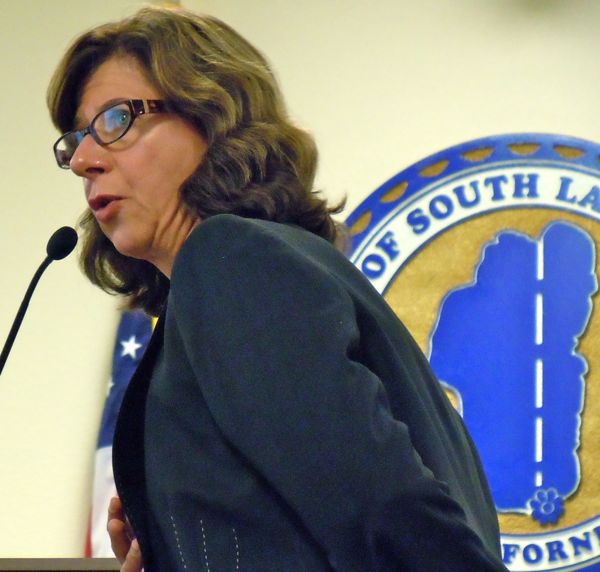
Christine Vuletich

Her last day in South Lake is Feb. 17. Her first day in Douglas County is Feb. 27. Normally people at this level give their boss at least 30 days notice. Not in this case.

Vuletich’s relationship with her bosses has been tenuous at times. This council and previous city councils have had difficulty in getting straight answers from her regarding finances. The same has been true for Lake Tahoe News.

At the council meeting earlier this week regarding redevelopment she wasn’t even the one to address the council regarding all of the financing involved in the decisions being made.

As assistant county manager, her job will be even greater and more diverse than it is in South Tahoe.

Vuletich started in South Lake Tahoe with a salary of $69,000 a year. She is leaving with the pay between $117,240.03 and $142,512.24. The 2011-12 budget is not on the city’s website, so Lake Tahoe News could not find her actual salary. She will be making $109,000 in Douglas County. All staff there took a 5 percent cut in pay for this fiscal year which began July 1, so it’s possible that could be reinstated in the summer. Negotiations with Douglas County bargaining units are just beginning and managers usually get the same increase or cut as the case may be.

Douglas County Manager Steve Mokrohisky told Lake Tahoe News, “(Vuletich) is dynamic. She will be a great fit for Douglas County.”

Vuletich was one of five finalists for the job. Mokrohisky said everyone in South Tahoe spoke highly of her. However, he said no current or former councilmembers were interviewed.

Douglas County has been without an assistant county manager since July when Mokrohisky took over for Michael Brown who moved to Oregon. And it has not had a finance director in more than a year. With two unsuccessful national searches for a finance director, Mokrohisky decided a different approach was needed. Combining the positions into one also saves the county $120,000 a year.

Vuletich will be responsible for Douglas County’s 2011-12 $120 million budget. South Lake Tahoe’s budget this fiscal year is $94.7 million. Taking a job in Minden means Vuletich’s commute will only be 10 minutes.

City Manager Tony O’Rourke is evaluating his options. Next week he expects to name an interim finance director. After 60 to 90 days a decision will be made as to whether that person is right for the job or if a search beyond the confines of city staff should be conducted. O’Rourke told Lake Tahoe News it’s also possible the department could be reorganized.


Alpine Touring and Telemark Demo Event

Alpenglow Sports has partnered with Alpine Meadows Ski Resort for the 5th annual Alpine Touring and Telemark Demo Event on Feb. 11 from 9am-3pm.

The event will provide a forum to perpetuate the enthusiasm for all aspects of in-area and backcountry skiing.

Free to all, the event will showcase the latest and greatest in both telemark and alpine touring equipment. Participating vendors will include Black Diamond, Dynafit, G3, Scarpa, Garmont, Marker, Volkl, DPS, Moment and SkiLogic.

Participants must possess a valid lift ticket or season pass purchased from Alpine Meadows or Squaw Valley, along with a driver’s license and credit card for deposit.

For more information, call (530) 583.6917.


Study: 3 Tahoe area counties expected to see job growth

By Anne Knowles

Three counties near or surrounding Lake Tahoe should see faster job growth in the coming decade compared to the state as a whole, and more quickly than in the nearby Sacramento region, according to a recently released report.

Alpine, El Dorado and Placer counties – the Golden Sierra region – should see about 18,000 new jobs by 2015 and nearly 32,000 by 2020, according to the report by the Center for Strategic Economic Research in Sacramento.

That’s a growth rate of 11.1 percent between 2010-15 and 19.6 percent between 2010-20, compared to 10 percent and 13.6 percent in the state overall, and 7.2 percent and 12 percent in Sacramento, for the same time periods.

Many of those jobs will come in the health care sector, which posted gains in the area even during the recession, and a rebound in construction, which lost more than 7,600 jobs between 2005-10 in the three counties.

Some of the upswing in construction, the report says, will come from retooling for green technology, which may require skilled workers like carpenters and electricians to retrain. In addition, new jobs will be available in green technology-specific occupations such as solar photovoltaic installers and technicians, and solar designers and engineers, as well as sales representatives for such products. The counties are home to about a quarter of the region’s clean energy technology firms, including SMA America and Solar Power Inc., and close to 16 percent of the jobs, according to the report.

The report projects 7,254 new health care jobs in the Golden Sierra by 2020, 5,046 in accommodations and food services, 4,693 in construction, 2,816 in government and more than 1,000 each in retail, finance and insurance, and professional, scientific and technical services. The projected job losses, both less than 100 jobs, are in two job sectors: agriculture, forestry, fishing and hunting; and mining.

About a dozen job sectors will post double-digit job growth, according to the report. Twenty occupations, including bookkeepers, cooks, registered nurses and retail salespersons, will account for 42 percent of the new jobs.

Job growth may be faster in the area, but it comes on the heels of higher job losses in the last half decade. Between 2005 and 2010, about 16,000 jobs were lost in El Dorado, Placer and Alpine counties, for a decline of 9 percent, compared to a drop of 7 percent and 5 percent in the Sacramento region and the state as a whole, respectively.

Most of the job losses in the Golden Sierra region were in construction (7,625), professional, scientific and technical services (2,494) and retail (2,194). The only gains in that time period were agriculture, forestry, fishing and hunting (22), utilities (13), health care and social assistance (3,233) and other activities including government (1,328).

In 2010, nearly 32,000 Golden Sierra residents were unemployed for close to 12 percent unemployment, compared to about 5 percent unemployment in 2005, the report says. But after adding underemployed and discouraged workers no longer looking for work the real unemployment was 81 percent higher.

Nearly half, or 48 percent, of the workforce leaves the area for work and only about 74 percent of those are replaced by workers commuting from elsewhere. From 2004-09, 40 percent of workers in the area were categorized as high wage earners earning more than $3,333 a month, 32 percent were considered moderate wage workers making between $1,251 and $3,333 a month and 28 were low wage earners making less than $1,251 monthly.

The report, Golden Sierra Area Labor Market Analysis, was commissioned by the Golden Sierra Workforce Investment Board in Auburn.


Dismal snowpack melting away fast with all the sun

By Kathryn Reed

PHILLIPS STATION – While there was snow to survey, there wasn’t much. The water content measured near Sierra-at-Tahoe on Wednesday came in at 19 percent of normal.

Statewide, the snowpack water content for Feb. 1 is 37 percent of normal.

The water content as measured by the Department of Water Resources was 3.8 inches near Echo Summit. This compares to 24.8 inches a year ago.

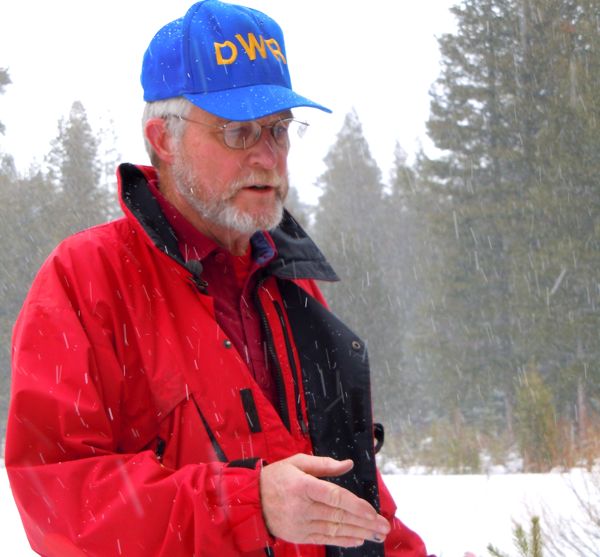
Frank Gehrke with the Department of Water Resources talks water content Feb. 1 near Echo Summit. Photo/Kathryn Reed

It was deceiving to have Frank Gehrke take the samples along a 500-foot open area just off Highway 50 while snow was coming down because it gave the perception winter is alive and well in the Sierra.

That just isn’t the truth.

South Lake Tahoe recorded 3.88 inches of precipitation for all of January, according to the National Weather Service. Weather gurus are not seeing any love on their models in terms of winter-like weather. And the blips that may produce moisture this month aren’t enough to make up for the precip deficit all of Northern California and Northern Nevada are dealing with.

While the National Weather Service said this total was not a record low, the water content comes close.

According to the Department of Water Resources, the Feb. 1 water content was the second lowest on record, with those books starting in 1946. In February 1963 at Phillips Station it was all dirt — nothing to record but zeroes.

Gehrke pointed out that besides the abysmal amount of snow (15.6 inches where he measured Feb. 1) and the low water content, the storm patterns are likely going to create a problem for reservoir managers. This is because the snow is melting faster than usual with day after day of sun.

And he said if the winter progresses with these same storm patterns, the white stuff will disappear even faster.

Reservoirs in California that supply municipalities and farmers are still holding their own after the records set in 2010-11, but if this dry pattern lasts all winter, restrictions could be put in place.

Lake Oroville in Butte County, the State Water Project’s principal storage reservoir, is at 107 percent of average for the date and Lake Shasta, the federal Central Valley Project’s largest reservoir with a capacity of 4.5 million acre-feet, is at 99 percent of its normal storage level for the date.

Besides the lack of snow likely to affect the whole state in terms of water supply in the coming months, it is impacting the Lake Tahoe economy today.

It wasn’t until last weekend that snowmobiling operations started at Tahoe businesses. Kirkwood is the only Tahoe area resort to have its whole mountain open, but with no snow in the forecast for the next two weeks, that status could change. Ski shops are starting to have clearance sales to move merchandise. Snow removal operators may be turning to lawn service soon.

With businesses unable to operate at full throttle it means less operating cash for them, but also fewer employees. South Lake Tahoe’s unemployment rate is at 15 percent, while Douglas County’s is at 13.8 percent.

Feb. 1 DWR readings:

Location

Elevation

Snow Depth

Water Content

% of Long Term Average

Alpha

7,600 feet

14.8  inches

 3.6 inches

17

Phillips Station

6,800 feet

 15.6 inches

3.8  inches

19

Lyons Creek

6,700 feet

21.8  inches

5.8  inches

30

Tamarack Flat

6,500 feet

  15.2 inches

4.8  inches

25