Ex-STHS football player on a new track — without heroin

Publisher’s note: This is the second of two stories about heroin use on the South Shore. Click here to read the first article.

By Jessie Marchesseau

Josh does not look like your stereotypical Hollywood heroin addict. In fact, he sat two tables away from me at a local café for nearly 20 minutes while I waited for the subject of my interview to walk in, someone who looked like a heroin addict.

In black pants, black beanie and a white long-sleeved shirt, Josh looks like a typical Tahoe twenty-something-year-old snowboarder. He is clean shaven with a strong, muscular build, something he attributes to working out six days a week and eating healthy.

By looking at him, you would never guess that eight months ago Josh (whose name has been changed) was in a very different place. He was 60 pounds heavier, homeless, living on the streets in Los Angeles and instead of working out, he was shooting up heroin.

“I’ve replayed the whole thing, how it started, how it just spiraled all the way down, and I ended up at the very bottom,” he said. “I can’t imagine any lower you could go than Skid Row in LA. I can’t imagine anyplace worse.”

“It’s like a horrible relationship, you know the person’s so bad for you, but you can’t get away from them because it’s all you know, and it’s all you want.” — Josh

Now 27, Josh’s downward spiral started 10 years ago, in high school. He was athletic, had lots of friends, snowboarded and played football for South Tahoe High School. When a doctor prescribed him pain killers for a football injury, he remembers liking it right from the start.

Though Josh did not get addicted to the pain killers, he did continue to dabble in other drugs. It was not until after high school that he tried heroin for the first time.A friend had done heroin before, and the pair drove all the way to the Bay Area to get some. Josh decided to just snort the drug at first, but after seeing the instant high his friend had from injecting it, he reached for the needle.

“It was all over from there,” Josh said. “I was 19, and until just seven months ago, it was constant.”

Back here in Tahoe, heroin was not readily available. But OxyContin, another opiate, was. Injecting the prescription painkiller became a multiple times per day habit for nearly five years.

At first, Josh was able to hold together a fairly normal life. He had a girlfriend, a car, a job, even enrolled in the culinary program at Lake Tahoe Community College. He managed to hide his habit from family and friends.

But as the spiral continued downward, those things ceased to matter. He started blowing off work, sold his car for two eight balls of heroin (an eight ball is one-eighth of an ounce), and gave up trying to hide it. The only thing that mattered was getting high and getting enough money to get high. He sold everything he could and began stealing from friends and family: money, ATM cards, anything he could pawn.

At the same time, OxyContin was becoming harder to find and more and more expensive, up to $80 for a pill that would last about six hours. Heroin, on the other hand, was becoming easier to find and was only $5 to $10 for a bag that could last just as long. Making the switch was easy. After all, this had all started with that first hit of heroin. But Josh’s addiction was also escalating. One point, or a tenth of a gram, is considered a single dose of heroin for most people. Josh was doing six at a time.

His first run-in with the law was in 2008. Josh was pulled over with methadone in his possession, something he kept around for emergencies when he could not find heroin fast enough. He went to jail. Over the next three years he would go to jail six or seven more times. Even though he would detox while he was there, as soon as he was released, Josh would start using again.

“In my head it seemed like if I didn’t have it, I didn’t know who I was,” he said. “It’s like a horrible relationship, you know the person’s so bad for you, but you can’t get away from them because it’s all you know, and it’s all you want.”

With the price of heroin going up, and Josh unable to hold a job, he and his new girlfriend decided to move to LA where the drugs were cheap. Once there, they blew all their money on heroin and ended up on Skid Row, sleeping on a cardboard box, all their worldly belongings in a shopping cart. He was arrested twice, held up at gunpoint and their shopping cart stolen. Josh had hit rock bottom.

“I just woke up and was like, ‘Who am I? What the hell has happened?’” he said.

For the first time in his life, he did not want to do heroin anymore. Josh had already been through court-mandated rehab numerous times, counseling, Narcotics Anonymous, methadone programs. Nothing had worked because he had never wanted to quit. This time was different. June 12, 2011, he called his mom and caught a bus back to Tahoe.

With a warrant out for his arrest, it was not long before the police caught up with him. He had never been so happy to be arrested. Josh spent the next three months in El Dorado County jail sobering up. It was finally over.

Clean since the day he went to jail, Josh said he has had no urge to start using again. His girlfriend also returned from LA and joined him on his journey to recovery. They motivate and support each other, neither one looking back.

At 27, Josh said heroin has taken nearly a decade from him. He is starting over, building a new life from the ground up. He is taking care of his body for a change, he and his girlfriend want to get married, and he hopes to finally finish culinary school.

While Josh got a second chance, not everyone is so lucky. Two of his friends made the El Dorado County coroner’s list of heroin-related deaths last year, and several others are in jail.

Josh said he feels like he has a good head on his shoulders today, and he never would have met the love of his life if he had not gone through this. Even so, if he could do it all over again, he wouldn’t.

“If I could go back in time and not stick that needle in my arm, I would have never, ever done it, knowing what I know now.”



South Lake Tahoe becoming a mecca for heroin users

Publisher’s note: This is the first of two stories about heroin use on the South Shore.

By Jessie Marchesseau

South Lake Tahoe has seen its first heroin-related death for 2012, and if 2011 is any indication, it will not be the last.

The victim, a 31-year-old female, was found in a South Lake Tahoe hotel room on Feb. 2, and was transported to Barton Memorial Hospital where she later died. She showed evidence of being a long-term drug user and had a history of drug-related charges. Toxicology reports are still pending, but El Dorado County sheriff’s Lt. Les Lovell and Detective Matt Harwood, coroner investigator for South Lake Tahoe, say it is an obvious heroin overdose.

South Lake Tahoe has a higher per capita population of heroin users than some major cities.     — Rich Barna, Tahoe Turning Point executive director

Just four days later, another opiate-related death occurred, this one, an overdose of prescription pain medication.

In 2011, the El Dorado County Sheriff’s Department recorded nine opiate-related deaths in South Lake Tahoe. That is a significant number for a city with a population of less than 25,000. In fact, Rich Barna, executive director at Tahoe Turning Point, an outpatient counseling and rehabilitation center, says South Lake Tahoe has a higher per capita population of heroin users than some major cities.

The reason for this is unclear. What is clear, however, is that there have been an alarming spike in heroin arrests and seizures in the South Lake Tahoe area during the last 12 months.

The South Lake El Dorado Narcotics Enforcement Team seized 239 grams of heroin in 2011. This is up from 6.2 grams in 2010 and 21.8 grams in 2009. That is more than a 1,000 percent increase in just two years.

Halfway through 2011, South Lake Tahoe was ranked the No. 1 location for heroin seizures in the Eastern California District. The final numbers for 2011 are not in yet.

“We are almost constantly filing cases for use, possession and sale of heroin,” Hans Uthe, El Dorado County deputy district attorney in the South Tahoe office, told Lake Tahoe News.

While Barna believes it is not so much an increase in heroin usage as it is in people getting caught, Lovell and SLEDNET task force agent Brandon Auxier are convinced otherwise.

“What we see historically is we see drugs come and go,” Lovell said, “… and heroin’s one of those that comes and goes.”

Lovell and Auxier attribute heroin’s current popularity to a difficulty in obtaining OxyContin. Also called Hillbilly Heroin, OxyContin is a fairly common prescription painkiller. Both drugs are opiates, both are extremely addictive. But at $25 for a single dose, heroin has a much more attractive price tag than OxyContin, which runs about $80 per pill. Heroin is also much more accessible than the prescription drug.

Counselors at Tahoe Turning Point say switching from prescription painkillers to street drugs such as heroin is a common progression. This is why heroin users can be found at any age, from all walks of life and with varying backgrounds. It is also why authorities are seeing an increase in heroin use among teens. What starts with painkillers for a sports injury or from raiding mom and dad’s medicine cabinet can progress to heroin usage.

But the transition from one drug to the other is not always easy.

“People don’t realize how easy it is to overdose,” Harwood said.

As a coroner investigator, Harwood said he has seen a definite increase in heroin- and opiate-related deaths compared to five or six years ago. And with two already on the books, 2012 is shaping up to be a killer year.

“It’s unfortunate that we have so many people addicted to it,” he said.

This increase in heroin usage brings with it an increase in people trying to kick the habit. Tahoe Turning Point has experienced an obvious increase in patients seeking treatment for heroin since last summer.

———-

Note: On Feb. 18, Lake Tahoe News will share Josh’s story; from his heroin-induced downward spiral to his journey up the road to recovery.


‘Miss Representation’ — a plea to stop exploiting women

By Kathryn Reed

OLYMPIC VALLEY – A mother of two young children is worried the 21st century is little better than the last 100 years when it comes to sexual stereotypes and the consequences that follow. Her daughter – the elder of the two – received compliments about her beauty when she was born in 2009. Her son (born in 2011) received letters from the president and vice president, and many predictions he would one day be president.

Jennifer Siebel Newsom told the more than 200 women at the Feb. 15 Queen of Hearts lunch at the Resort at Squaw Creek that she knows women have progressed, but fears the steps are not great enough to ensure her offspring will be offered equal opportunities.

Jennifer Siebel Newsom speaks Feb. 15 about her film "Miss Representation" at the Resort at Squaw Creek. Photo/Kathryn Reed

She laments the fact that girls are taught at an early age that looks are important – especially to be successful, while boys are told they are natural leaders. And with those teachings boys learn to treat girls as though they are not equals.

Newsom wrote and directed the film “Miss Representation”. It debuted at the Sundance Film Festival in 2011. The 90-minute film was shown at the Wednesday lunch.

“This film is meant to be more than a film. It is meant to be a call to action,” Newsom said.

She spoke before the film was shown and then took questions afterward. Newsom shared stories from her youth. While she comes from a background of privilege, her life has not been easy. Being pretty did not shield her from tragedy or abuse.

But what bothers Newsom is the prolific exploitation of women in the media. The media being news outlets, television shows, Hollywood films – the whole spectrum.

“… the film exposes how mainstream media contribute to the underrepresentation of women in positions of power and influence in America. The film challenges the media’s limited and often disparaging portrayals of women and girls, which make it difficult for women to achieve leadership positions and for the average woman to feel powerful herself,” the movie’s website says.

Newsom doesn’t believe change will come until younger women – even girls – get involved in the discussion. That is why she and others involved with the film are promoting the movie to schools, with a curriculum component available.

She said it is time people standup to sexism.

The movie says women spend more money trying to look beautiful than they do on their education.

The film uses examples from most mediums to show sexism and sexual exploitation of women.

It also provides some statistics that aren’t often reported in mainstream media.

• The number of youth getting cosmetic surgery tripled between 1997 and 2007.

• Seventeen percent of teen girls cut. Cutting is self-mutilation.

• Cuba, Iraq, China and Afghanistan have more women in politics than the United States.

• Nine states consider domestic violence a pre-existing health condition and therefore women can be denied health insurance.

• Films made in the 1920s, ’30s, and ’40s portrayed women as more capable and intelligent than what is produced today.

• G rated movies – especially animation – have female characters as scantily clad as R rated movies do.

• Twenty percent of teens have sex before age 14.

• More news outlets report on celebrity happenings and gossip because it’s cheaper to produce.

“Miss Representation” also has interviews with Condoleezza Rice, Nancy Pelosi, Katie Couric, Rachel Maddow, Margaret Cho, Rosario Dawson, Dianne Feinstein and Gloria Steinem and others.

Pelosi talked about how when she ran for office and her youngest child was a senior in high school people asked her, “Who is going to take care of your children.”

In the film she says, “I don’t think men are ever asked that question.”

Feinstein expresses her frustration with the media using the verb “complained” for women who are quoted and “explained” for male respondents.

Rice said no male presidential candidate is asked if they are tough enough to be commander in chief, but women are.

The images of women delivering television news were like watching soft porn with all the cleavage. The point was made that what’s being said is not important, but the dressing or package that delivers it is.

Couric winced at images of herself in short skirts on the “Today Show” – even questioning if she contributed to this need to wear something that really isn’t appropriate for the job.

Then there were the comments about and photos of female candidates – on both sides of the political aisle – that their male counterparts are never subjected to. The film makes a clear case that women’s looks and sexuality are part of what they do – even if they are running for president or vice president of the United States of America.

When it comes to Hollywood, it’s advertisers who are saying what goes on. Men in the 18-34 bracket have money to spend. Advertisers want the products those guys buy to be in films and the films to appeal to that age group. That is why there are so many films that lack substance.

Product placement is not new, but this line of advertising is a bit more covert. The movie points out how it’s similar to the early 1950s after World War II when women wanted to keep working, but instead the government and corporations wanted them back in the home.

The television show “Father Knows Best” came out and with it came advertisers placing their products to appeal to women – demonstrating the latest appliances, showing a happy family is one where mom stays at home. This was a covert ploy to get women to get back to “where they belonged”, according the men in power.

If change is to come, it will be from the consumer, the film pointed out.

“The consumer’s voice is probably the most powerful voice, aside from the voters,” the film says.

In other words, if people keep watching programs or movies, or buy print, or view online media that degrade women, then the practice will continue because there will be no financial incentive for the industry or corporate America to change.


Survey: Residents less than enamoured with South Tahoe

By Kathryn Reed

While the number of people who believe South Lake Tahoe is going in the correct direction increased by 50 percent in the most recent survey compared to the prior year, the majority of survey takers said the city is off track.

Partial results from the December citizen survey were just released. Twenty-two percent believe the city is on the right path. While that is a dismal percentage, the 2010 survey had 15 percent believing in what the city was doing.

This was the largest percentage increase in all the questions asked.

The goal of the annual survey that was started in 2010 is to ask residents and business owners a series of questions to find out how the city is doing in a number of areas. From there it is up to staff and the City Council to figure out how to improve on those numbers.

“We have to do a better job in the services we are delivering,” City Manager Tony O’Rourke told Lake Tahoe News. “We need to focus less on ourselves and more on the public.”

This was in response to 29 percent of respondents believing they get value for their tax dollars. That dropped two percentage points from 2010.

Forty-one percent of the people who were sent a survey filled it out – or 444 people. The 2010 survey had a 35 percent response rate. On things like this response rates usually range between 25 percent and 40 percent.

Twenty-two questions were about the city, though many were multi-part. For example, under the question about the quality of services in South Lake Tahoe, 38 areas needed to be graded either excellent, good, fair, poor or don’t know.

The highest rated city department was fire at 88 percent believing these men and women do a good job. However, garbage collection was at 92 percent – the top ranked entity. But garbage isn’t even a city business; South Tahoe Refuse is a private company that contracts with the city.

“I’m going to make it a point to have these garbage guys visit our staff,” O’Rourke said. “That is the type of customer service we want to obtain.”

The worst area in the city is streets – with an approval rating of 14 percent. That is the same number from 2010.

Besides comparing the results from year-to-year, the city also puts itself up against other cities in the United States.

Out of 339 cities, garbage service in South Lake Tahoe is ranked eighth best. This compares to street repair that is No. 391 out of 400. That means people in nine other cities have a bumpier, more unpleasant experience than people here.

Snow removal, which is considered a core service, received a 63 percent good-excellent rating. Compared to other cities, South Tahoe is 108 out of 255.

O’Rourke wants to do what he can to make the number go higher. It’s impossible to know if all the news about cutbacks to the department as well as last year’s heavy snowfall that was not always plowed to residents’ satisfaction contributed to the rating.

But it was up 3 percentage points from the previous year.

O’Rourke said he was alarmed with only 30 percent saying business service is good or excellent.

“We are ranked 156 out of 170 and we are a tourist destination where service should be our hallmark. That is a horrible story,” O’Rourke said. “I think the pubic is critical, but not in an overly negative way. They call it like they see it.”

Staff, as was done a year ago as well, was also surveyed. All those results will not be made public until employees hear the news first. However, O’Rourke said overall feelings “went from neutral to slightly negative.”

“It seems like employees feel picked upon. But we have to be fiscally solvent before we are mother hens,” O’Rourke said. “There is a nexus to what we do today and how it affects us down the road.”

In coalescing all of this information the city also sought data from neighboring counties with the main goals to find out the percentage of employees who were let go in the last year, change to the pension and health care plans, and what the significant impacts were. South Lake Tahoe officials in this chart provide that information.

The citizen survey will most likely be discussed in full at the March 6 City Council meeting. It is slated to be released at that time as well. The council could make changes to the strategic and business plans that were adopted last year to incorporate any information from the survey.


S. Tahoe budget hole would grow without parking meters

By Kathryn Reed

For people to say they didn’t know South Lake Tahoe intended to charge for parking near beaches, makes one wonder if they had their head in the sand for the past year.

“The other new source of revenue is via metered parking, especially near beaches.” That’s from a March 2, 2011, Lake Tahoe News story.

The city in its budget for 2011-12 – that would be this year – is counting on more than $300,000 from parking revenue in the form of citations and meters.

Venice Drive in South Lake Tahoe is slated to have parking meters this summer. Photo/LTN

On Feb. 7 the City Council was expected to approve an amendment to a city ordinance that would have expanded parking meter zones to Regan Beach, Stateline Beach, Venice Drive between Tahoe Keys Boulevard and Tahoe Keys Marina, and Saddle Road between Ski Run Boulevard and Wildwood Avenue. Instead, the four (Angela Swanson was absent) caved to pressure from marina interests.

“We did have 200 people at both budget hearings, so it is not like this is news,” City Manager Tony O’Rourke said.

Jay Kniep with Lakeside Park Association; Bob Hassett who operates the marinas at Camp Richardson, Tahoe Keys and Lakeside; and Zan Barker the president of the Lakeside Park Association said at the council meeting last week that they found out about the parking issue this month.

This, despite the fact the parking issue has been discussed at multiple public meetings for nearly a year, has been written about multiple times, is included in the current budget year which started Oct. 1, and that meters already were erected near Heavenly Village.

“It’s chilling to have this announcement and no input,” Barker said. “Everyone I’ve talked to is concerned. I beg you to step back.”

Step back the council did.

A special meeting just to accommodate these three men and their special interests has been scheduled for Feb. 22.

These men think paid parking will hurt their businesses. After all, they won’t be making a dime off the fee. It will go into the city’s coffers.

But paid parking is not new on the South Shore. Even Hassett charges for parking every summer to get to the Beacon restaurant and adjacent marina. But he gets to keep those dollars.

The Ski Run Marina owner charges in the summer and the U.S. Forest Service has a fee at some locations.

If the council doesn’t move forward, it’s possible the summer paid parking season will be cut short. Originally the council was expected to have on its Feb. 21 agenda an item to approve buying the parking meter kiosks. Clearly that won’t happen because the special interest meeting will be the day after the next council meeting.

Police Chief Brian Uhler, whose department handles the bulk of the parking issue, said each week and month that decisions are delayed means that much longer for the equipment to be purchased, put into the ground and to become operational. Which in turn could mean less money collected that would necessitate mid-year changes to the budget.

O’Rourke pointed out the council can do whatever it wants as long as the electeds remember they adopted a budget that banks on parking revenue. If they want to back away from meters, then another revenue source needs to found or the council can keep making cuts.

Meeting info:

Date: Feb. 22

Time: 6-7:30pm

Location: Parks & Recreation Complex, Cedar Room, 1180 Rufus Allen Blvd., South Lake Tahoe

More info: (530) 542.6136.


Douglas County officials tout goals to reinvigorate economy

By Anne Knowles

MINDEN – Douglas County’s multifaceted strategy to boost its economy is working, according to proponents who presented an update on the economic vitality plan to the county’s Board of Commissioners.

“It’s a feel-good meeting I am happy to report,” said Mike Bradford, CEO of the Lakeside Inn and Casino in Stateline, who led the meeting at the Carson Valley Inn here and leads the Tahoe Revitalization team for the county.

Tahoe Revitalization is one of a dozen components of the roadmap adopted 17 months ago by the county. Each piece is overseen by a team of local businesspeople, and county and city government representatives who are responsible for turning talk into action and delivering measureable results.

Construction of a bike path connecting Round Hill Pines Beach to Stateline is part of Douglas County's economic revitalization plans. Photo/LTN file

“The goal is to transform the South Shore into a true mountain recreation spot,” Mitchell Mize, director of real estate for Edgewood Companies and a member of the Tahoe Revitalization team, said at the Feb. 10 meeting.

“We need to resurrect the entertainment that used to be there,” he said. “And we need to influence the TRPA’s (Tahoe Regional Planning Agency) Regional Plan update to allow the kind development we need there.”

Rize said the “grand plan” – the South Shore Vision Plan – is complete. That plan, developed with $50,000 supplied by the South Tahoe Alliance of Resorts, will complement the combined $25 million Embassy Suites and MontBleu resorts on the South Shore have invested in hotel renovations. Another $35,000 to conduct an economic impact study was provided by STAR, the Lake Tahoe Visitors Authority, Douglas County and South Lake Tahoe. And $2.5 million from the Federal Highway Administration is funding the South Shore bikeway demonstration project featuring 3.2 miles of bike paths connecting Stateline to Round Hill Pines, which will break ground this summer.

Next up, said Rize, is completion by year-end of an environmental impact statement for the Highway 50 revitalization plan, which would turn the highway into a three-lane local roadway in through the Stateline casino corridor while realigning the highway through a neighborhood to the east, as well as securing funding from both private and government sources for construction of the project.

Rize said, in the end, the success of the teams’ efforts will be measured in room nights, transient occupancy tax collected, commercial vacancy rates, gaming revenues and investment in commercial property.

“We’re looking to compete with Vail and Aspen,” concluded Rize.

Melissa Shaw Granat, team leader for the Tremendous Trails element of the plan, said 16 miles of trails above Genoa with connections to the Tahoe Rim Trail would open this spring. The 100-mile loop of trails planned for the county was recently christened the Carson Valley Discovery Trail after an August survey and workshop helped pick the name and the Flagship Trail map is almost complete, which should help draw visitors to the area. Also to help promote tourism, the team is working with the California Tahoe Conservancy on a smart phone application that would map area trails and on creating signage for the paths.

Granat said they are working with area visitors’ authorities to find ways to measure the economic impact of trails.

Gardnerville and Genoa, the focus of two of the plan’s components, have already been able to gauge progress in terms of new businesses. Genoa, which is trying to capitalize on its historic downtown, has recently added seven businesses, including three restaurants, a consignment shop and a clothing boutique, said Dan Aynesworth, team leader for Genoa Destination. That’s a 46 percent jump in new businesses when the target was 10 percent, said Aynesworth. Room nights have increased 6 percent, he said, with a goal of 7 percent.

Redesign plans for Genoa’s downtown are half completed, said Aynesworth. The Genoa Trail, funded with $100,000 from The Nature Conservancy, is 60 percent designed and construction should begin in June, with completion planned by the Candy Dance in September. A covered wagon that will be turned into a road sign for the town located on Highway 395 East has been acquired with $6,800 from the town. Casino owner and local rancher John Ascuaga has donated $1,500 for the cemetery beautification project.

Gardnerville added 16 businesses last year, a 9.5 percent increase, said Paula Lochridge, leader of the Main Street Gardnerville team. She said they have a 10-year goal of getting the commercial vacancy rate down to 5 percent, recruiting 10 new businesses and creating 50 new jobs.

Other presentations were made on Ascent Douglas, the work to attract sporting goods manufacturers to the county; Sports Aviation Foundation, work to bring more aviation, including gliding, tourism to the area; the county’s K-12 education and transportation needs; and the long-awaited Carson Valley Community and Senior Center, which is scheduled to open in 2014.

Three components of the plan – Maximize WNC Facility, Minden Momentum and Energy Science Park – have teams but have yet to find a so-called champion, or leader to move them forward, said Lisa Granahan, economic vitality manager for the county.


Fabulous views unveiled after steady climb on snowshoes

By Kathryn Reed

I have to catch my breath at one point as I feel the pull in my legs and lungs at the same time. “That’s why it’s called High Meadow,” Rosemary says.

I don’t have my snowshoe legs. That’s my excuse. It’s February and this was the first time to strap on the devices this winter. Usually by this phase of winter I’ve blazed trails throughout the basin.

Although there is exposed dirt on part of the the route most exposed to the sun, it still seems easier to hike with the snowshoes than boots. As we keep climbing, the snow just gets better for this winter activity.

Power lines and Mount Tallac demonstrate modern conveniences and the power of nature. Photos/Kathryn Reed

Oddly, neither Sue nor I had snowshoed here before. Different off-spurs could have us exploring the High Meadow trail system for days. We’ve biked parts of Power Line, but had done zero winter outings until last weekend.

Already on the to-do list for the three of us is going farther than we did this particular day. Next time the end point will be Star Lake. That is about six miles one-way. High Meadow is about one mile below the lake. (Distances are according to the U.S. Forest Service.)

In summer 2010, the Forest Service turned the meadow into a construction zone in order to restore Cold Creek.

On our trek we make it to an earlier manmade disturbance – power lines. Power Line trail gets its name from all those overhead wires that run through the forest.

The clearing we use as a turn-around location provides spectacular views looking west to Mount Tallac, Pyramid Peak and other ridgetops in Desolation Wilderness.

Although signs are clearly posted that no snowmobiles are allowed where we are, the tracks prove the sleds have been out.

With the trail wide enough for a vehicle in places, it allows us to walk at least two across. It makes it easier to chat over the crunching of the snow.

Large conifers loom overhead, casting shadows on this gloriously sunny day. While the temperature was chilly to begin with, the exertion has us losing layers.

A vista of sorts beckons us before we reach our end point. The knoll provides panoramic views in all directions. Lake Tahoe almost looks small below the forest.

I’m ready to explore some more.

Getting to the High Meadow trailhead:

• From South Lake Tahoe, turn east onto Al Tahoe Boulevard.

• Turn right on Pioneer Trail.

• Turn left on Remington Trail. (Sierra House Elementary School is on the corner.)

• Follow signs to the end and park.

• On the trail, we veered up and to the right at times, but signs could be better.

ngg_shortcode_0_placeholder (Click on photos to enlarge.)


Pop titan Whitney Houston found dead at age 48

Publisher’s note: While Whitney Houston was never on a stage in Northern Nevada, she did have a connection to Lake Tahoe. The 1992 film “The Bodyguard” was partly filmed at Fallen Leaf Lake.

In the film, Houston and co-star Kevin Costner were holed up at his father’s cabin at Fallen Leaf.

Leah Halsten, who was in “Carnival Cabaret” from 2002-08 at the Horizon casino in Stateline, impersonated Whitney Houston.

By Geoff Boucher, Los Angeles Times

Whitney Houston, a willowy church singer with a towering voice who became a titan of the pop charts in the 1980s and 1990s but then saw much of her success crumble away amid the fumes of addiction and reckless ego, has died. She was 48.

Kristen Foster, a publicist, announced Saturday that the singer had died, and police sources later confirmed that she was found unresponsive in her room at the Beverly Hilton Hotel about 3:30pm. Paramedics performed CPR on her, but she was pronounced dead about 4 p.m., Beverly Hills Police Lt. Mark Rosen told KTLA News. An investigation into the cause of death is pending.

Whitney Houston

On Thursday afternoon at the hotel, Houston drew the attention of reporters and security staff with her erratic behavior, dripping sweat and disheveled clothes. The singer was disruptive at that day’s rehearsals for music mogul Clive Davis’ annual Grammy industry party and showcase; that party at the Hilton on Saturday night was supposed to include a performance by Houston.

Late Saturday, Davis told those assembled at the party that he had a “heavy heart” and was “personally devastated” by Houston’s death, but “simply put, Whitney would have wanted the music to go on, and her family has asked for us to carry on.”

The star’s professional decline had become a familiar part of her public saga. Her haggard appearance at times shocked fans who had once been drawn to the singer’s world-class smile and approachable glamour in music videos, album covers, concerts and, later, hit films. Songs like “I Will Always Love You” and “Saving All My Love for You” had women around the world singing along with the star, but by the end of the 1990s they barely recognized her.

Read the whole story


Millions of dollars for Tahoe fuels projects may have been misspent by Fire Safe Council

By Anne Knowles

The Nevada Fire Safe Council may have to return $2.7 million to the U.S. Forest Service unless it can prove it properly spent the grant money. A federal investigation found the group mishandled the funds.

The U.S. Department of Agriculture’s Office of Inspector General, which has been investigating the group after receiving a tip in July 2011, found NVFSC violated several federal regulations, including commingling federal grant money with other funds, allowing one person to be in charge of all aspects of managing the grant money and not conducting annual audits.

While no criminal charges have been filed, Andrew List is no longer with the Nevada Fire Safe Council. Photo/LTN file

In a report released in January, the OIG recommended the USFS recover $2.7 million of the $9.8 million it awarded the nonprofit for hazardous fuels reduction work in the Lake Tahoe Basin. In a response to the OIG, the Forest Service said it is working with NVFSC and has given the group until Feb. 29 to provide documentation proving it spent the money in a way allowed by the grant.

Lake Tahoe News in July 2011 broke the story that the Nevada Fire Safe Council’s financial practices were being questioned and the subsequent federal investigation.

The OIG also recommended the USFS withhold any further grant money until NVFSC proves it has implemented adequate internal controls and conducted the missing audits, and that NVFSC provide documentation for all other money spent. If unable to do so, the USFS should withhold reimbursement, the report says.

The OIG is still investigating NVFSC to see if it overcharged for fuels reduction work because it did not use a competitive bidding process to award contracts, the claim of the whistle-blower whose call prompted the investigation. The OIG said it would deliver a final report, but did not specify when.

“This first report is letting us know they have uncovered some concerns,” Cheva Heck, a public affairs officer with the USFS’s Lake Tahoe Basin Management Unit, told Lake Tahoe News. “At this point, we’re going to work with Nevada Fire Safe Council and move forward.”

And while the OIG report did not accuse NVFSC of anything worse than mismanagement, it also didn’t rule it out.

“Although nothing has come to our attention at this time to indicate that fraud actually occurred, our review of the council’s financial accounting practices is still ongoing,” the report says.

As an example of commingling of funds, the report said NVFSC put $705,611 received through the American Recovery and Reinvestment Act into an account with other funds from other sources and used the account for rent, utilities and for other purposes not authorized under the act.

The report said Andrew List, the former executive director, was solely responsible for all aspects of handling the grants, such as receiving, depositing and dispersing the funds, when rules require those tasks to be handled by multiple people in order to reduce error and fraud.

Finally, the investigation found that NVFSC had not been audited for four years, from 2007 to 2010, as required by federal regulations.

When asked why, NVFSC board members told OIG that List had “maintained that each year that the audits were not being performed because an accounting firm could not be hired at an acceptable price.”

According to the report, on Oct. 14, NVFSC board of directors told the OIG it planned on replacing the executive director with an interim director, developing new business and accounting procedures and hiring an accounting firm to manage its grants.

List left NVFSC late last year and Elwood Miller is now interim director.


Good and bad of Dangberg family history put into words

By Kathryn Reed

STATELINE – Say the name Dangberg in the Carson Valley to an old-timer and the reaction is not likely to be favorable.

Even though the family is responsible for creating and naming Minden, putting in much of the irrigation system associated with the Carson River that is used today, and having employed hundreds in the area, their legacy is not all good.

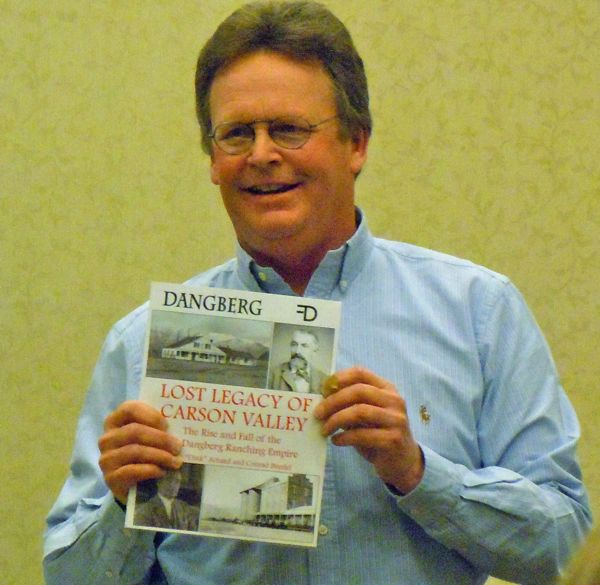
Conrad Buedel spoke about the family and the book he co-authored with Steve “Dink” Achard, one of the last of the Dangberg descendants, during a Soroptimist International South Lake Tahoe lunch at Harrah’s Lake Tahoe on Feb. 8.

Conrad Buedel

Achard, who is in his 80s, didn’t open the pile of memories that led to the book until 2004. It took the two men seven years to sort through everything before publishing “Lost Legacy of Carson Valley: The Rise and Fall of the H.F. Dangberg Ranching Empire” in 2011.

The elder Dangberg came to the valley in 1853 via New Orleans, where he had landed by ship from Germany. He grew 160 acres into 33,473 by the time he died in 1904.

Much of what he built stands today as a state park whose operation has been turned over to a nonprofit because of Nevada’s budget woes.

The barn built in the 1870s remains. Buedel says the wood dowels connecting the beams have helped preserve the structure.

“The stone cellar is still there. They bought the stones from the prison,” Buedel said.

Dangberg became one of the first in Nevada to grow alfalfa and to later raise sheep. The diversification of business interests helped the family accrue a good deal of wealth – in cash and land.

Dangberg and his wife, Maggie (whose brother created the Ferris wheel), had six children.

It was Fred Jr. who wanted to change the focus of the company, selling off some of the land for development purposes. He also wanted to create a town even though Gardnerville already existed.

First the name Halle was proposed. This is the town Dangberg Sr. had been born in. With the V&T Railway agreeing to have a terminal in the new town, officials were afraid people would think they would pronounce Halle, hell. So, Minden became the name – after the county seat of Halle.

Fred Jr. was able to get the railway to have a depot because he was in the Nevada state Senate and worked out a deal.

Buedel said such shenanigans today would likely land a lawmaker in jail.

By the 1920s the Dangberg company needed to borrow money and sell bonds. The issuance of $750,00 bonds was secured by all of the family’s land holdings. The stock market crashed. More money was borrowed.

Fred Jr., as relayed by Buedel, is making bad decisions. During a poker game with a $50 pot he offers up the family’s 160 acres at Marla Bay. There goes that lakefront property.

By now Fred Jr. is stealing money from the company. He’s feuding with his brothers who eventually sue him for the money.

Members of the family who had never had to work have to find employment. Eventually, the ranch and business change hands several times.

The state takes possession in 2004 with $2 million from the Question 1 Conservation and Resource Protection dollars.

On April 1, 2007, tours of the Dangberg Home Ranch Historic Park began.

Copies of the book are $29.95 plus tax and are available by calling (775) 267.6676 or emailing tahoeconrad@charter.net.