Tahoe transportation gurus keep trying to connect the lake

By Kathryn Reed

STATELINE – Ten ideas to provide year-round transportation linking the North and South shores have been whittled to three, with two involving ferry service and one a bus route.

Advocates believe a ferry on Lake Tahoe could provide 3,500 daily boardings, operate eight hours a day during the height of summer, take about 45 minutes with a layover of 15 minutes, and make 12 roundtrips a day.

Today, no consistent year-round public transit service exists between the North and South shores.
This ferry is what the Tahoe Transporation District shows on its website as a possible boat to ply the waters of Lake Tahoe.

Five community members showed up at a meeting Tuesday night on the South Shore to hear what is going on with water transit on Tahoe. Another meeting is slated for tonight on the North Shore.

Lake Tahoe News asked officials if year-round public transit between the North and South shores is something they want or something the public is demanding.

Alfred Knotts, who is leading the project for the Tahoe Transportation District, said, “We have to show the feds there is public demand.” That is because the feds are funding part of the study and are hoped to be a source of money for whatever alternative is picked.

The Federal Transit Administration has given TTD a $500,000 grant that is paying for this study and the public relations associated with it.

A travel mode survey was conducted in October 2010 that is being used to gauge how locals and tourists move around the Lake Tahoe Basin. That survey revealed 17 percent of the 123,000 daily trips are made between the North and South shores.

The survey also says 81 percent of the daily trips are from full-time residents, while the remaining 19 percent are made by visitors.

It’s mostly tourists who transportation officials believe would use the ferry service.

While buses are one component that will be studied, that aspect of the equation was not discussed at the Tuesday meeting.

Still to be studied is whether a ferry would produce more emissions than these people would spew in a land vehicle. After all, lake clarity is supposed to be the mantra of all entities in the basin.

What’s proposed

Alternatives 1, 2 and 6 are what will be studied. Alternative 1 is direct ferry service between South Lake Tahoe and Tahoe City. Alternative 2 is ferry service between South Lake Tahoe, Tahoe City and Kings Beach. Alternative 6 is bus service between South Lake Tahoe and Kings Beach via the East Shore.

Matthew Taunton with HDR consultants in Phoenix, who is working with TTD on the proposals, said alternative No. 1 would be the cheapest ferry proposal because it only has two terminals.

But he also said at other meetings there is community support for Alternative 2 because it goes more places.

Boats being looked at cost about $11 million, with an operating cost of at least $1.2 million a year.

More analysis will be done on the three ideas to come up with a preferred alternative. After that, the environmental analysis begins on the preferred alternative.

Knotts said whatever idea is pursued will connect with land-based transportation. That includes TART on the North Shore and BlueGo on the South Shore, even though the latter has never had consistent routes and is not used by tourists.

How parking will work, or getting people to ferries remains to be figured out.

It’s expected whatever system is proposed will need to be subsidized – possibly as a public-private venture.

“This would diversify and connect our markets in ways that do not exist,” Knotts said.

Not a new idea

Water transit on Lake Tahoe is not new. It has been talked about at least since 1987. And it has been tried several times. Nothing has stayed afloat for long.

In the early 1990s, Hornblower Cruises ran the Meteor. A Plexiglas cover made winter travel chilly between South Lake Tahoe and Tahoe City. The first trip with skiers was in January 2002.

Ironically, it was named after the historic logging steamer that sank in Lake Tahoe in 1940 after 65 years of service.

A 46-foot double-decker cabin was expected to be the solution in 2003 to transport people between the five marinas operated by Bob Hassett. Now he uses not much more than a dinghy to move people between the South Shore marinas he operates – Timber Cove, Camp Richardson and Lakeside. Hassett started that shuttle in 2002.

Last summer Hassett started a larger boat shuttle between Camp Rich and Meeks Bay.

A 2003 proposal by Caltrans that was adopted by the Tahoe Regional Planning Agency says, “Discussions of a water ferry option generally led to the conclusion that a bicycle water ferry is a unique and potentially viable option for bicycle recreation and transit, but that there are two distinct paths to its development: 1) in terms of bicycle transit, increased bicycle access on ferries and improved ferry stops/service should be part of the broader scope of improving waterborne transit throughout the Tahoe Basin and 2) in terms of a unique recreational activity, a bicycle-only ferry pilot project could be implemented and run by a local nonprofit or bicycle advocacy group.”

In 2005, $8 million was approved by the feds for water transit on Lake Tahoe.

“That was an authorization and not an appropriation, meaning if we meet FTA’s criteria, we could be eligible for an appropriation to fulfill what was authorized,” Carl Hasty, TTD executive director, told Lake Tahoe News on March 6.

South Lake Tahoe’s 2008 draft Sustainability Vision has a goal to “create regular/dependable waterborne transit for residents and visitors.” That hasn’t happened.

The Blue Warrior shuttle on the North Shore in summer 2010 didn’t last long.

A consultant in November 2010 recommended water transit begin the following summer – but that didn’t happen.

Tahoe Transportation District in December 2010 thought it could have some water service functioning this summer.

Fifteen months later, Knotts would not give a date when a ferry might ply the waters of Lake Tahoe.

Funding of this project is nowhere to be found at this time. The California water bond that keeps being taken off the table once was going to help fund waterborne transit at Lake Tahoe. It still could. But some people in this Los Angeles Times article, called that idea “pork”.

——-

 Info:

• Meeting – March 7 at 6pm at 221 Fairway, Tahoe City (the Tahoe City PUD office).

• Alternatives and the PowerPoint from the meetings iare expected to be posted on TTD’s website.


From record hot in Lake Tahoe back to winter white and cold

By Kathryn Reed

TWIN BRIDGES – Sierra-at-Tahoe could have been called Bare-at-Tahoe this weekend based on the amount of skin that was showing. After all, South Lake Tahoe broke a record March 4 with a high of 59. The previous record of 58 was set in 1986.

Truckee at 61 degrees was three degrees shy of tying the record high set in 1914. Minden was 73 on Sunday, tying the record high set in 1925.

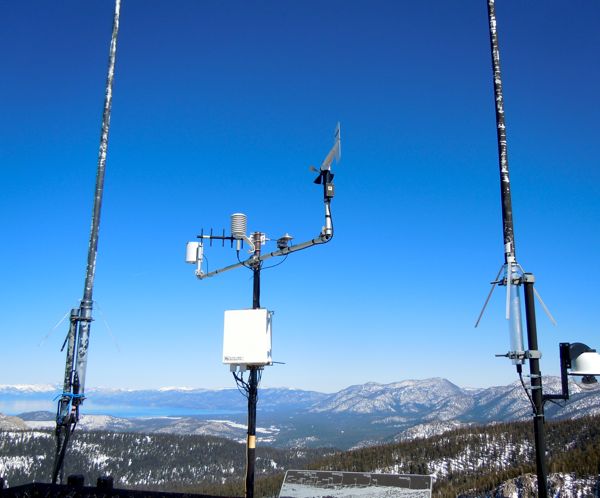
The weather station at the top of Grandview at Sierra-at-Tahoe is expected get some action March 6. Photos/Kathryn Reed

But today will be the complete opposite – or at least more normal for early March. The high is expected to be 31 degrees in South Lake Tahoe – three degrees warmer than the forecasted overnight low. And tonight the mercury is expected to drop to 10 degrees in South Tahoe.

“Wind is going to be the main problem,” Brian O’Hara, meteorologist with the National Weather Service in Reno, said of the cold front that moved into the area last night.

Ski resorts are hoping the on-again, off-again winter the Lake Tahoe Basin has been experiencing is on again.

“There is a direct correlation to the snow we’re getting and the business we are seeing,” Steve Hemphill, spokesman for Sierra, told Lake Tahoe News. “We are very optimistic about March.”

The parking lot Saturday was definitely more full than the week before. Despite the added people and snow, hardly anyone was enjoying Castle – and it was groomed to perfection.

Last week Sierra added 41 inches to its snowpack, with a couple inches forecast for Tuesday.

Most resorts in the Lake Tahoe area received more than 3 feet of snow in the last week.

Heavenly Mountain Resort opened Mott Canyon, some of its expert terrain, on March 5. But clearly it’s not a normal season when in March only 3,600 of the 4,800 acres are open.

“We are still making snow whenever possible,” Sally Gunter, Heavenly spokeswoman, said.

Homewood Mountain Resort on the West Shore is spinning all its chairlifts.

Kirkwood Mountain Resort is one of the few areas with all of its runs open. They are expecting to get up to 6 inches as this storm comes through.

With the announcement of Vail Resorts buying this resort near the Carson Pass, more people have been making the drive to check it out, according to spokesman Michael Dalzell.

“Kirkwood is doing very well this spring,” Dalzell said.

To keep people driving to Kirkwood the resort has original events lined up like the March 16-18 Freeride Flow Festival. It combines big mountain riding, music and yoga.

Resorts are not releasing closing dates yet. Mid-April is the norm. Most areas like to get through Easter to have the spring break crowd be the last hurrah of the season. That bunny will be bouncing around April 8.

ngg_shortcode_0_placeholder (Click on photos to enlarge.)


South Tahoe pedaling toward creating mountain bike park

By Kathryn Reed

Strap on a helmet and skip the wilderness, Bijou Community Park may be the place to mountain bike.

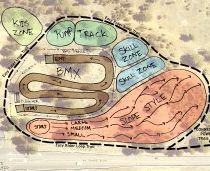
About 4 acres of this South Lake Tahoe park off Al Tahoe Boulevard may become home of the Bijou Bike Park. Proponents would like to build the pump track and kids skill zone this summer, with relocation of the BMX track coming in 2013, and a slope style course built in 2014.

The South Lake Tahoe Parks and Recreation Commission discussed the ideas at its meeting last week, with the City Council expected to vote on the idea at the March 20 meeting.

Proposed components of Bijou Bike Park. Rendering/Design Workshop

“It could be a great thing for the community and no cost to the city,” Community Services Director Stan Sherer told Lake Tahoe News.

He said with adventure sports growing, the facility would provide an opportunity to draw events that would lure tourists to the area while at the same providing locals with a place to play.

Other than the land and possibly some maintenance and in-kind labor, the city will not put money out for the project.

To-date, conceptual plans have been put together by Design Workshop. South Lake Tahoe BMX and TAMBA, the local mountain biking club, are spearheading the movement.

When TAMBA was resurrected last year many people talked about creating a pump track on the South Shore.

According to Bikes and Berms, “A pump track is a continuous loop that can be ridden on a bike without pedaling. Tracks consist of a series of rolling bumps (rollers) and banked corners (berms) that allow the rider to gain momentum and reach speeds of up to 20 mph. Basic pump tracks are an oval shape with a berm at each end and rollers in between to make the straights. More advanced pump tracks will be irregular shapes with lots of different lines and sections with several berms in a row or even rollers that can be jumped over.”

Having the BMX track in the same area would make for a natural complement for cyclists. Plus, Lake Tahoe Unified School District officials want to have that land back.

“I can tell you that the land where the BMX track sits is identified as part of expanding track and field amenities, specifically a discus course. However, there is no time line set for the move as of now. The BMX Association will continue to operate hosting races and practices on a weekly basis in 2012,” Lauren Thomaselli, president of South Lake Tahoe BMX, told Lake Tahoe News.

This is the 11th year the track has been open. And it’s the only sanctioned BMX track in the country on public school property.

“The BMX track would consist of a series of earth berms, jumps and table tops with a mechanized starting gate and some form of bleachers for spectator seating. The mountain bike skills park would be comprised of more ‘built’ features that are obviously design[ed] and engineered,” according to material supplied by the cycling groups. “The focus of the bike park is to provide skill graded progression for beginner to expert riders by helping to develop a wide range of bike skills including balancing, bike handling and jumping.”

The only things likely to be disturbed in Bijou Park are a couple exercise stations.

Sherer said the cost of the bike park is unknown. But he also said it could be a revenue source for the city if it were to be built.


LTVA’s No. 1 goal — bring in overnight guests to S. Shore

By Kathryn Reed

STATELINE – Generating room nights. That’s the overall goal of the Lake Tahoe Visitors Authority.

If the South Shore tourism agency can get people to spend the night, it means hotel taxes for Douglas County and South Lake Tahoe, probably sales tax for both entities, and those same people spending dollars in restaurants, on recreational activities, spa treatments, you name it.

With a budget of $4.3 million – 43 percent of which comes from the Tahoe Douglas Visitors Authority and 41percent from the South Lake Tahoe Tourism Improvement District – the LTVA is spending more on luring people to the area.

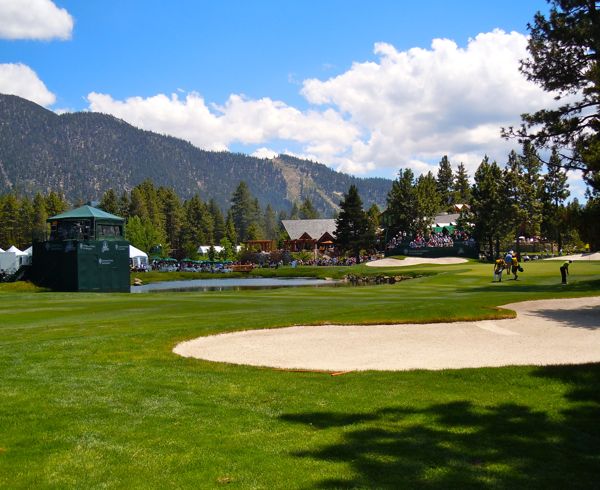
The celebrity golf tournament each July in Stateline remains one of LTVA's main events. Photo/LTN file

Carol Chaplin, executive director of the LTVA as well as the TDVA, gave a presentation last week to Soroptimist International South Lake Tahoe about the rebranding of the area as Tahoe South as well as an update on the agency.

She is slated to be one of the first presenters to the South Lake Tahoe City Council on March 6. The agenda for the 9am meeting at Lake Tahoe Airport says she will talk about destination marketing, the past year and current initiatives.

Tahoe South is something Lake Tahoe News first wrote about in December, but is something that has been in the works for a while.

In the first month of LTVA’s relaunched website, the number of unique visitors has increased by 13 percent. The site gets about 300,000 page views a month.

While putting heads in beds is the ultimate goal, the other goals of the LTVA are to spur economic growth, attract visitors, and build awareness and appreciation for Lake Tahoe’s natural environment.

The South Shore and North Shore work together on many levels, but when it comes to attracting the drive-up market they are competitors.

“Cross-over to the wild side” is LTVA’s ad slogan to show that the South Shore is little bit more fun, is how Chaplin put it.

While the talk is about getting away from gaming as the focus and instead having the outdoors being the emphasis, the fact is gaming is still well represented in the promotional material LTVA publicizes.

LTVA is still in the event business, though they have to be of a bigger variety that generates those room nights.

It’s being involved with American Century Championship which attracted nearly 40,000 people in 2011 and Iron Girl triathlon that had 600 competitors in 2011 – three times what it had the first year in 2010 – that LTVA focuses on.

Chaplin said she is talking with Amgen officials about bringing the Tour de California back to Tahoe – ideally with cyclists actually riding – in 2013.

The area is one of five being considered for the Peace and Sport event.

More emphasis is also being placed on the wedding co-op to tout the area a destination for brides and grooms.

A facilities analysis was recently completed that will soon be put into a report that will give LTVA a definitive list of regional amenities to know what events it should or should not go after.


Old ski lodge set to open on top of Echo Summit

By Kathryn Reed

ECHO SUMMIT — A true old-style mountain lodge is about to open in Lake Tahoe. Through large pane windows expansive views of rugged Sierra peaks are visible. A woodstove flanks one wall, ready to get people warm.

This isn’t some newfangled structure designed to look old. This is the lodge that was built in the 1970s at the old Nebelhorn Ski Resort atop Echo Summit. For years it has sat idle.

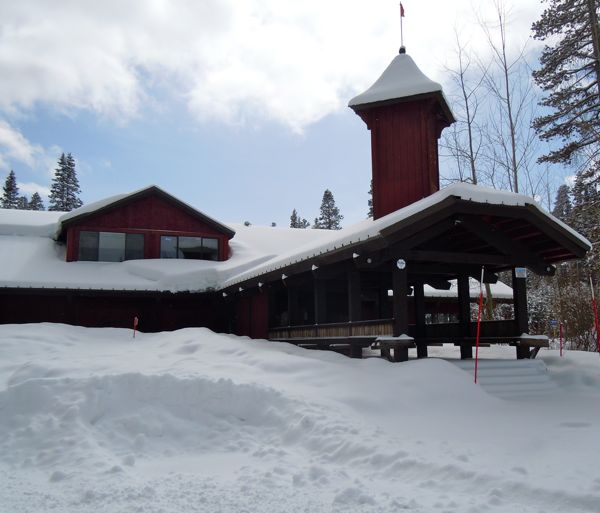
Adventure Mountain's lodge at the top of Echo Summit is expected to open this month. Photos/Kathryn Reed

When Jim and Linda Mueller opened Adventure Mountain sledding hill six years ago their desire was always to have the lodge be part of the mix. Once the Lake Valley fire marshal signs off on the paperwork the Muellers will unlock the doors. That’s expected to happen this month.

Food choices will be limited to begin with –pizza, chili, hot dogs, hot cocoa and other drinks.

A beer and wine license might be secured down the road.

“It will be a work in progress,” Jim Mueller said standing in the lodge.

Old skis still need to be mounted on the walls and a little bit of artwork hung. Plenty of stacked wood is out back.

The Muellers have made a substantial investment in the property. When they entered the lease with the U.S. Forest Service there was no running water and the septic system wasn’t working. Code upgrades were also necessary.

While the No. 1 complaint on Yelp is the vault toilets that sledders must use, when the lodge opens people will be able to use flush toilets.

The roof has been replaced, too.

“In the summer it will be available for weddings, conferences and day camps,” Mueller said.

Cathedral-like windows reveal some of the 13 machine groomed sledding runs. Soon those people – there were 50,000 last season – will be able to come inside.

But guests have adapted to playing in the outdoors. Some bring barbecues and chairs, making a day of it. About 80 percent of Adventure Mountain’s guests are day visitors from the Bay Area and Central Valley. The other 20 percent are mostly visitors to Lake Tahoe who are staying a week and want a break from skiing.

New this season is a beginner snowboarding run.

All the hills are accessed by walking as far up as allowed or until the person wants to start sledding.

There are also four miles of marked, ungroomed trails for snowshoeing and cross country skiing.

The old ski resort closed in 1988, with the Forest Service taking out the two chairlifts and rope tow 10 years later.

In 1968 a running track was put in so athletes could train at a high elevation for the Summer Olympics in Mexico City. (The track was later moved to South Tahoe Middle School, but was replaced a few years ago.)

The California Conservation Corps called this site home for years before moving to their Meyers location in 2002.

Mueller said it’s possible the lodge will be open in the summer for recreationists.

From the parking lot several hiking and biking trails go off in nearly every direction. The Pacific Crest, Pony Express and Tahoe Rim trails touch the property. Mueller said the bike ride to Kyburz on the Pony Express Trail is a good one.

The Muellers, who live in Meyers, have big plans beyond opening the lodge this month.

“We hope to eventually have a special needs youth camp up here,” Mueller said.

He said regulators won’t allow overnight lodging even though the CCC did for years. The shower facilities remain. It is possible log cabins would be constructed.

——-

Details:

Website

• Hours – weekdays 10am-4:30pm; weekends 9am-5pm

• Cost – $18 to park, unlimited sledding

• Other – equipment available to rent, small retail center.

ngg_shortcode_1_placeholder (Click on photos to enlarge.)


Buoy battle at Tahoe escalates despite TRPA court victory

By Kathryn Reed

The Tahoe Regional Planning Agency must use better science and environmental analysis to prove increasing the number of buoys and piers in Lake Tahoe will not harm the alpine waters.

Although it was the TRPA that essentially was on the winning side of a decision that came out of the Ninth Circuit Court of Appeals on Feb. 29, it is not a clear-cut victory.

Some believe more buoys on Lake Tahoe will bring more boats and more pollution. Photo/LTN file

In some ways, the League to Save Lake Tahoe won, too.

It was the League that filed the original lawsuit. The conservation group took issue with TRPA’s plan that would have allowed an additional 128 private piers and 1,822 buoys to the already existing 768 piers and nearly 4,500 buoys.

It is estimated this would create an additional 62,000 boat trips each year on Lake Tahoe.

“The amount of pollution you get out of a boat is dramatically more than you get out of a car,” Carl Young, program manager for the League, told Lake Tahoe News. “The reality of it is when you put a buoy on the lake, it’s not just a buoy. It’s the boat connected to it. When boats are used on the lake, they have certain impacts.”

TRPA is tasked with improving lake clarity. The irony is this court decision came out the same day the lake clarity report was released. While a dinner plate of sorts can be seen to a greater depth than in 2010, the clarity has stayed essentially the same in the last decade despite more than $1.5 billion being spent on clarity efforts.

While Tahoe led the charge a decade ago in banning the old polluting two-stroke engines, TRPA staff and board members don’t routinely talk about how boats pollute Lake Tahoe. But the League contends boats pollute the lake more dramatically than cars do through air pollution. Car emissions, what comes out of woodstoves — those are topics TRPA is vocal about.

The shorezone issue has been contentious for nearly 24 years and became even more so after the Governing Board of the TRPA adopted a shorezone plan in October 2008. That month the League and Sierra Club filed suit in U.S. District Court in Sacramento.

The bi-state regulatory agency appealed the September 2010 decision by U.S. District Judge Lawrence Karlton that struck down the TRPA’s shorezone ordinance.

The San Francisco-based appellate court on Wednesday did not overturn the entire District Court decision, but instead ruled on a segment of it.

TRPA must provide better, thorough environmental documentation as to why illegal buoys should be allowed in the baseline analysis.

“What we have with this ruling is a process for moving a shorezone policy forward with a more thorough analysis and we will be reviewing our options,” Kristi Boosman, spokeswoman for TRPA, told Lake Tahoe News.

But with the focus of the agency being on the Regional Plan update, in particular the draft environmental impact statement coming out at the end of the month, it’s not likely the TRPA will address the shorezone in the immediate future.

The League will wait to see what the TRPA comes up with before it makes a move. According to Young, his group from the get-go wanted better analysis and is happy the court is mandating TRPA provide it.

“What the Ninth Circuit did was overturn that portion of Judge Karlton’s ruling saying the agency basically could use potentially illegal buoys, but it needs to justify why it would be included and analyze the impacts,” Young said.


Tahoe’s clarity — a billion dollar scientific experiment

By Kathryn Reed

Stabilized is the word being used to describe what is going on with the clarity of Lake Tahoe. It took $1.5 billion to get to that point.

That is the amount of money spent, according to the Tahoe Regional Planning Agency, on environmental improvement projects between the inception of the program in 1997 and 2010. In 1997, the depth the Secchi dish, which looks like a white dinner plate, could be seen was 64.1 feet. In 2010 the depth was 64.4 feet.

On Feb. 29 the 2011 clarity data was released, showing a clarity depth of 68.9 feet – or an improvement of 4.5 feet in one year. 2010, though, was the second worst reading since records began to be kept in the late 1960s, having decreased by 3.7 feet from 2009.

It has taken $1.5 billion to stabilize Lake Tahoe's clarity. Photo/LTN file

The back-and-forth nature of the readings amounts to little change in the last decade. In 2000, the disk could be seen at a depth of 67.3 inches.

“We feel it’s positive news because we’re at the point of stabilizing,” Kristi Boosman, TRPA spokeswoman, told Lake Tahoe News. “It would have been a whole lot worse had we not made the investment we did.”

But there is no proof that statement is true.

That money – mostly from the feds through the Southern Nevada Public Lands Management Act – is about to run out. That means another funding source needs to be found. Public-private partnerships are touted as the answer, but what exactly that looks like and who will be in either category remains to be seen.

Lake Tahoe clarity readings: 2011: 68.9 feet (21 meters) 2010: 64.4 feet (19.6 meters) 2009: 68.1 feet (20.8 meters) 2008: 69.6 feet (21.2 meters) 2007: 70.1 feet (21.4 meters) 2006: 67.7 feet (20.6 meters) 2005: 72.4 feet (22.1 meters) 2004: 73.6 feet (22.4 meters) 2003: 71 feet (21.6 meters) 2002: 78 feet (23.8 meters) 2001: 73.6 meters (22.4 meters) 2000: 67.3 feet (20.5 meters) Source: TRPA

“We always have to ask ourselves if we are getting results from the dollars because they are public dollars,” Harold Singer, executive director of Lahontan Regional Water Quality Control Board said. His agency is tasked with managing water issues on the California side of the basin, though Lahontan’s jurisdiction is much greater than Tahoe.

“You can’t tie year-to-year clarity readings to the landscape. You have to look at long-term trends,” Singer told Lake Tahoe News. Otherwise it’s just looking at what was going on that one year instead of at the big picture, he said.

The surprise with the year-over-year improvement was 2011 was a heavy snow year, which in turn created a ton of runoff. This usually means more sediment reaches the lake to cloud the water, with an expected outcome of diminished clarity.

Geoffrey Schladow, director of the UC Davis Tahoe Environmental Research Center, in a statement said, “The factors that contribute to lake clarity are complex, and are not necessarily linked to factors occurring in the current year. Understanding what controls the long-term trends is at the heart of what we are attempting to do.”

TERC along with TRPA released the report.

But one of the problems is no one is sure what is working and what isn’t. For years nutrients like nitrogen and phosphorous were seen as the big bugaboos. Now it’s fine sediment.

While TRPA has come up with a top 10 list of what individuals can do to help with lake clarity, there is no overall top 10 list of projects that could or should be implemented.

No one has identified the top areas contributing to the degradation of lake clarity. The mantra is “urban upland” – or the old developed areas in the basin.

This means that instead of taking a concerted approach to fixing the biggest polluters, the powers that be have cast a broad net to fix the problem. So, the next billion dollars that is spent on lake clarity may not be spent in the most efficient manner because after all of these years no one has prioritized what needs to be fixed to get the best return on investment.

Goals from 2008-18 are outlined on Page 14 of this document. But they are neither specific nor detailed.

TRPA also supplied this information with accomplishments through 2006. It says how the money was spent, not whether it did any good in terms of lake clarity.

Even though the goal of TRPA and the states is to have Lake Tahoe’s clarity be 97 feet by 2076, no detailed plan to reach that goal has been put in place by now. TRPA was created more than 40 years ago with the main emphasis to protect the waters of Lake Tahoe.


S. Tahoe convention center project out of bankruptcy

By Kathryn Reed

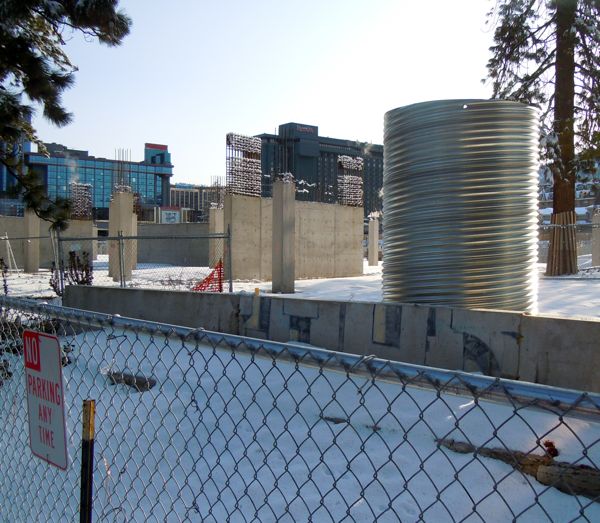
The hole – as the 11-plus acre site on the state line in South Lake Tahoe is known – is out of bankruptcy.

After a 4½-hour hearing Wednesday in Sacramento, the judge dismissed the case.

“We are definitely in a better place because we don’t have to get approval from the bankruptcy court (about a project). We hope in the next month or two we would get together (with the property owners) and see where we go,” City Attorney Patrick Enright told Lake Tahoe News.

The convention center property is out of bankruptcy as of Feb. 29. Photo/LTN file

Randy Lane, the principal of Lake Tahoe Development Company of Zephyr Cove, was not available for comment Feb. 29.

It is his company that in October 2009 filed for bankruptcy. But it was the City Council two years before that allowed him to break ground without having a final parcel map filed or secured financing in place.

No final map means there are 29 parcels to deal with – most of which are covered with rebar and concrete.

Now four entities own the 29 parcels. Sixteen have been foreclosed on, four are in the process and the remaining nine are owned by Lake Tahoe Development Company, with Owens Financial having the first deed of trust on those nine. This means Owens could foreclose on the properties at any time.

It is now up to the four property owners to figure out what to do with the land. It’s possible one could buy out the others or all could sell to another entity.

While many have said the convention center, two boutique hotels, retail and open space planned for the property across from Heavenly Village on the Harveys side of Highway 50 should be scrapped, that is the project that was approved. Permits would allow for alterations, but not a change to the footprint. It was supposed to be the largest project in the city limits at more than $400 million.

TRPA said the permit expires in nine months. If the next developer has to start from scratch with permitting, it will cost time and dollars.


Sierra water content 10 times less than what it was in 2011

Location

Elevation

Snow Depth

Water Content

% of Long Term Average

Alpha

7,600 feet

 19.4 inches

4.9  inches

18

Phillips Station

6,800 feet

17.7  inches

3.9  inches

16

Lyons Creek

6,700 feet

30.5  inches

8.3  inches

33

Tamarack Flat

6,500 feet

24  inches

6  inches

26

Source: DWR

By Kathryn Reed

PHILLIPS STATION – “In California we talk about averages and normal, but it doesn’t describe our weather well. We have more extremes.”

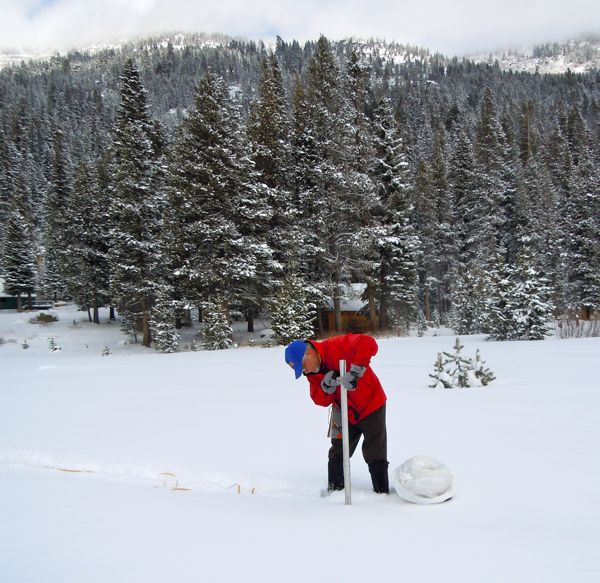
Tuesday’s snow survey compared to a year ago is an example of the extremes Frank Gehrke is talking about. On Feb. 28 the water content near the entrance of Sierra-at-Tahoe was 16 percent of normal compared to 178 percent of normal a year ago.

Gehrke, who measures the snow near Echo Summit five times a year for the state Department of Water Resources, won’t make any predictions about what March will bring. But to play catch up “we need a significant, major turn around in the storm track,” Gehrke said.

The snow depth was 17.7 inches, with 3.9 inches worth of water.

Frank Gehrke finds little snow to measure Feb. 28 near Sierra-at-Tahoe. Photo/Kathryn Reed

Years like this were also recorded in 1945, 1963 and 1991. In ’45 and ’91 the slow start was followed by a tremendous March. But history does not necessarily repeat itself.

“We’re not doing too well up here,” Gehrke said.

To those who don’t live in the area it might have been hard to believe Gehrke. He was breaking tracks as he snowshoed through fresh snow. Trees were covered with white stuff. A bitter wind whipped through the air and storm clouds passed overhead.

But snow in the Sierra has been scarce as the measurements show. Storms have been sporadic at best.

Normally the water content increases with the February measurement by 4 to 5 inches. In the past month it went up one-tenth of an inch.

There is so little snow, with so little water content that instead of measuring each of the stops along the route, Gehrke pours the collections into a bucket to be measured at the end.

“In shallow snowpacks it’s more accurate to weigh it in bulk,” he said.

While those in Tahoe know the dismal snowfall has created a cash-flow problem for most businesses in the region, the impact to the rest of California likely won’t be felt until this summer or later.

Reservoirs are doing OK based on runoff from last winter, but the State Water Project has reduced the amount of water it expects to deliver to entities down stream to 50 percent of their allocation. This is down from projections of 60 percent. Last year these 29 public agencies that service 25 million Californians and nearly a million acres of irrigated farmland received 80 percent of their allocation.

If the snowpack does not improve this year, water managers will need to think about how best to allocate resources for next year.

But March is trying to do its best to not be dry and disappointing. The winter storm warning issued by the National Weather Service is from 10pm Wednesday to noon Thursday – the first day of March. With it, expect 2 to 4 feet of snow above 7,000 feet and 12 to 30 inches below that elevation.


South Tahoe man dies after trailer goes up in flames

By Kathryn Reed

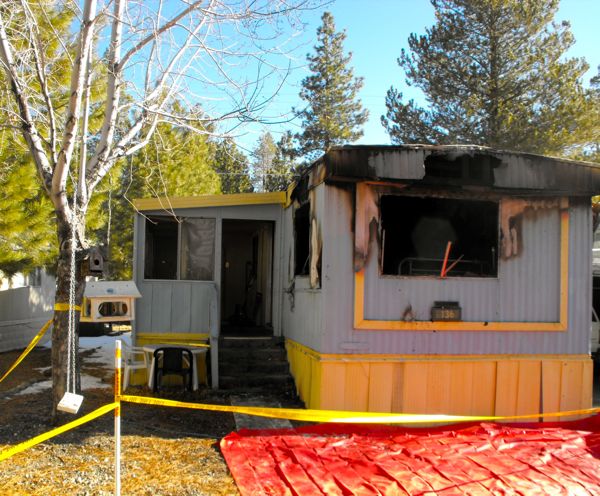
A South Lake Tahoe man had time to call 911, but not enough time to escape the fire that engulfed the bedroom of his trailer.

Glenn Sauls, 82, was found by firefighters and paramedics in his trailer at 1080 Julie Lane about 2:30am Feb. 5. He later died at Barton Memorial Hospital from smoke inhalation.

“He breathed in so much smoke,” Gareth Harris, chief of Lake Valley Fire Protection District, told Lake Tahoe News.

A South Tahoe man died from smoke inhalation when his trailer caught fire. Photo/Lake Valley Fire

While South Lake Tahoe was the primary agency to fight the fire, Lake Valley handled the investigation because South Tahoe doesn’t have a fire marshal.

It appears Sauls had been smoking in bed, Harris said. This is based on the number of cigarette butts found in that room and that the fire was contained to that area.

However, smoke and heat damaged the entire trailer, rendering it a total loss.

While the trailer met the standards when built, fire officials say without having smoke detectors in every bedroom and outside of them, it could mean people won’t know danger looms.

In this case, the one smoke detector was in the kitchen at the other end of the trailer.

Harris also stressed the importance of not smoking in bed.

Lake Valley will install smoke detectors for free for people who cannot afford them or for older residents so they are not climbing on ladders.