CTC, S. Tahoe land swap may add parking to Harrison Ave.

By Kathryn Reed

The first of two votes was taken Thursday to put sensitive land into the California Tahoe Conservancy’s hands and developable property in South Lake Tahoe’s control.

The Conservancy board at the March 15 meeting at Lake Tahoe Community College agreed to give South Lake Tahoe 19 acres in exchange for 33 acres. The City Council is expected to vote on the land deal March 20.

“We will trade properties that don’t belong in the Conservancy’s hands and we get highly sensitive property,” CTC Deputy Director Ray Lacey told Lake Tahoe News.
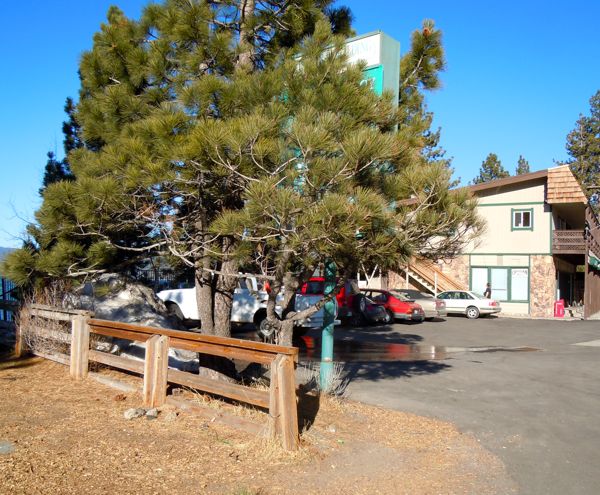
The lot at the corner of Modesto and Harrison avenues is likely to become a parking lot. Photo/Kathryn Reed

The conservancy could restore the property it will acquire and in one case improve the floodplain along the Upper Truckee River. The city could create parking for Harrison Avenue businesses and possibly sell another parcel.

Two of the four parcels the city will acquire are on Highway 50. One is next to the Tahoe Daily Tribune that the CTC came to own in 1988 in a deal that involved about 100 properties.

For years the city has talked about turning that into parking. Hilary Roverud, development services director, would only admit conceptual planning shows the dirt lot becoming paved.

However, City Councilwoman Angela Swanson, who is also on the CTC board, told Lake Tahoe News, “The Harrison Avenue plan depends on the Tribune land swap.”

About 50 parking spaces could go there.

Another parcel the city will get is the old Unocal site next to IHOP. The Conservancy acquired that last fall.

Roverud would not say whether the city intends to keep the parcel, develop it or sell it.

A parcel the city has managed for years but has been under CTC ownership is the grassy area by Regan Beach where weddings are often conducted.

“It will remain deed restricted and the public will continue to have lakefront property,” Lacey explained.

The last property in the swap is the community ball field by Lake Tahoe Community College. Ownership came to light during the brouhaha of the SnowGlobe music festival New Year’s weekend.

“It’s a community asset and makes more sense to transfer that asset to the community,” Lacey said.

The land the Conservancy will be getting includes where the former drive-in movie theater on Glenwood Way was and the acreage adjoining the Upper Truckee River west of Sunset Drive.

The Conservancy is likely to restore more than 100,000 square feet of coverage at the old drive-in, with about 12,000 square feet being in a stream environmental zone.

Another agenda item Thursday also involved how the Conservancy manages land. The board adopted the Asset Lands Program Guidelines.

Four properties are part of this equation, with no others being considered. This was stressed so people don’t think the Conservancy is going to be in the habit of selling land to keep itself afloat.

Most of the 5,000 parcels the CTC owns could not be sold based on the money used for their purchase.

Lacey said, “Asset lands are parcels of land within the Conservancy’s ownership which are not essential to carrying out Conservancy goals and which could have significant market value.”

To be sold are the drive-in site the CTC traded that day with the city. A single-family home could possibly go there. The Conservancy will retain restoration credits.

Part of the Lyon’s Ranch that was acquired in 2008 will be sold. Possibly two houses could go there. The CTC is keeping what it needs for trails and river access.

The vacant lot between Tahoe Valley Pharmacy and the Factory Stores at the Y will be sold.

The last piece is the Tallac Vista facility near Heavenly. CTC took possession in the1980s as part of a legal settlement that resulted in 150 condos not being built there.

When these properties hit the market they will be available to anyone.



Bear found in Incline Village killed by wildlife officials

By Anne Knowles

A male black bear identified by the Nevada Department of Wildlife as the animal who ripped siding off an Incline Village home last month was caught and euthanized on Wednesday.

The male bear captured and euthanized by NDOW on March 14, according to the BEAR League. Photos/BEAR League

NDOW discovered the bear after responding to a call it received from an individual in Incline Village the morning of March 14. NDOW officials tranquilized the bear and then positively identified it based on distinctive markings and patterns of behavior gleaned from accounts of witnesses to the incident in February, according to Chris Healy, spokesman for NDOW in Reno.

He declined to say how many people saw the bear rip siding off a home last month, but Healy said the bear trapped and put down Wednesday was positively identified by several people, including an NDOW biologist and people living in the Incline Village neighborhood.

“We are totally confident we identified the bear,” said Healy.

Soon after the incident last month, NDOW trapped another male bear and released it because the agency believed the animal it was looking for was a female based on sightings of a mother with two cubs in the area.

Advocates for non-lethal handling of bears say the department trapped the wrong bear again, and killed it.

Ann Bryant, executive director of BEAR (Bear Education Aversion Response) League in Homewood says she believes the bear seen peeling siding off the house was a female. She says there have been sightings of a male bear rummaging through garbage in the area, but that bear has been chased into another location now and is not the bear captured by NDOW.

Bryant says the garbage-trawling bear is about 2 years old and weighs about 150 pounds, while the bear captured yesterday by NDOW was about 3 years old and 250 pounds.

A male bear seen rummaging for garbage in Incline Village has been chased away, according to BEAR League.

“And the coloration is all different,” she said.

Bryant thinks the bear euthanized by NDOW was lulled out of hibernation by the traps set by the department.

NDOW’s Healy says the department is under fire for doing its job. He says that in 15 years NDOW has captured 900 bears and euthanized about 10 percent of them for public safety concerns.

“What do they want us to do if there is a wild bear?” Healy said. “These are dangerous situations made worse by amateurs.”

Healy says Incline Village residents should be more concerned about stricter garbage collection ordinances since it is garbage that attracts the bears.

“Blaming us is like blaming the guy who cleans up after the circus parade,” said Healy.

BEAR League’s Bryant concedes that garbage ordinances could be better enforced but says that is not the answer. The problem, said Bryant, are people who are afraid of the bears and interested only in killing them, not managing them.

“It’s another notch in their belt,” said Bryant. “And NDOW feeds into it and caters to them.”


TAP — 25 years of bringing performing arts to students

By Kathryn Reed

Performing arts is more like a disappearing act for many small communities – especially for the schools in those towns.

Not so on the South Shore.

With an annual budget of $100,000, Tahoe Arts Project is able to bring three to four shows a year to more than 5,000 children from Alpine County to Lake Tahoe Unified to Douglas County.

Peggy Thompson, executive director of the nonprofit, has been with the organization for nearly 20 of the 25 years it has been around.

Asked how TAP has been successful for a quarter century, she told Lake Tahoe News, “I think a lot of it is people realize the importance of providing these programs to children who otherwise would not be able to experience any type of live performing arts.”

Usually it’s new groups that come to the schools, but in honor of this being the silver anniversary, Thompson and her board decided to bring back three favorites. The Standards – an a capella of five brothers – were in town in September; the comedic-juggling Gizmo Guys played in January; and Manding Jata – music and dance of West Africa – will be here next week.

Besides the performance these professionals put on, they all come with an educational component. For example, The Standards for the younger grade levels talked about nutrition, exercise and health, while the middle and high school students heard an anti-bullying message.

In addition to the week of school assemblies, each act puts on a show for the public. This year MontBleu in Stateline has donated its show room for those performances.

Each year the Missoula Children’s Theater comes in the fall and summer. This allows youngsters who have never acted a chance to try the craft.

Thompson says the most difficult part is negotiating a contract because TAP has such a limited budget.

Revenue for the nonprofit comes from various fundraisers including the July fine arts festival, service clubs and donations from the public. Grants used to be a larger component of the budget, but those are drying up.

It was Harriet Goldman who founded TAP in 1987. She had moved to Tahoe from the Bay Area with her two kids and was appalled to find the schools had no performing arts, Thompson said. With volunteers and the support of Lake Tahoe Unified, the program started in a couple schools and grew from there.

In some ways things have not changed. The schools could not bring this caliber of performing arts on their own.

“Through the programming committee and the board we work hard in the selection process. We bring in a variety,” Thompson said. Talks are under way now with performers who will come in the 2012-13 school year.

“In the next 25 years or before I leave I would like to see a performing arts center. I think we could do more if we had a space,” Thompson said.

——–

Info to know:

TAP is online, with a new website coming soon.

• Manding Jata public show is March 23, 7pm at MontBleu. Tickets are $12 for adults, youth and seniors $8. Call (530) 542.3632 or buy them at the door.


Barton doc, Tahoe patients part of national drug study

By Jessie Marchesseau

William Cottrell, a physician at Barton Osteoporosis & Bone Health, is partnering with the pharmaceutical company Amgen to host an observational study for the osteoporosis drug Prolia.

The drug was approved by the FDA and released to pharmacies in 2010. So this is not a trial to see if the drug works or what the side effects are. Rather, observational studies like this one are designed to see if the patients like the medication, if they choose to continue using it, how they tolerate the side effects and other such factors.

William Cottrell

Cottrell has not only had Prolia available to his patients, but has been educating other physicians on the drug for more than a year.

“I do it for the mental stimulation and satisfaction,” he said of teaching other doctors about prescription medications. “There is nothing more rewarding than educating your peers to their satisfaction.”

Prolia is not the first prescription drug Cottrell has chosen to learn and subsequently educate his peers about. He says doing so allows him to learn all the ins and outs of a medication and find the answers to questions he may never have thought to ask.

“There are some physicians that are much more curious than others, and I’m a very curious guy,” he told Lake Tahoe News.

The reputation and relationships Cottrell developed among the medical science community from doing such presentations prompted Amgen to approach him about participating in the Prolia study.

At a couple presentations and conferences over the years, Cottrell had also crossed paths with Doreen Spires, a former research biologist and the current clinical research coordinator for the study. With a background in pharmaceutical research and 16 years of investigating bone density issues, Spires was an ideal candidate to partner with Cottrell for the Prolia study.

However, an invitation from Amgen was not enough to earn Barton Osteoporosis & Bone Health a spot among the 90 participating facilities in North America. They had to meet a set of strict guidelines put forth by the pharmaceutical company as well as pass an inspection including the Barton pharmacy and lab. Cottrell, Spires and Barton passed on the first try.

“Even the study coordinator said it was very unusual to pass the first time,” Cottrell said. “It was a compliment not only to me, but to the hospital.”

The study will observe 600 patients nationwide, of which Spires and Cottrell were asked to observe 10. However, patients’ response to the study far exceeded the team’s expectations.

They signed up three the day the study began in September 2011. The other seven spots filled up in no time, so they asked for 10 more. The request was granted, and again, the spots filled quickly. When they requested five more, Amgen granted them 10. Though they have not reached their 30-participant threshold yet, Cottrell and Spires will be signing people up through the end of March.

“The benefit to the patient is that they’re helping other patients in the future,” Spires said.

The study will last for two years with participants receiving injections of Prolia every six months. The first group of patients are just now coming in for the second treatments. Part of the study is seeing how many participants stick it out for the full two years, but Spires says so far most of the patients are happy with the twice per year protocol of the drug.

This is Cottrell’s first time participating in this type of study, but he is already looking toward the future.

“If they like the way you do things, they ask you to do things down the road,” he said. “And the dream drug for bones is in the pipeline, and Amgen has it.”

For questions regarding the Prolia observational study or to become a participant, contact Barton Osteoporosis & Bone Health at (530) 543.5490.


Ski companies survive with diverse locations, activities

By Susan Wood

Even the Easter Bunny wouldn’t put all his eggs in one basket this spring. So why would a smart ski resort company do the same in winter?

That’s the question major U.S. ski resort companies such as Vail Resorts and Powdr Corp. ponder every year with their mix of assets, investments and planned capital improvements – much like an investor evaluates and reevaluates the diversity of a financial portfolio.

Ski resort companies are no longer satisfied with one area and one activity in an industry that’s constantly evolving.

When Northstar on Dec. 20, 2011, didn't have enough snow to cover its slopes, Vail Resorts' Colorado resorts did. Photo/LTN file

Take Vail, for example. The Broomfield, Colo.-based corporation is often seeking good investment opportunities – including China, which would introduce a mass population and completely novice market to the industry.

According to the China Ski Association, the number of skiers and boarders who graced the slopes in places as untouched as inner Mongolia and the Altai Mountains featured in the 2009 Warren Miller film “Dynasty” has soared. Records show the numbers jumped from 200,000 in 2000 to 5 million five years later. If the right opportunity arises, this discovery would spell mega dollars for a company that already owns four ski areas in Colorado and soon will have three in Northern California with the finalization of the Kirkwood Mountain Resort deal which is expected this week.

Along with Boreal Mountain Resort in the Lake Tahoe region, Powdr Corp. out of Park City claims holdings in Utah, Colorado, Oregon and Vermont. The names are synonymous with landmark skiing –Park City, Mt. Bachelor and Killington.

Mother Nature bestows her will differently from one area of the United States to another. This means the region that gets the snow in one year may carry the weight of the balance sheet in revenue and vice versa.

“It certainly helps to have resorts located in different regions across the entire country. It can help us balance out the weather pitfalls,” Powdr Corp. Chief Development Officer Tim Brennwald told Lake Tahoe News. He called it “common sense” and “not a grand scheme” because the snowfall “can vary all the time.”

Proving their point

This year made for a prime example in January. Snow was expected to hit Boreal in the Sierra Nevada Mountain range. Instead, the storms split and dumped nearly 5 feet of snow in Bend, Ore., where Mt. Bachelor was only too happy to advertise to a snow-hungry California market. Whistler in Canada jumped on the same marketing bandwagon.

Brennwald said his company has passed on the Asian market to instead keep an eye on possibilities in Europe and New Zealand.

Snowmaking has in many ways changed the game a bit, and sometimes it doesn’t even take snow to tout amenities at a resort. The corporation plans to turn Boreal into a year-round resort this summer by building Woodward Tahoe, a 33,000-square-foot facility geared toward action sports such as skateboarding, skiing, snowboarding, BMX riding and gymnastics.

“Obviously, we won’t need a lot of natural snowfall to make this work and is another way we diversify our properties,” Brennwald said.

Importance of more than one location

Snow – where to make it (in the cold) and where to get it (in the storm track) — is the key to success for most ski resort companies.

But even the downward slope of snowpack levels – (well below normal in Lake Tahoe this season) – didn’t hurt lodging reservations in February according to a recent report from Mountain Travel Research. One could say the market itches for the sport – especially following a record, blockbuster winter like 2010-11 that builds positive snow equity.

“It’s true the weather is the driving force behind ski resorts diversifying. There isn’t necessarily a consistency (in weather) from coast to coast. There’s lots of experience in defense of this notion, and it serves these (resort executives) well to believe that. They’ve done well in the last 10 years,” said Michael Berry, president of the National Ski Areas Association.

Future ski resort holdings will expand beyond the typical boundaries of North America for companies such as Vail, Berry predicts.

“They’d love to see China open up,” he said. The novelty would make any ski equipment manufacturer salivate. Outside North America and Western Europe, enthusiasts ski and board with primitive gear.

Berry notes one of the biggest benefits to the diversification of ski resorts is the multi-state season pass. Vail’s Epic pass provides a Tahoe rider with an invitation to hop a plane to Denver and experience Vail resorts with varying personalities – from the high altitude Breckenridge and quieter cousin Keystone to the luxurious Beaver Creek and massive flagship Vail resort.

The company has become so much about skiing that a recent quarterly report to investors indicated less of a focus on building its RockResorts beachy hospitality brand at the expense of its ski properties.

“Our real strategy is a geographic strategy,” Blaise Carrig, co-president of Vail’s mountain division, told Lake Tahoe News in a recent conversation.

Diversity in properties makes for one major consideration in ski area companies investing in properties.

Carrig, with a long background running Heavenly Mountain Resort, explained how the South Lake Tahoe ski area is quite different than Northstar in Truckee. Both resorts must have something special to bring to the table. The former has expanded its offerings in other amenities such as snowshoeing and cross country ski trails and equipment in the winter, and an adventure park with dry inner tubing in the summer. The latter, on the other end of Tahoe, has long been the destination visitors’ delight with amenities as diverse as golfing and tennis to stargazing and hiking off the gondola.

Access to transportation and a solid bed base are other considerations in terms of buying properties.

From there, investments that pay off in the long haul like snowmaking can always be added, Carrig said. Being a “tough year,” he took much solace in a corporate report that showed a 15 percent drop in skier visits compared to last year.

“This means that 85 percent of our customers are still coming to ski and spend money. Sure, we’re off, but I’m going to look at the point where the glass is full,” he said. “I don’t see (the weather) as a pattern. I guess our plan B is investment in our resorts.”

It’s been said, “You have to spend money to make money.” The big ski companies are doing just that.


Building demolition would add beach access in S. Tahoe

By Kathryn Reed

Providing more public access to Lake Tahoe as well as increasing the views for pedestrians, cyclists and motorists would be achieved if the Alta Mira building changed hands and then was leveled.

This nondescript building at 3339 Lake Tahoe Blvd. in South Lake Tahoe is on the March 15 California Tahoe Conservancy agenda. Staff is asking the board to enter an 18-month option at a cost of $10,000. This is essentially a down payment so the owner – called the Alta Mira Partnership – won’t sell to someone else in that time frame.

The Alta Mira building in South Lake Tahoe that sits above the lake may be torn down. Photo/Kathryn Reed

“In our 27-year history we have tried to enhance opportunities to lake access,” CTC Deputy Director Ray Lacey told Lake Tahoe News.

This building would be the end point of Lakeview Commons when it is totally developed. Getting rid of the building would visually improve the area as well as provide another 190 feet of beach access for the public. A little more than 2,000 linear feet of sand exists from El Dorado Beach to the Alta Mira building.

“This would provide a proverbial anchor to the edge of El Dorado Beach,” Lacey said.

It was a grant of more than $6 million from the Conservancy to South Lake Tahoe that made Lakeview Commons a reality. This project overhauled the land at El Dorado Beach at the corner of Highway 50 and Lakeview Avenue.

Another $4 million to $5 million is needed to complete the project that would end at the Alta Mira building. That money, though, is not in anyone’s budget.

Also unknown is where the $2.5 million would come from to buy the 0.55-acre Alta Mira parcel.

Bruce Eisner, CTC program manager, said his agency has about $1.5 million that could go toward buying the Alta Mira building, but the rest would have to come from other sources.

The Tahoe Fund is one group that may be able to help.

While the board of this nonprofit has not voted on this particular topic, some members have expressed an interest in exploring acquiring the land.

“This is a key piece of property. We don’t have any definite commitments to it,” Cindy Gustafson, chairwoman of the Tahoe Fund board of directors, told Lake Tahoe News. “We are not in a position where we could singularly acquire it, but we would work with partner agencies.”

Eisner said if the Conservancy in the next 1½ years decides to buy the property, the agency would stipulate the current owners demolish the existing building before title would be transferred.

ngg_shortcode_0_placeholder (Click on images to enlarge.)

—-

Meeting info: California Tahoe Conservancy board meets March 15, 9:30am at Lake Tahoe Community College in South Lake Tahoe.


Miles of snowshoe trails just steps from neighborhood

By Kathryn Reed

As the sun beat down last Sunday in what turned out to be a record high 59 degrees, the clothes started coming off.

Powerline trail, which in some places parallels Pioneer Trail, is one of those routes that no matter the sport sweat is bound to be involved.

It’s not that it is super difficult, but it seems like from most entry points it’s a steady climb. And from there, the route under the trail has rollers, so it’s a steady up-and-down jaunt.

Marianne and Rosemary follow Debbie along the Powerline trail. Photos/Kathryn Reed

On this snowshoe excursion Rosemary and Sue commented how things didn’t look familiar with white stuff on the ground. Rosemary runs in this area in the summer, and Sue has ridden her mountain bike here.

This particular day there are seven women appreciating that snowmobiles have beaten us to the trail. Say what you want about those sleds, but they lay down a nice track to snowshoers.

One guy came by with his young daughter decked out in a pink helmet. It looked like she was doing the driving.

With the intensity of the sun, the snow is soft. Most of the trail is covered, though a few bare spots were visible.

While trees line the trail, it is hard to forget you are not far from civilization with all those powerlines overhead. Still, the serenity that comes with playing in Tahoe is unavoidable.

Large boulders are scattered to the side near the start of the route. Cold Creek is mostly covered in snow. Pines give way to Manzanita as the trail follows the powerlines.

Much of the trail is wide enough so people pair off and chat along the way. We don’t know how far we went – other than it was an hour in at a decent pace. Debbie has an altimeter on her Swiss army knife, but no mileage. The rest of us have kept our phones in our pockets with no desire for technology to provide us stats about our day on the trail.

It was about being outside with friends – not keeping track of calories burned or miles walked.

Getting there:

From Highway 50 go up Al Tahoe Boulevard. Turn right on Pioneer Trail. Go past Sierra House Elementary School and turn left on Marshall Trail. Turn right on Columbine Trail. Parking at the end in cul-de-sac. Note: If it is snowing, you will be towed. We headed toward the sign that said Fountain Place Road beyond the green gate.

ngg_shortcode_1_placeholder (Click on photos to enlarge.)


Girl Scouts — 100 years of creating tomorrow’s leaders

By Kathryn Reed

When Girl Scouts was formed 100 years ago this month, women did not have the right to vote, Title IX was 60 years away, and leadership roles for women were rare.

On March 12 the world celebrates the group of girls who number 10 million in 145 countries. Though the numbers are much greater because there is the saying, “Once a Girl Scout, always a Girl Scout.”

Some well known women who started their leadership training in Girl Scouts are: Hillary Rodham Clinton, Laura Bush, Madeleine Albright, Janet Reno, Sandra Day O’Connor, Joyce Brothers, Katie Couric, Lucille Ball, Grace Kelly, Gloria Steinem, Mary Tyler Moore, Dakota Fanning and Queen Elizabeth II.

While the organization is often only thought about this time of year because of the annual cookie sales, Girl Scouts is much more than a box of Thin Mints.

“The emphasis has always been empowering girls and valuing girls and what they can do,” explained Shelly Martinez. She was a troop leader in South Lake Tahoe while her daughter, Ali, went through grades K-12. Martinez took a four-year break from Girl Scouts and is now helping again.

On the South Shore about 100 girls are divvied up in the 11 troops that stretch from Meyers to Round Hill.

Karen Tucker, who is a service unit coordinator, which means she oversees the individual troops, said there would be more troops if leaders could be found.

It’s one of the least expensive activities available for youth. It costs $12 a year, plus any expense the individual troops have.

“It’s a great place for girls to grow up being girls. It’s a really nice organization. They get to do lot of fun stuff and learn a lot of skills,” Tucker said.

While all are Girl Scouts, there are five divisions based on grade level: Daisy is kindergarten-first grade, Brownie is grades 2-3, Junior is 4-5, Cadets 6-8, and Senior is high school.

The name Daisy comes from Girl Scout founder Juliette Gordon Low whose nickname was Daisy.

At the senior level they are working toward silver and gold awards. A gold is similar to an Eagle Scout for boys.

Projects under way include one teenager creating a movie about the dangers of texting and driving, while another is organizing a band to play at the senior center and other places in town for free.

No longer do girls wear the brown Brownie or green Girl Scouts uniforms. There was a time, in this reporter’s lifetime, when that brown dress was regularly worn to school on meeting days.

Today, the girls buy the sashes that are worn on special occasions. They also have all their badges on the sash.

Cookie sales are a big part of what Girl Scouts is about.

“Cookies are definitely a fund raiser, but for me it was also a way for girls to learn skills,” Martinez said. “They are out there using leadership, learning how to market a product, setting goals, and knowing how much money they earn per box. They set goals not only for themselves, but also for community service to help others.”

Money from the sales funds activities and camp. The North Shore group has a permanent camp, while the South Shore contingency often finds various places to go. Last year it was to Sugar Pine Point State Park on the West Shore and this year they will be in the cabins at the 4-H camp in Stateline.

Cookie sales will continue through March, with girls setting up in front of local grocery stores. Cookie sales have been going on nearly since the beginning. According to the Girl Scouts’ website, “The earliest mention of a cookie sale found to date was that of the Mistletoe Troop in Muskogee, Oklahoma, which baked cookies and sold them in its high school cafeteria as a service project in December 1917.”

On March 12, Girl Scouts throughout the world will celebrate the 100-year mark. On the South Shore they will be gathering at Embassy Suites at 6:15pm.

For more information about Girl Scouts, call Karen Tucker at (530) 541.1204.


Retired El Dorado County sheriff’s sergeant arrested

By Kathryn Reed

A retired El Dorado County sheriff’s sergeant who worked in the South Lake Tahoe substation is behind bars.

Donald Philip Atkinson, 50, was arrested March 8 on 44 felony charges. He is accused of embezzling more than $300,000 from the El Dorado County Deputy Sheriff’s Association, of which he was president. Grand theft, perjury and forgery are among the other charges.

The 11-page complaint filed by the state Attorney General’s Office in El Dorado County Superior Court says the crimes occurred between Jan. 1, 2005, and June 30, 2011. The alleged thefts started when he lived in the Carson Valley and continued to when he moved to El Dorado Hills, where he was most recently living.

Donald Atkinson

Atkinson is the detective who in 2006 handled teacher Karsten Gronwald’s child pornography case. In 2007, he was widely quoted admonishing then Sheriff Jeff Neves for shuffling assignments that put search and rescue responsibilities in the hands of Placerville deputies. He was vocal with the Board of Supervisors when it came to budget cuts.

El Dorado County Superior Court Judge Daniel B. Proud set Atkinson’s bail at $1 million.

This is the same judge who in March 2007 ruled against the deputy sheriff’s association and in favor of Neves in regards to the labor suit.

When a scam in June 2007 was gaining traction soliciting money for the deputy sheriff’s association it was Atkinson who warned people not to donate the money.

A joint press release from Attorney General Kamala D. Harris and El Dorado County District Attorney Vern Pierson says, “An investigation by the El Dorado County District Attorney’s Office with assistance from the Attorney General’s Office showed that Atkinson falsified official documents, including Fair Political Practice Commission forms, submitted forged documents to DSA and claimed checks were written for charitable purposes but pocketed the money. The investigation was conducted after a request from the El Dorado County Sheriff’s Office.”

Atkinson allegedly used the money to open accounts in his name.

He is accused of taking $100,000 from a 72-year-old woman and $20,000 designated for the families of Sgts. Mark Dunakin, Ervin Romans, and Daniel Sakai and Officer John Hege, the four Oakland police officers killed by a parolee in March 2009.


South Lake Tahoe to undo decades of neglect to its roads

By Kathryn Reed

Without a single member of the public to witness the discussion or vote in person, the South Lake Tahoe City Council unanimously agreed March 6 to borrow $5 million to begin repairing roads.

With interest it will cost more than $10 million in taxpayer money in the next 30 years to pay back that $5 million certificate of participation.

About 14.5 miles of roads will be improved with $4 million starting in June. The other $1 million will be divvied up between improvements to Harrison Avenue and Linear Park. (There are 259 lane miles belonging to the city.)

Rocks fill a hole on Venice Drive in an attempt to keep vehicles from needing a wheel alignment. Photo/LTN

Councilman Hal Cole in particular was miffed no one was in the room to witness the councilmembers merely doing the job they were elected to do. He thought they were doing something grander. The reality is these five are cleaning up the mess of previous councils and administrations that put infrastructure as a low priority and in turn has resulted in taxpayers paying twice as much for what many consider basics in city government – roads.

One street that will be repaired is Venice Drive. Cracks and holes are so wide a mountain bike is needed to ride on it because thin road bike tires are likely to get a snakebite flat.

Evan Williams, who lives on this street in the Tahoe Keys, says he remembers when it was so smooth roller skating on the street was like being on glass.

The city has a backlog of $320 million in deferred maintenance and rehabilitation to its roads.

Jim Marino, capital improvements manager, told the council it’s important to spend money on maintenance to protect prior improvements and to get the most longevity out of a road.

“It is nearly six times more expensive to rebuild a road than it is to maintain it,” Marino said.

What’s called the collector and arterial roads will be focused on first.

A chip and cape approach will be tried in some areas to determine if this method is effective in Tahoe’s winter environment. Instead of stopping after the seal part, which is normal, the cape is a second step where thicker petroleum is used.

Some discussion centered on whether any of this work would resonate with Lahontan Regional Water Quality Control Board. “No” was the answer because credits in the Total Maximum Daily Load initiative are not given for fixing roads even though that fine sediment is often touted as one of the main contributors to the decline of lake clarity.

When the City Council a year ago approved the strategic plan the goal was to spend 80 percent of the borrowed $25 million in five years to bring the city’s streets up from what many call Third World conditions. (The council is expected to revisit the strategic plan at the March 20 meeting.)

The city has the resources to pay back $10 million in loans, or two year’s worth of work.

The plan is to go to the voters in 2013 to ask for the transient occupancy tax to be increased starting the following year. That in addition to an amusement tax would fund the remaining three years of significant road repairs.

Part of the theory is the influx of vehicles on city streets from tourists is speeding up the degradation of the roads so those people should help pay for the upkeep.

The reason to put off the TOT hike is to let the hotel industry recover after such a dismal winter when it came to occupancy. City Manager Tony O’Rourke told Lake Tahoe News the city expects TOT for January and February to be down $300,000.

When it comes to the work that will be done this summer, Marino said the price of oil could play a role in how much work gets done. He also said to expect delays when the construction season begins, especially with Caltrans coming back to work on Highway 50.