Whittell test scores going down; 4-day week intact

By Kathryn Reed

ZEPHYR COVE – School board members in Douglas County on Tuesday received enough information to convince them the four-day school week is not the reason test scores at Whittell High School are going down.

After WHS Principal Crespin Esquivel gave a sobering account of how students are doing at his facility, the next part of the April 10 discussion centered on whether the 7-12 school should continue with the Monday-Thursday schedule that began in fall 2009.

The board on a 7-0 vote agreed for the next three years to keep Whittell on the four-day schedule.

Whittell Principal Crespin Esquivel listens to the board talk about his school. Photo/Kathryn Reed

Board member Randy Green said five years of data is needed before true conclusions can be made.

“I don’t think we can tell if the results are the four-day week or site specific,” board member Tom Moore said of the test data. “I do firmly believe it is one of the two.”

Superintendent Lisa Noonan said she is convinced “we can’t blame it on the four-day week.”

Statistics presented by consultant Steve Mulvenon, who was tasked with compiling a report to the board about four-day school weeks and how other districts are coping as well as to assess specifics about Whittell, showed that reducing the days in the classroom does not negatively impact test scores, nor does it save districts money.

When proponents of the Whittell four-day school week first presented their idea, one of the overriding reasons was to decrease absences because so many extracurricular events are on Fridays, which was pulling students from the classroom. The number of class periods missed dropped from 27,972 in 2008-09 to 16,984 in 2009-10 and 17,589 in 2010-11.

While the perception of parents, teachers and students – who all had the opportunity to take similar surveys – was that academic performance is better with the four-day week, the principal’s report showed a different reality.

Part of the discrepancy could be that the survey questions were broad in nature and parents may have just thought about their child’s individual test scores or semester grade. Esquivel on Tuesday was talking standardized tests that affect several grade levels, as well as the ACT that college-bound students take.

“We do have a trend that is heading down. We are trying to implement good things, but we won’t see results for two to three years,” Esquivel told the board.

The data shows almost across the board in every grade level and subject tested (reading, math, science, language arts) students are doing worse than their predecessors.

Esquivel has no definitive reasons why. By incorporating the data Mulvenon presented the blame cannot be put on enrollment – it has been steady for at least three years, the ethnicity of the student body has not changed dramatically (28 Hispanics in 2006-07 compared to 42 in 2011-12), and reduced or free lunches have not spiked (37 students in 2006-07 and 48 in 2011-12).

“In 2008 Whittell had 25 percent of students take the ACT. In 2011 68 percent took it,” Mulvenon said. “The more students who take standardized tests the more likely the average (score) gravitates to the mean.”

It was stressed by several people that with Whittell having such a small student body it only takes a few students to change the percentage in test scores. For example Douglas High has a graduating class of about 400, which is nearly double Whittell’s entire population. So, to have a 10 percent drop it scores, it could mean five students doing poorly at Whittell, while it would take 40 from Whittell’s senior class.

A bright spot is 90 percent of Whittell’s class of 2011 graduated. And students in the class of 2012 have been accepted to a variety of universities including a full ride to Georgia Tech, an athletic scholarship to Oregon State, one to Baylor, another to Tulane, more than 15 to UNR to name a few.

The concern is if the test scores continue to decline that graduation rates will drop and post-secondary options won’t be there for tomorrow’s Warriors.

The board and staff are also worried that as new state mandates come into being the stakes will be higher and thresholds harder to meet.

Esquivel admitted the collaboration between Whittell seventh-grade teachers and Zephyr Cove’s sixth-grade teachers needs a 180-degree improvement. Mentoring programs are also going to be implemented.

The board was also assured the superintendent and principal would be meeting to come up with a more definitive plan of action.



South Tahoe city manager on the road interviewing for jobs

By Kathryn Reed

Halfway into his three-year contract with South Lake Tahoe, Tony O’Rourke is looking for another job.

He has been out of the office quite a bit in a quest to move on. He says the decision has more to do with his family than it does professional reasons.

Tony O'Rourke

“For the long term I need to find a solution to this personal issue,” O’Rourke, 57, told Lake Tahoe News.

Today and Wednesday he is in Medford interviewing to be city manager of that Southern Oregon town. He is one of four finalists for the job.

O’Rourke started with South Tahoe in August 2010 with a salary of $175,000.

The Medford job pays between $138,000 and $152,000 a year, plus benefits.

O’Rourke has informed the entire South Lake Tahoe City Council about his need to move someplace else. He said a number of cities have approached him about leading their community, but geographically they don’t all meet his family’s needs.

Mayor Claire Fortier said the council would prefer O’Rourke stays, but understands the reasons he wants to move on.

“Tony has been a very, very effective city manager; doing the things we needed done,” Fortier said.

While O’Rourke’s review has been on the closed session agenda since last fall, this council has yet to formally critique him. Fortier said the council individually reviewed him, she gathered their input and that O’Rourke then did a self-analysis. She said the council has been waiting to all be together to go over the review with O’Rourke, which could be at the April 17 meeting. However, by then it might not matter because he could be submitting his resignation letter.

While he is out of town, Nancy Kerry does his job — despite not having the title of assistant city manager — just the responsibility.


Sawmill Road bike path weeks from breaking ground

By Kathryn Reed

If the weather cooperates, work will begin May 1 on the Sawmill Road bike trail on the South Shore.

The contract between El Dorado County and Don Garcia Excavating and Paving is signed. Permits are in hand. It’s just a waiting game right now.

Besides the 8-foot-wide class 1 bike path that will be built on the south side of the road (the right side headed from Lake Tahoe Boulevard toward Meyers), parking at Sawmill Pond will be improved, a couple spaces put in near Echo View Estates, and a ton of water quality work done. Eight culverts will be replaced, channels will be lined with rock, rock bowls created to treat stormwater, the road paved and striped, and fencing put in along with some signs.

All of this comes with a price tag of $842,000.

The dirt to the right will be a bike path on Sawmill Road by the end of summer. Photo/LTN

Much of the money comes from the Congestion for Mitigation of Air Quality funds.

———

Class I – Bike Path: A dedicated exclusive bike path meant for bike and pedestrian traffic.
Class II – Bike Lane: A marked lane exclusively for bike travel on roadways.
Class III – Bike Route: Sometimes marked, Bike Routes offer advantages compared to alternative routes. Bicycle riders must share the roadway with other vehicles.

———

The Sawmill Road project is broken into two phases in large part because of funding. But right-of-way issues are a concern with the second phase, though not enough of one for planners to believe it won’t be built in 2013.

The first phase will go from Lake Tahoe Boulevard to about Echo View Estates. This is all adjacent to public property owned by the California Tahoe Conservancy and California State Parks.

Phase two has more private property owners so it’s taking longer to secure rights-of-way. The county cannot legally pay someone more than fair market value, no matter what the landowner believes the property is worth.

This is also why the path is being built in a non-contiguous manner. For a year the route won’t tie into the network of trails that are already in the ground.

The second phase will connect with the bridge that crosses the Upper Truckee River and is the path that extends to Meyers. The design for that section is 90 percent finished. Environmental clearance is complete. When the rights-of-way issues are put to rest, permits will be sought and the Board of Supervisors will be asked to bid the project.

“We are very hopeful it will be next season. We don’t see anything stopping it,” Brendan Ferry, senior planner with El Dorado County, told Lake Tahoe News. “It should be a nice trail for all kinds of user groups. That was the goal.”

Changes in Meyers

As people continue out to Meyers on the existing trail they will notice changes along Highway 50 in 2013-14 when Caltrans begins water quality projects in the area.

County Supervisor Norma Santiago, last week when she addressed the Meyers Roundtable, said Caltrans expects to put a pedestrian button in at the intersection of Highway 50 and Pioneer Trail so people can cross there more safely.

This piece of news was met with applause by those at the meeting.

With how the flow of traffic is now and how the lights are set, neither cyclists nor pedestrians can safely cross at that intersection.

Caltrans also plans to create a safety section for people crossing Highway 50 right in Meyers. The wide area of asphalt near the bug station will be a landing spot of sorts as people break the crossing into segments instead of dashing across all the lanes of traffic at once.

Meyers will also have class 1 and 2 bike trails when Caltrans is done with its work.

Lake Tahoe Boulevard

Changes to Lake Tahoe Boulevard will probably come in 2014, though they could start a year earlier. These two miles of work will also likely be broken into two phases.

A class 1 trail is slated to go in on the west side of the road from Sawmill Road to Viking Way. (That’s the same side as South Tahoe High School.)

“It will be a fully separated path kind of in the forest on an existing forest road,” Ferry said. “That is entirely on public land. We are working with the Forest Service to get that done. Permitting shouldn’t be too tough because it’s an existing disturbance.”

This will tie into the class 2 trail that comes from Y area of South Lake Tahoe.

A crosswalk will be put in so people can more safely get across Lake Tahoe Boulevard from one bike trail to the other.

Headed in the other direction, toward the Upper Truckee neighborhood, Lake Tahoe Boulevard for about four-tenths of a mile will go from two lanes in each direction to one. Part of the current pavement will be used for the bike path.

“It goes to two lanes after you get through the curve. We don’t see it as an impediment to timing,” Ferry said. “And it’s a cost effective, environmentally friendly way to get the bike path.”

Plus, the bike path there will be 6-feet-wide instead of the minimum 4-foot requirement.


Minden airport becoming a sports aviation center

By Anne Knowles

When Douglas County developed a plan to revitalize its economy, it’s no wonder planners looked to the Minden-Tahoe Airport, which already brings an estimated $30 million into the region annually.

“The airport is one of the major economic engines in the community,” said Linda Mae Draper-Hivert, a member of the Minden-Tahoe Airport Advisory Committee and economic vitality champion for Sports Aviation.

Draper-Hivert and a team of seven are working to capitalize on the airport and the region’s well-known soaring conditions – the Sierra Wave, caused by the mountain range, helps gliders soar higher — to boost tourism and add jobs.

A rendering of what the museum may look like.

Sports Aviation is one of 12 components of the county’s 2-year-old economic vitality plan, which also includes efforts to rejuvenate the South Shore and the downtowns of Gardnerville and Genoa as well as build an extensive network of hiking trails throughout the county.

The airport team’s goals include building a flying museum and learning center on the east side on the airport as well as hosting a series of aviation events designed to draw visitors from all over the world.

“It’s a big, big project,” said Draper-Hivert, a pilot who has been operating at the airport since 1979.

To accomplish it, the nonprofit Sports Aviation Foundation was established four months ago, and $5,000 has been raised so far to pay a grants writer to procure grants for funding much of the work.

The group has already launched the Aviation Roundup Air Show & Fly-in, an event first held last August and scheduled this year on June 30 and July 1 at the airport. Last year’s event, said Draper-Hivert, had something for everyone, including aerobatic performances, glider rides and exhibits such as the Zoo, a display of planes – named the Beaver, Mustang, Bronco and Husky – for children to view and explore.

The goal, said Draper-Hivert, is to emulate the Oshkosh Air Venture, a 60-year-old event that attracts half a million visitors and infuses $180 million into the Wisconsin economy.

“There’s nothing quite like that on the West Coast,” she said.

Another event, the U.S. Open Class Nationals, an annual gliding competition that hasn’t been hosted in Minden since 1997, is June 10-21 at the airport. In March, SoaringNV, a gliding business located at the airport, sponsored a Wave Camp, a weeklong clinic to learn how to fly the Sierra Wave.

Draper-Hivert said plans are to build facilities at the airport to better accommodate future events, including an RV park and tie downs for participants.

The biggest piece of the Sports Aviation project is what Draper-Hivert called the Aviation Heritage Museum and Challenger Learning Center. Renderings of the museum were drawn up by Eissmann-Pence Architects in Minden, an in-kind donation of $30,000.

The museum will house aviation displays and informational kiosks while the Challenger Learning Center will join a network of 47 such centers around the world. The nonprofit learning centers were established by the families of the astronauts lost during the last flight of the Challenger space shuttle in 1986.

The centers provide simulators and mock-ups of mission control and an orbiting space station. An inflatable dome owned by the Challenger Learning Center of Northern Nevada, planned in Sparks, has already traveled to Douglas County schools. Draper-Hivert said it features 13 programs for kids including trips to the moon, under the sea and on the Titanic, all as 3D projections inside the dome.

Draper-Hivert said the county hopes to build and open the museum and learning center by 2016 or 2018.

The other members of the Sports Aviation team led by Draper-Hivert are Terry Lalonde, Mike Bradford, Ed Hayes, Laurie Harden, Rick Walters, Bobbi Thompson and Chris Johnson.


TPH wants the lake to be video-recording destination

By Kathryn Reed

What can’t Tahoe Production House do?

So far, it can do everything anyone has asked. TPH can do simple things like converting a VHS into a DVD. It can also be a full service production house that writes scripts, shoots them, edits them and delivers the final product.

Most production houses – like the ones in Los Angeles – are broken into specialties. Brandi Ledbetter Brown, owner of TPH, wanted to develop a one-stop shop to meet the needs of clients so they didn’t have to go all over the place.

Brandi Ledbetter Brown is putting Tahoe on the map with her production house. Photos/Kathryn Reed

Her five-year plan involves companies from outside the Lake Tahoe Basin coming here to have their commercials shot or other video or recording needs met.

In the back the roll-up door allows a car or large boat to come into the studio via the loading dock. That kind of accessibility allows for a diverse clientele.

While some may question why South Lake Tahoe needs such a sophisticated enterprise, others are saying why did it take so long.

With 2,300-square-feet of space, the non-descript storefront on Highway 50 near Tahoe Keys Boulevard belies what lies inside. Equipment is state-of-the-art. A small blue box – the encoder – allows live productions so the studio can be turned into a radio or television studio.

The encoder is what led Chris Minnis, who produces the bodybuilding Tahoe Show, to hire TPH. Already in the can are the 30-second commercial and sponsorship piece for Tahoe Show. What the encoder will allow is for the August event to be broadcast on the Internet. This in turn will be a revenue stream for Minnis.

A massive server in the control room will allow the Tahoe Show to sell digital downloads.

“We can rent space on the server for video hosting,” Brown says of the cloud-based server that has 16 terabytes of online storage.

This is the brains of the studio.

While TPH is all about cutting edge technology, it’s also about creativity and having fun.

Walking in it’s more like being invited into Brown’s living room. Comfy furniture, a big TV and a foosball table makes one forget this is a business.

But this is part of the business. The television can be used to preview client’s work, conduct a virtual meeting, have a CD release party or some other venture someone envisions.

On the other side of the building Candy McCart is adjusting the lights before photographing Dave Corti for the cover shot of his golfing book.

Brown talks to McCart about the soft box lights. The patch panel allows McCart to adjust the built-in lights without having to go into the control room.

She is renting the studio space by the hour, with the bulk of the equipment her own. McCart picked TPH because no place else in the basin or Reno has what TPH has.

On Saturday, the TPH gang was working with a guy backed by Sony who needed a green screen for a shot for his music video.

Tim Whaley is down the hall. Jokingly, he is referred to as Brown’s work husband.

He’s in the Mac edit suite working on a promo for the South Lake Tahoe Wedding & Honeymoon Association. It’s about showing people what a wedding in the area could be like, as opposed to the traditional method of telling them. The short footage Lake Tahoe News sees is edgy, innovative and captivating.

“He is old school and says, ‘This is how we do it in LA.’ And I say, ‘This is how we do it on an iPhone’,” Brown says of their business relationship. She says they complement each other well.

Whaley is the technical half, Brown the people person.

She has a slew of independent contractors working for her – from sound engineers to photographers to grips.

Since the start of the school year she has been going to South Tahoe High School to help students working in the new digital arts academy.

Brown is very much a local. Her family has long roots here. She graduated from Incline High School, then went to Loyola Marymount University where in 2006 she earned a bachelor’s in TV and film production.

Her start in the business was on the other side of the camera – being part of Cinderella pageants and 16 years in Harrah’s Lake Tahoe’s “Ebenezer Scrooge” production.

Brown spent every Saturday for her four years in high school doing a five-minute spot for the now defunct KMTN-TV.

It was at a summer film academy during her junior year where she discovered what she wanted to be when she grew up.

“That’s when my love and passion for production of things came into play,” Brown said. “I started looking at schools and realized I could go to school and do this for a living.”

After college she spent a few months back at KMTN before working for RSN for four years.

Last year she started figuring out a way to create a production house in Tahoe – where she and her husband want to make their home. Now it’s a reality, with 2012 being the first full year Tahoe Production House is mixing up the sounds and images people want to create.

ngg_shortcode_0_placeholder (Click on images to enlarge.)


Living in Lake Tahoe increases risk of getting skin cancer

By Kathryn Reed

Cancer is still one of those words that people think should be whispered, or that it should not be said outside of a close-knit circle. Even worse, people think the diagnosis is an automatic death sentence.

Yes, cancer attacks various parts of the body and to different degrees. Yes, a lot more needs to be known about the causes, a lot more research done to find cures, more people should get the tests that would render an early diagnosis, and people could be living a life that perhaps would prevent them from getting certain cancers.

For now, the one thing that most people won’t be immune from is having cancer touch their lives – be it a personal diagnosis, that of a family member, a friend or a colleague.

One application of sunscreen is not enough.

I’ve experienced all of those.

My father is proof you don’t die from cancer. He had colon cancer; did the whole chemo thing. He lived for many years before he died two years ago this month from a heart attack.

My good friend has cancer. She had 18 chemo treatments. The last one may have been this week. We’ll know after a CAT scan later this month how the drugs she’s been infused with have attacked the cancer.

In the last six months I have had two basal cell skin cancer spots removed – one from my calf, one from my neck. (In the world of skin cancer, I have the good kind.)

Maybe my dad’s diet had something to do with his colon cancer. Maybe my friend’s choices in life had something to do with her diagnosis. I’m sure my fair skin exposed (overexposed?) to the sun brought on my growths.

But the problem with cancer is there isn’t always a definitive cause – not yet, any way.

I went to a lecture this week by Ronald Gemberling, a plastic surgeon affiliated with Barton Health, to hear what he had to say about skin cancer.

While he gave some information, much of the presentation was showing disturbing pictures of people with melanoma – the bad skin cancer. Perhaps it’s because he is a surgeon paid to work on those types of things that he thought it necessary to spend more time talking about “fixing” things than preventing them.

An alarming statistic to me was learning how prevalent skin cancer is. In 2011 in the United States there were more than 2 million skin cancer cases. All other cancers tallied 1.6 million cases.

Gemberling said with people living longer it contributes to doctors seeing more patients with skin cancer. It’s one of those diseases that creep up on you.

I’ve already damaged my skin from years of sun bathing, playing tennis without sun protection, not wearing a hat and believing I looked so much better with a tan than with my pasty-white Scandinavian skin.

Still, having chunks of my skin removed was a wake-up call. I now own a wide brimmed hat to protect my face and neck from sun. I’m putting sun block on my face more often. I’m working up to every day – that’s a memory issue.

Gemberling (who is not my doctor) said it’s important to choose a block and not merely a sunscreen. He also says 15 SPF is all that is needed.

That last part contradicts things I’ve read and what my sister, Pam Valentine, who is a nurse practitioner and for years specialized in oncology, tells me. She and the doctors she works with recommend SPF 50 “because you are getting better coverage and blocking more of the UV rays.”

SPF stands for sun protection factor.

The theory is the more protection, the better. And look for products that work on keeping out UVA and UVB rays. Most only repel the latter.

Gemberling and Valentine agree whatever level is used it needs to be reapplied and that there is no such thing as water- or sweat-proof sunscreens.

Living at higher elevations like Lake Tahoe has its own set of problems. Gemberling said for every 1,000 feet in elevation it increases the risk of getting skin cancer by 4 percent. With Tahoe being at 6,200 feet, just living here means a greater chance of getting skin cancer than if one resides in the Bay Area.

Gemberling said two in five people living in Lake Tahoe would get skin cancer. That’s 40 percent of the population.


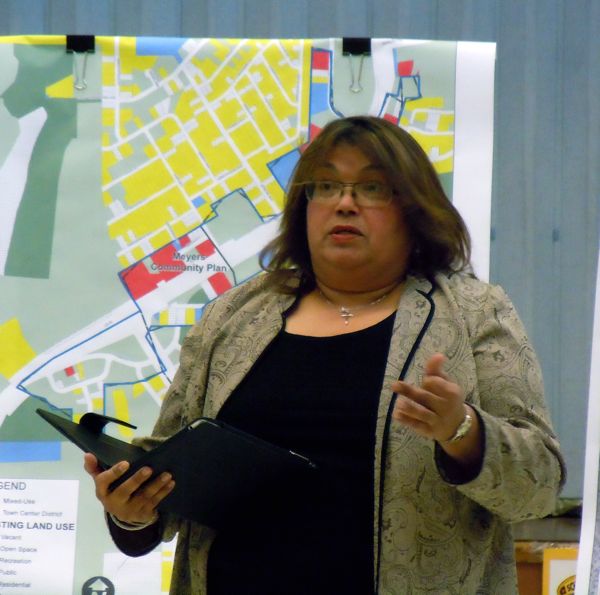
Meyers restarts process to be a more livable community

By Kathryn Reed

MEYERS – Another meeting, another plan, another promise the next document won’t sit on the shelf, but instead will actually be implemented.

That last part kept being pounded into the more than 40 people who attended the Meyers Roundtable meeting this week. But only a fraction of those people are ordinary citizens of this enclave at the base of Echo Summit. The rest have jobs with El Dorado County, Tahoe Regional Planning Agency, or other planning-design-consulting firms.

County Supervisor Norma Santiago, after the more than two-hour meeting on April 4, told Lake Tahoe News, “The teams will define the projects they want to implement so then we can shop for funding to pay for it.” (Santiago is also on the TRPA Governing Board.)

El Dorado County Supervisor Norma Santiago talks about plans for Meyers. Photo/Kathryn Reed

She said the now much-outdated community plan never came to fruition because there was no funding.

Sue Novasel, who leads the roundtable, was instrumental in getting the 18-year-old document off the ground. Back then teams worked on various components. That same way of doing things is going to be implemented this year.

The old document has things like walkable, livable communities – just phrased differently. It talks about a town eager to have connectivity through bike paths.

The original Meyers Community Plan came out in October 1993, with revisions made five years later. That document says, “The community plan for Meyers is intended to serve as the comprehensive land use and development plan through the year 1997.” The current Meyers plan may be accessed via the TRPA’s website.

The problem isn’t what is in the document – in fact, much of it will likely be used in the revision. It may just need to be tweaked to use today’s language and incorporate 21st century building requirements.

The problem is the plan has served as nothing more than a paperweight.

Community plans are one of those TRPA mandates. While in some ways they are slated to disappear if the Regional Plan update is approved at the end of the year, they are just going to be replaced with action plans that come with different criteria and mandates.

“The local community is determining their own character,” is how TRPA COO Ed Gurowitz described the new, friendlier agency and its proposed Regional Plan.

He said with Meyers starting now and intending to have its plan done as the Regional Plan comes to fruition, this particular South Shore plan could be a model for other jurisdictions around the lake.

Michael Ward, who is with the Lake Tahoe Prosperity Center and working with the Tahoe Sustainable Communities Program, spoke to the group assembled at the magnet school about the grant his group is using to help Meyers. He was evasive about the exact dollar amount that will be allocated to Meyers. Ward kept saying this is seed money that could attract other money. But for that to happen a real plan approved by TRPA that outlines priorities needs to be in place.

In the coming months a series of workshops-meetings will be scheduled so the people of Meyers can plot a course of action, with the goal being action – not just another plan.


S. Tahoe council re-enters ‘convention center’ fray

By Kathryn Reed

While the South Lake Tahoe City Council has always said the convention center project is not a city project, all of a sudden the electeds want to be involved with filling in the hole.

City staff has been on the periphery as the project languished in bankruptcy for more than two years. The council, though, has not publicly been involved until now.

It's unknown if the concrete and rebar at the hole are structually sound. Photo/LTN file

Councilmen Hal Cole and Bruce Grego on Tuesday were appointed to an ad hoc committee with City Manager Tony O’Rourke and City Attorney Pat Enright. They have been tasked with conversing with the parties involved with the defunct project near the state line about how to get a plan together before permits expire.

Had a performance bond been required for what was supposed to be a $410 million project, the city might not have the eyesore it has.

The July 11, 2006, Owner Participation Agreement – the contract between the city and Lake Tahoe Development Company – says, “It is typical of development projects like this one for cities/agency’s [sic] to request the participant to have performance and labor & materials bonds. This insures [sic] that the project once started will be completed. However, the developer is concerned that this will add to the overall cost of the project and point out that the agency will have no financial obligation if the convention center and public improvements are not completed. In addition, the participant’s construction lender will be monitoring the project very closely and will help assure that the project will be completed. The requirement for obtaining these bonds is not included in this agreement.”

Cole, who is a contractor by trade, told this reporter years ago there is no such thing as a performance bond. This was when he was on the council before this stint and while agreements were getting approved.

Market study

Cole along with then Councilman John Upton are the only two councilmembers who are known to have seen the market study that was done in 1995 that “proved” South Lake Tahoe needed a convention center.

The document was not released to the media until last year.

This study is what the electeds based their decision on to go forward with the project at the time – a study the majority never saw. It’s a study that was commissioned by Lew Feldman, the attorney for the developer. Coopers & Lybrand out of Texas put it together.

While in many ways reporting on the study is old news, Lake Tahoe News is the first news source to do so.

It is important to know what has happened in the past and who was involved so perhaps history doesn’t repeat itself.

It’s possible the town is better off with an empty lot instead of more empty buildings. After all, no one saw the recession coming – at least no one associated with this project.

From 470 surveys of regional-state-national event planners this is what they said of the likelihood of having an event in South Lake Tahoe:

        National      Regional            State    Corporate
Definitely yes

10%

15%

22%

15%

Highly likely

4%

16%

7%

8%

Possibly

29%

20%

25%

28%

Unlikely

29%

16%

21%

20%

Definitely no

28%

33%

25%

29%

Source: Coopers&Lybrand


Those are some of the numbers used by city officials to say a convention center was a must-have building for South Lake Tahoe.

The study says 79 percent of the reasons entities would not choose South Lake Tahoe – like air service, gambling next door, preference of a large city – could not be overcome.

The city was supposed to have a 50-year lease to operate the convention center. This was going to be how it made money in addition to the increase in hotel and sales taxes.

But the market study says, “… the potential convention facility in South Lake Tahoe is estimated to incur an operating deficit in its fifth year of operations, the first year of stabilized operations, of approximately $67,000 (1995 dollars). This level of operating shortfall is consistent with or slightly less than the results of similar facilities throughout the country. Furthermore, the financial analysis assumes a significant level of spectator events held in the facility. Without the income that could be generated by such activity, the annual operating deficit could increase by up to $250,000.”

What was released to the public and is in the report is the $11.4 million per year that was anticipated in spending by people using the facilities – on hotel rooms, food, entertainment and transportation.

The study further states half of the dollars spent would be in California and half in Nevada.

Event organizers, according to the study, ranked room quality and size, number of rooms, and food service quality as top criteria for determining where to have a convention or meeting.

Something that was never budgeted is money to lure conventions to South Lake. But it was a component of the study.

“The marketing of conventions, trade shows and other events requires a substantial amount of time and resources,” the study says.

The South Shore doesn’t have a convention bureau.

With the Reno airport being a little more than an hour away – without traffic and snow – that, too, could be an issue with potential attendees, the report says.

Had the project been completed, it was expected to compete with mid-sized state and regional facilities.

The project was sold to the public as though the center would be available for community events. The study called for 60 events (national-regional association events, corporate meetings, state association events, public shows, spectator events) that would cover 204 days. The public shows equaled two events over seven days.

As the process went on, parking was never resolved. The project never had enough spaces to store the number of vehicles expected at the site. Harveys was going to be the place to park. But that agreement was never secured even though construction began.

The study says, “The availability of adequate parking is an important factor in accommodating local and state conventions, trade shows, public shows and certain corporate events. A relatively high percentage of attendees within the local and state event market would likely drive to a convention facility.”

Current day issues

Once the project emerged from bankruptcy court earlier this year the clock on the Tahoe Regional Planning Agency permit started ticking. It runs out at the end of the year. To start that process all over will be costly and time consuming; potential roadblocks to a developer.

While the 11-plus acre parcel near Harveys and Heavenly Village has sat idle for years because Lake Tahoe Development Company filed bankruptcy in 2009, the future is murky.

Randy Lane of LTDC still owns nine of the parcels. The entire project is 29 parcels because the city allowed concrete to be poured without a final parcel map on file. Sixteen have been foreclosed on, with four in the process. A notice of default has been filed on two of those four, with the sale slated for June 1 in Placerville.

Another twist to the case is the lawsuit filed late last year by Harry Segal who believes he should be a primary creditor and not secondary. That case will be heard in Placerville in El Dorado County Superior Court.

At the April 3 council meeting it was agreed the five want to have a public session with the key players at the second May meeting to hash out what can be done with the property. Cole asked for staff to provide an update on the condition of the concrete and rebar as well as details about the TRPA permit.

He said it’s critical decisions are made this summer about the future of the site.

But the city doesn’t own the land – which at one time with the improvements that are in place had a value of more than $100 million – nor does it have the wherewithal to buy it. So, while the property is in the city limits, the council has as much control over getting movement on the site as it does to resolve the tenant issues at the Y.


S. Tahoe tries to make special events less of a problem

By Kathryn Reed

An angry citizenry prompted South Lake Tahoe officials to look closely at how it handles special events.

Guidelines were thoroughly discussed April 3 during a City Council workshop at which six members of the public gave their input, plus one letter was read into the record.

New Year’s Eve weekend’s SnowGlobe music festival, which definitely helped the economy, rattled so many houses that some nerves are still frayed more than three months later.

December's SnowGlobe music fest forced South Tahoe's hand to formalize special event guidelines. Photo/LTN file

The council at the April 17 meeting is expected to adopt guidelines for special events.

The problem with SnowGlobe was the sound – not of music per se – but the excessive bass associated with the type of music that spilled from the community ball fields at Lake Tahoe Community College.

To prevent a repeat of those problems, the city is considering imposing rules that call for special events to be between 10am and 10pm, with decibel levels of no more than 95.

“Ninety-five dbA is restrictive. Most cities are generic,” City Manager Tony O’Rourke said. But he also said it’s easier to relax rules than to implement them after the fact – thus the reason he supports the 95dbA.

He pointed out how the Tahoe Regional Planning Agency’s noise rules call for sound not to exceed a certain limit over a sustained 24-hour period. Based on that criterion, the booming sound from SnowGlobe did not violate TRPA rules.

In doing research, South Tahoe officials found two cities with decibel limits higher than what is being proposed locally. Aspen and West Palm Beach have limits of 100dbA.

With these being guidelines and not an ordinance, it means staff has more flexibility. For instance, it’s likely another New Year’s Eve event could have an end time of 12:30am so revelers could celebrate the new year. But to avoid another SnowGlobe incident, either speakers will be positioned differently, or acts will be scheduled so the less deafening ones come on last.

Having a say in the schedule is part of the guidelines.

Some discussion Tuesday centered on whether the city should charge a permit fee.

It was pointed out by staff as well as B Gorman, CEO of the Lake Tahoe South Shore Chamber of Commerce, that it takes most events a handful of years before they turn a profit.

“People have no idea how expensive events are,” Gorman said, relaying how people after year two of Sample the Sierra asked where the proceeds are going. The $30,000-plus spent on tents and other materials for the event are still being paid off.

Money for the city comes via hotel and sales taxes.

Gorman suggested in addition to city staff, that someone like Carol Chaplin, head of Lake Tahoe Visitors Authority, be on the events committee.

While Councilmembers Claire Fortier and Tom Davis liked that idea, Councilwoman Angela Swanson said someone less entrenched in the business, like a member of the city’s recreation commission, should be involved.

That issue was not resolved at the meeting.

Where events can be conducted was another issue brought up at the meeting.

“Venues are our biggest obstacle,” Stan Sherer, community services director, said.

The South Shore is an obvious draw because of its natural beauty, easy drive from the Bay Area and Central Valley, and proximity to Reno-Tahoe International Airport. But locations for events are lacking.

A baseball tournament coming to the area in the summer is using fields throughout the basin and in Gardnerville.

Cody Bass wants to bring a festival on the scale of Outside Lands that is staged in Golden Gate Park in San Francisco. He envisions the way to do that is to convert Bijou Community Golf Course into a music venue. He’d like that to happen Labor Day weekend.

JoAnn Conner, president of South Tahoe Chamber of Commerce, would like the city to look at the number of similar events it allows at a given site – for example how many crafts fairs are at South Tahoe Middle School.

Councilman Hal Cole, remembering the contentious nature of meetings regarding arts events, said he is not ready to revisit that issue.

Another aspect of future events is a waste management plan will be required, with the goal of being zero waste.


Water content inching up, but still well below normal

By Kathryn Reed

PHILLIPS STATION – “By no means are we in great shape, but be we are nowhere near as fragile as we were last month.”

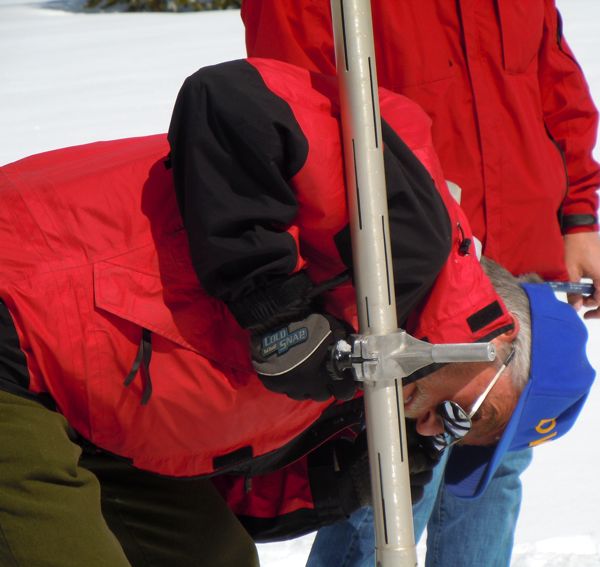
That is the assessment of the water content in the Sierra Nevada by Frank Gehrke. Gehrke, who works for the state Department of Water Resources, was at the base of Sierra-at-Tahoe along Highway 50 on Monday for the penultimate snow survey of the season.

Usually by the April survey talk begins of a diminishing snowpack. This year, the readings keep increasing. Considering the first reading this season on Jan. 3 at Phillips Station Gehrke collected dirt in his instruments, things have improved dramatically.

Frank Gehrke takes a reading April 2 near Phillips Station. Photo/Kathryn Reed

Still, this location is at 39 percent of its long-term average, with water content of 11 inches and snow depth of 31 inches. A year ago, the water content was 43.5 inches, snow depth 124.2 inches and 154 percent of normal.

For April 2, 2012, the state is 55 percent of its average. While this is not good, water gurus are staying afloat from the abundance of moisture from winter 2010-11. Lake Oroville, the State Water Project’s principal reservoir, is 107 percent of average and Lake Shasta, the federal Central Valley Project’s largest reservoir, is at 104 percent of average.

This bodes wells as the snowpack traditionally begins to diminish with the start of April because of fewer storms and warmer temperatures increasing snowmelt.

Gehrke was breaking trail on his cross country skis as the media followed alongside. Under the blue sky and sunshine the snow sparkled like diamonds, almost as though it knows it has a value that no banker will trade for a greenback.

Tahoe merchants know snow depths can be measured in dollars. On one of the best ski days of the season it was easy to find a parking spot at Sierra-at-Tahoe. Stashes of powder could be found a day after the storm, while others enjoyed the rarely groomed Clipper run. Even at 10am corduroy was scattered about.

It was an interesting Monday morning seeing how important snow is to so many facets of the California landscape and economy.

Another storm that is likely to arrive tonight in the greater Lake Tahoe area (that could last into Thursday) is good news for the overall water situation in the state. First, it means more moisture. Second, the cooler temps will slow the snowmelt. The longer water stays in its frozen form, the better for storage reasons. It means not needing to irrigate, flooding being less of a concern, and evaporation not occurring as soon.

And it’s good news for the greater Lake Tahoe economy. Businesses dependent on snow can hope to salvage a season that has been rocky in so many ways.

Location

Elevation

Snow Depth

Water Content

% of Long Term Average

Alpha

7,600 feet

  44 inches

15.9 inches

48

Phillips Station

6,800 feet

      31 inches

11 inches

                           39
Lyons Creek

6,700 feet

   52.4 inches

  19.1 inches

61

Tamarack Flat

6,500 feet

   44.9 inches

 13.6 inches

50

Source: Department of Water Resources