Dissecting demographics key to knowing Tahoe visitors

By Kathryn Reed

STATELINE – Paying attention to what the population looks like is critical to knowing who to market Tahoe to.

That was the overriding message of Emilyn Sheffield. She was one of two presenters at the annual Lake Tahoe Visitors Authority-Lake Tahoe South Shore Chamber of Commerce tourism conference on Thursday.

Sheffield, who is a professor at CSU Chico, also brought 20 of her students to the South Shore. They spent several days in the area essentially testing the tourist product.

Professor Emilyn Sheffield suggests ways South Shore tourism officials can draw more people to the area. Photo/Kathryn Reed

The other speaker was Ralf Garrison, director of MTRiP – Mountain Travel Research Program. Much of the information was the same that he delivered at the Mountain Travel Symposium at the Resort at Squaw Creek earlier this month.

The two-hour event April 26 at Harveys drew a crowd of about 100 people.

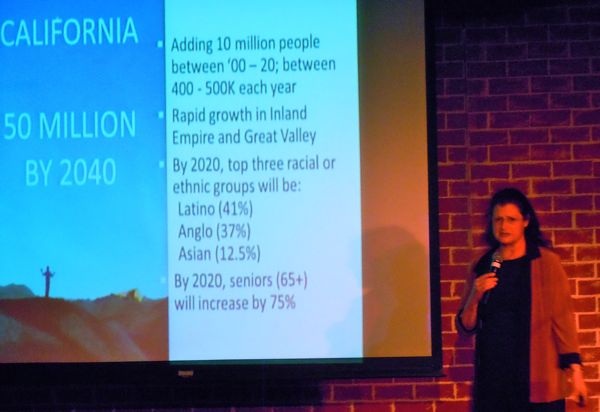
Using information from the Census to project trends in demographics, Sheffield said it’s important tourism leaders in Lake Tahoe realize that California’s population by 2020 is expected to be 41 percent Latino, 37 percent Anglo and 12.5 percent Asian.

She said while Tahoe has relied on Anglos in the past, this cannot continue unless the region wants to be an exclusive enclave.

Sheffield added that while the Tahoe South website redesign looks good, it needs more.

“You only see Anglos. You need more diversity of photos and more diversity of spokespeople,” Sheffield said. Too many white people on the website was her complaint. People who travel want to see people who like them doing what they might do in whatever location it is.

Sheffield added that growth in the Asian market could be good because historically they are interested in gaming. But she said Hispanics overall don’t like the snow, so it’s good the area has four seasons.

Sheffield suggested three things for the South Shore to focus on:

• Recapture the Baby Boomers by reconnecting with them through their values of peace, love and harmony with nature. She added that if hotels are not pet-friendly, they would lose this group.

• Rethink what accommodations are like. Boomers and Hispanics are traveling not as couples, but multigenerational. This means two rooms, two bathrooms in a single unit. Sheffield said they tend to rent houses instead of condos. With the Latinos, they like to go places where people know how to speak Spanish.

• While the millennials have meager means today, they are the future. “Expect them to be loyal,” Sheffield said. That’s why they should be lured to Tahoe today. She said they may only have $200 to spend in a weekend, but they will spend it all. Hostel-like accommodations may be the answer for lodging, then the rest will be spent on food and entertainment. And for this generation, make sure there are enough plugs for all of their digital devices.

Garrison pointed out how tourism businesses need to look beyond the traditional people they market to. He said a resort in the Tahoe area during January had an 80 percent spike in ski school business – when there was no snow.

The resort was attracting beginner skiers who felt safe to drive the mountain roads.

“So it shows there are different ways to market,” Garrison said.


Meyers Landfill bill doubles to $13 mil.; case back in court

By Kathryn Reed

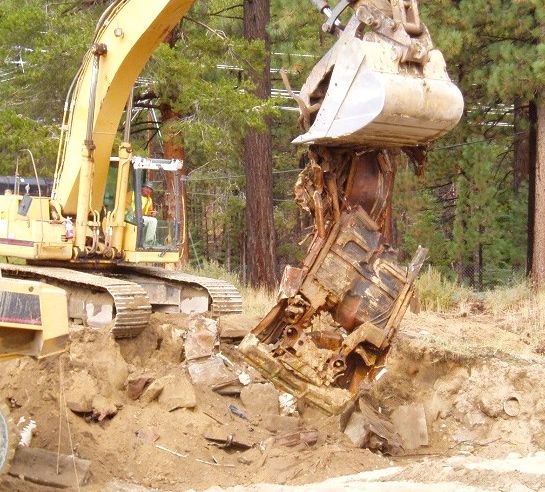
Cleaning up the old Meyers Landfill is costing more than twice what was expected – for a total of more than $13 million. The doubling of the cost has also created another lawsuit between the U.S. Forest Service and El Dorado County.

El Dorado County Board of Supervisors this month approved taking $6.3 million from the General Fund Contingency to pay for the cost overruns.

The April 17 staff report to the board says, “Failure to pay back this temporary loan will adversely impact other services provided by General Fund appropriations.”

Meyers Landfill cleanup is costing more than $13 million. Photo/USFS

Gerri Silva, director of environmental management for the county, expects the $6,313,156 to cover everything related to the actual work on the project. By the end of the summer the restoration to the site off Pioneer Trail should be complete.

The Meyers Landfill was used from 1947-71. Twenty years later the feds sued a slew of entities for cleanup costs. Vinyl chloride, a carcinogen produced when household waste breaks down, was the main contaminant under the sealed plot, although methane and other gases posed problems.

Those lawsuits lasted for years and cost the various agencies – mostly public, with a few private companies involved – millions of dollars. Those millions aren’t even part of the $13 million to fix the land so it is usable again and deal with the toxins so they don’t threaten people or the environment.

The entire disturbed area is more than 20 acres. Originally, the liner was to cover 7 acres, with what’s called the plateau area encompassing another 4 acres.

Because debris was found in a larger area than expected, the cost to remediate the site grew. But the county does not believe it should have to incur the expense because when the federal court case was settled it was the USFS plan that El Dorado County had to follow, with the Forest Service saying what the cost would be and where the cleanup would take place.

Silva said the original budget was $5.5 million, which the county’s insurance company covered.

“The Forest Service gave us 100 percent of the remedial design. They included what they thought it would cost, but there was a lot more waste there that had to be relocated,” Silva told Lake Tahoe News.

To recoup its expenses, the county took the feds to court. (No matter who wins, all of this is taxpayer money.)

The federal court granted the county’s motion for construction, enforcement, and modification of the partial consent decree. The Forest Service appealed this to the Ninth Circuit Court of Appeals. The next set of court briefs are due May 11.

According to the county, “If affirmed by the Court of Appeals, a hearing will be scheduled to determine the potential amount of the additional construction costs due to the large number of issues, errors, and omissions with the final 100 percent remedial design the county may recover from the U.S Forest Service.”

The Lake Tahoe Forest Service office deferred comment to the U.S. Department of Justice in Washington, D.C. However, because the matter is ongoing litigation, Wyn Hornbuckle declined to answer the following Lake Tahoe News questions:

• The cost of the project is more than twice what the Forest Service said it would cost when the agency came up with the design and told the county what to do. How do you account for this?

• How do you expect another agency to pay this when it’s your plans that seem not to be working?

• What does the USFS attribute the cost overruns to?

The county and USFS agree the land could be open to the public in August.

“Everything is contingent on site conditions and how well the vegetation is growing and how the cover system is settling in,” Cheva Heck, spokeswoman for Lake Tahoe Basin Management Unit, said. “We could reopen Garbage Dump Road as soon as August of this year; once the construction equipment and trailers are off the site. If it takes longer for vegetation to re-establish, the site could remain closed for more than a year. Our intention is to reopen the site to dispersed recreation like biking, hiking, dog-walking and similar activities.”

This will be the third summer contractors have been working on the Meyers Landfill.


South Tahoe city manager offered job in Washington

By Kathryn Reed

South Lake Tahoe City Manager Tony O’Rourke has been offered the same job in Yakima, Wash.

O’Rourke, who signed a three-year contract with South Tahoe that started in August 2010, told Lake Tahoe News he will take the weekend to decide about what to do regarding the job offer. He expects to make a decision early next week.

The Yakima City Council voted 7-0 on April 27 to hire O’Rourke.

South Lake Tahoe City Manager Tony O'Rourke has been offered a job in Washington. Photo/LTN

Still to be negotiated are the terms of the contract. It is possible if wages and benefits don’t meet O’Rourke’s liking, he could turn down the offer.

He said he would be talking with South Lake Tahoe’s council this weekend, too.

“A decision will be made soon. I want to be fair to both parties,” O’Rourke said.

There is no penalty per his contract if he leaves South Lake Tahoe early. He is “supposed” to give 90-days notice, but it is entirely up to the council when it would let him out of the contract.

However, on the flip side, had the council wanted to fire O’Rourke, he would have been entitled to nine months severance pay – 50 percent more than former City Manager Dave Jinkens had in his contract.

O’Rourke, 57, has been looking for another job for several months.

Earlier this month he told Lake Tahoe News, “For the long term I need to find a solution to this personal issue.”

While he has been a lightning rod in his short tenure in South Lake Tahoe, the council has had his back, collectively agreeing he has done what the city needed.

Nancy Kerry, who earlier this month was officially given the title that puts her second in command and the top city official when O’Rourke is out of town, on Friday night told Lake Tahoe News it would be inappropriate to speak about O’Rourke’s job offer until she had spoken with him and the council.

Mayor Claire Fortier, who also was not aware of the O’Rourke’s job offer until Lake Tahoe News called, said, “South Lake Tahoe will be fine. Tony has created a very strong senior management team that is very capable of filling the void until we have the next city manager.”

O’Rourke echoed that sentiment.

“We really have an outstanding senior staff,” O’Rourke said.

For the council and city as a whole, he said, “What they need now is more civility and consistency. The heavy lifting has been done.”


TRPA draft EIS Regional Plan update showdown begins

By Kathryn Reed

STATELINE – Sixty days. That’s how long people have to review and comment on the environmental documents associated with the Tahoe Regional Planning Agency’s Regional Plan update as well as the transportation update.

About an hour of Thursday’s Governing Board meeting was devoted to discussing how long the comment period should be on the environment impact statements. While some wanted the maximum 90-day period, the board voted on a 60-day limit with the idea the vote on the EIS will happen before the end of the year and there will be more time for public meetings. Board members Mara Bresnick and Ryan High, the alternate for Ross Miller, voted against the 60 days.

Those in the conservation community asked for the 90 days, visually demonstrating the task ahead for all who want to participate in the process by bringing to the podium the volumes of binders that contain close to 3,000 pages of information. All of the docs are on the TRPA’s website.

TRPA Governing Board member Claire Fortier of South Lake Tahoe listens to deliberations April 26. Photos/Kathryn Reed

Before the April 26 vote, board member Claire Fortier said, “The folks who want the delay are the same people who were at the Regional Plan committee meetings.”

Fortier, who is also the mayor of South Lake Tahoe, was one of the six members of the committee who came up with the proposed Regional Plan update.

Regional Plan draft EIS

Five alternatives are in the EIS, with alternative 3 the preferred alternative. TRPA staff describes alternative 2 as what the conservation community wants. Conservationists say that is not true.

“We provided a 256-page Conservation Alternative to the TRPA. That alternative was discussed with the staff over a number of months,” Laurel Ames, with the Tahoe Area Sierra Club, told Lake Tahoe News. “We were shocked to find our alternative eviscerated and allegedly replicated as current alternative No. 2. The EIS analysis of alternative No. 2 does not reflect our alternative.”

The “we” also includes the League to Save Lake Tahoe, Friends of the West Shore and other conservation groups.

Sydney Coatsworth with Ascent Environmental Inc., the firm that prepared the draft EIS, described the alternatives in basic terms as follows:

• Alternative 1 would keep things as they are – using the current Regional Plan that was adopted in 2007. This comes with 86 residential allocations, 874 residential bonus units, 383,579 square feet of commercial floor area, and 342 tourist accommodation units.

• Alternative 2 is described as low development with increased regulation. It calls for 2,600 residential allocations, 200,000 square feet of CFA, maximum coverage of 50 percent on high capability land in community plan areas. Existing height rules stay in place except in some high-density locations.

• Alternative 3 is called highly incentivized redevelopment. Coverage and development transfer ratios are based on sensitivity between areas, allows coverage transfer across the nine hydrological related areas, and has changes to density and height standards. There are three tiers for height, the maximum being 197 feet in the Stateline casino corridor. (That is the current height of Harveys and Harrah’s Lake Tahoe. For the Stateline casino properties to get a permit to redevelop, they must conform to rules in the Regional Plan. If this alternative is adopted, then they would. Those casinos were built before there was a Regional Plan.) This alternative also has 2,600 residential allocations and 200,000 square feet of CFA. It exempts non-motorized trails from being categorized as coverage.

• Alternative 4 is labeled as reduced development with incentivized redevelopment. It comes with 4,000 residential allocations, 400,000 square feet of CFA, 200 TAUs, and 70 percent coverage on parcels in community plans.

• Alternative 5 has a similar rate of development and regulatory structure as the 1987 plan. It comes with 5,200 residential allocations, 600,000 square feet of CFA and 400 TAUs.

Fourteen environmental topics are analyzed in the EIS. Chapter 2 details the alternatives. The 14 are land use, transportation, air quality, green house gas-climate change, noise, geology-soils-coverage, hydrology-water quality, scenic resources, biological resources, recreation, population-employment-housing, public services-utilities, hazards-public safety, and cultural resources.

Chapter 3 focuses on the analysis. Two designations not often, if ever, found in an EIS are labeled as B for beneficial and SU for sufficient-unavoidable.

What people are saying

Several times during the past two days of TRPA board meetings it was stressed how the Regional Plan update and the EIS are drafts. Comments on the Regional Plan will be taken until the day the board votes on it in December. The EIS has 59 days left for people to comment.

TRPA Executive Director Joanne Marchetta repeatedly said the plan update would get on a four- to five-year cycle – no more of this every 20-year process – or 25, as is the case now. The idea is to be able apply adaptive management techniques to the plan – so changes can essentially be made on the fly to things not working instead of waiting years after that realization.

Seventeen people during the public comment period spoke about the draft EIS.

Dan Siegel with the California Attorney General's Office goes over his notes at the April 26 TRPA meeting.

First out of the gate was Dan Siegel, California deputy attorney general.

“I believe the draft has serious legal defects,” Siegel said. In particular he took issue with delegating authority to local jurisdictions, coverage rules, and the allowance of new development.

Ames, with the Sierra Club, spoke of the desire for better stormwater rules, in particular the need to use infiltration techniques instead of collection basins.

Jennifer Quashnick, who has worked for the Sierra Club, questioned why when so many people touted the economic benefits of the plan why there is no feasibility study associated with it to prove that point.

On the other side, advocating for the adoption of alternative 3, were attorney Lew Feldman, Carl Ribaudo of SMG Marketing, consultant Gary Midkiff, Richard Shaw of Design Workshop, Clint Purvance of Barton Health, Blake Riva of East-West Partners, Chuck Sharer of Edgewood Companies, Hilary Roverud with the city of South Lake Tahoe, B Gorman of Lake Tahoe South Shore Chamber of Commerce, and Carol Chaplin of Lake Tahoe Visitors Authority.

Formation of the plan

To come up with the draft Regional plan the committee met 15 times, with unanimous agreement coming on 145 items.

Fourteen of the items that will need to be resolved between now and December are:

• Transfers of planning and permit review responsibility to local government

• Options for stormwater management implementation

• Annual release system for residential allocations, bonus units, and non-residential development allowances

• Transfer of coverage across hydrologically related area boundaries

• Tourist accommodation unit transfers

• Development and subdivision authorized in the recreation district

• Building height in the high density tourist district

• An eight-hour ozone threshold standard

• Level of service allowances when alternative transportation modes are available

• Distribution requirements of air quality impact fees

• Restrictions on biomass burning facilities within the basin

• Numeric restoration targets and trails for stream environmental zones

• Coverage or other permanent land disturbances in stream environmental zones

• Airport activities and nuisance abatement requirements

• Ridgeline and viewshed protection and scenic mitigation

• Maintaining and restoring the scenic qualities of the natural appearing landscape.


Peer review: TRPA thresholds on right track, but plenty of room for improvement

By Kathryn Reed

INCLINE VILLAGE – Rain falling on a hillside golf course. It would have made for the perfect field trip for the Tahoe Regional Planning Agency Governing Board.

Instead, the board stayed inside to talk policy.

But had they walked outside The Chateau at the Incline Village golf course, they could have asked if this course uses a fertilizer with phosphorous on its grass, seen the impacts of stormwater runoff to the near shore, witnessed issues with stream environmental zones, viewed scenic concerns, and even investigated whether they could have used public transit to get to the meeting.

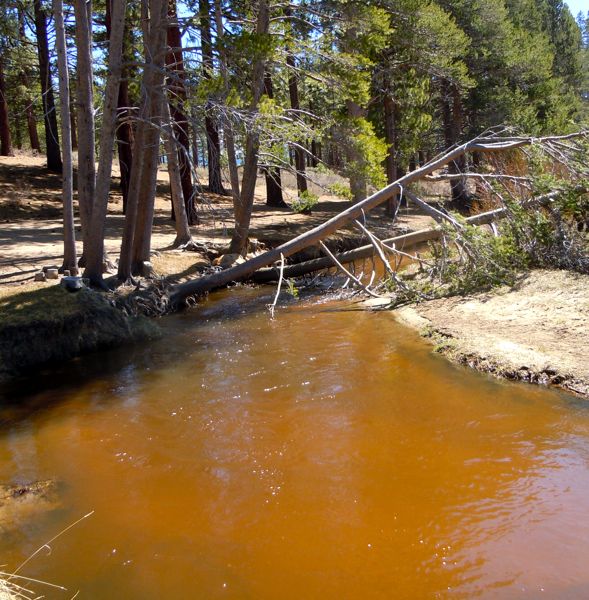
Improving Lake Tahoe clarity's includes paying attention to the tributaries. On April 22, Trout Creek in South Lake Tahoe was a brown-rust color. Photo/Kathryn Reed

After all, those were the issues they talked about all day Wednesday. Issues that amount to 2,500 pages – all of which are said to be on TRPA’s website. These are issues that everyone living or doing business in the Lake Tahoe Basin will have to follow. Many are ones that have been in effect for decades.

Under the dark skies and intermittent rain, the Governing Board endured the first of what is expected to be two full days of dialogue about the proposed update to the Regional Plan and associated documents.

By the time the April 25 meeting came to a close at 4:45pm, a couple dozen people remained – while the morning had about 75 in attendance. Much of what was discussed Wednesday was a regurgitation of what has been talked about leading up to this point.

Thursday’s session, which starts at 9:30am at TRPA’s Stateline office, will be about the environmental documents related to the Regional Plan update and Regional Transportation update. Speculators expect more public comment and a livelier session.

Only two people commented on the first segment regarding the thresholds, while no one commented on the afternoon session that delved into the Regional Plan and transportation updates. However, public comment was not expected to be taken Wednesday per Executive Director Joanne Marchetta’s opening comments, but people will have a chance to comment today on Wednesday’s items.

While Marchetta was upbeat, saying the thresholds are working and more rigor will be used going forward to analyze progress, the fact remains that since 1997 when the environmental improvement program was created more than $1.5 billion has been spent in the basin with the primary purpose being improved lake clarity.

Clarity is not declining as fast as it once did. That’s the improvement TRPA officials continually point to.

Threshold update

While the nine thresholds must be updated every four years, this is the first time the data has been peer reviewed.

Within the nine categories are 151 subcategories, so to speak. The nine are air quality, water quality, soil conservation, scientific resources, wildlife, fisheries, vegetation preservation, recreation, and noise.

Of those 151 standards, TRPA made a status determination on 92 of them. Sixty-three percent of the 92 standards were attained and 37 percent have not been attained, Shane Romsos, acting measurement department manager at TRPA, told the board.

Board members raised questions about the monitoring process and why some things cannot be measured. Money is one reason, poor standards are another.

“We are trying to move the monitoring into the 21st century; to measure things that have relevancy for policy management action,” Romsos said.

About $2 million a year is spent on monitoring TRPA threshold requirements by agencies throughout the basin. Twice that amount is needed to measure everything. Five times that amount, or $10 million a year, is what is need for “top of the line” monitoring, Romsos said.

“We have standards, but it’s unclear what we are trying to achieve,” he said.

He used wood smoke as an example. Smoke measurements are ambiguous and what they were pre-1981 are not even known. The recommendation by the peer review and from Romsos to the board is to replace wood smoke with measuring particulate matter.

TRPA outlined the concerns in the threshold measurements as:

• Long-term annual average Secchi depth and summer clarity

• Phytoplankton primary productivity and near shore attached algae

• Uncommon plant communities

• Single noise events like aircraft

• Cumulative noise events like urban outdoor recreation sites.

Jim Mahoney, who led the peer review done with six others, said, “The panel does not find any fatal flaws.” While that is the technical phrase for all is well, he went on to praise the threshold studies as one of the best he’s seen in his 30 years.

Still, there is plenty of room for improvement. Romsos said some of the suggestions are being implemented, with others to be considered.

People who don’t live or work in the basin did the review – in fact none of the seven lives in either California or Nevada.

Mahoney suggested in the next update that TRPA, “Expand the use of comprehensive land use perspectives.” He said the panel found not enough emphasis was placed on looking at how the thresholds are interrelated and how the basin is affected as a whole.

“The peer review – they really want us to link the thresholds,” Romsos said. “As we talk about policies it’s those that have multiple threshold benefits.”

Mahoney also stressed the importance of environmental and economic analysis.

The panel, Mahoney said, recommends the TRPA find out “the connection between lake clarity and near shore water quality; the important links between regional soil conservation and water clarity; the possible adoption of some of the best practices for maintaining lake ecosystems previously developed for other lake systems; the beneficial effect of riparian and wetland restoration upon the eight wildlife species chosen for monitoring in the Tahoe basin; the spatial distribution of vegetation communities throughout the basin, including management practices that support fire reduction; continued focus on air quality monitoring the basin with special attention to ozone ambient air quality standard attainment; development of percentage-of-exceedance methods to evaluate the community noise thresholds; increased use of visual illustrations in scenic value thresholds developed for community and regional design applications; and network approaches to addressing the interconnectivity of recreational venues.”

When it comes to the Regional Plan update, ways to gain threshold benefits, as presented by TRPA staff, are to:

• Transfer coverage out of sensitive lands

• Improve walkability and bike access

• Environmental redevelopment

• Phase out phosphorus fertilizers.

Muck closest to shore

What the shoreline looks like received the most dialogue by board members.

John Reuter with UC Davis, who for years has been working on lake clarity and helped create some of the thresholds, said Davis along with UNR and Desert Research Institute has received a grant to study the near shore.

“We are going to take a scientific and systematic evaluation of what the near shore indicator should be,” Reuter said. “We don’t want it just based on what the public would like. No one wants (algae). But what can be expected? What’s realistic?”

For so long lake clarity has only been defined by how far a white dinner plate-looking disc can be seen by the naked eye from aboard a boat.

With the acceleration of algae and the browning of the lake where the water hits beaches, people are becoming alarmed.

It’s a line of questioning board member Claire Fortier, who is also mayor of South Lake Tahoe, pursued.

Reuter said what’s needed is more details about stormwater.

A bit of an irony is that while TRPA embraces the total maximum daily load mandates imposed by the Lahontan Water Quality Control Board, the effects of what comes out of the stormwater pipes is not analyzed. All that has to be quantified is that less comes out each year – especially in the form of fine sediment.

But Reuter pointed out, while decreasing the sediment load reaching the lake will help the near shore, “it does not mean the entire near shore improves.”


CVS in old Bill’s casino to open in May; other tenants set for summer move-in

By Anne Knowles

The Stateline site known as Bill’s Casino, named for Harrah’s founder Bill Harrah and purchased two years ago by Mike Laub, will reopen its doors next month.

After a remodel costing more than $3 million and employing 80 workers, the 40,000-square-foot site is being reborn as a mall.

“Everything is new,” said Laub, who bought the property in March 2010 for $5.22 million. “New parking lot, new landscaping, new windows, new heating system. The only thing left is the foundation and the steel.”

A portion of the old Bill's casino will open in May, with the remaining tenants who have signed leases moving in during the summer. Photo/LTN

“It’s looking more and more high-end,” said Sam Dufour, owner of Teaz N Pleaz, an adult lingerie shop and one of eight tenants in the new mall. “It will change the face of the area.”

The unnamed mall – Laub told Lake Tahoe News he might have a contest to name it – will launch on May 6 with the opening of a CVS store without a pharmacy. According to the Douglas County building permit, the store will be 11,102 square feet.

Michael DeAngelis, a spokesman for the Woonsocket, R.I.-based drugstore chain, said CVS decided to forgo a pharmacy because the Stateline store is expected to attract more tourists and visitors than residents.

Laub said he expects the CVS to employ about 20 people, and for the remaining mall tenants to employ another 60. He said one tenant, the Lucky Beaver Bar & Burger, soon would be having a job fair.

During June, most of the remaining occupants are expected to debut, including Dotty’s Casino, Tahoe Diamond District, Lucky Beaver Bar & Burger, Tahoe Ink, Teaz N Pleaz, and Pilates Studio Lake Tahoe. An eighth tenant, The Raw Bar, a bar and seafood restaurant, is expected to open in August, according to Laub.

Teaz N Pleaz is adding to its stores in Fair Oaks and South Lake Tahoe with a 1,500-square-foot store in the new mall, which Dufour hopes to open June 1. He characterizes the store as a competitor to Victoria’s Secret, but its website also sells sex toys and adult games, along with apparel.

Pilates Studio Lake Tahoe is opening in late June in a 3,000-square-foot space on the third floor of the mall, said Tara Farrah, the studio’s owner. Farrah plans to offer private and group classes taught by four Pilates instructors and three yoga teachers. She may also add Zumba, a Latin-inspired dance aerobic program, and hopes eventually to offer outdoor classes on the mall’s rooftop.

“I wholeheartedly believe in Pilates,” Farrah said. “I had a ski accident years ago, and it saved my life.”

Farrah’s husband, Pat, will be opening the Lucky Beaver Bar & Burger, a 24-hour gaming bar serving gourmet burgers, on June 15. The county building permit lists it as 3,105 square feet. It feature video-table top gambling, a mini sports book, a grill inside and a fire pit in the back with outdoor seating.

Farrah said there is considerable parking in the back. “It will be a great location for locals and out of towners.”

He co-founded Home Depot. On this project Farrah has two partners —  Mike Leeper, who ran Bar 24 at Bill’s Casino, and Kevin Lane ,who owned the Cedar Room in Round Hill.

Tahoe Diamond District, a jewelry store listed as 1,266 square feet on its building permit, and Tahoe Ink, a tattoo parlor with thousands of square feet, according to its permit, are expected to open in early June, according to Laub.

Finally, a 6,500-square-foot Dotty’s Casino is scheduled to open in early June, too. The casino will have 100 slot machines, a bar and a restaurant, said Laub.

Dotty’s, which caters to locals and women who don’t typically like casinos, was the focus of a push by the Nevada Resorts Association to impose stricter guidelines on slots parlors. In August 2011, the Nevada Gaming Commission amended its regulations to require Dotty’s and similar establishments to offer bars seating at least nine patrons and restaurants of at least 2,000 square feet seating for at least 20 customers.

Calls for comment to Nevada Restaurant Service, the corporate name for Las Vegas-based Dotty’s, were not returned.

Three storefronts remain vacant in the mall, said Laub: a 4,500-square-foot spot on the first floor that Laub is now negotiating with several potential tenants and two spaces on the second floor that can be flexibly configured for between 1,000 and 3,000 square feet.

“The second floor would be a perfect location for a salon,” said Laub.

Originally, Laub planned to build a strip club at the site, but the Douglas County Commissioners nixed the plan.

The site is also known for a safe discovered in its walls during the remodeling. Some believe the safe may be connected to the unsolved murder of Richard Chartand, the original owner of the casino, when it was known as Barney’s Casino. He was killed in 1968 by a car bomb, believed to have been planted by the mob.

The Oprah Winfrey Network acquired the rights to reveal the contents of the safe on an upcoming series, but has decided not to use the safe in any show, a spokesman for the TV network told Lake Tahoe News.


S. Tahoe officials: SnowGlobe did not damage ball field

By Kathryn Reed

Jessie Jorgensen is running all around the soccer field by Lake Tahoe Community College. She does this weekly.

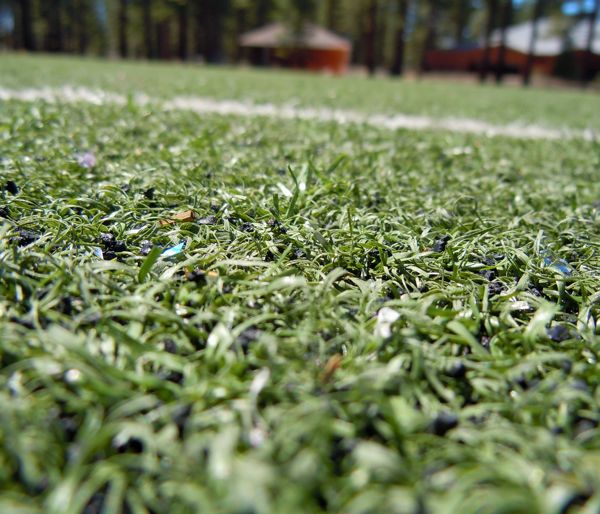
Right after the New Year’s weekend SnowGlobe music festival the toddler enjoyed finding trinkets like piercings and necklaces. Now it’s mostly leftover confetti that she scampers over.

Jessie and her dad, Pete Jorgensen, come out to the community ball fields so the little one can run around. They live on the other side of Al Tahoe Boulevard.

The elder Jorgensen on Sunday points to how the sides of the field are a brighter shade of green than the playing area. After nearly a decade of wear-and-tear, this would be expected. But Jorgensen and others say SnowGlobe substantially added to the fading of the artificial turf.

Bob Aaron, another South Lake Tahoe resident, calls the damage done to the fields by SnowGlobe as “unrepairable” and wants to know who is going to pay for it.

South Lake Tahoe, which owns the field, acknowledges confetti is still embedded in the turf.

“The confetti was the worst. That was an ill-conceived idea,” Stan Sherer, community services director, told Lake Tahoe News. He added that the promoters were told not to use confetti, but did so anyway.

Aaron told Lake Tahoe News the field is riddled with cigarette butts and burns.

On April 22, Lake Tahoe News saw one butt in the field – though not every inch was scoured.

Sherer, who was inspecting the field Monday, said he sees adult soccer players smoking on the field and sidelines all the time.

“The biggest problem from SnowGlobe was the gum,” Sherer said.

A few globs are visible, as are remnants from stickers that got stuck to the artificial grass.

Sherer said a substance would be applied to those spots by hand. Inmates from the nearby jail will be working on the field – so it’s free labor for the city.

The other foreign object Lake Tahoe News found was what looked like a round battery.

The city’s belief is the music festival did not do irreparable harm, nor did it affect the playability of the field. Already the infill has been screened and reraked. It’s time to play ball, according to Sherer.

This field is used nearly every day or night when snow is not covering it.

“The field is aging. It already exceeded its life expectancy,” Sherer said. “The only thing that helps is that it is shaded so much. The UV breaks down that field. And it’s more pronounced at altitude.”

Remnants of stickers are still stuck in the artificial turf at the community ball fields.

The colored specs are confetti from SnowGlobe. Photos/Kathryn Reed

What looks like a camera battery is on the field. The black is part of the field.


Spooner Lake operator ends ski business, moving bikes

By Kathryn Reed

Gliding along the perfectly groomed trails at Spooner Lake is no longer an option – and not because the seasons at Lake Tahoe are changing.

For 27 years, Max Jones has run the cross country ski center as concessionaire for the Nevada Division of State Parks. And for a dozen years he has operated the summer mountain biking operation out of the park that is at the junction of highway 28 and 50. That, too, is leaving the park.

Groomed trails at Spooner Lake may not be available next winter. Photo/LTN

While Jones, who was in the 1986 Olympic trials for cross country ski racing, is giving up the snow side of his business, he is keeping the biking component. After all, he is a two-time national mountain bike champion and in the Mountain Bike Hall of Fame.

“My wife (Patti McMullen) and I have not had a paycheck since October,” Jones told Lake Tahoe News. “This was the winter that never snowed on this side of the lake.”

It was so bad Jan. 1 when the parks department wanted to lead a snowshoe it turned into a walk in hiking boots around Spooner Lake.

The couple is tired of fluctuating winters – the feast or famine way of doing business in the winter at Lake Tahoe.

Their focus, though, will still be split. Now it will be between mountain biking and a café that is slated to open in July.

The cycling business will operate out of Incline Village starting next year on property once home to the Bonanza television set and later theme park-like attraction. Tunnel Creek Café will be open year-round, serving sandwiches, coffee, beer and other items. It will be in the building that sits on the mountain side of Highway 28 that says Tunnel Creek Station.

This biking season Jones’ operation will be the same as it always has been at Spooner – with rentals as well as a shuttle bringing people who are finishing the Flume Trail back to Spooner.

Starting in summer 2013 the shuttle will take people to Spooner, drop them off, and then let them ride the Flume Trail, which will end where the café is.

Rentals will still be part of the mix. The primary focus will be the Flume Trail, then the shuttle on even days up to Tahoe Meadows for riders to pedal on the Tahoe Rim Trail.

Expanding beyond that is possible – maybe even into Genoa.

Jones says he likes how in the last handful of years the mountain bike trails in the basin have improved, in large because of the U.S. Forest Service. He said the expansion of trails is good so riders are spread out.

What happens next winter at Spooner remains to be seen.

“What we want to do is spend some time to evaluate what the public wants us to do up there,” Dave Morrow, administrator of Nevada State Parks, told Lake Tahoe News. “There is certainly a dedicated group of cross country skiers who would like to see the trails groomed. There are others who may like to see additional or other activities.”

Ice fishing and more access to snowshoe trails are options. Parks staff may use a snowmobile as a groomer for cross country skiing next winter until a more permanent solution is settled on.

Morrow said not to expect the level of grooming that Jones did.

The lease between Jones and the state was up, so it was a natural time for a change. Jones didn’t want to pay more, and the state wanted to increase its take.

“The concessionaire at Spooner was more of a convenience to the park visitor than a source of income for the park,” Morrow said.

Surveying users and conducting public workshops will help determine the future of the park and what type of, if any, concessionaire is brought in after the summer season.

Also, state parks in the process of developing a management plan for Lake Tahoe State Park.

For people who want to suggest what should happen post-Jones at Spooner, they should call (775) 684.2770 and ask to speak to the administrative assistance or email dmorrow@parks.nv.gov.


Valhalla annual art-music fest ready to dazzle crowds

By Kathryn Reed

CAMP RICHARDSON – If people didn’t know why it’s called the Great Lawn before Saturday, they did after the cleanup session at the Tahoe Tallac Site.

Bag upon bag of pine needles were filled as volunteers descended upon the South Shore venue to spruce it up before the season kicks off in June.

While the Tahoe Tallac Association has been without an executive director since last August, the volunteer board is committed to keeping the 33-year-old Valhalla Arts and Music Festival alive for decades to come. The board of directors has had some turnover, volunteers are returning, and the dedicated paid staff is hanging on with limited hours.

Tahoe Tallac Association volunteer Jenny Sweatt on April 21 helps clean up the site. Photo/Kathryn Reed

On top of all of that, changes within the local office of the U.S. Forest Service – the landowners – have led to a better working relationship. The feds have even agreed to allow more events on the lawn, and for wedding receptions to filter from the Grand Hall onto the adjacent grass.

A bugaboo between the Forest Service and TTA in the past has been the gate across the driveway just off Highway 89. It limits access to the site. People would have to walk in after parking in the neighboring dirt lot. For some, that just isn’t an option, and for those who didn’t know what was on the other side of the gate, they might not have ventured forward on foot.

“We have been told they are moving the gate,” TTA board President Ginger Nicolay-Davis told Lake Tahoe News.

Even when a show is not going on, artists in residence are working in the small cabins — which are open for the public to see. Plus, the historic buildings are worth visiting in their own right.

By the end of May a USFS sign that has been controversial with the board because it seemed to detract visitors will be coming down, according to Nicolay-Davis.

Fifteen percent of the gross receipts each year per the contract with the USFS is supposed to go back into the site. That hasn’t always happened. But better accounting practices are ensuring it gets done.

Exterior painting will occur before the festival season begins and carpet will be replaced.

Revenue from weddings is expected to be double what it was a year ago.

With cash in the bank, the association will be able to pay someone to take care of the lawn this year instead of board member Dave Hamilton pushing his mower over the grass.

After this season, the board may consider hiring someone to take over more of the heavy lifting.

“We are very hopeful we will be able to hire at a minimum a summer director for the festival The board can’t do this forever,” Nicolay-Davis said. “In a perfect world we want to become a summer theater venue and mix in music and other stuff as part of our mission.”

Three plays will be staged at the Boathouse Theater this summer. “God of Carnage”, a Tony-award winning comedy,  starts the theatrical season on July 5. That is followed by the comedic play “Death by Golf” later in July.

The locals’ favorite “Guilty Pleasures” is returning in August with new, updated material – including a segment on the Ta-hole and revisions to the TRPA skit. Hamilton is the mastermind behind the words and lyrics.

All three plays will be for multiple days, including evening and matinee performances.

Music on the lawn will be one day a month starting in June. (June 17, July 8, Aug. 19 and Sept. 2.) It is geared to locals. A variety of genres will be represented during the free noon-2pm performance.

Plus, there will be several musical acts in the boathouse, though those cost money.

The improv, which has always drawn a crowd, will be one day a month, as well – July 3, Aug. 7, and Sept. 4.

“My thought was to have really good events, but not as many (overall),” Nicolay-Davis said.

For more information about the festival, go online to the revamped website that was launched earlier this month. Here is the Valhalla 2012 schedule. And right now a membership drive is going on, which entitles people to free tickets. For details on membership, click on the ad at the top of Lake Tahoe News’ home page.


S. Tahoe unites residents to improve neighborhoods

By Kathryn Reed

Bear cans and defensible space were the two primary concerns of residents who turned out for a neighborhood meeting this week.

South Lake Tahoe has divided the city limits into six areas, even though there are really 20 distinct neighborhoods. This was the fifth meeting of residents since last fall. Here is the neighborhood map.

The idea is to revitalize the neighborhoods with a little help from the city and the bulk of the effort coming from residents.

“You can tell when folks come to the meetings they are tired, but they have some hope left,” Tracy Franklin, the city’s marketing and outreach coordinator, told Lake Tahoe News after the April 17 Neighborhood Service Team meeting that includes Tahoe Keys, Tahoe Island, Tahoe Valley and Gardner Mountain neighborhoods.

While the areas are large to begin with, the future may call for breaking them into the 20 smaller neighborhoods.

The definition of the teams is, “It is a group of neighbors working together for the good of all, with a common vision, goals and objectives. A Neighborhood Service Team makes decisions on common problems within a community by sharing ideas and solutions.”

Tracy Franklin leads a community neighborhood meeting at Tahoe Valley Elementary School. Photo/Kathryn Reed

At this particular meeting garbage bears, overgrown lots, and graffiti were the major topics by the residents.

Franklin followed up with information for the meeting attendees who provided their email address. It had contact info for the fire department — (530) 542.6162.  That’s who to call regarding defensible space.

And she checked in with South Tahoe Refuse about getting a group deal on the bear-resistant cans that come with a lid that screws shut.

Franklin’s email said, “A marketing campaign could be launched in town to get local residents to sign up for the purchase of their bear can(s). South Tahoe Refuse was contacted regarding this idea and STR does not purchase the containers. It was suggested that local hardware store vendors be contacted to discuss the potential of purchasing bear containers. Currently the bear containers are sold in town for $99 each. It would be ideal to try and reduce the cost to $50-$60 per can. A volunteer is needed to head up this effort.”

Jim Marino, capital improvement manager for the city, spoke about the roadwork in the neighborhood that will start in July. Venice Drive from Tahoe Keys Boulevard to Aloha Drive will be like new by the end of summer. Work on it will be after the bulk of the tourists have come to town, but it could be torn up for a month.

“The roads in this town are simply sitting on native material,” Marino explained.

Fill was brought in by the Dillingham Corp. in the 1960s when the Tahoe Keys was built.

“Traffic in town this year will be a mess,” Marino said. The city, Caltrans and South Tahoe Public Utility District have projects on the books.

The city expects to go out to bid on Tuesday for its road projects, with possible awarding of a bid by the City Council on June 19 and construction starting in July.

In the state streets – to the right of Keys Boulevard when entering off Highway 50 – an asphalt rubber seal will be applied with the intent it will give the roads another eight to 10 years of life.

This neighborhood group, likes others before it, agreed to a neighborhood cleanup day. It will be June 2. Caltrans donates the bags, CalStar donates plastic gloves, the city has a jug of water, residents do the sprucing up. The California Conservation Corps often helps as do various nonprofits. Franklin drives a pickup to haul away the debris.

A Tahoe Keys Property Owners Association employee said all residents are invited to the June 23 Tahoe Keys Garage Sale at the parking lot of the homeowners association as well as the June 25 5:30pm Lawn Care and Water Conservation program at the TKPOA office.

Here is a list of future neighborhood meeting dates.