Beating victim far from out of the woods; no arrests

By Kathryn Reed

“Right now we just hope he does not stop breathing.”

If he does, it means Derek Penaranda will likely have died.

Penaranda’s parents are hoping and praying their son will survive the beating he sustained in a South Lake Tahoe bar last weekend. Today he is clinging to life in a coma at Renown Medical Center in Reno.

Penaranda, who is called Zippy by everyone who knows him, was in town to celebrate his 30th birthday with family and friends. They had rented a place in the Tahoe Keys.

Derek "Zippy" Penaranda and Katie Musselwhite planned to get married one day. Photo/Provided

Before two taxis took the group of friends to Mo’s Place, the gang had spent part of last Saturday kayaking in the canals of the Keys, with some going out to the lake.

Because Penaranda was born on his parents’ anniversary, they have seldom celebrated it – instead deferring to their son. This year was different. Both occasions were being celebrated in Lake Tahoe.

That celebration took a tragic turn when a phone call came in the early hours of May 20 telling Debbie and Wayne Penaranda to get to Barton Memorial Hospital.

What sticks with Wayne Penaranda is overhearing someone in the emergency room say how when his son was turned over on the floor of the bar he was blue.

“At that time I expected the worst possible outcome primarily on what I know about those types of injuries … when you are deprived of oxygen,” Penaranda told Lake Tahoe News.

He said he doesn’t know the particulars that resulted in his son being punched unconscious as well as the owner of the bar, Mo Patel.

No one at Mo’s would talk to Lake Tahoe News on May 25, but said Patel was expected in this weekend.

South Tahoe police are also not releasing details of the fight or the investigation.

What Penaranda said he was told is no one was allowed to approach his son as he laid on the floor of the bar not breathing. It was first responders who got him breathing again.

At Renown a cat scan showed Zippy’s vertebrae and spinal cord were intact, and that his skull was not fractured. But there was swelling and bleeding in the brain.

“He had numerous contusions on his chest and back where he was kicked and stomped,” Penaranda said of his son. “His heart had stopped.”

An EEG showed brain activity.

On Tuesday it was time for an MRI.

“The MRI showed extensive cerebral cortex damage,” Penaranda said.

The Penarandas returned home to Ripon, in the San Joaquin Valley, with only two of their three sons. They are back in Reno this weekend to be with Zippy. Penaranda said it’s been a constant flow of people to the hospital. The people in the small agriculture town have been showing their support for the family, including setting up a Facebook page and arranging for a barbecue to honor Zippy on Sunday. (That will be at noon at Mistlin Sports Park, Ripon.)

Zippy has been living with his longtime girlfriend Katie Musselwhite. The Penarandas expected they’d be married one day and provide them with grandchildren. Zippy works for California Living and Energy in Ceres.

For now, though, his job is to fight for his life.

“Medically, the next phase is for them to stabilize him. Our hope is now he can breath with minimal help from the resuscitation machine and apparatus,” Penaranda said with hope. “As soon as he is healthy enough, then a long-term care facility, then hopefully he regains consciousness and then some form of rehabilitation.”

If Zippy survives this ordeal, it will be a long road to recovery, and perhaps never to the life he knew.

Bryan Stowe, who was 41 when he was attacked in March 2011 at Dodger game, took months to open his eyes. A website providing updates on Stowe, says, “Bottom line and without sugarcoating anything, Bryan is far from the old Bryan and each day is a struggle.”

That beating had 14 detectives on the case in Los Angeles.

South Lake Tahoe Police Department can count its detectives on one hand.

Significant differences, though, are South Tahoe police have the advantage of video (which is not being released to the media) and witnesses.

“We are interviewing everyone who was there, reviewing reports, and doing follow-up interviews as needed,” Lt. David Stevenson told Lake Tahoe News on May 25.

A taser was used that night, but not by officers, Stevenson said. “It went off, but it did not hit anybody,” he said.

As of Friday, no one had been arrested. It’s likely attempted murder charges will be filed against at least one person. If Zippy dies, then manslaughter is the presumptive charge.



Opinion: LTN endorses June 5 ballot measures B and C

El Dorado County voters are being asked on June 5 to approve two measures that would help small businesses.

Measure C is a countywide measure that would alter El Dorado County’s Charter that was approved in 1994. It would allow department heads to approve expenditures of $10,000 or less. As it is now, anyone doing work for the county must have a formal contract no matter what is being done.

Measure B is just for South Lake Tahoe and would change the business license structure by lowering the annual tax for most businesses, while increasing the cap for a handful.

Lake Tahoe News is recommending a yes vote on both measures. They each need 50 percent plus one vote to pass.

Measure C would streamline business in El Dorado County. In turn, this means businesses – many of which are small – would be paid in a more timely fashion. It will also reduce county staff time and paperwork.

All of this makes for a more efficient, effective government operation.

It does not mean oversight has been eliminated. There are checks and balances in place to make sure money is not leaving county bank accounts for purposes other than what was intended. And there are protocols to ensure it was a necessary purchase or the work performed was required.

County Counsel Lou Green wrote the impartial analysis of Measure C for voters. He says, “The purpose of the measure is to simplify the contracting process with service providers who do not traditionally use signed contracts in their business, and who frequently resist the county’s request for a written contract. However, the proposed amendment does not allow for undocumented transactions.”

A similar measure was on the ballot a few years ago that would have allowed expenses up to $15,000 be approved without a contract. That failed 51 percent to 49 percent.

As a comparison, South Lake Tahoe’s city manager is allowed to approve expenses up to $6,000 without council approval and contracts up to $30,000.

Besides Lake Tahoe News, other supporters of Measure C include Supervisor John Knight, Supervisor Ron Briggs, District Attorney Vern Pierson, Sheriff John D’Agostini, Auditor-Controller Joe Harn, and the El Dorado Hills Chamber of Commerce board of directors.

Measure B in a slightly different format was also before voters in recent years and barely failed.

What is different this time around is this will lock in rates for businesses whose gross sales do not increase. As it is today and was on the previous ballot measure that did not pass, the business license tax increased each year based on the consumer price index. The CPI component has been eliminated in Measure B.

Ninety-eight percent of South Lake Tahoe businesses would have a lower tax with the passage of Measure B.

While Lake Tahoe News supports Measure B, there are two flaws. One is the timing. The vote is June 5 and the new rate structure takes effect July 1 – when the annual license is paid to the city. This was poor planning on the city’s part. The increase should have been delayed to 2013 to give businesses the opportunity to work the new rates into their budget.

The other flaw is with not keeping the CPI part of the tax structure. Without having it in there, and assuming Measure B passes, one day the city will be collecting less money than it did in 2011.

Conflicting messages have come out of city hall as to whether Measure B is all about making things more equitable for businesses or if the intent is to bring in a couple hundred thousand dollars more a year.

Lake Tahoe News likes both reasons. We just don’t understand why the CPI component was eliminated and strongly disagree with that decision. But we don’t disagree enough to vote no.

Measure B is for businesses. Yes, the cap goes from about $3,000 a year to $20,000 – but that means those making more money are paying a fairer percentage of their gross income. The measure attempts to level the paying field, so to speak.

South Tahoe Chamber of Commerce has come out against Measure B. Lake Tahoe South Shore Chamber of Commerce is not taking a stance.

Lake Tahoe News says yes to B and C.


Financial pact smooths path for Tahoe to host Olympics

By Susan Wood

With international and U.S. Olympic officials paving the ski trail this week for future bids in the States, organizers of a bi-state coalition to bring the 2022 Games to the Tahoe-Reno region solidified their dedication to the monumental effort.

It’s early, and there’s a lot to do. But great feats don’t happen overnight – and resolution is always within reach to those who go for the gold. The International and U.S. Olympic committees agreeing on a revenue sharing plan in Quebec City after a two-year quagmire may serve as proof to that.

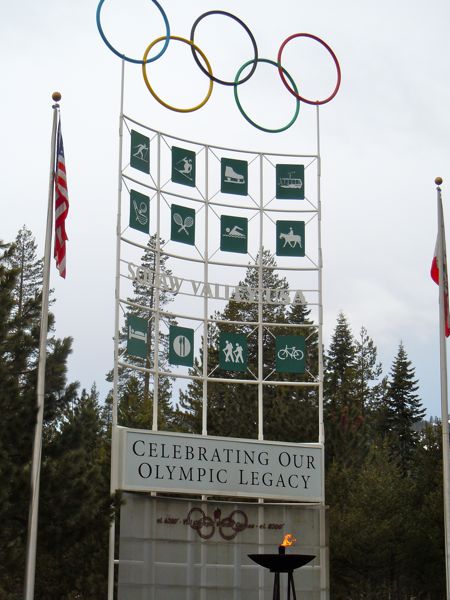
The Olympic flame may be reignited in 2022 in Lake Tahoe. Photo/LTN

The last time the United States hosted the Olympics was 2002 in Salt Lake City and before that 1996 in Atlanta. In the last decade, the nation was perceived to have been snubbed.

The two entities were debating over a 1996 pact in the level of sponsorship revenue and broadcasting rights. The IOC believed the U.S. share was excessive. In the end, the USOC would take a lesser percentage after 2012 and absorb $20 million in Games costs, the Washington Post reported Wednesday.

Further details will be available next week, Lake Tahoe-Reno regional coalition Chief Executive Officer Jon Killoran, who was in Canada for the meetings, told Lake Tahoe News. He deferred comments to Squaw Valley-Alpine Meadows Chief Executive Officer Andy Wirth. Squaw was home to the 1960 Winter Games, an event made possible by the insurmountable persistence and vision of the late Squaw founder Alex Cushing.

Wirth, the interim chairman for the Lake Tahoe Winter Games Exploratory Committee, told Lake Tahoe News “any kind of progress” is a good thing for the ambitious effort.

“It’s a great day for the U.S. Olympic Committee and Olympic movement,” Wirth said.

“On one hand, it’s great news. On the other hand, we have a lot of work to do,” he said. “And regardless of this news, our effort really hasn’t changed.”

The introductory stages for Tahoe-Reno have included filling out a board of up to 25 members. The panel is currently 20 members – full of high-powered talent. Among the members are Nevada Lt. Gov. Brian Krolicki, former Squaw owner-executive Nancy Cushing, Vail Resorts co-President of Mountain Operations Blaise Carrig, Reno Tahoe International Airport chief Krys Bart and Olympian Daron Rahlves, one of the greatest men’s downhill racers of all time.

Now the coalition wants to organize an environmental standards committee to handle some of the biggest concerns surrounding the Reno-Tahoe bid. Denver and Salt Lake City are also vying for the 2022 Games, with Bozeman, Mont., joining the quest.

“This could be the most intriguing part – to have an environmentally sensitive Games,” Wirth proposed.

One board member would lead the to-be-formed environmental committee, which is described by the Squaw head as one of “the most tangible things” the Games coalition has worked on.

The effort to bring the Games back to Tahoe started in 2001 with Reno sports commissioner Jim Vanden Heuvel, who died three years ago. The drive has enlisted the assistance of California Lt. Gov. Gavin Newsom, state Sen. Ted Gaines, R-Roseville, and a San Francisco Bay Area sporting event group.

The USOC could decide to focus its attention on the 2024 Summer Olympic Games. Either way, a layer of tension has been lifted with the May 23 news.

“It’s good if we have an agreement because this has created difficulties in the relations with USOC,” Swiss IOC executive board member Denis Oswald said early Tuesday according to an ESPN report.


Bleak budget news for LTUSD; busing upsets parents

By Kathryn Reed

Saying no to the governor’s tax plan on the November ballot will mean a $1.6 million hit to Lake Tahoe Unified School District.

Because of union contracts layoffs at that point aren’t an option even if the school board wanted to entertain that idea.

What Gov. Jerry Brown has told districts is in addition to cutting the school year by the already allowed five days, 15 more for a total of 20 are allowed to be wiped off the calendar.

Fewer Lake Tahoe Unified school buses will be on the roads in the 2012-13 school year. Photo/LTN file

To make ends meet in the worst case scenario, LTUSD would need to cut the 2012-13 school year by 12 days to absorb the cash flow gap from the state.

“They haven’t give us any other choice,” Superintendent Jim Tarwater told Lake Tahoe News during a break at the May 22 board meeting.

If necessary, that decision would come after the Nov. 6 election when classes are under way.

CFO Deb Yates presented the board and a room full of people the district’s budget update based on what the governor proposed in his May revise last week.

“I’m absolutely flabbergasted people keep holding their positions when they keep missing the numbers,” Yates said of state employees.

The state budget deficit is $15.7 billion, up from $9.2 billion.

She was in Sacramento on Monday with colleagues getting briefed on what the governor and Legislature intend to do when it comes to funding K-12.

“There is a lot of confusion in how the numbers are rolled out. They are not funding us,” Yates said.

Now on the table is the “weighted student formula” which creates four categories of funding based on grade level instead of the current scenario where districts are given the same amount of money for each student.

“I don’t know how they think it costs less to educate K-6 than others,” Yates said.

The categories are K-3 ($5,466 per average daily attendance), 4-6 ($4,934), 7-8 ($5,081), and 9-12 ($5,887).

She said based on that formula, LTUSD would lose an additional $200,000.

What brought the masses out Tuesday night was the threat to transportation. Nine people – parents, students, drivers – spoke about the need to ensure students are safe and that the environment is a consideration if more cars were put on the streets.

Parent Alice Jones said with not having all of the Plan C transportation documents on the district’s website, it created a lack of transparency. The deleted bus stop document was not available until the morning of the meeting, thus not giving people ample time to review it. She asked for the board to table the vote until the public had time to go over the ideas.

The board didn’t seem to care about transparency based on the fact not one of them made reference to when the plan was available to the public.

At the end of public comment, board President Wendy David said, “We have no intention of not getting your child to school safely on a bus, but we have a fiduciary responsibility to keep the schools open.”

Plan C (A and B were presented at the May 1 meeting) calls for eliminating 39 bus stops compared to 86 in other scenarios. Two buses instead of one would be used to get Bijou students home. Gone would be the potential for a 75-minute ride, and instead it would be closer to 50 minutes.

The long walks to bus stops are mostly eliminated. Stops in the Tahoe Keys, Al Tahoe and Sierra Tract neighborhoods have been restored.

It is likely to be more crowded on buses because routes have been eliminated.

The district now runs 12 full-size buses that can seat 84 and four smaller buses with a capacity of 20. The smaller buses are used for special education students. Starting in the fall there will bet 10 full size buses and two smaller ones.

The board requested the transportation department give another presentation after the first month of school to report on how the changes are working.

In other action:

• Board member Sue Novasel asked for a future agenda be targeted to discussing school district owned ball fields and how Title IX may be related to them.


S. Tahoe skydiver dies landing in Lake Tahoe, 2 survive

Updated: May 22, 2012, 3:25pm

By Kathryn Reed

CAMP RICHARDSON — One skydiver is dead and two others survived their jump near Camp Richardson on Tuesday morning.

Robert Ranieri, 29, of South Lake Tahoe was found in 12 to 15 feet of water by El Dorado County sheriff’s divers.

Lt. Pete Van Arnum said Ranieri used to be a search and rescue volunteer for his department.

The coroner is likely to perform an autopsy Wednesday. The FAA will be part of the investigation.

The plan was for the three to jump from the helicopter that had taken off from Lake Tahoe Airport and land on Pope Beach like they had done last week. Instead, two of the jumpers landed in the icy waters of Lake Tahoe, while the third landed on the sand.

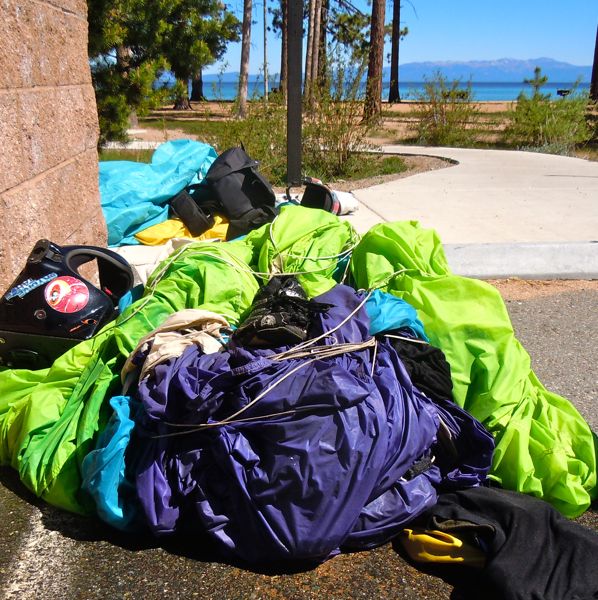
Helmets, parachutes and other gear from the skydivers. Photos/Kathryn Reed

According to the National Weather Service in Reno, the wind speed at the airport at 8:53am was 17 mph, with gusts of 24 mph. The accident occurred moments earlier.

Van Arnum said sky diving is rare in the Lake Tahoe Basin.

“There are not that many good landing areas in the basin because you don’t want to land in the water or in the trees,” Van Arnum told Lake Tahoe News. “These guys chartered a helicopter ride from airport. Supposedly they were experienced.”

Chris McKean, who owns a barge that is docked at Camp Rich, said he and some of his crew at about 8:45am raced to the jumpers who were in the water. He said the man they pulled to safety was about 250 yards from shore and about three-quarters of a mile down Pope Beach.

McKean said the person was treading water without a life jacket and yelling for help.

“He was shivering and cold and worried,” McKean said.

Hypothermia can set in quickly and people cannot survive for long in Lake Tahoe because of the temperature. The water temperature last week at Camp Rich tested at a depth of 10 feet was 48 degrees, while the surface temp at Timber Cove was 52 degrees.

“We went for the other guy. We found his chute and helmet floating, but not him,” McKean told Lake Tahoe News.

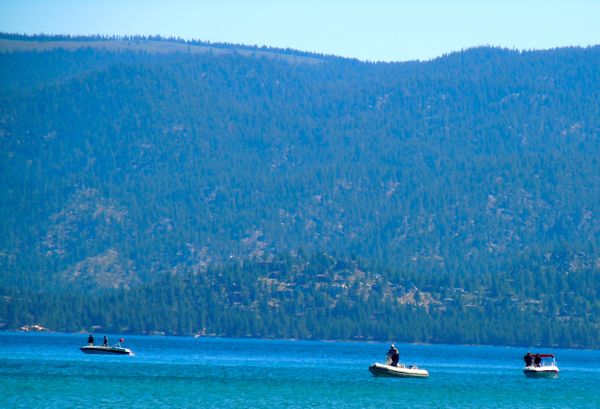
At 10:42am a yell from one of the searchers on one of the nearly dozen vessels helping with locating the missing parachutist could be heard on Pope Beach. The victim’s body had been found several hundred yards off shore.

Law enforcement and private boaters had been using a grid system to locate the victim. A CalStar helicopter had helped early on, with a CHP and Coast Guard chopper called off once the body was located.

The surviving skydivers and their friends waited out the search at Pope Beach, but declined to speak with Lake Tahoe News. Gear from two of the parachutists was in a heap at the edge of the beach parking lot.

“I don’t mean to be rude, but I have no comments at this time,” Claudio Belloto, who runs the helicopter tour operation out of Lake Tahoe Airport wrote in an email to Lake Tahoe News.

About 12 boats, some private, help locate the skydiving victim on May 22.


It was a long wait for friends at Pope Beach.


Ball field advocates take convoluted approach to decision-making

By Kathryn Reed

Recommendations for how to spend $500,000 to improve ball fields on the California side of the South Shore are expected to be discussed in July by the board that oversees recreation Measure R.

However, the committee that is tasked with coming up with the ideas in its last two meetings did not cover everything on its agenda, so a special meeting may need to be called for the seven to complete their job.

At this pace, no improvements will be made to South Tahoe ball fields this season. Photo/LTN file

About half of the May 21 meeting was devoted to discussing whether Assembly Bill 2404 is relevant. The committee said yes, though, no vote was taken.

South Lake Tahoe City Attorney Patrick Enright told them the California law is relevant.

“The statute doesn’t make a distinction of whose land it is, but how it’s used,” Enright said.

Entities have until 2015 to come into compliance.

But committee members also said it’s not up to them to determine if their recommendations comply with this California law that requires boys’ and girls’ athletic facilities be of equal quality.

Committee member Ken Riegal wondered if the money had to go to ball fields so then the whole boy-girl equity issued could be avoided.

“You are always going to have to deal with AB2404,” Enright informed the committee.

Chuck Leonard, who chairs the committee, said, “We are so bogged down with the male-female issue, we are not getting anything done.”

But that boy-girl, man-woman thing is relevant. They could be wasting their time, the public’s and potentially the South Lake Tahoe Recreation Facilities Joint Powers Authority board’s if they come up with ideas that cannot be implemented because of AB2404.

What the committee has not gotten is a legal opinion about whether inequity exists today based on the condition of the fields or even what the ruling would be when the girls’ varsity softball field is completed at South Tahoe High School.

If the area were deemed to be out of compliance, then an assessment of what needs to be done to right the wrong would be necessary.

If they are in compliance, then what’s needed is to know what would tip the scale either way to ensure improvements don’t inadvertently render the area out of compliance.

Instead of pursuing this course of action, the committee went over a wish list. A list that was not completed before the meeting was adjourned just after 6pm – after two hours of dialog.

Hal Cole, who is South Lake Tahoe City Council’s rep to the JPA board, was at the meeting. He told Lake Tahoe News the committee should figure out if it makes more sense to spend the bulk of the money on one substantive upgrade or parcel it out in nickels and dimes.

Brett Long, a local landscape architect who designed South Tahoe High School’s football field and the track-field at South Tahoe Middle School, spoke early about how the committee needs to have designs before a cost estimate can be relevant. He has contacted JPA staff member John Upton and board member Norma Santiago about providing some designs for free.

Steve Knoll, who is in the same profession as Long and is on the fields committee, bristled at this. At the meeting he told everyone the reason he joined the committee is because he has expertise in field design.

“The cost to do public works projects is staggering,” Steve Morales, facilities director for Lake Tahoe Unified School District said. “I doubt any of the facilities are ADA compliant except for the South Tahoe Middle School and the college field.”

Field improvements could trigger the need to bring dugouts, bleachers and restrooms into compliance for the disabled.

Besides Cole, the other elected official in attendance was LTUSD board member Sue Novasel. The school district is at the table because most of the fields are on land it owns. The city maintains most of the fields.

However, it was pointed out Monday that the last use agreement between the district and city expired about a dozen years ago.

If the committee were to pay for city staff time, the half million dollars might be spent before the JPA board ever had to weigh-in. At Monday’s meeting Enright was there most of the time, the assistant city attorney popped in, the paid legal intern was in attendance most of the time, the parks supervisor was at the table the whole meeting, and his boss was there much of the time. From Lake Tahoe Unified School District, Morales was the lone paid staff member sitting for two hours.

Upton does get paid. That’s out of the Measure R money.

———

The next ball fields committee meeting is June 25, 4-6pm in the downstairs conference room at Lake Tahoe Airport.


O’Rourke presses to upgrade S. Tahoe’s infrastructure

By Kathryn Reed

On June 5, the South Lake Tahoe City Council is slated to have a workshop on the capital improvement program, or the infrastructure of the city.

At the June 19 meeting, the council is expected to approve the certificate of participation that is basically a $5 million loan. That money is slated for roads, Harrison Avenue upgrades and revamping Linear Park. (This will be City Manager Tony O’Rourke’s last meeting before beginning a job in Washington.)

Infrastructure improvements will begin before the COP money is in hand.

“We don’t have to wait for the COP. We will reimburse the general fund,” O’Rourke told Lake Tahoe News.

In other words, O’Rourke is OK’ing the city to take money from one fund to be used in other, without a definite guarantee fund No. 1 will be repaid. O’Rourke is literally banking on the assumption the council still favors the COP process. Because it’s not a tax, residents don’t have to vote on it – though it will be taxpayer money that pays back the loan.

At a meeting in July 2011, Councilman Tom Davis said, “The interest is $32 million over a 30-year period so really it’s $10 million a year. (The COP) just doubled the cost.”

O’Rourke at the May 15 council meeting went over the five-year budget scenario in a big picture scenario without getting into the nitty-gritty.

As with most financial documents, it’s not stagnant and it’s built on presumptions that don’t always come true.

For instance, transient occupancy tax collections in March were 8.2 percent less than the previous fiscal year at the same time. This meant the city needed to make a $600,000, or 6 percent mid-year adjustment to the budget.

O’Rourke told the council it should cut the 25 percent operating reserve to 20 percent. The money in the fund now equates to 35 percent of the general fund. He said that excess, so to speak, should go to capital improvements over several years. This would include purchasing fire trucks.

Adjusting the reserve would need to be brought back to the council and four of the five need to approve it.

What wasn’t discussed at the meeting this month was merging resources with Lake Valley Fire Protection District.

While the city in March appeared hot to get to the negotiating table, no meetings between the departments have ever occurred.

O’Rourke told Lake Tahoe News the city is doing an analysis of what is appropriate.

He said, “We’re of the mindset of let’s date before we get married.”

O’Rourke added that consolidation is not off the table, but more research needs to be done before that would occur.

He also said going forward the budget has Brian Uhler remaining as police and fire chief.

When it comes to what happens at Harrison Avenue, that could be decided today as city staff meets with business owners.

“We want to see it improved, but if there is any delay by property owners or no interest, we can move the money elsewhere,” O’Rourke said. “There is no lack of needs.”

An item that could come with a price tag of close to $500,000 is upgrading the finance department’s software and hardware. However, the idea is it will create efficiency in the department, and therefore throughout the city. An RFP has been released.

A stream of revenue could be collecting more hotel tax. A request for proposal was released May 14 seeking firms that could primarily go after delinquent or non-existent taxpayers.


Consensus on TRPA Regional Plan elusive at this point

By Kathryn Reed

Sides are clearly being drawn as the clock ticks on the comment period on the environmental impact statement for the Tahoe Regional Planning Agency’s Regional Plan update.

TRPA Executive Director Joanne Marchetta is making the rounds pitching her agency’s views that are contained in preferred alternative 3.

Meetings are scheduled to gain input and disseminate info.

The future of Lake Tahoe is likely to be determined by TRPA's Regional Plan update. Photo/LTN file

Conservation groups are sending out info saying why they believe the plan is flawed.

While most of those groups – with the League to Save Lake Tahoe being the largest – have been at the table as the process has been going along, they are not happy their entire proposal was not considered as one of the alternatives. Instead, alternative 2 is what TRPA calls the conservationists’ alternative.

“We provided a 256-page Conservation Alternative to the TRPA. That alternative was discussed with the staff over a number of months,” Laurel Ames, with the Tahoe Area Sierra Club, told Lake Tahoe News at the April 26 TRPA meeting. “We were shocked to find our alternative eviscerated and allegedly replicated as current alternative No. 2. The EIS analysis of alternative No. 2 does not reflect our alternative.”

At that meeting, representatives of conservation groups lobbied for a 90-day comment period, but the Governing Board chose 60. The reasoning by the groups was the volume of material that needed to be read would be time consuming. The board’s reasoning was to meet the goal of voting on the measure in December, the shorter time period was ideal.

Friends of the West Shore on May 17 in an email newsletter said, “The TRPA has provided stakeholders with only a 60-day period to comment on these documents. FOWS wants to inform you that we are reviewing these documents with technical consultants and will keep you abreast of each new development.”

However, that group and others have already sent a letter to TRPA outlining concerns. Lake Tahoe News was sent a copy of this letter on Mother’s Day weekend by neither a member of TRPA nor one of the groups.

So, despite needing time – the groups obviously have enough knowledge to know what they don’t like and to voice their concerns.

That letter in part says, “It appears to us that the agency is reversing many of the crucial regulations mandated by the Tahoe Regional Compact. We urge the TRPA Board to exercise prudence and do everything in its power to uphold, achieve, and maintain the environmental thresholds it is charged to enforce.

“It is our belief and concern that the proposed Regional Plan will neither restore nor protect the lake. Instead, it will open the floodgate one more time to rampant growth and high-density urbanization, thereby making more thresholds impossible to attain.”

The letter is signed by Laurel Ames – Tahoe Area Sierra Club, Darcie Goodman-Collins – League to Save Lake Tahoe, Susan Gearhart – Friends of the West Shore, David Hornbeck – Sierra Club-Toiyabe Chapter, Ann Nichols – North Tahoe Preservation Alliance, Scot Rutledge – Nevada Conservation League, Jerry Wotel – North Tahoe Citizens Action Alliance, Roger Patching – Friends of Lake Tahoe, and Ellie Waller – Tahoe Vista resident.

Marchetta, while speaking to Soroptimist International South Lake Tahoe on May 16, told the members to do their own research because a lot of misinformation is floating about.

She said TRPA’s goal to regulate growth worked so well that it has had the adverse affect of stagnating progress.

“The environment, economy and communities are inextricably linked. We are pursuing that goal through our Regional Plan update. Responsible environmentalism has to look at the whole system,” Marchetta said.

In the Friends of the West Shore newsletter, it states, “Preliminarily, FOWS is concerned that the RPU as currently written does not adequately protect the lake, and contains fundamental weaknesses that could prove to be the plan’s undoing. … There is simply no way the TRPA can comply with its central mandate of achieving and maintaining environmental thresholds on the one hand and facilitating upland urbanization and unsustainable development on the other.”

Alarm bells are being raised about the prospect of increasing how tall a building can be and the density of development.

Marchetta at the Soroptimist meeting said, “We are proposing modest changes or additional height and density in 1 percent of the land area. We are not proposing to grow the basin; we are proposing to fix it.”

—–

Dates to know:

• May 21, 5-8pm: Open house on the Regional Transportation Plan and Regional Plan, The Chateau, 955 Fairway Blvd., Incline Village

• May 22, 5-8pm: Open house on the Regional Transportation Plan and Regional Plan, TRPA office, 128 Market St., Stateline.

• May 23, 9:30am: TRPA Governing Board meeting public hearings, North Tahoe Events Center, 8318 North Lake Blvd., Kings Beach.

• May 24, 9:30am: TRPA Governing Board meeting public hearings, TRPA office, 128 Market St., Stateline.

• June 11, 9:30am: Advisory Planning Commission public hearings, TRPA office, 128 Market St., Stateline.

• June 27, 9:30am: TRPA Governing Board public hearings, North Tahoe Events Center, 8318 North Lake Blvd., Kings Beach.

• June 28, 9:30am: TRPA Governing Board public hearings, TRPA office, 128 Market St., Stateline.

———-

Other vital info:

The public comment period runs through June 28 for the environmental impact statements for the draft Regional Plan update and Regional Transportation Plan. Send comments to regionalplancomments@trpa.org or to mobility2035comments@trpa.org for the Regional Transportation Plan.

All of the documents are on the TRPA website.


Heavenly proposing changes for summer, winter guests

By Kathryn Reed

Riding four-wheelers on what are normally ski runs, more trails to hike on, an outdoor events center – those are just some of the offerings Heavenly Mountain Resort wants to provide guests in the coming years.

The U.S. Forest Service is taking comments until mid-June on the resort’s proposed plans.

“A lot of the hiking is just on the roads, which is not the best. We think this will be a big improvement,” Matt Dickinson with Lake Tahoe Basin Management Unit told Lake Tahoe News.

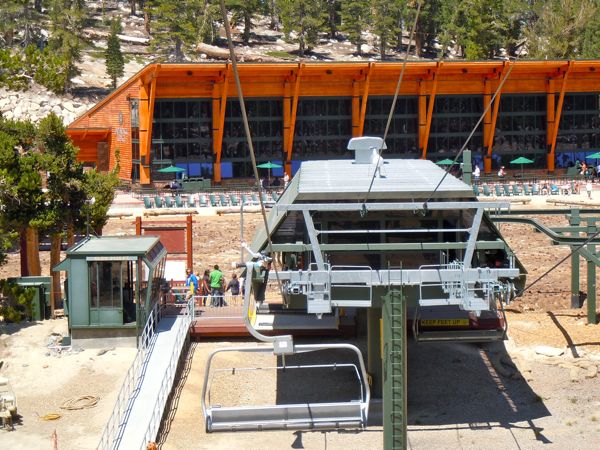
Heavenly may put in a hiking trail that would eliminate the need to use Tamarack chairlift in the summer. Photo/LTN file

He is overseeing the application process. The Forest Service, as owner of most of the land Heavenly operates on, must make sure proposals fit into the already approved master plan and that the public has time to voice its opinions.

The hiking trail that would go from the base of the Tamarack chairlift to the top where it would intersect with other routes has been in the master plan for years.

Exact alignment of the trail will be determined by Heavenly and Forest Service officials working in cooperation by surveying the land together.

Dickinson also said his agency will walk the route where Heavenly wants to install a surface tow lift so people can better access Player’s Terrain Park on Upper Powderbowl run. This would keep skiers-boarders in the park without having to take a chairlift.

To do this means taking out about 60 trees, six of which are more than 24 inches in diameter.

“The Jeep tours will start from the Tamarack Lodge or the top of the lift and go on to the top of Sky chair and possibly down and continue a loop back to the gondola,” Dickinson said.

With the passage in 2011 by Congress of an act that encourages more recreation on Forest Service land in the summer, this allows local land managers to approve more activities that had previously been frowned upon.

“More people visit Tahoe in the summer than the winter. We want to provide a more robust experience, have more attractions up there,” Heavenly spokesman Russ Pecoraro said of the top of the gondola area.

He also said not to expect any of the changes for summer recreation to come this season.

Pecoraro told Lake Tahoe News the timing of the Forest Service decision along with when corporate offices determine the capital improvement budget will dictate what is put in the ground this summer. Plus, the short construction season will also play a role.

Concerts at the Tamarack Lodge are being talked about for the future.

A summer pass for the gondola is $59. Still to be determined is if that will include a ride up Tamarack chairlift.

It’s likely the tubing hill for the summer – which operates on a synthetic turf-like surface – will have two lanes instead of one like last summer. Just enough snow still exists that the hill will not be open Memorial Day weekend when the gondola starts spinning again. And there’s not enough snow to tube on.

The gondola will be open next weekend from 10am-4pm each day and then everyday from 10am-5pm starting June 8 and until just past Labor Day.

—-

Info: For more information on the proposal or how to comment, contact Matt Dickinson at (530) 543.2769 or go online.


1,188 — South Lake Tahoe sets a Guinness cycling record

By Kathryn Reed

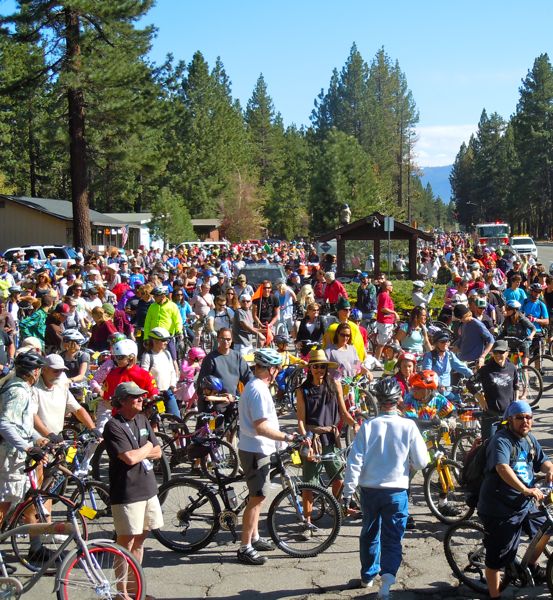
South Lake Tahoe is headed for the Guinness Book of World Records because 1,188 bicyclists rode in a single file on Thursday afternoon.

This broke the record of 916 cyclists who did the same thing in Davis.

More than 1,000 cyclists wait to be counted May 17 as they set a world record for the most number of riders in a single file. Photos/Kathryn Reed

Paperwork needs to be reviewed by the Guinness folks, along with the video of the riders, so it’s not official until organizers hear back from London.

“It was way more thank I expected,” Mark Cutright told Lake Tahoe News as he watched the cyclists roll through the official counting station near the senior center.

He said about 1,200 tags were printed out that were attached to handlebars. To be counted, a cyclist had to ride through the counting station. Kids in carriers were not counted – just the adult doing the work. Nor were the dogs in carriers and baskets counted.

The Slow Rollers bicycle group put on the event. Cutright credits Steve Barker for coming up with the idea. The city participated by giving a police, fire and ambulance escort. Cutright did the legwork of getting the permits to allow for a lane of traffic to be dedicated to the cyclists from the Y to the senior center parking lot.

Joanne King of South Lake Tahoe was riding through when the record was broken, while it was Jeremy Jensen who was the last rider.

When the fire truck sounded its horn at 4:20pm May 17, the cyclists gathered in the soon to be T.J. Maxx parking lot whooped it up.

Bob Harms with his 18 horns – one even from Brazil – and four dingers had already been adding to the festivities before any pedaling began.

Besides being an event to set a record, it was a costume parade. It was a bit remarkable the footwear people could pedal in – from sandals to cowboy boots to heels.

Goofy hats and helmets that were decorated filled the mass. Full costume suits from bears to Tigger to a bumblebee were on two wheels.

However, some bikes came with three wheels, and at least one was a unicycle. With all the shapes and sizes of bikes, it was a bit like a museum. Bill Yale was on a Coker from the early 1970s.

It was a slow ride – living up to the organizer’s name – as it took about an hour for the first cyclist to reach MontBleu.

ngg_shortcode_0_placeholder  (Click on photos to enlarge.)