Search and rescue training turns into recovery of kayaker
By Linda Fine Conaboy
MEYERS — Search and rescue volunteers know when they sign up for the job no two days will be the same, a generalization they discovered to be tragically true on Saturday during what was supposed to be a routine training exercise.
The SAR training cadre, consisting of Marcel Rowley, Terry Carroll, Nathan Smith, Chris Stanton, Bruce Donley, Sten Seeman, Charlie Powers, Brian Tupper, John Nugent, Mike Mullens, Matt Massie and Sienna Smith under the leadership of Scott Gabler and Deputy Greg Almos had finished a water rescue training class on the Upper Truckee River and had just arrived at Camp Richardson to complete their smooth water maneuvers.
According to Almos, suddenly a 911 call went out and the SAR team-in-training made their way to the vicinity of the Valhalla pier where a male had jumped off of a kayak and attempted to swim to shore.
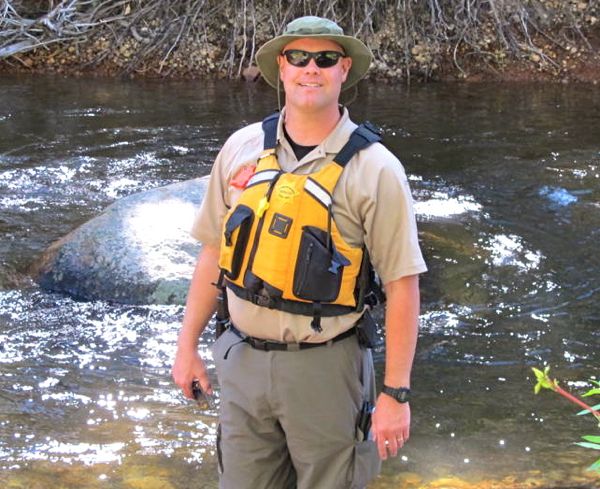
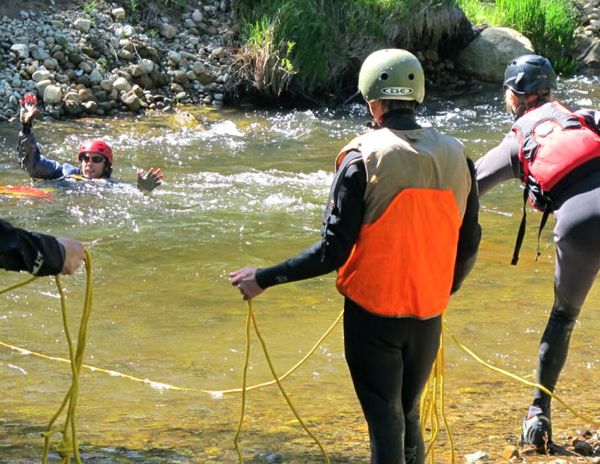
El Dorado County search and rescue volunteers on June 2 train in the Upper Truckee River. Photos/Linda Fine Conaboy
“We had two boats in the water,” Almos, who leads the El Dorado County Sheriff’s Department SAR unit, told Lake Tahoe News. “The SAR volunteers ran to help and with the assistance of Camp Richardson employees, immediately pulled the victim out of the lake and started CPR.”
Almos said the SAR team continued administering CPR even after the medics arrived to start their advanced care procedures. According to Almos, rescuers were able to detect a pulse after performing CPR, but the Bay Area man died the evening of June 2.
The 31-year-old from Antioch has not been identified pending notification of family.
Almos, who is also in charge of the Office of Emergency Services as well as the boating program, said more adults than kids are rescued by the SAR team, mainly because adults are more daring and kids tend to be supervised, a fact that proved true on Saturday.
He said lake rescues happen fairly frequently, but not often in the rivers. “If someone is in distress in swift water, it’s tubists and sometimes it’s kayakers,” he said of river rescues. “This is a mild year because the water [in the rivers] isn’t so high.”
Saturday’s training class started on the Upper Truckee River where it flows through Meyers and passes the banks of the old Sierra Pines Campground. It is designed to give awareness and beginning insight into various types of water — standing or flowing waters, Almos explained.
“People need to understand that cold water can be very dangerous.” — El Dorado County sheriff’s Deputy Greg Almos
During a moving water rescue, ideally, there will be two people downstream to snag a victim who may have slipped by the upstream team. Rescuers communicate by a series of whistles; one blast is an attention getter; two blasts notifies people something is coming and to look upstream; three short sounds means something is happening downstream and three long blasts indicates an emergency, or that a rescue is in progress.
Almos cautioned that it’s important to do what you can do to rescue someone while you’re onshore rather than wading into the water — especially if you’re alone.
“You could attempt to use a throw bag (an inflatable attached to the end of a rope). Going in after somebody has to be well thought out. You need a support team for that,” he said. “Do what you can do from shore.”
The 11 people involved in Saturday’s rescue are all volunteers, ranging in age from 18 to 50 and are part of a larger group totaling 35 within the Lake Tahoe Basin in El Dorado County. There are about 100 volunteers located on the West Slope. They all have pagers and are on call 24/7.
“We run anywhere from 50 to 70 calls annually,” Almos said. “Although most calls are for backcountry rescue, all of the rescues are performed by the team.”
He added that the Placerville team handles between 20 to 40 calls each year.
“People need to understand that cold water can be very dangerous. Plan your recreation. Don’t be impulsive. Always have people with you and always have a life jacket if there is a chance you could be submerged. It’s all about safety and avoiding a problem,” Almos said.
——-
Notes:
• The 2012 National Search and Rescue Conference is June 4-6 at Harvey’s in Stateline. The conference is a combined presentation by the Mountain Rescue Association and the National Association for Search and Rescue and features various exhibitors, speakers and workshops.
• The third annual El Dorado County Search and Rescue Appreciation Day is June 20 at Riva Grill in South Lake Tahoe from 5-9pm. More information is on the flyer.
A job to do as community burns, friends lives unravel
By Susan Wood
When the Lake Tahoe sky turned orange and black over the North Upper Truckee area five years ago, our land of blue was changed forever.
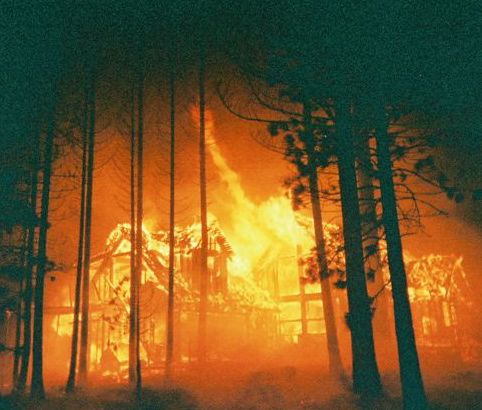
June 24, 2007, started out like any other late-spring Sunday. People were out and about. Some ventured out of town to get an early taste of summer. Of course I remember thinking it was breezy on the South Shore. So when the call later known as the Angora Fire came over the police scanner at 2:14pm, I soon learned what wind mixed with an unattended campfire could do as it rolled over slash piles, trees, brush and hundreds of homes.
Angora Fire -- 5 years later
As the reporter on duty, I threw on the fire suit in the Tahoe Daily Tribune’s newsroom and headed down Highway 50 toward the Y and onto Lake Tahoe Boulevard. The huge plume of smoke told me this was no ordinary fire. It was indeed unprecedented.
In my many years of being a news reporter, including at large papers, I’ve responded to several fires. Nonetheless, being first on the scene brings a lot of responsibility. My truck raced by Sawmill Pond, beating a police barricade erected later. I parked east of the much-destroyed Mule Deer Circle after turning my truck around for a quick escape between Clear View Drive and Coyote Ridge Circle. Embers were blowing everywhere, and houses erupted in flames around me as I walked up Lake Tahoe Boulevard to North Upper Truckee Road — a neighborhood known for its permanent residents. My heart sank.
Homeowners were desperately throwing belongings in their vehicles. People were screaming, and others were running east. I peeked through the houses at what appeared to be a wall of fire mowing down everything in its path. Hot and determined, the fire crackled, groaned an eerie sound and filled the air with smoke.
Stopping to call in updates to the newsroom made it challenging. For one, a microscopic ember curled its way around my safety goggles, burning my left eye. With my good right eye, I saw small fires starting around my truck. As I contemplated leaving, the person I wanted to see most drove up in a U.S. Forest Service truck. It was Kit Bailey, Lake Tahoe Basin Management Unit fire management officer. Bailey is often serious, but the steadfast concerned expression across his face said it all. The fire was in control and taking many homes on its path as it headed over Tahoe Mountain Road and Gardner Mountain.
I needed to get in front of the fire so I drove back down to Sawmill Road where an El Dorado County sheriff’s deputy was holding back a resident wanting to get her cat out of the house and was willing to risk arrest to do so. I felt bad. So many brave stories of neighbors rescuing trapped animals were told later. Some pets didn’t make it.
My thought at the time was: What if the fire rolled over Tahoe Mountain and the Angora Ridge to the Fallen Leaf Lake community? Getting out of there would be a nightmare.
I picked up Sierra Nevada Media Group photographer Kat Allison, whose bravado is larger than her logic. I decided to drive back to Highway 89 and go up Fallen Leaf Lake Road, where another deputy stopped my progress before reaching Tahoe Mountain Road. We turned around, parked and scampered up the ridge in our hiking boots in time to see an army of firefighters from an onslaught of agencies awaiting its fierce arrival. Fire burns faster up hill, and this one was extremely hot as it roared over boulders and houses. Part of the fire had already arrived, consuming at least one Uplands Way house in my peripheral vision.
Upon my return to my office, my heart poured out again. Many homeowners were already emailing me to see if I knew whether their houses were standing. Even my fellow writer, then Sports Editor Steve Yingling, saw me open a topographical map and asked about his home on Boulder Mountain Road. I didn’t want to jump to conclusions, but my anxiety rose because I knew the path mowed through that area. And by that time, it was hot and unrelenting.
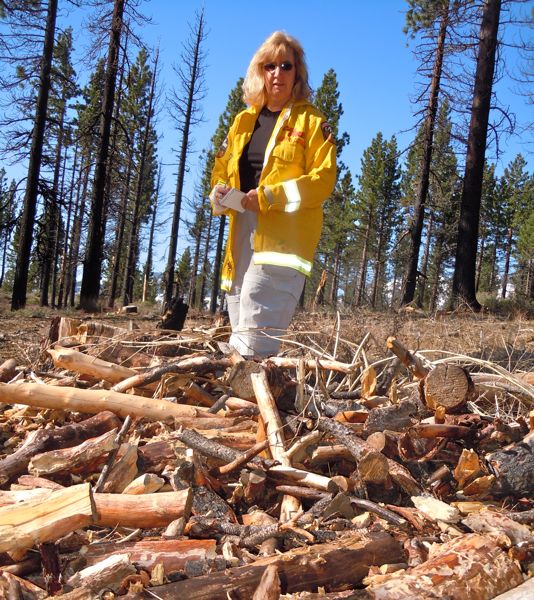
Susan Wood was the first reporter on the scene of the Angora Fire on June 24, 2007. Photo/LTN
My colleague lost his home, but found his black cat, which returned days later to the burned-out fireplace hearth.
Randy Peshon, Norma Sprague, Keith Cooney, Solange Schwalbe, John and Louise Simon — so many stories like these with names we know were shared for days, weeks, months and years after the Angora Fire, which consumed 254 homes, caused more than $160 million in damage and consequently prompted swift changes to stringent environmental regulations and cooperative emergency communication systems. (No local radio reports came over the airwaves, and calls from Lake Tahoe Golf Course were quickly dismissed by the California Highway Patrol dispatch center in Truckee as a “control burn”.)
The hope is we’ve learned a lot from the experience. (Hence, a first-of-its-kind study examining the communication, prevention and recovery of wildfires is being drafted by the University of Colorado. Read about it June 17 as this writer took part in the study’s questionnaire.)
The aftermath resembled ‘the last days’
After a near sleepless, emotionally draining night, I returned Monday morning to what seemed like the scene of a crime. As I drove up Lake Tahoe Boulevard to North Upper Truckee, power lines were down. Ash filled the air and blanketed the ground. A few people were out sifting through debris. So many sites were simply marked by a fireplace or burned out vehicle. I talked to homeowners, but felt as though I wanted to back off and just take it all in. The scene was nothing short of devastating. The neighborhood was gone.
How would we recover? Would the fire take more with it as it mowed through Gardner Mountain and threatened South Tahoe High School structures before making its way down to Highway 89?
Placing priority on home
Tuesday was marked as yet another day of picking up the pieces of our community and writing about it. I was emotionally drawn to the point of the fire’s origin and arranged a special visit with the Forest Service’s law enforcement team. I stood motionless and quiet at the illegal fire site near Seneca Pond – a favorite party spot for teens — with utter amazement as I was told how the fire from Saturday night had sparked up and was carried in the wind the next day. My thought was: Whoever did this would have to live with themselves and could they?
That afternoon I was tested as the scanner in the busy newsroom erupted again. A backfire jumped Highway 89 and landed in the West Way area. I gulped to think of the inadequate Lukins Water system serving that area. Evacuations in a heavily populated area leading into Tahoe Keys were under way. I had to get home to evacuate. I live outside the Keys.
Getting home was much of the adventure that afternoon as motorists found plenty of curbs, fences and easements to roll over in their haste. Tahoe Keys Boulevard resembled a parking lot as yet another round of panicked residents felt displaced. Surely, an emergency evacuation plan was in order for an area I later learned was deemed in the red as an extreme fire hazard, according to the California fire marshal’s office. (To this day, there is no designated evacuation route for the South Shore. It depends on the emergency.)
You know what people ask: What would you take if you had to evacuate in a matter of minutes? The answer for me was clear: Things I couldn’t replace. Bailey, our black Labrador, went into my truck camper bed first. She was later surrounded by documents, photo albums and even the Olympic torch that I carried on Sierra Boulevard in 2002. I threw in camping gear to be mobile. But which bicycle was a more perplexing question.
There’s indeed a psychological benefit to watering down your house, fence and trees with a garden hose waiting for a fire to arrive, but that’s about it. You can bet a fire of this magnitude would dry out whatever I doused as it forced me out, and I knew this.
I remember being ever so thankful that my neighbor John Poell is a very skilled firefighter with Lake Valley Fire. He fought it at the highway before that danger was diminished.
Frayed nerves — that’s how I would describe my community’s initial reaction in the first few weeks of the most significant disaster on the South Shore of Lake Tahoe. After the fire was mopped up, community meetings showed angst, anger and concern.
Still, even in the face of trying to find those responsible, working through insurance plans, dealing with survivor’s guilt, clearing debris and avoiding unscrupulous contractors, the community pulled together with donations, moral support and even a bistate Blue Ribbon Commission headed by then Republican California and Nevada Govs. Arnold Schwarzenegger and Jim Gibbons tasked with making constructive changes to handling fire fuel reductions in the basin.
As part of a small effort to clear our hearts and minds, a makeshift parade was organized to celebrate the living spirit of our town.
For me, the catharsis of the disaster was encapsulated by a visit down Coyote Ridge with Tribune colleague John Simon and his wife, Louise, a longtime teacher with Lake Tahoe Unified School District.
I drove the two of them beyond the police barricade days after the fire, so they could see their home. As they surveyed the wreckage of their completely destroyed home, they found solace in little items and minor things that survived. I’d never see John cry. But in such a brave, cleansing act, he felt OK to embrace Louise in front of me and sob like a baby. I wrapped my arms around both of them, and tears came streaming down my face. They were looking for her wedding ring (which later was miraculously found).
I wished my tears could have drowned this fire. I sobbed thinking of so many displaced, scared and without essentials. I had held it together until then. There was so much to grieve and little time to allow for it. One of my nephews had also died on that fateful day.
You can bet I won’t forget it.
Reflections of Angora Fire 5 years after the devastation
Life goes on, but that does not mean we can or should forget the past. To do so means the likelihood of forgetting what we have learned. Complacency can set in – which is never a good thing.
That is why with the five-year anniversary of the Angora Fire coming up later this month Lake Tahoe News is taking a look back and a look forward. This fire that started on June 24, 2007, wiped out 254 houses on the outskirts of South Lake Tahoe. These were homes primarily filled with our friends and colleagues.
While no one has been brought to justice for not fully extinguishing the campfire near Seneca Pond that started the fire, the investigation continues.
Angora Fire -- 5 years later
The people living in the Angora burn at the time of the fire and today are resilient folks. They had to endure heartache and suffering, and still today all the wounds are not healed. Perhaps, they never can heal. But the people are moving forward.
We know it can be hard to do so when reminders of the fire can’t be ignored. Charred trees still dot the landscape. Winds blow like they never did before. Lights from neighbors are visible when before the trees blocked that glare.
Vegetation and animal life have changed. It’s not just the people who were affected by this inferno.
Plenty of lessons have been learned from this fire that burned about 3,100 acres – mostly on U.S. Forest Service land, caused more than $150 million in damage and cost $23 million to fight.
About 80 percent of the terrain burned in Angora was charred within eight hours.
What has happened to that land in the last five years and do we have the resources to fight another Angora?
Those questions and more will be answered during the course of the next four Sundays as Lake Tahoe News explores various aspects of this wildland fire.
We have not attempted to cover every angle of this fire and the aftermath. We are not here to point fingers.
What we hope the four-day series will do is provide a glimpse of what has gone on in the past five years. It’s also an opportunity for people and agencies close to the fire to offer their perspectives.
Anyone who was here while the fire raged has a story to tell. We hope you will share yours during the question of the week that is posted on Wednesdays, through letters, or in comments. But, please, be respectful in your comments on stories.
We want to thank everyone who wrote a story for this endeavor, who shared his or her stories. Thank you to the U.S. Forest Service and Lake Valley Fire Protection District for providing many of the photos. Thank you to Tahoe Production House for compiling the video and slideshows.
Thank you to the firefighters, law enforcement and others who contributed to ensuring not a single life was lost and that the fire, while horrendous, was not any worse than it was.
Thank you to the people of the Angora burn area – those who stayed and those who moved elsewhere – for showing everyone what courage, tenacity and community are all about.
Facts:
• June 24, 2007, Angora Fire started
• July 2, 2007, fire fully contained
• 3,100 acres burned
• 254 houses destroyed
• July 5, 2007, bi-state commission formed
• Aug. 9, 2007, Stan and Diana Freeman are the first to pour their foundation.
• 56,317 tons of ash and rubble were removed and transported for disposal (2,823 truckloads); 6,134 tons of concrete (352 truckloads) and 2,001 tons of metal were recycled (90 truckloads); and 8,511 tons of trees were recycled for lumber (405 truckloads).
• El Dorado County waived building fees for people not expanding their footprint. However, more than half went bigger.
• May 27, 2008, governors declare state of emergency in Lake Tahoe Basin. Fire commission’s 247-page report’s six categories are: Environmental Protection, Issues of Governance, Community and Homeowner Fire Prevention, Forest and Fuels Management, Fire Suppression, and Funding.
• June 2008, 63 percent of the homeowners had filed building plans with the county. Of those 161 permits, 153 applications were filed in 2007 so they could use California’s old building regulations.
• June 2012, of 499 affected parcels, seven vacant parcels have changed ownership, 77 single-family residences have changed ownership.
LTCC students create temporary campus restaurant
By Kathryn Reed
It isn’t quite like the Food Network’s “Restaurant Impossible,” but the challenge is probably the most difficult culinary test these budding chefs have had to execute.
Students in Steve Fernald’s Food Preparation class at Lake Tahoe Community College are tasked with planning a three-course lunch menu that includes a beverage, make enough food for about 30 people, and have a vegetarian main dish available.
Two of the four teams have their work behind them. Now they are the servers and helpers for the remaining teams.
It was two years ago that Fernald last had students put on these types of lunches.
“It is based upon the fact that we have a great group of students this year who have proven to work hard and do good jobs at nearly every task that has been given to them. I am really proud of the effort, creativity and energy the students are putting into planning and executing their own lunches,” Fernald told Lake Tahoe News why he brought the lunches back.
Spinach salad starts the three-course meal May 31 at Lake Tahoe Community College. Photo/Kathryn Reed
Anita Kasch, who is part of Team El Dorado, said her group brainstormed a couple times before coming up with their menu.
“When we decided on a Mexican theme, we searched for recipes and ideas online as well as in a couple of cookbooks. For the rice dish, for example, we had three or four recipes that we made in class as a team. We sampled them and decided which we liked and which we didn’t,” Kasch told Lake Tahoe News. “The one we liked the best we tweaked a little to make it our own and to make it better to fit on our plate. We went through this process with nearly every menu item, using trial and error to find what worked the best. It was all a real team effort.”
On May 31 it was Team Sierra’s turn to wow the crowd gathered at the college. They had about 3½ hours that morning to get the food ready.
Dressed in their white chef coats, two students greet Becca and I who check off our reservation and take our money. We are seated at a table that has a carafe of water on it. While Tahoe water is already delicious, this water has fresh limes, lemons and oranges in it to make it taste even more flavorful – and perhaps healthy.
Pull apart rosemary Parmesan bread is quickly brought to the table with olive oil-balsamic vinegar for dipping. Being able to pull it apart made it fun, and definitely different than just having slices of bread. Having it be light, airy and small pieces made it so we didn’t just fill up on bread and water.
Out comes the first course – spinach salad. It has red onions, feta cheese, candied almonds, craisins and finely diced tomatoes. The presentation is superb and the amount perfect.
The flavor, though, well, we both thought it needed something more. The dressing tasted only like oil had been put on the greens and nothing more. Nuts in a salad like this are great, but the candied aspect made it too sweet.
While we had different entrees, our sides were the same – spaghetti squash, zucchini and asparagus. Mixing the spaghetti squash and zucchini together gave it the right flavor, while on their own they were just OK.
Becca had the steak rouladen – stuffed with collard greens, bacon and goat cheese, topped with a demi-glace wine reduction sauce.
I had the eggplant stuffed with herbed ricotta cheese, breaded and pan-fried.
Unfortunately, neither of us was thrilled with our entrée. Becca’s meat was dry, and the bulk of my eggplant was left on the plate.
The dessert, a peanut butter custard with a chocolate crust topped with flambé bananas could have lost the bananas for better a presentation and less competing flavors.
The caramel on the dessert tasted like it could have been made from scratch. It was yummy.
“It is definitely an empowering form of education that has lit a fire under this group,” Fernald said of all of the students.
—–
Note: To sign up for the June 7 or June 14 lunches, email fernald@ltcc.edu. Seatings are at noon and 12:20pm. Cost is $10. This includes a three-course lunch and creative drink. There is a set menu, but a vegetarian option can be ordered when making the reservation.
Tahoe pioneer continues to be an inspiration to others
By Hal Cole
It’s been two weeks since I last visited Margie. She has been ill for many months and this last visit was particularly impactful. I am very aware that every time we say a casual “goodbye” to family and friends it very well could be “farewell”. It was very obvious to both of us that this visit was special. Her squeeze of my hand was a little tighter, the look in her eyes a little sadder.
My family’s relationship with the Springmeyers began many years ago. In the early ’60s my father would have his International Scout serviced at the Springmeyer Garage in the building just east of Izzy’s where we first met Buzz, Margie’s husband. Probably the first significant encounter was in 1969 when my wife, Francie, was 15 and living with her family on Glenwood Way. She kept her horse Gypsy, in the backyard, but would occasionally let her out to graze with the Springmeyer’s cattle. Buzz would periodically chase her off, but at the same time seemed to like the young cowgirl and soon invited her to join his annual cattle drive from the Bijou Meadow up to High Meadows for the summer.
Growing up next to that meadow, it was always Francie’s dream to live there. As fortune would have it, soon after we were married a lot on Pioneer Trail bordering the meadow was listed for sale. The price was more than the two of us could ever afford, but the owner was willing to allow us to make payments so we both took on second jobs and managed somehow to pay it off and began planning our future. Soon after our purchase, Margie would come by and tell us tales about our new home site, which she used to own, and her life. It wasn’t long before Francie and Margie became quite close, sharing their love for the land, Indian jewelry and animals.
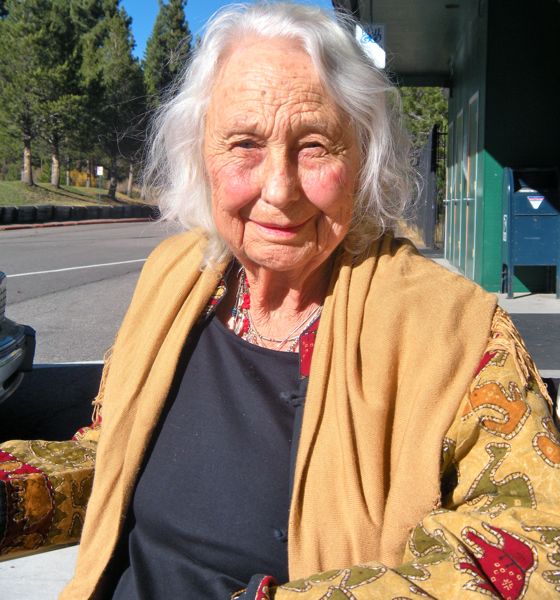
Marjorie Springmeyer is a pioneer of Lake Tahoe who now lives in the Carson Valley full time. Photo/LTN file
Our destinies began to merge soon after we bought that property. We had just sold our home, the first I had ever built, and for the first time in our lives had money in the bank and began to plan on building a home on the meadow. Just two weeks after our escrow closed Margie tracked Francie down at work and told her that the meadow property next to our lot was going to be sold at a court ordered sale. Her two brothers, Knox and Bill, had petitioned the court to sell the property over Margie’s objections. Margie told us if we showed up in court with a check we could buy her brothers’ share of the meadow and share ownership with her. It would take all of our money to do it and meant that building a home would have to wait. We agreed and our friendship became a partnership. I soon after realized that the timing of that event was more than luck.
Over the subsequent years our two families would share many more coincidences. Our daughter, Casey, was born on July 23, Margie’s birthday. Casey was a young child staring out at the meadow when out of the blue she told her mom that a dog had pushed her in to the creek and she had died, but now she was back. She had no way of knowing that Margie’s daughter, Connie, had drowned in the Bijou Creek when she was just 3 years old. Margie became Casey’s godmother.
Margie’s distrust of city hall and government in general inspired me to enter politics. I represented her on the Bijou Community Plan Committee and soon began my foray in local government, all the while using her as a sounding board.
I don’t want this article to be about me, rather my view of a woman who has had a profound influence on my life and was truly one of Tahoe’s pioneers. Her family, the Johnsons, was one of Tahoe’s original landowners. She saw a land unspoiled and beautiful beyond description, but also suffered through much hardship. She was injured in a car accident while in high school, giving her a permanent limp that kept her from the athletic life she so loved. She has also witnessed the loss of her husband, daughter and two sons (Fred and Jon). My sister had also died at 3 years old so I know the effect the loss of a child has on a mother.
Margie lived in a world where women weren’t supposed to be in charge. She stood up for herself to whoever crossed her. She is a survivor and to this day cares about Tahoe’s future. At the conclusion of my last visit, I assured her that I would keep our meadow open and full of the animals we both love. I also asked her if there is anything she hasn’t done or missed. She told me there were two things she hasn’t done. She said that she had never had a glass of beer. When I asked what the second one was she whispered to me with that twinkle I know so well, “I can’t tell you.”
Loop road opponents dominate SLT council meeting
By Kathryn Reed
If the loop road project were completed, will a section of South Lake Tahoe become a ghost town as drivers avoid a significant commercial segment of town, or will it stimulate the economy?
If Highway 50 and city streets in the Stateline area were left as they are, will this be good or bad for the city financially?
Plenty of people have an array of opinions, but no hard facts have come forward to put substance to their thoughts.
On Tuesday night the South Lake Tahoe City Council got an earful about what people think about the proposal that would eliminate 88 dwellings where 245 people live. Thirteen businesses would be affected in some way. “Affected” has yet to be defined. No residents or businesses in Nevada would be relocated.
All of this would be so traffic on Highway 50 would be rerouted through a neighborhood on the mountain side behind Harrah’s and MontBleu, with the idea it would provide a more walkable, scenic area in the Heavenly Village-casino corridor areas.
Businesses in South Lake Tahoe are making it known how they feel about the loop road. Photo/LTN
The May 29 evening workshop was intended to give the public an opportunity to weigh-in with their thoughts about this project that is being driven by the Tahoe Transportation District – not the city, not Douglas County, and neither state transportation agency.
More than 50 people attended the meeting.
What was not pointed out is TTD can go forward with the project, even if the council never gives its blessing, as long as eminent domain is not required.
Of the 26 people who spoke, five were in favor of the project, 13 against and eight were not definitive in their stance. However, of those eight, more were critical than supportive.
Eleven letters were submitted, though not read into the record despite the writers asking for that to happen. All were against the project.
Bill Cherry, an attorney representing a business owner in the project area, handed the council members a petition with 106 signatures from business people who are against the loop road.
Terry Hackett, who is the controlling partner of the Village Center, said he has yet to formulate an opinion.
“We’ll review the economic impacts,” Hackett told the council.
But no one has commissioned a thorough economic analysis.
The environmental documents that will be prepared for the loop road will include an economic component, but not a substantive one that addresses some real concerns the city would have. This is because the loop road is a transportation project, not an economic stimulus project.
The South Shore Vision Plan, the proposal that would revamp the highway from Ski Run Boulevard to Kahle Drive, does have an economic feasibility component. Carl Ribaudo with SMG Marketing is putting that study together. He is also one of the people who spoke at the special council meeting in favor of the loop road.
However, the impacts to businesses in the loop road area that would not be demolished and/or relocated are not being studied. This was part of Hackett’s point.
If the road were rerouted, people would go behind his shopping center where there is no signage. He added had a loop road been proposed in 1980 when he bought what was then known as the Crescent V Center, he would not have done so.
Pete MacRoberts, who operates the Holiday Inn Express, said there is no way guests can merely use the Carrows driveway.
Randy Vogelgesang, South Tahoe Public Utility District’s board liaison to the city, said, “A lot of time infrastructure is relocated at our expense and that is passed on to ratepayers.”
How other utilities – like gas, electric, telephone and cable – would be affected and the residual impacts on ratepayers has not been brought forward to the public.
The council never intended to take action Tuesday. But most have strong feelings.
“I don’t support using eminent domain again,” Councilman Hal Cole said.
People intimately familiar with eminent domain spoke – like Lou Pierini who went through it with other redevelopment projects.
“Of the 100 businesses displaced, I’m the only one left,” he told the council.
“I think the council needs to make a decision early,” Councilman Bruce Grego said. He wants the council to take a vote in the fall before the process is dragged out any longer and more money is spent.
Tahoe Transportation District has money to get through the design process – of which 10 percent is done. It’s estimated the project could cost $70 million to build – of which about half is projected to be spent on acquisition and relocation of property and people. However, not a penny of that money has been secured.
A relocation plan is expected to be released any day. Comments on it will be taken for 30 days. If the project goes forward, rights of ways and relocation could begin in 2014.
Councilwoman Angela Swanson said, “To me this is a huge land use piece for the city. We need to see if it pencil’s out.” She wants to look at the broad vision of the city instead of viewing the loop road as an isolated project.
Paul Genasci, whose office is not in the project area, said, “This town does not just exist in the casino corridor.” He said complaints from tourists are about blight, not the congestion in the casino corridor. He questions if tourists have been asked what they think since the project appears geared to improving the tourist experience.
Dominic Acolino, general manager for Embassy Suites, said his guests are frustrated with the infrastructure on the South Shore. He mentioned how he suggests they go to Van Sickle Bi-State Park, but warns them to be careful because there are no sidewalks.
What he failed to mention is if the loop road project he supports goes through, a state highway will go in front of the only bi-state park in the country.
Jay Kniep believes the environmental gains touted from the project could be achieved without rerouting the road, just like they were with the Heavenly Village project. He also questions the old studies being used that call for an increase in traffic on the highway when in fact the reality is fewer vehicles are on the road.
The draft environmental documents are expected to be released this fall. The soonest construction could begin is 2016.
S. Lake Tahoe council skips headhunter; Kerry city manager for at least 90 days
Nancy Kerry will be city manager of South Lake Tahoe at least until Oct. 1.
The City Council at a special meeting Tuesday night voted 4-1 to put Kerry, who is current assistant city manager until Tony O’Rourke leaves at the end of June, in the top job. Councilman Tom Davis was the lone dissenter. He favored a full search for the next city manager.
Nancy Kerry
The council also on May 29 on a 5-0 vote hired Ralph Anderson & Associates to perform a background check on Kerry. This was one of four firms who earlier this month gave presentations to the council with a desire to become the headhunting firm to find the next city manager. The fee will not exceed $2,000.
Kerry, who was not at the meeting because she is on vacation, will have her interim contract on the June 5 agenda. She will be making $2,000 more a month starting July 1 – for what would be $141,240 a year. (O’Rourke makes $175,000.)
— Kathryn Reed
South Lake Tahoe done with putting up with code violators
By Kathryn Reed
Snowmobiles stored across multiple lots in a residential area. Overturned garbage cans with trash strewn about. Boarded up abandoned houses. Businesses moving half their belongings to the outdoors. Junk cluttering yards so it looks like a mini landfill.
This is South Lake Tahoe.
While not every parcel is a visual nightmare, hardly any street is immune from having a lot that could be cited for a code enforcement violation.
Owners of this house on Primrose Road will have a code enforcement hearing in June. Photos/Kathryn Reed
City officials are done putting up with the eyesores. Aesthetics of the situation could be argued by the owners or renters responsible for violating the law, but the laws governing their actions are what police officials are going after.
In 2011, 200 nuisance cases were processed. That number is expected to increase this year as the city cracks down on offenders and more complaints file in.
It’s anticipated there will be some push back from residents as citations and fines start being written and levied. But these are not new rules. What is new is they are being enforced.
“It’s a question of what is legal and illegal,” Police Chief Brian Uhler said. It doesn’t matter if he likes what it looks like or not. He is going by the law.
“If the law is bad, then change the law. If the law is rational and sound, then enforce it.”
To make sure the council knows what’s about to happen each member is being given a tour of some of the more egregious properties. Councilmembers Tom Davis and Angela Swanson have been on the “scenic” tour with Uhler and Community Services Officer Bob Albertazzi. Albertazzi is the one who is tasked with talking to residents, writing citations and then dealing with council when people appeal the citation.
“My perspective is I think it’s time. Some of it is way beyond normal stuff in a yard. What I saw was pretty bad,” Davis told Lake Tahoe News. “The most important point I want to make is to make sure the city notifies the owner before we abate it. That is critical.”
Lake Tahoe News last week was shown some of the same areas the council will become acquainted with.
“Temporary shelters are a major issue of contention,” Albertazzi said. “They are not permitted and many do not comply with set backs and easement requirements in the code.”
He’s talking about the canopies people use as a carport.
Driving through town some of the canopies are tattered. Others look fine. But the condition isn’t the issue. It’s the fact that they are illegal no matter the condition they are in. There is nothing in South Lake Tahoe’s building codes that allow for these canopies.
On Primrose Road is a yard that is best described as a junkyard. It goes beyond clutter. Tires, television, sofa, rolled up carpet, broken furniture, torn mattress against a vehicle, shopping cart full of everything but groceries, empty aquarium – all visible over the fence.
A hearing regarding this particular property is scheduled for June 20.
Another “junk” issue is related to perpetual yard sales. People are starting to tarp their goods, and sell stuff each weekend as a means to make some non-taxable cash.
The problem is nothing in the code addresses these ongoing yard sales. If Albertazzi and Uhler have their way, that will change.
A house on Helen Avenue smells so bad from the mold inside that neighbors one time called thinking a dead body was inside.
Officers are allowed on properties when it comes to health and safety issues.
But resources are limited. For now, most of the violators come to the officers’ attention through complaints from neighbors.
However, a temporary 30-hour week employee is expected to be on the streets in mid-June to handle these types of code violations.
Abandoned structures litter the city. One on South Avenue has had the city’s attention for the last three years. It’s paid for. But the stairs are rickety, squatters have come and gone from it, and it looks like one strike of a match would bring it all down.
Uhler said safety is the biggest issue with this parcel. But it will take the city’s legal team to find a way to solve the problem.
The code says the owners are supposed to make it habitable or be fined $1,000. The owners can be taken to small claims court and a lien put on the property.
“But it doesn’t solve the problem,” Uhler said.
Driving down Highway 50 it’s easy to spot the businesses violating the outdoor display law. This rule makes is so store owners don’t turn their sidewalk or front area into another area to sell their wares.
Temporary activity permits are available for special sidewalk sales and things like that. But just moving stuff out front, well, that’s a big no-no that isn’t going to be tolerated much longer.
And with the sign ordinance finally passed, those sandwich boards – other than on holiday weekends – will be removed. Same with other non-permitted signs like banners and add-ons. The latter often say “now open” and are plywood additions to what was legally permitted.
Albertazzi said more than 300 businesses along Highway 50 have been given written notice about what the rules are governing signs.
“So there is no excuse why they use temporary signs,” Albertazzi said.
On the June 5 council agenda is likely to be an item recalculating the fines for the various code violations. Uhler would like this item brought back to the council once a year like the fee schedule is so the amounts are kept in check and reviewed for relevancy. Uhler also wants to streamline the process so abatement happens faster.
ngg_shortcode_0_placeholder (Click on photos to enlarge.)
Opinion: A time to remember those who died for the U.S.
Memorial Day is often called the kick-off to summer. The real meaning of today goes much deeper.
Memorial Day is about honoring those in each branch of the military who have died for the United States.
As much as it’s easy to say war is not necessary. It is a reality. People have been dying for this country for close to 250 years. They die every week.
The names of these men and women whose lives are cut short are seldom mentioned unless they are from the town where you live. But they were a daughter or son, a mother or father, a niece or nephew, a sister or brother, a friend.
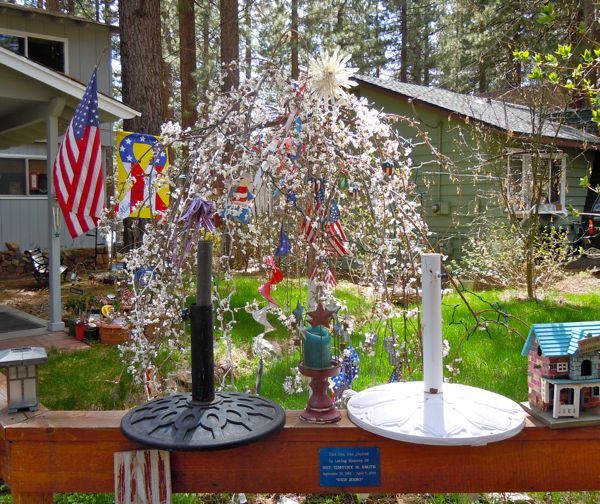
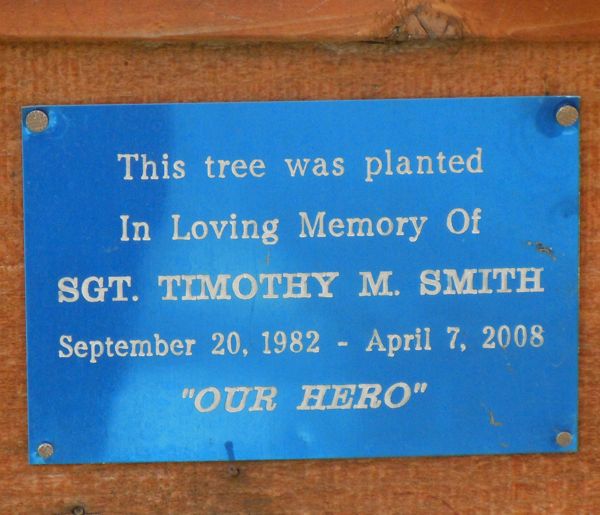
South Lake Tahoe has had its share of recent losses — Pfc. Brandon Williams, 21, died in October 2006; Sgt. Tim Smith, 25, in April 2008; Spc. Garrett A. Fant, 21, September 2011.
Tim Smith's family remembers him every day with this memorial in the Al Tahoe neighborhood of South Lake Tahoe. Photos/LTN
Walking through Happy Homestead Cemetery tells a story about this areas rich military history. Men and women here have been and continue to serve in the military. Some serve during times of peace, others during war, or other conflicts.
Lake Tahoe News believes a debt of gratitude is owed to the people who today serve on a voluntary basis. And we can’t forget about those who were told they would serve or face the threat of being jailed.
How many of us have the courage to wear one of those uniforms? It’s a small percentage of the overall population.
As you gather with friends and family today, take a look around. Many families are without someone today because they were killed in action, a training mission or some other circumstance. They did die fighting for our freedoms.
Yes, we all suffer loss, but would we be willing to die for our country?
—–
Ceremonies:
• 11am, Happy Homestead Cemetery, South Lake Tahoe.
• 11am, El Dorado County Veterans Monument, Placerville.
Study shows a 6.9 quake possible in Lake Tahoe
By ScienceDaily
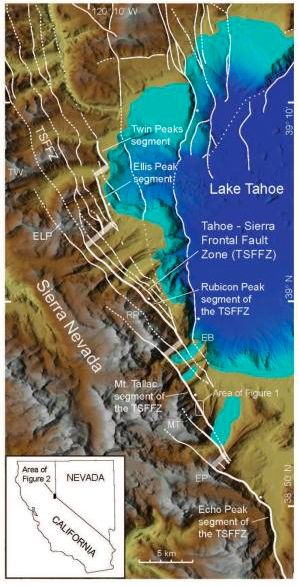
Results of a new U.S. Geological Survey study conclude that faults west of Lake Tahoe, referred to as the Tahoe-Sierra frontal fault zone, pose a substantial increase in the seismic hazard assessment for the Lake Tahoe region of California and Nevada, and could potentially generate earthquakes with magnitudes ranging from 6.3 to 6.9.
A close association of landslide deposits and active faults also suggests that there is an earthquake-induced landslide hazard along the steep fault-formed range front west of Lake Tahoe.
Faults lines are dashed where approximately located, dotted where concealed, bar and ball on downthrown side. Heavier line weight shows principal range-front fault strands of the Tahoe-Sierra frontal fault zone. Opaque white boxes indicate approximate segment boundaries and right steps in range front separating principal fault strands. Map/James Howle-USGS
Using a new high-resolution imaging technology, known as bare-earth airborne LiDAR (Light Detection And Ranging), combined with field observations and modern geochronology, USGS scientists, and their colleagues from UNR; UC Berkeley; and the U.S. Army Corps of Engineers, have confirmed the existence of previously suspected faults. LiDAR imagery allows scientists to “see” through dense forest cover and recognize earthquake faults that are not detectable with conventional aerial photography.
“This study is yet one more stunning example of how the availability of LiDAR information to precisely and accurately map the shape of the solid Earth surface beneath vegetation is revolutionizing the geosciences,” said USGS Director Marcia McNutt. “From investigations of geologic hazards to calculations of carbon stored in the forest canopy to simply making the most accurate maps possible, LiDAR returns its investment many times over.”
Motion on the faults has offset linear moraines (the boulders, cobbles, gravel, and sand deposited by an advancing glacier) providing a record of tectonic deformation since the moraines were deposited. The authors developed new three-dimensional techniques to measure the amount of tectonic displacement of moraine crests caused by repeated earthquakes. Dating of the moraines from the last two glaciations in the Tahoe basin, around 21 thousand and 70 thousand years ago, allowed the study authors to calculate the rates of tectonic displacement.
 “People need to understand that cold water can be very dangerous.” — El Dorado County sheriff’s Deputy Greg Almos