Al Tahoe homeowners open their doors to look at the past

AAUW home tour focuses on old cabins

By Jessie Marchesseau

Original old Tahoe cabins all over the area. The little box-like ones clad in weathered wood siding or just plain logs. It’s hard not to wonder what those little gems look like inside and what they looked like way back when.

Saturday’s American Association of University Women Home Tour provided an opportunity to find out.

The tour is a biennial event and past tours have been in the Angora burn area, Cascade Properties, the Tahoe Keys and other prominent South Shore neighborhoods. This year’s tour, entitled At Home in Al Tahoe: Historic Retreats at The Lake, featured eight cabins in South Lake Tahoe’s oldest neighborhood. The cabins, all built between the 1920s and 1940s, have been extensively maintained, restored, updated and upgraded by their respective owners.
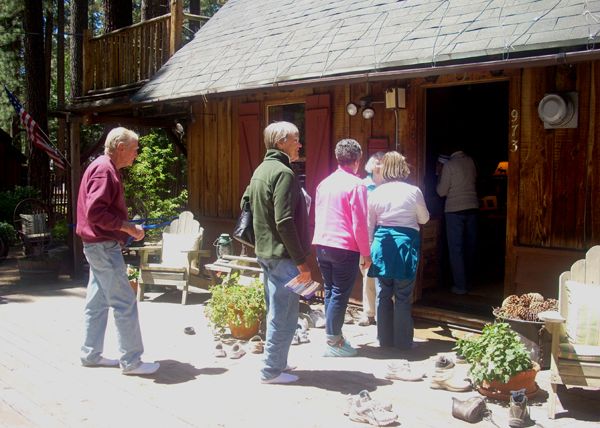
The AAUW home tour in Al Tahoe on June 23 was sold-out. Photo/Jessie Marchesseau

The self-guided tour started on Cave Rock Avenue at a cabin built in 1937. The front deck is almost as big as the cabin. A step inside revealed that this was one that had been more restored than upgraded. The beams, though redone, still showed signs of the bark that had been left in place when the cabin was erected. The steep log staircase leading to a loft above looked more like a ladder than an actual stairway and made many tour-goers more than a little nervous on the descent. A stove against the wall and refrigerator in the corner were the only real indications of where the kitchen area was in the big room that served as kitchen, living and dining space.

Carolyn MacRae, interior designer and owner of The Design Shoppe in South Lake Tahoe, purchased the cabin for her father in 2003. She took on the task of redoing some of the previous remodel work to make it appear more original and creating a space for her father to house his extensive collection of Native American artifacts, including a totem pole standing proudly in the living room.

“One of the goals with it is to make the setting feel like the collection feels, and like it’s always been here,” MacRae said.

But not all the cabins on the tour were redone with the intension of making them look and feel original.

Some still had logs or wood paneling for walls, while others had been upgraded to sheet rock. Nearly all have experienced some sort of expansion, as the tiny footprint of these cabins does not leave much room for modern conveniences. Some additions were designed to blend seamlessly with the original architecture, but others had details such as granite countertops and two-person Jacuzzi bathtubs which were dead giveaways of modern upgrades.
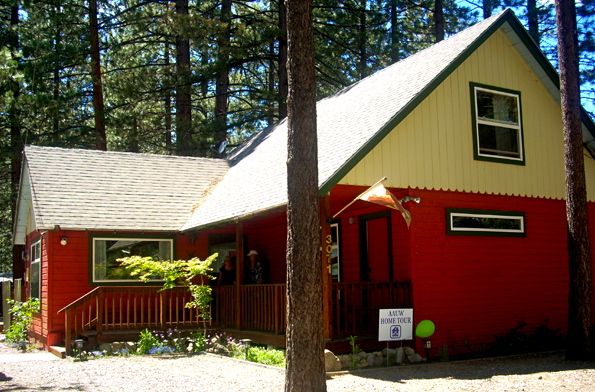
Many cabins in Tahoe have the same footprint as when they were built decades ago. Photo/Provided

Barb Childs, president of AAUW South Lake Tahoe branch since 2010, said part of her criteria in choosing the cabins for the tour were that they had been not so much remodeled as restored, maintaining the original integrity of the era.

Though some cabins flaunted more contemporary updates than others, they all managed to maintain original elements that make it almost immediately known to any visitor that this home has a story to tell. All of the cabins displayed a great deal of wood; from floors to walls, ceilings to cabinetry, the warm ambience of natural wood prevailed. Nearly all the homeowners managed to work some antlers into their décor and there was no shortage of the obligatory pinecones, bears and photos from the TV show “Bonanza” – which was filmed in Lake Tahoe.

Janet De La Motte of San Luis Obispo attended the tour with her daughter. As the owner of an Al Tahoe cabin built in 1939, something that has been in her family since the day it was built, De La Motte said she loved the rustic charm displayed by all the homes.

“It shows you that you don’t have to go and remodel as soon as you buy a vintage home,” she said, noting that on HGTV the first thing anyone does when they buy an older property is completely gut it.

De La Motte and her daughter, Janelle, gathered some ideas for their cabin from the tour and were delighted that they were able to walk the entire route, a detail that was no accident.

Childs said with the opening of Lakeview Commons, the AAUW, in addition to their focus on a historical tour, wanted to do something to encourage people to bike, walk and enjoy the entire area.

As the final stop, refreshments and silent auction items were available to attendees at Pichetti Winery.

The event, which is always well-attended, sold-out of the 350 available tickets on Friday. Tickets were $20 in advance.

One hundred percent of the proceeds from the event go toward AAUW’s scholarship funds. The group awards scholarship to women transferring from LTCC to four-year universities, as well as to middle school girls who wish to attend Tech Trek, a science, math and computer summer camp at UC Davis. AAUW focuses on advancing equity for women and girls.

“You can’t change the world,” said Kay Henderson, chairman for this year’s Home Tour, “but sometimes you can change a little part of it.”



Edgewood Lodge wants to be driver in high-end market

By Kathryn Reed

STATELINE – With a history in Lake Tahoe that dates to 1896, the Park family’s Edgewood Companies is poised to build the first high-end lodging establishment on the South Shore.

Thursday marked the final day people could comment on the draft environmental impact statement for the Edgewood Lodge. Testimony was taken during the Tahoe Regional Planning Agency’s Governing Board meeting, to which only people in support of the 154-room hotel spoke. There will also be 10 fourplexes, or casitas.

The League to Save Lake Tahoe had submitted a letter on June 27 praising the environmental improvements that would accompany the project if it were to be permitted. But the League does have concerns.

Edgewood Companies expects the TRPA Governing Board to vote on the lodge project in September.

The letter says, “… the League remains concerned with the expansion of the urban boundary that was necessary on recreation land to allow development such as the proposed project.”

Lew Feldman, the attorney representing Edgewood, told the Governing Board there would be no impact to the urban boundary.

“We absolutely disagree it is a legal issue,” Feldman said.

It’s possible the final EIS will be released in late July, with the Governing Board taking action in September. If the green light is given, Edgewood Companies could start by rerouting hole 9 on the golf course and working on the other affected holes.

The hotel will take two construction seasons, so the earliest anyone could book a room is fall 2015.

Patrick Rhamey, vice president of real estate for Edgewood Companies, told Lake Tahoe News the other factor is obtaining financing and making sure the economy is ready for what his company wants to deliver.

For the area, it is expected to bring in $24 million a year to the local economy from what guests spend, $1.7 million a year in sales tax, and $2 million annually in hotel tax.

“I hope this becomes the model for our community as we go forward,” Carol Chaplin with Lake Tahoe Visitors Authority told the board.

She said NBC is ready to highlight the project during the American Century Celebrity Golf Championship that is at Edgewood Tahoe each July.

Bill Chernock, who used to have the job Chaplin has but is now head of the Carson Valley Chamber of Commerce and Visitors Authority, said, “The hole in Tahoe’s tourism product is the lack of high-end lodging. It’s what separates Tahoe from the Aspens, Montereys and La Jollas of the world.”

Gone will be the parking lot with a view of Lake Tahoe.

“I call it the world’s most scenic parking lot. It needs to go,” Rhamey said at the June 28 meeting.

At the lodge will be parking. Plus, there will be a few spaces for day use.

Of all the thresholds TRPA deals with, noise is the only one this project will not address.

Environmental gains include stopping a half million pounds of sediment from reaching Lake Tahoe and stopping fertilization on 24 acres of turf. Edgewood Creek will flow into Lake Tahoe naturally, not via a pipe. This will improve the fish habitat. It’s estimated the amount of nitrogen reaching the lake will decrease by 13 percent and phosphorous by 26 percent. Those two elements contribute greatly to the loss of clarity.

The beach at this Stateline property will be open to the public – which it isn’t now. No retail, other than sundries for guests, is planned. A spa, though, will be on site.

Expansion of the current clubhouse is also in the works.


Grand jury wants El Dorado County to take over S. Tahoe

By Kathryn Reed

Having South Lake Tahoe be absorbed by El Dorado County, and turning the ice rink into a private enterprise are the two issues the El Dorado County Grand Jury wrote reports on involving the city.

While South Tahoe Public Utility District was a target of an investigation, grand jury foreman Ted Long said no report was made.

The entire grand jury report is expected to be available within a matter of days.

Lake Tahoe News has received advance copies of some of the reports.

Long said he is the one who initiated the query into consolidating the city into the county.

“What is the city doing that is so earth shattering?” Long said to Lake Tahoe News. “I think it would be better to get rid of the city.”

The report says, “This grand jury is suggesting that a dialog should begin to reinvent the meaning of local government. What are our priorities and how can they best be paid for? Have we outgrown the traditional notions? Are we using technology to its maximum benefit?”

If South Lake Tahoe wanted the county to take over, first it would have to dissolve, as in no longer being an incorporated city. This requires LAFCo (Local Agency Formation Commission) to be involved.

Long should know all of this because when he was on the South Lake Tahoe City Council he was the city’s rep to LAFCo.

With the voters in the mid-1960s agreeing to incorporate, it takes the voters of South Lake Tahoe to unincorporate. Only two cities in California have done so. That was in the 1970s – one did so because it was broke, the other because of rampant corruption.

The grand jury report says money would be saved by consolidating city and county resources and getting rid of the city. Long said this would happen by not having duplicate top administrators.

But consolidation isn’t that easy because of labor agreements, debt the city has and assets it owns.

City Manager Nancy Kerry said if dissolution was so easy cities like Stockton would be looking at doing so instead of filing for bankruptcy. Plus, the difficulty in actually dissolving redevelopment agencies in California proves the process is convoluted.

“I think we should look at the broader picture. Should we leverage resources? Sure. We are talking to the school district and everyone,” Kerry told Lake Tahoe News.

This week the city met again with Lake Valley fire officials to discuss creating a partnership. While no decisions have been made, the city is looking at ways to save money and get rid of duplicate resources.

While the civil grand jury wants the city to save money, having a private company operate the taxpayer built ice rink is not a good thing, according to the second report. This, despite the fact the city is saving in excess of $100,000 by not operating the rink. That figure does not include the profit margin the operators are to pay the city.

The grand jury issued five recommendations regarding the ice rink. The main one is to go back to the voters to see if they are OK with the rink being operated by a private company. The other recommendations are things like mandating the council respond to grand jury emails. But protocol would be to have the city attorney respond to legal matters.

“Private-public partnerships have been legal for a long time,” Kerry said in regards to the flap involving the piece of ice.

She said when the city receives a copy of the report City Attorney Patrick Enright will review any legal issues that are brought up and the findings will be in the city’s response to the grand jury.

When the grand jury report is officially out, it will be accessible online. This June 25 LTN article is about the Pioneer Fire Protection District hiring a political consultant with taxpayer dollars and the ties El Dorado County Superior Court Judge Steven Bailey has to the consultant.


Change in Nevada lawmakers could alter future of state’s involvement in TRPA

By Anne Knowles

Nevada’s future in the Tahoe Regional Planning Agency is still up in the air despite the recent defeat of the man who sponsored the bill that was approved last year that threatens to remove the state from the Compact.

Sen. John Lee, D-North Las Vegas, the main proponent of Senate Bill 271 passed by the 2011 Nevada Legislature, lost to Patricia Spearman in the state’s primary earlier this month. Spearman was backed by a broad coalition of groups, including the Sierra Club and the Nevada Conservation League, that were unhappy with Lee’s record on a number of issues, including the effort to withdraw Nevada from the Tahoe Regional Planning Agency Compact unless certain reforms are made.

Lake Tahoe will always be part of Nevada, but whether Nevada will always be part of TRPA remains an unknown. Photo/LTN file

“When we made the decision to try to defeat Lee in this election we were hopeful it would improve our chances to repeal this legislation,” says Kyle Davis, political and policy director, Nevada Conservation League. “Our goal is to see repeal of that legislation next session.”

Nevada Assemblyman Kelly Kite, R-Minden, a co-sponsor of SB271, whose district includes the Douglas County portion of Lake Tahoe, also was defeated in the primary. Retired Gardnerville rancher Jim Wheeler, who bested Kite and a third Republican candidate, Gary Schmidt, will face Independent American David Schumann in the general election in November.

Lee and Kite still sit on the Legislature’s interim committee that oversees the TRPA and Kite is one of the members of a three-person delegation tasked with meeting with its legislative counterparts in California to negotiate changes to the agency. The Nevada delegation, which also includes Assemblywoman Marilyn Kirkpatrick, D-North Las Vegas, and Sen. James Settelmeyer, R-Minden, is expected to have the first meeting with its California colleagues during the annual Lake Tahoe Environmental Summit being hosted by Sen. Dean Heller, R-Nev, at Edgewood Tahoe in Stateline on Aug. 13.

Then the Nevada group is required by the law to deliver a report on the state of the TRPA to the interim committee by Oct. 15, when the interim committee wraps up. That’s also the deadline for the committee – called the Legislative Committee for the Review and Oversight of the Tahoe Regional Planning Agency and the Marlette Lake Water System – to request up to 10 bill drafts for the 2013 legislative session.

In the meantime, Leo Drozdoff, executive director of Nevada Department of Conservation and Natural Resources, and John Laird, California’s secretary of Natural Resources, have been meeting to discuss the TRPA. They plan to meet again in July, according to Kay Scherer, deputy director of the Nevada department.

Laird, who attended his first California Tahoe Conservancy meeting this month (usually a delegate sits in for him on the board), said he and Drozdoff hope to have something to be able to present at the environmental summit.

One of Nevada’s main complaints about the bi-state agency has been its inability to deliver a Regional Plan update. The TRPA recently produced a draft RPU and the accompanying environmental impact documents and has had four public meetings to discuss it, with another today in Kings Beach and one Thursday in Stateline. The agency is taking public comment until June 28, with the goal of delivering a final update by year end.

“I’m optimistic the new RPU will be adopted before the new (legislative) session or soon after,” Nevada Conservation League’s Davis told Lake Tahoe News. “We’re hopeful that Nevada won’t pull out if they develop a new RPU.”

The bill draft or drafts requested by the interim committee could end up in any number of committees during the 2013 legislative session. SB271, for example, emanated from Senate Government Affairs, then chaired by Lee. The make-up of the committees for 2013 is unknown as is the number and content of bill drafts the interim committee on the TRPA will request.

The new members of the next interim committee overseeing the TRPA, which by statute meets every interim, will be determined by the Legislative Commission after the 2013 session.

Wheeler, the winner of the Republican primary for Assembly District 39, is the heavy favorite to win the seat. For his part, he says he would like to be assigned to Natural Resources, Agriculture and Mining, although there is no guarantee he will be appointed to the committee of his choice.

Wheeler opposed the incumbent largely on Kite’s vote to pass Assembly Bill 561 during the 2011 session. The bill, negotiated by the leadership of both parties with Gov. Brian Sandoval, extended a number of taxes to raise $620 million for the state. Wheeler has signed a pledge, available at his website, to not to raise any taxes if he were elected to office.

“I am a very, very conservative person, and I feel the constituents are very conservative,” Wheeler says.

Wheeler says instead he would look to cuts in state government employment through attrition and the education budget to balance the budget.

“You have to look at everything,” Wheeler says. “The education budget is 51 percent of the budget. We’ve been throwing money at it and it hasn’t worked for 50 years.”

He says he supports Sandoval’s plan to provide vouchers for education.

“We need more charter schools. We need to bring private enterprise into the school system.”

Wheeler also supports SB 271.

“We need to get the TRPA straightened out,” he says. “It was a good bill passed in the last Legislature.”


Cefalu resigns from LTUSD board effective immediately

By Kathryn Reed

The abrupt resignation Tuesday of Judy Cefalu from the Lake Tahoe Unified School District board upstaged everything else on the agenda.

Not even board President Wendy David was given a heads-up about the letter written by Cefalu. That letter was addressed to Superintendent Jim Tarwater.

Reached at home by Lake Tahoe News on Tuesday, Cefalu didn’t believe her departure mid-term was newsworthy even though the electorate voted her in for a four-year term. She had nothing to say to them.

“I just think it was time we have someone else come in. It’s as simple as that,” Cefalu said. She thinks new, younger ideas are what the board needs at this point.

She mentioned she would soon be turning 74, and that it would be good to pass the baton onto someone younger.

Her resignation is immediate. She did not attend the June 26 meeting.

The board discussed Cefalu’s resignation in closed and open sessions. The board has 60 days to appoint someone to fill the remainder of the term that expires in December 2013.

As in the past when there has been a vacancy, the board conducts interviews in open session and makes the decision in open session.

Cefalu only had good things to say about the board, administration and district as a whole.

In other action, the board approved the 2012-13 budget.


Tahoe agencies close to failing in their job to implement change post-Angora Fire

By Kathryn Reed

Five years later and people are still wondering how they will evacuate safely from the Lake Tahoe Basin in an emergency, if a reverse 911 system has been installed, and how to get their neighbors to get rid of that shake roof.

While a panel of agency officials sat on the stage of the theater at South Tahoe High School on Monday talking about what they have done in the five years since the Angora Fire, it was more personal information the audience sought.

But answers for them were few or limited.

The June 25 forum was hosted by state Sen. Ted Gaines, R-Roseville. Speakers were Gareth Harris of Lake Valley Fire Protection District, Kelly Keenan with CalFire, Patty Kouyoumdjian of Lahontan water board, Joanne Marchetta-TRPA, and Mike LeFevre-USFS.

North Shore real estate agent Sue Daniels asked why the Caltrans signs can’t alert people about red flag warning days and what the state’s $150 rural fire tax will be spent on.

Gaines said he would look into the sign question. As for the tax, he calls it double dipping. The money collected from homeowners won’t help CalFire or any firefighting efforts.

Keenan explained the tax means $89 million for CalFire, but in reality the department’s budget from the state has been reduced by that same amount so the tax is not a net gain to the state fire agency. What people are paying for is unknown. The tax really goes to the general fund to be spent however the governor and Legislature want.

A resident in the Lake Valley area asked what to do about a neighbor who believes doing nothing to their fire prone-shake roof is fine.

Harris said his district received a $5 million grant from FEMA to deal with just that issue. The money is available to assist homeowners in Lake Valley, Meek’s Bay and Fallen Leaf Lake fire districts.

But Harris also encouraged residents to call their local fire department about any defensible space issue and have the firefighters be the bad guys and the court be the enforcer if it were to get to that point.

Angora burn area resident Susan Ward told the audience of more than 100 how she never received a reverse 911 call five years ago. No one told her Monday night the reason there was no call is because the El Dorado County Sheriff’s Department thought the governor had to make that decision. Not so. The county has the capability to use this system without Sacramento’s OK – so do other jurisdictions.

While El Dorado County Sheriff John D’Agostini and South Lake Tahoe Police-Fire Chief Brian Uhler attended the forum, neither spoke and neither stayed until the end. They would be the ones to answer how the 911 system works.

The other issue Uhler and D’Agostini could have addressed is the evacuation plan because that is the job of law enforcement. None of the speakers could give any details about how people will be evacuated in the event of an emergency.

It was total chaos five years ago that proved whatever system might have been in place did not work. This proved true the Sunday the fire started and then the Tuesday when the Tahoe Keys area was evacuated when the fire jumped Highway 89.

Grading the work done post-Angora

State Sen. Ted Gaines reveals the agencies in the Lake Tahoe Basin barely received a passing grade based on the lack of implementation of recommendations post-Angora. Photos/Kathryn Reed

Gaines had asked the non-partisan Senate Office of Research to examine how the 90 recommendations issued by the bi-state Blue Ribbon Fire Commission that was convened by then Govs. Arnold Schwarzenegger and Jim Gibbons had been implemented.

Sixty have been completed and 10 are in the process. To this, Gaines gave the effort a C-minus grade – barely passing by most standards.

One recommendation of the bi-state commission was to, “Adopt the priority of life, property, and the environment, in that order, with respect to fire safety and fire prevention.” The action taken, according to the report released Monday, was, “Implemented.”

Firefighters have those priorities, but those who control the basin have a different agenda. Water quality is one. Spending grant money to keep their jobs is another. Planning and more planning without implementation appear to be other priorities.

“It’s not an important issue, it’s an urgent issue,” Gaines said of needing to make Lake Tahoe fire safe.

He doesn’t understand when people talk about the importance of Lake Tahoe how protecting it from a devastating fire isn’t at the top of the list. He pointed to the Democrats in the state Legislature not wanting to fund projects that would help Tahoe.

One of the recommendations was to create an 800 number for people to call for information about defensible space guidelines. But the number provided in the report went to a personal residence when Lake Tahoe News called it Monday night.

An “undetermined” was the action for the recommendation, “To avoid continued confusion regarding interagency communications during wildland fire occurrences, all dispatch centers and responding resources in the Tahoe basin will adhere to the existing agreements.”

Considered “implemented” was the recommendation to, “Work with their respective congressional delegation to establish an annual sustainable fund for forest health for the Lake Tahoe Basin.”

But the people speaking on the stage Monday said money is an issue and there is no “sustainable fund” for fuel reduction or firefighting. Congress has not reauthorized the Lake Tahoe Restoration Act that supplied the initial money for environmental projects that included fire related activities. SNPLMA funds are about exhausted. And some entities in the basin would like the remaining Southern Nevada Public Lands Management Act dollars be spent on a loop road on the South Shore instead of fire related issues.

One of the recommendations that was found to be “undermined” was, “Find more stable, long-term funding to replace the stopgap funding provided by the states, likely through the collection of a parcel fee or similar special assessments on property owners.”

Everyone in at the forum would likely have categorized that as “not implemented”.

Going into the burn

Before the evening meeting, Gaines went on a tour of the Angora burn, witnessing the forest as it looks today, talking to homeowners who have rebuilt and seeing a community garden that has sprouted from the ashes.

“We all move to Tahoe because it’s beautiful. We stay because of the people,” Marsha Hudson told Gaines. She said having an evacuation to-do list on the inside of a cupboard helped her family retrieve more belongings than they would have otherwise remembered in such a stressful situation.

ngg_shortcode_0_placeholder (Click on photos to enlarge.)


El Dorado County judge tied to firm grand jury probed

By Kathryn Reed

When the El Dorado County Grand Jury report comes out in the next week an item about the Pioneer Fire Protection District will seem a bit vague to those not in the know. This is because the consulting firm in question has not been named.

The firm in question is Dan Dellinger Consulting.

The Pioneer Fire Protection District hired the consultants after Dellinger listed Superior Court Judge Steven Bailey as a reference.

It appears Bailey did not want the general public to know about his dealings with Dellinger and did what he could to ensure the ties would not come to light.

Last summer the grand jury started looking into the small rural fire district’s hiring of Dan Dellinger Consulting, which is run by Dan Dellinger and Cris Alarcon.

(Alarcon was arrested Feb. 6, 2012, by El Dorado County sheriff’s deputies on suspicion of using a false license plate and using a false vehicle registration. In March, Alarcon was arraigned on 14 charges. He has pleaded not guilty to the charges and is scheduled to be back in court in July.)

The original contract between Pioneer fire and the consulting firm was modified in August 2011 because the original contract appeared to contain services for illegal campaign activity in violation of California Government Code Sections 8314 and 54964.

The grand jury prepared a draft report on the entire matter and submitted it for review to Bailey. Bailey is the presiding judge of the grand jury and has been for a few years.

He never recused himself from this matter despite having ties to Dellinger. Bailey was not available for comment. But Bailey also has ties to others in the county. Bailey is the brother-in-law of county Supervisor Ron Briggs and son-in-law of former state Sen. John Briggs. The elder Briggs is famous for the 1978 proposition called the Briggs Initiative that had it passed, would have meant all employees in California’s education system who are gay or lesbian and their supporters would have been fired.

It’s not just Bailey to whom this consulting firm is tied to. Dan Dellinger Consulting in the past has managed the political campaigns of Sheriff John D’Agostini and county Supervisor Ray Nutting. The consulting firm is currently providing advice to Superior Court Judge Warren Stracener for his November election bid. Former Gov. Arnold Schwarzenegger appointed Stracener to the bench.

Dellinger is also in the same camp as Rico Oller, who represented Lake Tahoe in the California Assembly and Senate, and who is trying to be this area’s assemblyman again. Years ago, Dellinger and Oller were involved in a questionable incident involving the killing of a bear.

What gets convoluted is how it came to pass that Dan Dellinger Consulting is not mentioned by name in the report. When it came time to decide which of the two versions of the grand jury report involving Dellinger was to be the final one that would be printed Bailey was out of the office.

El Dorado County Superior Court Judge Suzanne Kingsbury told Lake Tahoe News she was given the reports one day and told to make a decision that day. She does not know what the urgency was. But it was Bailey who asked her to read the reports. Both work in the courthouse in South Lake Tahoe.

“All I did was read two different versions and selected the one that was better written,” Kingsbury told Lake Tahoe News on June 24. “I didn’t edit anything. I read two different versions, pure and simple. One had attachments with extraneous writing. I didn’t know where that came from.”

Without supporting documentation to the handwritten items, Kingsbury said it was not publishable on those grounds. The naming of people was not a concern to her.

But who wrote on the documents is not known, but presumably it was Bailey who marred the documents because grand jury foreman Ted Long told Lake Tahoe News the originals went to Bailey and they came back “edited to pieces.”

Kingsbury said she made no edits.

For a number of months the grand jury had been debating whether to include Dellinger’s name in the report. Libel and slander were reasons for concern, though Long said that can be the case with any investigation.

Long sent an email to Lake Tahoe News and others (that LTN has not edited), that says, “After review Kingsbury invoking penal code section 929 was concerned about potential libel/slander actions, choice to remove the attachments and the specific mention of Dillinger Consulting.”

That code deals with the slander-libel issues.

But Kingsbury is adamant her decision “didn’t involve section 929.”

Also on June 24, Long spoke with Lake Tahoe News, stating that Kingsbury invoked 929 as her reason. However, he admitted that Kingsbury neither told him this in writing nor verbally, but that he surmised there could be no other reason for picking the report she picked. He was not aware the version with Dellinger’s name had handwritten notes on it because it didn’t when it left the grand jury office.


S. Tahoe dispatch sends units within seconds to Angora

CHP won’t talk about Truckee dispatch investigation

By Kathryn Reed

Within 13 seconds of the first call that came into the South Lake Tahoe dispatch center at 2:09:13pm on June 24, 2007, fire units were alerted.

Angora Fire -- 5 years later

Leona Allen doesn’t know how many calls she received that first day. Working alone in the dispatch center on what was supposed to be a day off, what she does remember is the first call, her husband saying her 90-year-old dad was safely evacuated (his house later burned to the ground), the call not on Day 1 from Barton Skilled Nursing asking her to help move her mom because they were evacuating and having to say she could not leave work – which she didn’t leave for five days.

It wasn’t long into that Sunday five years ago that Allen learned her house was also one of the 254 that was consumed by flames.

Much controversy has centered on whether the flames could have been doused faster had the California Highway Patrol dispatch in Truckee not told callers it was a control burn, which meant those dispatchers didn’t dispatch resources.

An investigation followed, but the results are not known. Allen, who was involved with the investigation, doesn’t even know the outcome. She said a Truckee dispatcher called her asking if there was a control burn, to which Allen said, “No.”

Lake Tahoe News submitted a public records request to CHP seeking the report on the investigation. This is the state agency’s written response, “The department is unable [to] provide you with the requested ‘report from the investigation.’ The investigative reports are personnel documents, prepared as inquiries into the performance of department dispatch personnel. Pursuant to the Public Records Act, disclosure is not required of records that are ‘personnel, medical, or similar files, the disclosure of which would constitute an unwarranted invasion of personal privacy.’ (Government Code Section 6254(c)). The mandatory, rather than voluntary, contribution of involved personnel creates a privacy interest in the information that courts will recognize; see, e.g., California First Amendment Coalition v. Superior Court (1998) 67 Cal.App.4th 159.”

No one in Truckee or at the Sacramento headquarters would say if anyone was disciplined or if any policies were changed. Nor would anyone say why the dispatchers thought there was a control burn on the South Shore at that time.

All agencies on the South Shore that would have had the authority to ignite a prescribed fire say there were no controlled burns on June 24, 2007.

Every 911 call is logged into the computer aided dispatch system.

Residents to this day are still thanking firefighters for their efforts. Photo/LTN

Lake Tahoe News also sought the transcripts of the 911 calls from the Truckee office on June 24, 2007. CHP late last week said a recording could be provided. But FedEx was not able to get the disc to Tahoe by Saturday. When LTN receives it and if the audio is of publishable quality, we will release them.

Where a 911 call goes depends on the phone carrier and if the caller is on a cell or landline. In the past five years, more cell calls go to the area the caller is in instead of the nearest CHP dispatch.

El Dorado County Sheriff’s Office is dispatched out of Placerville.

“They monitor us, so the deputies knew immediately and took on the evacuations. They just reacted. I didn’t even have to call. It’s why we all listen to each other,” Allen told Lake Tahoe News. (Allen eventually left her dispatch job and now works for Lake Valley Fire Protection District as the communications specialist.)

The South Tahoe office dispatches South Lake Tahoe police and fire, Lake Valley fire, and Fallen Leaf Lake fire.

The California Highway Patrol, Tahoe Douglas fire, Nevada Highway Patrol – they all came without being asked.

Allen’s co-workers started showing up without being called in.

In addition to the mounting calls from people reporting what became known as the Angora Fire, during that first hour there were 10 emergency medical calls, including a structure fire that had nothing to do with Angora.

No confusing this plume of smoke with a control burn. Photo/Lake Valley Fire

Two dispatchers had to evacuate, but immediately returned to work. Twelve-hour shifts were the norm for five days. Cots were set up. Food brought in.

“I remember going to the first briefing with the Forest Service on Day 2 and I was still in the same clothes as when I started,” Allen said.

It wasn’t long before the fire was of such a magnitude that it was no longer considered a local event.

“When a fire gets so large that the local dispatch center cannot handle it, it is turned over to an emergency communication center in Camino, Gardnerville or Minden,” Allen explained.

When the feds get involved – which was the case because most of the land belonged to the U.S. Forest Service – and emergency aid agreements are triggered, a dispatch center for that specific fire is created. This happened on that first day of Angora.

Still, the local calls were coming in to the South Lake Tahoe center. All sorts of calls came in — one man said he knew how to fly a helicopter better and that the guys in the air were doing it all wrong. People called wanting to know if they should evacuate.

A big flip chart was set up in the center so the dispatchers could record what callers were offering (things like hotel rooms, a place for horses) and who to contact. Red Cross was provided all this info.

The little details that are huge to people in the middle of a tragedy were being coordinated by these men and women, like finding a home for 12 displaced bunnies.

Firefighters would call in with addresses of houses gone. The dispatchers had to keep working knowing the homes of family and friends were nothing but ash.

Allen says the only thing she would have done differently regarding the fire was to have commended her dispatchers sooner.

“The quality of a good dispatcher is maintaining your composure and quality of work when you know the vortex of fire is just down the road,” Allen said.


Trout Creek transports paddlers to oasis by Tahoe

By Kathryn Reed

It’s easy not to want to paddle in Trout Creek. Listening and watching are the preferred activities. If only the binoculars were in the canoe.

A cackle of chirping birds makes it seem like we’ve entered an aviary. Unfamiliar calls fill the air. Flitting about are species we don’t recognize.

Later, Tom Millham from Lake Tahoe Wildlife Care identifies the yellow-headed blackbird.

“We have had them in the past, but not for a very long time. You will see a lot more of them in the Carson Valley,” Millham enlightens me.

Sandy paddles in a field of lilies in Trout Creek. Photos/Kathryn Reed

On this Sunday in June the lilies are starting to bloom a vibrant yellow. The balls on the end of the green stem are like round lemons. Green and red lily pads dot the surface; at times making it so there is more plant life than water visible.

Instead of being in the middle of South Lake Tahoe, not far from a busy neighborhood and state highway, it feels like we are paddling in a remote nature preserve. This feeling, in part, has to do with the dog ban in the Upper Truckee Marsh – allowing for more birds to make their home here.

Five of us started the day at Baldwin Beach after having left a car in the homeowners’ association parking lot at Tahoe Keys. (It costs $7 per vehicle to park at Baldwin.) [Editors update: The Tahoe Keys Property Owners Association’s parking lot is private and not open to the public, according to Greg Feet, general manager of the association.]

Trish, Sandy and Pat are in kayaks, while Sue and I are in a canoe.

We opt to begin by going up Taylor Creek. Several inlets have us guessing which way to head. U-turns in a 17-foot canoe can be interesting.

Up another arm we think will lead to where the salmon spawn in the fall and people see the creek from the Rainbow Trail. We don’t make it. A substantial beaver dam blocks our route.

Knowing our ultimate destination is more than four miles away we choose to make another 180-degree turn.

Back onto Lake Tahoe we head toward Camp Richardson. Wakeboarders are to our left, jumping the boat’s wake in the otherwise tranquil waters. Too early to stop for a Rum Runner at the Beacon.

It’s nice to be on the lake early before the boaters and personal watercraft are creating obnoxious noise pollution and making it a bit scary for human powered watercraft.

We take our time, chatting along the way. Then we hit the Keys and it’s time to gawk at the opulence and varied architecture of the gated Lighthouse Shores area that seldom seems to have people occupying these mini-mansions.

On we go.

Entering Trout Creek we have several choices. The water has a mind of its own and no longer is a single body of water through the Upper Truckee Marsh. We head right, away from the houses.

Mount Tallac is like the alter of the outdoors with the snow cross still visible. We are blessed to live and play in this oasis of Mother Nature’s.

To get there:

From South Lake Tahoe, head north on Highway 89. Go past Camp Richardson. On the right will be a sign for Baldwin Beach. Beyond the payment kiosk park to the left where the road makes a Y.

To leave a vehicle at the Keys, go down Tahoe Keys Boulevard (of Highway 50). Follow this until you see the lake; parking on the left.

Paddling – from the beach, go right. At the Keys, you will pass the channel for the houses, then the channel for the marina. Next right is the Upper Truckee River. Keep going on Lake Tahoe. The next inlet is Trout Creek. The creek goes under Highway 50 and to Lake Tahoe Community College. We stayed in the marsh area.

ngg_shortcode_1_placeholder (Click on photos to enlarge.)


Report: Replanting in Angora on CTC property a success

By Kathryn Reed

With some areas of the Angora burn having lost 100 percent of its trees, human assistance was needed to restore what a human was ultimately responsible for destroying.

Replanting of mostly Jeffery pines was what the California Tahoe Conservancy chose. The state agency owns about 90 acres of the nearly 3,100 acres that burned in the June 2007 fire. Of those, 40 acres had nothing left.

Mastication of trees like what the USFS did is also the approach the CTC took on some of its land in the Angora burn area. Photo/LTN file

Susie Kocher with the UC Cooperative Extension gave an update June 20 to the California Tahoe Conservancy board about the 40 acres that endured the high intensity fire.

Kocher explained how the loss was much greater than what a natural fire would have left behind. The Angora Fire whipped through the North Upper Truckee area on June 24 five years ago after an illegal campfire was not properly extinguished at Seneca Pond. Ultimately, it destroyed 254 houses.

While the forest is showing resiliency, Kocher informed the board that it would be 60 years before the forest returns to what the average person would call a forest. For now, the seedlings that were planted are just a few inches tall.

About 130 trees have been planted per acre. In addition to the Jeffery, sugar pines are the other primary species. Some incense cedar has been planted, but they are not thriving. This is because they prefer shade and right now it’s direct sunlight in the burn.

Kocher has been studying the recovery process on the CTC acreage since the first analysis of the burn was conducted in July 2007. A report was released this year about the restoration, with Wednesday’s meeting at Inn by the Lake being the first time the board heard the information.

“Where there has not been planting, there are very (few) trees coming back,” Kocher told the board.

Larry Sevison, chairman of the CTC board and Placer County supervisor, questioned whether the 86 tons of fuel load per acre was going to create a fire hazard.

Kocher said even though mulch from the masticated trees along with limbs are on the forest floor, the alternative would be leave the charred trees standing. Those would eventually fall, be in larger pieces and create more of a fire threat.

“Though the fire risk cannot be calculated at this time as computer models do not accurately predict wildfire behavior in masticated fuels, it is generally accepted that masticated fuels burn with lower flame lengths than natural fuels and are more difficult to ignite because compaction impedes the fire’s access to oxygen,” according to the preliminary assessment report of restoring CTC lands post-Angora that was prepared by Kocher and Daylin Wade of the CTC.

Kocher told the board when it comes to leaving the mulch, “It’s a trade off between erosion control and fire risk, but I can’t tell you how much.”

Norma Santiago, CTC board member and El Dorado County supervisor, questioned the threat of the white thorn growing in the burn area.

While Kocher called it a “fire adaptive species”, she said there is less of the prickly bush in the treated areas.

Overall, Kocher said the treatments applied to the Conservancy land have been effective. She said the ultimate goal of creating a healthy forest is on track five years after the flames whipped through the area.