Tahoe Douglas bomb squad robot deactivates danger

By Susan Wood

GLENBROOK – When a suspicious package turns up, the Tahoe Douglas fire agency brings out the big guns in its arsenal of tools.

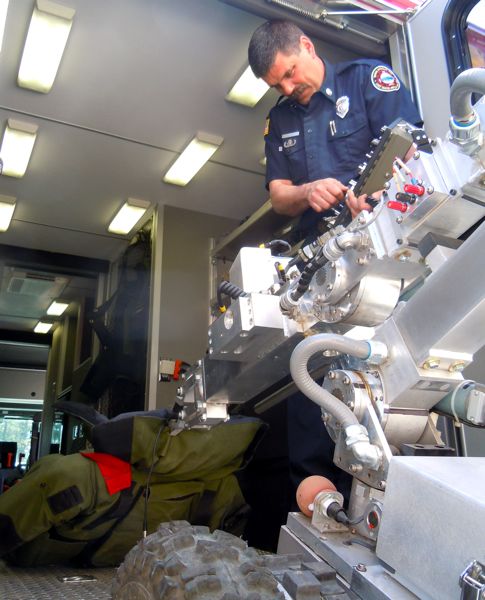
In the Glenbrook station stands a robot weighing 500 pounds, spanning 3 feet, standing 4-feet-high, with a reach twice that length and gun barrels pointed – ready for action. But the irony is, she appeared to have the push-button humanity we’d all wish to tap into during a crisis.

Her gender is really a mystery and the naming will come from a contest at the South Lake Tahoe Fire Fest slated for the fall. Jim Antti, a captain with the department and commander of the bomb squad unit, said they get asked that all the time about her name.

Capt. Jim Antti proves training is a never ending component of being part of the Tahoe Douglas bomb squad. Photos/Susan Wood

She is capable of dragging out a 200-pound person or device. She can also turn on a dime to position herself in compact spaces, Antti indicated as he pushed the toggle switches on the control panel handling the robot through a computer signal.

Forget Star Trek. Remotec’s $88,000 wonder bought with federal grant funds goes where no public safety official wants to go. She’ll go in with her highly trained bomb squad technicians, whether a bomb or just a suspicious package is pinpointed. Weapons of mass destruction are also listed as possible front-line response calls.

“Those are 12-gauge shotguns,” Antti said, pointing to two steely barrels on the robot.

It suddenly became apparent what she’s capable of doing – blowing up a bomb, of course when it’s safe to do so. The “safety” label written in red on the radio-controlled panel was on for good housekeeping, as she prepared to maneuver up a ramp from the back of the half fire truck, half cloak-and-dagger-type hideaway priced at $320,000.

It’s been an up-and-down ride for the robot and the men of the Tahoe Douglas Explosive Ordinance Disposal team formed 15 years ago, although a more informal collective of bomb squad unit has existed for a few decades.

Today’s contemporary unit trains and trains and trains for an average of two to three calls a month. But those calls are often serious, even on the responses to hazardous materials. For that, the robot can sniff out the chemical danger with a sensory device attached to her torso. She can also see – with five cameras on board. She comes equipped with a speaker that is used when she is accompanied by a technician needing to share information. She can walk up stairs and even travel over Lake Tahoe snow just by popping her wheels off.

“She’s designed to go over anything,” Antti said, while pushing buttons. “It’s like a big video game.”

Still, there are no fun and games in these calls. The unit – with its truck a cross between a studio set for the “Jetsons” and “24” — was dispatched to two calls of explosive devices set this spring in South Lake Tahoe.

Tahoe Douglas crews were on hand for one of the region’s worst crimes when a bomb ripped through the second-floor offices of Harveys casino three decades ago. The technicians trained to handle suspected bombs spent more than 30 hours on the device before it blew up.

In April 1995, the unit went to Oklahoma City where a federal building was blown to pieces in the worst domestic terrorism cases in our nation’s history. Even after the fact, the scene requires skilled technicians to maneuver through the rubble.

Then, the 9/11 terrorist attacks hit the nation six years later, and the calls of suspicious devices flourished, along with the funds from U.S. Homeland Security.

“We had a spike of calls after 9/11,” Antti said, adding the Nevada fire department in Douglas County doesn’t mind. “There’s only seven of us, so we depend on the public to recognize a bad situation.”

The Tahoe Douglas unit is one of four specialty divisions in Nevada, covering an area from its base county west to South Lake Tahoe and east to Carson City including the Nevada Legislature with assistance for the state Capitol Police force.

The unit – which collectively spans five decades of experience — joins forces with the ATF and FBI on cases. It assists and trains inside and out in various terrains alongside the other Nevada units on a regular basis. Complacency from fielding a lack of calls is something the unit battles.

“This is why we train,” the fire captain said.

Occasionally, the tactical squad has made the trek to train with forces in Israel where bomb handling may be considered a way of life.

The world is a dangerous place – with bomb recipes easy to get and easy to make for those with warped personalities and the drive to do damage.

“The Internet has certainly not done us any favors,” the commander said, firing up the van’s generator. “Now you can go on the Internet and find out how to make anything. But what you don’t know is whether the person (online) knows what they’re talking about.”

The suspects are charged with felonies.

The selection process for the bomb squad is lengthy, demanding and not for the faint of heart. For one thing, making the unit means being able to wear a 100-pound suit with a ballistic vest and steel plates. This costs $28,000. The helmet, complete with a defroster and radio, runs $10,000.

“Twenty, 30 minutes of work time in a bomb suit, and you’re done,” Antti said.

All the equipment is nicely tucked into closets and compartments in the van. Up front is a fire truck. In back, the van resembles living quarters, with a microwave, coffee maker and refrigerator in case it’s a long call. Two computer screens inside and one outside the truck show the progress of the robot. Floodlights on the back are there to guide the machine.

“We need to be self-contained for a few days,” Antti said.

For undercover cases or those demanding a 4-wheel drive vehicle, Tahoe Douglas fire parks a pickup version of the full van in the Carson Valley.

The unit with van and robot make public appearances, including its annual pilgrimage to the local school’s Drug Store Project to give youngsters an up-close-and-personal view of public safety resources.

“I have been asked many times why do we need a bomb squad up here at the lake. It is easy to see that we have a strategic location advantage, that we can respond down to the valley and assist for incidents, and we protect one of the world’s natural resources along with the casinos at Stateline,” said Eric Guevin, Tahoe Douglas Fire Protection District spokesman.

ngg_shortcode_0_placeholder (Click on photos to enlarge.)


Real estate the big addition to Northstar this season

By Kathryn Reed

TRUCKEE – A ski slope out the back door. That is how the eight townhomes under construction at Northstar are being sold.

East West Partners, which has come out on the other side of bankruptcy, is back in the game at this Truckee resort. While the developer has the rights to more than 1,000 units, build-out isn’t even in sight.

On the other side of the ski hill is Martis Camp, a private gated community on 2,177 acres that accesses the ski resort by the private Martis Camp Express Lift. DMB/Highlands Group is the developer on this project.

Vail Resorts put in $30 million worth of improvements that skiers could use last ski season, but does not have any capital upgrades for the upcoming season.

Plenty of windows let in natural light in the Home Run townhomes. Photo/Provided

Instead, it’s all about developers creating homes for potential skiers to live in.

The remaining 58 cabin home sites at Martis Creek were released this summer; ranging from $500,000 to $2.8 million.

Before those lots went on the market, 75 houses were under construction and 80 were being designed. Nearly $28 million in real estate transactions occurred in Martis Camp in the first half of 2012. Last year set a record for deals at $90.2 million trading hands.

The East West townhomes range between $1.645 million and $2.295 million. That includes the structure – not just a plot of dirt.

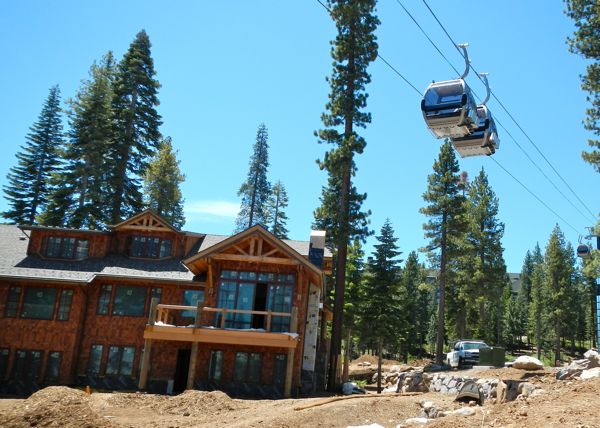
Called Home Run because the homes sit on the ski run by the same name, these eight are in various stages, with two models having just opened. All will be done this month. Two people from the Bay Area and one from Florida have already bought three of the larger townhouse.

The townhomes range from 1,900-square-feet to 3,200-square-feet. Vaulted ceilings provide an airiness. Oversized sliding doors give the feeling of being outside.

Alder is throughout.

“There are a lot of darker woods. There was a shift in design five or six years ago,” Sue Hyde with East West told Lake Tahoe News on a recent tour of townhomes.

Flooring is rustic oak wood and wool carpet, with hydraulic heating. Appliances are all Bosch.

The selling point for these eight – eventually there will be 16 units – is the ski-in, ski-out capability. Riders will be able schuss to the Ritz-Carlton gondola to be whisked to mid-mountain.

The gondola going to the Ritz-Carlton goes through the Home Run development. Photo/Kathryn Reed

These homes are being built to LEED silver specifications, just as East West did with the Village at Northstar. The LED lighting, insulation, appliances, reduced construction waste, location, and lack of need for a vehicle once on site are components of the energy efficiency.

Up the road a bit Q&D Construction crews are putting in infrastructure for the 25 home sites that are all about 1 acre. This is another East West project. Bridges have been built for vehicles, which will be tunnels for skiers. Ski ways have been incorporated throughout the area.

It will be a gated community. Hyde said she expects everyone to be second homeowners.

The home sites will go on sale after the first of the year. A price has not been established.


360-degrees of awe from the top of Ralston Peak

By Kathryn Reed

TWIN BRIDGES – Mount Tallac from the South Shore is an impressive icon. But when it comes to looking at Tallac’s backside from the top of Ralston Peak, the grandeur pales in comparison to the razzle-dazzle Mother Nature provides from this vantage point.

It’s so much better than being at the top of Tallac, too, because the vistas are jaw dropping gorgeous. Civilization is nowhere on the horizon unless ski slopes count.

It’s odd feeling like I was in the middle of nowhere and yet knowing exactly where I was. Familiar landmarks surrounded me as I took in the 360-degree view.

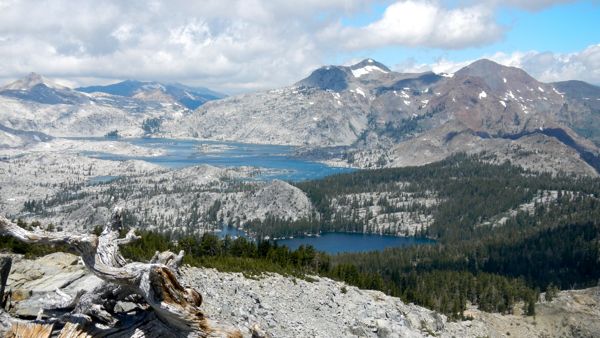
Looking down on Lake Aloha from the top of Ralston Peak. Photos/Kathryn Reed

Barren runs of Sierra-at-Tahoe; splotches of snow dotting Pyramid Peak – which at 9,983-feet is the highest mountain in the Crystal Range and Desolation Wilderness; the pools of Lake Aloha that resemble a moonscape; Price, Jack and Dick peaks looking manageable to climb from our perch at 9,235 feet; Lake Tahoe so vast it could be the ocean; Fallen Leaf so small it could be Heather Lake.

With 50 mph winds forecast for our destination, we were dressed more like a winter hike than summer. Warmth was not what we found on this last Sunday of June, but that didn’t matter – except that it meant we didn’t linger long.

There are 12 women and two dogs making the trek to the top of Ralston. I was not alone in this being my first excursion up this landmark that can be seen from Highway 50 near Horsetail Falls. While there are several routes to get to the top, we start at Echo Lake.

We cut off two miles each way by taking the boat across. It fits all of us. It costs $12 one-way – each person. The boat shuttle is a racket. They have a captive audience and are clearly ripping people off. That’s the only negative.

The ride is beautiful. Larkin delivers us to the dock on the far side where we begin our 8-mile roundtrip journey. (We start hiking at 8:40am and return to the dock at 3pm.)

It starts out rocky. The runners in the group sprint to the lead. Others fall to the back, taking in the scenery of Tamarack Lake that comes up on our left.

There are lupine, phlox, pussy paws, wallflower, Indian paintbrush, shooting star and sulphur buckwheat to photograph. Wildflowers, while not in abundance, dot the landscape in an array of colors.

At this elevation they are smaller than what is found at lake level – dwarf-like, Kim says.

Winter’s sparse snowfall has turned western-facing manzanita black. Lack of water has killed some of these bushes in the backcountry.

While they are a species that burns hot in a fire, dead manzanita is more susceptible to fire than a live plant. Fire is more of a concern for the manzanita trees because it becomes a ladder fuel, Lauri explains.

Trail signs pop up. So many choices for where to play in Desolation Wilderness. Some of the routes are along the Pacific Crest Trail.

We take the second left headed toward Lake of the Woods. We keep her to our right, never reaching her shore. Pyramid Peak – aptly named because it looks like pharaohs could call this mountain home – looms over this lake.

Pockets of snow crop up, but nothing substantial enough to hinder our progress.

We traipse through a soggy meadow before the last ascent to the tip-top.

Mountain hemlock and white bark pine are sprouting from the rugged terrain. They like it at this elevation.

Giddy with delight of making it to our destination and taking in the scenery, we are all smiles feeling like we are on top of the world.

ngg_shortcode_1_placeholder (Click on photos to enlarge.)


Airport agreement expires in 3 months and there is no plan

Publisher’s note: This is the final installment of the three-part series looking at the past, present and future of Lake Tahoe Airport.

By Joann Eisenbrandt

The 29 years since South Lake Tahoe assumed operation of the Lake Tahoe Airport from El Dorado County have proved to be a bumpy ride, peppered with aborted takeoffs and emergency landings. After almost a decade of accusations and heated debate over the appropriate configuration and levels of commercial service, and who should make those determinations, a web of entangled lawsuits had stalled negotiations. In 1992, the contending agencies accepted the Lake Tahoe Airport Master Plan Settlement Agreement to end the litigation. That highly structured agreement provided the framework for commercial service at the airport for the next 20 years.

South Lake Tahoe is already looking forward, literally and figuratively, to its expiration this fall, and has made clear its intention to bring commercial service back to Tahoe. When asked for specifics on the city’s plans for moving forward on this quest, Lake Tahoe Airport Director Sherry Miller said, “We’re still peeling the onion.”

How much crying will be involved in that process depends on three factors: What course the city chooses to follow and when; what things are the same as 20 years ago; and, and what things are different.

According to Miller, the city has three possible paths: Reinstitute commercial service prior to the expiration of the 1992 Settlement Agreement this October and attempt to comply with all its existing provisos; attempt to renegotiate some terms of the Settlement Agreement and then bring in commercial service under those guidelines; or wait until the Settlement Agreement expires and then bring in commercial service outside its confines.

If the city secured a commercial air service provider prior to the expiration of the Settlement Agreement, they would be, Deputy City Attorney Nira Feeley explains, “Confined to what’s in there. The city would need to show compliance with all the mitigation measures in the Settlement Agreement.” If such commercial service continued after the Settlement Agreement expired, the City Council would then, “take discretionary action to authorize commercial service above the decibel levels of the Settlement Agreement and then do a full CEQA (California Environmental Quality Act) analysis of this commercial service.”

If the city attempted to renegotiate the Settlement Agreement and bring in commercial service under amended terms, it would necessitate the involvement and sign-off regarding any changes by all the signatories to the original 1992 agreement – the city, TRPA, League to Save Lake Tahoe and the California Attorney General’s Office.

Lynda Gledhill, spokeswoman for the state Department of Justice, refused to comment and then wouldn’t explain why even though her office was a major player in all of this 20 years ago.

The FAA would also be involved. In 1992, that agency stipulated that the Airport Noise and Capacity Act of 1990 (ANCA) ― which requires all airport operators who have taken federal funding not discriminate with regard to airport access or hinder interstate commerce ― did not apply. They would want to revisit that issue under any revised agreement.

Apart from the ANCA issue, TRPA Associate Counsel Scott Lichtig told Lake Tahoe Newshe believes renegotiating the existing Settlement Agreement would be problematic. “The city could go forward if they met the requirements, but probably not at this stage of the master plan. They are still at Stage 1 instead of Stage 3. The permits were issued for Stage 1 20 years ago. No permit was issued for Stage 2 because they never got there. If the city has a plan for how they could substantially comply and get a Stage 2 permit … but I have a hard time thinking how that would happen. It would be pretty tough to reactivate a Settlement Agreement that for the last 10 years has just been laying fallow on both ends.” (The 1992 Settlement Agreement had three stages spanning its 20-year term, with different allowed enplanement levels, noise restrictions and mitigation measures for each. Commercial service never got past the Stage 1 level.)

Without a plan, Lake Tahoe Airport may remain sleepy. Photo/Joann Eisenbrandt

The third option would be for the city to let the Settlement Agreement expire and then move forward to bring back commercial service. In that case, as City Attorney Patrick Enright explained to Lake Tahoe News, the city would, “Have to negotiate with TRPA to meet all the requirements regarding noise, air pollution and VMT to get a TRPA permit.” Under this scenario, Feeley adds, the city would have one additional decision to make, “whether we do a new master plan or bring in service under the existing master plan – which is the 1992 Master Plan Settlement Agreement. TRPA regulations appear to require a master plan. We are currently looking into whether that requirement is trumped by FAA regulations.”

TRPA External Affairs Chief Julie Regan explains, “If the current plan expires before a new plan is in place, the status quo would continue, i.e., the city would continue to operate the airport as a general aviation facility until a new plan is developed and put in place.”

Not everyone agrees with that assessment, largely because of those things that remain the same as they were 20 years ago.

What remains the same is the core question whose answer forms the foundation for the answers to all other questions at the lake, “Who should speak for Tahoe.”

The list of those who wish to fill that role to one degree or another also remains the same: the city of South Lake Tahoe, Tahoe Regional Planning Agency, California Attorney General’s Office, League to Save Lake Tahoe, Federal Aviation Administration, and of course, the residents of Lake Tahoe themselves.

Airport – good or bad?

The “airport as benefit or liability” debate also lives on. It goes something like this — Does the airport provide a needed and significant economic stimulus to the local Tahoe economy, serve as an effective marketing tool not just for the airport but for the larger community as well, reduce VMT and thereby positively impact air and water quality as part of an coordinated basinwide transportation system, provide local residents and business owners accessible air service in summer and winter, and give the community an irreplaceable lifeline in medical and wildfire emergencies?

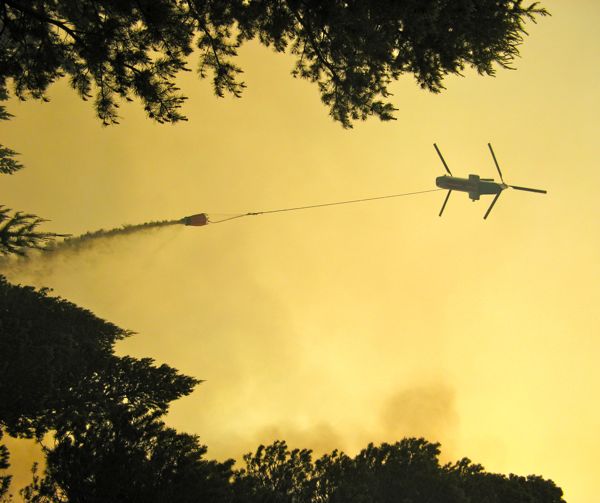
Lake Tahoe Airport was vital to the air assault on the Angora Fire in 2007. Photo/Lake Valley Fire

Or, can the disruptive single-event and cumulative noise levels generated by commercial service never be sufficiently mitigated; is such service patently inappropriate in Tahoe’s rural environment; are any VMT reductions insignificant and overshadowed by the air and water quality degradation from aircraft emissions and on-ground fueling services; are there serious safety and quality of life issues for residents living in the flight path; and, do any monetary benefits derived from commercial service go overwhelmingly to the ski, lodging and casino industries without removing the ongoing airport subsidies draining the city’s general fund?

Each of the mix of local, state, regional and federal Tahoe stakeholders has a role in determining what happens in Tahoe generally and at the airport specifically – it’s deciding who is at the top of the legal-environmental pecking order that has proven to be the sticking point. Problems arise when it is perceived, as George Orwell phrased it so well in “Animal Farm” that, “All animals are equal, but some animals are more equal than others.” It was the inability to replace this perception with a meaningful consensus on how to move forward that led to the lawsuits over the airport in the late 1980s, and the eventual creation of the 1992 Settlement Agreement.

In December 1980, the federal Compact establishing the bi-state Tahoe Regional Planning Agency was enacted. That Compact gave TRPA, “The power to establish environmental threshold carrying capacities and to adopt and enforce a regional plan and implementing ordinances.” The Compact also mandates that with minimal exceptions, no project “may be developed in the region without obtaining the review and approval of the agency and no project may be approved unless it is found to comply with the regional plan and the ordinances ….” The Compact goes on to say, “The agency shall seek the cooperation and consider the recommendations of counties and cities and other agencies of local government, of State and Federal agencies … and of civic groups and private persons.”

Working out the kinks of how power and cooperation can work effectively together has remained challenging, often producing mixed messages. For example, the Noise Element of the draft EIS for the 2012 Regional Plan update states, “Although local jurisdictions have established noise-level standards, such policies are not described in detail here because, for all projects with the Lake Tahoe Region, the TRPA-adopted noise threshold standards and code take precedence over local jurisdictions’ noise ordinances.”

The city believes it’s been at the bottom of the environmental pyramid for a long time. At the Feb. 7, 2012, City Council meeting, Mayor Pro Tem and Airport Commission Chairman Tom Davis expressed his frustration with TRPA, “In their quest to protect us, they’ve made us obsolete.”

City Manager Nancy Kerry says of the bi-state agency, “They have authority because of the bi-state Compact, but environmental concerns shouldn’t shut down a functioning airport. I don’t think TRPA regulations will stop commercial service. … We’re not going to ignore the goals of the Settlement Agreement. We don’t believe there are any thresholds that can’t be met. The goal is to bring commercial service back here.”

FAA will have a loud voice

Because the facility involved in this regulatory matrix is an airport, partially funded and maintained with federal money, the FAA becomes a key player, further destabilizing the hierarchy.

“The FAA controls the actions that go on at an airport,” Kerry explained. “Whether we want to use it for an air show, what we do with the hangars … it’s an airport. Its uses and functions are governed by the FAA.”

“FAA is involved in airport planning,” Advisory Circular 150/1570 notes, “to ensure that proposed airport development is safe, has utility, and meets airport design standards, and identifies obvious issues that could become environmental concerns.”

Fernando Yanez, planner at the FAA’s San Francisco Airports District Office, explains that once Airport Improvement Program (AIP) money is used, the FAA wants to, “be sure our federal investment is a wise investment.”

According to FAA guidelines, the city does not have to prepare a new master plan before reinstituting commercial service, even though given all the circumstances that may be the best choice.

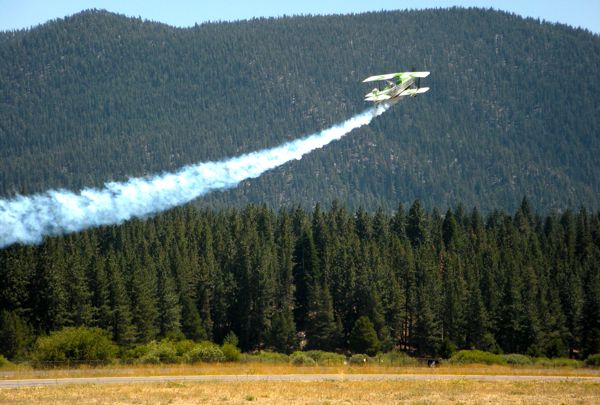
The August air show and this month's celebrity golf tournament are when the airport gets the most use. Photo/LTN file

“A master plan shows where the operator wants the facility to go. There hasn’t been such a planning document at Tahoe in a while,” Yanez told Lake Tahoe News. “They could choose to do a new one since things have changed – the economy and the social economy. It can be an update or a narrative report in more depth, and then there’s the master plan, a full-scale planning document.”

The airport sponsor is primarily responsible for airport master planning, and the actual master plan components represent the airport sponsor’s views, not the FAA’s. The elements and complexity of the master planning process will vary depending on the circumstances of each individual airport.

FAA review and approval are required for only two master plan components – the Forecast of Demand and the Airport Layout Plan. The Forecast of Demand predicates future levels of service (operations) and the type(s) of aircraft providing that service.

“It’s statistical,” Yanez explains. “It’s up to the airport to convince us that the data they’re using is reasonable and their premises are realistic.”

The second required federal approval is of the Airport Layout Plan, which shows existing airport facilities, provides a blueprint for future airport development and shows that consistency with safety requirements and community land use plans are maintained.

The next step is the NEPA (National Environmental Protection Act) process, which in California, would run concurrently with CEQA. At the conclusion of this environmental process, a preferred master plan alternative is selected and then federal grant funding for project design kicks in, followed the next year with funding for the actual project implementation. According to Miller, the cost of a full master plan is between $450,000 and $500,000, with the financial split generally being FAA 90 percent and the airport operator 10 percent. The airport receives yearly federal “entitlement” funding of $150,000 and can also seek additional “discretionary” AIP funds for such projects.

TRPA has a different perspective. “The key to the process is the update of the master plan.” Julie Regan said. “If there is a substantial change in operations, the city would do an update of the master plan. … That has been our discussion for many years with the city … looking at where we are today in the 21st century.”

The League to Save Lake Tahoe also sees a new Airport Master Plan as essential, as expressed in its 2006 review of the airport’s positives and negatives, “The forum to address such trade-offs and questions as part of a reassessment of the Lake Tahoe Airport and surrounding land is an update of the Airport Master Plan.”

“TRPA regulations appear to require a master plan,” attorney Feeley agrees, but adds, “We are currently looking into the issue of whether that requirement is trumped by FAA regulations. ANCA says that any restrictions placed on an airport by an entity other than the operating entity (the city) are pre-empted by the standards set forth in ANCA. It’s never a clear question of where TRPA law is pre-empted by other federal laws and regulations because TRPA is a federal agency. It is the city’s position that ANCA trumps TRPA’s regulations, but at this point it’s premature to say what the FAA’s position is.”

Differing definitions

The problem centers on TRPA’s maximum permitted single-event decibel levels for commercial aircraft that are more restrictive than the FAA’s. TRPA’s RPU goals for noise require an Airport Master Plan to include, “Implementation and enforcement of the single event noise thresholds for aircraft.”

ANCA requires that an operator receiving federal funding must “make its airport available as an airport for public use on reasonable terms and without unjust discrimination to all types, kinds, and classes of aeronautical activities, including commercial aeronautical activities offering services to the public at the airport.”

Which noise and/or access restrictions mandated by an agency other than the FAA or the city could prove discriminatory is the issue.

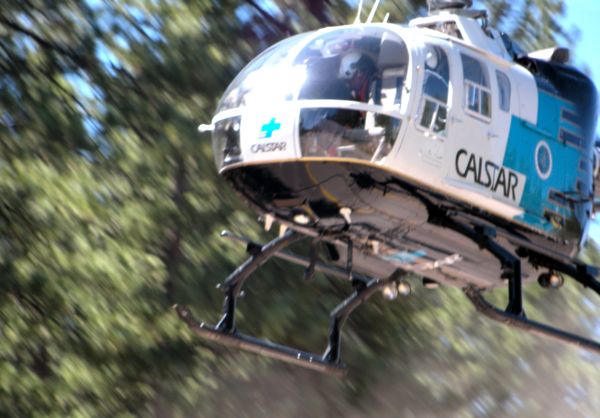
CalStar -- the air ambulance -- is based out of the South Lake Tahoe airport. Photo/LTN file

“Ultimately the courts decide if we get to that point of who trumps who,” Regan affirms. “The bi-state Compact was agreed to by Congress. We have this framework. … We have to work underneath that framework. If there’s a conflict about the regional role of TRPA, the courts will decide as they have over the last 40 years. But we can work together to find compromise. When we have issues, we try to work it out without involving the court system.”

TRPA Associate Counsel Scott Lichtig adds, “Those are questions that we litigated for years in the ’80s and could spend years litigating again. That’s not the best use of time. TRPA would argue that the 80 dBA standard is currently applicable, but we are hoping to engage with the city to see what they need for dBA threshold standards and what technology is today, to come up with a regulatory framework that allows them to have commercial service without disturbing the environment. We can sit down with all the different stakeholders in the basin and come forward with something that doesn’t lead to litigation.”

League Executive Director Darcie Goodman-Collins believes some things are the same and some are different. “Our primary role has always been to speak up for the environment, so that this factor is not lost or forgotten in planning discussions. What will change is the way we do this. We are aiming to build a more mutually respectful and collaborative communication process with all stakeholders … we are now more committed to listening to alternative viewpoints, and doing our part to tone down the bickering.”

In the city’s press release following the settlement of the League’s lawsuit against the city’s General Plan update, Councilman Davis commented, “It’s time to put an end to lawsuits as environmental policy and direct our resources to real improvements.”

The city believes its willingness to consider and engage the Tahoe community in the airport planning process, along with the improvements in aircraft technology, will prove to be important in avoiding a repeat of the airport’s lawsuit-ridden history.

Miller explains, “The largest difference is that the city is a different city and the airport is a different airport. Technology has changed with quieter airplanes that cause less pollution. Airport managers used to operate them like this is our airport and we’re going to do what we want, when we want. It’s different today. We need the community’s buy in and support to make this successful.”

Economics plays a role

The change in the economic climate and its devastating impacts on Tahoe is recognized by everyone, but how big a role commercial air service might play in reversing that depends on who you ask. When asked, Kerry answered, “I used to hear people in our town say they’re not impacted by the tourist trade. Today nobody says that. The great recession leveled that discussion in the community. We need to create a sense of demand and be a choice. One piece is commercial air service. There are so many vacation choices today. The ones that do well have a close by airport. Promoting Tahoe flights is actually promoting Tahoe.”

As Davis puts it, “This town’s dying a slow death. We need a better mousetrap.”

TRPA recognizes the need to revitalize the Tahoe economy, but tempers it with their environmental perspective. “TRPA is part of this community. We need to pick up the economy of our community today. We’re in a world of hurt,” Regan says. “We’re supportive of programs that help the economy, but with an economic boost that is also compatible with the special environment we live in.”

The expiration of the 1992 Lake Tahoe Airport Master Plan Settlement Agreement remains some months away. The city has begun “reaching out” as Kerry put it, to commuter airlines and will base its choice on route structure and will look to use the same Bombardier QUAD 400 67-seat turboprops that now serve Mammoth. They plan on initially targeting the Los Angeles and San Diego markets where they feel the lack of air transportation has kept the number of visitors down. “There’s a pent-up demand in that (Los Angeles) market,” Davis is convinced, “even with no marketing.”

But marketing, Davis confirms, will be an important part of the city’s strategy once a commercial service carrier has been selected, with the city hoping to partner with LTVA, the Tourist Business Improvement District (aka the hotels) and South Tahoe Association of Resorts (the old Gaming Alliance). “It may be a tough sell to get them to buy in, but there’s the opportunity because business is down, there’s the impact of Indian gaming. The economic model here has changed.” Davis added that some type of “marketing subsidies” might also be involved.

The city put out a “request for qualifications” for airport engineering and planning consultants as mandated periodically by the FAA because they will be receiving federal funds for any future master planning or airport improvement processes. They recently entered into a “blanket agreement” with Reinard Brandley, who has provided consultant services to the airport for 50 years and has a history with TRPA and a familiarity with the environmental issues. No Supplemental Services Contract has been signed for services specifically related to the creation of a master plan. The city may also decide to solicit master-planning proposals from other consultants as well.

Lichtig confirms the city, “Has had very general discussions (with TRPA), but we’ve told them to come to us with an idea of what you’re looking for ― what type of jets they are thinking to bring in here ―and we’re more than happy to work with you. It’s not as simple as TRPA saying yes or no. There are a number of major stakeholders. I’m trying to get everyone at the table.”

Communication among the stakeholders is vital, but equally vital is communication with local residents and businesses. In the years leading up to the 1992 Settlement Agreement, the failure to involve the public early enough in the planning process created a backlash of anger and distrust down the line. The city says it plans to change that this time around.

“People are skeptical, and rightly so,” Kerry recognizes. “We’re going to get community support through outreach and education.”

Right now there’s no way of foretelling the actual path ― bumpy or smooth, twisting or straight, short or long ― that the city’s quest for commercial air service will take. There are so many things that everyone agrees on, yet so many that they don’t. All the stakeholders have no problem defining the challenges, but arriving at a consensus on how best to meet them has proved to be much harder.

“I hope,” Lichtig says decisively, “that this process unfolds 180 degrees opposite of how it unfolded in the past with a decade of litigation and lawyers. Everyone is struggling with budgets, TRPA, the city. I can’t fathom anyone wanting to fight this through the courts.”


Airport creates environmental dogfight at 6,200 feet

Publisher’s note: This is the second of three stories looking at the past, present and future of Lake Tahoe Airport.

By Joann Eisenbrandt

In the mid-1800s, white trappers and settlers spilled over from the gold mining encampments of the California Mother Lode and changed Lake Tahoe forever. Attempts to designate the lake as a national park failed in 1905 and again in 1935 because private enterprise and development already dotted the lake’s entire perimeter. The focus then turned to how its human inhabitants could interact with the Tahoe environment without destroying it. In many ways, the Lake Tahoe Airport has become a poster child for this struggle.
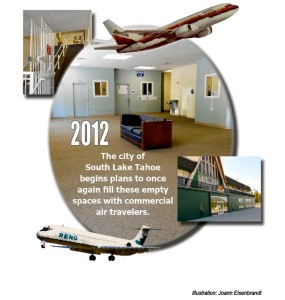
The 1992 Lake Tahoe Airport Master Plan Settlement Agreement, which has regulated commercial air service at Tahoe for the last two decades, expires this October. There has been no scheduled commercial service to Tahoe since 2000, but the city is actively laying the groundwork for its return, rekindling the debate over its positive and negative impacts.

In 1985, while the pre-Settlement Agreement distrust and fighting was still raging, California Deputy Attorney General Ken Williams explained to this reporter, “The problem is that things at Tahoe tend to polarize so fast. Once you get into a tug-of-war like that, it’s very hard to let go of the rope.”

Tahoe’s major stakeholders ― South Lake Tahoe, Tahoe Regional Planning Agency, California Attorney General’s Office, League to Save Lake Tahoe and with regard to the airport, the FAA ― all clearly recognize the basin’s two inseparable yet polarizing issues, environmental preservation and economic survival. As Julie Regan, TRPA’s external affairs chief, told Lake Tahoe News, “Our entire Regional Plan is based on restoring the lake and revitalizing our community. We’re supportive of progress to help the economy, but we live in a fragile environment. We need an economic boost that is also compatible with sustaining the special environment we live in and the serenity of Lake Tahoe.”

Darcie Goodman-Collins, executive director of the League to Save Lake Tahoe, says something similar, “This is really a false dichotomy. Without a clear blue lake, there can’t be a healthy economy at Tahoe, so the two must go hand-in-hand. Economic vitality is important in any community because it enables investments in environmental restoration and protection. … The challenge is building an economy that will both thrive over the long term and benefit the lake.”

South Lake Tahoe City Manager Nancy Kerry agrees, “We look at what law governs airport operations and how do environmental concerns fit in with airplane regulations. We have things we want to do to help our community find a better life. We all live in Tahoe and work here. We all love Lake Tahoe.”
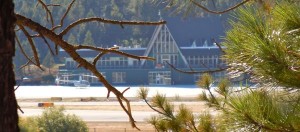
For some, it's hard to see the benefit of Lake Tahoe Airport through the trees -- literally and figuratively. Photos/LTN file

But loving the lake and letting go of the rope can be two different things, especially when the future of Tahoe is seen as hanging in the balance. Even now, the line between cooperation and lawsuits remains a thin one. In April 2011, the League expressed its concerns over the future of the airport in a letter to the city Planning Commission regarding the city’s General Plan update, “The city of South Lake Tahoe General Plan EIR must provide more information about plans for the South Lake Tahoe Airport and the impacts it would create. The city is pursuing airport development, but the EIR does not provide enough information about potential air quality and noise impacts that would result from the planned development.”

The League’s lawsuit was subsequently dismissed in February 2012, when the two parties reached a settlement agreement. The issues surrounding the Lake Tahoe Airport remain unsettled.

First of all, noise

Noise isn’t just sound. It’s unwanted sound. Just mention “SnowGlobe” and you realize how noise can send otherwise calm people into a frenzy. Understanding the emotional underpinnings of noise is as important as understanding the statistical measurement of noise itself. As the FAA recognizes in its Aviation Noise Effects Advisory Circular, “It is not possible to state simply that a given noise level from a given noise source will elicit a particular community reaction … an individual’s attitudes, beliefs and values may greatly influence the degree to which a person considers a given sound annoying.”
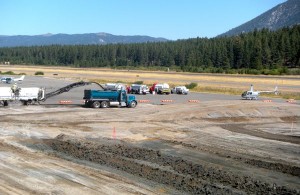
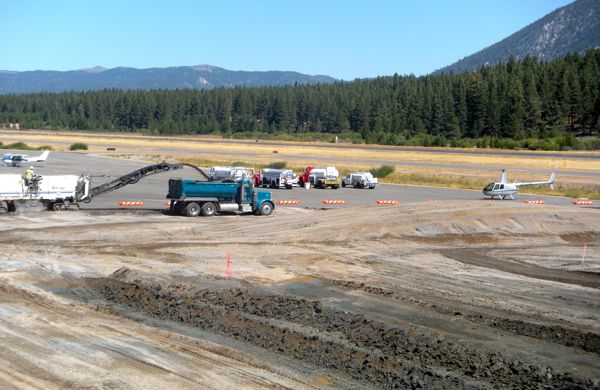
FAA mandates the runway be kept in good working order.

Technically, noise events, quantified in decibels (dB), are measured as “intrusions” over the existing background or “ambient” noise levels, which have been estimated to be much as 20 decibels lower in a rural setting, such as Tahoe. Acoustics, the science of noise measurement, is complex, and depends on a number of precise factors, and different agencies such as the FAA, California Division of Aeronautics and TRPA have all developed descriptors for time-measured noise events.

The 1992 Settlement Agreement contains specific aircraft arrival and departure decibel limits, and a monitoring and complaint system to track them. There has been significant disagreement over the decibel levels, but the reason why discussions have turned so quickly into emotionally charged ones is the fact that such noise itself is seen by many as totally inappropriate in Tahoe’s unique environment. As one respondent to a phone survey done by this reporter in 1988 put it succinctly, “It’s sick to have an airport in beautiful country like this.”

TRPA’s Regional Plan update pinpoints noise as a significant impact that needs to be tracked and mitigated. “High noise levels can reduce the public’s enjoyment of the natural environment, impact quality of life for residents, and disturb native wildlife.” The TRPA Compact requires the adoption of “environmental threshold carrying capacities” for the Lake Tahoe region. These are the minimum standards TRPA believes are needed to maintain the lake’s scenic and natural values. One of those carrying capacity standards is for noise.

Noise can be measured as a maximum single-event level or as a cumulative noise level over time. TRPA has established Environmental Threshold Carrying Capacity Noise Standards for both – a Single Event Noise Level (SEL) for single, non-repetitive events and a Community Noise Equivalent Level (CNEL), which averages cumulative noise levels in a specific “noise contour” over a 24-hour period with extra penalties assigned to nighttime aircraft noise events. These noise standards are measured in decibels as A-weighted (dBA), de-emphasizing very high and very low frequency sounds in the same way they are perceived by the human ear.

TRPA’s noise standards for commercial aircraft have been disputed by the city since it first took over the airport from El Dorado County in 1983. At that time, the city contended that TRPA’s dBA limits for commercial aircraft takeoffs and arrivals were taken arbitrarily from FAA Advisory Circular 36-3B, ― which establishes noise standards by aircraft type ― with the express intention of banning specific aircraft from Tahoe whose test ratings showed they couldn’t meet TRPA’s then single-event daytime standard of 84dBA, while allowing others. TRPA planners disagreed, stating they “drew the line” based on the best-available technology of the time, the DC-9-80, which could meet that standard.

In the 2012 Regional Plan Update Goals and Policies, TRPA’s single-event noise thresholds for commercial aircraft are 86 dBA arrival and 80 dBA departure daytime, and 77.1 dBA nighttime (8pm to 8am) with a CNEL level in areas impacted by the airport of 60dBA.

Noise was clearly a defining issue leading up to the 1992 Settlement Agreement. The city believes it should be less of a problem today. Airport Director Sherry Miller says comparing commercial aircraft from 1992 with today’s new generation like, “comparing apples and oranges. Technology has changed. Airplanes are quieter and less polluting.”

Mayor Pro Tem and Airport Commission Chairman Tom Davis agrees. “Aircraft have changed to Stage 3. I really don’t see noise as an issue now. We’re looking for regional service, not big jets. Like the Quad400 at 68 decibels and there are even quieter ones. The technology is there.”

Michael Golden, president of Mountain West Aviation, the fixed-base operator at the airport, explains, “The environmental impacts of flight in general are far less than those of motorized transportation. It uses the least energy and is the most environmentally friendly. Because of the rising costs of fuel, aircraft had to become more efficient to meet the market demand, and making them more efficient made them quieter. As speed increases, you need more power to battle the wind resistance, so there were changes to engines and airframes, using air foils at the wing tips. Aircraft noise is not just the sound of the engines, but the sound of the aircraft moving through the air. The more efficient it is, the quieter it is.”

FAR (Federal Air Regulations) Part 150 establishes the FAA’s system for measuring airport and background noise, determining the exposure of individuals to noise and creating a standardized airport noise control and compatibility planning program. It works in conjunction with FAR Part 36 that “contains noise certification standards for most airplane types, generally requiring newly designed and manufactured aircraft to be significantly quieter than older aircraft.” Part 150 requires the airport to develop noise exposure maps ― “noise contours” ― that spread out in rings from the actual airport itself and show different acceptable CNEL noise levels for different land uses.

That requirement is met by the Lake Tahoe Airport Comprehensive Land Use Plan that establishes the airport’s planning boundaries and creates a land use plan defining compatible land uses for future development around the airport. It includes noise restrictions and regulations from the 1992 Settlement Agreement and recognizes, “The Lake Tahoe Airport is an extremely noise sensitive airport. … The impact of aircraft noise on the basin can and should play a role in decisions made regarding the development of the airport and its surrounding area.”

The League to Save Lake Tahoe questioned how well aircraft noise impacts could actually be mitigated. Its November 2006 Lake Tahoe Airport Impacts Report says, “Larger commercial and corporate aircraft are generally louder than smaller aircraft, which directly and negatively impact all who live, work or visit near the airport or flight path.”
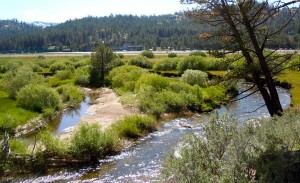
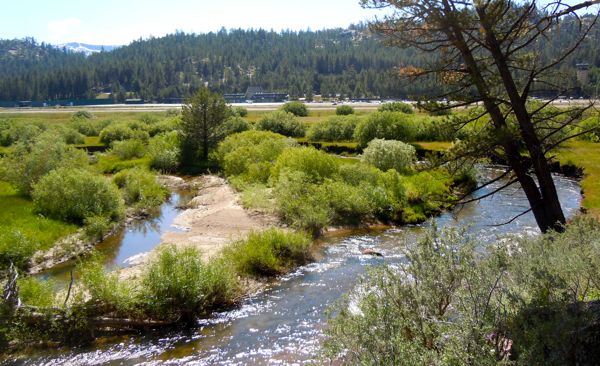
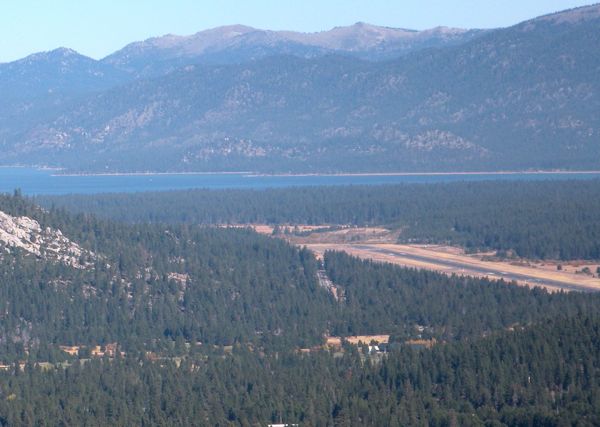
Lake Tahoe Airport is next to the Upper Truckee River.

In its April 2011 letter challenging parts of the city’s General Plan update, the League continued to remain skeptical that “airport noise will not create a significant impact. What data is available to assert that current air traffic noise does not already impact the TRPA noise threshold and that the any future increase in air travel to and from the Lake Tahoe Airport will not further impact the TRPA noise threshold?”

Every five years since 1987, TRPA has produced a “Threshold Evaluation Report” assessing the effectiveness of its Regional Plan. The latest 2011 Report was peer reviewed by an independent panel of scientists coordinated by the Tahoe Science Consortium. Regarding noise, it found, “the approach used to assess and report Single Event and Cumulative Noise Event conditions to be overly complex and recommend that it be comprehensively reviewed and simplified … as applied and interpreted, achieving adopted standards is infeasible. Enforcement too is challenging due to the transient nature of sources of noise and limited enforcement mechanisms to achieve adopted standards. Noise standards and assessment methodology should be reviewed and considered for adjustments.”

The TRPA’s Regan explains the airport was “essentially carved out of the RPU because it’s a specific set of concerns,” including noise, which will be addressed more fully and updated on a separate track. She estimated this process might take several years. Such a re-evaluation of TRPA’s noise thresholds and assessment methods could be a potentially significant change in the approach to noise measurement and enforcement. It is unknown exactly how events will play out if the city begins the process to reinitiate commercial service before a fresh look at TRPA’s noise thresholds has been completed.

Even with improved measurement methods, removing the emotional component of the noise issue will be difficult as it cuts to the heart of the “who speaks for Tahoe” question. Noise is not just sound. It’s unwanted sound. And unwanted all the more by many because it’s happening at the lake.

Air quality, water quality and VMT

Just as there is a TRPA threshold for noise, there are also thresholds for air and water quality and the requirement for mitigation measures for projects that might impact them. TRPA and the League to Save Lake Tahoe view automobiles as a major source of the emissions which create those pollutants in the air which eventually affect the lake’s clarity – imagine that endless chain of cars creeping slowly from Stateline to Echo Summit at the end this holiday weekend. How many miles cars travel in the basin or VMT (vehicle miles traveled) is seen as having a direct impact on air and water quality. The TRPA Compact has the goal of reducing yearly VMT 10 percent from its 1981 base-year levels.

But what if more of those visitors came by airplane? And what if air travel was part of an integrated regional transportation system? Would the drop in VMT from cars offset any pollutants, specifically nitrous oxides (NOx), created by the aircraft themselves?

The League says, “No.” Its Lake Tahoe Airport Impacts Report contends the “re-introduction of commercial air service to the South Lake Tahoe airport would likely emit far more air pollution into the basin than if the expected passengers instead drove automobiles to the basin,” and goes on, “Contamination from lead additives still widely used in aviation fuel near the airport can result from leaks or spills and from the lead-based aviation fuel particulates being blown into the surrounding meadow, forest and waterway.”

In the League’s April 2011 letter challenging the city’s General Plan update, it added, “State, federal and TRPA standards for ozone are currently out of compliance in the Tahoe basin. Ozone is detrimental to human and environmental health. Ozone precursors resulting from airport operations are overlooked in these findings and must be considered. Additionally, CO and particulate are produced by airport operations.”

Airport Director Miller believes advancements in aircraft technology have greatly mitigated such impacts. “All I can tell you is that the aircraft we will be attracting are a new generation and produce significantly less pollution. Research of a 1980’s B-727 versus a 2012 Q-400 will show you the difference. With older 727s there was some environmental destruction. They were huge pollution producers. You could follow their grey exhaust trail as they took off. That’s rare now. I can see why there was so much upheaval over air service in the past.”

Air pollution also affects water quality. TRPA’s goal is to “reduce nutrient and sediment loads for surface runoff, groundwater and atmospheric sources to meet 1967 to 1971 levels of algae and water transparency measured in Lake Tahoe.” The Lake Tahoe Total Daily Maximum Load (TMDL) identifies fine sediment particles, nitrogen, and phosphorus that are discharged into the lake from land-based and atmospheric sources that add nutrients to the lake and impact water clarity. Because most of these come from automobiles, reducing VMT is seen as a key to reducing water pollution as well.

Kristi Boosman, TRPA public information officer, adds, “We are looking at what science says about major pollutants. We are dealing with a holistic system, not silos. Our RPU takes that into consideration. The health of each part of the system is critical to the health of the lake. That’s the definition of sustainability.”

The city believes commercial air service will mean less automobile travel, less VMT and consequently, less pollution. For TRPA, Regan explains, “Commercial service as a VMT reducer is an open question. We need to do a more detailed analysis of where the airport fits into the VMT question. General aviation is not reducing VMT at this point, but there’s a variable because we don’t know about commercial service.”

But how is the airport’s VMT scorecard produced? Whether commercial service has a positive VMT “savings,” depends on the ratio of “diverted” passengers – those who would have driven to Tahoe if there’d been no air service to “induced” passengers – those who came because there was air service. Also factored in is the transportation mode that visitors arriving by air use once they are here – rental car, bus, shuttle – and how much VMT they accrue in the mode they’ve chosen while in the basin.

A July 1984 study by Kyung-Il Ghymn from UNR showed 69 percent of airline passengers were “diverted,” producing a significant savings of 89.9 VMT from each air carrier operation. These figures were based on flights by AirCal’s 737-300s, with much larger passenger loads than are being anticipated under any current return to commercial service. The League and the California Attorney General’s Office questioned these figures, pointing to when and where the survey was done – on a holiday weekend at the airport― saying this produced a pre-selected, non-scientific sample.

The city views the airport’s VMT-reducing role as important within a larger coordinated basinwide transportation system context. Still, the question remains how many flights using smaller regional aircraft would be required to create a significant VMT reduction and would any “savings” be overshadowed by the airport’s negative environmental impacts.

Financial impacts

Setting the environmental question aside for now, will commercial service provide an economic benefit to the larger Tahoe economy? The 1984 Ghymn study also included a Passenger Profile Study that tracked visitors’ length of stay and daily expenditure patterns. It concluded that with average stays of 5.4 days and daily expenditures of $67 the gross annual expenditure by commercial airline visitors was just more than $31 million. Factoring in expenditures by general aviation visitors and payroll figures from airport tenants, the report put the total impact at $57 million in 1984 dollars.

A voting precinct is one of the airport's main uses.

A survey, not restricted to airline passengers, was done by the Marketing Council, predecessor to the Lake Tahoe Visitors Authority, in 1985, and many other South Shore visitor surveys have been done by various agencies since. These surveys not only make predictions on direct impacts ― actual dollars spent ― but also use a multiplier to gauge the “rollover” or “trickle down” effects as those dollars are re-spent throughout the larger Tahoe community. Not everyone agrees on whether the money actually trickles down throughout the local economy or just goes directly to the casinos, ski resorts and other large California or Nevada properties.

In 1989, Laurel Ames, then consultant to the League, told this reporter, “My guess is that the amount of dollars spent on the airport could be circulated, or even thrown out of cars going down Highway 50 and have a better effect and be spread more evenly throughout the economy.”

City Manager Kerry sees it differently. “The airport is in South Lake Tahoe. You could make the argument there’s no trickle down benefit if the airport was in Zephyr Cove. We are the direct beneficiaries of this airport. People get off the plane, take a taxi, car or bus and go through our town … statistics back up the fact that people are no longer coming here just for the casinos, they come here for vacations.”

In 2007, the city commissioned RCC Associates, a Boulder, Colo.-based firm, to do an off-airport economic impact study. It used five scenarios with varying start dates for the return of commercial service, varying levels of enplanements and varying speeds at which yearly enplanement levels would rise at the airport through December 2012, using newer Boeing 737 138-seat and Bombardier Q400 70-seat aircraft, as well as one scenario with general aviation service only.

All of the scenarios with commercial service projected enplanements ranging from 300,000 to 430,000 passengers annually, with cumulative direct and multiplier impacts over the years of service ranging from about $111 million to just more than $1 billion, with the city “capturing” 40 percent to 60 percent of visitor spending. The report included the disclaimer that it was, “not intended to provide a definitive estimate of the likely economic impacts of TVL” because of “the lack of recent operating history at TVL, and the inherent margin of error in the many modeling assumptions which are required to project economic impact,” but was meant as a “jumping off point” to facilitate discussion of the airport’s potential economic impacts. (TVL is the FFA’s designation for Lake Tahoe Airport.)

Some of the report’s 2007 assumptions are no longer valid, such as the low awareness by visitors of the proximity of the Reno airport, whose aggressive Tahoe-linked marketing has greatly increased that awareness; the willingness of travelers to spend more for the convenience of flying directly into Tahoe, which didn’t anticipate the economic downturn; and the attractiveness of redevelopment and the convention center, which many never be completed.

The city points to Mammoth as a contemporary example of commercial service-generated economic impacts. It is also a mountain airport, with regional service provided by Bombardier Q-400 turbo-prop aircraft – the city’s preferred choice. Kerry states that, “Mammoth estimates that (commercial) air service brings in $220 million a year.”

While Mammoth Airport Manager Bill Manning did not confirm an exact figure, he told Lake Tahoe News, “We’ve done a lot of analysis on it. Last year we did a study. If you take enplanements, what’s spent per day, say $500, for five days and use an economic multiplier, it’s simple to come up with the economic impact.”

Mammoth Airport’s annual enplanements are about 35,000. He added, “It’s huge for the local population to be able to get out of here and get back; to start a business and be able to get to L.A.”

The study was privately financed, so more specific details were not available.

With all such studies, how one looks at the results depends on how accurate one thinks the raw data is, how valid the sample of respondents is and how appropriately the survey questions themselves were framed. Even if one accepts the results, are they offset by the costs of running and maintaining the airport itself?

The city currently spends close to $500,000 annually keeping the Lake Tahoe Airport open. This figure will decrease to about $300,000, Kerry says, once the hangars that were built are paid off and start bringing in revenue. She adds, “Most airports are not moneymakers,” nor are they expected to be. The addition of commercial service, she believes, will eventually help the airport reach break-even.

The League, in its 2006 analysis of the airport, brings it back to the question of tradeoffs, “Do the economic and transportation benefits from the Lake Tahoe Airport outweigh the costs to the environment, such as air and water pollution, and community, such as noise and tax subsidies?”

Noise. VMT. Air quality. Water quality. Economic vs. environmental impacts. All of these issues will play a part in the process as the city moves toward returning commercial service to Tahoe. How much each of will impact that process, and how closely the process itself it will resemble the conflicts over commercial service of the past, will remain unknown until the city has presented a more fully defined plan.

 Part three on July 7: What’s the same as 20 years ago and what’s different and how that will affect the city’s search for commercial service.



Lawsuits grounded commercial service in Tahoe for 20 years

Publisher’s note: This is the first of three stories looking at the past, present and future of Lake Tahoe Airport.

By Joann Eisenbrandt

South Lake Tahoe wants commercial airline service to return to Lake Tahoe Airport. This isn’t news, but it’s moved to the forefront with the expiration this October of the 1992 Lake Tahoe Airport Master Plan Settlement Agreement ― a complex document that has formed the regulatory framework of commercial service at the airport for the last 20 years.

The answer to why this is significant today lies in the past.

The 1992 Lake Tahoe Airport Master Plan Settlement Agreement’s goal was to put to rest a swarm of counterpunching lawsuits and years of acrimonious fighting over the levels, value of and right to control commercial air service at the Lake Tahoe Airport during the mid-1980s and early-90s. At a settlement conference on Sept. 21, 1992, the warring stakeholders ― South Lake Tahoe, California Attorney General’s Office, Tahoe Regional Planning Agency, League to Save Lake Tahoe and Federal Aviation Administration ― symbolically buried the well-bloodied hatchet.

The lawsuits were dismissed and replaced with the minutely-detailed three-stage Settlement Agreement establishing tightly-controlled parameters for commercial service including: the allowed decibel levels of incoming and departing flights; enforcement of a list of presumptively-banned aircraft which could not meet those noise standards; annual noise level averages surrounding the airport; a tiered increase in the number of allowed yearly enplanements; environmentally-focused facility improvements; ongoing studies to determine traffic counts and vehicle miles traveled; a list of environmental mitigations and public education the city must perform; limits on and fees for rental cars; and an upgraded noise monitoring, reporting and complaint system, to name just a few.

On the surface, this was a fight over commercial airline service, but at its heart it was part of the larger struggle to answer the quintessential Tahoe question, “To whom does Tahoe belong?” and its corollary, “Who should be in charge of crafting the blueprint for its future?”

Scheduled jet service into the Lake Tahoe Airport ended in August 2000 when Allegiant Air, the last of a string of commercial and commuter airlines flying under the guidelines of the Settlement Agreement, ceased service. Then, as now, the city viewed the airport as an integral component of Tahoe’s economic survival. Mayor Pro Tem and Airport Commission Chairman Tom Davis, an active participant throughout the airport’s troubled history, realizes, “There’s valid skepticism in town about this airport, but we have a vision. I challenge the naysayers who don’t have a solution. There’s now a whole generation behind us that knows we need a balance…. We have the airport. We have the asset. We just need an airline.”

City Manager Nancy Kerry agrees, “We have this facility. What is its best and highest use? A general aviation airport is just a waste of space. We need to invest now so we’re ready when the economy recovers. It will have very minimal impact on the environment, but have a great impact on the economy.”

Not everyone has seen it quite that way. In a 2006 Lake Tahoe Airport Impacts Report, the League to Save Lake Tahoe asked, “Is the Lake Tahoe Airport, particularly commercial air service, part of the solution or part of the problem in terms of meeting the widely-supported goal of transporting people to and from the Lake Tahoe Basin in ways that have fewer environmental impacts? Do the economic and transportation benefits from the Lake Tahoe Airport outweigh the costs to the environment, such as air and water pollution, and community, such as noise and tax subsidies?”

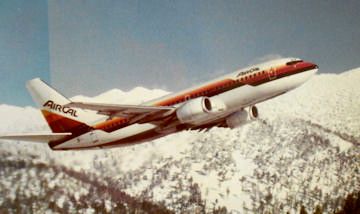
AirCal was one of several commercial airlines that used to have regular flights into Lake Tahoe Airport. Photo/Provided

But who should speak for Tahoe? In 1989, Tom Martens, then executive director of the League to Save Lake Tahoe, told this reporter, “Tahoe belongs to the people of the United States and of the states of California and Nevada, more than to the local people unfortunately … because Congress and the states of California and Nevada declared it a national resource. They did that because of local mismanagement, so what may once have belonged to the local folks, doesn’t anymore, and probably never will. Without regulation from outside, Tahoe would have been gone.”

Taking a look back

In the 1940s, Lake Tahoe was a sparsely populated, quiet summer getaway. There was no city of South Lake Tahoe, no TRPA, no League to Save Lake Tahoe, few year-round residents, no visible conflict between economy and environment, and no commercial-service airport.

Following World War II, the lake’s population began to expand, and with the 1960 Squaw Valley Winter Olympics, everything changed. A building boom to accommodate the influx of visitors brought a spurt of residential and commercial development, especially on parcels fronting Highway 50. Motels and shopping centers began to dot the landscape. Highways 50 and 80 were built and improved. In late summer 1959, with funding assistance from the FAA, El Dorado County built and began operation of Lake Tahoe Airport.

In 1965, residents of the Al Tahoe, Bijou, Tahoe Valley and Stateline areas, concerned over excessive urbanization and the lack of land-use controls or a formal local government, voted to incorporate South Lake Tahoe. Other residents, worried that the new city was “owned” by developers, looked outside the basin for regional controls, beginning the path to today’s TRPA. In December 1965, the League to Save Lake Tahoe was formed.

The battle lines were drawn. The real fight for Tahoe began, and the fundamental question, “To whom does Tahoe belong?” took its place as the unseen but powerful “elephant in the room” in every subsequent discussion regarding Lake Tahoe’s future.

From its beginnings in 1959, the airport was served by myriad charter, commuter and commercial air service. The initial 5,900-foot runway was expanded to its current 8,541 feet in late 1962. The airport hit its peak service levels in the late 1970s, reaching close to 300,000 enplanements in 1978.

But the rumblings of trouble to come had begun. In 1977, AirCal (later American Airlines) first began scheduled commercial service to the then county-run airport. The California Attorney General’s Office, the chief law enforcement office of the state, sued AirCal, the Public Utilities Commission and the Civil Aeronautics Board on behalf of CTRPA (California Tahoe Regional Planning Agency – TRPA’s precursor) for their failure to comply with the requirements of the California Environmental Quality Act.

CEQA is the California statute, originally enacted in 1970 as a corollary to the federal NEPA (National Environmental Policy Act). Unlike the TRPA Regional Plan, CEQA does not set specific environmental thresholds to be met. Instead, it requires public decision-makers consider and define the environmental impacts before approving a “project,” such as commercial air service, and if significant, build in ways to mitigate them.

South Lake Tahoe took over operations of the airport from El Dorado County in 1983. Photo/LTN file

Further complicating things, in1978 the federal Airline Deregulation Act was passed, eliminating the control of the Civil Aeronautics Board over domestic air routes after Dec. 31, 1981, giving air carriers the right to provide, or stop providing, service on any routes they chose. In December 1980, a restructured bi-state TRPA enacted its Regional Plan.

City steps in

By then, feeling the effects of airline deregulation, yearly enplanements at the county-run airport had dropped to just more than 33,000, the physical plant was deteriorating and the airport was costing the county much more than it provided in revenue. Viewing the airport as a vital link to the outside world, and fearing that under the county it would not be maintained, the city began negotiations to take it over.

On Oct. 5, 1983, the city assumed operation of the airport from El Dorado County and with it the obligation to complete the county’s stalled master plan. The AG’s Office agreed to a 90-day exemption for the county’s completion of the CEQA-mandated documents, partly due to the earlier massive landslide on Highway 50.

On Oct. 11, the city approved a six-month lease with AirCal at their existing flight levels, telling the AG’s Office that within that timeframe they would have a completed Airport Master Plan. The CEQA process requires preparation of either a negative declaration or an environmental impact report, saying in the first case that the project creates no negative environmental consequences, or in the second, that if it does, sufficient mitigation measures will be in place to adequately offset them. The third option, a mitigated negative declaration, affirms that even though a project creates some impacts that cannot be fully mitigated, the project is so necessary for the larger public good that it still must go forward.

In March 1984, the city filed a negative declaration for the AirCal flights. TRPA noted concerns over noise, offsite parking impacts, traffic, and the danger of fuel spills in a stream environment zone, among others.

The lawsuits started whizzing. The AG’s Office sued the city over perceived inadequacies in the environmental document. The California AG’s Office had already sued TRPA stating that certain elements of its Regional Plan were inadequate. The city contended the Federal Airline Deregulation Act took away the power from any agency except the federal government, specifically the FAA, or the city to impose environmental thresholds, and sued TRPA saying it had no jurisdiction over the Lake Tahoe Airport, and even if it did, its standards, specifically those in relation to aircraft noise, were arbitrarily arrived at.

In May 1984, Judge Edward Garcia of the U.S. District Court, Eastern District of California filed a restraining order halting development in the basin in response to the AG’s lawsuit, preventing TRPA from approving “projects” such as AirCal’s flights. That December, the city prepared a draft EIR for an increase in weekly AirCal flights to 35, again finding the flights created no significant environmental impacts. The AG’s Office then sued the city stating this environmental document was also inadequate.

Progress stalls

Lake Tahoe Airport was now securely entangled in the “who speaks for Tahoe” debate. Attempts to settle the overlapping lawsuits individually were unsuccessful. Work on the Airport Master Plan ticked on, but slowly. Caught in the meat grinder of remarkably bad timing, a small Bay Area startup airline, Westates, began the complex and expensive environmental process to serve Lake Tahoe, but was blown out of the air by cost overruns and never began service.

In spring 1986, an Airport Consensus Group was formed in hopes of resolving the issues, and agreed to an Interim Service Agreement (ISA) for short periods during the summer and winter peak seasons of 1987, to monitor and evaluate the noise levels and other impacts of the expanded airline service. Pending litigation was put on hold. The suits over TRPA’s Regional Plan had been dropped, a revised Regional Plan approved and the building moratorium lifted.

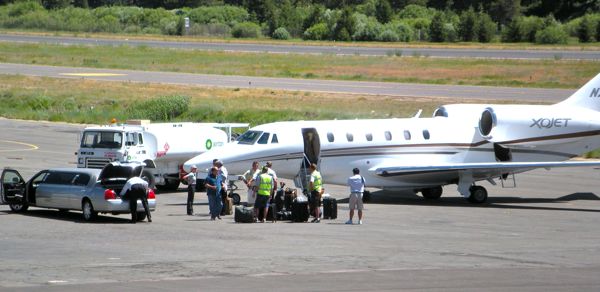
Today it is mostly private jets that use Lake Tahoe Airport. Photo/LTN file

In July 1987, during the ISA’s summer segment, the FAA wrote a letter to the city expressing its concerns that in striving to “beat the box” … “Aircraft pilots attempting to reduce the noise levels of their aircraft as they fly over a monitoring station may engage in maneuvers which are not consistent with the highest order of safety.” The parties to the ISA, while denying any safety issues, became spooked by the prospect of liability. No winter ISA segment was held.

In 1987, AirCal became part of American Airlines. American terminated service to the Lake Tahoe Airport in 1991, with the smaller commuter American Eagle continuing. The Settlement Agreement was signed in September 1992 and American Eagle suspended service in November of that year. In the years that followed, a cavalcade of attempts at reinstituting commercial and commuter service had short-lived success: United Air and Alpha Air-Trans World Express in 1992, Reno Air from December 1994 to September 1995 under a $1 million privately-funded subsidy by the Tahoe Airline Guarantee Corporation; Sierra Expressway from 1995 to 1996; Allegiant Air from June-October 1999 and briefly in August 2000; and Tahoe Air from June-November 1999.

Soon after, questions arose over continued funding for air traffic control services at the airport tower. In 1997, the FAA had determined Lake Tahoe Airport had fallen below the critical 1 percent service level required for FAA funding. With a lack of commercial service, the airport had scored a 0.1. The city struggled to retain the tower and its air traffic control services through various combinations of FAA funding, state grants and city contributions, but in 2004 it closed.

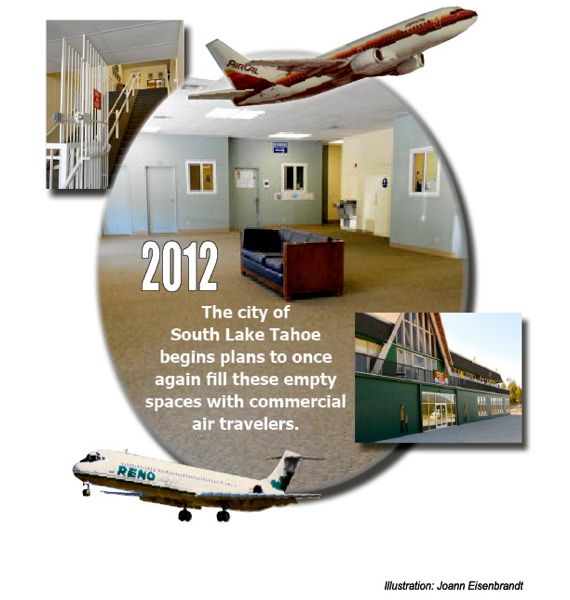
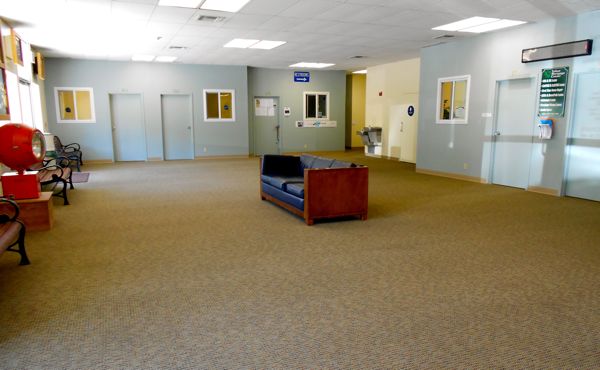
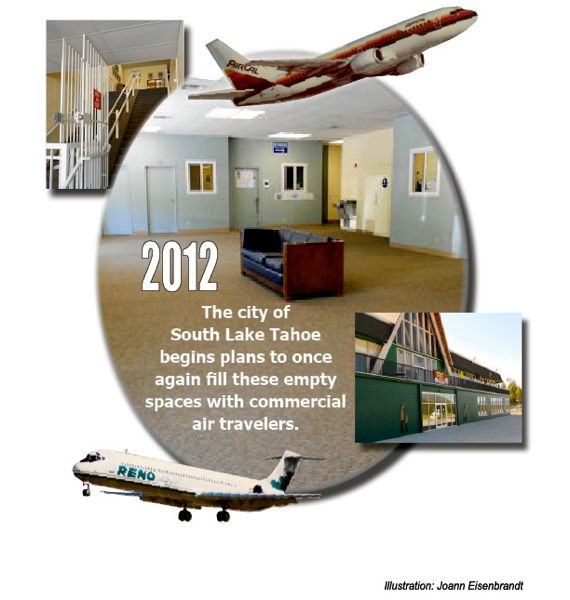
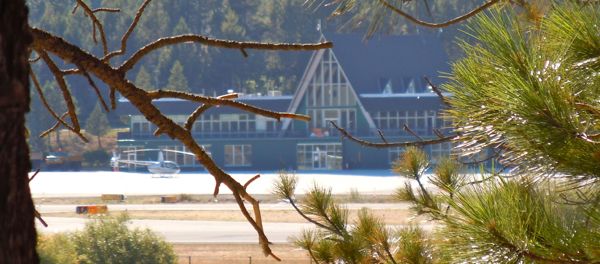
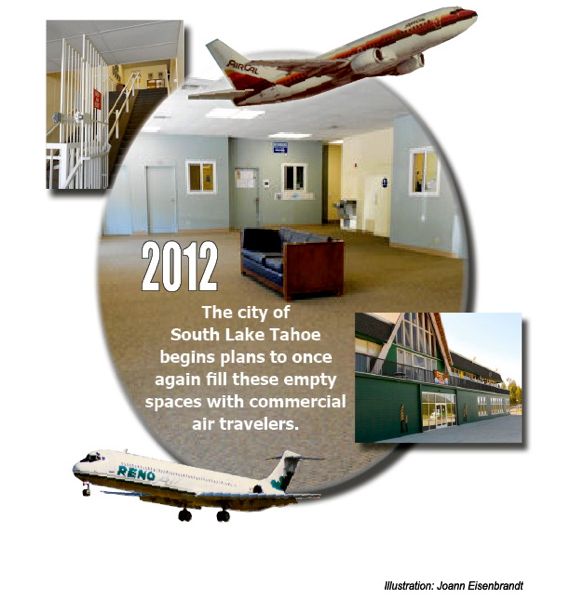
Today there is no scheduled commercial service and the tower sits empty. General aviation services are provided by the fixed-base operator, Mountain West Aviation, helicopter flights by Reno Tahoe Helicopters, flight training by Lake Tahoe Flight School and food by the Flight Deck Restaurant. South Lake Tahoe administrative offices now quietly occupy much of the space previously overrun with the noisy jostling of arriving and departing passengers and the whining of a large, shiny metal baggage carousel.

The city has continued to contend during the 20-year term of the Settlement Agreement, that commercial service is a vital part of the airport’s reason for being. For 20 years, many have just as strongly disagreed. Now, as the expiration of the 1992 Settlement Agreement this fall comes clearly into focus, a blast of fresh air has reignited the long-smoldering debate over this polarizing issue and the questions that lie beneath it, “To whom does Tahoe belong?” and “Who should be in charge of crafting the blueprint for its future?”

Part two on July 6: The issues that have made reaching a consensus on commercial airline service so difficult.


S. Tahoe council blocks pot club move after signaling it would approve

By Anne Knowles

The South Lake Tahoe City Council voted to deny a request from one of the city’s medical marijuana dispensaries to relocate its business after last month intimating it would approve the move.

At its June 5 meeting, the council declined to act on City Attorney Patrick Enright’s advice to deny City of Angels 2 its request and instead voted 4-1 on a motion directing staff to prepare a resolution to approve the move, according to Nancy Kerry, interim city manager.

But a day before the July 3 meeting, the council received a letter written by the South Lake/El Dorado Narcotic Enforcement Team (SLEDNET) painting a vivid picture of the criminal activity surrounding the marijuana collectives.

“Every day SLEDNET agents are intermingled with the marijuana industry that has become so enormous here, traffickers from outside California have made this city a prime distribution point for the east coast,” reads the letter dated July 2. “No longer are we seeing the large scale indoor grows. We see a simpler form of trafficking of marijuana through the U.S. Post offices, UPS and Fed Ex. It is such a significant problem that the U.S. Postal Inspector’s Office recently assigned a full time inspector for marijuana trafficking in our area post offices. Now the primary workload for our task force is the sales and distribution of marijuana from traffickers who simply go to the collective, purchase lbs (sic) of marijuana and ship it off in mail.”

The letter went on to describe eight cases involving large sums of marijuana in which all of the convicted felons claimed to have been working with one of South Lake Tahoe’s three collectives.

“I can provide further examples at your or the city council’s request,” read the letter addressed to South Lake Tahoe Police-Fire Chief Brian Uhler. “This year alone we have seized $142,708 in marijuana proceeds and worked interstate investigations in New Hampshire and New York.”

SLEDNET Task Force Commander Jeff Catchings told Lake Tahoe News there are numerous ongoing investigations into people tied to the collectives but no open investigations of the collectives themselves.

“This is a huge problem and we can’t turn a blind eye to it,” said Catchings. “No other business in South Lake Tahoe has so much criminal activity connected to it.”

“This is a game changer,” said Councilman Tom Davis several times during discussion of the resolution at the meeting. “This documentation from law enforcement is huge.”

“This is out of control,” agreed Councilman Bruce Grego, who cast the sole vote to deny the dispensary’s move at the first meeting. “I think we need to end it today.”

City attorney Patrick Enright cautioned the council that the item under consideration was narrow, focused on whether to allow City of Angels 2 to relocate, but adding that the California court rulings were inconsistent regarding whether cities had the power to ban the dispensaries outright.

And Councilwoman Angela Swanson raised concerns that the city could be opening itself up to some liability if they backtracked on the matter.

“I believe to not support this puts the city in a precarious legal position,” said Swanson. “We don’t have proof (the marijuana) is going through the collectives. There could be other things going on.”

Uhler, who delivered the SLEDNET letter to the council, said law enforcement was working on a way to track the collectives’ transactions.

City of Angels 2 owner Gino DiMatteo spoke during the public comment period, assuring the council that his dispensary abides by the law.

“If my collective had anything to hide we would never have offered surveillance to the chief of police,” said DiMatteo. “They have access to our security video any time.”

DiMatteo was told by his current landlord that he had until mid-July to change his business or vacate his current Third Street location after the landlord, Darcy DeTarr, received a letter from the U.S. Attorney General’s Office threatening to seize the property if pot continued to be sold there.

In the end, the council voted down the resolution to allow the dispensary to relocate.


Correction: South Lake Tahoe City Council did not vote on a resolution presented at its July 3 meeting and instead directed  staff to draft a new resolution that it voted on at its June 5 meeting. The council did not re-vote on an improperly-worded resolution, as originally reported. The story has been changed to reflect that.


Mitchell remains a strong voice in preserving Tahoe’s past

By Susan Wood

With a glass of wine in hand and an incomparable view outside her Ski Run-area hilltop home, the woman who dedicated about half her life to Lake Tahoe history is sharing a bit of her own with a grateful community.

Betty Mitchell just turned 90 years old – but of course, one would never know it judging from her ongoing goals and the shape she’s in. (The big party is this week.) She stacks her wood and still finds time to visit and help out at the museum run by the Lake Tahoe Historical Society, a group this charter member and past president has committed at least four decades to in South Lake Tahoe.

To many – Betty Mitchell is the Historical Society. Even Del Laine, herself a longtime anchor of this community, calls Mitchell “the heart of that organization.” To think, she hated history as a child.

“Now they do a good job (of teaching it), but when I was a kid, they presented it badly. It was a bore,” Mitchell said. The UC Berkeley grad had no interest in memorizing war years. She wanted to know why events occurred.

Nonetheless, Mitchell’s blossoming interest in history came from her roots. Her father was a history buff, and like him, she would “shudder at the thought of losing everything,” meaning the archives and artifacts that define an area.

“Here we have the best trails, the best lakes and the best beaches. They could have done so much more. They’ve put the emphasis in the wrong places. This year, they’re finally putting the emphasis on recreation. I’m glad to see that.”         — Betty Mitchell 

“And that’s what was happening here,” she said of South Lake Tahoe.

Her involvement in the Historical Society has kept her healthy, moving and active. After all, it’s difficult to think of a Cal alumni who majored in social services sitting and watching the world go by without participating.

Mitchell is modest, but not meek by any means.

In 1958, she and her late husband, Tom, moved to the Bijou area on Janet Avenue.

Back then, “Glenwood only went that far,” she recalled. The Mitchells discovered they had to arrange for their two children, Pat and Linda, to get to school because the bus would only put neighborhoods on the route that housed at least seven students. This one had six.

Learning was crucial to the schoolteachers of the household. After serving as a pilot in the Army, Tom spent a lifetime in the teaching profession. After a career in social services, mainly in the San Joaquin Valley, Betty became a substitute teacher when their children were in school. The Livingston High School sweethearts moved here because “Tahoe had the best salaries for Tom,” she said.

And of all the places to live, there was a prerequisite beyond money.

“I’m a mountain kid,” she said.

The Mitchells were accustomed to small towns with small schools. Betty represented one of five students who attended the two-room Yosemite (National Park) Grammar School, which still stands today.

“It still looks like it did when I was a kid,” she said.

The Mitchells seldom missed the every five-year reunion of their high school.

Eight years after moving to Tahoe, the couple had their Ski Run-area home built. It’s a homey house that has Betty’s character written all over it. The Declaration of Independence hangs on one wall. Antique bottles line the top of the kitchen cabinets. Tom’s Merced ranch homestead deed signed by President Andrew Johnson adorns another wall.

Despite the important hangings, the Mitchell home is dominated by windows. “You’d never be allowed to put this many windows in this house today,” she said, referring to TRPA rules.

The views are as rich with history and memories as the house.

One whole wall provides a panoramic mountain view, with Pyramid Peak dominating the landscape. During the Angora Fire five years ago, she watched in horror as the blaze crested the ridge and teased the Fallen Leaf Lake community.

“I saw that and wondered about Barbara (Craven),” Mitchell said of her friend, another longtime South Shore matriarch.

Five years before that, Mitchell was tested when the Gondola Fire raged up the ridge and threatened residents in the Saddle Road-Needle Peak area before the wind shifted and the blaze headed east.

The view of Lake Tahoe takes up another wall. And on the other side, she looks out at Heavenly Mountain Resort’s Gunbarrel chairlift and Olympic run. In the winter, the twosome watched the ski activity – sometimes through binoculars for greater detail.

He’d announce when ski patrol were “bringing another body down,” Mitchell says of her husband.

But in 1960, it was Squaw Valley that provided one of the most memorable times in Tahoe during Mitchell’s 54 years here. The South Shore was also involved – mostly with building a bed base for the huge world-renowned endeavor. Beforehand, she and Tom worked as timers for pre-Olympic races.

Civic involvement was the mantra of the Mitchells.

Betty has been a member of Soroptimist International South Lake Tahoe since 1969 and once served as president. She was also on the first Sierra Nevada Region Public Affairs Committee.

Her involvement in women’s issues became the guiding principle on what she chose to volunteer for. She led the Soroptimist club’s El Dorado County Commission on the Status of Women and was a founding member of the South Lake Tahoe Women’s Center (now called Live Violence Free). She even became the executive director for one year. She also was a member of the Lake Tahoe Children’s Theatre throughout the 1960s.

Together, the Mitchells were among three couples who spearheaded the drive for the city of South Lake Tahoe to incorporate, because as Betty saw it: “There were no rules, and we needed some.”

The incorporation was spawned out of a desire for city services such as snow removal and public safety.

“She’s one of the tireless people who joined an effort or cause and works at it, works at it and works at it,” said Laurel Ames, another Tahoe pioneer who organized the city effort. She’s known Betty for about 50 years and characterizes her as “warm, engaging and outgoing.”

“You know that if you call her up and ask a question, she’ll have the answer,” Ames told Lake Tahoe News. Ames considers Betty as the “glue” of the community.

Betty supported her husband’s independent ventures as well.

Late after the city incorporated, Tom served on the city Planning Commission. The panel witnessed a lot of action when it came to the early stages of the sign ordinance. To this day, the controversial rule dictates what type of and how many signs may be placed on city streets. Betty remembered the politics ran rampant – especially on an issue plagued with perceived favoritism. Tom didn’t budge at not giving exceptions for the biggest businesses in town. The San Francisco Chronicle ran the story when most reporting agencies were afraid to.

“It was really kind of typical. In small town USA, you decide if you want to live some place, and the reasons you do, and you know you have to put up with stuff,” she said. “I feel connected to Tahoe. The things I like about it are still here. I don’t want to live anywhere else.”

Regardless of her love for Tahoe, there was a time Betty was pushed over the edge.

When Sunset magazine published a spread about a dozen years ago about Tahoe, it featured the recreation and beauty of the North Shore while the South Shore was shown as a haven for gambling. She grabbed the magazine known as the bible of Western culture, drove to the South Lake Tahoe Chamber of Commerce office and left it on Executive Director Duane Wallace’s desk. He wasn’t there.

“I was so mad. I wished he had been there. Here we have the best trails, the best lakes and the best beaches. They could have done so much more,” Mitchell said of the Sunset magazine spread. “They’ve put the emphasis in the wrong places. This year, they’re finally putting the emphasis on recreation. I’m glad to see that.”

Her own favorite hike is above Red Lake to Winnemucca Lake, a hotbed for wildflowers and one place where Betty dropped some of her husband’s ashes after he died of cancer in 1994.

Despite her time with her children, three grandchildren and two great-grandchildren and her cat Buster plus her involvement with the California Widowed Persons Association, Betty admitted: “You never stop missing.”

Memories abound of her adventures with Tom. She recalled joining others to do her preferred hike in a one-way shuttle with one vehicle parked at Woods Lake and another at the Carson Pass trailhead.

And it was Betty’s vehicle Laine could remember most as the lighter side of this Tahoe mover and shaker’s life – “a larger-than-life utility vehicle” upon which a passing motorist would need to strain to see her behind the wheel.

“We all knew it was Betty on the way – short of height but never short of stature,” Laine told Lake Tahoe News. “Betty has been a strong force in the bedrock of the South Shore community and remains so today with her dedication to the history of our region.”


Gondola Fire threatened to take out South Shore 10 years ago

By Susan Wood

When up to 30mph winds ignited a hellish wildfire under the town gondola on Lake Tahoe’s busiest week a decade ago, firefighters, residents and stakeholders may have sought divine intervention in stopping the 673-acre blaze that threatened 550 structures, forced the evacuation of hundreds of people and cost more than $3 million to fight.

During four challenging days, they certainly got it – from Heavenly Mountain Resort, an army of firefighting resources including more than 1,700 in fire crews, successful emergency plans and a whole lot of water at their disposal.

Like the Angora Fire five years later, South Shore communities suffered no loss of life from the Heavenly Gondola blaze. This one was presumed to have been sparked by a carelessly discarded cigarette out a gondola car window between towers 11 and 12 on July 2, 2002.

Kit Bailey, fire chief for the USFS in Tahoe, explains how the Gondola Fire burned. Photos/Kathryn Reed

The impact on those who fought the Gondola Fire and lived through its rage is remembered vividly.

No one may have internalized the crisis more than Kit Bailey, fire management officer for the Lake Tahoe Basin Management Unit of the U.S. Forest Service.

Bailey, who has spent more than three decades fighting fires, including a stint in Oregon as a smokejumper, has seen it all. But to this day he remembers what intersection he was in when the call came over the radio. The fire officer seemed a little perplexed that any cigarette can start a fire, but he and other fire investigators had no doubt upon examining the area afterward. Some say the odds of a cigarette igniting a blaze are 1 in 10, but Bailey believes they could be even higher. No suspect has ever been fingered, despite lengthy interviews conducted of guests.

“It’s difficult for a cigarette to start one. It has to land in the right spot in the right fuels,” he said, while recently surveying the point of origin with Lake Tahoe News. Ironically, a cigarette butt lay close to the same spot as it did 10 years ago when the perfect storm formed.

“(Officials) were aware. They knew the potential was here. And all the conditions came together,” he said, referring to heavy wind, a cigarette and a preceding dry winter with drought-like spring. “But one benefit to Lake Tahoe of having a fire here is the access to international resources. They moved the resources quickly. And I think there were lessons learned for the local fire departments.”

On July 2, 2002, the winds were whipping and the town was filling up with tourists for the Fourth of July holiday as the 12:30pm call came from dispatch. Crews raced over to Montreal Road and negotiated the rocky terrain up the gondola line. Part of the territory is now home to the nation’s first bistate park named after rancher Jack Van Sickle. It was tough getting the water line up to the fire until one was attached at Keller Road and trucks were brought up to the blaze from a South Tahoe Public Utility District service road.

The scar of the Gondola Fire 10 years later.

“We needed a continual supply (of water),” Bailey said.

The unrelenting wind hurled the fire in two directions. There was a time when residents at the Saddle Road area watched intensely as it headed southwest toward their homes. They were not on mandatory evacuations, but were told to be ready.

However, the winds carried the bulk of the blaze east in a rage that spread from 2 acres to 25 in only an hour. With the amount of dry brush and trees and huge neighborhood lining the canyon, Kingsbury Grade became a hotbed of concern.

“We had small-scale wind shifts, but the predominant wind pushed it across the hill (east). That’s why it burned diagonal instead of up,” Bailey said, pointing to the swiping scar across South Lake Tahoe’s most recognizable ridge view.

Fire crews tried to conduct an “anchor and flank” to surround the fire from the back and pinch it off but “we couldn’t get in front of it,” Bailey lamented.

Instead, he knew its sporadic crowning at the top of the trees and consumption of hot-burning pine needles in a grove about halfway up the ridge east of the gondola line were going to spell trouble.

“When it flashed there, it burned more intensely. I thought: ‘Now we’re done’,” he said.

Ski resort helps

Fire crews and resources stepped into high gear as the blaze rolled into the North Bowl and Olympic chairlift areas of Heavenly’s ski resort.

Kit Bailey stands at the point of origin of the Gondola Fire.

Although the danger exists with flying operations in the wind, the Lake Tahoe Airport became grand central station is terms of helicopter drops. Residents and tourists watched six helicopters take constant triangular runs between the lake, the mountain and the airport to refuel. An estimated 300,000 gallons of water from Lake Tahoe were dropped on the fire.

Beyond the ample water source, Heavenly chipped in with its own trifecta of fire suppression.

Bailey said fire crews received much help from Lake Tahoe’s features of winter – Heavenly ski runs served as perfect fire breaks and the resort’s snowmaking guns blew out water used in the summer for irrigation. The mountain’s lakes at the East Peak and Sky areas were on standby if necessary.

Jim Larmore, who was Heavenly’s snow surface director at the time, recalled the fire as a successful challenge for which emergency response plans trains twice a year. These operations plans were set in motion quickly because the ski area was forced to contend with providing a safe evacuation of 200 people who were still on the gondola. Workers quickly stopped loading riders at the base, but continued to run the lift to the end point.

“Our first thing was to get people out of harm’s way,” Larmore said.

From there, riders were shuttled over to the top of Kingsbury ahead of the fire and down to the Carson Valley. Highway 208 from the lake to the summit turnoff was closed to traffic.

Tourists taken elsewhere

Meanwhile, the Ridge Tahoe was dealing with its own issues as the resort was situated in the direct line of the predominant fire. Between operator Resorts West’s four properties at the summit, 1,500 guests among its 376 units were evacuated due to the urging of then Tahoe Douglas Fire Chief Tim Smith when asked by the Ridge’s Senior Vice President Dan Garrison.

Charred trees make it hard to believe the fire was in 2002.

“The conversation lasted less than a minute,” Garrison told Lake Tahoe News.

The most startling reason Garrison believed the resort was in danger came when the management team met on the view deck of the clubhouse facing the lake and “ash began to land on the tabletops.” Guests were told to grab their medicine and leave their food because “there is no time.” Gas valves were shut off and water pumps floated in the pool.

One guest who refused to evacuate was told to provide the name of his dentist if he didn’t leave. He later obliged.

When the sky darkened from the smoke, guests shuttled by bus were leaving as fire units arrived to line Ridge Club Drive. Fire crews took over and stayed at the resort overnight, while spot fires broke out on the property.

“I remember as I drove away I looked into my rearview mirror and behind one of our buildings a large pine tree was fully engulfed with flames. I said to myself: ‘Building 10 won’t be there in the morning.’ And while it sounds dramatic, tears rolled down my cheek. I’ve been with the property before it was a property starting in 1982,” Garrison recalled.

Lessons learned

In the end, with no deaths and property damage — the Ridge executive commended his quick-thinking staff, as did Larmore of Heavenly.

The aftermath set wheels in motion in fire prevention and recovery efforts.

No smoking signs were erected throughout Heavenly’s property. More fire hydrants and valves were installed with the ability to run a 2,500-foot water hose from the gondola mid-station down the mountain. The gondola cars were equipped with plastic plates over windows that do not allow cigarettes to be dropped out.

The community and agencies have planted trees, including a major effort put on by Heavenly and the Sugar Pine Foundation last October for Vail Resorts’ annual Echo Day. Volunteers placed more than 1,000 seedlings in the ground over a 10-acre span in the Van Sickle Bi-state Park.

“We certainly hope to see these newly planted sugar pine seedlings thriving 100 years from now,” Heavenly’s General Manager Pete Sonntag said in a statement released last fall.

A quarter of the gondola fire burned in the California Tahoe Conservancy property endowed by Van Sickle to build the state park.

“In a way, the rocky nature of the gondola burn is a small blessing,” CTC’s top forester Brian Hirt admitted to Lake Tahoe News.

He explained how having less highly flammable chapparal growth in the rocks has allowed the new, small trees to grow faster. Usually, the overabundance of the underbrush hinders the tree growth.

“The good news is that there are quite a few trees establishing in the gondola burn, but the bad news is that the scar will take longer to appear healed,” Hirt said, adding the area is also “prone to erosion.”

The CTC pledged to continue to work with Nevada State Parks – the agency that spearheaded the opening of the 725-acre, day-use park. Much faith and love has gone into the building and restoration of the park, including a Lake Tahoe Stewardship Day that brought out people from many walks of life to participate in the burn-area cleanup.

The fire consumed 243 acres in Nevada and 17 of the Conservancy’s property designated for the park.

The day of the fire, CTC’s program analyst Bruce Eisner was preparing to tour the area with this reporter and instead found himself watching the blaze roar over the ridge from the Saddle Road area.

“Whoever threw the cigarette out of the gondola knew absolutely nothing about this bistate park,” he said.

Eisner said he was never concerned the fire would douse the hopes of the park forming as planned.

“I grew up in Southern California, so I’m well aware of how fast fire moves. But this was a first in being the closest I’ve come to a wildland fire,” he said.


Mountain bike lesson proves the sport is more than pedaling

By Kathryn Reed

TRUCKEE – “Don’t be nervous. If anything, you should feel more secure with all the gear. You can roll down the mountain with all this gear and you won’t get hurt.”

Then David Fox asked me to sign a liability waiver. The irony would have been amusing if it weren’t me and Sue in the get-up that had us resembling the gnarly biker chicks we don’t even aspire to be.

Wearing what looks like flak jackets, except for the fact the arms – especially the elbows – are super padded, we then put on the kneepads. But they also protect the shins, so we look like we could be doing battle. We are just hoping it’s not a fight with terra firma, because we’re afraid she may win.

Kathryn Reed and Sue Wood ready to tackle Northstar's mountain bike park. Photo/Luke Sheppard

Our cycling helmets won’t do. Nope. Here at Northstar it’s the full headgear that covers our face and chin.

Not even our gloves are acceptable. No fingertips are showing once we are fully outfitted.

Sue looks at me in bewilderment or maybe it was disgust. This was my idea and she came along reluctantly. Before we arrived at the resort I had joked it wouldn’t be so bad; it’s not like we’d be wearing all those pads the expert riders wear.

Next time I’ll do more research about the activity before opening my mouth.

I say all this because it was getting the gear on that was the most nerve wracking part of the adventure. Riding under the direction of Luke Sheppard, while not always easy or comfortable (which had nothing to do with him), was an experience I would highly recommend. He is the manager of the 4-year-old bike academy at Northstar.

Northstar knows what it is doing. Not everyone wants a paved bike path. And not everyone is willing to go it alone at a bike park.

After all, a recent report from the Outdoor Industry Association says Americans spend almost $650 billion on outdoor recreation each year. The bulk of those billions is spent on guides, hotels and restaurants. Less than 20 percent is spent on goods like backpacks and bikes. The same study revealed that between 2006 and 2011, the outdoor recreation industry grew by an average of 6 percent a year.

Northstar’s bike academy has been growing as well – a testament that those who like to play outdoors will do so even in a recession.

This Truckee-area resort has a variety of classes available for anyone who can operate a bike with hand brakes.

We take the gondola out of the village to mid-mountain. Every third car is a bike rack. We walk past the lodge to the mountain bike center to get fitted for our bikes. Giant sponsors this park; so all the bikes are that brand.

With hydraulic brakes, Sheppard says to use one finger to operate them. This also allows for a better grip while riding.

“Brake early, gently and confidently,” he advises.

We then take the Zephyr chairlift up. (Vista is open to cyclists on weekends.)

Live Wire – a trail with 50 jumps on it – is being irrigated to keep the dust down.

“It’s very similar to a BMX track,” Sheppard says as we pass above some of the trail.

We spend our morning on TryUmph. It starts out like a fire road, so I’m thinking this will be easy. But Sheppard wants us to stand. This is completely foreign to us. Stand tall – not just our butts off the seat. This is so the bike is absorbing the terrain and not our bodies.

We are supposed to trust our bikes.

Riding over the rocks that are clearly embedded in the ground gets us used to the bounce. We dodge the loose rocks.

Stopping to the side Sheppard is almost giddy talking about the tread on the tires. It’s important stuff – especially when it’s time to brake or turn.

We practice turns on a straightaway to get the feel for leaning the bike into the turn while keeping our bodies upright. This helps keep the tread on the dirt so the tires don’t slide and the rider doesn’t tumble. Something feels weird. Sheppard says it’s because I’m leaning and the bike is straight.

Here comes a real turn. I want to lean into it, but only the bike is supposed to be tilted. I’m thinking too much. I’m going so slow I should be able to do this. Making the turn was no big deal, but I’m sure a video replay would show it was not executed well.

We get onto the Easy Rider trail beyond the mid-mountain lodge. This is where we put our skills to the test. While not a true single track, the route is much narrower. Rollers are fun, reminding us of a trail near Lake Tahoe Airport. Sharper corners don’t allow time for thinking – lean, stand – and breathe. Platforms are on the trail to get us used to the transition from dirt to manmade structures – just in case one day we are out doing jumps.

If we ever take the Bumps and Bends class, we would be taught how to corner faster, jump and ride rocky terrain.

While more lifts are not likely to open to cyclists, resort officials are talking about expanding the trail system. There are more than 30 trails now.

Notes:

• The website has prices, hours and full explanation of what the bike park offers.

• Helmets are required for all riders.

• The park will be closed Sept. 22-23 for Tough Mudder.

If competition is what you want, Northstar has it:

• Tahoe Trail 100 (Leadville 100 Qualifier) – July 22.

• Pro Gravity Tour – Aug. 3-5.

• Tara Llanes Classic – Sept. 28-30.

• Downhill Mountain Bike Race Series will kick off July 8.

• Thursday night Cross-Country Race Series begins July 12.

ngg_shortcode_2_placeholder (Click on photos to enlarge.)