London — a 3-time Olympic city sparkles in the limelight

By Susan Wood

AMESBURY, England – A flicker of flame carried by four-time gold medalist track star Michael Johnson emerged through a rare, cloudless sunrise at Stonehenge, setting a dramatic stage for the planet’s touchstone for goodwill and humanity – the Olympic Games.

With his signature smile and svelte physique, the 44-year-old American athlete brought the torch on July 12 at 5:09am to the ancient National Heritage Site prior to his official, 300-meter torch-bearing “leg” at the Salisbury Cathedral a few hours later.

The world record-holding sprinter, who took gold in 1996 at Atlanta in the 200- and 400-meter events, made an outrageously slow lap around the spiritual, circular stones as the sun beamed over the “heel stone” and through the structural rock formation. It was a magical moment – one the media from around the world wouldn’t have missed. He repeatedly described the event as “an amazing experience” as reporters held onto every word.

When asked by Lake Tahoe News if the lap was his slowest run, he replied: “Pretty close, but well worth it.”
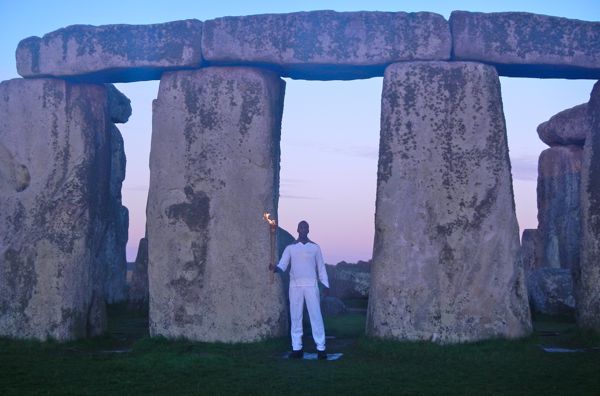
U.S. Olympic track star Michael Johnson with the Olympic torch July 12 at Stonehenge. Photos/Kathryn Reed

Johnson posed with the 31-inch-long, 2-pound torch for the cameras alongside Amelia Clifford, a young Salisbury track star who ran the torch the day before. She was elated, while standing before other gatherers like fellow torchbearer Phil Monk. The local teacher was nominated by his students and colleagues at the Stonehenge School. It was rather appropriate for Monk to be there. He knows the history and magnificence of the Sarsen-stone site built in BC 2400 by hundreds of men over 30 million hours using wooden platforms on rollers and ropes to bury them 6 feet under.

To this day, the burial site that is considered one of the world’s most recognizable attractions makes up a place for reflection and rebirth – including that of the seasons. Thousands of people descend on Stonehenge for the summer solstice each year. The appearance of summer dominated the discussion that morning as much as the arrival of the torch, which is made of gold to represent the qualities of the flame – brightness and the warmth of the light it shines.

“We haven’t had a morning like this in months,” Monk said. England has endured one of its wettest summers in decades.

Spirits were further lifted eight miles away at 7:45am when Johnson arrived to carry the torch in Salisbury in front of thousands lining the streets waving British flags. The town’s celebration the day before brought out 35,000 Olympic fans to witness the spectacle.

The Olympic torch carried by 8,000 people in the relay was designed to touch at least 95 percent of England’s population within a one-hour distance of 1,018 communities on its twisty, 8,000-mile route.

The traditional lighting ceremony took place on May 10 at the Temple of Hera, Olympia, home of the Ancient Olympic Games. The Olympic flame traveled through Greece before a British jet labeled “Firefly” picked it up for its journey through England, which started at Land’s End in Cornwall. The torch also had a one-day appearance in Dublin, Ireland, on June 6. A little more than a month later, it graced the streets of England’s original capital, Winchester – where King Arthur held court with the Knights of the Round Table in the 12th century. The banners were still flying over High Street days later.

Leading up to tonight’s Opening Ceremony, the torch relay will have lasted 70 days and marked 66 evening celebrations, six island visits as well as a variety of types of transports – by foot, plane, train, watercraft and even on a Ferris wheel known as the London Eye.

Each ceremony marked yet another demonstration of rural community pride. In the tiny town of Bowness, more than 10,000 Olympic fans gathered to see the torch transported by a 122-year-old steamboat over Windermere Lake in the Lakes District of northern England, a land of captivating natural beauty.

Jacqui O’Connor, who works for Windermere Lake Cruises, told Lake Tahoe News a regatta of boats flanked the MV Tern steamer with 175 people on board for its journey across the lake which is lined with green meadows, castles and estates. She was among them, along with a group of schoolchildren.

“It was amazing. The kids were so excited,” she said.

Community rural pride represents a common theme on the torch relay route, which culminated with its last stop in Westminster July 26 before making its way the following day into the Olympic Park for the Opening Ceremony.

A record 4 billion viewers are expected to watch a portion of the telecast.

Building a complex Olympic-style cathedral

Signs of London hosting the 2012 Olympic Games blanket one of the world’s most exciting cities.

Posters line the escalators of Underground stations. The London Heathrow Airport has opened a temporary terminal to handle an influx of anticipated passengers descending on the host city. Stands for seating to watch the triathlon and marathon swimming events have been erected at Hyde Park. The park had already staged a number of parties and concerts before the Olympics even started.

The majestic Tower Bridge serves as a backdrop for giant Olympic rings. Inside the tunnel, an educational display highlights other host cities.

London is the only city that has hosted the Summer Games three times – 1908, 1948 and 2012. The vision of this year’s Games is sport, education and culture, a fitting tribute to a city long known for its multi-culturalism. And this year, sports in Britain have captured a world stage – from Bradley Wiggins’ winning the Tour de France to Andy Murray reaching the finals at Wimbledon, where he sent droves of prideful English into the pubs and tea rooms to witness the first British male to make the finals in 76 years.

For the first time, the All England Club at Wimbledon stands ready to host Olympic tennis. The grounds are tastefully immaculate, nearby residents are excited and U.S. tennis greats like the Williams sisters are eager to go for gold in doubles.

The park is the place

Nowhere is the host city more electric than the Stratford neighborhood in East London, an older, industrial area revitalized to become home of Olympic Park.

Helicopters fly overhead as part of the security functions to build the Games’ Olympic Park, which house the stadium, aquatic center, water polo arena, Velodrome and BMX track in eight venues, along with the opening and closing ceremonies. Seating for all the events in just that 500-acre area tops 156,000. A dozen venues have gone up outside the park and 10 outside London.

With the opening, a countryside scene with animals and a Queen Jubilee bell with a quote from the play “Tempest” make up the latest hints to a hush-hush opening put on by Oscar-winning director Danny Boyle, Blue Badge Tour guide Helen Bartolome said, while taking a group of about 30 people around the park’s perimeter. The tour costs 14 pounds and lasts two hours.

The opening will hit a crescendo with the lighting of the Olympic cauldron, following the flame’s 8,000- mile journey. Bartolome said taking the torch all through the country quelled the criticism that the Games were “London centric.” Instead, this was England’s Olympic Games.

On the tour, Sarah Hobbs of Kent County agreed. She not only witnessed the torch relay, she touched it at the McDonald’s after it traveled through her rural homeland.

“It was so inspiring,” Hobbs said, adding she was surprised the torchbearer let her get so close.

With London being awarded the Games in 2005, three components were addressed: The regeneration of the economically depressed end of East London; the making of arguably the “greenest” Games in terms of recycling and reconstruction; and the encouragement of the public to get into sports activities.

“There’s an enormous initiation (for sports) in the schools,” Bartolome said, as wide-eyed tour attendees took in the scenery. Some people have gone on the tour numerous times to see the progress. On this one, the sounds of jackhammers and metal poles hitting the ground marked the ground zero where the Queen Elizabeth Olympic Park now stands.

To pull off such an endeavor, the city had to commit to cleaning up the water and contaminated land, as well as remove 52 electric pylons, bury miles of cable, erect a power station and move companies through the redevelopment process.

To view the area, it’s hard to imagine the place as it was. Now, boats line the canals, ping pong tables stand ready for players, bustling shoppers tour the major Stratford-area complex anchored by the John Lewis department store. The retailer set up a viewing platform so people can see the park being built under their feet.

Some venues like the shopping center represent infrastructure designed to stay long after the Olympics to benefit a host city. Others, such as the water polo arena will come down because as Bartolome put it: “Only two out of 30 people know someone who plays water polo.”

The guide also pointed to the modern architecture from the highway overpass to tell the group how even the stadium – which used only half the steel of Beijing’s Olympic Games to promote energy efficiency — will be scaled down to 25,000 seats.

“We don’t need an 80,000-seat stadium in Stratford,” she said. The group looked out at the skyline in awe of how the construction and deconstruction would come about. Looming overhead was a helter-skelter of a 35-story structure called the Arcelor Mittal Orbit, named after a steel magnate who erected the building with a viewing platform as art meant to enhance the Games.

Nearby, housing for the 13,000 athletes will be transformed into apartments after the Games.

This is one example of London’s venues being designed as sustainable.

With all that is built, whether permanent or temporary, London stands poised to make a difference this year.

Tour attendees stood silently to read the sign outside the gate that is intended to capture the spirit of the grand-scale event and make the monumental effort worthwhile: “There would be no goose bumps, gasps, pounding hearts, tears of joy, records smashed, strangers hugged or whole world together without…”

In two weeks, you finish the thought.

Susan Wood ran the Olympic torch 10 years ago in South Lake Tahoe for the Winter Games staged in Salt Lake City.

ngg_shortcode_0_placeholder (Click on photos to enlarge.)


Washoe Meadows Park may be integral to Meyers’ future

By Kathryn Reed

MEYERS – Meyers is an ideally situated spacious and walkable mountain community that values sustainability, health, wellness, and the natural environment. Uniquely concentrated with year-round outdoor sport and recreational opportunities, the Meyers mountain culture is the hallmark of our thriving local-based economy, boasting a diverse commercial and retail environment, welcoming visitors and providing residents with an extraordinary place to live, work, and play.

That is the recently adopted vision statement for Meyers. Those words lay the framework for this South Shore hamlet as it goes about putting itself on the map in a more definitive manner.

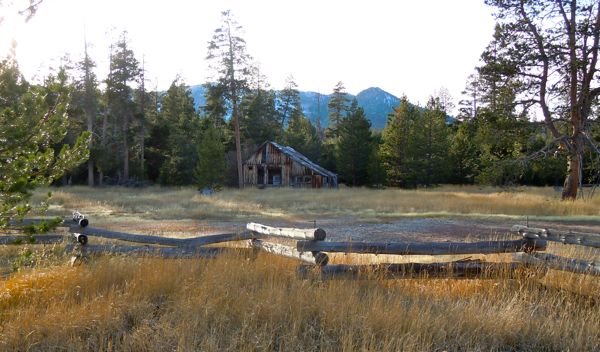
California State Parks may need to do an Historic Structure Report on the Celio barn in Washoe Meadows State Park. Photo/LTN file

Gone is the Meyers Roundtable; with Wednesday night being the last meeting. In its place will be the Meyers Advisory Council. The first meeting will be Aug. 15 at 6pm at Lake Valley firehouse on Highway 89. At that meeting the council will be appointed and work officially begins on developing the Meyers area plan. That will be an official document that will ultimately need approval by the Tahoe Regional Planning Agency.

Part of that plan will include Washoe Meadows State Park and Lake Valley Recreation Area. The latter is better known as the home of Lake Tahoe Golf Course.

“We want to help the community be a recreation hub. Our park is right in the middle of this recreation hub,” Steve Musillami, chief of the State Parks Planning Division, told the more than 30 people at the July 25 meeting.

Most of Wednesday’s meeting was about the future of the state park and golf course.

While a lawsuit regarding the reclassification of the land and CEQA irregularities is still tied up in the legal process, the State Parks people carried on as though that did not matter. When asked about it, they said they were not at liberty to talk about it.

In January, the California State Park and Recreation commissioners upheld their earlier decision to swap land between the adjoining park and recreation area in order to allow for the golf course to remain 18 holes after the Upper Truckee River is restored.

Musillami spoke about how 100 percent of the golf course is now in a stream environmental zone, that 6,200 linear feet of the course are along the river and 850 would be when reconfigured if they do what they want, and that the boundary of the course would shrink. The latter means fewer holes are likely to be on what locals still consider to be State Parks land.

The state has money to design how the Upper Truckee River would meander. (That can’t go forward until the lawsuit is resolved.) Money for the first phase of trail improvements is also in hand.

Parks officials are on a year-to-year agreement with American Golf Corporation to operate the golf course. The concessionaire contract will eventually go out to bid with the presumption whatever company is selected will foot the bill to change the golf course to accommodate the river restoration. The parks department could put all sorts of criteria into the request for proposal – like different winter activities must be offered or the clubhouse could be more than it is today.

This golf course at one time was touted as being the No. 3 money generator for the State Parks system. On Wednesday it was said to be No. 5, making about $600,000 in the last year. The agency’s website shows it at No. 50 with revenue of $503,998 in 2010-11.

“People know the golf course, but not what is behind it,” Musillami said. “We don’t want to have a park out there that no one visits.”

That is why his agency wants to be part of the Meyers plan.

But the state agency has some work to do. In the next month or two folks in Sacramento will decide what level of planning document to create for Washoe Meadows – a general plan would be the most extensive or it could be something much less. Each comes with different levels of environmental review.

No matter what the planning process, plenty of meeting attendees voiced their opinions about what they would like to see the area evolve into.

Daunelle Wulstein and others want to make sure equestrians still have trails to ride on and bridges that are safe for their horses to cross. Norma Santiago spoke for several people in asking for the future concessionaire to offer more than golf – to be a center that involves biking, kayaking and more than snowmobiling when it snows. Some talked about refurbishing the Celio barn; maybe even making it a destination for diners on cross country skis or snowshoes. Lynne Paulson wants biking and hiking trails by the river and not the golf course. Kristi Boosman wants fertilizer use to be reduced. Sue Novasel was not alone in wanting mountain bike trails to be plentiful. Rene Brejc wants the Meyers commercial corridor to link to the park.


Foreclosure possible for Embassy Suites S. Lake Tahoe

By Kathryn Reed

Embassy Suites Lake Tahoe’s parent company is in financial trouble.

Ken Corporation of Japan, which has owned the hotel property since December 2000, is looking to refinance a loan in order to stay solvent. (Hilton continues to operate the hotel and the Echo restaurant.)

Max Saito, representative with Ken Corp., told Lake Tahoe News the $3 billion corporate bond the company is repaying involves multiple properties.

Embassy Suites is in financial trouble. Photo/LTN

“We are negotiating a term so we can have better terms for the loan. It’s not necessarily that we cannot pay,” Saito said.

However, the company first defaulted on its payment in February.

In April, the appraised value of Embassy Suites was $36.3 million. This is down from $79.3 million in 2006, when the loan went through. The loan represents more than 160 percent of the value of the property.

Although room nights are being generated this summer, this past winter hotels throughout Lake Tahoe were empty because snow was not falling. Plus, the entire Lake Tahoe Basin is still stuck in a recession, no matter what national pundits say. The current unemployment rate for the city of South Lake Tahoe hovers at 15 percent.

Saito kept reiterating the property is neither in foreclosure nor is it on the edge of it. But that is not what others are saying.

According to Trepp, a leading provider of information, analytics and technology to the commercial real estate and banking markets, “The servicer is dual tracking foreclosure as well as a possible modification.”

Saito said he believes a modification will be successfully negotiated.

Asked what the worse case scenario would be. Saito told LTN, “If we can’t renegotiate the loan, then it’s the normal course for a foreclosure. Someone else buys it; either the lender or different owner.”

Ironically, Ken Corp. bought the property in a bankruptcy deal.

KOAR-Tahoe Partners was unable to keep up with it payments to Mitsui Trust & Banking Co. The firm had a $53 million seven-year construction loan because it was trying to convert 188 of the rooms to time shares. KOAR went into default in summer 2000. That’s when Ken Corp. stepped in.

The hotel opened in December 1991. In December 2006, it underwent a $3 million renovation. It is the largest hotel in the city limits.


Triglia to close South Lake Tahoe pot shop; DiMatteo moving into fitness business

By Kathryn Reed

South Lake Tahoe will definitely be down to one pot club by Aug. 20, with one of the owners staying in town to run a different business.

Matt Triglia on Monday withdrew his challenge to being shut down and agreed to a slew of conditions that allow him to operate Patient2Patient medical marijuana collective until Aug. 20 at the latest.

Gino DiMatteo, who was officially evicted last week from his spot on Third Street where he ran City of Angels 2, has told city officials he is buying Push Fitness.

Tim Christenson's name will have to come off the sign when the sale of the business goes through. Photo/LTN

Neither Triglia, nor his wife, Erika, returned a phone call July 23.

City Manager Nancy Kerry on July 11 revoked Patient2Patient’s permit because the dispensary was violating various city codes. Triglia initially appealed that action, but since changed his mind after things began to unravel after last week’s council meeting.

At the July 17 City Council meeting it was revealed that the Triglias had been detained in Missouri in December and had $85,000 in cash taken by authorities. Triglia at the council meeting adamantly denied it was him.

Later last week when confronted with police photos from Missouri, Triglia changed his story, according to city officials, to say he was working for Homeland Security. When that story fell apart, officials said, Triglia agreed to close shop.

Triglia has until Aug. 1 to paint the building – which means covering up the illegal mural as well removing unpermitted signs. He must also post a notice to patients stating he will be closing.

“They have removed the illegal growing operation from the Spot,” Kerry told Lake Tahoe News. The Spot is the business operating in the building closest to Highway 50. Escrow on that building never closed, so ownership will revert to Matt Johnson of Gardnerville, according to Kerry.

The Triglias own the building set back farther where patients enter.

Changing direction

The closure of Patient2Patient and City of Angels 2 means Tahoe Wellness Collective will be the only medical marijuana dispensary in South Lake Tahoe.

While the Triglias’ plans are unknown, DiMatteo is returning to his life in the world of fitness.

The phone number DiMatteo used for the medical marijuana collective has been disconnected. Tim Christenson, who has owned the fitness club for the past several years, did not return multiple phone calls.

In addition to buying the club, DiMatteo is selling his house in the Angora Highlands area – one of two he owns in the area.

But the fitness club comes with outstanding bills.

El Dorado Climbing Walls, based in Colorado, has been trying to collect what it’s owed from Christenson for nearly a year.

John McGowan, president of the climbing wall firm, said the legal expenses exceed the cost of installing the wall. He told Lake Tahoe News that last week a judge ruled that who pays legal fees is still to be negotiated. McGowan said Christenson wanted that off the table.

A settlement hearing is scheduled for next month, but McGowan believes ultimately the case will be decided by an El Dorado County Superior Court judge.

“I believe it will go to court. But will Push Fitness be solvent?” McGowan wonders. “They could do a sale of assets and close Push. Gino could buy the assets and not the liability.”

(Christenson does not own the building, just the business.)

In addition to the climbing wall firm wanting money, Christenson has regularly not paid taxes. And there is no record of a fictitious business license for Push Fitness registered with El Dorado County.


Sherer loses job 1 week after sparring with South Lake Tahoe City Council

By Kathryn Reed

South Lake Tahoe Community Services Director Stan Sherer was fired Monday.

“It’s kind of a shocker. I really can’t talk about it,” Sherer told Lake Tahoe News the night of July 23.

Sherer came on board with the city in January 2011 to lead the Parks and Recreation Department. During consolidation because of budget shortfalls his job responsibilities increased, department title was changed, as was his job title. And his department was reduced in staffing significantly.

Stan Sherer

He was verbally chastised by the City Council as last week’s meeting regarding a long-term contract he approved without the electeds knowledge.

Asked if that was why the city let him go, Sherer said no. However, the first inkling he had that there was trouble was when he met July 20 with City Manager Nancy Kerry. He would not divulge the details of that conversation.

Kerry, when reached July 23, was tight-lipped as well.

“His employment with the city was terminated effective today,” Kerry told Lake Tahoe News. She would not elaborate because it’s a personnel matter.

Sherer had come to South Lake Tahoe from Sparks, where he had worked in that city’s rec department for 16 years.

“I really wanted to make a difference up there,” Sherer said. “I appreciated my time there and wish I had more time to make a difference.”


University study questions USFS beliefs about fires

By Scott Sonner, AP

Scientists using field notes from surveys first conducted by the government before the Civil War believe they’ve gained a better understanding of how Western wildfires behaved historically.

Researchers at the University of Wyoming studied historical fire patterns across millions of acres of dry Western forests. Their findings challenge the current operating protocol of the U.S. Forest Service and other agencies that today’s fires are burning hotter and more frequently than in the past.

Combing through 13,000 firsthand descriptions of forests and retracing steps covering more than 250 miles in three states, where teams of government land surveyors first set out in the mid-1800s to map the nation’s wild lands, the researchers said they found evidence forests then were much denser than previously believed.

The 2007 Angora Fire ravaged the South Shore of Lake Tahoe. Photo/Lake Valley Fire

“More highly intense fire is not occurring now than historically in dry forests,” said William Baker, who teaches fire ecology and landscape ecology in Laramie, Wyo., where he’s been doing research more than 20 years. “These forests were much more diverse and experienced a much wider mixture of fire than we thought in the past, including substantial amounts of high-severity fire.”

If he’s right, he and others say it means fuel-reduction programs aimed at removing trees and shrubs in the name of easing fire threats are creating artificial conditions that likely make dry forests less resilient.

“It means we need to rethink our management of Western dry forests,” said Baker, a member of a U.S. Fish and Wildlife Service working group that is developing plans to help bolster northern spotted owl populations in dry forests.

Baker’s conclusions have drawn sharp criticism from other longtime researchers who believe that decades of fire suppression have led to more densely tangled forests and more intense fires, the position advanced by the Forest Service.

“I have yet to hear any knowledgeable forest or fire ecologist or forest manager say they are convinced by the main interpretations in that (Wyoming) paper,” said Thomas Swetnam, a professor of dendrochronology and director of the Laboratory of Tree Ring Research at the University of Arizona. “I doubt it will gain much traction in the scientific or management communities.”

The Forest Service did not immediately respond to a request for comment.

Baker said the historic government land surveys provided researchers with a surprisingly detailed and precise record.

The studies conducted by Baker and others over the past two years focused on parts of Colorado, Oregon and Arizona, but were indicative of dry forest types stretching from the Rockies to the Sierra Nevada previously thought to be “open and park-like” and typically enduring only cycles of frequent, low-severity fire.

“The major surprising finding was … areas of high density of forest and higher severity fires in really all dry forests across the West,” said Mark Williams, who co-authored two of the three studies with Baker.

“The notes are pretty descriptive,” said Williams. “You can look for where the fire started and ended. We were actually walking the same lines, collecting fire scars from trees.”

Wallace Covington, the director of the Ecological Restoration Institute at Northern Arizona University, takes no issue with the Wyoming duo’s data collection or statistical analysis but said some of Baker’s conclusions don’t follow from his data. Covington first testified before Congress in 2002 about the urgent need to thin forests to guard against catastrophic wildfires and insists it’s still necessary.

Others say the Wyoming studies are important new information in an emerging field of research.

Jennifer Marlon, a Yale University paleoecologist, said a study she recently led on the impact of climate change on forests over thousands of years appeared to be largely consistent “with Baker’s idea that there were large, severe fires even in dry forests historically.”

The fire record her team built for the Western U.S. for the past 3,000 years shows “that fires during the 20th century generally are actually fewer and smaller than ever before given current climate conditions,” said Marlon, who emphasized the role of climate on wildfire.

“The general trend from high fire in the 1800s to very low fire in the 1900s is strong and clear from three independent datasets,” she said. “Open park-like conditions may have indeed occurred after the ‘peak’ in burning during the mid-1800s.”

Baker and Williams contend that past studies of forest structure and fires were not so much wrong as “incomplete” because that they placed too much emphasis on anecdotal references, sampled too small of areas and often concentrated on old-growth stands more resistant to fire.

One of the earliest references to the open nature of the forests is found in a 1943 study by Harold Weaver, a forester from Oregon State who characterized forests in Oregon’s eastern Cascades as “like a park, with clean-boled trees and grassy forest floor.”

An updated view was summarized in the 2012 spring edition of California Forests: “Human fire suppression activity during the past 100 years have created dense, more crowded forests and shifted the fire regime in Sierran mixed conifer forests from one of frequent, low-level fire to one where high intensity wildfires are more common,” wrote John Battles, chairman of ecosystem sciences in Department of Environmental Science, Policy and Management at the University of California, Berkeley

Williams said the Wyoming studies have significant implications for wildlife that depends on post-fire habitat, such as the black-backed woodpecker, which has survived for millions of years by eating beetle larvae in burned trees.

Four conservation groups filed a petition with the U.S. Interior Department in May seeking Endangered Species Act protection for the bird in the Sierra Nevada, Oregon’s Eastern Cascades and the Black Hills of eastern Wyoming and western South Dakota.

The new studies provide the first “real, direct data'” showing that more forests burned historically, creating more post-fire forest habitat, said Chad Hanson, a forest ecologist and director of the John Muir Project who is helping lead the listing effort and suing the Forest Service to block post-fire logging in woodpecker habitat near Lake Tahoe.

“It indicates the woodpeckers had more habitat historically than they do now,'” Hanson said.

Williams said when he started the study he had “the same general ideas most people have – that the forests were less dense and there were frequent, less severe fires to maintain that structure.”

Now, he believes thinning and post-fire salvage operations should be re-examined and emphasis placed on maintaining high-density stands in certain circumstances that would not threaten people or homes.

“We shouldn’t be managing just for low-density forests,” he said. “We should not be unhappy with – or perhaps even manage for – higher severity fires in the forests.”


Mancuso’s Truckee gym inspires weekend warriors

By Susan Wood

TRUCKEE — The roots of Olympic ski racing medalist Julia Mancuso run vast and deep in Truckee – much like the downhill runs she conquers.

A resident of Olympic Valley, Julia needs no last name for people in the Lake Tahoe region to know whom one is talking about.

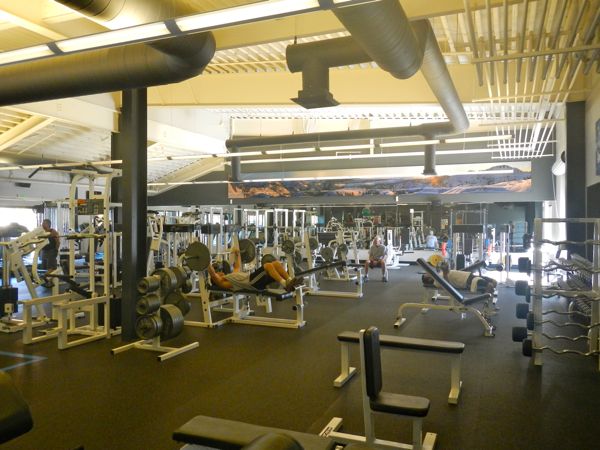
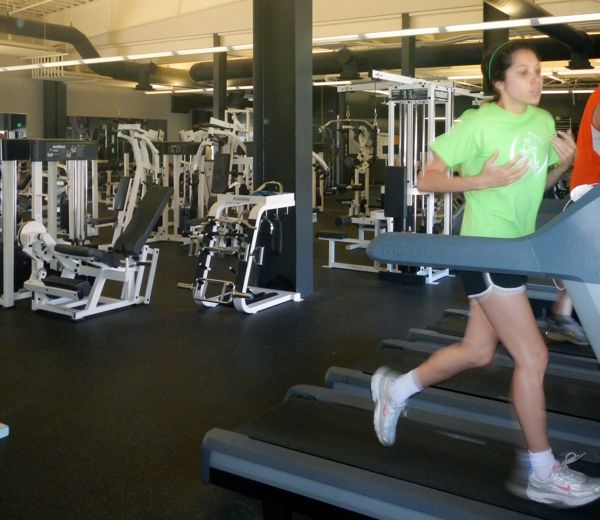
At the JM Performance Training Center, this 6,000 square-foot facility is where recreation and racing meet style and sex appeal. Mancuso is known for mixing the fast and the feminine. Mancuso took over ownership of this Truckee fitness facility a year ago. The Pioneer Trail Drive gym brings a unique flair to conditioning.

Olympian Julia Mancuso trains at the gym she owns in Truckee when she is in town. Photos/Kathryn Reed

Seven years after launching her career in a major way at the World Cup on Copper Mountain in Colorado, Mancuso won a gold medal in the 2006 Winter Games in Turin, Italy. Then she turned around and captured two silvers in the combined and downhill events in 2010 at the Vancouver Games in Whistler. It’s been a hard-fought road in the shadows of her U.S. Women’s Ski Team mate Lindsey Vonn. Despite the friendly competition, Mancuso placed fourth overall in the nation’s women ski racing program last year.

But it’s not only her fierce performances on the slopes that make Mancuso so memorable. Her personality comes out in all her endeavors.

At the front desk, her gym sells pink sweat shirts for $20 with a caricature readily known as the ski racer. A big, bold photograph of her carving a perfect slalom turn hangs near the front entrance. A panoramic photo of where she skis, Squaw Valley, takes up the high side of an entire back wall of the gym.

No plans have been made for expanding the gym’s retail outlet to include Mancuso’s “Kiss My Tiara” line of lingerie, but gym worker Andrew Finkelstein didn’t rule out the idea either when he gave Lake Tahoe News a recent tour. The tiara line was inspired by her coach presenting her with a royal tiara for luck in 2005. Five years later, she wore it during the medal ceremonies at Whistler.

Mancuso’s stamp on the gym has carried over to the grounds and the clientele of 800 members.

Vivian Herrera was drawn to the gym because of Mancuso.

“I’m a snowboarder, so when I moved here from Chile, I wanted this gym because of her experience with skiing. I’ve been athletic my entire life,” said Vivian Herrera, who moved to Truckee five months ago. She works at the Ritz-Carlton Lake Tahoe spa. She usually hits the treadmill, free weights and the TRX suspension training classes. A popular new training mechanism, TRX works on one’s body core through suspended stretching bands in various positions.

“The people are friendly here, and they offer special training classes that keep you fit,” Herrera added.

These principles are what Mancuso had in mind when she opened her gym more than a year ago.

“Being active and fit is a part of my DNA. I live for it. It was only natural to take the opportunity when it came up,” Mancuso told Lake Tahoe News. The star athlete is learning one day at a time about the business side. “But at the end of the day, I know I am giving a place to the community to come and play and have fun and feel really good.”

Mancuso’s father, Ciro, owns the land and the building, which has stood for 12 years under a different name.

The ski racer also relies on a competent team that helps the customers by “inspiring them to reach their goals.” If that’s not enough to hammer home the mission of the gym, the signs in the group exercise room remind others who aspire to be the best like Mancuso to place the end result in sight. They say: “Follow Your Dreams” and “Commit to be Fit.”

The hallway leading to the women’s locker room also serves as a reminder to working hard at fitness, at least for the prospective Olympian in all of us. The hall is lined with posters of the Olympic Games, a touch sure to instill pride and chills in even the most cynical.

The local Olympian would like to see another bid for the Winter Games in Tahoe. A high-powered committee is working on the 2026 Games.

“I attribute 100 percent of my success as an Olympic ski racer to the mountains and growing up in Squaw Valley,” she said, admitting, though, she hasn’t skied many other places in Tahoe to compare where the women’s downhill run should be located.

Squaw named a run after her called Julia’s Gold.

“Although the run on KT is steep and short, it’s a ton of fun. There is really nothing like skiing in my hometown,” she said.

The vibrant 28-year-old Mancuso, who was born in Reno, tries to return to Tahoe for a few weeks to train each year, although much of her life is on the road.

Andrew Finkelstein demonstrates how the Olympic setup works.

Still, her gym lives on without her physical presence. And a spike in membership when she took over the operation showed the power of the image mixed with a little elbow grease. The staff took out the tanning beds from the previous gym and focused entirely on a well-rounded fitness approach that members would embrace.

“We tried something a little more modern, and we tried to make it fun,” Finkelstein said, while walking around the front room.

Sure, there are many features one would find in a lot of fitness centers – 25 nautilus weight machines, a dozen cardio units, 15 free weights stations, dumbbells, kettlebells, jump ropes and plyometric accessories. It’s the assortment mixed in with a wall of pull-up bars and stretching devices that make it stand out. Plus, one free weight corner is labeled the “Olympic setup.”

“This is a little corner event in itself,” Finkelstein said. He picked up the long weight bar, transporting an observer to the Summer Olympics.

Moreover, how many gyms can attract the Squaw Valley ski team in their spin rooms?

The TRX suspension classes often sell out, and the others such as “Cardio kickboxing,” “Bosu strength and stability” and “Summer hardbodies” stay busy, according to Finkelstein.

Sometimes the workouts go outside – with esteemed general manager and triathlete Chris Cloyd taking the members out for a run in the center after their workouts.

“We work pretty hard keeping our members happy,” Finkelstein said. And then there’s Mancuso, who commended her staff for their efforts.

Sometimes Mancuso and the gym members think alike.

Mancuso said she plans to work on an approach for reducing injuries in her training in the upcoming year. This is also the goal of longtime gym member Keith Abrahms, who has come to the gym since its inception.

“It’s the only thing that keeps me vertical,” he said, while working on his biceps. The carpenter strives to keep his core intact to keep him out of medical clinics.

The Performance Training Center offers a standard annual membership for $50 a month.


Rypien leads ACC with several guys in the hunt

By Kathryn Reed

STATELINE – Record crowds on Saturday witnessed golf that, while it may not rival Augusta, proved to be intense. Nine points separate the leader and No. 10 player after two days of play at the American Century Championship.

Mark Rypien sits atop the leader board heading into Sunday’s final round at Edgewood Tahoe. He last won the event in 1990 when traditional scoring was used. A 54-hole modified Stableford format was introduced in 2003.

Dan Quinn, who has a two-day total of 40 points – three behind Rypien, at a July 21 press conference said, “I’ve been kind of shocked that this is the score that’s leading. Normally if you’re 43 or 44 on Saturday, you’re 10 or 12 points behind. So, I’m pretty happy … I still have a chance.”

2011 ACC winner Jack Wagner get some extra help late Saturday. Photos/Kathryn Reed

Quinn has won the celebrity tournament four times; the most recent being in 2004.

But guys not often in the top 10 are in the hunt:

Mark Rypien, 43

Dan Quinn, 40

Mark Mulder, 38

Tony Romo, 37

John Elway, 37

John Smoltz, 37

Jack Wagner, 36

Billy Joe Tolliver, 33

Joe Theismann, 33

Chris Chandler, 32

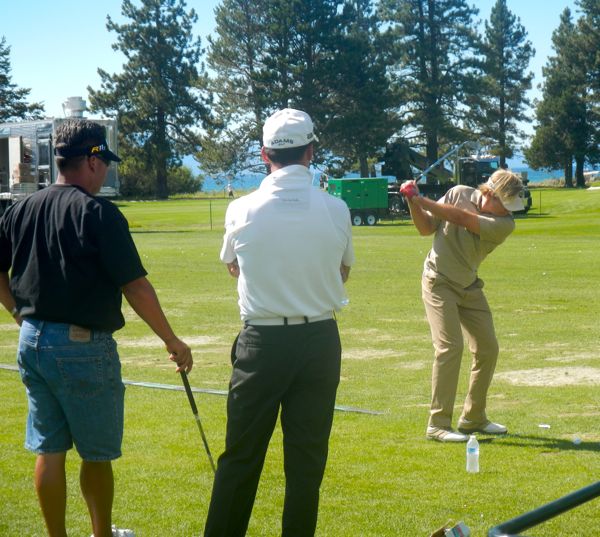
Wagner, who won the event last year, was the last man standing on the driving range. Two people stood within close range offering the actor advice about his swing.

While many of the players are in it for the title, others are there to have fun – just like the fans.

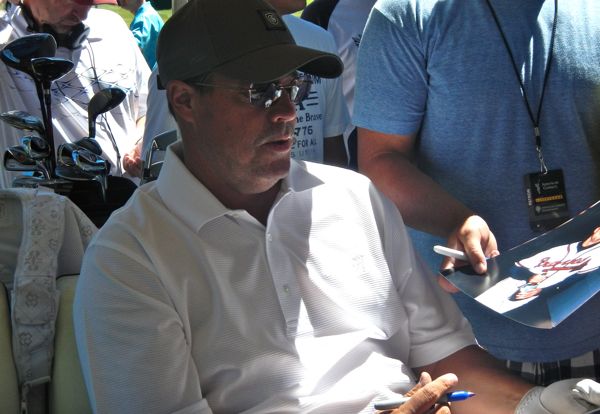
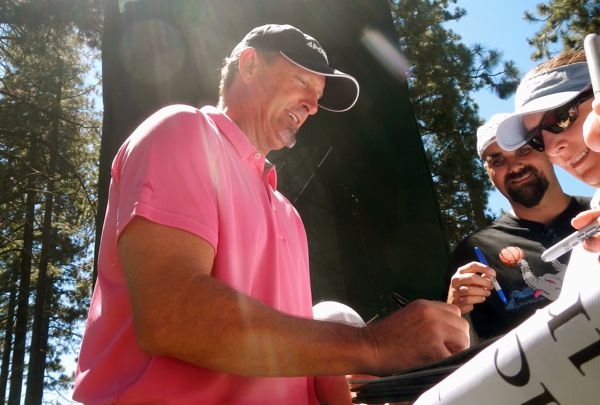
Legendary All-Pro quarterback Joe Theismann didn’t hesitate to sign autographs as he walked the line of the putting green.

Jerry Rice could take a lesson from his elder. Even though his game has improved through the years and he has been known to mingle with the crowd, on Saturday he walked off the putting green without so much as a smile to the gang along the ropes.

This was in direct contrast to Alfonso Ribeiro and Carson Palmer who smiled and conversed with people as they were on the putting green.

Even though Charles Barkley is usually jovial, he left hole 9 in a cart Saturday without a word to anyone despite a large crowd wanting his autograph.

The strip of sand along hole 17 was one big party on Saturday – as is tradition. The tournament provides this group with its own bar on the beach.

Douglas County sheriff’s Sgt. Ron Elges and Deputy Adam Windsor kept an eye out to make sure the crowd stayed on the other side of the rope.

The tournament is on target to break last year’s attendance record of 40,156. The single day record was set July 21 at 13,727. The previous record of 12,276 was from 2011.

Action begins July 22 at 8:05am. Here are Sunday’s tee times.

— Susan Wood contributed to this story.

ngg_shortcode_1_placeholder (Click on photos to enlarge.)


Tour to showcase mountain gardens, growth post-Angora

By Linda Conaboy

In preparation for its ninth annual garden tour, the Lake Tahoe Historical Society recently previewed all nine gardens that will be on view July 29. Five of the gardens are within the Angora burn area.

“It’s always scary to put this together, basically because we have to pick the gardens the year before. We looked at this year’s gardens in August and September last year,” Catherine Whelan, president of the historical society, said. “You just don’t know how gardens will turn out and what winter will do to them”

Creek bed and covered seating area in Marsha Ward-Hudson's garden. Photos/Linda Conaboy

Whelan said the historical society picks a variety of homes to showcase what can be done in a shade garden, as well as a sunny one and how to approach gardening at various levels — as well as to prove it’s possible to garden in the mountains.

“This year, we’re giving a special nod to the gardens in the Angora burn site. We support all of their struggles,” Whelan told Lake Tahoe News.

Traipsing around Debbie and Buzz Bera’s backyard it became apparent — yes, you can garden in the mountains. Although the Bera home wasn’t destroyed in the burn, their garden was singed.

Perennials are the corner stone in this not-too-large yard — bright perennials and the whimsical birdhouse fence tantalize the palette for more. More is the pond and waterfall fenced in by the wall of birdhouses, all on the sunny side of the yard. The shady areas include a greenhouse and enough hostas to add green to an otherwise difficult area to cultivate.

On to Marsha Ward-Hudson’s home on Mt. Olympia Circle. The welcoming front yard has a carefully manicured lawn with lots of plantings surrounding the large porch. To get to the back, the preview party marched along stepping stones buried in verdant and pillowy ground cover, the kind that makes one want to take her shoes off to see if it’s really as soft as it looks.

Who would think you could grow lush ground cover like this in the mountains? Believe it. In the backyard, a faux creek bed winds its way from the vegetable garden, along the lawn’s curvy edge to the covered patio.

Landscaping with natural elements at the Cressy home.

Ward-Hudson utilizes old tires filled with what looks like well-amended soil to cage her veggies. Like other yards here, this one suffered from the fire retardant used to smother the fire; however, about two feet of new topsoil seems to be providing ample nutrients for the multitude of flowers and emerging vegetables.

The third stop, the Angora Community Demonstration Garden proved to be a bittersweet one, for this is where Owen and Esther Evans once had a home. It was one of the 254 lost in the fire of 2007. Because of age, the Evans decided not to rebuild, but chose to create a garden to give back to their neighborhood.

A sign on the property states this collaborative garden is a model of water conversation, best management practices, defensible space and beauty. All of which became apparent by a stroll along the paths where various flowers, vegetables, ground covers and strawberry vines grow in profusion.

Like so many others, Lisa and Joe McAvoy not only had to plant another garden; they also had to rebuild their home, a task completed mainly by Joe McAvoy with a little help from his friends.

Lisa was responsible for the garden. Like the house, this, too, was a labor of love. With John Fellowes at Aspen Hollow Nursery, McAvoy created a visually resplendent and artful outdoor scene. “It’s going to be a forest,” McAvoy said. “To make way for new things, I keep moving plants around.”

Birdhouse fence at Debbie and Buzz Bera's home.

What has resulted, among the well-placed boulders, lush foliage and a water feature that looks like a natural oasis in this garden is a lovely place to sit and contemplate the magnificent mountain views. But look the other way for a reminder of the fire as blackened trees rise on the mountain in front of the house.

When visiting, be sure to check out the fanciful garden art and various sitting areas in the McAvoy gardens.

It’s hard to believe what has been resurrected from the Angora disaster, especially when visiting Brooks and Karen Martin’s home and garden.

Brooks Martin said they had put the finishing touches on their garden just before the fire (a two-year project with the help of John Fellowes), only to have their home and their garden disappear the next day.

“All that made it through the fire were the prayer flags, the Quan Yin statue and the statue of St. Francis,” Brooks said.

A fresh start among their huge, natural boulders, the likes of which you may remember from the fictional Ponderosa Ranch, features multiple outdoor seating areas, a large water feature and even some tiny mushrooms sprouting on the home’s north side.

The seating areas are arranged to catch the day’s lighting as it strobes across the landscape — there’s lots of shade for hot Tahoe days and sun when it’s needed.

Next, on down the hill and off of Pioneer Trail for neighboring homes owned by the Cressy and Williams families.

Although both of these houses have the same gardening conditions in their adjoining yards, each was treated to a different landscape. Jennifer Cressy, who, along with John Roos, is in charge of the demonstration garden at Lake Tahoe Community College, used all-natural vegetation in her yard, while the Williams produced more formal grounds amidst the towering evergreen trees.

Daniel Cressy designed and installed the many fountains in his yard, while the Williams opted for an in-ground koi pond, minus koi. In the Williams’ yard it’s interesting to note the juxtaposition of natural vegetation, fountains and succulents tucked into the landscape among the pines.

From the street, Stephanie and Neal Niederman’s home is a delight. Walking from the side to the back yard it’s easy to realize these folks have spent a lot of time and a great deal of effort on their yard.

Garden at the Niederman home.

“Our whole life is here,” Stephanie Niederman said. “And the plant of the year is delphinium.” Her tall and hearty delphiniums are enough to make even an inveterate gardener envious.

“The secret to our garden is well-amended soil,” a thought echoed by nearly all the gardeners on our tour. The Niederman side yard is a plethora of green grass and plants that flourish in the shade, as evidenced by the healthy hostas lounging at the edge of the grass. The sun-loving varieties, grown from Stephanie’s penchant for purchasing flower six-packs are happy too.

The last garden is Carole Spreklesen Foster’s. There is a lush garden cultivated on her original home site as well as the adjoining lot she purchased so she could grow more plants.

This is where you will find food, some provided by Harrah’s and Harveys, libations, and music courtesy of Dream Spirit Baroque Band, all to be enjoyed in Foster’s park — at least that’s what it may remind you of. Don’t forget to check out her authentic teepee, filled with all things Native American. The colt’s foot and Japanese willows are just two of the unique plants Spreklesen Foster grows.

Although Spreklesen Foster’s home is listed last on the tour, if it’s more convenient, there’s no need to visit it last. Food and drink will be served there all day.

——

Details:

When: July 29

Time: 10 am-4 pm

Price: $20

Tickets are available from: Tahoe Outdoor Living, Aspen Hollow Nursery, Nel’s Garden Center, Sunbasin Nursery and at the Historical Society at 3058 Lake Tahoe Blvd. If there are tickets left, purchase them the day of the event at the Historical Society.


Ex-starting pitchers find success with small white ball

By Kathryn Reed

STATELINE – Being a starting pitcher in Major League Baseball means a lot of days off from work. And like a lot of people with free time and money, golf fills in those hours.

Some of the former starting pitchers playing in this week’s American Century Championship golf tournament at Edgewood Tahoe say their prowess on the greens has something to do with being the best athletes on the diamond. A couple said it in jest, while Rick Rhoden didn’t have a hint of sarcasm when he voiced that opinion.

Rick Rhoden is the only former starting pitcher to win Tahoe's celebrity golf tournament.

Rhoden has room to brag about his ability in both sports. In his 16 years as a Major League pitcher he won 151 games, had a 3.59 ERA, was an All Star twice, and played in two World Series.

Since retiring in 1989, he has won the ACC tourney eight times, the last being in 2009. He has qualified for the U.S. Senior Open, and has three top 10 finishes in the Champions Tour.

“It’s pretty much the same motion with transferring your weight,” Rhoden told Lake Tahoe News of the similarities of pitching and golfing.

While David Wells is one of 22 pitchers to throw a perfect game, his golf abilities don’t match. He says it’s the Atlanta Braves pitchers who give his profession a good reputation for what can be done on the links.

David Wells

During Tuesday’s practice round his tee shot on hole 8 didn’t even go 200 yards. He picked up the ball and moved it to closer to where the others in the foursome were making their second shot.

The only similarity between the two sports is “that you get pissed,” Wells said. He added that golf was more likely to benefit hitters than pitchers.

On the other side of the Stateline golf course Greg Maddux was proving former Braves pitchers know what to do with a little white ball. But he said there are no similarities between the sports.

Former Braves pitcher Greg Maddux benefited from having a putting green at Turner Field. Photos/Kathryn Reed

“Golf is way harder,” Maddux said while signing autographs as he sat in his cart at the start of hole 15.

Fellow Braves teammate John Smoltz is also in the field at ACC.

Stories abound about how Maddux, Smoltz and Tom Glavine not only competed on the mound against opposing teams, but among themselves when it came time for golf.

According to Golf Digest, “When Atlanta won the 1995 World Series, they convinced then-team president Stan Kasten to install a putting green inside Turner Stadium after the Braves moved there in ’97. The artificial-turf green covered 360 square feet, included four holes and was surrounded by a floor-to-ceiling, panoramic mural of Augusta National.” (A restaurant has since replaced it.)

Bret Saberhagen

What Bret Saberhagen says is similar between being a starting pitcher and playing golf is the mental game. But the three-time All Star and two-time Cy Young winner also said having time allows his brethren to fine-tune their golf game.

For Hall of Famer Goose Gossage, it was all that time off between starts that allowed him to feel comfortable with a club in his hand.

“A relief pitcher couldn’t golf all day and do what I did,” Gossage told Lake Tahoe News. “I didn’t get to start the ninth with a three-run lead and no one on.”

Goose Gossage said his pitching schedule helped his golf game.

He also didn’t work every day and got paid more.

The other starting pitcher playing in this year’s celebrity golf tournament is Mark Mulder.

—-

Notes:

• The first round of the three-day tournament begins today.

Go online to find out the pairings.

• First tee time July 20 is 9:10am.

• This 23rd annual event has a purse of $600,000.

• Corporate partnerships for the tournament have been secured through 2015.