Opinion: TRPA has outlived its usefulness, time to disband

By Kathryn Reed

What is wrong with Lake Tahoe? Plenty.

What is right with Lake Tahoe? A few things.

What can be done so the answers are reversed?

Every time I leave town I contemplate the above questions because the negatives of Tahoe become crystal clear when other locations seem to have their stuff together. I also contemplate those questions and their answers with friends, colleagues and others in the area.
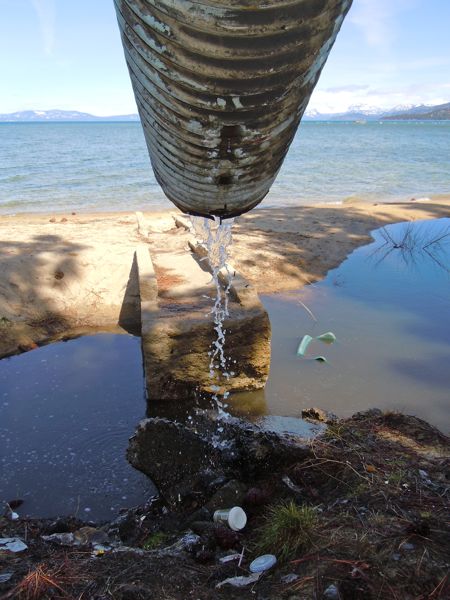
TRPA, a federal agency, has allowed cities, counties and state transportation agencies to let gunk flow directly into Lake Tahoe. Photo/LTN file

I have relatively minor examples in my life that show the difficulties I have had with rules in the Lake Tahoe Basin.

We don’t have our TRPA best management practices certificate because our driveway is out of compliance. It has a 1 to 2 percent grade. It’s concrete. The most expensive part of replacing the driveway is getting rid of the concrete. Tahoe Regional Planning Agency and the Tahoe Resource Conservation District want us to put in a swale on the “lake” side of the driveway. The water flows the other way, in front of our neighbor, into a ditch and into a field by an elementary school where sediments are naturally filtered out.

We live on a high water table. Each spring the sump pump sends water from under the house, through a pipe to the back yard – where many times the yard is then flooded. The water goes underground, back under the house and the process is repeated. I have spoken to TRPA, Lahontan Regional Water Quality Control Board, South Lake Tahoe and South Tahoe PUD officials about having a communitywide catch basin for all this water so it could be used for irrigation. I have even said tax us. Yep, I used that three-letter word.

They all said it’s not possible, that there is no shortage of water here so there is no incentive and that people would not tax themselves.

Well, taxing for the sake of taxing we won’t support. But taxing because there is a true, tangible benefit is different.

You see people, we are going to have to pay for the improvements in town. We are the government. I hear people say taxes are high in Tahoe. Prove it. Show me.

Yes, it’s expensive in terms of housing, food and gas. But taxes? Not so much.

(Yes, the state of California is outrageous – but that’s a different issue.)

Another personal issue was with business licensing. When I wanted to start a home-based business, I needed to go to the airport (aka city hall) for the regular business license. Then I had to go to South Lake Tahoe’s Tata Lane office for the home business license. Then I got to pay more money for the privilege to work at home – where I am not adding more vehicle miles traveled to get to an office.

Imagine if I had wanted to do something grander?

Government and regulatory agencies are the problem.

Companies and individuals wanting to do large-scale (even medium-scale) projects are hindered by regulations and then sued by environmental groups that don’t like the projects. The hoops people have to go through are astounding and counterproductive.

Improving infrastructure

Not all development or redevelopment is bad. But neither should it all be approved because there is environmental gain.

Do we really need a five-star resort at Homewood along a road that is so crowded? Do we really need a state highway in front of the only bi-state park in the country?

We can’t blame our woes on second homeowners. Like South Lake Tahoe, in Vail and Park City about 70 percent of the houses are not occupied by primary residents. Those towns are functioning and look great.

But those cities taxed themselves. (They aren’t perfect, no area is, and it’s not that we have to be them – but we do need to stop saying what we don’t want to be and figure what we do want because what we have is crap.)

We have to pay to have free transit if that’s what we want. We have to pay for roads if that is what we want.

Yes, part of the problem cities and counties have is the amount of money doled out each year on pensions and health care for retirees. But don’t begrudge the retiree for getting what their union bargained for. Look at the electeds who agreed to those public dollars to be spent on a few employees instead of the greater public. (It’s only a handful of employees who abused the system by racking up OT and doing other things to inflate their pension. But we the public need to demand those practices are not allowed – to stop the loopholes that essentially amount to the theft of public money.)

We can start by voting. Nov. 6 is the next chance to make a difference. City and county reps sit on TRPA and other vital boards. If you don’t vote, you are part of the problem.

Lakeview Commons in South Lake Tahoe was paid for by California Tahoe Conservancy dollars. That’s state money. Part comes from Tahoe license plate sales. Wouldn’t it be more logical to drive around with a Tahoe plate (California or Nevada), than a bumper sticker?

Improvements to the North Shore in Placer County come from taxing hotel guests in Lake Tahoe. Maybe next year when South Lake Tahoe asks voters to increase the hotel tax some of the dollars could be allocated for events or the arts or to improve athletic facilities and not just go to balance the general fund.

Monumental change needed

There are other ways to bring change beyond voting.

It is time to disband the TRPA.

A week from today is the annual Lake Tahoe Environmental Summit. Sen. Dean Heller, R-Nev., is hosting it at Edgewood Tahoe. Two other U.S. senators, a congressman and possibly the governors of California and Nevada, along with a cadre of local muckety-mucks, who often act like star-struck adolescents around these Washington-types, will join him.

TRPA was enacted by Congress to protect Lake Tahoe. Congress can make TRPA go away. What if we showed up at the 10am event in Stateline and took back our lake? What if we the people told these members of Congress that enough is enough?

TRPA has nine thresholds. Lake clarity is just one of them. That is why they get to say if your deck can be expanded, waffle on how big of a tree you get to cut down in your yard, if windows on a house should be allowed to be seen by boaters on the lake, and to decide after a fire obliterates 254 houses that pine needles as an erosion control measure isn’t so wise.

TRPA has done good. But even its executive director keeps admitting to how things must change, that past policies weren’t based on science, and that it is a new day.

Well, the new day should be that they go away.

Local jurisdictions can figure out how to zone areas. Local jurisdictions can figure out what type of lighting is good, what paint colors work, what signs should look like and if a tree should be removed.

Local water agencies and fire departments have proved that they can form regional alliances. Because we do need a regional, aka lakewide, approach to some matters.

Lahontan and the Nevada Department of Environmental Protection, along with owners of lakeside property, U.S. Coast Guard, and departments of waterways for the states will figure out the lake clarity part.

TRPA stresses that is a planning agency and not a doing agency. It looks like it planned the demise, ruin and destruction of Lake Tahoe based on the dilapidated infrastructure, lack of attention to water clarity along beaches (where we and the tourists are swimming), creating commodities out of commercial floor area and tourist accommodation units, and the empty buildings (because it’s so dang impossible to convert old hotels into housing or to renovate structures because of the air mitigation fees).

TRPA has failed us. We must stop this. We can’t rely on the updated Regional Plan that is supposed to be approved in December. Those close to the process say a lawsuit is likely if it does pass, and that it won’t include any meat in terms of real change. All of that remains to be seen and is speculation at this point.

Still, TRPA is hurting the Lake Tahoe Basin, not helping it. It served a purpose once, but now it is so much about creating job security for the people inside those walls.

This is the agency that last month paid approximately $12,000 for two people to come talk to the Governing Board and locals about what Tahoe needs to do fix itself. At the end of the three-hour public session I told two TRPA employees that the night was a complete waste of my time. Someone else told them the two speakers were preaching to the choir.

TRPA is a public agency – so that means those were our dollars that paid those people to essentially have a paid vacation in Lake Tahoe. Wow, I could talk for $6,000. I could give you my opinion for much less – oh, wait, I just did – and it was free.


London’s vibrancy spills forth on every streetcorner

By Susan Wood

LONDON – It’s only fitting England’s largest city hosts the 204 nations that make up the family of the 2012 Summer Olympic Games.

London is a city of vast diversity – given its multicultural atmosphere. The many languages and ethnicities heard and seen on the streets and in the “tube” are as varied as a visitor’s choices of things to do, food to eat, beverages to consume, neighborhoods to scour and places to stay.

Among them, the Shepherd’s Bush neighborhood is what’s termed the West End, where theater is king, the BBC broadcasts, a menagerie of city blocks of Georgian architecture stand and even the history includes a different Olympic time.

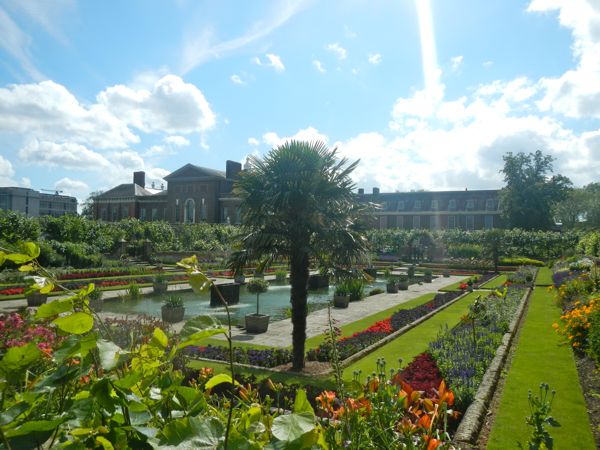
Kensington Palace's gardens are full of color. The gardens are free to roam, while there is a fee to tour the palace. Photos/Kathryn Reed

As the only city to host the Games three times, London’s first was staged in Shepherd’s Bush’s “White City” in 1908. Britain ended up winning 56 medals. White City eventually became home to greyhound racing on the speedway.

Today, a modern, hip neighborhood thrives – as reflected by the four-star K West Hotel & Spa on Richmond Way. The decade-old boutique hotel may be all glass at its front entrance, but it’s all eco-friendly green in principle – a gold member of the government-sanctioned Green Tourism Business Scheme among its four notable associations. Little touches can be noticed in the spacious executive double room — including two types of trash cans for waste, dimming recessed lighting and a perfectly-fitting narrow bathtub so there’s no waste of water for those who bathe as sport. And the towels are nicely oversized for drying off.

Downstairs, a luxurious, full spa awaits a robe-clad guest who wants to make the most of the water lounging experience for an additional 25 pounds a day. (Check the exchange rate to budget accordingly because the dollar is most often worth much less.)

Steps away from a massaging foot bath is the hydrotherapy hot pool that is equipped with metal chaise lounges to accommodate anyone of any height. (It’s much more comfortable than it sounds.) Across from it, the “water fountain” works on the shoulder muscles. If the spa visitor becomes overheated from the steam room or sauna, a unique Snow Paradise room with the simulated white stuff can bring the body temperature down. It’s hard to do more than a minute. For longer-lasting relief, a collage of treatments is available for an additional fee.

From the lobby, the K West Lounge is fun and inviting – especially with bartender Carlos at the helm. He goes out of his way to make sure the guest gets what she wants. Upstairs, the Kanteen restaurant serves breakfast, lunch, snacks and dinner at reasonable prices. (Recommended: sweet potato fries and a raspberry crème brulee in the evening with Wimbledon on the “tele” make a good room picnic until starting the next day with a filling full English breakfast in the Kanteen restaurant.) A guest can either opt for a hot breakfast there or the continental version served in the lounge downstairs for an extra room charge.

After the Olympics in September, K West rooms run from 127 pounds a night for a junior double to 177 pounds for an executive double or 268 for a suite.

With cushy seats and rectangular, rock fireplace in the lounge as well as piped-in jazz and mood-enhancing colored lighting throughout the hotel, the comfortable, relaxing K West offers subtle and blatant amenities that make a guest’s stay so comfortable one may not want to leave if not for the city of London calling.

Stepping out for the day highlights the new and the old

When venturing outside with the chirping birds, K West Hotel is an ideal launching pad for inviting walks around Shepherd’s Bush or hopping the London Underground metro to see the varied sites.

The West End touts some of the best theatrical performances in the world. For one, there’s the captivating “War Horse” that started in the National Theater and moved over to New London Theatre. Walking through the Piccadilly Circus neighborhood is a carnival experience. Pedestrians jam the sidewalks, lights are flashing at night and the place is electric with activity. There and farther east to Covent Garden where the pub crawl is the scene, street performers try their hand at entertaining pedestrians with either gravity-defying feats or statuesque displays.

At a slower pace, a meandering stroll from Shepherd’s Bush down the bustling, shop-lined Bayswater Road and historic High Street of Kensington can lead a walker to the ornate Kensington Palace and colorful Gardens, where the late Princess Diana lived with her sons William and Harry. About a 15-minute walk from the palace, a visitor can see where she is honored at the Diana Memorial Fountain on the corner of Hyde Park. It’s a circular wading pool that brings out all ages.

Kensington Palace tours cost 12 pounds. (For about 150 pounds, the London Pass with transportation card gives a visitor access to more than 50 attractions and six days of riding the Underground.)

The palace built in 1605 and restored a year ago features the Royal Ceremonial Dress Collection, a Queen Victoria story told through quotes from room to room and a film of Queen Victoria’s Diamond Jubilee celebration of 1897. Queen Elizabeth II’s ceremony was set last June, a few weeks before the Olympic Games.

A quick hop and connecting change on the Underground from one of two Shepherd’s Bush stations (Hammersmith and City or Central lines) within walking distance from K West Hotel can place a London visitor in the heart of Olympic Park, where Blue Badge Tour guides provided a thorough history and view of the park and surrounding structures in the East London area of Stratford. (Crossing the city only takes between 45 minutes to one hour and is convenient to use.)

From the far east side, visitors have ample choices to backtrack on a sightseeing day – by train from the multitude of stations, bus or ideally on foot to take it all in.

A bridge-to-bridge pedestrian tour on your own over the windy River Thames is highly recommended given their different personalities and views.

The gothic Tower Bridge, one of the most famous in the world, has donned giant Olympic rings for the host city’s special occasion. A tour, which is included on the London Pass, costs 8 pounds without and includes a trip to the Victorian engine room that’s so immaculate one could almost eat off the hardware. Either way, it’s well worth the trip down London’s memory lane and a high-level walkway featuring displays of other famous bridges of the world and past Olympic Games from one end of the bridge to the other.

Across the way, standing on the London Bridge provides a world-class view east to the Tower of London fortress housing the heavily-guarded Crown Jewels and west to Shakespeare’s Globe Theatre and Southwark Bridge. Each bridge characterizes a different personality of this exciting city along the River Thames. The waterfront walkways are alive and electric with visitors hitting the famous attractions.

Due southwest of the Tower Bridge is grand central for government — the House of Parliament with Big Ben alongside. The complex may be one of the most recognizable landmarks in London, but it’s Westminster Abbey across the street that is a must for sightseers wanting to immerse themselves into the heart of London.

Its history is unsurpassed in terms of grandeur and importance. One can almost feel an apple drop when standing in front of Sir Isaac Newton’s memorial. The working church’s acoustics are like no other with its high, majestic ceiling and walls adorned with stained glass and soaring vaults to demonstrate its glory to God. The church was designed in the shape of a cross. (No photographs can be taken, but the audio tour provides a long-lasting visual.) Tours cost 8 pounds without the London Pass.

A longer walk over the Westminster Bridge can transport a visitor from the 10th century to the modern age of the London Eye. The ride, which crosses between a Ferris wheel and a gondola, provides the best 360-degree views of the city at 443 feet up. In London, its height is only surpassed by the city’s newest skyline addition – the modern-looking, pointed Shard, which opened at more than 1,000-feet high just prior to the 2012 Summer Olympic Games.

An Olympic first

A short, direct tube ride due south of Shepherd’s Bush gets a visitor to Wimbledon, home of one of the four tennis grand slams. The All England Club is hosting the venue in the Olympic Games for the first time – something 2012 French Open winner and clay king Rafael Nadal was quoted in the Wimbledon museum as saying “is fitting for the best tennis club in the world” to host. Many tennis greats from Serena Williams and Roger Federer to Maria Sharapova and hometown hero Andy Murray have shown up for the Games.

Like the Olympics, Wimbledon tickets are expensive or hard to come by with a discount – bringing most of the tennis faithful fans to queue. The process requires standing in line in the wee morning hours with thousands of others. Once in the grounds, the lucky fans will find court seats.

All the work is worth the effort, despite the usual threat or reality of rain. New over the last few years has been the premier Centre Court retractable roof and giant Jumbotron screen set up on the front field for grounds spectators to watch the television broadcast.

Up-close and personal with television

A 15-minute walk from the K West hotel down Wood Lane invites a sightseer wanting the more unconventional tour to the grounds of the BBC, Britain’s primary television network watched by 20 million viewers. The tour lasts up to two hours and costs about 12 pounds.

The complex is shaped in a giant question mark, resembling an ideal motto for the proud, serious network, which tour guide Debbie said differs from CNN’s broadcasts that look like footage of “a disaster movie.” The television news operation alone employs more than 2,000 people and is divided between “planned” and “breaking” news. Guests of the tour get a brief view of the busy newsroom.

The BBC Weather Centre cranks out 140 forecasts every day; something a tour guest can try in front of a green screen. The tour is part learning, part interactive and involves waiting rooms and studios where Mariah Carey, the Metallica band and Madonna have sat to go on the air and well-known shows like “Absolutely Fabulous” have been taped.

The BBC will move to Manchester in the near future.

Moving across the city changes the scene

Three Underground station stops away from Shepherd’s Bush off the Central Line opens up the world of London’s largest of its Royal Parks – Hyde Park.

Just on its edge, K West’s sister hotel  — the four-star, traditional Lancaster London that started in 1967 — sits steps away from the Lancaster Gate station off the Central Line.

Location, location, location seems to be the mantra here. A guest could spend a whole day in Hyde Park. For three years, the park’s lime trees have been pollinated by the hotel’s 1 million bees that are kept in rooftop hives. Among others, the Lancaster’s efforts have given it the eco-friendly reputation as the Green Hotel of the Year this year from the Considerate Hoteliers Association made up of its lodging peers. In October, the hotel will aptly host the London Honey Show, and at least 500 people are expected.

The 416-room Lancaster hotel serves the honey in its Island Grill, the floor level casual restaurant off the street that’s one of two it runs along with a bar. The Thai eatery, named Nipa, is reasonably priced and boasts tasty dishes.

When the Lancaster London Hotel Company owner from Thailand comes to visit, he makes a point of stopping into the restaurant, according to spokeswoman Alison Hull, who added the city has been “transformed” since the arrival of the Olympic Games. Upstairs, the view rooms provide an awe-inspiring, picture-window-sized view of the London skyline and tree-lined park. The rooms start at 199 pounds in September following the Olympics.

(Note of caution: opening those windows may serve to save a guest from an inconsiderate one who decides to smoke at all hours of the night on a non-smoking floor. After three complaints, security officers and staff elected to do nothing about it.)

Nonetheless, the view will draw a guest outside for the day.

First on the list, no visit to London would be complete without going to the queen’s Buckingham Palace for the changing of the guard by her royal staff. The mid-morning spectacle of mass tourism and pomp and circumstance requires patience and height in a crowd.

But with a 25-minute stroll through one end of Hyde Park to the other, the photos alone are worth the 45-minute presentation. To the delight of the masses who fight tooth and nail for an ideal viewing spot, the guard marches in unison – some on horseback, others with swords and yet more with brass and others with big guns.

The brass guard band covered a song list from the Britain anthem to jazz and even a Billy Joel tune, “Moving Out,” before the members did so.

“I can’t believe they’re playing jazz,” one amazed man said in the crowd.

Upon the guard and crowd disbursing, the best of the estimated millions of photos shot can be grabbed. The return from the southeast corner of Hyde Park to Lancaster Gate on the northwest end can be made on foot with an unscheduled trip along the lovely Serpentine channel to watch the birds and boaters. (Recommended: take a stop at the Lido Lounge along the Serpentine for one of England’s pub beers to slow things down on a sightseeing marathon.)

Out the door for a short walk to the Knightsbridge neighborhood down Sloan Street may be just what a shopper is looking for. The exclusive boulevard is home to Harrods, a department store extravaganza. Window shopping alone can be a magical experience. Plus, there is a tribute to Princess Diana and Dodi Fayed.

ngg_shortcode_0_placeholder (Click on photos to enlarge.)


Joy Rothschild — 1949-2012; an activist until the end

A life-long advocate for social change, Joy Rothschild never stopped fighting for what she believed in.

In her 63 years she inspired others to be part of the change she sought. She was not one who just talked a good game, but instead spent time and money supporting the issues that were important to her locally and nationally.

Joy passed away Aug. 2 after a courageous battle with cancer.

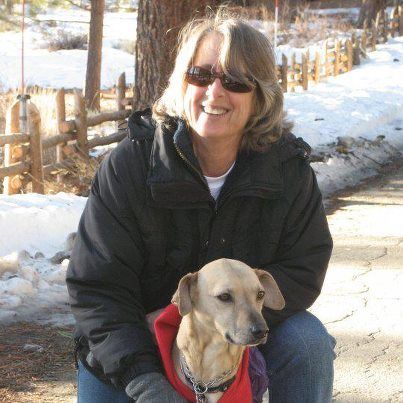
Joy Rothschild and her dog AJ.

A native San Franciscan, she was born Jan. 13, 1949. Growing up in the Bay Area at a tumultuous time inspired Joy to speak her mind, get involved and become an activist.

In the late 1960s, Joy traveled to New Orleans where she worked for the rights of farm workers alongside Cesar Chavez.

She worked on the campaigns of John Burton, Sala Burton and Dianne Feinstein. One of her proudest accomplishments was working on Feinstein’s 1984 mayoral recall campaign — in which more than 70 percent of the voters said yes to Feinstein.

Shortly after that campaign Joy moved to South Lake Tahoe with the intent of unionizing the culinary workers at the Stateline casinos. While that bid failed, what she gained was a love for Lake Tahoe. She called the area home ever since then.

In 1987, Joy began working as an instructional aide for Lake Tahoe Unified School District. While at Al Tahoe Elementary School she became involved in the classified union and served as its president for several years. In 1989, Joy transferred to South Tahoe Middle School where she worked as a “Challenge” class aide for grades 6-8. These were classes for youths who were smart, but not succeeding in school. Joy connected deeply with youth who were troubled, keeping in touch with many into adulthood.

“She was beloved by the kids for her compassion, humor, wit and kindness. She could get to the toughest kid. And she was so good at it,” Cindy Cowen, a teacher at STMS who worked with Joy, said. “She could make the kids laugh, cry, and be better human beings.”

Later Joy began working for the district’s truancy program and then the McKinney Vento program for homeless students at the district.

Joy and Cowen put together an instructional book titled “It is Our Business” that is used in part today in LTUSD and Alpine County.

She retired from the district in 2003.

Joy’s desire to help troubled youth extended beyond LTUSD. For many years she was a volunteer with Court Appointed Special Advocates. She was also a staff member for CASA El Dorado County.

“Joy was an exceptional advocate for the most troubled youth who needed an honest, straightforward friend and advisor. She formed trusting relationships because she genuinely liked ‘her’ kids. Each youth that was touched by Joy, knew they had a friend for life,” Wendy David, former CASA site manager, said.

Much like there are trail angels for people doing long hikes, Joy took that concept in a different direction. She regularly gave scholarships to Mount Tallac High School students. Not one to want public recognition for her deeds, she would write checks to various organizations that needed help without the direct beneficiaries knowing where the money came from. They include, but are not limited to, Tahoe Magic, Zawadisha Fund, and Ally Club at South Tahoe High School.

“She has been my anonymous Ally donor for the past several years, and it is because of her that I was able to do much of the wonderful work we have with Ally. She is the reason we attended the gay prom, the reason we had snacks each week, and the reason that I felt I was doing the most good possible,” Bridey Heidel, Ally advisor and South Tahoe High School teacher, said. “Joy is also the reason I became a teacher. After seeing me substitute teach one day, she held my face and said, ‘This is what you must do. It’s what you were meant to do.’ I never planned on being a teacher … until that moment.”

She helped women and children locally and afar. She made several excursions out of the country as volunteer-vacations where she worked to improve the lives of women and children in those countries.

Joy participated in every local production of the “Vagina Monologues.” This year she was honored as the Vagina Warrior for her dedication to making the lives of women better.

Joy at times was an active member in the local Democratic Club and always a passionate Democrat.

She loved to hike and cross country ski throughout Lake Tahoe.

Joy is survived by her father, Rocky Rothschild of San Francisco; sister Teri Rothschild of San Francisco; several cousins; and an abundance of friends; and her beloved dog AJ.

A celebration of life will be Aug. 14 at 5pm at the home of Wendy and Kerry David, 1300 Keller Road, South Lake Tahoe. Please bring a favorite dish or bottle of wine to share.

In lieu of flowers, donations may be made to CASA El Dorado County, 1354 Johnson Blvd., Ste. 2, South Lake Tahoe, CA 96150; or South Lake Tahoe Cancer League, 1602 Cherry Hill Circle, South Lake Tahoe, CA 96150; or Zawadisha Fund: Micro loans for women, P.O. Box 6602, Tahoe City, CA 96145.


Mount Rose wants to infuse $23.5 million into ski area

By Kathryn Reed

With Mt. Rose proposing a $23.5 million expansion to the ski resort over 10 years, it could be in the position to be a player if Lake Tahoe-Reno ever gets the Winter Olympics.

In 1960 the resort was the alternate for the women’s downhill when Squaw Valley hosted the Games. Today, it along with Heavenly Mountain Resort, are the only Tahoe area resorts capable of hosting the men’s downhill, Tahoe-Reno Olympic committee officials have told Lake Tahoe News.

An artist's rendering of what the skier bridge over Mount Rose Highway might look like.

While regional Olympic officials are now eyeing 2026 as the potential year for hosting the Game because the U.S. Olympic Committee won’t go after the 2022 event, Mt. Rose is ready to make improvements that have nothing to do with the Olympics.

The Reno area resort is hoping to start the environmental phase of the process this fall. The U.S. Forest Service will have to sign off on the ski area’s plans. The resort is on the Humboldt-Toiyabe National Forest.

The soonest the plans could be implemented would be next year, though resort officials are saying it could be the following year.

A little work that has nothing to do with the mega plans is going on now.

“Granite Construction is still working on the secondary entrance to the ski area about a half-mile west of the Mt. Rose main lodge. It is being put into place with the future goal of improving circulation into the resort, but entry will not be accessible for the coming season,” Kayla Anderson of Mt. Rose told Lake Tahoe News.

What looks like construction in the main parking lot is actually the staging area for crews working on the erosion control project for highways 28 and 431.

The multimillion-dollar plan includes increasing terrain, more lifts and snowmaking improvements.

Next door, on the north side of Mount Rose Highway is the acreage known as Atoma.

“Mt. Rose looks to expand skiing services onto this 99-acre parcel to complement the beginner terrain on the Mt. Rose side of the mountain. This open, mosaic-glade style skiing would make for a unique lower level snow experience combining open runs with pods of trees intermixed throughout the new area,” the resort said in a statement.

A 3.5-mile run would be created from top to bottom. To make this happen, a bridge for skiers over the highway would be built. This bridge would link Atoma to the existing trails at Mt. Rose. Even the chairlift is proposed to cross the highway.

Ponderosa and Galena chairlifts would be taken out to make way for a high-speed chair going to the top to access runs in the Galena area.

Plans call for lengthening the Lakeview lift, which would provide views of Lake Tahoe as well as easier access to some terrain.

A restaurant near the top of Norwest Magnum 6 is on the books. It would provide 270-degree views of Lake Tahoe and Virginia Peak.


Upper Truckee Marsh dog ban over; leashes mandatory

By Kathryn Reed

It’s over. That would be the temporary dog ban in the Upper Truckee Marsh.

This popular meadow area that leads to a beach along Lake Tahoe and to the edge of Trout Creek had a three-month (May 1-July 31) dog ban imposed for the last two years. The reason is so many people were allowing their dogs off leash that it was impacting the wildlife in the area.

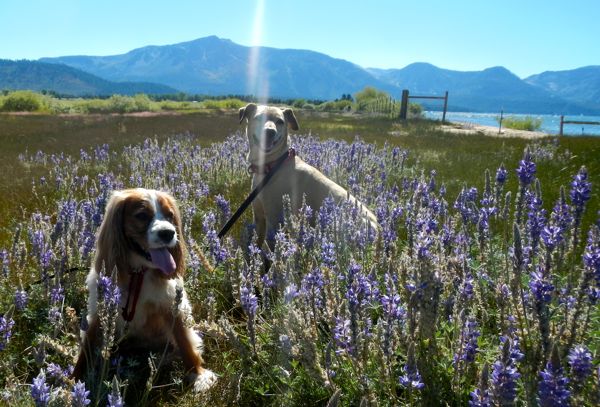
AJ and Rusty romp in the sand after a swim in Lake Tahoe. Photos/Kathryn Reed

This time period was picked because it’s when birds are breeding, with the peak time, at least in 2011, being June 22-July 19. Studies continue to be conducted as to what the effects are on birds, if more are in the area without dogs and how many little ones are born.

Dogs were stressing out birds by chasing them, sniffing at nests – some of which are on ground level in bushes.

While there was a time when cows used this as pasture land, the area has returned to a more natural look with native species calling it home.


A survey in summer 2011 found that two willow flycatchers were in this marsh area as well as neighboring Cove East. This songbird was put on the federal endangered species list in 1997.

AECOM of Sacramento compiled the data for CTC that was presented to the board at its June meeting. Will Richardson with the Tahoe Institute for Natural Sciences based in Truckee collected point count data of avian species.

Rusty and AJ are thrilled to be in the Upper Truckee Marsh.

“We believe the very high waters, and perhaps more importantly the late timing of the peak water level, were actually quite problematic for the nesting of many species that do not regularly suspend their nests in emergent vegetation,” Richardson wrote in his report from the 2011 survey. “Among these are the ducks, coots, shorebirds, and terns. We suspect that many species and individuals either nested elsewhere, possibly further (sic) upstream, or simply vacated the area completely in 2011.

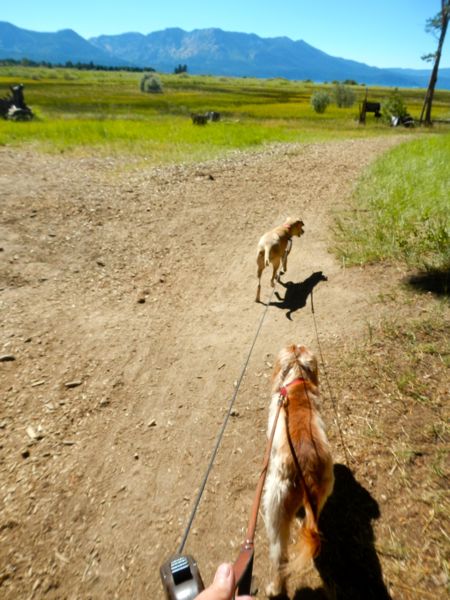
Dogs on leashes are allowed in the Upper Truckee Marsh.

He went on to say the number of shorebirds in the surveys done by AECOM will be below normal because they skipped the beachfront because of how wet everything was and how high the water was a year ago.

“We cannot stress enough that the effects of 2011’s high water on shorebird distribution will completely overshadow any apparent effects of the seasonal dog closure, and thus 2011 will surely be a low outlier with regards to shorebird use at the site,” Richardson wrote.

Data from the most recent closure won’t be available for several months.

A slew of birds call this marsh home – from Canada goose to bald eagles to mourning doves to spotted sandpipers.

It’s possible the seasonal dog ban will be permanent. That’s up to the CTC board. It will occur every year until they vote to do something else.

Several dogs of all sizes and breeds were enjoying the 80-plus degree weather on Aug. 1 – the first day the ban was lifted. Even though dogs are allowed on this acreage owned by the California Tahoe Conservancy, leashes are mandatory.

Of the nearly 5,000 CTC properties in the basin, this South Lake Tahoe parcel is the only one with this type of closure. The 311 acres were purchased about 11 years ago for $10 million. It is considered one of the most sensitive areas in the basin.

“It is the singular and most unique habitat in the Lake Tahoe Basin,” CTC Deputy Director Ray Lacey has told Lake Tahoe News.


Lake Tahoe’s irreverent show ‘Guilty Pleasures’ returns

By Kathryn Reed

Going 50 on 50 has been a mantra of locals for years. But what isn’t known is if the phrase or song came first.

Dave Hamilton says he’d like to think he coined the phrase, “but I imagine that term was around before the song.” This is in reference to the song and skit about driving 50 mph on Highway 50.

"Guilty Pleasures" is at the Boathouse Theatre for five shows starting Aug. 1. Photo/Provided

Hamilton with Mark D. Williams (who is the music instructor at Lake Tahoe Community College) are the creative geniuses behind “Guilty Pleasures” – the totally Tahoe play that returns to the stage for five performances starting tonight.

This is the sixth version of the play that was first written and produced in 2002. The last time it was updated was in 2009. Hamilton writes the dialogue and lyrics, while Williams is responsible for the music. Hamilton said the second half has changed so much through the years that it doesn’t resemble the first rendition.

“There will be three completely new numbers and many of the bits have been updated as well,” Hamilton said of the 2012 show.

Songs include “Keep Tahoe Blues,” “Living on Tahoe Time” and the “TRPA”.

The play is about a progressive judge who allows several individuals to perform a show as part of their community service.

Hamilton and Williams came up with the idea for “Guilty Pleasures” after working on stage productions together and thinking they could do better than some of the material they had been working with.

“We had done two shows at the Boathouse — ‘Nunsense’ and ‘6 Women with Brain Death or Inquiring Minds Want to Know’. Both are comic skit musicals and in the pantheon of shows, not very well written. However, both have been wildly successful. People like goofy shows,” Hamilton told Lake Tahoe News as to how the idea for “Guilty Pleasures” came to life. “We figured we could write something that bad and not have to pay to do it. I was trying to think of an overarching idea to capture some of the song ideas I had come up with. Somehow I came up with the idea that these people, normal folks, were all doing the show as part of a community service project.”

Most of the shows in the past decade have sold out. This is attributed to locals, second homeowners and regular visitors being able to relate to the themes delivered in “Guilty Pleasures”.

Returning to the Boathouse Theatre are Kurt Munger, Chris and Pam Taylor. The three have been in each of the six shows. Stephanie Grigsby, Anita Jones, Mark Williams (not the music guy) and Matt Ault will be playing different parts than they have in the past. “Guilty Pleasures” newbies are Carrie Bauwens, Joanie San Agustin and April Foiles.

Whether there will be a future update Hamilton won’t commit to saying at this time.

“After six versions, it gets harder to find material that everyone will get. There is always something topical going on, but in general it gets more difficult,” Hamilton told Lake Tahoe News. “It is interesting because about when I think people are tired of it, I keep running into local people who have never seen it. We did feel that when we ran it three years in a row, that it lost some steam. But then look at ‘Beach Blanket Babylon’.”

Details:

• Dates: Aug. 1-4, 7:30pm; Aug. 5, 2pm

• Cost: $18 adults, $15 seniors-students-children, in advance; $20 at door

• Info or tickets: Go online or call (530) 541.4975.

•Location: The Boathouse Theatre is at the Tallac Historic Site, which is located two miles past the intersection of highways 50 and 89, just past Camp Richardson, on the lake side of Highway 89.


Lost Lake remains a hidden wonder for at least 2 hikers

By Kathryn Reed

TAHOMA – Lost Lake is appropriately named. We never found it.

Still, the trek along General Creek provided stunning scenery and a chance to explore some terrain that was new to us.

Two winters ago Sue and I cross country skied on the trails at Sugar Pine Point State Park on the West Shore. These trails are where Olympians raced in the 1960 Games hosted by Squaw Valley. We said at the time it would be great to come back to explore the trails on foot.

Lush, green foliage is everywhere.

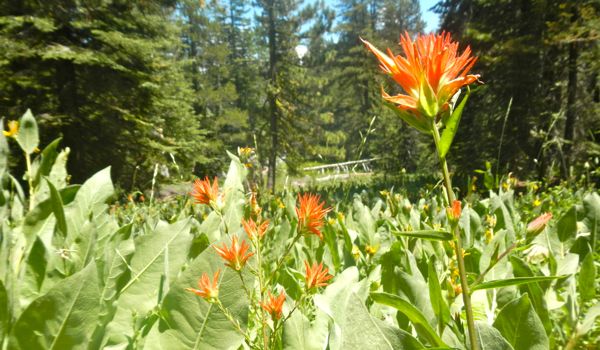
Indian paintbrush fills part of the General Creek trail. Photos/Kathryn Reed

When we went back a little more than a week ago we said it would be great to come back with mountain bikes. Plenty of tracks and a lone cyclist proved our point.

That’s the thing about this state park – it has something for most recreationists. Because where we were playing is also the General Creek Campground most people not staying the night tend to drive by instead of venturing past the attendant at the shack taking money.

Although the park’s employee gave us a map on an 8½ by 11 inch sheet of paper, it is not the most defined trail system. We didn’t let that bother us. We also didn’t let it faze us that another employee was not clear on how to get to Lost Lake and said it had been quite some time since he’d been there.

Maybe some of the $54 million surplus the parks department has could be put into maps and signage.

After parking in the day use lot, we followed the trail that skirts the campground until we hit a trail the width of a road. From there we headed left into Sugar Pine’s network of trails. The red trail is a loop. Going either way gets you to a sign that says Lily Pond. That’s how we went.

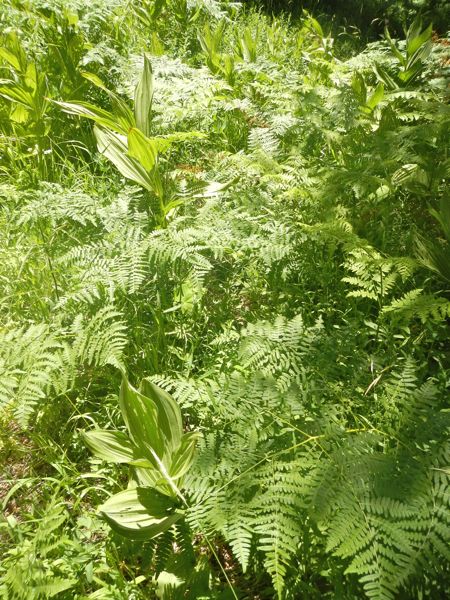
Ferns dot the landscape.

For the majority of the 10-mile roundtrip trek we were able to look up because the ground is free of rocks. Oftentimes we were able to walk side-by-side. But off the loop we walk single file.

An abundance of Indian paintbrush covers the landscape in a vibrant glow of red. A field of skunk cabbage is flowering. Lupine adds a shot of purple to the palette. Other wildflowers are out.

But what is most striking is the plethora of ferns. It reminds us both of the Tahoe-Yosemite trail, which as the crow flies, is close by, and runs somewhat parallel to the General Creek trail.

We were on this hike before the recent rains and still some of the terrain was so lush that “tropical” is the word that comes to mind to describe it.

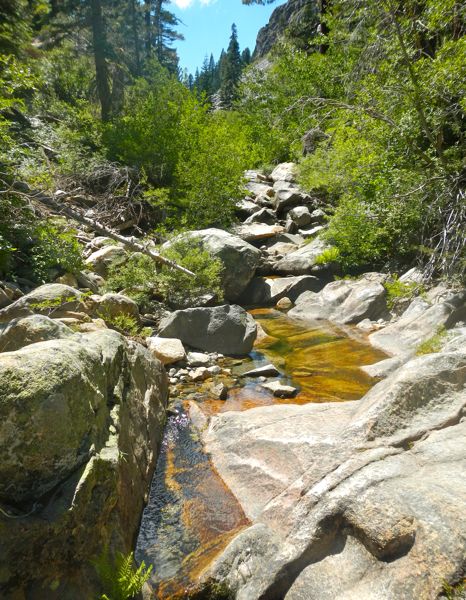
As we start to climb, a wall of granite is to our right and the creek to our left. Eventually we have to cross the creek to stay on the trail, but the water is low and rocks easy to scamper over.

Various pools of water look inviting to swim in – if one likes cold water. Fish dart back and forth – some 6-inches in length.

We get high enough that when we turn around Lake Tahoe is in the distance.

Up we go, hoping around each bend we will find Lost Lake.

General Creek is close by most of the hike.

We hit a marker that says Lost Lake to the left, Rubicon to the right. Right would have us on the Rubicon-McKinney trail. With the Jeep back at the campground lot, it wasn’t going to do us any good to get on a 4-wheel drive trail. We head up a ways toward Lost Lake. It’s not there.

A guy off trail checking out the scenery doesn’t know where it is either.

The heat is getting to me. Sue is struggling with recovering from a cold. We turn around.

Lost Lake remains lost.

—-

Getting there:

From South Lake Tahoe, go north on Highway 89, around Emerald Bay and past Meeks Bay.

Before hitting Tahoma, on the right will be a sign for the Ehrman Mansion.

In less than one mile make the left turn into the Sugar Pine Point Campground.

Parking is $10.

Dogs are not allowed.


TRPA changing approach regarding individual BMPs

By Kathryn Reed

STATELINE – A communal approach to BMPs may save individual property owners money and angst, while also keeping more sediment from reaching Lake Tahoe.

While the Tahoe Regional Planning Agency is not doing away with best management practices, it is headed toward being less focused on what individuals (those 43,000 parcels) are doing and more focused on communitywide efforts.

Through the total maximum daily load protocols mandated by the Lahontan Regional Water Quality Control Board on the California side of the lake and Nevada Department of Environmental Protection in the Silver State, TRPA in part will be using the data they collect to help measure the volume of sediment reaching the lake.

Drip lines will still be required, but the emphasis by TRPA on individual BMPs is likely to decrease. Photo/LTN

John Hester, who is overseeing the Regional Plan update for TRPA, said staff is proposing being less focused on monitoring individual projects and instead looking at larger areas, including subwatersheds. He said the idea is to get away from a one-size fits all approach.

During a multi-hour presentation to the TRPA Governing Board last week, reps from both states and the TRPA outlined how using the total maximum daily load will be incorporated into the Regional Plan update. That update is expected to be voted on in December.

But it was stressed that the TMDL is not the sole mechanism for achieving lake clarity.

“There is some sense that TMDL is all there is,” Joanne Marchetta, TRPA executive director, said. She said that’s not accurate. “The whole system is much larger than that.”

She said the TMDL is one component of the stormwater management system, which in itself is just part of the bigger picture. After all, particles floating in the air also contribute to water quality issues.

“Fifteen percent of fine sediment is from atmospheric deposition,” Bob Larson with Lahontan told the TRPA board. “But we don’t know exactly where it is from.”

He said it is most likely dust from paved and unpaved roads. While past theories put the blame on the Sacramento Valley and Gobi Desert for polluting Lake Tahoe, Larson said that is not the case.

Road improvements – including better street sweepers, along with improved public transportation are ways the road dust could be decreased.

Marchetta went through the evolution of water quality programs in the basin starting in the 1970s.

She admitted the introduction of parcel-by-parcel best management practices “was not driven by science. It was driven by policy.”

The theory was every drop of water needed to stay on the property it landed on.

BMPs have cost homeowners and businesses a tremendous amount of money in the last couple decades with no measurement as to whether they did any good. It meant redoing driveways, putting in drip lines so the runoff from roofs didn’t cause erosion, and covering bare soil.

“Simple erosion control practices will continue to be required around roof drip lines and to stabilize bare soil, but area-wide solutions are being recommended to help property owners with things like their driveways,” Kristi Boosman, spokeswoman for TRPA, told Lake Tahoe News after the meeting. “The draft Regional Plan proposes to coordinate TRPA’s BMP implementation efforts with local jurisdictions so that limited resources are focused in the areas that achieve the greatest pollutant load reduction. These areas would be determined by load reduction plans and Lake Clarity Crediting Program load reduction strategies local jurisdictions have to prepare as part of the TMDL.”

Besides stormwater concerns, water quality is impacted by watershed management, invasive species, how threatened-endangered-sensitive species are handled, and whether it was a dry or wet winter.

Through the TMDL program, the five counties, one city, U.S. Forest Service, and two state transportation departments collectively are tasked with reducing fine sediment particles reaching the lake by 10 percent in the next five years and by 33 percent in 15 years.

Larson said if a switch were flipped today that stopped the sediment from reaching Lake Tahoe, it is estimated it would take five years for the lake to respond – to be at the desired clarity level of water officials.


Tahoe company takes the mystery out of backpacking

By Kathryn Reed

Hiking is one thing, but staying overnight in the woods is a whole other experience. What to bring? How heavy should the pack be? Bring water or filter it? Sleeping pad or the ground? Tent or stars? Real food or that packaged stuff? Bear can or wing it? Permit or just go?

Backpacking can be a daunting experience even for an avid hiker or car camper. It’s an experience Renee Gorevin wants to share with more women so they feel comfortable in the woods.

Renee Gorevin's company Tahoe Treks teaches women all about backpacking. Photo/Provided

As someone who has been backpacking more than half her life (she started at age 23), Gorevin spent years in the woods with her husband, Mark. She came to realize she depended on him to take care of most things. Then about 15 years ago she started going on overnighters with female friends. She had to rely on herself.

“This was a huge transformation for me as a woman,” Gorevin told Lake Tahoe News.

“Nature provides perspective in your life. It’s not all about me. There is this big thing out there. I feel like you can’t have too many women who have experienced that.”

That is how Tahoe Treks was born.

This is the first summer Gorevin and her posse are offering multi-day backpacking excursions for women 18 and older. For now, six rookies will be paired with two experienced backpackers from Tahoe Treks. (People who have backpacked before are welcome.)

“My desire and goal is to stay small and maintain quality. And the other part is the leave no trace – to not have an impact on the area,” Gorevin said of why group sizes are limited.

Even though three levels of excursions are offered, a certain amount of fitness is required – like being comfortable to walk five miles with a pack at elevations that could reach 9,000 feet.

While trekkers must provide their pack, tent and most everything but stove and cooking equipment, Tahoe Treks advises people what to bring so people are prepared.

In fact, the first couple hours of each trip are spent at the trailhead with everyone emptying their backpacks to assess the contents to decide if something should be left in a vehicle.

Gorevin has training for guiding through the Tahoe Rim Trail Association. As a longtime teacher in Lake Tahoe Unified School District, she knows how to educate.

Tahoe Treks is a nonprofit, which allows the company to offer the guided trips onto U.S. Forest Service land. However, Gorevin said the federal agency is still reluctant to have her charge for her services on public lands. That is why the company’s website says “donation” instead of “fee” for the trips.

Gorevin will be donating her services each year with one trip for young women ages 14-18 who might not otherwise have an opportunity to backpack.

She is also working on a volunteer component for Tahoe Treks, which may involve carrying out other people’s trash or helping with campsite inventory.

This season’s trips will be into the Desolation and Mokelumne wilderness areas.

Beyond teaching women the finer points of backpacking, the trekkers will also be taught about the principles of Leave No Trace, the differences in stoves, how to use a bear can (even though one is not required on any of the 2012 trips), how to filter water, and what wilderness areas are all about.

Notes:

Tahoe Treks is online

• Email: info@tahoetreks.org

• Telephone: (530) 318.0516.


2 cycling bridges to be replaced in South Lake Tahoe

Ball fields group sitting on half a million bucks

By Kathryn Reed

Cyclists in South Lake Tahoe will soon have a less bumpy ride across two bridges.

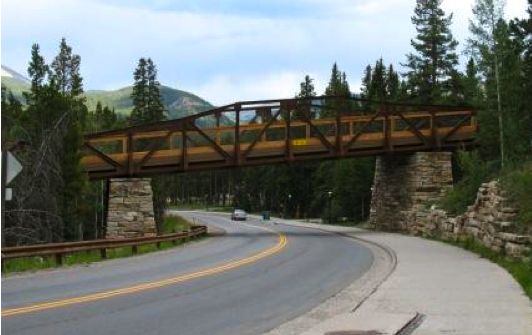
The old Douglas fir planks on the structures spanning Trout Creek and Upper Truckee River will be replaced with a material similar to what is on the 15th Street Bridge. Even road bike riders should be able to use them.

Bike trails in South Lake Tahoe will be upgraded this year. Photo/LTN file

The allocation of $30,000 to get this work done was granted July 27 by the South Lake Tahoe Recreation Facilities Joint Powers Authority board. It’s anticipated the city’s public works crew can do the job this building season.

Friday morning’s three-hour meeting at Lake Tahoe Airport was the JPA’s annual meeting. An unexpected expense for the JPA board was the need to pay El Dorado County $44,000 for the assessor’s office to notify property owners of the annual assessment. When this was first done in 1991, it cost $11,000. El Dorado County Supervisor Norma Santiago, who also chairs the JPA board, is going to research why the fee has quadrupled and see if it can be lowered.

With the passage of Measure R, which altered the original language of Measure S to allow for more flexibility in spending recreation dollars, the JPA will now meet twice a year. The next meeting will be in January, though no specific date was agreed to.

The bike improvement money comes from Measure R and would not have been allowed under Measure S. One of the significant changes in the measures was to allow for current trails to receive maintenance funds.

The other thing the bike committee recommended and the board agreed to is to put $100,000 as matching dollars for a $600,000-plus grant that would go toward cycling on the South Shore.

If the grant were not secured, it would have to be decided if the $100,000 goes into trails or is again used as a tool to go after more money. Notification should come in October if South Tahoe is awarded the grant.

The other component to Measure R is that the ball fields – baseball, softball, soccer – have $500,000 now to spend. But the committee tasked with making recommendation to the board had nothing definitive to recommend. This, despite the members having met for half a year.

Sue Novasel, who is on the Lake Tahoe Unified School District board, made a pitch for the high school softball field to get $45,000. (She is not on the ball field committee.) That field has taken up an inordinate amount of the committee’s time. Issues with state and federal laws involving equality of boys and girls’ facilities is at stake.

South Lake Tahoe City Councilman Hal Cole, who is on the JPA board, said to Lake Tahoe News after the meeting, “Are we going to do the high school field which is not part of the JPA?”

He said if the JPA puts money into that field, then the JPA will have further responsibilities for that field down the road.

“We need to fund the biggest priority and go from there,” Cole said. He doesn’t want to do a bunch of insignificant improvements.

John Upton, the lone paid staff member of the JPA, said it’s possible if the fields committee comes up with a true recommendation for the board, that a special meeting could be called.

“I think everyone supports a third field at the Al Tahoe site. I feel it will be a field for baseball and softball. The committee needs to decide that,” Upton said after the meeting.

Steve Knoll and Chuck Leonard, field committee members, gave a presentation to the board about the state of fields on the California side of the South Shore. (The recreation measure’s boundaries are essentially the same as Lake Tahoe Unified.)

The field and bike committees plan to keep meeting and figuring what is best for Tahoe.

As was pointed out by some at the meeting, the cycling community had an edge because a master plan through the Tahoe Regional Planning Agency exists. No master plan is in place for the fields. The committee could as the board to fund a master plan, but what was proposed to voters was the taxpayer money would be used on actual field upgrades, not a planning document.