Calif. regulators back fire safety rules following lethal infernos

By George Avalos, Bay Area News Group

State regulators last week approved new rules aimed at improving fire safety in multiple areas of California, a move taken after an array of deadly infernos in the North Bay and Southern California.

PG&E and other utilities in the fire-prone Golden State would be required to increase the minimum clearances between trees and other vegetation and electrical equipment such as power and transmission lines, under wide-ranging rules adopted by the Public Utilities Commission.

“This decision adopts new regulations to enhance the fire safety of overhead electric power lines and communication lines located in high fire-threat areas,” PUC staffers wrote in a proposal that was approved by the PUC.

Read the whole story


Birders flock to Tahoe’s waterways for annual count

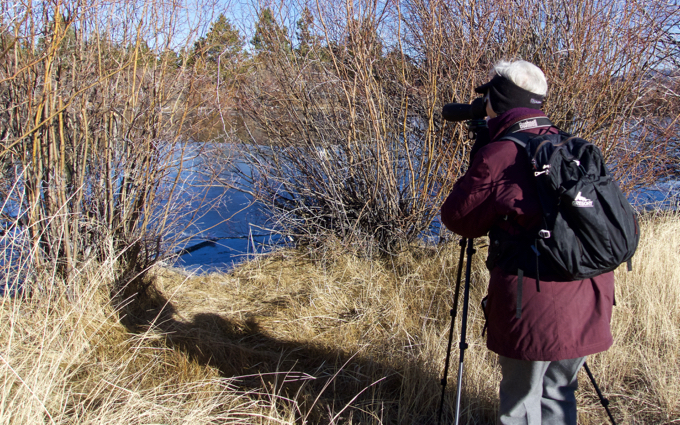
TINS Executive Director Will Richardson, left, leads a group Dec. 17 at Cove East to count birds. Photo/Kathryn Reed

By Kathryn Reed

It was a hunting expedition of a different kind, which netted more than a hundred waterfowl, a ruby-crowned kinglet, magpie, stellar jay, meadowlark and more.

These birds were captured in photos, through binoculars, high-powered telescopes, and with pen and paper.

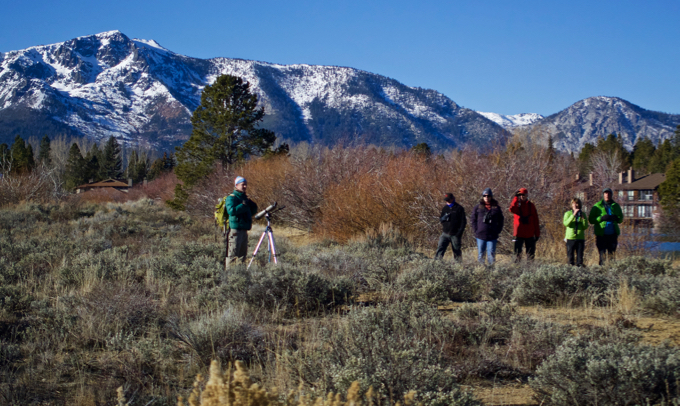
The birders were out in force on Sunday for the annual Christmas bird count. This one organized by Tahoe Institute for Natural Science is the only one in the basin.

“Our focus is on the lake level wetlands and meadows. They tend to be where most of the birds are,” Will Richardson with TINS told Lake Tahoe News.

Meadowlarks are identifiable by their yellow chests. Photo/Kathryn Reed

The weather cooperated for the count. While it was near freezing temperature-wise, the wind was non-existent unlike the day before. This was a good thing because birds tend to hole up in the wind, and don’t make their presence known.

A large throng on Dec. 17 had their eyes focused on the water and in the trees at Cove East. Other groups were scattered about the South Shore. The local count goes through Dec. 20, after which the tally will be available.

Sue Stevenson gets an up close view of waterfowl. Photo/Kathryn Reed

“These people are so knowledgeable. I learn so much,” Grace Anderson of Meyers told Lake Tahoe News as she walked near the Tahoe Keys Marina. “Tahoe is an amazing bird place.”

Richardson and other TINS staff dispensed tidbits of information along the way. The ruby-crowned kinglet used to breed in the lodgepole pines throughout the basin in the early 1900s. Today it would be hard to find them nesting. They come here in the winter because they are tough, Richardson said.

Resources are at the ready to help birders with identification. Photo/Kathryn Reed

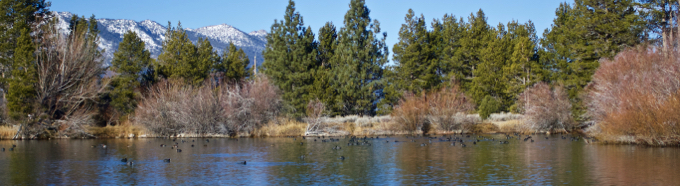
At the lagoon that juts north from the Tahoe Keys Marina area toward Cove East are more than 100 ducks. But then the group is told they aren’t all ducks. A coot is not a duck; it’s a rail. It doesn’t have webbed toes like a duck, but instead has lobbed toes.

Those in the know are surprised to see coots, redheads, ruddys and gadwalls all swimming together.

Sue Stevenson of South Lake Tahoe has her scope out watching a redneck dive for food. It’s like a dance of sorts that is mesmerizing.

She’s been birding since the 1980s, having started in New Jersey. She’s been doing so in Tahoe since 2000. Stevenson is a regular in the birding group led by Lynn and Don Harriman. They have been counting birds every Wednesday for the last nine years – either at Cove East or in the Upper Truckee Marsh.

At the Cove East count are people from South Lake Tahoe, Truckee, Carson City, Sacramento, Penryn and the Bay Area.

The group pauses to watch a meadowlark scamper about. It’s distinct with its yellow breast and black collar. While it’s not unusual to see them in the basin, it’s not an everyday bird like a stellar jay or mountain chickadee or magpie.

Waterfowl are a predominant fixture in the Lake Tahoe Basin. Photo/Kathryn Reed

This is the Audubon Society’s 118th annual bird count. Tahoe has been doing it since the early 1980s.

“The data collected by observers over the past century allow Audubon researchers, conservation biologists, wildlife agencies and other interested individuals to study the long-term health and status of bird populations across North America,” according to the Audubon Society’s website.

The concept of the Christmas bird count came about as an alternative to the annual hunt where two sides tried to kill as many animals as possible. Ornithologist Frank M. Chapman came up with the idea, which in that first year in 1900 involved 27 birders in 25 locations.

Now the count goes beyond Christmas Day, spanning the period from Dec. 14-Jan. 5. While most counts are in the United States, the event is global.


Hight ready to prove herself in South Korea

By Garvin Thomas, NBC

Elena Hight moved to Lake Tahoe from Hawaii when she was 6, so snow was new to her.

Acrobatics, weren’t however.

Her parents tell her she was jumping off everything by the age of 2. And now, after a big setback, Hight is hoping to jump back into the games.

Read the whole story


Caltrans, contractors clashing over road quality

By Adam Ashton, Sacramento Bee

Every time you pay more at California’s gas pumps to fill your tank, you’re feeling the price to fix the state’s roads.

But are you feeling the improvement?

California’s newly paved roads are built to standards of smoothness that are the strictest in the country. With that standard comes high costs that have surprised contractors, who are fighting for reimbursement and bitterly condemning a level of smooth they say no driver would ever notice.

At least one major contractor also contends the smooth pavement is dangerous, arguing that corrective measures he takes to hit the target actually shave features that are supposed to keep roads safe in wet weather.

Read the whole story


Northstar – off the charts good

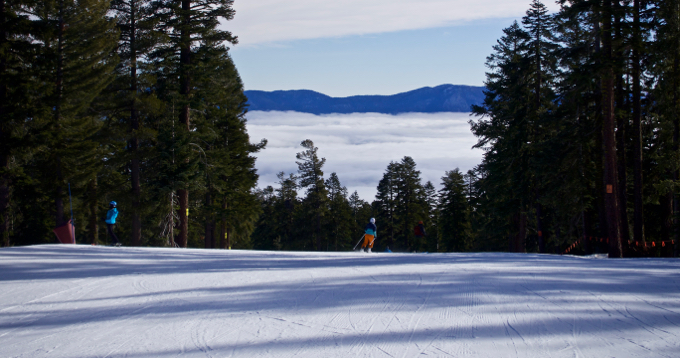
Near empty slopes at Northstar seem to flow onto the inversion covering Lake Tahoe. Photo/Kathryn Reed

By Susan Wood

TRUCKEE – Pssst – here’s the best-kept secret for those who have been living under a rock – midweek skiing is nothing like the weekend.

Midweek riding offers a world all its own for those either lucky enough to be retired or crazy enough to call in sick to work. Then, there are those who work odd hours or swing shifts and others who want to celebrate the slopes to themselves. The experience is surprisingly a mixed bag of motivations.

Wednesday at Northstar was no exception.

“It’s eclectic – all types. You can see everything from retirees to ski teams to locals to visitors wanting a different experience,” Northstar spokeswoman Marcie Bradley told Lake Tahoe News. “(Midweek is) serene and quiet.”

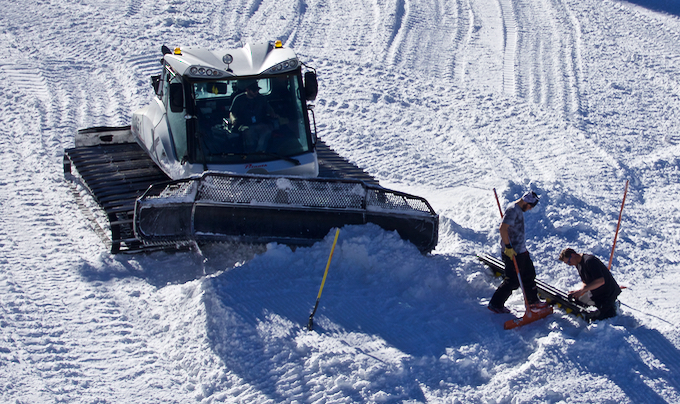
A crew prepares the terrain park that is now open. Photo/Kathryn Reed

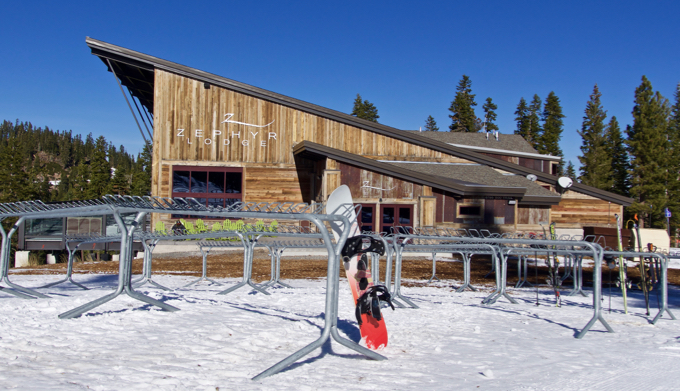
She’s right. Only three boards and four sets of skis were resting in the racks by midday at the routinely-busy Zephyr Lodge.

Compulsive skiers and boarders wanting the assurance of technology to tell them what lift lines are uncrowded may check a feature on their Epic Mix pass that allows them to check the length of time to get on the slopes. Vail introduced the feature last year.

Eric Behrens of Healdsburg, who’s been skiing at Northstar since he was 10, doesn’t need to check. He knew what to expect midweek, that’s why he was there.

The 41-year-old skier was celebrating his 10-year anniversary with his wife at Northstar. He came up midweek, and had a room at the Ritz-Carlton Lake Tahoe, which is tucked in about a third of the way up the slopes.

“Nobody’s here. There’s no line,” Behrens said, while riding up the Comstock Express chairlift. He’s semi-retired, so his schedule is somewhat flexible.

One snowboarder from Redwood City didn’t care he was supposed to be at work. The 59-year-old, who plans to retire at 61, called in sick to his job in San Francisco to go skiing with no lines. He boasted of the bold decision.

Northstar has much to brag about. Besides its reputation for being family friendly, customer-service oriented, amenity-filled and professionally astute about what it’s doing, the Truckee ski resort has the operation down like a fine-tuned instrument. 

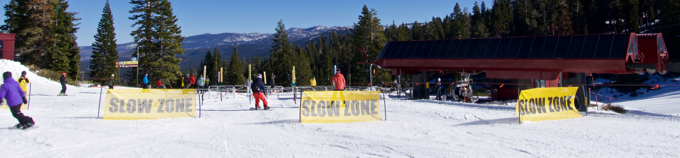
Slow times at Zephyr Lodge. Photo/Kathryn Reed

Despite the bare ground at lake level, the big guns of snowmaking operate top to bottom skiing, with wide runs that can make you claustrophobic anywhere else.

The ski resort boasts 58 inches of snowfall even before Christmas. Since it’s been quite cold, the snowmaking has been working around the clock on some days. And there’s something to be said for that. Northstar has some of the best snowmaking capacity in the nation. With apologies to natural-snow snobs, it appears the man-made variety holds up better on warm days. Northstar is able to cover half its mountain with its chemical mix.

The runs off East Ridge on one side of the summit and West Ridge on the other are fully covered. Sketchy runs with obstacles like the black diamond trails of Rendezvous and Dutchman are well marked with warnings. The view off the ridges is outstanding, and the terrain is worry-free, and at midweek, it’s like the wide-open road.

Skiers and boarders seeking a greater red-carpet experience may add on the Platinum Piste service, a trail combining the resort’s signature grooming on a trail designed exclusively for them. Early birds may sign up for First Tracks, which opens its runs to them before the lifts turn for the masses.

The resort on Friday opened its Pinball terrain park under the Vista Express chairlift. This is one of nine lifts the resort is turning to serve 30 trails.

Northstar should start to see an uptick in people hitting the slopes for the holidays. If you’re one of those who couldn’t get away any sooner or later, there is an advantage to the exhilaration of coming out when the resort is bustling with activity.

No waiting in line during midweek skiing at Northstar. Photo/Kathryn Reed

Events include:

·      Noel Nights, Dec. 22, features a winter wonderland with horse-drawn sleigh rides.

·      Breakfast with Santa, is just that on Dec. 24.

·      New Year’s Eve Fire & Ice, Dec. 31, rings in 2018 with a fireworks show.

·      Her Mountain Retreat, Jan. 6-7; Feb. 3-4, provides an all-women getaway on the slopes.

·      Mountain Table Dinner, Jan. 12, Feb. 2, Feb. 16 and March 9, allows for a night dining excursion at the Zephyr Lodge.

·      Spring It On, April 7-8, celebrates the warm-weather season at the resort with a favorite — the pond-skim event.

·      Snowshoe tours for families are scheduled for Dec. 24, Jan. 1, Jan. 14, Feb. 18. Stargazers can take part on Dec. 21, 23, 27; Jan. 13; Feb. 17; March 10; April 14. Twilight enthusiasts may seize the event Dec. 16, 23, 30; Jan. 6, 20, 27; Feb. 3, 17, 24; March 3, 4.


AAA: Record holiday travel will impact roads

By Bart Jansen, USA Today

A record 107.3 million people will travel to celebrate year-end holidays, braving higher gas prices than last year and roads in some spots threatening three times the normal traffic congestion, according to a AAA forecast Thursday.

Holiday travel already set records this year for Memorial Day, Independence Day and Thanksgiving, according to AAA. The projected 3.1 percent increase in travel from Dec. 23 through Jan. 1 would represent the ninth consecutive year-end rise, according to AAA.

Most travelers will jump in cars, with 97.4 million projected to hit the road.

Read the whole story


Scientist: Calif. has slim chance of normal winter

By Dale Kasler, Sacramento Bee

This is how dry it has been so far this season: California’s chances of having a normal “water year” have fallen to around 33 percent in much of the state, according to a federal scientist.

Michael Dettinger, a hydrologist with the U.S. Geological Survey, said those dismal odds are based on the amount of rain and snow that has fallen so far this year – and the history of how much precipitation California traditionally gets in the remaining months of the rainy season.

Dettinger said most of Northern California has either a 33 percent or 34 percent chance of having a normal water year.

Read the whole story


Plenty of dead trees, too few biomass facilities

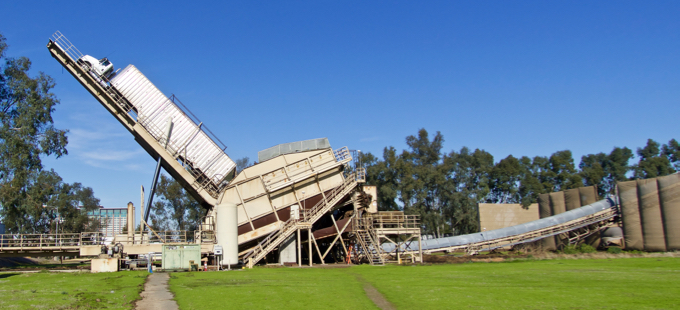
A truck delivers biomass to the Rio Bravo plant in Rocklin. It then goes up the conveyor belt. Photo/Kathryn Reed

Publisher’s note: This is the second of two stories about California’s tree mortality and how biomass is one solution to the problem.

By Susan Wood

If a record 129 million dead and dying trees collected over the last seven years doesn’t electrify California to get serious about renewable energy like biomass, then perhaps nothing will.

State and local officials along with stakeholders have started to see the light more than ever in terms of processing biomass, which is organic matter used as fuel.  

A study released this fall by a working group assigned by the California Resources Agency took a collective swipe at proposing the modern method as an alternative to burning slash piles, or worse yet, allowing them to decompose and present a fire hazard. The multi-agency effort was spawned from Senate Bill 859, which was signed by Gov. Jerry Brown last year as a comprehensive $900 million climate control package intended to reduce carbon emissions.
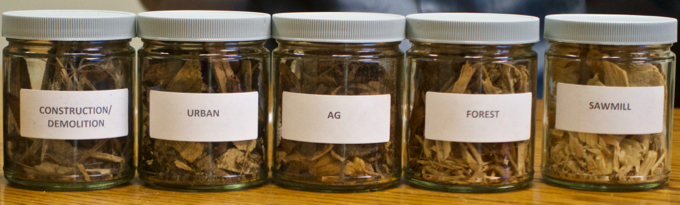
It’s not just forest material that can be turned into electricity. Photo/Kathryn Reed

Three times as many defunct plants versus operational biomass facilities exist in the state. Regulations are cumbersome. Space is necessary. And establishing a market can be tricky.

Placer County is wrestling with all three challenges in its creative quest with green waste management at its Eastern Regional Material Recovery Facility “MRF,” once called the landfill outside Truckee.

The plant is already surging with efficiency in what it does with area residents’ trash. Now it wants to transfer some of that waste it collects from contractors clearing the mass timber out of the forest into a biomass fuel.

A rendering of what the Cabin Creek facility between Tahoe City and Truckee could look like. Rendering/Phoenix Energy

Placer seeks to establish a place close to the basin

County officials are negotiating with Liberty Utilities to come up with a price and terms that would lead to Placer having its own 1 to 2 megawatt biomass plant on the waste facility grounds.

Four years in the making, the Cabin Creek proposal involves building an 8,000-square-foot structure where a caretaker’s residence now sits, but would be relocated. The operation would span on a strip of property along power lines and the service road, while wrapping around a cell tower. A storage area would be designated, and operators would need another grinder to work alongside the MRF’s existing one.

The concept coined a Power Purchase Agreement “PPA” went through the California Environmental Quality Act process years ago, but there were other hurdles in the tedious banter of the deal. The difficult part is that unlike other renewables biomass as a fuel source is not subsidized. Plus, natural gas is inexpensive by comparison.  

Nonetheless, the light at the end of the tunnel could be Liberty’s goal to go 100 percent renewable; so, many options are on the table. The percentage of the renewable energy mandate has been climbing, as California grapples with leading the world in combating climate change.
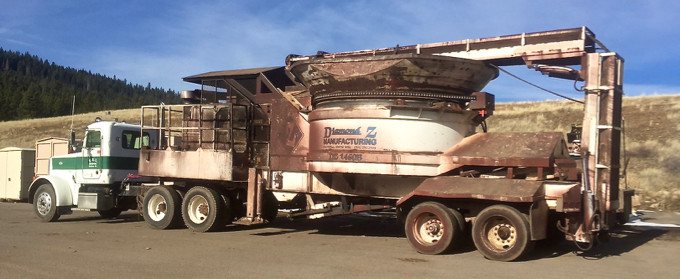
A grinder at the MRF in Placer County could be used by a future biomass company. Photo/Susan Wood

Placer County Supervisor Jennifer Montgomery had hoped a deal would be reached Dec. 15. The county and Liberty are still talking.

“We’re committed to getting the biomass facility built,” county Deputy Chief Executive Officer Dave Defanti said Friday. He added the results are “positive,” and the county is “exploring all options.”

The aim is to find a middle ground between what Liberty Utilities currently pays and what biomass would cost to generate. For now, the difference hovers at about a nickel per kilowatt.

Liberty Utilities contends there’s no “deal breaker” price that would guarantee its business interest.

“Energy markets fluctuate, and what may seem like a reasonable cost now may not be in the relatively near future,” Liberty spokeswoman Kathy Carter told LTN.

The energy purveyor brought on a 50-megawatt solar project earlier this year that is already meeting a quarter of its customers’ electricity use. Another project added 10 MW more. 

“Biomass energy is a renewable resource, but it’s more expensive than solar and wind. Still, we understand that it also has many forest health and other benefits, so we’re open to continuing to work with Placer County to take a fresh look at this,” Liberty Vice President Travis Johnson said.

Currently, the MRF represents a pit stop for agencies and their contractors to funnel their treetop debris to Rio Bravo in Rocklin. Already, 5,200 tons of biomass woody debris are channeled through the Truckee area recovery plant to Rocklin.
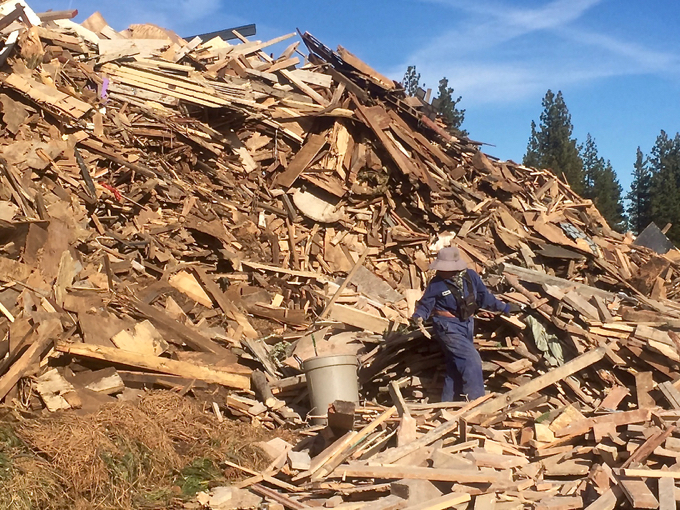
Wood debris at the MRF at Cabin Creek could become energy one day. Photo/Provided

But that’s a long, expensive haul for trees coming out of the Sierra Nevada as agencies such as Caltrans have learned. The transportation agency worked alongside the U.S. Forest Service in massive fuel reduction programs.

“To me, it makes a lot of sense,” Placer County senior civil engineer Walt Schwall said of the proposed Cabin Creek on a tour this week.   

He’s not alone.

“We see a facility like the one in the Cabin Creek area as a tremendous option. It would not only accelerate the removal of the dead and dying trees as a result of drought, biomass facilities like that would reduce the wildfire threat by helping us catch up on the burn piles,” said Tom Lotshaw, spokesman for the Tahoe Regional Planning Agency.

“We definitely see biomass as a viable option,” Lotshaw told LTN.

One could even argue that processing the woody debris through an energy facility is better environmentally than burning carbon into the air. The concept of having one nearby is also an eco-improvement because fewer vehicle miles equal less carbon emissions from trucks.

Once again, the state is asked to strike that delicate balance between business and the environment. And history has shown that change in the name of progress doesn’t come easy.

Still, if Cabin Creek fails to proceed with Liberty Utilities, there are other parties who may be interested, insists Brett Storey, a Placer County analyst.

The playing field is vast with possibilities.
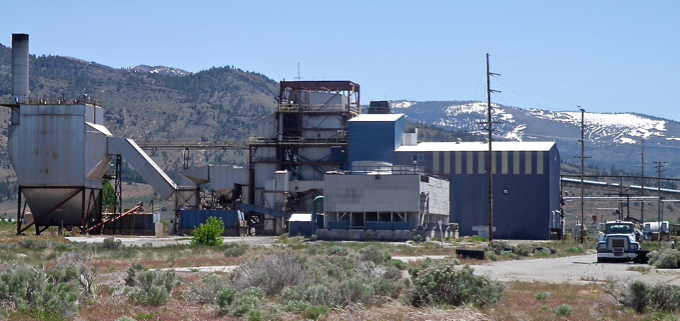
The Loyalton biomass plant is about to resume activity. Photo/Provided

The planned return of the Loyalton plant

Thirty-seven miles from Truckee, a 212-acre, 20-megawatt biomass facility is due to go on line again within a month in Loyalton where one once operated.

The Loyalton Biomass Plant was the site of a Sierra Pacific sawmill and biomass facility before the mill closed in 2001 and within the decade the biomass portion shut down.

American Renewable Power, the new operators based in Irvine, are in the process of adding to the 17 employees hired, and securing contracts with utilities and energy purveyors, according to Sierra Business Council President Steve Frisch. Plant manager Jim Turner expects the facility to go on line shortly after the holidays. Plant owner Steve Mueller was unavailable for comment.

The company estimated an economic windfall of $1.7 million to the rural region over the next few decades as it sources biomass fiber from 5 million acres in nine counties within an hour’s drive from the plant. 

More than 40,000 tons of the woody debris are awaiting the plant’s return to operation. It’s expected Loyalton could process 180,000 tons a year.

Bigger plans exist beyond producing energy, given the cost inequity of processing biomass.

“There has to be another motivator,” Frisch said, referring to the community-service need of ridding the California forest of its tree die-off crisis.  

It takes vision to complete the mission. For example, biochar –a charcoal used as a soil amendment — is yet another “value-added” product company officials and the business council anticipate seeing out of the Loyalton plant.

“We need to do some other product in order to offset the cost,” Frisch said in speaking for the Sierra County region. “That’s why Loyalton is so important.”
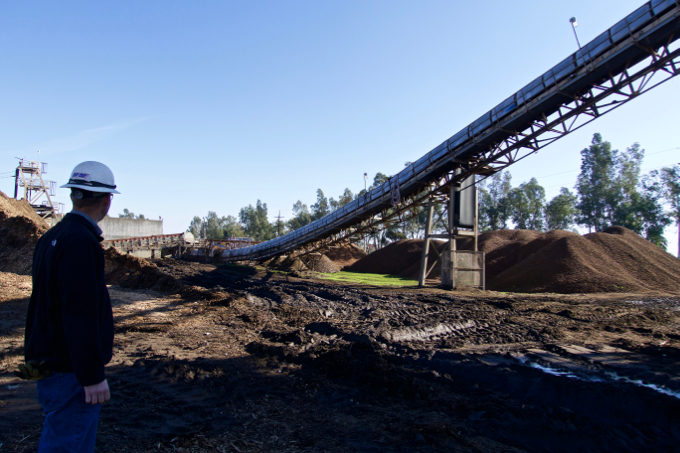
Rio Bravo plant manager Chris Quijano watches the material go on a conveyor belt into the plant. Photo/Kathryn Reed

No time to waste

The burning desire to rid the Sierra Nevada of its ever-escalating tree die-off has put the big boys of biomass into action. Rio Bravo of Rocklin has processed 6,000 tons of green waste from the Lake Tahoe Basin this year.

The 50-acre plant located adjacent to Thunder Valley Casino began its quest to “re-compose” the mass timber about 30 years ago – with a five-year shutdown in the 1990s. Biomass became the answer, despite solar being a lot cheaper to produce, plant managers contend.

Today, the facility processes 35 tons of the green energy source, cranking out 24.4 megawatts of energy an hour now under contract with Southern California Edison. The plant had earlier managed a 26-year contract with Pacific Gas & Electric.

In its daily routine, the Rocklin plant sees 50 trucks hauling 24 tons of debris. They’re channeled through an elaborate system of chutes and machines that grind up and break down the treetop debris and other timber material. One megawatt can power 800 homes. Overall, 20,000 homes get their electricity in a given hour through the 25-megawatt facility.
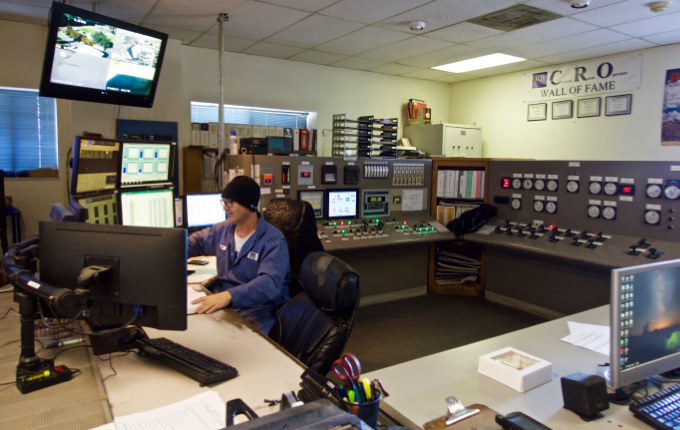
Jeff Johnson handles the control room at the Rocklin biomass plant. Photo/Kathryn Reed

The facility represents an efficient system that operates at 87 percent capacity when the operation is not undergoing checks or audits.

It takes in wood chips and mass pine timber, along with other materials from orchard trees in what’s considered its agriculture segment. Other sources from the urban sector also make their way through the processing plant.

With a state energy diversion mandate of 50 percent by 2030, much material is considered capable of being broken down and reused.

“We can make power every day,” plant manager Chris Quijano told Lake Tahoe News on a recent tour of the grounds. Rio Bravo is one of six biomass plants IHI Power Services Corporation runs in the United States.

The mechanics of this one in Northern California is impressive – taking 30,000 tons of high-hazard dead trees out of the woods and turning them into electricity in 2016. The power the plant generates is essentially thrown into an energy bucket to dispense.

The alternative to burning slash piles in the forest produces water vapor opposed to carbon emissions. That huge white plume from the plant is not smoke – even though there’s severe burning involved from a boiler connected to the turbine. The combination and process creates steam at 950 degrees Fahrenheit.

“And 3 million tons of high hazard trees are available,” Quijano said.

The process has other air quality benefits advocates tout.

When the mass timber goes either unburned or unprocessed as biomass, it is left in the forest to rot. The decomposition releases greenhouse gases, including methane.

Either way, following the tree from a dead state to energy commands cooperation from Mother Nature. That’s why the plant even carries a weather station on site.

The wet deluge from last year represented a trying time for plant operators. At one point, they had to deal with a lake on the property that didn’t exist before, providing a few disruptions in truck traffic for starters.

Of course, the pond brought out more birds, as a sanctuary of organic matter, dirt and water gave wildlife a place to land.

That’s the circle of life meeting the cycle of material.


Calif. wildfires a looming threat to climate goals

By Julie Cart, CalMatters

Beyond the devastation and personal tragedy of the fires that have ravaged California in recent months,  another disaster looms: an alarming uptick in unhealthy air and the sudden release of the carbon dioxide that drives climate change.

As millions of acres burn in a cycle of longer and more intense fire seasons, the extensive efforts of industry and regulators to protect the environment can be partly undone in one firestorm. In particular, as raging blazes pump more carbon into the atmosphere, state officials are grappling with the potential effect on California’s ability to adequately reduce greenhouse gas emissions.

The state’s environmental regulations are known to be stringent, but they have limits: They apply only to human-caused emissions. Carbon and other pollution generated by wildfires is outside the grasp of state law.

“The kinds of fires we’re seeing now generate millions of tons of GHG emissions. This is significant,” said Dave Clegern, a spokesman for the state Air Resources Board, a regulatory body.

In less than one week, for example, October’s Wine Country fires discharged harmful emissions equal to that of every car, truck and big rig on the state’s roads in a year. The calculations from the subsequent fires in Southern California are not yet available, but given the duration and scope of the multiple blazes, the more recent complex of fires could well exceed that level.

The greenhouse gases released when forests burn not only do immediate harm, discharging carbon dioxide and other planet-warming gases, but also continue to inflict damage long after the fires are put out. In a state where emissions from nearly every industry are tightly regulated, if wildfires were treated like other carbon emitters, Mother Nature would be castigated, fined and shut down.

The air board estimates that between 2001 and 2010, wildfires generated approximately 120 million tons of carbon. But Clegern said a direct comparison with regulated emissions is difficult, in part because of limited monitoring data.

“Nature doesn’t follow the rules very well,” said Jim Branham, executive officer at the Sierra Nevada Conservancy, a state agency that has created a plan to better harness California’s forests in reducing carbon in the atmosphere.

As is so often the case in environmental catastrophes, one thing leads to another, creating what Branham calls the double whammy: Burning trees not only release powerful pollutants known as black carbon, but once a forest is gone, its prodigious ability to absorb carbon from the atmosphere and store it is lost, too.

Scientists estimate that in severely burned areas, only a fraction of a scorched tree’s emissions are released during the fire, perhaps as little as 15 percent. The bulk of greenhouse gases are released over months and years as the plant dies and decomposes.

And if a burned-out forest is replaced by chaparral or brush, that landscape loses more than 90 percent of its capacity to take in and retain carbon, according to the Conservancy.

Severe fires have the capacity to inflict profound damage in a short span. The U.S. Forest Service estimates that the 2013 Rim Fire in Central California spewed out the equivalent of the carbon dioxide emissions from 3 million cars. That is a setback to the state’s effort to get cars off the road, another critical tool for reducing greenhouse gases.

The role of wildfire as a major source of pollution was identified a decade ago, when a study conducted by the National Center for Atmospheric Research concluded that “a severe fire season lasting only one or two months can release as much carbon as the annual emissions from the entire transportation or energy sector of an individual state.”

It’s a measure of the dramatic ramping up of fires in the West that today a single fire can meet that threshold.

The entire equation has been made worse by the state’s epidemic of tree death, caused by drought, disease and insect infestation. The U.S. Forest Service this week updated its estimate of dead trees across California to 129 million. That loss alone could be a blow to the state’s vision of a low-carbon future.

“Dead trees don’t sequester carbon,” Branham said.

Forests as carbon-chewers are part of the state’s strategy for cutting greenhouse-gas emissions significantly by 2020 and beyond—a goal that could be undermined by nature’s caprice. The air board is expected to direct state agencies to determine more precisely how much carbon can be absorbed by California’s variety of landscapes.

Air quality, too, is subject to state, as well as local and federal, regulations. But those standards go out the window in large fires, when soot and ash blanketing entire regions can be seen from space.

The federal Environmental Protection Agency, which sets air pollution standards nationally, has an “exceptional events” rule that exempts states from fines under certain extraordinary conditions.

California has invoked the rule during wildfires at least once before, in 2008, for fires in the Sacramento area. The request was accepted, according to the air board.

More recently, Sean Raffuse, an analyst at the Air Quality Research Center at the University of California, Davis, came up with the “back of the envelope” calculations for October’s Sonoma County fires.

Raffuse said he used federal emissions inventories from fires and calculated that five days of ashy spew from the northern California blazes equated to the annual air pollution from every vehicle in California.

Those kinds of computations are seldom replicated, largely for lack of the necessary instruments present at fire sites. But things are changing. Researchers have been attempting to better understand the full range of environmental damage wrought by wildfires. One tool is drones that can be flown through smoke plumes to collect samples for analysis.

“We don’t have the means to measure emissions from a wildfire like we do from a tailpipe,” Branham said. “We are lagging well behind in understanding and having hard data of the effects of these fires. And most of the data are chasing reality.”


Cost of living causing Californians to move

By Conor Dougherty, New York Times

Russel Lee and his wife spent the past few years going online to do the depressing math of how much less housing costs pretty much everywhere that isn’t California. They looked at Idaho, Arizona, North Carolina and Kentucky, but Lee, who was born in San Francisco and has lived in the Bay Area his entire life, could never quite make the move. Then the fires came.

In October, as the most destructive wildfire in state history swept through Northern California, Lee’s three-bedroom home in Santa Rosa was consumed by the flames. He lost everything. He used the insurance payment to buy a $150,000 home outside Knoxville, Tennessee, and will soon leave California for good.

For the half-century after World War II, California represented the epitome of middle-class America on the move. As people poured into the state in search of good weather and the lure of single-family homes with backyard orange trees, the state embarked on a vast natural engineering project that redirected northern water southward, creating the modern Southern California and making the state the most populous in the nation.

Those days are long gone.

Read the whole story