Cocktails evolving into more than just a mixed drink

By Kathryn Reed

Drinking isn’t just about quenching one’s thirst. These days it can be a meal unto itself based on some of the ingredients.

Mixologists have come into their own. They are much more than a bartender. They are chefs behind the bar – creating cocktails that are anything but ordinary. While using locally grown ingredients, much like chefs are doing these days, they are also creating drinks that are seasonal in nature.

“We are bringing the kitchen to the cocktail,” is how Camber Lay, with Parallel 37 at the Ritz in San Francisco, described how mixologists approach drink making.

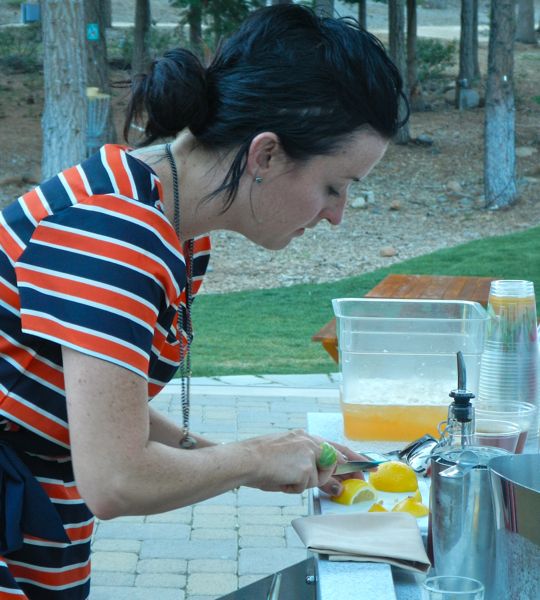
Glasses are ready to be filled with A Wild Rose from the West Shore Cafe, one of the winning drinks at the Mix It Up event at the Ritz-Carlton, Lake Tahoe. Photos/Kathryn Reed

Two events in September tested regional drink creators’ ability to invent an original drink for the public, while competing against their peers. Wild Turkey was the spirit those at the Ritz-Carlton, Lake Tahoe had to use, while vodka was the liquor in the drinks at the Barton Foundation gathering.

Both events collected money for charities. The one at the Ritz at Northstar raised funds for Project MANA, which is a hunger relief organization serving the North and West shores of Lake Tahoe and Truckee. This event was part of the larger annual Autumn Food & Wine Festival. Barton’s Signature Cocktail event at Riva Grill in South Lake Tahoe was a fundraiser for the Barton Foundation.

The South Shore event grossed $5,900. Each bartender donated his or her tips, which raised more than $500 of that amount.

Gail Oversteg from Manzanita restaurant at the Ritz picked some lemon verbena from the property for her Mela Melange, which she described as a deconstructed Manhattan.

Nicole Barker of Cin Cin at the Eldorado casino in Reno has a pear tree at her house. She boiled some down for six hours to use as the base for her drink.

Camber Lay likes using local, seasonal items in her cocktails at Parallel 37 in San Francisco.

“We do everything fresh, from scratch. There are no low end liquors,” Barker said of her bar.

Kelley Luchs from the West Shore Café in Homewood came up with A Wild Rose. He said he wanted to play with something not often used – so rose water was his special ingredient.

The public picked the winning drinks at the Ritz, with Luchs and Barker tying.

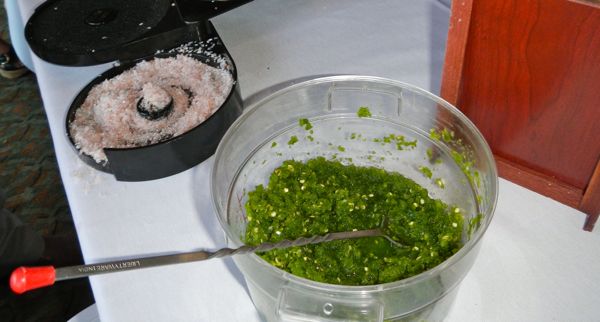
Muddled jalapenos were an ingredient in two drinks at the Barton event.

On the South Shore, with the winning drink eventually winding up on the menu at the Barton Gala in December as part of the Festival of Trees and Lights, winter was a central theme for the creators.

Two cocktails at this event used fresh jalapenos. Jimmy Kelso from the Edgewood came up with the Caliente Christmas Martini. Vodka, pomegranate and muddled jalapeno were the major ingredients. It was served with a candied jalapeno.

James Kent Meiers of the Cantina devised the Cukacabra. Vodka, orange agave liqueur, with muddled cucumber and jalapeno were the winning combination. That drink will be served at the gala in two months.

“I was mixing flavors to complement Cantina’s food,” Meiers said of how he came up with the drink.


Highway 28 plan — safe road for drivers, recreationists

By Anne Knowles

CARSON CITY – A dozen Nevada and federal agencies are developing a plan they say will make the East Shore of Lake Tahoe a safer and more accessible recreational destination for motorists, cyclists and pedestrians alike.

The plan covers about 13 miles of Highway 28, from Incline Village to Spooner Lake, and is an update to the 2000 corridor management plan for the area.

A 2- to 3-mile stretch from Crystal Bay already is being undertaken locally by Washoe County and will include a separated bikeway, new signage, traffic calming and enhanced line of site at intersections.

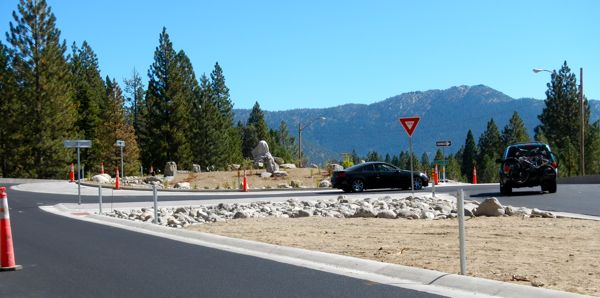
Improvements are already happening on Highway 28, like the roundabout put in this season at the base of Mount Rose Highway. Photo/LTN

The agencies are relying on local efforts like the Crystal Bay plan and other studies, and then working to fill in the gaps, according to Derek Kirkland, capital program specialist with the Tahoe Transportation District in Stateline, one of the participating agencies.

“One of the thoughts being considered in the plan is to relocate the unsafe shoulder parking to various off-highway locations within the corridor and provide more convenient access to popular recreational destinations,” Kirkland said, “and create multi-modal connections through shared use paths separated from the highway as well as transit service for the entire corridor.”

The Highway 28 plan could end up including transportation service from as far away as Reno as well as new parking lots, hiking and biking trails and road improvements such as new signage and guard rails to boost safety, improve lake clarity and attract new visitors.

The agencies are seeking public comment on the project during four public meetings. Three meetings – in south Reno, at UNR and in Carson City – were this past week and the final meeting, at The Chateau in Incline Village, is scheduled Oct. 9 from 5-7:30pm.

Three of the four meetings were outside the basin because the majority of the visitors to the corridor are from Reno, as well as Carson City and Carson Valley, Kirkland said.

There is also a website to post suggestions and ideas through Oct. 29. At the website, people can type comments on virtual sticky notes and attach the notes anywhere on a map of the area. Visitors can also read and “like” comments left by others.

The effort started last year with the launch of the East Shore Express bus service between Incline Village and Sand Harbor State Park, which was designed to reduce car traffic and parking along the highway during the busy summer season.

The service, which had 12,000 rides between June 15 and Sept. 3, resulted in about 162 fewer cars parked along the shoulder of Highway 28 on peak summer days, according to the TTD, which used LSC Transportation Consultants to count cars during busy days in August.

Kirkland said the goal is to extend the bus service to Spooner Lake. To fund that, service on Monday and Tuesday may be reduced in the future to free up the limited money. Currently, two buses run every 20 minutes from 9am to 6pm between Incline Village and Sand Harbor during the summer. The service is funded by grants from the U.S. Forest Service and the Nevada Department of Transportation as well as fares, which are $3 for adults and $1.50 for children.

Bike trails from Lake Shore Boulevard to Sand Harbor are also being studied and will soon undergo environmental review with construction slated for 2014. Loomis Engineering in Carson City is designing the trail and a draft document for public comment should be available this winter or spring, said Nanette Hansel, senior environmental planner with Ascent Environmental in Stateline.

The trail, designated for now as the North Demonstration Project, would be part of the Stateline-to-Stateline bike trail. The first mile of the South Demonstration Project, from Kahle Drive to Elks Point Road, is expected to be completed this month and the next portion, from Elks Point to Round Hills Pine Beach, will begin next summer.

Kirkland said they are also talking to the Mt. Rose ski resort about using its parking lot in the summer and providing transportation from there to the corridor.

“Students (at UNR) want a bus from Reno to the lake,” he said.

For the future, the agencies are considering adding parking lots along the Highway 28 route to reduce shoulder parking, adding trailheads to make it easier to access beaches, more bike trails, and signage and guard trails both for safety and aesthetics.

“One option is getting rid of all shoulder parking with new parking lots,” Kirkland said. “Not taking away parking but relocating it.”

Shoulder parking, said Kirkland, contributes to road erosion and poses dangers to drivers, bike riders and walkers alike.

But it will be close to impossible to find land to build parking lots, said North Swanson, a resident of Cave Rock who attended the Carson City public meeting on Oct. 4.

“It’s steeper than heck on both sides,” said Swanson. “Frankly, our concern is they will take away our parking. We’ve fought the battle for parking for 25 years.”

Swanson is a coordinator for Tahoe Area Naturists and appealed a USFS plan to enlarge its lots that he said would have reduced parking from 500 spots on the highway shoulder to 50 parking lot spaces.

Shelly Aldean, a Carson City supervisor who also attended the meeting, said she was in favor of plans that cut down on car traffic and its ill environmental effect.

“Anything that reduces congestion, idling time and removes people from the shoulders,” Aldean said. “We need a multifaceted approach.”

This Highway 28 diagram outlines some of the plans.


‘Secret’ convention center deal may cost S. Tahoe $1.8 mil.

By Kathryn Reed

South Lake Tahoe officials have always claimed there is no city money involved in the failed convention center project. Depending on the outcome of a lawsuit in El Dorado County Superior Court, that statement could prove to be wrong to the tune of approximately $1.8 million.

This is because on March 9, 2007, then City Manager Dave Jinkens along with the city’s outside redevelopment attorney, Stacey Sheston, signed an indemnity agreement that puts the defunct Redevelopment Agency, which is now the city because it’s the successor agency to the Redevelopment Agency – on the hook for this amount. The original indemnity was for $3 million, but the difference involved two other properties that are not part of this lawsuit.
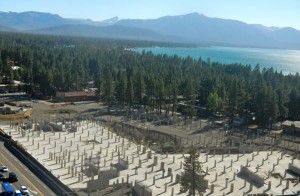
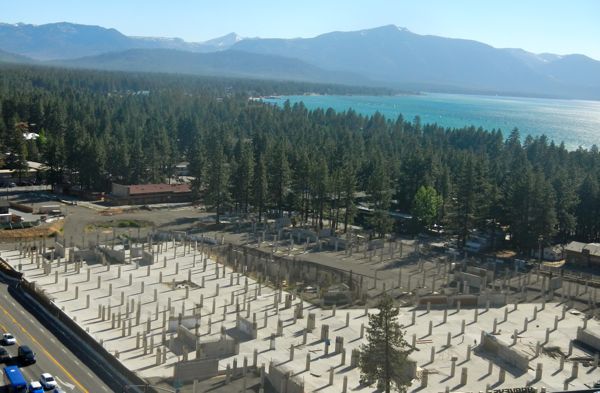
Concrete and rebar -- it's what South Lake Tahoe locals call The Hole. Photo/LTN

Jinkens was acting as executive director of the South Tahoe Redevelopment Agency at the time he signed the document. He wore two hats, as did councilmembers – they were the City Council and the board of directors for the Redevelopment Agency.

The agreement protected Placer Title Company and Stewart Title Company on loans of more than $3 million that were brokered by Z Loan & Investment and Lake Tahoe Development Company that involved three assessor’s parcels numbers.

Z Loan is considered a hard-money lender. A hard-money lender provides a “bridge loan” and is usually used when traditional financing cannot be secured. This is what Randy Lane and John Serpa, who ran Lake Tahoe Development Company, were in need of to acquire all of the property to build what was supposed to be a more than $400 million hotel-convention center project on the eastern edge of South Lake Tahoe at the state line.

Lane told Lake Tahoe News the need for this type of lender was necessary because traditional financing wasn’t possible because of what he intended to do with the property – acquire buildings and tear them down.

“A lot of [traditional loan] agreements say you won’t do anything that adversely affects their collateral,” Lane explained.

In addition to needing money to buy the properties, Lane was borrowing against the properties before he owned them.

“For the city to say that it never had any financial exposure on the project is just untrue,” attorney David Becker told Lake Tahoe News.

Bankruptcy has since left the more than 11-acre site a pile of rebar and concrete whose integrity is in question after years of exposure to the elements, with not all of the 19 parcels foreclosed on, and Owens Financial – who has the most money on the table – proposing retail along Highway 50 and nothing behind it.

According to Julie Regan at the Tahoe Regional Planning Agency, “The convention center permit has an approved construction schedule which is valid at least through October 2016.”

Pending lawsuit

The lawsuit that could saddle South Lake Tahoe with the $1.8 million bill involves Harry Segal and Janice Halpern-Segal suing Fidelity National Title Company.

“The Segal family is suing to prove that Randy Lane’s loan should not have been made against their property before the Segals actually sold their property to Mr. Lane. The lender (Z Loan) made their loan to Randy Lane six months prior to the Segals agreeing to sell their property to Mr. Lane,” David Becker, the Segals’ attorney, told Lake Tahoe News.

Becker was not their attorney at the time they were selling their property.

The Segals carried the paper for the sale to Lane. However, Lane and the title companies contend the Z Loan lien takes priority over the Segal lien, even though Lane did not own the property he pledged as security.

“The artificial title, made possible by the city’s indemnity, created a false appearance that Mr. Lane owned the title. Had the city properly publicized the back-door deals, somebody may have caught how risky it was for the Segals to sell their property to Mr. Lane,” Becker said.

This was at a time when Jenny Lane, Randy Lane’s daughter, worked for Stewart Title.

Dina Reed (no relation to this reporter) was Jenny Lane’s assistant when this was taking place. She is now manager of the Stateline branch of Stewart Title. She says there is nothing illegal or unethical about a client’s daughter working on her dad’s paperwork, and that multiple eyes would be on the documents.

Reed said indemnity agreements like this occur with any type of construction deals, even for a residential house.

Debbie Landerkin, manager of Placer Title, deferred all comments to her legal counsel.

Jody in Placer Title’s legal department wouldn’t provide her last name. She was more curious about how LTN obtained the document than answering questions.

“That document would not be something I could discuss with you because it is not a public document,” Jody said.

Landerkin’s signature is on supplemental joint escrow instructions involving the Segal property. So are Jinkens and Lane’s. That was signed two days prior to the indemnity agreement being signed. At that time Landerkin was dating Bruce Budman who was South Lake Tahoe’s finance director.

The city could have indemnified itself and had Lake Tahoe Development Company take the risk instead of potentially jeopardizing taxpayer money – as might be the case depending on the outcome of the lawsuit.

“Everything that could go wrong in the Segal-Lane transaction did go wrong. And it all started with the city’s indemnity,” Becker said.

South Lake Tahoe City Attorney Patrick Enright told Lake Tahoe News, “If there was a judgment against the agency, it would be a liability of the South Tahoe Redevelopment Successor Agency, not the city of South Lake Tahoe.”

What he failed to add is that the current City Council acts as that successor agency – so the city is liable.

Enright said he became aware of the lawsuit in August 2011.

A trial date for the Segal case is expected to be picked Oct. 29.

At this time it is not public how much money the Segals have received, if any, from Lane. They owned a business on land owned by a different party. The parcel was obtained by eminent domain, which was orchestrated through the city.

However, the Segals told Lake Tahoe News, “The money for our retirement was lost as well as the future financial security of our children.”

Who knew what

In 2004, when Marriott Corp. was contemplating being the convention center developer the hospitality company and the city agreed neither wanted to indemnify the project because they did not want to subject themselves to potential legal claims.

But things clearly changed three years later, but no one in power remembers or knew about that change.

Jinkens emailed Lake Tahoe News, “I do not recall the agreement specifically and because I retired in August 2010, I do not readily have access to city records. I speculate, but I am not certain by memory, that the agreement had something to do with the RDA’s use of eminent domain to acquire a few (2-4 properties??) of the 29 parcels needed for the convention center project and the requirement that of the title company to verify that the city has a right to acquire the property before the property was transferred to the developer. I am sure that before any documents were signed by city officers that the city’s then legal counsel approved their use.”

Lake Tahoe News asked the city for the documents and provided Jinkens with a route to obtain them to jog his memory. It has been more than a month and he has not gotten back to LTN for further comment.

Cathy DiCamillo was the city attorney at the time. She did not respond to Lake Tahoe News’ inquiries about the matter. But at that time Jinkens was using outside counsel, including special redevelopment attorneys. Jinkens and DiCamillo had such a rocky relationship that they required a “therapist” to help them work together so it’s possible DiCamillo did not know about the transaction. However, her job before working for the city was as an attorney in the same office as Lew Feldman – who was Randy Lane’s attorney throughout this process.

The City Council at the time was comprised of Bill Crawford, Jerry Birdwell, Ted Long, Kathay Lovell and Mike Weber. All responded to LTN except for Weber. The four who responded have no recollection or knowledge of any indemnity agreement entered into by Jinkens.

Current councilmembers – Claire Fortier, Tom Davis, Bruce Grego and Angela Swanson – did not respond to Lake Tahoe News’ questions so it is not known what they know and when they learned about it.

One question was: Why was an owner participation agreement used for this project and not a development agreement?

Councilman Hal Cole answered only that question. He wrote, “In response to your series of questions about the Chateau project I want to add the following. I was hoping Patrick Enright would fill in the blanks for you on all the legal questions as I could only answer what I had firsthand knowledge of. He did not address the OPA issue. My understanding of a Disposition and Development Agreement (DDA) is it is a contract between a developer and a redevelopment agency that involves the sale of agency owned land. This is what we did for the gondola project. We assembled the land, made the map changes and sold the parcels. An Owner Participation Agreement is a contract between a property owner and the redevelopment agency to allow the development of property owned by the owner/developer. It was the city’s expectation that Randy [Lane] would acquire and assemble the land (new map and all) and then use redevelopment financing for the public areas (convention center space, open space and walkways).”

Cole and then City Councilman John Upton served on the committee tasked with negotiating the agreement with Lake Tahoe Development Co. They were the only two councilmembers who ever read the market study that the city hung its hat on saying a convention center was desirable, though the study doesn’t come to that conclusion.

Enright told LTN of the 2007 council, “The city or agency is not aware of when, if ever, individual board members became aware of the agreement. There is no record that the agreement was ever discussed in closed or open session by the Redevelopment Agency board of directors.”



Educators crusade for youths to be safe at school, in life

By Kathryn Reed

A 13-year-old walks into his principal’s office and says he wants to write a letter to the judge. The judge lets him take the stand. His parents are in the courtroom.

“I told him, all you can do is tell your truth,” Beth Delacour said.

In the end, the judge last year said the boy no longer had to visit his dad. This meant no longer being regularly exposed to guns and drugs.

Teacher Cindy Cowen, left, and South Tahoe Middle School Principal Beth Delacour talk about anti-bullying programs. Photo/Kathryn Reed

While Delacour, who is principal of South Tahoe Middle School, is not a proponent of single-family households, she knows sometimes it beats the alternative. What she most advocates for is helping her sixth-, seventh- and eighth-graders find their voice so they can stick up for themselves.

That same youngster stopped by her office this school year. He said he wants to be a judge someday and asked his principal what he needs to do to make that dream come true.

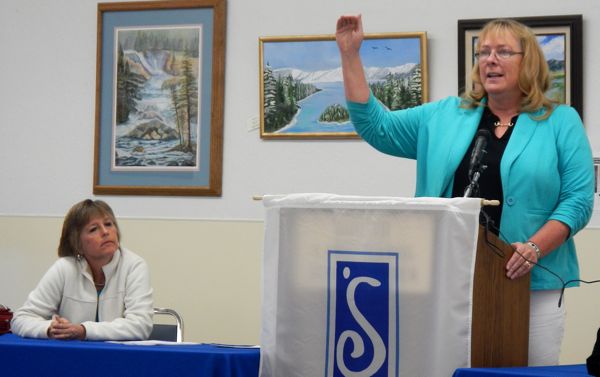
Delacour and Cindy Cowen, a teacher at the South Lake Tahoe school, spoke before Soroptimist International Tahoe Sierra on Sept. 27 about how the service club’s financial support is helping bring programs to the school that deal with bullying – this includes working with the aggressor and the victim.

The overall goal is to change the climate and culture of the school.

“We needed to get these kids to feel like they are people,” Cowen said.

Through Teen Truth Live the message is if you aren’t making a difference, you are doing nothing. This program has been part of the school for a few years. This year a summit of between 30 and 50 students will be convened with the goal being for them to identify what other improvements can be made to the school.

As Delacour said, the kids are the ones in the trenches – they are seeing, hearing, feeling what is going on more so than any adult on campus.

One of the Soroptimists asked what the difference between bullying and teasing is.

The educators said bullying is chronic, it doesn’t stop, it’s harassment, it’s repeated and it’s unwanted.

Because bullying can be a learned behavior, another member of the service group asked if parents are part of the anti-bullying lessons.

They have been. But those who “needed” to show up to events the school sponsored didn’t and therefore it was more like preaching to the choir based on who attended.

Between Horses and Humans is another component of helping youth stop being a bully and for others to stand up to the bullies. It’s also a program where parents must be involved.

Oct. 1 was World Stand Up to Bullying Day.


Cops: 2 men cooking drugs cause explosion in S. Tahoe

Updated Oct. 3, 6:55pm

By Kathryn Reed

A suspected drug lab exploded in the middle of South Lake Tahoe on Wednesday afternoon.

Barrek Madden, 23, of South Lake Tahoe was flown to UC Davis Medical Center in Sacramento with third-degree burns to his face and upper torso.  Schuyler VanFleet, 22, of South Lake Tahoe had his hair, eyebrows and beard singed. He was arrested on felony charges of unlawfully causing a fire and operating a drug lab.

At about 3:15pm Oct. 3 an explosion could be heard coming from a bottom floor unit of the Forest Manor Apartments at the corner of Forest and Wildwood avenues.

Firefighters enter the apartment just before 4pm Oct. 3. Photos/Kathryn Reed

“They had butane as part of the process and it caught fire,” Police-Fire Chief Brian Uhler said.

He said the suspects were cooking or refining the hashish.

Because fire crews did not know what all was inside the apartment they took their time before entering. At first they let the fire smolder a bit.

“We withdrew personnel because of a possible drug lab and materials,” Uhler said.

A family who lives above the suspected drug lab fled down the street after hearing the explosion, which they described as loud.

“I see smoke and one guy on fire. I don’t know him. I just got my family out,” the resident, who did not want to give his name, told Lake Tahoe News.

All the units were evacuated.

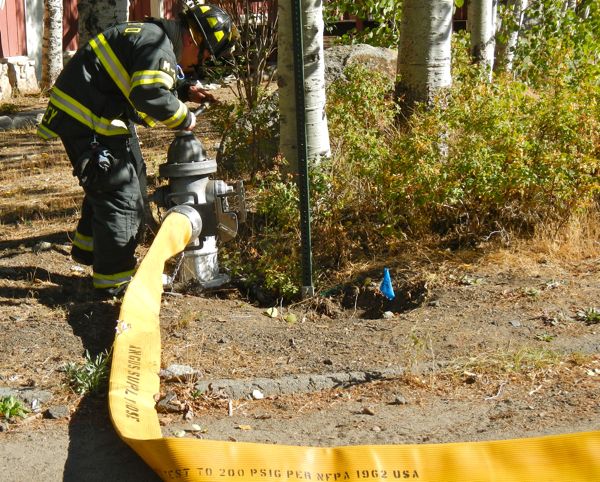
South Tahoe firefighter Doug Bailey hooks the hose to the hydrant.

The extent of the damage to the one unit is not known, nor is is known if other units experienced smoke damage. However, the entire complex at 3754 Forest has been deemed unsafe at this point. The fire department has requested the American Red Cross provide temporary shelter for the displaced residents.


S. Tahoe staff, council differ on need for commissions

By Kathryn Reed

Even though staff told the South Lake Tahoe City Council there is no money, time or staff to deal with the non-mandatory city commissions, the elects aren’t ready to disband them.

Instead, the council wants to have every member of the Parks and Recreation, Latino Affairs, Sustainability, and Airport commissions make a case for why their particular commission should stay the way it is. Even if everyone weighs-in, there is no guarantee later this fall the council won’t take staff’s recommendation and do things differently.

And if the commissions stay in place, the council will have to figure out how best to allocate the minimal resources left in the city to handle this non-essential work. Staff reductions in the last few years mean 65 fewer positions – or one-third the employees are gone.

Prior to the Oct. 2 meeting the city manager had contacted the chair of the Sustainability and Recreation commissions to apprise them of the agenda item. Neither attended Tuesday’s meeting.

The Latino Affairs Commission only has a couple members and therefore is not able to meet because it does not have a quorum. This has been an issue for that commission for some time.

Councilman Tom Davis, who chairs the Airport Commission, said he is fine with disbanding that group. However, David Kelly, who is on that commission, said the opposite.

City Clerk Suzie Alessi and City Manager Nancy Kerry tag-teamed the presentation to the council that outlined what the commissions do and why change is needed.

Kerry explained that each commission is subject to the Brown Act – the California open meeting law, how staff helps oversee the commissions and that city offices are used for the meetings.

What was proposed was to make many of these commissions committees. This would eliminate the open meeting requirements, allow for less structure and potentially the ability to get more things done.

However, the council likes having control over the commissions, including who is on them. Council members also questioned whether there would be their desired transparency if the groups become committees. And then there was the question of whether committees would have the same voice as a commission.

By state law or city code South Lake Tahoe must have the Building Board of Appeals, Delinquent Refuse Fees Hearing Board, Planning Commission, and Airport Land Use Commission.

The city has technically not had the latter commission. It got away with it under old state requirements by having the Planning Commission plus two airport commissioners convene. They haven’t met since 2007. But current law necessitates the new commission be formed.

That commission will be comprised of two county reps, two city, two aviation experts and one person from the general public. The purpose is to work on land use issues involving the airport. With the city soliciting requests for proposals for someone to come up with a master plan for the airport, the commission would be on the ground floor with that process.

The current Airport Commission is more involved with operations of the airport. The new commission would have none of those responsibilities.

Council recommended blending the Delinquent Refuse Fees Hearing Board’s responsibilities into one of the established commissions. The Planning Commission or Building Appeals are contenders.

Davis wondered why the city deals with collections for South Tahoe Refuse when it doesn’t for other utilities. Because that stipulation is part of the franchise agreement is the answer. That, though, could be changed.

Changes the council agreed to are:

• establish the Airport Land Use Commission

• appoint two physically handicapped people, per the Health and Safety Code, to the Building Board of Appeals.


Nevada entrepreneur Donald Bently dead at age 87

To the community,

It is with considerable sadness that we announce the passing away Oct. 1 of one of the institute’s greatest friends and benefactors, our longtime trustee Donald E. Bently. He was 87.

Don began his relationship with IWP when he visited our first headquarters a block down from our current location. At the time, he had become disillusioned with Washington politics. Our mutual friend and eventual trustee, Terry Balderson, however, encouraged Don to visit us, as he believed that Don would be inspired by our mission and what Terry ended up calling our “purity of motive.”

When Don saw that we had not equipped our headquarters with new furniture, but were making do with bare bones accoutrements, he decided not only to donate to us, but to triple the size of his originally contemplated donation.

Donald Bently

Two years later, when we lost our lease and were having difficulty finding appropriate new campus facilities, Don took the extraordinary initiative to buy the Marlatt Mansion and the two adjacent townhouses for the institute’s use. He donated the use of the mansion to us for 15 years at $1 per year, and spent several million dollars gutting and rebuilding the adjacent townhouses, which were beyond repair. I did not ask him for any of this. Thanks to Don, we have enjoyed an extraordinary physical presence just eight blocks north of the White House in one of the best locations in the city.

Subsequently, Don endowed the Donald E. Bently Chair of Political Economy at the institute, which has enabled our longtime professor, Amb. Alberto Piedra to teach moral philosophy and applied ethics to our students.

Don was one of the world’s greatest experts on rotor dynamics. He not only blazed new paths in the engineering theories surrounding rotating machinery, but he also was an inventor and entrepreneur, whose innovations have made the world a much safer place. One of Don’s inventions is a “probe” – a small device that detects vibrations in rotating axles, and therefore the possibility of impending failure in machinery. Such failure can produce meltdowns in nuclear power plants and catastrophes in oil refineries, among other things.

Don’s first company, Bently Nevada, which became the largest manufacturing company in the state of Nevada, also played a pioneering role in the diagnosis and servicing of major machinery. Don eventually sold the Minden company to General Electric.

And then when he was already in his 70s, Don established a new company, Bently Pressurized Bearing Corporation, which manufactures a bearing that can hold in place a rotating axle without actually touching the axle and thus avoiding friction. This extraordinary technology is based on injecting highly pressurized air between the bearing and the axle. In addition to his world class expertise as an engineer, Don was also involved in agriculture, ranching, the development of biofuels, and other sustainable energy concepts.

Don was a long term investor. His companies were completely privately held, and because he was able to structure the way he built his companies for the long term without having to worry about quarterly reports to stockholders, he was always able to keep on the cutting edge of his field technologically. He fended off subsidized competition from Japan; he fended off competition from U.S. government-funded entities, always offering a better product. He did business in over 50 countries around the world, and never agreed to pay a bribe. If people wouldn’t buy his product on that account, he simply refused to do business with them.

Don was a believer in a sound currency. He strongly advocated that the U.S. government guarantee the value of the currency, thereby guaranteeing bondholders that they would be paid back the full amount that they had lent the government.

Don was an American patriot who served our country as a Seabee in the Pacific theater during World War II. He was a believer in limited government, the free enterprise system, and a strong national security posture.

He looked upon his support for IWP as an investment in America that would also benefit his companies, his community, and his family for the long term.

On behalf of the entire IWP community, I would like to extend our sincerest condolences to Don’s son, Christopher, and daughter-in-law Amber Marie, as well as to his longtime assistant Carol Money, and the many other dedicated members of his staff.

Thank you for everything, Don. You have been a great blessing to our cause, and you have touched so many lives.

R.I.P.

Sincerely,

John Lenczowski, Institute of World Politics founder and president

Note: More on Donald Bently may be found online.


Aggressive search of DiMatteo residence caught on video

By Kathryn Reed

Officers in full SWAT gear with assault rifles using a flash-bang to enter Gino DiMatteo’s South Lake Tahoe home was caught on video by his neighbors.

DiMatteo’s civil defense attorney, Ted Long, has released the video to Lake Tahoe News and KRNV-TV in Reno. The latter is seen here.

“We are expecting the whole thing to blow up in their face. It’s been weeks now and we have not seen a lick of evidence,” Long told Lake Tahoe News.

DiMatteo’s residence and business – Push Fitness – were searched on Aug. 31, the same day he was arrested on a variety of drug charges as well as bribery. However, Angela Swanson, the South Lake Tahoe City Council member he is accused of bribing, has yet to be charged. Instead, the El Dorado County District Attorney’s Office is letting her name be associated with a crime she has never been charged with.

She remains on the council and is actively participating on the boards she is assigned to. Swanson was not available for comment Oct. 1.

Gino DiMatteo returns to court Oct. 3 in Placerville.

Long doesn’t believe Swanson will be charged because he doesn’t believe she or DiMatteo did what the DA investigators are alleging.

It has come out that Swanson was the catalyst for a donation from DiMatteo to the Lake Tahoe Educational Foundation, of which Swanson is a board member. This cash donation of more than $1,000 came on the same day the council agreed to allow DiMatteo to move his medical marijuana dispensary. That decision was later rescinded by the majority of the council.

It is also one of the issues in which Long is representing DiMatteo. Long says his client has a letter from the city attorney that says go ahead and spend money to move. DiMatteo did – $60,000, according to Long.

Long, who is a former city councilman, said his first course of action is to go to federal court to get the city’s decision to ban DiMatteo from moving overturned. He says the odds are 50-50. At a minimum, he wants the city to pay DiMatteo so he can recoup his loses for tenant improvements that were for naught.

Long also wants the DA and El Dorado County Sheriff’s Department to pay for the more than $30,000 in damages to DiMatteo’s home when officers stormed it in August.

DiMatteo was already detained when officers ransacked the residence, Long said, so there was no need for the forceful entrance.

“What if his two teenage daughters had been there? It could have caused serious injury, if not death,” Long said of the flash-bang. “It was totally unnecessary. I could have unlocked the door.”

(Rob Wolfel – who was not available Oct. 1 – is DiMatteo’s criminal defense attorney.)

DiMatteo will be in court in Placerville on Oct. 3. He has pleaded not guilty to all charges. He also wants a speedy trial – to which he is entitled to 45 days after being arraigned.

“We want to force them to produce something and then force them to go to trial,” Long said of the prosecution. “If there was some evidence, we would have seen it.”

Long also told Lake Tahoe News that at no time has DiMatteo been in the witness protection program, as has been rumored.


Conner: Jobs for locals, better transit, bring in businesses

Publisher’s note: This is the fourth of five Q&A profiles of a South Lake Tahoe City Council candidate running in the Nov. 6 election.

Name: JoAnn Conner

Age: Old enough to have an AARP card; young enough to play hopscotch with my grandgirls.

How long have you lived in South Lake Tahoe?: 31 years.

JoAnn Conner

Work/volunteer experience:

Work: In South Lake Tahoe, I have worked as an educator, a temporary worker, a child care provider, a journalist, director of a learning lab, manager at a retail store, medical front office staff, catering and food service, director of the Washoe Tribe Head Start Program, director of the Washoe Heritage Information Network, and currently Regional Manager and Independent Associate with Legal Shield/Identity Theft Shield and owner of Golden Bear Events.

Volunteer: Current member of the American Legion Auxiliary, South Tahoe Cancer League, and president of the South Tahoe Chamber of Commerce. In the past, I have been president of the Lake Tahoe Historical Society (when we moved the log cabin and toll house), board member of Tahoe Douglas Rotary, president of South Lake Tahoe American Association of Pen Women, board member of American Business Women, volunteer at Christmas Cheer, Optimist Club, Neighborhood Chairperson for Sierra Nevada Girl Scouts, co-pack master for Boy Scout Pack No. 594, member of South Tahoe Bowmen, president Lake Tahoe Writer’s Club, president of Silver State Fiction Writers, and involved in youth sports.

Why are you running for City Council?: I feel I have a unique connection to a large variety of people in the community, and will bring a fresh perspective and new ideas to the council. We need fiscal responsibility; we owe it to the people to use our money wisely. We need to ensure public safety, do everything possible to bring new jobs here, and be more business friendly.

What is your vision for South Lake Tahoe, the South Shore and the entire Lake Tahoe Basin?: We live in an unusual environment that requires the entities in the basin to work closely, both to maximize public services and to attract visitors. My focus would be on South Lake Tahoe and working more closely with the Meyers community. My vision, based on conversations with business and recreation factions, would be to create more jobs by increasing access to recreation, conservation efforts with people in mind, and therefore creating more income to allow for improvements in our infrastructure and dwellings. Appeal to visitors would be enhanced. I would like to see us become more of a destination for special events, festivals, and family recreation as well.

What are the three best things about South Lake Tahoe?: The giving and caring spirit of the people, the pride in presenting beautiful, recreational surroundings to guests and locals, and having a good place to raise a family.

What three things would you like to change in South Lake Tahoe and how will you go about changing them?: We need more jobs for locals. I would actively seek out compatible business to come here, and work to give incentives for hiring and mentoring locals. I would expand on the neighborhood meeting concept and encourage buy-in from the locals, and help with the volunteer program to improve aesthetics of our neighborhoods. We need a better public transportation system; possibly partially funded by environmental groups.

What would you do to balance the budget?: The budget has improved in the past year, with less of a deficit than we have seen for a while. I would look into better investments for retirement funds and work with public employees to revamp future retirement and benefit policies. More enforcement of vacation rental fees, and possibly a business license fee for people who rent out multi-family dwellings. I think there are some changes we could make to policies that would encourage more revenue and bring efficiency to a higher level.

What would you like to see in a recreation master plan?: We need to upgrade our golf course and keep fees competitive. Be more local friendly. We need more activities at our recreation complex that would attract local youth, especially teens. Our skateboard park needs more work, our playing fields need to be expanded to accommodate more tournaments from other areas coming to Tahoe, in addition to adequate fields for our local youth and adult sports. I would like to explore the idea of “bike sharing” used in other communities to cut down on vehicle usage.

Promoting recreation was touted two years as a means to stimulate the local economy. Nothing has been done in that time. What will you do so that same sentence can’t be said two years from now?: The city manager and the JPA are looking at developing more fields. Our advertising efforts should promote hiking, biking, camping, and marathon activities more, in addition to skiing and snowboarding. Work more closely with bicycle coalitions and groups that can be resources for bringing people here. Two years in a row, the 401K Cyclists for Cancer have been through our town. Where’s our publicity? Encourage and help businesses that are working to get more events here, like the snowball baseball tournament and CUFA soccer.

What types of recreation do you enjoy in Lake Tahoe?: Hiking, walking, bike riding, snowshoeing, camping, boating, disc golf.

How will South Lake Tahoe be different in four years after the end of your term?: I am only one person, one vote, and I don’t own a magic wand, but I would hope my energy could be used to bring together a more cohesive faction of locals working together with agencies and each other to look for, and expand upon, the positive aspects we can use to build our town.

Being on the council requires working with four others. Give readers an example of how you work well others in difficult situations with differing opinions: I taught rival gang factions in the same classroom at the same time and never had a fight in my room. That took some leadership and diplomacy skills. Often just posing questions to get others to think from another point of view can be helpful in conflict resolution. Then, work on compromise. This isn’t about the five people on the council; it is about the people of South Lake Tahoe. I would hope that would be a common interest that would generate compatibility in most cases.

What are your opinions about the following issues and/or entities?:

• Loop road – Not in favor of the current configuration being proposed by the TTD. Harming or obliterating existing business and dislodging residents who rely on low cost housing for a dubious benefit to South Lake Tahoe is not a winning proposition.

• Hole at Stateline – Currently, there is another developer looking at the property. If this is a win, great. If not, we need to actively pursue a positive resolution for this dangerous eyesore.

• Tahoe Valley Plan – Hopefully, can move forward. This area of our city is in need of revamping.

• Giving money to any chamber or tourism bureau – Not in favor.

• Benefits, including pensions, for city staff – Look for better return on investment, but also restructuring to a sustainable system, targeting new hires first.

• Tahoe Regional Planning Agency – Continue to develop better communication. Seems to be a move on their part to be perceived as more amenable to people and solutions instead of enforcement.

• Lahontan Regional Water Quality Control Board – I would like to find out more information on this topic; the relationship appears to work, but could be fine-tuned to a better partnership.

• South Shore Vision Plan – I think this, in its current state, is more beneficial to Nevada than South Lake Tahoe. More local input from those who live and work in our town should be considered.

• Lake Tahoe Airport – Not an easy answer to this one. Lawsuits have plagued this site in the past, but it is my understanding we are still liable for a large debt if we close this. The closure would be problematic in regards to safety issues and, if we are to rebuild a tourist economy, this is a key component. Neighbors are not happy about the noise it would bring, but newer technology cuts down on this.

Why should voters vote for you over someone else?: I believe I have proven myself to have integrity that addresses the needs of the people, not a personal agenda. I do not have any ties to big business support, nor does my income rely on any support from the casinos, ski resorts, city, county, state, or any other special interest group. I am a “little guy” who can truly identify with the needs and feelings of most of the people in our town. Yet, my background with big business and communication with same, also allows me to see their perspective.

Is being president of a chamber of commerce a conflict of interest?: I don’t believe so; I feel it has given me three years of interaction with business owners and the public on an intense level. I have a good grasp of what the “little guy” on the street thinks and their concerns. Being president means I have been at nearly every council meeting for over a year, so also understand a lot of what the city is facing. I will not be the current president by the time of the election.

Is there a person or business you would not take a campaign contribution from?: Yes. I will not take any contribution or support from any business or individual that expects me to advance their personal agenda if I am elected. I support legitimate business with a focus on South Lake Tahoe and Meyers and I will serve the residents, doing my best for the city as a whole.

Tell readers something about yourself that they may not already know: I was so shy when I started high school I couldn’t even walk to the front of the class and say my name. By the time I got to college, I was voted best speaker in my class and delivered singing telegrams to make extra money.


Douglas County shines light on Vail Resorts as example of public-private partnership

By Anne Knowles

MINDEN – Public-private partnerships, including the commercial use of public lands, dominated the discussion at the 18th annual Critical Issues Conference hosted by the Business Council of Douglas County.

Speakers from both sides of the equation talked about a federal lands bill stuck in the U.S. Senate and the bill passed last year allowing ski resorts to use public lands in the summer, as well as efforts to make Lake Tahoe a ski destination on par with Colorado and Utah.

“We need the private sector to invest and take risks. And we need the public sector to balance regulations and its public service role,” Steve Mokrohisky, Douglas County manager, said at the Sept. 27 event at the Carson Valley Inn in Minden.

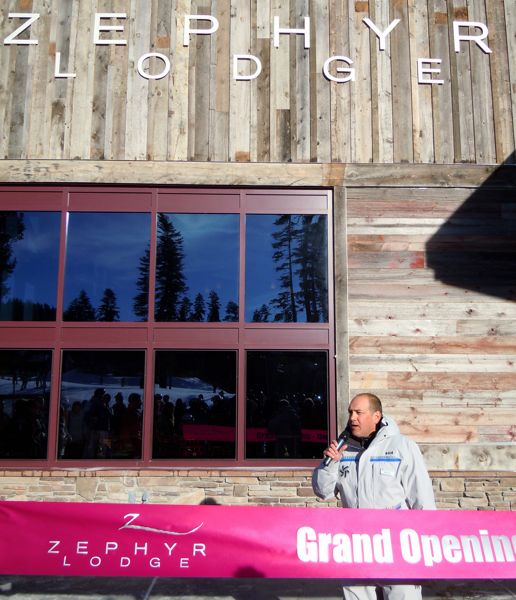
Vail Resorts is making a splash at Lake Tahoe, including Northstar COO Bill Rock in 2011 opening Zephyr Lodge. Photo/LTN file

“Vail hasn’t succeeded in a vacuum. It’s partnered with other public and private entities to make progress,” he said, also citing South Shore’s other large corporate presence, Edgewood Companies, as a model of cooperation between business and government.

Bill Rock, vice president and chief operating officer of Northstar in Truckee, one of three Tahoe-area ski resorts now owned by Vail Resorts Inc., spoke about plans for Kirkwood, Heavenly and Northstar.

“Kirkwood has been a great addition for us. It’s not our typical resort. It’s smaller, authentic, has a lot of character,” Rock said.

He said the company plans to operate the resort for a year before determining how it will invest in the property. When Vail purchased Kirkwood in February, Blaise Carrig, president of the company’s Mountain Division, said Vail liked its existing master plan calling for new lifts and a restaurant at the top of Chair 2.

Investments made at its other Tahoe resorts over the years include the 16,000-square-foot Tamarack Lodge at Heavenly, the 700-seat Zephyr Lodge at Northstar and additional lifts and beefed up snowmaking capabilities. Rock said the company is also known for outspending its competitors on maintenance.

Vail said sales of season passes for the upcoming season were up 17 percent during its year-end financial results announcement on Tuesday. The company doesn’t release data on specific resorts or of its two Tahoe passes, the $439 Tahoe Local Pass and the $399 Tahoe Value Pass, which give holders access to all three resorts. Skier visits at its Tahoe resorts during the 2011-12 season were down 22 percent, and down 9 percent at its Colorado venues, due to the dry winter.

Rock also talked about the Ski Area Recreational Opportunity Enhancement Act enacted last year that lets ski resorts located on public lands operate summer commercial enterprises with U.S. Forest Service approval. Vail applied to the USFS two months ago for summer operations at its Vail Mountain resort in Colorado. The plan is called Epic Discovery and includes ziplines, rope swings, an education center, an alpine slide, hiking and mountain bike trails and a guided Segway tour on trails.

Vail is planning something similar for Heavenly including hiking trails.

Rock told Lake Tahoe News the company wants to bring more events to Heavenly like the U.S. Freestyle Championships, announced in April, and a yet-to-be announced or scheduled high-roller event that would couple card games with a snowboard competition.

All of this is part of an effort to make Lake Tahoe a ski destination to rival Colorado and Utah, said Rock. He said more work needs to be done to accomplish that, including improving transportation to and from the Reno Tahoe International Airport and inside the basin, and adding more internationally-branded lodging like the Ritz-Carlton at Northstar.

The business council event also included Sen. Dean Heller, R-Nev., via a recorded video, and Pam Robinson, Heller’s state policy director, as well as Rep. Mark Amodei, R-Reno, on a conference call.

Both Nevada officials talked about the need for more availability of public lands for commercial use, citing the so-called Yerington lands bill, which would allow for expanded copper mining in Yerington, resulting in an estimated 800 jobs. The bill passed the House, but has yet to have a hearing in the Senate.

Robinson also said the federal government, which she said creates nine new regulations a day, needs to ease up on business restrictions to help the economy. She also said the senator, who is in a heated campaign to keep his seat and who hosted the recent Lake Tahoe Environmental Summit, is encouraged by changes happening at the Tahoe Regional Planning Agency.

“One example,” said Robinson “is the unanimous vote on the Edgewood project.”