Barton on course to be trauma center; severs ties with 4 docs

By Kathryn Reed

While Barton Health officials say money is not the overriding reason to become a trauma center, it is the primary reason they say four doctors as of Jan. 1 will no longer be affiliated with the South Lake Tahoe healthcare system.

Clint Purvance, chief medical officer for Barton Memorial Hospital, said it is hoped the Level 3 trauma designation will be acquired in the first quarter of 2013.

There are four levels of trauma centers, with Level 1 usually reserved for teaching hospitals that are research based. Level 3 requires an emergency room, general surgery, orthopedic and anesthesia be available 24 hours.

“We are not changing the level of care, we are changing the system,” Purvance said. “The delivery of health care is fragmented at best.”

Purvance, with CEO John Williams, spoke with Lake Tahoe News about the changes that are about to occur.

It is the medical practices of Emerald Bay Center for Women’s Health and Tahoe Women’s Care that will not be contractually renewed at the end of the year.

“Even though we did not come to terms with the ob-gyns, they can still practice at Barton. They can use the da Vinci. They can run their own practice,” Williams said. “We just won’t be managing and underwriting their practices.”

Trauma center

It’s not known how many more patients would be able to be cared for locally instead of being flown to Renown Medical Center in Reno (a Level 2 facility) or UC Davis Medical Center in Sacramento (Level 1) if Barton receives the trauma center designation. Officials aren’t releasing projected income from the change either. Nor has it been released if the cost to patients will go up if Barton becomes a trauma center.

For the past year as Barton has worked on its trauma center status, additional equipment has been purchased, employees hired and others trained to meet the demands of the American College of Surgeons. El Dorado County also has criteria for Barton to meet in order to become a trauma center.

“It raises the bar and awareness,” Williams said of being a trauma center. “It’s good for the community image.”

Purvance said the center would create a coordinated care system for patients from the moment they are injured.

As it is now, someone could arrive by ambulance and no one in the ER will know ahead of time what type of care would be required or even that a patient was coming. That would change per trauma center protocol. Barton is talking to its health care partners to put the coordinated system in place.

Even though Barton will be 50 years old next year and has lived without being a trauma center, the health care administrators say the world is changing and things need to change locally.

Even if Obamacare is altered, there is still the California Health Benefit Exchange that providers in the Golden State must adhere to.

Williams said starting in 2014 it will be “value vs. volume when health care reform hits.” Reimbursements are expected to be less, but the number of people with insurance is likely to increase.

Keeping more people at Barton is obviously a moneymaker. But that does not mean patients won’t be flown out even if the hospital is a trauma center.

Neurological trauma with bleeding inside the head, spinal cord injuries, major amputations, burns, and pediatric trauma patients will continue to be airlifted to Reno or Sac.

While trauma centers were in the decline in the 1990s and early 2000s, the reverse has been true the last few years. According to Kaiser Health News, this is in large part because money can be made from being a trauma center.

A Kaiser study show that since 2009 more than 200 trauma center have opened in more than 20 states, with 75 more hospitals seeking approval.

“Trauma centers make money. If a hospital is not making money on trauma, then it’s not structured the right way,” Mike Williams, president of the consulting firm Abaris Group in Martinez told USA Today. “Trauma centers can basically charge whatever they want.”

Women’s care

With Barton being a private hospital, negotiations with individual doctors or groups it contracts with are confidential. Without either side releasing the numbers, it is not known how far apart the hospital administration and the offices of Tahoe Women’s Care and Emerald Bay Center for Women’s Health were.

“Substantial” is how Williams described the difference.

Kelly Shanahan with Emerald Bay Center said, “We basically asked for a continuation of what we have now. The only thing additional was paying our malpractice premium.”

Doctors Gary Willen, Kris Kobalter and Caroline Habaradas with Tahoe Women’s Care did not return a phone call.

This was the administration’s decision, not the board’s.

“I don’t think the board had much of a choice. The administration tried to negotiate in good faith,” Barton board President Guy Lease told Lake Tahoe News.

Shanahan also believes the decision by the administration was personal.

“He doesn’t like us,” Shanahan said of Williams. “I really think it’s about the personalities.”

Obstetrics is not a moneymaker. And with there being a 21 percent decline in births at Barton from 2010 to 2011, the income is on the decline.

While these four docs were costing Barton Health money on the obstetrics side, Shanahan does not believe the g-y-n part of her practice was taken into consideration.

Barton know it needs ob-gyns. Two doctors have been interviewed to replace the four they let go. How many will be hired is an unknown.

Shanahan said the two ob-gyn offices agreed to merge to save money, but that and other concessions were not good enough for Barton.

Barton owns the building Tahoe Women’s Care is in, while Shanahan also owns her. It’s still possible they could consolidate so they can continue to practice medicine locally.

Shanahan foresees having a strictly gynecological practice.

“I kept my office through breast cancer and chemo. I will be damned if this hospital administration makes me shut my doors,” Shanahan told Lake Tahoe News. “I don’t think it is a community hospital. I think it’s corporate.”


Splash of autumn color shines throughout Lake Tahoe Basin

By Kathryn Reed

SPOONER SUMMIT – Autumn has such a distinct scent. You know it when you smell it.

All along the trail to Marlette Lake on Saturday I kept taking deep breaths. While it is really death that is in the air, the power of it gives me energy.

Perhaps it’s the power of nature to cycle through life and death with such relative ease that makes me jealous. We humans have such a difficult time with such monumental things like life and death.

But nature, well, she seems to embrace each season.

Fall is in bloom throughout the Lake Tahoe Basin. Photos/Kathryn Reed

Aspens really do seem to quake in the gentle breeze. Shimmering in the vibrant sun on this rather warm fall day, it’s hard to know if the leaves are hanging on for dear life or trying to shake free to move on.

It’s like a painters palette – all these shades of green, yellow and orange decorating the landscape.

A woman on the trail says she was out three days earlier and notes how much more color there is Oct. 13. She’s what a New Englander would call a “leaf peeper” – because of her ardent interest in the fall colors and desire to see them at different stages.

The abundance of green proves the peek is still to come. Maybe this week. Temperatures, wind and moisture play a role in this leaf changing business.

It’s such a ritual on the East Coast that foliage is tracked for when best to see it. Even the National Weather Service has a color meter.

Mostly it’s aspens along the route to Marlette Lake, though this is not the only flora turning color.

So many people are out – and many with their dogs – that it feels a bit like hiking to Winnemucca Lake during the height of wildflower season. But we don’t mind. Everyone is so friendly. Those of us with cameras seem to play a game of leapfrog with each other as we keep passing one another.

Instead of taking the North Canyon Trail, we take the Marlette Trail. It’s narrower and is not open to mountain bikers. While we didn’t see any horses along the way, we saw plenty of evidence they had been out that afternoon.

We aren’t sure how far we went. The sign at the trail on the Spooner side says it’s 3.75 miles to Marlette Lake. The sign at Marlette says it’s 4.5 miles to Spooner.

Along the way we saw people with shirts that said “Hike for Beer” and finally asked about it. There was beer for sale at the lake. We saw people walking back with cups of beer.

Then we were told the amber ale was gone. Yet visions of aspens seemed to remind me of my thirst that could not be quenched until I got home. Oh, the punishment for getting a late start.

Still, this was an excursion about foliage. And we were not disappointed.

Getting there:

From South Lake Tahoe, take Highway 50 east.

Either turn left onto Highway 28 and then park at Lake Tahoe State Park on the right for a fee; or pass that turn and at the true summit park for free on the left.

(That lot can get full and the state park can use your money.)

Note: For a less ambitious hike, but still one full of color, consider the 2.1-mile loop around Spooner Summit. This would be suitable for most ages and abilities.

ngg_shortcode_0_placeholder (Click on photos to enlarge.)


Finding the center of California requires time to explore it

By Susan Wood

CAMBRIA – It’s easy to fall in love with the Central Coast of California in autumn – or during any other time of year for that matter.

With so much to do and see, what will soon become apparent on a trip through a region that stretches from Santa Cruz to Santa Barbara is the time allotted to fully take in the varied sights and activities will require that of a vacation hopping countries in Europe.

California has maintained the reputation for being the land of the active. But for the more docile wanting to appreciate the finer tastes and bountiful harvests in life, the Central Coast has emerged with formidable wine regions.

Fall is evident throughout the vineyards of the Central Coast. Photos/Kathryn Reed

Paso Robles (which the locals nickname “Paso”) and Santa Ynez Valley may make the case of being the next Napa and Sonoma valleys.

This is the land of Pinot Noir. But as the more than 200 Paso Robles area wineries such as J. Lohr, Peachy Canyon and Robert Hall have proven, bold tastes may come from bottles of Grenache, Cabernet Sauvignon or even Sauvignon Blanc on a 90-degree day 25 miles east of Cambria.

Cambria, this crown jewel of the Central Coast, represents the proverbial California lifestyle – a quaint town broken up between two villages and a beach where a one-mile boardwalk allows a walker the experience of being on the bluff or in the sands and moonstones.

When the fog doesn’t roll in, the sunset brings out all types to Moonstone Beach in the hopes of catching the last-second green flash at the horizon line. It’s worth driving hours to see.

Then, there are the stones the beach is named after. Even on an average weekday morning, people were spotted looking down or even digging for the small, bluish rocks.

“The good news is people decided to travel this summer,” said MaryAnn Carson, executive director of the Cambria Chamber of Commerce. Carson added that after two bad, recession-spawned years in 2009 and 2010, the town has used 12 major events – to bring people to the region.

San Luis Obispo County assists the promotional efforts. Towns as far away as Pismo Beach take part.

Plus, the multitude of area hotels has supported the ventures by taxing the tourists 1 percent to subsidize these events.

Visitors have a place

The El Colibri Boutique Hotel and Spa is situated above the popular Moonstone Beach, requiring just a three-minute walk on the boardwalk from the hotel to see the ocean.

Nestled within a nature preserve, it’s the only hotel lining the boardwalk on the west side of Moonstone Drive.

The place is a perfect launching pad for a 10-minute drive north to the monumental Hearst Castle, cycling one of the best, most scenic stretches of the California Coast where elephant seals are bountiful on the beach and flocks of pelicans soar over the water.

Named after a hummingbird, El Colibri is as intimate, charming and relaxed as its picturesque surroundings. Inside, there’s a romantic feel to the 34-room hotel. Every room comes with a gas fireplace to take the nip of the fog away. Saturday nights feature jazz performers and a local winery. On one September night, the Midnight winery uncorked a Zinfandel that rivals those in El Dorado and Amador counties.

The spa stands out as an exceptional amenity. Dunking in the hot tub in a semi-private, open space may be the ultimate remedy for capping off an evening in a restful state – if not for the more-than-memorable massages from therapists Terri and Diane.

The latter provided Kae, who declared she was a “new woman” after receiving “one of the best massages (she’s) ever had.” Among the many treatments offered, Kae got an aromatherapy massage.

(Just one shortfall: the offerings of the complimentary continental breakfast and evening tapas in the comfortable wine bar don’t live up to the service level of the hotel, so you’ll need to look elsewhere for nutrition – especially if out wine tasting.)

Robin’s restaurant in the “east village” fits the bill for lunch or dinner.

Going south to ‘Sideways’ land

Filling the tummy for a day of wine tasting or evening out is not an issue in Buellton, located four miles west of the cute Danish town of Solvang in the Santa Ynez Valley.

A chef cooking eggs to order can get any day off on the right foot at the Marriott Santa Ynez. This Marriott is large and comes with many amenities, including tennis and squash courts and even a game room near the swimming pool patio.

It’s yet another perfect jumping off spot for cycling the Santa Ynez Valley, home of one of the most acclaimed organized bike rides in the state – the Solvang Century, which is always in March. (Bring your rain gear as this reporter has been caught in hail twice during that event.)

On the way to the Danish town, it’s advised to take the time to check out Ostrich Land, if only from the road on a bike. The rescue farm is listed as one of the area attractions between Buellton and Solvang.

Solvang is the quintessential walkable town – with wayfinding signs, an inviting village green and sidewalks lining the shop-filled streets. (Note: the Danish eateries may introduce the aebleskiver for those seeking a delightful puffball pastry in the middle of the day.)

The Santa Ynez Valley is a wine region that’s made it to the big screen. More than 80 wineries offer vintages ranging from Syrah to Chardonnay. But it was the love of Pinot Noir that put the region on the map when the movie “Sideways” was released in 2004. The story of two very different men out wine tasting before one gets married became a cult hit that brought scores of people discovering the region.

According to Buellton Chamber of Commerce and Visitors Bureau Executive Director Kathy Vreeland, the fascination has endured yet another year despite a 20 percent recessionary dip in visitation in 2009 and 2010.

“I don’t think any of us expected (the popularity),” Vreeland said.

And now, there’s a sequel called “Vertical” in the works.

Still, the original saga of Miles and Jack lives on at the Hitching Post restaurant in its real name in the movie. The steakhouse still boasts throngs of people who stop to just have their pictures taken in front of the sign or eat at the movie characters’ table.

“People want to follow what Miles and Jack did,” Vreeland said.

There’s even a Sideways wine tour.

That aside, followers who swear off Merlot (as Miles declared in the movie because his ex wife drank it) and onto the more hearty Pinot Noir will still appreciate the vast varietals found in the valley such as Lincourt’s tangy Chardonnay and Beckman’s four-way, Syrah-based blend of Cuvee Le Bec.

(Note: a preceding stop at Wandering Dog Bar for a few flights of local wines and advice from fourth-generation wine taster and staffer Ian may be just the ticket if time is a factor.)

If you go:

Cambria: Off Highway 1 between Monterey and Morro Bay

El Colibri Boutique Hotel and Spa

Rooms start at $169 (midweek specials for $139).

Buellton: Off Highway 101 between Santa Maria and Santa Barbara

Marriott Santa Ynez

Rooms start at $149.

ngg_shortcode_1_placeholder (Click on photos to enlarge.)


Declining property values at ‘the hole’ in South Lake Tahoe create $1.5 million problem

By Kathryn Reed

Deciding to disband redevelopment agencies throughout California has proved to be more cumbersome than many people anticipated and has necessitated the revision of laws and new ones created to help local governments comply with what Sacramento wants.

It has left South Lake Tahoe and El Dorado County battling over $1.5 million. It’s Nancy Kerry as a member of the successor agency and Joe Harn, the county auditor who is supposed to oversee all the financial dealings with the agency, who are going after each other.

A meeting Oct. 11 of the South Tahoe Redevelopment Successor Agency board was heated and contentious at times. This is the board created after the state said redevelopment agencies must go away.

A lower assessed value on properties at the South Tahoe hole means a loss of $1.5 million. Photo/LTN

Hal Cole represents South Lake Tahoe and he is the chairman of the board. Other members include John Knight, El Dorado County supervisor; Kindred Murillo, Lake Tahoe Community College president; Vicki Barber, superintendent El Dorado County Office of Education; Randy Vogelgesang, South Tahoe Public Utility District board member; Nancy Kerry, South Lake Tahoe employee; and Coy Baugh, public member.

The battle over the nearly $1.5 million stems from property owners of the rebar and concrete that was supposed to be a hotel-convention center near the state line asked for their parcels to be reassessed. They were. It meant about $1.5 million less in property taxes having to be paid by those property owners.

But the problem is the county already allocated those funds. They went to the Redevelopment Agency before it was dissolved.

On Oct. 1, Harn said he would deduct the $1.5 million from the 2013 property tax disbursement.

On Oct. 9, city staff on behalf of the successor agency wrote a letter objecting to Harn’s actions.

Kerry, at the Oct. 11 meeting, said she is not disputing the money is owed, but questions who gets paid first. She believes the money should be considered a debt the successor agency would deal with. Harn says that is wrong, that the money is a tax roll adjustment.

Harn said it’s his job to make the correction without regard to who is affected by the action.

Kerry wants it as a debt because then the obligation to pay it back is secondary to the bondholders.

“It’s crippling to take all of it at once. The successor agency is not questioning that the money is owed,” Cole said.

In this post-redevelopment era, is it the county treasurer-tax collector who would determine if a payment plan could be structured. If it’s not, then where the $1.5 million comes from remains unknown.

It was resolved at Thursday’s meeting that the city on behalf of the successor agency would see if the county would work on a payment plan for the $1.5 million and that a meeting with the state Department of Finance would be sought so those people can weigh-in.

However, Mindy Patterson, lead analyst with the Department of Finance, on Oct. 11 via email confirmed the $1.5 million is a roll correction – not debt, as the city would prefer it labeled.

Having $1.5 million be wiped off the books also means the agencies that benefit from this property tax won’t be getting their share. That includes South Lake Tahoe, El Dorado County, STPUD, LTCC and Happy Homestead Cemetery District.

It’s likely their share of funds from what was redevelopment won’t be seen for years based on all the debt the successor agency is now saddled with.

The one bright spot for the agencies is that at the Oct. 11 meeting on a 5-2 vote, with Cole and Kerry the dissenters, it was agreed the $1.4 million that had been set aside for the Aspens housing project will be returned to the successor agency coffers. And in turn it will be distributed to the government bodies listed above.


Endorsement: LTN says Sass, Conner are best choice for South Lake Tahoe City Council

Publisher’s note: The following endorsement is from Lake Tahoe News after a team of six community members gathered to hash out who the two best people in the field of five are to lead South Lake Tahoe on the City Council for the next four years.

We believe Austin Sass and JoAnn Conner will best represent South Lake Tahoe on the City Council for the next four years. We believe they are stronger as a team – though they aren’t running as that – than individuals. This is because of what each brings to the table.

Sass has the corporate-world experience this town needs. We need someone who can speak the language of big business. Like it or not, there are a ton of corporate entities in town and more are coming – from grocery stores, to department stores, to ski resorts, to hoteliers.

Sass has experience with big budgets. Multimillion-dollar budgets. A budget like the city of South Lake Tahoe has.

The incumbents believe borrowing from reserves and satisfying the state requirement of passing a balanced budget each year means the city has a balanced budget. City Manager Nancy Kerry last month told Lake Tahoe News the city is likely to face more than a $1 million deficit in the next fiscal year – 2013-14. Neither of the incumbents is addressing this reality.

Sass comes from a tourism-marketing background where he worked for Vail Resorts and Aramark. We have a tourism-based economy. We need someone on the council with that background.

On the other side of the spectrum, Conner has a perspective no one else brings. She has lived the non-privileged life of Lake Tahoe. She talks about the whole community. She talks about the people no one else is talking about – the people living check-to-check, small business owners, their employees – the people who truly make this a community.

When Lake Tahoe News put out a call to the power structure to show up at Bread & Broth to mix with those who may only get one hot meal a week, she was there that night. She was sitting beside, talking to and breaking bread with a segment of the population the other four candidates don’t acknowledge. And, yet, with 60 percent of Lake Tahoe Unified School District’s students receiving free or reduced lunches, clearly poverty with a view is a reality for so many.

Conner is the only candidate on the campaign trail advocating for more jobs in this town. She wants this area to have more than a tourist economy and recognizes that a simple thing like broadband would help inspire companies or those working remotely to move to South Lake Tahoe.

She also runs a small events company, so she gets that people want to do more than look at a lake or walk in the woods.

JoAnn Conner

Austin Sass

It may be disconcerting to some that Sass has received money from out of town interests or larger entities. But $5,000 of his donations came from the South Lake Tahoe Lodging Association. This group only represents hotels in South Lake Tahoe. It costs money to get your name in front of voters. He already had to replace signs – and he’s not the only one – because people vandalized them. While $5,000 is a lot of money in some ways, we don’t believe it’s enough to sway any candidate. After all, it’s not like it went into his private bank account.

Combined, Conner and Sass will bring the big and small perspectives to the table that this town and basin need. We need an eclectic mix on the council to move this city forward. We like that both want to promote recreation and both are active.

We can’t re-elect someone who when asked at the Oct. 10 Soroptimist candidate forum what vote he would change he said pot dispensaries instead of anything about the hole in the ground. It is partially Cole’s Hole. After all, Hal Cole is the one who has said there is no such thing as a performance bond.

And we can’t re-elect the other incumbent – a man who seems so incredibly out of touch with the residents of South Lake Tahoe. The depth of Bruce Grego is questionable. Nothing substantive comes out of his mouth.

Clinton Schue doesn’t seem to take running for office seriously, so how can anyone believe he would take the office itself seriously?

While we know Sass and Conner can come across as arrogant, even abrasive, we also know it takes people who are self-confident, a bit opinionated, and definitely self-starters to be successful councilmembers. We also believe the Sass-Conner combo will work well with the remaining councilmembers.

On Nov. 6 (or earlier via by mail) mark your ballots for Austin Sass and JoAnn Conner for South Lake Tahoe City Council.


Court decision on Stateline’s Sierra Colina project favors League to Save Lake Tahoe

By Kathryn Reed

The Ninth Circuit Court of Appeals has sided with the League to Save Lake Tahoe regarding one of five claims it made to stop the Sierra Colina project in Stateline. But that one aspect could derail the project.

The court in its Oct. 11 ruling will not allow the developers to use coverage in the way they wanted to, which involves bike trails. Plans called for conveying a public easement over a shared driveway for pedestrian and bicycle access and emergency ingress and egress for the neighborhood.

The League challenged that component of the project. The TRPA has limits on how much of a parcel may be covered. It all has to do with erosion and sediment that reaches Lake Tahoe. However, in the updated Regional Plan that is expected to be voted on by the end of the year, the designation of bike paths as coverage is supposed to be altered. How that change plays into this project remains to be seen.

The Sierra Colina project is in orange.

Sierra Colina is the name of the project Steve Kenninger and Gail Jaquish are trying to develop on the 18-acre bare parcel between the Lake Village housing area and the old Nugget building on the south side of Highway 50 and across the street from Rabe Meadow.

In a statement Kenninger gave to Lake Tahoe News he said, “The court’s opinion is an abuse of discretion of the highest order, and a complete disregard of the court’s authority and obligations under applicable law.”

A press release from Kenninger further says, “The League and the Ninth Circuit shattered this collaborative public/private partnership in the basin, at the expense of the general public.”

The League had sued the Tahoe Regional Planning Agency because the bi-state agency is the entity that issued the permits in June 2009 granting the coverage, along with allowing the whole project to proceed.

Tahoe Regional Planning Agency officials said they are reviewing the decision and did not have further comment Thursday afternoon.

“The League to Save Lake Tahoe is pleased that the Sierra Colina dispute has come to a close and that concerns over the extent of paving and roadways in this project will be addressed as the development goes forward. We are gratified that the court has endorsed existing protections on road building and removed the possibility of a precedent-setting relaxation of those protections,” the League said in a press release.

It is not known what the Sierra Colina proponents will do now that the decision by the court has come down.

However, environmental improvements have already been taking place in a cooperative effort with the property owners, Douglas County and U.S. Forest Service.

Sierra Colina was to be a LEED certified, 50-home, multi-family residential project that included nine moderate-income deed restricted homes, a network of public trails, with more than 10 acres of dedicated open space.


S. Tahoe council candidates outline stances to voters

By Kathryn Reed

STATELINE – Budget and fire department staffing were two issues the South Lake Tahoe City Council candidates tackled before each answered three random individual questions.

This second forum of the political season was hosted by Soroptimist International South Lake Tahoe at Harrah’s Tahoe. Two positions are open, with five people vying for them. Clinton Schue did not attend the Oct. 10 event.

The first question was: The consensus among many residents is that the city is practically broke, between what is owed bondholders through the now defunct Redevelopment Agency and the need to keep borrowing from reserves to balance the city’s general fund. Some would go so far as to say the city is insolvent. What is your response to the claim of insolvency?

Incumbents Bruce Grego and Hal Cole took issue with that assessment of the city’s coffers, while challenger Austin Sass’ response was about 180 degrees different from theirs, and newcomer JoAnn Conner was about 90 degrees different.

“We have a balanced budget,” Grego said. “Things are not out of control. I think the problem is resolving itself.”

He didn’t mention that by state law the city has to approve a balanced budget each year.

“I’m really proud of our city’s financial condition,” Cole said. He mentioned a AA minus rating, that there is more than the required 25 percent in reserves. He also boasted how the city is paving streets.

He did not mention how the city borrowed millions of dollars to pave those streets and that taxpayers will be paying that off for the next 30 years.

“We do have a problem and we need to address it now,” Sass said. He doesn’t see how using $6.2 million in reserves in the last few years is good fiscal policy.

Conner likes that employee agreements have been revamped and said the city is doing better today than it was a year ago. She wants to increase revenue by making sure everyone is paying their transient occupancy tax – especially vacation rentals – and to levy a business tax on duplexes, triplexes and fourplexes.

Question 2: Public sentiment is that with no upper management, the staffing at the fire department is in shambles. How protected is the city?

Cole: He believes with three people responding to each fire and an ambulance at each station, the city is protected. He said the fire marshal duties have been contracted with Lake Valley Fire and that consolidation talks are ongoing to determine if that is the best route.

Conner: She believes with neighboring agencies working well together the residents of South Lake Tahoe are safe. She did confuse the role of the fire marshal with battalion chiefs when she said, “The captains are doing the job of fire marshals.”

Sass: He, too, believes the mutual aid agreements keep city residents safe. However, he said talking to Lake Valley and Tahoe Douglas fire staff, he has learned those agencies are “concerned with onsite management of a fire.” And he said city staff is worried about equipment, especially with an engine failing during the Peter Darvas house fire last month.

Grego: “We are fully protected.” He said the city is looking at buying a new fire apparatus, but that it costs $500,000.

[No one mentioned that the city does not have a capital outlay fund so when any equipment reaches the end of its usefulness there is no pot of cash to replace it.]

Next up, Ann Swallow, who moderated the Wednesday event, asked each of the four three questions.

Q: The city has tightened its purse strings by reducing expenses, some of which have included eliminating positions and/or departments. As a result, employees are potentially facing a more work and less pay scenario. How would you address the potential for decline in morale and productivity?

Grego: “Morale is something we need to work on by recognition.” He also suggested hiring people outside the city to do some of the work.

Q: The city of South Lake Tahoe currently has no position on the use of eminent domain. If the issue is raised, would you vote yes or no?

[This was a false statement by Soroptimist. A previous council passed the policy that eminent domain will not be used. It would take four out of the five councilmembers to change that policy.]

Sass: “Eminent domain should be used as a last resort.” He could see using it if 95 percent of the loop road property and business owners accept to be bought out and that for the greater good the 5 percent are taken by eminent domain.

Q: Would you vote for the Tahoe Regional Planning Agency’s Regional Plan update as it is currently proposed?

Conner: “Yes.” She believes how TRPA wants to change best management practices as well as allowing sensitive property to be traded to encourage development elsewhere are good things in the plan.

Q: Beside yourself, who else will you vote for for City Council?

Cole: “Elect two candidates who have a vision.” He wants someone who is like-minded.

Q: Do you think councilmembers should be on nonprofit boards that could benefit from the councilperson’s elected position?

Grego: “No. It is against the law.” He said councilmembers are not allowed to vote when there is a conflict.

Q: What are your views about a recreation master plan and how would you pay for it?

Sass: He wants to create a sports and recreation commission and assess what the facility needs are. He believes revenue will come from attracting tournaments and other athletic events to the area – especially when the facilities are in place.

Q: Is it appropriate for the South Shore Chamber of Commerce to endorse a candidate?

[There is the South Tahoe Chamber of Commerce, which Conner is president of, and the Lake Tahoe South Shore Chamber of Commerce. It was not clear which chamber the Soroptimist meant.]

Conner: “We have always felt we should not endorse candidates.” She said her chamber endorses issues, not people.

Q: Explain a vote you made during your tenure on the council that you would change today and would you change it?

Cole: He wishes he had not allowed medical marijuana dispensaries because he says they ended up selling drugs in bulk to people out of state and that it has been bad for the city. He called the operators “drug dealers”.

Q: The Tahoe Transportation District is moving the loop road forward with $810,000 in grant money. What is your position on the loop road and how would you protect city residents and business owners?

Grego: “I oppose the preferred alternative. I see no benefit for the city of South Lake Tahoe to support it.”

Q: What are your thoughts about the El Dorado County Grand Jury’s recommendation of merging the city of South Lake Tahoe and El Dorado County?

Sass: “I’m not sure if it’s a good or bad idea. A study would need to be done about what the city residents would gain and what they would lose.”

Q: What steps would you take to generate revenue in the city while keeping expenses at a minimum?

Conner: “Market our recreation because it’s the most viable asset we have.” She wants residents to be tapped to do some of the work, which some already are when it comes to securing grant funding. She says broadband would allow different businesses to come to town. “I would put studies on a pause.”

Q: Over 18 months ago the City Council met jointly with Douglas and El Dorado counties in public session. Since then no meetings have taken place. What is your opinion with regard to the City Council meeting regularly with these neighboring counties?

[The meeting was actually Nov. 4, 2011, when the city and Douglas County met. The city and El Dorado County have not met. ]

Cole: “There is no state line.” He would like more meetings and is disappointed the second one with Douglas was canceled.

[The election is Nov. 6. Vote by mail ballots should arrive this week.]


Locals give S. Tahoe officials earful about Al Tahoe area

By Kathryn Reed

While the consultant in charge of the Harrison Avenue project in South Lake Tahoe said the purpose of Tuesday night’s gathering was to exchange information – the city saying what it wants to do and locals saying what they want – some wondered what the point really was.

One person said how four years ago the city agreed there would be no one-way streets in that area. Now some people are miffed that maps show one-way streets.

Bob Albertazzi, right, talks Oct. 9 about South Lake Tahoe's plans for parking in the Al Tahoe area. Photo/Kathryn Reed

Another meeting-goer brought up how a year ago a vocal group was adamant that parking permits in neighborhoods, especially Al Tahoe, was a bad idea. That idea is back on the table at a proposed cost of $25 per household a year.

On the flip side, a man told Bob Albertazzi, who was leading the parking discussion, that he believed what the city had come up with was a viable solution.

Marti Monns, who lives by Regan Beach, told Lake Tahoe News, “I don’t believe in paid parking in an area like this.” She also doesn’t want to pay for a permit. She knows what it is like to be a single mom, so she wants to keep things affordable for those who live and visit Lake Tahoe.

Monns added that the congestion during Fourth of July and concerts at Lakeview Commons is tolerable. What concerns her and others is if the city puts paid parking in at Regan Beach, it will spill over into the neighborhood because those people will want to park for free. That is why the city is looking at permit parking – to lessen the impact on locals.

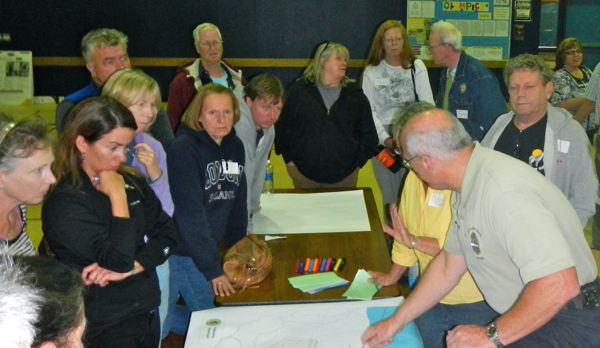
The meeting on Oct. 9 at South Tahoe Middle School attracted about 80 people. Three stations were set up for people to get info and voice opinions. They included talking about events at Lakeview Commons – the impacts, types of events and how many there should be. The city plans to have event specific guidelines for Lakeview Commons devised by December. That same month request for proposals will be sent out for concessionaires for that location.

Another sector at the meeting focused on parking management. What wasn’t mentioned by city staff is how in the current budget there is revenue budgeted to come from paid parking. Then again, it was in the last fiscal budget, too, but the City Council took it out when public pressure weighed heavily on them.

The third station at the meeting was talking about plans to revamp the Harrison Avenue business district. Hilary Roverud, who runs the city planning department, said, “The actual physical changes are only proposed for the commercial area.”

Another opportunity for people to comment on Harrison Avenue will be during the 30 days when the CEQA document is on the street. It should be released Oct. 12. The Planning Commission is likely to have a special meeting later this month about that document. The council Nov. 6 is expected to have a public meeting about creating an assessment district for Harrison.

In March or April, city staff would like to award a contract to a contractor who would then begin work in May.


Massive thinning project creates healthy Tahoe forest

By Kathryn Reed

FALLEN LEAF LAKE – Sunlight shines into campsites like never before. Piles of logs are scattered about the South Shore. Burn piles are dotting the landscape. Open space where trees once stood are visible from Camp Richardson to Fallen Leaf Lake.

All of this is the result of the multi-million dollar, multi-year, multi-acre South Shore Fuels Reduction Project the U.S. Forest Service started last month. The goal is to wrap up the work at the Fallen Leaf Lake Campground this month so campers are not impacted two seasons in a row.

But weather has been a problem. Four days last week the crews had to quit early because of the fire danger – the humidity level and temperature combined created hazardous conditions.

By the time the South Shore Fuels Reduction Project is done, more than 10,000 acres will have been treated. Photos/Kathryn Reed

“The big problem here is people are not considerate and are not obeying closure notices,” Robert Guebard, who is overseeing the operation for the Forest Service, told Lake Tahoe News last week on a tour of the site.

People have taken down signs – which presents a dangerous situation for others entering an area they don’t know is off-limits.

Even though the Lahontan Water Quality Control Board issued a permit for this project in the spring, that oversight agency requested more detailed plans. Those were handed over in late May, but Lahontan didn’t furnish the go-ahead permit until September. That is why the USFS got such a late start this season.

Of the 10,100 acres that will be treated, 6,000 will be hand thinned, while 4,100 acres will be mechanically treated. Slope, access and wetlands are the main factors that necessitate hand thinning. The Twin Peaks area is an example of this.

For the rest of the month, crews will be at Fallen Leaf Lake with what looks like oversized Tonka toys. One machine fells the trees, strips off the limbs and cuts it to a specific length before piling the logs for the next machine. The next apparatus lifts the logs into an open bed truck of sorts that has a massive “arm” to lift the wood into piles at the landing site.

The Sierra Nevada Framework, a document from more than 10 years ago, prevents trees with a diameter of 30 or more inches from being felled. The U.S. Forest Service team is not always appreciative of what can seem like an arbitrary rule. A half dead fir must be left behind near the road that leads from the campground to Fallen Leaf Lake. It’s too big to fell even though it’s not healthy.

Fallen Leaf also has archaeological sites and historic sites, like old flumes, where thinning is prohibited.

CTL Forest Management out of Placerville is doing the work. It will be up to CTL where the wood goes – whether for commercial use, biomass or firewood.

“These guys are at the whim of the market. Right now the biomass market has tanked. That’s why you see big burn piles,” Guebard explained.

While it looks like a significant logging operation is taking place in the Lake Tahoe Basin, the reality is it’s a massive thinning process.

The goal is in 10 years the South Shore will be a healthy forest when it comes to how dense it is, the ladder fuels that are gone, the tree canopy, the size and variety of trees left. Fire used to take care of all of this naturally. But with people living in the woods, fire suppression is the norm. That means forests need help to be healthy.

The goal is to have treated 1,100 before snow brings the operation to a standstill this fall. Camp Rich is done for the year. The Railroad Grade trail by Powerline is being worked on now.

Next year the Sierra Tract-Golden Bear area, and South Upper Truckee by Hawley Grade will be treated.

Maintenance will be ongoing so the forest doesn’t end up like it is today – overgrown and prone to a severe wildfire. It’s possible prescribed ground fires will be used down the road to keep the forest healthy.

ngg_shortcode_2_placeholder  (Click on photos to enlarge.)


Cole: Get rid of blight, be less divisive, increase recreation

Publisher’s note: This is the last of five Q&A profiles of a South Lake Tahoe City Council candidate running in the Nov. 6 election.

Name: Hal Cole

Age: 63

How long have you lived in South Lake Tahoe?: 52 years

Hal Cole

Work/volunteer experience: I have owned and operated a successful construction company for over 35 years. I have also served on the City Council, Barton Hospital board of directors, Governing Board of the TRPA and CTC and sat on the city Planning Commission.

Why are you running for City Council?: I love this community and have dedicated the past 20 years to serving in any way I can. I believe my experience and institutional knowledge can be of great benefit as we face the challenges ahead.

What is your vision for South Lake Tahoe, the South Shore and the entire Lake Tahoe Basin?: To truly be a world-class destination resort. In order to accomplish that we must begin serious work on restoring the near shore waters, encourage private investment to help rebuild our infrastructure, make a concerted effort to improve and market our recreational opportunities and build a spirit of partnership within our community.

What are the three best things about South Lake Tahoe?: The sheer beauty of it all, the changing seasons and the feeling of community a small town affords.

What three things would you like to change in South Lake Tahoe and how will you go about changing them?:

1. Encourage the demolition of the blighted buildings lining Highway 50.

Solution: Offer more options for their use and consequently their value. This can be done by changing the restrictions put on the property by the TRPA. For example, if you own a motel and want to remodel or transfer its use to another property, your only option is to build another motel or apartment. If we want to encourage the development of our commercial centers such as the Y, we must allow the freedom to transfer existing development out of areas where they are not profitable and into areas we are trying to develop. Whether the new use is a motel or commercial should be determined by the market and not a document created by bureaucrats.

2. Reduce the divisiveness in our community.

Solution: I think we are making progress. There is more community outreach lately. The city is going into neighborhoods and holding local meetings to get more focused input. Our City Council meetings encourage participation and our council members are open to new ideas. We need less criticism and more participation.

3. I would like to see more emphasis put on recreation for our infrastructure development and our marketing.

Solution: Develop a recreation master plan as I elaborate later.

What would you do to balance the budget?: Probably a more pertinent question would be, “What have you done to balance the budget?” First, a little background. In 2002, when our economy was booming and our revenues were growing, our city had no money in reserve. I was part of the council that decided to build a cash reserve. By 2009 we had close to $14 million. On advice from economic advisors, we also adopted a policy that we would always retain at least 25 percent of our annual operating budget in reserve, enough to run the city for three months. 2008-09 was also the first budget year that the impact of the recession was fully felt. Prior to 2008, we were receiving approximately $30 million in general fund revenues. Today we are getting close to $28 million. To compound matters, our expenses were rising. Two years ago we were facing a $5 million deficit. Today that has been reduced to $500,000 and next budget year (2013-14) we expect to present a balanced budget. This was accomplished a number of ways. Over the past four years we have reduced our labor force by 30 percent (from management to line employees) while minimizing the impact on our core services (police, fire and snow removal). Our employees are now paying their full share of their retirement and we revamped our health insurance. This kind of downsizing is unheard of in the state and could not have been done without having a reserve in place to soften the blow to our community and employees. Property tax revenues have not yet bottomed out, but the slide has slowed and usually the property tax collected lags the economy in general. Our sales tax and TOT are above our projections; signaling what I believe to be the start of a long, slow recovery. While we were reducing expenses, we have been investing money into our infrastructure as seen by Lakeview Commons, the Bonanza Community Park, repaving of our streets and the planned improvements to Harrison Avenue – all of which should enhance our visitors’ experience and restore some of our residents’ faith in the future.

What would you like to see in a recreation master plan?: I would like to see both private and public providers from both states develop the plan with an emphasis on identifying unmet needs and creating recreation programs that can be bundled and marketed (i.e. skiing and ice skating, youth camps, canoeing and guided hiking, etc.)

Promoting recreation was touted two years as a means to stimulate the local economy. Nothing has been done in that time. What will you do so that same sentence can’t be said two years from now?: First of all I strongly disagree with the statement, “Nothing has been done”. The planning and construction of Lakeview Commons is arguably the single biggest recreation project the city has done since the ice rink. We are seeing locals and tourists alike flocking to the beach. Families are enjoying the water, we have hosted paddling events, we have boat launching and canoe rentals. We are in the process of using unspent recreation JPA funds to improve our bike trails and ball fields. I cannot think of a time when we were as focused as we are now on recreation. Recreation is what will define Tahoe’s future.

What types of recreation do you enjoy in Lake Tahoe?: Tennis in the summer, skiing in the winter.

How will South Lake Tahoe be different in four years after the end of your term?: The TRPA Regional Plan will have been adopted and the city will have an approved plan for the Y, incentivizing new investment. We will have continuous sidewalks and bike trail from the Y to Stateline. We will be well on our way for the development of the “56 acres” (the property across highway 50 from Lakeview Commons). Edgewood will be near completion of their project. Harrison Avenue will have a complete renovation complementing Lakeview Commons. Community pride is infectious. Business and homeowners alike will invest in their property.

Being on the council requires working with four others. Give readers an example of how you work well others in difficult situations with differing opinions: I have always prided myself in my ability to listen. I do not like to weigh in on issues until I have heard all sides. The most recent example is the Loop Road. The council heard hours of testimony and was divided on how to proceed. I proposed reopening the process and bringing forward other alternatives to be considered when preparing the environmental documents. Since then we have had a much more open dialogue and I do believe the final outcome will be embraced by a larger majority of our community.

What are your opinions about the following issues and/or entities?:

• Loop road – The option proposed was developed in a vacuum. The concern of affected businesses needs to be addressed. Other options need to be considered. Improvements to Highway 50 at Stateline are essential and we need to make sure the investment gives us the most benefit.

• Hole at Stateline – The City Council made a huge mistake when they approved the permit in 2007 and allowed the developer to go ahead with only the foundation, with no timetable or financing to complete the project. They also did not require that the property be consolidated into five parcels as required in the development agreement. The consequence has been catastrophic. The foundation now covers most of the 29 separate lots. Any potential buyers have to negotiate with separate lot owners making it impossible to make a single offer. The city has two potential options: take control of the property with eminent domain (something I don’t think any future council will ever do) and market the project or begin abatement action declaring the site a health and safety issue.

• Tahoe Valley Plan – This is a prime example of how the TRPA stifles our ability to plan our own community. We spent years on the process. We formed a committee of local businesses and residents and created a vision of what we wanted to see at the Y. I worked with our assistant city manager to codify the various elements of the plan. Our City Council formally approved it. The TRPA then told us that they would not consider any more community plans until they adopted the broader Regional Plan update. Three years later it still has not happened.

• Giving money to any chamber or tourism bureau – I have always felt that there is a partnership between the city and the chambers and LTVA. Our pledge was that we would invest in the infrastructure to attract visitors, fill our lodging and shop at our stores as evidenced by the Gondola Village, the ice rink, Lakeview Commons, etc. We have spent millions of dollars on these improvements, often in lieu of other services. In return, we hoped the tourist industry would invest in the marketing of our product. The city cannot afford to do both.

• Benefits, including pensions, for city staff – As I mentioned earlier, our employees have agreed through their bargaining units to pay their full share of the retirement (PERS) and have agreed, albeit not without much discomfort, to the revamping of our health insurance. We are one of the few cities in the state of California to achieve such concessions.

• Tahoe Regional Planning Agency – For me this issue is a double-edged sword. I was living here as a young child in the early ’60s and saw how clear our waters and how unspoiled our beaches were. Left unchecked, unbridled development could have had an even more serious impact. On the other hand, the only way to improve our built and natural environment is to rebuild what is here. The TRPA has done a terrible job at recognizing this and reducing the barriers preventing the redevelopment of our town.

• Lahontan Regional Water Quality Control Board – Again, the goals are lofty, but the reality is slapping us with unfunded mandates that we will never be able to afford. I feel that many times environmental agencies take the “all or nothing” approach. Either comply with all their regulations or be hit with fines or barriers to development. I believe that a small step in the right direction is better than standing still.

• South Shore Vision Plan – I have seen many visions and plans presented over the years and they usually fall flat due to lack of financial resources. This plan is the most comprehensive I have seen and one that is likely to proceed. I support it. I vocally offered one suggestion at our joint meeting with Douglas County, and that was lake access is still not fully addressed. Shuttling people to a dropping off point and then having them board a waterborne shuttle to the beach is not the best answer. We need easy to ride shuttles to take them from their lodging to the water. We must realize that they are visiting “Lake Tahoe” and it needs to be all about the lake.

• Lake Tahoe Airport – This is one of our most underutilized assets. For certain an airport could not have been built post TRPA. It is here — let’s take advantage of it. It has shown its value when our forests are on fire, and it offers an alternative for our visitors to travel here. It has also proven to be an effective alternative for housing our city offices.

Why should voters vote for you over someone else?: We are still in critical times. Running a city like ours requires many skill sets (i.e. police, fire, road maintenance, recreation, land use planning, budgeting, etc.). There are many people who are relatively new to the city and in very critical positions and I believe I offer the balance needed between new ideas and experience.

What is your relationship to Community Athletic Coordinating Council and is being on the recreation joint powers authority a conflict of interest for you?: I have no affiliation with the C.A.C.C.

Four years ago you said the Tahoe Valley Plan would be done by now. It isn’t. Any comment?: Yes, as I mentioned earlier, the city did its due diligence in preparing the plan. It was the TRPA that was unwilling to review it.

Is there a person or business you would not take a campaign contribution from?: I will not accept any contributions from anyone in return for any promises. I am fiercely independent and over the years I’m sure I have made some decisions that have disappointed people who are my most ardent supporters and at times have voted in support of my harshest critics. I have always voted my conscience and always will.

Tell readers something about yourself that they may not already know: Since my early adulthood I have been distrustful and critical of government. I still am. That is the main reason I entered politics.