Combat pilot relives Vietnam War so others may learn

By Kathryn Reed

Leaving college to enlist in the Army. Wanting a change, a new direction, to be a bit defiant and get off the track his parents had laid out. It can happen to any 22-year-old.

The difference is this was 1967. The Vietnam War was raging. Young American men, boys really, were dying every day. The country was divided.

No one thought about supporting the soldiers and not the conflict. Forty-five years ago they were one and the same.
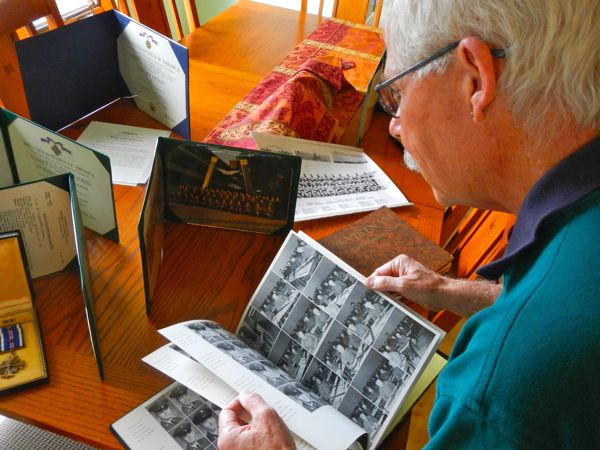
South Lake Tahoe resident Gary Jones looks through a yearbook from infantry training. Photos/Kathryn Reed

This was when protests were the norm on college campuses. It was a time when more people were drafted into the military than willingly walked into a recruiting office.

Gary Jones admits his desire to join the Army and go to flight school was part rebellion. After all, the junior at UC San Diego wasn’t in danger of being drafted.

Today, his life is what is taught in history classes.

This South Lake Tahoe resident has donated memorabilia to the local library that will be on display all month in honor of Nov. 11 being Veterans Day.

While Jones wants to tell his story, the 66-year-old’s voice quivers a bit as he relives his last mission over enemy territory. The one that sent him to a hospital in Japan for three months, the one that left him with diminished muscle mass, the one that is the root of his post traumatic distress.

He was with a unit in Cu Chi, a village near the Cambodian border. His job as a light observation helicopter pilot was to fly low to find trails. After a while, Jones could tell how old the trail was, the equipment that had been on it as well as the number of people. He describes it as being like an Indian trail guide.

While a Cobra flew above to be the main firepower, gun battles could not be avoided.

“I took AK47 fire up my right side,” Jones tells Lake Tahoe News. It went through the seat, into his thigh, off his armored chest plate, bounced off his elbow and exited through his bicep.

“It blew me off the controls,” Jones said. “My gunman grabbed the controls and we started to climb.”

But this just made the helicopter an easier target. Jones was able to set the chopper in a rice paddy. He looked out and it appeared to be raining. In a way it was – it was raining bullets around the three Americans.

“I could move my arm and leg. Blood was everywhere in the cockpit,” Jones said. “I was starting to go into shock. I was saying goofy stuff on the radio.”

Medics arrived and he was airlifted out. In Japan, men just like him – those wounded in combat — surrounded Jones. There was a certain camaraderie. It was not until he was back in the States that the survivor’s guilt settled in.

He had been writing what he called graphic, truthful letters home. Those stopped just before he was shot. He finished them as he recuperated, which was a cathartic experience.

On the table in his South Lake Tahoe home, a few feet away from where he is sitting, is his Purple Heart medal as well as the Distinguished Flying Cross.

His dress uniform has all the ribbons he earned while serving from December 1967 to March 1971.

It was in 1975 that he moved to Tahoe with his wife. He started as a probation officer. Two years later he joined the Nevada National Guard. In 2002, he retired from the guard. Jones had retired from the El Dorado County District Attorney’s Office the preceding year after having been an investigator since 1981.

Sometimes he misses flying and the sense of family the military lifestyle provides.

But Vietnam is never that far away. He is wearing a shirt that says Vietnam Helicopter Pilot Association, Life Member. A model of the helicopter he flew is on a bookshelf. When the traveling Vietnam Wall was in Carson City last weekend he was there. He has the etchings of names of boys he went to high school with, of men he served with and soldiers he witnessed die.

“It’s important to talk about it,” Jones says of his experience as well as what people today in the military are going through.

ngg_shortcode_0_placeholder  (Click on photos to enlarge.)



DiMatteo faces federal drug charges; bribery investigation involving Swanson still alive

By Kathryn Reed

Gino DiMatteo, the man accused of bribing South Lake Tahoe City Councilwoman Angela Swanson, is back behind bars. This time he faces federal drug charges.

While the state drug charges have been dropped, the federal charges are more serious if only because of the venue. Plus, the El Dorado County District Attorney’s Office in a press release said, “… the investigation into certain South Lake Tahoe city officials as to their dealings with DiMatteo is ongoing.”

Gino DiMatteo

DiMatteo was arrested Nov. 2 in Placerville where he was scheduled to appear in El Dorado County Superior Court on a hearing related to the state charges.

His criminal attorney, Rob Woelfel, told Lake Tahoe News, “I’m pleased that all of the California charges have been dropped and it is disappointing that law enforcement is trying to direct this into a federal forum to deny my client a medical marijuana defense.”

DiMatteo, who used to run the City of Angels II medical marijuana dispensary in South Lake Tahoe, was first arrested Aug. 31 on a slew of drug charges as well as bribing a public official. Now he operates Push Fitness, which Friday night still had its lights on.

In moving the case to U.S. District Court, it raises the seriousness of the allegations against Dimatteo. For one, the feds don’t recognize any form of marijuana being legal. This is in direct contrast to the state of California which allows the sale and use of medical marijuana.

The exact charges DiMatteo faces have not been released and the federal complaint is sealed.

Swanson has never been charged or detained. However, she has been questioned and her electronic devices taken as evidence. It has come out that she solicited a donation from DiMatteo for the Lake Tahoe Educational Foundation, on whose board she sits, at the same time she was voting to allow DiMatteo to move his pot club to a different location in town. She maintains her innocence. DiMatteo was known to give quite a bit to charity, so this donation would not have been out of the ordinary. And Swanson’s votes have consistently been in favor of medical marijuana, so the time of the donation and vote may look bad, but are not out of character for either individual.

Swanson did not return a phone call Friday.

A twist often not seen in cases like this is in the press release from the district attorney there are quotes from DiMatteo criticizing Long: “I – I really think that Ted Long’s only agenda is political. And I think it’s his intention to no, you know, not represent me properly and just use my – my – I don’t know how to say it. You now, what’s happening to me – to advance himself and his own agenda.”

Ted Long was not available for comment. He had been DiMatteo’s civil attorney, but had spoken out about the criminal case.


Lake Tahoe area ski resorts count down to opening day

http://youtu.be/19mhiCx4bPM

By Kathryn Reed

While this will be the first full season Kirkwood Mountain Resort has operated under the Vail Resorts flagship, it has been a mainstay in the Tahoe area for 40 years. Also celebrating its 40th year is the second newest Vail acquisition – Northstar.

But it’s Squaw Valley, Alpine Meadows and Sugar Bowl that are investing the most amount of money in infrastructure for the 2012-13 ski season.

Ski resort operators are doing snow dances in hopes no one comes to the slopes this year with open-toed footwear. Photo/LTN file

And that season has already begun. Squaw was open for a day in October as a fundraiser, while Boreal remains open on weekends.

Snowmaking guns at Northstar and Heavenly Mountain Resort were fired up in October.

All resorts are hoping that for this season the manmade stuff sets a base and gets the season going; unlike last year when snowmaking helped save the season. But even an epic, record snowfall winter like 2010-11 is not all that welcome because it makes getting to the resorts difficult and digging out challenging.

While forecasters look west, analyze computer models and study historical data to predict what the weather will be like this winter for the greater Lake Tahoe area, only time will reveal what this winter will be like. But if one is to look at local lore, most years when significant snowfall has dropped on Heavenly (like last month), that winter is above average when it comes to white stuff. Again, time will tell.

Here are few highlights at some Tahoe area resorts for this season:

Opening dates *:
Boreal – Open Fri-Sat-Sun
Mammoth – Nov. 8
Heavenly – Nov. 16
Northstar – Nov. 16
Squaw Valley – Nov. 21
Kirkwood – Nov. 21
Sugar Bowl – Nov. 22
Homewood – Thanksgiving-ish
Tahoe Donner – Thanksgiving-ish
Sierra-at-Tahoe – November-December
Alpine Meadows – Dec. 7
Diamond Peak – Early December
Mount Rose – Early December
Bear Valley – Early December
* All are subject to change.

Squaw

Big Blue Express, a high-speed six-pack chairlift, replaces High Camp chairlift. It starts where the base of the High Camp lift was, but goes farther – to the top of the ridge so it will be easier to access Shirley Lake, Solitude and Granite Chief chairlifts.

The Links double chairlift is out and in its place is Mountain Meadow, a triple chair.

The Park Pulley telecord, touted as a modern day tow lift, is designed to provide easy access to the Belmont terrain park and to eliminate traversing across the mountaintop meadow.

The resort is trying to catch up with others when it comes to snowmaking capabilities by putting in $3 million worth of upgrades. Some of that cash was also spent on groomers.

A Burton Learn to Ride program will be initiated.

Olympic Plaza Bar has been completely remodeled to the tune of $300,000.

New shops are also expected to open in the village.

While Squaw and Alpine have one owner as of fall 2011, the bulk of the money is being spent at the 1960 Winter Olympics venue. Combined, about $24 million in capital improvements have been made for this season at the two areas. This year’s investment follows the $15 million in base area and on-mountain improvements from last winter.

Called the Renaissance, the plan is to invest $70 million at Squaw and Alpine by winter 2015-16.

Alpine

With a vast improvement to snowmaking efficiency at Alpine, a mile-long terrain park will be built. Snow Park Technologies will be tasked with building Tahoe’s longest park.

Alpine will also operate a Burton Learn to Ride center.

The ticket office has been reconfigured with seven windows, including one to comply with the Americans with Disabilities Act.

Northstar

Additional glading was completed in the Promised Land ski pod over the summer.

Lack of snow last year prevented the launch of snowcat and backcountry tours on Sawtooth Ridge, so that is back on the agenda this season.

A Burton Riglet Park that introduces snowboarding to ages 3-6, like what Sierra-at-Tahoe started last season, will open at Northstar.

Sean White continues to call Northstar his training grounds. He will help design a 22-foot superpipe.

Tavern 6330’ opens in the Village at Northstar.

Dec. 22 is when the resort will celebrate its 40th birthday. White is expected to be on hand for the party.

Sugar Bowl

Sugar Bowl will be operating the country’s largest cross country ski area – Royal Gorge. The resorts are already linked by an “interconnect” trail that allows skiers to ski between the two. Plans are in the works to improve that route. Sugar Bowl also has plans to invest $500,000 in Royal Gorge this season.

The resort is partnering with Sierra Nevada Dog Drivers to return a sled dog race to the region after a 17-year hiatus. The Jack London Commemorative Sierra Sled Dog Derby will be at Royal Gorge on March 2-3.

In 2013, an academy that will train young skiers and snowboarders for high-level competition will be complete. This is part of the $50 million in improvements the resort has made in the last few years.

Rental gear is free for people participating in group lessons with a daily lift ticket.

Returning is the Rahlves Banzai Tour finale on March 16-17.

Kirkwood

Major capital improvements aren’t coming this season. Vail officials have not released a game plan or time line for upgrading their newest resort.

The Swatch Freeride World Tour makes its only U.S. stop at Kirkwood Feb. 27-March 3.

New this season is a four-day backcountry camp offered through Expedition: Kirkwood on Feb. 15-18.

Heavenly

Heavenly increased its snowmaking capabilities this summer with 10 energy-efficient Viking V2 snow guns on lower Stagecoach.

Unbuckle at Tamarack, the après ski party, is being touted as better than before. The Gunbarrel Grill is being called an “on-mountain man cave”.

The resort will host the U.S. Freestyle Championships on March 29-31.

Instructors in Heavenly’s Peak Performance Academy will work with skiers and snowboarders in an all-mountain clinic that will feature video analysis, high-end riding and off-piste tactics, while addressing personal goals. The two three-day clinics are Jan. 25-27 and Feb. 8-10 and one five-day clinic is March 4-8.

Sierra

Sierra-at-Tahoe this season will offer snowcat tours that will take skilled skiers and riders to the top of Huckleberry Canyon to access backcountry terrain. The Sierra Snowcat is also available for private tours by groups of five or more.

Sierra-at-Tahoe season passholders have the added benefit of skiing or riding for free at multiple mountains around the country. Unlimited season passes include 10 days at both Mountain High in Southern California and Stevens Pass Mountain Resort near Seattle. All Sierra season passholders can ski or ride Monarch Mountain in south-central Colorado for three days.


Public given opportunity to come up with loop road ideas

By Kathryn Reed

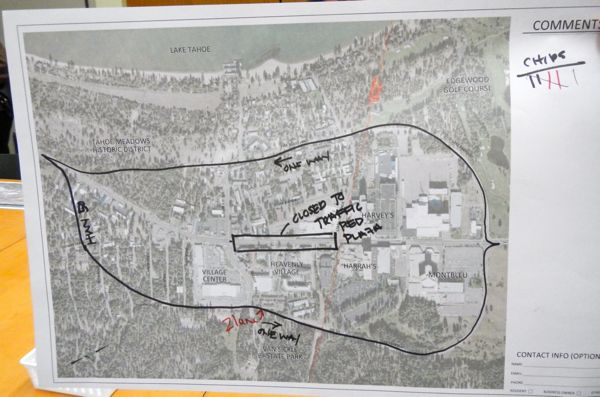
With pens in hand, people started drawing what they thought would be the best route for a loop road at the South Shore’s state line. At the other end of the table a container was filling up with those casting a vote for there never to be a loop road beyond what exists today.

Tuesday’s meeting at Lake Tahoe Community College was a bit of a do-it-yourself exercise instead of having people talk ad nauseam.

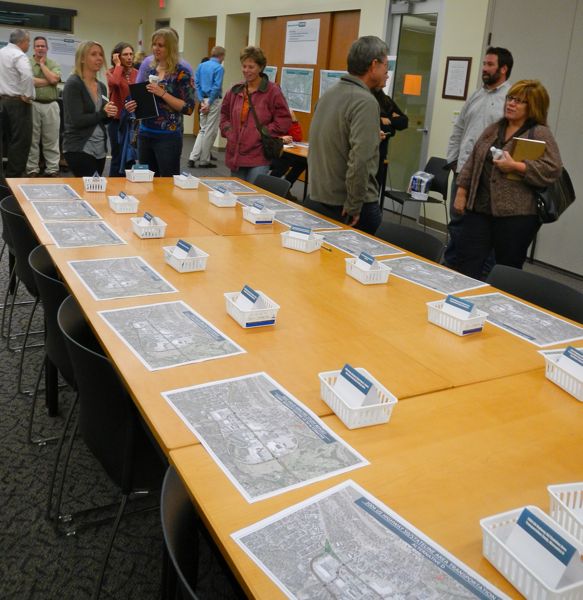
People have multiple choices for what a loop road could look like on the South Shore. Photos/Kathryn Reed

Along the walls was information detailing the history of the road that dates to the 1970s. At that time the road was to be an actual loop around the backsides of the Stateline casinos. The most recent official drawings have the road only going on the mountain side – behind Harrah’s and MontBleu.

A long table had placemat size renderings of 16 alternatives. At each one was a bucket of sorts where people could cast up to two votes for their preferred alternative(s). Those not wanting change could put their chip(s) in the 17th container.

Plenty of other people came up with suggestions that were unique or melded alternatives already on the table.

People were also asked to list their top three goals of a loop road or offer new ones. The 12 that were listed, that consultants said came from the community, were:

• Decrease traffic congestion • Improve pedestrian-bike facilities • Safer streets • Increase access to amenities • Better pedestrian amenities • Fulfill requirements of the Tahoe Regional Planning Agency Compact and area plans • Better pedestrian lighting • Have advanced forms for transportation • Encourage special events • Increase air-water quality • Improve economy • Enhance community and tourist experiences.

Some people read the list and wondered who came up with those and why people aren’t trying to achieve them even without a loop road.

Wood Rodgers is the consulting firm hired by the Tahoe Transportation District to cull all the information and run the workshops. TTD is the lead agency for the loop road.

Several people drew alternatives not already provided by planners.

While the bulk of the businesses and residents that could be displaced are in South Lake Tahoe, this project could go through even if the City Council doesn’t want it.

Proponents of a loop road want to turn the current state highway into a city street so the state line area – which includes California and Nevada – would be more pedestrian friendly. Highway 50 would be routed behind the casinos in Nevada and through existing neighborhoods and/or businesses in California.

For those who want some sort of rerouting of the highway, it’s the “where does it go in California?” that causes the most consternation. To this date, consensus has been elusive.

“We want to quantify what we’ve heard from the community,” Mark Rayback with Wood Rodgers told Lake Tahoe News.

His team will do that by coalescing the written comments, looking at which alternatives are most popular, and taking the similarities of what has been suggested to come up with what the public deems the top priorities.

A second meeting like the one Oct. 30 will be conducted Nov. 7 from 1-3pm at Embassy Suites in South Lake Tahoe. It will be the same format.

It’s possible at the Dec. 14 TTD board meeting that someone from Wood Rodgers would present a summary of findings, but with no action to be taken.

In the first quarter of 2013 a design charette is likely to occur. From there, four alternatives – though that number is not definite – could be chosen to be studied via environmental documents.


Asian clams being suffocated to protect Emerald Bay

By Kathryn Reed

Asian clams are expected to always be a reality in Lake Tahoe. But an $810,000, yearlong project is under way to keep them from taking over Emerald Bay.

With it estimated that 95 percent of the people who launch a boat at Lake Tahoe make their way to Emerald Bay, keeping that inlet as pristine as possible is not only good for the environment, but for tourism – aka the economy.

Brant Allen brings up a handful of Asian clams -- the ones he is helping get rid of at Emerald Bay. Photos/Kathryn Reed

Excretion from the clams creates algae blooms, which makes the nearshore, or beach area, unappealing to swim in, look at or paddle over. The bay has about 10 acres of nearshore.

These are not clams one eats – mostly because it would take too long to get a forkful. They are about 2 to 3 centimeters, with some 1-2 millimeters – like a grain of sand.

Another reason to eliminate the Asian clams is that they produce calcium – which Lake Tahoe doesn’t naturally have much of. And calcium is needed for quagga mussels to survive and thrive. To date, that aquatic invasive specie has not turned up in Tahoe. It is the critter that has devastated Lake Mead in Southern Nevada.

Allison Gamble with the Tahoe Environmental Research Center said it will be impossible to ever eradicate the clams from Lake Tahoe, but controlling them and eliminating them from key locations are the goals.

The earliest recording of this invasive clam at Tahoe was 2002, but it took six years for them to be a problem. A year later, 2009, was when the Aquatic Invasive Species Program rolled out. This included boat inspections, which look for Asian clams. Most likely the clams arrived via a boat’s bilge.

While scientists know the Asian clams are in Donner Lake, they were surprised when told by a photographer with the Reno Gazette-Journal that she found some in the Truckee River. There is no monitoring program on the river.

Clam control

On Oct. 25 a team of divers began covering 5 acres at the mouth of Emerald Bay with a biomass material made of shredded aspen that is then covered with a rubber mat. The purpose is to smoother the clams. This is all being done in about 15-feet of water, with 25 feet being about the deepest.

Looking over a boat it’s easy to see the black covering the sand. Crews should be done placing the mats by the end of November. During this time boats may still access Emerald Bay, but there could be a bit of a delay if divers are in the water.

Brant Allen with UC Davis is one of those divers. On Tuesday he described it as an “exhausting day of work.” The mats that are rolled out by two divers weigh 300 pounds on land and not much less under water.

It takes about 30 minutes to unroll each mat. Two hundred thirty-eight mats need to be placed on the lake bottom. The project also includes 25 tons of rebar that cover 10 miles, and 17,000 rivets.

The goal is to suffocate the clams by extinguishing their oxygen supply. Scientists have access points to check the site on what will likely be a monthly basis until all of the material is removed a year from now.

They live just under the sand. When shells are visible, it means the clam is dead.

Other points of interest

Steve Chilton with the U.S. Fish and Wildlife Service said, “AIS is the largest threat to the ecosystem.”

Most of the clams are on the south end of the lake. Emerald Bay is the farthest point north and west they have been found.

“The economic impact of Emerald Bay to Lake Tahoe and the region cannot be overstated,” Dan Shaw, environmental scientist with California State Parks said. The bay is state parks land.

About 1,000 boats a day come into the bay on peak summer days. Shaw told Lake Tahoe News a camera was set up this summer to record the speed of boats, but because so many come through the mouth it was impossible to gather that data.

To pay for the project, California Water Board allocated $458,220 and $352,000 came from the Southern Nevada Public Lands Management Act. The latter source of funding will be exhausted in 2014, so where money will come from for future projects is an unknown.

ngg_shortcode_1_placeholder (Click on photos to enlarge.)


South Tahoe tightens controls on contract agreements

By Kathryn Reed

A botched lease has South Lake Tahoe doing business differently.

“We have so many ad hoc policies that we want to wrap all the contracts under one policy and then each can have nuances,” City Manager Nancy Kerry explained.

While the changes occur at staff level, the protocols will be brought to the City Council in November or December so the five are aware of what is going on – or at least what is supposed to happen. Assistant City Attorney Nira Feeley is tasked with coordinating how the new contracts will read and be handled by the city.

“It’s so this will never happen again,” Kerry told Lake Tahoe News.

The “this” is the original contract the city had with Unity at the Lake. It has nothing to do with the lessee, but everything to do with the contract.

All this came to light in July when the council found out a five-year contract had been entered into with Unity to rent a city owned building at 1195 Rufus Allen Blvd. This was the first the electeds had heard of it.  Shortly thereafter, Stan Sherer, director of Community Development, was no longer employed with the city.

The agreement had to come back to the councilmembers this fall because in July they agreed to have Unity pay $1,700 month in rent, with the understanding this had been taking place since October 2011. But the reality is Unity and Sherer had a verbal agreement that Unity would make upgrades to the facility in exchange for rent. Unity thought rent payments would begin June 1.

Receipts and the work itself proved Unity had done substantial upgrades to this building where a preschool used to operate. And while it’s not unusual for tenant improvements to be used as a form of rent, it should be in writing and higher-ups should be informed.

In the future, contracts like this will require the signature of someone above the pay grade of department head.

South Tahoe has a handful of contractual-type agreements – such as concessionaire, facilities rental, professional services, and public works. A template will be used so all the basic criteria are covered in each contract, with additions made as needed.

“Nobody should write their own agreements. It should all go to the City Attorneys Office. And now it will,” Kerry said.

Going forward each contract will have a checklist with it that will stay with the file. It is a type of checks-and-balances that is designed to streamline the process, protect the city and ensure everything is done above board. It will also include whether the contract needs to go to council.

“This is so five years from now someone will know why the agreement was signed,” Kerry said.

Another problem with the Unity agreement is that utilities were being paid by the city. It should have been just like the ice rink agreement – the lessee pays the utilities. The city and Unity compromised, with the church group paying utilities beginning January 2014.

The sign is another issue. It doesn’t meet city code. Work is still being done to make it conform. But the city could be on hook because Sherer approved the sign without a permit and had city staff install it.


A howling good time at canine Halloween party

By Kathryn Reed

Kiss, sit, dance, do a trick, eat fast – oh, and look really cute.

Halloween games aren’t just for kids. They aren’t even just for humans. Dogs got into the act Saturday during the second annual Howl’ween Party at Tahoe Best Friends in South Lake Tahoe.

Owner Paige Rice loves Halloween almost more than she loves dogs. And she isn’t the only one.

Susan and Ernie compete in the Oct. 27 dancing competition at Tahoe Best Friends. Photos/Kathryn Reed

More than two dozen four-legged critters showed up at Oct. 27 party. And most were in costume.

According to the National Retail Federation, pet owners will spend more than $370 million this year on costumes for their dog or cat. Considering this is an increase of about $40 million from 2011, people clearly have money for their animals. And this compares to the $80 million people spend on candy and decorations for Halloween.

Chelsea found a hot dog out fit for Shiloh in San Francisco. This seemed appropriate for the wiener dog.

And the Dachshund had lots of kisses to give her owner – enough to tie for first in the licking contest. Tony and his “Angora Brindle” Ollie were the other winners at Tahoe Best Friends. The contest was to see whose dog gave their owner the most kisses. A few people took Rice’s advice and rubbed bits of hotdogs on their face to entice their dog.

The afternoon started with a form of dog musical chairs. As soon as the music stopped dogs had to sit. Not only that, they had to stay. Each round one dog would have to step aside. The last dog sitting – AJ – came away with a coupon to make her stay at Tahoe Best Friends a little cheaper next time. (AJ, who was dressed as a San Francisco Giants fan, is this reporter’s dog.)

But when it comes to tricks, sitting is ordinary. Just say “touch it” and Hailey, a 1-year-old pocket beagle, will do that. Pixie the Chihuahua jumps and jumps like a yo-yo. And with her costume, that is just what she looks like – a yo-yo. The two won the trick contest.

Many of the dogs enjoying the fun aren’t even regulars at Tahoe Best Friends, but instead have owners who love to have a good time. TBF is a doggie day-care center that offers “dog sitting” by the day or overnight. And a human is always on site.

People definitely are making their pets a member of the family. According to the U.S. Census Bureau, families spend an average of $58 per month on their pets. That is an increase of 99 percent since 1999. All together, $50 billion is what Americans are expected to spend on their pets (not just dogs) this year – from grooming, boarding, pet hotels, pet-sitting and day care — according to American Pets Products Association.

While the afternoon was all about Halloween fun for four-legged family members, Oct. 31 can be stressful for them. That is why the American Society for the Prevention of Cruelty to Animals offers these tips:

• Limit treats to trick-or-treaters. Chocolate — especially dark or baking chocolate — can be dangerous for dogs and cats. Candies containing the artificial sweetener xylitol can also cause problems.

• Pumpkins and decorative corn are considered to be relatively nontoxic, but they can produce an upset stomach in pets.

• Wires and cords from electric lights and other decorations should be kept out of reach of pets.

• Use battery powered lights instead of candles. Pets can easily knock a candle or candlelit pumpkin over and cause a fire.

• Don’t put your dog or cat in a costume unless you know he or she loves it. For pets who don’t like them, wearing a costume might cause undue stress.

• If you do dress up your pet, make sure the costume isn’t annoying or unsafe.

• All but the most social dogs and cats should be kept in a separate, quiet room away from the front door during peak trick-or-treating hours. Too many strangers can be scary and stressful for pets.

• When opening the door for trick-or-treaters, take care that your cat or dog doesn’t dart outside.

ngg_shortcode_2_placeholder (Click on photos to enlarge.)


3 waterfalls tumble through scenic river canyon

By Kathryn Reed

MCCLOUD – It’s October in a dry water year and we’re in search of waterfalls.

Wow!

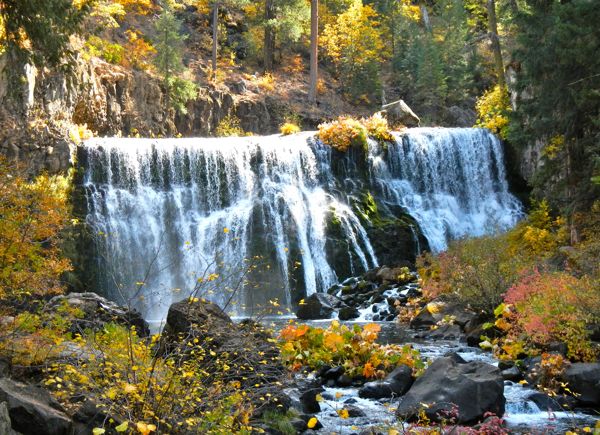
The amount of water descending last weekend from the three falls along the McCloud River was thundering. I can’t even imagine what they would be like in the spring – especially in a normal snow-rain year.

The McCloud River offers three distinct waterfalls. This is Middle Falls. Photos/Kathryn Reed

According to the U.S. Forest Service, “The Upper McCloud River is spring-fed, not dammed, and flows steadily all year through a basalt canyon lined with forest of Douglas-fir, white fir, Pacific yew, ponderosa pine and incense-cedar.”

If it weren’t for the abundance of fall colors, just looking at and listening to the water it would have seemed like this were a different season. Each waterfall is spectacular in itself.

For a 3.8-mile round-trip hike, this is one of the best for scenery in such a short distance. Where else are three waterfalls in such close proximity?

Black oak, vine maple and Pacific dogwood brighten the forest with their yellow, pink and orange. While the color is not as vibrant as Tahoe has been this fall, the variety of foliage was a welcome change.

Sometimes the trail is like walking through a dense forest, while other times there’s an airiness with blue sky as the canopy.

Lava rock is in abundance.

This is a rather easy hike in the Shasta-Trinity National Forest that ascends 300 feet to a maximum elevation of 3,600 feet.

Heading back we get a glimpse of Mount Shasta.

Plenty of fly fishermen (and women) are casting lines in hopes of snagging a trout. Most are releasing their catches. It’s such a popular fishing hole that two vehicles from an Oregon outfitter are in the parking lot.

With temps routinely hitting the 90s in the summer, the swimming holes welcome those who want to cool off. People are also known to use the cliffs as an entry point into the river.

Even though overnight temps were freezing and this area got snow when Tahoe did last week, some of the campground spots were taken by RVs and tents.

The Forest Service acquired this land in 1932 from the McCloud River Lumber Company. Originally, it was the seasonal home of the Wintu Indians. The campground gets its name from T.B. Fowler who homesteaded in the late 1800s. He eventually built a hotel along the river that burned to the ground in the early 1900s.

Getting there:

McCloud is about an hour north of Redding.

From South Lake Tahoe, get onto Interstate 5. Then go toward McCloud on Highway 89 for 15 miles. Turn right at the Fowlers Campground sign. Park in the day parking and start walking.

It’s also possible to drive to each of the falls and walk just a short ways.

ngg_shortcode_3_placeholder (Click on photos to enlarge.)


Apple Hill growers not complaining about economy

By Kathryn Reed

CAMINO – People want their apples and they are willing to drive for them.

Parking lots were full Friday in Apple Hill and apple treats of all kinds were being consumed.

Granted, many of the license plates were from Nevada on Oct. 26 because a slew of workers had the day off in celebration of Nevada Day.

“Our Nevada customers are very loyal. They appreciate fresh produce,” Christa Campbell with Rainbow Orchards said.

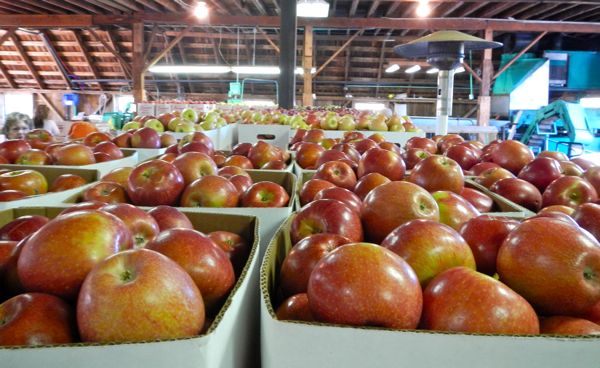
Apple Hill orchards offer numerous varietals at their farms. Photos/Kathryn Reed

Still, those in the apple business say the economy has not hurt them except in terms of growth being slower.

“I keep expecting the economy to affect us, but business keeps getting better,” Denver Dale Martin of Denver Dan’s told Lake Tahoe News. “People want fresh produce and you can’t get any fresher than picking it off the tree.”

Campbell said, “In the last couple years we’ve noticed a lot of people from Tahoe.”

In part, she attributes this to Rainbow Orchards participating in the Sample the Sierra food and wine event, which is now on Labor Day weekend in South Lake Tahoe. One year she sent blueberries to a chef and another year blackberries. She thinks it was 60 pounds of her Triple Crown blackberries that were turned into a dessert.

“People know we’re here because of Sample the Sierra,” Campbell said.

She added that gas prices have not slowed the stream of cars into the area.

It’s Mother Nature who makes or breaks a season.

The storm that brought snow to Tahoe this week dropped rain on the West Slope. This time of year all the wet stuff does is wash away the dust. It also slows the harvest because tractors tend to sink in the mud.

Campbell said the goal is to have the harvest wound up by the first hard freeze; otherwise the fruit won’t be any good.

Apple varieties ripen at different times. Pink Ladies were just being brought into the selling area Friday afternoon. Campbell said this has become a favorite of consumers because they are a little sweet and a little tart, anything can be done with them, and they can last until June if refrigerated.

Cold weather is good for apples – it helps with the color, according to Scott Larsen, who is one of several family members working at Larsen Apples.

People are all over his property – some in the warehouse trying to figure out which of the nearly 20 types of apples to buy, others are enjoying lunch.

For the previous two years, Larsen only capitalized on about 10 to 20 percent of the crop because of the weather. A cold snap in the spring struck his Pippins and Pink Ladies. Still, this year’s harvest is substantially better than the last two falls, with 60 to 70 percent of the apples making it to market.

One thing he said that is hard to keep up with is when the consumer catches wind of a varietal and it becomes the trendy thing to have. It’s not like trees can be planted and immediately they produce the latest fad.

Martin of Denver Dan’s says the same thing. The 80-year-old has been in the apple business for 50 years. While he likes to grow traditional apples (Macintosh, Jonathan, Goldens) on his farm where the customer does the picking, he said this year it’s Honey Crisp people are looking for, while last year it was Pink Ladies.

It’s Golden Delicious that does the best at Larsen and Grandpa’s Cellar because they are good for eating, good for cooking and have a bit of a shelf life.

The aroma wafting from Grandpa’s Cellar is overwhelming — in a good way. All things apple are being baked – and all from scratch.

Pat Scheuner opens the freezers – pies, struddles, turnovers, dumplings – are stacked high. These delicacies, more so than bushels of apples, are what keep the cash registers ringing. People come with coolers to haul the goods away to be baked at a later date.

“Our business is up this year,” Scheuner shared with Lake Tahoe News.

She said one thing that is rare is this growing region adheres to strict quality assurances. Folks from the Apple Hill Agriculture Commission test for sugar and juiciness of the apples. No apples are picked until they are ripe.

“You won’t get an apple that doesn’t have flavor and juice,” Scheuner said. “We have standards. That is pretty unique.”

—–

Notes:

• Each orchard has different hours of operation. Many are open through Thanksgiving weekend, and then weekends only until the end of the year.

Apple Hill Growers Association website has more information.

• Not all orchards have the same types of apples, some sell food already made, some sell food to take with you.

• Some orchards let you to pick the apples, while most have picked them.

• Many places have other items for sale – like pears, pumpkins and apple cider.

ngg_shortcode_4_placeholder (Click on photos to enlarge.)


Tahoe Conservancy ready to restore Upper Truckee Marsh

By Kathryn Reed

While the Tahoe Keys subdivision will remain as is, the sensitive wetlands surrounding it could expand, sand dunes may return, the sailing lagoon that abuts the Cove East walking trail may be filled in and that trail rerouted, and the mouth of the Upper Truckee altered.

These are some of the proposals in the draft environmental documents that will be released by the end of the year for the Upper Truckee Marsh.

Four alternatives are being studied. The California Tahoe Conservancy owns this swath of land that borders the Tahoe Keys and Al Tahoe neighborhoods in South Lake Tahoe and goes from Highway 50 to Lake Tahoe. No preferred alternative has been selected, so all four will receive equal analysis.

It's possible this lagoon at the Tahoe Keys will be filled in. Photo/LTN file

“The purpose of the project is restoration, but we know it is well accessed so we had to do some level of public access,” explained Scott Carroll, project manager. “We just put different features in different alternatives so we could evaluate the impacts – from water quality to impacts on biological resources to parking – the array. In the end, when we develop a preferred alternative, what we do to the site will be guided by what access works in that type of setting.”

One option includes building a platform that would allow cyclists and walkers to get from one side of the meadow to the other. Other things being considered to make the area more people friendly include a fishing platform, signs and kiosks.

Most of the proposed changes are for the Cove East side of the marsh. It’s possible the mouth of the Upper Truckee River could be rebuilt or reduced. In the 1960s it was dredged and was the original access to the Keys.

The Conservancy acquired the 22 acres in a settlement agreement stemming from the Keys development. In 2002, a $10.5 million restoration project was completed that brought back the wetlands that run between the walking path at the end of Venice Drive and the river.

Three of the alternatives would fill in the sailing lagoon, which is to the left of the trail when walking toward the lake. Then the trail would head in that direction where boats come into the marina instead of along the river.

Restoring the Upper Truckee River is a large component of this project.

“We want to restore the historic and natural hydrology of the system as much as we can within the constraints we have,” Carroll told Lake Tahoe News. “(The) express purpose (is) enhancing the ecosystem of the area – from habitat for aquatic species and terrestrial, and species utilizing the riparian zone. We are trying to create a sustainable linked system.”

The other goal is improving the water quality that enters Lake Tahoe.

Three individuals own some of the land where the Conservancy would like to do work – Marjorie Springmeyer, Knox Johnson and Royce Dunlap. All have been approached, but no agreements are in place.

For the most part, little is proposed for Trout Creek, which runs through what was known as the Barton Meadow. Those 311 acres were purchased about 11 years ago for $10 million and is now referred to as the Upper Truckee Marsh. It is considered one of the most sensitive areas in the basin.

The bank of the creek near the highway is proposed to be fortified in each of the alternatives.

What this project will cost is unknown. And when it would begin is also undetermined. CTC employees expect a number of comments will be received during the 60-day comment period. The plan is for the Tahoe Regional Planning Agency’s Advisory Planning Commission and Governing Board to discuss the project in January. The final environmental impact report and environmental impact statement could take a year to prepare.

When the project begins, it’s possible it will be done in multiple phases depending on funding sources.