Buses free on popular South Lake Tahoe routes

By Kathryn Reed

Offer a free bus ride and people will jump on board.

That is what BlueGo officials discovered in September when two routes through South Lake Tahoe were free for five days. Ridership jumped 60 percent, according to Curtis Garner, who runs the transit system.

What isn’t known is if the riders were locals or out-of-towners.

BlueGo buses will be free on two routes Dec. 22-Jan.6 Photo/LTN file

“The long-term goal of the program is to get people to use public transportation a few times, discover how convenient it is, educate them about the benefits of public transit, whether it’s economic or environment, and increase ridership for the long run,” Garner told Lake Tahoe News.

Starting Saturday, routes 50 and 53 will be free. Part of the reason for picking the Dec. 22-Jan. 6 time period is because this is when a huge influx of vehicles will be in town for the holidays. The goal is to get visitors out of their cars and onto the bus.

These are essentially what metropolitan areas call spare the air days.

“We hope to have a decent impact on congestion this year,” Garner said.

Route 50 goes from the transit center at the Y to the transit center at Heavenly Village – all on Highway 50. Route 53 is from the Y, through Bijou, along Pioneer Trail and ends at the transit center on Kingsbury Grade.

Garner said those two routes transport approximately 70 percent of the riders who use the bus system.

Normally it costs $2 one-way on either of these routes.

BlueGo will be reimbursed through Congestion Mitigation and Air Quality funds. The Tahoe Transportation District, which oversees BlueGo, is eligible for the state funds because Lake Tahoe’s air is substandard.

“CARB, or the California Air Resource Board, determined many years ago that our carbon monoxide levels were too high. Steps have been taken to bring the area into compliance, but as of this time CARB has not changed our designation,” Garner explained.

Lake Tahoe is what’s a called a “non-containment area” because the air is “worse than national air quality ambient standards,” Garner went on to say.

Future of free buses

Mayor Tom Davis has long been vocal about wanting to develop a free bus service in town like other resort areas have. He is hoping the data collected from these free trial periods will help his cause.

The South Shore bus service has a budget of $4.5 million. Of that, $700,000 comes from the fare box.

Carl Hasty, executive director of Tahoe Transportation District, told the City Council this month, “In order to continue the service we have today and to make it free all the time it’s that $700,000 from the fare box (that needs to be funded). It would need to be more if you want to increase service.”

Councilwoman JoAnn Conner brought up the fact that there is no service to Meyers.

While ridership is increasing throughout the system, buses are not full. That is one reason the free rides can also be offered – there is room for people without adding buses.

In September, ridership increased by 8 percent compared to September 2011, and it was up 6.7 percent in October compared to October 2011.

——

Notes:

• Schedule and bus stop information is online, as well as at the transit centers and on buses.

• Free rides are Dec. 22-Jan. 6; only on routes 50 and 53 of BlueGo on the South Shore.


SHES secretary takes her name off attendance roll

By Kathryn Reed

Oftentimes the first person anyone sees on a school campus is the person who knows the most, has all the answers and can be guaranteed to have a smile no matter the chaos going on all around her.

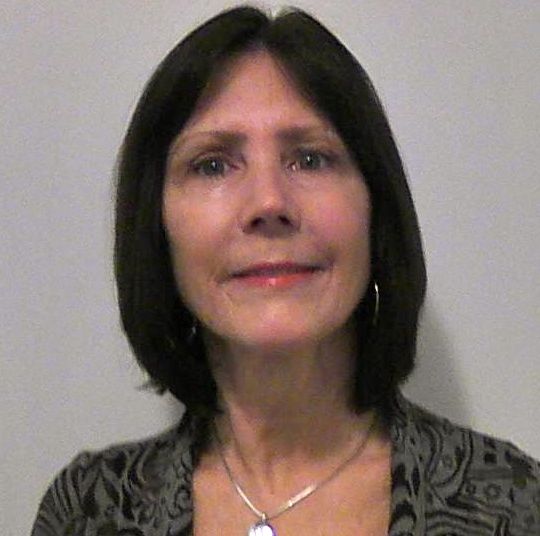
That is the case with Cindy Farmer.

As secretary at Sierra House Elementary School, she is the keeper of all the information. She knows students by name. She has helped create a home away from home.

But when students return in January from the winter break they will have to learn a new name. Farmer is one of 17 classified employees in Lake Tahoe Unified School District who will retire as of Dec. 31. Friday is their last day of school.

Cindy Farmer

“When I first started I woke up every morning and couldn’t wait to get to work. And I still love coming every day,” Farmer said. “I will miss it. It will be very emotional for me when I leave.”

But at 62 she knows it is time to call it quits, spend more time with her biological family, and enjoy all the reasons she and her husband, Jim, call Lake Tahoe home.

Farmer will have more time to tend to her immaculate yard and garden, as well as hike some more.

During her time at the South Lake Tahoe school she has worked for four principals – three men and one woman.

“You have to get a feel for their personality. One was very organized, one messy, one brand new. They were all different,” Farmer said of her bosses. “You have a different relationship with each one. Some you can tease with more, some are more serious. They have all been so good to me.”

Ryan Galles is one she laughs with nearly every day.

“She makes the job look easy and it is not an easy job,” Principal Galles told Lake Tahoe News. “She never puts anybody off when they have something that needs taking care of.”

With her last day being Dec. 21, he joked that it would be the end of his world.

“She started out as a colleague and we ended up as incredible friends,” Galles said of Farmer, even though he is close to her kids’ ages. “We’ve had a really strong relationship. It’s so important for a secretary and principal to work closely.”

Farmer started at the school in 1984 – eight years after it opened – as a volunteer in the classroom. She did that for 13 years before becoming the school secretary.

She thought she would miss being in the classroom with kids, but then realized as school secretary she gets to see the entire student body.

Paige Cefalu met Farmer about 20 years ago. Cefalu taught at the school and Farmer was her aid.

“I made her promise me she would not leave before my kids left,” Cefalu said. By that time Farmer was working in the front office.

“I subbed for her for one week. It was the hardest job … between being secretary, the nurse, dealing with teachers, the principal, phone calls,” Cefalu said. “She definitely does not get paid enough and she does it with a smile on her face.”

Collectively, the retiring employees have given LTUSD 411 years of service. Retirees are:

• Ken Gerrard, LTESMS, senior custodian, 15 years

• Birgit Lukins, STHS, senior attendance assistant, 21 years

• Steve Dorman, maintenance, craftsworker, electrician, 18 years

• Cathy Crabtree, STMS, cafeteria, 25 years

• Sandra Bobman, Tahoe Valley, library assistant, 35 years

• Andy Balwing, STHS, custodian, 35 years

• Jerry Buckley, bus driver, 18 years

• Sandy Hood, Sierra House, instructional assistant, 26 years

• Hillary Dembroff, occupational therapist, 15 years

• Cheryl Walters, STMS, instructional assistant, 33 years

• Holly Weber, Sierra House, cafeteria supervisor, 28 years

• Romeo Alaoen, STHS, custodial supervisor, 36 years

• Wayne Blaylock, STHS, custodian, 26 years

• Pam Giordano, STHS, cafeteria assistant, 22 years

• Kathy Humphreys, EC, administrative assistant, 20 years

• Jerry Lufrano, Al Tahoe/EC, custodian, 26 years.


LTWC submits expansion plans to TRPA for wild animal rehabilitation facility in Meyers area

By Kathryn Reed

Before Lake Tahoe Wildlife Care backers begin an all-out fund-raising campaign to get the dollars together to buy a 16-acre parcel in Meyers and transform it into a state-of-the-art rehabilitation-education center, they want to make sure TRPA is OK with their plans.

This is why even though LTWC doesn’t own the property, plans were submitted last week and assigned to a planner on Monday who will review the documents.

The Tahoe Regional Planning Agency has 30 days from Dec. 10 – the date the plans were submitted – to determine if all the documents are in order. Then it could be 120 days before a decision is made.

LTWC is still in need of whole fish to keep feeding the raptors and bears it is caring for. Photo/Provided

However, Kristi Boosman, spokeswoman for the bi-state regulatory agency, said a hearing officer is expected to make a ruling in February. LTWC would need a special use permit for a public services facility. The use is allowed under either Regional Plan.

Boosman added that TRPA supports what LTWC wants to do.

“We are looking at a three-phase project. The first would be to move the rehab center from the current site to the new location,” Tom Millham told Lake Tahoe News.

Millham and his wife, Cheryl, have been running LTWC for more than 30 years. One of the main problems is they have been doing so in their back yard on three-quarters of an acre.

They are limited in the numbers of animals and types they can take in. LTWC has 10 bear cubs – the most in its history. Capacity meant the state Department of Fish & Game had to find another facility for two cubs that were injured and in need of help.

The three bear cages LTWC uses are all approved by the state.

In all, the center has nine cages. It’s anticipated that would increase to 14 at the new location. Plus, they would be larger.

The Millhams have devised a makeshift area for waterfowl. That’s something that would change at the larger location – having a dedicated site for those birds.

Plus, the plan is to have three areas for raptors. This would eliminate the need to seasonally take the netting up and down.

Right now LTWC volunteers are nursing a bald eagle and peregrine falcon. Both should be released back into the wild.

If TRPA approves the plans, then Lake Tahoe Wildlife Care supporters will begin in earnest raising the $10 million to $12 million that is needed to acquire the property and transform it into the animal rehab-education center.

What the education center – the second phase – would look like is also in the plans. The downstairs would be a teaching room, amphitheater, café and shop, while upstairs would be offices.

A large vacation rental is on the property now. The footprint would not change – just what the inside looks like and the use.

The property also has an active TRPA permit, so what LTWC is doing is amending it a bit.

“We submitted the plans with elevations, where cages would be placed on the property, all the water and electrical,” Millham said.

The third phase of the new facility would be to create a park for non-releasable animals. Only native animals to the Sierra would be housed there.


Bankruptcy judge removes El Dorado County from transit case; gives credence to conspiracy

By Kathryn Reed

RENO – Even though plaintiffs wanted to draw El Dorado County back into the fray of the MV Transportation-STATA lawsuit, a bankruptcy court judge on Monday granted the county’s motion to dismiss.

Sallie Armstrong, outside counsel for the county, argued that the county’s payment of $160,000 to MV two years ago satisfied its obligation. U.S. Bankruptcy Court Judge Gregg Zive agreed.

David Thompson, the federal bankruptcy trustee appointed by Zive, had sought to bring El Dorado County back into the mix.

But the other attorneys representing a multitude of defendants are still on the hook for what could be millions of dollars if the Fairfield-based transit company prevails in its quest to have member agencies and their respective board members of the now defunct and bankrupt South Tahoe Area Transit Authority honor the contract that was in place.

Thompson is essentially representing STATA even though it doesn’t really exist. And in turn he represents another plaintiff for the gaggle of defendants to fight. But the judge has made it clear there will not be double recovery.

In 2010, MV filed a lawsuit for a number of reasons; most having to do with not being paid the nearly $3 million it claims it was owed to run the BlueGo bus system on the South Shore.

STATA, a nonprofit conglomerate of private and public entities, was the parent operation of the BlueGo system.

To be determined are what assets belonged to STATA, the value of them, where they are now, how to handle third party beneficiaries, successor liability, and whether conspiracy was involved.

Zive said his tentative ruling is that that conspiracy was plausible.

“I’m going to find out what happened even if I have to use an element of authority of this court,” Zive said. “That more than anything is of particular concern of this court. It’s almost like someone tried to fool me.”

Zive is referring to the approximately $1.6 million that was moved from STATA’s bank account to the Feldman Client Trust Account. STATA didn’t include that cash when it filed for bankruptcy.

Thompson in his September report to the court called it fraud.

The judge took great issue also with the fact that the participation agreement between the member agencies and STATA said that if it didn’t have the money to pay its bills, it must reduce service. The STATA board never reduced service, racked up bills and ended up bankrupt. But the member agencies and the people who were on the board at the time could collectively be held financially responsible.

Zive read from the agreement, emphasizing the word shall.

“Shall makes it mandatory and not discretionary,” the judge said. “You either decrease service levels or pay more.”

Zive said he didn’t understand why the STATA board didn’t reduce service when MV officials were calling for that.

He went on say STATA would have been better off had it followed its own rules and hired an executive director instead of allowing a Tahoe Regional Planning Agency employee to run things.

Joan Wright, representing Ridge Tahoe, said because her client wasn’t part of STATA when it was created in 1998, it should not be held liable. Zive wasn’t buying that line of thinking because Ridge Tahoe had a member on the board, benefited from the contract and was a member when MV was hired.

Lou Bubala, the outside attorney representing South Lake Tahoe, tried to make a case that California law precludes the city from being held liable under the Government Claims Act. That theory has not been ruled upon.

Bubala also tried to convince the judge there was never a contract between the city and STATA because the mayor at the time, Hal Cole, didn’t sign a contract.

“If the city reaps the benefit of a coordinated transit and made payments, how can it disavow its responsibility?” the judge asked. He said maybe with MV the city could weasel out of its obligation, but not to STATA.

As of the end of August, South Lake Tahoe had paid Bubala more than $75,000. City Attorney Patrick Enright did not respond to Lake Tahoe News’ request asking for the current dollar amount.

Douglas County has spent approximately $47,000 on legal costs related to the STATA litigation, according to County Manager Steve Mokrohisky.

“The county has a $50,000 deductible for legal costs, so insurance will cover any legal costs over $50,000,” Mokrohisky told Lake Tahoe News.

With the next court date set for Jan. 17, all entities will continue to rack up attorney costs. MV and the court trustee have indicated they will both be going after defendants to recover their legal fees.


CTC looking at how best to manage its lands

By Kathryn Reed

In a meeting that was more about reports than decision-making, the California Tahoe Conservancy board was updated last week about the Upper Truckee Marsh, lands the state agency owns and what the adoption of the Tahoe Regional Planning Agency’s Regional Plan means.

While the environmental documents for the Upper Truckee Marsh may be released at the end of next month, a comprehensive workshop about restoration along the Upper Truckee River is not slated until April or May.

Penny Stewart with the California Tahoe Conservancy told the board at the Dec. 14 meeting the idea is to bring experts from various disciplines together to talk about restoring the river – what has happened, what is in the works and what is planned. River restoration is part of the marsh project.

Nancy Gibson, U.S. Forest Service chief in the Lake Tahoe Basin and a non-voting member of the CTC board, said she supports the education component of such a meeting to explain the why here and why now questions. However, she said funding is in place for the reach of the river the Forest Service is responsible for and would hate to have that money threatened as the CTC takes this new global approach.

The Upper Truckee Marsh, which borders the Tahoe Keys, is an area the California Tahoe Conservancy wants to restore. Photo/AECOM

“I’m cautious about undermining decisions that have already been made,” Gibson said.

Lynne Paulson, who is concerned with what is going on at Washoe Meadows State Park and Lake Valley Recreation Area, said the panel discussion should happen sooner. The river runs through those parcels.

Les Wright, a member of South Lake Tahoe Recreation Commission, advocated for including a boardwalk across the meadow from the Al Tahoe neighborhood to the Tahoe Keys area.

Asset lands

Property that has some financial value to the CTC comes under the category of asset lands. They could potentially be sold and developed.

The 332 parcels that have been identified as such amount to 223.56 acres. Patrick Wright, CTC executive director, said it is not the intent to start unloading them all.

Bruce Eisner with the CTC said about 20 of those would likely be put on the market in the next five years. He said those are mostly in the commercial core areas. This would mean filling in open space in high traffic areas and getting rid of parcels that don’t fit the Conservancy’s goals.

Nine of the parcels are in Meyers near highways 89 and 50.

“These were acquired as a possible multi-agency visitors center,” Eisner explained. He said as Meyers moves forward with its area plan that these parcels might be of interest to planners, especially since the agencies have abandoned the idea of such a center.

The Conservancy’s current policy to sell land requires requests for proposals be sent out in a competitive bid process instead of the conventional route of using a real estate agent. Eisner suggested looking at revising that policy in order to offer flexibility.

Regional Plan impacts

With passage of the Tahoe Regional Planning Agency Regional Plan it means changes to land coverage issues involving the CTC and other marketable rights.

The ability to use excess coverage mitigation fees across hydrologic area boundaries is seen as a positive by the CTC.

The CTC hopes the incentives to transfer residential development rights from sensitive land to town centers will jump-start the agency’s ability to purchase developed land, like old motels, that were built in stream environmental zones.

Another change with the Regional Plan is that Van Sickle Bi-State Park, a CTC and Nevada State Parks project on the South Shore, is now designated recreation instead of conservation.

The CTC will also benefit from how bike and walking trails are exempt when it comes to coverage issues.

In other action:

• Wright said it’s likely Sen. Dianne Feinstein, D-Calif., will reintroduce the Lake Tahoe Restoration Act. This would mean money for various Tahoe groups for projects under the environmental improvement program that was established after then-President Bill Clinton came to Tahoe in 1997.


Scientists worry about long-term effects of changing levels of algae, oxygen in Lake Tahoe

By Kathryn Reed

INCLINE VILLAGE – In the last four years the amount of algae found in Lake Tahoe has dramatically increased.

Why?

Scientists are still trying to figure that out.

Cells that are 5, 6, 7 microns in size that were not detected a decade ago are here.

“For some reason they have exploded,” Geoff Schladow, director of the Tahoe Environmental Research Center on the Sierra Nevada College campus, said during the Dec. 13 State of the Lake report.

Asian clams in Lake Tahoe create algae blooms as seen in the top right of this photo. Photo/LTN

The data pertains to 2011. These reports began in 2007, though issues surrounding Lake Tahoe’s clarity have been studied since the 1800s.

Algae blooms are also related to the growing Asian clam population. While these creatures have not been found throughout the lake, pockets of them are on the southern end. The algae they produce washes ashore and contributes to the degradation of the beach experience because the pristine waters are anything but that in some areas.

Divers the first week of December finished laying 5 acres of organic material at the mouth of Emerald Bay in an attempt to smother the clams at that location.

One thing scientists are still trying to figure out is why lake clarity improved by 4½ feet in 2011 when it was one of the wettest winters on record. Normally wet years bring more sediment via runoff into the lake. Conversely, it’s drought years that are usually good for lake clarity because fine particles are staying on land.

Climate change is something those who study Tahoe know is taking a toll. Each year the flow of stormwater runoff is measured.

“The peak has advanced two weeks,” Schladow told the group of nearly 60 people. This means there is less snow in the mountains.

Records of air temperature also point to climate change, Schladow said.

Another measurement scientists look at is how often the lake mixes – as in the water at the bottom comes to the top and vice versa.

“As we go through the next century we will run out of oxygen at the bottom of the lake,” Schladow said. “Less oxygen at the bottom changes the chemistry at the bottom. ”

This could lead to more phosphorous and nitrogen being created. Those elements contribute to the decline of the lake’s clarity.

A cable is used to measure oxygen at the surface down to the bottom. Water temperature is measured, too.

“We are seeing how mixing changes oxygen (levels). Oxygen is the key variable for climate change,” Schladow said.

He is a believer that the lake needs to continue to be studied and monitored.

“If you don’t measure it, you can’t manage it,” Schladow said in regards to needing to make sure the funding is in place to study the lake and then take the corrective measures to ensure its health.


South Shore loop road down to 6 alternatives

By Kathryn Reed

STATELINE – While a decision has yet to be made as to whether a loop road beyond what exists today in the Stateline area should or will ever be built, the choices are being narrowed.

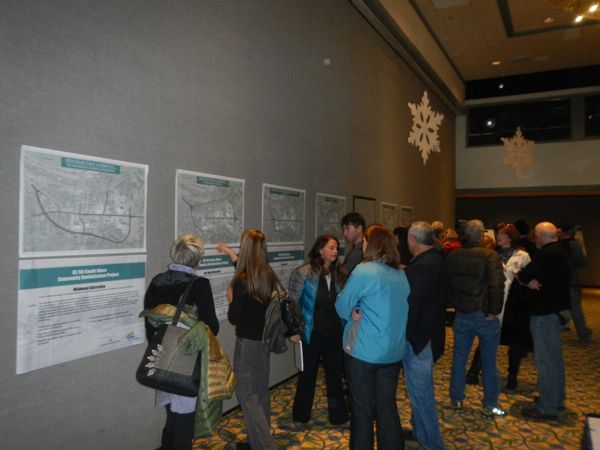
At a Dec. 13 meeting at Harveys there were six choices presented. This is down from the 16 that were talked about at the last two meetings. While people had the chance to write down their thoughts, no longer were they offered the chance to draw their own version.

Deanna Shoopman with Caltrans told Lake Tahoe News it is not unheard of in California to take a city street and make it a state highway and for the state highway to become a city street.

People study the various loop road alternatives on Dec. 13 at Harveys. Photo/LTN

That is essentially what proponents of the project want to do. While not everyone is convinced rerouting Highway 50 behind two or four of the casinos is necessary, the bigger arguments are about where the rerouting would start on the west side and whether it should be a half loop or full loop.

“Safety to the traveling public is our No. 1 priority,” Shoopman said.

For now, this is a Tahoe Transportation District project. Shoopman said her agency would formally weigh in on the project when the environmental documents come out.

Eric Guevin, fire marshal with Tahoe Douglas Fire Protection District, was perusing the maps Thursday afternoon, too. Traffic flow is what his department is concerned about.

“Intersections that are offset have more problems. There are visual barriers,” Guevin told Lake Tahoe News. “Squared intersections tend to be safer.”

Mike McKeen, who owns property in South Lake Tahoe that could be impacted depending on the route, believed the presentation was a charade, a propaganda campaign.

He took issue with the poster board that said 92 percent of the people favor moving forward, while 8 percent want the status quo.

Carl Hasty, TTD executive director, admitted those numbers were derived from the 118 people who attended the last two loop road meetings and that some of the same people attended both meetings and therefore were counted more than once.

What also isn’t in that number are the people who would vote to do nothing if their particular alternative is not selected.

Hasty said when his board next hears about the loop road, which could be March, that the history of the project will be told. This includes the various alternatives, not just what staff believes are the most popular.

It will be up to the TTD board to select which alternatives would be studied in the environmental analysis.

In the meantime, the economic analysis is ongoing. That, too, will be part of the environmental study.

TTD reps are also going business-to-business to talk to owners about their opinions.


Lane advising group wanting to develop retail space at South Lake Tahoe convention center site

By Kathryn Reed

Six years after the first mound of dirt was moved on the then-$410 million hotel-convention center project, more may be turned over.

Bill Owens, who owns 20 of the 29 parcels on the 11-plus-acre site by Stateline, is ready to build part of the project.

The goal is in summer 2013 work will begin on developing 30,000-square-feet of retail space – exactly what was originally planned. Depending on how fast work progresses, shops could be open by the holidays a year from now.

Owens owns about two-thirds of the project site on the east end of South Lake Tahoe. City National owns the other nine parcels that constitute about one-third of the site. The latter has not come forward with any ideas for that section.

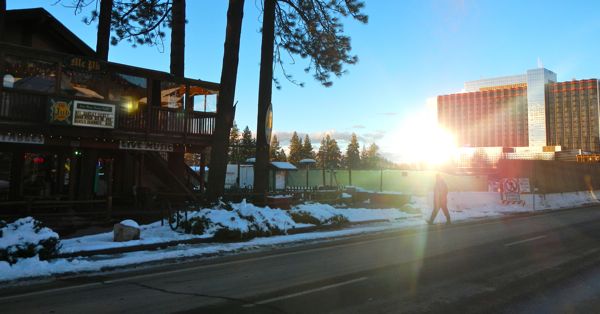
A pedestrian on Dec. 13 walks from the fenced off non-existent convention center toward McP’s Pub. Photo/Kathryn Reed

In October, the city hired a structural engineer to determine if the concrete and rebar are stable. The report said there would be no problem building on top of what was laid years ago.

The City Council at its Dec. 11 meeting briefly discussed the resurrection of the project.

City Manager Nancy Kerry at the meeting said a performance bond and parcel consolidation map would be in place before construction crews return to the idle site.

Not having those helped contribute to the mess that has ensued. While Councilman Hal Cole now wants that bond, he at one time told this reporter there is no such thing as a performance bond.

Nonetheless, the council agreed to put Cole and Mayor Tom Davis on the ad hoc committee that will be working with the developer. Cole with then-Councilman John Upton were the only two electeds to have read the market report that did not favor a convention center, but told their peers to go ahead with it.

Randy Lane, the original builder who ran the now bankrupt Lake Tahoe Development Company, is an adviser to Owens and is the person to whom the city has been talking about moving forward. Owens is the leader of Owens Financial, one of the lending agencies that ended up with property when the largest development project in South Lake Tahoe’s history folded.

Lane told Lake Tahoe News he expects to submit the necessary paperwork to South Lake Tahoe officials the first week of January.

Kerry said it could be a $10 million infusion of cash into the local economy if construction resumes.

“It could be a catalyst for economic recovery in the area,” Kerry told Lake Tahoe News. “We are excited that something is going to get going and getting rid of the blight that is pulling down economic recovery.”

Sidewalks would be put in and other streetscape aspects as were originally planned. This will help with safety issues because right now there is minimal room to walk along the fenced-off site on Highway 50.

What businesses may go in there remains to be seen.

“I’m not concerned about the leasing part of it,” Lane said.

Originally McP’s Pub, which is still open at the western edge of the site, was going to move into the new center. It was going to be three times the size it is now, with a stage, more pool tables and expanded food menu.

Pete Joseph, who owns McP’s, is out of the town and unavailable for comment.

Lane said he had not spoken with Joseph to see if he would want to keep with the original plan.

This new first phase (the originally project had two phases) would stop short of the current McP’s bar-restaurant.

Making sure the public and businesses are secure is another concern of the city’s. The proposed development would go about one-third of the way from Highway 50 to Cedar Avenue. Right now it’s covered in concrete and rebar and has a cyclone fence around it.

Parking for the retail center would need to be worked out, too. In the first set of plans underground parking was to be provided for some aspects of the project. But the council and Tahoe Regional Planning Agency officials in the permits that were issued allowed for the project to go forward without adequate parking. The developer was supposed to secure parking at Harveys, but that was never done. So, whether enough spaces would be incorporated into the project as it’s put together in a piecemeal process remains to be seen.


TRPA board approves Regional Plan update

By Kathryn Reed

STATELINE – Historic. That is what some called the near unanimous vote Wednesday by the Tahoe Regional Planning Agency Governing Board to approve the Regional Plan.

For a document that was supposed to be approved in 2007, it was long in coming. It got derailed, turned upside down and faced the threat of Nevada not being at the table.

In the end, the voluminous document earned the support of all but two California appointees.

Now all eyes are on the calendar 60 days from now. For one, that is when the Regional Plan would become the law of the land. Second, that is the deadline individuals and groups have to file a lawsuit to prevent the Regional Plan from taking effect.

The TRPA Regional Plan is the planning bible for the Lake Tahoe Basin. Photo/LTN file

While the board approved all the items voted on, not everyone in the room agreed with the decision. Of the 51 people who spoke at the daylong meeting at Harveys casino on Dec. 12, 34 were for the plan, 14 against and three were non-committal.

The first 22 people who spoke were either from the government, fire service, utility district, science community, education or health care. All were in favor.

Then it was open to the public at large.

“Today is your legacy. It is your legacy to leave,” Joanne Marchetta, executive director of TRPA, told the board before the vote.

Ultimately seven items were voted on. The Advisory Planning Commission voted on each first. For the item to be approved by the Governing Board each required four votes from California reps, and four from Nevada members.

The items were:

1. Issuance of 2011 Threshold Evaluation

2. Certification of Regional Plan Update Final Environmental Impact Statement

3. Amendment of Environmental Threshold Carrying Capacities

4. Adoption of Regional Plan Update and Code of Ordinances

5. Certification of the Mobility 2035: Regional Transportation Plan and Sustainable Communities Strategy Final Environmental Impact Statement

6. Adoption of Mobility 2035: Regional Transportation Plan and Sustainable Communities Strategy

7. Submit 208 Plan to California and Nevada Agencies for Approval and Certification.

The APC board voted unanimously to approve all the items.

Governing board member Mara Bresnick, who is the California Assembly Speaker appointee, voted no on everything.

Governing board member Byron Sher, California Senate Rules Committee appointee, voted for Nos. 1 and 7, and then abstained on the rest.

During deliberations Sher said, “If I were going to remain on the board, I would probably vote against the Regional Plan update.”

While Sher has been a vocal opponent to the Regional Plan, he was given a standing ovation by the board and those in the room for his service. This was his last meeting as he plans to resign Dec. 13 from the Governing Board.

—-

Note: Here are a TRPA RPU fact sheets that give an overview of the new Regional Plan.


South Lake Tahoe City Council agrees to raise garbage rates, install parking meters

By Kathryn Reed

Tuesday was a day of 4-1 votes. The first involved garbage rates and two were about paid parking in South Lake Tahoe.

JoAnn Conner on her first day as a member of the South Lake Tahoe City Council voted against the 1.57 percent South Tahoe Refuse hike. The increase will be effective Jan. 1.

For most residents it means the current monthly rate of $24.33 will now become $24.71.

Conner believes with the decrease in residents and people having a hard time making ends meet, that this is not the time for an increase. The other council members were not thrilled with the increase, but agreed to it.

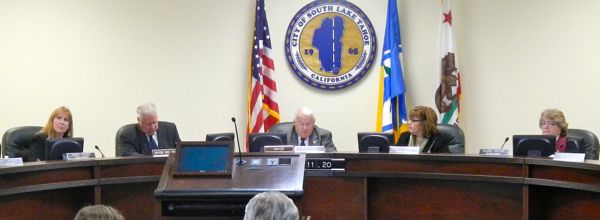
The South Lake Tahoe City Council — JoAnn Conner, Hal Cole, Tom Davis, Angela Swanson, Claire Fortier. Photo/LTN

The garbage company per the franchise agreement may ask for rate hikes every three years that have to do with all sorts of factors. But the one granted Tuesday had to do with the consumer price index. STR may ask for hikes based on the CPI in the interim years.

However, rates did just go up May 1. This was actually a delay from Jan. 1, which is the date the company had wanted for that increase. But the city, along with El Dorado and Douglas counties were in talks to get their rate adjustment times in alignment. In May, fees went up 4.48 percent in El Dorado County, and 4.97 percent in South Lake Tahoe and Douglas County.

El Dorado County supervisors have already approved the latest increase. Douglas County commissioners are set to vote on it Dec. 20.

Another money related issue on the agenda involved putting in parking meters at various locations in the city.

Parking issues in South Lake Tahoe are driving a wedge between residents and somewhat between council members.

Two votes were taken at the Dec. 11 meeting with Mayor Tom Davis casting the lone dissenting vote each time.

Ultimately the ordinance the council approved in November regarding parking meters is intact except there won’t be any meters on Ski Run Boulevard from Highway 50 to Pioneer Trail.

On Jan. 8 the council is expected to revise the ordinance to add meters on Ski Run from Pioneer Trail to Saddle Road and along Paradise Road, and to identify neighborhoods that should have permitted parking.

Sixteen people spoke at the meeting and three letters were read into the record.

The views ranged from this is the worst time to do something like this to do it now because there is never a good time. Some believe it will hurt businesses, while others said the meters could help turn over business. Others said it would just hurt locals. The counter argument was locals need to pay for the areas they use, just like tourists.

In other action:

• Davis is now mayor of South Lake Tahoe and Hal Cole is mayor pro tem.

• Conner was sworn in as a new councilmember after Bruce Grego said his goodbyes.