Incline beach access fight leads to questionable land sales

By Anjeanette Damon, Reno Gazette-Journal

Five years ago, Washoe County handed 87 parcels of land over to the Incline Village General Improvement District, forgiving more than $800,000 in unpaid property taxes on the land in exchange for a promise from Incline Village to use the land as publicly owned open space.

The lots, most of them unbuildable scraps of land, had wound up on Washoe County’s delinquent tax rolls because the owners hadn’t paid property taxes for at least three years. Under state law, those parcels can be given to another government agency if that agency will use the land for a specific public purpose.

But after telling the county the land would be used for open space, an IVGID official, without approval from the agency’s elected board or public notice, sold three parcels to private buyers, a Reno Gazette Journal investigation found.

Read the whole story


SnowGlobe to cut off Al Tahoe Blvd. to locals

By Kathryn Reed

SnowGlobe is already irritating people and the loud bass that permeates the otherwise tranquil night air of South Lake Tahoe hasn’t even started.

A section of Al Tahoe Boulevard, one of the major thoroughfares in town, is going to be closed the better part of the three days of the music festival.

“Just another issue that points out that the play fields are not a suitable location for SnowGlobe,” a local resident told Lake Tahoe News.

For some residents wanting to get to the post office, their bank and the shops in the center at Al Tahoe and Highway 50, it will mean driving seven miles or so out of their way.

Johnson Boulevard will be open.

Al Tahoe will be closed from the college entrance at Johnson to Murietta Drive, the road leading to South Tahoe Public Utility District.

This will be the first time in the seven-year history of the controversial festival that the road has had restrictions.

Safety is being the reason given for the closure.

With people driving into crowds becoming almost a norm (the latest incident happening today in Australia), the closure will help prevent that from occurring. It’s only a chain link fence that keeps people out. There are usually 10,000-plus people at the ball fields each of the nights of the Dec. 29-31 event.

An added benefit to the closure is pedestrian safety.

“In years past we have had some concerns with motorists up and down Al Tahoe when SnowGlobe is letting out,” Police Chief Brian Uhler told Lake Tahoe News. “There are big crowds of people up and down Al Tahoe. The intersection with the college is problematic.”

People versus vehicle issues are more of an issue at the end of the night because most of the people leave at once, whereas they trickle in.

The closure will be in place from 12:30pm to 12:30am on Dec. 29 and Dec. 30, with the closure being extended on the morning of New Year’s Day to accommodate the concert lasting longer.

Those associated with the concert are also warning residents to expect the sound to be an issue this year without snow on the ground. The snow absorbs the bass. One thing neighbors can be thankful about is the concert promoter didn’t get his way with everything; he wanted one of the stages to be in Bijou Community Park. That would have put the noise even closer to residents.

However, SnowGlobe is forcing the closure of Bijou Park starting Dec. 27. It will reopen Jan. 3, assuming things are cleaned up faster than they were a year ago. Because Lake Tahoe Community College doesn’t want much to do with this event any more, the city has allowed this locals’ park to be used by the promoter.


LTVA expanding focus beyond traditional tourist

By Kathryn Reed

Diversifying the types of people coming to the South Shore and the reasons they do so is a goal of local business owners and tourism officials.

Lake Tahoe Visitors Authority is making a concerted effort to attract more conventions/meetings to the area. This in turn will ideally put more heads in beds and get the people to spend money on other things during their stay.

To begin with the goal is to work on groups with attendees of up to 400 people.

This isn’t just about getting more people into the Stateline casinos. Plenty of smaller properties have meeting rooms as well which could be good for a few dozen people. The goal is to fill these spaces on both sides of the state line.

“One of our strategic goals is to do what our partners cannot do themselves. In last year’s budget, we allocated a small amount toward a consultant to evaluate our destination as it relates specifically to meetings and make recommendations on how to launch a campaign,” Carol Chaplin, LTVA executive director, told Lake Tahoe News. “Based upon those recommendations, there are things we can do that are very cost effective: build out a better meetings webpage; allocate some staff time to some regional trade shows; create a collateral piece; create a sales committee representative of our destination properties. That’s where we are right now.”

The Nevada Division of Tourism this month gave LTVA a $15,000 grant to develop a marketing plan to attract meetings and conventions to this area. The money could be used on digital display advertising, e-blasts and e-newsletters and website page redesign.

LTVA will convene a group of interested properties to devise a strategy for luring groups to the South Shore. The marketing committee will have a say, and then the proposal will be presented to the board.

This effort is separate from and in advance of anything involving the event center that is being developed in Stateline.

“As we get closer to event center reality, we’ll have the opportunity to tackle the trade show/exhibition segments as well as events. The event center will need its own strategy,” Chaplin said.


Bears make comeback in Nevada

By Doug Puppel and Nikole Robinson Carroll, Nevada Public Radio

After being declared nearly extinct in Nevada in 1979, black bears have staged a comeback in the state, with a population today numbering in the hundreds.

Fanning out east and south from Lake Tahoe, bears are repopulating the Great Basin ranges that hunting, logging, and encroaching civilization drove them from a century ago.

A study by UNR and the Wildlife Conservation Society credits the bears’ return to long-term conservation efforts. Also, modern grazing and forestry practices have allowed for reforestation of historic bear habitats.

Read the whole story


No recreational pot at Calif. Tahoe ski towns

By Jenny Kane, Reno Gazette-Journal

California ski towns are going to have to wait a little longer for recreational marijuana. 

On Jan. 1, adults 21 and over will be allowed to possess up to one ounce of recreational marijuana in California, but most ski towns in Northern California won’t allow sales of retail product yet. 

Some of the most popular ski towns in Northern California — South Lake Tahoe, Truckee and Mammoth Lakes included — have moratoriums on recreational marijuana businesses, which means that product won’t be available until late spring, at the earliest.

Read the whole story


Sheriff Pierini calling it a career after 40+ years

By Kathryn Reed

STATELINE – Violence on New Year’s Eve at Stateline used to be the norm. People were struck by flying Champagne bottles. One year someone was shot. Disobedience ruled. At the peak about 100,000 people filled the casino corridor – many of them underage.

Closing Highway 50 at the bewitching hour and then long enough to clear the throng of revelers was Ron Pierini’s idea – and that was when there were just a couple thousand revelers.

This is just one of many ideas Pierini has had through the years that has helped the men and women who work for Douglas County Sheriff’s Office.

Today New Year’s Eve at Stateline is nothing to write home about – which is fine for law enforcement. Still, they prepare for the worst – especially with terrorism now always being a real possibility.

“There’s been many New Year’s Eve nights where the sheriff and I were out of doors at observation posts watching the crowd and I’m thinking to myself, here is a dedicated elected official being out in the cold after being so many years as sheriff,” South Lake Tahoe Police Chief Brian Uhler said of Pierini.

It’s that kind of dedication to the job, really to the community, that has made him so electable by the people of Douglas County and respected by those outside the agency who work with him.

Pierini has had an incredible career, with the bulk of it spent at DCSO.

A year from now Pierini will retire as sheriff of DCSO, a position he has had since 1997 when he was appointed to replace Sheriff Jerry Maple. He is finishing his fifth elected term.
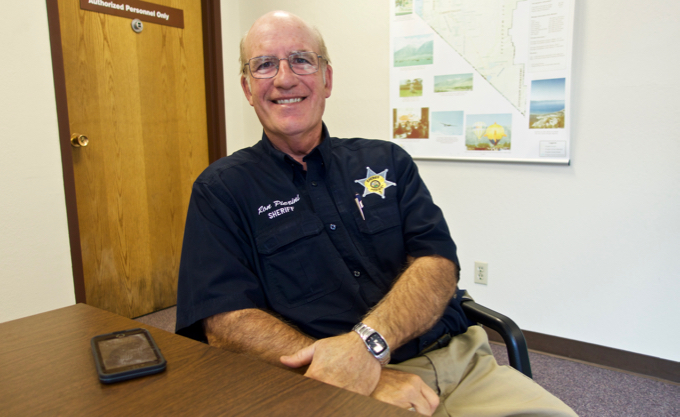
Douglas County Sheriff Ron Pierini is retiring when his term expires in 2018. Photo/Kathryn Reed

A storied career

Pierini grew up in Northern Nevada, graduated from UNR and started his career with the Carson City Sheriff’s Office. He came to Douglas in July 1976 as a deputy at the Lake Tahoe substation, which at the time was on Warrior Way. He worked there for 18 years, rising to the rank of captain. Then he went to the Carson Valley for three years where he was undersheriff for Maple.

“The community up here was very strong,” Pierini said of Tahoe.

Things have changed in his 40-plus years as an officer. Back in the day, Tahoe was responsible for 80 percent of the county’s crime. Now it’s 20 percent.

Traffic was worse then. Before the loop road it could take two hours to get from the old substation through the casino corridor. There was more of a permanent population at the lake.

Pierini is proud to claim that Douglas has the lowest crime rate of any county in the state. Instituting programs and providing officers with the appropriate tools are how that’s been achieved.

Gang activity and drugs are issues Pierini has no tolerance for. In the 1990s when he started to see some unsavory types try to stake their territory here, he set up a gang task force. It stopped the problem.

“I’ve lived in Nevada my whole life. I don’t understand why we’ve legalized marijuana,” Pierini told Lake Tahoe News during a wide-ranging conversation. He believes it will just escalate the use of harder drugs. “We say it’s OK and it’s not OK.

“As time goes on we will see traffic accidents and people will die.”

Fatal car accidents in the county are already an issue, with eight people having lost their lives this year.

Pierini is all about early drug education. He goes to every DARE (Drug Abuse Resistance Education) graduation. This is a program for grade school students.

“They go home and I wonder if their parents are using drugs,” he said.

Pierini is known for his blunt talk, which depending on who’s on the receiving end may not be welcome.

“The characteristic that I will always attribute to the sheriff is his unfailing straightforwardness. You never get a couched answer from Ron, you get the facts, whether pleasant or otherwise,” Bill Chernock with the Carson Valley Chamber of Commerce told Lake Tahoe News. Those two have a history that goes back to when they both worked at the lake.

Memorable cases

Like most in law enforcement, Pierini finds crimes involving children to be some of the most difficult to comprehend. Krystal Steadman is one of those cases.

“It hit me so hard and all of Lake Tahoe,” Pierini said of the 9-year-old who was raped and murdered in 2000 by a father and son duo. She was a fourth-grader at Meyers Elementary School when the pair abducted her. “It’s one of the worst things that ever happened.”

Then there was the shootout in 1982, with shots being fired as officers and the bad guys sped along Highway 50; glass was falling on Pierini.

The suspects drove into a garage in Round Hill. When they came out they continued to lead officers on a pursuit up Spooner Summit, all the while shots are being fired. The suspects drove off the side of the road and then came out with their hands up.

The woman from the house in Round Hill – an innocent victim in the melee – was in the car. Officers didn’t know that until she stepped out of the vehicle. She had been on the floor during the shootings and was lucky to not have been struck.

In 1980, Pierini was the captain at the Tahoe substation when Harveys was bombed. It was the largest bomb to go off in the United States until the World Trade Center bombing in 1993.

“It was a big deal. We saved 600 people,” Pierini said.

Sonny Bono’s death in 1998 at Heavenly ski resort gave him a taste of mass media. As sheriff, he is who people wanted to talk to.

“Every media truck from around the world was at Heavenly,” Pierini recalled. Journalists wanted to know if this was an assassination or if drugs were involved. “It was just that he hit a tree.”

Bono was a congressman at the time, but was still widely known as the other half of Sonny and Cher.

Oftentimes the Tahoe Douglas Fire Protection District is part of the drama that is unfolding. Pierini and now retired Fire Chief Ben Sharit had very different jobs, but often were involved in the same altercation.

“I always had access to him which was amazing with how busy he was,” Sharit told LTN. “He was apolitical in a political position. I value his commitment to public safety.”

Moving on

While those are a few of the big cases Pierini has been involved with, it’s more administrative work that he does today. It’s dealing with the budget. It’s making sure the state-mandated body camera program for officers is carried out. This means figuring out how to store all that data – and paying for the equipment, and dealing with the fact the recordings will be a public record.

At 65, Pierini looks like he could still tangle with any bad guy he encountered. And while that’s not necessarily what he wants to do in his last year, he also hasn’t started counting down the days to December 2018.

“I’m not looking forward to retiring,” he said. Still, he knows now is the time go. It may give others in the department a chance to do new things. Undersheriff Paul Howell will also be retiring next year.

And it means he can spend more time traveling with his wife, seeing their kids and grandchildren. And Pierini’s 91-year-old mother lives in Carson City, so now he’ll have more time for her as well when he no longer has a job that is essentially 24 hours, seven days a week.


From elite athletes to Tahoe business owners

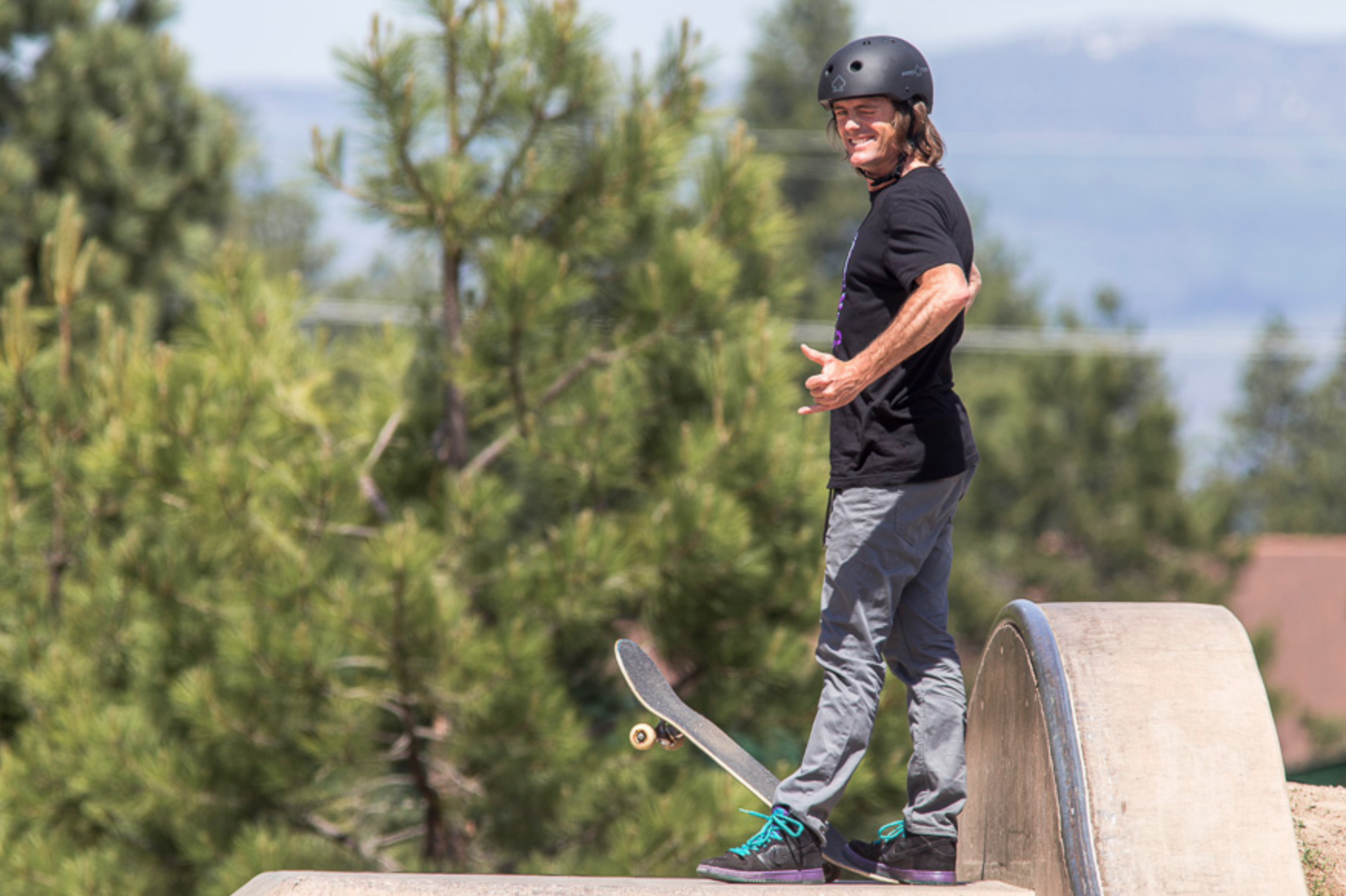
Snowboarder Ryan Williams is the brains behind the app Stomp Sessions. Photo/Provided

By Alexandra Spychalsky, Moonshine Ink

It’s no secret that Tahoe is rife with professional athletes, both current and retired, but it may surprise some to learn that a number of local businesses, from long-standing staples to new companies just taking off, have former elite athletes at the helm.

The decision to leave a professional run in a lifelong passion is not easy. Here are five athletes who all decided their successes needed to be measured in more than medals and magazine covers.

Kristin Krone stands in the construction zone that will soon be her new bakery, deep in discussion with her team. The white subway tiles gleam behind her as Krone ponders the best placement for the kitchen sink. Although she has owned Wild Cherries for 18 years, this is her first opportunity to design a space from scratch. And she is loving the new challenge.

Before she got into the coffee shop businesses, Krone was chasing gold on the U.S. Ski Team, traveling on the World Cup circuit, and competing in the 1988 and 1992 Olympics. In her later years on the team, however, she found herself pondering different careers at every turn, which she took as a sign that she was ready for a life off the snow.

Read the whole story


Climate change hits Winter Olympic preparation

By Associated Press

AAS-FEE, Switzerland — The athletes’ half-hour commute in the Swiss Alps — up two gondolas, then through a tunnel in the world’s highest underground train to a glacier at 11,000 feet — served up daily grim reminders that global warming is threatening their line of work.

After exiting the train, they squelched through a field of grayish mud to reach shrinking snowfields scarred by new crevasses. Occasionally, they heard the sharp roars of glacial ice breaking off in monster chunks, then echoing across the peaks where they trained jumps, tricks and turns for the Pyeongchang Olympics. Most days, they basked in brilliant, snow-melting sunshine that bathed the whole scene in deceptive beauty.

Another subtle but telltale indicator of climate change’s disruptive impact on winter sports: Many athletes — here 5,000 miles away from the Rockies and 3,500 miles from the Green Mountains of New England — had the letters “USA” emblazoned on their jackets. Americans once had little need to swap continents to guarantee offseason access to snow. But warming is forcing athletes to hunt farther from home for wintry conditions, particularly just months away from an Olympics.

Read the whole story


Dry Christmas trees can spell disaster

By Kathryn Reed

CARSON CITY – Less than a minute. That’s how fast a dry Christmas tree can be reduced to charred pine needles.

Most people will start to dismantle their tree in a week or so. Now is when trees start drying out, potentially creating a disastrous scene that could ruin the holiday in so many ways.

The Reno and Carson City fire departments last week demonstrated what happens when a dry tree catches fire and what happens to a healthy tree where there are sprinklers. The difference was dramatic.

The dry tree that had not been watered in days was a ball of fire in seconds. Think if there were presents under it, and anything flammable nearby. It wouldn’t just be Christmas that went up in smoke.

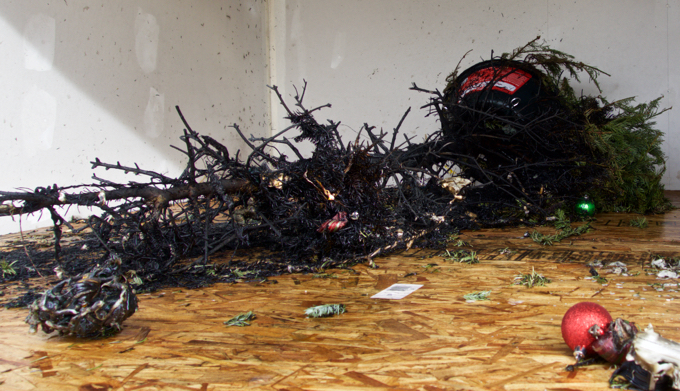
Charred remains of what was a decorated Christmas tree. Photo/Kathryn Reed
Stats from the National Fire Protection Association:
· Between 2011-15, there were an average of 200 home fires that started with Christmas trees in the United States. On average, annually these fires caused six deaths, 16 injuries, and $14.8 million in direct property damage.
· On average, one of every 32 reported home fires that began with a Christmas tree resulted in a death, compared to an average of one death per 143 total reported home fires.
· Electrical distribution or lighting equipment was involved in two of every five home Christmas tree fires.

Bart Chambers, fire marshal for the state of Nevada, stressed how important it is to check the water level for trees on a daily basis.

“You need to make sure your tree is maintained,” Chambers said. If needles are falling, that’s a bad sign.

It’s also important to cut off a couple inches from the base once the tree is at home so it will be able to absorb that water. That’s because once a tree is cut pitch covers the base, forming a scab of sorts that prevents it from taking in water.

Chambers told Lake Tahoe News the number of Christmas tree fires across the country is holding steady, but fire officials would like to reduce that number because most are preventable.

Another issue with a fire with a dry tree is that it is going to produce thick, dark smoke. That could create evacuation difficulties for people. A healthy tree is going to give off a gray smoke that is less dense.

In the demonstration the dry tree was fully engulfed within 30 seconds. The smoke alarm sounded at 4 seconds. The walls of the structure it was in were blackened. This could have been someone’s family room – a total loss.

For the healthy tree, it had some damage to the back after 90 seconds. The smoke alarm sounded after 15 seconds. The sprinklers kept it in fairly good condition.


How the USFS grows millions of seedlings each year

By Greg M. Peters, Forests Magazine

Tucked into the Douglas fir and ponderosa pine forests of Northern Idaho sits the quaint lakeside town of Coeur d’Alene. The former lumber town is now a popular tourist destination drawing families from across the Pacific Northwest and beyond. Gone are the pounding mills, replaced with fancy lakefront hotels and bustling shopping centers.

But it’s not hard to find relics of the region’s once-thriving industry: Huge logs chained together to form breakwaters protect marinas and lakeside restaurants scattered around Lake Coeur d’Alene—the region’s main tourist draw. In the sprawling Idaho Panhandle National Forest that nearly surrounds the town, century-old stumps the size of boulders rot beneath a canopy of trees that themselves seem a hundred or more years old. Both the stumps and the Forest’s now abundant trees provide clear evidence of a century of forest management that has played out in this quiet corner of America.

A short 10-minute walk from the box stores and fast food restaurants that skirt Coeur d’Alene’s edges is another example of how connected this small city is to the forests that surround it. Here, just off of an unassuming and ordinary street is the U.S. Forest Service’s Coeur d’Alene Nursery. Established in 1960, the Coeur d’Alene Nursery straddles the past, the present and the future on a 220-acre plot of land. A squat single-story building greets visitors who enter into a small lobby decorated with a few posters, some t-shirts and hats. Greenhouses, warehouses and fields, some fallow and some flush with small green trees, spread out behind the office, a tapestry of incongruous shapes and colors. An assortment of sheds, tractors, four wheelers and other custom-built contraptions rounds out the scene.

Read the whole story