Lake Tahoe may host Winter X Games

By Kathryn Reed

The last time the two main visitors authorities for Lake Tahoe worked to bring a major sporting event to the basin it was snowed out. Snow would be a good thing for their latest endeavor.

Lake Tahoe is one of four cities in the running to host the Winter X Games for a three-year period starting in 2015.

Aspen, which is one of the contenders, has been the host city-resort for a dozen years. This year’s event is Jan. 24-27. The other cities vying for the three-year contract are Park City and Quebec City, Canada.

The local bid is sponsored by Lake Tahoe Sports Organizing Committee, a recently created coalition designed to bring high-end events to the area. Committee partners include Lake Tahoe Visitors Authority, North Lake Tahoe Chamber/Convention & Visitors Bureau/Resort Association, Heavenly Mountain Resort and Squaw Valley.

The two visitors bureaus put together the successful bid to bring the Tour of California bike race to Tahoe in May 2010. But snow canceled the Stateline and Squaw starts.

Now they will be doing a snow dance and having fingers crossed nothing like January 2012 is repeated when snow was so scare that a cycling event would have been welcome. Heavenly and Squaw would be the mountains where athletes would compete.

Tahoe athletes have a history of doing well at the X Games – Jaime Anderson, Hannah Teter, Shaun White and Elena Hight are a few who have found success at these extreme games that include skiing, snowboarding and snowmobiling.

“The demographics of the X Games align perfectly with attractions and appeal of Lake Tahoe and its combination of outdoor recreation, spectacular natural beauty and 24-hour lifestyle,” Carol Chaplin with the LTVA said in announcing Tahoe making the initial cut.

The 2012, four-day event attracted approximately 108,000 spectators who contributed between $6 million to $10 million to the Aspen economy.

In the history of the games, which are owned by ESPN, they have been at Big Bear Lake (1997), Crested Butte (1998, 1999), Mount Snow, Vt. (2000, 2001), and Aspen (2002 through 2014).

Finalists will be picked in April, with the host area announced later this year.


Science through theater engages students

By Kathryn Reed

ZEPHYR COVE – Suddenly the sun is gone. Plants wither. People and animals die. No air to breathe. No water to drink.

Briefly, all of this happened at Zephyr Cove Elementary School on Jan. 15. It was all to show the students how important the sun is to the survival of life on Earth.

They actually showed themselves as they took on various roles.

In a whirlwind of interactive learning, students in Brenda Capshaw’s third-grade class are being taught about the solar system. Diane Handzel is taking over the class for an hour for eight Tuesdays to teach them a bit of science through theater.

The students act out parts in a variety of skits. It’s nonstop action even though it’s part lecture, part video, part question-answer, part acting. There is no down time. It’s all about learning, even if the kids think it’s playtime.

Third-graders at Zephyr Cove Elementary on Jan. 15 learn about the sun. Photo/Kathryn Reed

This is the third year Handzel, who runs Get in the Act! Arts in Action, has worked at Zephyr Cove. And in that time science test scores have gone up.

“There is no real data that Arts and Action helps life science scores, but I like to think it did,” Principal Nancy Cauley told Lake Tahoe News. “Not only are the students learning facts about the solar system, they get to act out in crazy, creative ways that kids love.”

The money to pay for the Arts and Action program comes from the parent-teacher club.

The third-graders are broken into groups representing animals, humans, water, land and air. Amongst themselves they are to figure out why their group is the most important to the Earth. While they all came up with viable reasons, in the end, it was the sun that is ultimately the most important.

When asked what they learned about the sun, they raised their hands, to say: it’s made of gases and atoms, it’s the only star in our solar system, it gives off light and energy, without it the Earth would float away because of the lack of gravity, and that it’s the center of the solar system.

Handzel and a colleague created the Stateline company in 2009. They work throughout the Lake Tahoe Basin – including Tahoe Valley Elementary School in South Lake Tahoe, Truckee Elementary, and Tahoe Lake Elementary in Tahoe City.

“We work with the teacher and the classroom curriculum,” Handzel told Lake Tahoe News after wrapping up the sun segment. (Next week she will focus more on planets.) It’s about introducing vocabulary and science concepts. And it’s geared to the appropriate grade level.

Second-graders might learn about magnets, while fifth-graders get instruction on electricity.

“I believe she has had an impact on how kids see the world through science,” Cauley said. “They have a better understanding of science because they were able to use every sense of being to act it and be it.”


Bear aversion study under way at Lake Tahoe

By Kathryn Reed

Bears are smart animals. They learn where easy food is, but they can also learn they aren’t wanted in houses, dumpsters or vehicles.

“The alternative is a lead bullet,” Mario Klip, bear biologist with the California Department of Fish and Game, said if bears don’t learn their lesson.

Klip is working with his two Karelian bear dogs in the wild on aversion techniques. He believes a nip in a bear’s butt by one of the trained dogs is better than any type of bullet fired at a bear.

He likes using what he calls a “hard release” of a bear that has been trapped and then is released. His dogs, Villa and Sasha, chase the bear, nipping at it, barking. The idea is to create an experience the bear doesn’t like.

Klip said people need to create a less than welcoming environment for neighborhood bears. The obvious is to not leave trash out for bears to get into.

Mario Klip with the California Department of Fish and Game talks Jan. 12 about bears. Photo/LTN

“You need to make sure the animal knows it’s your (house). That you don’t want them. You need to make the bear feel uncomfortable,” Klip said. “You want to limit the undesirable behavior.”

Bears like high caloric foods and ones that smell good. Ice cream, peanut butter and syrup are three of the favorite foods they like to forage for in houses and garbage.

Besides bears’ being a nuisance and distributing garbage about, they take the debris into the woods. This can alter the ecosystem a bit because they are dragging food scraps into the woods instead of eating berries or some other natural food source.

However, in Klip’s studies he has found bears are not solely reliant on garbage, that their scat shows they are eating food that would be normal in their diet.

Nearly 50 people turned out Jan. 12 to hear Klip talk about the work he is doing in Tahoe with bears. The American Association of University Women sponsored the presentation at Lake Tahoe Community College.

Klip is using his research at Tahoe on bear aversion techniques to help him obtain a doctorate from UC Berkeley. While other places in the world are using dogs for bear aversion, he is the only in California doing so.

“There is a global phenomenon that people believe wildlife have intrinsic value. You can’t kill it just because it annoys you,” Klip said.

While the state agency he works for has a rule on the books that a black bear can be killed if it attacks a human, the reality is humans have usually done something to anger the bear. It could be that a bear is in a house, but a person is blocking the exit so the bear takes a swipe. The bear can then be put down. Or it could be a person has food in their tent and a bear goes after it – and inadvertently the person. Again, the bear can pay the ultimate price.

Klip said bears in Lake Tahoe don’t stalk people. However, that’s not true in other states.

“In more remote areas humans are prey,” Klip said, like Alaska. These are places where bears haven’t see humans, and therefore see them as a potentially tasty morsel. “Every bear in California has seen a human.”

The biologist believes coyotes are more dangerous than bears.

It’s estimated between 300 and 500 bears are in the basin.

While hunting bears caused an outcry when Nevada changed its rules a couple years ago, the state allows 10 bears to be killed, while California’s total is about 2,000, Klip said.  New in California as of Jan. 1 is the ban on using dogs during a hunt to tree a bear.


Frozen pipes cause damage at 4 Stateline casinos

By Kathryn Reed

After three days of record-breaking low temperatures, many pipes in the Lake Tahoe Basin had enough and started doing some breaking of their own.

The four major casinos in the Stateline casino corridor have all had burst pipes. The damage started Jan. 13 at Horizon when a pipe near the loading dock froze and broke.

Harrah’s, Harveys and MontBleu each had frozen pipe issues Monday. This has kept maintenance departments as well as Tahoe Douglas firefighters busy.

At Harrah’s Lake Tahoe at about 8am Jan. 14 a stand pipe that is a fire department connection broke on the 18th floor and flooded the tower with several thousands of gallons of water.

“It incapacitated the elevators for some time,” Tahoe Douglas Fire Marshal Eric Guevin told Lake Tahoe News.

Stateline casinos are mopping up after pipes burst from extreme cold. Photo/LTN file

Water went into the restaurants on the upper floors and down the elevator shafts. Most people chose to stay in their rooms.

Three hours later a sprinkler head froze and discharged in the high limit gaming area. Some of the high rollers had to be evacuated.

“The engineering department was quick to respond in all the issues and make it safe for everyone and minimize the water damage and get the fire system back online for the safety of patrons,” Guevin said.

The role of the fire department is to make sure the fire lines are working as soon as possible, help maintain the safety of everyone during the crisis, assist with evacuations and set up contingency plans in case there is a fire when the sprinkler system is inoperable.

The next pipe to go was at 11:30am at Harveys. A fire head discharged over an employee at a jewelry store. The gaming floor then began to flood.

At 3pm another head froze at Harveys; this time near the elevator lobby of the casino floor.

Harrah’s-Harveys spokesman John Packer was unavailable for comment.

“The cold definitely got inside the building and affected those pipes. Those systems have held up well over years, but this definitely challenged them,” Guevin said.

The record cold in South Lake Tahoe on Jan. 14 was minus 11 degrees. The previous record of minus 7 was set in 1997. (The National Weather Service in Reno predicts a warming trend – with the low on Jan. 15 forecast to be 5 degrees above zero, which would be 12 degrees off the record.)

At MontBleu on Monday afternoon a zone near the casino area by the front doors had frozen pipes.

“They were designed not to freeze,” Guevin said.

He expects crews will be working into Tuesday morning to get those systems working. In the meantime, a “fire watch is in place,” Guevin said.

Edgewood Tahoe Golf Course had issues on Monday, too. At 8am a frozen sprinkler head broke in the maintenance shop.

“The main significance of all of this is that it’s very cold and it affects the fire lines that are designed to save lives and property. This time they did discharge, but they are still important systems to have to save lives. That is undisputed,” Guevin said.


1987 parking deal between South Lake Tahoe, Heavenly Mountain Resort surfaces

By Kathryn Reed

While the South Lake Tahoe City Council keeps making decisions about paid parking, the issue won’t go away. And it’s not going away because of a 1987 agreement with Heavenly Mountain Resort that has come to light.

The staff report dated Nov. 18, 1987, says, “Any costs related to the use of these streets for parking by Heavenly Valley will be reimbursed to the city by Heavenly Valley. This will result in no direct cost to the city’s general fund.”

The agreement approved by the City Council at the Dec. 1, 1987, meeting called for the ski resort to implement and enforce a parking permit system on some of the streets leading to the California Lodge, as well as provide snow removal in the permitted parking area.

While Mayor Tom Davis indicated a partial recollection of the agreement, the details of it have not been enforced in the last quarter century.

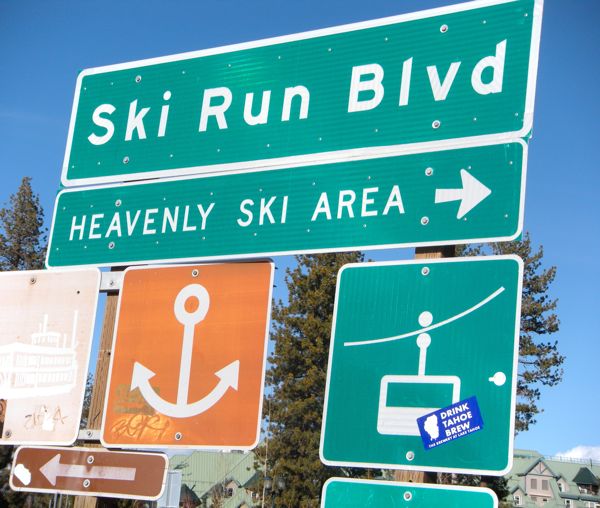
Paid parking on Ski Run Boulevard is in a state of flux. Photo/LTN file

Police Chief Brian Uhler, whose department is responsible for parking, has been talking to Heavenly officials about the 25-year-old deal.

“I’m optimistic we can reach an agreement,” Andrew Strain, head of government affairs for Heavenly, told the council last week.

He told the council the resort has plowed and sanded the streets when the city crews could not do so, that the resort has paid for one-third of the cost of the message board signs on Ski Run Boulevard, $240,000 was spent on a repaving project, and that overflow parking is needed no more than 20 days a season.

All four councilmembers agreed they want the 1987 agreement to be analyzed, revised and an update on what aspects of it will be enforced this winter.

When it came to voting on the parking meter-permit plan it was a 3-1 vote with Davis voting note. He didn’t give a reason for doing so.

Paradise Avenue from Ski Run Boulevard to Wildwood Avenue has been designated a parking meter zone. Free permits will be issued to residents impacted by paid parking areas.

Fees associated with paid parking will come back to the council. It’s possible Paradise Avenue will allow overnight parking – at a cost – because this is currently where some guests of Embassy Vacation Resort park instead of paying the hotel.

In other action:

• The council collectively voiced its frustration with the Tahoe Transportation District in light of a letter received by Executive Director Carl Hasty. The council expected the loop road discussion to be more in depth and for one meeting to be in council chambers for city residents, which in turn would be televised for more people to see. “I thought it was a dog and pony show,” Councilman Hal Cole said of the presentations he went to. “That is not how you select a $60 million project.” A stern letter will be sent to Hasty saying just how the council feels.

• The council agreed to use a recruiter to find a city attorney. Patrick Enright will be leaving when his contract expires at the end of May.

• A workshop will be scheduled to prioritize capital improvement projects.

• The city will be taking employee and community surveys in the coming weeks, with results available in March.

• A request for proposals to be the concessionaire at Bijou Park, Lakeview Commons and Regan Beach has been released. A business or person may apply for one or all three. The City Council is expected to make a decision in late February or early March.


LTCC to groom campus trails for Nordic center

By Kathryn Reed

A Nordic center at Lake Tahoe Community College is expected to open next month.

The college board of trustees on Jan. 8 approved the creation of the South Lake Tahoe Community Nordic Ski and Snowshoe Club. This will be a pilot program run through the college’s Connect Community Education.

Megan Waskiewicz, who runs Connect Ed, told Lake Tahoe News after the meeting that when people think of alpine locations, they assume Nordic and hockey will be part of the mix.

Until now there had been no groomed cross country trails in South Lake Tahoe.

A 5-kilometer course that will go behind the college starting at the Ledbetter Terrace will be groomed. This is where the parking will be, too.

U.S. Forest Service employees will practically be able to get on the trail from their office’s front door. Forest Supervisor Nancy Gibson submitted a letter of support for the center.

Garrett Villanueva, trail building expert with the U.S. Forest Service, is part of the volunteer team of community members helping make the center a reality.

It has been quick process to get the center off the ground this season, as well as a collaborative effort.

Tyler Cannon bought equipment from the now defunct operation at Spooner Summit. He has volunteered to do the grooming.

This Google map image has the route of the LTCC Nordic trails drawn in white.

Pete Fink and Jonathan Moore with the city’s Recreation Commission spoke in favor of the center at the board meeting. Fink said he believes there is room for growth by possibly adding the Bijou meadow in the future.

He even said the college should think about having a Nordic team in the future. To which a college official said LTCC did in the past.

Waskiewicz said Lake Tahoe Unified students have gotten wind of the idea and want to start using the trails. Right now South Tahoe High School trains at Kirkwood.

Waskiewicz told the board her future goals are to have 10 kilometers of groomed trails, skate skiing and a walking path for snowshoers.

While it will cost money to use the trail, the goal this season is to see what type of interest there is. It will be an honor system to use the trails – much like parking areas have with an envelope to pay the fee. Passes will be available during the week at the Connect Ed off on campus. Day use will be $5, with an individual season pass costing $29.

Feb. 1 is the target date for the Nordic center to be open.


Horizon hotel-casino lays off workers; Edgewood considers options for Stateline property

By Kathryn Reed

Horizon hotel-casino in Stateline is struggling to keep its door open and find people to rent one of the 539 rooms.

Tahoe Horizon LLC, a subsidiary of Columbia Sussex Corp., runs the South Shore business. Horizon employees were laid off before the December holidays. This is usually one of the busiest times of the year for lodging properties at Lake Tahoe as well as for casinos.

While General Manager Corinna Osborne did not return Lake Tahoe News’ phone calls, one of the fired employees who spoke off the record, said about a dozen workers were let go. Valet, bellmen and restaurant workers are out of work. One of the employees had been with the property for more than 30 years.

Horizon hotel-casino operators have just more than 16 months on their lease. Photo/LTN file

“Business is just real bad right now,” a fired worker said.

The Four Seasons restaurant used to serve three meals a day. Now it just serves dinner.

Tahoe Horizon’s contract to operate the hotel-casino expires March 31, 2014. The next day Edgewood Companies takes control of the building. Edgewood has owned the land for more than 50 years.

While Edgewood is aware of the recent layoffs, officials said the hotel-casino operator is not contractually required to report those dealings to them as the landlord.

“We don’t have any indication they won’t stay open,” Patrick Rhamey, vice president of real estate for Edgewood, told Lake Tahoe News. The company is not making contingency plans if the Horizon wants to close before the contract expires.

Rhamey would not say what the Horizon may become after Edgewood takes over. However, the property will stay open over the long haul.

“It possibly could close temporarily for a short period of time, but not an extended period of time,” he said.

With gaming licenses difficult to get in Nevada, it’s probable a portion of the 30,000-square-foot casino floor will forever have some form of gambling.

Rhamey said the company is discussing what the property will become, but said nothing has been decided.

The company’s website says, “Edgewood Companies has been conducting research and analysis to evaluate potential reuse or redevelopment options for the Horizon site. Options ranging from the preservation of the status quo to a complete scrape and redevelopment are under consideration. The full redevelopment of the site may include a destination resort with a recreation and entertainment focus. Amenities could include a live entertainment venue, a recreation hub to serve as a gateway to Tahoe’s great outdoors, a casino, and an indoor spa and fitness facilities with complimentary retail and restaurants. A redevelopment would include significant water quality improvements to improve clarity in Lake Tahoe.”

While the future of the Horizon is up in the air, Edgewood Companies is going forward with plans to develop Edgewood Lodge on the nearby Edgewood Tahoe Golf Course. A business plan is being created which will include who is going to build the facility as well as operate it.

Site work and the pier will be done this summer, with actual ground breaking of the lodge likely occurring in 2014.


Scientist: Consumers have role in climate change; forecast for Tahoe bleak because of less snow

By Kathryn Reed

STATELINE – While China was the No. 1 fossil fuel emitting country in 2011, what is missing from most conversations is who is consuming all the goods that country is producing.

A significant amount of CO2 emissions comes from making things. And it is people in the United States who are buying those things made in China.

This was one of the points driven home Thursday by Chris Field – that consumers have a role to play and must be held accountable, just as the polluter does and should be.

Field was the keynote speaker Jan. 10 at the Operation Sierra Storm Meteorologist Conference in Stateline. The four-day conference ends Saturday.

The scientist was part of the team that won the 2007 Nobel Prize and lead author of the study on the effects of global climate change.

Scientist Chris Field on Jan. 10 talks about climate change. Photo/Kathryn Reed

Field explained how it was thought when the 1997 Kyoto Protocols were adopted that developing nations had a long ways to go to catch the industrialized nations when it came to emissions. That theory was proved wrong.

In 2011, the top four emitters in the world accounted for 62 percent of global emissions: China – 28 percent; United States – 16 percent; Europe – 11 percent, and India – 7 percent.

But that is not the whole story.

“Per capita, China’s emissions are one-quarter what they are per capita compared to the United States,” Field told the group gathered at Harveys casino.

Based on data from the Mauna Loa Observatory he said there is proof atmospheric CO2 has increased 40 percent since the 1950s.

Beyond that, ice cores extracted from Antarctica can show scientists what was going on thousands of years ago.

To simulate how small amounts of particles can change the composition of the atmosphere, Field took two 1-liter bottles of water. Into one he inserted drops of red dye to represent the amount of CO2 released in the atmosphere during the Industrial Age.

Then he shined a red light and green light through the now pink water. The red went through, the green did not. The experiment was to show selective absorption – which is what happens in the atmosphere.

“Heat trapping gas alters climate,” Field said.

And while it has been proved fossil fuels are altering the atmosphere, which in turn changes climate, Field readily admits, “Mostly we live in a fossil fuel powered world.”

For Lake Tahoe, a diminishing snowpack and greater threat of wildfire are two of the key factors as climate change continues to take hold.

“Snowpack is vital to the economy and ecosystem. There is a clear trend of warming in mountain ranges. Snow melts earlier each spring,” Field said.

He said some models show the snowpack in the Sierra diminishing by 50 percent by the end of the century, while other models say it will be 90 percent.

This in turn will lead to greater wildfires because the brush will be so much drier. The threat is already there because the time between snowmelt and first storms is getting longer.

Another consequence of less snowpack is less water reaching the agricultural heartland of California. Farmers in the Central Valley grow crops with irrigated water – from reservoirs that have been filled from Sierra snow.

Field said it is going to take technology, leadership and cultural change to alter the course the world is on when it comes to climate change.


DCSD wins decision to negotiate step increases

By Anne Knowles

MINDEN – Some Douglas County School District support staff have to wait another month to receive pay increases due them since July 2012.

The county’s school district board of trustees was scheduled this week to vote on ratification of a long-negotiated contract agreement with the Douglas County Support Staff Organization, which is the bargaining unit representing 240 secretaries, food service, custodial personnel and other support staff.

The yearlong negotiations ended up in arbitration when the two parties could not agree on employees so-called step increases, or salary increases, which in the past were automatically triggered when employees met certain time-related milestones.

“Since 1996, they’ve been given to us and have never before been part of the negotiations,” Nancy Hamlett, the organization’s president, told Lake Tahoe News.

Contract discussions dragged on last year, says Hamlett, over whether the step increases could be negotiated in every contract.

“If I were to rate the negotiations, I would give them an F,” said Hamlett.

After the parties could not come to an agreement at a July 9, 2012, meeting, the issue went to an arbitrator, who decided in the district’s favor. The decision is final and cannot be appealed. Arbitrator William E. Riker issued his decision Dec. 20.

The employee organization, though, has not had a chance to meet and vote on the contract since finding out the arbitration decision after the holiday break. The board of trustees always votes on contracts after the employees’ groups approve them. During the Jan. 8 board meeting, Neil Freitas and other board members said they were worried ratifying the contract first would set a bad precedent and could be misconstrued as trying to force employees into an agreement.

Hamlett said she could hold a vote within the week. Assuming the employees vote to approve, Sharla Hales, president of the board of trustees, said the item could be put on the consent calendar for the board’s next meeting on Jan. 25. If the board approves the contract then, employees would receive their step increases in their paychecks issued Feb. 15.

Seventy-three support staff employees are due an average of a 5 percent pay increase. The term of the agreement is from July 1, 2011, to June 30, 2013.

Nevada is a right-to-work state so while the organization bargains for 240 employees, it has 137 members who can vote on the contract.

During Tuesday’s meeting, after a closed-door session, the board of trustees also voted to approve an agreement with three types of non-represented employees — confidential employees, classified supervisory and professional employees. The first two don’t receive any pay increase, but step and longevity will be paid through 2013 retroactive to July 1, 2012. The professional agreement is from 2011-16 and any pay increases will be based on individual performance.

In other action:

• The board was told no offers were made to buy the Kingsbury Middle School so the Stateline building will remain on the market. The board may accept the highest qualified bid at or above $4 million, the property’s appraised value.


Ex-LTBMU Forest Service chief Bob Harris killed

By Kathryn Reed

Bob Harris, former forest supervisor of the Lake Tahoe Basin Management Unit, has died. He was 72.

“He was quite an environmentalist, but also a professionally knowledgeable land manager. He was able to balance environmental ethics with land and conservation knowledge,” Bill Morgan said of his friend of 47 years.

Harris led the local U.S. Forest Service office from 1988-97. He arrived at a time when the Forest Service Plan was being finalized and left as the Environmental Improvement Program was being launched.

Harris was a key figure in having then President Bill Clinton and Vice President Al Gore visit the basin in what was the inaugural Lake Tahoe Environmental Summit in 1997.

Bob Harris

“One of the legacies of that monumental visit was some funding for the first time by federal sources to invest in the future of Lake Tahoe’s health,” Don Lane, long-time Forest Service employee, told Lake Tahoe News. “The EIP was the legacy of that visit. Bob was very much engaged in facilitating that.”

Harris followed Morgan a bit career-wise. Both were engineers to start with. When Morgan left the Tahoe National Forest, Harris took his engineering job.

Morgan was a supervisor of the LTBMU before Harris. During part of Harris’ tenure Morgan was executive director of the Tahoe Regional Planning Agency.

“I think the most outstanding characteristic about him was he was a high-energy guy. He never turned down a request when someone needed something,” Morgan told Lake Tahoe News.

They both also had a profound interest in the Tahoe-Baikal Institute; having traveled together to Russia. It was Harris who recruited Morgan to be on the board of directors.

“He would take young people from the Baikal Institute on long hikes in the mountains and tell them about forest management and the history of Lake Tahoe,” Morgan said.

Harris grew up in Oakland. He graduated from UC Berkeley with a degree in civil engineering.

In the last 1960s he helped design the Taylor Creek Visitors Center, including the stream profile center. He also worked on trails in Desolation and Meiss wilderness areas.

As Harris progressed up the ranks and took over the Lake Tahoe office, his love of the outdoors did not diminish.

“He liked to go in the backcountry a lot. You usually don’t get people who are that physically engaged,” Lane said. He remembers that time fondly – being out with the big boss, sitting around a campfire, sleeping on the hard granite, going over mountains and hiking through meadows.

Lane said it was Harris’ collaborative management style that allowed him to accomplish various tasks with people of differing opinions.

Although Harris retired in 1997, he still visited the local Forest Service office, always with a smile.

“He pushed Forest Service retirees – (saying) don’t just quit, stay involved,” Lane said. “He really pioneered a lot of education and community education programs.”

Harris died from a gunshot wound Jan. 6 at his Pollock Pines home. His 70-year-old wife, Colleen, is accused of murder.

Harris is survived by two sons and a daughter. Funeral services are pending.