Funds from Measure R allocated for South Shore bicycle trail, ball field improvement

By Joann Eisenbrandt

The South Lake Tahoe Recreation Joint Powers Authority met Jan. 25 in the City Council chambers to decide how to allocate the estimated $450,000 in previously unspent Measure R money.

Shay Navarro, chairperson of the Bicycle Advisory Committee, presented her committee’s funding requests. That committee in conjunction with the city, California Tahoe Conservancy, El Dorado County and Lake Tahoe Bicycle Coalition identified trail building and maintenance needs within the JPA’s jurisdiction, to, as Navarro put it, “work alongside the city’s efforts to make this a world class, year-round bicycle destination.”

The committee requested the following allocations of Measure R funds:

• $100,000 to South Lake Tahoe to match the grant of $475,452 received from Caltrans through the Bicycle Transportation Authority, which is contingent upon the release of these JPA funds. Funds would be spent in the five bicycle trail rehabilitation zones as outlined in a detailed memo to the JPA from Jim Marino and John Upton.

• $88,000 for TREX (or similar) decking for the bicycle trail bridges over the Truckee River and Trout Creek. (In July, $30,000 was allocated for this, but the improvements were not made.) Additional research concluded that an additional $58,000 would be needed.

• Up to $45,000 for a bridge to raise the portion of trail behind McDonald’s that seasonally floods.

• An endorsement by the JPA of the Bicycle Advisory Committee letter to South Lake Tahoe and El Dorado County requesting creation of a collaborative agreement for a regularly-scheduled bicycle trail maintenance program (striping, sweeping and snow removal) among the city, El Dorado County, Caltrans and the Lake Tahoe Bicycle Coalition. This does not include any funding request.
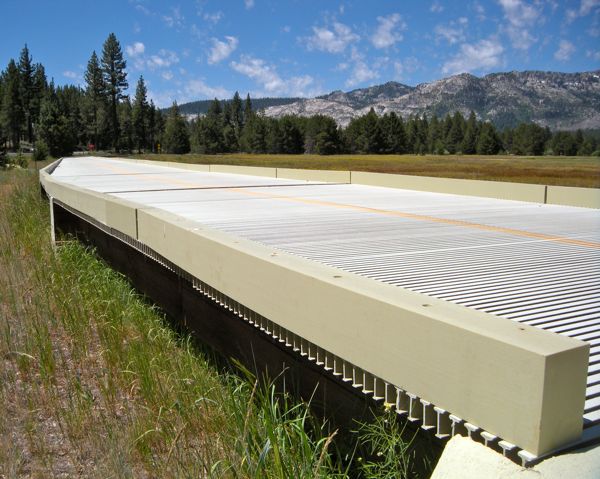
The South Shore can expect more bike trail improvements like this one at Sawmill and Highway 50. Photo/LTN file

Following Navarro’s presentation, bike committee member Chuck Nelson expressed concerns that the BAC’s recommendations on funding priorities as well as specifics on the creation of a collaborative bike trail maintenance program may not be carried out as envisioned.

“The Bicycle Advisory Committee has a very important role under Measure R in providing recommendations to the JPA,” he insisted. “We want to make sure it’s done right.”

He asked that the motion approving the allocation of the $100,000 to the city require acceptance of the BAC’s recommendations.

El Dorado County Supervisor Norma Santiago responded that she supported the allocation of the $100,000 but could not support imposing such requirements on a jurisdiction, adding that everything she’d heard from the BAC indicated there had been and would continue to be an openness on the city’s part and that if any recommendations needed changing, the BAC would be involved in that process.

City Councilwoman JoAnn Conner, the South Lake Tahoe’s JPA representative, told Nelson, “You sound accusatory. It’s unfair to categorize the city as uncooperative. There’s nobody on the City Council who doesn’t believe in this … I suggest you work from a position of trust with the city. We’re committed to getting this process done.”

After additional discussion, the JPA unanimously approved all four of the Bicycle Advisory Committee’s requests.

Fields Advisory Committee member Ken Riegel then presented a PowerPoint outlining his committee’s requests for Measure R funding. They were:

• $134,000 to the Lake Tahoe Unified School District to rehabilitate the field at Sierra House Elementary School, which he described as “a dangerous, uneven field.”

• $90,000 to LTUSD for varsity softball field No. 2 at South Tahoe High School. He noted the school district has already done substantial work there and these funds would be used to complete that work.

• $20,000 to LTUSD for planning only at this time for the construction of an added multi-used softball field at the Al Tahoe fields site. Additional funding for the projects themselves would come and be used in 2014 and 2015. These fields, he noted, are the most highly used with over 300,000 children using them annually for softball, baseball and soccer. Because so many families are involved, he indicated that, “many volunteers and professionals are also available to rally on completing these projects.”

• Designate future JPA funds in the following amounts for additional fields projects: $134,000 for constructing an added field at Al Tahoe; $29,150 for relocation of the T-Ball field at Al Tahoe; and $92,600 for upgrading the existing fields at Al Tahoe.


Riegel also listed additional “unfunded projects” identified by the FAC at the magnet school in Meyers, Tahoe Valley Elementary, Bijou Community School and South Tahoe Middle School. The magnet school was identified as their top priority.

FAC member Marilyn Breisacher spoke to the importance of the “gender-neutral” improvements that have been made to fields in the community, specifically referencing the amenities to the fields at South Tahoe High School for girls. Her daughter, she explained, had to play in the past on a field with “no restrooms, concession stand or adequate seating,” adding that the improvements won’t just help local players but will also help bring in more girls softball tournaments.

The JPA approved all four FAC requests as presented. The next Recreation JPA meeting will be in July. The Bicycle and Field Advisory Committees will be meeting later this quarter and will bring updates to the July JPA meeting.

The three-member JPA consists of Santiago, Conner, and Tahoe Paradise Park Improvement District Board Member Judy Clot. The latter two are new to the board, with Friday being each of their first meeting.

Measure R was passed in November 2011 with the intention of changing and expanding the locations and services that could be funded by the Community Facilities District originally established by Measure S when it passed in September 2000. Measure S provided for a $5.8 million bond to construct an ice rink, four ball fields adjacent to Lake Tahoe Community College, improving Tahoe Paradise Park and opening it to the public, and maintaining 25 miles of new bike trails. Measure S also provided for yearly maintenance funding for the new athletic fields by LTCC, Tahoe Paradise Park and the newly constructed bicycle trails. Under Measure S, each single-family home in the district is assessed $18/year. Measure S/R will sunset in 2030.

In reality, only about eight to 10 miles of bike trails were built. The unused remainder of the annual Measure S allocation of $125,000 continued accumulating, but was unspendable. Measure R unlocked those funds by adding to the authorized improvements and services funded by Measure S to include the renovation and maintenance of Class 1 bicycle trails existing prior to Sep. 19, 2000, and the renovation of youth ball fields within the Community Facilities District. It created a Bicycle Advisory Committee and a Fields Advisory Committee to make recommendations to the JPA as to costs and priorities of future improvements and maintenance for sports fields as well as bicycle paths in the district.


Master plan to set a route for Lake Tahoe Airport

By Joann Eisenbrandt

The South Lake Tahoe City Council on Tuesday made two decisions regarding operations at the Lake Tahoe Airport: the potential outsourcing of airport management and the selection of an outside consultant to prepare an airport master plan.

In October 2012, the city put out request for proposals asking for submissions from airport management companies to manage and operate the Lake Tahoe Airport, with the goals of maximizing the uses and users of the airport, and lowering the airport’s operating costs. The airport is currently managed by city staff consisting of Airport Director Sherry Miller and four airport maintenance technicians.

It operates at an approximate annual deficit of $325,000. The idea of outsourcing airport management was suggested by former City Manager Tony O’Rourke in March 2011 as part of the city’s five-year plan to reduce personnel costs.

Lake Tahoe Airport’s future is tied to the next master plan. Photo/LTN

RFPs were received from two airport management companies, GCR Inc. from New Orleans and ABS Aviation headquartered in Atlanta. ABS manages operations at the Minden-Tahoe airport. The management fees in these proposals ranged from $300,000 to $500,000 annually.

These proposals were evaluated to see if they would create “a reduction in the negative cash flow.” In her staff report to the council, City Manager Nancy Kerry indicated that they would not and recommended the council reject both bids. The report noted, “The airport is managed well with a very minimal staff.”

Another reason for rejecting outsourcing of airport management at this time is that the city is about to undertake the preparation of a new airport master plan, a long-range planning document dealing with all aspects of airport operations, which Kerry indicated would be assessing a wide range of viable economic alternatives for managing the airport.

“The studies and analysis provided through the master planning process,” the staff report noted, “will provide guidance to conduct a more informed decision on this matter.”

Sherri Thompson, ABS Aviation COO, and airport manager at the Minden-Tahoe Airport noted that ABS wants to stay “engaged” in the process, is involved in the Tahoe community and wants to see the airport succeed. Michael Golden, owner of Mountain West Aviation, the airport’s fixed base operator, spoke, encouraging the council to increase utilization of the airport and set “tangible milestones for staff” such as ensuring that all hangars on the airport are leased out.

The council accepted the staff recommendation and rejected both bids for outsourcing airport management at this time. (Councilwoman Angela Swanson was not at the meeting.)

The council then considered the selection of an outside consultant to produce a new airport master plan. The last airport master plan was completed in 1992 as part of the Lake Tahoe Airport Master Plan Settlement Agreement. This agreement among the city, TRPA, California Attorney General’s Office and League to Save Lake Tahoe ended years of contentious disagreements and resultant lawsuits regarding appropriate noise restrictions, commercial flight levels and other operational issues at the airport. It put in place a complex set of requirements and restrictions regarding commercial service.

During the last 20 years, a cavalcade of commercial air carriers served the Lake Tahoe Airport under the terms of the settlement agreement, but none of them lasted. There has been no scheduled commercial service at the airport for more than a decade.

The city has continued to maintain the economic importance of the airport to the community, and has retained its FAA-issued Part 139 Air Operating Certificate, required of airports with scheduled commercial service.

There has been considerable discussion, with varying viewpoints, of what are the guidelines for commercial service now that the settlement agreement has expired. There are no simple answers. Some parts of the 1992 master plan and accompanying environmental impact report carry over. Which ones they are depends on who you ask. As City Manager Nancy Kerry noted at the council meeting, “We still operate under that umbrella,” but did not go into any specifics.

TRPA External Affairs Chief Julie Regan told Lake Tahoe News in June 2012 that, “If the current (master) plan expires before a new plan is in place, the status quo would continue, i.e., the city would continue to operate the airport as a general aviation facility until a new plan is developed and put in place.”

General aviation airports do not have scheduled commercial service.

Kerry indicated that an airport committee, comprised of herself, Miller and councilmembers Tom Davis and Swanson has been reviewing these issues over the last year, and determined that the city’s best course was to complete a new, comprehensive master plan now.

Under FAA guidelines, the city had to first put out a request for qualifications to be sure a qualified consultant was selected before any agreement regarding the costs of the master planning process could be entered into. An RFQ was put out by the city in August, and three responses were received: from Mead and Hunt Inc., C&S Companies and Vanir in Association with RBF Consulting. Staff recommended the city select Mead & Hunt, and enter into negotiations with them to prepare the airport master plan. This recommendation was based on the criteria that the firm had the necessary technical expertise, their staff had familiarity with this specific airport, local regulations and environmental issues, had experience preparing master plans at similar airports as well as past success in actively engaging local communities in the master planning process.

Once the consultant is selected, then the city, the consultant and the FAA enter into negotiations. The FAA will pay 90 percent of the costs, up to $318,000. The city must pay the remaining 10 percent. The city has already allocated its share in the 2012-13 budget. These amounts do not include preparation of the environmental documentation, which is estimated to be about $250,000. The city will conduct a cost benefit analysis to determine whether it is best to hire a consultant for this phase or hire one or two short-term in-house environmental planners.

The council accepted the staff recommendation and directed that the city enter into negotiations with Mead & Hunt. A formal agreement will come back to the council for approval at a later date.

Master plans historically can take up to two years to complete. Kerry noted that the city is hoping in this case to have an “expedited” master planning process.

The city has been actively seeking proposals from regional air carriers flying new generation, quieter aircraft to begin serving the Lake Tahoe Airport. Mayor Tom Davis added, “We might have an airline interested within a year or year and a half.”

If the new master plan were not completed at that point, then the city and Tahoe Regional Planning Agency officials would have to sit down and decide on what noise, flight levels and other requirements had to be satisfied in order for the city to get a TRPA permit. Kerry said the city would need to complete environmental documentation if they changed the “current use” of the airport by adding scheduled commercial service. She added that she believes TRPA would respond positively to a proposal from an airline with three to five flights a day using quieter aircraft that met the decibel levels established under the 1992 Settlement Agreement.


Potential 2014 Sochi Paralympians in Lake Tahoe for qualifying snowboarding competition

By Kathryn Reed

Fifty-four riders from eight countries will be competing this weekend at Sierra-at-Tahoe in the first qualifier for the 2014 U.S. Paralympic snowboarding team.

Today begins a two-day camp for riders, with the race on Sunday.

With the folks associated with next year’s Olympics in Sochi, Russia, deciding less than a year ago to include snowboarding in the Paralympics, riders are scrambling a bit.

“I have personally met several of the athletes. They are inspiring as they have overcome their disabilities, and not only get on the mountain — but can beat about half of us through a race course,” Sierra General Manager John Rice told Lake Tahoe News.

Some of these disabled U.S. athletes and coaches at a World Cup event will be in Tahoe this weekend. Photo/Provided

Sunday’s race will be on the boardercross trail on Smokey. It is tied to the USASA event the same day.

More than 20 officials from the International Paralympic Committee and U.S. Paralympic Committee will be in town this weekend.

Brent Kuemmerle, who has a prosthetic leg, has been instrumental in getting people with physical disabilities into high-level competition. It doesn’t get higher than the Paralympics.

With the assumption Sochi would not host snowboarders at the Paralympics, Kuemmerle decided it was time to return home to the South Shore and open the Tahoe Adaptive Competition Center. He figured he had until 2018 to have athletes ready for the next Paralympics.

Then Sochi officials changed their mind and Kuemmerle was in limbo. Potential Paralympians are sticking with one of the three established U.S. resorts where they have been training.

“This camp was going to be my coming out party,” Kuemmerle said.

And while it won’t have the splash for TACC it would have had if TACC were home to future Paralympians, Kuemmerle is not giving up on his dream. He is still bringing recognition to his business, to Sierra and Lake Tahoe as a whole.

Tahoe Adaptive Competition Center is a new organization, but it’s an extension of everything I’ve been doing for close to 15 years,” Kuemmerle told Lake Tahoe News.

He spent the previous two winters coaching a disabled snowboarding team in Winter Park, Colo., home of one of the largest Paralympic training centers in the world. But it’s a mountain known for skiing, not snowboarding.

“At Winter Park you are on the hill five days a week training, then to the recreation center and work on off hill training — weights, swimming, running. That is what I intend to bring to Tahoe,” Kuemmerle said.

He envisions other winter sports like Nordic skiing, downhill and sled hockey being components of TACC. Then he wants to branch out into summer sports.

TACC has a five-member board, volunteers and coaches with Sierra and Heavenly Mountain Resort.

“I believe his heart is in the right place, and once he gets his organization off the ground it will be successful and a great addition to the South Tahoe winter recreation community,” Rice said of Kuemmerle.


Tahoe cop Poland behind bars on federal charges

By Kathryn Reed

South Lake Tahoe police Officer Johnny Poland is behind bars on five federal charges.

Poland, who has been in and out of trouble with the department, has been under investigation locally and by the FBI for more than a year. That investigation culminated Jan. 23 when he was arrested without incident outside the police department.

He faces five charges related to trying to get others to change their testimony and tampering with evidence. The violations allegedly started on June 29, 2011, and continued through Dec. 20, 2011.

Johnny Poland

Police Chief Brian Uhler told Lake Tahoe News the charges have to do with charges Poland faces and not other cases.

Poland, 44, will be spending the night in Sacramento County Jail. He is scheduled to be in court Thursday morning.

Part of the federal complaint says, “In 2009, law enforcement had observed Poland, again off duty, in close association with gang members at a funeral.”

It goes on to say he was having a relationship with a gang member with whom he shared sensitive information.

The complaint says Poland in 2003 had sex with a 17-year-old South Tahoe High School student while he was the school resource officer. He was 35 at the time and married.

Poland has been on paid administrative leave since November 2011. That status will change to unpaid after the court hearing on Jan. 24, according to Uhler.

“We have a sense of conclusion or closure with the events that happened today. They were not unexpected,” Uhler told Lake Tahoe News.

Poland had been asked to come to the station Wednesday morning to fill out paperwork. He did. And then he was arrested in the parking lot.

Uhler said he met today with officials from El Dorado County District Attorney’s Office regarding state charges. A decision on whether more charges will be filed has yet to be determined.

Uhler is also working on what happens next in regards to Poland being an employee of South Lake Tahoe.

Poland complaint


S. Tahoe council refuses to ban plastic bags

By Kathryn Reed

South Lake Tahoe’s proposed plastic bag ban is in the garbage – for now.

The council on a 3-0 vote (Councilwoman Angela Swanson was absent) decided to not adopt an ordinance that would have banned plastic bags at stores throughout the city. They were not convinced of the environmental need in Tahoe or why they would want to legislate morality.

Plastic is allowed in South Lake Tahoe.

The city’s Sustainability Commission brought the idea forward after it had been discussed for more than three years. At the same Jan. 22 meeting, the council did away with the commission. That decision was initially proposed in the fall. Now the commission must decide if it wants to remain intact as a committee.

As for the plastic bags, it’s not that the council doesn’t want to help the environment, but the three had issues with various components of the proposal.

“I would like the stores to decide if they want to charge for paper,” Councilman Hal Cole said.

The proposal was to charge 10 cents per paper bag.

Kay Ogden, a member of the Sustainability Commission, said there are legal reasons for needing to have a fee associated with the paper if plastic were banned.

City Attorney Patrick Enright said changing the wording from “shall” to “may” for the paper fee would also trigger more CEQA analysis. As written, South Lake Tahoe’s proposal got by the California Environmental Quality Act with a categorical ban.

The bags used for produce and meat would have been exempt. And plastic of a certain thickness are considered reusable.

But Councilwoman JoAnn Conner says she and many of her friends reuse the plastic bags groceries come in.

The EPA says 5 percent of plastic bags are recycled. The Sustainability Commission says 8 million single use plastic bags are used in South Tahoe each year.

Ogden along with Juliana Prosperi said the plastic bag ban would help Tahoe businesses. Their presentation said it is estimated $200 a year in state and federal taxes are spent per person to clean up litter and waste associated with single use bags.

“In all of your documents you talk about cost savings, but I don’t see it,” Mayor Tom Davis said.

His biggest issue was with the potential bacteria growing in reusable canvas bags if people aren’t regularly washing them. He cited a study that says 97 percent of people don’t wash their bags.

Davis said he would prefer the plastic bag issue be resolved at the state level. In California, 60 cities and eight counties have adopted plastic bag bans, according to Ogden.

Everyone agreed educating the consumer about perceived and real harms of plastic bags needs to be done so more people would voluntarily use something other than a one-time plastic bag.


Opinion: It’s my body, don’t legislate it

By Kathryn Reed

I have not had an abortion.

But I would. I likely would have had one had I gotten pregnant when I didn’t use protection. I would have gotten an abortion – even today – if I were raped and impregnated.

I have friends and family members who have had abortions. It is probable some of my younger friends and family members will one day be added to that list.

Talk to any woman who has had an abortion. No one I know says it was an easy decision. No one I know laughs it off. While the physical aspects of the procedure are long gone, the emotional angst never quite fades away.

It is a monumental decision to bring a life into the world or not to. And the person whose body is affected is the only person who should be making that decision. Whether the woman consults with the man involved, family, friends, clergy, personal physician – whomever else – it is ultimately her decision.

It is shameful that in 2013, especially on this 40th anniversary of Roe v. Wade, I am even writing about abortion. While idealistically it would be great if there were never an unwanted pregnancy, that will never be a reality. I can type until my fingers are numb about contraception and still there will be unwanted pregnancies. There will always be medical reasons for an abortion as well as those in the case of rape.

In May 1989, Phyllis Schafly, who was the backbone behind defeating the Equal Rights Amendment, and Sarah Weddington, who defended Jane Roe in the 1973 Supreme Court decision, squared off at Harveys in Stateline as part of the casino’s lecture series.

I was there. I was 23 years old. I was covering the debate for the Tahoe Daily Tribune, where I was in my first job out of college. I know I did not grasp the significance of the women I was listening to or the debate. For me, I thought abortion had always been legal because it had been since long before I started having sex.

I think back now on that room filled with nearly 800 people and wonder if that many locals would come out today for a similar lecture.

Then I wonder why people aren’t angry that 40 years after abortions were legalized states are one-by-one limiting a woman’s access to a safe abortion. It isn’t about whether or not you would have an abortion. It’s about a woman having the right to make decisions about her body.

Government does not belong in anyone’s bedroom – as long as they are consenting adults.

People should have the choice to have sex (protected or not) with whom they want. And if a woman wants to terminate a pregnancy – for which there are myriad reasons – she should be able to do so. She did not need her parents or the government’s permission to get pregnant, nor should she need either of their permissions to get “unpregnant”.

This video says it so well. It’s not about taking sides or about being pro life or pro choice. Those labels are too limiting for our world today.


Meyers publisher releases ‘Get Out of My Crotch’

By Kathryn Reed

“Get Out of My Crotch.”

This book title is exactly what many women want to tell lawmakers. With a cover of the Statue of Liberty holding a sheet of paper covering her crotch, there is little doubt about what this compilation of 21 essays is about.

It will be released Jan. 22 – on the 40th anniversary of Roe v. Wade, the landmark U.S. Supreme Court decision legalizing abortion.

It’s not a book about abortion. It’s about women, politics, freedom – or the lack of, bodies, and today’s culture.

“Get Out of My Crotch” is rooted in anger.

“I got really mad last spring about hearing about legislation based on menstrual cycles. Every day I would come to work and hear a story about a bill being proposed talking about personhood, or transvaginal ultrasounds, or redefining rape and I could not believe people were not storming the streets,” editor-publisher Kim Wyatt told Lake Tahoe News. “People were talking about this like it was acceptable. I felt like I had to do something.”

The Meyers book publisher created Cherry Bomb Books – an imprint of Bona Fide Books – to be the home of “Get Out of My Crotch”.

“There is great writing in here. There are writers people should know in here … writers people should be reading,” Wyatt said.

The works and writers are:

• “The Alienable Rights of Women” – Roxane Gay

• “Before Roe v. Wade” – Betty MacDonald

• “Remember Savita Halappanavar” – Katha Pollitt

• “Ask an Abortion Provider” – Dolores P.

• “Confessions of a Good Girl” – Sari Botton

• “Three Heresies” – Addy Robinson McCulloch

• “Ripple Effect” – Tara Murtha

• “Lucky Breaks and Little Miracles” – Sarah Mirk

• “A Mile in Their Shoes” – Kari O’Driscoll

• “Knocked Over: On Biology, Magical Thinking, and Choice” – Martha Bayne

• “Endo” – Janet Frishberg

• “Un-Bearing” – Mira Ptacin

• “Grown-Woman Swagger” – J. Victoria Sanders

• “ Justice for All” – s.e. smith

• “The Great Leap Backward” – Camille Hayes

• “Birdsong and Gunshot” – Rebecca K. O’Connor

• “Explicit Violence” – Lidia Yuknavitch

• “Caffeine-Free Rape” – Elissa Bassist

• “I Know Who You Raped Last Summer” – Kevin Sampsell

• “Don’t Know Much About Biology” – Kate Sheppard

• “Binders Full of Women, Episode 1: The Story of Mary and Bill” – Rebecca Cohen.

Botton is the co-editor with Wyatt. She was working on a book about Roe v. Wade when Wyatt came up with her book idea.

While there is a clear audience for the book, Wyatt hopes it will reach younger readers. She wants young women to understand the freedoms they may take for granted are incrementally being taken away at the state level.

“I have lot of young women working here. We talk a lot about politics,” Wyatt said. “Last year they were completely checked out from politics because they didn’t like the BS partisanship. They weren’t paying attention because they were tired of all the chatter.”

She believes this book is for them.

A discussion guide as been created in case educators – more likely college level – would incorporate “Get Out of My Crotch” into their curriculum.

Go online to order a copy of the book.

Events:

• Jan. 22, 7pm: Book launch in Portland on the 40th anniversary of Roe v. Wade at Crush, 1412 SE Morrison St. Readers include “Get Out” Portland contributors Sarah Mirk, Kevin Sampsell and Lidia Yukanvitch. A portion of the proceeds will go to Planned Parenthood Advocates of Oregon.

• Jan. 25, 7pm: Lake Tahoe Community College Writers’ Series hosts a reading of “Get Out of My Crotch” in the library. Short reading and discussion with contributors Janet Frishberg and Camille Hayes, as well as publisher and co-editor Kim Wyatt. Books will be available for purchase.

• March 4, 7-9pm: Bluestockings Bookstore, Cafe, and Activist Center, 172 Allen St., New York. Join editor and contributor Sari Botton and contributors Elissa Bassist, Betty MacDonald, and Mira Ptacin. Books will be available for purchase. A portion of the proceeds goes to Planned Parenthood.


Resorts don’t limit their fun to skiing, boarding

By Kathryn Reed

TWIN BRIDGES – Don’t ski? Don’t worry. Ski resorts have something even for guests who don’t want to strap a board or two to their feet.

They can provide a different way for you to slide or let you strap other devices on your feet that are less scary than skis or a snowboard.

“At Sierra we are so passionate about progression. We hope they go down the sledding hill and then want to ski,” resort spokesman Steven Hemphill told Lake Tahoe News. “We don’t look at it as just a tubing option. We look at it as getting them on the snow and then intrigued about sliding on skis or a snowboard.”

Plus, Sierra-at-Tahoe offers other activities that aren’t snow related – like the Cal band that is playing this weekend and various wine events throughout the season.

Tubing at Sierra is an option for those who don’t ski or want a break from schussing. Photos/Kathryn Reed

Most Tahoe area resorts have something other than skiing or snowboarding for their guests.

Chris Sathre, 46, of San Juan Capistrano brought his 4- and 6-year-old to Sierra’s tubing hill. It was hard to tell which of the three was having more fun. Sathre liked the hill because it’s safe and you “get a little speed.” While he skis, the tubing allows him to have fun with his kids.

Twelve-year-old Sonya Pinsky of Alameda gets a running start to fly down the tubing hill at Sierra-at-Tahoe. As she goes over the rollers she pulls up on the tube to get some air.

Scary? Not to her. Pinsky is all smiles talking about the fun at the resort’s Blizzard Mountain.

Two routes are available for tubers; both with curves where riders can go up embankments. When the worker spins the tuber there is no telling what direction one is going – except down. What might be around the corner or even when the next corner is can’t be ascertained unless the rider only received a normal push to get going.

For the more experienced tubers like Pinsky, it was all about running  about 15 feet from the start line, landing on her stomach on the tube and going fast.

“So many people may not have seen snow. It’s a great way to ease into it,” Hemphill said.

The tubing hill used to be on the Broadway run. Three years ago the resort created Blizzard Mountain near Lot E.

In addition to the tubing lanes, there is a bouncy house, snow fort and sledding.

It costs $25 to tube for two hours. The number of runs one can get in all depends on how many people are there – just like skiing. Food and beverages are sold at the bottom where the tickets are purchased. The sledding is at the top of the tubing hill.

The top of the tubing hill is also a turn-around point for snowshoers.

Jen Soto and her mom Patti Brecht, both of El Dorado Hills, have opted to snowshoe while others in their party are skiing. Soto is recovering from a back injury, so she wanted a less strenuous activity. This was her first time on snowshoes, second for mom.

They rented their equipment from the little telemark hut near the Grandview lift. All-day rentals are $25 – which includes access to the trails. For those with snowshoes, the three-mile roundtrip trek is free.

Starting off the signs clearly point where to go. Then markers lead us into the woods where it’s incredibly quiet and no longer do we realize we’re at a bustling ski resort on a Sunday.

But then the signs are gone and the packed snow goes in opposite directions. One route is over a creek with no clear indication there is any sort of bridge other than snow covering the water, while the other leads out of the woods to the trail that is wide as a road.

We choose the safer route. However, a resort official later said that the true route crosses the creek and goes to a lookout where Pyramid Peak looms tall in the distance.

An option for those who don’t want to be outdoors is to participate in the Wednesday wine tastings from 3-4pm in the Pub. El Dorado County’s Madrona Vineyards pours a variety of wines.

Besides the Cal band, various musical acts come to the resort at different times.

All of Sierra’s events are online.

ngg_shortcode_0_placeholder (Click on photos to enlarge.)


South Shore transit case goes to mediation

By Kathryn Reed

It took the judge in the MV Transportation-STATA court case the entire day to finally tell all the parties they are going to mediation.

U.S. Bankruptcy Court Judge Gregg Zive on Jan. 17 also ruled on a slew of motions. All parties have until Feb. 19 to let Zive know who the mediator will be and when the sessions will begin.

“I’m hopeful for mediation. I think there are paths forward through that process,” Scott Lichtig, Tahoe Regional Planning Agency attorney, told Lake Tahoe News. “I would like to see it wrapped up in months and not years.”

TRPA is also represented by outside counsel.

South Lake Tahoe City Attorney Patrick Enright would not comment at this point on whether he believes mediation is a feasible resolution for the city.

Jessica Woelfel, who is representing MV, declined to comment for this story.

Fairfield-based MV Transportation used to run the South Shore bus system known as BlueGo. STATA – South Tahoe Area Transit Authority – was the overseer of the transit company. STATA was made up of public and private entities that had financially contributed to the bus system. STATA filed for bankruptcy; MV in 2010 filed a complaint to be paid.

El Dorado County is the only member of STATA to settle with MV.

One of the things that has protracted this case is each defendant has legal counsel, so there are multiple filings on the same motion.

Zive’s decision to send the case to mediation in part is because he recognizes the time and money that has been spent to date on the case.

However, if the parties cannot resolve their differences, litigation would be the next step.

In mediation it is likely the various parties will meet together and separately with MV and the mediator.

On Thursday the Reno judge denied:

• The motion by the private members of STATA (the casinos, Ridge Tahoe, Heavenly Mountain Resort) to dismiss the breach of contract/alter ego claim and the breach of the implied covenant of good faith and fair dealing claim.

• The motion to dismiss claim by all defendants regarding third party beneficiary, conspiracy and intentional interference with contractual relations.

• Tahoe Transportation District’s motion to dismiss the successor liability claim on the basis that MV’s allegation based on a fraud theory was plausible.

The only motion Zive dismissed was the negligent misrepresentation claim.

David Thompson, the federal bankruptcy trustee appointed by Zive, represents STATA – even though the agency doesn’t exist because the members dissolved it. But the question of STATA’s assets is pertinent to the case, which is why it is represented in the proceedings.

The defendants also submitted a series of motions to dismiss STATA’s cross claims. Zive denied all but the fraudulent transfer claims against the defendants except for TTD.


South Lake Tahoe victim of hit and run DUI coping in pain; hopes to walk, work again

By Kathryn Reed

“There is no prognosis for full recovery. I will have problems for the rest of my life.”

That is the life sentence Adam Rose has been left with after being hit by a drunken driver in August while riding his bike on Emerald Bay Road between his house and the store. The sentence for the woman who hit him has yet to be rendered.

The 38-year-old South Lake Tahoe resident spends two to three days a week going to physical and occupational therapy. Every six weeks he sees an orthopedist in Reno.

The woman who hit him, 54-year-old Christine Whalen of South Lake Tahoe, sits in the El Dorado County Jail unable to post bail. She is headed for prison.

Adam Rose before he was injured. Photo/Provided

“One day I was building a deck for a client and riding my bike to the store and the next second I was hit by a drunk driver and left on the side of the road for dead,” Rose says of how his life has unfolded. “I received a life sentence of sorts. I will never be able to do a lot of things I wanted to do. I will never be able to go free climb a mountain or backpack. I used to go backpacking. I cannot do that again. I really liked my work … and I can’t do that.”

But it’s even the basics of life that Rose has difficulty with. He can barely walk. Crutches and a wheelchair are how he gets around most of the time.

He can’t drive.

“My right foot won’t lift up. You need range of motion for the gas pedal,” Rose told Lake Tahoe News.

He pays for the bus to pick him up to take him to physical therapy.

Rose was a contractor before the accident. He remodeled kitchens, bathrooms, put on new decks, laid wood floors and did other work.

Like many who are self-employed, he didn’t have health or disability insurance. He has been able to get health insurance through El Dorado County that pays for his physical therapy.

He lives with his girlfriend who pays most of their bills.

Rose has an attorney who is working with Whalen’s insurance. What the payout might be he doesn’t know — assuming there is one.

Even though he is in constant pain, the most meds he’ll now take is an over the counter drug like Advil.

This, despite losing 50 percent of the muscle in his left forearm that he says will never come back. His arm strength is about 20 percent of what it was. He’s lucky if he can lift something that weighs 2 pounds. His hand cannot open all the way.

His right leg was broken in three places.

Rose’s days are spent “burning a hole in the couch” with all the sitting. Even cooking is an ordeal because he can’t lift pots and pans.

“I would love to be able to walk again. I want to take my dog for a walk,” Rose said. “I know I will always have a limp. If I can walk with a cane, that would be a goal. I would love to work again.”

He knows he will never return to the physical labor he so enjoyed. But a management position in construction is something he sees as a real possibility.

“I have a good attitude, good sprit. I’m looking at things positively, though realistically,” Rose said. “I have not had depression, other than what would normally be expected.”

Rose says he has forgiven Whalen, but it will be impossible to forget that fateful day.

“I do think if she only ends up serving a short stint in prison, she is getting off easy. I think she should do 15 to 20 years, not two to three,” Rose said.

Whalen was driving on Highway 89 near 12th Street in South Lake Tahoe on Aug. 21 when her vehicle struck Rose, who was on his bicycle. She fled the scene.

One day Whalen will go to prison. She has pleaded guilty to felony hit-and-run with injury, felony driving under the influence and causing injury, and felony failure to yield with the intent to evade. This is will be a strike under California’s three strikes law.

She could be sentenced from zero time with felony probation to about five or so years in state prison. The time she has spent in El Dorado County Jail does not count toward prison time. Ultimately it is up to the judge.

The probation department in working on a presentencing report. Rose will be interviewed for the report and could speak at the sentencing hearing.

“It is very unusual for someone to plead out in this manner. It appears to reflect her remorse and willingness to accept responsibility for her actions without need of trial or even a preliminary hearing,” El Dorado County Assistant District Attorney Hans Uthe told Lake Tahoe News.

Whalen has no prior convictions.

—–

Terry Soule, Adam Rose’s mother, shares her thoughts in this column.