Childhood scare with power line in Tahoe leaves scars, changes electric company’s policy
By Kathryn Reed
South Shore children had to die and become severely burned before the utility company would take responsibility for cutting back trees near power lines.
It was on Sept. 29, 1969, when 9-year-old Dan Cook was climbing trees with his 7-year-old sister near their Echo View Estates home that he nearly died after becoming entangled in the electrical wires.
“We sued Sierra (Pacific) Power. If you see trees trimmed by power people, that is why,” his mother, Bea Cook said. The Cooks were one of three families to sue the electric company.
The power company is responsible for tree trimming.
In less than a decade in that era, five children were singed to varying degrees by power lines. Two died and three lived.
Dan had grabbed onto a 14,000-volt power line. It was the main source of power coming through the area near Sawmill Road. Kids would play in the sand pits in the area – with climbing trees one of the main activities.
“A neighbor boy came up and said Dan’s leg was smoking and he was hanging 30 feet in air,” Cook recalled.
This is Burn Awareness Week and Shriners Hospitals for Children is putting on a yearlong education campaign.
It wasn’t until 1997 that the Shriners burn center in Sacramento opened.
Dan Cook spent almost two months at Barton Memorial Hospital. He had two surgeries before being released in time for Thanksgiving in 1969. From his right hand that had touched the wire, the burn crossed his body, leaving third-degree burns on his upper left side that went down to his ankle.
His mom has wonderful things to say about Barton. (Bea and Bruce Cook still live here, while Dan, his wife, and their children are in Florida.)
But about a year after the incident three more surgeries were required. This time at St. Mary’s Hospital in Reno.
Not much has changed since the 1960s because Barton sends patients with severe burns to the nearest designated burn center, according to doctor Warren Withers. Patients can also be flown directly to a burn facility from the scene if first responders deem that appropriate.
The most common burns Barton sees are usually due to cooking or fireplace accidents. In 2012, Barton’s emergency room saw 59 burn patients: • 53 were treated and released; 12 were children • 3 were admitted to Barton • 3 were transferred to a designated burn center.
At age 12, it was recommended Dan go to the burn center in Texas because what was being done regionally was not working. At that time Shriners had facilities in Galveston and Boston.
“For us, Shriners is just incredible in what they do, have done and continue to do,” Cook said.
Shriners paid for mother and son to travel to Texas, put her up in a hotel for a month and performed six surgeries on the boy. Shriners provides care for children up to age 18. The treatment is free.
On the bottom floor of the Texas facility they were raising pigs for the grafting material. It was a 30-bed facility, with Dan on the reconstructive side.
Dan Cook when he got out of Barton Hospital. Photo/Provided
Using Jobst bandages for burns was new at the time. But they were too rough for Dan, so once he got home his legs were wrapped with Ace bandages to keep pressure on the skin grafts. He was also having to wear shorts to school, which some of the kids didn’t think was right. Apparently his little sister set them straight.
On the back of his left knee the doctors put in grow darts with the thinking Dan would not need more surgeries – that the grafts would grow as he did.
“He is 6-4 now and has never had another surgery because of those grow darts,” Cook told Lake Tahoe News.
Dan Cook
When the Coast Guard saw his scars they said there would be no admittance without a doctor’s clearance. Shriners obliged and the young man became a Coastie for four years.
“When I see a Shriner, I give them hug,” Cook said, knowing they made sure his son was able to live a normal life.
Error by ex-South Lake Tahoe employee may lead to designated open space being built on
By Kathryn Reed
A July 1981 agreement to keep a South Lake Tahoe parcel designated open space may go by the wayside to get the city out of a lawsuit that resulted from a former employee wrongly granting a building permit for the site.
While Deputy City Attorney Nira Feeley pleaded her opinion to the council on Tuesday, the electeds weren’t so sure her idea was the best one.
On the request of newly sworn-in Councilwoman Brooke Laine, the five agreed to delay their decision. A special meeting has been called for Feb. 11 at 9am to discuss just this matter. If the agreement is not signed by Feb. 20, either party may pull out of the deal. The plaintiff has until March 5 to dismiss the suit against the city.
If the council doesn’t agree to the deal, the case goes back to court.
To date all the legal fees have been in house. City Attorney Patrick Enright didn’t have an accounting of how many hours have been spent on it, but quite a few, he said. It has been an ongoing legal matter since the current property owners sued the city in 2009.
Thang D. Vu and Jennifer Khuu bought the 1348 Wildwood Ave. property in 2002 from Chris and Kathleen Muller.
It was the Mullers who in 1981 entered into an agreement with the city granting “an open space easement on, upon, over, across, above, and under the subject property and relinquishes to the public in perpetuity the right to construct improvements thereon.”
There were three ways the city could renege on the deal as outlined in the contract if it had written consent from the California Tahoe Regional Planning Agency (CTRPA) or its successor agency:
• That no public purpose described in subdivision (b) of Section 51084 of the Government Code will be served any longer by keeping the subject property as open space and that finding is concurred in by the CTRPA or any successor agency.
• That the property is to be purchased in fee by governmental agency or its agent.
• That the CTRPA regulation authorizing this dedication is declared invalid or unenforceable by a court of competent jurisdiction.
Feeley in her report Feb. 5 to the council cited the first bullet point in her arguments – that the settlement is in the best interest of the city as a whole.
Joel Jacobs, deputy attorney general representing the state, told the council his office supports the settlement agreement.
The settlement proposal has Vu and Khuu being able to build a single family structure and then having to buy another parcel somewhere in the Lake Tahoe Basin and have it retired.
(Neither spoke at the council meeting nor did anyone representing them.)
In September 2007, then city building official Ron Ticknor issued a building permit. Vu started building. In February 2008, Ticknor told Vu the permit was suspended. In April 2008, Ticknor asked the California Natural Resources Agency to abandon the open space easement. The state agency denied the request. In August 2008, Ticknor revoked Vu’s permit.
The Vu’s sued. The city prevailed in a demurrer. In 2010, Vu appealed. The appellate court reversed part of the trial court’s ruling and sent the case back to the lower court. The case is in trial court and will stay there unless the settlement agreement is signed.
Neighbors are irate the couple might be allowed to build on the property. Jerry Goodman told the council Vu knew all along he could not build. He is upset someone with money is presumably able to buy their way around the law.
“Ethically and morally you don’t have a choice on this,” Goodman told the council.
Goodman’s attorney, Jeff Rahbeck, cited California law as to why the property should remain open space.
Letters from seven other people who are against allowing the building to continue were entered into the record and two other people spoke against the staff’s recommendation.
• On a 4-1 vote, with Mayor Tom Davis dissenting, the council agreed to designate areas in the city as paid parking zones.
• On a 3-2 vote, with Davis and Councilman Hal Cole saying no, money has been allocated to purchase the parking kiosks.
• On a 4-1 vote, with Davis in the minority, Peckham and McKenney has been hired for a fee of $45,000 to bring forward city attorney, public works director and administrative service director candidates.
• Deferred amending the contract with the ice rink operators for four months. This is the length of Tahoe Sports Entertainment’s temporary alcohol permit.
• A special meeting is set for March 12 at 6pm to discuss the loop road.
Copper thieves hit Camp Concord, 2 Tahoe parks
By Kathryn Reed
Copper thieves stole an estimated $50,000 worth of pipes from Camp Concord.
The January crime is similar to the thefts that occurred last fall at Emerald Bay and D.L. Bliss state parks.
The suspects, who remain at large, broke into the restrooms at the South and West shore facilities and took out the copper piping to presumably sell as scrap metal.
Copper theft is big business.
“Copper is becoming more valuable, and it is difficult to trace and identify. Most of the copper plumbing doesn’t have identifying marks, so it’s difficult to trace it,” El Dorado County sheriff’s Lt. Pete Van Arnum told Lake Tahoe News.
The price for scrap copper can change on a daily basis. In California it can go for more than $3 a pound. (South Tahoe Refuse does not buy scrap copper.)
The value increased about 50 percent from 2006 to 2011.
According to the U.S. Department of Energy, copper thievery is about a $1 billion a year business.
A law that took effect Jan. 1, 2012, in California makes stealing copper with a value of more than $950 grand theft. A felony conviction can come with a three-year prison sentence and $10,000 fine.
Van Arnum believes the same person or people could be responsible for the thefts in El Dorado County.
“The method of operation was pretty much the same,” he said.
The lieutenant said no other jurisdictions in the Lake Tahoe Basin have reported similar thefts.
His department is responsible for the Camp Concord investigation off Emerald Bay Road. State Parks has its own law enforcement team. However, the two do share information and work together when appropriate. The sheriff’s office also works with the state copper task force.
“We know in the materials alone it will be about $15,000 to replace what was taken. Because we have our own maintenance staff, the labor we did not cost into that. If we contracted out, it would be higher,” Brian Barton, chief ranger for the Tahoe area said.
But the restrooms at the two parks have not been fixed because there isn’t the money to do the work. Barton is hoping by the time the parks reopen at Memorial Day that the restrooms will be serviceable.
Barton said a material other than copper is being considered for the replacement pipes.
All of the locations that were hit aren’t used in the winter, so the exact dates the thefts occurred is unknown.
“We don’t know how they got in. We feel someone had a key to our gates because the gates were not damaged,” Barton said. He said a current employee is not believed to be involved.
Anyone with information on any of these copper thefts is asked to call the sheriff’s office at (530) 573.3000 or Secret Witness at (530) 541.6800.
5th-graders learn on slopes instead of classroom
By Kathryn Reed
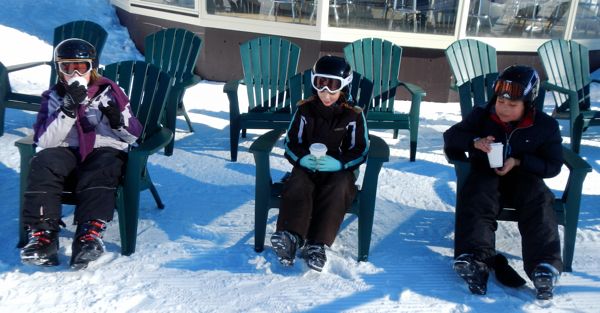
Sitting in the snow, as snowboarders often do, the three friends chat about what it’s like to be on the slopes.
This is Day 2 for these fifth-graders from Sierra House Elementary School. And it’s not exactly what they thought it would be like.
Camille Dahili, Yesenia Garcia and Serena Palaroan all agree snowboarding is more difficult than they expected, but it’s way more fun, too. Balancing and stopping are the hardest, they say.
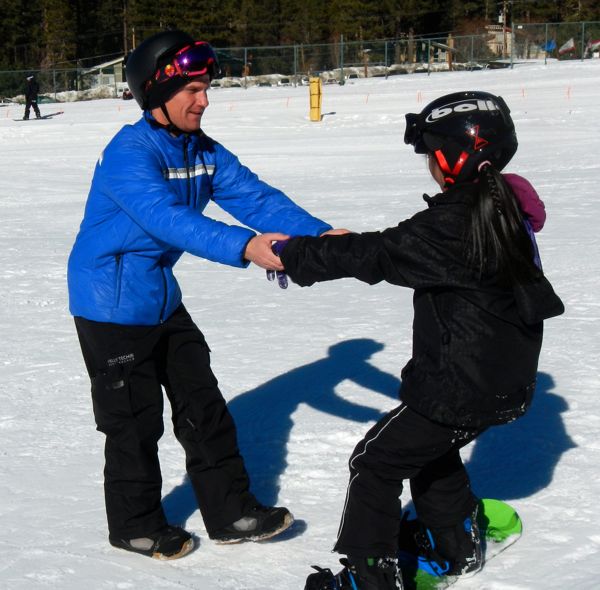
Serena Palaroan learns to use her edges from Heavenly instructor Jonathan Lyman. Photos/Kathryn Reed
For three days all fifth-graders in Lake Tahoe Unified and St. Theresa School learn to ski or snowboard at Heavenly Mountain Resort. And if they already know what it’s like to have a plank or two strapped to their feet, they are paired with an instructor who can cater to their appropriate level.
“We think three times is enough to get a taste … to learn to turn and stop, ride the lift safely, a little bit about skier and rider etiquette, and the skier responsibility code,” Mike Allen, Heavenly’s director of skier services, told Lake Tahoe News.
The program has been in place since at least the late 1980s.
Allen said this age level is ideal for first-timers.
“It’s an age when kids get their own sense of independence. They have good strength, good sense of balance,” he said.
It’s not all fun and games – even if the kids don’t realize this.
“It’s an extension of the classroom,” Sierra House Principal Ryan Galles said of the ski program. “There is the PE benefit, learning about health and safety. We live in a mountain town so safety decisions are a huge piece of the discussion. We do writing activities with this before and after.”
Lily Smith, Bryona Ziegler and Christian Arcinega-Pineda take a hot cocoa break.
For many of these kids, this is their first time to be at a ski resort. Galles estimates almost half of the kids have not skied or boarded before.
There is something about food and skiing that go together – whether it’s making a pizza with skis in the snow, or putting them together like a sandwich when taking a break, or holding poles like a cafeteria tray and not spilling.
These little triggers are ways ski school instructors help youngsters to learn to be better skiers.
Lily Smith, who isn’t new to the sport of skiing, said, “I like challenging yourself and having fun.”
She is paired with Christian Arcinega-Pineda and Bryona Ziegler.
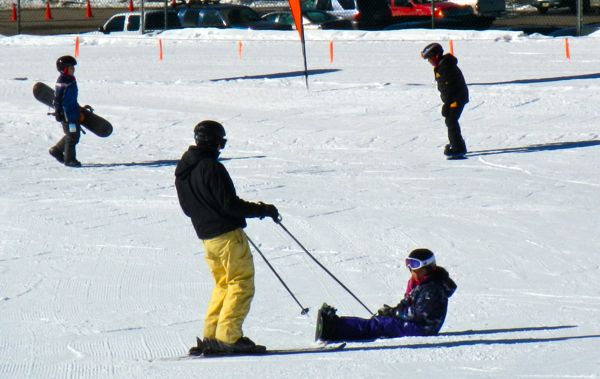
Sierra House Principal Ryan Galles makes sure Yesenia Garcia is OK after falling.
Instructor Gavin Lynch gives them advice as a group about how to hold the poles in front of them and individual tips as they ski to him.
Arcinega-Pineda said he’s learned “how to control myself down the slope.”
Mostly it’s all smiles — except for the the snowboarders when they fall. But that is another part of the learning process.
Beaver Creek scores with days of culinary riches
By Kathryn Reed
BEAVER CREEK – Unfamiliar aromas waft through the room, dozens of corks are coming out of wine bottles, chefs usually only seen in magazines or on television are milling about. This weekend is all about eating and drinking, and a little about getting on the mountain.
It’s definitely not your ordinary ski vacation. Talk among guests proved that. People were not chatting about which runs they went on or how the snow conditions are or even past ski experiences – it was all about what was on the other end of the fork or spoon or what was being swirled in a particular glass.
Instead of flying all over the country to taste the delectable dishes of seven well-known chefs, Beaver Creek assembled the culinary geniuses in one place. John Besh, Anthony Giglio, Tim Love, Spike Mendelsohn, Alex Seidel, Gail Simmons and Sam Talbot were the stars.
The Jan. 24-27 annual Beaver Creek Food & Wine Weekend is an experience for those who enjoy food that is off the charts good, wines not found in all restaurants or store shelves, and a camaraderie among foodies that has conversations turning to: “What was in that pumpkin puff?” “How did they get the beets sliced like that?” “Was the pasta sautéed in rabbit au jus?”
No shortage of wine at the Beaver Creek Food + Wine Festival. Photos/Kathryn Reed
It would have been impossible to attend all of the events during the four-day affair, but it’s easy to pick one event or put a package together. A couple from Denver opted for the Snowshoe & Gourmet lunch – it was her birthday present from her husband. (This event often sells out.) Last year people met at the event and said they wanted to come back – so that’s what the new group of friends did. A couple from Key West picked a package stacked with events – so much so they had to skip one they were so full. One couple mentioned how they have been to 70 countries and each trip revolves around food. A couple from the Houston area wanted an adult vacation.
While Beaver Creek is known for being a family-friendly resort, the food and wine event definitely caters to a different crowd – one that doesn’t even have to touch the snow.
The first night was an opportunity for the chefs of Beaver Creek (Christian Apetz, David Gutowski, Daniel Joly, Jay McCarthy, David Walford and Kirk Weems) to wow the group.
Walford took an animal familiar to those in Colorado – lamb – and turned it into a stew that some called “magnificent.”
When it came to the foie gras stuffed Twinkies the reactions were mixed – from “oh, ya” they are worth having to “Twinkies should only be filled with something sweet”.
The celebrity chefs had the night off from work in the kitchen, but they worked the crowd so guests could ask for a tip or two.
Events like this are also an opportunity for wineries to get in front of people who might not be familiar with their label. Paula Schweiger of Schweiger Vineyards and Winery in St. Helena says only family members or employees pour so customers can get information “right from the source”. This was not true of all the wineries at this event.
For Ed St. John at Pedroncelli in Geyserville the thinking is an event like this attracts people from all over the country, so he is reaching a broader demographic than if it were a locals-only event.
Matt Jones, who is on the national board of directors for Slow Food USA, looks over the assembled celebrity chefs and says, “There are killer purveyors here tonight. Alex Seidel is a terrific chef and former Food + Wine top new chef.”
(Food + Wine magazine is the other main player besides Beaver Creek in putting on the event.)
Seidel owns Fruition restaurant in Denver. Vail visitors may remember him when he was the chef de cuisine at Sweet Basil. He’s all about cooking with local ingredients. So much so that he has a 10-acre farm that in addition to fruit and vegetables being grown, sheep are raised for their milk that is turned into cheese.
Gourmet lunches
Seidel was the featured chef with Grouse Mountain Grill Executive Chef Gutowski at the Snowshoe & Gourmet Lunch. The day started with a trek through Beaver Creek’s McCoy Park Nordic Center. It ended at Gutowski’s restaurant inside the Pines Lodge.
To take the chill off from the lift ride down, hot cocoa is served – made with Lindt chocolate. It was like having dessert before the main course.
Then the glasses of Schweiger 2011 Sauvignon Blanc came around. (Stella, Leffe and Hoegaarden beers were available at most of the events as well.)
“I wanted to do as much as I could from Colorado,” Seidel told the diners as they started in on the roasted beet salad.
The pumpkins used for the puffs that were served with the first wine came from a farmer in Boulder. The rogue blue panna cotta for the salad is from Seidel’s sheep.
The salad, which also came with poached pear and almond vinaigrette, and pickled pearl onions was so pretty it was hard to ruin it with a fork. But it was too inviting not to want to devour.
“It’s like a rock concert for your mouth,” Jude Mansur of Fair Hope, Ala., said of the salad.
This was paired with a 2009 Schweiger Merlot.
Winemaker Andy Schweiger said they bottle the Merlot after 36 months “to give the tannins more time to obliterize.” This is twice the amount of time some wineries wait to bottle.
“I make wines to complement food,” he told the group.
Only 300 cases of the Merlot were bottled; with a good number of those opened in Beaver Creek last weekend.
The 2008 Schweiger Cabernet Sauvignon was chosen to go with the braised rabbit pappardelle. The rabbit had caramelized cauliflower, clamshell mushroom conserva, with truffled rabbit jus.
Superlatives ran off the tongues of those at the table as they barely paused between bites.
The house-made crème fraiche cake with vanilla cream, lemon curd and huckleberry sorbet was paired with the Schweiger Port X.
The port is 100 percent Cab grapes that are blended with brandy.
The dessert was so incredible that the table wanted seconds.
The next day diners got a little exercise via the slopes of Beaver Creek before the exquisite lunch that was prepared at the Ritz-Carlton, Bachelor Gulch. Chef John Besh, who was also on the slopes, admitted the first course was prepared by his team.
His Southern roots did not necessarily inspire Besh’s dishes for the day. He served elk as the main course. This is a common item on menus in Colorado.
He told Lake Tahoe News he prepares the foods he grew up with – like gumbo, etouffee and jambalaya – when he is at home.
Besh owns six restaurants in the New Orleans area. He’s participated in nine Iron Chef competitions and was runner-up on Food Networks’ “Next Iron Chef”.
Besh said he tries to ski two weeks a year, with the food and wine event his adult week.
Walking into the dining area guests are handed a glass of Capture 2010 Chardonnay. Slippers are also provided so ski boots don’t have to be worn during lunch.
The first course is cauliflower and lobster bisque with quail and brioche toad-in-the-hole and shaved white truffle. This is paired with Hoegaarden beer. The thick broth is poured tableside onto the ingredients already in the bowl. Chunks of lobster are in the soup so there is no mistaking what is being served.
The main course was chestnut cavatelli, a ragout of elk shoulder and wild mushrooms. It was paired with a Capture 2009 Cabernet.
“It’s like filet mignon,” Gary Mathews of Key West raved.
Dessert was a warm gateau Basque with red wine preserved berries. It was served with a Capture 2008 Port.
(The Healdsburg winery poured a Sauvignon Blanc at the Grand Tasting that they said is the No. 1 Sauvignon Blanc at the French Laundry in Yountville.)
Grand Tasting
For the signature event, the Grand Tasting is about nibbling on culinary treats from the celebrity chefs as well as Beaver Creek’s chefs, all the while pairing the food with mostly California wines, but a few Colorado ones as well. (Two Rivers in Grand Junction, Colo., was a nice find.)
Jay McCarthy, corporate chef for Group970 Restaurants, is taking a breather from his station. He’s letting Chris Foley of Beaver Creek Chophouse handle the jalapeno and cheddar elk mac and cheese. McCarthy has been up since 7am getting ready for the tasting that started at 7pm at the Park Hyatt.
McCarthy says it’s a tight brotherhood of chefs in Beaver Creek. After all, the enclave only has 400 residents, while the county has 30,000. With a million skiers hitting the slopes, the multitude of restaurants has a lot of hungry people to feed.
Many of those restaurants came out to show off what they can do. Dishes ranged from smoked trout parfait to slow roasted guinea hen breast to toast with ricotta.
But that wasn’t any ordinary toast with ricotta. Chef Sam Talbot used Korean style figs and braised scallions. It was just the right balance between the sweetness of the figs with the cheese.
Bryan Simonsen at Blue Moose Pizza created what he called autumn pizza. It was crimini mushrooms, truffle oil, parsley, Parmesan, garlic, olive oil and goat cheese on a whole wheat crust.
The mini ding dongs from Christina Apetz and Janielle Hultberg at 8100 Mountainside Bar & Grill brought back fond childhood memories for many people. Their more adult dessert was beer floats. Chocolate ice cream for a dark beer like Leffe, lemon for the Stella.
Other events
There were three other events on the Friday for a total of five. The Burgers & Beers will be featured in an upcoming Lake Tahoe News story.
And there were four events people could partake in on Saturday.
Sunday was the Celebrity Chef Ski Race & Brunch.
While the 2014 dates and events have not been announced, the Beaver Creek website will have details when available.
ngg_shortcode_0_placeholder (Click on photos to enlarge.)
S. Shore chamber turning its attention to politics
By Kathryn Reed
Lake Tahoe South Shore Chamber of Commerce is about to become a lot more political.
That was one of the proclamations by CEO B Gorman at Thursday’s annual breakfast meeting.
“The board made a courageous and progressive decision at their retreat. They have decided to create a Government Affairs Committee,” Gorman told the group assembled at Tep’s restaurant on Jan. 31.
Criteria for what issues or political races are worth taking a stand on are still being developed. The framework is expected to be completed in April.
The chamber is also going to start tracking elected officials’ votes primarily as they relate to decisions that affect businesses. Gorman said the chamber would then be able to share with the 643 members how politicians have voted – basically if they are business friendly or not.
In many ways the chamber is already political. In 2006 it put together a Regional Plan initiative to help direct how the TRPA’s final document would look.
“We provided TRPA policymakers with information about how they impact you as a home owner, business owner and employee,” Gorman said. “We were responsible for 150 people showing up at TRPA meetings.”
The TahoeFuture.org website that the chamber set up to provide people information as the bi-state planning agency went through the process to update its Regional Plan will remain active as the document begins to be implemented.
This year, the chamber is going to focus on economics and relationships.
Following up on the October economic forum will be a workshop (March 5, 5-8pm, Embassy Suites) to look at what happens next. People will talk about what they are working on – from the city’s recreation master plan, to Tahoe Regional Planning Agency area plans, to Vail Resorts, to Lake Tahoe Community College. The public will help identify the gaps – what isn’t being done.
Implementing the plans, ideas, goals – that’s the next step.
With the wayfinding signs installed on the California side of the South Shore, the chamber is going to try to do the same in Nevada.
Another goal for 2013 is to up the 84.3 percent membership retention rate to 86 percent.
Today the chamber’s new website is expected to launch.
Councilwoman takes issue with loop road talk
Alternative 2 of the loop road proposed by the Tahoe Transportation District.
By Kathryn Reed
STATELINE – One thing rang loud and clear Wednesday – Tahoe Transportation District and South Lake Tahoe officials are not on the same page when it comes to the proposed loop road on the east side of the city.
Carl Hasty, leader of the TTD, was the guest speaker Jan. 30 at the Soroptimist International South Lake Tahoe meeting at Harveys.
City Councilwoman JoAnn Conner was a guest of the Soroptimist. She was sitting next to newly appointed, though not yet sworn-in, Councilwoman Brooke Laine.
Hasty spoke about Alternative 2, the original route his agency brought forward and how the city doesn’t like it. But it is still on the table.
Carl Hasty, Tahoe Transportation District executive director, talks Jan. 30 to Soroptimists about the loop road. Photo/Kathryn Reed
The TTD is an independent agency and does not take its direction from the city. The city has one vote on the TTD board. That member is Councilwoman Angela Swanson.
TTD can go forward with the loop road no matter how much the council protests. If properties would need to be obtained by “force”, either the city or Caltrans would need to implement eminent domain. The city says it won’t do so. Alternative 2 would affect more than 80 properties – some residential, some commercial.
Then Hasty spoke about the triangle alternative.
“The city says they would like this in the environmental documents,” Hasty said.
Conner looked quizzical, and shared with tablemates that that alternative has not been before the council.
During the question and answer period she told Hasty she had no idea what he was talking about when it came to Alternative 3.
Hasty said he plans to be back in front of the council in February or March to discuss the loop road.
The idea is Highway 50 would be rerouted behind the casinos, with most proposals going only behind Harrah’s and MontBleu. The current highway by Heavenly Village and in front of the Stateline casinos would be narrowed and become a city street.
Hasty called the loop road an opportunity and that those in the room should see it that was as well.
Making the area more pedestrian and bike friendly are goals, as is the ability to close down the road and have events on the city street.
But what is never discussed is why today events don’t occur on the current loop road – behind any of the Stateline casinos.
After the council gets an update, the TTD board will hear a presentation, the results of the economic analysis should be out in the spring, then alternatives will be refined.
“We are not at the detail level yet,” Hasty said. That will come with design charettes as well as when the city and Douglas County work on their respective area plans.
The goal is for the loop road to go through the environmental process in 2014, funding would be sought in 2015, with construction to follow when money is in hand.
Heavenly’s tram — a 50-year-old tradition
By Susan Wood
One of South Lake Tahoe’s most famous landmarks has carried countless skiers and boarders up the steep slopes of Heavenly Mountain Resort’s lake-facing ridge. It has carried a history with it – one that has stood the test of time.
The tram has been operating for 50 seasons.
From old-timers to modern-day users, the tram in six minutes has whisked riders up to the back slopes. It can cart 600 people an hour up the mountain. Near the top is a restaurant, which has changed names a few times since the lift’s inception in 1962. It’s now a burger joint with a bar called Booyah’s.
South Shore’s longtime skier, former Heavenly employee and Olympic volunteer Martin Hollay still makes the tram part of his morning ski ritual. Hollay lives a few blocks away — his home base since going to work for Heavenly in 1964.
Views from the tram are one reason people continue to ride it from Heavenly’s California Lodge. Photos/Kathryn Reed
He likes the views from the tram and said he’d be heartbroken if it were taken out. The views are unparalleled, sweeping 180 degrees of the lake’s south shore.
“It should be kept because it’s a big part of Heavenly’s history,” Hollay told Lake Tahoe News.
Although the tram is documented in the 2007 Heavenly Master Plan, its days could be numbered once the redevelopment plan involving the California Base Lodge is launched. This is according to Heavenly and confirmed by the Tahoe Regional Planning Agency and U.S. Forest Service. A smaller lift situated closer to the ground will replace the tram. It is proposed to land near the top of the Powderbowl chairlift.
“Its removal is no longer tied to the implementation of the gondola,” said Andrew Strain, Heavenly’s planning chief. The Heavenly Gondola opened in 2000 near Stateline from the Highway 50 street level.
The scenic impacts of the building and towers were discussed by TRPA back then, but never fully addressed. The new plan was approved in 2007 by the regulatory agency.
The U.S. Forest Service, which leases the land to Heavenly, is treating the plan as a “concept document,” said Jonathan Cook-Fisher, the Lake Tahoe Basin Management Unit recreation special uses regional manager.
Fisher uses the tram because before he hits the slopes he likes “to tinker” with his gear. One can do that while standing in the tram. Other than that, he treats taking the tram versus the other lifts as a difference between an escalator and elevator.
“It has served the ski area well,” he said.
Heavenly’s tram has been transporting people for 50 seasons.
Tram proponents — including former employees — hope there is as much room for the lift in the town as there is in the hearts of its residents.
Malcolm Tibbetts, Heavenly’s former vice president of mountain operations of 32 years, remembers working with the tram like it was yesterday. However, the place looked a lot different and wasn’t owned by Vail Resorts.
“When the tram was first built, it was a separate company, but it didn’t stay that way very long,” he told Lake Tahoe News. “Back then, the lifts were numbered.”
There were three chairlifts and two rope tows. The tram was completely rebuilt in 1986 – making the new one faster and larger. The new one doubled the number of passengers to 50.
“As a tourist lift, it was fantastic,” said Tibbetts, who still lives on the South Shore. “From a marketing standpoint, it probably paid for itself.”
“It’s a part of the Heavenly history,” he said.
Tibbetts recalled how employees would unwind at the top building known decades ago as the Pioneer Hut.
“It was added onto through the years,” he said. “We loved to do our own construction.”
The tram turned out to be a bane and a blessing. It needed much maintenance, creating a “huge headache” for the mountain operations workers, Tibbetts added. “It had its quirks,” he said.
One morning, all but one member of the ski patrol was caught in the tram when one of the cables “reversed,” making it necessary to slow the tram down to a “creeping” speed a half hour before the mountain opened.
The restaurant that came to be known as Monument Peak was a steakhouse where workers and old-timers staged last-minute parties.
Some parties were more memorable than others.
About a decade ago, a spine-tingling version of “God Bless America” was sung by a host of pioneering South Lake Tahoe families who gathered at the restaurant to honor the late Patsy Gilman Wood. Her husband, Robert Wood, was a founding partner of Heavenly and was on hand to help lead the group in singing her favorite song. (Patsy Wood has a run and lift named after her, but is not related to this reporter.)
The Woods were instrumental in getting the tram off the ground in 1962.
Today’s riders are more than grateful of the effort.
“We always ride the tram,” said local skier Jill Berliner on a recent morning with her son, Bram Sigman.
He noted how many riders are scared to go up the tram because of how steep the ridge appears.
They also know when the gondola is on wind hold, the tram is often a last hold-out to get on the mountain.
Lake Tahoe’s Olympic gold medalist Teter tells the world how to ‘Master Snowboarding’
By Susan Wood
Olympic gold medalist Hannah Teter, who snowboards for Sierra-at-Tahoe and hails half the time from the South Shore, has written a book about her sport.
The “how to” book called “Mastering Snowboarding” reveals its “seven truths” as told by one of the best. Teter has won many awards, including five medals in the Winter X Games in 2003, 2004, 2005, 2009 and 2010. Most notably, she won gold for the United States in 2006 at the Winter Olympics in Torino, Italy – for which she was tapped as the U.S. Olympic Committee’s Sportswoman of the Year.
Now – at a the mere age of 26 as of Jan. 27, she has elected to share the secrets of her craft with beginners and moderates as well as advanced riders.
Everyone has to start somewhere. For Teter, it was the back yard of her parents’ home hitting a jump her brother had built.
“I think I got a little banged up, but I had the bug from (then on) and never looked back,” Teter told Lake Tahoe News.
When asked why she is giving away her secrets in such a competitive sport, Teter added: “I wanted this book to be something that any rider from the first-day beginner to the up-and-coming pro could pick up some tips from, (ones) that I wish I had been presented with when I was coming up.”
This isn’t the first time Teter has given back. She is an active philanthropist – especially when it comes to the world’s poor. She started Hannah’s Gold in 2008, named after her family’s maple syrup that comes from her hometown of Belmont, Vt. The charity donates profits from the foundation to the village of Kirindon, Kenya, where the money goes to securing clean drinking water, schools and farming projects. Her efforts got the attention of Ben and Jerry’s Ice Cream of Vermont, which labeled a flavor after her – “Hannah Teter’s Maple Blondie.” (Note: This reporter from Vermont tried it a few years ago on a visit to the company’s Waterbury factory and highly recommends it to all sweet tooths.)
This time, Teter gives back by warning snowboarders in her seven truths, that yes, “Everyone fails.” It’s all a part of the risk one takes to advance in any humbling sport.
“It’s easy to get down on yourself when you first start snowboarding,” the book says on how to “stay positive” in the “What to expect” chapter highlighting the seven truths. “Practice makes perfect.”
The other six truths sound simple and include:
• You are going to feel uncoordinated.
• Feeling embarrassed is optional.
• Visualizing helps.
• You may love or hate snowboarding right away.
• If you are optimistic and focus on having fun, you will enjoy the ride.
• You are going to be sore at the end of the day.
The “Getting the most out of your ride” chapter may reduce the soreness of workouts. Techniques involving crunches, dumbbells, medicine balls and stretches are featured.
The book, which is co-written with Tahoe Snowboard magazine founder and editor Tawnya Schultz, highlights a little of the snowboarder’s own language. For example, the “ollie” means to use the momentum of your body on a jump.
There’s also a host of rail tricks with cute names such as the tail and nose taps along with the wall ride. The tricks chapter represents the most compelling tips Teter said she wants readers to take away from the book.
“Some fun tricks in there aren’t super fun to learn,” she said of the challenge.
Once again, most things worthwhile in life don’t come easy.
“There are many tricks to be learned, and they are well diagrammed,” randyw22 posted on Amazon.com, one place where the book can be purchased for $15.17 in softback as a coffee table book and $11.99 on Kindle.
It appears Teter is challenging herself yet again for the upcoming Winter Games in Russia in 2014, telling Lake Tahoe News she’s working on a few new tricks.
“I’m hoping to have (them) dialed in before the end of the season,” she said.
What’s the biggest obstacle to honing the craft?
“(It’s) always mental. Once you release that self-doubt (that) is the biggest obstacle to success … the sky is the limit,” Teter said.
Teter knows all about a limitless sky.
She came across the opportunity to write the book through her management. The publishers, Human Kinetics, have come out with a slew of recreation-oriented how-to books on a range of topics – from social dancing and high-scoring baseball to senior fitness and the triathlon anatomy. The Illinois-based company has released seven “mastering” books in the series, which also highlights mountain biking and judo. Beyond Amazon, Teter’s is available through Barnes & Noble and Books a Million.
“We obviously picked her because she’s well known in the sport. It’s great we got someone of her caliber,” the Illinois-based company’s Publicity Manager Alexis Koontz told Lake Tahoe News.
Koontz announced Teter’s book a month ago, and it has received rave reviews. One came from the head coach of the U.S. Snowboarding and Freeskiing Association.
“Hannah has not only won Olympic gold and silver medals, but she has also lifted women’s snowboarding to the next level during her 10-year pro career. ‘Mastering Snowboarding’ lays out a clear path so you too can reach your potential, feel great and have fun,” Mike Jankowski said in a statement.
Of course, a girl has to have some fun, and that’s something Teter has come to embrace when she’s not working.
The pro snowboarder, who has perfected the skills of flying through the air above the manicured, hard-packed superpipes, enjoyed the oh-so different experience of carving Tahoe’s recent holiday powder at Sierra-at-Tahoe before hitting the road.
“I had the time of my life. Sierra-at-Tahoe is family to me. It is the most fun mountain to shred in all of Tahoe,” she said.
The ski resort west of Meyers rewards the pro with her own “walk-of-fame-style” preferred parking spot marked by a star just next to the slopes.
When she visited, she dropped off a copy of the book to Sierra General Manager John Rice, whom she mentions in the book’s acknowledgements alongside marketing manager Mindi Befu.
“Hannah has become a true champion in many aspects of life, as a competitive snowboarder and as a philanthropist. Her passion for the sport and for life are what set her apart from other successful athletes. We wish her all the success in the world with her latest project as an author,” Rice summarized.
After a quick read, Rice said he found the book to be “a very complete guide to snowboarding” – from the tricks and gear to health and safety.
In particular, the Sierra chief also liked the way she covered all aspects of the sport, including its origin. “The History of Snowboarding” in Chapter 1 notes “snurfing” in the 1970s from an East Coast surfer sliding on lunch trays strapped to his feet. Snowboarding gurus Jake Burton Carpenter and Tom Sims took notice, and the sport’s popularity took off in the 1980s. In the decade’s second year, the first National Snowsurfing Championships were staged at Suicide Six ski area in Woodstock, Vt. – this reporter’s hometown. The first ski area in the United States was launched within a mile from Suicide Six – Mt. Tom.
Travelocity founder, Tahoe resident offers inspiration with book on business innovation
By Kathryn Reed
Plenty of people can talk a good game, but few actually are in the game. Terry Jones is a talker and a player.
As founder of Travelocity and chairman of Kayak.com, Jones knows what it takes to start a successful company from scratch and keep it viable. As someone who has been on the lecture circuit for the past 10 years, he knows how to inspire.
But the Incline Village resident also knew he was packing a whole lot of information into 60 minutes, where people might take away one or two ideas. That is what inspired him to turn his talks into a book. “ON Innovation: Turning On Innovation in your culture, teams and organization” was published in 2012.
It’s a fast read. Jones has designed it so it does not have to be read cover-to-cover. He also envisions it being a reference book.
The 194-page book ($15) has 72 ideas. Each chapter is a few pages. This is a book that is ideal for front line staff, CEOs and definitely middle managers.
“Most books on innovation are very academic,” Jones told Lake Tahoe News.
His is more of a “how to” book. How to do things, how to look at your business in a new way, how to be strategic, how to listen — overall, how to innovate. The book delves into the need to experiment, take chances and lose the phrase “we’ve always done it that way”.
“You have to reinvent yourself all the time. I don’t think it has anything to do with Tahoe, it has to do with business in general,” Jones told Lake Tahoe News.
He said retail in particular has it hard because of all the competition online.
Jones knows he’ll be writing another book. The focus will be about building digital relationships.
He said it’s travel more any other industry that has been transformed by the Internet. This includes people using the Internet to search for places to stay, to rent skis and a place to eat at the end of the day.
Jones was the keynote speaker at last fall’s Nevada Governor’s Conference on Tourism.
He is on the board of the Lake Tahoe Shakespeare Festival – chairman the last three years and currently the secretary. Jones said when he first started working with the Incline group the bulk of the advertising was with local print publications even though 60 percent of the people at the summer event were tourists.
Now the festival has a strong Web presence.
Jones has had a place in Cave Rock for about 10 years. When he got divorced he wanted out of Texas and picked the Tahoe house. Through Match.com he met his current wife.
“She said if you want me, you get Incline too,” Jones said. They live together in Incline, though he is on the road about 150 days a year.
When he isn’t speaking, writing or doing work for one of the multiple boards he sits on, he can found enjoying Lake Tahoe. This season he returned to the slopes after having quit downhill skiing when he was 15 because he needed a spinal fusion. He finally got that fusion.
He skied earlier this month for the first time in 50 years.
“My wife was a competitive skier in college. I hope to get to the point where I can ski with her,” Jones said.
In the summer, look for him skimming across the water in his Wherry boat at Sand Harbor.