Hotel lobbies becoming Wi-Fi magnets

By Barbara De Lollis, USA Today

Travelers may hate paying for Wi-Fi in their guest rooms, but more hotels are getting ready to offer it for free in lobbies.

More than 300 Marriott Hotels & Resorts locations will flip the switch in the coming weeks on free lobby Wi-Fi to please guests and non-guests alike, a senior Marriott executive tells USA TODAY.

Wi-Fi currently is free in the lobbies of about 185 of Marriott’s nearly 500 hotels, and it will become standard across all hotels by March 31, says Marriott’s Michael Dail.

“We have so many people who don’t spend the night but may come for a meeting or happy hours. That’s what they want,” says Dail, the brand’s marketing vice president. “A lot of our hotels already offer (free Wi-Fi), but we want to make it standard.”

The move toward free lobby Wi-Fi underscores how hotels have sought to reinvent lifeless lobbies and common areas to lure a new generation of travelers who work and socialize differently. The hotels are adding libraries, lounges, communal tables, desktop computers, ping pong tables and various other conversation starters with the hope that people will linger and work over coffee, cocktails or a $10 hummus plate.

“Over the past five years, we have renovated (hotel lobbies) and overhauled the menus, so the last piece is opening up the Wi-Fi access,” Dail says. “These are great social hubs for meetings, for leisure travelers, for social business. People are congregating there like people do in a house kitchen.”

Some owners of upscale hotels predicted this would be the future. Sunstone Hotel Investors, for instance, began making Wi-Fi free in the lobbies of its Marriott-brand hotels starting about three years ago as they were updated, says Marc Hoffman, the company’s executive vice president. The company owns Marriott hotels in Boston, Philadelphia, Portland, and Park City.

“We noticed several years ago the trend for travelers to want to enjoy public area, bars, restaurants, lobbies in a new way,” he says. People also rely on lobby Wi-Fi to “reduce the frustration” over paying for Internet in their rooms, he says.

As Sunstone revamped each lobby, the spaces were unveiled with free Wi-Fi. As a result, Sunstone has seen a “dramatic increase” in the use of the spaces, food and beverage sales, and guest satisfaction, Hoffman says.

Hyatt behind Marriott

Lagging behind Marriott is Chicago-based Hyatt, which still has several locations where lobby visitors seeking Wi-Fi will be asked to pay a fee, says Hyatt spokeswoman Amy Patti.

Many of Hyatt’s full-service hotels in the U.S. have installed two desktop computers that provide 15 minutes’ worth of free Internet, she says.

But in today’s wired world, travelers get annoyed and may even move when they discover that they have to pay, since Wi-Fi is free in so many other places.

“It’s interesting how many of the upper end and luxury hotels want to charge for this service, while at the same time trying to position their public spaces as ‘social hubs’ that are supposed to be friendly places to informally connect, socialize and relax,” says frequent traveler Mark Snyder. “It happened to me recently in NYC, so I went around the corner to a place that truly is a ‘social hub’ — Starbucks.”

Frequent traveler Henry DeLozier also has a strategy to get around Wi-Fi fees in hotels where he doesn’t have elite status, such as Fairmont. “I refuse to pay and carry a wireless modem instead,” he says.

Hilton, Doubletree, Sheraton: Free lobby Wi-Fi old news

Marriott and Hyatt, however, are exceptions.

Wi-Fi, for instance, has been free in the lobbies of the 300-location Doubletree by Hilton chain since 2005. And last year, the 550-location Hilton chain made it free, says spokeswoman Dasha Ross.

Starwood’s Sheraton chain also offers free Wi-Fi in its lobbies.

Does Marriott’s move mean that travelers can expect even bigger news: That the chain will make Wi-Fi free in guest rooms?

“We’d love to do the full hotel, but we’re not ready,” Dail says.

Potential downside?

When large hotels make Wi-Fi free in public spaces, data usage typically soars, says Roger Crellin, president of hotel-Internet provider iBahn.

“We have seen an up to 300 percent increase in data traffic,” he says. “From a business perspective it’s a great service.”


Funding issues force CTC to scale back projects

By Kathryn Reed

Maintaining its nearly 5,000 properties and paying the people to do so are the priorities of the California Tahoe Conservancy in this era of austerity. New projects, while important, are farther down the priority list.

This was the bleak news delivered to the board on Thursday at its meeting at Lake Tahoe Community College.

That is not to say the Conservancy won’t be funding projects – just not to the level or at the frequency as some in the Lake Tahoe Basin may have gotten accustomed to.

CTC logoAlmost $2.3 million has been set aside to buy the Alta Mira building and Johnson Meadow in South Lake Tahoe. The building is at the far end of what is to be the second phase of Lakeview Commons. Demolishing the structure would open a view to the lake and tie the area into the Commons that was completed last year.

About the same amount of cash is being put toward the Sustainable Communities Investment Program.

The CTC’s Kevin Prior, who went over the numbers with the board, said this money would be used to acquire coverage outside town centers, tourist accommodation units and commercial floor area. (The Tahoe Regional Planning Agency has made a commodity out of hotel rooms and commercial square footage.)

Just more than $900,000 is set aside for the South Tahoe Greenway Bike Trail that one day will go from Meyers to Stateline. The Homewood and Dollar Creek bike trails have $1 million in CTC funding.

The CTC has budgeted $1.4 million for restoration of the Upper Truckee River Marsh. That project will be before the Tahoe Regional Planning Agency board on the afternoon of March 27.

The capital outlay budget is expected to drop to less than $12 million for fiscal year 2014-15. It’s just more than double that this fiscal year.

“We can no longer rely on a percentage of bond sales,” Executive Director Patrick Wright said.

In the past, bonds were the primary source of the Conservancy’s budget. And while a water bond is still being talked about for the 2014 ballot, the original $100 million earmarked for Lake Tahoe is likely to be dramatically diminished or not exist at all. That is one of the warnings Wright delivered March 21.

Plus, a poll that came out this week shows voters are growing less enamored with the idea of a water bond.

“We hope by 2016 one or more new funding sources will come through,” Wright said.

The CTC divides its pot of money into two main categories – support and capital. The former deals with salaries, maintaining its assets – this includes fuel reduction projects, and the day-to-day operations of the agency. The capital budget is for acquisition of property and upgrading those parcels.

The support budget, which for 2013-14 is slated to be just less than $5 million, comes largely from license plate revenues. The CTC gets money from the Tahoe specialty plate as well as the environmental license plate fund.

A marketing campaign has the goal of increasing the $1.2 million Tahoe plate revenue by 10 percent in the next year. Instead of going after individuals, the CTC wants to get companies to buy into the program. About 30,000 vehicles in the state have the Tahoe plate.

The Conservancy also recognizes it has not done a great job in educating people about how the bike trails and other projects are the result of the those new and annual renewals of the specialty plate.


Ad campaign helps fill N. Lake Tahoe hotels

By Renée Frojo, San Francisco Business Times

“Your life called. It wants its balance back.”

That’s one of the lines from North Lake Tahoe’s newest advertising campaign that’s trying to take some of the credit for the destination’s surprising boost in hotel bookings.

Despite the severe lack of snow, hotel bookings in Tahoe are reportedly up by more than 30 percent weekly over the first three months of 2012. While that also could be attributed to an improvement in the economy, other than anecdotal evidence, heads in beds is one of the few things advertisers can use to measure success of a campaign.

This is one of the ads created for North Lake Tahoe by School of Thought.

This is one of the ads created for North Lake Tahoe by School of Thought.

To give them credit, it has been eye-catching.

If you haven’t noticed the billboards or stencil street power washings which is running in San Francisco and Los Angeles, the focus is on living your life to the fullest and pitching a winter escape to North Lake Tahoe as inner restoration.

Unlike previous campaigns, they’re not telling you what to do, exactly, just giving a glimpse of what you’re missing — reminders about the joys of life away from a desk or computer. Of a dozen different headlines, only one is specifically ski related.

“Every year the ads for Tahoe tend to portray some sort of badass skiers, and North Tahoe in particular is distinctive, so we felt campaign needed to reflect that,” said Joe Newfeld, co-founder and creative director of San Francisco-based advertising agency School of Thought, which is spearheading the campaign for the North Lake Tahoe Marketing Cooperative.

Some of the campaign’s headlines include, “When your kid asks about the stars, do better than an app,” and “Somewhere not far away, people are sipping hot chocolate and making snow angels.” Or one of my favorites, “A sick day is a terrible thing to waste.”

The $330,000 campaign also did some creative marketing by slashing broadcast radio from its budget to add more Internet radio, TV, blogger outreach and even street stencils — all with a 15 percent cheaper budget than the year before.

“We don’t take credit for all of it, but the numbers are up and that’s good for the clients and the economy up there,” said Newfeld.

Hopefully the continued lack of snow won’t put a damper on things.


South Tahoe devising plan for state line area

By Kathryn Reed

Remove development on the lake to provide better views. Have hotels near bike-pedestrian paths. More access to public transportation. Boardwalks. More kayaking. Decrease the number of driveways at Bijou Center. Make Lakeside Beach public.

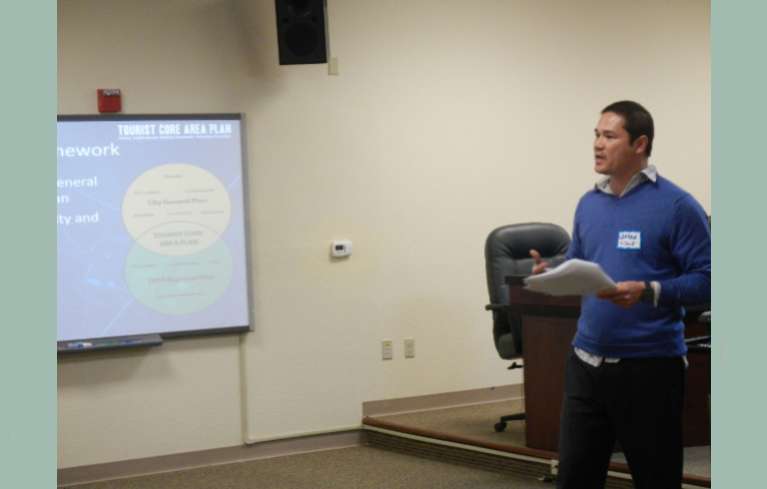
Those are some of the ideas the public came up with at a meeting Wednesday night in regards to the tourist core area, aka the state line section of South Lake Tahoe. The plan goes from Ski Run Boulevard to the Nevada border.

The city is on a mission to have the area plan for this part of town go to the Planning Commission in May, the City Council in July and the Tahoe Regional Planning Agency Governing Board in August.

South Lake Tahoe planner John Hitchcock talks March 20 about the Tourist Core Area Plan. Photo/LTn

South Lake Tahoe planner John Hitchcock talks March 20 about the Tourist Core Area Plan. Photo/LTN

“The intent of the area plan is not a vision plan, it’s an implementation plan,” John Hitchcock, planner for the city, told the approximately 40 people who were at the March 20 meeting at Lake Tahoe Airport.

Hitchcock went over how area plans are TRPA’s latest version of community plans, but with the goal of being more functional. With a new TRPA Regional Plan in place, area plans come with redevelopment incentives, increased height allowances in town centers and the goal of revamping what’s in place for environmental gain.

South Shore resident Jerome Evans is concerned no one has asked business owners if they want to move to what are being called town centers; and wonders why an economic study to prove or disapprove this approach to planning is good or bad was not done.

One goal of the plan will be to harness and capitalize on the recreation areas that exist – Heavenly Gondola; Van Sickle Bi-State Park – including access to the Tahoe Rim Trail; Edgewood Tahoe Golf Course – and the beach that will be public after the lodge is built; the lake; and Ski Run and Lakeside marinas.

After the nuts and bolts were talked about, the mass of people went into the lobby area to write on maps, fill out comment cards and ask officials questions. The three main areas were land use planning and community design; conservation-water quality; and transportation-recreation.

Sharon Doughty, co-owner of the Ski Run Center that is anchored by the Red Hut Café, told City Manager Nancy Kerry after the group session that she is worried the plan will eliminate mom and pop businesses. Doughty fears the town centers will be high rent districts.

“Our goal is not to get rid of anything except something that is on very sensitive land,” Kerry said. “We don’t want to plan for the outcome, but instead plan for the opportunity to occur.”


Past decisions add to S. Tahoe’s Linear Park costs

By Kathryn Reed

South Lake Tahoe is balking over the $35,000 connection fee the water district is imposing in order for there to be ample water to irrigate Linear Park.

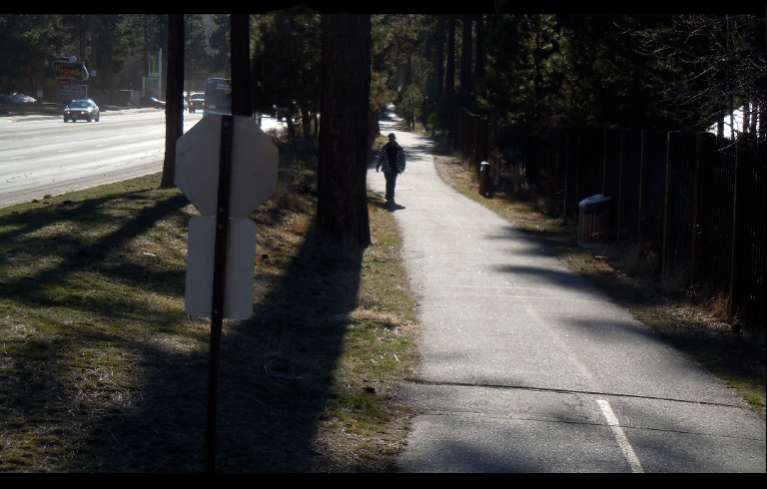
This stretch along Highway 50 isn’t really a park, but instead a paved path with landscaping from McDonald’s to Holiday Inn Express in front of the gated Tahoe Meadows neighborhood. It once looked better than it does now, but plants died without enough moisture and then the lights got kicked in, which contributed to the dilapidated look of the area.

In 2004, the now defunct Core 24 Charities had landscape plans drawn up for the area and secured a free connection for the 2-inch waterline from South Tahoe Public Utility District.

Linear Park in South Lake Tahoe will get a makeover this summer. Photo/LTN file

Linear Park in South Lake Tahoe will get a makeover this summer. Photo/LTN file

South Tahoe PUD saw this as a demonstration project to show how native landscaping can work in Tahoe with minimal water use and a way to promote its turf buy-back program.

(Core 24 morphed from the inaugural Leadership Lake Tahoe class that at the time was a product of the two chambers of commerce that later merged to become the Lake Tahoe South Shore Chamber of Commerce. Duane Wallace was the head of one of the chambers and on the STPUD board, STPUD spokesman Dennis Cocking was in LLT and Core 24, as was this reporter. When Core 24 dissolved, it gave the city $22,000 to be used solely for Linear Park.)

Former City Manager Dave Jinkens later traded that free connection for water at city facilities.

And with the current landscape design by Brett Long, the same person who did Core 24’s plans, the city wants lots of grass. This is not what the nonprofit had proposed or what was endorsed by STPUD. This requires larger water lines to accommodate all of the irrigation.

It also means the city now must pay a $35,000 connection fee. (The whole project will cost about $770,000.) The City Council on March 19 entered into an agreement with Herback General Engineering to do the work.

The California Tahoe Conservancy paid for most of the work the first time, but they aren’t allowed to use taxpayer money on do-overs.

Mayor Tom Davis pulled the item from the consent agenda and then went on a rant about how horrible STPUD is for charging connection fees.

The district, which was not at the meeting, told Lake Tahoe News afterward the connection fee is about buying into the nearly $1 billion South Shore water system.

“When people say waive this or that, they are saying all the ratepayers should help pitch in and waive this for project X,” STPUD’s Cocking said.

The money goes toward future improvements and replacement costs to the system.

“We are bound by law to charge what are real costs and what the costs of infrastructure are down the road,” Cocking said.

He added that the last time the rates were looked at – 2009 – the consultants recommended an increase. The board keeps saying stick with what’s in place.

But for Davis, he said the fees are “excessive” and “a job killer”.

He said the city doesn’t charge STPUD a fee to have the water and sewer lines under city streets.

When told this, Cocking said the city has altered its rules when it comes to STPUD crews doing repairs and that now more streets are paved by the district than anytime in the past – so the city is charging a fee of sorts.

At the end of the council meeting the five decided to create a new position, where Councilwoman Brooke Laine will be the city’s rep who will go to STPUD meetings and report back what is going on.

In other action:

• City Manager Nancy Kerry was given an “excellent review” by the council, according to the mayor. No changes were made to her contract.

• Aaron Abrams and Michael Adlard were awarded the concessionaire contract at Lakeview Commons and Regan Beach. Donna Rise (Aloha Ice Cream) will be the concessionaire at Bijou Park. Both contracts are expected to be for three years.

• The council approved guidelines for special events at Lakeview Commons.

• The five agreed to issue a request for proposals for signature events at the Commons.

• Councilmembers Davis and JoAnn Conner will work with city staff, Lake Tahoe Community College and the business community to keep SnowGlobe in town. The North Shore is wooing the music promoters. The college board on April 9 will have a debriefing on the 2012 New Year’s weekend music festival.


Dilapidated S. Tahoe motel to be resurrected

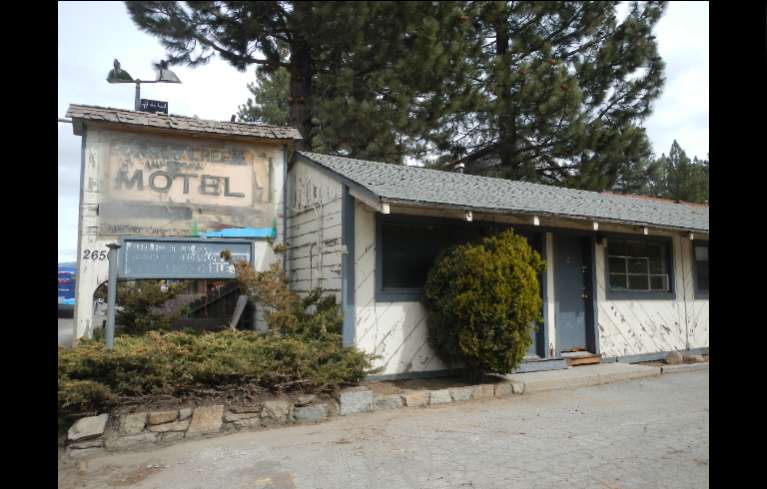
Trout Creek Motel's new owner promises upgrades. Photo/LTN

Trout Creek Motel’s new owner promises upgrades. Photo/LTN

By Kathryn Reed

One of South Lake Tahoe’s rundown hotels on Highway 50 is about to undergo some much-needed rehabilitation.

“By April 30 it will be looking good from the road,” Robert Durward said of the Trout Creek Motel.

He is the new owner of the 11-room lodging facility near the Town and Country Center. Durward also owns the Sky Lake Lodge next door and the El Nido down the road. He has refurbished both.

“My plans are not to tear it down, but have more curb appeal from the street and revamp the whole thing,” Durward told Lake Tahoe News.

The former owner had been cited and fined by the city numerous times for never making any of the improvements to the blighted facility.

Bill Potts, senior housing inspector for South Lake Tahoe, said Durward has promised to do what the former owner never did — remove the sign, rehabilitate the roof, paint the building and remove the foundation that is in the driveway.

In a letter from Durward to the city, he says he also plans to upgrade the rooms.

The three tenants have been given eviction notices. Once the place is renovated, Durward plans to keep it a weekly rental facility. He said it’s too hard to make it a tourist hotel because of the spring and fall shoulder seasons would mean too many nights with no heads in beds.

Durward said if the weekly rentals don’t work, he’ll think about converting the property into apartments.


Iraq war is missing from U.S. classrooms

By Jonathan Zimmerman

Upon today’s 10th anniversary of America’s war in Iraq, a critical question with serious ramifications has been little explored: What are our children being taught in schools about the conflict, as it passes from “current events” into history?

To answer this question, one obvious place to start is school textbooks. I looked at several of them, and was happily surprised. The books present a fairly complex and balanced view of the war in Iraq, avoiding the falsehoods and sugarcoating that has so often marred American history instruction. But textbooks only tell part of the story.

Just as important is what is actually emphasized in the classrooms, and the ability of teachers to engage in real inquiry. Unfortunately, a combination of school policies and judicial decisions have made it so that many kids learn little or nothing about what we have done in Iraq, or why we have done it.

I’m a professor of education and history, and wrote a book examining conflicts over history in American public schools. But for me, this probe is more than theoretical: My daughter is an 11th-grader in a suburban public high school, where she takes Advanced Placement U.S. History.

Her textbook, “The Enduring Vision: A History of the American People,” has a 2009 edition that carefully examines the Iraq and Afghanistan wars. It includes lengthy passages about controversial issues, including prisoner abuse overseas and domestic surveillance at home. Ditto for the 2009 edition of another textbook, “Out of Many: A History of the American People,” co-authored by Yale’s John Mack Faragher, which is also used in many high schools around the country. Its new section on the Iraq War leads off with a picture of George W. Bush’s now-infamous “Mission Accomplished” photo op in May of 2003, when Bush declared that “the United States and our allies have prevailed.” But they hadn’t, of course, and the book pulls no punches about that. Parts of Iraq “plunged into chaos” after the U.S. invasion, which “strengthened a new generation of terror networks now drawn to do battle with American forces,” the book declares.

It also disputes American claims about weapons of mass destruction in Iraq, citing critics who charged that Vice President Dick Cheney and Secretary of Defense Donald Rumsfeld had “manipulated Pentagon intelligence estimates, selectively emphasizing data based on ideology rather than dispassionate analysis.” The section concludes with a long passage about prisoner abuse and torture at Abu Ghraib. Although Bush expressed “deep disgust” at photos of the abuse, the book notes, White House memoranda revealed that legal counsel Alberto Gonzales had urged Bush to declare the treatment of suspected terrorists exempt from Geneva Convention accords on war prisoners.

So our textbooks aren’t simply spouting pro-American propaganda, like they once did, and that’s certainly reassuring. But Cheney et al needn’t worry about a new generation of MoveOn.org protesters (who also get an approving nod in Faragher’s book) streaming out of American high schools. You wouldn’t sense much controversy about America’s wars in Iraq and Afghanistan if you walked through the halls of my daughter’s school, or if you sat in on her classes. Indeed, you might not know we’re at war at all.

That’s partly because these conflicts have gone on so long. She was 5 years old when we attacked Afghanistan (which is described at the end of her textbook). Now she’s 17, and we’re still there. How can you take note of something that’s always been around you? It’s all the kids know, which means they often know next to nothing about it.

Then there’s the absence of conscription, which means that almost none of these kids will go abroad to fight. In America, we leave that to the lower-middle-class and the poor. In a few inner-city high schools, teachers have raised hackles about military recruiters and have invited “counter-recruiters” to visit. Overall, though, there’s often even less critique of the wars in our poorer school districts than there is in our wealthier ones. The teachers have their hands full already, keeping order in overcrowded classrooms, and the kids often see the military as their only route into the middle class.

Let’s be clear: There was never a democratic golden age in America’s schools, when students and their teachers engaged in full-throated debate about the events of the day. During both world wars, teachers were fired for raising questions about them. And in the Vietnam era, as anti-war protest drifted from colleges into the high schools, many teachers tried to muzzle it. Some of them threatened to fail or downgrade students who wrote or talked about the war. And a 1971 survey found that over half of American social studies teachers spent less than 10 percent of class time on “controversial issues,” including the conflict in Vietnam.

But today, in many classrooms, there’s literally no time for any of that. Starting in the 1980s, with the “Back to Basics” movement, states began to mandate minimum-competency examinations for high school graduation. The 1990s brought another round of state-level tests, seeping into middle and elementary schools. And then came No Child Left Behind, the 2002 federal law requiring yet more exams — and tying various sanctions, positive and negative, to the outcomes. More than at any point in the past, schools would be judged by how their students performed on standardized tests.

Increasingly, then, anything that didn’t promise to raise the kids’ scores got left by the wayside. As always, the best teachers continued to question students about current affairs. But it took real courage to do so, in the face of ever more oversight and pressure from test-minded principals and superintendents.

Then there were the lawyers, and the judges. During these same years, American courts significantly reduced the speech rights of teachers in their own classrooms. So discussing the war in Iraq wasn’t just a diversion from your most urgent job, which was preparing the kids for the test. It could also mean the end of your job, period.

Just ask Deborah Mayer. In January 2003, as a first-year elementary school teacher in Monroe County, Ind., Mayer taught a lesson from Time For Kids — her district-approved student current-events magazine — on the looming American invasion of Iraq. The article contained a report on an anti-war demonstration in Washington, D.C., which prompted a student to ask Mayer if she would ever attend such a protest. Mayer replied that she had recently driven by a “Honk for Peace” march in nearby Bloomington, and had honked her own horn in support. She also said that people should seek peaceful solutions to their conflicts, noting that her own school trained student mediators for exactly that purpose.

After parents got wind of this exchange and complained, Mayer was told that her contract would not be renewed. A district court upheld the school board’s decision, and then a federal appeals court did the same. It drew on the Supreme Court’s 2006 Garcetti v. Ceballos ruling, which held that public employees do not have free-speech rights at work; instead, their words belong to their employer.

“The school system does not ‘regulate’ teachers’ speech as much as it hires that speech,” the appeals court underlined. “Expression is a teacher’s stock in trade, the commodity she sells to her employer in exchange for a salary. The teacher hired to lead a social-studies class can’t use it as a platform for a revisionist perspective that Benedict Arnold wasn’t really a traitor, when the approved program calls him one.”

So if the “approved program” says that we should “Support our Troops” — and that we shouldn’t say anything else about the war in Iraq, or in Afghanistan — well, that’s what the teacher has to do. Never mind that she has a mind of her own, or is enjoined with helping her students make up theirs. She is a civic ventriloquist, paid to repeat the words that the state puts in her mouth.

To be sure, we’ve all had teachers who tried to impose their own opinions upon us. That’s indoctrination, not education. But the best guard against it is not removing controversial questions from discussion, which is what authoritarian states have historically done. Instead, we need to prepare teachers who can model the skills of democracy: inquiry, reason, tolerance and dialogue. And we need to give those teachers the space to practice them.

I’m not optimistic, on either count. I teach at a school of education, where the students are imbued — if not indoctrinated — with the gospel of “social justice.” Too often, though, that means teaching a single truth instead of encouraging our students to find their own. And when they become teachers, you can bet they’ll repeat the same error.

In the fall of 2003, after the war in Iraq had begun, I flew to Chicago to give a speech about it to local school teachers. I told them that their duty was neither to get kids to support the war, nor to oppose it; it was to provide students with the information and the skills to arrive at their own, reasoned judgments about it. Afterward, a very nice young teacher thanked me for my talk. “You’re right,” she told me. “If we can get the kids talking and thinking, they’ll realize that the war is a great imperial misadventure.”

That’s a near-perfect embodiment of what my own students have learned to call Zimmerman’s Fallacy: If everyone actually reasoned from the facts, unencumbered by cant and deception, they’d agree with me. But they won’t, and they don’t, and they shouldn’t. Democracy depends upon a shared faith: that people of equal intelligence can reason from the same facts to different conclusions. If you don’t believe that, you don’t believe in democracy. And you shouldn’t be a public school teacher.

Since 2003, to be sure, there has been plenty of cant and deception about the war in Iraq. And there are lots of good reasons, in retrospect, to call it a misadventure. But there’s still a case to be made for it, too. Our kids need to hear that. Instead, in many schools, they hear almost nothing. And the silence is deafening.

So, how much are our children learning about the war today? It’s only one example, but my daughter’s experience may be instructive. Remember that textbook I described to you, with its passages about American torture and surveillance? It turns out her class isn’t using that 2009 edition, but still using the one from 2002. It came out right before the U.S. invaded Iraq.

Jonathan Zimmerman is a professor of education and history at New York University. He is the author of “Small Wonder: The Little Red Schoolhouse in History and Memory” and three other books. This article first appeared in Salon.

STHS students demonstrate consequences of drug use

Publisher’s note: This is one of a few articles about the Drug Store Project. This marks the 10-year anniversary of the program. This year’s event will be April 2 at Lake Tahoe Community College. For more info about volunteering, donating or if you have questions, email Lisa Huard at lhuard@ymail.com.

By Kathryn Reed

“Pick your friends wisely.”

That’s one way Caleb Russell stays away from drugs and alcohol.

As a freshman at South Tahoe High School, students who want him to use illegal drugs or alcohol have confronted him.

“If you’re not doing it, you’re not cool” is what some kids think, Odalys Rodriguez said. She, too, is a freshman at STHS. But she’s not buying the rhetoric.

Both students are part of the AVID program and are part of a group of 11 students who will be instrumental in the April 2 Drug Store Project. Now in its 10th year, the Drug Store Project teaches sixth-graders about the dangers of drugs. All of these AVID kids went through the program.

“It really did scare me,” Rodriguez said of Drug Store Project.

Russell said, “It gives you an idea of what will happen.”

They are proof that the program has worked.

South Tahoe High students prepare for role in the April 2 Drug Store Project. Photo/Kathryn Reed

South Tahoe High School students prepare for their roles in the April 2 Drug Store Project. Photo/Kathryn Reed

It’s March 14 and the freshmen are in the middle of their second rehearsal. Music plays and a group dances. Three others are talking another kid into taking some Vicodin and mixing his drugs. He does. And then he passes out.

This is aptly named the “party scene” during Drug Store Project. What happens to that kid as well as the underage party hostess unfolds in other scenes.

While their part is a huge component of Drug Store Project, they are having fun rehearsing, learning lines, trading out parts and helping each other. When it comes to the real day they have to perform the skit nine times because the younger students come in that many groups.

“It sends a message to sixth-grade kids to avoid a party situation,” teacher Julia Russell said. “They want to share with kids that you have to be aware at parties and make good choices.”

Choices – that’s the overwhelming message of Drug Store Project. That everyone has a choice to say yes or no to whatever they are confronted with and that each decision has consequences.

Part of the high school organization’s mission is community service. This is the second year AVID students have participated in Drug Store Project, while previously Friday Night Live kids did.


Stateline man indicted in CalPERS bribery case

By Dale Kasler, Sacramento Bee

Federal prosecutors filed criminal charges today in the CalPERS bribery case, naming the big pension fund’s former chief executive and a Nevada businessman.

Brian Stretch, a spokesman for the U.S. attorney in San Francisco, said former CalPERS Chief Executive Fred Buenrostro and former board member Alfred Villalobos were named in a criminal case late this morning.

Stretch said the two men were charged with conspiracy to commit fraud, conspiracy to obstruct justice and making false statements to federal agents.

Alfred Villalobos

Alfred Villalobos

Villalobos, who lives in Stateline, earned about $50 million as a “placement agent” obtaining CalPERS investments on behalf of various private equity firms.

State officials already named the two men in a 2010 civil lawsuit, charging that Buenrostro took bribes from Villalobos to steer business toward Villalobos’ clients. The two men denied any wrongdoing.

The criminal charges come more than three years after the Bee first disclosed that Villalobos hosted Buenrostro’s wedding at his Lake Tahoe mansion and took Buenrostro on a paid trip around the world. Also on that trip was former CalPERS board member Charles Valdes, who hasn’t been charged with any wrongdoing.

The bribery case was probably the biggest scandal in CalPERS history, prompting a massive “special review” commissioned by the pension fund.

“We’ve been through our embarrassing times,” CalPERS board president Rob Feckner said after the indictments were announced. “This is a good day”

The review, led by Washington, D.C., securities lawyer Philip Khinda, concluded in March 2011 that Villalobos and Buenrostro’s activities had probably cost CalPERS tens of millions of dollars in inflated management fees.

Khinda said some of CalPERS’ investment partners surely inflated their fees to make up for the millions they were secretly paying in commissions to Villalobos.

Stretch said Villalobos, 69, and Buenrostro, 64, were released on bond after an initial appearance March 18 in U.S. District Court in San Francisco.

The indictment says the two men concocted phony letters to induce one of Villalobos’ big clients, Apollo Global Management of New York, to pay Villalobos a $14 million commission in 2007.

The letters claimed that CalPERS was are of the fees Villalobos was earning – a disclosure demanded by Apollo.


Supreme Court to hear Sierra Nevada forest case

By Michael Doyle, Miami Herald

WASHINGTON — A long-running Sierra Nevada forest planning dispute will now be settled by the Supreme Court in what could shape up as a crucial public lands case.

On Monday, the court agreed to referee the dispute pitting environmentalists with the Portland-based Pacific Rivers Council against the U.S. Forest Service over decision-making that dates back to the second Bush administration. While the specific case involves 11 Sierra Nevada forests, the eventual outcome could shape everything from who gets to file lawsuits to the scope of future environmental studies.

“Definitely, throughout the West, this could have huge impacts on the moving of projects forward,” Dustin Van Liew, executive director of the conservative Public Lands Council in Washington, D.C., said in an interview Monday.

One key question confronting the court will be whether environmentalists have the “standing” to sue against a general forest plan, as opposed to a specific project proposal, by virtue of their making recreational use of the national forests. To gain standing in federal court, individuals must show they’ve been injured or face imminent injury.

The court case involves the Eldorado National Forest. Photo/LTN file

The court case involves the Eldorado National Forest. Photo/LTN file

A second major question is how extensively detailed the Forest Service must be when preparing overarching management plans, such as the one governing the 11 Sierra Nevada forests.

“The only role for a court is to insure that the agency has taken a ‘hard look’ at the environmental consequences of its proposed action,” Pacific Rivers Council’s attorneys said in a legal brief, adding that “agencies cannot take a ‘hard look’ unless they have reasonably identified the consequences of their actions.”

Underscoring the case’s potential significance, the Public Lands Council and the affiliated National Cattlemen’s Beef Association secured Supreme Court permission Monday to file a brief opposing the environmental group. Many more briefs, from both sides, are sure to come.

The court’s decision to hear the Sierra Nevada case, sometime during the 2013 term that starts in October, means that at least four of the court’s nine justices agreed to reconsider a 9th Circuit Court of Appeals decision from last year in which environmentalists prevailed.

In that 2-1 appellate court decision, the 9th Circuit panel concluded the Forest Service in 2004 failed to adequately study the effect of dramatically revised forest plans on Sierra Nevada fish populations.

“The Forest Service provided no analysis despite the fact that the 2004 (plan) allows much more logging, burning, road construction and grazing,” Judge William A. Fletcher wrote for the appellate panel.

The planning, and required federal environmental impact statements, cover nearly 11.5 million acres of Forest Service land stretching from Southern California to the California-Oregon border. Taken together, the Sequoia, Inyo, Sierra, Stanislaus, Humboldt-Toiyabe, Eldorado, Tahoe, Plumas, Lassen and Modoc national forests, and the Lake Tahoe Basin Management Unit, encompass more than 5 percent of all land managed by the Forest Service nationwide.

“My first Sierra Nevada backpacking trip was to the Mineral King area in 2000, during which time I also fished,” Pacific Rivers Council Chairman Bob Anderson, a South Lake Tahoe resident, said in a court declaration used to establish injury and standing. “I plan to continue these activities as long as the management of Sierra Nevada national forests does not prevent me from doing so.”

When presidents have changed, so have the Sierra Nevada forest plans.

The Clinton administration issued one Sierra Nevada plan in January 2001, about a week before President Bill Clinton left office. The George W. Bush administration then scrapped that plan, and issued another in 2004.

The 2004 Bush plan called for harvesting 4.9 billion more board-feet of timber than under the 2001 Clinton plan. The Bush plan also called for constructing 90 more miles of new roads, reconstruction of 855 more miles of existing roads and a loosening of restrictions on grazing. Bush’s supporters in the timber and cattle industries, among others, supported the changes, while environmentalists warned of the dangers.