S. Tahoe council to vote again on plastic bag ban

By Kathryn Reed

If South Lake Tahoe adopts an ordinance banning plastic bags, it is likely it would not be the law of the land until 2014. This is because the ordinance as written takes three months to be implemented and the council isn’t likely to vote on it until late summer, early fall.

A group of bag-ban supporters were at today’s City Council meeting advocating the electeds implement the ordinance that was voted down in January. The advocates came back with more information as was requested by the council at the time.

No longer does the city have a Sustainability Commission. It was axed at the same meeting the bag ban was defeated. But a group has formed to be a committee focusing on sustainable issues in the city.

Karen Fink, who is part of that group, pointed out that consumers are already paying for bags from stores – it just isn’t overt. There also isn’t a choice because it’s incorporated into the price of goods sold, much like any overhead expense.

Most of the 76 communities in the state that have plastic bag bans allow stores to use plastic and paper at a 5 or 10 cent charge per bag to the consumer.

Some talk on June 11 was about whether the fee would impact lower income individuals unjustly.

Julie Lowe, a plastic bag ban proponent, told the council, “It’s more of a problem with the affluent. We consume more and waste more. I feel the low income are way ahead of us.”

Darcie Collins with the League to Save Lake Tahoe said her group supports the ban. While no one from the Lake Tahoe South Shore Chamber of Commerce spoke, it was relayed that that board and the majority of the membership support a ban.

Supporters also believe such a ban would send a message to tourists that South Lake Tahoe is environmentally friendly.

Mayor Tom Davis said with the League, Sierra Club and Tahoe Regional Planning Agency having offices on the South Shore that in itself shows the area is environmentally friendly.

Davis and Councilwoman JoAnn Conner remain strong voices against the ban. Davis in particular said he does not see a problem. This was right after he cited how much trash Clean Tahoe picks up. He also said he drove around town and didn’t see an issue with plastic bags blowing around.

But the errant bags are found at the bottom of waterways, in bushes, meadows and elsewhere that a motorist would not see.

Conner said recreationists she knows don’t believe there is a problem either.

“We’re still looking at legislating personal behavior,” Conner said.

Councilwomen Angela Swanson and Brooke Laine are in lockstep in wanting the issue to come back for a vote. Swanson was not at the January meeting and Laine was not on the council then.

Councilman Hal Cole wants something done about the bags, but also would like some leeway for nonprofits like the food banks that fill bags for the needy to take with them.

Even though the California Legislature earlier this year voted against a statewide ban, the California Grocers Association came out in support of it.


‘Why I Farm’ gets to the core of small farming

By Susan Wood

RENO – The roots of “Why I Farm,” as told by small, third generation farmer Gary Romano, run deep.

It was clear by the recent Meyers-based Bona Fide Books opening party releasing Romano’s historic, semi-political account — subtitled “Risking it all for a Life on the Land” — that there’s a vested interest in the topic. About 40 people showed up at Campo restaurant in Reno on Thursday to hear the author toast, read and answer questions relating to the book. Some knew him. Others didn’t. Still, among the supportive crowd, all have a stark interest in Americans taking responsibility for what they consume and how the industry that supports them stays alive.

Small farmers are a dying breed these days. Yet, there is a segment of people associated with the Slow Food Movement who would love to buy local and fresh. Unfortunately, they do not make up the majority of Americans. Romano is among those rare outspoken farmers who want to do something about that.

Gary Romano's book delves into the plight of the small farmer. Photo/Daphne Gauged

Gary Romano’s book delves into the plight of the small farmer. Photo/Daphne Gauged

The Sierra Valley Farms owner joked about how farming is not a lucrative business, but one in which you can receive much reward. Few people can dictate the utter beauty of using a locally grown heirloom tomato “to make that (bacon, lettuce, tomato sandwich)” with such passion.

“It doesn’t get any better than that,” he said.

The audience seemed transfixed as Romano read and explained his need to dive into the dirt.

During the question-and-answer session it became obvious the attendees bought into the message.

“What grows best in the Sierra Valley?” one woman asked.

“Greens,” Romano quickly responded.

“The key is to know where your food comes from,” renowned chef and Campo owner Mark Estee told the attentive crowd while holding up the book. Estee, who commercially buys produce from Romano’s individual farmers market in Sierra Valley, reminded those who raised a glass of Prosecco and enjoyed his culinary snacks to make sure they purchase the book.

Consequently, Romano and Bona Fide Books Publisher Kim Wyatt accommodated a line of eager buyers after the talk.

“I’m a local farmer, you’re a local book publisher. Let’s make a book,” she recounted his introduction in finding her as “a kindred spirit.”

"Why I Farm" is the latest release from Meyers-based Bona Fide Books.

“Why I Farm” is the latest release from Meyers-based Bona Fide Books.

“I love his family history,” she added. Wyatt also thrives in publishing local stories, as shown by the release of “Permanent Vacation,” “Tahoe Blues” and “Get Out of My Crotch.”

Romano’s quick read highlights his evolution into farming as an adult in the 1990s, decades after he was introduced to the craft and industry as a child. The book is full of pictures, descriptions and 91 years of memories of his grandfather and father’s fresh flower business that took him from the metropolis of San Francisco to the Sierra Valley north of Truckee. The book is part political in trying to find a solution for the industry and consumers seeking to support it through their food choices. It’s also part nostalgia with a sentimental twist of this close-knit Italian family.

He told Lake Tahoe News the making of the book was sometimes emotional.

“It is because I lost my brother. And with twins, you have this connection. And he knew our (family) history better,” he said of his late brother, Larry.

Wendy Baroli, co-proprietor of Girl Farm, could relate. The fourth generation farmer with Italian roots makes a living at the long-standing family craft with Jill Heaton. Even on the night of the book launch, Baroli brought lettuce for Romano. The two farm operations often barter.

Like Romano, Heaton finds it ironic that the masses tend to worry more about food grown locally at farmers markets rather than the produce of big distribution chains selling at the supermarkets. The American public often leans toward the familiar. Then, there’s the borderline absurd farmers face from the public’s fear of bug infestations to illness outbreaks.

“I think it’s very interesting their top concerns (are) how fresh is it and then the safety of it,” Heaton said, while shaking her head. “I tell people: ‘If there’s something wrong with the food, we’re done’,” she said. Heaton and Baroli have their Northern Nevada household food supply down to a science, only buying coffee, sugar and flour at the traditional grocery store.

Romano also touched on how the self-sufficiency of growing your own food is lost on a younger generation pursuing a better paycheck. So the support of other small farmers into the food web represents a welcome change in our society.

The idea of supporting each other is: “You lift one small farmer up, you lift them all”: – especially as the book points out, the farmer is not the most experienced self-promoter.

The next promotional event highlighting “Why I Farm” is June 12 at Sundance Bookstore and Music in Reno. “Why I Farm” is available through Bona Fide as well as Amazon, but the latter takes more than a 55 percent cut.


Scientist details human impact on Lake Tahoe

By Jessie Marchesseau

INCLINE VILLAGE – Lake Tahoe is not the same as it used to be. Most of us are already aware of this, but none as much as Charles Goldman.

In 1959, Goldman, a limnologist and UC Davis professor, formed the Tahoe Reasearch Group and began regular and extensive testing of Lake Tahoe.

On Friday evening, Goldman gave a presentation at the UC Davis Tahoe Environmental Research Center in Incline Village entitled “The impact of climactic change and global warming on inland waters of the world.” The lecture was part of the annual UC Davis volunteer docent training session.

In his introduction on June 7, Geoff Schladow, director of TERC, credited Goldman with providing “unassailable evidence that Lake Tahoe has changed. Without that,” he said, “we would all be here arguing about whether or not it’s changed.”

Charles Goldman has been studying Lake Tahoe for decades. Photo/LTN file

Charles Goldman has been studying Lake Tahoe for decades. Photo/LTN file

Event organizers continued to bring in more and more chairs as 135 people crowded into the tight room to hear Goldman speak. The docent training sessions are generally for trainees only, but this year, organizers decided to open Goldman’s presentation to the public.

“He has all of the historic knowledge that really grounds the science in a historical context,” Heather Segale, UC Davis education and outreach director, said. “We can tell our docents about the latest and greatest, but giving them history gives them the long view of science at the lake.”

Goldman started with the long view of climate change in general by putting up a graph showing carbon dioxide levels going up faster and higher then they have in 800,000 years.

“There’s probably no problem that’s faced humanity the way this has since the ice age,” he said.

He acknowledged the climate change skeptics and compared their argument to that of tobacco companies arguing that cigarettes are good for you.

His slide show was filled with charts, graphs and photographs depicting everything from Arctic ice melt to changes in atmospheric makeup to the fault lines under Lake Tahoe. Pictures of lakes in Asia showed one so green with algae it practically glowed and another so polluted people can hardly breathe when attempting to cross it by boat.

Stopping and preventing pollution in Lake Tahoe has been one of Goldman’s main goals. In fact, he calls convincing authorities to stop putting sewage, treated or otherwise, into Lake Tahoe in the late 1960s his “single greatest contribution” and the most significant thing that could have been done for the lake.

He also remembered a time when the clean Tahoe air resembled the smog of a big city. The air quality outside the casinos, he said, was worse than inside, and virtually all the pollution was being created inside the basin. Again, he spoke up. People were defensive at first, but eventually changes were made.

Over the years, Goldman has seen a lot of changes in Lake Tahoe. He talked about watching the Tahoe Keys be built and how it is the main culprit of the Eurasian milfoil invasion in Lake Tahoe. It is also the site of the addition of non-native species such as goldfish.

Over the course of 30 years, Goldman has also seen the overall temperature of Lake Tahoe increase by about 1 degree. His graphs showed that while the maximum and minimum temperatures of Lake Tahoe fluctuate constantly, the average maximum temperature has remained virtually the same; it is the average minimum temperature that appears to be rising at a relatively steady rate. This means the lake is not cooling off at night like it used to, the result of increased CO2 in the atmosphere.

The long-term data collected by Goldman and his team over more than 40 years has resulted in building restrictions, erosion control, protection of wetlands and the establishment of water quality thresholds, all put in place to protect the delicate environment of Lake Tahoe.

Now retired, Goldman’s legacy in Lake Tahoe continues with the Tahoe Research Group and the Tahoe Environmental Research Group.

Goldman left the audience with this: “Keep in mind that the younger generation is going to inherit a badly damaged planet. It’s really up to us to inspire them with a lot of enthusiasm.”


Nevada gaming firm, Calif. lawmakers at odds over tribal casino

By Anthony York, Los Angeles Times

SACRAMENTO — When California voters approved Las Vegas-style gambling in 1998, proponents said it would be limited to places already recognized as American Indian lands.

But a rare ruling from the Obama administration and a deal approved by Democratic Gov. Jerry Brown would allow one tribe to build a casino on a 300-acre property owned by Station Casinos in the Central Valley town of Madera. The prospect has divided Indian tribes and touched off an intense fight in the Capitol.

Members of the tribe, the North Fork Rancheria of Mono Indians, have not lived on the Madera land for generations. But if the group is successful, it could help reshape the future of tribal gaming in California, opening the way for new casinos up and down the state — and closer to urban centers — according to critics of the gaming industry and other opponents of the deal.

Backers of the tribe’s plan say it is an exception. They point to strong support for the casino from Madera city and county officials as well as the tribe’s historic ties to the area, documented in an intricate seven-year appeal process and approved by the U.S. Department of the Interior.

Tribes that own some of California’s largest gambling halls say North Fork leaders and their Nevada-based financial backers are “reservation shopping” to put a casino in a prime location. Approval of the deal, they say, would break a promise made to voters 15 years ago that gaming would be restricted to remote locations.

State law limits casinos to land where the federal government recognizes a tribe’s historic tie. Once that determination is made, the tribe must negotiate a casino deal with the governor and have it ratified by the Legislature.

North Fork made its claim to the land, which was once slated to be a NASCAR racetrack, in question in 2004, a year after it was purchased by Nevada-based Station Casinos. Tribal leaders say the band spent summers in the Sierra Nevada foothills near Yosemite National Park to escape the Central Valley heat and moved to the lowlands that include present-day Madera to flee the snows of winter.

In the 1980s, the federal government set aside 80 acres for North Fork about 50 miles away, but the group’s leaders say that land is held privately by tribal members and does not belong to the tribe. Moreover, the land, on a steep slope on a remote hillside near Yosemite National Park, is environmentally sensitive and could not sustain a casino development, they say.

North Fork officials say the root of opposition to their plan lies in wealthy tribes trying to keep other Indian nations from sharing in the prosperity of the gaming business.

Other tribes also are uncomfortable, the North Fork leaders say, with the cut of gaming revenue the group is willing to share with state and local governments — potentially millions more than tribes typically have agreed to contribute in exchange for approval to operate casinos.

The tribe and Station Casinos have been trying for more than 10 years to build a hotel and casino with 2,000 slot machines on the Madera land. Along the way, they have enlisted the support of local leaders, labor unions and environmental groups.

The Department of the Interior accepted the tribe’s land claim in 2011. It was just the seventh time the federal government had granted such a request on land acquired after 1988, when Washington created rules to allow tribal casinos. Last year, Brown signed the gaming deal with North Fork.

The governor has downplayed concerns about casinos creeping toward California’s major cities, where they can add to traffic congestion, strain city resources and upset residents. He has said he expects the kind of deal he struck with North Fork to be rare.

The nearly 2,000 members of the tribe, the fifth-largest in California, “are mired in the type of poverty tribal gaming was designed to ameliorate,” said Jacob Appelsmith, a senior adviser to Brown who negotiated the casino deal.

Last month, the state Assembly ratified the plan. It has stalled in the Senate despite an intense lobbying effort for it by organized labor, which has been promised that the project would create thousands of union jobs.

The Picayune Rancheria of the Chukchansi Indians have a casino about 30 miles off the highway from the proposed North Fork site. Its leaders say the proposed new casino, with its more convenient location, could put them out of business and leave them saddled with debt after an investment of nearly $300 million to expand their operations.

Wealthier gambling tribes such as the Riverside-based Pechanga Band of Luiseno Indians and the United Auburn Indian Community, which operates the Thunder Valley Casino Resort between Sacramento and Lake Tahoe, are worried about other pending casino deals that could gain momentum if the North Fork accord is approved.

Brown also has authorized a casino with 2,000 slot machines for the Enterprise Rancheria of the Estom Yumeka Maidu tribe on newly acquired land the federal government ruled eligible in Yuba County. Enterprise is planning a 170-room hotel, as well. Its plan is not yet before the Legislature. Its business would compete with Thunder Valley, which has 3,000 slots and a 300-room hotel.

In addition, the federal government is considering a land request from a tribe in Barstow that could lead to a casino along Interstate 15 between Los Angeles and Las Vegas. That business could be a threat to some of the large tribal casinos in the area.

“Developer-driven gaming proposals like Stations-North Fork have infected Indian gaming for over a decade now,” Pechanga’s chairman, Mark Macarro, told senators at a recent hearing. “Tribes used to respect the boundaries of each other. But casino developers don’t care one way or the other.”

North Fork’s chairwoman, Elaine Bethel-Fink, said wealthy tribes oppose her group’s deal because their own will be up for renegotiation in a few years, and they don’t want pressure to match North Fork’s revenue-sharing plan.

“The concern,” Bethel-Fink said, “is that we’re being too generous.”


Heat in Lake Tahoe keeps breaking records

By Kathryn Reed

Hot. That’s the word of the day. It’s the word for the last five days. It will probably be the word for today, too.

Sunday is expected to be the sixth consecutive day South Lake Tahoe has recorded a record high.

The following is data from the National Weather Service in Reno:

• June 8 – high 88, previous record was 83 in 1996

• June 7—high 88, previous record was 83 in 1996

• June 6 – high 85, previous record was 83 in 1996

• June 5 – high 85, previous record was 82 in 2002

• June 4 – high 83, previous record was 82 in 1996.

Roni Davis and Brenda Knox on June 8 paddle along Lake Tahoe. Photo/Kathryn Reed

Roni Davis and Brenda Knox on June 8 stay cool paddling along Lake Tahoe. Photo/Kathryn Reed

“It’s pretty unusual to set record temperatures six days in a row,” NWS in REno meteorologist Zach Tolvy told Lake Tahoe News.

Records are breaking throughout California and into Nevada.

People have been flocking to Lake Tahoe this weekend to escape the more oppressive heat in other parts of Northern California where the mercury has been in the triple digits.

Once in Tahoe, the beaches have been a popular destination. Many people are venturing onto and into the water to cool off. Others can be found at the waterside eateries.

The temps in the basin are about 18 degrees above normal. Normal, though, should return on Monday.

But before that happens, thunderstorms are expected to roll through the basin and into western Nevada today, and linger into Monday.

“The biggest danger will probably be the wind,” Tolvy said. The Weather Service typically does not issue lake wind advisories with thunderstorms, but suffice it to say being on the lake as the storms come in is not advisable.

Gusts could exceed 60 mph today. It will be breezy most of the week.

The lake was pretty choppy Saturday afternoon – especially for those in human powered watercraft.

The thunderstorms are expected to be widespread and arrive midmorning to early afternoon, with some sticking around until the evening. Tolvy said they could be heavy in spots and are expected to be widespread.

Dry lightning will precede the rain, but is not seen as a serious fire threat.

For those hiking, remember lightning can strike far from where the thunder and/or rain are and standing on a slab of granite is not the best place to be.


Placer County approves tentative 2013-14 budget

The Placer County Board of Supervisors approved tentative 2013-14 $690.5 million budget is 5.4 percent less than the current year’s budget.

The reduction is largely a result in how the county is budgeting multi-year infrastructure projects.

The proposed operating budget is up $10 million, or 1.9 percent, because of projected increases of $7.9 million, or 2.2 percent, in the general fund and $3.6 million, or 2.6 percent, in the public safety fund.

More budget workshops are planned for August before the board is expected to adopt the final budget in September.

“I do think it’s important that any of the budget adjustments we make throughout the year are reflected in documents we provide to the public,” Vice Chairman Jack Duran said at this week’s meeting. He suggested the county provide quarterly updates to allow the public to track mid-year changes.

The county budget team and board members pointed to several encouraging signs, including a $60 million reduction over the last two years in the county’s unfunded liability for post-retirement benefits other than pensions. Collectively, they are known as other post-retirement benefits and include medical, dental and vision benefits.

A new actuarial report places the unfunded liability at about $136 million, down from approximately $196 million two years ago.

“Hopefully, the economy will continue to improve,” Supervisor Jennifer Montgomery said, “and, years into the future, we will be able to build back some of our services and build back some of our staffing to really provide that top-notch level of service that we provide now, but we could provide even better with more dollars and more staff.”

In a report to the board, the county budget team pointed to several accomplishments over the past year, including:

• A stronger focus on communicating with the public and employees about the county’s priorities and plans for achieving them. A cornerstone of that effort is a transition over the next several years to priority-based budgeting, an approach that seeks to improve transparency in the budget process while helping ensure county resources are allocated based on priorities and results to county residents.

• An approved plan for a phased opening of the county’s new jail in Roseville early in 2014.

• Board adoption of a multi-year budget strategy focused on balancing county priorities with available resources and making sure the costs of county programs can be sustained in future years.

• A comprehensive approach to infrastructure planning that seeks to identify and fund high-priority projects.

• Using one-time revenue for one-time costs.

• Budgeting conservatively so the county has flexibility to handle revenue and cost fluctuations.

• Maintaining healthy budget reserves.

• Focusing on innovative, cost-effective approaches for providing public services.

• Relying on a pay-as-you-go approach whenever feasible so the county maintains a relatively light debt load.

— Lake Tahoe News staff report


Defensible space can be the difference between a home still standing and one reduced to ash

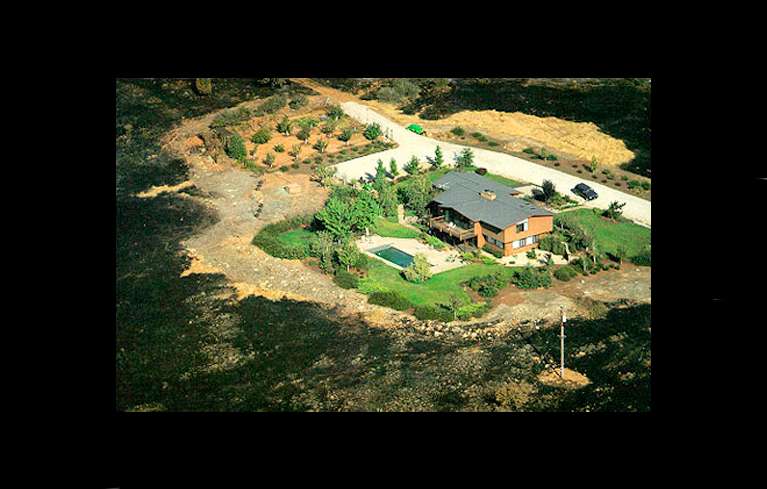
Defensible space can help save a house from fire.

Defensible space can help save a house from fire.

By Kathryn Reed

What would happen if an ember the size of a softball were to land on your property? On your roof? Is there anything that would catch fire?

That is the visual Leona Allen with Lake Valley Fire Protection District likes people to think about.

If that burning ball can ignite a larger fire, then better defensible space is needed.

“Our fire season is predicted to be heavy to extreme. That is something we want people to be prepared for. We want people to do defensible space,” Eric Guevin, Tahoe Douglas Fire Protection District fire marshal, told Lake Tahoe News.

While defensible space has become a common phrase in the last handful of years, laws about defensible space have been on the books for decades.

But it really came into play after the 2003 Southern California fires. After they were extinguished, a Blue Ribbon Commission was convened. Out of that came recommendations for suppression, response, building standards and defensible space.

“With expanding communities, we now have structures embedded in natural fuels. People who live there see it as nature, not fuels. Fire sees a structure as something to burn,” South Lake Tahoe Fire Chief Bruce Martin told Lake Tahoe News.

Many people moved to Tahoe to be in the mountains, which means being around trees. But too many trees too close together, with canopies not adequately spaced can be a bad thing.

Years of suppressing fire also means some forests are now more combustible. That is a reason thinning or fuels reduction projects are so common.

But individuals have a responsibility to be fire aware, too. From zero to 5 feet is supposed to be a noncombustible area around a structure. This means rock or succulent plants that hold lots of moisture. The 5- to 30-foot area is supposed to be lean, clean and green. Trees should be 10 feet apart; same with crowns. From 30 feet to 100 feet or the property line is where vegetation can start transitioning back to the wild.

A rake, loppers and gloves can improve the defensible space area of many houses, Guevin said. He added that juniper is “like a gas can” and it’s best to remove it.

“They say your defensible space is as good as your neighbors’, so you have to look at it from a community aspect,” Guevin said. “The way codes are written now there is more ability to enforce people to take action. They can be liable for fires that start on their property and spread to another. It’s called fire trespass.”

Adequate water supply, ease of access to and from a house, proper signs on streets, addresses clearly marked are all part of being fire ready. So is having an evacuation plan.

Gareth Harris, fire chief at Lake Valley, said, “Every home in the Angora area had been contacted three times. Of the homes that did defensible space, 75 percent survived the Angora Fire. Statistically, that is saying a lot considering the devastation of homes lost there.”

Six years ago this month, 254 houses on the South Shore – in Harris’ jurisdiction – were swallowed by fire. This, after someone who has never been caught left an illegal campfire without its being fully extinguished.

Fuel, weather and topography are the key factors in how a wildland fire will spread.

“Because a fire is a force of nature we can’t stop it. We can try to protect homes in front of it and work the edges. We have to wait for the weather to moderate to put (the fire) out,” Martin said.

He believes if a couple million dollars had been put into fuel breaks or treatments that the $150 million in property loss from Angora would not have been so high.

In 2007 the Tahoe Regional Planning Agency was promoting wood chips and pine needles as tools to cut down on erosion. Property owners could only cut down trees with a diameter of 6 inches or less. Policies have changed and TRPA even has a forester on staff now. Now trees 14 inches or less in diameter may be taken down without a permit; and firefighters can mark trees for defensible space reasons.

“Reducing the threat of catastrophic wildfire is a top priority for TRPA and we encourage defensible space and fire resistant landscaping practices. Our stance on pine needles is clear: on areas of bare soil, rake them in the spring and let them fall in the fall. Keep pine needles and flammable vegetation away from structures and follow fire guidelines to clear your roof of pine needles regularly,” Jeff Cowen with TRPA told Lake Tahoe News.

—-

Note:

• Living with Fire is a website that has more information about defensible space.

• This article is about an individual defensible space inspection.


Scientists zapping Lake Tahoe aquatic life

By Kevin Oliver, KCRA-TV

It’s shocking research on invasive species, literally.

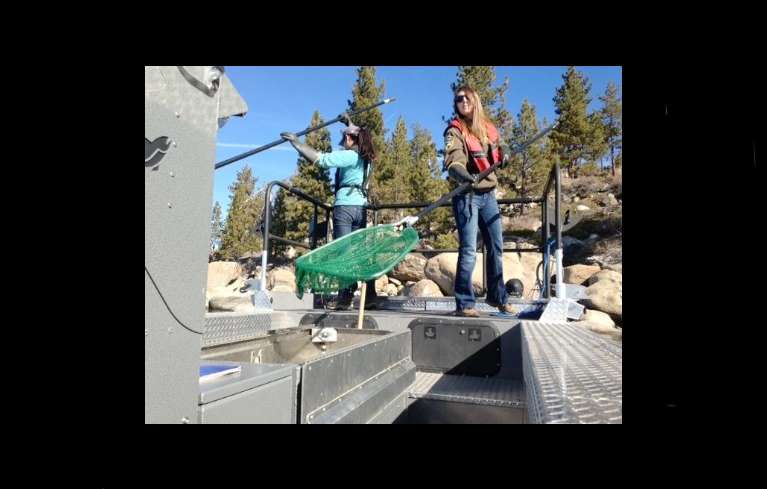
Researchers and scientists spent this past week on Lake Tahoe zapping fish with electricity as they try to survey the number of non-native fish and stop their spread.

The researchers used modified vessels called E-boats, equipped with electrified probes that stun anything that swims within 10 feet of them.

Researchers then scoop up the stunned fish as they float to the surface.

 6 of 12 Kevin Oliver/KCRA Researchers from the University of Nevada, Reno, UC Davis, and California State Fish and Game regularly survey fish using a specialized boat with electrical probes extending from it which stun temporarily stun nearby fish. Read more: http://www.kcra.com/news/-/11797728/18991232/-/u25jv2/-/index.html#ixzz2VaCCkR11

Researchers regularly survey fish using a specialized boat with electrical probes extending from it. Photo/Kevin Oliver/KCRZ

Invasive fish are pulled from the water, put into storage tanks and hauled off to be examined and disposed of.

Researchers used five boats simultaneously to conduct what they called a “blitz” in order to get as accurate a count as possible of how many invasive fish are in various areas of the Tahoe Keys in a three-day period.

Biologists use the figures to compare data in an attempt to see what kind of an effect invasive species are having on the lake.

Part of the study will look at whether they can break the spawning cycle and reduce the number of non-native fish by pulling them from the water before they fertilize their eggs.

The same researchers found large goldfish during past expeditions. Three more goldfish were found earlier in the week.


No surprise to find rogue genetically altered crop

By Michael Wines, New York Times

One week after the revelation that an Oregon farmer had found genetically engineered wheat growing in his fields, scientists remain mystified over how the strain — apparently the remains of a test crop shut down a dozen years ago — got there.

The boom in so-called transgenic crops should prompt even more careful evaluation of future varieties.

But few are surprised. Even with extensive precautions, gene-altered plants turn up in unwanted places regularly enough that farmers have come to consider a few of them weeds, and even a threat to their livelihood.

And while none of them yet poses any known public health hazard, experts say the boom in so-called transgenic crops should prompt even more careful evaluation of future varieties with an eye to the prospect that they, too, could eventually appear elsewhere.

In the case of the wheat found in Oregon, most experts say, all those prospects are remote. The experimental wheat was created and tested by the Monsanto Company to be resistant to its best-selling Roundup herbicide, and similarly Roundup-resistant varieties of corn, soybeans and other crops are widely grown with no known health effects.

In a telephone news briefing on Wednesday, Monsanto officials called the appearance of the altered wheat “a random isolated occurrence” and said there was no evidence that the wheat had moved beyond the single farm or that its seeds were in the seed stocks that the farmer used to plant his fields.

Nor is the Monsanto wheat likely to spread elsewhere, most experts say. The plants found in Oregon, which the company said covered less than 1 percent of the farmer’s 125 acres, are the only ones found anywhere since Monsanto abandoned plans to sell modified seeds in 2004.

As with most transgenic plants, the wheat could have transferred its engineered trait to ordinary wheat via its pollen, which contains the single gene for herbicide resistance. That gene is dominant, meaning plants fertilized by the Monsanto wheat’s pollen would likely pass the Roundup-tolerant trait to future generations.

But while plants like corn fertilize each other, spreading their pollen far and wide by winds, butterflies or bees, wheat plants generally fertilize only themselves. Moreover, wheat pollen rapidly loses its potency once it leaves the plant.

“A transgene that comes up in corn could be a much different situation,” Kendall Lamkey, the chairman of Iowa State University’s agronomy department, said in an interview. “Corn pollen can travel, under the right conditions, a great distance,” he said. But with wheat, he said, “The gene’s unlikely to be moving to other varieties in any significant way.”

When a gene does move to other varieties, however, the potential for mischief can be considerable.

Consider the benchmark example: in 1998, Aventis Agroscience Inc., a Swiss company now known as Syngenta, won federal approval to sell a strain of corn called StarLink altered to produce a pesticide that kills insect larvae. After scientists found a moderate possibility that the strain could trigger allergic reactions in some people, the government registered the corn for use only in animal feed and biofuels, and imposed safeguards to keep it out of the food processing chain.

At its peak, StarLink corn was grown on less than half of a percent of all the corn acreage in the United States. Yet by September 2000, it was discovered in corn taco shells, triggering a huge recall, tests on more than four billion bushels of corn and the cancellation of StarLink’s federal registration.

Such dire consequences are rare, but not unheard of. A group representing more than a thousand organic farmers in Saskatchewan complained in 2002 that gene transfers from canola that had been genetically engineered to tolerate herbicides had contaminated their fields. That made it impossible to certify their canola as wholly natural, costing the farmers $10 million, the group stated.

Nature is hardly the only culprit in genetic transfers. Farmers can accidentally mix bags of natural and modified seed. Combines that harvest a gene-altered crop can pick up its seeds, then drop them while harvesting a field of natural plants.

Both farmers and manufacturers alike employ measures like putting buffer zones around fields, to limit the risk that genetic material will cross from altered crops to natural ones. But many experts say that the myriad ways that seed and genes can be spread make that possibility substantial.

The real question, they say, is how much that matters.

Absent any proven health threat, the most common fear is economic — that organic farmers will lose crops, or that food exports to countries that ban imports of gene-altered products will suffer. The Oregon incident instantly raised fears that the United States’ $8 billion annual wheat trade would be hard hit, although the strain of winter wheat at issue makes up only a fraction of those exports.

But a 2010 report on genetically engineered crops by the National Research Council noted that genes can pass not only from an altered plant to its natural brother, but to less close relatives in the wild. “Such hybridization is common in plants generally and is a key process for the evolution of new plant species,” the report stated.

Concerns about transfers to the wild already had stalled approvals of genetically altered crops like sunflowers and rice. During tests in Oregon of a pesticide-tolerant bentgrass in 2003, “introgression of the transgene into weedy populations was detected at a considerable distance from the test sites,” the report stated.

That is also a potential problem with genetically modified wheat, said the chairman of the group that prepared the report, David E. Ervin, an environmental management professor at Portland State University in Oregon.

“There has always been a worry with wheat, being in the grass family,” he said. He added that if there were a transfer of the gene into grasses, “There’s going to be difficulty in controlling those grasses, and you might have to resort to stronger herbicide treatments, some of which have more environmental consequences.”

That underscores the need for caution in approving new varieties of altered plants, he said, adding: “All bets are off when you start introducing new kinds of crops. That we haven’t had any serious events to this point doesn’t mean we won’t have significant risk of them occurring in the future.”



DiCamillo returns to S. Tahoe as temp attorney

By Kathryn Reed

Former South Lake Tahoe City Attorney Cathy DiCamillo is back on the payroll.

She started this week as interim deputy city attorney. She will be working for Nira Feeley, who is interim city attorney until Tom Watson takes the helm July 8. Feeley will be going out on maternity leave about a week later for three months. DiCamillo will be on board that entire time. She is making more than $7,000 per month.

“With Cathy’s extensive legal background and experience, she is able to pick up any of our cases fairly effortlessly and will provide the city as well as Nira and Tom leading the City Attorney’s Office with high-level legal assistance far better than bringing in another new and temporary attorney,” City Manager Nancy Kerry told Lake Tahoe News. “For example, I know that (Wednesday) she was reviewing redevelopment/successor agency dissolution matters. As deputy city attorney her day-to-day work assignments will be directed by the interim city attorney and/or city attorney.”

The irony is that when DiCamillo worked for the city the first time she was deemed to not have enough redevelopment experience. That is when then City Manager Dave Jinkens hired outside legal counsel to help with such matters.

DiCamillo was the city attorney for about a decade before retiring in June 2009. During a 2008 closed session DiCamillo received a less than favorable evaluation by the City Council. Months later she submitted her resignation.

Previously, she had worked for attorney Lew Feldman. He is the attorney who from the get-go and to this day is representing the developers for the Chateau project. (That project will be on the June 11 City Council meeting.)

Feeley is the lead attorney on the Chateau project. Kerry said Watson is being briefed on all aspects of it so he will be “up to speed when he officially begins.”

It is not known how much DiCamillo will eventually be involved with the Chateau project. She has nothing to do with the staff report that will be presented Tuesday and she has not been assigned to that project. But she was the city attorney at the time the project was allowed to start without having a consolidated map filed or financing in place.

DiCamillo was also the city attorney when Jaye Von Klug was the city’s redevelopment manager. Von Klug is the one who spearheaded the overspending at the Heavenly Village project that required $7.2 million being “borrowed” from the general fund unbeknownst to the City Council.