More people = more impacts on environment

By Julie Cart, Los Angeles Times

A federal report looking at trends in population growth, travel patterns and land use and their impact on the environment is predictably sobering.

With the U.S. population expected to grow 42 percent from 2010 to 2050, the report from the federal Environmental Protection Agency offers a glimpse into the crowded world we’re in now and how planners of the future might make decisions with less environmental harm.

Among the findings of the current situation: imperiled water supply with at least 850,000 acres of lakes, reservoirs, and ponds and 50,000 miles of rivers and streams soiled by stormwater runoff. Although vehicle emissions standards are more strict, that has been offset by a 250 percent increase in vehicle miles traveled since 1970.

In the same vein, transportation is responsible for 27 percent of domestic greenhouse gas emissions.

The report is an update of the agency’s 2001 study and suggests strategies such as clustering development around existing centers and near public transportation, encouraging mixed-use developments and designing streets that welcome bikers and pedestrians.


Grego starts El Dorado supervisor campaign

By Kathryn Reed

Gerri Grego has all the paperwork filled out with the state and is ready to start campaigning for a race voters won’t go to the polls for until a year from now.

The South Lake Tahoe resident wants to be the next El Dorado County supervisor who represents the basin in Placerville.

“While I enjoy and look for consensus, I don’t have to have it. I am pretty independent,” Grego told Lake Tahoe News. “If it’s possible for me to accomplish something, I will go for it. There is more than one way to accomplish things.”

The 60-year-old served on the city’s Planning Commission from March 2007 to February 2011. During that time the commission tackled the city’s General Plan and medical marijuana ordinance before the City Council took up those issues.

Gerri Grego is vying to be an El Dorado County supervisor. Photo/Provided

Gerri Grego is vying to be an El Dorado County supervisor. Photo/Provided

Grego worked on the General Plan before being appointed to the commission. It was her work on the 56-acre project – which in part is now Lakeview Commons – that launched her civic involvement.

“I am one of those trouble-shooting people,” she said. “ I will come up with things that need to be accomplished and come up with different ways to accomplish that goal and work until I get it done.”

Being an analytical thinker is one of the strong traits she would bring to the full-time job, Grego said. “I have the ability to cut through the junk.”

Supervisor Norma Santiago is being termed out after eight years. The election will be in June 2014, with a run-off between the top two vote getters that November if no one receives more than 50 percent of the vote. Sue Novasel is the other declared candidate.

Grego is also part of the Lake Tahoe Sustainability Collaborative that was formed by the Tahoe Regional Planning Agency.

“I certainly see the advantage to a sustainable community. It is where the economy, environment and people work in harmony to the benefit of all,” Grego said, adding that she would like to bring that philosophy to the county level.

She is the city’s appointee to the El Dorado County Commission on Aging.

The senior center is an area she wants to keep working on. Grego was instrumental in getting the commission to write a letter to the county saying it’s time for mental health to find a place other than at the senior center to call home.

“I would like to explore the idea of the seniors being given the deed of the property or the city. That would certainly show support for seniors and the program,” she said.

Grego, who is married to former Councilman Bruce Grego, has been the resort manager of the Beachcomber Inn for the last 15 years. Her boss knows if she is elected, a new manager will need to be found.


Gun sales surge in California

By Phillip Reese, Sacramento Bee

Gun sales boomed across California to record levels last year as horrific mass shootings reignited the gun control debate, new state figures show.

A growing number of Sacramento-area gun dealers – about 200 and counting – sold a total of 74,000 firearms in 2012, roughly 20,000 more than in the previous year.

That’s enough guns to provide a new firearm to every resident in the city of Folsom. And sales are still going strong.

Click here for the rest of the story


Tennis in Tahoe a challenge because of courts

By Kathryn Reed

Tennis is mostly a seasonal sport at Lake Tahoe because the lone indoor court is at Ridge Tahoe, which requires owning a time share there or being a guest to use that court at the top of Kingsbury Grade.

But the lack of indoor courts isn’t because of lack of interest. Depending on the time and location it can be hard to get a court in Tahoe. Part of this has to do with the number of and access to public courts. So many of the courts are in subdivisions – like Tahoe Keys in South Lake Tahoe and Tahoe Donner in Truckee.

Once upon a time the long-term facilities’ map for Lake Tahoe Community College called for covered courts. Lake Tahoe Unified School District has talked about covering courts, as has Douglas County Parks and Recreation Department.

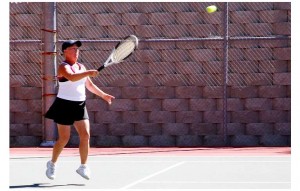
Sheryl Herschman plays on the 3.5 USTA team at Zephyr Cove. Photos/Carolyn E. Wright

Sheryl Herschman plays on a USTA team at Zephyr Cove. Photo Copyright 2013 Carolyn E. Wright

Funding is the main hold up.

As the South Lake Tahoe-El Dorado County Recreation Facilities Master Plan comes together, tennis will be part of the discussion. What that will look like remains to be seen, but there will be opportunities for the public to voice its opinion.

When expanding and improving facilities and offerings are talked about, the idea of bringing in tournaments and groups from outside the area are always at the top of the list for why to do something.

When MontBleu casino in Stateline was Caesars Tahoe eons ago, professional tennis was played there on occasion.

In summer 2008, Incline Village Tennis Center was the site of an exhibition match between Justin Gimelstob, who was once in the top 50, and Paul Goldstein, a Stanford graduate once ranked No. 40.

Zephyr Cove’s six courts, which are owned by Douglas County, are home to an annual tournament as well as four USTA teams this season. Tahoe Donner has USTA teams and tournaments, too.

Granlibakken in Tahoe City and Northstar in Truckee (the courts there are run by the homeowners association, not Vail Resorts) are private, but offer clinics to people not staying at the resorts.

Carel James, who divides her time between Florida and Lake Tahoe, said of Florida, “Many residential developments have tennis courts on the premises and will participate in league play, allowing other players from outside the development the opportunity to pay a fee to join their private courts. Being a part-time resident in Tahoe for the past eight years, I have seen a growing interest in tennis almost rivaling winter sports.”

Public courts in the basin

The Tahoe Paradise courts are open to the public. Two of the three are playable and were resurfaced in the last few years.

“The courts are available on a first come, first serve basis at no cost. Generally speaking the courts are unlocked. The only time they may be locked is if there is a wedding ceremony being held,” El Dorado County Supervisor Norma Santiago told Lake Tahoe News.

“The two courts are in great shape and usually empty. As far as I know, the only option for me to play in this town is on those two courts,” Brenda Stewart of South Lake Tahoe said of Tahoe Paradise. “(South Tahoe) Middle School is a terrifying/dangerous, crack-filled nightmare. I’m locked out of the Keys and I still can’t figure out how to play at the high school.”

The use of the six taxpayer-funded courts at South Tahoe High School is not easy to understand. Instead of going out for bid, the district has historically allowed the school’s tennis coach to use the courts for his personal use in the off-season.

Superintendent Jim Tarwater told Lake Tahoe News, “What we usually do is work out where the money goes. (Coach Justin Clark is not paying a set fee) because it’s too volatile. We identify each year what we want to replace. This year it was windscreens. The district will pay for repaving.”

Tarwater said he has looked at Clark’s books and the most he’s made in a summer is about $4,000.

“This is not a profit thing. That is not legal to do,” Tarwater said.

Clark told Lake Tahoe News, “If I break even every summer or pay myself a little, then I am happy. Also, I employ six kids for summer jobs and provide usually four scholarships to the tennis academy needy kids and about four work/play opportunities where the kids work and get free tennis. After all that, there is enough to pay me little.“

Without a formal process in which someone can make money off public facilities, this becomes a gift of public funds.

This email was sent to Tarwater by LTN, “With Justin using so much court time for his private Tahoe Tennis Academy that makes good money and the district not making a dime from it, how does the district justify a private business that didn’t have to go through and RFP process making money off public courts?”

There was no reply.

The academy has between 10 and 50 players in it each week, according to Clark.

This is the 2013 STHS court time-fee schedule that was provided by Clark. Clark wants people to reserve a court 48 hours in advance online. But the district hasn’t set up the online scheduling platform.

“The online public facilities use scheduling portion of the software has not yet been tested. We are still building the final fee schedules/pieces in the software and hope to test in a controlled environment this summer,” LTUSD CFO Deb Yates told Lake Tahoe News. “We most likely will roll the software out to the school sites first, then determine when it will be ready for the live public.”

If Clark or one of his designees is not at the courts, the public is shut out because the courts are locked.

Douglas County puts out a request for proposal for a licensed tennis professional to run the six courts at Zephyr Cove. Rob Wheatley is in the middle of a multi-year contract that calls for him to pay the county a flat fee each year.

Suzy Allione serves during a match at Zephyr Cove.

Suzy Allione serves during a match at Zephyr Cove.  Photo Copyright 2013 Carolyn E. Wright

There was a time when the county took a percentage of gross receipts, but the time and paperwork involved made it not cost-effective.

Scott Morgan, who runs the county’s parks department, said the courts are now self-supporting. About $20,000 will be spent this summer to repair cracks.

If a player is not a member of the Zephyr Cove Tennis Club, then she is supposed to pay $5 each time she steps on the court. The highest seasonal membership fee is $70 for non-Nevada residents who aren’t kids or seniors. The county approves all the fees Wheatley charges.

When Wheatley is not there, the courts are open and free to anyone, according to Morgan.

“In his contract he has to do a free youth clinic to grow the game,” Morgan told Lake Tahoe News.

Other public courts around the Lake Tahoe area include:

• The Incline Village Tennis Center is part of the Incline Village General Improvement District. The 11 courts have a fee based on time of day and whether the player is an IVGID member. Reservations are encouraged. There are four pros on staff.

• Two at the top of the tram at Squaw Valley. They are free to play on with the purchase of a tram ticket.

• Two courts at Kilner Park near Sunnyside. No fee, no reservations needed. The Tahoe City Public Utility District runs them.

• Four courts at North Tahoe High School are also run by TCPUD.


Partial ruling favors TRPA in Regional Plan lawsuit

By Kathryn Reed

The Tahoe Regional Planning Agency on Monday won a partial decision in federal court when the judge dismissed some of the claims against the bi-state regulatory agency.

“The litigation is still pending, but this answers a lot of questions TRPA raised at the start,” TRPA spokesman Jeff Cowen told Lake Tahoe News.

The Sierra Club and Friends of the West Shore filed a lawsuit in February in U.S. District Court in Sacramento to stop the TRPA’s Regional Plan that was approved in December from taking effect in its entirety.

Neither of those groups was immediately available for comment June 17.

A federal judge is handing out the ruling on the TRPA Regional Plan update lawsuit piece-by-piece. Photo/LTN

A federal judge is handing out the ruling on the TRPA Regional Plan update lawsuit piece-by-piece. Photo/LTN

Judge John A. Mendez said the Regional Plan update does not violate California law by allowing local jurisdictions to have more authority. This was one of the items in the lawsuit.

Plaintiffs, not taxpayers, are to bear the expense of litigation. Mendez upheld that stipulation, too, which has existed since 2010 when the Rules of Procedures was amended.

“The only new rules not in effect are the land coverage credits and exemptions which are on hold waiting for parallel approval of the Lake Tahoe Water Quality Management (208) Plan by the U.S. EPA, which is expected to be considered by the end of this month,” Cowen said. “TRPA is expecting to be able to process applications with the new coverage rules this summer and we are working closely with local jurisdictions to develop their area plans.”

Area plans have replaced community plans in the TRPA paperwork world. Douglas County is expected to approve the first area plan in the basin at its June 20 meeting in Stateline. South Lake Tahoe is having a special meeting in July to discuss its plan for what is being called the tourist core.

It is not known how future rulings by the judge could impact an area plan that the TRPA Governing Board approves.

Further litigation is always possible when it comes to specific projects in an area plan.


A scenic paddle between Tahoe eateries

By Kathryn Reed

While everyone touts there only being one island in Lake Tahoe, four of us say not so fast.

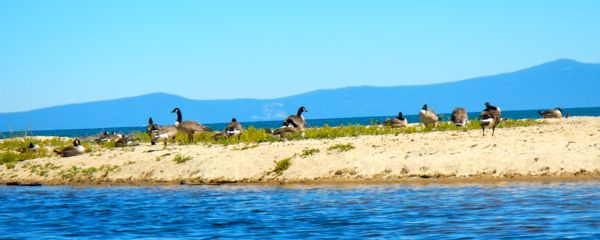
What about that sandbar of sorts between Trout Creek and the mouth of the Upper Truckee River that is home to a flock of geese?

“It’s a natural part of Lake Tahoe’s sedimentation and fluvial geomorphology. Unless the area was part of a planned river restoration, islands like that might remain unaltered for many years before natural hydrologic action takes them out or moves them entirely,” Jeff Cowen with the Tahoe Regional Planning Agency told Lake Tahoe News.

Geese Island

Geese Island

Lauri Kemper with Lahontan Regional Water Quality Control Board had this to say, “The ‘island’ is formed from the flows and sand/sediment coming out of the Upper Truckee River and Trout creek and is dynamic. [It] changes based on lake elevations and river flows and timing of snow melt, etc. It is not likely to ever become ‘permanent’, but if it persists, it may provide an environment for willows and other plants to begin growing there.”

While Kemper said I could name it Reed Island, she said to not start doing anything to the island.

“You can name temporal objects,” she explained.

The four of us out on a recent paddle opted to call it Geese Island based on the inhabitants.

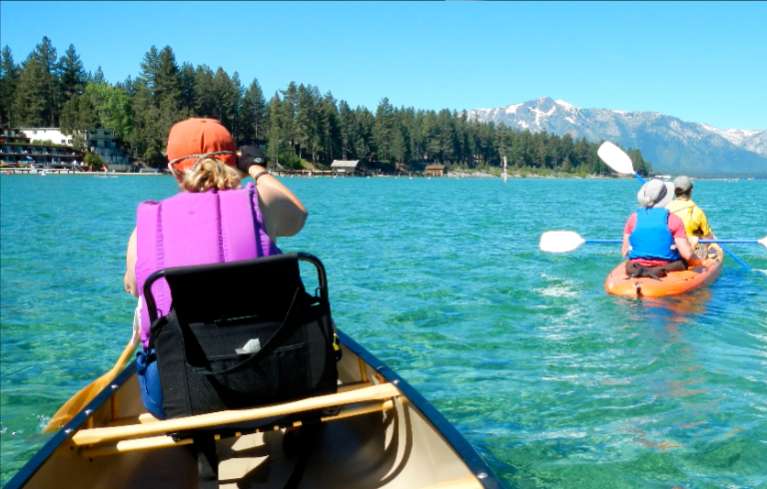
We started the morning at Lakeland Village, where our friends had access to a kayak. Sue and I launched our canoe from there.

In addition to the island’s being new since we were last on this stretch of water along the edge of the South Shore, the entrance to Trout Creek is covered with sand. A year ago it was spectacular to paddle in there among all the blooming lilies. While we could have portaged our vessels, we opted to keep heading toward the Tahoe Keys.

Standup paddleboarders outnumbered other human powered craft – at least on our way out. By the time we headed to our home port there were whitecaps on the lake.

Sue steers clear of Brenda and Roni in the kayak. Photos/Kathryn Reed

Sue steers clear of Brenda and Roni in the kayak. Photos/Kathryn Reed

Headed south we had Mount Tallac as our beacon. The water is so clear – even more than 100 yards from shore. And some places it’s shallow enough for people to be standing next to us.

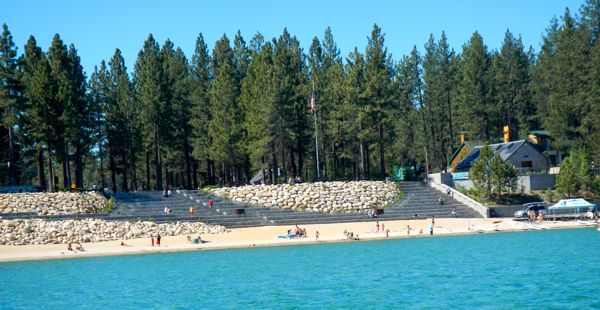
Lakeview Commons really is something to see from the water. Regan Beach is as unimpressive from the water as it is on land.

It becomes a bit of an architectural tour going along Lakeview Avenue and into the Keys.

“I loved being on the lake and seeing things from a whole new perspective,” Roni said.

We didn’t know what to expect coming into the Tahoe Keys Marina in terms of whether we could tie up the kayak and canoe. No problem. We could have stayed for two hours.

As we leave the Fresh Ketch, a marina worker warns us the winds are supposed to be picking up soon and to be cautious. We thank him and heed his warning as we paddle a bit closer to shore on our way back.

It’s getting rough, but plenty of people are still playing on the water.

We get to Timber Cove pier and have the only unpleasant experience of the day. I shout “hey” to a Zodiac with “Camp Richardson” on the side to get the guys’ attention. They are headed to shore and we are headed to go under the pier.

Lakeview Commons

Lakeview Commons

They nastily shout back, “It’s a boat channel.”

Perhaps if they would have been looking in front of them and paying attention to those on the water instead of the skimpily clad woman on the pier they were keeping pace with, they wouldn’t have been annoyed by being shouted to by two middle-aged women in a canoe with unattractive life jackets on. I can only imagine if we were tourists, what kind of impression the exchange would have left.

We paddle on.

Now it’s time for a stop at Riva Grill. No problem getting beyond the boat channel and putting our toys alongside those that are available for rent.

One short push and we make it back to Lakeland – ready for another day on the lake.


Reid says no one in D.C. willing to compromise

By Karoun Demirjian, Las Vegas Sun

Legislation, as Sen. Harry Reid often says, is the art of compromise. But lately, Reid has not been in a compromising mood.

“Who would I negotiate with?” Reid said last week when asked about his recently expressed reticence to parley with Republicans over how to keep student loan rates from rising on July 1, an issue on which Republicans and Reid’s Democrats differ. “I don’t know of anyone. I’m serious about that. I don’t know of anyone.”

In light of Republicans and Democrats trying their best to work with fresh bipartisan vigor on divisive issues from immigration reform to the federal budget, Reid’s observation might sound like defeatism.

But the conclusion he has been building toward for years also is the foundation of a strategy Reid regularly deploys to achieve his aims.

Sen. Harry Reid says compromise is elusive in Washington. Photo/LTN file

Sen. Harry Reid says compromise is elusive in Washington. Photo/LTN file

Ask Democrats why Reid is sticking so fiercely to his proposal to extend student loan rates instead of linking them to interest rates, as Republicans would prefer, and they will recall December 2011, when Reid and Republicans couldn’t agree on how to offset the cost of a payroll-tax-cut extension.

Reid didn’t like the Republican proposal to pay for it with a salary freeze for federal employees. He dug in his heels, insisting he would go no further than a temporary extension. After a punishing few weeks as the target of campaign-style advocacy, Republicans acquiesced — 36 hours before Christmas.

Since then, the experience of the debt ceiling, budget, sequestration and “fiscal cliff” suggest that as the hourglass runs low, the House can be driven to follow, albeit often at the last minute, the Senate’s lead.

“The play right now is to put (House Speaker John) Boehner in a box … to make it so uncomfortable for Boehner that this is his only course of action,” said David Damore, a professor of political science at UNLV. “He either has to let popular legislation die going into 2014 or, essentially, allow Democrats to be part of the winning coalition. Or does he want to run in the midterm with his party killing immigration and killing student loans?”

Congress will contend this summer with issues that are both pressing and practically designed to play on the campaign trail. The first half of the summer promises to be dominated by immigration and student loan rates, and the second half by immigration and the budget.

On immigration reform and student loans, Democrats have the more naturally crafted sales pitch.

“On immigration and student loans, Reid is in a position of strength, on the substance, on the politics and on his team sticking together,” said Eric Herzik, a political science professor at UNR.

“Republicans have to figure out a way to keep their most conservative Tea Party base happy while at the same time at least start to talk to immigrants, especially Latinos. … And on student loans, Republicans can’t make up a good story line. It’s not only a lot of young people trying to pay their student loans, it’s their parents, too.”

Republicans, however, are in no mood to roll over. Boehner’s House passed a student loans bill last week despite the threat of veto by President Obama, and the speaker has been adamant that while he supports the idea of comprehensive immigration reform, he has no intention of having the House rubber-stamp the Senate’s proposal.

But if Reid is listening to Boehner’s words, he’s filtering them liberally.

“He’s already said a lot of things,” Reid said, calmly dismissing the force of Boehner’s stated plans for immigration and saying with steely confidence: “I would prefer them to pass our bill.”

Reid, for months, has been maintaining a nearly split stance when it comes to his estimation of Republicans in the House and Senate.

On the one hand, he oversees a Senate in which he routinely expounds on the merits of bipartisan cooperation, as he has lately with his hands-off approach to the Senate’s immigration bill, designed by a bipartisan group of eight lawmakers and vetted through the regular order in the Senate Judiciary Committee.

On the other hand, he is still Democrats’ No. 1 attack dog, charged with pillorying his Republican counterparts.

Lately, Reid has abandoned the 2012 election description of Republicans as “extreme” in favor of calling them “anarchists.”

“You have to understand, we’re in a period where the anarchists have taken over the House of Representatives,” he said in a recent interview, supporting his claim with: “I studied the anarchists, before World War I, after World War I. … Some say they’re the ones who started World War I. Now the new anarchists aren’t violent. But they still have the same basic beliefs that the anarchists had — no government.”

Reid’s firebrand tactics are normally part of a larger, coordinated strategy to advance the Democratic position.

“If Reid pushes too hard and becomes the bad cop, he’s usually able to find a good cop to carry his message for him,” Herzik said.

Usually, the good-cop role is played by the White House, whether it’s Obama intervening on grand bargain talks with Boehner or Vice President Joe Biden spending New Year’s Eve at the Capitol to hash out the final details of a fiscal cliff deal with Senate Republican Leader Mitch McConnell.

But with the White House largely distracted by scandals at the IRS and National Security Agency, Reid has lately been on his own, and as such may be seeing other incentives to make an uncompromising push for the Democratic platform.

“You look at 2014 and those Senate seats, and it’s going to be hard for Reid to hold the Senate,” Damore said. “So he’s got to do all this now; otherwise, he’s just going to be the minority leader.”

Even Reid has obliquely referred to the potential of losing the Senate in reference to his agenda, telling an audience at a ceremony on Capitol Hill last week to honor the victims of last December’s school shooting in Newtown, Conn., that a Republican-controlled Senate is a sure sign that “we’ll never, ever get anything done” on gun control.

As long as he has a Democratic majority, Reid can put relative faith in the reliability of his caucus. In every major deal of the past two years, Senate Democrats have stuck together more than any other quadrant of Congress.

“This divisiveness within the Republican caucus is new. Traditionally Democrats are the more divided caucus, so they were the ones that could be split,” Damore said. “But now, there’s hay to be made for that. … The issues line up well for him, so why not take the opportunity?”

In lieu of a negotiating partner, Reid is publicly relying on the strength of the Senate Democrats, and the substance of his position, to try to knock out the top items on his agenda.

“I feel confident we’ll get something done, in spite of the Tea Party (on immigration) … because it’s an issue that 80 percent of the American people support,” Reid said. “Now maybe (Republicans) will do the same thing with this that they did with guns — 90 percent of the American people supported gun legislation. But I think that they’d better be very careful.”

In a divided Congress, to truly operate without a negotiating partner is a tall task. But, experts remind, even in an adverse environment, Reid is still a dealmaker. So broadcasting that he can’t make a deal may be just what lets Reid get a deal done.

“At the point Reid is finally just saying, ‘I’ve got no one to work with, so I don’t even have to concern myself with them, I’m just going to pummel whomever’s on the other side’ … then you’re really not attempting to negotiate. But I don’t think that’s happening,” Herzik said.

“What Harry Reid says at the start of an issue and where he ends up on the issue can be very different. Because he’s ultimately about guiding an issue to conclusion.”


Study: Reading novels makes people better thinkers

By Tom Jacobs, Salon

Are you uncomfortable with ambiguity? It’s a common condition, but a highly problematic one. The compulsion to quell that unease can inspire snap judgments, rigid thinking, and bad decision-making.

Fortunately, new research suggests a simple anecdote for this affliction: Read more literary fiction.

A trio of University of Toronto scholars, led by psychologist Maja Djikic, report that people who have just read a short story have less need for what psychologists call “cognitive closure.” Compared with peers who have just read an essay, they expressed more comfort with disorder and uncertainty—attitudes that allow for both sophisticated thinking and greater creativity.

“Exposure to literature,” the researchers write in the Creativity Research Journal, “may offer a (way for people) to become more likely to open their minds.”

Djikic and her colleagues describe an experiment featuring 100 University of Toronto students. After arriving at the lab and providing some personal information, the students read either one of eight short stories or one of eight essays. The fictional stories were by authors including Wallace Stegner, Jean Stafford, and Paul Bowles; the non-fiction essays were by equally illustrious writers such as George Bernard Shaw and Stephen Jay Gould.

Afterward, each participant filled out a survey measuring their emotional need for certainty and stability. They expressed their agreement or disagreement with such statements as “I don’t like situations that are uncertain” and “I dislike questions that can be answered in many different ways.”

Those who read a short story had significantly lower scores on that test than those who read an essay. Specifically, they expressed less need for order and more comfort with ambiguity. This effect was particularly pronounced among those who reported being frequent readers of either fiction or non-fiction.

So how does literature induce this ease with the unknown? Djikic and her colleagues, Keith Oatley and Mihnea Moldoveanu, have some ideas.

“The thinking a person engages in while reading fiction does not necessarily lead him or her to a decision,” they note. This, they observe, decreases the reader’s need to come to a definitive conclusion.

“Furthermore,” they add, “while reading, the reader can stimulate the thinking styles even of people he or she might personally dislike. One can think along and even feel along with Humbert Humbert in Lolita, no matter how offensive one finds this character. This double release—of thinking through events without concerns for urgency and permanence, and thinking in ways that are different than one’s own—may produce effects of opening the mind.”

The researchers have no idea how long this effect might last. But their discovery that it is stronger in frequent readers suggests such people may gradually become programmed to respond in this way. “It is likely that only when experiences of this kind accumulate to reach some critical mass would they lead to long-term changes of meta-cognitive habits,” they write.

Their results should give people “pause to think about the effect of current cutbacks of education in the arts and humanities,” Djikic and her colleagues add. After all, they note, while success in most fields demands the sort of knowledge gained by reading non-fiction, it also “requires people to become insightful about others and their perspectives.”

If their conclusions are correct, that all-important knowledge can be gained by immersing yourself in a work of literature. There’s no antidote to black-or-white thinking like reading “It was the best of times, it was the worst of times.”


South Lake Tahoe restaurateur judges State Fair wine competition

By Evan Williams

SACRAMENTO – The announcements, introductions and instructions have been dispensed with. You wait patiently at your table and the sound of faintly tinkling glassware grows louder as carts laden with wine glasses, each filled with 2 ounces and labeled with a numerical code, begin to parade into the hall. The glasses are lined up in front of you with great care by the stewards. Your panel assistants have provided you with pencils, water, palate cleansers, and a large spit bucket because there is no swallowing. Your clerk provides you with the scoring sheets and now your job begins.

You, and the other three judges on your panel, combined with the other 68 judges in attendance now must determine the good, the bad and the ugly from the nearly 3,000 wines submitted to the California State Fair Wine Competition.

Let the fun begin!

South Lake Tahoe's Evan Williams at the 2013 California State Fair wine judging. Photo/Provided

South Lake Tahoe’s Evan Williams at the 2013 California State Fair wine judging. Photo/Provided

Well, actually, we try to make it fun and lighthearted, but it really is pretty serious business, and surprisingly taxing – not physically, but mentally.

I am always mindful that some very hardworking winemaker has poured their blood, sweat and tears into the wine I am about to examine. But I must try to fairly and objectively evaluate this wine and, to the best of my ability, score it in a way that will hopefully aid the retail purchaser looking for good quality and value in their wine purchase.

I’ve been judging wines since the late 1980s and have worked this competition since 2001. In that time I’ve seen an evolution in the process from the old “retain or eliminate” format through the “Peterson Method” (named for Dr. Richard Peterson, this is an evaluation process I personally favored, but which could result in the daunting prospect of having as many as 80 to 100 wines on the table at once) and now back to lower volume flights. New this year were computerized entries with a wireless terminal at each panel; greatly helping the clerks in their jobs and expediting the scoring process.

It is the nature of wine competitions that, with few exceptions, the super-premium producers do not submit their wines for judging, nor would it make any sense for them to do so. First, they sell out every vintage, so they really have no need to promote any further. Secondly, they are in a no-win situation. If they win a gold medal, people would say, “Sure they won a gold, look at the price they charge!” And if they don’t win a gold, even harsher criticism befalls them, “Look at the price they charge for those wines and they can’t even get a gold!”

So what you have at these events are primarily two categories of producers. The high-volume vintners hope they can benefit from having their less expensive wines favorably scored so they are able to market them as good quality wines and a great value. Then there are the smaller and/or newer producers who have limited marketing dollars and staff, but are able to capitalize on good competition results in press releases and in their tasting rooms, and don’t all those pretty ribbons and medals look nice on the wall?

Becoming a judge

What does it take to become a wine judge? Well, you need to taste a great deal of wine! As a buyer for the last 35 years, I am fortunate to have wine show up at my door on a frequent basis. And I do try to taste everything. But it’s important also to know what you are tasting, as well, and to be able to identify faults, flaws and additives. And that’s where experience, and the UC Davis Advanced Tasting Seminar, comes in.

This is a fundamental, yet fairly intensive wine class that will give you a sound basis for evaluating wines, covering most of the more common defects you might encounter in wines and allow you to test your sensory evaluation capabilities. Then a prospective judge must pass the Sensory Evaluation Exam, as administered by UC Davis, after which the fair officials will accept your application to be a judge.

The California State Fair Wine Competition is the only one that requires all judges to be credentialed.

Starting the process

In professional wine judging (and in the restaurant business, too), there is the problem of inherent differences in individual palates, a phenomenon which was documented in some groundbreaking work by Tim Hanni, MW, who was invariably puzzled as to how two people could taste the same wine and have such remarkably divergent opinions about it (and how this leads to sometimes emotional disagreements on judging panels). In his research, Hanni discovered that it really just boils down to genetics.

Some people are born with significantly more papillae on their tongues than other people, and there’s not a thing to be done about it. Those with the most papillae are referred to as “hyper-sensitive” and comprise roughly 25 percent of the population. (There is actually a small subset of this group called “sweet tasters” who are quite literally are the proverbial “sweet tooths”.) Then there are the approximately 50 percent in the middle who are called “sensitive” and then there are the remaining 25 percent who have the least amount of papillae on their tongues and are known as “tolerant” tasters.

The tolerant tasters typically enjoy hot and spicy foods, big, tannic red wines, martinis and single malt scotches along with IPA beers and cigars. The hyper-sensitive tasters are always trying to mask bitter; bitter is their mortal enemy. They drink their cream “with a little coffee in it”, usually sweetened heavily. They cannot tolerate grapefruit or artificial sweeteners such as may be found in diet sodas, and given their preference, will gravitate toward white and even dessert style wines. They also are big on salty snacks, and you might think that a contradiction for the “hyper-sensitive” to be salt hounds but again, it is all in the effort to mask bitterness.

Typically, the “hyper-sensitive” will have a more heightened olfactory (and even auditory) sense, as well. The nose is really where most of the heavy lifting of wine appreciation takes place. The tongue is a relatively crude instrument, detecting sweet, sour, salty and bitter, as well as “umami”, another discovery for which Hanni is credited.

“Umami” is a term used to describe the savory sensation of most meat proteins. In the aforementioned “Peterson Method” a taster could evaluate larger flights of wines by first relying purely on the nose to begin to differentiate and then rank the wines into groupings, again based solely on the bouquet and aroma of the wine. (I found this to work well for me.) In a large flight you might spend an hour or more establishing a ranking based on the nose before you even begin to taste a single wine. With rare exceptions, an attractive smelling wine will be pleasant in the mouth as well, but evaluation obviously requires wines be tasted for acidity, sweetness, flavors, mouth-feel and finish.

Then the rankings are further adjusted after tasting to allow to best wines to ascend to the top.

It’s no great surprise that most chefs are “hyper-sensitive”, as am I, and I have a nose like a bloodhound, which can be a curse at times. My wife, on the other hand, is “tolerant” (some may say she would have to be to live with me) so we complement each other nicely. She eats all the hot food and drinks the Grey Goose and I eat the M&Ms and drink the Chardonnay. (I am still able to evaluate and score big, reds but it’s not what I would generally choose to do. Given my druthers I usually opt for whites and frequently end up judging Chardonnays, something a great many judges find boring and tedious, but a long day of Petite Sirahs and Zinfandels will absolutely scorch my palate).

Working together

This year my gracious panel mates were Carol Shelton, owner-winemaker of Carol Shelton Wines and the “Queen of Zinfandel”; Chris Macias, food and wine writer for the Sacramento Bee; and David Crippen, director of winemaking for Renwood Wines, right in our own backyard of Amador.

We enjoyed fairly good consensus and more than our share of laughs. It really helps if things don’t get too tense on a panel. But what happens when you get a “hyper-sensitive”, two “sensitives” and a “tolerant” on a panel? You end up all over the map and it can get to be a very trying scenario. There’s a certain amount of “horse trading” which goes on in every panel, and you just have to give up some ground sometimes in hopes of getting some back later. Everyone will push for their favorite wines and if you don’t help out a little, you won’t get any love back when it’s your turn to push your favorites. So you have to go along to get along. Usually it’s a pretty equitable process.

It was a time of change for the California State Fair Wine Competition this year as longtime (26 years) chief judge G.M. “Pooch” Pucilowski has moved on and was replaced by Sacramento Bee food and wine writers and venerable judges, Mike Dunne and Rick Kushman.

Many new judges appeared this year as well. Transitions are always fraught with little glitches and this was no exception. But it seems the event is in capable hands and will go forward fairly seamlessly. Kem Pence keeps a steady hand on the proceedings and the staff and volunteers (over 100). They always go above and beyond the call of duty to see to it that things go smoothly. It is a big event with a lot of moving parts, and I am always impressed with the fluidity with which it runs.

The “Continuing Education” Judge’s Seminar this year was an outstanding presentation on oak flavoring products as produced by Oak Solutions Group, and how this is such a remarkable asset for the winemaker to have in their “tool kit” to not only save money on very expensive oak barrels, but customize flavors and toast levels with more than 100 different oak profiles from which to choose. As a self-confessed “oak whore” this is really cool stuff, and perhaps a topic for another piece.

Evan Williams is the owner of Evan’s American Gourmet Cafe and Cantina restaurants in South Lake Tahoe.


Record fine in El Dorado County mine case

By Don Thompson, AP

SACRAMENTO — State regulators imposed a record $11 million fine Thursday on the operators of a renegade gold mine in the Sierra foothills east of Sacramento.

Owners of the Big Cut Mine south of Placerville previously ignored more than $1 million in fines from the state Mining and Geology Board, and board executive officer Stephen Testa said he doubts the state can collect on this one.

But the board also plans to seek a court injunction to halt mining while it sues over the property owners’ repeated failure to correct violations of the states’ Surface Mining and Reclamation Act.

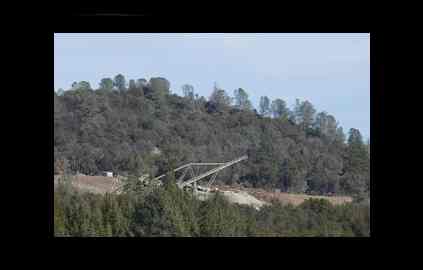
In this Wednesday, Jan. 25, 2012, file photo, mining equipment sits at the Big Cut Mine near in Placerville, Calif. The state Mining and Geology Board is considering levying a $2.5 million fine against the operators of a renegade gold mine in the Sierra foothills east of Sacramento. (AP Photo/ Rich Pedroncelli, File) Read more here: http://www.sacbee.com/2013/06/13/5495635/record-11m-fine-for-illegal-california.html#storylink=cpy

Mining equipment sits at the Big Cut Mine near in Placerville in January 2012. Photo/Rich Pedroncelli/AP

Regulators say the miners have continued to scrape valuable ore from a ridge about 45 miles east of the state capital even though two of the operators also face criminal charges in El Dorado County. Joseph Hardesty and Rick Churches have another court appearance set for Friday. State agencies and county prosecutors say the ongoing mining operations are illegal, have polluted a nearby creek and threaten to collapse 150-year-old mining tunnels.

Testa had recommended the board impose a $2.5 million penalty, more than enough to cover his agency’s expenses and the estimated cost of cleaning up the site.

But the board voted 6-0 to impose the entire $11 million penalty allowed by law, based on two years of multiple violations at a maximum penalty of $5,000 per violation per day. It’s the largest penalty every imposed by the board, Testa said.

“It sends a message to something that you don’t see very often, and that is a party that just ignores everybody and just does what it wants to do,” Testa said.

The miners sent no representatives to the board meeting, did not contest the fine, and their attorney, William Brewer of San Diego, did not return a telephone message. Hardesty has previously contended that he has a historic right to operate the mine over the objections of state and local authorities.

“They have local legal troubles, they have state legal troubles, they just seem to be of the mindset that laws don’t apply to them,” said Don Drysdale, a spokesman for the state Department of Conservation.

The price of gold has fallen considerably to $1,400 an ounce, down from more than $1,600 an ounce when the Associated Press published stories about the mine in February 2012.

Yet regulators say the mine’s operators have apparently decided that the fortune to be made outweighs the threat of fines. The owners have ignored $850,000 in penalties and multiple cease-and-desist orders over the last three years, expanding what officials say is an unpermitted and illegal surface mining operation.

Aside from the recent fines, the owners never paid more than $220,000 in penalties levied a decade ago, despite losing an appeal in court.

By the time investigators used a search warrant to inspect the property again in November, the operation 1.5 miles south of Placerville had spilled beyond the 150-acre site’s southern boundary onto about 2.6 acres owned by the El Dorado Irrigation District.

Despite the earlier orders, the operators had increased the size of an ore processing plant, dug several additional water retention ponds, brought in multiple pieces of heavy mining equipment, and installed a truck scale and water pipelines.

“This is a case of an egregious, ongoing, total and intentional failure on the part of the owners/operators to comply with … regulations and local county laws,” Testa said in a report to his board.