West may never look the same after wildfires

By Kurtis Alexander, San Francisco Chronicle
 
As hotter and bigger fires blaze through the West and yet another year passes with a disastrous toll, America’s wildlands are having a harder time bouncing back. Some spots, from the singed valleys of Wine Country to the steep slopes of the Sierra, may never look the same.

The fiercer fires are killing more of the vegetation needed to provide seeds for regrowth, and scientists are learning that even when new trees sprout, many are struggling with the warmer and more extreme weather wrought by climate change.

While wildfires have historically benefited the natural landscape, cycling soil nutrients and clearing space for new plants, for example, scientists say more burned areas are likely to end up devoid of trees and populated instead with weeds and grasses. This new vegetation is even likelier to burn, setting in place a vicious cycle of only more fire and less forest.

Read the whole story


Bleak results in first snow survey of 2018

Frank Gehrke on Jan. 3 finds little snow to measure near Echo Summit. Photo/Kathryn Reed

By Kathryn Reed

PHILLIPS STATION – A major component of the first snow of the year was missing – snow.

Even so, there was something to measure. On Jan. 3 the California Department of Water Resources recorded an average depth of 1.3 inches of snow in the field adjacent to the entrance of Sierra-at-Tahoe. This equated to a water content of 0.4 inches. This is 3 percent of the long-term average for this location at this time of year.

Throughout California the snowpack is dismal. Statewide, the snowpack water equivalency is 2.6 inches, or 24 percent of the Jan. 3 average.

Dry brown grass dominated the local field, while patches of snow were intermittent. It wasn’t even cold. It felt more like fall than winter.

“There is still a lot of winter left,” Frank Gehrke, who conducts the survey near Echo Summit, said on Wednesday. “January, February and into March are frequently productive.”

He pointed out how while last January was better than now, it was the first quarter of 2017 that produced the abundance of snow. This is often the case. Still, California traditionally receives about half of its annual precipitation during December, January and February. And December was a dud.

Snow is an obvious economic driver for Lake Tahoe this time of year. But that’s not what the survey is about. The measurements that are taken throughout the Sierra are about water content for users downstream – people and farms.

The good thing is that the abundance of moisture last winter has the state’s reservoirs still sitting with plenty of water. At the end of December, the state reservoirs were at 110 percent of average for the end of the year. This is the highest since December 2012.


Grant Davis, director of the state Department of Water Resources, was also at the Echo Summit snow survey. He wouldn’t talk about his anxiety level at this juncture in the water year, but instead pointed out how the state and feds need to work together to come up with better precipitation information.

He pointed out that a 72-hour forecast is 70 percent accurate, while looking out two weeks the accuracy plummets to 7 percent.

Davis said better seasonal forecasting will be better for water management.

“That is where science needs to go,” Davis said. There is an effort under way to improve medium- and long-range forecasting. This involves supercomputers and new radar to better predict when atmospheric rivers will occur and where they will land.

Michelle Mead with the National Oceanic and Atmospheric Administration was also at the survey. While the region is expected to get some precipitation starting today and extending into the following weekend, there are no big atmospheric rivers on the horizon.

As Davis pointed out, “California’s great weather variability means we can go straight from a dry year to a wet year and back again to dry. That’s why California is focusing on adopting water conservation as a way of life, investing in above- and below- ground storage, and improving our infrastructure to protect our clean water supplies against disruptions.”


2017 Calif. wildfires — staggering losses

By Phillip Reese, Sacramento Bee

2017 will go down as one of the worst in California wildfire history, the latest state fire statistics show.

Large wildfires destroyed or damaged more than 10,000 structures in California last year, a higher tally than the last nine years combined. Large wildfires had killed 43 people – 41 civilians and two firefighters. That’s higher than the last 10 years combined, state figures show.

Several fires were among the worst ever recorded in the state.

Read the whole story


Heller opposed Trump in ’16, now feels closer to president

By Debra J. Saunders, Las Vegas Review-Journal

WASHINGTON — Sen. Dean Heller, R-Nev., readily admits he “wasn’t one of the biggest supporters” of President Donald Trump during the 2016 election. “I didn’t know him. He didn’t know me.”

But now that the two know each other better, Heller told the Review-Journal, they have a “much closer relationship.”

Perhaps no other candidate running for re-election in 2018 has more to win and more to lose because Trump is in the White House. Heller vehemently opposed Trump in 2016 and is the only GOP senator running for re-election in 2018 in a state won by Hillary Clinton.

Read the whole story


SnowGlobe turns S. Lake Tahoe grass fields into dirt

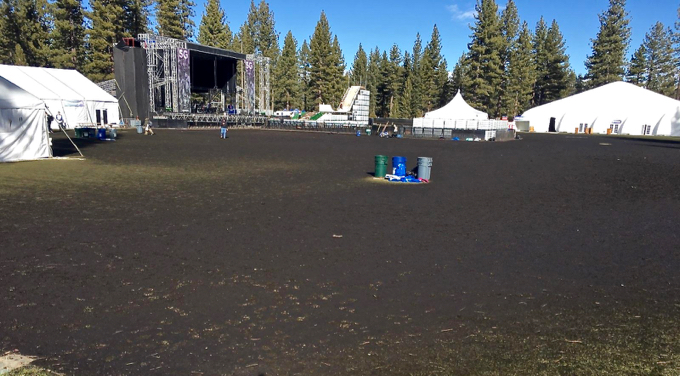
Fresh sod was laid on this field last fall. This is what it looks like after SnowGlobe. Photo/LTN

Updated at 8:04pm:

By Kathryn Reed

Just weeks ago the brand new sod fields in South Lake Tahoe were green and a dormant brown color. Now it’s raw dirt.

What happened? The three-day music festival SnowGlobe.

“I am horrified by the condition of the field. We were told that SnowGlobe was going to invest $1 million on a covering that would protect the field. Clearly that did not happen,” Councilwoman Brooke Laine told Lake Tahoe News.

Lake Tahoe News on Jan. 2 emailed all five councilmembers for a comment about the field, as well as Ray Jarvis whose department at the city is responsible for the field, and concert promoter Chad Donnelly.

Donnelly, who rarely communicates with LTN, did not respond to the email, nor did Councilmembers Jason Collin and Austin Sass.

Councilmembers Wendy David and Tom Davis issued a joint statement: “In our deliberations on the SnowGlobe contract, it was of concern to us what damage might occur to the fields. Per your question, we can see that there was an impact to the new fields. There was considerable discussion prior to the final contract and it addresses these concerns.”

This was the seventh year for the festival, which is always Dec. 29-31. This was the second year at the new fields. Prior to 2016 it had been on the synthetic soccer field at Lake Tahoe Community College. In 2016, it was on the new ball field, but at that time it was just dirt. The sod was laid last fall.

The contract with the Colorado-based promoter says, “Promoter shall reimburse the city, within 30 days of receipt of city’s statement of costs, for city’s documented cost of repairing any damage to the property caused by the promoter. In addition to any costs and expenses described herein, and unless otherwise specified herein, promoter shall bear the sole risk and pay all costs and expenses of whatever kind and nature which arise from this agreement and rental.”  

So, while any damage to the field will be the responsibility of the promoter, the fact is right now it is not a grass ball field, but instead a muddy mess. And with rain in the forecast, it is only going to get worse.

It means locals whose tax dollars paid for the field don’t have a place to recreate this winter; at least not until it snows or there is always the mud.

“To a certain extent, the appearance of the fields may be worse than the actual damage. For instance, directly in front of the main stage where thousands of festival-goers were dancing it’s pretty likely there is damage to the turf. However, when standing in the same spot from which (the photo was taken) the field looks the same all the way to the main stage yet the impacts are very different,” Jarvis, director of Public Works, told LTN. “As people were dancing in front of the main stage the grass was getting pushed down, forcing fine soils up through the grass. The dirt also moved around the site as attendees moved to other areas away from the main stage, which creates the appearance of more extensive damage than what is likely real damage.”

LTCC’s contract with Donnelly was only good through this past concert. That elected board and staff are distancing themselves from SnowGlobe, with little of their property used for the event.

The statement the mayor and mayor pro tem provided to Lake Tahoe News further states, “We do not plan or intend to replace the turf each year so we will be watching how the turf recovers and what repairs are needed as a result of SnowGlobe this year. After determining what level of restoration is necessary, additional turf protections may be needed for the future.  

“As a council and as a city, we continue to look at the noise and the field impacts and how to further mitigate both in the future, listening to residents and businesses in regards to this event. SnowGlobe is a large, economically successful event for our tourist based economy, positively impacting lodging, restaurants, grocery stores and all of our visitor based businesses and their employees.”

Donnelly wants a 10-year contract for SnowGlobe as well as the opportunity to bring other events to this same location at other times of the year.

For now, the city electeds have agreed SnowGlobe can come back in 2018, but beyond that they want to see how the field holds up. That assessment usually comes in the spring after the snow melts. Right now there is no snow. Time will tell if any grass sprouts back.

Donnelly initially told city staff he would spend nearly $1 million on a cover. The council on Jan. 2 found out he didn’t buy a cover, but instead spent about $100,000 to rent one. But the cover clearly did not span the entire field.

It was always going to be questionable if such a cover would help or harm the field. The grass was going to be matted down by equipment, structures and more than 10,000 people each night dancing on it. The hope was the field would spring back to life by using the cover.

Right now there doesn’t look like there is much life to the field.


Sonny Bono — 20 years since he died at Heavenly

By Bruce Fessier, Desert Sun

Twenty years ago this week, Sonny Bono went missing at Heavenly Mountain Resort.

He was a Palm Springs icon, born Salvatore Phillip Bono to a Sicilian peasant and a second-generation Italian-American whose marriage was arranged when his mother was 14. In Washington, D.C., he was the Honorable Sonny Bono, Republican member of the House of Representatives for California’s 44th District. But, to everyone else, he was Sonny.

He and his fourth wife, Mary, often went skiing around Lake Tahoe. Sonny had grown close to the late Bill Harrah, owner of the Harrah’s Hotel and Casinos, when he and Cher were TV’s biggest musical stars of the 1970s. Harrah’s Lake Tahoe was like a second home to him.

Congress was on break, so, Sonny and Mary went skiing with some friends to usher in 1998.

Read the whole story


Recreational marijuana business thriving in Incline

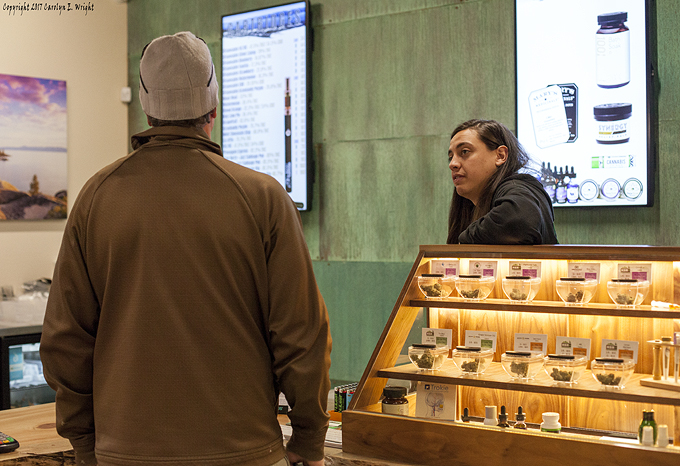
Adrian Angulo helps a customer at NuLeaf in Incline Village. Photo Copyright 2018 Carolyn E. Wright

By Kathryn Reed

INCLINE VILLAGE – Even though recreational pot could be sold in California as of this year, only one place in the Lake Tahoe Basin is doing so – and that’s in Nevada.

NuLeaf has been selling medicinal marijuana since July 1, 2016, and recreationally since Aug. 5, 2017.

“We’ve gotten a lot of business from California customers coming over on the weekends,” Andrew Zaninovich, a manager at NuLeaf, told Lake Tahoe News on a tour of the facility. The Incline Village shop is building a regular local clientele as well.

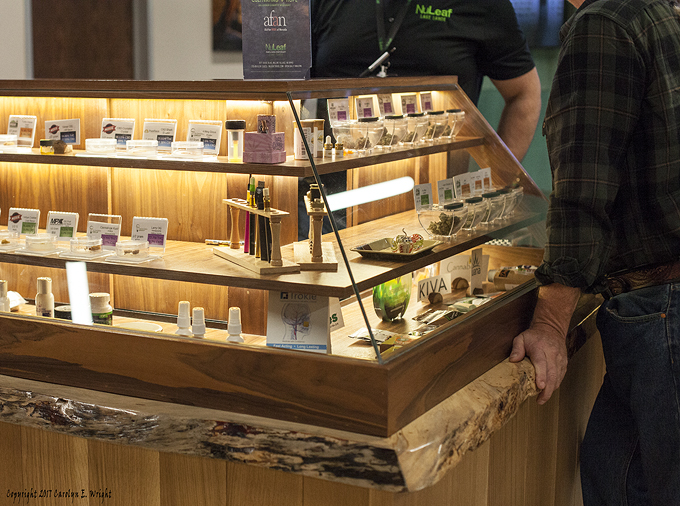
Two cases are full of various marijuana products. Photo Copyright 2018 Carolyn E. Wright

It is up to the individual jurisdictions to decide if they will allow pot to be sold. South Lake Tahoe is on a path to regulate it starting in the summer. Other locales are taking a hands-off approach for now.

Walking into NuLeaf it’s almost like a medical office in that it’s a bit sterile. The receptionist takes people’s IDs to make sure they are valid and the customer is of age. The information is also logged into their system. Signing in and out, and stating the purpose of the visit are also required. No one younger than 21 (except for medicinal patients) are allowed into the retail area.

Andrew Zaninovich of NuLeaf talks about the various products that are for sale. Photo Copyright 2018 Carolyn E. Wright

Behind the locked door it looks like a boutique candy shop – and for some, that is exactly what this is. The edibles in that glass case, though, will produce more than a sugar high.

Two glass cases containing the exact same product allow for efficiency. The natural wood and low light give the place a sense of refinement.

Customers are smelling the flowers. To the uninitiated, that’s the pot you’d smoke. Besides THC (tetrahydrocannabinol) and CBD (cannabidiol) levels, the flavor profile is important to some people.

It’s possible to buy it raw or already rolled. The least expensive joint before taxes is $13.

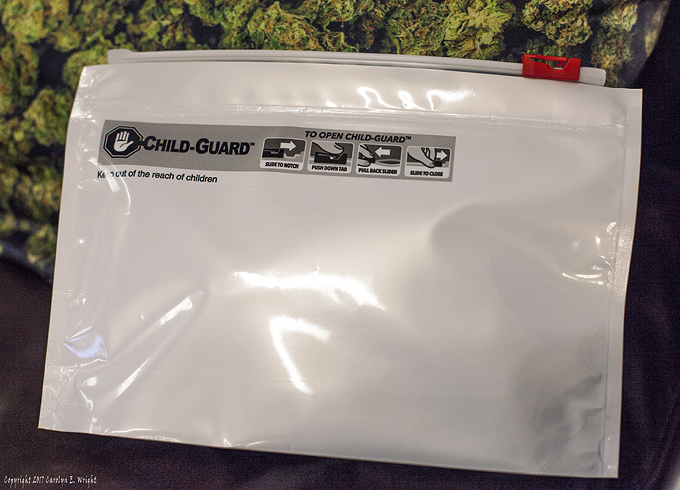
Purchases come in a discrete, child-proof bag. Photo Copyright 2018 Carolyn E. Wright

Indica, sativa and hybrid varietals are available, with the latter two being more popular. Sativa tends to be more energizing.

Edibles come in flavors, too. NuLeaf purchases its edibles from a third party that the state of Nevada has approved. They can be eaten or products mixed into drinks.

Blueberry, lemon meringue, mint chocolate chip and key lime are just some of the flavors – which could be for flowers, edibles or concentrates.

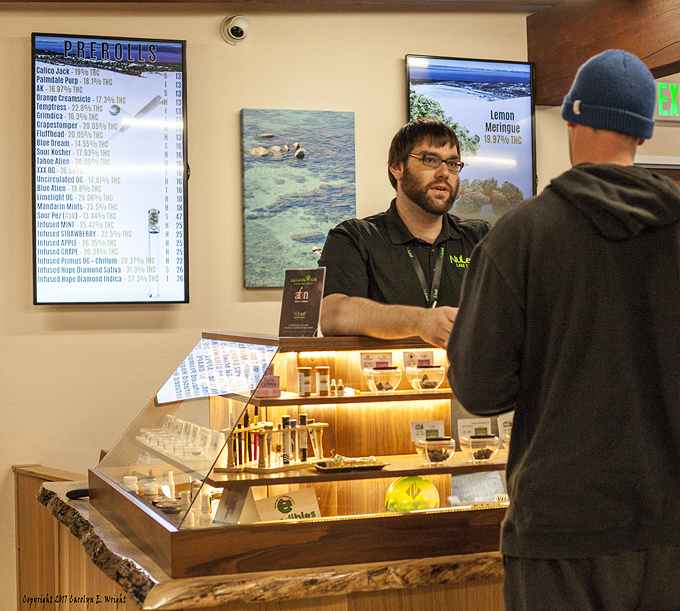
Sam Fuller talks to a customer about what his shop has to offer. Photo Copyright 2018 Carolyn E. Wright

Cartridges are another way to partake in pot. It’s similar to a vaping pen. Zaninovich explains this is a more discrete, easier way to use the drug.

For cancer patients, the most popular item is Rick Simpson oil.

“It’s shown a lot of promise for people dealing with cancer,” Zaninovich said.

The budtenders – that’s what the salespeople are called – are well versed in the products. They can speak to what someone might feel by eating or smoking or vaping a product, they know where it came from, and are patient with those who aren’t accustomed to buying pot legally.

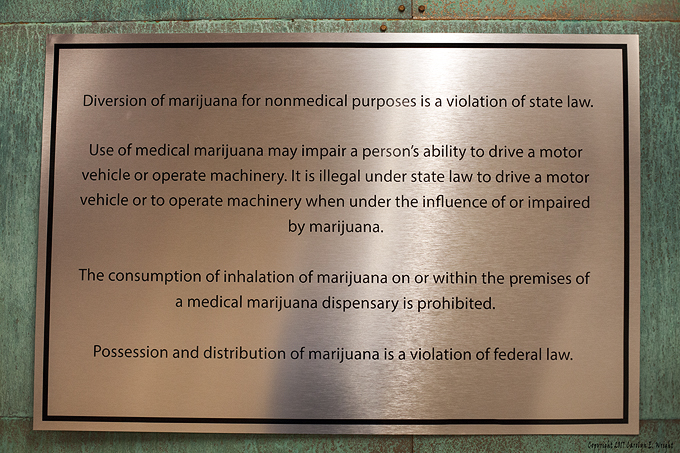
There is a limit to how much one can buy – 1 ounce, or 3½ grams of concentrate. This is to abide by state law as to how much one person is allowed to have on them at a time. No one can use the goods on the premise. It’s also not legal in Nevada to smoke in public.

Rules about the use of marijuana are clearly posted. Photo Copyright 2018 Carolyn E. Wright

Each purchase comes in a sealed, child proof package.

An ATM is in the lobby. Cash is the way business is transacted because marijuana is still illegal on the federal level. An ATM machine exists inside the shop, which is essentially taking cash from the lobby ATM. It gets around some banking rules.

Against the left wall are accessories as well as ointments, lotions, salts, patches and other products such as coffee with CBD. Items with CBD for pets are also available. Apparel is for sale, too.

NuLeaf is on the main street through Incline. On this particular day people of all ages – most appeared older than 30 – men and women, were making purchases. The store is open seven days a week.


New Nev. laws tackle day care, women’s health issues

By Kimber Laux, Las Vegas Review-Journal

Several laws adopted by the Nevada Legislature in 2017 sprang into effect just after midnight Monday.

Amid the new crop of legislation are laws that require state insurance plans to cover contraceptives, strengthen penalties for guardians who abuse or neglect vulnerable persons in their care, and increase regulations on day care facilities.

The enactment of Senate Bill 233 and Assembly Bill 249 guarantees Nevada women access to contraception and other preventive care services, such as mammograms and HPV screening and vaccinations. The new laws require private and state insurance plans, including Medicaid, to provide coverage for reproductive health and allow women to obtain a 12-month supply of contraceptives.

Read the whole story


LTN Book Club: Good read on creation of Airbnb

By Kathryn Reed

Disrupter. That’s what Airbnb has been to the lodging industry and communities where it operates.

Airbnb is part tech company, part lodging company, part tourism company. It is anything but ordinary. And that’s what those who like it love about it.

Author Leigh Gallagher captures the entrepreneurial spirit of the three men (Brian Chesky, Joe Gebbia, and Nathan Blecharczyk) who founded the company in 2008 in San Francisco by delving into their world. The concept of the business is simple – strangers renting rooms from strangers.

“The Airbnb story: How three ordinary guys disrupted an industry, made billions and created plenty of controversy” (Houghton Mifflin Harcourt, 2017) is a look at this start-up, the fragile beginnings, the meteoric rise, the controversies, the struggles, the future.

It’s in part a book about business – the Silicon Valley in particular. It’s venture capitalists, it’s finding a niche and filling it, it’s fulfilling dreams, learning to adapt, flying by the seat of their pants, and being anything but conventional.

It’s part biography – three men found a way to launch a concept multiple times until it finally took hold, how they struggled financially, but now are part of the Bill Gates-Warren Buffett club that promises to give away the bulk of their wealth. The vulnerabilities and naïveté of the founders are revealed.

Gallagher, who is an assistant managing editor at Fortune magazine, does not shy away from delving into the controversies Airbnb and similar businesses have brought to the communities where they operate. Nor were some of the horror stories of guests glossed over.

It’s not a book championing Airbnb. Instead it sheds light on how it came to be, the struggles and where it plans to go from here. It talks about how the hotel industry has changed how it does business because of the shared rental market, and even highlights how chain hotels themselves were once disrupters.

It’s $30 billion valuation (it is still a private company, though predictions are an IPO is in its future) is larger than Hilton and rivals Marriott.

There is one mention of Lake Tahoe in the book, which showed the author’s unfamiliarity with the location – suggesting the region is one municipality and not realizing these short term rentals in the basin are governed by one city and five counties. The reference is to how Tahoe is logical to have property management companies operate listings. In the same breath was an inference that the area doesn’t have a housing problem.

“In cities where there is a real housing issue, however, like New York, (Chesky) says the policy should very clearly be one listing per host,” Gallagher said. If she knew the Tahoe-Truckee market, she would have pressed him more or not used the Tahoe area in this context.

That was the only disappointment in the book.

Agree or disagree with the concept of short term rentals, this book is a fascinating look at three people who had the gumption to take an idea and turn it into a billion-dollar business. While their success is phenomenal, the process to get to where they are and to not rest on their laurels is inspirational.

—–

·      Please join in the discussion via commenting. Feel free to pose questions. Please keep the discussion to the book and questions.

·      Questions: What did you learn that surprised you the most from reading this book? Would you use a company like Airbnb – why, why not? What are your opinions about the sharing economy? How have companies like Airbnb changed how you travel? If you had the money to invest in Airbnb in the early days, would you have backed these men – why or why not?

·      The next book will be “What Unites Us” by Dan Rather and Elliot Kirschner. From the jacket cover, “With a fundamental sense of hope, ‘What Unites Us’ is the book to inspire conversation and listening, and to remind us all how we are, finally, one. Rather brings to bear his decades of experience on the frontlines of the world’s biggest stories. As a living witness to historical change, he offers up an intimate view of history, tracing where we have been in order to help us chart a way forward and heal our bitter divisions.” The review will be posted on Lake Tahoe News on Feb. 1.


Opinion: Predicting the news of 2018

By Kathryn Reed

Just because the headlines of 2017 are in the past does not mean the issues are gone.

#MeToo or as Time magazine called the movement – The Silence Breakers in naming them the person of the year – is bound to be a significant carryover into 2018.

While the high profile cases of the upper echelon garner the bulk of the headlines, the magazine pointed out sexual abuse is at all levels. For hotel workers, some are treated like an amenity – a toy of sorts – for high paying clients. How often has this happened in Lake Tahoe?

Some of the women whose names are part of these stories are powerful in their own right. And, yet, look how long it took them to stand up for themselves and all women? If they were afraid, imagine how terrifying it is for the “average” woman to come forward.

The truth is powerful. It can also be scary. And it always has consequences.

At the last South Lake Tahoe City Council meeting one of the electeds said how he was surprised to learn that unwanted hugs are a form of harassment. Incredulously, one of his colleagues pointed out that it was unwanted. He said he is a hugger, as though his desire to hug someone is more important than the recipient’s. He asked how he was supposed to know the person didn’t want a hug. His colleague said just don’t hug.

Really, that is the bottom line. Just don’t do it. Whatever it is.

It’s hard to find a woman who can’t use the MeToo hashtag. That’s so incredibly sad. We all have a story, some horrifying and life altering, others just an annoyance like a cat call.

Another headline apt to carry over into this new year is the growing chasm between the haves and have nots. The divide in the Lake Tahoe Basin is growing every day. The economy is great – for some. It is tanking for others. Wages are not keeping up with the cost of living. Every basic bill is going up – food, gas, utilities (garbage, electric, water, phone). Rents are going up, as well as insurance (medical, homeowners, business), and of course taxes. It doesn’t end.

More people on the edge are going to fall off. Then what?

People want things for cheap or free. They don’t want to pay fair market. My prediction is that some of the things we take for granted that are free today will not exist or will be completely different a year from today, maybe even Lake Tahoe News. Businesses can’t keep giving things away without compensation. Life is an evolution – personally and professionally.

Housing will continue to be in the news. It will be in the form of affordable housing, homelessness, and vacation rentals. People want government to solve their problems, but are all of these issues really the job of government? That in itself is a discussion that is warranted because it will help lead to the answers. Compromise is going to be needed, and that is going to be hard for a lot of people. We all want to get our way, but sometimes doing things for the greater good is better. Selflessness is required, and that is always difficult.

As we forge a path in this new year, let’s remember to do so with respect. Let’s listen. Let’s not talk over others. Let’s not dismiss people because we disagree with them. Let’s start figuring out what we want and then chip away at the hurdles to accomplish those goals.

We have a strong, passionate, engaged group of residents, second homeowners and visitors who love Lake Tahoe. We are all stewards with a stake in the region’s future. Let’s find that common ground where in a year from now there are fewer people wondering how their bills will get paid, where their next meal will come from, if they will be assaulted.

Let’s be better than the headlines.

Kathryn Reed is publisher of Lake Tahoe News.