Sierra — an outdoor climate change lab

By Tracie Cone, AP

SEQUOIA NATIONAL FOREST — In parts of California’s Sierra Nevada, marshy meadows are going dry, wildflowers are blooming earlier and glaciers are melting into ice fields.

Scientists also are predicting the optimal temperature zone for giant sequoias will rise hundreds and hundreds of feet, leaving trees at risk of dying over the next 100 years.

As indicators point toward a warming climate, scientists across 4 million acres of federally protected land are noting changes affecting everything from the massive trees that can grow to more than two-dozen feet across to the tiny, hamsterlike pika. But what the changes mean and whether humans should do anything to intervene are sources of disagreement among land managers.

“That’s the tricky part of the debate: If humans are causing warming, does that obligate us under the laws of the National Park Service to try to counteract those effects?” said Nate Stephenson, a research ecologist with the U.S. Geological Survey.
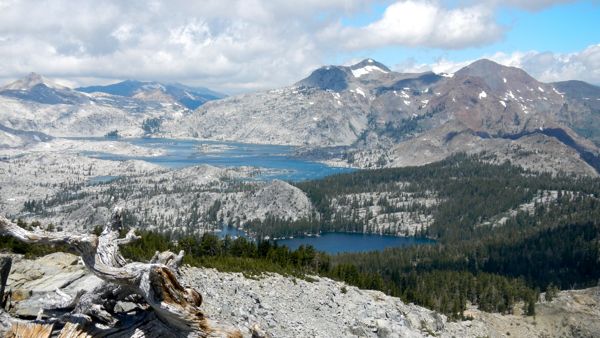
Looking down on Lake Aloha from the top of Ralston Peak. Photos/Kathryn Reed

Looking down on Lake Aloha from the top of Ralston Peak. Photo/LTN file

“How do you adapt to a changing climate if you’re a national park?” added Stephenson, who is 30 years into a study of trees in the largest wilderness in the continental U.S., Sequoia-Kings Canyon National Park.

Since 1895, the average temperature across California has increased by 1.7 degrees, and experts say the most visible effects of that warming occur within the Sierra Nevada, where low temperatures are rising and precipitation increasingly falls as rain rather than snow. Some models show noncoastal California warming by 2.7 degrees between 2000 and 2050, one of many reasons President Obama pledged last week to use executive powers to cut carbon pollution.

The state’s two largest rivers — the Sacramento and San Joaquin — originate in the Sierra. The range also is home to Lake Tahoe, the largest alpine lake in North America; Mount Whitney, the highest peak in the Lower 48; and the nation’s only groves of giant sequoias, the largest living things on earth.

There are mounting concerns about the beloved sequoias, whose sprawling, 10-foot-deep root systems make them especially vulnerable to drought and heat.

Because the trees exist only in such a small region, scientists are debating whether to irrigate the 65 groves in the southern Sierra to help them endure warmer temperatures. Otherwise they fear the trees could die. During the last warm, dry period 4,000 to 10,000 years ago, their numbers were greatly diminished, according to pollen evidence collected by researchers at Northern Arizona University.

“Whether we would water them certainly comes up on our climate change scenario planning,” said Koren Nydick, science coordinator at Sequoia-Kings Canyon National Park. “They are a very unusual species because they’re also looked on as a social artifact.”

Stephenson says his decades of studying conifers in Sequoia National Forest have shown they are dying at twice their historic rate, partly because the climate is warmer and dryer. The giant sequoias grow much more slowly than conifers over many hundreds of years so changes have been tougher to recognize, though researchers suspect seedlings already may be having a harder time taking root.

“That’s always the million-dollar question,” said Stephenson, director of USGS’s Sierra Nevada Global Change Research Program. “We just don’t have a big enough sample size to know what’s going on with the giant sequoias, whereas we monitor thousands of pines and firs and have much more confidence.”

So far, the dozens of changes researchers have noted, in everything from earlier songbird fledging dates to greater wildfire intensity, may point to a warming climate. But it’s far from understood whether that would mean doom or adaptation for California’s ecological heart.

“I don’t want to say that because we’re seeing one thing, that’s how it will play out,” said Rob Klinger who is studying alpine mammals for the USGS’s Western Ecological Research Center. “The endgame of our study is determining whether there will be uniform change or will it be patchwork. If you look at evolutionary time scales, species have gone through these changes before, and they handle it.”

As part of a doctorate project at UC Merced, Kaitlin Lubetkin for five summers has hiked the backcountry taking inventory of 350 subalpine meadows formed when glaciers retreated eons ago. The marshy ground acts as a reservoir that eases flooding after snow melts, and the stored water feeds streams during dry months and sustains wildlife such as the endangered willow flycatcher songbird and the Yosemite toad, which is being considered for threatened species status.

Over the past decade of warmer, drier conditions, however, pine trees have begun to take root, acting like straws to pull the moisture out of the meadows, Klinger and Lubetkin have observed.

“Pretty much right up to the tree line you’re getting encroachment in every meadow,” said Lubetkin.

In September, Hassan Basagic of the Glaciers of the American West Project will be hiking to 12,000 feet elevation to measure the Lyell Glacier in Yosemite National Park and monitor the changes he first began observing in the early 2000s. Scientists from Yosemite National Park and the University of Colorado recently noted that the glacier is no longer moving — and is melting — by using measurements they’ve made over the past four years, as well as some of Basagic’s earlier work.

Basagic’s used photos from the 1930s to show that in the early 2000s the rate at which the Sierra’s glaciers were receding picked up.

“A lot of people call glaciers the ‘canary in the coal mine.’ They’re an indicator that the alpine climate is changing,” said Basagic, who monitors glacial changes for Portland State University research projects. “With that change, other things will change, like the plants and animals that depend on certain climatic conditions.”

Already the American pika, a cold-loving rodent, is moving to higher elevations, and a U.S. Fish and Wildlife Service report says, “Climate change is a potential threat to the long-term survival.”

The USGS’s Klinger, however, said pikas might be more resilient than the wildlife service predicts. “It doesn’t hibernate and it has dealt with expanding and contracting snow packs and changing temperatures — and yet it persists,” Klinger said.

If the trends continue, some species are expected to adapt by finding more hospitable environments, scientists say. One potential place is Devil’s Postpile National Monument in the Eastern Sierra, where 40 data collection devices are showing that temperature inversions caused by atmospheric pressure are filling the region of steep canyons with colder air.

Scientists are studying whether other areas with similar features might serve as refuges for some species. They’re looking at establishing seed banks in the 800-acre park where several climatic regions overlap and more than 400 plants, 100 birds and 35 animals coexist.

“We have an incredible living laboratory to understand what’s happening with this cold air pool,” said monument Superintendent Deanna Dulen. “We’re really trying to get a good baseline of knowledge so we can look at the changes over time. We have the potential to be a refuge, but also to be a place of increased vulnerability. There’s so much to learn.”



Lake Tahoe sweltering in record heat

By Kathryn Reed

California, Nevada, Arizona and Utah are sizzling, with record temps breaking all over the place – including the Lake Tahoe area.

And the mercury is going to continue to climb for a couple more days. A heat advisory remains in effect until Wednesday at 10pm for much of Western Nevada.

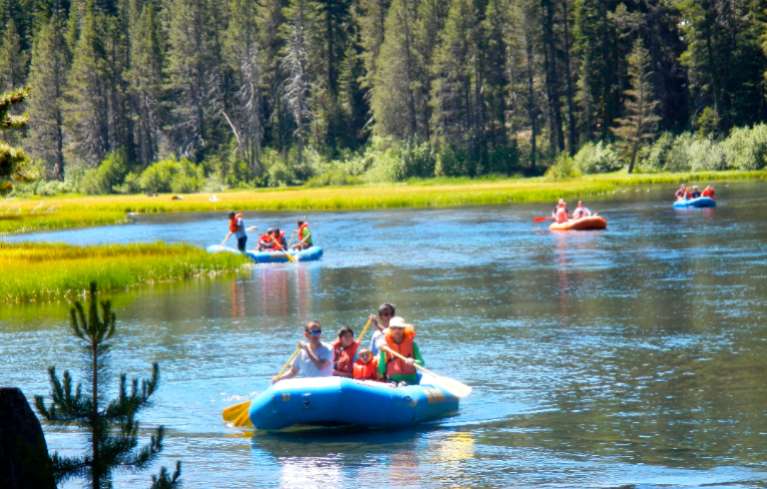
The Truckee River outside Tahoe City was full of rafters June 29. Photo/Kathryn Reed

Truckee River outside Tahoe City on June 29 is full of rafters . Photo/Kathryn Reed

South Lake Tahoe broke records Friday and Saturday. Both days it was 89 degrees. The old record was 87 for both days, set in 2010 and 1972, respectively.

Truckee broke a record June 28 by five degrees; the new record is 94, the old from 2010 was 89. On June 29, Truckee tied the 2010 record of 88.

“Right by the shore there in Tahoe City it’s getting numbers in the mid-80s, but the records are in the upper 80s. Mainly it looks like inland away from lake is getting records,” Shane Snyder, meteorologist with the National Weather Service in Reno told Lake Tahoe News on Sunday.

He said more records are likely to fall today.

“That will get destroyed,” Snyder said of the June 30 87-degree record for Truckee.

South Lake Tahoe’s record for June 30 is 88, and the forecast is for closer to 90.

To the south and east of the Lake Tahoe Basin there is a chance of isolated thunderstorms today. Those will be moving into Tahoe on Monday and Tuesday.

While Las Vegas, Phoenix and Death Valley are always hot this time of year, they are redefining what hot means. It was 115 in Vegas on Saturday, when normal is about 103. The one death from the heat wave was reported in Vegas. A man in his 80s was found dead inside his home that did not have air conditioning.

Barton Memorial Hospital treated one person for dehydration on Saturday.

Death can occur when body temps hit 106 to 107 degrees.dog car temps

Leaving pets and children in vehicles can also have deadly consequences. A Bay Area woman was arrested last week on animal cruelty charges for allegedly leaving her dog, which died, inside a parked vehicle.

While beaches in the basin have been full and rafters are flocking to the Truckee River, the water temp is still chilly – especially farther out in the lake and a foot below the surface. This is why jumping into the water without a life jacket can pose a risk of hypothermia.

Sunscreen should be reapplied, and reapplied again – on adults and kids on all exposed skin. Drink plenty of water. Alcohol and heat can be a bad combo.

South Lake Tahoe police officers have been interacting with a greater number of people lately.

“The people we were contacting seemed to be drinking a little more than usual. They required being arrested instead of a move along thing,” Police Chief Brian Uhler told Lake Tahoe News. On the day shift Saturday,  there were eight arrests and last night there were five. This is higher than usual. Most were for alcohol and domestic violence related issues.

Uhler expects officers to continue to be busy as people living where temps are in the triple digits continue to flock to the basin, which just adds to the number of people in town.


Crafting specialty beers one bottle at a time

By Kathryn Reed

Beer. It’s one four-letter word that can help make this heat wave tolerable.

And Ray Loehrer has plenty of it right now. The South Lake Tahoe home brewer bottled a couple cases on Friday. And the mugs were already chilling in the freezer.

His kitchen and laundry room look a little like makeshift science labs. Water is boiling on the stove to sterilize the caps. The dishwasher is whirring as the bottles get one last hot rinse and dry.

Two 5-gallon containers sit in the laundry room. Yeast needs to be in a dark room to ferment – and that’s the darkest place in the house that has room to move around in.

A stopper allows for the perfect amount of beer to fill each bottle. Photos/Kathryn Reed

A stopper allows for the perfect amount of beer to fill each bottle. Photos/Kathryn Reed

The fermentation process takes two weeks – one week to ferment, one to settle. At the bottom of the glass container is what looks an inch worth of yeast. It’s important none of that ends up in the bottles that will be consumed.

Those large containers are soon drained into another bucket where corn sugar that has been dissolved in hot water is added. This has to do with the carbonation process.

The brewing part he does outside with a propane tank. He said it smells too much to do it inside. It can take four to five hours to brew.

Loehrer has been brewing his own beer for more than 20 years. He admits they weren’t that great to begin with. But experience makes a difference.

In 2009, he entered his first and only competition – the California State Fair. He entered three beers. The Belgian Ale earned a second place and the Amber Ale third place.

The water, yeast and hops all can make a difference in the end product. He refuses to use tap water because most water companies add chlorine – South Tahoe PUD included. This is why he insists on purified water.

When Loehrer first started he was using dry yeast. Now he swears by liquid yeast.

He whips up a batch of beer a few times a year. The busy season is Christmas because his hobby has turned into a gift for others.

While he likes his Honey Ale, Porter and Belgian Ale the best, he does drink beers that he hasn’t made.

A raspberry wheat he made was a big hit with friends. Some people have asked to buy a six-pack or case, but he wants to stay away from the legal issues of doing that. He’s good with sharing.

One thing Loehrer says is important is sterilization. From the caps to the bottles to the tubes that transfer that liquid amber – they all go through at least one sterilization process.

He can buy a case of bottles for about $7. The theory of using the brown bottles is that they let less sunlight in.

While Loehrer created labels, he quickly realized that getting them off for the next batch was time consuming. Now he puts a tiny sticker on each bottle cap so people will know what they are about to ingest. Those all get thrown away, while bottles can be reused.

The capping process, while a bit labor intensive, is still easier than what he first used. This is more like a hand press.

In about a month the beer will be great for consuming. The 3-week-old Honey Ale was tasting pretty darn good on this bottling day. Loehrer said a brewer must imbibe while brewing and that those in the room must do so too – it’s all about tradition.

ngg_shortcode_0_placeholder (Click on photos to enlarge.)


Nevada regulators keep eye on Macau casino action

By Christopher Palmeri, Bloomberg

The use of outside VIP room operators by casino companies in Macau limits their ability to prevent money-laundering and other illegal activities, one of Nevada’s top regulators said.

“Criminal transactions are widely alleged to take place just out of the direct purview of the casino,” A.G. Burnett, chairman of the Nevada State Gaming Control Board, said in testimony before the U.S.-China Economic and Security Review Commission in Washington yesterday.

Enlarge image Nevada Regulator Says Macau VIP Rooms Make Compliance Harder

VIP room operators run gambling parlors for high-rollers within larger casinos and provide credit as well as organize trips for mainland gamblers to Macau. The Chinese city, the world’s largest gambling hub with $38 billion in revenue last year, gets most of its revenue from Chinese high-stake bettors. Burnett didn’t name any individual operators.

I. Nelson Rose, a professor at Whittier Law School in Costa Mesa testified that Chinese government limits on money transfers from the mainland to Macau, at 20,000 yuan or $3,150, create a market for VIP room operators to lend money to gamblers.

“The structure of the casino system in Macau effectively allows people to use the casinos to circumvent these capital controls,” William Reinsch, chairman of the commission, said in his opening remarks.

The commission was created by the U.S. Congress in 2000 to report to legislators on trade and economic issues between the two countries, according to its website.

Spokesmen for Las Vegas Sands Corp., MGM Resorts International and Wynn Resorts Ltd., the three Las Vegas-based companies with operations in Macau, declined to comment on the hearing.

Director Manuel Neves at Macau’s Gaming Inspection and Coordination Bureau, the city’s regulatory body, didn’t return two phone calls seeking comment.


Fill up now; gas prices in Calif. go up July 1

By Mallory Hoff, KCRA-TV

The pain at the pump is about to get worse for Californians — specifically, on July 1.

On Monday, motorists will pay an additional 3.5 cents a gallon — and it’s not because of the cost of fuel, but rather, a tax increase.

“Happy Fourth of July,” motorcyclist Kevin Shallenberger said Thursday.

The increase comes after the state Board of Equalization voted to increase the excise gas tax, which will total 39.5 cents per gallon.

“Legislation that was passed in 2010 mandated that the excise tax be adjusted up and the sales tax adjusted down, to keep it revenue-neutral so that there wouldn’t be an impact overall in the amount of tax drivers pay at the pump,” said Venus Stromberg, a spokeswoman for the state Board Of Equalization.

The board said the money will go back into the roads.

“The excise tax dollars that you pay to the state when you buy a gallon of gasoline go back to the state to fund highway and transportation projects,” Stromberg said.

But the Howard Jarvis Taxpayers Association president said motorists may not be getting what they pay for.

“They drive down I-5 and they still see those pot holes,” said Jon Coupal, president of the association. “We’re paying very, very high gas taxes and not seeing that money diverted into the things that motorists use. It’s a serious reflection of the inability of California to govern itself.”

The situation will leave some with a financial dilemma.

“It’s hard to plan long trips or anything because it’s too much,” driver Judy Smith said.


LTCC graduates ready for next stage of life

Lake Tahoe Community College's class of 2013. Photos/Kathryn Reed

Lake Tahoe Community College’s class of 2013. Photos/Kathryn Reed

By Kathryn Reed

Make every day matter. That was the message Lake Tahoe Community College English instructor Suzanne Roberts delivered to the graduates as she struck a balance between joy and sorrow during the June 28 commencement address.

The evening was a bit of remembrance for three former college employees who died this spring – Kathy “Ms. B” Bluethman, Sue Huff and Carl Young, acknowledgement to the two main former presidents at the school – Jim Duke and Guy Lease, acknowledging Bob and Tammy Hassett as distinguished alumni, and a sendoff to the 140 students who earned their associates of arts degree.

LTCC President Kindred Murillo congratulates Raina Patrocinio.

LTCC President Kindred Murillo congratulates Raina Patrocinio.

LTCC has a rich tradition of being the top small college in the state when it comes to the number of students who transfer to one of the UC colleges. Cal is always a popular choice, as is UC Davis.

Georgillis Ortega receives a congratulatory hug from President Kindred Murillo.

Georgillis Ortega receives a congratulatory hug from President Kindred Murillo.

Chris Sidell is one of the LTCC grads who will go to Davis, where he will study viticulture.

Many of the students are the first in their families to earn a college degree.

College President Kindred Murillo spoke of the confidence she has in this group of young people.

Looking at the sea of green gowns, one could see many clearly didn’t fit the traditional student model just based on their age.

For Karen Jaimes, one of the student speakers, she is an example of someone who many would have said college would never be an option. Even she had those thoughts for seven years.

Jaimes became a mother when she was 14 years old. She thought her future would never involve college.

Graduates celebrate June 28.

Graduates celebrate June 28.

“Miss (Susan) Baker and Miss (Amy) Jackson inspired my dreams back into my life,” Jaimes said of the two longtime educators at Mt. Tallac High.

She credited the college’s flexibility in taking classes with allowing her to also be a full-time mom.

For Samantha Ramirez, her two young daughters also inspired her to keep going. She balanced being a mom, wife, working two jobs and being a full-time student.

As Roberts said, the evening was a commencement ceremony – a start, not an ending.

“The thing to remember is your life is now,” Roberts said. “Risk failure to chase your dreams. Go live your one wild and precious life.”


Court: Gay marriages can resume in California

By Maura Dolan, New York Times

The U.S. 9th Circuit Court of Appeals on Friday cleared the way for gay marriages to resume in California.

The court lifted its stay on an injunction which ordered state officials to stop enforcing Proposition 8. With the court’s action, counties can now begin issuing same-sex marriage licenses.

A spokesman for the U.S. 9th Circuit Court of Appeals had originally said it would takes the court at least 25 days to act after a Supreme Court ruling. Immediately afterward, Gov. Jerry Brown ordered his public health agency to advise the state’s counties to “begin issuing marriage licenses to same-sex couples in California as soon as the 9th Circuit confirms the stay is lifted.”

Opponents of same-sex marriage have argued that Chief U.S. District Judge Vaughn Walker’s 2010 decision overturning Proposition 8 applied only to the two same-sex couples who challenged the ballot measure. But their enthusiasm for going to court to try to narrow the effect of the decision appeared to wane in the hours after the decision.

With Brown and Attorney General Kamala Harris pledging to block Proposition 8 across California, the momentum for gay marriage was likely to hinder any further challenges.

California voters passed Proposition 8 in 2008, six months after the California Supreme Court ruled that gays had the right to wed. The state high court later ruled that the initiative was a valid state constitutional amendment but upheld the validity of an estimated 18,000 same-sex marriages that occurred before the election.

The Supreme Court ruled that ProtectMarriage, the sponsors of Proposition 8, lacked legal authority or standing to appeal Walker’s ruling blocking the ballot initiative. The high court said Proposition 8’s sponsors were not directly affected by Walker’s ruling. Only state officials had the right to appeal, and they refused. That procedural decision wiped out the 9th Circuit Court of Appeals’ 2-1 ruling against Proposition 8, leaving only Walker’s decision in place and affecting only California.

County clerks who preside over marriages said they were ready for same-sex weddings. Marriage licenses already are gender-neutral, and clerks began receiving calls Wednesday from gay couples wanting to schedule appointments.

Harris called on the 9th Circuit on Wednesday to lift its hold on Walker’s ruling immediately. The attorney general said she believed that the appeals court had the authority to act quickly.


USFS diverts money from fire prevention to suppression

By Jack Healy, New York Times

WOODLAND PARK, Colo. — A light breeze riffled the tops of ponderosa pines and old Douglas firs on the mountains above this tourist town. It was a serene summer day, but as Jonathan Bruno wandered through the trees, he wondered how long before it all went up in flames.

Jonathan Bruno, who works for a local environmental group, is worried about cuts to programs that help prevent fires.

“It’s just a matter of time,” said Bruno, who works on forest restoration projects for a local environmental group. “I’ve been losing sleep. There’s just not enough money.”

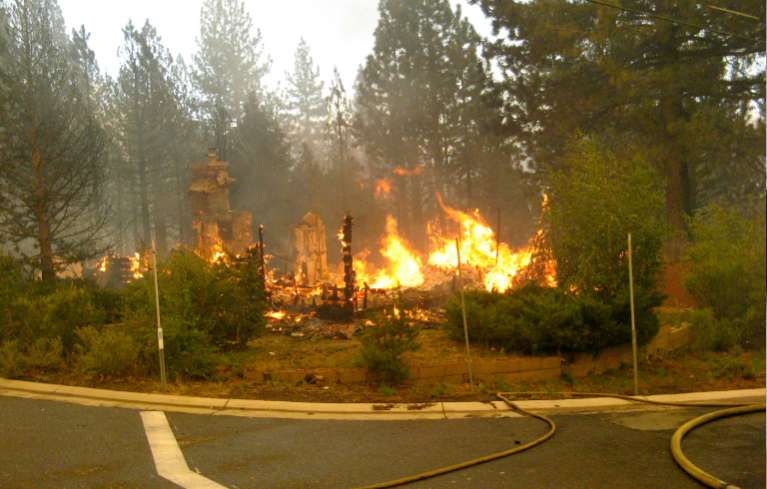
2007 was the worst fire season in the Lake Tahoe Basin when 254 houses on the South Shore were destroyed. Photo/Lake Valley Fire

2007 was the worst fire season in Lake Tahoe when 254  South Shore houses were destroyed. Photo/Lake Valley Fire

As another destructive wildfire season chars the West, the federal government is sharply reducing financing for programs aimed at preventing catastrophic fires. Federal money to thin out trees and clear away millions of acres of deadfall and brittle brush has dropped by more than 25 percent in the budgets for the past two years, a casualty of spending cuts and the rising cost of battling active wildfires.

The government has cut back on programs to reduce fire risks in areas where homes and the wilderness collide. The U.S. Forest Service treated 1.87 million acres of those lands in 2012, but expects to treat only 685,000 acres next year. Conservation advocates say that is likely to mean fewer people working to prevent runaway fires, fewer controlled burns and fewer trucks hauling away dry brush and tinder.

Trimming trees and clearing brush can make blazes less destructive, and the Forest Service said it had treated more than 26 million acres since 2000. But as the government spends an increasing amount to battle wildfires, critics say it makes little sense to cut back on prevention.

“There is a growing consensus in the West that dollar for dollar, these kinds of prevention efforts are paying off,” said Sen. Ron Wyden, Democrat of Oregon. “And when the big fires break out, the bureaucracy steals money from the prevention fund and the problem gets worse. The Forest Service has become the fire service.”

Twenty years ago, the Forest Service spent 13 percent of its budget on fighting fires. These days, 40 percent of its money goes to firefighting, and that is still not enough to cover the bills. Forest officials went $400 million over budget fighting last year’s fires, and they expect to run over again this year.

Automatic spending cuts approved by Congress have pinched in other places. This year, forest officials hired 10,000 seasonal firefighters — a decrease of 500 from a year ago — and say that despite updates to their aging fleet of air tankers, they are also fighting fires with fewer fire engines.

“Obviously, there isn’t enough to go around,” said Tom Harbour, the Forest Service’s director of fire and aviation management. “If you can get the forest in the right condition, we know that homes are going to be safer, forests are going to be safer. But we took a hit there.”

In 2012, the Forest Service and the Interior Department — which also manages huge swaths of public lands — spent about $500 million combined to clear out what they call “hazardous fuels” in fire-prone areas. In budgets for next year, the agencies are on track to receive less than $300 million, according to numbers compiled by Chris Topik, the director of Restoring America’s Forests, a Nature Conservancy program.

Harbour said forestry crews were focusing their prevention work on high-risk areas closest to homes, highways and businesses.

Conservationists and Western politicians say the cuts could not come at a worse moment.

Last year, more than nine million acres went up in flames during one of the worst fire seasons on record. Years of drought and beetle epidemics have turned entire mountainsides into matchboxes, and fire experts say rising temperatures and changing climates are making wildfires hotter, longer and more destructive.

“We’re heading in the wrong direction,” said Sen. Jon Tester, Democrat of Montana, where 150 homes burned in last year’s fires.

This month, Colorado’s most destructive wildfire erupted 25 miles from Woodland Park, in a pine-shaded suburb north of Colorado Springs. It killed two people and burned 511 homes. In southwestern Colorado, fire crews were still struggling on Thursday to contain a blaze that is burning through 83,000 acres, feeding on thousands of beetle-killed spruce trees in the San Juan National Forest.

A walk through the woods or a drive into the mountains shows how vulnerable parts of the West are to fire. Dry soil crunches and crumbles underfoot, and huge patches of dead evergreen trees dot the mountainsides. Across the country, officials say 65 million acres of national forest are at a high risk for fires — an area bigger than Oregon.

Towns like Woodland Park, population 7,200, are tucked into the mountains across the West, islands of development in an ocean of trees. Houses on roads like Forest Edge Road or Ponderosa Way brush up against national forest land, enjoying all the beauty and risk that comes with the location.

As operations director of the Coalition for the Upper South Platte, Bruno spends his days here convincing homeowners to trim low-hanging branches and identifying thick hillsides that could be the next to set off an inferno.

Studies have shown that thinning out forests — whether on one homeowner’s land, or a huge national landscape — can help keep fires in check, burning along the ground rather than racing from treetop to treetop. In the Southwest, treating land helped to control wildfires 87 percent of the time in 2011, and in 75 percent of cases last year, according to Forest Service data.

Some sections of Pike National Forest here have been thinned, spacing out the trees and removing low-hanging branches. But thousands more acres are dense tinderboxes, Bruno said.

“If the fire got in,” he said, “this town would not be here.”


Plenty of variety in Tahoe luxury home market

By Kathryn Reed

For those with $42.995 million to spend it will get you a lakefront compound on five parcels with four houses. Those looking for some history might be interested in the former Howard Hughes estate that is selling for $19.5 million. Those with a more modest budget should check out the $2.495 million cabin that was built in 1926.

These were just three of the 23 houses available to tour on June 26 during the 17th annual Chase International Lake Tahoe Lakefront and Luxury Estates Tour.

Agent Sue Lowe, who organizes the event, was at a house on Skyland Boulevard that is going for $4.95 million. She explains Nevada property taxes to a potential buyer – how they aren’t configured anything like California’s, and how Douglas County where the house is located has much lower taxes than Washoe County.

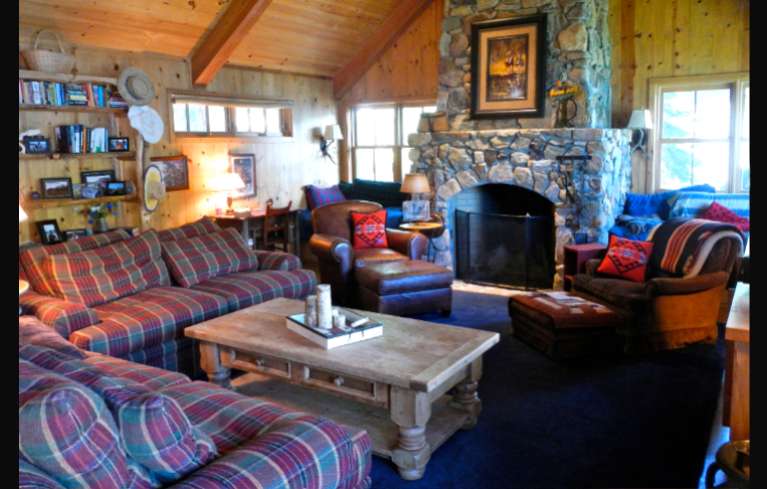
The living area of this Fallen Leaf Lake house is inviting. Photos/Kathryn Reed

The living area of this Fallen Leaf Lake house is inviting. Photos/Kathryn Reed

Most of the houses on this tour are right on the water.

Lowe tells Lake Tahoe News these properties are still the most appreciated in the basin, with lake views second most popular.

It’s the rare property that has a pier, boathouse and sandy beach. Some don’t have any of those amenities. This house has the beach – which in itself is rare for this side of the lake, which is traditionally rockier.

The houses are all over the board in terms of what they look like from the outside, the character inside and the price range. The least expensive was $2.195 million in Meeks Bay. The most expensive was $42.995 million in Incline Village, which was recently reduced from $49.9 million.

The latter is known as Sierra Star. Tom Gonzales, founder of Commerce One, assembled the five parcels that have four houses. In what is called the Carriage House he used to have 100 motorcycles. There is 2,000-square-feet of garage space.

Below that is 10,000-square-feet – mostly concrete. A lift that can hold 250,000 pounds is off to the side.

The top floor is another 2,000-square-feet. It’s where the mechanics and others lived.

The main house is 10,000-square-feet. The other two structures – or guesthouses – are each 4,000-square-feet.

It’s possible to buy the whole 4.3-acre compound or pieces of it.

“The luxury market is heating up with increased activity around the lake,” Lowe says.

In the last eight months two houses on the lake each sold for more than $20 million. That hadn’t happened since 2008.

December 2012 was the hottest December that Lowe can remember. She attributes it to Californians being fearful about Proposition 30 and wanting out of the state, as well as the uncertainty of what the capital gains rate would be.

“In California, people realize we’ve hit bottom and if they want a slice of heaven, they need to do so now to get the best possible price,” Lowe said.

Another house that had lots of visitors on Wednesday was the property in Crystal Bay that was once owned by Howard Hughes. It’s known as Summertide.

The price tag is $19.5 million. The kitchen is small, but it’s been remodeled and feels very modern with the granite and high-end appliances.

The main area has a rustic, comfortable feel to it. The bottom floor has three rooms that seem more like hotel rooms with a shared balcony.

Someone on the tour said it’s about 200 steps down to the cottage that is closer to the water. Even from there it’s more steps to the alcove.

A cabin sandwiched between two larger homes is selling for $2.495 million. It was built in 1926 and feels like it hasn’t had any upgrades since the 1970s. There is no insulation, according the agent stationed at the property.

From the deck looking right is Zephyr Cove Resort – a quiet and raucous neighbor depending on the time of the year.

Another oldie is the $2.295 spread in Cascade Properties. It was built in 1961 and the original family is selling it. It’s been on the market two weeks. The driveway is harrowing and the inside stairs are probably not up to code. The setting is idyllic. The land is what this is about, not the house.

Out at Fallen Leaf Lake is a $4.495 million three-cabin spread. It also comes with three docks. The spaciousness of the main room in the largest of the three buildings would be ideal for entertaining, as would the kitchen.

The deck on one of the cabins is about as big as the interior.

According to Lowe, the market is improving in all price ranges — not just the seven-plus figure houses.

ngg_shortcode_1_placeholder (Click on photos to enlarge.)


Glenbrook contending with unwanted bears

By Kathryn Reed

A bear was captured in Glenbrook on Monday by the Nevada Department of Wildlife and released the next day near Mount Rose.

According to Linda Bradley, manager of the Glenbrook Homeowners Association, the last time the state was asked to trap a bear in their neighborhood was in 2008.

She told Lake Tahoe News this particular yearling was not scared off by loud noises as other bears are. She also didn’t want to run the risk of it entering a home, when then the consequences for the bear could be fatal.

Bears in Tahoe neighborhoods is a fairly common thing. Photo/LTN file

Bears in Tahoe neighborhoods is a fairly common thing. Photo/LTN file

Bradley said she spoke with the BEAR League this week about policies at Glenbrook and invited the animal organization to speak at a community event to make people more bear-aware.

Two to three other bears consider these 750 acres home, Bradley said.

Chris Healy with NDOW said there are two traps in the general Glenbrook area still.

“They have bears that are doing some property damage,” Healy told Lake Tahoe News. “People have concerns the bears are not afraid enough of humans.”

Glenbrook has community bear-proof dumpsters for people to leave their trash in, which is encouraged if they are vacation renters or leaving before trash day.

The rumor that the homeowners are trying to get rid of beavers is not true, according to Healy. He said the last time Glenbrook HOA asked for a depredation permit was in 2008.

However, two active beaver permits have been issued to Edgewood Tahoe Golf Course. And there is an ongoing permit for Incline Creek.

With beavers being large rodents, they cannot be trapped and relocated. This is true for all regions of the country.

“Is the life of that one animal worth all the damage that is happening?” – that is one criteria of whether a permit will be issued, Healy explained.

With the controversial permit for Incline that was first issued last year, the beavers were impacting a sewer line, which could lead to a messy spill that would have the potential of reaching Lake Tahoe.

Healy said beavers are an on again, off again issue in the basin.