Death Valley eager to celebrate the heat

By Jay Jones, Los Angeles Times

Record heat is drawing tourists to Death Valley at possibly the most uncomfortable time of the year, where they are snapping a photograph next to a thermometer or attempting to fry an egg without a stove.

Death Valley National Park has posted warnings to visitors on how to survive the heat. It wouldn’t seem a great time to visit, but on the other hand, the national park has issued an open invitation for folks to come celebrate the 100th anniversary of the hottest-ever temperature on the planet.

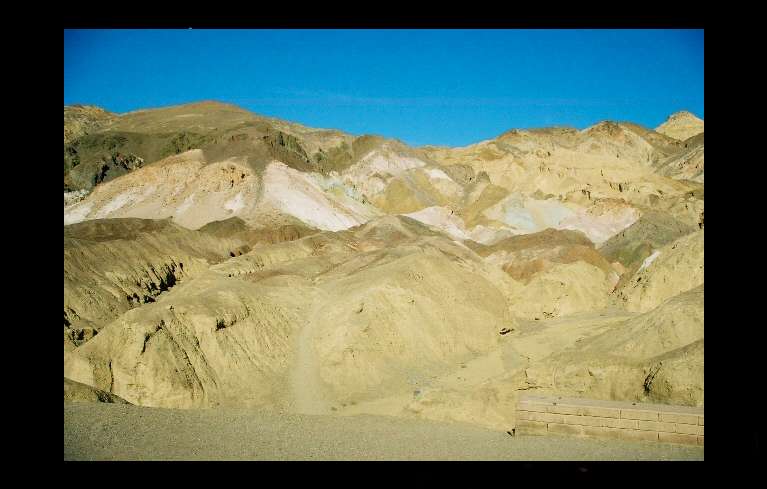
Along Artist's Drive travelers are able to witness a natural palette of colors. Photo/LTN file

Along Artist’s Drive travelers are able to witness a natural palette of colors. Photo/LTN file

The thermometer soared to 134 degrees on July 10, 1913, at what’s now the appropriately-named settlement of Furnace Creek.

The celebration will kick off at noon July 10. The Furnace Creek Visitor Center will host a series of discussions, led by meteorologists and rangers, on a variety of topics related to the region’s extreme climate.

At 1:50pm, Weather Underground historian Christopher Burt will explain how Death Valley recently snatched the temperature record previously claimed by El Azizia, Libya. Park Service employees will also discuss how they cope with life at the hottest place on Earth.

At 4pm, visitors can join park rangers for a ritual that’s taken place every day since recordkeeping began in 1911: the reading of the official thermometer at the Furnace Creek weather station.

On Sunday, the temperature there peaked at 129 degrees. That set a record as the hottest June temperature ever recorded in the United States.

July and August are typically the hottest months in the Mojave Desert, according to the National Weather Service.

Death Valley’s geography helps account for its scorching temperatures. A sign at the Furnace Creek Resort’s golf course notes that its elevation is 214 feet below sea level.


Tahoe is all about the outdoors — including eating

By Susan Wood

If Belgium can allow France to claim its fries, then maybe Spain will surrender its honorary al fresco dining niche to the United States – if only for a day.

After all, it’s the Fourth of July – America’s signature holiday that marks a summer fun of eating, drinking, schmoozing, relaxing and taking in one’s outdoor surroundings.

Al fresco is the Spanish derivative of “outside at a fresh temperature.” It’s a type of dining that’s popular in the summer and is designed to promote pedestrian activity. Think Paris, then transport yourself.
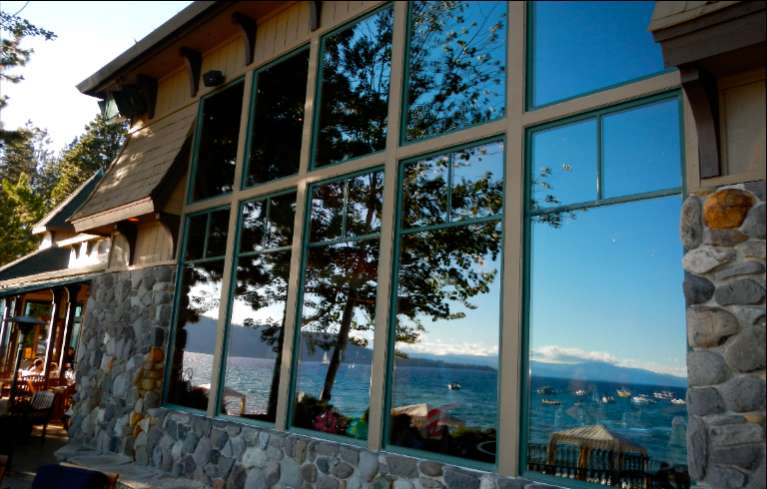
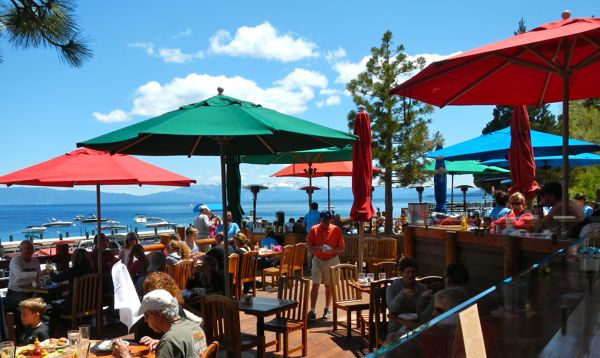
Lake Tahoe reflected in the windows of Lone Eagle Grill in Incline. Photos/Kathryn Reed

Lake Tahoe reflected in the windows of Lone Eagle Grill in Incline. Photos/Kathryn Reed

Flanked by the Sierra Nevada mountain range, the Lake Tahoe region has no shortage of such places to take your dining party outdoors. The options on each shore range from the very childlike and biker babe-like to beach party-ish and elegant settings steps from a fine dining restaurant.

Some places scream tourist. Others are known as local hangouts. Several mix them up.

A few offer mountain scenery. Many provide lake views.

High marks go to the Lone Eagle Bar and Grill in Incline Village. Its patio seating, albeit limited, provides the epitome of relaxation outside its indoor bar and restaurant. Cushy, padded seating on the wooden chairs and chaise lounges let you settle in next to the beach. Don’t be surprised to see chairs set up for a wedding on the shoreline. Order a concoction from its creative cocktail list and the mushroom pizza off the appetizer menu.

Music that’s not overbearing is piped in to add to the ambiance. Watch the boats go by as the sun sets across the wide swath of lake. If you find you’re just not close enough, there’s always the pier bar where a patron may sit inches from the water.

“I feel like I’m on the water,” one woman said, enjoying the lakefront view with her friend.

Even the employees like being there.

“This is definitely the best job for the view,” bartender Shane said.

Looking west, over the water

Few places can lay claim to being at a bar so close to Lake Tahoe. One of my past favorites that made me a no show twice was the West Shore Café in Homewood across from the ski resort. First, it wasn’t open in early June, then it was closed for a wedding last Saturday. Their loss.
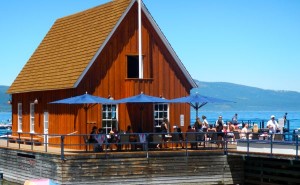
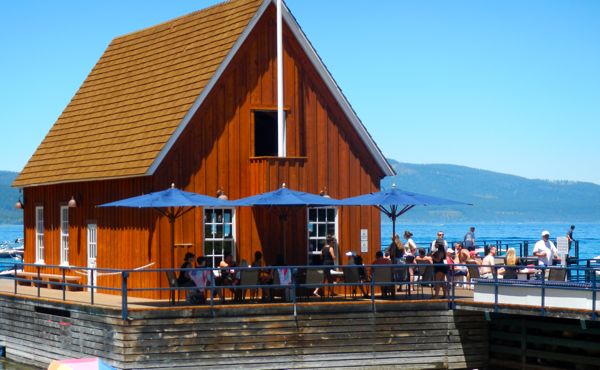
Chamber's Landing

Chamber’s Landing

Chamber’s Landing may be an alternative for some, but not for those seeking more of a local connection to Tahoe. The pier bar seems all about the tourist – without the service. Get your own so-so drink that tries to be a knock-off of the Rum Runner of the Beacon fame.

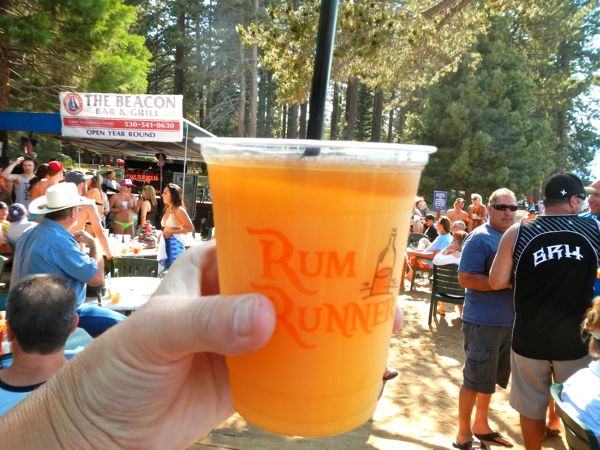
The Beacon near Camp Richardson on the South Shore is the proverbial beach-bar-party scene on hot summer weekends. Live bands crank out the rock ‘n’ roll outside where you can sink your toes in the sand and people watch for hours. Expect lots of skin. The seating is closely guarded by security on busy days, but the staff is
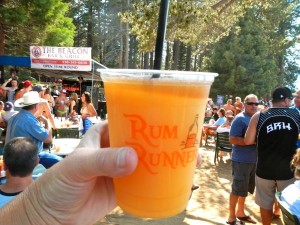
Beacon at Camp Rich

Beacon at Camp Rich

friendly about their jobs. No dogs and no taking your drinks out of the restaurant domain.

South Lake Tahoe’s version of al fresco on a pier has made a painful transformation from the late Blue Water Bistro. The Boathouse says cheap all over it the minute one arrives and leaves on what looks like an oil pan for a parking lot. The picnic tables are funky, the signs are nonexistent, the food is incredibly limited and the service is remarkably slow, which is too bad. (I will always love walking on that pier.)

Down Highway 50, the Riva Grill at the Ski Run Marina is set back from the shoreline but gives the diner a sense of being there. The seating is a bit crammed outside, but maybe after a few Wet Woodys it’s not as noticeable. (Here’s a hint: Either sit high on the wooden bench and not in the cheap plastic chairs in the aisle or sit inside next to the large picture windows.)

Another marina boasts a popular place in the Tahoe Keys. The Fresh Ketch may also leave a “cheap” feel with its plastic furniture on the grass outside its superb indoor bar setting, but it gets major points for providing a two-hour courtesy for boat-in dining to kayakers and canoers. The staff is friendly and the drinks are good. Diners will get a kick out of reading the boat butts with cutesy names.
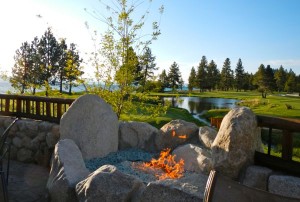
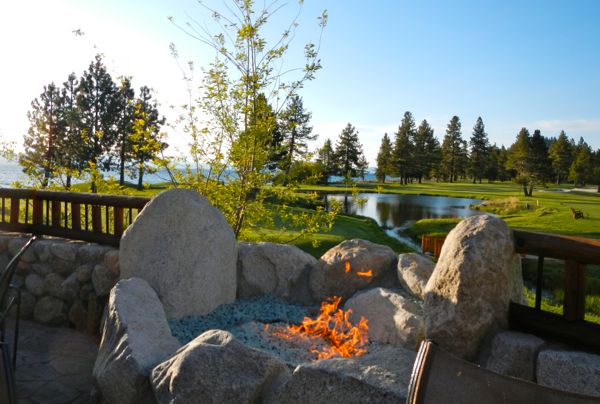
Brooks Bar

Brooks Bar

Tied with Lone Eagle for the best lakeview experience is by far Brooks Bar at Edgewood Tahoe Golf Course. The best mojitos here meet the best lake setting with the golf course on one side and the lake on the other. The lapping waves beckon you to the beach. The golf course greens call for a roll in the grass. If it’s nippy or if you just want ambiance on the patio, belly up to the fire pit and ask for a heater lamp. The staff would be happy to accommodate.

A close second to the other two is Sunnyside – which lives up to its name. It’s almost as if the seating is tiered to accommodate as many people as possible trying to secure a 180-degree view of Lake Tahoe. There’s nothing like basking in the sun on the patio steps away from the outside bar with the beach close by. Brenda said she’s transported to Hawaii or Arizona at Sunnyside.

The wooden furniture is more upscale than most. The drinks are superb and appetizers are good. A few rooms for rent upstairs beg for a West Shore stay.
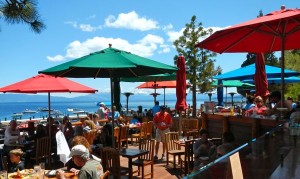
Sunnyside

Sunnyside

It’s so comfortable on what’s touted as “Tahoe’s largest outdoor deck” that dining alone on the long counter is more than acceptable.

Take me to the river

Tahoe City can stake claim to a bar and restaurant with history and a lot going for it. The Bridgetender situated along the Truckee River near Fanny Bridge offers an ideal setting for R&R, especially after partaking in the various recreational activities this lake town encourages.

When I say wooden furniture, I mean furniture that appears to be carved out of a log from a fallen Jeffery pine. The bar in the middle of the tables has Tahoe written all over it. The historic place has an ambiance. If it’s not enough to hear the river noises, a fountain over the small pond up front is quite soothing. The staff brings its “A” game.

The River Ranch has also been a Tahoe summer favorite with its sit-next-to-river patio amid the trees – but a wedding party got there first.

And this is Tahoe

There’s no way to dismiss the places that represent the mountain scene of Lake Tahoe and beyond.

One of the favorites is a short drive to Meyers. The al fresco experience at the Getaway Café banks a view of Cowboy Rock and Freel Peak while sitting amongst the flowers planted with love and care. There are tables for two and four and six. Umbrellas are out to provide adequate shade, but one can thoroughly enjoy baking in the sun. The pine trees surrounding the place say Tahoe. The straw grass placed on the lawn says rural. (Note: the food is always good, and it’s far enough off Highway 50 to mask the noise.)
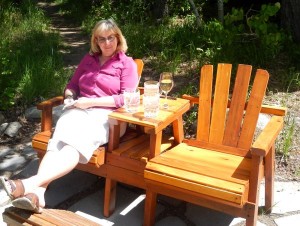
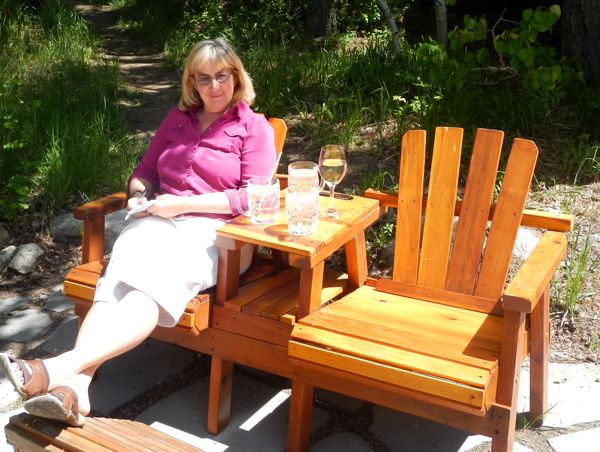
Sue at Sorensen's

Sue at Sorensen’s

Turn left on Highway 89 from the Getaway, and you can truly get away to Sorensen’s Resort. An absolute favorite, the aspens exemplify the Tahoe outdoor dining experience. It’s as if the trees are cradling you when sitting on the patio. Between the chirping birds and quaking aspen leaves in the breeze, diners will feel as though they’ve stepped into a spa.

What’s the best seating there? Nestle into the high-backed wooden chairs, put your feet on the footstools and set up a mini table setting between the chairs. Don’t even think of leaving without ordering the berry cobbler. Try it with a Sprite or a Pinot Grigio, depending on your mood, and you may be parked there for hours as the leaf peepers or bikers come and go.

Going urban

Brothers bar maintains a long reputation for attracting a biker crowd, and for good reason. It’s fun, the bartender is on top of his business and the outdoor patio gets the full exposure of sun along Highway 89 north of the Y in South Lake Tahoe.

The picnic tables seem appropriate for a fun-and-games kind of place. If the horseshoe tournaments don’t bring you in, perhaps the large screen television on the patio for Monday Night Football may give you a change in scene from a living room.

There’s a fire pit for chilly evenings. But it’s the outdoor bar for major parties that says al fresco summer dining.

Across the highway on restaurant row, the Rockwater has a few options for al fresco dining. The grassy area can accommodate large parties in an open setting. The deck setting next to the outdoor bar is nice for some shade or to sit under the mounted heaters, depending on the temperatures outside. Fun activities like karaoke Wednesday nights round out the experience, and it’s good to know one can just sit outside and watch sports on the outdoor televisions.

It gives it a sports bar feel. But with that, the bar could stand to be a little less loud. The music blasts. At least it’s difficult to hear the traffic. (Note: the service is notoriously slow, so don’t be in a hurry.)

For more on roadside dining, hit the Coyote Grill at Round Hill, where wine and appetizers beckon and dogs are welcome. Sure, you’re practically sitting in the parking lot. But according to Amy: “Tahoe’s so nice, the views are even good in a parking lot.”

Wire chairs and tables are probably easy to clean. The food and service are adequate.

The best restaurant service and arguably food at the lake sits halfway up Ski Run Boulevard at the Blue Angel Café.

This is an eatery that paints a creative menu like it’s fine art. The café is planning to put out more tables and planted new sod next to the planter boxes to satisfy its loyal clientele’s thirst for outdoor dining. Bike racks out front make it obvious this restaurant knows its patrons better than most.

Also new to the whole Al fresco scene is Scusa, the Italian restaurant at the end of Sierra Boulevard right on Highway 50. Upon a stormy night, I peeked out to its new setting to find a cozy spot out back with crushed rock at its base, iron tables and chairs, a fountain flowing, heat lamps ready and a high fence to seal off the area.

Whether in or out, the food and wine with an elegant, adult-like setting is always worth going for.

For the casual flair

Want to feel like a kid again? Since everyone screams for ice cream at Lake Tahoe in the short summer season, the places that offer it and provide it will do much business in those months.
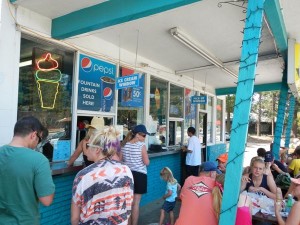
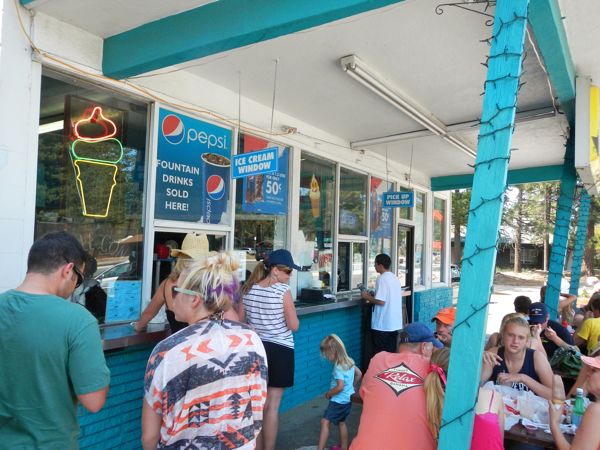
Sno-Flake

Sno-Flake

It’s hot. Our first thought is a soft serve cone from the Sno-Flake Drive-In, a mainstay in urban South Lake Tahoe. But of course, we’re not alone with our thought. The few picnic tables outside fill up fast. So as an alternative to consume this feast (even in a small size), Kae and I sat with our legs dangling off benches surrounding flower plants right alongside Modesto Avenue.

Looking across to the Tahoe Tribune building brought back many memories, some even good.

The Al Tahoe neighborhood brings out many people on their bikes. Sno-Flake might want to add racks for these patrons.

Cycling on the North Shore to Squaw Village easily made Kae, Roni, Brenda and me hungry for a smoothie. The Mountain Nectar touts about a dozen different flavors of smoothies and some milkshakes that had me taking note why I wanted to return some day.

If you go in the morning, sitting in front of the fire pit in the slanted wooden chairs outside the Fireside Café is wide open to the first takers.

It wouldn’t be summer without real ice cream on the South Shore at the Camp Richardson Ice Cream Parlor. Kae decided a lunch break last week should involve some sugar. Seven picnic tables are inviting to sit while she eats the huge scoop. Plenty of shade is provided by the tall pines. While the shop is right on Highway 89, the tables are back far enough for it not to be annoying.

Beyond the Lake Tahoe area

• The best in Pacific coast outdoor seating may be found at the Inn at Spanish Bay. You can’t go wrong with Carmel Bay in full view.

• While in Scottsdale, a diner can get a show from the Cantina Laredo patio as the waiter whips up the guacamole, right at the table.

• The show continues at the Troon North Golf Course Clubhouse, where a family of javelinas entertains diners at the sunset hours.

• While in St. Helena, check out the patio dining at Tra Vigne for brunch – in particular on Mother’s Day. The Tuscan Courtyard lives up to its name, where the trees provide shade without clunky umbrellas.

SolBar restaurant in Calistoga allows dogs, which was quite annoying at a fine dining restaurant.

• Like kids? Bring yours to Skipolini’s Pizza’s patio in Clayton, where Kae grew up, or in Walnut Creek. The pizza itself would prompt one to drive 10 miles out of the way to have one.

Kathryn Reed contributed to this article.


Congressional bill all about Douglas County

By Karoun Demirjian, Las Vegas Sun

Douglas County’s public lands issues now have a proposed federal solution, after Nevada Sens. Harry Reid and Dean Heller introduced a bill Tuesday to address everything from economic development to wilderness and sage grouse protection.

The bill, titled “The Douglas County Conservation Bill,” would give the necessary permission for municipal and other entities to obtain or purchase federal public lands and transfer “important cultural sites” to the Washoe Tribe of Nevada and California.

Read the rest of the story


Dehydration, heat exhaustion not to be taken lightly

By Beth Brown

It’s important for people to understand the difference between heat exhaustion and dehydration, especially if you are exercising in high temperatures and even high altitudes, such as Lake Tahoe and our surrounding areas.

Heat exhaustion is a condition, where symptoms may include heavy sweating and a rapid pulse, a result of your body overheating. It’s one of three heat-related syndromes, with heat cramps being the mildest and heatstroke being the most severe.

Beth Brown

Beth Brown

Heat exhaustion is preventable. Causes of heat exhaustion include exposure to high temperatures, particularly when combined with high humidity and strenuous physical activity. Signs and symptoms of heat exhaustion may develop suddenly, or over time, especially with prolonged periods of exercise.

Possible heat exhaustion symptoms include:

• Cool, moist skin with goose bumps when in the heat

• Heavy sweating

• Feeling faint or dizzy

• Fatigue

• Weak rapid pulse

• Muscle cramps

• Nausea

• Headache

Without immediate treatment, heat exhaustion can lead to heatstroke, a life-threatening condition. Some things you can do when you start to feel heat exhaustion symptoms: stop activity and rest (in a comfortable and cool spot, like under a shady tree); slowly drink cool water and/or sports drinks with electrolytes. Seek help immediately if you think you are experiencing heat exhaustion.

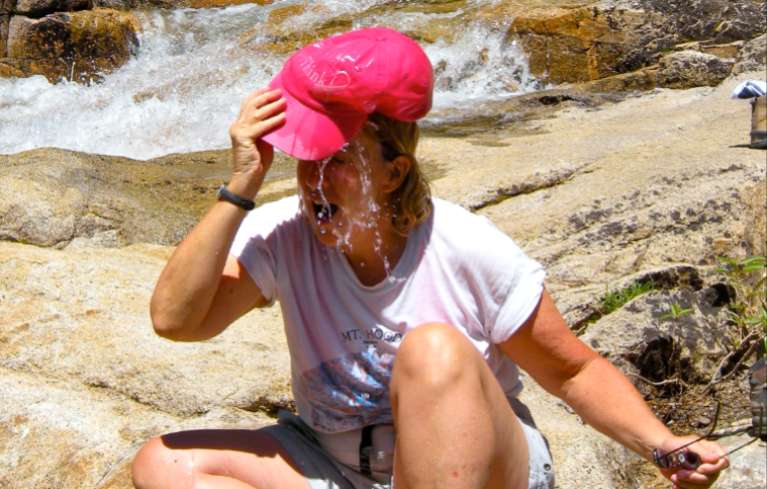
Staying cool on a hot hike is important. Photo/LTN file

Staying cool on a hot hike is important. Photo/LTN file

Dehydration occurs when you lose more fluid than you take in, and your body doesn’t have enough water and other fluids to carry out its normal functions. Anyone may become dehydrated, but young children, older adults and people with chronic illnesses are most at risk. If you don’t replace lost fluids, you may get dehydrated. Common causes of dehydration include intense diarrhea, vomiting, fever or excessive sweating. Not drinking enough water during hot weather or exercise also may cause dehydration. You can usually reverse mild to moderate dehydration by drinking more fluids, but severe dehydration needs immediate medical treatment.

The safest approach is prevention. Monitor your fluid loss during hot weather, illness or exercise, and drink enough liquids to replace what you lose. Mild to moderate dehydration is likely to cause: dry sticky mouth, feeling tired or sleepy, fatigue, feeling thirsty, not urinating, unable to make tears, dry skin, headache, constipation, dizzy or lightheaded feeling.

Severe dehydration, a medical emergency, can cause: Extreme thirst, irritability, lack of sweating, no urination, shriveled and dry skin, rapid heart rate and rapid breathing, hot skin, confusion. Unfortunately, thirst isn’t always a reliable gauge of the body’s need for water, especially in children and older adults. A better indicator is the color of your urine: Clear or light-colored urine means you’re well hydrated, whereas a dark yellow or amber color usually signals dehydration.

 When to see a doctor. If you’re a healthy adult, you can usually treat mild to moderate dehydration by drinking more fluids, such as water or a sports drink (Gatorade, Powerade, others). Get immediate medical care if you develop severe signs and symptoms such as extreme thirst, a lack of urination, shriveled skin, dizziness and confusion. (Mayo Clinic, 2013)

Barton wants you to have a safe and happy summer and the best prevention is education. So, whether you’re running, hiking, cycling or even boating be sure to keep the above warning signs in mind.

If you feel as though you or a loved one are experiencing any of these symptoms, be sure to call 911 or visit Barton Memorial Hospital’s emergency department, located at 2170 South Ave., South Lake Tahoe. Questions, call (530) 541.320.

Reference: Mayo Clinic, July 2, 2013, Heat Exhaustion.

Beth Brown is director of nursing for Barton Emergency Services.


S. Tahoe parking garage ownership questioned

By Kathryn Reed

Title to the South Lake Tahoe parking garage is in the name of the non-existent city Redevelopment Agency. It’s supposed to be owned by the South Tahoe Joint Powers Parking Financing Authority.

A contract was signed in 2002 by then City Manager Dave Jinkens to make that happen. But the title was never filed.

Even so, the city has been in the habit of listing the parking garage as a Redevelopment Agency asset.

When the state did away with redevelopment agencies it forced jurisdictions to unload those holdings and give the state the money after debts were paid. This would technically mean the city would have to sell the garage, the bondholders would be on the losing end and could potentially sue the city, and that there would be no guarantee the garage remained a garage. Though the city could buy it.

But what the city wants is for the state to acknowledge the original intent of the agreement and allow the title to be filed 11 years after it was supposed to happen.

The council members acting as the Parking Authority board voted July 2 during a special meeting for this to happen. Late in the afternoon the oversight board (which handles redevelopment issues) seconded that vote. El Dorado County Supervisor Ron Mikulaco was the lone dissenting vote.

Now the motion goes to the Department of Finance for a ruling.

“It is unfortunate the city administration did such sloppy work in the early and mid-2000s to put the city in this no-win situation,” El Dorado County Auditor Joe Harn told Lake Tahoe News.

The city has asked Harn to leave the parking garage off the due diligence report that he expects to have prepared by the end of the summer. If it were on there, the state would say sell it. The city expected the DDR late last year. There is disagreement between the auditor’s staff and city staff regarding whether the necessary documents have been sent to Placerville for the DDR to be written.

The DDR is a document California came up with when it decided to abolish redevelopment agencies.

Once the DDR is signed off by the state, the successor agency, which is comprised of the City Council members, must devise a Long Range Property Management Plan for the remaining assets that the state eventually would vote on.

Also caught up in the paperwork is the sale of the lot on the corner of Highway 50 and Ski Run Boulevard that the city’s Redevelopment Agency once owned. A buyer has been waiting in the wings since last year.

The other thing the council did while acting as the parking board was to authorize going forward with the next step to have the bonds on the structure be refinanced. They cannot be refinanced until the deed is filed as it was supposed have been done in 2002.

There is no longer money to cover all the debt, so refinancing is imperative. What happens if the state says no to any of this, would be the subject of future meetings.


Eastbound I-80 open; mud still covers west lanes

Update 9:25pm:

Eastbound lanes of I-80 are open. Motorists are moving at 25 mph with a CHP escort. Westbound lanes are estimated to open at 11pm Tuesday.

—-

A major mudslide triggered by severe thunderstorms late this afternoon closed Interstate 80 about 1.5 miles west of the California-Nevada border.

Caltrans crews said the football field-sized mudslide is covering the lanes in both directions.

It is estimated the mud and debris is 3 to 8 inches deep.

It is not known if any vehicles were caught in the July 2 slide.

Eastbound traffic is being directed off the interstate at Hirschdale Road in Truckee. Westbound traffic is being turned around at the state line. Motorists should use alternate routes.

Eastbound big rigs are being routed on Highway 89 through Loyalton to Highway 395 in Nevada. Westbound big rigs are being routed to Highway 395 through Loyalton to Highway 89 to Truckee.

There is no estimated time for the opening of the interstate. Dump trucks and loaders are already trying to clear the mess.

— Lake Tahoe News staff report


Highways in Calif. some of the worst in U.S.

By Gary Richards, San Jose Mercury News

California’s highways continue to rank among the worst in the nation — a sorry distinction the state has held for more than a decade.

The Golden State’s highway system is ranked 47th among the 50 states in overall highway performance and efficiency in the latest annual highway report by the Reason Foundation. That is a slight improvement for California, which ranked 48th in the two previous studies and has ranked in the bottom 10 every year since 2000.

Only Alaska, Rhode Island and Hawaii have worse roads, while North Dakota, Kansas and Wyoming have the best and most cost-effective highways.

“I’ve noticed a lot of paving over the past few years, but there are so many roads with so many potholes,” said

Mark Lin of Stockton, who commutes over the Altamont Pass to the East Bay. “Interstate 580 is like driving in a Third World nation. It needs fixing bad.”

The report covers road conditions through 2009, the most recent year data was compiled by the Department of Transportation.

“It’s hard to believe it when you hit a pothole or see a bridge in Washington collapse, but the nation’s roads have been getting better,” said David Hartgen, author of the study and a professor at the University of North Carolina at Charlotte. “There are still several states struggling and plenty of problem areas but progress continues to be made.”

Progress has been slow in California, which spent $679,000 per mile on road maintenance and other highway

upgrades. That’s a significant increase (24 percent) in per-mile highway expenditures over 2008, making per-mile spending in the state nearly five times the national average. But with 18,260 miles, California’s highway system is the 11th largest in the nation and carries the most traffic of any state.

“California seems to lag behind the others,” Hartgen said, noting that improvement was shown in only two of seven categories analyzed. “This report doesn’t get into the why and we are not asserting they are doing a good job or if there is something fundamentally flawed in what they are doing. We’ll let the locals decide that.”

California’s urban interstates are the most congested in the nation, ranking 50th. The state ranks next to last in urban interstate pavement condition and 49th in the condition of key rural roads.

More than 16 percent of urban interstate pavement in California is in poor condition. Only Hawaii ranks worse, with 27 percent of its urban interstate pavement rated as poor.

But there are bright spots. California ranks 14th in highway fatalities and 12th in the number of deficient bridges.

Not only are California’s interstates full of potholes, they are also jammed — 80 percent of the state’s urban interstates are congested. Minnesota has the next highest percentage of gridlocked interstates, with 78 percent deemed congested.

Transportation officials say decades of underfunding have contributed to today’s poor road conditions in California. The state excise gas tax had not been raised in two decades until Monday, when it went up 3.5 cents.

“The trend is now being slowly reversed,” said John Goodwin of the Metropolitan Transportation Commission, “but our state dug itself a deep hole that we will not climb out of overnight.”

Added Hans Larsen, head of the San Jose Department or Transportation: “The cracked and bumpy freeways, potholes, weeds, graffiti and trash are all clear evidence of the lack of investment. The main source of funding for transportation has been the gas tax (and) it’s dying like a dinosaur as vehicles are getting more fuel-efficient or aren’t even using gas.”


Ken Smith — early S. Tahoe doc, former mayor dies

By Kathryn Reed

Ken Smith, Barton Memorial Hospital’s first chief of staff and former mayor of South Lake Tahoe, died June 28 in South Lake Tahoe. He was 87.

Dr. Smith was born in Alameda on April 21, 1926.

During World War II he spent much of his time in the Army in the Philippines. He left the service as a second lieutenant.

He returned to the Bay Area, where he had grown up, to do his undergraduate work at UC Berkeley. In 1954, he graduated from McGill University’s medical school in Montreal.

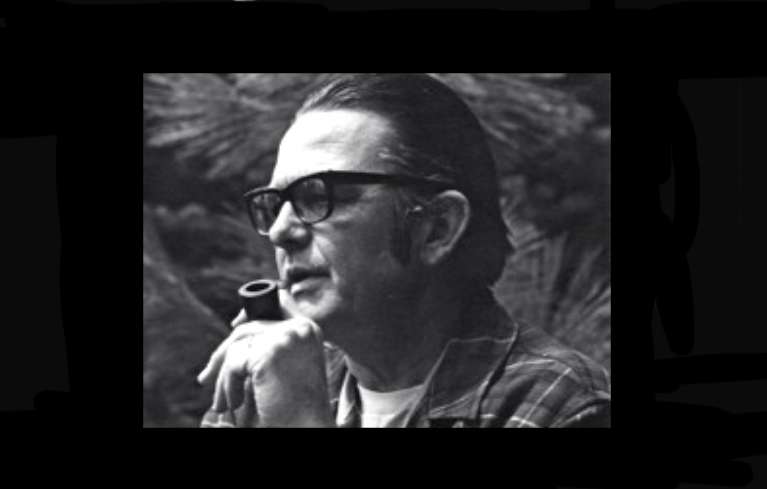
Ken Smith

Ken Smith

On July 16, 1950, he married Ruth Marilyn “Lynne” Zant.

It was in 1960 that the Smith family moved to South Lake Tahoe from Guerneville in Sonoma County. At that time there was no hospital in town. He was the second doctor in South Tahoe, with the other being Jim Whitely. The two had first met in the Bay Area.

Minor surgeries could be performed in their office, which was near where the senior center is now located. More intricate medical services required going to Carson Tahoe Hospital. A few beds were in their office in case someone had to spend the night.

While he delivered babies in his time, Dr. Smith was a general practitioner. Most people knew him as Doc Smith.

His daughter, Connie Hendryx, remembers as kids not being allowed to be on the phone for more than five minutes at a time because her dad was on call. This was at a time before call waiting or cell phones.

Barton Memorial Hospital opened Dec. 23, 1963. Dr. Smith became the first chief of staff.

With Whitely and Peter Irving, Dr. Smith opened a practice close to the hospital. At age 65 he retired in 1991.

At one time Dr. Smith was the medical director for Sierra Recovery Center, a drug and alcohol rehabilitation center.

Local politics and the environment were important to him.

“They were very much environmentalists,” longtime local Patty Olson said of the Smiths. She said they were into the ecology of the lake.

The Smiths were each other’s best friend, according to their daughter. Bird watching was a passion of theirs. When he would see a particularly interesting bird on the feeder outside his window it was his wife that Dr. Smith would call.

He was one of the key players in helping incorporate South Lake Tahoe in 1965.

Dr. Smith was appointed to the South Lake Tahoe City Council on Jan. 5, 1971, was elected in his own right, and then resigned on March 12, 1974. He was mayor for one year starting in spring 1973. He was also on the Planning Commission for about a decade starting in 1983.

While on the council Dr. Smith was instrumental in ridding the city streets of billboard advertisements as well as getting the power lines on Highway 50 to be put underground.

“A favorite thing after dinner was all six of us would sit around the table and just talk about environmental issues, politics, everything,” Hendryx said.

He served on the board for the Tahoe Resource Conservation District, was active with the League to Save Lake Tahoe, and was on the board of the Tahoe Rim Trail Association.

“He was so thrilled when it got built,” Hendryx said of the 165-mile trail around Lake Tahoe.

Dr. Smith was also involved with the Boy Scouts, having served as a Scout leader.

Olson recalls when their kids were growing up – she and husband Neil had three, the Smiths four, Whitelys four and Ledbetters four – that they created their own day care so the adults could all have a day free of kids.

She said socially they played bridge together.

Olson remembers that as being a much different time in Tahoe, when people knew each other and pitched in to help one another.

For at least a decade the Smiths were known for having a party after school got out. All the neighbors were invited, hot dogs and popsicles were served, and it was a time for Dr. Smith to share his dry sense of humor.

His wife, Lynne, in 1999, and sister Jean Sharp preceded Dr. Smith in death. He is survived by sons Ken “Casey” Smith (Glenda) from Saratoga and Larry Smith (Debbie) from Butte, Mont.; and twin daughters Kelsey Julander (Dale) from Bakersfield and Connie Hendryx (Michael) from Yreka; and grandchildren Emilie Hendryx, and Allison and Adam Julander.

Services are pending. In lieu of flowers, the family asks donations be sent to one’s favorite charity.


NV Energy plots path to make money without coal

By Andrew Doughman, Las Vegas Sun

Sen. Harry Reid arrived in Carson City on a Wednesday in February, commandeered an office at the Legislature and sat down with state Sen. Kelvin Atkinson to hatch a plan.

A sweeping proposal to move coal out of Nevada’s energy mix had incubated for months among a group of powerful and influential politicians, business executives and lobbyists before they stepped forward and selected Atkinson to help execute it — at least publicly.

What emerged from that meeting was a legislative power play reaching from D.C. to Nevada that illustrates how consummate insiders can dictate energy cost and policy for every Nevadan for the next decade.

The big idea: Nevada would cease its investments in three coal-fired power plants and NV Energy, the state’s energy monopoly, would get to build expensive gas and renewable energy power plants — a cost that ratepayers would have to bear.

In a state with nearly the highest energy costs in the Mountain West region and a growing renewable energy sector, a potentially risky shift from coal to gas and alternative-energy plants could have been momentous or disastrous for Nevada residents, businesses, energy providers and politicians.

Click here to read the whole story


El Dorado County probation employees tired of workplace harassment

By Kathryn Reed

Chaotic could be one word to describe the El Dorado County Probation Department. Discriminatory, dysfunctional and secretive would be other words.

“The kids aren’t the problem, management is,” said one person who recently severed ties with the department.

Rank and file employees are fearful of talking to Lake Tahoe News on the record and most higher ups won’t even talk.

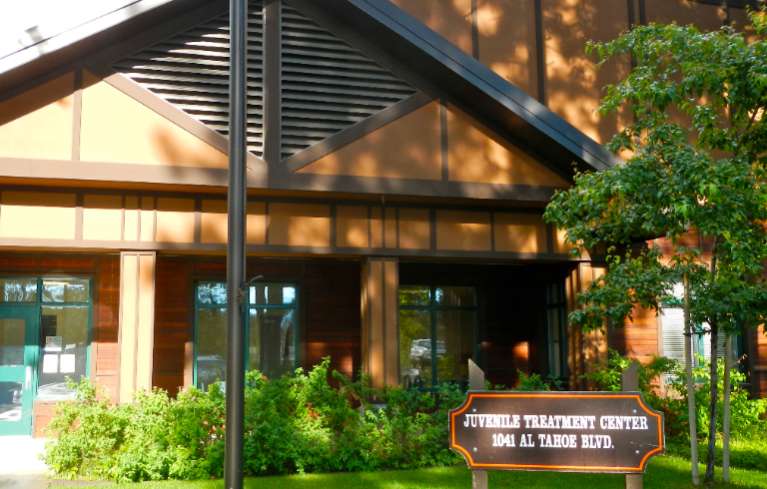
The Juvenile Treatment Center in South Lake Tahoe is one of the workplaces county probation officers say is less than ideal to work. Photo/LTN

The Juvenile Treatment Center in South Lake Tahoe is one place county probation officers say is less than ideal to work. Photo/LTN

When word got out last week that Lake Tahoe News was asking questions, interim Chief Probation Officer Vince Janette sent the following email to all probation staff, “Recently a few staff members were contacted off duty by the media. I would like to take this opportunity to remind all staff of policy IV2 Contact with the News Media. Please take a moment to review the policy and report any contacts via the chain of command. If you are contacted at home or in the community this policy still applies.”

He then attached the policy in the email, which was given to LTN by someone other than Janette. Part of the policy says only the chief of the department or a designated manager may speak with the media.

It also says, “Staff is prohibited from writing letters to the media or otherwise communicating with the media as a representative of the Probation Department.”

When Lake Tahoe News asked Janette if he thought there is a morale issue within the department, he said, “I will not comment on that.”

When asked to comment on whether harassment issues are ignored, he said, “I haven’t heard that.”

According to the people who spoke off the record with Lake Tahoe News, Janette is one of the harassers.

Change in leadership

Janette is now in charge of probation because Greg Sly, who is still technically the chief, is out on leave until he officially retires Sept. 13. Sly is getting full pay and medical benefits until then.

At first Janette said, “I’d rather not comment” – in response to whether he applied to be the chief permanently. Then he added, “I will not be our next chief.”

When Sly was asked to explain what is really going on today at probation, he emailed LTN, “Current direction from the CAO and County Counsel is that all media questions are referred to them. Therefore, I need to refer you to their offices.”

Terri Daly is the county’s chief administrative officer and Ed Knapp the county counsel. Neither is communicating with Lake Tahoe News.

In an email obtained by LTN written June 7 to staff Sly says he is remaining out on medical leave.

Sly’s email says, “I wish my career and term as your chief would be ending under different circumstances, but sometimes doing the right thing pays off a little differently than one would like. During my entire 29 year law enforcement and community corrections career, I always pushed for true justice on all fronts. But as I have often said, ‘Sometimes Justice just isn’t Just.’”

Sly was out on administrative leave from Sept. 28-Dec. 12 as well. At that time Gary Hudgeons, then assistant chief probation officer, was put in charge of the department. He abruptly left when Sly returned to work.

Sly has not always gotten along with the current CAO, but the truth to why he keeps being put on leave is not forthcoming because officials say it is a personnel issue.

Feeling threatened

Those who are left to do the work at the South Lake Tahoe and Placerville detention centers say there is a culture of harassment and discrimination within the department. This includes workers at the facilities housing the youths as well as those working in the field.

And it’s not just women who have been harassed. One guy chose to take a demotion to get away from a harassing boss. Another left to work at a coffeehouse.

“Within the department retaliation is alive and well and strong. If you speak out, you will absolutely be gone,” one employee said. “There is no personality conflict; it’s a power and control issue.”

Sometimes the harassment is because a person is outspoken, sometimes it’s for having a quirky personality, sometimes for just not fitting in with the established older-white-male power structure, and other times it’s for reasons that are not obvious.

But it’s predominately women who are subjected to the hostile work environment – unless they are having an affair with one of their male superiors or their husband is a cop.

Several people have left the department this year. They are fed up with the treatment, filing grievances and getting nowhere but being retaliated against.

Harassment, according to those who spoke with LTN, is verbal and sexual – and ongoing.

Some complaints are investigated, some are not. But even when they are, they often end with the harasser not being reprimanded and the employee reaching a financial settlement with the county so they will go away.

One employee said they look around and ask, “Why is the person who all complaints were directed toward still here and the person who instigated the investigation now gone?”