Tales of Tahoe come to life cruising on the Dixie

By Kathryn Reed

ZEPHYR COVE – Lake Tahoe history is best delivered by one who lived it. So it was appropriate that Mark Twain greeted us as we boarded the M.S. Dixie II.

Twain’s roots in the area run at least as deep as the lake itself – 1,645 feet.

This outing on Lake Tahoe is part history lesson, part outdoor adventure, and part scenic cruise.

I board the boat July 5 with two of my cousins – Dana from Arizona and Jenna from Missouri. This is the first time any of us has been on the Dixie. (This is actually the second Dixie. The platform of the first one is now a barge stored at the Tahoe Keys Marina that comes out for the fireworks.)

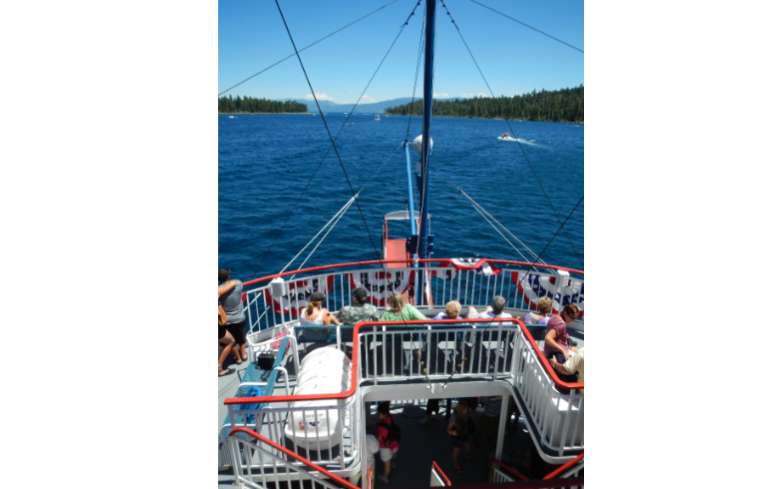
Heading out of Emerald Bay aboard the M.S. Dixie II. Photos/Kathryn Reed

Heading out of Emerald Bay aboard the M.S. Dixie II. Photos/Kathryn Reed

We had been up to the parking lot at Vikingsholm a couple days earlier to peer down at the bay and see it from land. Now was our opportunity to view it from the lake.

Far out on the lake we are able to see a tiny strip of white on the mountainside. It turns out to be Eagle Falls, which is right above Vikingsholm.

The highlight for many on these trips is seeing Vikingsholm as well as the teahouse on top of Fannette Island. (The castle is open during the summer for tours.)

Between “Mark Twain” (aka MacEvoy Lane) and the recorded information coming across the loud speakers, the history of Lake Tahoe starting with the Washoe people unfolds.

The problem, though, with sitting outside on the bow with the wind coming at us is that the voices are a bit muffled and we miss much of what is being said.

Still, we learn how the first road to Emerald Bay opened in 1913, that a glacier formed the bay, the scar to the left at the end of the bay is from a 1955 600-foot avalanche that closed the road for one year.

More recent, we are told 15 eagles wintered at the mouth of the bay – which is called Eagle Point – and they left three weeks ago.

It’s crowded on this holiday weekend. All the cruises were expected to sell-out during the long weekend. Arrive early because we had a hard time finding a seat outside. People had thought it a good idea to reserve their chair and then leave. Not so fast said some of the other passengers.

The Dixie has two interior floors, one of which has a small area where you can see through to the bottom of the lake. Food and beverages are available, and there is a small souvenir shop on board.

The other paddleboat Aramark runs on the South Shore is the Tahoe Queen. It is a true paddle-wheeler because the paddle is its sole power source. The Dixie has an engine. The difference also means the cruising times differ. The Dixie takes two hours for the Emerald Bay trip and the Queen 2½ hours.

The Dixie holds 525 people and is the largest cruising vessel on the lake, while the Queen can take on 380.

The Queen leaves from Ski Run Marina and the Dixie from Zephyr Cove.

The annual race between the boats is during Labor Day weekend.

ngg_shortcode_0_placeholder (Click on photos to enlarge.)


Calif. female prisoners sterilized without permission

By Corey G. Johnson, Center for Investigative Reporting

Doctors under contract with the California Department of Corrections and Rehabilitation sterilized nearly 150 female inmates from 2006 to 2010 without required state approvals, the Center for Investigative Reporting has found.

The women received tubal ligations in violation of prison rules during those five years – and there are perhaps 100 more dating back to the late 1990s, according to state documents and interviews.

From 1997 to 2010, the state paid doctors $147,460 to perform the procedure, according to a database of contracted medical services for state prisoners.

The women were signed up for the surgery while they were pregnant and housed at the California Institution for Women in Corona or Valley State Prison for Women in Chowchilla, which is now a men’s prison.
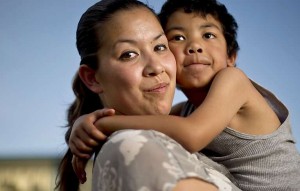
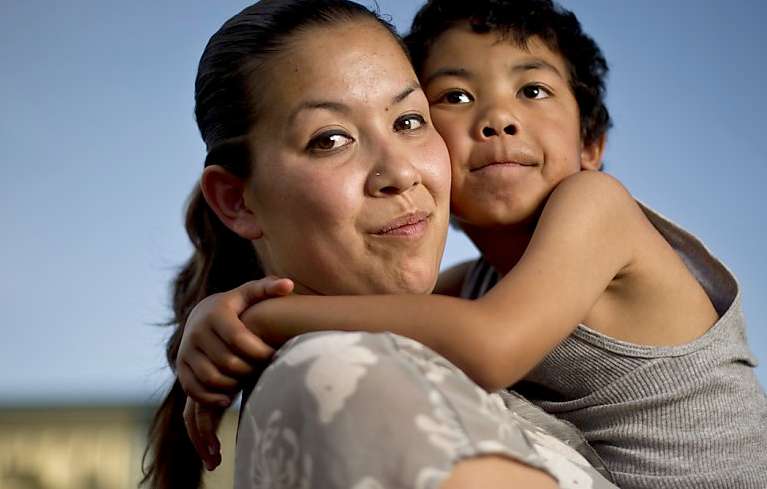
 Noah Berger, Center For Investigative Reporti Crystal Nguyen, with son Neiko, 6, says Valley State Prison infirmary staff offered sterilizations.

Crystal Nguyen, with son Neiko, 6, says Valley State Prison infirmary staff offered sterilizations. Photo/Noah Berger/CIR

Former inmates and prisoner advocates say that prison medical staff coerced the women, targeting those deemed likely to return to prison in the future.

Crystal Nguyen, a former Valley State Prison inmate who worked in the prison’s infirmary during 2007, said she often overheard medical staff asking inmates who had served multiple prison terms to agree to be sterilized.

“I was like, ‘Oh my God, that’s not right,'” Nguyen, 28, said. “Do they think they’re animals, and they don’t want them to breed anymore?”

One former Valley State inmate who gave birth to a son in October 2006 said the institution’s OB/GYN, Dr. James Heinrich, repeatedly pressured her to agree to a tubal ligation.

“As soon as he found out that I had five kids, he suggested that I look into getting it done. The closer I got to my due date, the more he talked about it,” said Christina Cordero, 34, who spent two years in prison for auto theft. “He made me feel like a bad mother if I didn’t do it.”

Cordero, who was released in 2008 and lives in Upland San Bernardino County, agreed. But she added: “Today, I wish I would have never had it done.”

The allegations echo those made nearly a half-century ago, when forced sterilizations of prisoners, the mentally ill and the poor were commonplace in California. State lawmakers officially banned such practices in 1979.

During an interview with CIR, Heinrich said he provided an important service to low-income women who faced health risks in future pregnancies because of past cesarean sections.

The 69-year-old Bay Area physician denied pressuring anyone. Referring to the $147,460 total, he said, “Over a 10-year period, that isn’t a huge amount of money, compared to what you save in welfare paying for these unwanted children.”

The top medical manager at Valley State Prison from 2005 to 2008 characterized the surgeries as providing inmates with the same options as women on the outside.

Daun Martin, a licensed psychologist, also contended that some pregnant women, particularly those who were on drugs or homeless, would commit crimes so they could return to prison for better health care.

The California Institution for Women in Corona was one of two state prisons where female inmates were sterilized without required state approvals. At least 148 women received tubal ligations in violation of prison rules from 2006 to 2010.

“Do I criticize those women for manipulating the system because they’re pregnant? Absolutely not,” Martin, 73, said. “But I don’t think it should happen. And I’d like to find ways to decrease that.”

Martin denied approving the surgeries, but at least 60 tubal ligations were done at Valley State while she was in charge, according to the state contracts database.

Federal and state laws ban inmate sterilizations if federal funds are used, reflecting concerns that prisoners might feel pressured to comply. California used state funds instead, but since 1994, the procedure has required approval from top medical officials in Sacramento on a case-by-case basis.

But no request for tubal ligations has come before the health care committee responsible for approving such restricted surgeries, said Dr. Ricki Barnett, who tracks medical services and costs for the California Prison Health Care Receivership Corp.

The receiver has overseen medical care in all 33 of the state’s prisons since 2006, when U.S. District Judge Thelton Henderson in San Francisco ruled that the system’s health care violated the constitutional ban on cruel and unusual punishment.

The receiver’s office was aware that sterilizations were happening, records show.

In September 2008, the prisoner rights group Justice Now received a written response to questions about the treatment of pregnant inmates from Tim Rougeux, then the receiver’s chief operating officer. The letter acknowledged that the two prisons offered sterilization surgery to women.

But nothing changed until 2010, after the Oakland organization filed a public records request and complained to the office of state Sen. Carol Liu, D-La Cañada Flintridge. Liu was the chairwoman of the Select Committee on Women and Children in the Criminal Justice System.

Prompted by a phone call from Liu’s staff, Barnett said the receiver’s top medical officer asked her to research the matter. After analyzing medical and cost records, Barnett met in 2010 with officials at both women’s prisons and contract health professionals affiliated with nearby hospitals.

The 16-year-old restriction on tubal ligations seemed to be news to them, Barnett recalled. And, she said, none of the doctors thought they needed permission to perform the surgery on inmates.

“Everybody was operating on the fact that this was a perfectly reasonable thing to do,” she said.

Martin, the Valley State Prison medical manager, said she and her staff had discovered the procedure was restricted five years earlier. Someone had complained about the sterilization of an inmate, Martin recalled. That prompted Martin to research the prison’s medical rules.

Martin said she and Heinrich began to look for ways around the restrictions. Both believed the rules were unfair to women, she said.

“I’m sure that on a couple of occasions, (Heinrich) brought an issue to me saying, ‘Mary Smith is having a medical emergency’ kind of thing, ‘and we ought to have a tubal ligation. She’s got six kids. Can we do it?’ ” Martin said. “And I said, ‘Well, if you document it as a medical emergency, perhaps.'”

Heinrich said he offered tubal ligations only to pregnant inmates with a history of at least three C-sections. Additional pregnancies would be dangerous for these women, Heinrich said, because scar tissue inside the uterus could tear.

Former inmates tell a different story.

Michelle Anderson, who gave birth in December 2006 while at Valley State, said she’d had one prior C-section. Anderson, 44, repeatedly was asked to agree to be sterilized, she said, and was not told what risk factors led to the requests. She refused.

Nikki Montano also had had one C-section before she landed at Valley State in 2008, pregnant and battling drug addiction.

Montano, 42, was serving time after pleading guilty to burglary, forgery and receiving stolen property. The mother of seven children, she said neither Heinrich nor the medical staff told her why she needed a tubal ligation.

“I figured that’s just what happens in prison – that that’s the best kind of doctor you’re going get,” Montano said. “He never told me nothing about nothing.”

But Montano eagerly agreed to the surgery and said she thinks it had a positive effect on her life.

Dr. Carolyn Sufrin, an OB/GYN at San Francisco General Hospital who teaches at UCSF, said it is not common practice to offer tubal ligations to women who’ve had one C-section. She confirmed that having multiple C-sections increases the risk of complications.

But even then, Sufrin said, it’s more appropriate to offer women reversible means of birth control.

Lawsuits, a U.S. Supreme Court ruling and public outrage over eugenics and similar sterilization abuses in Alabama and New York spawned new requirements in the 1970s for doctors to fully inform patients.

Since then, it’s been illegal to pressure anyone to be sterilized or ask for consent during labor or childbirth.

Still, Kimberly Jeffrey says she was pressured by a doctor while sedated and strapped to a surgical table for a C-section in 2010 during a stint at Valley State for a parole violation. Jeffrey, 43, was horrified, she said, and resisted.

“He said, ‘So we’re going to be doing this tubal ligation, right?'” Jeffrey said. “I’m like, ‘Tubal ligation? What are you talking about? I don’t want any procedure. I just want to have my baby.’ I went into a straight panic.”

Jeffrey provided copies of her official prison and hospital medical files to CIR. Those records show Jeffrey rejected a tubal ligation offer during a December 2009 prenatal checkup at Heinrich’s office. A medical report from Jeffrey’s C-section a month later noted that she again refused a tubal ligation request made after she arrived at Madera Community Hospital.

At no time did anyone explain to her any medical justifications for tubal ligation, Jeffrey said.

That experience still haunts Jeffrey, who lives in San Francisco with her 3-year-old son, Noel. She speaks to groups seeking to improve conditions for female prisoners and has lobbied legislators in Sacramento.

State prison officials “are the real repeat offenders,” Jeffrey added. “They repeatedly offended me by denying me my right to dignity and humanity.”

Corey G. Johnson is a reporter for the independent, nonprofit Center for Investigative Reporting, the nation’s largest investigative reporting team.
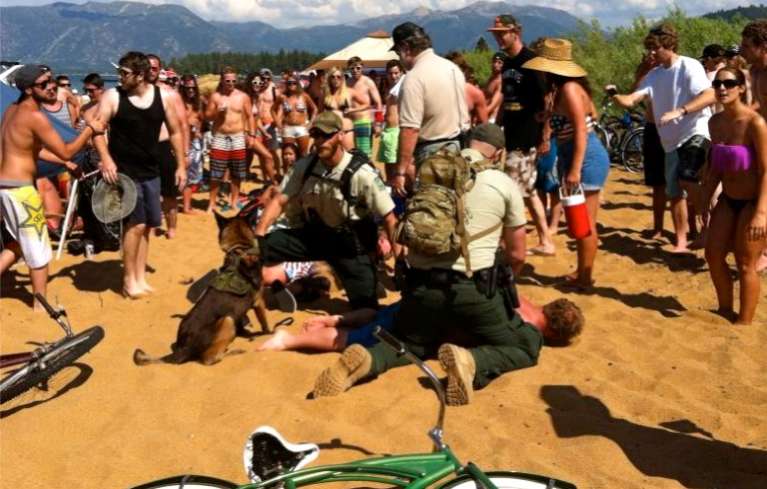


Beach-goers critical of USFS handling of fight

By Kathryn Reed

U.S. Forest Service officials are defending their approach to the July 4 melee at Ski Beach.

A fight broke out between two guys that ended with five law enforcement agencies being called to the South Shore beach, three people receiving citations for fighting, and one person going to the hospital.

“A subject attempted to assault a Forest Service officer and the K9 was used to apprehend him. The dog is fully trained and certified in patrol, narcotics detection and handler protection. Other Forest Service law enforcement officers helped restrain the subject. At this point, the officers were surrounded and the crowd was taunting them and yelling profanities,” Forest Service spokeswoman Cheva Heck told Lake Tahoe News.

U.S. Forest Service officers on July 4 hold down a man who was in a fight. Photo/Julie Gardner

U.S. Forest Service officers on July 4 hold down a man who was in a fight. Photo/Julie Gardner

But that is not what eyewitnesses said happened.

Julie Gardner of South Lake Tahoe was about a foot away on the sand from where a fight broke out between two guys. What started as an argument escalated into one guy shoving another guy who was wearing a full knee brace. The latter fell on his back onto a bike.

Gardner told Lake Tahoe News that two guys were assaulting the man with a brace when a friend of the solo guy jumped in to break up the fight.

“The U.S. Forest Service came over and released the dog. The dog immediately ran up and attacked him,” Gardner said of the friend of the man with the brace.

She did not hear the Forest Service give any warning that the dog was going to be deployed.

Many people who commented on LTN‘s first story about this fight were critical of the USFS, saying many of the same things that Gardner said.

The guy went down, officers cuffed him, but the dog didn’t let go. According to Gardner, the dog kept the hold for at least a minute as officers tried to get him to release. And then the dog allegedly bit the handler.

He was taken to Barton Memorial Hospital that night with several non-life threatening puncture wounds, according to Gardner.

Heck did not answer these questions:

• What is the policy regarding deploying a K9?

• How does the dog know whom to go after?

• When the crowd told officers they had the wrong guys, why didn’t they go after the two who ran?

• Allegedly the officers could not get the dog off the guy. What happened there?

• USFS officers are accused of shoving people to the ground. Any comment?

“This is a pending law enforcement matter, and no further details are available,” Heck said.

Gardner described the scene as chaotic, with people yelling at each other and law enforcement.

Forest Service officials say nearly 70 people were involved and estimate more than 1,000 people were on this beach that is just to the north of Baldwin Beach. Assisting the Forest Service were officers from South Lake Tahoe Police Department, El Dorado County Sheriff’s Office, California Highway Patrol, California State Park police and CalFire.

Gardner said she has never seen such ineptitude from law enforcement.

“It was a completely malicious, unwarranted attack by the dog and officers,” Gardner said.


Skin cancer on the rise among young women

By Emma G. Fitzsimmons, New York Times

On a hot July day last summer, I was lying on the beach at Coney Island with my younger brother when he noticed a dark mole on the back of my arm. “You should really get that checked at the dermatologist,” he said in a worried tone.

It turned out that the mole on my arm was fine, but another one on my cheek was basal cell skin cancer. A few weeks later, I had surgery to remove it and left the plastic surgeon’s office with a 1.5-inch scar sloping down my right cheek.

Friends and colleagues were surprised to see the scar because I was only 28. Even the medical resident who attended my operation said I was the youngest skin cancer patient she had met.

People flock to the beaches of Lake Tahoe on Fourth of July weekend. Photo/LTN

People flock to the beaches of Lake Tahoe on Fourth of July weekend. Photo/LTN

But as I learned more about skin cancer, I discovered that it is becoming increasingly common, especially among young women. A recent study by the Mayo Clinic found that melanoma, the most serious type, had increased eightfold for women under 40 since 1970.

“There is this thought that, ‘It won’t happen to me because I’m young,’ but that’s not true anymore,” said Dr. Jerry Brewer, a dermatologist at the Mayo Clinic and an author of the study.

Experts say that tanning beds are a major factor behind the increase in all three types of skin cancer for young women. More than 20 million people use tanning beds each year, and 70 percent of customers are young white women, who are at increased risk of developing skin cancer. The lamps in tanning beds can give off 10 to 15 times the UVA radiation of normal sun exposure, accelerating the process of skin damage. Instead of getting skin cancer 30 or 40 years down the line, many young women are getting it five or 10 years later, Dr. Brewer said.

Though I have never used a tanning bed, my dermatologist said I had an unlucky trio of risk factors: fair skin and blue eyes, an upbringing in Texas, where I spent long days in the sun growing up, and a family history of skin cancer. My grandmother and aunt had melanoma and survived, and my mother had basal cell carcinoma too.

While more than three million cases of basal and squamous cell carcinoma are diagnosed each year, only about 2,000 people a year die from these non-melanoma skin cancers. Melanoma is a far more ominous diagnosis, causing about 9,400 deaths each year in the United States.

Dr. Darrell Rigel, a dermatology professor at NYU Langone Medical Center, says that every month at his New York practice, about two women in their 20s are found to have early melanoma, a dramatic rise from 20 years ago. Once melanoma is the size of a dime, there is a good chance that it has already spread and treatment may not work, Dr. Rigel said. “I know I’m looking at a death sentence on their arm, and they feel perfectly fine,” he said. “It’s absolutely awful.”

This year, the Food and Drug Administration proposed new regulations for tanning beds that require them to have labels warning that they are not recommended for people under 18. And in April, New Jersey joined several other states in passing a law to prohibit indoor tanning for those under 17.

Even children can get melanoma. A recent study in the journal Pediatrics found that the number of cases among children and adolescents has been increasing each year by about 2 percent.

Another recent study, published in The Journal of the American Medical Association, found that while young women are more likely to be given a diagnosis of melanoma, young men are more likely to die from it. Researchers said the disparity was probably a consequence of behavioral tendencies — men are less likely to see a doctor or perform a skin self-examination — and possibly biological differences as well.

My brush with skin cancer has certainly changed how I view the sun. I don’t want another scar — or worse, a diagnosis of melanoma. I wear a 30 SPF sunscreen on my face every day and bought several sun-protective long-sleeve shirts to wear outdoors this summer. I am visiting my dermatologist every three months for a full body scan. (One annual checkup is recommended for those without a previous diagnosis.)

I returned to Texas in April for a friend’s wedding at a resort in the woods. After a long winter in New York, my husband and I were excited to go swimming at a pool near our cabin. In the past, I would have grabbed a lounge chair in the sun, seeing it as the perfect opportunity to arrive at the ceremony with a sun-kissed glow. But this time, I picked a chair under a wide umbrella. It’s just not worth it anymore.

Even a few sunburns can significantly raise your risk of skin cancer, Dr. Brewer said.

“Deciding how much sun you want to get is like asking how much cyanide you want in your breakfast cereal,” he said. “There is no amount of tan that is healthy.”


Hiking with kids — its about fun, not distance

By Mary Meehan, Lexington Herald-Leader

Author Jeff Alt didn’t have to look far for inspiration for his book about hiking with children. He has two kids and started hiking with daughter Madison, 8, “right out of the gate.” Son William, 5, also takes to the trail.

His hiking philosophy? If you start hiking with kids in a carrier when they are little, they will be more than ready to take to the trails on their own two feet as they grow older.

Alt’s new book is “Get Your Kids Hiking: How to Start Them Young and Keep It Fun” (Beaufort Books Inc., $13.95).

Alt is a member of the Outdoor Writers Association of America. He has walked the Appalachian Trail, has hiked the John Muir Trail with his wife, and he carried his daughter, when she was 21 months old, across a path in Ireland.

He wrote the book “because we as a nation have become lazy. Everything is at our fingertips now.”

Life is so fast-paced and programmed, he said, that even kids get into a dull routine: school, home, school, home. They are not exposed to the sensory experiences that come with being out in nature. He said he hopes the book will help encourage families to get off the couch and hit the trail.

The key to hiking with kids, he said, is letting them be the leaders. And, he said, parents need to focus on the experience — the butterflies on the trail, the mud on their shoes, the sounds of the forest. “That helps them engage in the outdoors. They can touch, feel and just see, learn and discover.”

Distance is not a priority, he said.

“I let the child lead. If they stop, I stop,” he said. “The child is showing me what they are interested in. You may only get a half a mile into the forest, but they are going to have so much fun they will want to do it again.”

Alt, a speech pathologist, laid out the tips in his book to match the developmental stages of children. Hiking with elementary school-age children is different from hiking with teenagers.

He admits that getting teens to disconnect from their digital world to take a hike can be a challenge.

“With teenagers, you kind of have to intrigue them,” Alt said. One way, he said, is to invite them to bring a friend along.

The right equipment is important, too, he said, no matter the age of the child. Food, water, a backpack and proper shoes are the basics.

There is another advantage to being on the trail and away from things, he said. It’s a great time to talk to your kids.

“You can talk to them about some life lesson or ask them how they are feeling just before the go off to college.”


Theater season in S. Lake launches with laughter

By Kathryn Reed

Small stage, older audience, limited talent pool, not a ton of money. Community theater can be limiting.

But those factors were not noticeable to those who on Friday night attended the debut of the summer theater season at the Boathouse Theatre. “The Complete Works of William Shakespeare (Abridged)” will be staged at the South Shore theater for five more nights.

This is the third season the Valhalla Festival of Arts has put on three plays. Much of it has to do with them being moneymakers. The nearly 160-seat theater was almost sold-out Friday.

“We want interesting, well-written pieces, but we also need something that entertains people,” Ginger Nicolay Davis, president of the Tahoe Tallac Association, told Lake Tahoe News. “One of the biggest challenges is to pick the right material.”

“The Complete Works of William Shakespeare (Abridged)” is very much a farce that keeps the audience laughing. Photo/Kathryn Reed

“The Complete Works of William Shakespeare (Abridged)” is very much a farce that keeps the audience laughing. Photo/Kathryn Reed

She is reading a dozen scripts now for next year’s season.

When it comes to picking a play, the size of the venue is a huge criterion. A play that features multiple actors won’t work. Nor will elaborate sets because of the limited stage area.

Seeing the same actors in play after is play is common in a small town. Because those in the local theater business know each other, they know who can do what. That’s why when it comes time to select a play the decision-makers do so knowing who might be able to play which part.

A desire to have a family-friendly play is also part of the mix.

“For next year I’m already reading family-friendly shows that perhaps we could cast kids in as well,” Davis said.

This version of Shakespeare was chosen to appeal to younger community members. While there were youngsters in the audience July 5, some of the material is not appropriate for little kids.

It’s a fun play with some Tahoe references woven in.

“I think this Shakespeare is really family friendly, but it is PG-13. It is Three Stooges meets Shakespeare,” Dave Hamilton said of this comedic play.

Hamilton is in his first season as festival director. But he is intimately familiar with the venue, the people and festival as a whole. He co-wrote the highly popular “Guilty Pleasures”, has been on the Tahoe Tallac Association board and is the former theater arts director at Lake Tahoe Community College.

“Everyone of us has a pretty significant background,” Hamilton told Lake Tahoe News.

But the actors aren’t getting paid.

Valhalla – or any theater company – can’t just put on any play they want. They must pay for the rights to the play. Something like “The Complete Works of William Shakespeare (Abridged)” runs about $1,200 because it’s based on a percentage of proceeds. A play from the 1950s or ’60 might have a flat fee of about $500.

And while the 2013 season has just begun, decisions about 2014’s shows will be made in a matter of months.

—–

Valhalla festival plays:

• “The Complete Works of William Shakespeare (Abridged)” July 6-7, July 11-13.

• “Motherhood Out Loud” July 18-21.

• “Better Late” Aug. 1-4.

More info about these shows and the entire festival may be found online.


Uneducated boaters a danger on Calif. waters

By Elyce Kirchner, Kevin Nious and Felipe Escamilla, NBC-Bay Area

In California, boat operators can be as young as 12 years old, have no boater education, no license, and still be legally allowed to operate a boat.

The NBC Bay Area Investigative Unit has also discovered the Golden State is the second worst in the nation in number of boating accidents. And, within the state, the 1,000-mile stretch of the California Delta, which consists of the lands and waterways between the San Francisco Bay and the Sierra mountains, has had the most accidents occur in its waterway since 2007.

In light of the dangers, some groups have been arguing for tougher boating regulations, but have been met with stiff opposition each time.

California does not require a license for any type of watercraft. Photo/LTN file

California does not require a license for any type of watercraft. Photo/LTN file

Lt. Doug Powell of the Contra Costa County sheriff’s marine patrol unit has been one of those lobbying for more stringent regulations.

“You wouldn’t give a 16-year-old the keys to your car, and tell them to go out and drive out on the street without any education. It’s hard to believe that we are doing that with boats,” Powell said, whose unit is responsible for patrolling more than 200 miles of linear coastline along the Delta from Richmond to Discovery Bay.

He believes that boater education should be required in the state. California is one of only five states, including Alaska, Arizona, South Dakota, and Wyoming, with zero boater education.

And many believe that the dearth of education is why California had about 2,775 boating accidents from 2007 to 2012, according to an NBC Bay Area Investigative Unit analysis of U.S. Coast Guard data. To compare, only Florida had more such accidents – more than 3,800 in the same time period. Texas ranked third with about 1,110, and New York and Michigan came in a close fourth and fifth with about 1,000 each.

“Yes, alcohol has been a problem but education is the main reason for accidents in our county,” Powell said. He said many tragic accidents could have just been avoided if boaters knew the basic rules of the road. In fact, according to the California Division of Boating and Waterways, the most common causes of collisions are operators not paying attention and lack of education- just a fraction of incidents are fueled by alcohol or drug use.

Jason and Maryann Hale know firsthand what can happen when boaters are neither equipped with adequate skills nor focused on operating a boat. On June 22, 2007, the Hale family was celebrating their son’s birthday on Whiskeytown Lake near Lake Shasta. The day of celebration took a tragic turn when a power boat plowed into a boat carrying several of their children, including their 12-year-old daughter, Trevienne.

The operator of the powerboat was “was out doing tricks spinning around and going through the no wake zone,” Jason Hale said. According to vessel accidents reports obtained by NBC Bay Area, not only was the operator not paying attention but he was going 20 to 30 miles an hour; Trevienne’s boat was traveling at 5 to 10 miles an hour. The documents show that the boat was speeding in a “no wake” zone, where boats aren’t allowed to go faster than 5 miles an hour.

Trevienne was knocked unconscious but was breathing. She was flown to Mercy Medical Center in Redding, where she eventually died.

“It’s like Russian roulette with your children and your loved ones out there, if someone doesn’t do what they are supposed to do out there,” Maryann Hale said. The Hale family is left devastated with the loss of their daughter, frustrated by the few safety requirements, and terrified to return to what once was a favorite leisure spot.

San Francisco Sailing Company owner, Erik Ostrander, is one of the many proponents supporting mandatory boating certifications. He exclusively rents out boats to customers who pass two certification courses, hoping to raise awareness that “the waters in the central bay are the most challenging in the world to sail.”

“It is ridiculous. I think it’s a mentality of thinking that the only person you are going to hurt is yourself, but they don’t realize that these people are colliding with other boats,” Ostrander said standing in front of Pier 39.

However, mandating boater education and similarly increasing regulations for waterway safety has been met with great opposition. In 1999, Gov. Gray Davis vetoed a bill that would have required education training for boat operators. Davis in part argued, “There is little evidence that a written test alone will improve the piloting skills of motor boat operators or reduce boating accidents.”

Yet, the Investigate Unit found that on average, states that require boater education on average have a lower rate of fatal accidents than states that do not. For example, New York and Illinois, which have long required boating education, have about three to less than one boating fatality per 100,000 boats over a four-year period. California, however, averaged four fatalities per 100,000 boats in that same period.

A similar bill in California was introduced in 2007, but also failed.

Ed Swakon from the Marine Council, an industry trade organization, believes that boater education is important but should not be a requirement. Swakon also believes that boaters should not be forced to obtain a license to operate.

“It might just be a taxation or revenue source that we don’t think needs to be imposed on the boating community at this time,” Swakon said.


People make loneliest road a bit more tolerable

By Claire O’Neill, NPR

It’s hard to say where the the 287-mile stretch of Nevada’s Highway 50 got its nickname “the loneliest road in America.” Photographer Ty Wright thinks some writer got clever in a Life article once upon a time — and that it just stuck.

But when he set out on a road trip for a grad school project in photojournalism, Wright was less interested in the origins of the superlative and more curious about its veracity: Is it really the loneliest road? And if so, who actually lives there?

He spent about 10 days exploring the five or so towns that dot the highway — and mostly what’s in between: a lot of nothing. His goal as a photographer was to capture how it looks. And to do that, he says, he listened.

“I think people get behind their cameras and start shooting without listening,” he says. “If I don’t know you, how can I tell [your] story through images? Even with a place. I found myself parking on the side of the road … just listening.”

A self-described “people person,” Wright says he found himself searching for connections in the most unlikely places. He has tales of ranches and brothels — and accounts of general goodwill from the locals, who seemed more than willing to accept an outsider without questions. But he still had questions: Who are the locals on this lonely road?

“It takes a certain type of person,” Wright says. “A strong, self-sustaining kind of person. They have different worries because their neighbor might be 2 miles away. They’re a lot more independent. They’re their own maintenance men. Their own proprietors. And they know how to live off the land. The ethic of work,” he says, “is just insane.”

Of course, one man’s “middle of nowhere” is another man’s home. Still, why make home on a lonely road?

“There was no consensus,” Wright says, “but I think it was just a tie to the community. And a tie to the land. There’s something spiritual and really unique to that place. You see the sawtooth edges of the mountains and the sunset stretches clear behind you and it looks like there’s two suns. I’ve never seen anything like that.”

Maybe it’s easy for a city slicker to say, but these days it seems like having little reception and lots of road is a rare experience. Yet the feeling of isolation, even in (or maybe especially in) the most wired urban areas, is universal. Wright’s antidote for travel loneliness contains a universal truth:

“Ultimately I’d say that people make the road not so lonely.”


Tourists returning to Tahoe reviving economy

By Kathryn Reed

“No vacancy” signs, traffic on the roads midweek, parking lots full. All of these are indicators of an economy that is on the rebound.

There are days, construction aside, when one cannot drive as fast they would like. Even the increase in bikes and pedestrians is slowing down the normal pace.

Beaches like the one at Lake Shore Lodge are always full for the July 4 fireworks. Photo/Kathryn Reed

Beaches like the one at Lake Shore Lodge are always full for the July 4 fireworks. Photo/Kathryn Reed

It hasn’t been this way in Tahoe since before the recession.

According to the Bureau of Economic analysis, spending on travel and tourism in the United States is up 6.8 percent in the first three months of this year compared to a year ago.

A report by Dean Runyan Associates said more than 200 million people came to California in 2012 as tourists. Collectively, they spent about $106.4 billion. This is an increase of 3 percent from the $101.8 billion that was spent in 2011.

Pat Ronan, who owns Lake Shore Lodge and Spa in South Lake Tahoe, said everyone he’s talked to – from casinos to vacation rentals – is doing better than years past.

“We sell out every year, but this year it was a month in advance,” Ronan, who is also chairman of the Lake Tahoe Visitors Authority, told Lake Tahoe News of this weekend.

The three- and four-night minimums that many hotels have for this weekend were not a deterrent.

“There is a huge amount of family business because now the whole family can afford to do it,” Ronan said.

Sandy Evans Hall, North Lake Tahoe Resort Association executive director, said 2012 was a great summer for her area and this summer is tracking to be on par or better.

“Probably our biggest increase now is showing up in September because of Iron Man, Tough Mudder and the food and wine festival,” Hall told Lake Tahoe News.

The first two are new events to the North Shore.

Events continue to be an economic boon no matter where they are.

Carol Chaplin, LTVA’s executive director, said events do two things. One, they draw people to that specific event, and the other is the event creates a sense of energy, that Tahoe is a happening place even if that particular event is not of interest or the person can’t make it that day.

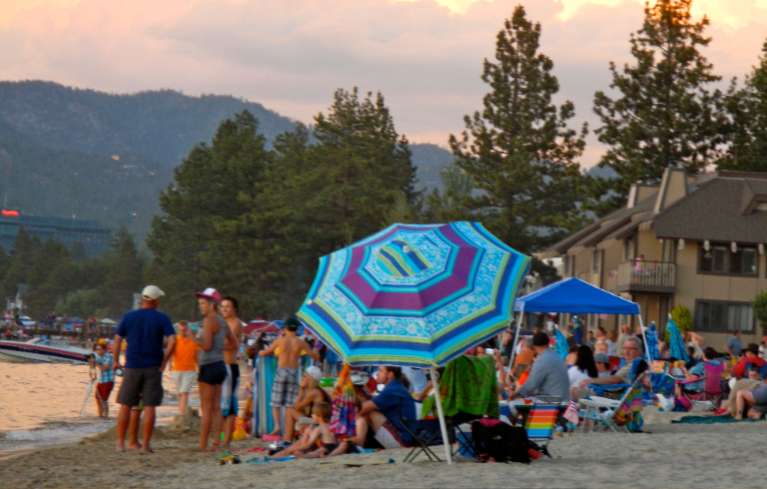
Fourth of July is traditionally the busiest time of the year throughout the Lake Tahoe Basin. This year is no different. Beaches were full of fireworks enthusiasts last night. The beach at Lake Shore Lodge and Spa was a mass of people with their eyes focused intently on the 25-minute fireworks display that featured 3,500 shells being shot off from three barges.

Tourist officials on the South Shore had predicted upward of 100,000 people could be in town this weekend.

The big difference this year compared to previous years is the advance bookings. The past few years people were all about last-minute travel, now they are planning. This is a sign of confidence in the economy.

Lodging is the first segment of a tourism destination to come back. Then people start eating out more and graduate to more expensive eateries. Then it’s a special event they can afford. Finally, it will be the truly optional items people will open their wallets for – like spa treatments, helicopter rides and shopping.

“For the boats, they are pacing well above where they were last year,” Teri Sweeney with Aramark said of the two paddle-wheelers and 50-passenger Paradise her company operates.

On the Fourth, a third cruise was added for the Paradise. It sold out in 1½ weeks. All of the cruises were sold out yesterday.

Sweeney added that the boat rental business is doing well, too.

People are eating out as well.

“Last year was a record year for Riva, Gar Wood and Bar of America. This year is proving to be as good or better, even in Kings Beach (at Caliente),” Tom Turner told Lake Tahoe News.

Turner owns the four restaurants scattered about the greater Lake Tahoe area.

July 3 is traditionally the busiest day for Gar Wood because people are stopping there on their way to the fireworks in Kings Beach. Riva Grill in South Lake and Caliente in Kings Beach are popular viewing platforms on fireworks night.

“People are definitely loosening up, but it is much more calculated these days,” Chaplin said. She doubts the visitor who has money to throw will be returning any time soon, but is confident the tide has turned.


Display of patriotism in S. Tahoe during parade

South Tahoe Refuse makes an American flag out of plastic bottles. Photo/LTN

South Tahoe Refuse makes an American flag out of plastic bottles. Photo/LTN

Red, white and blue were everywhere – in the parade, on the vehicles, as decorations and definitely the color of choice for attire.

About 35 vehicles participated in the second annual South Lake Tahoe Fourth of July parade.

Golden Bear Events organized the parade that was dominated by military veterans and city public safety vehicles.

The group of vehicles made their way from the Tahoe Valley Pharmacy to the American Legion at was described as walking pace.

Lots of people lining the parade route were waving U.S. flags. Plenty of horns were honking by people not even participating.

The parade ended at the Legion Hall where festivities continued on.

— Lake Tahoe News staff report