2-time breast cancer survivor conquers Mt. Shasta
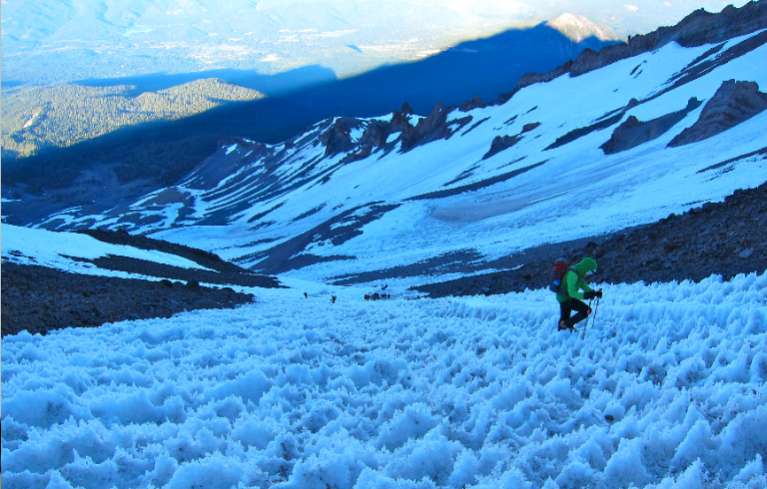
Linda Kazmar climbs Avalanche Gulch after sunrise June 22. Photo/Jeff Kazmar

Linda Kaczmar of South Lake Tahoe climbs Avalanche Gulch on Mount Shasta after sunrise June 22. Photos/Jeff Kaczmar

By Kathryn Reed

Today will be Linda Kaczmar’s last reconstructive surgery. It is one of many milestones for her in 2013.

It was not a decision she thought she would have to make again. When she went through all the breast cancer treatments 10 years ago she believed she was done with oncology wards.

But a lump in the same breast, discovered by a self-exam – like the first – that also didn’t show up on an X-ray, was enough to get her to see her doc.

It was back. And this time she was going in for a double mastectomy.

However, Kaczmar wasn’t about to let cancer get in the way of plans she had already made.
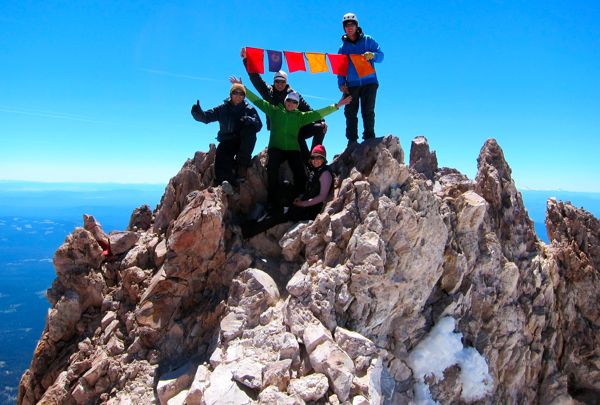
 At the summit -- 14,179 feet.  Jeff Kaczmar, from left, Steve Bannar, Linda Kaczmar, Chris Kozlowski, and John Dayberry (standing). Photo/Jeff Kazmar


At the summit — 14,179 feet. Jeff Kaczmar, from left, Steve Bannar, Linda Kaczmar, Chris Kozlowski, and John Dayberry (standing).

Before the January diagnosis she decided that same month to climb Mount Shasta – again. On the first attempt 10 years ago she didn’t summit. Her friend Chris Kozlowski said absolutely she would be alongside her on the trail this time. Then Stella Ortega joined in on the training.

And so began the South Lake Tahoe women’s – Quest for Shasta, 3 Girls and a Mountain.

Kaczmar credits her doctors at UC San Francisco for arranging their schedules to work with her training and desire to conquer the 14,179-foot mountain.

On June 21 (the summer solstice) – what had become an expedition of three girls and three guys – reached Helen Lake base camp at 10,000 feet. Ortega was not feeling well the next day and ended her quest there.

The others headed out about 2:30am June 22 with headlamps on. Soon those were put in packs and the five were walking under the light of the super moon.

The men along on the ascent were Kaczmar’s 28-year-old son Jeff, Steve Bannar – who two years ago performed knee replacement surgery on Kaczmar, and John Dayberry.

All five had their own stories about why they wanted to climb this mystical mountain that is the No. 1 Earth chakra. But the overriding reason was to accompany Kaczmar on her path to the top.

“The mountain was good to me that day. She helped me summit,” Kaczmar told Lake Tahoe News. She is the first to admit the climb was not easy – “it was very, very hard.” After all, it was 7,000 vertical feet.

At one point Bannar gave her a stern pep talk. Her son spoke words of encouragement. Kozlowski knew their training would pay off.
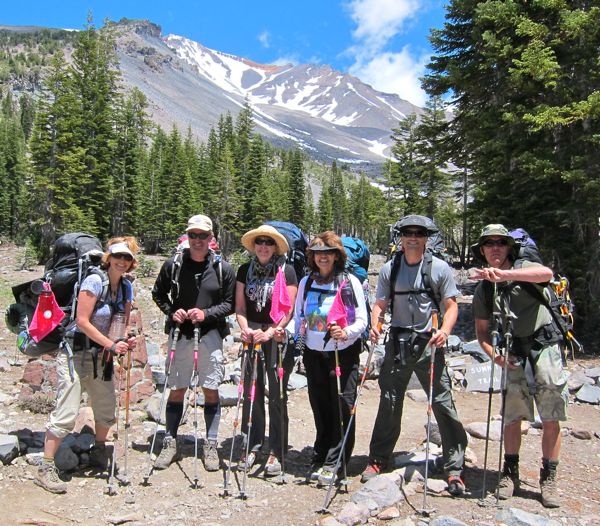
Going to base camp, from left,  Chris Kozlowski, Steve Bannar, Linda Kaczmar, Stella Ortega, Jeff Kaczmar and John Dayberry.

Going to base camp, from left, Chris Kozlowski, Steve Bannar, Linda Kaczmar, Stella Ortega, Jeff Kaczmar and John Dayberry.

“She was really struggling. We both agreed it was more than just us there. There’s a lot of energy on that mountain,” Dayberry said. “We had those discussions about heavy power points like Cave Rock and other sacred places. You have to tap into that. You gain healing and you gain energy from that and you go with that.”

Then, about 500 feet from the top they came across a woman “stuck” on the trail, saying she couldn’t make it. Bannar said, “Oh yes, you can” and took her pack. Kaczmar told her about being a two-time breast cancer survivor and she was going to the top and pulled the woman along. The woman, in her 20s, was there for her brother’s girlfriend who was diagnosed with breast cancer.

This Northern California mountain calls to many who have been touched by cancer. It’s the spirituality of the peak, the energy it emits. When Kaczmar was on the mountain 10 years ago she was with a group from the Breast Cancer Fund.

This time the fivesome did the climb without a guide.

A woman on the first expedition told Kaczmar, “It isn’t about the summit, it’s the journey on the mountain.”

And while today that is true for all of them, the Champagne Kozlowski popped open at the top flowed just as freely as the congratulatory hugs. There was something powerful about summiting – an accomplishment that the healthiest of climbers can be proud of.

Kaczmar turns 60 in November. The next adventure for this two-time cancer survivor is to have a voyage of some kind with her younger son who was not able to make the Shasta Climb.
Social media makes people feel like they’re missing out

By Justin White, Washington Post

Have you heard about FOMO — “fear of missing out”? Most common among the under-30 crowd, it happens when someone feels nervous about not attending social events, like that awesome party everyone else enjoyed last weekend.

People have always been concerned about their social standing, but the explosion of social media has made FOMO a bigger issue, for everyone from middle schoolers newly toting smartphones to adults. Now researchers have developed a quiz to test just how fearful people are about missing out.

Among the questions the FOMO quiz asks are how often someone checks social media (“when eating breakfast?” “when eating lunch?” “in the 15 minutes before you go to sleep?”) and how worried he or she feels when friends are hanging out without them. As the intro to the quiz puts it, “FOMO . . . is a relatively new concept where people are concerned that others may be having more fun and rewarding experiences than them. It is characterized as the desire to stay continually connected with what others are doing.”

FOMO is often associated with a perceived low social rank, which can cause feelings of anxiety and inferiority. When someone misses a party, vacation or other social event, he or she can feel a little less cool than those who showed up and snapped photos. In some cases, people are even afraid to miss out on bad stuff. FOMO is most common in people ages 18 to 33 — in one survey, two-thirds of people in this age group said they experience these fears. The survey also suggests FOMO is more common among guys than ladies, though it’s unclear why.

Research suggests FOMO can take a negative toll on psychological health. Constant fear of missing events can cause anxiety and depression, especially for young people.

Over the past few years, there’s been a lot of research on the way social media influences FOMO. Recent research suggests people who experience FOMO are most likely to value social media as part of their social development. Status updates and tweets (“OMG best night ever!”) let us know about all the exciting activities happening while we’re home catching up with the “Jersey Shore” crowd. Some psychologists even suggest FOMO helps drive the success of social media platforms, since we feel we need to use the technology to let us know what’s happening elsewhere. But in some cases, FOMO might actually be a motivator, encouraging us to socialize with friends.

Some argue that the feelings associated with FOMO strengthen connections with others, encouraging people to be more socially active. While it might be antisocial to sit around checking out the Facebook pages of

pseudo-strangers, it’s possible to use social media in a constructive way, like keeping in touch with friends and planning activities. (Maybe it’s time to reconnect with an old buddy who lives nearby?)

Psychologists say fears about missing out may be a type of cognitive distortion, causing irrational thoughts — such as believing that friends hate you if you didn’t get an invite to last week’s party — associated with depression. For people prone to such thoughts, modern technology may just exacerbate their fears about missing out. So experts say unplugging all those gadgets might not solve the problem as well as engaging in cognitive behavioral therapy or another kind of talk therapy might.

Whatever you do, remember when scoping out other people’s plans, especially online, that many people project their most idealized selves on the Web. So spy with a skeptical eye. And to those who are confident enough in their plans for this Friday night … well, hats off.


Yosemite river plan delayed 5 months

By Alexei Koseff, Los Angeles Times

WASHINGTON — Facing flak for proposing to eliminate some popular tourist amenities in Yosemite National Park, the National Park Service said it needed five more months to finish a plan to “protect and enhance” the Merced River, which runs for 81 miles inside the park.

Kathleen Morse, the park’s chief of planning, said Tuesday that officials intended to complete the plan by the end of the year rather than this month.

The effort to restore the river corridor and habitat to their natural states has been overshadowed by controversy, she said. The proposals include removing or relocating popular tourist concessions that are too close to the riverbank — such as bike and raft rentals, two swimming pools, a snack stand, an ice skating rink and some hiking trails. The plan also would add new walk-in campgrounds and increase day-use parking.

“It’s unfortunate that there isn’t more discussion about the positive things coming out of the plan,” Morse said, such as easing the gridlock that often greets drivers in Yosemite, which draws 4 million visitors a year.

The park service is preparing the plan under a 1987 law that designated the Merced as a “wild and scenic” river, giving it a high level of federal protection. Local environmental groups had successfully challenged two previous plans in court as inadequate.

Local business groups and others have criticized the latest blueprint as harmful to commercial operations in and around Yosemite.

“The issue is public enjoyment of public lands,” Rep. Tom McClintock, a Republican who represents the district that includes Yosemite, said Tuesday at a hearing of the House subcommittee on public lands and environmental regulation.

The plan, he said, represents “a new elitist maxim: ‘Look, but don’t touch. Visit, but don’t enjoy.'”

Several witnesses argued that the changes would hurt nearby communities that are economically dependent on the park. They said officials preparing the plan had ignored their concerns.

“People don’t believe in the park service,” said Brian H. Ouzounian, representing the Yosemite Valley Campers Coalition, which promotes drive-in campgrounds and other family camping.

Jonathan B. Jarvis, director of the National Park Service, disputed that notion. He said two-thirds of the 30,000 comments submitted by the public supported the draft plan.

Jarvis said visitors would still be allowed to use rafts, bikes and horses inside the park, but they would need to bring their own rather than rent them.

McClintock produced a letter from retired congressman Tony Coelho, a Democrat who wrote the bill giving the Merced federal protection. Coelho, now a lobbyist, wrote that he “never intended” for the law to apply to the Merced River inside Yosemite, only to the river outside the park.

“Yosemite Valley has never been wilderness,” Coelho wrote.

Jarvis said Coelho’s intent did not matter.

“We have to go with the plain language of the statute,” he said. The law “covers the entire length of the river through Yosemite Valley.”


Swimmer relives historic crossing of Lake Tahoe

By Kathryn Reed

While Erline Christopherson doesn’t remember every stroke, she does remember much of the 13 hours, 37 minutes she spent in Lake Tahoe.

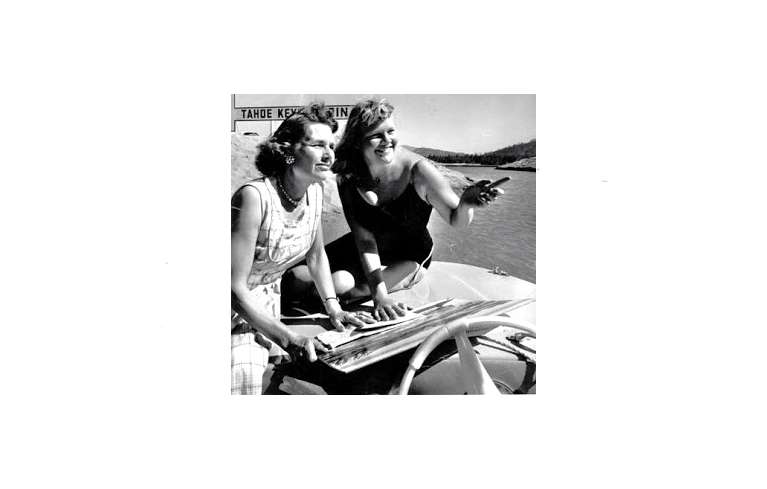
Fifty-one years ago this month the then-16-year-old made history by becoming the first female to swim the length of Lake Tahoe.

This week the Lake Tahoe Museum in South Lake Tahoe debuts an exhibit about Christopherson. She was in town briefly Monday to view it. The 67-year-old now lives in Florida.

“I wanted to do something no one else had done,” Christopherson told Lake Tahoe News. It took her three tries, but she did it. The first was at age 15 when she came 3 miles shy of shore, the second time she was 1 mile short. All three swims entailed dealing with afternoon storms. The second and third attempts were three weeks apart.

Erline Christopherson, right, with her mother, Elizabeth. Photo/Provided

Erline Christopherson, right, with her mother, Elizabeth. Photo/Provided

She swam from Cascade Properties to Dollar Point. It was so windy, the chaperone boat had to dock elsewhere.

Christopherson tried reading books about how best to prepare, but in 1962 that type of material didn’t exist. Her dad applied grease he used on the bailer to her body so it would not become water logged.

Her mom boiled beef and kept the water as protein water for her to consume during the swim. She also drank brown sugar water. Energy drinks as we know them today didn’t exist then.

Her sister sang to her to pass the hours.

Wes Stetson was in the air in his seaplane monitoring the progress. He landed and told Christopherson’s dad, who was in a boat, how to stay on course.

“All my dad had (as a point of reference) was a bald spot on the other side of the lake,” Christopherson said.

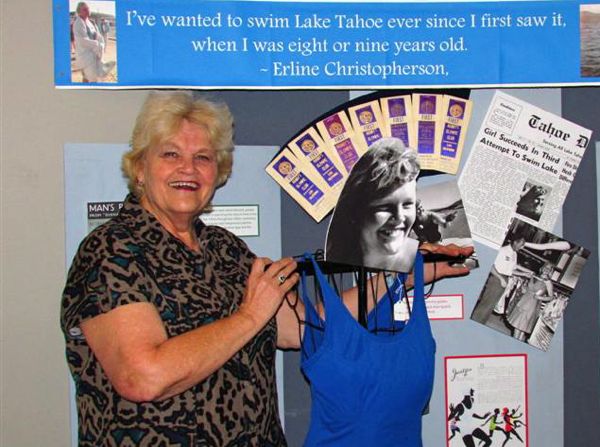
Erline Christopherson with the museum display. Photo/Denise Haerr

Erline Christopherson with the museum display, which includes the suit she wore. Photo/Denise Haerr

Christopherson was 7 or 8 when she first declared she was going to swim the 22 miles of Lake Tahoe.

“I did something that was my own. They can’t take that away from me,” Christopherson said.

She started swimming when she was 4, and was competing by age 10 in AAU meets. Her specialties were breaststroke and butterfly. At one point she was on the Junior Olympics.

Each attempt the family would come from their ranch in Lodi a few days early to acclimate to the Sierra. She swam the 15-mile width of the lake each of those three times as practice. Going from about Baldwin Beach to Emerald Bay, around Fannette Island and back were other training swims.

At home she would jump into the Mokelumne River and swim upstream against the current. Her swim coach allowed her train in one of the lanes.

She wore a blue one-piece swimsuit that is on display at the museum.

“A wetsuit gives you buoyancy. That is cheating,” Christopherson said.

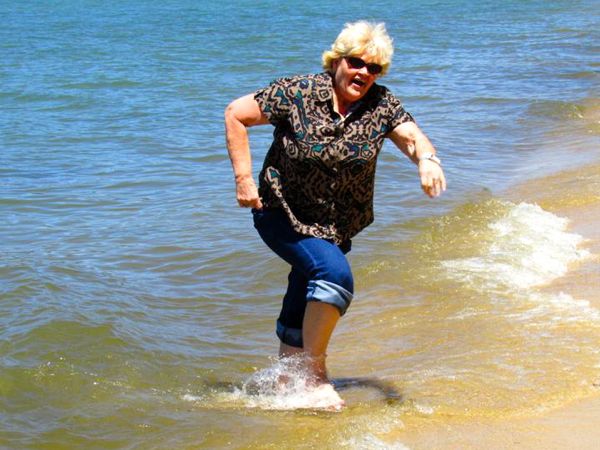
Remembering what it's like to be in Lake Tahoe -- Erline Christopherson. Photo/Denise Haerr

Remembering what it’s like to be in Lake Tahoe — Erline Christopherson. Photo/Denise Haerr

After she made history, the old Outdoorsman store allowed her to pick out any suit she wanted. What she wanted was not something she would compete in, but a bit more feminine. A poster of her was in the store as an advertising marquee.

Christopherson continues to swim. Four years ago, she won the series championship in an ocean race in Clearwater, Fla. – the only time she competed in it. She swims at least a mile when she gets in the pool; longer if she has the time.

“I love this lake. It’s the most beautiful lake in the world. I can’t come to California without coming up here,” Christopherson said. This time, though, there was no time for a swim.

—-

Notes: Museum volunteer Denise Haerr discovered a box full of memorabilia donated by Erline Christopherson. She started corresponding with the swimmer, which led to the visit on July 8. Haerr hopes Christopherson will give a talk about the July 25, 1962, feat and that a video would be created from old photographs and newspaper clippings.

The museum at 3058 Lake Tahoe Blvd., South Lake Tahoe is open Wednesday-Sunday from 11am-3pm. Donations are accepted.


Study: Wildfires have role in global warming

By Geoffrey Mohan, Los Angeles Times

Wildfires such as the Yarnell Hill blaze in Arizona may be warming Earth’s atmosphere far more than previously thought, according to a study by Los Alamos National Laboratory.

Researchers at the Department of Energy facility normally chase fires throughout the western U.S., to measure their atmospheric effects. But in 2011, they took advantage of a conflagration that came to their doorstep – the Las Conchas fire that burned more than 150,000 acres and briefly caused the evacuation of the sprawling facility in the New Mexico desert.

“This was just an opportunity in our backyard,” said Manvendra Dubey, a senior atmospheric scientist at the laboratory. “It was a freebie for me, so I couldn’t miss that opportunity.”

After the brief evacuation ended, Dubey’s team set up monitoring devices while the fire continued to rage across the desert scrubland. Their analysis, which included painstaking counting and classification of thousands of particles, revealed components that had not been considered in climate models, most of which have suggested that cooling and warming effects of two kinds of aerosols tended to cancel each other out.

The Los Alamos team identified tar balls – spherical, carbon-based particles – that are 10 times more prevalent than soot particles, and can boost the heating effect of wildfire emissions, according to the study, published last week in the journal Nature Communications.

“We provided the data that shows that current estimates, which are close to zero or show a very slight warming, are incorrect and the warming will be higher,” Dubey said. “We are confident this will change the results and show that fire emissions will have a tendency to warm.”

Close examination of soot also showed these particles were sheathed by organic coatings that “act like a lens to focus sunlight and amplify the sunlight that soot absorbs,” Dubey said.

Wildfires have increased in number, intensity and acreage throughout the southwestern U.S. over the last three decades, driven by climate change and forest management decisions to suppress fires instead of letting them take their natural course. That burning biomass pumps tons of aerosols into the atmosphere, directly changing how sunlight is absorbed, and indirectly affecting the process by influencing cloud formation.

“For a given amount of water vapor in the atmosphere, you could be condensing the water in many, many more small particles. So clouds could become brighter,” Dubey said. “These tar balls can get embedded, and soot can get embedded in clouds, and the clouds can then absorb more sunlight and evaporate faster.”

Climate scientists generally focus on the effects of two aerosols: soot, or black carbon, and smoke, known as organic carbon. Smoke tends to scatter solar radiation, for a net cooling effect. But black carbon absorbs it. Research in the last decade has increasingly suggested that black carbon may be the second strongest contributor to atmospheric warming, behind carbon dioxide, the most well-known greenhouse gas.

The Los Alamos researchers also attempted to simplify the complex chemistry and physics of aerosols. Climate models, they said, should consider aerosols as a combination of tar balls, soot and “other” particles, including smoke and irregularly shaped specks of dust and salt. Soot, they said, can be further classified by its degree of coating, enabling climate modelers to capture the nuanced effects of these particles.

The study results could push the U.S. back into the spotlight cast on emitters of black carbon, said Dubey, who recently spent several months in India. U.S. policymakers have increasingly pointed to the Indian subcontinent and China as major sources of emissions from burning biomass, largely from wood and charcoal fires.

“All these things emit the same; if you burn wood in your open stove or you have a fire, you have some similar emissions,” Dubey said. “I think this gives us all a common language to develop solutions to it.”


Empty school costs DCSD thousands each month

By Kathryn Reed

ZEPHYR COVE – A prime piece of real estate on the South Shore sits idle, with no buyer in sight.

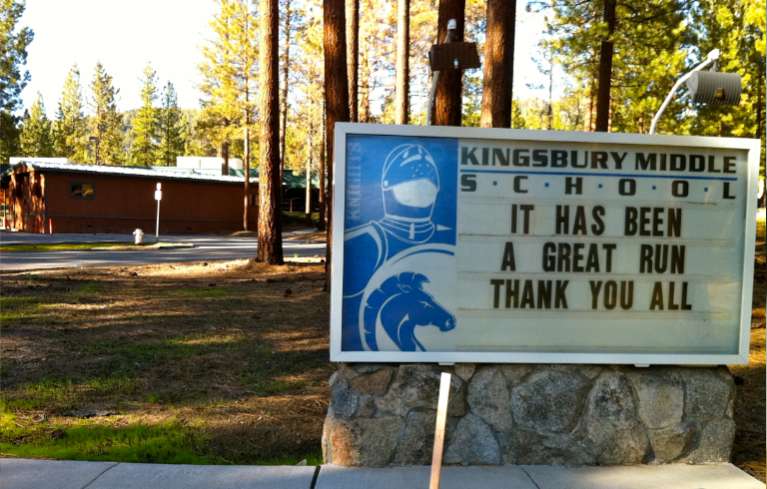
The empty 36,000-square-foot former Kingsbury Middle School in Stateline is costing the district between $10,000 and $15,000 a month to ensure the alarm is on, pipes don’t freeze and other basics are taken care of.

The Douglas County School District board first voted to put the 10-acre site on the market in January 2012.

Kingsbury Middle School sits empty. Photo/LTN file

Kingsbury Middle School sits empty. Photo/LTN file

Superintendent Lisa Noonan told the board July 9 that no buyer has come forward. The potential sale has been on the agenda each time the board meets in Tahoe – which is quarterly.

While groups have come forward expressing interest and people have looked at the property, no one has put in an offer. Noonan said all the lookers have said they need to raise the cash.

It’s possible the county’s area plan that is nearly through the Tahoe Regional Planning Agency approval process could ease some of the stipulations on what the land could be used for. There are also Nevada education rules that limit future uses.

The property is listed at $4 million based on an appraisal from close to two years ago. Per state law the district cannot sell for less than the asking price.

An attorney advising the district has said based on the length of time the property has been on the market that legally the price could be lowered.

But board members were not thrilled with that idea, even without offers, based on the real estate market improving at Lake Tahoe.

Board President Tom Moore told Noonan, “I think in October we’ll be looking for creative recommendations in how to go forward (if there is no buyer).”

In other action Tuesday:

• The board voted 4-1 (Neal Freitas abstained and Sharla Hales was absent) to turn Aspire into a stand-alone high school. It has been an alternative education program in the valley until now. The plan is to seek accreditation this coming school year.


Mancuso focuses training on Sochi Olympics

By AP

Julia Mancuso is holding her breath for the Sochi Olympics. So far, she can stay under water for more than a minute.

The Squaw Valley skier incorporated freediving into her training program this summer in Maui, plunging under the ocean’s surface to collect shells and gaze at aquatic life.

Mancuso usually spends her offseason mountain biking and surfing the big waves around the island. Being an Olympic year, though, she’s decided to stay “a little less radical in my other sports I do.”

That’s why she picked up freediving, which is like snorkeling, except without, well, the snorkel.

Later this month, Mancuso will swap the sea for snow as she ventures to New Zealand for camp with the U.S. ski squad.

After all, Sochi is just seven months away.

“It’s approaching really fast,” said Mancuso, who splits her time between Hawaii and Squaw Valley. “Just have to keep getting strong and stay healthy.”

Mancuso is coming off a solid World Cup season, but one that was pretty much overshadowed by Tina Maze’s amazing run. The Slovenian compiled a record 2,414 points to take the overall crown away from Lindsey Vonn, who sustained a season-ending knee injury in a February crash.

The 29-year-old Mancuso finished on the podium four times, all in the super-G. She wound up second overall in that discipline, behind Maze.

Given Maze’s extraordinary season, though, along with Vonn’s expected return from a torn ACL and the rise of U.S. teenager Mikaela Shiffrin, Mancuso realizes that she probably won’t be among the favorites heading into Sochi.

That’s fine with her. She hardly ever is at the Olympics, even though she typically saves her best for the biggest of stages.

Mancuso captured gold in the giant slalom at the 2006 Turin Games. Four years later in Vancouver, she stole some of the spotlight from Vonn, taking silver in both the downhill and super-combined.

“I definitely perform well under pressure,” said Mancuso, who recently added ZICO Pure Premium Coconut Water as a sponsor. “I think it will be really exciting having a little more pressure going into Sochi.

“I’ve always thought of the Olympics like it’s another race and just try to shine.”

Rain or shine, she’s been enjoying her time in Maui, even if she’s curtailed some of her usual activities.

By this time of year, she’s normally visited most of her treasured spots to surf and stand-up paddle. And by this time of year, she’s also put plenty of daring miles on her mountain bike.

Not so much this offseason.

“I’ve been training really hard. But it’s just a little more focused, like instead of going on a crazy mountain bike ride, I might ride the stationary bike and watch a movie,” Mancuso explained. “Every summer I train hard, but it’s more important to stay injury free. In the past, I’d just be playing and maybe hurt myself. A sprained ankle or something, or just little tiny things that kind of put you back a week in training.”

And that’s why she picked up freediving to fill her time. In the process, she’s amassed quite a collection of sea shells.

“It’s a lot of fun,” said Mancuso, who’s planning a vacation to Fiji later this summer to freedive with friends. “We have these really cool fins, three-foot fins, and we stay in the water for a really long time, dive and just search for shells.”

These days, Mancuso is in a good place — more at peace and more relaxed. That has a lot to do with being healthy, which hasn’t always been the case. For years after winning gold in 2006, Mancuso dealt with nagging back problems that fragmented her training.

“It’s horrible trying to perform when something is hurting you. You couldn’t train that extra day because something was hurt, couldn’t push yourself as hard because you were holding back,” Mancuso said. “But I’ve learned to take care of my body. Dealing with injuries is a big part of being an athlete and being happy.”

There’s also this: Things are well with boyfriend and fellow skier Aksel Lund Svindal of Norway, even if they don’t see each other as much as they would like.

“We’re so busy that it’s fine. We’re both really driven,” Mancuso said. “That’s just part of the game, when you have a lot of personal goals, when you want to win, and you live on other side of the continent.

“But it’s cool to have a good friend on the World Cup circuit, a good friend who’s your boyfriend.”

Her new goal? Introduce Svindal to freediving.

“Maybe he will be into freediving. We’ll see,” Mancuso said. “This summer has been really good for me.”


Report: 2000-10 hottest decade on record

By K. Kaufmann, Desert Sun

It’s now official. The decade of 2001-2010 was the warmest on record, causing almost a 2,300 percent spike worldwide in heat-related deaths.

That shocking figure is one of many contained in the report, “The Global Climate 2001-2010, A Decade of Climate Extremes,” released last week in Geneva by the World Meteorological Organization. An agency of the United Nations, the WMO has members from 191 countries and territories worldwide and is dedicated to creating networks for collecting and sharing weather and climate data and expertise.

The report is 20 pages of meteorological figures and charts, some rather technical, but what it all boils down to, in the report’s opening sentence, is that:

“The first decade of the 21st century was the warmest decade recorded since modern measurements began around 1850. It saw above-average precipitation, including one year — 2010 — that broke all previous records.

“Many of these events and trends can be explained by the natural variability of the climate system. Rising atmospheric concentrations of greenhouse gases, however, are also affecting the climate. Detecting the respective roles being played by climate variability and human-induced climate change is one of the key challenges facing researchers today.”

What all this means, according to the WMO summary of the report:

“Every year of the decade except 2008 was among the 10 warmest years on record. … Results from WMO’s survey showed that nearly 94 percent of reporting countries had their warmest decade in 2001-2010 and no country reported a nationwide average decadal temperature anomaly cooler than the long-term average.”

The long-term analysis is important, the report notes, because distinguishing between individual extreme weather events and climate change requires long-term data, precisely because extreme weather events do not occur frequently. A decade is the minimum time frame for detecting temperature changes, the report says.


Incline Lake may forever be dry

By Kathryn Reed

INCLINE VILLAGE – Should a manmade lake at Lake Tahoe be restored? Or should the acreage be returned to what it was pre-1930s?

Those are some of the basic questions being asked by the Lake Tahoe Basin Management Unit. The answers aren’t as simple.

A handful of people showed up Monday night to give the U.S. Forest Service input into what was Incline Lake. The 777-acre parcel was acquired in 2008 from the Incline Lake Corp. The final price, though, of $43.5 million was not settled until 2011.

The private lake had existed since the 1930s. It was regularly stocked so fishermen would have something to catch. The lake covered 19 acres of the land that is situated along Mount Rose Highway. It is about a mile below Tahoe Meadows and to the left if driving toward Reno.

Two national forests and Incline Village General Improvement District own the land surrounding the parcel. That is in large part why the Forest Service wanted the land – to remove that private parcel from the middle of forest and make it contiguous public property for recreation use.

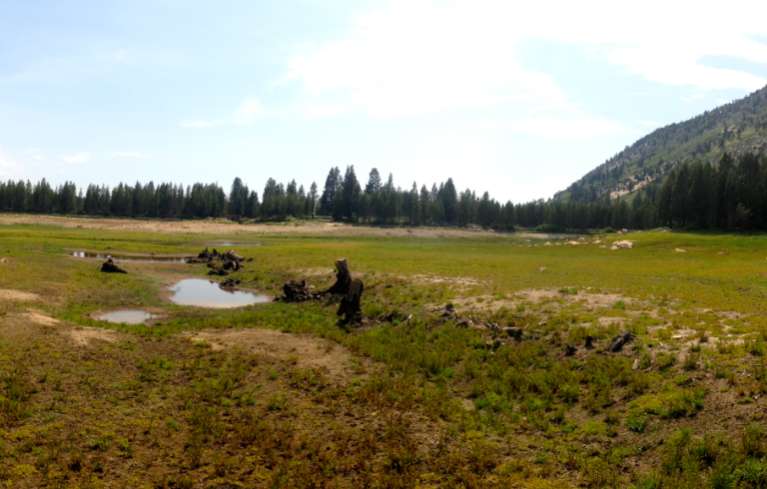
Ponds are naturally forming where Incline Lake used to be. Photo/Matt Dickinson

Ponds are naturally forming where Incline Lake used to be. Photo/Matt Dickinson

The lake was drained in 2009 because the dam was deemed seismically unfit. It was the previous owner that drained the lake and took down all structures on the property.

The entire area is open for public use. Hikers and bikers are welcome, but no motorized vehicles.

The Forest Service is taking comments on the scoping documents until July 19. Today the agency is looking at removing the dam and restoring the land to a marsh area. It could resemble what Grass Lake on Luther Pass is like. This would be 15 to 20 years out to allow Mother Nature to do her work.

“I’m leaning more toward rustic wetlands. I like their proposal,” Sue Hughes of Incline told Lake Tahoe News as she was leaving the July 8 open house at the IVGID offices.

Ponds are already starting to naturally form. John Gregory of Incline said water flows year-round at this location.

Leaving the dam and refilling the lake are not options because of the instability of the rock structure. This area is prone to earthquakes and downstream is where the bulk of Incline Village residents live. It is possible a smaller dam could be built, but that would also mean a smaller lake.

Dan Dominy of Incline is a fisherman who for years enjoyed casting a line there. He worries about what the impacts might be if more people use the area in the future, especially since there is a road on the land.

The Forest Service has $5 million set aside for improvements. Dam building and then the subsequent maintenance would require more money.

A network of trails and signage are possible. Informal trails exist today. One leads to the Mount Rose Wilderness, another goes along Third Creek to downtown Incline.

An environmental analysis will likely be released in January 2014. Work – whatever that looks like – could begin in 2015 building season.

—

Notes:

• The next meeting about the future of his property is July 10 from 5-7pm at Homewood Suites, 5450 Kietzke Lane, Reno.

• Comment deadline is July 19.

• More info is online.


Nature’s East Coast classroom may benefit Tahoe

By Patricia Craig, Penn State

UNIVERSITY PARK, Pa. — Matt Hurteau spends a lot of time climbing trees. The assistant professor in the Department of Ecosystems Science and Management in the College of Agricultural Sciences, joined Penn State in July 2011, filling an Earth Systems Ecologist position jointly funded by PSIEE and the college.

“The position asked for someone who worked across disciplinary boundaries to tackle the kinds of questions I’m interested in,” Hurteau said. “And the thing that was abundantly clear to me when I came to Penn State was that ‘interdisciplinary work’ was not just an idyllic vision. It was reinforced that I was expected to work interdisciplinarily, which really piqued my interest.”

At the base of Hurteau’s work is the concept of carbon sequestration, particularly in forest systems. When trees photosynthesize, pulling in carbon dioxide from the atmosphere, they assimilate the carbon into wood.

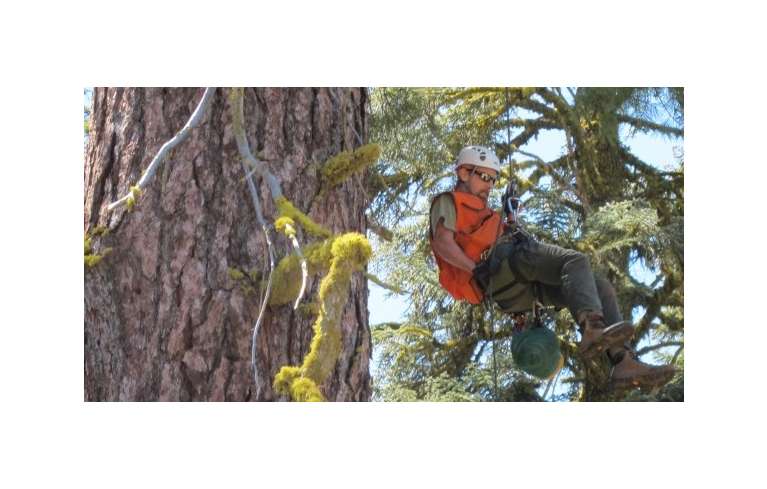
Matt Hurteau, assistant professor in the Department of Ecosystems Science and Management, rappelled down a sugar pine. Image: Penn State

Matt Hurteau rappells down a sugar pine.
Photo/Penn State

“In fact,” Hurteau said, “about half of all annual accumulated growth ring mass is carbon.” That carbon comes directly from carbon dioxide, therefore if we can encourage trees to grow more each year through an ecologically based approach, they can pull in and store more carbon from the atmosphere.

Hurteau leads the Earth Systems Ecology Lab, which includes a team of both undergraduate and graduate researchers and postdoctoral scholars. The two main undertakings of the lab are forest-based climate change mitigation and adaptation.

“The quality of people I have in my lab is absolutely integral to the work we – undergraduates, graduates and post-docs – are excited about what we are doing that really makes this fun,” said Hurteau.

One of his lab’s current projects is modeling the carbon implications of ecologically based forest management. Funded by the U.S. Department of Defense Strategic Environmental Research and Development Program (SERDP), Hurteau and his colleagues are working across three military installations to link a growth-and-yield model with a process-based model to quantify the carbon trade-offs between a range of forest management strategies.

“As the fifth largest landowner in the country, the Department of Defense has a lot of threatened and endangered species on their properties. We’re running model simulations to look at what could happen with regards to a number of different things: providing optimal habitat for a specific threatened or endangered species, changing forest structure as to minimize wildfire risk or sequestering as much carbon as possible.”

In another project funded by the U.S. Department of Agriculture’s Integrated Approaches to Climate Adaptation and Mitigation in Agroecosystems Program, the lab is investigating climate change mitigation and adaptation in fire-prone forests under different climate scenarios. Hurteau said this research is particularly interesting because he is coupling the data with different variables, including future wildfire modeling and emissions modeling. The lab is also partnering with the Desert Research Institute to present their findings to stakeholders and natural resource managers in the Lake Tahoe area.

“One of the biggest rewards to this kind of work is doing research that has societal relevance,” Hurteau said. “While I always want to push the envelope on our understanding of things, I also try to step back and look at these problems in the context of the questions being asked now by the people in decision-making positions. How can we better inform them with the information we generate from this work?”

Beginning with his undergraduate studies, Hurteau has been thoroughly immersed in scientific research. At Northern Arizona University, he studied different Native American uses of fire for land management, specifically focusing on the Kaibab Paiute Indian Reservation in northern Arizona.

“I wanted to get a degree in something that would allow me to focus my attention on the natural world” Hurteau said.

And that is exactly what he did. After a stint with a pharmaceutical company, where he used vacation time to go backpacking, Hurteau went back to school and graduated with a bachelor’s degree in Forestry from Northern Arizona University in 2001 and a doctorate in ecology from UC Davis in 2007.

As a graduate student at Davis, Hurteau focused his research on forest systems, where he looked at understory plant communities in mixed conifer forests. Hurteau explained he was investigating “how changes in climate and changes in nitrogen deposition from pollution in California coupled with prescribed burning would influence understory plant diversity and productivity in that system.”

Beyond his research, Hurteau said he thoroughly enjoys teaching, especially at the undergraduate level. Last fall, he taught his first undergraduate class: Forestry 201, Global Change and Ecosystems.

“We really seek to link the physical and natural worlds together,” Hurteau said, “and do so by focusing on the connections between our climate and terrestrial ecosystems.”

“I thoroughly enjoyed teaching that class. I had a really diverse group of students. Most of them weren’t from the sciences – a lot were in business or economics. And that challenges me even further to make sure my students have a firm grasp on the information,” he continued.

“At the end of the day, I want students to gain an appreciation for the complexities that are in the natural world, an understanding for how these things are interlinked, an appreciation for the fact that humans are such a dominant force on the planet – we can change and are changing the climate system – and ultimately to think critically about every piece of information they get.”